
Retrospect
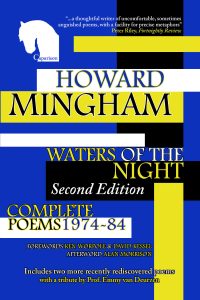
Howard Mingham’s Waters of the Night – Complete Poems 1974-84 (Caparison)
Wept, honoured and sung
It’s a rare occurrence in the field of poetry to read an entire life’s body of work in one go and to be so moved by the originality of voice, tone and turn of phrase. It’s a sad irony therefore that such a poet should be, to quote Sir Walter Scott, “unhonor’d, and unsung”. From what little is published about Howard Mingham’s life it seems that he died too young and without the recognition that he is now overdue. His untimely suicide in his early 30s only adds weight to the often deeply poignant and sometimes prophetic lines that he composes.
I thought I would begin a review by finding out some more about his life or work and went straight to Google. No such luck. Little is known about either aside from the excellently written forewords by poets Alan Morrison and David Kessel to The Waters of the Night – Howard Mingham – Complete Poems 1974-1984 who seem doggedly determined to keep Mingham’s memory alive – and rightly so.
There are several strands running through Mingham’s work, if one were to approach this exegesis, such as it is, thematically; his socialism, atheism, his empathy for both man and beast. All 25 of his poems show some measure of these and the world is richer for them. What burns most brightly in his work to my mind is his use of Biblical imagery that captures elegantly both the beauty of the original and the tenderness of its application. This is not to suggest that Mingham’s intention was to proselytise – far from it, but given the sum of our experiences and knowledge, these ‘cultural references’ are treated with a lightness of touch that would suggest a very personal respect. From what I can glean of his own attitude to religion, he was an atheist, which is most probably why the imagery itself is handled so poetically rather than religiously. This invests it with a certain gravitas for which the Romantic poets might have called upon Nature. Consider these lines from ‘The Cat’:
Envy-bright
it watches solitary
the plenty birds
Slowly he moves,
rehearsing leaps
mind certain as a cut diamond
‘Those things clutter the trees’
said the Lord
‘I am in agreement’, he purred
‘And they remind me of Paradise’.
The capitalisation of ‘Lord’ and ‘Paradise’ are not accidental and do not go unnoticed – they serve to accurately reference the Biblical texts and in so doing, add the weight of respect and a certain air of mysticism that quietly pulsates behind this poem. Could it be that the ‘story’ of the poem is to suggest an agreement between God and Satan – the hidden voice of the cat, or is it a Darwinian example of natural selection, that re-writes the creation myth? Neither one of these answers is satisfactory in all honesty as they serve to reduce and resolve the poem to a mere fact, where facts are inappropriate. The poem itself, to my mind, stands as it is – beautiful in its simplicity and elevated by its imagery.
Morrison mentions in the foreword to the collection that Mingham’s particular brand of socialism as what Mao Tse-Tung would describe as ’embourgeoised-delusional’ and Mingham’s ‘Ode’ is preceded with a fragment of Mao’s speech from the Yenan Forum on Literature and Art of 1942 that is referenced therein. The effect this has is to throw into sharp relief the raw humanity of Mingham and to juxtapose the machine-like world of Mao’s vision with the simple love and fellowship with humanity to which Mingham alludes. He writes: ‘You say I must learn the workers’ language / You say it does not begin with love / I do not know / I had always thought it did’. The disagreement with Mao’s sentiments is stark in comparison. Later in that same poem, Mingham describes his fictitious son and the aspirations he has for him:
Let him know his left from his right
and not hop the old polemics
of the absurdly just and logically right
[…] Let him not glad
wave the mad flag
or crazy beat the drum
[…] Let him love, deny and know.
Whereas Mao’s vision of art is in complete service to the revolution and meant solely for educative purposes to oppose the counter-revolutionary argument:
[Our purpose is] to ensure that literature and art fit well into the whole revolutionary machine as a component part, that they operate as powerful weapons for uniting and educating the people and for attacking and destroying the enemy, and that they help the people fight the enemy with one heart and one mind.
Quotations from Chairman Mao Tse-Tung (1967) p.301
Mingham’s vision is much less antagonistic and he uses his art to build bridges, to reach out to his fellow human and to offer hope for the future. Mingham’s humanistic vision is also incredibly honest; he writes: ‘Let him rise each day / and modestly study / the large and airy body / of abstractions’ here he is not only referencing Mao directly in contradiction, he is confessing that the abstractions of life – love, art – are those that should motivate us, not the dry logic of the Maoist machine. Mingham is essentially an artist, pursuing the belief that art should be as free as the soul from which it comes. He stands opposed to the dehumanisation that Mao’s contorted brand of socialism created with his brutal ‘cultural revolution’. Indeed there is an inherent difficulty in the contiguous positioning of the words Mao and socialism. Mingham is rather a true socialist – a humanitarian who values life and love – abstract maybe, but necessary and ideal, definitely.
His humanitarianism extends not only to his fellow human but to the animal kingdom as well. It is unclear whether he intends his animal imagery to be metaphorical for humankind, however that may be reading too much into his references. The short poem Sleepless Night could as well be written for the homeless of the world as it is for an urban fox: ‘Through a long night emptily / And now the dawn and a morning hunger / Stretch, day-long, before him’. Considering the era in which Mingham was writing up until his death, there is a retrospective irony considering the subsequent exacerbation of the homeless situation that the Thatcher government was later responsible for in the 1980s. Given the social divisiveness of most of our successive governments it is all-too easy to draw comparisons with Mingham’s socially aware poetry that has humanity at its heart.
Aside from these considerations there is simply some beautiful and memorable imagery in amongst his poetry ‘I am petrol on the puddle of night’, from ‘Ode’ and ‘He who was the sky has now become the sea’, from ‘Rain’. Amongst the beauty there is pain, stemming it seems from his schizophrenia and incarcerations in various mental health institutions. Not only does this serve to inspire his poetry but it almost seems from some of the lines that Mingham draws a great deal of strength from this supposed ‘weakness’. He talks of a ‘marvellous agony’ and a ‘beautiful wound’ (‘From Ward F5’) – both oxymora that reveal this dichotomy of his mental suffering and poetic flourish.
It is a sad irony that in common with other outsider artists like Antonin Artaud and Isidore Ducasse, Mingham may ‘achieve greatness’ but will probably never be a mainstream poet or more widely recognised in the established canon. He deserves both of these things but the nature of his oeuvre with its recondite references to the world of schizophrenia, which many people would find either uncomfortable or pass over as the lines of a literal ‘outsider’ would preclude his entry into the poetic canon. This is not necessarily a negative thing however as the joy of discovering a poet or artist that only a select few know about has its own particular pleasure and the appreciation feels more profound in some kind of literary cadre. Therefore when Mingham writes ‘there are mountains, canyons in the mind / where publishers never wandered nor critics ever climbed / and where only a seldom sun has ever shined’ (‘To Scholars and Ken Worpole’) he is writing prophetically and we, the favoured few who have encountered his poetry are the richer for it.
READING MARX
A Personal Account
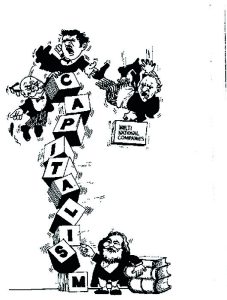 with drawings by Bob Starrett
Fifty years ago, when I was training to be a teacher at Neville’s Cross College of Education in Durham, I had the good fortune to be tutored in Sociology and supervised on school practice by Maurice Levitas (or, to give him his Hebrew patronymic, which he sometimes used, Moishe ben Hillel). Here was a veteran of Cable Street and the Spanish Civil War, a stalwart of the CPGB and the Connolly Column of the International Brigade, a former furniture-polisher and upholsterer, a plumber, a latrine-digger (with the Royal Army Medical Corps in India and Burma), a teacher of English (with plenty of Drama, in secondary schools in London and Lowth), and now, in his middle age, a teacher-trainer appointed to the staff of the college where I was a student! He was just what we needed.
Seeing how green I was, with my head full of Red, Black, and Green ideas, and also some plain daft ones, loosely cobbled together, if cobbled at all, Morry (as he was widely nick-named) felt moved to educate me, and to educate me in more than Education.
He told me, I remember, in one of our tutorials, to question the Registrar-General’s designation of some workers – those in Social Class V – as “unskilled”. No, said Morry, all Labour requires skill, including mental skill. Try using a pick without knowing what you’re about, or a scythe! He himself had an impressively wide skill-set, acquired in his wide experience of work. He took pride in all of it, keeping into old age, for example, his curved needles (some semi-circular) from his time as an upholsterer, and losing none of his ability in sewing.
He told me also to be wary of the claims of psychometrics. Certain forms of it, he argued, were based on bad science, and served bad politics. Labelling some people sheep and others goats on the evidence of spurious tests was pernicious. He spoke with a mix of academic rigour and passionate engagement, referring me, I recall, to Brian Simon’s critique of Cyril Burt’s famous (or infamous) work on Intelligence, while at the same time citing personal experience. As a prisoner-of war in Spain, in one of Franco’s camps, Morry had been subjected to batteries of tests by visiting Nazis, keen to use him (and others) to further their racist, specifically anti-Semitic anthropology.
Educational failure was another topic that Morry opened up for discussion. When pupils fail an exam, he asked, is it their own failure alone? Could it also be the failure of hostile teachers, or careless schools, or impoverished homes, or an unjust society dedicated to maintaining its class distinctions?
I did not know then that Morry was busy putting his insights and knowledge and combative spirit into a book. This was published in 1974, with the title Marxist Perspectives in the Sociology of Education.
Supplementary to my college curriculum, and just as important, were the demos that Morry took me on, and the lists of public meetings that he said I must attend, and the books on political theory that I must read (and read systematically), starting with Marx’s early MSS dating from 1844 (The Paris Notebooks) and his Theses on Feuerbach from the following year. He thought it best that I start my journey-of-ideas there, where Marx started his.
See how the young humanist stood Hegel’s idealist philosophy on its head, making it materialist, Morry explained; see how he went beyond Feuerbach, committing himself to changing the world, not just interpreting it; see how he identified the deep structures and movements of history, class against class; see how he laid bare the alienation that workers experience under Capitalism, as they lose control of the products of their labour, and even lose contact with their own true selves.
This programme of accelerated learning that Morry set in train coincided with the crisis days of 1968, when the “evenements” in Paris (and beyond) shook Capitalism, and shook Socialism, too. Morry was charged with a great energy by these events, as if they spoke directly to him. He saw in the students’ movement a proto-revolutionary situation that cried out to be joined, and widened, especially through working class solidarity. I heard him argue this case again and again wherever people would listen, cheerfully rebutting the charge made by others in the CP that he was suffering from a rush of ultra-Leftism to the head. He was mistaking Paris for Barcelona, they said, and 1968 for 1936. Unabashed, he himself looked further back, to 1848, and directed me to read The Communist Manifesto and Marx’s other writings from and about that year of revolutions. Reading them was a revelation.
It was as if I had been given a three-dimensional model showing the layers of rock lying beneath a large and complex landscape, and giving it its shape. How swiftly the Manifesto opened up new understandings for me, and established new connections between things I had previously only half-known! How gleefully I embraced its use of strong metaphors, from a “spectre haunting Europe” early on in the book (that is to say, Communism), through “heavy artillery” (commodities being traded overseas), “fetters” (the constraints of the Feudal System), a “robe of cobwebs” (false consciousness), ending with “grave-diggers” (the forces of organised Labour burying Capitalism at some future date).
Before I left college, I was inspired to have a go at crystallising what I had learned so far from Marx and Morry, in the form of a short poem. I did not have the confidence to show it to my tutor, but here it is (below) for Culture Matters readers. Note: the “old mole” motto-text was added later:
OPEN SESAME
Well grubbed, old mole!
KARL MARX
The Eighteenth Brumaire of Louis Bonaparte
Under the furrows of old Europe
lay
the ruin and the saving
of its steady, backward way: coal,
coal upon coal.
In banks’ vaults,
as if an ocean underground,
full-fed by trade and the world’s toil,
a second Flood backed up, and broke,
of brutal gold.
Empowered,
the anarch Progress forced its change,
all-consumingly on every land
and every suffering folk
that came within the rampage
of its rule of smoke.
Breaching all norms and bonds,
the iron masters and their human tools
exhausted Europe,
then went on to wreak their marvel
on the other continents of plundered Earth.
Their legacy to us:
they redefined and laid to rest
the past that they inherited,
and brought our doomed dystopia
to the titan fury of its birth.
Getting to grips with Marx’s later works took me longer. I approached them by a zig-zagging route of theory and practice, practice and theory, over a period of several years.
In the case of Capital, I made the initial mistake of trying to speed things up by reading other people’s summaries of Marx’s conclusions, without working through the real-life evidence and explanations and interpretations that Marx himself required, and provided in great quantity in his book. Only after campaigning on issues of economic justice in Scunthorpe, where I went to teach, and helping to organise a cross-party, cross-union Left Action Group, only then did I begin to build up the key-concepts and, just as importantly, the structures of feeling that Capital demanded.
A crucial stage in that process of building-up was attending a WEA class organised by John Grayson, and tutored by Michael Barratt Brown. Michael adopted a quite brilliant teaching strategy. He asked the steelworker members of our class to provide him with information relating to a pay claim then being negotiated with the employers. He showed exactly how certain costs and profits that were essential to a full social and economic audit never found their way into any published annual report. The employers’ so-called “balance sheets” were not balanced. Michael’s book What Economics Is About served as a primer for our class-work. Here was Economics, not as a ”dismal science”, as Thomas Carlyle called it – he should have known better, given the great contemporaries of his who were working in that field – but as a weapon in the struggle.
What a broth of a book Capital proved to be, when I came at last to immerse myself in its heights and depths and great length i.e. the teeming volume of Volume One. I found that it was, in some places, to some extent, exactly as Francis Wheen described it in his celebratory Marx’s Das Kapital: A Biography. It was “a vast Gothic novel… a Victorian melodrama… a black farce… a Greek tragedy… [and] a satirical utopia”. These ingredients were mixed together in profusion, and richly interspersed with hundreds of quotations from (and allusions to) works of World Literature, factory inspectors’ reports, trade statistics, etc. How many square miles of printed matter did Marx have to scan, how many years of sitting and making notes did he have to put in, how many headaches and heartaches did he have to go through, before this epic and epoch-making piece of “congealed labour” was ready for publication?
Wheen reminds us that Marx was a failed poet, a failed dramatist, and a failed novelist, all these failures being accomplished before the end of his student years at Berlin University. “All my creations crumbled into nothing,” Marx wrote; but his literary ambitions did not crumble. He redirected them. The work in which they came to most vigorous life was Capital.
A good example of Marx in novelistic mode is his deployment in Capital of a large and varied cast of characters, reminiscent of Dickens. Here is one, a juvenile worker in the Potteries:
J. Murray, 12 years of age, says: “I turn jigger, and run moulds. I come at 6. Sometimes I come at 4. I worked all night last night, till 6 o’clock this morning. I have not been in bed since the night before last. There were eight or nine other boys working last night. All but one have come this morning. I get 3 shillings and sixpence. I do not get any more for working at night. I worked two nights last week.”
Regarding this wretched way of life and place of work, a local doctor, quoted by Marx, observed: “Each successive generation of potters is more dwarfed and less robust than the preceding one.”
Turning to Marx in dramatic mode, we can cite his use of a device similar to that deployed by Dante in his Purgatorio:
Let us leave the noisy region of the market, Marx wrote, casting himself in the same role as Vergil in Canto 5 of Dante’s epic. We shall follow the owner of the money and the owner of labour-power into the hidden foci of production… Here we shall discover, not only how Capital produces, but also how it is itself produced. We shall at last discover the secret of making surplus value.
Just as Dante did before him, Marx summoned up a succession of witnesses, in his case witnesses for the prosecution, from these “hidden foci of production”. His guiding principle was borrowed from Dante: Let the people speak. And speak they did, as in the case of J. Murray (above) and many more. (What a good template we have here, by the way, for readers of Culture Matters to use, by which to present your own present-day selection of witnesses for new prosecutions.)
And what of Marx’s exercise of his poet’s craft in the writing of Capital? We find no shortage of examples of metaphors here, and other forms of poetic imagery. Metaphysical poets of any era would be proud to have used them so creatively. Here is one: vampires. Marx wrote: Capital is dead labour, which, vampire-like, lives only by sucking living labour, and lives the more, the more labour it sucks.
It does not matter if the vampires, imagined or real, feed on others’ blood or others’ labour, the phenomenon is the same: it is a ceaseless and exponential series of acts of taking, of expropriation, and sometimes of killing cruelty. We see it in the busts and booms of the markets, in the losses that many suffer that others might profit, in the recurrent immiseration of whole sections of a country’s population, sometimes of whole populations, while the elites and their darlings flourish, and we see it bloodiest of all in the almost permanent state of war that so unstable an economic order (or disorder, rather) gives rise to. Marx’s metaphor is precise and complete. It conveys the essential motive force that rages at the heart of Capital.
To sum up: Marx and Morry: two warriors, both engaged in their own times, but aware of all times, past and future; both embattled thinkers as well as thoughtful activists; both possessing a warm-heartedness as well as a hard-headed realism; both exponents of an integrative vision, in which no aspect of human enquiry or interest is deemed alien; internationalists; dialecticians; passionate wordsmiths… Getting to know the former warrior through the good offices of the latter was the best part of my student years.
Glasgow
January – March,
2018
Originally published at Culture Matters www.culturematters.org.uk 2018
Jenny Farrell on
A Marxian Reading of Wuthering Heights
30 July 2018 marks the 200th anniversary of Emily Brontë’s birth. Her novel Wuthering Heights (1847) is an amazing, creative challenge to the personal cruelties and oppressions based on class, gender and ethnic background which were being generated by the hardening class divisions of English society in the 19th century.
Emily was one of four Brontë children to survive into adulthood. Their father was an Irish clergyman, from an impoverished family, who moved to Cambridge to study for holy orders, became a Tory and received an Anglican parsonage on the Yorkshire moors. Three sisters wrote novels, which they first published under male pseudonyms. Charlotte became most famous for her novel Jane Eyre, Anne also wrote fiction, and Emily wrote poems and just one book, Wuthering Heights. Their hapless brother Branwell’s claim to fame is a portrait of his sisters, still exhibited in London’s National Portrait Gallery. All Brontë children died before the age of forty – Emily was thirty when she perished of TB.
England in the mid-1840s was in the throes of the Industrial Revolution, vividly described by Brontë contemporary Friedrich Engels in his first book (1845) The Condition of the Working Class in England. Growing up, they would have been aware from the newspapers they read of the devastation of hand-workers, especially the handloom weavers in their region, and the resulting large-scale impoverishment. Haworth, homestead of the Brontës, lay near the Yorkshire mill towns, badly hit by the Hungry Forties. Their adult lives coincided with struggles against the Corn Laws, factory reform, strikes and the height of Chartism. Ireland was haemorrhaging from its holocaust, the Famine. All this affected the writings of the Brontë sisters, filtering through in one way or another.
Emily’s profound understanding of 19th century England, and capitalism, is reflected in Wuthering Heights. This novel shocked the Victorian reader, and its violence still alarms readers today. At its heart is the story of Catherine Earnshaw and Heathcliff, a destitute, probably Irish child brought home by Mr Earnshaw from Liverpool. A deep bond develops between the children. Catherine is a tomboy, the opposite of the Victorian idea of a female. Mr Earnshaw protects Heathcliff, and insists he be treated as a family equal. Catherine’s elder brother Hindley detests Heathcliff, and torments him physically and emotionally. After Mr Earnshaw dies, this abuse escalates. Hindley, who had been away for three years, returns with a wife and orders the servants and Heathcliff to stay away from the family living quarters:
Hindley … won’t let him sit with us, nor eat with us any more; and, he says, he and I must not play together, and threatens to turn him out of the house if we break his orders. He has been blaming our father … for treating H. too liberally; and swears he will reduce him to his right place.
Catherine and Heathcliff, however, remain inseparable. Cathy teaches Heathcliff everything she learns. In a key episode, they roam over to Thrushcross Grange, home of the Linton family, the largest capitalist landowners in the area. It is very different to the Heights – a Victorian mansion furnished in the most expensive style. Mr and Mrs Linton are absent; Edgar and his sister Isabella are seen violently pulling a dog between them for pleasure, a thing Heathcliff cannot comprehend.
When the Lintons become aware of two onlookers outside, whom they mistake to be after the rent money, they let the bulldog loose on them, and it gets a hold of Catherine. When they are brought into the Linton house, Heathcliff is sent away, whereas Catherine is deemed respectable and treated for her wounds. She stays five weeks and returns a young lady.
Increasingly, Catherine is sucked into the prevalent class values, spending less time with Heathcliff and more with the Lintons. Unsurprisingly for the reader of Victorian novels, Edgar asks Catherine to marry him. However, contrary to Victorian expectations, Brontë makes clear that Catherine’s acceptance signifies her betrayal of Heathcliff, of their absolute loyalty, of their impassioned and classless relationship.
Catherine reveals to the housekeeper Nelly Dean that it would degrade her to marry Heathcliff. Heathcliff overhears this but disastrously does not hear her continue:
He shall never know how I love him; and that not because he’s handsome, Nelly, but because he’s more myself than I am. Whatever our souls are made of, his and mine are the same; and Linton’s is as different as a moonbeam from lightning, or frost from fire.
Catherine’s bowing to money and convention triggers the tragedy. Heathcliff, devastated, leaves Wuthering Heights, not to return for three years.
The turn of events in the second half of the novel is unprecedented for the Victorian and uncomfortable for the modern reader. Heathcliff has acquired money and an understanding of law. He returns to ‘settle my score with Hindley; and then prevent the law by doing execution on myself’, but Catherine’s welcome rekindles all the old passion. Heathcliff puts into operation a plan that is designed to beat class society at its own game. He gambles with Hindley, taking his property. He marries Isabella Linton in order to gain Linton property. He treats Isabella brutally, as just what she is in terms of Victorian law – his property. Interestingly Heathcliff tells Nelly about Isabella:
No brutality disgusted her: I suppose she has an innate admiration of it, if only her precious person were secure from injury! … set his (Edgar’s, JF) fraternal and magisterial heart at ease: that I keep strictly within the limits of the law. I have avoided, up to this period, giving her the slightest right to claim a separation; …
Edgar makes clear their new relationship: ‘she is only my sister in name: not because I disown her, but because she has disowned me’. Who disowns whom is a matter for the reader to decide. The institution of the Victorian family as a harbour of humanity is shattered at every level.
Heathcliff becomes master of Wuthering Heights and many years after Catherine’s death forces a marriage between his weakling son Linton, ‘my property’, and Catherine’s daughter Cathy, again to acquire Linton property. He even imprisons Cathy to do so. Interestingly, Linton immediately turns tyrant to Cathy:
She’s my wife, and it’s shameful that she should wish to leave me. He says she hates me and wants me to die, that she may have my money; but she shan’t have it: and she shan’t go home! She never shall! …. uncle is dying, truly, at last. I’m glad, for I shall be master of the Grange after him. Catherine always spoke of it as her house. It isn’t hers! It’s mine: papa says everything she has is mine.
With this action, Heathcliff parodies, in a grotesque way, Catherine’s class marriage to Edgar. In the likely event of son Linton’s death, Heathcliff not Catherine would inherit. Everything is turned into its monstrous extreme.
Hindley’s son Hareton, who resembles both the young Catherine and Heathcliff remarkably, is Heathcliff’s fiercest and most loyal defender. And despite himself and his best laid plans, Heathcliff likes Hareton. Heathcliff treats Hareton and the servants at the Heights without much social difference. They all work, live and eat together. Women coming to the house, such as Isabella and later Cathy Linton, are stripped of their property, by marriage, and of their class comforts. They work for their living.
The only person who enjoys a work-free existence is son Linton, whom Heathcliff despises but has educated. When he is dying, shortly after his marriage to Cathy, Heathcliff comments: ‘but his life is not worth a farthing, and I won’t spend a farthing on him’. Repeatedly, the reader is shocked at the lack of sentimentality. Over and over, we are confronted with the reality of cash nexus and the law.
Hareton, Hindley’s son, is not educated and cannot read, write or use numbers. Again, this is in keeping with the rules of class society – why educate a farm worker? Heathcliff has pared down all his dealings to the bare logic of capitalist rationality. There are no frills, no pretences of kindness. Heathcliff’s tenants too are treated roughly. There is no humanity. It is only in this stark, unmasked form that readers realise this is the true nature of their own society. It is hyperbole, yes, but for that reason all the more effective in revealing the essence.
The union of Hareton and Cathy, which concludes the novel, is a rebellion against a world governed by the iron grip of inhumanity. Although they will overcome the property barrier with their marriage, they will accommodate themselves in the ‘respectable’, ‘civilised’ Thrushcross Grange. And yet there is hope for a relationship of equality, untypical of the Victorian era.
What remains with the reader, however, is the tragedy of Catherine and Heathcliff whose absolute freedom from all the dictates of class and hierarchy was the essence of their relationship. This kind of relationship is doomed. That is the tragedy.
I often think of Heathcliff in today’s world, as the ruling class increasingly reveals its profoundly barbaric nature. There is ever less pretence of culture and humanity. Education and health care are business, the state extracts itself progressively from a duty of care. Politicians set ever-decreasing value on a shallow veneer of humanity. We are seeing the beast for what it is, perhaps most grotesquely in Donald Trump, but certainly not only in him. The difference to Heathcliff is that Heathcliff cannot reach personal fulfilment by living this way. He wreaks revenge on the class system, but the price is his own humanity, indeed his life. Class society is the root cause of Heathcliff’s inhumanity.
Brontë does not spell this out in quite these words. Her very clever and innovative narrative ensures that the reader is taken in by the double, prejudiced Victorian class lens of Mr Lockwood and Nelly Dean. Even Isabella’s letter, the only verbatim document apart from Heathcliff and Catherine’s direct speech, quoted by Nelly and filtered again via Lockwood, expresses her class point of view. Therefore, the reader has to do what readers of the bourgeois press must do daily: read between the lines and presume that we are dealing with half-truths, omissions and fake news.
Heathcliff only responds humanely when he is with Catherine, and in his torment after she dies. They can only be together in death, buried beside each other outside the church: ‘on a green slope in a corner of the kirk-yard, where the wall is so low that heath and bilberry-plants have climbed over it from the moor; and peat-mould almost buries it’.
The sides of their coffins are open to each other. Heathcliff’s love for Catherine, is his humanity, and it is a world apart from Victorian class marriage. In their relationship of unequivocal equality Emily Brontë anticipates a more humane society, one that reaches far beyond hierarchical systems. It reaches into a time when unequal gender difference is replaced by an equality of personhood. In her subtle, utopian vision, Emily Brontë anticipates a humane society, unrestrained by the class-based laws that Heathcliff reveals to be barbaric.
If the meaning of life is to create conditions that are commensurate with humanity, then Emily Brontë’s remarkable novel highlights this. Her dream is yet to be achieved.
Originally published on Culture Matters (2018) under the title ‘Emily Brontë, Heathcliff and imagining a classless society’
Simon Jenner on
A Biting Barker
George Barker (1913-91) has suffered an oxymoronic fate worthy of himself. Much of his rhetorically intellectual achievement was overlooked in the days when in the 1940s, he was best celebrated and felt most attuned to an era still misunderstood. And not least by himself, with his incapacity to stop burying this achievement with a wealth of puns and poesy. And again in later decades, when his period was forever fixed by the watershed of The True Confessions of George Barker (Part 1, 1950); and later work overlooked as the prosier effusions of a writer responding to later astringencies, and damned for that too.
Although celebrated as an influential master of rhetoric with colloquially-grounded argument, caricatured as a kind of clearer Dylan Thomas, his own dazzle blinded many to what else his coruscating puns and marshalling of stanzaic extension amounted to. Of course it was partly his own fault, and particularly the occasions when his work convinced one he could never be capable of any such thing. At least Confessions in itself is recognized and read. It’s just symptomatic of Barker’s fate that the stature of the work should be shrouded by its own qualities. Again, the power it calls upon the reader, its claims upon ‘a biting Barker’ as John Heath-Stubbs celebrates him, in The Triumph of the Muse (1958) to deliver his fairground ride, are difficult to stop. Such are his stanzaic leaps and metaphor-bounded calls upon his
own life that one is swept in the fire of its execution. As criticism, in a time when both poets seemed fading from fashion, Heath-Stubbs’s commentary perhaps lives as the most astute contemporary appraisal of Barker’s gifts, and in this poem, marshalling not a little of Barker’s own virtuosity:
But next there came to seek her high decision
A biting barker with a coloured coat,
In tatters slashed – yet oddly, with precision.
A chimera, blent of lion, snake and goat –
Or was it St John’s seven-headed Beast? –
Followed his steps, and had him by the throat;
Half Mephistopheles, half spoiled priest
Or spoiled child – a man none could agree on,
Yet, at this levee, he was not the least.
The muse presented him a loud carillon
Of sounding words, with which the Beast to tame,
And let him find a place by François Villon –
(John Heath-Stubbs, Collected Poems 1943-87 (p. 610))
Such criticism, calling up ‘Holy Poem IV’ (with ‘St John on Patmos of my heart’) neatly encapsulates Barker’s self-dramatised polarities. This demon-doubled poet rises as only the comic double of Barker’s own dramatic self-divide, the oxymoronic double-binds and puns that litter, alliterate and power his arguments.
Criticism has rightly concentrated on the formation and sustaining impulse of Barker’s qualities from the Thirties through to say, 1951, when the shorter mature poems in News of the World hotly followed Confessions (both 1950). But the conscious sequels to Barker’s masterpiece are more than overdue for examining on their own gnarled terms, even if this does telescope many collections into glancing half-lights, passing through them.
Some additional grace-notes to Barker’s poetics help to underline the ontology behind the outrageous, though. Eros in Dogma (1944) for instance signalled the kind of punning subtlety lost behind the unsubtle nature of puns. ‘Sacred Elegy V’, stanza IV, contains two such. The end famously expostulates ‘O dog my God!’ God’s palindrome (decently taken up as a whole poem by Carol Ann Duffy in ‘The Dyslexic Philosopher’ some index of Barker’s greater pressure) hides another: ‘O dogma God’, an aural pun worthy of, after all, the title of the collection. Earlier in the stanza comes another instance of if not pun, then the mesmeric traps Barker was well aware he was creating. ‘Fiend behind the fiend behind the fiend behind the/Friend.’ This is a dark enough reading, God as a fell sergeant as the trope began. Still, reading it twice enacts the kind of reversal Barker springs at the end with his dog/God. ‘Fiend, behind the fiend, behind the fiend behind, the/Friend.’ The line break places the Friend more firmly behind the fiend than the initial visa versa, so one returns to it as a resolution. ‘Behind’ becomes an indicative, such as ‘Behind is.’ Again, this is subtler than Thom Gunn’s ‘I know you know I know you know I know.’ But even Geoffrey Hill learnt much from Barker (and even more from Sidney Keyes). ‘Genesis’ with its ‘trigger claw’ and much else is thoroughly indebted to Barker’s ‘The private parts, haired like a trigger’ encoded in its overall stanzaic force and Crashaw-coloured fervour; naturally Hill’s High Anglicanism later refracted this through sootier stained glass.
Barker’s relation to the world is often too spell-bound, and like certain fantasists he can live too wholly in the world of metaphor and allusion, not grounding himself in the colloquialisms he so often brought to undercut the too-inebriating Catholic God-yearnings (as Martin Seymour-Smith said of Lionel Johnson) in Confessions. Here, the balance of narrative, rather than sheer meditation as in elegies he wrote of dead-drunk friends – or even of the earlier, platitudinous ‘Three Memorial Sonnets… for two young seamen lost overboard’ of January 1940 – touches the fundament as one might put it, of Barker’s life: ‘we are excreted, like shit’ is an exhilarating breakthrough into a hyperactive Crashaw; indeed one not removed from Francis Thompson’s paler attempts, ‘twixt heaven and Charing Cross’, with which one might substitute Soho for the later (lapsed) Catholic. Living in a sometimes metaphrastic world, rather like Sci-Fi, has rendered some of his shorter lyrics – the ‘Cycle of Six Lyrics’, for example – too vague of impact; the translation of one world into another hasn’t quite taken.
Here, no particularity of incident (death does rather concentrate Barker) strikes away from the lyric body and catches light. This begets a world less energetically resided in by his quasi-disciple Jeremy Reed, who similarly lives in trope, but with less panache if more precision (not slashed, however, which would do him much good), and with tenements more locally haunted.
Barker in a sense yielded to his best suit, the longer poem, even the long one, and the three volumes, In Memory of David Archer (1973), Villa Stellar (1978), and Anno Domini (1983) all trek towards a final integrated statement, more public than Confessions, which is the province of the last-named. Anno Domini is a summa and benediction, religious plea and politically-charged tract in one. After that, he understandably reverted in the posthumous Street Ballads (1992) to shorter forms.
Sometimes Barker’s vision bifurcated as it diversified. Poems of religious rhetoric and increasingly frothy mythic imagery jostle with more surreal or even magic-realist scenarios more loosely handled, fictions calling on a flatter delivery. Subsequently, some limpid poems emerge of a remarkable imaginative freedom, such as Barker had indeed developed from the 1950s, perhaps fully flowering in Villa Stellar. Vignettes, narratives imagined or reprised, strayed in from his work as a novelist, now suspended. Often these are juxtaposed like a mosaic in a work (like Dreams of a Summer Night) to suggest if not enact imaginative integration. ‘Roman Poem III (A Sparrow’s Feather)’ of a sparrow dying amongst mechanical birds (‘the analogies a re too trite’, recalling The Dead Seagull of 1950) from The View From a Blind I of 1962, or some sections of Dreams of a Summer Night (1966). XI envisages a ghosted England ending:
As I approached the Colonel stood up and extended his hand to me
Out of the past, and I held it not briefly, knowing that
Sometimes, but only too seldom, we can take tea with the dead.
In Memory of David Archer is an uneven work, cast in a magma of formal elegiac measures
and conversation poem, with its litanies and refrains couched as device and (slightly drunk) solo chorus. The first poem with its irregular pulse, varying but usually short stabbing lines envisages a conversation piece oozing out of its formal urn: ‘You lift a hand/to those who have gone before us… to whom only death can restore us:’
to lift a hand in farewell
for them at the black hell
neither you David or I
found this a hard thing to do –
for they, most of them, died
in a sort of twisted pride
or as they lifted up
the whiskey in the cup
or turning a handsome head
in honour among the dead…
At this period, 1973, one might be expected to be picking amongst the ruins of a Soho voice. Elegy shifts obliquely but inevitably to one for himself, and the wider shores of dream self-accusation. XXXVII graphically enough depicts his taking out his brother’s eye with sword-play:
the stair upon
which her own blood dripped, the hand on the rail,
the dangling eyeball, the lowered head of
the sacrificial offering, the red hand of her eldest
and halved vision of her youngest son,
and she stood still.
Again, ths could have emerged from an earlier novel. Transparent craft contains the delicate myth-forging apparatus, though the habitual mosaic of loss, guilt, atonement and (inevitably in a long poem seeking closures) adjustment lives in too many longeurs and frame-jumps. As discrete as Barker needed to cast his segments, it’s inevitably in seeking closure that Barker most intensifies, in LIV:
The words are always as
strange and dead as those
fragments and oddments that
the wave casts up on the shore:
I stand in the sea mist
gazing down at the white
words and odd bits of wood
and wonder what they were for.
I think that they were not
ever intended to do
what, when we seek to speak,
we believe that they may:
they cannot bear us up
the frothy words and like
wings at the lame foot
lift us out of the clay.
LIV, like a passacaglia, repeats a litany of wrack – ‘odd bits of sea-blanched wood’ – on Overstrand in this tacked, measured argument with words, registered with a precision shorn, not slashed, of afflatus. Wrack, and ‘all ceremonial evidence/attesting that we love/simply because we must’ induces a religious synaesthasia familiar to most Catholic apologists; Messiaen in music for instance. Barker’s force lies in the manner he circles the singular bits and oddments, snatching more than a detritus of agument, almost figuring Tielhard de Chardin in a kind of Catholic Darwinism. The tone is differently nuanched, less personal and sexual than earlier Barker creationism (as it were) – that our freedom to be damned as he also puts it, comes of sex.
Why do I hear them cry
out from the far side of life,
those forms and impulses
unborn beyond the sky?
Why should they hope and seek
above all else to be?
Tonight on Overstrand
I know for one moment why.
Archer needs selection, which doesn’t detract from its real successes. Dialogues, Etc (1976), like Poems of Places and People (1971) collects several small-scale success, which itself enshrined longer ruminative poems of his father, most significantly ‘At Thuragaton Church’. Villa Stellar five years on from Archer breathes more contentment, and despite Barker’s attempt to inject the urgency and agency of loss and childhood, reads this. Less uneven and delighful in many instances, it reverts to the ground of Dreams of a Summer Night, but more evenly thewed in argument; pre-figuring Anno Domini in a tonal consistency that Barker often twitches to avoid monotony. Envisaged as a quartet, to record ‘biograhical instances.. and frames of mind’ it tries ‘to describe the changing colours of the memory, as the dolphin might, if it could, try to descibe the altering colours of its skin as it dies.’ Anno Domini literally caught up with this plan. One of his real successes is revitalising his short-lined lyrics with the work of the his children’s books, like To Aylsham Fair (1970) and such work as
‘January jumps about’. XXXIX or playfully suggests ‘to put the matter a bit too wittily/passing through Hell on ym way to Italy.’ XLIII and XLVII invoke the older elegaic lyricism, occasionally the less successful kind in ‘Cycle of Six Lyrics’, and improving on them. Barker often turns snarling on those who suspect, rightly, lyric pressure has dropped:
If my images seem a little dusty it is merely because the
mirrors get cloudy the more we breathe upon them.. (XLVIII)
And revives himself. LVII with its ‘You want the moon? That is what you will have’, and the final LVIII’s realisation that ‘Inside it is so/quiet that the silence seems inclined to/talk to itself’ moves Barker to familiar, but now poignant perorations.
Quite certainly Barker now wished for an integrated summa. His too easy reliance on multi-faceted sequence called for an intellectually charged corrective. This is perhaps the clue to the grey glinting power of his last major work. Anno Domini opens in small case, like a long subordinate clause, recalling contemporary button-holing poems using the title as the opening of a poem, and recalling in these large measures the strategies of Drummond Allison, with his long subordinate clauses dangling over a resolution. It is, in fact, a distended prayer, unvarying in metrics, broken only in a few sections, continuous over thirty pages, a kind of Kaddish, though infinitely more nuanced and disciplined than say, Ginsberg. The material is more bluntly presented, not unlike an Auden list, again recalling later Auden, MacNeice, or the Audenesque work of such poets as (again) Drummond Allison who recruited his list procedures in comic perorations, as in the uproarious ‘We Shall Have Company’ (1941). Prosier, certainly, but with an underlying grip over the cornucopia of damns and damaged riches pouring into a Thatcherite post-Falklands Britain, with Barker’s now sharply politicised admonitions towards the unemployed. The curious construction is announced in the first paragraph (which then runs on without a break for three pages), which therafter moves in large sentences:
-at a time of bankers
to exercise a little charity;
at a time of soldiers
to cultivate small gardens;
at a time of categorical imperatives
to guess about clouds;
at a time of politicians
to trust only to children and demigods.
Later Barker turns after ‘visions of a blue/Fra Angelican clarity’ to
Turn your hand not away
from the wilfully unemployed
because they employ the state
as not those from whom the state
only too wilfully employs. Mitigate
the frenzy of the erotic system
in the heart of those who outlive
their time; transmute the ferocity
of the fanatic into
a purpose conscious of moral proportion…
Barker here has transmitted a lariat sequence of concerns for the downtrodden of Thatcher’s Britain, his own very personally realised sexuality, and reflections on chiefly the Ayatollah, concerns at which were to be differently refuelled twenty years later. After the argufying of the end of Archer, and some of Villa Stellar, not to mention Confessions, this at first sight appears grey and lachrymose, and tensed to its clauses, doesn’t make very easy reading. It’s framed after all as a large-scale plea, and the paragraphs are so large that one sinks the sense of the author’s grip in the litany of protest. As if a homeopathic drop of LIV ofArcher had been infused into the welter of political driftwood of the later work. But it is there, and realised on a strange cumulative scale, which does not falter. It’s significant too, that Robert Fraser in the Selected Poems of 1995, includes it entire, the only such poem apart from Part 1 of the Confessions. The problem with claiming cumulative strength is that it always sounds like special pleading for boring long poems, and this can’t altogether be avoided in Anno Domini. Barker succeeds because he is aware of just such a cumulation, and is impressive because he knows the limits and ends of extended arguments, hasn’t been boring before (windy at his worst), and never relaxes into that flaccidity betraying the Truly Boring Long Poem. But the slower rhythm, quite deliberately realised even in a local way, dulls the edge of the Confessions-fed reader. Nevertheless, this is still the acerb, politically aware but not ridden Barker glimpsed in the Thirties, for instance, and in the Confessions, but never quite as here.
Earlier, doling out a generality of evils, Barker slips happily into the genealogy of his tropes:
Strike the lamb dumb
if it should Ego sing
and poleaxe the bull
if it should bully the lamb
or bugger the powerless. When
the knife of kisses excoriates
the flesh that it loves the best
let the knife and lover be forgiven
and perhaps even the flesh.
Hide, if you must, your face
from the homicidal maniac
so that, although blind, he sees
you are not gone away, but only
like the moon turned away
from the crime which we cannot
as yet understand, but must,
blind mystery of justice,
believe to be somehow involved
in the exonerating epicycles of your will.
Barker’s powers of analogy and instance are undiminished in the same intellectual force of, say again, LIV of the Archer poem. And he can still be fuddy-funny: ‘Teach us not to despair on Tuesdays/when all things seem to recede/into temporal mirrors…’ But the form, epic and ambitious as it is, has attenuated his lyric moment, which causes the force to leak occasionally at the margins. Anno Domini is an exasperatingly rewarding poem. One of its rewards is Barker’s final benediction, yet again like LIV coming full circle like a hellish tape loop (or, here, a telegraph pole) after a far wider compass, and now capitalising the word that began the poem:
Why are heroism and devotion like
great works of art? Because
they have no object beyond themselves?
Why do poets stand around
like telegraph poles? Because
all they can do is pass on messages?
At a time of bankers
to exercise a little charity –
Simon Jenner on
Sidney Keyes: Collected Poems (Carcanet, 2008)
On or about November 2nd 1941, British poetry changed. An overkill, a publicity stunt even. But literary history can be altered by literary accidents – and personalities. Eight Oxford Poets, edited by rising Oxford poet Sidney Keyes, went to press without Philip Larkin. It began a feud with the posthumous Keyes lasting forty years and fissuring the perception of a whole poetic decade. Keyes’s neo-romantic stance fuelled his antipathy to the then-Audenesque Larkin. It also made him highly influential, so particularly reviled. Writing to Robert Conquest on the latter’s prospective inauguration of New Lines and Movement, Larkin was fuelled by – in 1955 – revenge on ‘our Sidney’. Larkin’s animus against Keyes enshrined the Forties for him. It fuelled Larkin’s bid at recognition in another decade, that might underwrite his existence.
They were exact contemporaries. Keyes, born on 27th May 1922, attended Queen’s, Oxford, where he had a wonderfully cross-fertilising friendship with John Heath-Stubbs and Drummond Allison – one poet not influenced by Keyes. After becoming a member of what he termed ‘the O. C. T. U. Generation’, he left for Libya and was killed covering a patrol on 29th April, 1943. His posthumous second volume and Collected Poems inflamed a myth – and Larkin.
‘War Poet’ the ironic title of one of his poems, was a supremely ironic epitaph for such a poet, even one haunted, as one would expect, by rather Rilkean notions of death. A keen internationalist, he loved Klee, Holderlin – and Clare and Wordsworth. He told Richard Church he should have been a 19th century regionalist. Keyes was, firstly, sickeningly precocious, aided by a poet schoolmaster Tom Staveley. Back in 1938 he wrote ‘Elegy’, about his extraordinary grandfather:
April again, and it is a year again
Since you walked out and slammed the door
Leaving us tangled in your words. Your brain
Lives in the bank-book, and your eyes look up
Laughing from the carpet on the floor:
And we still drink from your silver cup.
The directness of this ritual commands respect. ‘April again. . . . a year again’ at the commencement of each stanza whips the paradoxically fast moving funereal rhymes from scutcheoned hearse horses to the ‘smart cobs’ of the dead man’s youth that appear in the second stanza. Recalling his virility and speed are fitter memorials than nodding graveside oratory. The grandfather is omnipresent not simply in a register of smart cobs, silver cups, or in the minutiae of burial. His clearly dominant character ‘drives our thoughts’ both like his cobs, in the brisk tempo of the second stanza, and in the ritualistic ‘neither. . . nor. . . nor’ of the poem’s closing lines that suggest a regal slackening of pace, an arrived cob: ‘We shall never forget nor escape you, nor make terms/With your enemies, the swift departing years.’
Perhaps ‘Sour Land’, also quite early, fulfilling Keyes’s regionalism, encapsulates his solitary poetics and sly self-portrait, here refracted through Pope:
His lame leg twisted on the spiral stair,
He cursed the harsher canker in his heart;
Then in the turret he would scrawl and glare
And long to pull his enemies apart.
When night came knocking at the panes
And bats’ thin screeching pierced his head,
He thought of copulation in the lanes
And bit his nails and praised the glorious dead.
It ends in the third section by returning to blank verse, lines which Geoffrey Hill – very influenced by Keyes as much of his work shows – quotes in Tenebrae:
Two men are digging not a trench –
A grave for all you know and all you hope.
Remember the weasel questing down the hedge,
The dead crow hanging from the oak.
This is a very ancient land indeed;
Aiaia formerly or Cythera
Or Celidon the hollow forest called;
This is the country Ulysses and Hermod
Entered afraid; by ageing poets sought
Where lives no love nor any kind of flower –
Only the running demon, thought.
Keyes was a master of blank verse, of deft metonymic manipulation, disturbed pastoral. Although Eliot blew wind into longer poems, Keyes individuated themes shared by contemporaries Allison, Larkin, Ross, Douglas. Auden was a common factor, literariness peculiar to Keyes. Hill was his inheritor. Jeffrey Wainwright’s introduction is a model of analysis and evaluation. But the heroes are a father and daughter. Antony Smith, the headmaster of Keyes’s (and Mick Jagger’s) old school, Dartford, mounted a Keyes conference in 1987. Its success, pooling Keyesiana, led everyone to agree on a permanent site. Shamefully, only Greenwich University accepted the archive. And latterly his daughter Sarah Smith wrote her PhD there on Keyes, enriched with a 15 year absorption in the poet and his friends. Her biography is forthcoming.
Anthony Smith badgered Keyes’s publishers, Routledge, to reissue a new Collected in 1988, with original editor Michael Meyer able to add overlooked poems, mainly blues – another trait common with Larkin. Smith managed to track down Keyes’s runner, and elicit the moving testament we again have here. Alas, Meyer did not agree with the Smiths or the poet’s sister, that more fine poems should be added. There it is, till 2014. But we have this handsome volume, returning Keyes to print – topped with a striking painting by the poet’s grand nephew. Robert Nye thinks Keyes a potentially even finer poet than his admired Douglas. With Keyes’s astonishing assurance and clarity of purpose before us, we can again wonder. Pace Philip, Sidney is ours.
Simon Jenner on
Obituary
Malcolm Arnold, October 21st 1921-September 23rd, 2006
Malcolm Arnold wrote 130 film scores, including The Bridge on the River Kwai, for which he won an Oscar, in just 10 days. His Dances were famous and everyone could whistle the English Dance from Set 2, used in What the Papers Say, for so many years. But Arnold’s shaggy genius is enshrined in a dark and manically popular idiom, split between rejoicing, menacing boisterousness and despair. And he looked like Stephen Fry, too. The first thing I did when hearing of the death of Malcolm Arnold was to think: ‘I knew this was coming’, and reach for the biography, Rogue Genius which I’d bought exactly two years ago at the LPO concert featuring his intimate, edgy Sixth Symphony and pandemic Philharmonic Concerto. Buying the CD of this concert too, last week, I reflected it would be typical if he should miss his 85th (as did Rubbra 20 years ago), typical that he’d not been featured at the Proms this year or in 2001, and typical that he should receive a posthumous BBC boost. He’s been buried, more or less, since he stopped composing in 1990. Let’s skip posthumous oblivion. He’s received all the obloquy whilst living – much of it hilariously self-inflicted following various drunken spats. His genius, wholly different to the granite of his exact contemporary Robert Simpson, was symptomatic of a bi-polar bear of a sensibility, Stephen Fry interrupting Sibelius – whose 4th symphony he admired perhaps above all others. Some claim his 2nd or 5th, and many his 7th and 8th symphonies and several concertos (like the Viola) as his masterworks. And of course the Dances, even the Irish and hallucinated Welsh Op 138.
One might add the terrific 2nd String Quartet, Op 118. He spoke too faithfully of the wild uneveness of our condition. He was too uneven, and prolific. So was Shostakovitch. The truth is, we’ve only assimilated the popular Arnold, and not taken him on as we have the similarly ‘unbalanced’ compositional mood-swings of Shostakovitch and at his best, Schnittke. Arnold is rather more unnerving. If he wasn’t British but Russian, would he now be more popular? But like Bax, his CD sales have told an utterly different story to the pucillanimity of the (particularly London) programmers. He’s not Shostakovitch, but he is Arnold, and as someone who loves Maderna, Xenakis, Ligeti, Nono, Boulez and Berio I’d like to see all their centenaries in 15-20 years time. But 2021 should be a double date for the BBC, Simpson and Arnold, who of course were so critical of it. It would be typically disarming if the BBC could celebrate that side, too.
Simon Jenner on
From Suicide to Sassy – The Strange Rebirth of Classical Music 1945-2006
The savage suicide of classical music has been overrated. It’s a pretty rehabilitated animal now, and comes licking at you when members of the Berlin Phil or Birmingham Symphony pop round to schools and give some local backing to aspiring young composers. Small orchestras gig with rock stars and perform all sorts of backings, visit young people or are
visited by them. There’s backing to rap music and a whole range of fusion music going on, mainly with members of orchestras, but chamber groups and soloists too. The BBC relay much of this, and clearly this isn’t the old case of rock stars and glam orchestrations from the guignol-laden rock opera 1970s – with glum violinists digging into their bows so they don’t need to dig into their pockets. They’re all musicians who listen to the stuff on their MP3s. None of these people were even born then. Just when the government thought it was safe to kill off music in schools and thus starve classical music of future audience and artists, the musicians are biting back, but gently. The Royal Philharmonic Orchestra started all this in the 1980s, when they were perceived as the weakest link when the then government wanted a sudden death (‘goodbye and thanks for all the niche’) to visit one of
London’s four main orchestras (bar the BBC). Some weak link. It became the plank to save classical music in this country. And it’s been exported to Berlin, where Sir Simon Rattle, inspired by the RPO, has got the Berlin Phil bopping to the untermensch, the poor, the abandoned East. Everyone, even the union-bound U.S. orchestras, are doing it now.
So why was there a crisis in the first place, and why all the fuss that we’re regaining lost artistic ground? If you want to look at what happened to classical music, you could do one of two things. First, take a look at Rebel Without a Cause, and listen to the croony hits of 1953 before it, and the rock and roll of 1954-55 when it came out. You’ve got kids with disposable income and cars on the loose, not to mention flouncy dresses. They generated a far raunchier, far more immediate kind of pop music than the Eisenhower-inflected decade with croonings fit for the McCarthy witch-hunts. Rock was born of money, boredom, and emasculation from any politics. Sex and music – always in bed or leading each other on – were left. The energy that fed into that produced the greatest flowering of popular music, and the greatest genre since jazz, which was no longer cool by the Birth of the Cool (which was also 1954). The two and a half decades to 1980, and the death of punk, coincided with the death of classical music as the naturally dominant musical genre. But this was no ordinary death, some will say. It was suicide, and came at just the wrong moment, as suicide usually does.
If you add to that the fact that many educated music-lovers under sixty now passionately engage with the scholarly minutiae of pop music, not classical, and you can see that the whole shift in culture has become engrained. When the anoraks have departed for scholarly reasons, it’s time to get new kit. But there are caveats to enter, even here. The great age of pop has receded too, and no-one will be seriously arguing over nostalgic annotated re-digitalised versions of Brit-Pop. In about twenty years, this generation will be passing its interest on to a tabula rasa of taste. It has left its mark, though. World Music is here to stay, and is currently infinitely more respectfully listened to, assimilated and absorbed by classical composers than, say, its exotic and often decorative use over the 20th century. Pop in the 1960s, and the adventurousness of that generation that had the disposable income to create its own teen culture, has a lot to be thanked for. The impact of World Music on classical deserves a wholly different consideration than can be offered here, but is another, more stable reason for the re-positioning of the classical genre.
So the other pastime in seeking the strange death of contemporary classical music, would be to look at anything from Vienna from 1900-14: Egon Schiele to Karl Kraus, but above all where music led through Wagner to expressionism. Everybody loves Mahler – and Strauss’s extreme operas – now, but they were thought to be – rightly for the conservative Viennese, and conservative world – where it all went wrong. It led to Schoenberg. Scriabin, Stravinsky and Prokofiev might have intensified and barbarised the harmonic palate in Russia and Paris. But it only led to angular tunes and neo-classicism, the kind of thing you could play at smart Parisian gatherings without the riot that attended Stravinsky’s The Rite of Spring in 1913. Debussy led another reaction, in France. But again, this has alienated no-one, and his, Ravel’s and the music of Les Six’s Music 9 which was a reaction to Debussy and Ravel) were rapidly assimilated. Pierre Boulez was right to say that Debussy’s piquant ballet Jeux, also of 1913, paved the way to his own music, but Jeux has been assimilated. No, as Constant Lambert said in 1934, all the bombs had been thrown before 1914.
This was in fact a time-delayed bomb. Schoenberg’s expressionism and that of his pupils Berg and Webern, didn’t catch on and was subordinate in popularity and influence to Stravinsky’s neo-classicism, which fully emerged in 1920 with Pulcinella (using 18th century music, partly by Pergolesi) but influenced by an austere wartime in Switzerland. Schoenberg himself, alarmed by where his expressionism was leading, devised by 1921 his own neo-classicism, but this was the 12-tone system, involving tone rows that had to be repeated in whatever way imaginable, but only when each note had been used up in turn. If that sounds tortuous, then it did to Schoenberg himself, who often relaxed this tonal serialism in later years, and even composed in different idioms when revising and extending old scores, or recomposing classical music. He would certainly have been a little aghast at what happened around the time of his death in 1951: total, not tonal, serialism.
Still, it was the rediscovery of this method, in the late 1940s in that home of isms, Paris, that really changed the musical world. Just as the horror of 1914 had in a sense frozen the need to experiment, and like Picasso’s neo-classical post-war period, return to the human body, no longer celebrating the futurist machine (having just seen what it could do), 1945 changed things too. At the epicentre of Fascism and suffering from it lay France and Germany. Italy, Britain and other countries were a little further out, and Scandanavia further out still. As Stephen Johnson argues brilliantly in BBC Music Magazine, there was a desire to purge old associations., The older music, particularly romanticism from Wagner onwards, and even tonality, was tainted by association. Think film reels and fascism, the marching of the Legions in Respighi’s The Pines of Rome. A kind of post-war cleansing followed, particularly in Germany and France, where composers linked up under Pierre Boulez at Darmstadt. Other countries reacted more slowly, and were the first to react against this, as we shall see later. Some countries like Spain and Russia were frozen under dictatorships which had prevailed in Germany and Austria, stamping out anything modern. There were literally scores to settle there. And too, there was a sense of regeneration, the age of vast social engineering and socialist planning, the NHS and modernist building estates. The bomb shadowed everything but the technocratic age came with the music. The squeaky door noises, accompanying journeys into space with the theramin, were well-nigh symbiotic theme tunes to the song of our silver-suited selves. It’s just that we never got there, or got bored with the moon.
We got instead total serialism, where even musical intervals had to be repeated in a row.
The Belgian composer who excited Darmstadt when he devised this, Goyvaerts, soon left in despair to become an airline pilot and only in 1975 to return, composing minimalist music!
So the process of musical composition became more important to many, than the audient result. And the audiences.
That’s not the whole picture, of course. Quite apart from the more traditional, usually older composers, who went on but were cold-shouldered for two decades, there were other modernisms too. There isn’t the leisure here to go into all the different kinds of music being written, the exciting electronic experiments, that flowered with IRCAM in Paris. Or the ground-breaking musical world of Georg Ligeti with his floating atmospheric micro-music, one in fact called Atmospheres, or his piece for 100 metronomes. Most people know him because they’ve heard him in 2001, the choral Lux Aerterna. Or Iannis Xenakis’s music born of fighting the fascists and the British who had betrayed the newly democratic and left-wing Greece, and his time under Le Corbusier as an architect. These people sound like nothing on earth, but are earth.
But of course all this earnestly – and guiltily – sponsored music alienated audiences, especially those now tuning into the suddenly vibrant rock and pop. ‘Conducted Stockhausen? I’ve stepped in him’ said the venerable and venal Sir Thomas Beecham, speaking for a very large part of the musical world by 1960. Stockhausen said in the 1960s he’d love children to go to school whistling his work. He then went on with his electro-acoustic pieces, and micro-tonal intervals, often to bewitching effect (as in Mantras, 1970, for two pianos). But unless you’re Marvin the paranoid android, and dream electric sheep as you whistle, that kind of whistling is beyond even trained lips and will do no favours to your embouchure. At least Marvin could have slept the 10 million years he was left in a time warp.
This was the nadir of composer-audience alienation, and of course it stuck long after the composers themselves had abandoned such extreme positions. Just as it was the modernist architects who by 1949 had questioned high-rise buildings but were sidelined by ambitious councils and governments who wanted a quick fix, so it was that composers from the periphery at first, and then the increasingly querulous centres of Scandanvia and Britain, who questioned the focus on sheer process. And it was firstly America, further out still which led the reaction. In fact apart from black jazz, America now produced its first indigenous white musical form, in its refutation of all that serialism had stood for after Schoenberg’s collegiate dissemination from his Hollywood retreat. Minimalism was born. It was fresh, endearing and then enraging, and limited. And it wasn’t a patch on jazz which really has influenced 20th century classical music. But it did signal the desire for a new aesthetic and hey, people liked it and bought the records.
Doubtless this was a national reaction, but that was only partly true. Many composers in Europe and throughout the world flirted with the technique developed by people like Terry Riley, Steve Reich and Philip Glass (once characterized as Flip Gloss).
In Poland Kristof Penderecki had been the most modernist composer in a land that just tolerated him and his compatriot Lutoslawski. But, like Goyvaerts, he suddenly did a volte-face after his music had developed as far as it could go. He twanged straight back into romanticism. He wasn’t alone. Scandanavia had always looked eclectically on modernism, and Britain too began to produce composers who began to audibly soften or develop in a crabbed way.
This wasn’t the way of the most consistently memorable of them, Harrison Birtwistle. But his exact contemporary Peter Maxwell Davies (born like several famous British composers in 1934, the year quite a few more died) and Richard Rodney Bennett, for instance, two years his junior certainly audibly softened over the years. There were still composers who rightly never compromised their own modernist gifts, born in the 1940s like Brian Ferneyhough (1943). This generation though, like Robin Holloway (1943), or Michael Finnissy (1946) embraced a modernist technique but romantic chords, as didthe tighly wrought and miniaturist Oliver Knussen (1952), also composer of children’s operas; and many others born through the 1950s like Knussen’s exact contemporary and friend the sparsely beautiful Simon Bainbridge, the subversive but melodic Judith Weir (1954), and despite protestations to the contrary, the punchy Steve Martland (1957), the obsessive and lyrical Simon Holt (1958), the modernist and utterly memorable George Benjamin and the jazz-inflected Mark Anthony Turnage (both 1960). Composers younger still used all sorts of fusion. And James Macmillan (1959) used a post-Shostakovitch expressionism to hurl forth his Catholic faith and Marxist beliefs. And was more commercially successful than any, and far more prolific, if uneven. Modernism wasn’t abandoned, as Julian Anderson and Thomas Ades (1971) have shown. And perhaps most of all, Rebecca Saunders, born like Anderson in 1967. But these composers, like Ferneyhough, and Richard Barrett (1959), have decamped to Germany, like France, the last bastion of traditional modernism.
There are a lot of very crunchy-chorded, sexy composers on the scene who write often accessible and frankly ephemeral music, once described as tafelmusik. Graham Fitkin (1963) and his brother Simon come to mind.
But these younger composers have turned up a lot of sheer theatrical talent, and this is where we can return to those orchestras playing with fusion and funk. Jocelyn Pook (1962), continuing that long line of viola players who are really composers or opera singers in disguise, and Jonathan Dove (1958), represent the best of this generation who turn to often public commission rather than say George Benjamin’s agonized six months retreats.
My money is still on Benjamin to produce some elided masterwork, tuneful despite himself; but there’s rather a lot of music to listen to before we can come to swallow it. We have to think what we mean by tunes. Over the centuries, these things change.
Listen to Medieval pop tunes, and come away with a fragile, mystical strangeness and another world entirely. But this century, like none before it, is concurrently assimilating all musics from all periods. That will change things; and what we think are tunes.
The point is, Stockhausen was right. It’s just that if you get to children at an early age they really are unbiased, and will whistle, well not Stockhausen exactly, but anything the human frame can play or exude, down to the fart of a bassoon. If we‘d asked the children in the 1960s, they might have come up with a few suggestions. Their children are doing that now. Robert Worby at the BBC for instance has just written an article showing how to get your school piece performed. We’ve reconnected with the audience that matters, and it will grow up having already formed – just a bit – some of the music it is going to make, and plug into on the grandchild of the MP3.
Alan Morrison on
Nicholas Lafitte
Near Calvary – Selected Poems 1959 – 1970, The Many Press ISBN 0 907326 20 X
No Macro Lover
Nicholas Lafitte committed suicide at 27 after a long battle with schizophrenia. Arguably this highly gifted poet threw away, along with his life, a greater literary legacy. It’s probably best however to refrain from such speculations and resist the temptation to billet Lafitte with the likes of Douglas, Keyes et al. Anyhow, he did live and write for at least three years longer.
Lafitte is more of an obsessional than confessional poet; more a Plath than a Lowell, with the odd lyrical smatter of Lorca. His poetry swings between polarities of stark intellectualism and morbid religiosity reminiscent of the ‘mania’ of Christopher Smart (the title ‘The Madman Compares God To A Great Light’ says it all). It would be shallow to put this down to schizophrenia; there’s evidence of deep ontological concerns which are perfectly rational, if a little obsessive.
Lafitte’s style can be stream-of-consciousness:
It is the leopard-coloured sand
You see, supine beneath these, ultimate
Fins of the sea-scales I lie
On the sea’s edge, a heavy sand to be squeezed
As who would squeeze a flannel with my one
Eye against the sun I see the sheer
Rock face soars up unperspective-
Wise to where trees shatter the sky
(‘This, Is The Sea’).
It can be casual and direct like the Roman love poets:
Love is not loving or being good or kind,
is rather a sort of shared disturbance
in the emptiness, ripple in a pool of
bleakness. To say I love you as you once said
to me does not demand a gesture like, say,
a valentine or kiss. Love is.
It can be supremely descriptive: ‘the damson twilight, half creamed clouds/Of smoke hung like laundered sheets from the beamed/Roof tree’ (‘Evening Over Malta’); ‘the trees scorched ochre, chrome yellow’ (‘And the blue grass taut and dry’). It can be succinct and evocative: ‘men,/with freckled hands sip beer in silence’ (‘To A Sicillian Prostitute’).
Typically of many mentally afflicted poets, Lafitte invests a neurotic animism in the anxiety-free natural world: ‘The old wasp/Sun stings the window pane’ (‘To A Sicillian Prostitute’); ‘the January sun/Must always dwarf the summer, see/How it stretches skies across the city’s black!’ (‘Poem For Robert’); where the evening is a yellow glass,/And battered crows comment scornfully’ (‘Seven Last Words’); ‘The pathology of autumn synchronises/ Breakdowns with the falling of the leaves./A neurotic sun travels round the sky’s rim’ (‘In The Clinic’); ‘Climate is mortality’ (‘Calvin’s God’).
Some phrases of Lafitte’s read like sections of Van Gogh’s paintings: ‘knives of rain’; or Max Beckmann’s: ‘oiled existence skins’.
‘In The Clinic’ is the accessible mental illness piece which had to be written, but still surprises metaphorically: ‘November is/The staff nurse with the clinical smile’. It includes the motif of the head as a helmet which crops up sporadically throughout the collection: ‘Schizophrenia’s/Worse, that’s when you wear a balaclava/Helmet in the summer’.
Lafitte’s introspection is limitless: ‘I am no macro-lover,/nor even very nice’ (‘If There’s God Above The Blood-Bathed Heavens’). It verges on the solipsistic: ‘I AM MY WORLD’ (‘Homage To Wallace Stevens’).
Lafitte is gripped in a morbid theology, a faithless faith blighted by a questioning intellect:
There is no final metaphor. Only this,
Inevitable, fidget with the images.
Canterbury carried by anthropomorphic
Frenzy demands male ministers.
At the end of this piece Lafitte, as if exhausted with trying to sum up the ‘sensed otherness’ of spirituality, sighs a final metaphor: ‘men fumbling with matches in the night’ (‘Thoughts At Night’).
Some parts of this collection read like a philosophical self-help pamphlet getting in a bit of a tangle. Lafitte is a soldier of doubt who comes through the smoke of the battlefield in spite of himself, in spite of his final act. His mastery of poetic styles is breathtaking as is his descriptive inventiveness. He is only let down by occasional over-theologizing.
So is Lafitte’s philosophical epitaph to be: ‘My god has gone; we are all/alone now, each in our desperate bed’ (‘Letter from Mwanza’)? Powerfully typical of this poet’s gifted pessimism, but I prefer: ‘Yet shall/My love endure the summer of my strength’ (‘Seven Last Words’).
Originally published as ‘No Macro Lover’ in Poetry Express 19 © 2004
Alan Morrison on
The Silent Poet
Sources:
Collected Poems, Edited by Alidia Monro, Prefaced by Ruth Tomalin (Gerald Duckworth, 1953; 1970)
The Silent Pool and other poems (Faber, 1942)
It’s ironic as it is surprising that the founder of The Poetry Bookshop and, in turn, the now venerably established Poetry Review itself, Harold Monro, should have passed into relative obscurity over the last century; that is, in his standing as an actual poet. I certainly find this surprising since having been introduced to his haunting voice via a slightly foxed copy of the 1942 Faber volume The Silent Pool and other poems (beautifully presented with orange cover and red dust-jacket). In a way this book’s title served as an apt introduction, since this seems to have been a poet and a man who had put so much of his energies into the publishing and promoting of other poets of his generation – most notably in the groundbreaking Twentieth Century Poetry (1933) (an A-Y of the time’s movers and shakers from Lascelles Abercrombie to W.B. Yeats) and the school-defining Georgian Poetry series, chaperoning in the likes of W.H. Davies, John Masefield, Robert Graves and legion other enduring names – that somehow his own distinct albeit un-pigeon-hole-able voice was fogged along the way, muffled as it were under the pool of his own self-promotional silence. However, having long since acquired a beautiful hardback edition of his Collected Poems, edited by his second wife Alida and published by Gerald Duckworth, I’ve come to discover the full depth and range of Monro’s oeuvre.
Monro’s evident shyness as a person, chaperone (drawing aside the curtains of the back of the shop … with a faint smile and “stiff little soldierly bows and a slight wave of the hand”’, xxvi, Duckworth) as well as a poet, not being one to thrust himself forward in spite of being in a uniquely pivotal position to do so, perhaps betrays a deep-seated self-negation to the man, echoes of which resound throughout his often ghostly oeuvre. Indeed, many of Monro’s poems resemble a strange blur between pseudo-Romantic lyrical poetry, gothic balladry, and ghost narrative – like a cross between Kipling, Poe and M.R. James. So many of his poems are concerned with absence, emptiness and a sense of being haunted or of even haunting; whether this be through the metaphor of an empty house (‘The Empty House’), or even world (‘Earth for Sale’), or through the dissipated encounters and absent moments sketched out in numeral-segmented pieces such as ‘Strange Meetings’. And Monro often presents himself as a visitor to this emptiness, almost as a spectre himself, haunting his own poems like a posthumous editor:
Does not my ghost appear?
My eyes feel over intervening space,
And I am leaning forward at the strain
Till, now, my fingers nearly touch your face.
Lean out to me: I’m calling with my brain.
(‘Silence Between’)
This is of course a metaphorical device, in the poem above no doubt evoking his sense of dislocation and powerlessness in reconciling the platonic nature of a sexless marriage which frustrates his wife (in this case probably his first, though the poem could also equally refer to the similar impasse with his second wife, Alida Klementaski).
This aching sense of absence, even absence of himself, throughout his work betrays the troubles of his torn personality, an anomic status as a poet publisher, married homosexual, individualistic communitarian. As related, for instance, by Imagist poet F.S. Flint:
He was a living contradiction in terms, not only (perhaps less) as a poet and shopkeeper, but also in everything else. It is hardly possible to state one of his characteristics without immediately being reminded that in him too was its opposite. He was hard-working and lazy; he was a lover of freedom and a tyrant; unconventional and conventional; a bohemian and a bourgeois…
(vi, from Preface by Ruth Tomalin, Duckworth)
Since the Georgian tag, with which Monro has since been misleadingly labelled, has seemingly yolked back into fashion in the last two or three decades of the burgeoning ‘mainstream’ through a resurgence in form (most commonly tercets) and light verse, one would think that poets such as Monro would be back in fashion. But the fact that Monro has not been honoured yet with posthumous revamping among modern poets is actually a kind of back-handed compliment, in its way, or absence of a way: it gladly distances him as a poet from the more well-known and fondly remembered ‘Georgians’ such as John Masefield, Rupert Brooke and Walter de la Mare. This is quite apt since Monro evidently was far more than just another Georgian poet: although his sometimes superficially pedestrian style and tendency towards balladry is an obvious feature of his work, his subjects are far from the proverbial stomping ground – or rather, ambling ground – of his average contemporaries.
Monro deals in absence, loss, emptiness, other-worldliness, more totems of the early modernists’ imagescapes, such as T.S. Eliot’s The Waste Land than of, say, Edward Thomas’ willow-clopping ‘Adelstrop’s or Rupert Brooke’s legendarily green ‘in the corner of a foreign field”s. Monro’s often suburban-set scenarios are deceptively placed, focusing more on what is not present in such settings than what is (and what should be banished altogether, as in the blistering ‘Aspidistra Street’) and on the simmering symbolism in the inanimate, the secret lives of household objects, as exemplified in ‘Every Thing’:
Since man has been articulate,
Mechanical, improvidently wise
(Servant of Fate),
He has not understood the little cries
And foreign conversations of the small
Delightful creatures that have followed him
Not far behind;
He failed to hear the sympathetic call
Of Crockery and Cutlery, those kind
Reposeful Teraphim
Of his domestic happiness; the Stool
He sat on, the Door he entered through:
He has not thanked them, overbearing fool!
What is he coming to?
This animism in some way serves as a metaphor, one might consider, of Monro’s own seething creative energies behind a demure façade of mannerly proprietorship. Occasionally detectable tremors of an inner volcano of repressed emotion and political temper bubble to the surface of some of his more socio-polemical poems, in which, for me, Monro’s true idiom flowers in spare expression and subtle metaphor, but always with a sense of cool control. His stabs at suburban drabness are many and always compelling:
Dull and hard the low wind creaks
Among the rustling pampas plumes.
Drearily the year consumes
Its fifty-two insipid weeks.
Most of the grey-green meadowland
Was sold in parsimonious lots;
The dingy houses stand
Pressed by some stout contractor’s hand
Tightly together in their plots.
(‘Suburb’)
One can’t help thinking of hapless Gordon Comstock from Orwell’s Keep the Aspidistra Flying, struggling relentlessly to complete his unfinished suburban polemic which never seems to get beyond the first stanza’s description of poplars, while stagnating as a down-at-heel bookshop assistant for the bibliophobe Mr Cheeseman.
More of a Pomagne than champagne socialist, Monro was however in reality perhaps more like Gordon Comstock’s bourgeois altruistic publisher in said novel than Comstock himself (who was more represented by the legions of ‘hard-up poets’ who often rented rooms at Monro’s Devonshire Street bookshop); Monro was indeed a man of ‘private means’, as well as Cambridge-educated, but these aspects again seem to have contributed, along with many others, to his self-checked anomies. Monro’s own socialism was, in-keeping with his personality, another unspoken trait, one only voiced through his more socio-political pieces, in which his Diggerish (see Gerard Winstanley’s tracts) anti-property instincts come through:
I am so glad that underneath our talk
Our minds together walk.
We argue all the while,
But down below our argument we smile,
We have our houses, but we understand
That our real property is common land.
(‘The Silent Pool’)
Naturally this deep-seated recognition of property and its very concept as the root of many of the world’s ills was another factor that added to his troubled conscience, being a proprietor himself.
But Monro also had more taboo demons: he was a closet homosexual as well as alcoholic; he was tormented throughout his life by ill health, mental and physical, depression and neurosis, possibly a form of neurasthenia, palliated by tobacco (“‘the study smelt agreeably of tobacco’” as one Dr del Re commented of Monro’s rooms in Florence) and, more ruinously, drink. But ultimately Monro the man hides behind Monro the poet: again, a contradiction, a voice trying to tear out from beneath the good manners of poetic form, and Eliotesque line-restraint and aphorismic prose tendencies (not to mention similar fondness for the feline motif as in his often anthologised ‘Milk for the Cat’ and in the following poem):
Through the hall, far away,
I just can see
The dingy garden with its wall and tree.
A yellow cat is sitting on the wall
Blinking toward the leaves that fall.
And now I hear a woman call
Some child from play.
Then all is still. Time must go
Ticking slow, glooming slow.
(‘London Interior’)
I would in many ways describe Monro as a ‘polite Eliot’. I have no doubt whether consciously or not Monro’s works went on to inspire voices such as Betjeman, and Larkin (or, the ‘impolite Betjeman’), and indeed The Group poets as a whole: acidic dissection of suburban habits bursting with misanthropy within clipped stylistic precision.
For me Monro’s only real Achilles’ Heel is in his occasional sloppiness, random lapses into whimsy and seemingly almost nursery-rhyme repetitions – as in the otherwise brilliant ‘Aspidistra Street’’s puzzling verbal play, ‘Drips and drops and dripples, drops and dribbles’, and the slightly embarrassing tweeness of ‘Every Thing’’s ‘The kettle puffed a tentacle of breath:–/ “Pooh! I have boiled his water, I don’t know/ Why; and he always says I boil too slow’. But in a way these clumsy lapses add to his works’ imperfect charm and quirkiness.
Oh for modern poetry to embrace occasional lapses of control for more spontaneity and character and distinctiveness of voice. But sadly style has long since been streamlined.
I regard Monro as a very good poet; not a great poet, but certainly a poet all his own who occasionally produced great poems (in particular ‘Bitter Sanctuary’, ‘Aspidistra Street’, ‘Earth for Sale’, ‘The Silent Pool’), throwing in some real oddities into the bargain (‘Overheard on a Saltmarsh’, ‘Milk for the Cat’ et al), which would in turn throw any pale assertion of his ‘Georgianness’ straight out of the window at any close examination of his oeuvre. Monro is a poet not easily placed or even assessed, and for me that entirely justifies his – belated – inauguration into the long hallway of inimitable poetic voices – or rather, true poets.
For me personally, his work proved to be a true stepping stone for my own attempts in the genre, somewhat later in my development and courtesy initially of that elegant little foxed Faber paperback. Monro’s voice has shown how it is possible to write directly and clearly while also imparting powerful messages and appropriate metaphors, though this isn’t always an easy balance to strike. I also identify strongly with his themes – isolation, absence, ghosts, metaphysical poverties, misanthropy, anti-materialism, death and so forth – and with his own personal thanatophobia (fear of death and anything related to it), the perennial ague of most poets, which Monro, struggling with his own loss of faith and unhappy surrender to atheism (in particular, his struggling in coming to terms with ‘no individual immortality’), powerfully confronts in the compelling ‘Living’ (a poem which in many aspects foreshadows Larkin’s stunning ‘Aubade’):
Slow bleak awakening from the morning dream
Brings me in contact with the sudden day.
I am alive–this I.
I let my fingers move along my body.
Realization warns them, and my nerves
Prepare their rapid messages and signals.
While Memory begins recording, coding,
Repeating; all the time Imagination
Mutters: You’ll only die.
Here’s a new day. O pendulum move slowly!
My usual clothes are waiting on their peg.
I am alive–this I.
And in a moment Habit, like a crane,
Will bow its neck and dip its pulleyed cable,
Gathering me, my body, and our garment,
And swing me forth, oblivious of my question,
Into the daylight–why?
Most of all, I admire Monro’s knack of nailing the metaphor straight onto the page in an enviable clarity and conciseness that resonates beautifully, as in one of his greatest pieces, the deeply emotive ‘The Silent Pool’.
I have discovered finally to-day
This home that I have called my own
Is built of straw and clay,
Not, as I thought, of stone.
I wonder who the architect could be,
What builder made it of that stuff;
When it was left to me
The house seemed good enough.
Yet, slowly, as its roof began to sink,
And as its walls began to split,
And I began to think,
Then I suspected it;
But did not clearly know until today
That it was only built of straw and clay.
Any poet capable of composing such a simple yet powerful verse as this is worthy of enduring admiration.
Alan Morrison on
‘Thirty Bob A Week’ and the Poetry of Poverty
Made of Flint and Roses
I couldn’t touch a stop and turn a screw,
And set the blooming world a-work for me,
Like such as cut their teeth — I hope, like you —
On the handle of a skeleton gold key;
I cut mine on a leek, which I eat it every week:
I’m a clerk at thirty bob as you can see.
But I don’t allow it’s luck and all a toss;
There’s no such thing as being starred and crossed;
It’s just the power of some to be a boss,
And the bally power of others to be bossed:
I face the music, sir; you bet I ain’t a cur;
Strike me lucky if I don’t believe I’m lost!
For like a mole I journey in the dark,
A-travelling along the underground
From my Pillar’d Halls and broad Suburbean Park,
To come the daily dull official round;
And home again at night with my pipe all alight,
A-scheming how to count ten bob a pound.
And it’s often very cold and very wet,
And my missus stitches towels for a hunks;
And the Pillar’d Halls is half of it to let–
Three rooms about the size of travelling trunks.
And we cough, my wife and I, to dislocate a sigh,
When the noisy little kids are in their bunks.
But you never hear her do a growl or whine,
For she’s made of flint and roses, very odd;
And I’ve got to cut my meaning rather fine,
Or I’d blubber, for I’m made of greens and sod:
So p’r’haps we are in Hell for all that I can tell,
And lost and damn’d and served up hot to God.
I ain’t blaspheming, Mr. Silver-tongue;
I’m saying things a bit beyond your art:
Of all the rummy starts you ever sprung,
Thirty bob a week’s the rummiest start!
With your science and your books and your the’ries about spooks,
Did you ever hear of looking in your heart?
I didn’t mean your pocket, Mr., no:
I mean that having children and a wife,
With thirty bob on which to come and go,
Isn’t dancing to the tabor and the fife:
When it doesn’t make you drink, by Heaven! it makes you think,
And notice curious items about life.
I step into my heart and there I meet
A god-almighty devil singing small,
Who would like to shout and whistle in the street,
And squelch the passers flat against the wall;
If the whole world was a cake he had the power to take,
He would take it, ask for more, and eat them all.
And I meet a sort of simpleton beside,
The kind that life is always giving beans;
With thirty bob a week to keep a bride
He fell in love and married in his teens:
At thirty bob he stuck; but he knows it isn’t luck:
He knows the seas are deeper than tureens.
And the god-almighty devil and the fool
That meet me in the High Street on the strike,
When I walk about my heart a-gathering wool,
Are my good and evil angels if you like.
And both of them together in every kind of weather
Ride me like a double-seated bike.
That’s rough a bit and needs its meaning curled.
But I have a high old hot un in my mind —
A most engrugious notion of the world,
That leaves your lightning ‘rithmetic behind:
I give it at a glance when I say ‘There ain’t no chance,
Nor nothing of the lucky-lottery kind.’
And it’s this way that I make it out to be:
No fathers, mothers, countres, climates — none;
Not Adam was responsible for me,
Nor society, nor systems, nary one:
A little sleeping seed, I woke — I did, indeed —
A million years before the blooming sun.
I woke because I thought the time had come;
Beyond my will there was no other cause;
And everywhere I found myself at home,
Because I chose to be the thing I was;
And in whatever shape of mollusc or of ape
I always went according to the laws.
I was the love that chose my mother out;
I joined two lives and from the union burst;
My weakness and my strength without a doubt
Are mine alone for ever from the first:
It’s just the very same with a difference in the name
As ‘Thy will be done.’ You say it if you durst!
They say it daily up and down the land
As easy as you take a drink, it’s true;
But the difficultest go to understand,
And the difficultest job a man can do,
Is to come it brave and meek with thirty bob a week,
And feel that that’s the proper thing for you.
It’s a naked child against a hungry wolf;
It’s playing bowls upon a splitting wreck;
It’s walking on a string across a gulf
With millstones fore-and-aft about your neck;
But the thing is daily done by many and many a one;
And we fall, face forward, fighting, on the deck.
John Davidson’s anthemic ode to poverty, ‘Thirty Bob A Week’, has endured as a frequently anthologised poem (along with his less representative ‘The Runnable Stag’) since it was penned in 1894 while the author scrimped a hack’s wage in London to support a wife and two children, and when he had the spare time, pursue his literary ambitions. These ambitions were partly fulfilled around this period with his third volume of verse, Fleet Street Eclogues (1893), which achieved considerable popularity through its brilliantly subversive balladry (controversial at the time for its gritty social themes and diction). But his later, more epic works, such as The Testament of John Davidson (1908) – which veered towards a philosophical acceptance of the very Social Darwinism he attacked in his earlier more socialistic anti-materialist poetry, as exemplified in the above poem – met with little success either critically or publicly. The final ray of light for Davidson was a Civil List Pension granted him in 1906, but it was not enough to rescue him from the build-up of years of privation, artistic and economic struggle, depression, asthmatic problems and burgeoning hypochondria which fatally fixated on the belief he had cancer. Apparently, and as his final suicide note indicated (he had penned many before, often in poetic form), it was the dread of a long dragged-out death that finally led him to drown himself off the coast of Penzance, his final home. In light of this retrospective fact, it loads the line ‘He knows the seas are deeper than tureens’ (soup dishes) in the poem above, with a haunting resonance.
Thanks partly to the posthumous championing of his works by T.S. Eliot – whose own poetry, particularly ‘The Love-Song of J Alfred Prufrock’ and the brilliant gossiping lingo of ‘A Game of Chess’ from his modernist masterpiece The Waste Land (1922), reflected a detectable Davidson influence – Davidson’s poetic reputation survived the critical hiatus of his latter years, through the stylistic upheavals of the 20th century, and now, into the post-modernist 21st century. However, since Davidson’s work was both subversive in content as well in its use of traditional form (such as the lyric and, as above, the ballad), his oeuvre is difficult to pin down and one might suspect that a poem such as the masterly ‘Thirty Bob A Week’, in its unapologetic anti-capitalism, might prove an awkward future anthology contender as long as editors hallow from the contemporary mainstream of apolitical middle class professionals. It would be difficult to imagine one of the current pool of solicitors, university academics, linguists, physicists and creative writing tutors who form the main pool of established poets of today shining to, let alone empathising with, the gritty theme of such a poem as this for a prospective posthumous anthology. But for many poets of today who operate more in the untutored margins, where one might think historically the most radical creativity of any generation would be active, will surely strongly identify with the perennial themes of economic oppression, poverty and artistic struggle against the crushing demands of industrial society addressed in this mini-masterpiece.
For after all, for many of us, little has changed since Davidson confronted these issues in such an inimitably sing-song manner way back in 1894. Similar themes went on to be novelised powerfully by many social writers, some contemporaneous to Davidson, such as Arthur Morrison. There was later the swathe of social satire and polemical novels such as some early writings of H.G. Wells (The World of William Clissold; Mr. Kipps; Tono-Bungay etc.), his fellow Fabian George Bernard Shaw’s legion satires (and lesser known social novels such as An Unsocial Socialist), through to the social documentaries of George Orwell (e.g., Down and Out in Paris and London and The Road to Wigan Pier). But it is more so the socialist novel The Ragged Trousered Philanthropists (1906) by Hastings writer Robert Noonan, under the pen name Robert Tressell, a politically astute middle-class skidder who lived and worked at first hand with the working-class journeymen and painter-and-decorators he studies in said book, that appears the natural inheritor, in prose form, of the empirical dialectic – and indeed dialect-ic – voiced through the working-class narrator of Davidson’s ‘Thirty Bob a Week’. Indeed, the narrator could very well be Tressell’s alter-ego Owen in said novel – though Davidson’s narrator is a downtrodden clerk locked in the ‘dull official round’, as opposed to a blue collar worker; but he is evidently working-class in diction and phrase, intellectually canny to his plight and trapped potential. Davidson, like Tressell after him, was also something of a middle-class skidder, hailing from a comfortable Scottish background but skidding down in his own lifetime into relative poverty, through a combination of ill health (neursathenia or ‘nerves’ in his case), having to provide for a family while working as an underpaid journalist in 1890s London, coupled with the perennial artistic disenfranchisement suffered by any truly ambitious writer who seeks to produce true literature as opposed to profitable pulp.
‘Thirty Bob A Week’ is a seering indictment of industrial drudgery and mind-numbing routine, voiced through a cockney narrator whose parochial idioms and turns of phrase produce some potent and often deeply moving poetry – the beautiful image of a wife ‘made of flint and roses’ instantly springs to mind as an example of this colourful blue-collar tongue, a sort of effortless poetry of the proles. Davidson is able to take grammatical liberties by speaking through a cockney narrator, and produces some – albeit less hackneyed – Kipling-esque slang-constructs such as ‘difficultest’, ‘’rythmetic’, ‘the’ries’ and the inevitable ‘ain’t’s’ (though commonly used in the 19th century by, ironically, the upper classes and aristocracies – perhaps by way of asserting their common bond with the working classes, bypassing the people in-between with whom they have less in common than the former). There is a palpable element of Kipling-pastiche in this poem, and one suspects this was conscious on Davidson’s part; the narrator sounds like one of Kipling’s ‘Tommy’’s, though this version is talking about urban impoverishment rather than ‘Fuzzy Wuzzies’ putting the wind up his pith helmet in the Sudan; a clerk in khaki as it were, for he soldiers through the daily battles of industrial survival. This anti-capitalist twist on Kipling is truly revolutionary.
There are also phonetically spelt words to directly echo cockney, or perhaps lower-middle-class Pooterish pronunciation, such as ‘Suburbean’; and a similarly tempered malapropism in the misspelling of egregious to read ‘engrugious’. While ‘rummiest’ is a slight distortion of the then-used but now archaic word ‘rummy’, meaning ‘odd’, ‘queer’, ‘funny’ and the like. Other strange phrases such as the ‘hunks’ the narrator’s wife stitches towels for apparently means, or used to mean, ‘a surly old person; a miser’ (presumably the same type of usurious shrew who leads the impoverished Raskolnikov into the deadly cycle of Crime and Punishment) . The loaded phrases and authentic class diction of the poem makes it not only an eminently enjoyable and moving poem imbued with verbal colour and singing rhythmn, but also one which serves in a way as a miniature of social history. An invaluable piece on many levels: an indictment of capitalism, a cockney sing-a-long and a last gasp of working-class consciousness, all rolled into one.
Occasional voices have emerged through the last century touching on privation at first hand, probably most notably the Supertramp poet W.H. Davies; others such as Martin Bell have more latterly touched on hardship, albeit more temporary than chronic. Today, in spite of the growing embourgeoisment of contemporary poetics (though conversely manifest in growing linguistic impoverishment), there is an underground of poetry being produced (and occasionally managing to get into print, through such radical publishers as Smokestack Books, Sixties Press, Five Leaves, to name a handful) from the social margins, working-class or more often than not, classless, but from poets still writing in relative privation (indeed, some of the poets on this very site such as Peter Street and David Kessel testify to this existent breed); some even living the old ‘garret’ way in grubby urban bed-sits in the thrall to slum landlords. Yes, such circumstances are still part of our society sadly, even if many arbiters of ‘the poetry scene’ choose to deny it, or even worse, dismiss it as literary cliché. The poetry of poverty is still a part of modern British society, no small thanks to the erosion of the Welfare State through Thatcher and New Labour – things having come full circle again with a thump prompting some of us to wonder sometimes whether the Attlee Government ever really happened at all.
Poetry and poverty are in many ways intertwined, for even if poets are fortunate enough not to suffer any material hardships, most of them in various ways suffer other forms, since the genre is misunderstood by most in society, and often perceived as a private indulgence rather than as a public-spirited cultural contribution. But then as long as only one ‘class’ – if you like – of poets are given exposure through the supplements and leading publishers, a monopolised vent for their own specific perspectives, perhaps the public are partly vindicated in their prejudice. I hope the more marginalised voices of today’s poetry scene will not come to be as overlooked as no doubt many posthumously unsung poets were of former times, simply by fault of their social circumstances. Take the ‘v’ out of poverty and with a little rearrangement, you get something else far more positive, and it’s our duty not to ignore it. John Davidson’s ‘Thirty Bob A Week’, for me, is an enduring bastion to the timeless struggle of the oppressed creative spirit in the material tyranny of capitalism, which is (still) for many the antithesis of artistic (and spiritual) freedom.
Alan Morrison
Makars of the Smoke – Eliot’s Anglo-Scot Precursors: Harold Monro, John Davidson & James ‘BV’ Thomson
Two of the most influential yet overlooked voices of British poetry from the Yellow ’Nineties to the Modernist Twenties were Anglo-Scot: John Davidson (1857-1909), who hailed from Renfrewshire, and Harold Monro (1879-1932), who was born in Belgium to Scottish parents. Their lives and works overlapped uncannily: both moved to London to pursue literary careers; wrote on unfashionable social themes; were stylistically of the English rather than Scottish tradition; were oddballs of their respective ‘groups’; depressive and alcoholic; and died in their early fifties. Both, too, epitomised and then broke with the poetic conventions of their periods, paving the way for T.S. Eliot and the Modernists. Eliot cited Davidson’s outstanding ‘Thirty Bob a Week’ as an early signpost for his own development; and recognised a debt to Monro’s poetry, some of which he published in The Criterion.
But both have won patchy posterities as baton-carriers for later trophy-bearers Eliot and Christopher Murray Grieve (Hugh MacDiarmid); Monro, even more abjectly, as ‘chaperone’ first, poet second. Each is largely remembered through a handful of partially representative anthology favourites: Davidson for ‘The Runnable Stag’, ‘In Romney Marsh’ and ‘Thirty Bob a Week’; Monro, for ‘Milk for the Cat’ and the weird ‘Overheard on a Saltmarsh’. But their respective oeuvres, brimming with neglected gems, have been underestimated for the sustained impact they had on succeeding generations. As Davidson once prognosticated with aplomb:
The insane past is the incubus: the world is really a virgin world awaking from a bad dream. These are some of the seeds of the new thing I bring, of the new poetry which the world will make.
The often-cited mutual imperfections in the work of both poets are conspicuous due to the exceptional craftsmanship of their finest poems. In Davidson there is sometimes the sense of a mind rampaging ahead of the pen, though this can make for some exhilarating writing. Neither had as consistent a polish as Eliot; but the naïf vitalism of Davidson’s verse and the disarming phantasmagoria of Monro’s shared vulnerabilities and spontaneities that lacked in their inheritor’s. Eliot’s emotional bloom came prematurely in ‘The Love-Song of J. Alfred Prufrock’, and that poem’s components had already been proscribed on the worry-beads of Monro’s oeuvre.
Davidson and Monro were both verse-progressives; when employing regular rhyme, there was the sense in each of a restless itching towards something more instinctual. Davidson, a prosodic autodidact, appraised ‘rhyme’ as a ‘modern’ sensibility, a ‘property of decadence’, but one that was the manure for ‘a higher manifestation’. He traced its interpolation back a mere seven hundred years to the ‘Minnesingers and the Troubadours in the gorgeous decadence of the last crusades’ who ‘led Poetry out of the study and scriptorium into the court and the camp…arrayed for her novel rôle in the new-fangled frippery’. To Davidson, rhyme was ‘a bedizened harlotry… more convenable than the austere and unadorned beauty of rhymeless verse’; but ‘English blank verse’ was
…a supreme relief of nervous tension, the fullest discharge of emotion, the greatest deliverance of energy; it satisfies the blood and the brain; the bones and the marrow.
Davidson was a revivalist: he sought a reconnection with the verse tradition of antiquity. Eliot felt ‘Davidson wrote too much and sometimes tediously’, but the Scot’s dogged progression into a neo-Miltonic epic blank verse – The Triumph of Mammon – was hugely ambitious and partially successful. It is ironic that a stalwart of the Rhymers’ Club (the verse-equivalent of the Pre-Raphaelites) became a proselytiser for non-rhyming poetry.
Davidson’s ‘near-genius’ (sic) was in his re-alignment of poetic tradition with his times, politicising the character of poetry during one of its starchiest periods: his introduction of ‘prole’ lingo into a largely bourgeois medium (In A Music Hall (1891); ‘Thirty Bob a Week’) and splashes of urban imagery provided Eliot with the founding-stones of his embryonic aesthetic. But such retro-radicalism originated with Davidson, the Walter Sickert of the pen (Sickert’s What Shall We Do for the Rent? could easily be a companion-piece to Davidson’s ‘Thirty Bob a Week’).
The progenitor of this ‘makar’ migration to London was the earlier dissenting Scots poet James ‘Bysshe Vanolis’ Thomson (1834-1882), whom Davidson – canny of a lineage – championed, and Eliot cited as another influence. Thomson’s life and work was a virtual blueprint for Davidson’s and Monro’s: a Scottish schoolmaster who moved to London, he endured the poverty of poetic apprenticeship, was manic-depressive and alcoholic, tortured by atheistic death-anxieties, and died prematurely at 47. Thomson’s insomnia led him to walk London’s darkened streets, culminating in his lugubrious masterpiece of chiaroscuro, The City of Dreadful Night:
The City is of Night, but not of Sleep;
There sweet sleep is not for the weary brain;
The pitiless hours like years and ages creep,
A night seems termless hell. This dreadful strain
Of thought and consciousness which never ceases,
Or which some moments’ stupor but increases
…
They leave all hope behind who enter there:
One certitude while sane they cannot leave,
One anodyne for torture and despair;
The certitude of Death, which no reprieve
Can put off long…
Thomson’s tone and pentameter adumbrate Davidson’s. But the latter would leap beyond this, into the hard waters of blank verse, the trans-historical nature of which he discussed in icily prophetic lines:
…the long matured spontaneous expression of a permanent mood of the world which has its crises in reformations and revolutions, and which in the twentieth century will arm itself for action more heated and more terrible than all the wars and persecutions of the past…
This apocalyptic outlook foreshadowed the Vorticists and the post-War Eliot of The Waste Land and ‘The Hollow Men’:
The world is only beginning. We have done nothing, said nothing, sung nothing. The history of past is the history of one empire at a time. Now several empires must compete together.
Like a red-plush Nostradamus, Davidson comes disturbingly close to predicting the First World War; even Hitler’s Blitzkrieg and the Holocaust. Had he survived into the Twenties, he might conceivably have flirted with Fascist ideas, as Eliot did with Thirties Falangism (before converting to a less illiberal Roman Catholicism). The umber palette of Eliot’s Thames meditation in The Wasteland’s ‘III. The Fire Sermon’ has uncanny colouristic and semiotic echoes of Davidson’s ‘The Thames Embankment’ penned thirteen years earlier:
At lowest ebb the tide on either bank
Laid bare the fat mud of the Thames, all pinched
And scalloped thick with dwarfish surges. Cranes,
Derricks and chimney-stalks of the Surrey-side,
Inverted shadows, in the motionless,
Dull, leaden mirror of the channel hung…
In such poems, Davidson prepared a new imagistic ground on which Eliot could later blossom, and overshadow him. But Eliot’s was no conscious obscuring: he openly recognised his debt to Davidson’s ‘Thirty Bob a Week’:
…I found inspiration in the content of the poem, and in the complete fitness of content and idiom: for I also had a good many dingy urban images to reveal. Davidson had a great theme, and also found an idiom which elicited the greatness of the theme, which endowed this thirty-bob-a-week clerk with a dignity… The personage that Davidson created in this poem has haunted me all my life, and the poem is to me a great poem forever.
What struck Eliot most about ‘Thirty Bob’ was Davidson’s ingenious channelling of his own vitriol born from an impoverished, rented life as a poet with responsibilities (a family) through the monologue of a distinctly un-Scottish, lower-middle-class London office clerk, radically orchestrated in a melange of Kipling-pastiche and Cockney idiom:
And it’s often very cold and very wet,
And my missus stitches towels for a hunks;
And the Pillar’d Halls is half of it to let–
Three rooms about the size of travelling trunks.
And we cough, my wife and I, to dislocate a sigh,
When the noisy little kids are in their bunks.
This infusion of earthy working-class verbiage into the traditional ballad form – itself a riposte to the hitherto bourgeois argot of English poetry – prefigures the infectiously authentic pub gossip in The Wasteland’s ‘II. A Game of Chess’; though it’s doubtful Eliot was as empirical as his predecessor, as Maurice Lindsay noted:
During the first half of the ‘nineties… [Davidson] had considerable sympathy with the poverty in which the working classes in London were enveloped; a poverty the Scottish counterpart of which he had been familiar with at Greenock as a boy. This sympathy led him to study their speech, and adapt it for the purposes of poetry.
Davidson’s mutation from the compassionate ‘Thirty Bob’ to the draconic Mammon is not simply one of intellect, but of soul: the self-scouring course from socialism to antisocialism. At one point in Davidson’s verse-play, ‘Mammon’ elicits a moral paradox from the mouth of the Socialist spokesman (Davidson shoehorning in a topical polemic on eugenic-leaning literary leftists George Bernard Shaw and H.G. Wells?):
Crawford. Unnatural selection:
I mean to say, by mating men and women
As horses are and cattle, poultry, dogs….
… Then, sterilizing fools,
Degenerates, weaklings, all who should not breed.
‘Mammon’ is Davidson’s Superman, planted above the prosaic morality and ‘fishy glow’ of Christianity, and its secular cousin, Socialism:
Communist, anarchist, nihilist—all these
Are wriggling maggots in the fetid corpse
Of Christendom: their sayings Jesus said—
Frustratingly, again, Davidson describes the ‘manure’ but not the ‘higher manifestation’ of his vision.
Davidson’s radical shift in philosophies may have been symptomatic of the unspecified ‘insanity’ that haunted his background (most harrowingly through his brother, whose asylum committal Davidson paid for). In personality, he metamorphosed during his lifetime from a diminutive ‘bird-like’ schoolmaster whom pupils nicknamed ‘Jenny Wren’ into a cantankerous, hubristic recluse. The suggestive aetiology is manic-depression, toxically propped on alcohol. But in spite of his solipsist tendencies, Davidson never lost his political eye, even if it altered its view, as in his tirade against democracy as ‘Mob’ rule, ‘The Testament of Sir Simon Simplex Concerning Automatism’:
And Socialism is decadence, is death:
The Mob expropriates, degrades, destroys;
The Individual conquers, makes, enjoys.
Such feudalistic Quixotry and cudgelling of compassionate politics is a far cry from earlier socio-empathic poems as ‘In the Isle of Dogs’,
Mirrored in shadowy windows draped
With ragged net or half-drawn blind
…
Like monitors of guilt
By strength and beauty sent,
Disgraced the shameful houses built
To furnish rent.
Or his masterpiece, ‘Thirty Bob a Week’:
I ain’t blaspheming, Mr. Silver-tongue;
I’m saying things a bit beyond your art:
Of all the rummy starts you ever sprung,
Thirty bob a week’s the rummiest start!
With your science and your books and your the’ries about spooks,
Did you ever hear of looking in your heart?
Davidson’s ‘anti-Socialism’ however is a misnomer: the materialistic consumer ‘Mob’ he lambasts in ‘The Crystal Palace’ as philistine and ‘Mod’ is a distinctly capitalist breed of Yahoo; Davidson’s truck is more fundamentalist, it is with democracy itself:
Voltaire, the man who worshipped first, who made
Indeed, the only god men reverence now,
Public Opinion. There he sits alert –
A cast of Houdon’s smiling philosophe.
Oscar Wilde, in his contemporaneous dialectic The Soul of Man Under Socialism argued true individualism, the cultivation of authentic human personality, could only be achieved by throwing off the bondage of private property; capitalism permitting only individualisms dictated by the markets. Davidson’s conviction that Man was ‘the universe made conscious’ should have generated a begrudging egalitarianism. But, ironically, given his formative rebellion against his father’s dour religion, it fermented into a Calvinistic atheism: a belief in Man’s inalienable difference, the greatness of some, the worthlessness of others; Social Darwinism. Thus ‘Mammon’ is an antinomian figure, asserting his destiny through patricide and fratricide in Classical Myth style – ‘Get thee behind me, God; I follow Mammon’ he howls in self-worship. Davidson’s rampaging language and pounding tempo drive some disturbingly convincing Socratic dialectics:
Mammon. But I deny your immortality:
…
Think of the being you despise the most—
Some jack-in-office, parasite or pimp:
Would you have him immortal?—except in Hell?
The brilliant verbalism is sustained throughout, but the polemic gets thinner, as in this anti-Socialist rant:
Your famous Gulliver, in Laputa found
A yellow-faced projector up to the eyes
In merd, pursuing the most ancient study
…how to reduce
The excrement of men to food again:
A symbol for your socialists, who smear
The proud and wealthy world with nastiness,
Still fumbling at the emunctories of the state
(I mean its economic processes)
And churning up the stuff of the latrines
(The broken men, the skilless and unskilled,
The unemployed, the unemployable)
In quest of menstruums to decoct from dung
The sweetness of the rose…
The scatological nods to Gulliver’s Travels are not the only Swiftian features: there is too a rhetorical tone akin to the Malthusian satire A Modest Proposal… ‘Mammon’ is a ranting Anti-Christ, a Vorticist god:
…I, Mammon, mean to make
This mighty world a hundredfold itself.
There shall be deeper depths of poverty,
A more distressing toil, more warlike war,
An agony of spirit deadlier
Than that which drenched Gethsemane with blood…
This mortal god proclaims with satanic arrogance: ‘The world will yet know more essential personalities than Buddha and Christ…’ It is an anti-Christian eschatology, turning the tables of damnation on any deemed to beatify weakness and defame natural vitalities as ‘sins’. Davidson the visionary is quarried from the darker, aphorismic Blake of The Marriage of Heaven and Hell. But Mammon reads like a mind gormandizing on its own philosophical entropy: the more Davidson glorifies the finite vitality of Man, the more his tone betokens impending extinction. The lack of articulation of his panacea-society is the more disappointing for a writer who could ‘state facts in terms of poetry’ that left ‘scars on one’s consciousness’ (James Douglas). The frustrated abruptness of Davidson’s vision is perhaps suited to its arrested development. The figurative tirades have the unfinished promise of abandoned scaffolding. Unlike the exquisite marquetry of Eliot’s poetry, Davidson’s leaves a porous impression on the page, as if in penultimate draft; but this naïfety gives his work a jagged edginess.
Davidson was sometimes sidetracked by his own autodidactic marginalia, especially on the overlap of science and poetry (again, way ahead of his time). One example is his rumination on ‘A speculative writer’s’ assertion that the eye was ‘a degenerative organ, the malversation of some higher perceptive power’, its ‘tympanic membrane’, a ‘combination of mirror and sound-board’, implying the ‘ear was originally intended for vision as well as audition’. Davidson goes on:
…the reader of poetry knows… the optic nerve responds like a taut string to the rhymes that vibrate in the membranous labyrinth of the ear.
He then suggests that due to this aural ‘malversation’, modern man is tone-deaf to blank verse.
The later vulgarities of Davidson’s views might in part be explained by his background. He had a less auspicious start in life to his Harvard-groomed inheritor (and, indeed, the Cambridge-educated Monro): a grammar-schooled ‘son of the manse’, he slogged his way through demeaning jobs – clerk in a sugar factory, recalcitrant ‘Grub Street’ hack – before making his mark on the page. And later, his energies would be eroded again by poverty after a rapid decline in his poetic popularity; an eventual Civil List pension, swallowed in debts. This cocktail of asthma, depression and privation exacerbated his already brittle temperament. Nevertheless, it is still difficult to reconcile the compelling idiomatic monologue of a down-at-heel London clerk in ‘Thirty Bob a Week’ – which contains some of the most powerful poverty-tropes in the English language – with the Nietzschean viscera of Mammon.
In spite of being a property-sceptic shop-proprietor, Monro’s politics resisted misanthropic corruptions: an ethical socialism combined with clipped turns-of-phrase and polemical overtones drew parallels with Orwell. This is most apparent in their shared hate-motif, the ‘aspidistra’: while Orwell subverted it as a banner in Keep the Aspidistra Flying! (1936), Monro, a decade earlier, immortalised the aspiring pot-plant in his scouring critique of suburban conformity, ‘Aspidistra Street’:
Sure, the lovely fools who made Utopia
Planned it without any aspidistra.
There will be a heaven on earth, but first
We must banish from the parlour
Plush and poker-work and paper flowers,
…
And the gloomy aspidistra
Glowering through the window-pane,
Meditating heavy maxims,
Moralising to the rain.
Here Monro echoes Davidsonian negativism: instead of describing his ‘Utopia’, he describes all the things it is not. But where Davidson focussed on dismantling macrocosmic obstacles, Monro hones on microcosmic symbols of consumer society ripe for the stripping, urging a pogrom on ‘Anti-macassars, vases, chiffoniers’. In ‘Bitter Sanctuary’, Monro constructs in poetry the neurotic ‘middle-class’ interiorised society into which Eliot can later slip Prufrock effortlessly as into a doll’s house:
She lives in the porter’s room; the plush is nicotined.
Clients have left their photos there to perish….
…
She pokes her head out to greet new clients, or
To leave them (to what torture) waiting at the door.
Such tonal scope, phrasal polish and melodic ‘broken’ rhyme are qualities one would normally term ‘Eliotonian’:
Watch the flunkeys bring the coffee;
Watch the shepherds on the downs,
Lords and ladies at their toilet,
Farmers, merchants, frothing towns.
The poem’s episodic sequencing and sprouts of dialogue between two sots in a pub (original title, ‘The Alcoholics’) prefigure the disconnected conversation of Eliot’s ‘couple’ in The Wasteland:
O yet some face, half living, brings
Far gaze to him and croons:
He: “I’m changing into stone.”
She: “Would I were! Would I were!”
Monro and Davidson both rode on the intellectual tension-release of Darwinism, though acclimatised differently to the implications of a Godless cosmos. Davidson championed Man as the new God; then spiralled into misanthropy. Monro turned thanatophobic – ‘It is taking me nothing less than appalling time to get accustomed to the idea of no individual mortality’ – and wore away his nerves through alcohol and overwork.
Davidson’s own quota of Gaelic gloom was offset by an outward bellicosity and gusto. He sparred with WB Yeats, the only other firebrand among the otherwise frail tubercular talents of the Rhymers’ Club. But Davidson’s bravado and anti-establishment chip were born from a fear of obscurity. He obviated a morbid awareness of his own limitations – ‘The fires are out… and I must hammer the cold iron’ – by lambasting the poetastery of others:
The want of poetical power is the impelling force in the case of most versifiers. They would fain be poets, and imagine that the best way is to try to write poetry and to publish what they write. …Equus asinus still believes that the possession of an organ of noise is sufficient, with a little practice, to enable him to sing like a nightingale.
But Davidson’s outspokenness wasn’t a pose. A fellow master at Kelvinside Academy once eulogised that ‘even the name he gave… was itself a statement of…stolid integrity and worth’ (‘Harold Monro’ too has an orotund solidity). Like Gissing’s Edwin Reardon in New Grub Street (1891), Davidson was temperamentally incapable of hackwork. He was every bit his own aesthete as Blake was. But unlike Blake, Davidson’s egoistic ‘credo’, rooted in science and Nietzsche, could not countenance incapacity. On 23 March 1909, Davidson drowned himself off the coast of Penzance, where he was ostensibly taking his ‘cure’. Ever prolific, he left a paper-trail of suicide notes, some in poem-form: ‘I felt the time had come to find a grave:/ I knew it in my heart my days were done’ (‘The Last Journey’). A letter to his publisher included with his final manuscript itemised his motives with chilling detachment:
The time has come to make an end. …I find my pension is not enough; I have therefore still to turn aside and attempt things for which people will pay. My health also counts. Asthma and other annoyances I have tolerated for years; but I cannot put up with cancer…
There’s a similar morbidity to one of Monro’s final tropes: ‘Roll up the long scroll, far too long unrolled’. An un-reconciled atheist, Monro obsessed on the inescapable prospect of – to quote Larkin in his very Monrovian ‘Aubade’ – ‘nothing to think with/ Nothing to love or link with’:
I am alive–this I.
I let my fingers move along my body.
Realization warns them, and my nerves
Prepare their rapid messages and signals.
While Memory begins recording, coding,
Repeating; all the time Imagination
Mutters: You’ll only die.
(‘Living’)
Monro’s modicum of genius is in his distillation of death-anxieties into quotidian symbolism:
When I returned at sunset,
The serving-maid was singing softly
Under the dark stairs…
(‘Great City’)
‘How far is this twilit city from “the drowsy golden Georgian dream”, and how near to the post-war mood of The Waste Land’, noted Ruth Tomalin. Monro’s oeuvre has been misperceived as ‘period’ poetry; closer examination reveals a sharply polemical and surreal mind ‘helping poetry in a new modern idiom’. Belgian-born, Scottish-sired, homosexual, alcoholic, it seemed Monro’s destiny to hop-scotch through a series of ma de grass-like society guises (including a mutually platonic second marriage). A tribute by FS Flint sums up his enigma:
Harold Monro was a dark Scot, and from the complication of that ultimate origin flowed…his virtues and his vices both as a man and a as a poet. …He was a living contradiction in terms, not only …as a poet and shopkeeper, but also in everything else. It is hardly possible to state one of his characteristics without immediately being reminded that in him too was its opposite. He was hard-working and lazy; …unconventional and conventional; a bohemian and a bourgeois…
These contradictions made for a mercurial oeuvre. His self-appointment at the beating heart of the metropolitan literati as owner of the country’s first Poetry Bookshop could be viewed as a convoluted attempt to ‘lose’ himself in the shadows of others’ accomplishments. But Monro’s shadowiness distinguished him: friends such as Arundel del Re were left with indelible glimpses of a shy chaperone often seen drawing aside the curtains at the back of his poetry shop with ‘stiff little soldierly bows and a slight wave of the hand’.
Given Davidson’s existentialism, his suicide could be viewed as the ultimate self-affirming act, one of the obscure variegations of suicidal ideation (see Al Alvarez’s The Savage God). Davidson opted for oblivion both literally and literarily: he curiously requested that none of his poetry be re-published until the period of copyright (seventy years) had elapsed. Maurice Lyndsay claimed this seriously hampered Davidson’s posthumous reputation, since by the time of his suicide most of his volumes had gone out of print. But it was with the later disinterring of his unfinished Fleet Street and Other Poems (1909) that more truncated snatches of Davidson’s ripening genius came to light. If Davidson hadn’t taken the ultimate leap, at 52, it’s arguable he would have ended his days via the same slow-acting poisons as Monro, who died two days in to his 53rd year, the day after the Ides of March. Both died in the month directly preceding Eliot’s ‘cruellest’.
Posterity is a fickle mistress: it buries some names only to later exhume them from critical neglect for later generations. It is important for today’s English poets – mindful of their partly Welsh but mainly Irish-shaped mainstream of the past forty years – not to forget the Scottish surge that pushed British poetry into hitherto uncharted waters (and beyond, through MacDiarmid, Edwin Muir, Joseph MacLeod). Davidson and Monro loom large on an Anglo-Scot map – adumbrated by the ghost of James ‘BV’ Thomson – that marked the spot for British Modernism to take root. They influenced a line of major poets – Wallace Stevens, Hart Crane, David Gascoyne, George Barker, Stephen Spender, Alun Lewis, and, most crucially, T.S. Eliot, who was to become both augmenter and obscurer of their own immortalities.
Sources
John Davidson – A Selection of his poems (ed. Maurice Lindsay; prefaced by TS Eliot; Introduced by Hugh MacDiarmid; Hutchinson, 1961)
Harold Monro – Collected Poems (ed. Alida Monro; prefaced by Ruth Tomalin; Duckworth, 1933; 1970)
Poets of the 90’s – “The Tragic Generation” – Derek Stanford (John Baker, 1965)
This monograph was originally published in The London Magazine.
Alan Morrison on
100 Years of Robert Tressell’s
The Ragged Trousered Philanthropists
(1914-2014)
And the strange case of its ‘abridged’ bowdlerisation for the first 41 years of its publication history
Poverty is not caused by men and women getting married; it’s not caused by machinery; it’s not caused by “over-production”; it’s not caused by drink or laziness; and it’s not caused by “over-population”. It’s caused by Private Monopoly… — Robert Tressell, The Ragged Trousered Philanthropists

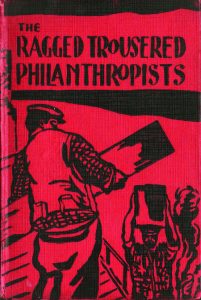
Book cover images from the seventh reprint of the book (235pp) ed. Jessie Pope (The Richards Press Ltd. & “The Daily Herald”, June 1927)
Preamble on Contemporary Parallels
In 1906, Robert Tressell (real name Noonan), started writing his autobiographical novel The Ragged Trousered Philanthropists, while working a fifty-six hour week as a painter- decorator and signwriter in Hastings. In the novel Tressell’s alter-ego, Owen, attempts to convert his exploited workmates to Socialism, ultimately to no avail. It was completed by 1910, only to be returned unread by the publishers because the manuscript was in long-hand. It was finally published four years after the author’s premature death, in 1914. Hence 2014 is the centenary of its publication.
That this novel gained a near Biblical status among the British Left throughout the twentieth century further emphasises its timeless relevance. Some even cited it as contributing to the 1945 Labour election victory. And in the early twenty-first century, the novel seems even more relevant than it has been for nearly half a century, in the wake of the near-collapse of capitalism, the “Great Recession” and the dismantling of the welfare state to all but its vestiges. Tressell’s polemical novel was in itself a ‘fictionalised’ crie de Coeur for the necessity of a new social contract to counteract the iniquities visited on the working classes (abject poverty, slum conditions, poor sanitation, and associated diseases such as consumption and rickets).
Tressell’s ears were burning: three years after he wrote the book, Liberal Chancellor David Lloyd-George introduced the first foundations of what would eventually become the welfare state, through his radical ‘Peoples’ Budget’ of 1909 – when, memorably, “the Welsh wizard” declared:
This is a war Budget. It is for raising money to wage implacable warfare against poverty and squalidness. I cannot help hoping and believing that before this generation has passed away, we shall have advanced a great step towards that good time, when poverty, and the wretchedness and human degradation which always follows in its camp, will be as remote to the people of this country as the wolves which once infested its forests.
Over a century later, a government fronted by one of the most privileged generations of Tories in living memory swept into power to announce a period of austerity with an “emergency budget” also framed within the rhetorical analogy of “war” – but this time it was a ‘war’ which was to be waged not ‘against poverty’, but against the poor. And after just four years of welfare caps, cuts to Legal Aid, and the bedroom tax, with abject poverty and street homelessness spiralling out of control, and millions dependent on food banks, those ‘wolves’ are once again infesting ‘our forests’. This has of course been largely ‘supported’ by the public on the back of the most relentless and virulent politician-and-tabloid-spun campaign of ‘scroungermongering’ in British history (even more vicious and ubiquitous than the so-called “scroungerphobia” of the mid to late Seventies, as anatomised in Pete Golding and Sue Middleton’s Images of Welfare: Press and Public Attitudes to Poverty (1984)).
The blue torch and red-top driven four year ‘Welfare Hate’ (2010-2014, and still in full tilt) has been so devastatingly efficacious as to now have instilled in the public consciousness an almost unquestioning conviction that “the dole” is a social and ‘moral’ taboo, almost considered commensurate to having a criminal record (and through mandatory ‘community volunteering’ vast sections of the unemployed are being ‘rehabilitated’ in much the same way as ex-prisoners on probation).
The sheer unreasoning and atavistic hatred and resentment whipped up against the unemployed –the most abject victims of banker-caused economic recession and Tory facilitated austerity– irrespective of personal circumstances or even sickness and disability has today culminated in a new anti-welfare consensus which in spite of 2 million families (many in work) now living in food poverty, and the rise of food bank use, of evictions, homelessness, suicides and the deaths of approximately 50,000 incapacitated claimants within six weeks of being speciously declared “fit to work” by Atos (as instructed on criteria directly from the DWP), a majority of the electorate is still apparently convinced that the benefits are “too generous” and need to be cut still further, even though British welfare rates are among the stingiest and most punitive in Europe, and are actually less than half the average amount for out-of-work benefits in the Eurozone.
But the anti-welfare British attitude has a long pedigree: almost as soon as basic unemployed allowance was introduced after 1909, to make a claim for this assistance was pejoratively alluded to as “going on the Lloyd-George”. Nevertheless, such begrudging euphemisms were still far more preferable to today’s commonplace dysphemism of “scrounger” – a term more akin to the terminologies of the eugenics-inclined 1930s Social Hygiene Movement, along with “parasites” and “feckless”, phrases deployed prolifically today in poisonously Malthusian red-tops such as the Daily Express.
In 2014, pundits of all political persuasions are now beginning to question, for the first time in decades, whether Marx’s argument of dialectical materialism – ingeniously recapitulated by Tressell’s ventriloquism through his alter-ego ‘Owen’, replete with explanatory charts – is as ‘wrapped up’ as it was supposed to have been with the presumed colophon of Eighties Thatcherism. But today, after four years of remorseless Tory-driven austerity that has uprooted the last burnt stumps of Attleean social democracy for what is effectively now a privatised plutocracy, we can read Tressell’s novel, a century after its publication, and see in it such uncanny parallels with the iniquities of our society. This is both a tribute to the farsightedness of the writer, and a damning indictment of our degenerated national character.
The Book
But to the book itself, as a depiction of the iniquities of working-class existence in the Edwardian era: Tressell invites us into the dead-end existences of a group of painters and decorators whose employer, the exploitative private firm Rushton & Co., pits them against one another in an inexorable grappling for scant work placements which they’re encouraged to ‘scamp’ (i.e. rush) in order to maximise profits. Owen nicknames his workmates ‘the Ragged Trousered Philanthropists’ for submitting themselves unquestioningly to this cycle of pitiful wages, bouts of unemployment and poverty.
Subsisting on ‘…block ornaments, margarine, adulterated tea, mysterious beer’, their lives are a collage of cheap tobacco and tubercular diets – the Pound Stretcher fare of yesteryear. Their only daily respites are short breaks sipping stewed tea from tins, sat on upturned pails occasionally used as makeshift soap-boxes by Owen for tub-thumping on the sanity of Socialism, which always falls on deaf ears: ‘…it was not as if it were some really important matter, such as a smutty story … something concerning football … or the doings of some Royal personage or aristocrat’.
Our present ‘celebrity’-obsessed, Royalist society shows little has changed in terms of the British idea of ‘culture’. These ‘philanthropists’’ rely for their opinions on the local tabloid rag, The Obscurer, which voices the jingoism of the Directors of the limited company that funds it:
The papers they read were filled with vague and alarming accounts of the quantities of … the enormous number of aliens constantly arriving … the crimes they committed, and the injury they did to British trade.
The Tressellian parallels with regards to the grotty anti-“scrounger” and anti-immigrant stigmatising nature of right-wing British red-tops such as the Daily Express
and Mail are all too striking. While the materialistic acquisitiveness (what Marx termed ‘commodity fetishism’) and philistine aspirations encouraged by government and advertising are every bit as endemic as they were in Tressell’s time:
These wretches had abandoned every thought and thing that tends to the elevation of humanity … in order to carry on a mad struggle to acquire money which they would never be sufficiently cultured to properly enjoy.
Tressell’s book was nothing if not contentious in its tone of almost despairing criticism of attitudes of the very working classes whose emancipation it championed, as is signposted in its deeply sardonic title of course. In these senses, Tressell’s ‘Owen’ presages the haughtily judgemental Orwell of The Road to Wigan Pier(1937), in which the latter notoriously broached the thorny subject of the olfactory nature of class distinction: ‘the lower classes smell’. Orwell himself wrote very favourably about Tressell’s book, when reviewing it in the Forties: ‘a book that everyone should read’ and a piece of social history that left one ‘with the feeling that a considerable novelist was lost in this young working-man whom society could not bother to keep alive’.
The derelict lots of the ‘philanthropists’ are depicted in 12 hour shifts decorating the freezing interior of a house referred to poignantly as ‘the Cave’, constantly stalked by their taskmaster foreman. One only needs to draw up the contemporary parallel of Amazon staff having to wear special wrist-straps that monitor how long they take in the toilet to see how this Orwellian practise has translated into the electronic age. As we see through Tressell’s eyes, casualisation is nothing new, and the zero hours contracts of today are an echo of similarly iniquitous exploitation rampant in the 1900s. The employees of Rushton & Co. are liable to dismissal at an hour’s notice, something still prevalent today in temping placements where contracts can be terminated at less than an hour’s notice.
Another depressing parallel between 1914 and 2014 is the still spreading cancer of privatisation:
The only reason they have not monopolized the daylight and the air is that it is not possible to do it. If it were possible to construct huge gasometers and to draw together and compress within them the whole of the atmosphere, it would have been done long ago, and we should have been compelled to work for them in order to get money to buy air to breathe. And if that seemingly impossible thing were accomplished tomorrow, you would see thousands of people dying for want of air – or of the money to buy it – even as now thousands are dying for want of the other necessities of life. You would see people going about gasping for breath, and telling each other that the likes of them could not expect to have air to breathe unless the had the money to pay for it. Most of you here, for instance, would think and say so. Even as you think at present that it’s right for so few people to own the Earth, the Minerals and the Water, which are all just as necessary as is the air.
Despite the much-needed surgery of nationalisation in the mid 20th century, this growth re-attached itself through Thatcherism. Today we are now seeing an already privately infiltrated NHS now being even more comprehensively privatised under the Tories, with suggestions that, in addition to the continuingly exorbitant annual rises in prescription charges (first introduced in 1951, which prompted NHS founder Nye Bevan to resign as Health Minister in protest), in future, patients may also be charged to see their GPs. If the Tories were to secure office in 2015, it will not be long until English patients are once again at the mercy of medical capitalism, as they once were back in 1906: ‘It happened that it turned out to be more expensive than going to a private doctor… The medicine they prescribed and which he had to buy did him no good…’. Indeed, Owen’s health problems are down to poor diet, poor living conditions and industrial stress, and are no more alleviated by costly quackery as modern industrially induced depression and anxiety are solved by anti-depressants.
One of the most moving moments in the book to my mind is a scene in which Owen, suffering from incipient tuberculosis (then known as “galloping consumption”, “hectic fever” or, among the bourgeois, “going into a decline”), is almost light-headed with rapture at having an opportunity for once to employ his skill as a signwriter on a special commission by his exploitative bosses. Owen relishes the experience almost as if it is an epiphany, since it is a rare opportunity for him to employ not only his hands but also his mind and heart (to paraphrase from William Morris). This is his only very brief experience of what in humanistic occupational theory is termed ‘authentic occupation’; the remuneration from the duty is the last thing on Owen’s mind, the experience in itself is reward enough –to risk a pun, it is the ‘journey’ that most animates the Journeyman.
Today’s ‘public’ services are run by unaccountable private companies –just as the novel’s town, Mugsborough (Hastings), is held to ransom by the Electric Light Company– who siphon off profits to shareholders instead of investing in improving their ‘services’, and who surround themselves in a sub-contracting labyrinth, impervious to customer complaints. British ‘democracy’ today is –as Tressell’s Mugsborough– dictated to by tabloid tycoons and businessmen. The three main parties –like the novel’s Liberals and Tories– squabble over a capitalist centre-ground. With the 1945 Clement Attlee Labour Government, much of this parlous state of affairs was of course finally reformed and in many aspects reversed, with the creation of the welfare state and the NHS, and the re-nationalisation of the core services and industries. But such a belated bouleversement, buoyed on a new societal sense of commonality and fellowship built up during the Blitz, enjoyed a honeymoon period for a further thirty years until it was systematically dismantled by Thatcherism.
The Bowdlerised Version 1914-1955
But what is less well-known about Tressell’s book is that on its first and belated publication, it was significantly abridged, or rather, ideologically bowdlerised, by its editor and publishers, on the seemingly reasonable pretext:
In reducing a large mass of manuscript to the limitations of book form it has been my task to cut away superfluous matter and repetition only. The rest practically remains as it came from the pen of Robert Tressall, house-painter and sign-writer, who recorded his criticism of the present scheme of things, until, weary of struggle, he slipped out of it.
This was from the brief Preface to the First Edition by journalist and poet Jessie Pope, composed in 1914, also of course the year of the outbreak of the catastrophic First World War, a vicissitude which inspired Ms Pope to pen some of the more emptily hortatory ‘calls to arms’ poems of the moment (her reputation for poetic patriotism later inspiring Wilfred Owen’s bitter empirical poem-riposte, ‘Dulce et Decorum est Pro Patria Mori’).
The conspicuous misspelling of ‘Tressall’ apart, the almost pitying sentiment of Pope’s tone in this Preface was also in-keeping with the main motive behind the publisher –to whom Pope recommended the manuscript on having it passed to her by Tressell’s daughter, Kathleen Noonan– Grant Richards’ request that the book be ‘abridged’, a condition of contract: the intention here was deliberately political, to adulterate the socialist optimism of the original ending by truncating the book so that it concluded on the distinctly more despairing episode in which an exhausted and consumptive Owen (Tressell himself was to eventually die of tuberculosis or “the white plague”) contemplates the mercy killing of his impoverished wife and children and his own suicide.
To demonstrate the drastic effect in tone and in terms of how the story lingers in the mind of the reader afterwards, here is the original ending of the original longer manuscript (which Tressell himself had to edit down from an even vaster 1,600 pages!), which didn’t actually appear until the first unexpurgated publication edited by F.C. Ball in 1955:
The gloomy shadows enshrouding the streets, concealing for the time their grey and mournful air of poverty and hidden suffering, and the black masses of cloud gathering so menacingly in the tempestuous sky, seemed typical of the Nemesis which was overtaking the Capitalist System. That atrocious system which, having attained to the fullest measure of detestable injustice and cruelty, was now fast crumbling into ruin, inevitably doomed to be overwhelmed because it was all so wicked and abominable, inevitably doomed to sink under the blight and curse of senseless and unprofitable selfishness out of existence for ever, its memory universally execrated and abhorred.
But from these ruins was surely growing the glorious fabric of the Co-operative Commonwealth. Mankind, awaking from the long night of bondage and mourning and arising from the dust wherein they had lain prone so long, were at last looking upward to the light that was riving asunder and dissolving the dark clouds which had so long concealed from them the face of heaven. The light that will shine upon the world wide Fatherland and illumine the gilded domes and glittering pinnacles of the beautiful cities of the future, where men shall dwell together in true brotherhood and goodwill and joy. The Golden Light that will be diffused throughout all the happy world from the rays of the risen sun of Socialism.
Now here is how the first abridged publication of the book in 1914 (‘edited’ by Pope, censored by Richards) –whittled down from 250,000 (1,600 pages) to just 90,000 words (234 pages!), and reduced still more for subsequent reprints– ends:
About an hour later, when he had finished writing the showcard, Owen went out into the scullery to wash his hands before going to bed; and while he was drying them on the towel the strange sensation he had been conscious of all the evening became more intense, and a few seconds afterward he was terrified to find his mouth suddenly filled with blood.
For what seemed an eternity he fought for breath against the suffocating torrent, and when at length it stopped he sank trembling into a chair by the side of the table, holding the towel to his mouth and scarcely daring to breathe, while a cold sweat streamed from every pore and gathered in large drops upon his forehead.
Through the deathlike silence of the night there came from time to time the chimes of the clock of a distant church, but he continued to sit there motionless, taking no heed of the passing hours, and possessed with an awful terror.
So this was the beginning of the end! And afterwards the other two would be left by themselves at the mercv of the world. In a few years’ time the boy would be like Bert White, in the clutches of some psalm-singing devil like Hunter or Rushton, who would use him as if he were a beast of burden, to be worked, driven, and bullied. His boyhood would be passed in carrying loads, dragging carts, and running here and there, trying his best to satisfy the brutal tyrants whose only thought would be to get profit out of him for themselves. As the vision of the future rose before him Owen resolved that it should never be. He would not leave his wife and child alone and defenceless in the midst of the ” Christian ” wolves who were waiting to rend them as soon as he was gone. If he could not give them happiness, he could at least put them out of the reach of further suffering. If he could not stay and protect them, it would be kinder and more merciful to take them with him.
It’s clear to see that by cutting the book at this point, the narrative is left open-ended at its darkest and most Hardyesque moment, with a distinct atmospheric echo of Jude the Obscure (1895). It is not known whether Pope herself was personally responsible for this wilful bowdlerisation of the book, but it nonetheless fell on her to undertake this considerable editing down, and so, in light of this complicity, her claim that she was simply cutting away ‘superfluous matter and repetition only’ was, to put it mildly, grossly disingenuous; unless of course such was her genteel naivety that she genuinely perceived Tressell’s resounding social overture at the close of the book as ‘superfluous’, or ‘repetition’.
Certainly, if there is to be one major fault highlighted about the novel, it is its’ aspects of repetition, which tend to suggest a certain compositional spontaneity, and could certainly prove a little off-putting to those readers not instinctually sympathetic to the socialist cause. In these senses Tressell’s book is emphatically polemical, and on occasions, palpably tub-thumping –his is indeed a tub-thumping prose style. But this is where he too had so much in common with the 17th century radical pamphleteers such as John Lilburne and Gerard Winstanley; and the polemic is part of the point of the book’s purpose, indeed, pivotal to it: it is essentially a manifesto communicated through a ‘fictional’ framework, in the same sense as Arthur Morrison’s Child of the Jago(1896), Jack London’s Martin Eden (1909), or, much later, Walter Greenwood’s Love on the Dole (1933).
If there was another criticism to be levelled at Tressell’s book, it is his slightly ham-fisted attempt at Dickens-style ‘character’-names to serve as a kind of prescriptive nomenclature determining the characters of the characters via trait-suggestive made-up names; but where as Dickens’ names tended to be more onomatopoeically evocative of certain personality types (Gradgrind, Bumble, Pecksniff, Sykes, Scrooge, Pinch, Cratchit, Sowerberry, Quilp, Heep, Squeers et al), Tressell’s were more blatantly schematic: Rushton & Sons (the exploitative bosses who encourage rushed jobs), Mayor Sweater, Crass, Didlum, Misery, Slyme etc. If Tressell’s novel had been more generally in the tone of social satire, as opposed to more social polemic, such fantastically schematic names would have worked better –as they did in the case of Miles Malpractice in Evelyn Waugh’s satire Vile Bodies(1930)– but part of the problem of TRTPs is that its’ tone oscillates throughout from polemic to satire to social realism, which gives an overall impression of stylistic confusion, even if the fundamental dialectical materialist thrust is well-honed and holds together.
Jessie Pope’s Preface started out much more promisingly than it ended up (as quoted above), her first two of only three paragraphs empathetically recapitulating much of the essence of the novel, albeit with initial confessions of indifference to its themes (this apparent ‘conversion’ in opinion/attitude typical of the novel’s morally restorative, proselytising power):
A few months ago a friend ask me to look at the manuscript of a novel, “The Ragged Trousered Philanthropists”, the work of a socialistic house-painter who wrote this book and died. I consented without enthusiasm, expecting to be neither interested nor amused –and found I chanced upon a remarkable human document.
With grim humour and pitiless realism the working man has revealed the lives and hearts of his mates, their opinions of their betters, their political views, their attitude towards Socialism. Through the busy din of the hammer and the scraping knife, the clang of the pail, the swish of the whitewash, the yell of the foreman, comes the talk of the men, their jokes and curses, their hopes and terrors, the whimpering of their old people, the cry of their children.
But even in more ‘social realist’ mode, the sleeping prejudices of Pope’s presumably bourgeois mindset betray themselves in a tone of detached pity, the constant use of ‘their’ as if speaking not only of a different class but almost a different species, and the very telling line, ‘their attitude to Socialism’, which implies she is reminding the reader, in a slightly disingenuously elliptical fashion, of the pivotal point of the book and the book’s almost symbiotically wieldy title, that practically all the working class characters of the story don’t actually seem to aspire to Socialism at all, but rather distrust it, resent it, are even hostile towards it, albeit false attitudes spoon-fed to them through the capitalist tabloid propaganda of their daily ‘working men’s’ papers.
It’s as if Pope is subtly communicating to readers that, while obviously the iniquitous conditions of the working class are unacceptable, Socialism is not necessarily the solution, and, in any case, according to Tressell himself, the working class don’t seem to want the very political credo supposedly associated with the interest of their class. Nevertheless, there is a kind of poetic irony in Pope’s ubiquitous ‘their’s and those used by Tressell to oppositely denote the monopolist classes of the Marxian ‘Us and Them’ paradigm that is the template of capitalist society:
In exactly the same spirit as you now say: “It’s Their Land,” “It’s Their Water,” “It’s Their Coal,” “It’s Their Iron,” so you would say “It’s Their Air,” “These are their gasometers, and what right have the likes of us to expect them to allow us to breathe for nothing?” And even while he is doing this the air monopolist will be preaching sermons on the Brotherhood of Man…
And given the fact that significant chunks of Tressell’s Marxist dialectic, replete with taxonomical charts and graphs, were left intact in the abridged version, while Pope’s Preface was in later editions (such as the 1927 one which I have, pictured above) preceded by a far more impassioned Foreword by socialist trade unionist George Hicks, would appear to suggest that the considerable abridgement of the book was not entirely politically motivated on behalf of publisher The Richards Press Ltd… Hicks’s Foreword is, in itself, exceptionally apposite and well-phrased, not to say, today, a valuable compendious social document in its own right:
ROBERT TRESSALL was the Zola of the building trade operatives. On reading this book one is made to feel that the author has caught the spirit, the tone, the soul, of working-class life more, perhaps, than any other writer of his time. What he has described is true to life; we know that he lived it.
We workers in the building industry know that he was one of us; that what he saw and felt burnt itself into the very heart of his sensitive nature, enabling him, with his literary genius, to embody in words the life we lived in the period he deals with. No middle-aged painter, or bricklayer, or carpenter, etc., or builder’s labourer, could read this book, especially if he also had been one of the agitators and had endeavoured to arouse his fellows to better things, without exclaiming at the end, “How true it all is!”
Even to-day, when conditions are a little better and brighter, and the philanthropists are not quite as ragged and are becoming increasingly class-conscious and concerned about their own interests, the poignant appeal of the book has lost none of its potency. And even to-day, the building worker is still casually employed, and still endures I many of the hardships, sufferings, uncertainties and petty tyrannies the author so feelingly describes.
Fortunately the Trade Unions have been able, by dint of hard struggles and f, ceaseless guerrilla warfare, to effect many improvements. Conditions are still lamentable, but the future is not so dark; and hopeless as it was in the bad old times.
We know, of course, that what Robert Tressall wrote about the life and conditions of the workers in the building industry, could also have been written about the workers in other industries, about the workers generally. They were all Ragged Trousered Philanthropists, and they still are to a large extent, though “through the welter, through the tangle,” as William Morris described it, they are beginning to see the end of their stupid philanthropy which rivets the chains of wage-slavery upon them.
How well this book recalls the troubles, hardships, disappointments, disillusionments, sufferings and repressions undergone by the pioneers of Socialism. Those early agitators and propagandists of the S.D.F. & I.L.P., working amongst their fellows, carrying on in the shadow of victimisation and dismissal from their employment, vainly endeavouring to make those with whom they came in contact see the necessity of organisation and economic and political enlightenment, must have been heroes, indeed, possessed of lion-hearted courage and the faith that conquers.
Robert Tressall was of their number. He was a painter, a member of the Painters’ Union in London, and subsequently on the South Coast, who gave unstintingly of his strength of mind and body to agitating for the S.D.F. He was an artist of great ability, both with brush and pen, but the sad and sombre conditions of working-class life never allowed him to give of the best that was in him. He suffered from ill-health.
Poverty, the tyranny of capitalism, disgust and despair caused him to seek for escape anywhere. He died of consumption, in 1911, in Liverpool, while on his way to America. How many of those Pioneers met with a fate somewhat similar to his? And how tremendous is the debt which our great organised Trade Union and Labour Movement owes to those nameless agitators and propagandists who did their work and passed out very much as he did?
This book is a Testament to the Cause of Socialism. I know of no better book to give to the newcomer into our Movement, or for circulation amongst the unconverted. At the present time, when our opponents are seeking to destroy our Trade Union organisations and attacking the conditions so laboriously established with incalculable struggle and sacrifice the lessons contained in this book should be learnt by heart by all toilers.
George Hicks, June 1927
The opening trope is a marvellous epitaph to Tressell the writer, and indeed comparisons have since been drawn between TRTPs and Zola’s masterpiece of social realism, Germinal (1885). The line [relating to ‘casual’ workers] is of course particularly apposite still today in this new age of Tory casualisation of the workforce and zero hours contracts, which makes Hicks’ phrase ‘And even to-day, the building worker is still casually employed’ sounds as historically ironic as the fact that Keir Hardie was decrying the scandalous absence of a ‘minimum wage’ as far back as the 1890s, it subsequently taking over a century for Parliament to finally pass minimum wage legislation!
Another criticism of the book is of Tressell’s polemical ‘tone’ as ventriloquised through the Marxist protagonist Owen who despairs at the apparent wilful ignorance and philistinism of his fellow painter-and-plasterers whom he futilely attempts to convert to socialism throughout, literally tub-thumping on upturned paint-tubs.
The Tressellian dialectic is noticeably splenetic in tone towards the working-class attitudes depicted, all of which are drawn from the firsthand witness of the author himself as a painter-and-decorator and signwriter in Hastings (the book is, therefore, effectively an autobiographical memoir in the guise of a ‘novel’). Such attitudes are, in the main, those of self-immolating blue-collar ‘Tories’ (“Angels in Marble” as Disraeli nicknamed them), who seem to revel in their own subjugation, which they aggressively guard against any perceived unpatriotic ‘Red’ resentments, as if the criticisms of the capitalist system which is explicitly constructed to trap and exploit them, and of the capitalists who administer it, is somehow a personal insult to themselves and their insultingly remunerated ‘work ethics’.
In this aspect, TRTPs exemplifies a very controversial seam in some types of socialist thought, a fundamental and seemingly contradictory misanthropy. But I would argue that in many ways this is simply a more personalised expression of a fundamental dissatisfaction with the state of affairs found in capitalism, which focuses as much on the symptoms (i.e. those working people of the title who seem to so ‘happily’ conspire in their own exploitation) as on the root pathology (i.e. capitalism).
Indeed, in order to imagine a better and more equitable world one has to first acknowledge and recognise how imperfect and inequitable the world currently is –without such an awareness of the grubbiness of things, one wouldn’t be prompted to consider how they might look if added a bit of sparkle. In my own experience, many socialists can come across, at least in surface temperament, more as ‘Ragged Trousered Misanthropists’ than anything else.
But from the lugubrious Gorgon head of disgust and anger sprouts the Pegasus of socialist possibility. Surely those who are most content and thus more superficially amicable, at least when they can smell profits, are the capitalists, who seem to have no problem living in propinquity to the social miseries of others, if nothing else, because such miseries are ripe opportunities for exploitation through usury (capitalists need the poor, but the poor certainly don’t need the capitalists). By contrast, it is difficult for socialists, distressed at the social miseries around them, and in the chronic absence of the kind of society they wish to come about, to display any obvious joie de vivre. In short, in order to be an optimist, one first has to be a pessimist: in order to see how good things could be, one has to first recognise how bloody awful they are.
So in teleological terms British society has practically come full circle – if not entirely, then well on the way towards it. It’s hugely instructive to read Tressell’s book today since it provides us with a foretaste of the type of society we are likely to return to shortly, and which we have already returned to in many respects. But throughout all political and social vicissitudes since its posthumous publication in 1914, Tressell’s magnificent socialist novel has stood the test of time, and withstood the many attempts by establishments to suppress and belittle it, most notably, through its contractual bowdlerisation for the first forty-one years of its published life, something almost unprecedented for any novel – which cheated an entire first generation of readers of well over half the length of the full work.
In terms of identifying the title’s equivalents in England 2014, one doesn’t have to look very far. In the recent aftershock of the UKIP triumphs in the Local and European elections, it is graphically clear that today’s ‘Ragged Trousered Philanthropists’ are those among the working classes who are currently flocking to Nigel Farage’s fanfare of a “Peoples’ Army”. Once again, it is not socialism to which many of the working-class are turning, but to the extreme right. The patriotic fad that was ‘Blue’ Labour, which attempted in a rather crass and dialectically contradictory way to woo back sections of Labour’s old working-class vote who had drifted to the BNP and EDL due to disaffection with an ever-remoter parliamentary political class, died a quick death –punctually replaced by the Disraelian-sounding ‘One Nation’ Labour; and so the subsequent burgeoning working-class disaffection with Westminster has instead been mopped up by the Purple xenophobes of UKIP.
The working-class supporters of UKIP, those mostly empty-pocketed pockets of the proletariat who are falling for the old neo-fascist chestnut that less foreigners will mean more jobs for the natives (“jam today” instead of “tomorrow”, in Faragian parlance), are today’s Tressellian equivalents. This is because, if they were to repeat their votes in the general election, they would be voting for a party whose domestic policies are diametrically opposed to their own class interests: privatisation of the entire public sector, the abolition of JSA, and a fixed universal tax rate of 30%, irrespective of income. Undoubtedly, the most graphic example of the Tressellian class-trap of today is UKIP’s purpleproletariat, ‘The Purple-Rinsed Philanthropists’ if you will; and it’s once again up the ‘Reds’ (and Greens) to rescue them from their future folly, which would be not only their own ruin but also the ruin of what is left of our social democracy, which is already hanging by a drip on life support.
Alan Morrison on
Occupied City/ Bezette Stad
By Paul van Ostaijen
Typography by Oscar Jespers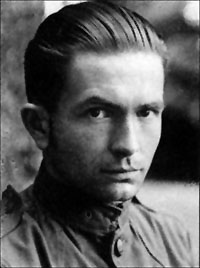
Translated by David Colmer
Inner design/layout by Katy Mawhood
With an Introduction by David Colmer
(Smokestack Books, 2016)
Smokestack is to be congratulated for bringing so many relatively obscure and neglected posthumous European poets to an English readership, and this avant-garde longer concrete work by Belgian poet Paul van Ostaijen comes via a translation by David Colmer, and highly distinctive typography and typographical/poster-like illustrations by Flemish artist Oscar Jespers painstakingly reproduced by Katy Mawhood. This beautifully produced book, replete with Jespers’ stunning abstract cover artwork, and, at the front of the book, striking red ink title pages, was funded by the Flemish Institute. This whole enterprise is quite a scoop for Smokestack, van Ostaijen having been a hugely influential figure in Flemish poetry, credited with having introduced Expressionism into Belgian literature, and having also been the first writer to translate Franz Kafka from the German.
Colmer’s compendious Introduction furnishes us with all the information we need about van Ostaijen and the contextualisation of this his most important work. Here are the most salient details:
Paul van Ostaijen was born in Antwerp in 1896 as the seventh and last child of a Dutch father and a mother from Belgian Limburg. Precocious in both literature and politics, he was expelled from one secondary school and attended two others before starting work as a clerk at the town hall of Antwerp in 1914. His father had sold his successful plumbing business and moved the family to Hove, a rural village just outside of Antwerp, in the previous year and it was from here that van Ostaijen witnessed the start of the German siege of Antwerp in September, 1914 – including the fire that razed the church of St. Martin in nearby Duffel and the retreat of a long column of Red Cross vehicles, events described in Occupied City. Like most other civilians, the van Ostaijens joined the exodus of refugees, fleeing first to Antwerp and then further north to the Netherlands where they stayed with an uncle in Steenbergen before returning to occupied Antwerp in late October.
Paul van Ostaijen spent the rest of the war in Antwerp, where he plunged into the city’s nightlife and cut an extravagant figure in literary and bohemian circles. With the artists Paul Joostens and Floris and Oscar Jespers, he set up a publishing house, Het Sienjaal, where he published his first collections of poetry, while at the same time continuing to write and agitate for a progressive Flemish nationalism. In January 1918 he was sentenced to three months in prison for demonstrating against the pro-Francophone Cardinal Mercier during a procession in Antwerp, but the appeal process delayed the implementation of this sentence until after the war, by which time van Ostaijen had already fled to Berlin. He remained there for three years, experiencing the disillusionment of the failed Spartacist uprising, mixing with artists and writers (amongst others, those associated with Bauhaus and Der Sturm), and producing works including Occupied City, which was published in Antwerp before his return to Belgium in May, 1921. Van Ostaijen avoided imprisonment as he had been granted an ‘administrative amnesty’, however, he did have to do his military service, stationed in Krefeld in Germany. From the mid-1920s Van Ostaijen suffered increasingly from tuberculosis, the disease that had already claimed two of his siblings, and died of it in 1928 at the age of thirty-two.
From an early age Van Ostaijen read widely in several languages and the rapid evolution of his work reflects international literary developments as well as his own driving poetic vision. The Signal (1918) is an early example of humanitarian Expressionism, while Occupied City, written during his Berlin exile, is strongly influenced by Dada and August Stramm’s ‘concentrated word’. Van Ostaijen acknowledged Apollinaire as a source of inspiration, but not for the typography of Occupied City, which is intended as a score and not as an illustration of the content of the text. (Some exceptions, such as in the poem ‘Zeppelin’, reflect an intervention by the designer, Oscar Jespers, who deviated here and in several other places from van Ostaijen’s original manuscript.) In his later work van Ostaijen moved his emphasis to simplicity and musicality and strove to produce ‘pure poetry’, autonomous poems that could exist without reference to either their creator or external reality.
Van Ostaijen’s work in general and Occupied City in particular have long occupied a central and influential position in modern Dutch and Flemish literature, but the language barrier prevented the work from becoming widely known outside of Belgium and the Netherlands. Late translations of Occupied City into German (1991) and French (1993) expanded the audience for this key text, and now, a hundred years on from the events it describes, it is a privilege to be able to provide the same service for English speakers. The poet and translator Donald Gardner put it best when he described translating van Ostaijen as being like ‘finding a missing piece of the jigsaw of modernity. It explains modernity and is explained by it.’
Colmer then gives an informative insight into the manner of his translation:
As a poetic account of Antwerp during World War I, Occupied City is as multilingual as the city itself. The original book includes Dutch, in its Flemish variant the language of both the poet and the populace; French, at the time Belgium’s administrative language and the language of the bourgeoisie; German, the language of the occupiers; Latin, the language of the Catholic Church; and English, a presence in this cosmopolitan city even then.
Trying to deal with all these languages while making the book accessible to English readers was one of many translation problems. Van Ostaijen quotes songs and advertisements,
references films and books, and gives snippets of dialogue in the original languages. In general I have tried to follow him here. Lines of German dialogue represent the occupier, but the significance of the French dialogue is more complicated. Van Ostaijen might be showing the bourgeois background of whoever is speaking, or perhaps satirising Belgian royalism and patriotism.
Even when not quoting someone else, he can slip into French now and then, understandable for someone living in a bilingual society, but this can be difficult to follow for an English-speaking reader and these passages I have tended to translate into English. I have retained Dutch where the poet is quoting from a song or giving the name of a Belgian or Dutch street, ship, book or film. Now, almost a hundred years after the book was written, it is
not always easy to catch the references and I am indebted to the many scholars who have studied van Ostaijen’s work. The books of Robert Snoeck, Jef Bogman and Gerrit Borgers in particular were invaluable. For the identification of typos in the original, I used the errata published as a separate sheet with the first edition and also the comparison of manuscript and book published as an appendix to the Collected Poems (1996).
The typography of the book presented a special challenge and it was not always possible to find an English wording that allowed a direct correspondence between the original and the translation. Similarly, some of the changes in English seemed to call for the introduction of new typographical features. Adaptation was required and I did this in collaboration with the designer Katy Mawhood, whose patience, creativity and professionalism were exemplary. Finally I would like to thank my fellow translators Kiki
Coumans and Michele Hutchison for their help with the French, and David McKay for reading the draft translation, saving me from several blunders and providing many invaluable suggestions.
David Colmer
Amsterdam 2016
Still more compendious, and with slight additions of information, are the back cover blurbs on van Ostaijen and on the work itself:
Paul van Ostaijen (1896-1928) was one of the most original and influential Belgian writers of the twentieth century. An avant-garde poet, satirist and revolutionary critic, he opened up Flemish poetry to modern city life, introduced Expressionism into Belgium, and was the first writer to translate Kafka from German. After the First World War he met George Grosz, Herwarth Walden and Walter Mehring in Berlin, and later opened an art gallery in Brussels.
Occupied City/Bezette Stad is one of the key anti-war works of the Dadaist movement. First published in 1921 as a work of ‘rhythmical typography’, it is primarily about the German occupation of Antwerp during the First World War. But it is also a love song to the modern city, and a declaration of war on post-1918 Europe. Designed and illustrated by the Flemish artist Oscar Jespers, this epic poem was originally advertised as ‘a book devoid of Biblical beauty / a book for royalists and republicans / for doctors and illiterates / a book that lists every important song of the last ten years / in short: as indispensable as a cookbook / “What every girl should know.”’
It is clear, not simply from the highly unusual and distinctive font-varying typographical formations throughout that Occupied City was a hugely significant piece of work of its time, and highly innovative for its time, depicting the German occupation of Antwerp in 1914, but published in 1921, significantly, just one year prior to T.S. Eliot’s groundbreaking modernist masterpiece, The Waste Land. Occupied City prefigures Eliot’s breakthrough work on many levels, not least its wide-sweeping macrocosmic marauding, its visceral sense of place and landscape, and its almost cinematic quality, the work being littered throughout with allusions to films of the period. It is a very visual work, not least in its ever-restless and surprising typographical formations that really have to be seen in print form to fully appreciate.
Wyndham Lewis and the Vorticists had already produced the cutting-edge avant-garde poetic magazine-cum-manifesto, BLAST, published punctually in 1914-15, which incorporated a similar typographical playfulness in its interior Manifesto; but in purely typographical terms, van Ostaijen’s long poem, or more specifically, artist Oscar Jespers’ radical augmentation of it through a dizzying variety of fonts, font sizes and font formations, left a radical mark. Having already mentioned The Waste Land, it is also ironic that a much later work published at the beginning of the 21st century, A New Waste Land, by Michael Horovitz, a poet who came to prominence as helmsman of mid-Sixties British Poetry Revival (see Children of Albion – Poetry of the Underground in Britain, Penguin, 1969), is one work that bears some visual resemblance to Occupied City. Another is much more recent: Andrew Jordan’s staggering semiotic work, Hegemonick (Shearsman, 2012), which has an Eliotic macrocosmic scope, fractured sometimes abstruse narrative, cryptic poetic footnotes, and some interplay between textual content and typography, and is in this writer’s opinion the closest any modern poet has come to producing a 21st century Waste Land (reviewed elsewhere on The Recusant).
But the inescapable yardstick for Occupied City is Eliot’s The Waste Land which was published the year succeeding it; both works share fragmentary images, broken narrative, macrocosmic scope and cultural interpolations, in van Ostaijen’s case, contemporaneous allusions from other media such as cinema, music, comic strips and advertising –the latter medium presumably brought in to comment on capitalism’s commoditisation of the arts. Both works are in the stream-of-consciousness circuit of literary expression, van Ostaijen’s perhaps more inclined towards chance word associations and accidents of meaning, as well as metonymy and synecdoche. Occupied City is also markedly less esoteric than Eliot’s masterwork.
The overwhelming visual impression left on one after reading/looking through Occupied City is of theatre and film poster typography with its randomly enlarged names and titles and variety of font styles designed in order to catch the eye of the onlooker and to magnify certain details, such as the more famous names among casts etc. so that certain words typographically leap out. Nonetheless, we must take into account the primary conscious function of Jespers’ acrobatic typography which was ‘intended as a score and not as an illustration of the content of the text’. Due to formatting issues, it is not possible to excerpt any of van Ostaijen’s text as it appears in the book, so the text will be excerpted throughout this review in a normal linear form (though I include next to the book cover at the top of this review an image reproduced in the book from van Ostaijen’s original drafts to give some idea of how the text looks).
Occupied City begins, radically, with a filmic-comic strip slant: the first phrase seems an instantaneous comment on the consumer society of the time:
Much shall be forgiven you
for
you’ve seen a lot of movies
The opening trope continues:
we know them inside
out
FanTOMas Zigomar with a big Z too long
For the uninitiated here –which includes myself– Fantomas was a 1913 crime caper film, and part of a series of silent films by French director Louis Feuillade. Zigomar was a series of films by Victorin Jasset with an eponymous hero (from 1911 on). The compendious Notes at the back of this book elucidate most of the French and German nomenclature and references.
There’s a detectable Nietzschean tone of desolation which will also, of course, underscore much of the apocalyptic, post-God despair of Eliot’s masterwork the following year, as van Ostaijen states: ‘we have come to the end of all isms schisms’. Much emphasis on ‘emptiness’, of consciousness, of ontology, strongly foreshadowing Eliot’s later Nietzschean poem ‘The Hollow Men’ (1925). There then follows a lengthy dalliance with nihilism in all its forms, and a typographical orgy around the word ‘nihil’ ensues. There’s a nice description: ‘trains tapping out the tired/ rhythm/ of/ weary/ people’. Then the Eliotic:
Positive is convincing oneself
of emptiness
of mud and clay
of ruination
the realisation of complete emptiness
echoing
A hint of Nietzsche’s theory of eternal recursion in ‘turn around turn around turn around again/ rotating earth reversed’. Then the juxtaposition of artificial culture with an impromptu advert:
Rimmel’s New Cosmetiue
For fixing the Hair Whiskers or Mustachios
and giving them a beautiful gloss & natural black
or brown colour.
E Rimmel, Parfumer 79 Strand; Bld. des Capucines, Paris
Van Ostaijen might be a serious commentator on his times but his polemical metier is not without its sense of humour as it demonstrates the degradation of common language through commercialism and advertising:
if the pageant rolls out again
the pageant again
the Ommegang
omega
omicron
Alpha (the letter not the margarine) beta zeta eta theta
Van Ostaijen makes no bones about his intractable artistic will to dominate his creation: ‘I want to be the director’. The poet’s frequent addresses in the plural help to keep readers feeling included, whether they like it or not, in the work which, in spite of its avant-gardism, is a work of commonality, or at least in pursuit of some kind of commonality –it’s aim, indeed, is communication: ‘We have known all songs/ 3 / Walzertraum evolution’. Ein Walzertaum (A Waltz Dream, or, more probably, A Dream Waltz) was an operetta by Oscar Straus with a German libretto by Leopold Jacobson and Felix Dörmann, based on the novella Nux, der Prinzgemahl (Only the Prince Consort) by Hans Müller-Einigen (1905).
A smattering of knowledge of classical music, its composers, works and nomenclature, certainly assist in deconstructing Occupied City:
from Lustige Witwe to Czardasfürstin
strike out all syrupy operettas
sentimental ersatz songs
Die Csárdásfürstin (The Riviera Girl) was an operetta by Hungarian composer Emmerich Kálmán. Eliot’s ‘Hollow Men’ continues to be anticipated:
everything is empty
frère Jacques
the last Pernod
Picon
quand je suis grihollow
sea wreck
never mind
stinking bus down worn-out street
lazy trains through stinking country
mountains sea valley valley sea mountains
A general sense of vacuum and existential ennui permeates:
rigolo gigolo zigoto
si tu veux faire une petite ballade
you’ve balladeered your way through Europe
your expectations die
Imagery becomes phantasmagorical, surreal, the animate and inanimate commingling with commercial branding:
EUROPE according to EROTIC BEDDINGS
we have known Europe for so long so long
drawn-out stretching flat and upwards
There is a sexualisation of physical landscape, a kind of geographic pornography (something expertly exploited, nearly a century later, by Andrew Jordan in Hegemonick):
legs thighs breasts Berlin Germany Brussels Amsterdam
Bucharest London Paris hair perfume fleurs Houbigant Longchamp
Maisons-Laffitte joe jack john joker gigolo rubsters ehrliche Frau
There’s a textual serendipity in the text being translated into English here (for the first time) with chance homonyms: ‘Should they have fallen all cathedrals/ cannibals/ Hannibals generals’. There are occasional pages mostly free of Jespers’ typographical acrobatics, and these appear like sudden pauses for more recognisable poem forms. The foreshadowing of Eliot’s ‘Hollow Men’ is quite striking:
and are these cross-drawn countries
not one great Christ
full of hollow wounds
and this hollow echoing sense of
despondency
not like Good Friday once
Personification is expertly deployed:
The gravely threatened city we will defend to the bitter end
lies trembling pale-bodied
an ASHEN POOL in the evening PRUSSIAN BLUE and the danger
stops time stops pan ting time stops space
This almost pornographic personification is used to startling effect, particularly when playing on ‘goose flesh’ as a flipside image of both the skin responding to touch, or sexual arousal, and the skin pricking up in the same formation as a fear reaction to threat and danger:
just enough
cash
the generals pimps patriots the demimonde
the goose flesh of the demimonde that’s no advertisement
that’s not satin not silk not moire
that’s goose flesh
shells falling despite your cash charity
Here Van Ostaijen belittles materialism in the face of material –and psychical– destruction; reading this one is reminded of the striking work of war artist Paul Nash, the sharp jagged forms and lines, also, of Vorticism, and, post-Thirties, of Picasso’s Guernica. The disturbing fusing of images of war and violence with those of sex proliferate: ‘cannon coitus’, and, in this particularly striking flourish:
a brothel flees to the cellar
bouncing breasts football bellies
tulle gold silver voile Mimi Manon sequins and teeth
the madam up to the nines
no time to change
the shell falls
without
un client mesdames voyons
in the cellar flesh quivers by the kilo
quivering breasts quaking bellies shuddering thighs
paint streams on greased mugs full of fear
and the grotesque oriental splendour
tulle sequins
scientific progress
teeth chattering gold and lead this time
Gaby – Recamier no dough to flee
suit way out of style streetwalking impossible
Ah c’est la merde merde pour les Boches merde pour tout le monde
lanky Irène is especially cold silver snakeskin mesh
and
watch out for rats
brothel girls huddle together
next door an abandoned piano
There’s also something reminiscent here of David Jones’ experimental long poem about his firsthand experiences in the First World War, In Parenthesis, although this work wouldn’t appear in print until 1937. The visceral agonies of war come into sharp relief:
wrecks cars riPping dark swathes of night
wrecked writhing
irregular TWITCHING crushed people
caked soldiers cursed beasts
treading tramping treading tramping
CORPSE rUMbling rusty cannon
MACABRe RiBs
DANCE iron
rattling ribs
clattering
cobbled roads
marauders break into houses lighter than shells
philanthropy
rescuing heirlooms
The paraphernalia of everyday life is listed almost like Joycean items of daily worship: ‘pram/ hatbox/ lamp chimney’.
the whores forget to solicit
they only flee
as if one can’t do both flee and solicit
but
the chairman of the ESTAMINET UNION saves the day
his top hat
and his tricolour neckerchief
An ‘estaminet’ is a small café which sells alcoholic beverages as well as coffee, also known as ‘brown pubs’ or ‘brown cafes’, they are ubiquitous features of Amsterdam, but also of Bruges and Brussels in Belgium. Van Ostaijen has a particularly dark, astringent sense of humour: ‘you can use their heads as stepping stones/ couldn’t that have stayed symbolic’. The sacramental items are listed a second time: ‘Always/ pram/ hatbox/ lamp chimney/ babe in arms’.
The contemporaneous cultural allusions throughout Occupied City make it quite a minefield of references though thankfully there are extensive Notes at the back to assist. However, not all nomenclature is included in the Notes:
Always people
a peculiar puppet show put on by God the Father
or Siderius (for astrologists)
Siderius appears to be possibly a double allusion: there was a German weapons company that supplied the Krupp artillery while operating with the Dutch army during the 20s and 30s, while Sidereus Nuncius was the title of an astronomical pamphlet by Galileo, published in 1610. Siderius is from the Latinate term denoting a time-keeping system that astronomers use to locate celestial objects. It would appear, then, that either van Ostaijen or the translator mistakenly pair Siderius with astrology rather than astronomy; either that, or van Ostaijen is playing on the similarities between the two terms.
Van Ostaijen often shows an Eliotic sensibility in terms of depicting images and nomenclature of bourgeois gentility against apocalyptic backdrops:
always elegant
Mr Crump Esq.
very fast car
greeting everyone
alighting calmly
at his hotel
‘Crump’, incidentally, is a term for a large artillery shell. Here we see bourgeois insouciance amidst foreign occupation: ‘Marching foreign soldiers/ occupied country occupied city aerial view’ is then juxtaposed with KODAK in large capitals: advertising has its place even in wartime. War even has its own music, its own cacophonic score:
Dance through the land of Howitzers
Dance of the crumps
shrapnel minuet
overwhelming
aRsenals RaTTling across the country
For much of this work van Ostaijen furnishes austere, pared down imagery, but occasionally there are beautified flourishes of phrase, as in ‘soldiers walking flowery rifles/ soldiers striding flowery rifles’. And the imagery is at its most descriptive and evocative when depicting war horrors:
CORPSE sprawled in maggots crawling
with maggots
falling
corpse
mute Scream of shako raining
s k y
filthy bubbles oozing from oilskin
trampled barbed wire
c u t s
hands
and bleeds gushes filth with filthy rain
mute stumps abandoned abatis
thousand 1,000 1,000
dizzy
shuddering cellar skeletons cold earth
blasted brewery one wall standing
Van Ostaijen’s use of the anachronistic ‘shako’ is curious, this term was used to described a common type of European military hat mostly of the Napoleonic era, but one suspects it is meant sardonically, contrasting the colourful baroque uniforms of soldiers of the past with the grim field greys and khakis of the First World War. Images of rust and decay abound:
snapped signpost
reddish-brown Instructions
about what
about what the rain
unending
filth gushes
Rusting ironware
steel helmet chopped o f f head
In Dadaist style, Van Ostaijen flirts with graffiti in terms of visual form but also in terms of randomising free associations of found phrases and slogans: ‘If only the walls moved red-hot story by Poe’. In many ways Occupied City is a kind of found poetry. Images of palaeontology and taxidermy give an entombed, airless museum-sense to the poet’s depiction of contemporaneous society:
Abandoned dolmen
stuffed mammoth
sudden wilderness
suddenly
Pompeii Herculaneum
missing only all-too-modern means of transport to get around
in the Museum of Arts and Crafts
There’s a continual Eliotic juxtaposition of the ancient and modern:
ANNO MCM X I V
simulating operations with several wax dummies
the docker the tally clerk the dock constable
blue coat with silver trim
WAXWORKS window number
and improved version of the galley slaves of Cayenne
As in Eliot’s The Waste Land, images of rust and decay are rife, as is the permeation of ‘brown’, the colour of mud:
Caulking carcasses
hammering
metallic dome
inverted cauldron
clear clatter of scattered skittles
transatlantic hull harbour-half
balance opposite side : the Rest
brown sloBBy hoBByhorse lost house crooked wheels port train
sails front and wings
Floris Jespers saw this transatlantic
harbour half sharply
but the brown slobby hobbyhorse
is the perfect colouristic
…
caulking tar to bales of hides
earthy colours that cut through all senses
‘Caulking’, the process and material for sealing joints and seams, is a leitmotiv in this section of the poem. The death (thanatotic) and sex (erotic) instincts often coalesce: ‘electric piano erotic whinnying’. This is a city of industrial decline and general stagnation:
Suddenly halted iron construction
no-longer-clanging
loud howls of idle cranes and
b u r i e d c i t y
One wonders if there was any possibility that Eliot might have caught sight of van Ostaijen’s work prior to or at the time of depicting his ‘Unreal City’. A ghostly nostalgia haunts this city:
broken carcass
port whores staring hopelessly
Feldgrau poor substitute for princely sailors
where are the old days
Hopeless cranes
Howling Whinnying
…
streetwalkers lay soiled flowers by the Christ of the Dyke
Wilderness with withered cranes
city centre moved to
a few boulevard cafés cinemas
(‘Feldgrau’ is German for ‘field gray’, the colour of German uniforms). Sex is depicted at its most seedy and decadent against the backdrop of metropolitan impotence:
Brothel
Sprawled worn-out brothels
e m a c i a t e d
YOO-HOO! Steinlen
in a filthy pubic triangle
rain and darkness
and a policeman
occupied-city-brothel-street
dank rotting fruit
reeking
from a greengrocer’s
grimy violet
The contemporary privation is juxtaposed with the biblical aphorism: ‘as if for ration books/ (man does not live by bread alone)’. ‘Zeppelin’ appears in a thick black almond shaped font like a brand name, and ‘good bye Piccadilly/ farewell Leicester Square’ (the English marching song, ‘It’s a Long Way to Tipperary’) comes sardonically underneath. Van Ostaijen’s filmic inclinations come to light again with the phrase ‘Empty Cinema’ emphatically underlined, and we’re ushered into the airless darkness of projected escapism replete with live musical accompaniment:
pianist plunking away
plunking through to the end
This is clearly a Western being shown:
z______________________A
to a gallop
some warmed-up
beans
warmed-up beans
warmed-up beans
beans
beans
It is either a synchronicity of the intellectual and spiritual sensibilities of the time, or Eliot was indeed aware of if not partly inspired by van Ostaijen’s experimental work, since, in the following passage, there is so much that is proto-Eliotic: the repetition of ‘hollow’, the Catholic image of a ‘rosary’, and the general sense of desolation and emptiness:
Nomenclature of Deserted Things
deserted EXISTENCE
deserted city
deserted square
deserted cinema
cinema cracked coffee cup
hollow harbour
hollow people
weary people
tired people
tired trains
jolting jarring standstill sown in landscape
deserted buffet
deserted bar
deserted barman
deserted barmaid
UPRIGHT PUPPETS
dejection deserted
BAR
feeble morning
tired noon
faint evening
naked night
houred rosary
trolley
broken tram s topped
silent
As with Eliot, van Ostaijen depicts the civilisation of his time as essentially moribund. Van Ostaijen uses colours symbolically in the following flourish:
Last vignette on a catchpenny paper
e.g. all vignettes light
red pink yellow royal blue
the last vignette a heavy lump of black
or darkness
iridescent green showing fast fall into dirty oxide green
last vignette stiffening motionless
the text below relates deserted castle wicked fairy success
the whole story
and all the happy colours above
damsels pages orange and penny-chocolate pink
are dragged
Once more, so much in this part of the work predicts Eliot’s poetic triumph of the following year in terms of images –note, for example, ‘violet night’, prefiguring Eliot’s ‘violet hour’ i.e. the end of the working day:
Outlandish houses in occupied city
deserted city of a thousand and one nights
deep violet night all houses
oriental style
or are they giant cakes Youth
at the caliph parties of my
representing the newly conquered city
two tall cakes and the street is the table
the guests have disappeared
and now this mute cake-table stands in the night
bove the table hangs an arc lamp
and now these cakes backlit
a flat set piece
(the evil spirit catchpenny print did not forget this last lamp
DELIBERATE: desolation needs this misplaced lighting)
Violet continues as a leitmotiv:
Above in the
VIolet sky
dark v i o lE T
phosphoresces
There are some images and turns of phrase randomly ploughed up by van Ostaijen which are made all the more striking for their suddenness, as below, while the poem maunders into Sunday mundane:
rosary beads
the tram detonates the everyday
consecrated Sunday tolling
mothballs and bourgeois women
the sharp
edge of
a dull
Sunday
opped
no Destination
only
the Dull Dance of the trams on
m__y____h_i_g_h________________w__ire___________nerves
stretched-out nerves
dance to the music
of dry drear y
r
o
s
a
r
y
b
e
a d s
Once more the Eliotic content is uncanny, even ‘nerves’ being mentioned, then another Catholic image.
Then, all of a sudden, what appears to be a fairly normal poem, at least, in terms of presentation on the page, appears under the soft-sounding French title ‘Sous les Ponts de Paris’. This beautifully phrased poem appears to be addressed to Christ (as the capitalised Y in ‘You’ corroborates) in all his iconographic guises; it seems the Saviour is being depicted as tantamount to a display dummy in a shop window, which is a profound and sublime juxtaposition:
A cry goes up from all the places
they have put You on display Your pain
They have hung You up on the corner of every block
to catch pennies in an offertory box
Still with the people You commune
they plunge their arms into your wounds
We put our hands in Your warm wounds We are deaf
and blind in faithlessness
Your Corpse has been defiled by popes and priests
Your wounds have taught our hands belief
They have raised up churches like mighty halls
Silver and gold drip from the walls
But van Ostaijen settles on ‘Harlequin’ as a depiction of our public icon of Christ, as in this stunning couplet:
You are displayed on every corner HARLEQUIN
with your beaten attitude and Your suffering
That serendipitous semi-rhyme in translation almost replicates a slangy Americanism: ‘Harlequin/ sufferin’’. The second numbered section of this striking poem has some particularly resonant images and rhyme-endings; it seems to change in tone and to depict the Son of Man as an abandoner of humankind in the post-Nietzsche godless universe, a marked absence amidst spiritual emptiness only made more emphatic in its triumph by the ravages of war:
2
Your final incarnation is for the rabble alone
I saw You deserting from the front
They did not gather up the weapons You cast aside
Holy Deserter, those relics were not convenient
In such times all churches should display
Your deserter’s guise and the weapons You threw away
I saw You staggering from town to occupied town
weak worn-out nerve-wracked and beaten down
In my occupied city I have seen You often
when You walked into the dance hall the music stopped
its slow waltz the rhythm of Your face was SO
much stronger in its sorrow than a broken cello
The occasional end-rhymes in this poem may well be the accident of translation but they work spectacularly well, especially that of ‘SO/ cello’.
and the gigolos and bar girls danced their slow light WALTZ
to the sorrowful rhythm of Your FACE
It seems almost as if Christ has stepped down from one of his high perches and become flesh again and merged into the human throngs:
I saw You standing in a stinking alley
a Landsturm man to keep you company
You moved amongst the press-ganged unemployed
long trains to Germany full of ragged men and half-grown boys
You kept watch on top of the dyke
with cold streetwalkers through the rainy night
Now You are worn-down and exhausted
stuffed full of sorrow once more
Reading that last couplet one cannot help but think of Eliot’s ‘stuffed men/ Leaning together’, and van Ostaijen’s choice of words here, ‘stuffed full’, certainly does make one thing of a scarecrow, or perhaps, again, a shop window dummy.
Rain drips from Your filthy sopping beards of hemp
over the city
Dripping down with the rain on the city’s filth
Your halting rhythm
For the reviewer, this deceptively simple poem is so much more than a more formal pause in the otherwise explosive typography and cacophonic prosody of the work as a whole: it is its most accomplished summit. But in the next section we return to the more showy displays of font, explosions, too, of image, colour and wordplay:
Light in the room tints flickering violet to Black
on linen and paper
cafés =
unmoving armoured cars
light artillery
all windows see street through coloured glass
windows like German professors
blue-black sinking of extinguished things
Filling
deeper DARKness dim dismal street
Falling
Van Ostaijen certainly has a highly distinctive descriptive sense: ‘streetlamps creating velvet surround’. Most of Occupied City is what might be termed ‘concrete poetry’, and certainly it is a visual poem, and something integral is lost when it is presented as normal verse on the page, as I’m forced to do through this review; nonetheless, so acute and striking are van Ostaijen’s imagistic and verbal combinations that much is communicated in the text itself:
st_rai_ned n_er_ves
mist breaking
over them
creak of trolleys
muffled crackling
muffled echoes in mist
velvet carriage R A G
R A G T I M E
The mention of ‘Ragtime’ does of course date the work to post-war. Van Ostaijen offers some almost synaesthesic sense-impressions:
warm light
smell of guitars
sound of whisky and
wilted rose
your flower Musette
if it’s miserable outside
it’s lovely near you
J a a r s m a
warms well
for van Ostaijen life is a dance, perhaps a danse macabre, and ‘hair turns grey mid-dance’. The irony is certainly not missed that the monarchies of England and Germany –and Belgium– were members of the same family, and that the British royal line dating back from Victoria comes from Saxe-Coburg-Gotha (swiftly changed to Windsor at the onset of war with Germany so as to deflect from their German origins), the same place that one of the Prussian Kaiser’s battalions hails from:
Good news from the front
immediately received W T by
the Ladies of Christian Charity (motto mine is mine)
a whole battalion of Feldgrauen
the King alone in the trench
Does he flee ? a king does not flee (very true)
Samson he takes the jawbone of an ass
Smites ½ battalion
the other 50 % turns tail
He then cleanses the jawbone of Boche blood
it was a battalion from SAXE-COBURG-GOTHA
A pithy couplet, ‘The Charlatan up on his Stand/ delivers patter to the Land’, introduces a poster-style page advertising the ‘Great Circus of the Holy Ghost’.
The next section, ‘Inward Circles’, continues the musical and terpsichorean theme:
Music Hall full
of
vague
desire
in its electric frugality
people in suspense
before the banal wonder
Music Hall a balloon
a
b
o
u
t
t
o
burst
In varying sized fonts with more than hint of Wyndham Lewis’s BLAST (‘BOOM’ is written particularly large) we get a concrete take on an orchestra evoking the blasts of battle:
BOOM
KETTLEDRUM
everything FLAT
h__________________________Oh
racing again violins cellos basses brass triangle
drums KETTLEDRUMS
There’s a kinetic feel to the alliteration:
drama in full battle tarts snakes throwing themselves at honourable
gentlemen the family falters the factory falters
honour falters lies there
all ideas go tumbling DOWN
HALT!
The impression is of homonymous free associations:
Drums roll drums rumble
drums thrum
BOM BAM
O –
r–a–n–g–e a-c-r-o-b-a-t-s
tee tee hEE
blossoming bloom blown
…
DRUM
hands that SLAP
Coffee Cups Dancing Along With The CrowD
d
an
ling ce
l et go
tinkling dome-breaking glasses
stiff standing
quand je suis grise
the rocking of the barge
that founders
that sinks
that goes down
sunk
THE CLUTCHING HAND
Jeanne
me
the others
ragged
vagabonds
the raging rattling of your flick
your dynamo
your hear
The next section of Occupied City is titled ‘Asta Nielsen’ and dedicated to Paul Joostens (1889-1960), a painter from Antwerp. The stream of consciousness continues in full tilt:
ASTA NIELSEN
ASTA
astra
star
empress Our Lady
Our Lady of Denmark
we carry you under baldachins
broad HOST
Asta Nielsen was a Danish silent film actress who, judging by photos of her online, happened to have an unusually elfin or pixie-ish face, and huge eyes arced over by statuesque brow and nose. Then comes perhaps my favourite passage in the entire work:
The greatest consolation for weary people
official reports Paris London Berlin Petrograd Rome
day in day out
rosary of reports
litany of dying cigarettes
when darkness emerges from light
and light from darkness
Thunderbolt
Starring ASta NIElsen
Queen of the Stock Exchange lady Eskimono first-class Carmen
DEATH in Seville
I still see the swing of your hips
beautiful with the camera movements
and your mouth
and your teeth biting the limp flower
The phrases ‘rosary of reports’ and ‘litany of dying cigarettes’ are particularly striking. Van Ostaijen marvels at the screen presence of this Danish silent movie star, almost depicting her as an ersatz Virgin Mary of the silver screen:
You have a way of entering
and gone
zIP!
too fast for the cameraman
and the screen in constant harmony
while you are on it
immanent CINEMATIC EQUILIBRIUM
therefore his prayer must be
A S T A
YOU
immaculate cinematic balance
The incantatory quality then lapses into all-out prayer:
pray for us
poor cinema-goers
the purity of limp hands dropping
pray for us weary people
the hearty laughter of a Sébasto whore
pray for us faded loins
smiling into a rainbow aperitif
pray for us men with no refreshment
ASTA more than all the stars together
pray for us who can manage without stars
asta more than the sun
since the invention of electricity
ASTA more than the moon
since loving couples became mere WAXWORKS
asta pray for us
without sun moon or stars
but not without cinema limp hands and aperitifs
asta deliver us from misfortune
Bad luck at the races
asta deliver us from sentimentality
C
I
N
E
M
A
but give us the Objectivity of your poised feet
ASTA deliver us
from gaslights in this age
of electricity
ASTA give us a kind gesture
and
keep acting in CINEMA
keep playing with your feet
but not with Ours
Asta the star is depicted as a potential saviour of the war-racked masses, the blitzed cinema goers:
this is no fantasy
YOU sustain us
more than Schopenhauer Bergson and the Farmer’s Union
Asta great passive A s t a
without sentiment
simply
swaying on a donkey’s back
l’apéro sur le sébasto
your broad face
your wide mouth
s
e
n
s
a
F
I
L
M
w
i
t
h
A
S
a s t r a
burst cherry of objective sensuality
bloody wound across your face
because you are very well made-up
black eyes
nothing suits you so well as black eyes
white fox as vulgar as it gets
black-and-white robe retroussée
CONTRASTS
This is, of course, all deeply sardonic and a satirical dig at capitalist entertainment and the blind adulation of film celebrity.
You are a good woman
with cheap tickets
you are everyone given individual imagination
that’s what I call the progress of science
the multiplication of woman
PAUL JOOSTENS
You and me coffee and cigarettes
and still able to afford
the sidereal oscillation of Asta’s legs
rigolo
apéro
sébasto
ASTA can do it all
Look
hola
night
blue
there she is it’s ASTA our ASTA ASTRA our asta astra astra nielsen
wallet lifter
elle s’approche sans méfiance
et tout à coup elle s’élance
slightly different
more imagination
ASTR A N I E LS EN
queen of the stock exchange with
sudden weakness for artiste
she becomes Spanish
such an enormous harem in this one ASTA
don’t you agree Paul J ?
I do Paul van O
she is so much so infinitely much
the many in one
the one in many
she is the gnostic par excellence
And so we sit sight sated
washed
by the waves of your divine acting
while the war news rolls over us
Berlin Paris London Petrograd
h
i
p
t
i
p
t
o
p
h
i
p
t
i
Apéro
Sébasto
Weib
Liszt
Asta Nielsen and Liszt
Van Ostaijen plays much with alliterative reverberations of ‘Asta’, ‘Astra’ and ‘star’. The final part of this sequence of the poem, ‘Mobile’, appears to depict a dance hall hit by a bomb:
Bandmaster orchestrion page
arm bowing
elegant gesture on side
answering cymbals
couples shuffle the square calmness from tables and stage
circling
into
the
d
e
p
t
h
s
circle turning in square
deeper and deeper
swirlin
g
couples turning
circle turning
yawning chasm
in the s qu
a r e
couples dash their falling sweat into the depths
black pearls
SteP steP to POPular songs HOP
big top hat the boss jigs away
joining in g g g
i i i
j j j
Stop everyONE says bowing page the dance is DONE
shuffling
square
Marie Plancher
Marie Planchée
According to the Notes, ‘Marie Plancher’ is ‘a variant from a popular song about a flat-chested woman’.
The first page of the section titled ‘Bar’ is quite comical as it is self-contradictory, with ‘The bar is empty’ at the top of the page, a vast blank gap, and then ‘and full of people’ at the bottom. Eliotic images of emptiness, barrenness and human simulacrums abound with associations of words and sounds:
nodding harlequins my mild likeness
naive idlers we desire emptiness filling our lifelong need to hide
bar hollow balloon about to burst and will never burst
…
toffs and tarts and toffs and tarts and toffs and
l on g emp t y h o u r s
There is some lovely alliteration:
hours girdling
idle
desire
queue queue queue
…
twirling Feldwebels Officers immer lustig bitte is laughing
a profession
The emptiness is never far away: ‘desire surges uncertain cutting through layers of emptiness’. This stream-of-consciousness and its juxtapositions of erotic and thanatotic images, which are very Joycean, are signature aspects to van Ostaijen’s style:
virgin at whoring daughter of private means perhaps
your clothes hooping wind whooping rushing
cold breaking your bones shell-flake stiff and flowing
rasping-scared disowned
light whip welts hoarse heat screams
lusting screams provocative dance
Oh the dance won’t rape
inextinguishable
…nude desire quivers in your smile
‘FOLIES BAR’ is the next setting: the stream-of-consciousness continues, this time citing women’s names along with musical allusions:
you are wonderful
behind the bar as the patrons leave you say
in the melancholy of a grimy opal twilight
Francia play the berceuse from Jocelyn
or
Francia play Gounod’s Avé Maria
your face ecstatic in clouds of ether
separation of body and soul
tears rolling mechanically down your face
without effort and as many as you like
you are a marvellous tear dispenser
your detached soul floating off with Jocelyn
A bit rusty on my classical music nomenclature, I looked up ‘berceuse’: according to Wikipedia it is “a musical composition usually in 6/8 time that resembles a lullaby”. While on the next page, titled ‘The Morning Melancholy’, we get the term ‘orchestrion’, which is a machine that plays music in the imitation of an orchestra:
Swirling pallid orchestrion
str_________________etched
houses lining up
hoarse street stretched instrument
until long arms stretch it again miniature street
‘Accordion’ appears on the page twice in a handwriting font with the D capitalised as if a separate word: ‘Accor Dion’. Then a caption shaped as an advert or invitation:
C H E Z G E R A R D
-
-
- à la réunion des Artisses •
-
Followed by:
nini Columbine whiteness tulle fading
whiteness in pearl-grey street
delicate image
In a square tilted to a diamond shape, the following text: ‘of a saint or/ Frost freezes legs to stiff posts crying/ standing broken in stretched street/ frost freezes the last girl gone/ street shrinks fi lthy rag to dirty Columbine costume/ as nini goes up she merges into the pallor’ with a large ‘or’ in its middle. Then:
square
____ weep on
Van Ostaijen makes some sport with alliteration and sound associations:
Cold in a Columbine Costume Cuts through the bar
Cognac I’m freezing all the men are gone
the room
will be full of cold
late
army boots
reduce
the
city
to
d
i
s
t
a
n
c
e
‘End of the Inward Circles’ is announced. Then comes ‘Withdrawal’. There’s a particularly striking image of music broken by war: ‘string snaps/ falls violin wood/ drenched kindling’. The words whizz and explode in a display of different fonts and formations:
red driving ripping rags locomotives
TB WHEEZE
threads hanging
from sleeves
tattered clothes shabby people
GAWKING
eyes
foreign
and
afraid
Basedow’s disease
hollow eyes strangled
requisitioned farmers
requisitioned wenches
all charity meat___________________
no stamp
Basedow’s –or Grave’s– disease is an autoimmune disease that affects the thyroid gland and has symptoms such as bulging throat and eyes. The images above depict much of war’s devastating privations: economic meltdown, rations, sickness, disease, trauma etc. Sound associations work particularly well in the trope: ‘Rout spouting pus on occupied city’. Not even language can manage to disentangle itself from the chaos and cacophony of war:
words growing waxing RAGING
murmuring
liPs SeiZing WoRDs
while restless
tick-tock machine-guns BROKEN Cadence
shelldrunk last resistance in ruins
dawn hawks up phlegm
lost heads
thousands of lost heads
sludge Ru i n e d Rib
Cage
rats ravens
fraying ribs
l i p s
seizing
words
bearing words forward in war’s furrows
dragging words into vague monstrance
the moaning
fermenting growing fermenting
GUSHING words
muffling the last weak sound of shells
words CRaSHing to PieceS on RoCKs
spurt ditch blood
WO R D
state street city soldiers
The use of the Roman Catholic term ‘monstrance’ is very potent in this context, it being the name for the receptacle in which the consecrated Host is exposed for veneration.
don’t go back Hell
mutter prayers
what will be
lips falter vague murmuring
GROWING
operetta screens reeling pinched smile
red
house teetering
breaking plaster
chalk
and yet
VOICE
word voice
waiting hollow
breath
L I E B K N E C H T
LAUGHTER
d o m e d r oom
Occupied City really picks up pace towards its close as van Ostaijen saturates us in sound-associations and stream-of-consciousness punctuated by names of countries and cities:
the doctors the bigshot doctors the bigshot professors don’t see
don’t hear
draw their homemade wisdom from the Belgischer Kurier
Victory Warsaw Grodno Kovno Brest-Litovsk Bucharest
and now and now
grain from the Ukraine ?
bread
hold out endure
and then
endure
brave Pomerania
victory goes to he who can suffer most
Van Ostaijen employs much alliteration or perhaps it’s the serendipity of translation:
all clocks gather speed
victorious defeated accordion
c’est la valse brune
exhausted beat and restless
sale of helmets bags of coffee machine-guns morphine
the imperial army emporium
Helter
good Catholics anxiously await
VICTORY TE DEUM
We return to the poet’s preoccupation with nihilism, a partly understandable post-war state of mind, and there’s a sense of mockery towards any persisting intimations of humanity’s innate goodness –one assumes this is an attack on bourgeois liberalism rather than more nuts-and-bolts socialism:
festivities in perspective Camelot Dionysius
N I H I L
long live nothing
Suzon
Wilson waxwork hero
ideology of vegetarian restaurants
man is good etc. etc.
that sort of thing
But then we enter into what seems to be a frustrated appeal to communism:
guzzling burgundy
NIHIL
that is the word
destruction
God religion metaphysics churches art brothels mind
don’t blather on so
destroy
HAIL THE SENEGALESE
blessed art thou Mary amongst women for thy womb
I S B A R R E N
Sister Anne can’t you see anything yet
no nothing at all dear
words can no longer convey
Oh our longing
for the ruination of all concepts
all hope
all idiocies
the red flood is not rising
the red armies are not growing
and nothing is breaking
and nothing is breaking
There’s a sense of expectancy of an atheist ‘red’ alternative for the future:
if all cathedrals fell
to be Chaos and able to create stone after stone a new house
a new table
But an air of futility infiltrates all:
I – can’t – help – it – either
there are no windmills
endless days banal antitheses
always this banging against the wall
we fall not the wall
We then witness juxtapositions of advertising and commercial images with those of religious anguish:
museum arsenal
library arsenal
and all of us arsenals
Amette – Creusot – Schneider – Baudrillart Ltd
Immediacy
is the apex of my desires a lexicon
now
a battering ram alone
a battering ram is the only tool to build
knocking down the makeshift
the caulked
death to the harlequin
Give me something lethal God I want to live
Helter
Skelter
millions of seconds of war fermenting
Hollow Heads wanted
Mannequins
Harlequins and mannequins point us back to the shop dummies, whether of fashions or failed gods, and a critique of the instantaneousness of consumer culture in the striking trope: ‘Immediacy/ is the apex of my desires a lexicon’. It’s difficult to imagine just how shocking this work must have seemed on its publication in the Twenties, especially when van Ostaijen infuses a kind of mock Catholic mass and associated invocations with phrases and images of brothels and prostitution:
lewd fluttering banners
officers offer their sex to the ecstatic mob a monstrance
priests sprinkle holy water
lewd Te Deum of
braying bitches in heat
organ patriotises
magnificat anima mea
all the women from Easylay
we’ll have the music you give us
bring on the potpourri
…
Ave Maris Stella
Vive l’Autrichienne
the Bavarians are withdrawing
Then van Ostaijen mocks the ectopic patriotism of post-occupation:
the occupation is over
the occupation begins
potpourri
because
we are
national anthems
national heroes
national colours
everything national
hip hip hoorah for the royal vulva
Vive la nation
ecstasy gentlemen
don’t forget ecstasy
cadavers rotting sewers
Tous les soirs grande manifestation patriotique
hopeless skelter the soldiers are dead
patriotic films
patriotic beer
patriotic lamb
And, at last, we crash to the close of this Dadaist-concrete epic with a fittingly resonant climax:
to work
why why why
don’t blather on so
life ah ah
everything is meaningless
now
crap
!
LONG LIVE THOSE WHO DIED LIKE DOGS
V I V E M A X
maybe some day
the need will grow so great
all the dykes will break.
Occupied City is an emphatic example of Dadaism which was a radical anti-art aesthetic movement of the early twentieth century –originating at the Cabaret Voltaire in Zurich, Switzerland, then transplanting to New York and Paris– that encompassed visual art, collage, sculpture, cut-up poetry and other forms; ethically affiliated to the Far Left, it ‘consisted of artists who rejected the logic, reason, and aestheticism of modern capitalist society, instead expressing nonsense, irrationality, and anti-bourgeois protest in their works’ (Wikipedia). It’s clear to see just how Dadaist is the sensibility both textually and visually of van Ostaijen’s masterpiece, in particular the random word-associative qualities, much of which is apparently ‘cut-up’ serendipities. There are, too, serendipities of translation, and that is a nice bonus to this first English edition of the work, in spite of an extensive quantity of German, French and Flemish (?) throughout. This work really must be read in its intended visual form and for that this beautifully produced volume is an essential acquisition and one well worth the £12 cover price. Smokestack is to be congratulated for unearthing and so faithfully reproducing this revolutionary work of art for a British readership.
Alan Morrison on
Alun Lewis
Alun Lews – Raiders’ Dawn (George Allen & Unwin Ltd., 1942)
Poems in Khaki
I recently acquired a small, delicate hardback of Alun Lewis’s strikingly titled Raiders’ Dawn. Its spine split and almost entirely cracked away only adds to the simple elegance of the production: thin pale beige dust jacket glued on to cardboard cover replete with a stark etching of the author, his chiselled Welsh physiognomy and downward glower bearing a slight resemblance to a circa 1950s Stanley Baker (the Welsh actor who went on to produce the 1964 classic Zulu, in which he also starred). But that’s by the by.
Alun Lewis (b. 1915) had just finished his second volume, Ha! Ha! Among the Trumpets (to be published posthumously in 1945), and had already achieved critical acclaim for his debut volume Raiders’ Dawn, when, at a mere 29 years of age, he was found unconscious with a shot to the head while on active service in Burma, on 5th March, 1944. He died of his wound a few hours later. Theories abounded of suicide, since a smouldering gun was found in his hand – but his body was discovered near the officers’ latrines after he’d been washing and shaving, so either he had been ambushed and tried too late to defend himself, or, as the Army tried to argue, he had tripped and accidentally let off his gun (though according to other sources, it was assumed – ‘off the record’ – by practically all his regimental comrades that he had indeed committed suicide). But why he should have been holding his revolver while shaving is anyone’s guess. Still, this is more the stuff of forensics.
My kind of forensics in this case is in giving a distanced opinion of the poetry in this volume, having investigated it fairly thoroughly now. That fact, in itself, is partly a recommendation. Reading Lewis, I note a tone of humility to the writing, rather similar to Wilfred Owen, though stylistically less grittily descriptive and metaphorical, but slightly more lyrical and gentle. Lewis indeed reads as a gentle, even passive soul, caught up in a violent scenario in which he is forced, reluctantly and self-critically, to participate. He has, as a poet, even less in common with his contemporary Keith Douglas, the latter being a more strikingly metaphorical poet, only – but significantly – lacking in the emotional directness and palpable compassion of the former. This, like Owen, is one of Lewis’s great strengths, to write compassionately without over-sentimentalising. And like Owen, Lewis’s work seems often preoccupied with War as a motif for Pity.
The opening poem in Raiders’ Dawn, ‘Prologue: The Grinder’, is an exceptional epigrammatic lyric, echoing some of the prayer-like, epitaphic qualities of Douglas’s haunting ‘Simplify Me When I’m Dead’. But while Douglas opts for the abstract in said poem, Lewis, in ‘The Grinder’, goes straight for the soul, or at least, the space where the soul is supposed to be:
Nothing to grind? Then answer, and I’ll go.
Who carved the round red sun?
Who purified the snow?
Who is the hidden one? You do not know.
As with Douglas’s classic of self-negation, Lewis too, in this poem, expresses a sort of futility, but in its defiant conviction and almost Socratic rhetorical jousting, the experience of reading ‘The Grinder’ is more strangely comforting.
This poem is a real gamble for the beginning of a debut volume, since it is challenging the role of the poet, the ‘grinder of words’, the describer; it is an expression of one poet’s sense of powerlessness in attempting to make a statement on his experience in war, using just words which in this scenario he feels are tools just not up to the job. And so the poet starts out in his first book by negating himself, his own role as a poet, and that of poetry itself to truly evoke and express extreme experiences. This makes ‘The Grinder’ a peculiar paradox as well as a beautiful poem.
After the opening set of questions, the poet then tells his addressee that he is going to summon his poetic powers to provide spurious, more fanciful answers to these insoluble propositions:
Then, as you cannot answer, I will take
Such odds and ends as likely you possess,
And grind them fine and patch them for their sake
And other reasons which you may not guess.
And then, even the hint of a poet’s instinctive exploitation of mortal traumas in his greed for subjects:
I grind my words like knives on such events
As I encounter in my peddling round.
Though then, almost penitently, admits in the process that any such attempts will prove impotent:
But the worn whetstone’s whirling face prevents
The perfect statement of the truths I found.
Further on, the fool that is the poet then turns on himself in the mirror, and honesty strips him down:
But why should a grinder of words be counted much?
He negates his own importance, and even that of the beings on which he preys for inspiration:
– who values such
A stroller through ten thousand petty lives?
The poem ends as it begins with this riddling tone:
Who carved the round red sun? The sun has set.
Who purified the snow? The hills are white.
Keep grinding them, though nothing’s left to whet –
Bad luck unless your sparks can warm the night.
With the repetition of the first stanza’s questions in the last, and the poet’s deliberately mundane and cold scientific explanations, as opposed to actual answers – ‘The sun has set’ and has not been ‘carved’ by any God, because in this cruel reality there evidently isn’t one – it seems Lewis is mocking poetic perception, trying to show how unimportant poetic considerations are in the harsh uncompromising reality of warfare. The poet, then, presents us with his own poetic disillusionment under the flying ‘sparks’ of gunfire. He has indeed ‘worked to outline with precision/ Existence in its native nakedness’. It’s a hard-hitting piece, but every bit as chillingly honest as, say, Owen’s ‘Anthem for Doomed Youth’.
And all this before even enter the collection proper. The first section, ‘Poems in Khaki’, begins with the book’s title poem, which is another deceptively straightforward lyric, startling in its lingering simplicity which smacks of some intrinsic though not instantly pinpointed wisdom – a true Blakean echo. The first stanza, though softly written, instantly wakes us up with a start at a shuddering reality of war’s moral anarchy:
Softly the civilized
Centuries fall,
Paper on paper,
Peter on Paul.
Civilisation falls flimsily as the Biblical paper it’s based upon. The poem ends on a stunning image:
Blue necklace left
On a charred chair
Tells that Beauty
Was startled there.
‘All Day It Has Rained’ is, in spite of its occasionally straining enjambments due to insisting on couplets, is another beautiful piece, beguilingly descriptive (‘And the wind that made the canvas heave and flap/ And the taut wet guy-ropes ravel out and snap’;
And we stretched out, unbuttoning our braces,
Smoking a Woodbine, darning dirty socks
Reading the Sunday papers…
and, typically of Lewis, admirably compassionate:
And thought of the quiet dead and the loud celebrities
Exhorting us to slaughter, and the herded refugees;
– Yet thought softly, morosely of them, and as indifferently
As of ourselves or those whom we
For years have loved, and will again
To-morrow, maybe…
The poem concludes on a consummate couplet, citing one of Lewis’s poetic heroes:
To the Shoulder O’Mutton where Edward Thomas brooded long
On death and beauty – till a bullet stopped his song.
‘The Soldier’ employs sexual imagery (‘Feel the dark cancer in my vitals’) to evoke the visceral spasms of warfare to ‘its climax of disaster’. Nature, as with religion and belief, is depicted as a hapless bystander, a picturesque anachronism in war’s brutal presence:
And summer leaves her green reflective woods
To glitter momently on peaks of madness.
In ‘The Public Gardens’, the poet in khaki observes civilians and children, from an emotional – thought empathetic – distance; his scribbling solipsism interrupted as if in relief by children who ‘passionately/ Snap my drifting lines with laughter’.
In ‘The Sentry’, beginning no-holds-barred with the line ‘I have begun to die’, Lewis beautifully expresses an anticipation of final departure by presenting life itself as a mere intermission in a darkness, by juxtaposing this sense with the ominously quiet break in fighting, giving time to reflect in the stillness:
…the guns’ implacable silence
Is my interim, my youth and age,
In the flower of fury, the folded poppy,
Night.
‘odi et amo’ is a tour-de-force of naked lyricism. In it, Lewis brilliantly expresses a sense of disembodiment from his actions:
My body does not seem my own
Now. These hands are not my own
That touch the hair-spring trigger, nor my eyes
Fixed on a human target, nor my cheek
Stroking the rifle butt; my loins
Are flat and closed like a child’s.
The poem culminates in the stunning couplet, again echoing the Nature as Impotent Witness motif of ‘The Soldier’:
And summer blossoms break above my head
With all the unbearable beauty of the dead.
Lewis frequently shocks us out of any complacency by often luring us in with deceptively bucolic verse, only to shatter the fantasy:
And then he sought within the glades of Love
The bleating wounded beast that was his voice.
Lewis is unflinching in his graphic images in order to hammer home his moral point:
When bees swarm in your nostrils
And honey drips from the sockets
Of eyes that to-day are frantic
With love that is frustrate,
What vow shall we vow who love you
For the self you did not value?
‘After Dunkirk’ captures the poet raging against religious hypocrisy:
First, then, remember Faith
Haggard with thoughts that complicate
What statesmen’s speeches try to simplify;
Horror of war, the ear half-catching
Rumours of rape in crumbling towns;
Love of mankind, impelling men
To murder and to mutilate; and then
Despair of man that nurtures self-contempt
And makes men toss their careless lives away,
While joy becomes an idiot’s grin…
An honest and self-critical misanthropy, sprung, as it often is, from a damaged compassion, gifts us ‘The difficult tolerance of all that is/ Mere rigid brute routine’, in a passage describing the repetitiveness of military life.
‘From A Play’ has – albeit less abstracted – echoes of Eliot’s ‘We are stuffed men/ Leaning together’ from ‘The Hollow Men’:
We are the little men grown huge with death.
Stolid in squads or grumbling on fatigues,
We held the humour of the regiment
And stifled our antipathies,
Stiff-backed and parrot-wise with pamphlet learning,
We officiated at the slaughter of the riverine peoples
In butcheries beyond the scope of our pamphlets.
Lewis skilfully portrays the pathos of the unquestioning soldier – or perhaps the less defensible complicity of the soldier shirking responsibility for his actions as if he has no moral choice in carrying out another’s orders: ‘So we guard out littleness with rifles’.
Possibly the mightiest tour-de-force in this collection is ‘Threnody for a Starry Night’, a series of brilliant aphorismic lyrics and epigrams, sequenced with numerals. III is so striking in its depiction of war’s dislocation and emasculation of its returning veterans who ‘cannot return’, that I quote it in full:
Polish girls singing, in the wind’s soughing;
We cannot go back. We dare not meet
The strangeness of our friendly street
Whose ruins lack
The clean porch, the shoe-scraper,
The Jewboy selling the evening paper,
The bow-window with the canary,
The house with a new baby,
The corner where our sweethearts waited
While we combed our hair.
We cannot return there.
By the mutilated smile,
By milk teeth smashed,
Love is outcast.
We choose the vast
Of dereliction which we fill
With grey affliction that shall spill
Out of our private parts like sawdust
From broken dolls.
V begins with the haunting aphorism, ‘Now only beggars still go singing/ And birds in forests./ We who are about/ A mass rearming for mass-martyrdom/ Are punctual and silent’. While VIII stuns in equal measure: ‘We were the daylight but we could not see’, and:
Yet now at last, in shelter, tube and street,
Communal anguish banishes
Individual defeat.
One gets the impression that the other four shorter sections of Raiders’ Dawn, namely ‘Poems In Love’, ‘Songs’, ‘On Old Themes’ and ‘And Other Poems’, consist more so of Lewis’s earlier output, the former two sections comprised of notably less mature and engaged lyrics and fantasias, though mostly all with some poetic merit, none of these more formative pieces comes close to the often startling emotional power of the poems in ‘Poems in Khaki’, and one suspects these two particular sections were tacked on to the greater works of the first. The latter two sections of the book improve on their immediate predecessors. ‘Old Themes’, as its title hints, is chiefly concerned with Greek mythological motifs and some translations (or variations) of Chinese verse, and in these aspects does not stand out particularly. The final section, disparagingly thrown to the back of the book with a glib ‘And Others’, is second only in quality to the remarkable ‘Poems In Khaki’. ‘The Madman’ is one of the most striking depictions of insanity I have read by a poet:
The shattered crystal of his mind
Flashes its dangerous splinters in the sun.
His eyes conceal behind their jagged smile…
…
The glow of beauty, its soft immanence.
The madman has that wonder in his eyes.
…
He knows life is a beautiful girl who loves no one
Yet makes the mirrors glitter and men mad.
This is not simply observation, it is insight.
‘The Mountain Over Aberdare’ serves as a tangible and candid description of the poet’s childhood home, offering something of a pastoral diversion after pages of blasted mental battlegrounds that almost obliterate the purpose of anything coming after it – but just about don’t:
Our stubborn bankrupt village sprawled
In jaded dusk beneath its nameless hills;
The drab streets strung across the cwm,
Derelict workings, tips of slag
The gospellers and gamblers use
And children scrutting for the coal
That winter dole cannot purvey;
Allotments where the collier digs
While engines hack the coal within his brain;
Grey Hebron in a rigid cramp,
White cheap-jack cinema, the church
Stretched like a sow beside the stream;
And mourners in their Sunday best
Holding a tiny funeral, singing hymns
That drift insidious as the rain
Which rises from the steaming fields…
…
And in a curtained parlour women hug
Huge grief, and anger against God.
But now the dusk…
Veils the cracked cottages with drifting may
And rubs the hard day off the slate.
And so on, brilliantly, with Wordsworthian rhythm but infused with gritty, tactile detail and frequently stunning metaphor. In other poems, there’s something of a verbal play springing, foreshadowing a future Welsh exponent of such, Dylan Thomas: ‘Hum of shaft-wheel, whirr and clamour/ Of steel hammers overbeat, din down/ Water-hag’s slander’, ‘…fat flabby-breasted wives’, all feature in ‘The Rhondda’. But this is a brief flourish of this kind, though hardly needed among the more typical pithy imagism of Lewis’s style, one rich in stunning aphorisms: ‘…strewing marrows carefully about the feet of saints’ (‘The Humanist’).
And just when one thinks, surely that’s it? Then comes the close, a short but perfectly formed poem, or epigram, which distils the essence of Lewis’s remarkable oeuvre, ‘The East’:
‘If passion and grief and pain and hurt
Are but the anchorite’s hair-shirt,
Can such a torment of refining
Be aimless wholly, undesigning?
Must
Such aching
Go to making
Dust?’
Whispered the wind in the olive tree
In the garden of Gethsemane.
This surely ranks among the best of its kind and would certainly not be out of place in Blake’s Songs of Innocence and Experience. The perfect simplicity in structure, the middle verse’s snap-shut Must/Dust via the clamp of a/bb/a, makes for a lasting achievement in itself, capturing in essence the extraordinary emotional distillation, in a minimum of words that in part best represents the true power and drive of Lewis.
This is poetry that beguiles on first reading, but which hits you straight between the eyes on its second, and Raider’s Dawn is one collection I’ll re-visit again and again; an enduring testament to the astonishingly sincere and imaginative voice of Alun Lewis, whose work deserves to be treasured and admired for posterity.
Alan Morrison on
Alun Lewis
HA! HA! AMONG THE TRUMPETS – Poems in Transit, by Alun Lewis
Introduction by Robert Graves
George Allen & Unwin Ltd.
Second Impression 1946
‘Such villages as linger in the mind’
It’s a rare thing when a poetry collection turns one’s eyes obsessively with a compulsion to re-read certain lines in order to fully absorb and assimilate their depth, originality and sheer beauty of expression. Off the top of my head, those poets who have caused this admiring and wholly positive allergic reaction in me – which some might simply term ‘being inspired by’ – include T.S. Eliot (particularly ‘The Love-Song of Alfred J Prufrock’), John Davidson (‘Thirty Bob a Week’ and ‘Testaments’), Harold Monro (most of The Silent Pool), Keith Douglas (‘Simplify Me When I’m Dead’ et al), Dylan Thomas (mainly Under Milk Wood), bits of Philip Larkin (‘Aubade’ especially) and Sylvia Plath, Donald Ward (The Dead Snake) and Canada’s late national poet, Milton Acorn – to name a handful.
More particularly, in terms of just sheer metrical and lyrical brilliance, and an indefinable imperfectness of touch which serves all the more to emphasize the flashes of greatness, Alun Lewis, at his very best, is (was) hard to beat. And after having sung the praises of an old tattered copy of his superb debut volume Raiders’ Dawn (1942), I have now had the pleasure of reading his equally distinctive follow up, Ha! Ha! Among the Trumpets (another striking book title – a rarity among poets – this one taken from Job 39 and intended sardonically), published posthumously by George Allen and Unwin Ltd. in 1945 (second impression) – after the author’s apparently ‘accidental’, fatal self-maiming in Burma in 1944. The copy I have unearthed is a beautifully plain production with an elegant and half-emaciated white dust jacket peeling from a pale blue perfect bound hardback. Possibly due to the privations of post-war publishing, the collection has a continuous bleed-through of poems without any blanks or section title dividing pages, the laudable Introduction by Robert Graves ending directly opposite the beginning of the book proper. But this economy of approach only adds a feeling of refinement to the production and its exceptional poetry. The numbering of the poems, further, adds an almost hymn-like quality to the verses.
Briefly, on the Introduction: Graves – who famously survived the horrors of trench warfare only to read his own obituary when he got home – reproduces a moving and intense letter sent by Lewis to him, which his friend and mentor suggests is ‘a natural forward to the book’ itself. The letter contains so much to fascinate: a young developing poet’s anxieties regarding the tortuous fine-tuning of his own poems for publication; a very telling and involving comment on existential angst in the uniquely anomie-inducing continent of India and a foggier view of England in comparison,
…England is ‘easy’ compared with India – easier to corrupt and easier to improve. There are few deterrents at home: the inclination isn’t continually oppressed by the cosmic disinclination, the individual isn’t so ruthlessly and permanently subject to the laissez faire of the sun and the sterility. India! What a test of a man!
and, along similar lines earlier in the letter:
I’ve felt a number of things deeply out here; perhaps the jungle has moved me more deeply than anything else, the green wilderness where one has nothing but one’s sense of direction and there is no alarm because there is the Sun and there is one’s shadow and there is time –
Almost out of the novels of Joseph Conrad (cue Lord Jim, Nostromo or Outcast of the Islands), or Graham Greene (Heart of the Matter et al) in its sketch of a troubled and deep-thinking Westerner adrift in a bald, un-ironic heat where there’s no recourse to the shade of cool objectivism. As is this:
I live a certain rhythm which I’m becoming able to recognize. Periods of spiritual death, periods of neutrality, periods of a sickening normality and insane indifference to the real implications of the present, and then for a brief wonderful space, maybe every six weeks, a nervous and powerful ability moves upwards in me. India and the army both tend to fortify and protract the negative and passive phase, and if I am suddenly excited and moved by something I have seen or felt, the excitement merely bounces on the hard unchanging surface like a rubber ball on asphalt.
In light of Lewis’s sudden and mysterious, fatal ‘accident’ in Burma later that same year, the following lines of this almost tangibly phrased letter, really do spring out to the retrospective reader with a chilling sense of self-prophecy:
…meanwhile I learn to fire a revolver with either hand and try to suppress the natural apprehensions of the flesh at a thing so long delayed and postponed and promised and threatened.
This emotional rawness and baldness of psychological self-expression lends Lewis’s actual poetry – his equally beguiling prose aside – an outreaching inclusiveness of tone which arguably lacked in his more remote contemporary, Keith Douglas. This essential emotionalism to his poetry – perhaps, in part, impelled by a certain vehement, impassioned Welshness – is what, for me, sets him apart from the other War poets (both First and Second), as an outstanding heart on paper; generally free of ego, deeply feeling and philosophical, gentle, morose, hopeful, but with an occasional stutter of subtle anger. For me his poetry is more emotionally affecting than Douglas (whose oeuvre was brainier, technically brilliant, metaphorically first rate, but often a little distant in approach); and arguably more varied in style and subject than the exceptional Wilfred Owen, the pity-trumpeter, though comparisons between him and Lewis seems somewhat impossible. On the back cover blurb however, the publishers do attempt a subtle swipe at Owen in favour of Lewis with:
…for like Thomas (Edward), the war has become an integral part of his (Lewis’s) life experience, not a violent thought-slaying wound as it was to Owen.
The blurbist does contextualise his comparison by noting that Owen, for instance, was consumed entirely by the war owing to his dying at the front, so didn’t have the fortune to survive the conflict and write at length afterwards about his experiences. But then that neither Lewis did does serve to suggest a slight denigration of the very different brilliance of Owen’s poetry. But what is most germane here is the publishers’ comment on the front flap blurb:
The influences of other poets have diminished: the only influence now apparent is that of life, and of the larger, anonymous tradition of English poetry that owns no school and seeks a virtue deeper than that of modernism.
This is a bold statement, and one which, to an extent, I’d concur with: it is precisely the lack of emotion in much modernism – post-Eliot – which, for me, and for many, forever excludes the hearts of readers from any deeper involvement in the style than the cerebral. Where, one might argue, Romanticism sometimes bashed us into recoiling stoicism by its occasional melodrama, and later, Georgianism undermined itself now and then with surface whimsy and overt pastoral nostalgia, modernism has to many – and seemingly as far back as the Forties – continually failed to absorb the full emotions of readers, often spluttering into almost autistic stylistic gymnastics at the expense of more immediately involving self-expression. For me certainly, the last great modernist – and arguably also the first major one in English – was T.S. Eliot, who just about managed to get the balance right between intellect and feeling, mind and heart. But for a comparable panache at subtly metrical, half-rhyming blank verse, but with even more of a heart-pump about it, Alun Lewis is one of the very best exponents.
Also on the flap blurb, another interesting notice made particularly moving in light of this book being posthumously published:
In his last letter to his publishers, Alun Lewis wrote of these poems that they should be read as the musical score of a life that will again express itself in prose when the din of war and preparation for war had died down, and there was time again to write and re-write.
For me, it’s in Lewis’s longer pieces, such as the masterly ‘Embarkation’, that his gentle genius is at its most evident. There’s a breathtaking ease, an enviable beauty of verbiage mingled with economy, to such passages as:
Consider this silent disciplined assembly
Close squadded in the dockyard’s hooded lamps,
Each blur a man with some obscure trouble
Or hard regret as bulky as the cargo
The cranking derricks drop into the hold.
….
Good natural agents of a groping purpose
That sends them now to strange precipitous places
Where all are human and Oh easily hurt
And – the temptation being to forget
Such villages as linger in the mind, …
Masterly and beautiful in its subtle musicality, and deep tugging humanity. Lewis is a master of human nuance, of gently tapping the surface to observe and collect the ripples of our condition, in fragments and glimpses of peculiar insight. He is, demonstrably, a master too of the striking line and beguiling phrase:
Ask whether kindness will persist in hearts
Plagued by the snags and rapids of a curse
And whether the fortunate few will still attain
The sudden flexible grasp of a dangerous problem
And feel their failures broaden into manhood
The profundity of this lightly Biblical, soteriological phrasing and allusion to the innate ‘failure’ of the human condition, forever pulled under by the conflict of morals and survival, is at times startling. This poem goes on at some length, but at no point does it feel in any way a struggle or a push, it carries the reader along in its cadence, punctuated throughout by moments of striking description, image and metaphor underpinned by a restless, gentle yet painfully honest humanism:
Yet each one has a hankering in the blood,
A dark relation that disturbs the joke
And will not be abandoned with a shrug:
Each has a shrunken inkling of the Good.
And one man, wrapped in blankets, solemnly
Remembers as he bites his trembling nails
The white delightful limbs, the nest of peace.
And one who misses what it’s all about,
Sick with injections, sees the ‘tween-decks turn…
then a killer metaphor emerges…:
To fields of home, each tree with its rustling shadow
Slipped like a young girl’s dress down to its ankles;
Where lovers lay in chestnut shadows.
‘Embarkation’, a mini-masterpiece in my view, and possibly Lewis’s crowning poem of all, is infused with stunning aphorisms and images, often beautifully alliterative and assonantal, as in ‘Oblivion is the colour of brown ale’, ‘Lust unconfessed’; or supremely original: ‘Opinion humming like a nest of wasps’. His turn of phrase is singular and sometimes breathtaking:
And farther on the mortgaged crumbling farm
Where Shonni Rhys, that rough backsliding man
Has found the sheep again within the corn
And fills the evening with his sour oaths;
The cure of failure’s in his shambling gait.
One of Lewis’s great gifts as a poet – apart from his visionary, Taliesinic qualities – is his ability to nail a moment of insight in a brilliantly lit aphorism, echoing the powers of Eliot and Auden showing, had he survived the war, how far and lastingly Lewis would have developed as a poet,
… when he laughs and bends to make
Her laugh with him she sees that he must die
Because his eyes declare it plain as day.
And it is here, if anywhere, that words
– Debased like money by the same diseases –
Cast off the habitual clichés of fatigue
– The women hoping it will soon blow over,
The fat men saying it depends on Russia –
And all are poets when they say Goodbye
And what they say will live and fructify.
Again, as throughout most of Lewis’s poetry, this tug always towards truth, no matter how dark or damaging, which seems to pull his lines on like a holy compulsion.
And I – I pray my unborn tiny child
Has five good senses and an earth as kind
As the sweet breast of her who gives him milk
And waves me down this first clandestine mile.
The poem preceding the masterly ‘Embarkation’, and the beginning of a thematic sequence spanning the second part of the book, The Voyage, is the similarly striking but much shorter prologue, ‘The Departure’. Again this poem tips and tilts with brilliant images and phrases, right from its start:
Eyes closed, half waking, that first morning
He felt the curved grey bows enclose him,
The voyage beginning, the oceans giving way
To the thrust of steel, the pulse and beat
Of the engines that even now were revolving,
Revolving, rotating, throbbing along his brain
Rattling the hurried carpentry of his bunk.
Setting an unknown bearing into space.
A little later, echoes of Eliot’s supremely rhythmic blank verse continues to hold sway and pull the eye along with enviable ease:
And he remembered all that was prevented,
How she came with him to the barrier
And knowing she could come no further
Turned back on the edge of his sleep,
Vexed, fumbling for her handbag,
Giving the world a dab of rouge and powder,
A toss of head, a passing hatred,
Going in all these trivial things, yet proudly; …
This poem ends with the chill and impersonal description of the soldier in question later waking up once the ship has arrived at its destination, which adds a deep and ominous resonance to its close in contrast to the dreamt-of image of his devoted fiancée, and ‘…the chafing/ Of nettles her hands would be weaving into a garment/ To turn her white-winged lover back to man’,
And then he woke unrested from his longing,
And locked himself and hurried to offload
Boxes of ammunition from the wagons
And send them swaying from the groaning derricks
Deep into the unrefusing ship.
Following, sequentially, ‘Embarkation’, comes the assonantly chiming, half- and perfect-rhyming, iambic tetrameter – excuses this prosodic lapse – of ‘A Troopship in the Tropics’, and here is a snippet of the poem, for me, the most striking stanza, full again with a classically Lewisian mix of aphorism and beautiful turn-of-phrase:
Time is no mystery now; this torrid blueness
Blazed in a fortnight from the English winter.
Distance is subject to our moods and wishes.
Only the void of feeling must be filled.
This is perhaps the least formalistically tight of all this poem’s verses, adhering only to a faint assonantal chiming with ‘winter’, ‘wishes’, ‘filled’, as opposed to the half- and –perfect rhymes of the ABCB scheme, but this is not the only reason it stands out.
‘By the Gateway of India, Bombay’ has an almost Blakeian form to it, strongly reminiscent of both the rhythm and prepositional style of the latter’s anthemic ‘Jerusalem’:
The storm’s cold javelins constrain
The swirling roads, the anchored fleet
Curled in Elephant’s lee
Where pilgrims walked on naked feet:
– And in the darkness did they see
The darker terrors of the brain?
And did the hollow oracle resound
In caves of unexpected pain?
And were they drenched as we who loiter
Beneath the Imperial Gate
By the biting arrows of the rain?
And did they also hate?
Perhaps an unconscious (or deliberate) parody of Blake’s lines: ‘And did the countenance divine/ Shine forth upon these clouded hills?/ And was Jerusalem builded here/ Among these Dark Satanic Mills?’
The collection is richly infused with khaki travelogue and fascinating descriptions of India and Burma. ‘Karanje Village’, for instance, exemplifies this aspect, as well as demonstrating a masterly control of form and an emerging confidence in experiment with language:
– The trees were obscene with the monkeys’ grey
down-hanging
Their long slow leaping and stare,
The girl in a red sari despairingly swinging her rattle,
The sacred monkeys mocking all they care.
…
And never entirely turning me away,
But warning me still of the flesh
That catches and limes the singing birds of the soul
And holds their wings in mesh.
Beautiful stuff. As is the fizzing descriptiveness of ‘The Mahratte Ghats’:
The valleys crack and burn, the exhausted plains
Sink their black teeth into the horny veins
Straggling the hills’ red thighs, the bleating goats
– Dry bents and bitter thistles in their throats –
Thread the loose rocks by immemorial tracks.
Dark peasants drag the sun upon their backs.
‘The Journey’ is a beautiful and intimate lyric, moving in its soldierly candour:
We were the fore-runners of an army,
Going among strangers without sadness,
Danger being as natural as strangeness.
And typically of Lewis, it rolls on and on, lushly unfolding with piercing insights, sumptuous images, punctuated with more bald truths of soldiering:
We had no other urge but to compel
Tomorrow in the image of today,
Which was motion and mileage and tinkering
When cylinders misfired and the gasket leaked.
Distance exhausted us each night;
I curled up in the darkness like a dog
And being a romantic stubbed my eyes
Upon the wheeling spokeshave of the stars.
It’s rich with beautiful aphorismic lines: ‘Daylight had girls tawny as gazelles,’; ‘Then caravanserais of gipsies/ With donkeys grey as mice and mincing camels’; ‘Sometimes there were rivers that refused us,’; and the biting,
There was also the memory of Death
And the recurrent irritation of our selves…
The brilliance in this book is copious and never cloying, and seeds much admiration in the reader through its gifted humility. ‘Home Thoughts From Abroad’ is hauntingly beguiling:
And we who feel the darkness twitch
With death among the orange trees
Seek, and not in vain, your hills
Whose bridle paths all end in dark
And find love in the gap of centuries
Although the swart brown heather bears no mark
Of boy and girl and all they planned.
We surely were not hard to please
And yet you cast us out. And in this land
We bear the dark inherited disease
Bred in the itching warmness of your hand.
There’s an almost prophetic tone to much of this poetry; an appalled nihilism almost holy in its intensity. Lewis’s gift at brooding lyricism is arguably unsurpassed by any other British poet of his era, as demonstrated brilliantly in ‘In Hospital: Poona (1)’:
Dark in the lap of firwoods and great boulders
Where you lay waiting, listening to the waves –
My hot hands touched your white despondent shoulders
– And then ten thousand miles of daylight grew
Between us, and I heard the wild daws crake
In India’s starving throat; …
Lewis always rises to the occasion of form, rocking to and fro with bristling energy within the confines of, in the case of ‘In Hospital: Poona (2)’, frequently forming couplets:
And from the polished ward where men lie ill
Thought rubs clean through the frayed cloth of the will…
…
That which the whiplash sun drove out of bounds –
The heart’s calm voice that stills the baying hounds.
And there are more of this calibre throughout. Certainly in this, his final collection, Lewis was beginning to more markedly merge his instinctive Welsh lyricism with a broader, arguably more Anglo-Saxon drift to adventurous metaphor, reminiscent in places of his contemporary Keith Douglas, as such lines as ‘Night bibles India in her wilderness’ (‘Indian Day’).
Possibly one of the finest poems in the book – and that’s not easy to pin down, though for me ‘Embarkation’ remains its pivotal tour-de-force – is the sublime threnody ‘Burma Casualty’ subtitled (To Capt. G. T. Morris, Indian Army). It begins with no holds barred, and is tangibly alliterative throughout and faintly reminiscent of the passionately grisly details of Wilfred Owen’s oeuvre – I reproduce, for
me, the most striking extracts below:
Three endless weeks of sniping all the way,
Lying up when their signals rang too close,
– “Ooeee, Ooee,” like owls, the lynx-eyed Jap, –
Sleeplessly watching, knifing, falling back.
…
And then a cough of bullets, a dusty cough
Filleted all his thigh from knee to groin.
The kick of it sucked his face into the wound.
…Great velour cloaks of darkness floated up.
A lump of bitter gristle that refused.
(…II…)
The Beast that breathed with pain and ran with puss
Among the jumping fibres of the flesh.
And then he saw the Padre by his cot
With the Last Unction: and he started up.
(…III…)
… And could a rubber tube
Suck all the darkness out of lungs and heart?
…
Then through the warped interstices of life
The darkness swept like water through a boat
In gouts and waves of softness…
He went alone: knew nothing: and returned
Retching and blind with pain, and yet Alive.
(…IV…)
Mending, with books and papers and a fan
Sunlight on parquet floors and bowls of flame…
The poem closes with the quite staggeringly phrased final angry death-call:
And Life is only a crude, pigheaded churl
Frowsy and starving, daring to suffer alone.
In conclusion – though for me there could never be one for this most sonorous of poets, whose blossoming promise was typically cut short by a bullet – Alun Lewis is an almost perfect fusion of all the known British war poets: he combines a similar compassionate anger to Sassoon, Owen, Rosenberg, with a lyricism arguably above that of Edward Thomas in its emotional depth, and some of the imagistic grit and metaphorical might of his more cerebrally-affecting fellow WWII casualty, Keith Douglas. After reading and savouring the superb Raiders’ Dawn, I wondered how a second volume could possibly compete with its depth and breadth and lyrical beauty, but Lewis pulled out all the stops with his second and – unbeknown to himself – last poetic statement, the stunning Ha! Ha! Among the Trumpets.
For me often the case historically is that sometimes the most obviously striking work produced in any medium – whether art, poetry, music, drama, prose – is overlooked by critics and spectators, almost as if the very obviously striking qualities are thus distrusted for tapping too blatantly into a collective vein in its audiences; that this aspect therefore might indicate a lack of originality or newness, in some sense. One might note this tendency in, for instance, classical music, where almost mathematical complexity, melodic evasiveness and bombast is often perceived as a sign of genius or greatness (cue baroque; Mozart, Vivaldi etc.), whereas, to my mind anyway, more formal but beautifully uplifting, melodically direct and rousing music (romantic; Satie, Debussy; folkloric, Vaughan Williams and Gustav Holst, Walton, Arnold), simply because of retrospective aspects in some cases, is appreciated, but labelled relatively as less great – almost as if its clearer tunefulness is somehow a crudity. In some cases this might be true, but for me personally, I’d listen to the latter composers till the cows come home but would have to make more of an effort of the ear with the former, none of whom touch me on an emotional level – bar perhaps Stravinsky. (But it’s all subjective, and I’ve probably just damned myself
in the eyes of classical music connoisseurs). By parallel, in poetry, it is predictable that a poet as cleanly-hewn, gentle but softly striking, faintly romantic, but always musical and emotionally affecting as Alun Lewis, one not so impelled to modernistic pyrotechnics as Keith Douglas, should have for so long been partially overlooked in the latter’s reappraisal (and this might have protracted to a similar fate as for the late Victorian visionary poet John Davidson – though still lauded in certain circles – and the somewhat mis-categorised, observationally sonorous Harold Monro (who to my mind shows more in common with the early T.S. Eliot – re ‘Prufrock’ –, or early George Orwell – cue suburbia-scorning parallels of motif between ‘Aspidistra Street’ and Keep the Aspidistra Flying – than with any of the ‘Georgians’ he was often confused with), if, thankfully, recent revisionism and nostalgia had not also turned back to less ‘difficult’ voices as Lewis. There is both a place for the metaphorical wizadry of Keith Douglas (championed more by the modernists) and for the sublime lyricism of Alun Lewis. Certainly now the spotlight is slowly moving back to the latter’s subtler, gentler take on human conflict and condition – cue, for example, high profile poet Owen Sheers’ tribute play, Unicorns – and I have no doubt Lewis will in time be recognised as one of the Greats, not only in War Poetry, but in British poetry as a whole. I, for one, salute his lasting contributions to English literature.
Alan Morrison on
We’re Going On! – The Collected Poems of Tom Wintringham
Edited by Hugh Purcell
(Smokestack, 2006)
One knows that a poetry collection from Andy Croft’s radical Smokestack Books will be – at least to anyone of a remotely leftist persuasion – a double fest of strong poetry and riveting polemic. Though Croft is as assiduous in his choice of poets as he is in to what extent his press wears its political heart on its sleeve, Smokestack is unambiguously left-wing, and this naturally is reflected, to an extent, in its published cannon. I for one applaud this in an age in which, for some strange and perplexing reason, it is not ‘fashionable’ to politicise poetry.
Those with insight into the modern Spanish attitude towards their historic Civil War (July 17, 1936 to April 1, 1939), will know it is not something they particularly like to discuss, since inherited knowledge of internecine brutalities on both sides has created its own form of censorship on the subject, though one chosen rather than imposed, as the official one was by Fascist victor and subsequent national leader (until his death in 1975), Francisco Franco. That said, after over three decades of the oppressive Censorship under said dictator, one can assume in the main that modern Spanish perceptions are more inclined to the Republican side than the Fascist. The Spanish also have an unusual positive take on monarchy, since it was with the restoration of the institution, in one Juan Carlos Borbón, that parliamentary democracy returned. This was probably a true surprise at the time since Juan Carlos had been designated by Franco as his successor, and was also hitherto a Carlist (believer in the absolutism of monarchy and Church). Though ultimately, what was and still is blazingly apparent is that the Spanish Civil War, at least symbolically, if not also literally, was possibly the only ideological war of 20th Century Europe, easily perceived as what it partly was: an internationalist crusade of the Left against the threat of a reasserted oligarchical Right. Not only this, but also a semiotic conflict between progressive, laitist (secular) Modernism and an absolutist (or Carlist) Traditionalism. Notions on a generation of young socialist poets and men of letters and unemployed working-class radicals (as in Ken Loach’s spirited depiction) flocking to arid plains of Spain to fight Fascism, can be seen as historical fact as much as the gritty realities of a poorly equipped Republican side pitted against a better-trained Fascist army, and, in turn, a corrupted Comintern. Indeed, these latter factors only add to the chivalric nature of this political war.
But before one begins to wonder if the British Left’s traditional view of events – distilled at a distance in Ken Loach’s gritty but ideological POUM-homage Land and Freedom (1995) – is simply specious romanticising, might be reassured, not to mention riveted, by the poetry of one of the more revolutionary and lesser known poets – that is, than his fellow Oxbridge Brigade’s Stephen Spender and ambulanceman W.H. Auden – but more prominent British volunteers of the conflict, Tom Wintringham (1898-1949). Through his ‘Spanish Period’, one gets a first hand poetic take on the conflict, and one even more valuable for being from the orthodox Communist perspective of an International Brigade leader, as opposed to the more popularly depicted Trotskyite POUM one (as in the aforementioned film, and Orwell’s candid Homage to Catalonia (1939); Hemmingway’s more romantic but highly emotive For Whom The Bell Tolls (1940) being less germane here), which ultimately lost in the internecine propaganda war of the Republican side, dominated by the Stalinist columns. Bearing in mind, however, that Wintringham was later to be expelled by the Communist Party – even after years of active service on its behalf and having helped launch the Daily Worker and Left Review – one can read his work in the knowledge that this was a trial-and-error journey through the Communist ideological machine, and one which concluded probably in more the vein of George Orwell’s cautious socialism. Having said this, the revolutionary flavour of Wintringham’s views never left him, and he later founded the Commonwealth Party, inspired in part by one of his historical heroes, Gerrard Winstanley, believing in the legendary Digger’s maxim ‘What other lands do, England is not to take pattern of’. Wintringham believed passionately in change, and was literally instrumental in many thwarted attempts to achieve it.
Wintringham was one of the founder members of the British Communist Party – one of 25 leaders jailed for sedition in 1925 – and went on to command the British Battalion of the International Brigade in Spain. As a writer, he was most well-known for his best-selling polemic, Your M.P. (under the pseudonym ‘Gracchus’, Victor Golanz ,1944). But seeing as this comprehensive volume includes an 18 page biographical Introduction on Wintringham by dedicated editor Hugh Purcell (not to mention a full published biography by Purcell, The Last English Revolutionary: Tom Wintringham 1898-1949 (Sutton, 2004)), there’s less
need to go too much into the poet’s life in this review, except of course to remark that naturally it is at the heart of the poetry contained herein, that serves as much as a private diary of military and political experiences of a life as it does a collection of poems. Indeed, one might view this collection as a valuable empirical social document of a momentous period of European history, from the First World War up to the Spanish Civil War, the first and last poems included dated as March 1914 and December 1937 respectively. This gives a true sense of the epic scale covered through this collection of poetic jottings, that, since penned by – and, as Purcell comments at one point, possessing an unfinished quality – a mover and shaker of the times depicted, often seem to function almost as Shakespearean asides in the heat of a narrative’s events, as if Wintringham – as was probably to some extent the actual case – rested his rifle down to scribble his thoughts into a notebook before returning to the battle line again (Wintringham undisputedly had far more excuse than most poets for not re-drafting). This book serves indeed as an individual’s political journey as mapped out through poetry: entering the First World War as a faint patriot, then – along with his contemporaries Wilfred Owen, Isaac Rosenberg, Sassoon et al – swiftly disillusioned in its arbitrary, shelling realities, turning to Communism, disillusioned later by its internecine power struggles, then finally settling on a sort of Utopian Socialism more akin to Winstanley’s bucolic vision than Marx’s materialist one.
As for the poetry itself, for work put down without posterity in mind, by way perhaps as more of a creative vent than a portfolio for publishers, Wintringham’s output is in the main impressive; even its rough edges and under-drafted qualities somehow fitting it and its contexts, rather like the makeshift uniform and large beret worn by the slightly-built bespectacled poet on the cover photo of the book itself. (If you ever wondered what James Joyce might have looked like in combat gear, this is the nearest you’ll get).
For much of Wintringham’s earlier output (1914-1917) the sonnet is the preferred poetic form, and one which other poets of that period, especially the Keatsian Wilfred Owen, seemed to be drawn to. But Wintringham often more specifically employs the Petrarchan sonnet, which he uses skilfully and emotively. It’s interesting too to read of First World War poems from, as it were, an aerial view, this poet having served in the Royal Flying Corps. Here is an extract from the second stanza of ‘Utterby Pines’ (June 1915):
Tower set with shimmer of marble, girdled round
With singing streams, and walled with sunlit stone;
— Such their white temples once, when worship-crowned;
Now the black pines sway with a shuddering moan
Over their ghosts. Such bitterness around
I dare not enter those dark woods alone.
This poem demonstrates an effective sparseness of style, sometimes almost an austerity, which lends a true sense of sincerity to its subject. In ‘1915’, Wintringham begins with a first statement that strikes an instant chord, in its brutal simplicity: ‘There can be never silence.’ Indeed, believably, for one who has experienced at first hand the din of war. The curiously antediluvian syntax of ‘be’ preceding ‘never’ lends a sense of ancient sagacity to this line, while also betraying the apprentice poet’s rooting in more romantic classical poetic traditions. But this is not a real surprise for one grooming their craft at the tail-end of the Georgian movement.
The sense that some of this work was in-progress, not yet re-drafted, and still in development, is literally shown through what are essentially three revisited mutations of the same poem, each altered, rearranged or partly rewritten: ‘Dawn Near Vimy’, ‘Below Vimy’ and ‘To Some Englishmen’. This is invaluable in to those reading this book purely for the poetry, because unusually it shows the process of a poet’s attempts to perfect the framing of a theme, and in this sense the three poems serve in part as three drafts, presumably ‘To Some Englishmen’ being the culmination of this. What’s particularly interesting here is that each poem is dated significantly far apart: the first, 1917, the second, July 1918 and the third, January 1919. This shows that Wintringham felt compelled to return periodically to this particular poem/theme, evidently finally finding time and detachment enough to finish it once peace had broken out.
Compare these extracts from the three poems, more evolutions of a poem than mere drafts, for while many lines and images reappear slightly rearranged, much new material is added in the process:
Mutter and thud and shudder, pulse and pause
The guns are waking and warring over the hill.
…
The ridge that was pulp in April, bare in May
Is caught in a net of delicate green and gold,
Over our dead the children’s flowers sway.
Daisies and gallant buttercups carpet the way
And the broken trenches hold.
…
On the breath of the summer morning, the curse of the crowded guns.
(‘Dawn Near Vimy’)
The stamping of great flashes
Is cracking and snapping the tracery of night;
…
Mutter, thud and shudder, pulse and aching pause again,
The guns awake to anger;
…
The crowded guns are cursing, while faint dawn breaks.
(‘Below Vimy’)
Above our dead in Picardy the children’s flowers play,
Golden the gallant buttercups, blood-red the poppies sway,
But your hearts hold red lust and gold…
(‘To Some Englishmen’)
The latter poem opens with the line, ‘With the force of twisted phrases you urged to curse and kill’, which has more than a ring to it of the quite striking epigram ‘A Fat Man…’ only two pages before:
A fat man with false teeth, who tells lies for his living
Told youth that war was making a man of him;
Youth smiled, well remembering.
Courchelette, October 1918.
Again, here is a sense of a poet developing his craft, often like many poets obsessing over certain lines, phrases and images, these then bleeding into future poems, partly appearing to be drafts, partly apparently different poems reusing and rearranging certain lines and images from an original. By the third, Wintringham has abandoned the reference to Vimy of the first two poems, perhaps by way of asserting it as a separate piece. All three poems, however, contain captivating images, and it’s tantalising to read how these are played with when they reappear throughout. One notes too the tendency to pare down as the poem is re-drafted/incorporated into a separate one – the proverbial poet impulse to strip down to the soul of the piece.
By 1919, Wintringham demonstrates some occasionally more Modernist tendencies in his style, as in the almost William Carlos Williams-esque ‘Balliol College, Oxford’:
I have seen a dynamo working
And I have smelt a gasometer
That is why I cannot accept your
comparison
of city lamps
To stars –
Possibly also I have heard too many
Of the gasometers of God,
Felt too few of his dynamoes.
And a new confidence emerges to experiment in the more discursive as in ‘Against the Determinate World’. But to my mind Wintringham always excels when in epigrammatic polemical mode, as in the hauntingly lyrical ‘Acceptance’:
I would turn-traitor if I could,
And beauty-monger to the bourgeoisie;
But the eyes of men who died in dark
Do not forget me.
I would go back to a fair land,
And believe in the things I see;
But these were my friends. They believed, and died;
They will not let me.
Moscow, January 1921
Spare but powerful stuff. A similarly toned and masterful sonnet is ‘The Cage’, my favourite part of which I quote below:
And words are stronger than we, strong and enchaining;
They straighten the tendrils of thought, they change desires
Into ink on paper page, with spaces remaining
To remind us of unsayable things. Our words are wires
‘Revolution’ is a rallying cry more than a poem, with its repetition of the line ‘Men will remember!’, and reads almost like one of Winstanley’s tracts. Its beginning bristles with the sort of radical hopes of the time (1925) which in our post-Thatcherite society today we can only wonder at as quaintly radical notions of a less cynical age:
Can you not feel it? The long tide stirring,
The people passing, pausing, returning
Swaying and surging in the cold wet streets?
‘The Immortal Tractor’ continues in this political vein, with a stirring though doomed optimism for the post-Leninist Soviet State:
‘Mid the famine of the mines and the phthisis of the mills,
We are moulding, forging, shaping the steel of our wills
Into pinions, into pistols, crankshaft-web and crankshaft-throw,
We are building Lenin’s Tractor. It will grow.
1931 and 1933
Wintringham the polemicist does not shy from outings of the heart, as in the sort of love poem in khaki and red, the sublime ‘Be to Your Lover’:
Because there is war in the world and little music,
Because there is hunger where the harvest spills,
Because of the children with old, thin, dull faces,
And the netted thoughts, and the thought-netted wills,
In the storm-clouded hours we seize for loving
Before the shells begin
Be to your lover as the bow moving
Is to the violin.
‘Speaking Correctly’ (subtitled A Reply to C. Day Lewis) is an intriguing piece, written with a mature precision in its sizing up to its recipient:
Marx for your map, Lenin theodolite –
This is a thing Smolny’s October shewed –
Crag-contour pioneered, valley and peak’s height
Known: all is ready? No, steel wire must be
Inseparable from concrete, you from me,
We from the durable millions. Then there’s a road!
Into the Spanish Civil War, and here Wintringham’s poetic skills, allied with an idealism now put into practise, strikes with his finest blows, producing some brilliantly focused pieces, such as ‘Granien – British Medical Unit’:
Too many people are in love with Death
…
‘Weep, weep, weep!’ say machine-gun bullets, stating
Mosquito-like, a different note close by;
Hold steady the lamp; the black, the torn flesh lighting
And the glinting probe; carry the stretcher; wait,
Eyes dry.
Our enemies can praise death and adore death;
For us endurance, the sun; and now in the night
This electric torch, feeble, waning, yet close-set,
Follows the surgeon’s fingers. We are allied with
This light.
Barcelona, 2 November 1936
Almost inevitably, there is a poem entitled ‘International Brigades’, which serves both as a strong poem and as a rallying cry for British assistance in the idealistic struggle. It begins with some aphorisms:
Men are tied down, not only by poverty,
By the certain, the usual, the things others do
By fear for and fear of another. Liberty
Is a silly word, in this flat life, and used
Usually by a Lord Chief Justice. It smells of last century.
There are free men in Europe still:
They’re in Madrid.
A no-nonsense stripping down to basics in both verbiage and tone gives this piece a real urgency, as is necessitated by its context:
Men are so tired, running fingers down football tables
Or the ticker-tape, or standing still,
Unemployed, hating street-corners, unable
–Earth-damned, famine-forced, worn grey with worklessness –
To remember manhood or marching, a song or a parable…..
While the free men of Europe
Pile into Madrid.
The poem goes on to openly plead with the outside world to bring much-needed aid and supplies to the comrades-in-arms, made more tragic with historical hindsight, since we know this aid never came:
The staff, corduroy-trousered, discuss when Franco will use it:
… How many gas-masks by then?
Will Europe, will England, will you ‘have given the gas-masks’
For the free men of Europe
Entrenched in Madrid?
Estado Mayor, Brigada Internacional,
28 November, 1936
‘January in Spain’ hints at the poet’s love-hate homesickness: ‘Yes, we hate England’s foulness; we hate London/ For its soot-sepulchre, its yellow fat/ Sweated out of all the world; we’ve got a han on/ Harrow and plough for it;// But never say we hate the English country/ Or English folk’.
‘Spanish Lesson’ meanwhile takes in the spirit of the country the poet is fighting for, his chosen crusading ground, and as if by way of honouring his new bond with this nation, he incorporates some Spanish for refrains, while rather ironically, employing sacramental Catholic motifs which would have been associated with the enemy – so one assumes this is intentionally ironic:
Young men marching, gallant Spanish fashion,
The free arm swinging across and elbow high,
Are Spain’s new bread and wine,
The blood of new Spain’s passion,
The body of our sacrifice;
Vino y pan.
(Wine and bread).
To my mind, the two finest poems of the collection close it. ‘The Splint’, written while Wintringham was convalescing at Benacasim and St Thomas Hospital, September – December 1937, shows the poet at the peak of his abilities in a moving depiction of the war veteran’s sense of disembodiment:
Time stops when the bullet strikes,
Or moves to a new rhyme:
No longer measured by the eyes’
Leap, pulse-beat, thought-flow,
Minutes are told by the jerked wound,
By the pain’s throb, fear of pain, sin
Of giving in,
And unending hardness of the pillow.
Hours in the night creep at you like enemy
Patrols, quiet-footed; powers
And pretences that are yourself give way
As without sound the
Splint bites tighter;
…
But there’s an answer, back of your thoughts,
Can keep mind and mouth shut:
Can, if you’ll hear it, release you. These men
Count you a man:
In and because of their friendship you can remember
One who’s the world’s width away: can think
To moan, to give in,
Would waken the curved girl who shares your pillow.
‘Embarkation Leave’ I quote in full, it being a piece which it would seem almost heartless to extract from. This simple and beautiful lyric in many ways represents the very best of Wintringham’s oeuvre, through its combination of sparse wording, reflective aphorism and sheer emotional punch:
For each embarkation leave
in the changing war that is never over,
while we have lives,
we have the need to state our need.
We’ve both known love as a wound’s fever;
known, too, the words ‘it isn’t loaded’
that are suicide;
and there’s plenty left of childhood’s greed;
So this loving’s possible, and no other:
bodies delight in beating death –
no fool hope’s growth,
none of the waiting, the futile grieving.
We need the sunlight’s unhurried loving
that pauses for laughter, or for breath,
but takes no oath.
It is impossible. So is our living.
Interesting to notice that this is both the only poem in which Wintringham liberates himself of the capitalised line, and which is undated; in themselves these omissions might serve as metaphors for a mind finally transcending the trials of his times, of which it was an instrumental part.
We’re Going On! is highly recommended by this writer to lovers of war poetry, of poetic polemic, and socialist literature, and, of course, those who are a bit of all three. This is a book that for all three reasons, I will cherish. It is one which also most emphatically proves how essential a press such as Smokestack is to the continued unearthing of neglected voices from the rank and file of social and political poetry. Editor Hugh Purcell, and publisher Andy Croft, are both to be commended for bringing the hitherto uncollected invaluable work of Tom Wintringham to a wider reading public.
Alan Morrison on
Who Are the English?
Selected Poems 1935-81
Introduced by Anne Cranny-Francis
(Smokestack Books, 2014)
 During the past year or so I’ve been working on and off on an epic long poem-in-progress juxtaposing the politics and attitudes of today’s “Great Recession” with those of the Great Depression of the 1930s, called Odour of Devon Violet. A recent piece about the work which I wrote for the Morning Star illustrated that the project has drawn extensively on various polemical, historical and literary sources, both contemporary and retrospective, in relation to the Thirties (not least some Left Book Club editions, including Wal Hannington’s superb The Problem of the Distressed Areas, Cyril Connolly’s Enemies of Promise, Christopher Caudwell’s Illusion & Reality, and also the invaluable daily ‘80 Years Ago Today’ columns compiled by Graham Stevenson in the Morning Star).
Violet takes in a plethora of key political, cultural and literary figures of that “Morbid Decade” –Christopher Caudwell, W.H. Auden, George Orwell, Cyril Connolly, Wal Hannington, John Cornford and legion others. But I confess that so far Australian-born English-domiciled poet, writer and political campaigner, Jack Lindsay (1900-1990), has only featured in one brief but fairly compendious stanza.
Having now been greeted with Lindsay’s Selected Poems, a significant period of which contemporaneously covers the Thirties, and from as empirical a perspective as one might hope for, focusing on many of the key figures and events (including the Spanish Civil War) of the decade, that is an oversight which I now plan to significantly rectify. This is because it is clear from reading the poetry in this exceptional and important publication, that Lindsay was not only a key cultural figure of the period, but also a significantly gifted poet.
A quick glance on Wikipedia reveals a decidedly brief biographical extract, which includes the following salient points:
…In the 1920s [Lindsay] contributed stories and poems to a popular weekly magazine, The Bulletin, as well as editing the literary magazines Vision (with his father Norman Lindsay) and London Aphrodite.
Lindsay founded, with P. R. Stephensen and John Kirtley, the Fanfrolico Press for fine publishing, initially in North Sydney. Jack Lindsay left Australia in 1926, never to return. When the University of Queensland Press tried to persuade him to come to Australia for the launch of The Blood Vote in 1985, he declined.
In the 1930s the Fanfrolico Press ceased as a business. Lindsay moved to the left politically, writing for Left Review and joining the Communist Party of Great Britain at the end of the decade, becoming an activist. He started writing novels while living in Cornwall. His works were published in the USSR under the name Richard Preston. He collaborated, amongst others, with Edgell Rickword.
What is particularly noticeable is just how vast Lindsay’s bibliography is; so vast, in fact, that Wikipedia itemises the books by decades. In the 1930s alone he published around 30 titles –about four books a year!– which included books as translator, scholarly works and poetry: Patchwork Quilt – Poems by Decimus Magnus Ausonius (1930; translator), Despoiling Venus (1935), Who are the English? (1936), Rebels of the Gold Fields (1936), John Bunyan: Maker of Myths (1937), The Anatomy of Spirit: An Inquiry into the Origins of Religious Emotion (1937), Sue Verney (1937), 1649: A Novel of a Year (1938), Brief Light: A Novel of Catullus (1939), A Handbook of Freedom: A Record of English Democracy through Twelve Centuries (1939; with Edgell Rickword), Lost Birthright (1939), England, My England: A Pageant of the English People (Fore Publications, 1939). In short, or not as the case is, Lindsay was nothing if not prolific; his bibliography spanning even beyond that of the Thirties’ most legendary literary ‘giant’ of all, W.H. Auden.
In her very thorough Preface and Introduction to this Smokestack Selected of Lindsay, Anne Cranny-Francis (of the University of Technology, Sydney, Australia) furnishes far more information than Wikipedia on the life and work of this super-prolific Australian-born writer and poet. I include below what are perhaps the most vital snippets of information through which to contextualise the poems themselves. First the Preface:
In 1936 Jack Lindsay read a review in the TLS of Allen Hutt’s This Final Crisis. The reviewer had dismissed the book’s arguments regarding the history of Chartism on the grounds that a writer like Hutt could never really understand ‘the nature of the English people’ because he was a communist. Lindsay was not then a member of the Communist Party (he joined
sometime around 1941), but he was incensed by the idea that the ‘English people’ was a mysterious and essential category of which only a few people had privileged understanding. ‘Clearly,’ he wrote ‘we have to teach these gentlemen history as well as economics.’ By way of reply he wrote a long poem, ‘Who are the English?’ and sent it to the magazine Left Review, where it was immediately published. It was subsequently issued as a pamphlet; a few weeks later it was staged as a Mass Declamation at Unity Theatre in London.
Inadvertently, then, that organ of the literary establishment, the TLS, had sparked in Lindsay what would become one of his essential preoccupations not simply with English identity (Lindsay having been Australian by birth, and of internationalist outlook) but with that of all nations under the capitalist yoke, in terms of how the hegemonies of such societies strip not only land, economic power and rights from its labouring-class populaces, but also their fundamental claim to any acknowledged share in the national identity (and national wealth, of course):
The question, ‘Who are the English?’ was of particular importance to Jack Lindsay, since he had only recently immigrated to the UK. Jack Lindsay was born in 1900 in Melbourne, Australia. His father was the renowned – and controversial – painter Norman Lindsay. After reading Classics at the University of Queensland, Lindsay moved to Sydney, and then in 1926 to London, where he established the Fanfrolico Press and the London Aphrodite. Neither press nor magazine were successful; unable to afford the passage home, Lindsay retreated to the West Country, writing and publishing poetry, fiction, biography, philosophy, translations and children’s stories. He never returned to Australia.
It is indeed significant to note that it was through the observations and perceptions of an immigrant to English society –albeit a white Australian and English-speaker– and not a thoroughbred Englishman that this rudimentary question was so emphatically posed and explored in a poem. This fundamental question also marked a significant shift in Lindsay’s interests, away from the Classical world and towards English history. Over the next few years he wrote two historical studies of the English Civil War, John Bunyan (1937) and Sue Verney (1937), a trilogy of historical novels about the English radical tradition, 1649: A Novel of a Year (1938), Lost Birthright (1939) and Men of ’48 (written in 1939, but not published until 1948), a short popular history England My England (1939), and edited (with Edgell Rickword) the influential Left Book Club anthology A Handbook of Freedom (1939).
The publication of ‘Who are the English?’ was propitious for Lindsay both poetically and politically since it brought him into contact with leading CP writers like Rickword and Swingler, with whom he was to work closely in the pages of Left Review, Poetry and the People and Our Time. ‘Who are the English?’ was consistent with the Party’s attempts in the late 1930s to popularise the idea of a radical national tradition. Following the Seventh World Congress of the Cominern, when Dimitrov had argued that the success of Fascism was based in part on its ability to mobilise the Past against the Present, communists had begun looking for imaginative ways to intervene in the popular apprehension of English history. But perhaps equally as crucially, it ‘marked a significant change in Lindsay’s thinking about poetry. Up to this point his poetry had been influenced by his father’s Dionysian aesthetic – anti-Modernist, Classical and Vitalist – publishing slim limited edition pamphlets like Fauns and Ladies (1923), Spanish Main and Tavern (1924) and The Passionate Neatherd (1926) and unstageable Georgian verse-plays like Marina Faliero (1927) and Hereward (1929).
Writing for a new and wider audience meant writing in a new way, in a voice that was both plainer and more rhetorical, declamatory, urgent and public, addressing the series of political crises through which he lived. During the 1930s, Lindsay’s poetry was preoccupied with the struggle against European Fascism, particularly in Spain.
We are then informed of Lindsay’s contribution to the war effort in the Forties and two longer works tantalisingly cited but not included in this Selected:
During the Second World War, he served in the Royal Signal Corps, before being transferred to the MOI to work as a script writer for the Army Bureau of Current Affairs. He published two long verse sequences, Into Action: the Battle of Dieppe (1942) and Second Front (1944).
Due to his contributions in both poetry and politics up to this point, he found himself in a well-connected position, particularly since, fortunately, the mainstream literati had yet to completely shake off its markedly left-wing polemical principles (although mainstream poetry was beginning to come under the a gradual embourgeoisement):
By the 1950s, Lindsay was a senior figure in the Communist Party’s cultural life, a crucial link with mainstream literary London and with distinguished Communist writers in Europe. His poetry was unavoidably shaped by the pressures of the Cold War – notably the civil war in Greece, the war in Korea, the Peace Movement and the events of 1956. He attended the 1948 World Congress of Intellectuals for Peace in Wroclaw, the 1949 Paris Peace Congress and the 1949 Pushkin celebrations in the Soviet Union. He visited Czechoslovakia in 1950, Poland in 1951, Romania in 1952 and 1953, and in 1954 he attended the Second Soviet Writers’ Congress in Moscow. He reviewed regularly for the Daily Worker and was responsible for the publication in English of several writers from the ‘People’s Democracies’. A hostile review in the TLS of Lindsay’s Byzantium into Europe (1952) concluded by calling for a purge of Communist Party members from British universities.
On my previous point, the point is taken in that last sentence.
At the same time, Lindsay’s developing ideas about culture, national tradition and democracy brought him increasingly into opposition with the Party leadership. He was on the board of Fore Publications, whose ill-fated ‘Key Poets’ series (including his own Three Letters to Nikolai Tikhonov) was denounced in the Daily Worker in 1950.
It would have been instructive to have it detailed precisely why it was the case that the Daily Worker (now the Morning Star) took issue with the ‘Key Poets’ series.
He was also one of the founding editors of the literary magazine Arena, publishing European writers like Pasternak, Camus, Eluard, Tzara and Cassou in the face of severe Zhdanovite disapproval from the Party’s cultural apparatus. Although other members of this ‘Cultural Opposition’ (notably Rickword, Swingler and the young Edward Thompson) left the Party in 1956, Lindsay remained in the Party until his death in 1990. Lindsay continued writing poetry all his life. In 1981, his Collected Poems was published, running to 604 pages. When Jack Lindsay died in 1990 he had written, translated and edited over 170 books.
There follows ‘A Note on the Text’ which emphasises the unique aspects to this Selected Poems:
This selection is based on the texts used in Jack Lindsay’s Collected Poems (The Cheiron Press, 1981), apart from ‘Who are the English?’ which is based on the original version published in Left Review. For reasons of space, this selection does not include Lindsay’s long verse-sequences, Into Action: the Battle of Dieppe (1942) and Clue of Darkness (1949).
Anne Cranny-Francis’ extensive Introduction, ‘… and the moons smelt of oranges’: the poetics and politics of embodiment in Jack Lindsay’s poetry’, tackles Jack Lindsay’s poetry from its author’s deeply philosophical form of dialectical materialism, which was rooted in holism (the wholeness of being as opposed to the demarcation between mind and body/thought and action, as in Cartesian Dualism):
Jack Lindsay’s poetry was a direct expression of values and beliefs that continued to develop over his lifetime – that we are embodied individuals, not disembodied minds; that art must
appeal to the whole person, not solely to either intellect or sensation; and that politics is a lived experience, not a set of ideological principles.
Cranny-Francis then excerpts from Lindsay’s unpublished manuscript The Fullness of Life: The Autobiography of an Idea on the subject of political being:
One point in common in all my phases has been the need to live wholly in accord with the dominant idea. Not to treat ideas and beliefs as a sort of luxury-product, as something to be taken out at convenient moments, brushed up, and put on display, then stowed away again till the next convenient moment. I have always tried, to the limit of my ability and understanding, to incarnate the idea, without trimming or compromise, in every aspect of my living.
So Lindsay’s perspective on political consciousness is essentially an ontological one. Cranny-Francis continues:
Accordingly, then, for Lindsay his poetry – like all other aspects of his life and work – is inherently political. And in order for it to appeal to the embodied individual, it must interrelate bodily, sensuous appeal with conceptual (including political) understanding. As he writes in Fullness about the thinking behind his early book, Dionysos: Nietzsche contra Nietzsche (1927): ‘Next, the insistence on the lived-through, the living through; on thought-thinking not on thought-thought. This philosophy is the opposite of all those which have sought definitive systems’. The distinction between ‘thought-thinking’ and ‘thought-thought’ is that between embodied engagement and disembodied thought; between a concept of thinking that values the input of embodied being and one which believes that bodily input is ‘transcended’ in thought.
She then excerpts again from Lindsay’s Fullness:
Only in poetry I felt the conflict [between permanence and change] reconciled and the courage to confront a divided world: a triumphant kinship with all who had ever sung or loved in the remotest gulfs of time, and with all who would yet sing or love; and yet the irremediable pathos of the precarious isolation of the singer or lover, his face immediately blurred in the black wind. So, till near the end of my teens, I cannot remember ever thinking about what my career was going to be. I lived in the moment of absorption by poetry, which dominated my studies.
Laurence Coupe quotes Lindsay noted in his essay, ‘The Modern Consciousness’ (London Aphrodite, 1928), that Lindsay hankered after the ‘concrete universal’ –that is, an attempt to ground the more religiously abstracted concept of universal consciousness in the material world, where the lived experience of being in both physical and psychological senses were thoroughly integrated and considered of equal importance and meaning. As Coupe also noted, Lindsay praised Kant ‘for attempting to reconcile mind and matter, idea and world, and in effect destroying all metaphysics’. Such materialist philosophy shouldn’t come as much of a surprise from a mind allied to secularism and communism; and yet, ironically, Lindsay was often dismissed critically by some left-wing literary contemporaries and fellow communists (and even by some conservative thinkers) for appearing to champion some sort of ‘nostalgic romanticism’. This was of course both misinterpretation and oversimplification.
If Lindsay was in any sense ‘romantic’, it was in a purely humanistic sense of the term –almost as if he was attempting to formulate a materialist mystique (or mystical materialism). His emphasis was always on the importance, even paramount importance, of what Cranny-Francis terms ‘embodied engagement’; corporeality. She emphasises how in various of his poems Lindsay sought to demonstrate how human ideologies were expressed through bodily experience every bit as much as mental comprehension, and that, indeed, the two hemispheres were essentially co-dependent. So that, in a poem about a community of Republican Spaniards briefly living their ideals by bodily as well as mentally cultivating and experiencing their own pocket socialist society, Lindsay employs much sense-impression to emphasise
…the Spanish people’s sense of political and social justice is expressed in images of bodily engagement (singing in the streets), the senses (time/music, moons/oranges, jasmine/stars) and synaesthesia (visual/olfactory; moon/orange). … the people embody the joyful experience of political equity…
What are ideals, after all, but mental blueprints for a new way of living? If never actually lived, then they remain simply abstract projections, and are never actually and authentically experienced, and, thereby, tested. And some would argue that untried and untested beliefs and ideals are worth no more than the map they are sketched on; they need to be given texture, substance, four dimensions. Sometimes, of course, attempts to put ideals into practice can produce deeply disappointing results –as in the perennial realisation experienced by sundry bucolic utopians attempting to combine ideals of common ownership and agricultural self-sufficiency with the pursuit of intellectual enlightenment, as simply leading them by dint of sweated brows and routine un-stimulating labour to a ‘cloddish’ quality of thought.
Lindsay might have been sympathetic to Henri Louis Bergson’s adage: ‘Think like a man of action, act like a man of thought’. The grey area between ‘thought’ and ‘action’, ‘politics’ and ‘poetry’, was the overarching paradigm of the Thirties generation –as exemplified in W.H. Auden’s poetry and polemic of the period (culminating in ‘In Memory of W.B. Yeats’: ‘poetry makes nothing happen…’ etc.) and Christopher Caudwell (Illusion and Reality)– in one neurotically aware of its having been denied the opportunity to prove its moral and physical courage in the same way that the previous generation had in the First World War (though such tests were of course to come in both the Spanish Civil War and then the Second World War).
Cranny-Francis continues:
The political environment of joy and hope, which precedes the fascist takeover, is thereby rendered as a complex of bodily experience – sensory, embodied, conceptual; the people embody the joyful experience of political equity, as does the audience of the Declamation.
She then expands on her hermeneutic view that Lindsay works very much through an ‘interweaving of political commentary and embodied engagement’, citing next the ‘Paris Midnight’ part of his his poem ‘Tristan Tzara’, Tzara learns/reveals that religion, where modern consumerism and idealist philosophy offer no answers but are used by bourgeois capitalism to conceal the reality of its social practice and organization, and that the apologists of capitalism (bourgeois cuttlefish) invent notions of pre-capitalist chaos and disorder in order to justify their own regulatory and disciplinary practices.
However, Hegelianism, wherefrom Marxism derives its dialectical aspects, is a form of philosophical idealism, commonly known as ‘German idealism’.
Cranny-Francis elucidates exactly how Lindsay communicates this ‘embodied’ evocation of politics and idealism as lived experience through his poetry, by highlighting the techniques of the aforementioned poem:
The mixture of material references – bibles, hoardings, cuttlefish – with the meanings they signify – religion, capitalism, obfuscation – exemplifies the same interrelationship of everyday embodied experience and thinking. Again, this is ‘thought thinking’ not ‘thought-thought’ with Tzara’s embodied experience represented by these concrete references to the everyday, while the meanings they signify are revealed as critical to his poetic and political practice.
Here we can see Lindsay works very much with daily concrete phenomena as more than simply symbols: these symbols in themselves are also actual concrete aspects to the manifest experiential nuts and bolts of living ideas (neo-Platonism?). This is an essentially phenomenological perspective. One might posit here that Lindsay’s approach is a type of materialist idealism, if there could be such a thing: an emphasis on reality as the human idea manifest (which is, ironically, perfectly compatible with some philosophies which materialists such as Lindsay would have dismissed as ‘mystical’ or ‘superstitious’, such as Swedenborgism or theosophy, apart from the point that both philosophies emphasise how material earthly reality is but a pale shadow of the authentic and hyper-real shapes and forms of the afterlife or astral plane, which is also the reason why attempts by theosophists to replicate so-called ‘thought forms’ or tulpa using our limited mortal palette can only serve as vague representations of the hyper-colours of the actual phenomena).
Interestingly, there was in Stalin-era Soviet Proletkult (‘proletarian culture’) Bogostroitel’stvo (“god-building”) a pseudo-scientific-metaphysical conception of cosmists such as Maxim Gorky, Alexander Bogdanov and Anatoly Lunacharsky, that ultimately humankind might evolve into purely cerebral entities, almost like disembodied minds, which very much taps into the theosophical notion of ‘thought forms’.
Perhaps unsurprisingly, being a secular-minded materialist/rationalist, Lindsay places much poetic importance on environment, landscape and location; he powerfully uses the imagery of location, in terms of geographical distance as a metaphor for psychical distance, to also express his sense of his ‘idealist’ father Norman’s detachment from him and his own dialectical materialist/Marxist beliefs, since he is still cradled in the Blue Mountain region of their native Australia long after the son has left home, the country, and moved to Europe.
Slightly curiously for an atheist materialist (albeit an ‘idealistic’ one to some extent, if that makes sense), one who, one would presume, approaches existence from a fundamentally scientific –as opposed to spiritualistic– point of view, a hemisphere dependent on the exercise of the human intellect above all, though in this instance, towards a more humanistic rationalism based as well on instinctive human feeling and emotion, Lindsay’s anathema is ‘abstraction’, as in ‘the removed, intellectualized, transcendent consciousness that enables individuals to act without empathy and without mercy’. This is emphatically the perspective of a dyed-in-the-wool humanist, that is, one who, whilst not able to believe in a god or an afterlife, and only in the notion of a ‘soul’ in the purely temporal sense of the human ‘personality’, nonetheless has at the forefront of their thoughts and intuitions a sense of some sort of endogenous human ‘morality’ mechanism –possibly rationalised as an evolutionary safeguard to preserve the human community– which is not dependent on any metaphysical ‘abstractions’ such as religion to leaven it with divine sanction of any kind.
It is the sense of ‘divine sanction’, particularly as manipulated by the power-hungry to justify sometimes unjustifiable cruelties to one’s fellow man, or even some celestially sanctioned passport to earthly immorality by dint of moral impunity due to predestined salvation, as in antinomianism (or even Carpocratianism), which, however, had its own secular translation in Malthusianism, social Darwinism, eugenics, and Nazism. Indeed, Lindsay’s evident distrust of metaphysical philosophies, and his conception of the ‘living image’ (i.e. reality as ideas manifest, the ideas being, without the manifestations of them, otherwise of little significance or truth), arguably has something of a Nietzschean/Zarathustran quality about it. And, as Cranny-Francis draws attention to:
in his early book, William Blake: Creative Will and the Poetic Image (1927) Lindsay wrote that Blake identified two conditions that afflict the human soul: ‘The first is all that tends to harden, to parch, to lose vital contact with life and set up an intellectual or moral abstraction in place of the living image’.
The Nietzschean (as well as Lawrentian) quality to Lindsay’s thinking is also echoed in other excerpts from his writings:
Describing in Fullness their joint (father/son) aims for Fanfrolico Press in London, he wrote: ‘ ‘ …we were in fact strongly patriotic, seeing Europe as culturally exhausted, going down into a swamp of primitivism, a desert of abstraction’ and, even more urgently, he wrote of their joint artistic project: ‘The sensuous image was coming to life, we believed, in the night of abstraction, the death of man’.
Here, instead of Nietzsche’s infamous trope ‘The old God is dead; I am the new god’ –which essentially meant, god and religion are, post-Darwin, proven as fallacies and hence metaphorically ‘dead’, while only the human mind/imagination/intellect is real, hence ‘the new god’– we have a slightly ambiguously couched allusion to ‘the death of man’. So is it man, humanity, as represented by its capacity for symbolic/magical thinking or what Lindsay glibly terms ‘abstraction’ (something many might link instinctively as much to the scientific/mathematical intellect as to the vagaries of the imagination/will to believe in invisible forces/spirituality etc.), that is seen by the poet as the ‘new’ ‘old god’ which is now emphatically ‘dead’ in terms of His capacity to ‘abstract’, and only true/real when living bodily and concretely? If so, then there is much paradox here, not to say contradiction, in Lindsay’s thought, or at least, in its philosophical roots –as Cranny-Francis continues to explore:
Jack explains in Fullness, he saw abstraction as the philosophical move or stance that enabled ideologically driven systems such as fascism and capitalism to flourish, and to generate the repression and alienation of individuals that characterize them. Norman was totally opposed to direct political action and had no sympathy for Jack’s political views, which was one reason (among many) for their estrangement.
At one moment we have Lindsay’s very understandable distrust of the capacity of ‘abstraction’ to delude/derange the human mind, and to lead to such immoral ideologies as fascism and capitalism. Yet, on the other hand, and as mentioned within the same paragraph, we have mention of his father Norman being ‘opposed to direct political action’ and to his son’s ‘political views’ –which, although left-wing, and hence, in Lindsay’s, and indeed my own view, socialism is far more compassionate, moral and just than the other two aforementioned –isms, all three are nevertheless materialisms, thus cut from similar cloths albeit which extremely different designs. Is it really entirely fair, or at least, philosophically coherent, to argue that two materialist –isms/ideologies (fascism and capitalism) are dangerous products of human ‘abstraction’, but not another, such as socialism? The motivation of the latter is, as I’ve said, objectively speaking far more philanthropic and compassionate than those of the other two ideologies; but the fact still remains to some extent all three are the result of a certain quantum of human ‘abstraction’.
Of the three, capitalism is the most emotionally sterile and clinically pragmatic; fascism is, depending on one’s interpretation, or its particular form, the most behaviourally brutal and ruthless, but yet in some respects based more on some aspects of human passions/‘emotion’ (i.e. fear and hatred) than capitalism is; while socialism is undoubtedly the most obviously ‘moral’ of the three, albeit arguably in a form inextricably related to basic tenets of Christian morality, while also being based on gut-level emotional feelings of fellowship and philanthropy (it is, in this writer’s opinion, a secular/humanistic translation of/alternative to authentic Christianity). But can we justifiably argue, like Lindsay, that somehow it alone, socialism, is immune to any contamination of ‘abstraction’ and therefore to any methodological corruptions? It would be wonderful if we could argue this, but sadly, in light of some lingering stains in terms of its sporadic historical applications in the form of, say, Stalinist Soviet Communism, it is very difficult to keep up the premise.
It becomes increasingly apparent that Lindsay’s personal philosophy was one which not so much merges the mind/body paradigm contentiously demarcated by Descartes, but subordinates the mind to the body and places emphasis on the body as ‘thinking’ matter, of which the brain is just one component, perhaps an amplifier. Such a train of thought is quite fascinating in many ways and indeed finds some modern day validation in the concept of ‘body memory’ (most active among those suffering after emotional and physical traumas), or even the relatively recent organic concept of the heart as a thinking as well as feeling organ. This is all thought-provoking and one senses some validity in it, however, returning to human ideologies such as fascism and capitalism, for instance: are not both ‘philosophies’ as much the product of a supplication to the most basic –or basest– human instincts (e.g. fear, violence etc.), ‘animal spirits’, acquisitiveness, greed, and also even emotions/feelings, albeit the darkest and most destructive ones, every bit as much as the products of ‘abstraction’?
There is arguably much of Nietzsche, and indeed D.H. Lawrence, in Lindsay’s concept of ‘the living image’: does it not echo to some degree the former’s emphasis on the human ‘will to power’ (in turn twisted through Hitlerism to apocalyptic ends) and the latter’s almost mystically inclined worship of the corporeal and libido? Interestingly, Cranny-Francis highlights the following, slightly unexpected aspect to Lindsay’s perspective:
Related to this understanding of individual consciousness as fundamentally embodied (not abstracted from the everyday material world) is the need to write of and for the whole person.
An interesting context for this is Lindsay’s response to D.H. Lawrence’s work, which he disliked for what he called its ‘sex mysticism’. In his essay, ‘The Modern Consciousness’ published in the journal, London Aphrodite (1928), he described Lawrence as ‘the opposed twin of Eliot and Lewis’, noting: ‘He wants the loss of identity, not its hellenised godhead. He wants to ooze back into the mud, masochistically surrendering to the brutal embrace of death, not to shape Praxitelean statues from his poised delight.’
So here Lindsay is expressly asserting his opposition to what he perceives more as the ‘primitivism’ of Lawrentian thought, its notably animalistic/‘fascistic’ qualities, while subverting Lawrence’s ostensible liberalism on the subject of human libido as actually more repressive and damaging than it might initially come across; as a form of ‘sex mysticism’, a form of libido sublimated into its own murky and occulting ‘mystery’, or what he terms ‘fetishism’, much in the way that Freud deconstructed Jung, and more recently, legion psychiatric thinkers have debunked even Freud, whose own attempts to demystify the human libido are now perceived as having in themselves simply constructed a whole new mythology/‘mystery religion’ around sex (e.g. the Oedipus and Elektra complexes), or rather, in Lindsay’s terms ‘fetishised’ it (there is a philosophical consistency here though with Marx’s concept of capitalism as ‘commodity fetishism’, and perhaps the term, elaborated on exceptionally in Edmund Wilson’s To The Finland Station (‘Marx: The Poet of Commodities’; 1940), was inspired by the dialectic of Das Kapital.
Lindsay is either being microscopically incisive in his onion-skinned nuances of thought, or trying to have his cake and eat it: to assert the primary importance of physical/bodily existence/experience as constituting the ultimate ‘truth’, but at the same time protecting this concept against any potential for lapsing into political barbarisms (such as fascism) by then arguing that such destructive ideologies are activated not by an appeal to some of the darker and baser human emotions/instincts (such as sex and violence), but much more so, if not entirely, to ‘abstracted’ distortions of them. This is, again, classic humanism at full throttle: highly idealistic in its fundamental conviction that the core human emotions/instincts are basically honed towards love, fellowship, compassion, empathy and philanthropy. That phenomena such as greed, selfishness, hatred, fear, destructiveness etc. are not essential components to humans, but simply corruptions of ‘abstraction’.
This is a hugely optimistic view of fundamental human nature, and one which even many of Lindsay’s fellow left-wing thinkers might have disagreed with, let alone the philosophically pessimistic Right which often argues we are fundamentally animals by nature and instinct and that therefore social Darwinism is the natural and inescapable character of human society (even if, contradictorily, it is right-wing thinkers who are much more moralistic when it comes to law and order than many on the Left are). It is certainly a way of thinking which, as opposed to post-Augustine and Lutheran Christianity’s ‘original sin’, puts an opposite emphasis on humanity’s ‘original goodness’. And it is quite a profound mode of thought the more one ponders on just how much products of human ‘abstraction’, even material ‘progress’, might have somehow, through the artificially constructed human environment (society, cities etc.) induced in humanity all the negative thoughts and feelings, rather than them being in themselves innate.
But it is also a human optimism which tallies with many strands of Christian and spiritual thinking, and seems particularly strange when one considers it is emphatically a secular strain of thought, where evolution, rooted as the theory is in a ‘survival of the fittest’ logic (from which both capitalism and fascism spawn), seems an extremely tenuous basis for supporting the notion of innate human morality (unless one can argue that morality in itself is an evolutionary product in order to protect a species from extinction?).
But the irony is it is as much Christianity, or rather, religion altogether and of many types, as it is any scientific modes of thought, that places most emphasis on humans being superior to animals for their more sophisticated morality and emotions and, crucially, their ability to think in ‘abstractions’, or symbols and metaphors. All right, so religion will argue this capacity at ‘abstraction’ is actually splinters of a divine ‘spark’ of consciousness put into humankind as created entities, but it’s essentially an interchangeable concept. Lindsay would have argued that religion/spirituality is an ‘abstraction’ –as he did the ideologies of fascism and capitalism –but just not his own personal ideology, Marxism? That seems to be philosophical cherry-picking, even if those such as myself are sympathetic to such a bias. But something just doesn’t add up in Lindsay’s philosophy.
Cranny-Francis further elucidates, through her particular interpretation of Lindsay’s somewhat convoluted thought:
Though Lindsay later acknowledged that over time he came to appreciate Lawrence’s understanding of ‘the nature of alienation and of the cash-nexus’, his instinctive response is to reject what he saw in Lawrence’s work as the fetishization of the sexual, at the expense of an integrated (embodied) being. The value of this contrast is simply to clarify that Lindsay was not arguing for a reversal of the mind/body dichotomy (valuing the body), but for its replacement with a fully integrated understanding of being or consciousness.
Cranny-Francis then further elaborates by focusing on the message of Lindsay’s poem ‘To Ann’:
This image of lovers meeting combines the bodily (sensory) and the intellectual or cerebral. The lovers meet and the world contracts to a roaring cataract of their own senses, thoughts, emotions, in which they encounter only each other. Their perception of each other is sensory – like our visual discernment of day and night, our hearing of a waterfall, our feeling of its spray – and intellectual – the history of love and lovers; of the meetings of like souls. Mind and body are evoked in the same images that are themselves both material (everyday world of noon and midnight, the torrent) and conceptual (lovers, history). For Lindsay this attempt to achieve ‘fullness’ or integration or ‘unity’ is the aim of life…
Cranny-Francis’ interpretation of this theme and poem:
In other words, the responsibility of lovers is not simply to retire from the world into their own safe space, but to use their joint energy to make a better world. Lindsay goes on to specify that this will be a communist future, which for him meant a world without class or alienation or injustice.
When lovers meet
nothing is lost:
the communist future
once grasped in our hands
This is not the kind of sentiment that many would expect in a love poem, but it is crucial for Lindsay for whom love cannot be abstracted away from our living in the world, which in turn is where our responsibility lies. The meeting of lovers, then, is sensory and emotional, intellectual, cultural, social and political.
Mmm. But doesn’t this all sound and feel just a little bit like proto-‘Flower Power’ Hippyism? In its own way, no matter how secular and humanistic, rather ungraspable, even mystical?
Cranny-Francis next analyses ‘a very different poem, ‘Where Are We Hopelessly Wrong?’ (1953)’ in which
Lindsay reflects on the experience of debating social problems and how to solve them in Marx House, London. He begins by evoking the bodily experience of such a meeting; sitting in a hot, humid, dusty room trying to keep awake as people debate around him/us:
The plumes of heat are sprinkling dust
Our faces lift their furtive lids
close down again and bodies creak
upon the chairs of polyp growth.
We start to understand and like plants growing towards the sun,
our thoughts rise and our bodies straighten, until fear strikes:
Higher we rise on tenuous stakes
of comprehension till we rub
green-haloed heads along the ceiling
then sink upon a spike of fear
And we see our own inadequacies and fears reflected in the
arguments of our opponents:
and look again on our own faces
from unsuspected mirrors set
by enemies in midst of words
to turn them on more complex axes
The poem excerpts here are particularly tantalising in their polemical epigrammatic qualities (and shortly I’ll move on to my own critical ‘take’ of Lindsay’s pretty exceptional poetics). Cranny-Francis argues that this poem illustrates again Lindsay’s emphasis on the physical environment, the stuffy –or draughty– (and in that time, likely smoky too) debating room, as part and parcel of the experience of ‘debate’; something much more than a purely cerebral/intellectual process, but an ‘embodied’ dialectical sparring intimately affected by the immediate environment. For Cranny-Francis this is a key element of his political argument: that we cannot abstract people from their everyday lives and expect to relate to them, to be able to work with them, or to create a viable new society.
Lindsay’s criticism is directed here at the infamously tortuous and sometimes even stultifying interlocutions of the Left, in this case, his local Communist Party branch. Cranny-Francis then reminds us: ‘For Lindsay, as noted earlier, politics is a lived experience, not just a set of ideas or dogma’. However, we might argue that while this might eventually be the case, and that politics as an ‘abstracted’ set of ethics is drawn from empirical observation of living experience, it nevertheless must percolate and organise itself in the mind –through some element of ‘abstraction’– before it fructifies into actual practice. Nevertheless, Lindsay’s dialect, via Cranny-Francis’ interpolation, still emphasises that ‘In each case the politics of a person, situation or a relationship is expressed as fundamental to their being and experience’.
We then move to perhaps Lindsay’s most well-known poetical work, the declamatory ‘Who are the English?’ (1936), where, according to C-F, ‘we find the same understanding of politics as arising out of, and also as forming, the lived experience of the individual’. In this ambitious long poem (though actually not that long) Lindsay juxtaposes ‘The denial of Englishness to the peasantry (Man’s voice)’ with the concomitant ‘formal exclusion of the workers from both the political process and the historical narrative’.
Having not until now –I’m almost ashamed to say– actually read Lindsay’s ‘Who are the English?’, nor even been aware of it –which is both ironic and significant in itself, given its anti-establishment attempt to highlight the pivotal role of the peasant/labouring classes in the development of ‘Englishness’, both industrially and culturally: was it tacitly ‘buried’ by subsequent critical hegemonies?– I find a long poem which tries to rebalance our own social and cultural heritage by tilting away from the bourgeois monopoly of our national historical narrative so that the proletarian contribution is emphasised as of equal, if not superior, importance in it, and which was composed over 60 years before my fictional sobriquet ‘Allan Jackdaw’ attempted a similar poetic panegyric in ‘his’ Keir Hardie Street (Smokestack, 2010); while my most recent attempt to disinter our largely obscured proletarian literary history, or what I call ‘shadow lineage’, of neglected labouring class poets and writers since the 17th century up to the mid-20th), Blaze a Vanishing (World Literature Today, 2014), it is hoped, at least adds an extra layer or texture to such ‘dialectical materialist’ verse tracts.
But Lindsay –in many ways a kind of ‘shadow Auden’ of his period (or one might even say, his having been Australian-born, the ‘Antipodean Auden’, or ‘Auden Down Under’), and also a more prolific poet distiller of much of the countercultural Marxian cultural polemic of his contemporary Christopher Caudwell (see Illusion and Reality and Studies in a Dying Culture) – did this first, and a long time before, during that peripeteia of the tectonically shifting, traumatised Thirties, when everything from politics to culture to fundamental post-Darwinian Western morality was in a state of percolation and ‘apocalyptic’ anticipation of dreaded ‘things to come’. In the rhetorical ‘Who are the English?’, Lindsay is essentially attempting not simply a rebalancing but in some ways a full-tilt bouleversement of the national historical and cultural narrative. It’s a seismic poetic interpolation, not so much in its extended but still fairly modest length, but in its sheer teleological sweep:
The declamation then goes on to refute this ruling class claim, showing the role workers have played throughout history and that they continue to play with their vision of a socialist republic, which is their England. Male and female voices, chorus and semi-chorus, literally articulate the involvement of all as individuals, classes and a nation in this history, while the movements that Lindsay specifies for speakers signify, in a direct way, that this is an embodied engagement, not simply a clash of ideologies.
Lindsay’s technique of using choruses to interlocute the narrative of the poem is significant in its echoing of Ancient Greek verse theatre, a medium into which the audiences were drawn and encouraged to ‘engage’ and ‘interact’ via repeated choruses and a choreographic emphasis on their being an active part of the performance itself, not merely spectators. The nearest equivalents we can look to centuries down the line, and in our own English culture, would be the music hall sing-a-longs of the 19th and early 20th centuries, pantomimes, or even Punch and Judy shows. That’s about the sum of capitalism’s approach to ‘community’-based theatre and performance: choruses of “He’s behind you!” and “Oh yes it is/ Oh no it isn’t” etc.
In its character of democratic commonality and inclusiveness, Greek theatre was, significantly, much cited by both Auden and Caudwell as an ancient ‘proletarian’ and community-oriented type of ‘theatre’ which worked through mutual interaction between audience, players and, crucially, playwright/poet, ensuring that while the former were always ‘included’ in the experience, the latter, thereby, was also kept connected to and included in the wider human community, rather than, as Caudwell put it –to paraphrase him– writing apart from and separate to ‘the people’ (from which he argued a ‘specialisation’ of literature had led through the centuries to a kind of embourgeoisment of poetics, leading to its cultural and societal irrelevance; again, see Caudwell’s aforementioned polemical works).
So it is very significant that Lindsay uses a similar form to Ancient Greek communal theatre to put across his polemical points in a declamatory dramatic poem (a technique also employed at the same period by Scots modernist Joseph Macleod in various long dramatic and polemical poems, albeit with a more oblique employment of language than Lindsay’s more accessible panegyric lyricism –see Macleod’s A Foray of Centaurs (’32), The Men of the Rocks (’42), and his poem-as-film-script Script from Norway (’53) et al. –in many respects Macleod could also be called, like Lindsay, a ‘shadow Auden’ of the Thirties, though very much his modernistic extreme alternative; titles such as Script from Norway in many ways acting contrapuntal to Auden’s co-authored long works of the period, Letters from Iceland and Journey to War et al).
C-F refers us to Lindsay’s own polemical work, Fullness, in which Lindsay writes:
The artist, the poet, the musician, who matters, is he who catches and defines this moment of freedom, of Aufhebung (transcendence), in the concrete here-and-now. Utopian ideas and aspirations to definite goals in the future may well play a part in his synthesis; indeed in some degree or other they cannot fail to be present; but the essential thing, the aesthetic core, lies in the concrete apprehension of the living moment as one of freedom, of the three freedoms defined by Marx.
Off the top of my head, I believe Aufhebung is in a lineage of such Germanic terms often employed by the Danish proto-existentialist philosopher Søren Kierkegaard, particularly in The Concept of Dread (which, by a chasmal coincidence, I happen to be intermittently thumbing through at the moment): for instance, Kierkegaard employs the term aufgehoben, meaning the annulling of the ‘relation of dread’ to humankind. Such terms emphasise, again, Lindsay’s fundamentally philosophical sensibility and approach to poetry. To C-F:
Lindsay’s genius was in his specific location of the person, idea or practice within the concrete reality of the everyday. That reality includes both the history that has formed it and the aspirations and dreams of those who live it, all of which is compressed into what he goes on to describe as ‘the concrete humanity of the particular moment’. This description might be read as Lindsay’s manifesto for his own writing and as a tribute to the richness and value of the poetry he left for us.
It’s now my turn to comment on Lindsay’s poems themselves, and, as is my usual method, I’ll approach the book in sequential order, remarking on those poems I find the most exceptional and important, particularly in terms of the historical, political and cultural contextualisation of the poet’s place in his long and eventful time stream. Eventful, since few poets or writers –bar perhaps George Orwell– had truly ‘lived’ their periods as much as Lindsay, very much the ‘empirical poet’, as opposed to purely the ‘poet of witness’ (more in Auden’s or C Day-Lewis’s lines), and so one who truly tried to ‘live’ his ‘ideals’, to personally ‘embody’ them and their legion seismic events. In these respects Who are the English? (Smokestack, 2014) is very much a ‘body of work’, poetry composed by a person who symbiotically wore his times almost as tattoos on his own skin, then translating these experiences to the page.
The first poem in Jack Lindsay’s Who are the English? – Selected Poems 1935 – 1981 is fittingly titled ‘First Fears and Misapprehensions’, which appears to be the middle-class Lindsay’s plea to be accepted by the proletariat as one of its own due to his personal experience of poverty, hardship and sacrifice. The first effortlessly cadent, rhythmical and rhyming verse exemplifies the spirit of the poem as a whole (of four stanzas in length):
Will you take me, workers? will you take me as one
of yourselves? I have stripped time’s rags and stand naked.
I have thrown away the past, all that I’ve wastefully done;
that’s ended now, I have no reason to shun
your eyes. I offer my hand. Will you take it?
I had sheltered early-years yet darkly threaded
by the child’s suffering when parents quarrel and break.
But I was not thrown out in the world. I was fed
though with sickening food. I was fed. I’d a bed though I lay awake.
This accessible lyrical verse, unpretentiously executed and direct in its tone. The third verse very much expresses Lindsay’s sense of ‘embodied’ ideals and serves almost as a self-epitaph to the experiential nature of his personal political and poetical journey:
I have learned what hunger is. I have tightened my belt.
and gone out to walk on the beach that the seagulls owned.
I have lived for weeks on a few potatoes, and felt
the rats crawl on me from slums of sleep, and smelt
the ghosts of fear that out of blood-darkness moaned.
I have shivered in the cold, having no coal or wood.
I have walked with chilblains on the spikes of frost,
and in the appalled disrelish of the thwarted blood
have known my flesh a desert where a child was born.
There is a sense of self-rejuvenation, even self-transcendence, in that last line –or what Lindsay would term Aufhebung; a metamorphosis of the heart (or Auden’s ‘change of heart’), which Lindsay would no doubt describe his ‘conversion’ to Marxist Communism and humanism as effectively being, ironically has the tone of the Christian ‘Damascene moment’ about it. While one is almost reminded figuratively of Nietzsche’s anti-Christian and pro-‘will to power’ aphorism of ‘the camel, the lion and the child’ with the images of ‘flesh’ as a ‘desert where a child was born’ (as well as the Wordsworthian trope ‘Child is father to the man’, from the poem ‘My Heart Leaps Up’).
Lindsay rises to the occasion of this important personal poetic and political statement with a notable crescendo, or valediction, of the fourth stanza:
I have gone further now. I have come out beyond
in the comradeship accepting the world’s greatest task.
I know what holds stars in the sky, I know what strikes out of the ground
the flower-sparks of the spring, I have touched the bond.
Only you can help me, only your aid I ask,
and you have given it since the fount was unsealed
and waters sparkled to wash the grime of my pains.
The world’s outrage on my remembering flesh was healed.
Workers, I too have nothing to lose but my chains.
It’s also worth noting at this juncture Lindsay’s sentence case style whereby he only capitalises the first words of sentences and not, as well, as is more traditional, the first letters of each new line; this lends his poems a more contemporary feel reading them today, and is not a stylistic that most others of his Thirties contemporary poets –Auden, Spender, MacNiece, C. Day Lewis, Tom Wintringham, Caudwell et al– were yet completely comfortable with, though which, interestingly, the slightly edgier, more modernistically inclined poets of the period were experimenting more with (e.g. David Jones, Joseph Macleod et al.).
‘Summer Song’ is an unexpectedly rapturous bucolic, strongly reminiscent of Dylan Thomas, although it is possible it was actually written prior to the latter’s rise to published fame, and even more likely, to his ultimate poetic expression; more likely then is the influence of Gerard Manley Hopkins, and also of James Joyce, with the profuse use of portmanteaus. Lindsay demonstrates in just the second poem of this book his mastery of a very different form of poetics to the declamatory polemical poem opening:
I lay and listened to the long lisping
of summer in wheat and slept beneath warm
a soft sly surge of whispering wheat-ears
rustling with blitheness ripe across birdlull
a sea of summer surfed on the stripes
lushtangle of hedge and the hawkweed clusters
cut in serenity high on the sky-banks
I slumbered fast and summer flowed over
in a weaving of waves the slow rumour of wheat
The portmanteaus, ‘birdlull’ and ‘lushtangle’, are not only Joycean but, again, glaringly Thomas-esque, especially set as they are against a rural backdrop. The following lines are particularly evocative of Thomas’s famous poem ‘Fern Hill’: ’till golden I glimpsed the green ripples gossiping/ sealed on the sky and spicily blown/ thistle-beards twisted in bloom of the blue’. Compare with the opening verse from ‘Fern Hill’, written and published –in Cyril Connolly’s Horizon– in 1945:
Now as I was young and easy under the apple boughs
About the lilting house and happy as the grass was green,
The night above the dingle starry,
Time let me hail and climb
Golden in the heydays of his eyes,
And honoured among wagons I was prince of the apple towns
And once below a time I lordly had the trees and leaves
Trail with daisies and barley
Down the rivers of the windfall light.
Clearly Thomas was heavily influenced by Manley Hopkins; but is it just possible that he had also read a certain lesser known Jack Lindsay’s poem ‘Summer Song’ prior to composing his own famous panegyric to a rural childhood?
‘Summer Song’ grows more polemical as it moves forward, as in the following beautifully rhythmic stanza tackling the clearances and enclosures and the many resistances to such incursions, stretching back to the disinherited Anglo-Saxons against the newly imposed feudalistic Norman yoke, through to the Peasant’s Revolts of the 14th and 15th centuries –and on still to the Diggers and Levellers of the 17th:
The peasants rising with rage and patience
against enclosures of ancient earths
with mattock and spade shaggily mustering
wrenched up the fences and walls around fallow
unfastening fields with a faith in unity:
they ran and they laughed with a leap into rapture
songs of blest islands invoked in a sweat
bristling with wealth and blazing westward
with fountains of wine in a flame of red wind
with ample apples and pancake palaces
preciously dyed for a promised discovery
The influence of Manley Hopkins –particularly his most famous poem, ‘Pied Beauty’– comes to the fore again in the next effusive stanza:
Filling the ditches they drudged with a fury
and night came down in a fever of dreams
they lay in a labyrinth with love’s own laughter
and star-blossoms crackled as blue as chickory:
the nightjar thudding in thickets of nuts
cried doom on devils: and lovers with litanies
moaned in high lofts or meadows of lustre
cradled in hay: the crowds in christ’s hunger
hurried for eden happily ensigned
and the dawn swung up with a snarl of trumpets
cried doom on devils: the yaffle went yiking:
on water-meadows with wings downpointed
the tidy redshank dropped with a trill:
sweet-apples rifted the russet shadows:
the deer sprang dappled on silver streams
all for loose life and the lap of the loving
the liberty-leap and the loyal of laughter
Lindsay’s ear for beautiful phrases, images and sense-impressions is striking at times: ‘blue as chickory’, ‘snarl of trumpets’, ‘russet shadows’. It is interesting too to see the image of a ‘nightjar’, which again reminds us of ‘Fern Hill’ ‘the nightjars/ Flying with the ricks’; while ‘sweet-apples’ also harks back –or forward, as is probably the case– to Thomas’s poem. The rather overloaded ‘l’-alliteration of the last two lines in particular is more of a moot point.
But, Joycean and Hopkinsesque sprinklings apart, Lindsay really comes into his own, through a bravura marriage of rustic portmanteaus and proletarian polemic, in the next glorious verse:
I speak with a song
for peasant-camps captained by Kett or by Pouch
an instant fronting the fate of England
a single swathe set for the scything
the songs of the promise: they sowed on their pathway
bullvoice of noon with braggart nostrils
the hour of the heron in moonstruck musing
a bubble-sweetness burst with the starwort
glistening in grasses and gingerly grappling
with hooks of its leaves that hoist to the light
burst in a breathing of waspish winds
smasht by the soldiers of wary sheriffs
gasping in ditchdeaths on gallows-elms
gagged and gaping for carrion-crows
‘Summer Song’ is indeed a formidable and soul-rousing tub-thumper of a poem which almost conjures to mind the pastoral stridency of socialist composer Gustav Holst’s ‘Jupiter’, Vaughan Williams’ ‘My Bonny Boy’ from his English Folk Song Suite, or Malcolm Arnold’s ‘Symphony No. 2’ and ‘No. 5’ from Peterloo Overture and his Scottish Dances.
Towards its close, the sumptuous and rhapsodic ‘Summer Song’ builds to a cymbal-crashing crescendo in a very distinctive and eclectic fusion of poetic styles which at once echo Shelley’s anthemic revolutionary rallying-cry, The Mask of Anarchy, Blake’s radical hymn ‘Jerusalem’, all suffused with Hopkinsesque portmanteaus and rapturous exclamations:
Peasants claiming your birthright commons
and losing England in longpast centuries
O larkpulse of morning lovely and mettlesome
you are still England
titmouse with long tail laired in the thornbush
the story’s not ended or England ended
the sentry of marshland the redshank mutters:
the springmarch is drumming and the sap of danger:
We are still England
The peasants’ passion climbs in the coverts
and deepens the tarn of troubled darkness:
the dreams of the people plead with the dead
and the devils fear in the damned faces
of England’s evil in city-streets
O let me live through the hell-harrowing
to view the murdered victorious march
as now they march in the noon of these murmurs
singing with standards of summer-sweetness
through England cleared into equal commons
and barriers broken
O peasant prophets
…
Lindsay’s ‘Summer Song’ is an unfathomably obscure polemical poem-anthem of its kind. A little less obscure is the eponymous poem of the book, and perhaps Lindsay’s most well-known, which was written in response to a hostile review of Allen Hutt’s This Final Crisis (1936) in the TLS (some things never change!), which argued ludicrously that the author couldn’t understand ‘the nature of the English people’ because he was a ‘communist’ –even if the work was largely about the Chartist movement. The long poem was subsequently staged as a ‘Mass Declamation’ at the Unity Theatre.
The declamatory ‘Who are the English?’, while not to my mind –and slightly ironically given its renown– among Lindsay’s very best poems in this Selected, it being slightly unevenly composed, a little overcooked rhetorically, and, occasionally, slightly prosaic (e.g. the opening lines’ almost essay-like question: ‘Who are the English,/ according to the definition/ of the ruling class?’, which lacks any poetic cadence), it is nonetheless an important poem, particularly in terms of its quite profound class-quandary as to the true character of the English, and in the context of its period of composition.
Not altogether obtrusive compositional shortcomings aside, the poem is immediately arresting, and rousing, and carries the reader almost compulsively forwards through its rollercoaster of English proletarian political history. One of Lindsay’s initial targets for opprobrium is the grease that oils the cogs of capitalism, advertising: ‘shot that hoardings of imperial size/ might fill each blank space of the motor roads/ with pink whore-faces beckoning the bankrupt to buy –’. Lindsay then begins what will grow into a long eulogy for the countless forgotten and nameless working-class Englishmen who had sacrificed themselves to help ‘build an Empire’:
Or you, the ragged thief, fruit of the press gang, gallowsbird,
flogged to a scarlet-breasted musketeer,
you, too, splintered your bones to build an Empire;
and now that names are lost in the desolation of moons,
snow drifting on the war gnawed litter of history,
the dump of bones, you starveling, accept your share
with those whom the great sounding names or greed
drew with drum flams to death in distant places,
while Flanders mud flakes off the latest dump,
you are the English
your ruling class has said it.
Lindsay’s declamatory tone is punctuated with some beautifully composed polemical aphorisms:
And shuffle along you toilers on whose cowed faces
the heels of your betters have left bleeding badges
as proof of your allegiance. Shuffle along,
all you thrifty cotters saved from brotherhood by Wesley,
all you farmhands sweated out of thought,
all you slum denizens humbly paying pence
to keep a Bishop in Christian poverty…
But Lindsay gets into his stride through more contemporaneously placed imageries, echoing the consumer symbolism of the Pylon Poets of the same period, and particularly of their stylistic cousin-twice-removed Louis MacNiece’s oeuvre:
all you shophands beaten over the brain
till you can only answer, ‘O let’s go to the pictures,’
all you that lick the hand providing dope,
you readers of the national newspapers
absorbing fascism and astrology
with your list of winners and hire-payment systems…
Then another lapse into a somewhat prosaic essay-style English: ‘I call instead on those who are not the English/ according to the definition of the ruling class’. This distinctly un-poetic line is then, however, followed by another stream of resonant images, allusions and descriptive phrases:
We’ll step back first six hundred years or seven
and call up the peasants hoarsely talking under the wind,
their cattle stolen by the king’s purveyors,
their wives deceived by whining hedge-priests,
Peasants leaving your wattled huts to haunt
the crooked dreams of Henry with your scythes,
unrolling a long scroll you couldn’t read
though you knew the word it held, not England,
but Justice – come, you peasants with hoof smashed faces,
speak from the rotting wounds of your mouths, we’ll
understand
prompting you with our anger.
Then come the radical English figures of the distant past, thick and fast, in almost incantatory homage:
I talked with John Ball, I was out with Jack Cade
I listened to Wicliffe, I was burnt as a Lollard.
Come with us peasants, waking from fumes of charcoal,
into the wintry dawn, while the cattle stamp,
leap from your strawbed, leave the blowsy alewife,
someone has called, and you have taken your fork,
against the thundering cataphract of power.
Here again we note Lindsay’s tilt towards the portmanteau. An exhortation ensues of those common men who either volunteered or were conscripted into the ranks of the New Model Army in what many thought initially was an attempt at fundamental revolution towards a future England free of the tyrannies of property and class:
I call on those who left the little farms
and left the common lands at Parliament’s voice
to chase the grave and comely henpecked king.
I call on Cromwell’s Ironsides and the men
who listened to the many voices blown, distracted,
birdcries out of the thicket of blood-darkness,
and answered awry, glamoured by dark phrases,
the slaughtered Lamb, the flayed carcass of their lives,
the unremitting call to follow truth,
to follow a bond denying their present slavery,
broken by harsh echoes from the unploughed thicket.
Here I’d say Lindsay is a little short on period details with regards to the seismic significance of the English Civil War (or English Revolution as many left-wing revisionist historians, not without valid reason, term it today), tilting instead towards a more broad and vaguer panegyric tangent, a kind of ‘covert pastoral’ (see William Empson’s Some Versions of Pastoral for the full definition of what this is –essentially, proletarian polemical poetry disguised as pastoral lyricism). But Lindsay does mention some of the more radical fringe movements of the 1640s and 1650s: ‘Come, you Anabaptists and you Levellers,/ come, you Muggletonians, all you Bedlamites,/ fall in behind us, you are not English, comrades.’ Curious though it is that there is no citing of the Diggers, perhaps the most important and truly pioneering radical egalitarian activists of that time, it is highly incisive of Lindsay to mention the ‘Bedlamites’ (i.e. the inmates of Bedlam, the infamous ‘insane asylum’), since there is a lasting school of thought which argues that many of those historically ‘committed’ to asylums and written off as ‘mad’ were tarred and incarcerated thus for what in more sophisticated or enlightened times since, might have been perceived more as intellectual nuances of anarchism, anti-establishment sentiments, or radical Leftist ideas; just as there is a school of thought that similarly argues what we term ‘mental illness’ might sometimes be otherwise interpreted as ‘political deviancies’ (cue the anti-psychiatric movement of the likes of R.D. Laing, and also Thomas Szasz’s The Myth of Mental Illness, et al).
And just as ‘Bedlamites’, or rather, those termed ‘mentally ill’ and committed or ‘sectioned’ to mental institutions are effectively stripped –at least temporarily– of their societal identities, freedoms and rights, so too are the proletarian English of Lindsay’s poem polemic –from the dispossessed Anglo-Saxons through the peasant classes to the modern industrial working classes– denied their fundamental identities as members of the English race simply by dint of being born into the lower classes.
Lindsay tips into an arresting hortatory tone reminiscent of that of Shelley’s Mask of Anarchy:
Come, you Luddites, come you men of the Charter,
singing your songs of defiance on the blackened hills,
invoking the storm, the whirlwind, being surer now,
deciphering at last the certain earth behind
the many voices confusing the moonstruck mind.
Come from the mines and the looms, come from the
ploughlands,
from the minds and the looms,
come and tramp the streets of Birmingham and London,
the dragoon are waiting to spit your skulls, my comrades,
for you are not English, you angry millions, you workers,
your voice snarls in the clang of the flaring foundry,
your voice rips louder than the raven caws at morning,
you are speaking out and were not meant to speak,
you are waking, comrades,
you are not English now,
your ruling class has said it.
The line ‘your voice snarls in the clang of the flaring foundry’ is particularly striking in terms of alliteration, sibilance and sense-impression. We then tilt back into Lindsay’s core poetic stomping ground of ‘embodied’ politics, of lived revolutionary ideals of their utmost meaning and authenticity when being enacted in the furore of the moment. This is a kind of eulogy to political activism in its most visceral and literal manifestation; this is Lindsay’s emphatically thrown gauntlet in the pivotal Audenic paradigm of the time: the quandary of poetry/thought and politics/action. Lindsay seems to set out to show how the Audenic dualism is a nothing more than an ‘abstracted’ mirage, and that poetry and action can merge into one, both on the page and on the street.
Stand out one of the men who were not English,
come, William Morris,
you that preached revolt to the workers and said
of the men who died for us in the Commune of Paris:
We honour them as the foundation-stone
of the new world that is to be.
You that cried out after Bloody Sunday.
Not one, not one, nor thousands must they slay,
but one and all if they would dusk the day!
And stand out you the unknown weaver,
who wrote in the Poor Man’s Guardian of 1832,
before Marx has shown us how the thefts were made:
the profit is that which is retained and never paid back,
there is no common interest
between working men and profit makers.
You were not English, we are not English either –
though we have these trees plumed upon the sunset
and turned back to the area rails our prison bars;
though we have followed the plough like a hungry rook
with love for the brown soil slicing fatly away,
to haunt in the end the dingy rain of the street
where a prosperous splith of warming music
trickled through drawn blinds on our beggar senses;
though we have crept into the daisy light of the dew
to wake once more in the dripping tenements;
though we have plucked hazelnuts in the lane of autumn,
making faces at the squirrel, to kiss between laughters,
that was not our land, we were trespassers,
the field of toil was our allotted life,
beyond it we might not stir though blossom scents
left tender trails leading to the heart of summer;
though we have loved this earth where our seat and our tears
drained through the thankless centuries, though we lay
long nights of agony digging our fingers deep
in the wet earth, yet the bailiffs evicted us,
it was all taken away, England was taken,
what little of it was ours in desperate toil
was taken, and the desperate toil remained.
To my mind, Lindsay’s poem –and indeed his poetry altogether– is at its most affecting, resonant and powerful when channelled through contemporary image and symbol, or, to put in another way, when at its most distilled MacNiecean:
and lanes of dank gloom where the echo of midnight falls
a late wayfarer stumbling, leaving nothing behind
except the gaslight coughing and the crying child,
milk turned sour in the thunder hour awaiting,
queues at the Labour Exchange while the radio squeals
in the shop nearby, and nothing remains, nothing
except the mad faces forming from the damp stains on the plaster,
the scabs of sickness and the jagged edge
of tins in the bucket, and the knock on the door,
and the child crying and the bug heats, hunger, hunger,
and the child crying
and the radio-message through crevices of the dark silence
Workers of the World…
For me, that last exceptional passage is perhaps the poetic and polemical highpoint of this entire poem, more resonant than the more declamatory parts due to its emphasis on contemporary social symbolisms such as ‘the Labour Exchange’ and its dismal reminders of the ‘shops’ that dominate post-industrial consumer capitalist society and adorn their windows with the unaffordable products of our own labours, like so many shiny albatrosses. MacNiecean imagery apart, there is also something of Auden here (though Lindsay’s style is more discursive) in the listing of proverbial images as every day symbols preceded deliberately with the definite article as if to somehow brand certain quotidian daily occurrences as rituals or anti-sacraments of routine, depersonalising contemporary life; this is a kind of anti-celebration and irreverent sanctification of the modern ‘religion’ of working poverty amid plentiful consumer-capitalism, wherein people worship not at altars but at shop window-displays. In reality, everything is grind and grime to no progressive collective purpose –the rest is window-dressing.
Lindsay then swoops into more hortatory mode again, as if to ensure he sustains the engagement of the readers and jump-start the less immersed awake with a sense of urgency: ‘Listen, hold up your head’, and then follows one of the most stunningly figurative passages in this poem:
…it wasn’t the rat
whisking under the coal scuttle, it wasn’t the lodger
stealing back scared from the woman under the bridge.
In this hour even the flower lips speak. It is
the augural moment declared by frenetic guesses,
come clear at last. The moon slit whispers, the rafter
creaks to a new pulse stirring, the bough of silence
cracks with a quick decision, men softly creeping
through forests of hardship to surprise the drunken castle.
Here Lindsay proves once again he has as capable of scintillating imageries and aphorisms as he is when in more direct polemical mode. Again, the hortation:
Lift up your head,
listen, you Rhondda miners, you Durham miners,
the radio voice is seeping through the barriers,
Workers of the World…
And again Lindsay displays a gusto of imagery and rhythms:
They are awake at Bleanleachan, men are stirring,
reaching out their hands, the moon sets in the coal tip,
the fans of the air shaft whirr like a giant breathing.
Come, changelings of poverty, cheated of the earth,
Albion or Land of Brut or Avalon,
Coal-ghetto that was once the Isle of Apples,
call it what you will, there must be in it
Socialist Republic.
England, my England –
the words are clear
Workers of the World, unite!
The voice comes pealing through the trumpet of the night,
You have nothing to lose but your chains!
Finally we come to the poem’s climactic close, which I think pretty much does justice to the poetic momentum built up hereto:
The sunlight breaks
like waves on a shingly beach, sweeping the mountains
with more than the sough of pines.
This morning is of men as well as light
its unity is born from the sweat of mingled toil,
it springs from the earth of action,
its is ours and England. We who made it, we are making
another England, and the loyalty learned
in mine and factory begets our truth,
this compact linking is to past and future.
The workers take the world that they have made!
Unseal the horns of plenty, join once more
the severed ends of work and play; and if the thieves
challenge our coming, we have learned the might
of sledged falling, the turbines’ fury, the craft
of dynamos winding energy from the elements.
In vain they turn their guns and poison gas
on those for whom electricity rears its unseen fortress,
the sun drops shrapnel of light upon their ranks
but feeds our renewed bodies; the womb of earth
cries for our seed. No others have the thews
to make this earth this England, breed to her desire.
The disinherited are restored, our mother,
England, our England,
England, our own.
The climax to the poem is indeed beautifully phrased and brilliantly judged in terms of tone and purpose. To use the crude capitalistic paraphrase, the reader gets a decent ‘return’ on their ‘investment’. And if ‘Who are the English?’ is perhaps a poem which might have done with a little bit more tidying around the occasionally ragged edges, or, conversely, even a little more expansion into greater historical details in the more broad-sweeping passages, its vein of impulsiveness serves well to pump the pulse of its impulsion (and propulsion), giving it a sense of having been to some extent composed very much in and of the moment it in part depicts, a poem with its finger on the pulse, as so to speak, and in those senses, a prime example of Lindsay’s philosophy of the essential embodiment of the metamorphic political moment.
It has been said of Steve Ely’s prize-shortlisted Oswald’s Book of Hours (also Smokestack, and which was recently reviewed by me on this site) that it is a kind of standard-bearer poem trumpeting the working-class place of Englands past –and to some extent it is, in part, tantamount to such; and Lindsay’s ‘Summer Song’ and ‘Who are the English?’ serve as earlier and, I’d add, more rawly passionate examples of such an ambitious poetic schema (for my personal tastes, contemporary/post-modern mainstream verse is on the whole a little too tight-lipped, pared-down and mealy-mouthed to properly evoke the gut-felt emotion of such important and powerful subjects as the legion forgotten English peoples of the poorer classes wholesale dispossession from the national narrative of the past).
But we have only come three poems into this substantial book –there are plenty more poems to explore and, to my mind, the best of Lindsay’s output are yet to come. So, to the next verse, ‘Warning of the End’. This is one of Lindsay’s more direct poems, brilliantly epigrammatic and brimming with powerful polemical aphorisms. Here it is in full:
Do you think that politicians and bankers do more than assume,
for the press-photographers, a face of bleared compassion
when people starve? do they hear the voice of doom
when bugs devour the slum-walls but do not lower rents?
Do you think the bourgeois turn their heads
if the hoof of famine stamps out a Chinese village?
(The Japanese have the situation in hand, eliminating the Reds.)
The bourgeois suffering comes in another fashion.
A tumbling market may disturb their pillage,
but is not serious; for they can always recoup
their losses elsewhere, pushing the workers down.
Only one matter gives them tears to shed,
only one bellykick makes their spirits droop.
That is when the shock-troops, that is when the cossacks,
sent to batter a crowd and back them dumb,
hear the voices Brother, the thundering voices Brother,
and answer We are Brothers, and laugh Brothers we come!
For me, the final fourth verse is a masterly example of polemical rhyme with a genuinely sublime close; while lines such as ‘A tumbling market may disturb their pillage,/ but is not serious; for they can always recoup/ their losses elsewhere’ not only alliteratively brilliant but also aphoristically exceptional, especially in picking apart the sheer unprincipled inhumanity of capitalism’s profit-motive. ‘Warning of the End’ is in my opinion a classic epigram of its period and more than stands up to contemporaries such as Auden, Spender and MacNiece.
‘Looking at a Map of Spain on the Devon Coast’, dated August, 1937. This appears to be one of Lindsay’s more empirical pieces, detailing his impression of coming upon a devastated Spanish town littered with –presumably loyalist– corpses, and yet, somewhat surreally given the geographical juxtaposition of the title, possibly a projected impression extrapolated from a map the poet peers at while in Devon. However, since we know Lindsay volunteered for the Republican side in the Spanish Civil War, we can assume that the Spanish details are indeed from personal experience/witness, and that for some poetic/narrative purpose he has chosen to merge and shift locations. It seems as if Lindsay is remembering how he anticipated going to when looking at the map from an embarkation point, presumably in Plymouth, and these reminiscences thus interspersed with more recent recollections of the devastation he has witnessed there after his time at the Spanish Front:
The waves that break and rumble on the sands
gleaming outside my window, break on Spain.
Southward I look and only the quick waves stretch
between my eyes and ravaged Santander moaning
with many winds of death, great blackening blasts
of devastation and little alley-whispers
where forgotten children die.
The map of Spain
bleeds under my fingers, cracked with rivers
of unceasing tears, and scraped with desolation,
and volleyed with these moaning winds of death.
Aragon I touch, Castilla, and Asturias.
Lindsay then moves on to articulating how following the Wall Street Crash and the Great Depression capitalism has finally slipped its mask and revealed the even darker side to its latent ‘animal spirits’: fascism –debatably the last ditch anti-democratic resort of capitalism-in-crisis, from which are deployed its assaults squads, in Spain’s particular case, those of the Falangists and Francoists:
The brittle mask has broken, the money-mask
that hid the jackal-jaws, the mask of fear
that twisted the tender face of love; and eyes
now look on naked eyes. The map of Spain
seethes with the truth of things, no longer closed
in greed’s geography, an abstract space
of imports, exports, capitalist statistics,
the jargon record of a tyrannous bargain.
The scroll of injustice, the sheet of paper is torn,
and behind the demolished surface of the lie
the Spanish people are seen with resolute faces.
They break the dark grilles
on custom’s stuccoed wall
and come into the open.
And while it is true that fascist movements always claim to be on the side of the ordinary people, the native workers, and also anti-capitalist, one can safely assume from much historical precedent that this is often simply a populist ruse to attempt to ingratiate themselves –a la Nigel Farage and UKIP– with the common populace from whom, of course, they conscript their ranks.
Historian David Thomson commented on the historical political pattern of capitalism tipping into fascism when its chips are down –as we see today with the fiscal fascism of the Troika, IMF and the Tory-led British Government; while, more blatantly, with the rise of the Far Right Front National in France, Jobbik in Hungary, and the Golden Dawn in Greece, et al: ‘The slog-arm bands of fascism are the hirelings of the capitalist class, the latest instrument of that war which was inherent in bourgeois society…’ (Europe Since Napoleon, 1957).
There follows from Lindsay a superb depiction of skirmishing in what had recently been an Loyalist-secured, anarcho-Syndicalist-run micro-socialist republic in Barcelona, now invaded and overrun by Fascists, the scenario evoked through some of the poet’s most striking and poignant images and aphorisms:
In the city-square the rags of bodies lie
like refuse after death’s careless fiesta.
Sandbags are plied across
the tramlines of routine.
A bullet has gone through the townhall clock,
the hands of official time are stopped.
New clocks for the Spanish people:
new springs and cogwheels for the Time of Freedom.
The garrotting machines are snatched
out of the chests of old darkness
and strung between lamp-posts and balcony
in the streets of sunlight in Barcelona.
My friend is holding the cartridge-belt, the gun
is trained on the corner, the turn in the dark street,
round which the Fascists will come.
The noticeboard of the People’s University
is nailed above the church’s door of stone
over the face of the Virgin in the shrine.
Then, like a refrain, Lindsay repeats the trope: ‘New clocks for the Spanish people:/ New springs and cogwheels for the Time for Freedom’. It’s as if this particular poem pours out from Lindsay effortlessly, since it is after all recounting the graphic and gruesome images of civil war, which he has personally encountered and witnessed:
These images slip through the mesh. They flush
the superficial map with hints
of what the tumult means.
You girl in overalls with young breasts of pride
bearing the great banner down the street,
your pulse accords with the day’s terrific cymbals.
You militiaman leaning
beside the soup-cauldrons on the ridge of stones
and bushes flickering with heat, your hands
speak of the sickle and hammer, and the rifle
you hold in such a way
breaks to a cornsheaf in your dreaming hour
….
…olive-trees tousled silver under the wind.
These closing stanzas have an almost rhapsodic quality, even though they are mostly detailing the terrible sacrifices of war –but the images of such sacrifices are treated almost as symbols of sanctification, even of salvation:
The old man choking among the thistles
by the peaked windmill with the lattice-wings
has spoken a curse. The child blindly crying
down lanes of terror in the endless night
of bursting faces, and the mother riddled
with rape on the dungheap, and the friend
who smiled at you yesterda
now crucified on the garden-wall,
litter these names. Oh, watch the map of Spain
and you can see the sodden earth of pain,
the least blood-trickle on the broken face,
and hear the clutter of the trucks that bring
the Moorish firing-squad along the village street,
and through the frantic storm of shattering guns
the child’s small wail. You hear it in your heart.
louder than all the roaring. An accusation
that shall be answered.
Lindsay then emphasises the industrial toils of the common workers as essential to the pulse of Spain:
And louder too than all the hell of war
clanging over the tiles or the hilltops hoarse
with raiding planes, there sounds the pulse of work,
the hum of factories in communal day.
The girl with the cap of liberty at the loom
weaves the fate of Spain,
the web of brotherhood on the wrap of courage.
The factory windows crimson with the sunset
flash signals to the fields of toil;
the slow echelon of sickles
advance upon the wheat. Now in the battle
the Spanish workers ride
the horses of the year, wild mountain-horses
tamed to draw the plough of man.
Hear the confederate engines throb
the belts whirr and the hammers of power leap thudding,
to bring about at last the generous hour
when man and nature mate in plenty’s bed.
These lines are beautifully wrought with an exquisite verbal craftsmanship rich in aphorism and alliterative images. One wonders whether the ‘wrap of courage’ the ‘girl with the cap… at the loom’ is weaving is a flag perhaps, and if so, we can only guess for which side, Republican or Nationalist…? Much of this industrial proletarian imagery is strongly reminiscent of the Stalinist Soviet poster propaganda of the period, its almost religious glorification of the sinewy workers at toil in factories or in the fields.
The close of this exceptional poem seems to inform us that after all this poem was possibly composed by Lindsay from a retrospective point of view, he presumably being on the Devon coast looking towards Spain across the Atlantic post-civil war and his trials and encounters there:
Oh, Map of Spain creviced with countless graves,
even now, even now, the storm of murder comes.
The burning face of day is blind with tears.
I stand at the Atlantic edge and look
southwards and raise my hand to Spain. Salute.
Certainly this is one of the most affecting and linguistically engaging poems of the Spanish Civil War which I have read, and a more empirical grasp of the realities of the conflict, from first-hand experience in it, than Auden’s comparatively more detached and, dare one say, ‘abstracted’ long poem Spain, composed and published in the same year, 1937.
But for the time being in this book we remain on the subject of the Spanish Civil War with what turns into something of a sequence. ‘Christmas Eve 1937’ employs a more lyrical and epigrammatic structure, in sextets of a A/B/A/B/C/C rhyme schemes, somewhat reminiscent in style of Second World War poets Sidney Keyes and Drummond Allison:
O Spain is scarred with graves, we know it well.
Splashing the acids of quick death, there screams
into the night of man the fascist shell –
O night of Spain,
we too have heard it grinding through our dreams,
the bird of evil with scabbed claws of pain.
Lindsay’s lyrical confidence is matched by a figurative and linguistic one, with some of his characteristic portmanteaus making sporadic appearances, as in the following dextrous stanza:
Thaelmann is cragg’d against the sunsethour.
He coughs and listens to enormous death,
he hears the jailertread, he clasps the power
that sets men free
though he is chained alone: ah, hold your breath,
listen with Thaelmann, heart of history.
This is first rate lyricism:
Tom Mooney sits and looks through prison bars
upon his lonely silence, sharing thus
the vigorous night that sweats with ceaseless stars,
our night of pain. …
Lindsay filters the political sufferings going on simultaneously across the globe in one night through the prism of his ‘embodiment’ of the moment –a kind of macrocosmic mindfulness:
In Trinidad now Uriah Butler stands
gripping the bars and Prestes in Brazil,
Mick Kane in England lifts his hidden hands,
and somewhere near,
as through the night the burning voices spill,
Chandler and Smith and Carney strain to hear.
…
And we too pause, I said. The shadows creep,
the weak light bubbles, empty is the glass,
and as we lean upon the bar of sleep,
we hear them all,
we see their figures into anguish pass,
we hear and answer their unfaltering call.
While the line ‘swinging and unceasing stars’ almost conjures to mind van Gogh’s swirling, spiralling Starry Night. It is instructive at this juncture to excerpt Lindsay’s Note on this poem for full historical elucidation of its subjects and protagonists:
Christmas Eve 1937
Ernst Thälmann (1886-1944) was the leader of the German Communist Party during the Weimar Republic. He was arrested in 1933 and held in solitary confinement for eleven years. He was murdered in Buchenwald in 1944. Tom Mooney (1882-1942) was a trade-union activist, sentenced to life imprisonmentfor alleged involvement in the in 1916 Preparedness Day bombing in San Francisco. As a result of an international campaign to secure his release, he was eventually pardoned in 1939. Uriah Butler (1897-1977) was a trade-union leader in Trinidad and Tobago, imprisoned in 1937 by the colonial authorities for organizing industrial action in the oilfields. Luis Prestes (1898-1990) was one of the leaders of the Brazilian Popular Front, imprisoned in 1935 by the Vargas dictatorship. The Communist miners’ leader Mick Kane was imprisoned in 1936 for organising a six-month strike for union recognition at Harworth colliery in Nottinghamshire. George Chandler, John Smith and William Carney were also miners who were imprisoned during the Harworth dispute.
The almost rapturous ‘On Guard for Spain’ is the most declamatory of Lindsay’s Spanish poems; it is also the longest, and, along with the title poem, perhaps his best known work. This poem is very much a call to arms or rallying cry, composed in more direct, accessible language:
What you shall hear is the tale of the Spanish people.
It is also your own life.
On guard, we cry!
It is the pattern of the world to-day…
The poem resounds with calls such as ‘Thus we plead with you our need./ Cannot you hear the guns in Spain?’ and salutary phrases. Lindsay self-assurance as to his poetic purpose is perhaps a little overstressed in the lines ‘I speak for the Spanish people,/ I speak for the Spanish people to the workers of the world’ –however, he certainly had more experiential right to claim as such than, say, Auden would have claimed to have had, in Spain. Though the vocabulary isn’t as urgently inventive or imagination as in the previous Spain poems, Lindsay’s more unobtrusive alliterative gifts combine to brilliant effect throughout:
Have you ever come out of the tangled undergrowth
into the clearing of history?
Then you have lived in Spain,
Spain of these years of pang and aspiration,
Spain the arena where a weaponless man
takes the charge of a bull of havoc,
Spain where the workers, going to battle,
go as to a fiesta,
Spain.
Salute to Spain!
There is a folkloric colour to some of these stanzas, echoing the work of Lorca, and which lends a faintly romantic quality to the depiction of Spain poised on an internecine precipice:
After the February elections
the people sang in the streets of work.
The echoes of time were notes of guitars
and the moons smelt of oranges
amid the jasmine-stars.
Bodies that had been jailed by fear
turned to the slopes of light once more.
The sun tied ribbons in all the trees
when we led the prisoners out of the jails,
thousands of comrades came singing out
while the waves of the sea clicked castanets
from shore to dancing shore.
The locks of the prisons of poverty
were broken by the manners of unity,
and brushing the cobwebs of old night away
we came out into the factories of day.
One could accuse the above verses of slightly clumsy effusiveness of expression and image given the catastrophic repercussions shortly to follow; the sense-impressions of ‘oranges’ and ‘jasmine’ ascribed to celestial bodies feels somewhat whimsical, while ‘guitars’ and ‘clicked castanets’ are fairly stock Spanish images. Nevertheless, these lyrical passages serve some purpose; and ‘the factories of day’ has a satisfyingly industrial iconography.
The anticipatory and hortatory note of the poem’s title is soon elucidated by the placing of this poem just on the brink of the outbreak of Spanish hostilities –so possibly set in mid-July 1936:
We cried, and cried again:
On guard, people of Spain.
Franco the Butcher lurks in the Canary Islands.
Queipo de Llano in Seville mutters threats in his drunken sleep.
Batet sneers in Barcelona.
Sanjurjo waits in Lisbon for the gong of murder to sound.
Mola, masked with a grin, chats with death at Burgos.
On guard, people of Spain!
Gil Robles whispers in the jungle of darkness.
There is a chinkle of bribes, a smell of powder
in draped sacristies, and bombs beside the pyx.
The crucifix is held up by a stack of rifles.
The muddy light drowning in cathedral-aisles
favours conspirators, or their leathery faces sweat
where Juan March and bankers have a word
behind the frosted windowpane of importance,
their heads scarfed with cigar-smoke
as they smile and bend closer.
But the poem improves as it goes along; and there is some instructive foregrounding of the state of Spain in the couple of years prior to the outbreak of the Civil War proper:
Remember, Spanish people,
the humble marchers shot down out of side-streets,
the shattered men splashed on the shattered walls of the Asturias,
the cobbles slippery with blood,
the girl screaming in the midnight of her rape,
the scythe of machine-gun volleys,
women and children mown down on red earth,
the cells of torture,
the long night of starvation,
the thugs of the Falange
sniping from taxis, hiding
round corners of the night.
Remember what was suffered in 1934.
As the poem tumbles on, Lindsay’s imagism intensifies, and he produces some beautifully alliterative and evocative aphorisms:
Cry out, and cry again,
On guard, people of Spain!
But amid the guitars of laughter,
amid the orange-suns
in Liberty’s newly-opened orchard,
a light of plenty
shining its promise into the crannies of slums,
and children playing
amid the carnation-glow
of the shadows of Granada,
who was there to hearken?
To my mind, ‘guitars of laughter’ and ‘carnation-glow/ of the shadows of Granada’ are particularly effective images. Occasionally rhymes –or rather, chimes– punctuate the cascades: ‘our sweat shall make the summer gold with corn,/ autumn shall ooze from the olive-presses,/ and we shall pluck from our flesh sharp winter’s thorn’. The second line is particularly Keatsian in flavour. Not surprisingly for an atheist Marxist, Lindsay is particularly accusatory and contemptuous of the Spanish Catholic Church, which he dispatches in one opprobrious aphorism: ‘Those dumps of reaction, the arsenal churches,/ bared their armouries of oppression’. The images, sense-impressions tumble onwards, and Lindsay’s eye-catching portmanteaus punctuate throughout:
Through hammerclang we heard it,
through clatters of looms, through chip of the machines,
down in the burning darkness of the mines,
on the red plains of dust,
along the sheeptracks on the heights of loneliness,
among the rocks of heat,
along the tinkling waterways,
where we were threshing corn in the cracked barn,
standing up in the dry shadow of the corktrees,
digging beside the silver shoals of olive-leaves,
coming off work at the junction,
wiping our oiled hands with some cotton-waste –
all over Spain we heard it.
Lindsay returns his accusatory glance to the priests again:
Now at last had the enemy shown his face
unmasked. No longer now
behind the veil of incense and the words of solemnity,
no longer behind the legalised titles of theft,
the enemy hid. Our brightening hopes
had forced them out undisguised to avow
their need to feed on the meat of broken lives,
to snuff the steam of simmering slums,
to alloy their gold with the blood of the poor.
Power ran openly amok in the barracks,
Greed took the glove from its leprous fingers in the square.
Two worlds stood face to face.
Then we swing back to the Shelleyean hortatory tone a la Mask of Anarchy:
Rise up, morning of July the Twentieth,
burn up into the sky of history.
Rise up, old sun, never to be forgotten,
and let the people speak.
There is then a verse-reminder of the empirical character of the poem:
We found an odd gun,
we brought it up on a truck from a beer-factory.
We rushed the Montana barracks
with some old pistols and our bare hands
through the swivelling machine-gun fire.
I was there.
I saw the officers cowering,
their faces chalked with fear.
The image ‘chalked with fear’ is particularly evocative. Suddenly Lindsay appears to tilt into an empathetic ventriloquism, seemingly embodying a random Spanish Loyalist husband and father:
I rose from the bed of my wife’s young body
at the call of Liberty.
O feed with my blood our flag’s red flame.
Comrades, remember me.
The fascists shot my children first,
they made me stand and see.
O dip the flag in my heart’s blood.
Comrades, remember me.
Spain rose up in the morning,
roused by the bluster of bullets.
Unbreakfasted, the people
put the fascists to rout.
This slightly audacious narrative switch is the alchemising of the poet’s earlier claim to ‘speak for the Spanish people’, and lends a more immediate and visceral response to the onset of hostilities. The juxtaposition of the words ‘Unbreakfasted’ with ‘fascists’ is particularly effective both alliteratively and symbolically: the brute nature of fascism is contrasted, in its vicious suddenness, with an un-preparedness of those attempting to forestall it, ordinary men and women, including many peasants, caught by surprise and thus running on empty –in more ways than one– in the valiant attempt. There follows a mantra-like repetition of the phrase ‘Spain rose up in the morning’.
And this sudden assault of militaristic fascism is depicted as brutal in the extreme, with what might be allusions to such atrocities as Geurnica, and many others, as well as many mechanistic symbolisms –Lindsay is also careful to emphasize the Moorish soldiers’ conscription into serving on the Francoist side, as opposed to their volunteering for it:
Therefore they came with Moors deceived and bribed,
therefore they came with Foreign Legion scum.
The fascist war-plot opened, with aeroplane-whirr,
it pockmarked Spain with spouting craters of bombs.
Mussolini the gangster rapped out his murder-instructions.
Hitler the gambler rattled his loaded dice,
to crush the people of Spain.
Therefore they shot the workers at Badajoz,
gouged and scourged and maimed and lamed and murdered,
blew up with grenades the wounded in hospital-wards,
mangled and hanged and flogged and smashed and ravished,
a fist of force slogging at every heartbeat
over the people of the invaded districts.
The rotary-presses of the world’s frightened masters
champed day and night with the stereotyped lies of hate,
to crush the people of Spain.
The following isolated trope is particularly resonant as to the ill-preparedness, even innocence and naivety, of the Spanish proletariat amassing to the Republican cause: ‘But the workers going to battle,/ went as to fiesta’.
There then follows a beautifully composed lyrical flourish depicting the poet’s departure for the Spanish Front, bidding goodbye to his own beloved as the train pulls away to the parched battlefields:
Now is no time for tenderness
when the heart grows most tender.
Now when the whole love of a life
brims into the farewell-kiss.
We kiss with closed eyes as the train-whistle jags us.
Darling, darling, your tear-wet lashes
brush my cheeks, and then the gust of war
wrenches us apart like a leaf torn
from its tree of safety and blown headlong
into autumn. A cold wind slides
along the grinding rail-tracks of departure.
Time and the carriage-door slam between us.
The train foreshortens, concertinas into distance,
into the lifted hills of menace,
Samosierra Front,
the screech of bullets in the splayed bush of heat,
like cigarras in remembered olive-groves of home,
the phenic acid gas in murmuring tent glooms
when Juan’s breast-wound bubbles,
and the sun’s great hammer clanging
in the sickles of the skies,
and the shadow of the wings of death
flickering over Spain.
Toledo in the splintering rain of destruction,
in a twisted skein of tempest-light,
with time a tower of toppling stone.
Irun a town pulled down on the heads of heroes
to give them a fitting grave.
This is a lyrical cascade reminiscent of the work of Alun Lewis, who would perish –in somewhat mysterious circumstances– during the following global conflict of which the Spanish Civil War had been a kind of dress-rehearsal. The trope ‘The train foreshortens, concertinas into distance’ is alliteratively masterly as well as imaginatively evocative of the very particular movement of locomotives, lines of carriages haltingly snaking as if punctuated with hinges (rather like those toy plastic snakes).
The ensuing verses continue their lyrical and imagistic assault masterfully –some tropes reminiscent of the more ‘witnessing’ Spanish Civil War poetry of Stephen Spender:
The scarred flanks of Oviedo
where miners blast their way through death’s thicket.
The ruined homestead where through the window
the dying man still fires.
The cornered peasants who fight to the end,
shooting from whited holes in the cemetery-walls.
And then the flails of the chilly wind
the spikes of pain in the stark midnight watch.
We lie in coffin-grooves of rock and shoot,
while winter flaps and howls
and rides us with cruel spurs.
Yet we cry louder than the winds of darkness,
louder than all the fields of frenzy
gashed with the flame-flowers of grenades.
Hammer of industry, strike down those who would steal from us.
Sickle of plenty, cut down those who would starve us.
Lindsay then alternates his poetic approach with what reads a little bit like a kind of embattled and subverted Beatitudes:
Mourn for the workers fallen at Badajoz
when night flows on us and the cold stars bubble,
in that dark width of silence, drown, go down,
mourn for the workers fallen, the best sons of Spain.
Mourn for the workers fallen Seville
in that dark pause that makes dark earth a stone
graven with the names of our beloved dead,
go down into the dark earth, remember them,
mourn for the workers fallen before Madrid,
mourn for the workers fallen at Malaga
mourn for the women’s bodies quenched like broken moons
mourn for the children their lives snapt at flowertime
mourn for the workers fallen before Irun
their strong hands claspt upon the last defiance
their sinewy bodies gay with all freedom’s promise,
wasted defaced thrust down from the lap of summer
mourn for the workers fallen the best sons of Spain.
Here Lindsay’s choice of two antiquated spellings, ‘snapt’ and ‘claspt’, add a sense of historicity and timelessness to the depictions; while we have another of his portmanteaus, with ‘flowertime’. One can then discern a poetic presentiment of the imagistic, mock-Vorticist, response to war so typical later of Keith Douglas (who, like Lewis, also perished in the Second World War):
into the stunning cyclone barbed with beaks of metal,
recalling only
tear-wet lashes that brushed my cheeks
and the voice that cried out over Spain:
They shall not pass!
The latter declamation known almost as famously in its original Spanish: ¡No pásaran! This long poem really does gather both topical and poetical momentum the more it tumbles on, with some hotly polemical and poignant tropes and aphorisms coming thick and fast:
That cry broke round the world; its tides of power
foamed upon every shore of man. The workers
answered; the International Brigade
swung through the streets of torn Madrid.
Shoulder to shoulder stood
the workers of all lands.
Lindsay’s tone occasionally takes on a prophetic tone, almost as if he is announcing and narrating a contemporary pitched Ragnarok or Armageddon:
Therefore, dropped from a throbbing sky,
with venom of flame the snakes of death leaped jagged
among the women and children of Madrid.
Therefore the fascists gathered in greater numbers,
Hitler the gambler tosses for his world-war.
On every front of thought,
in every street dark with the stench of hunger,
in every house throughout the world
where the loudspeakers of capitalism blare,
the fascists fight this war
to crush the people of Spain.
The trope ‘where the loudspeakers of capitalism blare’ is so potent, once more asserts the indirect association between consumer capitalism and, following its crisis (the perpetual precipice it is constructed on in accordance with what Marx diagnosed as its internal contradictions), the default tyranny of fascism. We then have a verse resounding with Lindsay’s core conviction of the urgent truth of the ‘embodiment’ of the moment and the ‘concrete universal’: these events are happening as he writes them, almost as if he is writing them, putting them in his own narrative; it’s rather like an attempt to be the poet-correspondent of the immediate moment –the message being, this is happening NOW, and everyone is universally caught up in some sense with the events, as they happen (a versified history live):
For the war in Spain is war for the human future.
All that crawls evil out of the holes of the past,
and all that rises with love for the lucid warmth of the day,
meet in this grapple. In it meet
the evil and the good that swarm
in your inherited blood.
Yes, yours, and yours, and yours.
Lindsay intensified this tone of empirical witness by metaphorically collaring the reader and forcing them to wake up to this vital and all-determining immediate reality:
Listen, comrades,
if you would know our pride.
Have you ever faced your deepest despair?
Then what you see in the agony of Spain
is your own body crucified.
Listen, comrades,
of you would know our pride.
Can you dare to know your deepest joy,
all that is possible in you?
Then what you see in Spain’s heroic ardour
is your own noblest self come true.
Lindsay closes in an almost hallowed tone, brilliantly fashioning a kind of prayer for the righteous of the conflict, those who view their actions in the civil war as a moral crusade to defeat the threat of a distinctly immoral enemy:
Then, workers of the world, we cry:
We who have forged our unity on the anvil of battle,
we upon whom is concentrated
the shock, the breath of flame
belched from the hell of greed,
we who are pivot of all things since we give
to-day the ground of courage and devotion,
the fulcrum of power to shift the harried world
into the meadows of the future’s plenty,
we who have claimed our birthright, O hear our call.
Workers of the world, unite for us
that bear the burden of all.
You shall not hear us complain
that the wolves of death are ravening in our streets,
if you but understand, if your bodies flow
into this steel of resistance, this welded mass,
making you one with us, and making us
unconquerable.
Workers,
drive off the fascist vultures gathering
to pick the bones of Spanish cities,
to leave the Spanish fields
dunged with peasant dead
that greed may reap the fattened crops.
Fuse your unity in the furnace of our pain.
Enter this compact of steel,
and then we shall not complain.
On guard for the human future!
On guard for the people of Spain!
It is, of course, a Marxist prayer, if there could be such a thing, in which the Marxian trope ‘Workers of the world’ is deployed sporadically like a religious incantation; what makes this audacious technique work so effectively and authentically is our knowledge that it is being written by an individual in the thick of the action of this conflict, who is further attempting to individually ‘embody’ the crucial ‘moment(s)’ of its living narrative. This would have undoubtedly made particularly uncomfortable reading for the Roman Catholic Carlists of the time, and, in spite of Soviet Communism’s tacit overtures as to transplanting a ‘state religion’ in the thorny ground of an uprooted and incinerated Catholicism, the prayer-like poetic approach here would no doubt also bristle against the atheistic consciences of most Marxists. This is a fitting climax to Lindsay’s incremental tour de force.
And this mock-religious poetic choreography of the Republican ‘crusade’ is played on by Lindsay even more emphatically, and controversially, in the ensuing poem, steeped in Roman Catholic terminology and structure. ‘Requiem Mass for Englishmen Fallen in the International Brigade’ is a religiously-inflected threnody of a more controlled form and tone than its more expressively and tangential predecessors:
Call out the rollcall of the dead, that we,
the living, may answer, under the arch of peace
assembled where the lark’s cry is the only shrapnel,
a dew of song, a skywreath laid on earth
out of the blue silence of teeming light
in this spring-hour of truce prefiguring
the final triumph, call upon them proudly
the men whose bones now lie in the earth of freedom.
The poem is rich in factual detail but never to any obtrusive degree, its descriptive language very much alive on the page:
Ask of the eagle that yelped overhead
where in the blaze of death the Spanish workers blocked
the Guadarrama passes with their dead.
Eagle of Spain, from your eyrie of the skies
answer. Where are they now, the young and the brave?
The brotherly dead pour out of the bugle-call.
Where are the faces we seek, the English faces?
Let the living answer the rollcall of the dead.
Where now is he, gay as the heart of spring
rich with the world’s adventure, wandering from where the moon
hangs in a crooked willow of Samara
to where congested London clots with a toxin
England’s aorta-vein? In strength of pity,
as he had lived, he died, and the bullets whined
through boughs of winter over his broken face.
Where is Ralph Fox of Yorkshire?
What is particularly powerful, and moving, about this hymn-like poem is Lindsay’s episodic focus on some of his poet-and-writer contemporaries who sacrificed their lives in the Republican cause they volunteered for –now posthumous conscripts:
Where now is he, the eager lad who beheld
England’s fate whitening under Huesca’s moon?
Where the shells splash enormous flowers of destruction,
flame-gawds of madness, fountain-plumes of terror,
there must freedom walk or the earth is surrendered
to these her ravishers, so I shall walk with freedom
and after the agony you will pluck fruits in the garden.
Where is John Cornford of Cambridge?
Lindsay’s Note on this poem elucidates: ‘Ralph Fox, John Cornford, Wilf Jobling, Moishe Davidovich, Jack Atkinson, James Wark, Bill Briskey, Alan Craig, Robert Symes, Tommy Dolan, T.J. Carter and Sid Avner were all members of the British Communist Party who died fighting in Spain with the International Brigades’.
Once again Lindsay’s alliterative powers are at the forefront of the linguistic surge; while expressions such as ‘flame-gawds of mandess’ are worthy of the great Ivor Gurney. I find the following stanza particularly resonant:
Where now is he, a voice among many voices,
who said: In poverty’s jail are bolted the guiltless,
the thieves lock up their victims. His voice protested.
Sentenced, he saw through a stone-wall the truth.
Clearer that wall of privation than any arguments.
He struck his hand on the stone and swore he would break it,
he took a rifle and broke through that wall in Spain.
Where is Wilf Jobling of Chopwell?
There’s a curious tendency towards syntactical inversion in these stanzas, as in the above, with the profound trope ‘In poverty’s jail are bolted the guiltless’, and also ‘he saw through a stone-wall the truth’ –curious particularly because no end-rhymes are being strained at. What is particularly instructive about this poem is that one is –or I at least–being introduced to some lesser known casualties of the Spanish Civil War –presumably not all ‘men of letters’?– and this lends the poem a very moving emphasis on remembering the forgotten of the International Brigades. The next two stanzas contain four of Lindsay’s portmanteaus and are brilliantly alliterative:
Where now is he that amid the grinding of plates
in the trampsteamer’s fo’castle listened. The waters
streamed through the hawserpipe; the ship dipped shuddering.
He learned who was racketing, who had rigged orders to gain
the world’s insurance-money while drowning the crew.
Bearing an ambulance-stretcher among the trenches of danger,
I have found my way home, he answered before Madrid.
Where is Davidovich of Bethnal Green?
Where now is he that came early to fighting?
In Sydney, while gulls screamed round pinchgut, he learned,
resisting eviction, that the people were all evicted
from the world of their making and stamped into hardship’s hovels.
He came back, a stowaway, to Edinburgh,
but cried: I stand in the open bows of purpose
journeying to Spain where the people claim their birthright.
Where is Jack Atkinson of Hull?
There is a presentiment of Dylan Thomas’s Under Milk Wood –particularly its posthumous episodes– in the following almost dreamlike verse:
Over the faint blue streak of the sierras,
the bare scarps heaving ribbed and flattening vague
when noon scoops out the shadows from ravines,
rasped the Caproni planes. Is this a strange country,
you Scotsman? No, I have recognised it. See,
the village-children clench their fists in welcome,
for we are they in whom love becomes justice.
Where is James Wark of Airdrie?
Possibly my favourite stanza is the following one, which depicts one of the more obviously working-class International Brigaders, demonstrating how conscientiously socialist Lindsay is in remembering and detailing every individual sacrifice, no matter social background:
Where now is he, that leader of London busmen,
in ragged olivegroves on the Jarama sector,
a company-commander? Wiping grit from his eye,
he laughed, and swung the machinegun on the ledge
of toppling Fascists, then to the higher ground
ordered his men. The fiery rocks split flailing
and the barrage shogged battering up the hill.
Where is Bill Briskey of Dalston?
Again we have a familiar portmanteau in ‘olivegroves’; while the dialect term ‘shogged’ is again reminiscent of Ivor Gurney’s oeuvre. There follows the account of the self-sacrifice of one ‘Alan Craig of Maryhill’ who, while ‘sang the International’ as he died. Lindsay’s language takes on a sinewy, visceral and almost phantasmagorical quality in the next seething verse, reminiscent in its intense imagery and alliteration of Wilfred Owen or David Jones, and in its unusual tilt towards descriptive abstraction, Keith Douglas:
Tanks lurched up over the rise, and men from their hands and knees
flung forwards on the gust of attack staggering
head-down. Our riflefire’s long crackle was drowned,
The booming rocked and racked the earth, but wavering
the crumpled line stumbled on grass-tussocks,
clumsily pitching. Out of the trench we rushed
the tanks wheeled crunching. But where is he that led us?
Where is Robert Symes of Hampshire?
We note again another portmanteau: ‘riflefire’. This poem really is teeming with striking polemical aphorisms, as in the following stanza:
Where now is he that, tramping on means-test marches,
knew that the road he had taken against oppression
led to the front in Spain? For he was marching
in country lined with harlot-hoardings of menace,
England seared into slums by the poison-bombs of greed.
That road of anger and love must lead to Spain,
the shouts in Trafalgar Square to No pasaran.
Where is Tommy Dolan of Sunderland?
The opening trope of this verse is particularly resonant in terms of juxtaposing the common man’s struggle against the domestic oppression of consumer-capitalism with the foreign oppression of militaristic fascism. The depiction of domestic capitalism through war-language is particularly powerful, with its ‘harlot-hoardings of menace’ and ‘poison-bombs of greed’, imagery which very much chimes with Graham Greene’s war-like depiction of consumer society in It’s A Battlefield (1934) –which, possibly, Lindsay had read by the time of writing this poem? Lindsay then goes full tilt into the imagery of domestic poverty amid plenty, including the vanity accoutrements of consumerism with ‘promise of cleansing beauty’:
This war has roots, everywhere, in the soil of squalor.
He watched on the tarnished slates the glistening moon,
a milky drip of light mocking the mouth of hunger,
a promise of cleansing beauty, a pennon of freedom;
and midnight, yawning, creaked with the ghosts of old pain,
till resolution regathered like the moonlight flowing
in through the cast iron bars at the foot of the bed.
Where is T.J. Carter of West Hartlepool?
There follows some stunning natural imagery in the next verse: ‘the spears of daffodil/and eyes of the sticklebacks emerald in water-darkness’; this blossoming of the poem from the harsh imagery of war, through domestic consumerist polemic, to wild natural images, culminates in a breathtaking final flourish:
These men as types of the English dead in Spain
we summon here in this nested hush of the spring
rising amid grey clouds of travellers-joy,
with marshgold smouldering in the hollows of sunset,
and sweetness plaited in the hazel-catkins.
Here in this green hawthorn-moment of England,
we conjure them, brief as an azure drift of windflowers,
and lasting as the earth of unity.
‘Requiem’ is certainly, to my mind, one of the outstanding poems not only of the Spanish sequence, but of the book as a whole.
Next onto the brilliantly Gurneyesque ‘Soldiers’, which begins: ‘Looked at from across the fence, what are they?/ Men, drab-clothed, sweating at some fatigue, and somehow/ cut off from the life you know…’. The influence of Gurney continues and coagulates in the second image-packed verse:
Soldiers tramping amid the plumes of dust,
putting a bren together in record time,
blood-blistering a thumb, waiting on schemes
close to the ramp for the grating on the pebbles,
polishing buttons or chatting in mess-room queues,
inside your voices, strengthens in the handclasp
you have no time to think, but a meaning gathers
In the dank Nissen, around the parked truck,
under the gun-nets, the eyes drowse and the voices
stumble, and no word has yet been found
to utter the thought. Against fascism we fight.
The Atlantic Charter. Unity. We the people.
Jazz-beats slap the heart with a home-yearning.
When the next man sings, those are the songs he sings.
What might have been more portmanteaus are noticeably hyphenated in the next stanza, which has also an almost sing-song energy to it –while, again, a faint influence of Gerard Manley Hopkins is detectable:
There is another day, of the shaken earth:
light-clap, flame-spout, thunder-splash corrosive
on face and hands, all the pomps and grime of terror.
Against the sheeted fire I see them moving.
O friend with blood pouring from your finger-nails,
broken body of man stark on the flare of agony,
O face of my friend bloodily blinded, gone.
It’s a kind of ‘khaki Hopkins’. Lindsay closes this excellent poem musing on the power of language to encourage active engagement with ideas, even aggressive engagement, as in conflict and war –the behavioural-engineering of propaganda and agitprop: ‘The slogans pass, across the dusk of musing,/ and are not yet our thought, which slips away’. And this trope almost seems to imply that, as opposed to the more typical depiction of words and ideas influencing action, in some instances, as in this one, it can be the other way round, or, at least, more a case of the words and ideas not yet having fully formed until after the action precipitated by them has come into effect. The final lines are another recapitulation of Lindsay’s core philosophy of the moment’s ‘embodiment’ and the ‘universal concrete’, with a meditation on the dominant paradigm of the period: words and action, poetry and politics:
And yet it is happening all the while. We know it.
Act becomes word, word becomes act. It is happening.
Against Fascism.
Unity.
We the People.
Here, not for the first time, Lindsay reminds the reader of the immanence of political action and experience, of the narrative in motion at the time of writing, of which both reader and actor are parts.
We then come to the more openly polemical but no less effective ‘Production Line’, the very title of which is a sardonic metaphor for the automatic working-class reproduction facilitated for exploitative purposes under the auspices of industrial capitalism and, before it, feudalism. Lindsay begins by simply asking:
You are an Englishman.
What do you mean, saying it? Say it.
I am an Englishman.
What does it mean?
What does it mean today?
Then, continuing in directly polemical mode:
Men speak of freedom.
Men speak of the struggles that gained our freedom.
It is written in books.
It is used to give a flourish
to the speeches of politicians
and the leading-articles of newspapers.
Then we have a beautifully figurative trope which compares to the aphorisms of Alun Lewis: ‘There are shadowy figures/ and the broken echo of trumpets/ from the valley of lost causes.’ Continuing in the Lewisian mould –though prefiguring it by some years– we have a digression into homage for ‘shadow lineage’ of the forgotten labouring classes conscripted into domestic labour, production and servitude and, at times of capitalist crisis, into khaki to sacrifice their already difficult existences altogether, and often without fanfares, medals or even headstones:
There are shadowy figures
bending over your lives,
and you have names, perhaps, for some of them,
and some of the names flash an allegiance.
You are grateful,
not quite knowing why,
but you are grateful,
you know, but don’t know why,
you owe the good of your lives
to men whose names are flags
on the stricken field of history,
glittering yet across the litter of years
amid the unyielding echo of those trumpets.
Again we have the motif of ‘trumpets’ which calls to mind again Alun Lewis and particularly his second collection’s biblically extracted title, Ha! Ha! Among the Trumpets (1946). The very fact that we can read Lindsay’s oeuvre today and see in it what some of the germs of the later poetics of the likes of Alun Lewis or Dylan Thomas hints at just how influential and seminal his poetry apparently was (assuming the latter two younger poets had actually read him prior to developing their own voices). Lindsay continues, in valediction:
Somehow you know that what you feel of fullness,
of life lived strongly to the full,
springs from those shadowy figures…
But:
How bring those shadowy figures
out of the starry darkness
into the stark light of your daily lives,
make them share your closest needs,
aid your hope of a life enriched
and a decent world for your children?
For Lindsay, there is no need to summon these ‘shadowy figures’ for they are ‘with us’ now and always, almost like guilty postits on middle-class consciences:
These giant figures
cloudy on the mountaintops of history,
how bring them, with a handshake,
into your kitchen, into the pub-bar?
into your factory, workshop, mine?
They can enter, they are friendly,
you have spoken with them
and have not recognised their voices.
They have stood beside you,
they stand beside you now.
Again this ‘now-ness’ evokes Lindsay’s ‘embodiment’ of the moment and ‘concrete universal’. Lindsay next ushers us into recollections of industrial initiations into the dingy occulting right of passage that is ‘work’:
Remember the first day
you went to work.
You stepped from familiar bonds
of safety, stepped
from the warmth of the hearth-circle
into a new sphere of authority
flapped with cold winds and fears of failure,
and did not fail, but got your grip
and found a place in the widening world of action.
Can you remember it?
It’s not so easy to remember.
O life the mighty river
carried you on its crest,
carried you from the sheltered pool of home
into the world of work,
into the hurry and swirl of great water,
into the clasp of a brotherly union,
the great tide sweeping on.
We’re then flung into a wonderful, almost rhapsodic flourish suggesting our essential commonality and debt to foundation-building of what we perceive as ordinariness in others:
Freedom is no different.
It is not built on another shore
with the trumpets sounding from the further side.
It is not a dream of fiery figures
cloudy on the hills of sunset.
It is close as love and work,
closer than breathing,
born from the generations
of men and women no different from yourselves,
born from this generation,
inherited, preserved or lost by you,
you that listen here.
Now as always, it is the ceaseless flow
linking a man with his fellows,
knitting you to man. Goes quicker beside you
than your blown shadow.
The innermost flame of the flame
kindling you man. Freedom.
There’s nothing stopping Lindsay’s proletarian outpouring, his poetic explosion of communistic esprit de corps:
Think of it like that.
Not as a vague word, perhaps a blind,
not as a shadowy tumult,
but as the quickening of your spirit,
the second birth, the song cleaving discord,
the sudden song, the simple pulse of love,
blossom of your blood and deepmost leap
of laughter, the quiet joke, the resolving touch,
the shared pillow, the meeting eyes of friendship,
the homing call of children in the dusk,
the triumphant swell of music,
movements of men at work,
endless movements of men at work,
men linked by work, men linked all over the world
by needs and purposes of work,
work transforming the world,
completing mastery over nature,
defeating the old wolves of famine and fear.
It’s interesting to note Lindsay’s seeming allusion, in that last line, to Lloyd-George’s unforgettably poetic “People’s Budget” speech as Chancellor on 29 April 1909:
This is a war Budget. It is for raising money to wage implacable warfare against poverty and squalidness. I cannot help hoping and believing that before this generation has passed away, we shall have advanced a great step towards that good time, when poverty, and the wretchedness and human degradation which always follows in its camp, will be as remote to the people of this country as the wolves which once infested its forests”.
This speech was essentially the inauguration of the new welfare consensus which would lead to Clement Attlee’s eventual founding of the Welfare State (1945) and NHS (1948), and it’s both interesting and ironic to note how back in 1909 it was “poverty” depicted as tantamount to a hostile adversary rather than, for instance, our contemporary Tory masters’ depiction not of poverty but of ‘the poor’ themselves as tantamount to a national adversary or ‘enemy within’, and also couching their austerity policies (re the 2010 ‘emergency’ budget) as if they were formulating it at a time commensurate to that of ‘war’ (as Cameron explicitly did early on in his premiership). How British political rhetoric has changed and subverted itself to the detriment of both politics and the common people in almost precisely one century!
Here Lindsay is emphatically saying that our ‘freedom’ isn’t, as popular patriotism tries to put it, entirely down to the sacrifices of –largely working-class men– in foreign wars (though that of course plays a significant part), but is as much if not more so down to the perennial pilgrimage of the hand and the sweat of the brow that is labour, work, production, and the perpetual struggle to provide for one’s family, and to survive the arrested Ragnorak of the hammer and the anvil, the factory and foundry:
That is Freedom.
Not something distant, not a distant brightness
and calling of martyrs ravished out of time.
Freedom has been with you all your days,
your days and nights. The inherited struggle
netting your every act. Is speaking here.
Freedom.
The drive of the break-through.
It sang in the deep of love, and it sings there.
It clenched in the thick of work, and is clenched there.
That energy breaking through.
Breaking through into fullness.
You have known it in your own struggles.
It is no different in the surge of history.
There it is your life twined with a million others
all facing the same needs and purposes.
Freedom is the break-through
into the new union.
What then the need today?
This is a communistic poetic, an expression of the ideal of collective industrial labour for the supposed good of the many, a patriotism of spirit not expressed in colourful flags and khaki but in the sweat and spit of domestic labour –a patriotism which is an expression of fellowship, of love of one’s fellow countrymen, rather than the abstracted love one’s ‘country’ as a concept, a mental map. In many ways it shares similarities to the social idealism and sanctification of ‘work’ and ‘labour’ so typical at the time of Soviet poster art and propaganda.
Lindsay’s polemic then tips head-on into a direct and hortatory call to arms against the oncoming storm of fascism on the Continent (presumably in this case referring to Spain):
Black on your lives,
black on England, black on all the world,
the fascist menace hangs its toppling thundercrag.
There stands the barrier.
All that you touch in love,
all the union and ending of fear,
all that you hold in work,
the promise of plenty and the gay mirrors
where life rejoices in herself,
all, all is menaced, thwarted, doomed
unless the fascist threat is met and broken.
There is the point where we must make
the break-through, freedom, or we fail,
utterly fall…
…
Now some must move upon that wall of terror
and walk through heaving stone and bristling fires of steel.
Your to make possible that advance.
Striking this blow at fascism, in your hand
grips all the past of struggle, our English struggle…
This is unambiguously a rallying cry on behalf of the precepts of democratic socialism against the tyrannical threat of fascism as a visceral expression of capitalism-in-crisis. In its directness and hortatory tone it bears much similarity to Rex Warner’s famous rhetorical intervention on the fascist threat in his Left Review pamphlet of the time (the authorship of which was however ascribed to C Day Lewis!): ‘We’re not going to do NOTHING’; as well as to Victor Gollancz’ stated Aim of the Left Book Club:
The aim of the Club is a simple one: it is to help in the terribly urgent struggle for World Peace & a better social & economic order & against Fascism, by giving (to all who are determined to play their part in this struggle) such knowledge as will immensely increase their efficiency. There are already over 36,000 members.
(And no doubt among that impressive number, Lindsay himself). It is to Lindsay’s considerable credit that he manages to punctuate such direct rhetorical activism with imaginative and powerful figurative imagery and aphorism in such lines as ‘the fascist menace hangs its toppling thundercrag’ –so he not only rallies in his language, he also evokes what is to be rallied against.
And then comes a truly crashing crescendo, more than simply tub-thumping, it is a rousing climax of common affirmation of purpose and identity, when, amid all this tempest and apocalyptic threat,
All the shadowy figures become real
in clatter of hammers or machinegun fire –
aimed at this enemy’s overthrow;
in harvesting sickles and gunfire swivelling.
Increase production.
In mine and factory, shipyard and foundry,
at lathe or assembly line, kilnflare or vat,
work to the beat of that purpose and need.
Increase production.
Love’s pulse the pulse of that need of delivery.
Work’s urge the urge of that purpose of union,
the purpose of break-through.
Here the very Soviet-style industrial labour imagery is counterpoised with industrial militarism as a response to the militarism-for-its-own-sake of mobilised fascism, emphasising thereby the essential and most crucial contribution of labour as of arms to the coming struggle; not least, of course, in terms of the industrial labour put into vital weapons manufacturing. This is a rallying cry for the mobilisation of democratic socialism in a necessity of arms to slay the Vorticist ‘dragon’ of fascist aggression.
Lindsay then concludes on a resonant note emphasising the consanguinity of industrial labour and industrial warfare, of labouring and soldiering, and one almost detects a hint that the more perennial struggle on the domestic front, of labour versus capital, is being juxtaposed with or even segued into the literal pitched battles abroad, so that by ‘fascism’ Lindsay is also referring at the same time to the ‘fiscal fascism’ of capitalism at home –both –isms being two sides of the same fickle coin:
That is the meaning of struggle
one with our lives. Understand
as a single and irreconcilable anger
the meaning of this war.
Soldier, fight.
Worker, work,
for the break-through,
the ending of fascism,
all energies linked for that purpose,
the break-through, the ending of fascism,
in unity of labour and battle,
weld all purposes, turn to your work,
saying: I know it.
I am an Englishman.
I know what it means, saying today:
I am an Englishman.
This final emphasis on national identity, on the working classes affirming and asserting there sense of Englishness, of being definitive –though still un-trumpeted– ‘Englishmen’ is an interesting theme to end the poem on; a poem which is exceptional expression of a suppressed but still simmering sense of an essential, gut-level consanguinity in Englishness. ‘Production Line’ is undoubtedly powerful stuff.
‘Peace is our Answer’ is a sequence of 12 numbered short poems in a variety of poetic forms. ‘1 She Began No Wars’, is constructed in two semi-rhyming stanzas of 12 lines each; it is a poem mainly made up of open questions whose slight ambiguity seems designed to provoke multiple responses. The second is titled as a question: ‘Who Will Dare Look This Child in the Eyes?’ It is in composed in five tercets, the most popular poetic form of today’s mainstream poetry, and a verse structure I’m not particularly fond of for various reasons; partly because I don’t completely see the point to what to my eyes look like amputated quatrains! But in Lindsay’s hands, somehow the tercet takes on a more pointed purpose and the clipped imagism he employs seems well-suited to their truncated quatrains, while the recurring rhyme through the third lines lends the verse a more impelling rhythm. Here it is in full:
This leprosy of death, this delicate
device of pain as vast as a star gone rotten
with some shrewd virus of decay:
This intricate defilement of deepest springs,
this pus of death that blotches and blots the sun
across the pitted face of day:
This thing was made by man, his brain, his hands.
You are a man, accomplice of this Thing.
Redeem your birthright while you may.
Hell has another name now, Hiroshima,
darker than all the rings of burning darkness
where Dante clambered his accusing way.
Can you escape the ghosted night, the eyes
of children scraped to ragged bone?
You are a man. What word have you to say?
‘3 Who Drives Them Out?’, which seems to be about Far Right anti-immigration rhetoric at times of capitalism crisis –proffering the aphorism, ‘They seek for boundaries/ in a world with no bound’– poses some moral questions to the reader and partly answers these with more open-minded, compassionate and internationalist sentiments: ‘The fear is gone when he looks/ his neighbour in the eyes’.
‘4 There Is No Escape’, takes on a more Blakean feel with five quatrains of rhyming second and fourth lines; it employs quite direct and accessible rhetorical diction in order to get its points across, and closes on an ostensibly simple but quite profound trope:
They will be powerless
when their power is broken.
They will be silenced
when the people have spoken.
‘5 They Think That Freedom Can Be Jailed’, is composed in a more mixed medium of five tercets with random rhyme-endings, followed by two quatrains which parallel one another’s rhyme schemes. It is written with a keen and delicate eye to images and alliterative lyricism:
the death of all that has proudly made a man
in pang of aspiration,
since the precarious fires began.
The eyes of the stars are all prickled out with pins.
The screams that weal the bloody darkness
serve but to deepen the eternal silence,
the death of man, the arctic hush of murder.
…
Yet here, where only jagged and barren stones
slope to the abject precipice,
even here, the spirit of man survives and answers.
…
Yes, here in darkness clotted and withdrawn
freedom is clenched within the fettered hands,
the pulse of song preserves its angry beat,
and the heart echoes still: How long, how long?
‘6 The Factory of Death’, is another Blakean lyric (re Songs of Innocence and Experience), which, in its flowing gnomic lines, also prefigures some of Alun Lewis’s slighter lyrical outings, such as his exquisitely aphorismic ‘Raiders’ Dawn’:
Lindsay:
Still to and fro
with prison pace –
O see yourself
in that dark place,
meeting evil
face to face.
The terrible shame
that men can fall
so low. The pity
panged over it all,
furnace-belch
and blood-soaked wall.
Lewis:
Softly the civilized
Centuries fall,
Paper on paper,
Peter on Paul.
…
Blue necklace left
On a charred chair
Tells that Beauty
Was startled there.
‘7 The Sacred Men’, again has echoes of Blake’s aphorismic lyrics, not least in its universal and immanent message couching the great historical crimes of Christ’s crucifixion and the Jewish Holocaust in a sempiternal aspic:
The faces change,
the faces are still the same.
You pass in the street today
then men who crucified Christ,
the men who thrust your brother
into the Auschwitz-flame,
the same one or another
who plays the ravening game
with all things bought and sold,
all murderously priced.
This lyric produces a strikingly resonant trope towards its close:
They are afraid,
these man of the ruthless hour,
…
The atom-bomb that they nurse
is their greed in its ultimate flower.
‘8 The People Have an Answer’ is a dextrous poem of five five-lined stanzas employing an effective A/B/A/C/C rhyme scheme. It begins in the spirit of personification:
The Sun, as a leader of the resistance,
under the eyes of policemen sprinkles
golden leaflets along the distance
and slips gay posters on every wall.
The people gather at the call.
Life against Death: the choice is simple,
but only simple folk can make it.
Men who are tied to the deathworld trample
the propagandist flowers and slight
the manifesto of the light.
The phrases ‘propagandist flowers’ and ‘manifesto of the light’ are particularly striking. Its final stanza is notable in its Audenesque depictions and tone, and as a Spender-esque antidotal statement against the thanatotic forces of fascism:
And now the Speeches are amplifying
echoes of park and home and workshop.
High over London the voice is crying,
and deep in the heart it enters in.
For Peace is Life, and Life must win.
The epigrammatic ‘9 Here Peace Begins’ comprises two verses of six lines each employing a satisfactory A/B/C/A/B/C rhyme scheme. It again has a Blakean flavour to it –here it is in full:
The grass upthrusts in souring earth
through rusted bedsteads in the yard.
The red geranium on the sill
defies the grime. And on the hearth
the child is bred with sturdy will.
For life is good, and life is hard.
Union they know at its full worth
because the struggles never cease;
and that’s a lesson to repeat.
Death they know, and they know Birth.
Ban the Bomb from Market Street!
Mothers are demanding Peace!
‘10 Peace Has 400,000,000 Names’ is to my mind strongly reminiscent of Harold Monro’s more polemical poems on the spiritual emptiness of consumer capitalist society. This poem needs to be excerpted in full to completely appreciate its satirical confidence and unusually –for Lindsay– sardonic depiction:
Here the tumultuous centre:
the eddies flurry,
break in or break away,
and the centre grips.
Still gossiping is Nell,
but Jane’s a shopper,
and Mary doesn’t mind
whatever at all.
Into equality enter,
dawdle or hurry,
it’s merry and market-day,
and the quack with his quips
holds Mary in his spell,
Nell comes a cropper,
and Jane still cannot find
the winkle-stall.
Here is the centre steady
through every rambling eddy:
Sign the Petition!
Here on the rickety table
you too are able
to master nuclear fission.
Your name’s not blurred, submerged,
when you have signed.
The others enlarge your life
and surge behind.
Millions of hands
clench in your hand
millions of minds
sing in your mind.
Smokestack editor Andy Croft’s Note on this poem is instructive in terms of historical contextualisation: ‘In 1950 the World Peace Council launched the Stockholm Appeal, calling for an absolute ban on nuclear weapons. Lindsay was on the committee of the Stockholm World Authors Peace Appeal, attending the 1948 World Congress of Intellectuals for Peace in Wroclaw and the 1949 Paris Peace Congress. Notable signatories included Louis Aragon, Thomas Mann, Pablo Picasso and Dimitri Shostakovich’.
‘11 Who Is Against Peace?’ continues on the theme of ‘Peace’, which surely chimed well at the time with the up-and-coming Peace Movement. Here we return to tercets, eight in all, each sporting triple end-rhymes, with a final isolated line sharing the same end-rhyme as the final verse. The poem targets the police as streetbound uniformed oppressors, or ‘bourgeois plenipotentiary’, as it depicts what is presumably an anti-war protest march. Here are some choicest excerpts:
Banners of sunlight flap along
the roadways where the people throng,
who know the discipline of song.
They call and chat across the files,
marching the slow fraternal miles
to Hyde Park or the Blessed Isles.
…
placards are trodden in the mud,
a woman screams with hands of blood,
the batons swing, the batons thud…
The final poem in the sequence, a titular allusion to a line from Shelley’s revolutionary anthem The Mask of Anarchy, ‘12 We are Many They Are Few’, is composed in seven quatrains with A/A/B/B rhyme schemes. For me, it is ironically perhaps the weakest of these twelve poems, so not the best placed in technical terms, but in terms of its hopeful message, aptly deployed to close the sequence. The fairly simple diction and almost rapturous tone echoes the poetry of William Morris, while also retaining some sing-song aspects of Blake:
and under the crack of torture still
sings the clear unravished will
and from slums where the children cry
the brotherhoods of song march by.
Next we tip headfirst into another of Lindsay’s compelling longer poems, this time taking a Hellenic direction: ‘Cry of Greece: A Mass Declamation’, which was ‘Originally published in 1950 by Arena with a woodcut by Gerald Marks as a 3d broadsheet to raise money for the League of Democracy in Greece’ (from Smokestack editor Andy Croft’s ‘Notes’ at the back of the book). This poem would appear to be about the Greek resistance to the Nazi occupiers. It is written from the Greek perspective, as the first verse’s futile appeal to English intervention suggests:
Turning to England out of the thorns of our shadow
we look on averted faces and hurrying backs.
To whom shall we plead now? and who will answer us?
Who hears the crackle of deaths and the tears of the children
that sound whenever the name of Greece is spoken?
The phrase ‘out of the thorns of our shadow’ is a particularly striking one to open the poem on (it also makes me consider poetic synchronicities, since I’d never read Lindsay before now, and so nor this poem and phrase, and although images of ‘thorns’ and ‘shadows’ perhaps tend to mingle figuratively in literature (possibly also biblically), my own poem sequence depicting the mentally afflicted as ‘anti-saints’ was titled The Shadow Thorns, and each poem was, also coincidentally, composed in –unusually for me as I seldom use them– in tercets, each of which also shared the same rhyme-endings, cue Lindsay’s ‘11 Who Is Against Peace?’ in his ‘Peace is our Answer’ sequence.
But my inkling here is that there is some kind of semantic pool of word associations, or poetic collective consciousness shared through time which inescapably poets perhaps above all other types of writers, often unconsciously ‘borrow’ from; this would also in part explain the quite striking similarities between some of Lindsay’s poems and slighter later works of Dylan Thomas, Alun Lewis et al: Lindsay couldn’t have ‘borrowed’ any of this from poets who wrote after him, and yet somehow Thomas in particular seemed to so epitomise his techniques, particularly the use of portmanteaus, although that’s probably down to one’s association between portmanteaus and Thomas due to his fame and hold on the public consciousness, especially through the airwaves a la the now legendary broadcast of Under Milk Wood).
The following three verses have again a kind of strangled rhapsodic quality to them reminiscent, to my mind, a little more of the Victorian take on Romanticism, as in the verses of William Morris, and less so authentic Romanticism:
Call down the hawks of the sun with the tinkling of tears
call up the sea’s bubble-monsters with flowerbells of dew
wear down the mountain-boulders with tumbling of lovers.
All that is easy to the softening of closed hearts.
To whom shall I sing then, who come with a song of pity?
To whom I shall I sing then, who come with a song of glory?
A song that should waken a tumult of answering wings
come with a snarl of trumpets and lifted laughters
come with a clap of the morning-stars for its echo.
…
Where are the voices? where is that pride of high musicks?
where are the English voices? the eagles of tempest?
where are the trumpets lusty against the liars?
I have no heart to call in the darkening silence…
And so on. This strange medley of late Romantic/ high Victorian/ faintly archaic (i.e. ‘musicks’)/ sing-song verse along with more modernistic influences (although those are not obvious in the above excerpt) remind me again of Joseph Macleod’s oeuvre –though the latter Scots modernist was significantly more avant-garde in his style than Lindsay. But Lindsay is a sufficiently imaginative and skilled poet as to get away with such flourishing Victoriana, as the next stanza amply demonstrates:
Yet if one man stands at bay against all the darkness
there shall be stars, a swarm of unquenchable stars.
If one man stands at bay against all the silence
there shall be voices O bladed voices unsheathed.
I am standing at bay against silence of death and the darkness.
I bring you a song of the Greeks on the hills of hunger.
I bring you a song of the Greeks in the perilous passes
a song of pity, a stubborn song of glory.
Flash out, courageous sword on the crag of the day.
Cry out, voices of children, the endless pang.
This poem is heaped with images and aphorisms, such as the alliteratively resonant: ‘The moan of the Greek children grows round your moated homes’. Again there is a conscious lapse into archaism: ‘The Greek women are ravisht each night in the bed of your love’. There is also a smattering of Christian imagery, though from a distinctly humanistic/purely symbolic perspective: ‘At the foot of your garden hangs the crucified man/ who trusted you, the Greek, brave heart the most betrayed’. This is one of Lindsay’s more lyrically confident poems, as the following passage furnishes:
…the rasping fall of the stars
and earth with many fangs. The Germans came
and we fought back. O land of the gnarled olive
against the golden dust and the winedark seas
we fought, we had no hope of victory then
we fought. Remember Forty-One. Strain back
behind the jangling lies, the mists of murder.
The image ‘winedark sea’ is a fairly perennial one dating back to Ancient Greek and Roman poetics, and, as some academics have argued in times past, actually meant fairly literally in terms of maritime description since, allegedly, the ancients’ ocular facilities were apparently more limited and less nuanced in terms of colour-perception, and so it’s sometimes been assumed they actually perceived the sea as similar in colour to red wine. This is slightly hard to swallow, admittedly, but it’s a quirk of anthropological scholarship which is always worth citing for curiosity value.
But these ventriloquised appeals to the English seem to fall on deaf ears, to the tintinnabulations of dusky symbolisms:
There as we stood in the trust of our first rejoicing
we were taken and thrust in the barbedwire sties and the cells
set on the desolate islands of grinding light
lashed and ravished in the police-stations
shot in the thickets, shot in the quayside alleys.
Then the poem takes on an angrier, rhetorically accusatory tone:
The Fascists were back in the Ministries, pacing the carpets
the Fascists were back in the clanking courts of the law
behind the grilles of the bank and the rings of cigar smoke
in the grand hotels and the dancing, the cocktail bars,
and all of their screechbright women with nylon flesh
Note here the more daring portmanteau ‘screechbright’ and brilliantly alliterative first line. The charge of wilful ignorance to the signs of preparation for occupation of Greece by the Germans gather ever thicker: ‘whose are the men that sail to the sad Peiraeus?/ whose are the generals and economic advisors/ chatting in Athens, plotting in Salonika?’ These accusations are punctuated by the prayer-like refrain: ‘Answer, people of England, the voice of our dead’. Then Lindsay moves on in time to the post-war Greek political implosion and its own subsequent Civil War:
What sent the world wrangling in wrongs and rankling
when the war ended and all of us hoped to be happy?
The murder seething in the pit of Greece
the treachery splitting Greece with fears and famines
the breaking of faith. That broke the hopes of all.
Lindsay then makes a statement of European commonality and how the beating heart of Western democracy is rooted in the most ancient democracy on earth, and the wellbeing of Greek democracy therefore a prerequisite to any aspirations for Continental peace and prosperity: ‘Greece is the open sore of imperialist evil./ When the Greeks are free, all over Europe again/ the unity of the peoples will be possible.’ This is, indeed, a premise just as important and resonant today, seventy-odd years on, when bankrupt Greece is under the yoke of the Troika and effectively reduced to a democratically eviscerated, debt-bonded client-state of the IMF and EU.
Lindsay then repeats an earlier trope: ‘The moan of the Greek children grows round your moated homes/ The Greek women are ravisht each night in the bed of your love./ At the foot of your garden…’ etc. The final verse has a prayer-like desperation about it and is demonstrably composed on the pulse of the moment it speaks about, as if to somehow will a swift and satisfactory solution to the contemporaneous Greek crisis:
We bring you a song of the Greeks on the hills of hell.
We bring you a song of the Greeks in the perilous passes
a song of pity, a stubborn song of glory.
Flash out, courageous sword on the crag of the day.
When Greece is free, the shadow will pass away.
Peace will be in our hands. Peace will be strong.
O open your hearts to the hands of our beating song.
Let Greece be free again. Let Greece be free.
This part of the poem, its close, is more obviously written ‘for the moment’, as so to speak, than necessarily for the posterity of full poetic satisfaction, as opposed to much of the poem before it; but in many ways it makes the whole feel more urgent and powerful, and, indeed, this poem, sadly, retains its sense of now-ness in the wake of the modern day fiscal subjugation of Greece. Potent stuff.
‘Buffalo Stadium, Paris, 1948 – to Paul Eluard’, is a rapturous expression of sempiternal immanence, commonality and psychical unity through the prism of the dedicatee’s poems which demonstrably Lindsay adores; this is Paris, Texas, as opposed to the city of eternal romance with its special bouquet. The style of this poem is more free verse than any poem we’ve encountered in Lindsay’s chronological collection thus far; the poem is, appropriately, given its tone, almost one breathless sentence (almost stream-of-consciousness in structure):
If all the notes of the birds
that have shaken the crystal bough
were gathered inside one silence
and rose in a single rapture
this day in Paris
this day everywhere
I see men coming from the dust of distance
winding about the sides of toppling mountains
and past their dearths and deaths, their daze of danger
they look towards this day
I see young lovers stooping from last night
under the mornings arch with secret laughters
to face the world without the need of veils
and move within this day
I see the peoples mated with the harvest
awakening from the night of stolen labour
to claim their birthright at the sun’s tribunals
and move within this day
We note Lindsay’s use of a prayer-like refrain again in ‘and move within this day’. This is more emphatically than most of Lindsay’s poems, one of the embodiment of the moment, of the ‘concrete universal’, in tone, theme and technique. It is, if you like, an expression of pure poetic communism:
This day in Paris
this day everywhere
catching in its handclasp
all days that have been, all days that are yet to be
We look in each other’s eyes
and see the babe of the newlife there
cradled in inner light
We look out on the world and ask:
why did it take so long to find this place
where no one casts a shadow?
This day whose date is unity
this day with its red seal on the charter of man
There is then a wonderful depiction of Elauard’s recitation of his poems in the stadium of the title:
Paul, this day is yours
Through the arch of your poems march
the people to this tryst
this oval space of truth.
And some rapturous use of language ensues in poetic response:
The shaken diamond shadows of maidenhair
under the waterfall-spray
are less gentle than the trembling of your fingers
as they inscribe this day among your poems.
The phrase ‘this day among your poems’ almost suggests the poems are comparable in their very oral ‘moment-ness’ to the people gathered together in the stadium among whom one mingles. Lindsay pays homage to Eluard (who was one of the founders of the original French surrealist poetry movement) by comparison to another admired communist poet in a beautifully phrased trope:
There are not many poets blest so fully.
Mayakovsky hearing the boots of sailors hammer
his metres on the cobbles of Leningrad
was not so proudly tall.
The poem closes on an appropriately rapturous note, Lindsay imagining the view from the poet’s podium of the thousands of faces beaming down at him around the stadium, and this is employed as a metaphor for a timeless human consanguinity:
The poet sang of a single love.
Then looking up he saw about him gathered
in tiers on tiers of silence the myriad eyes
the stars and all men living.
The sentiment of this poem, and of Lindsay’s philosophy as a whole, has the character of Holism, the social philosophy of wholeness (more connected to the political Left), as opposed to atomistic and reductionist schools of thought (much more of the political Right). This is a beautiful, elegiac poem.
Next we return to Lindsay’s more historically detailed outings with ‘Pablo Neruda at Stalingrad, 1949’, which comprises two numbered and titled sections (Neruda was a Nobel Prize-winning Chilean Communist poet). ‘1 We Were on our Way to the Tractor Factory’ is written in a very tangible descriptive language and a bravura deployment of ‘g’-leaning alliterations that give a very jagged quality to the lines –note also the archaism ‘washt’:
We were on our way to the Tractor Factory.
We stopped the car and walked by the zigzag cracks,
the oddments of war washt clean of their blood by the rain
and the harsh wind licking the straggled bushes.
We crossed a railway bridge. And I watched him bend
and take some shrapnel out of the ribs of the earth.
Later we chugged across the Volga
and swam in the great waters, and in my head
the moment remained. That and the sense of cleansing,
the sky that was sky upon sky, the hurdling sweep of the river
and the broad steppe-wind sliding into Asia.
Neruda looked out on Stalingrad,
recognising
his own images uprising
all round him from the burnt and buckled tracks
and battered scarps, the cracks
of parched and living clay,
the rubble of steel and rusted stone.
His face was sad
with acid tangs of wormwood blown
across the ravaged day,
the stark eternal earth of Stalingrad.
Neruda looked on Stalingrad,
realising
his own images uprising,
and weighed a scrap of shrapnel in his hand,
the split transfigured land
with stubborn steel-lights spilt
on children of the unbroken dance,
his face was glad,
his song was gathered in his glance,
where spread serenely built
the green eternal city of Stalingrad.
The semi-repetition of phrase is a curious feature here. We return to Lindsay’s embodied moment with the title ‘2 Now is the Moment’. The brilliant use of alliteration continues unabashed in this section, leaning notably on p-sounds:
You sit there rounded like an impossible Buddha
incarnated as the primordial Spaniard
blandly incorruptible as porcelain
and judging the world with total sympathy
for every known and unknown manifestation of life
and behind you are scattered the fragments of Stalingrad
And Lindsay’s use of sibilance and assonance is also effective here: ‘in the summer light of her irrepressible eyes’. The close of this fine poem is particularly resonant, touching again on Lindsay’s sense of the perpetual moment and the ‘concrete universal’:
Afterwards I swam in the turbulent Volga
and fought the waters, afraid of drowning
while you benignly regarded the sunset earth,
remarking as I emerged
shuddering in the heat:
‘This day has been longer than any day can be.’
We next enter into a long lyrical sequence titled ‘Three Letters to Nikolai Tikhonov’, which is split up into three lengthy sections under the titles of the three seasons ‘Autumn’, ‘Winter’ and ‘Spring’. It is important to emphasize here that this is not the same Ukrainian Soviet statesman of the Cold War era known for his ruthless efficiency, but the Greorgian-born Soviet poet and one-time chair of the Soviet Writers’ Union and member of the Serapion Brothers literary group. Lindsay, the Communist stranded in capitalist pandemonium, writes to his poet-pen pal Tikhonov as if composing a spirit-letter to an entity of happier state:
How are you faring in that Other World
with the white of mountain snow on your fiery hair
and a bristly sun at your heel whisks at a whistle
to dig you a golden grotto of Georgian warmth
The term ‘Other World’ lends a curiously mystical tone to this verse-letter, as if to be on the ‘other side’ of the Iron Curtain is tantamount to being in a parallel world or even a materialist afterlife –and it’s a clever juxtaposition. There’s a slightly less successful lyrical flourish which almost has the flavour of Roman love poetry or even a snippet from Ovid’s Metamorphosis about it: ‘you in the oval core of a crystal grape/ like a lover in a lover’s pupil reflected/ in a lover’s pupil whole as a spark of dew.’
Then Lindsay surprises us with a far more successful and effective figurative flourish which, not for the first time, prefigures Dylan Thomas:
I am cold this morning in the tassel-tags of mist,
the year slips through my hands and the jagg’d boughs,
and the brown river is crowned with the twists of foam
in a silence broken by the water vole’s splash
in a silence receeding into the cavern of reeds
where something turns over and over and dies again
and the grey squirrel peers through the open fingers
of bony oak twigs. …
…
Send me a slip of your sun to plant by my waters
and break my windows with the red stone of your laugh.
The almost-mystical character of this piece continues:
Yours is a world that’s bursting through a world
like fruit from flower in a brief hour.
Yours is a world that’s closing round a world
a fist of light that tightens
breaking the ancient locks of the measured seed
to loose the seed within the seed
to fuse the fist of light with the honeying fruit
to see within the fruit the pip of the ungrown tree
the tree in the pip and the flower in the tree
with all the blue fires of the children’s hair
crisping along the shadow of the green
a million years ahead and now…
Again we have the emphasis on the sempiternal moment, of immanence in now-ness: ‘It’s always now/ now in your laughter breaking the smoky windows/ with a horn of wine and a dove from the steel fountains.’ At times Lindsay might be accused of overdoing his rather refulgent high Romanticism:
and there in the golden leaves of the ungrown tree
we’ll rifle the moons of milk and the merry mouths
and then return upon our different worlds
with the same candid juices the same maddening sweetness
the mountain-echoes of songs of the unborn children.
It is difficult not to think that Dylan Thomas must have found some poetic nourishment in Lindsay’s oeuvre, as with this beautifully rhapsodic and flowing passage:
And you will sing more happily lapped at home
by the singing river and the wise seed begetting
wheat and rose on the selfsame stalk. And I
shall sing entranced and mad as a maenad of stone
in the gardens of trespass where the rain is black
and lovers go seeking for unforgotten selves
in the thorns of their tears and their unavailing deaths
Occasionally Lindsay waxes quite Keatsian too:
till at a tiptoe kiss
they hear the beat of the silence caverned in my tree
that takes the note of each wrangled life and echoes it in a concord,
and suddenly see their faces burning in the mirror of the rose
and know the cheat that’s shut them out from their own bodies always
even at a tiptoe kiss.
There then follows an almost mythological graftage of dialectical materialism and Marxian teleology:
They will claim with their ghostly hands the hands of earth,
by the glow of that kiss their long lost mouths will come home,
they will pass through each other’s body into their own,
and turn again on the wrath-point of a grace
branched from the dance that sparks in the round of the grape
where you are globed with a song of eternal life
and that’s the moment when Capitalism dies
and lovers and workers are one in the cock of the dawn.
They will be born again
with the sky of a storm in their hands and their righteous hair
and the shell of Venus curved blue in their halcyon eyes
and the face of Marx grown one with the ancient stones.
The mention of ‘eternal life’ is interesting given Lindsay’s supposed atheism; however, one suspects such intimations of immortality are much more in the sense of the eternal moment, and akin to the thought of Gorky and the cosmists, than any genuinely metaphysical sentiment. A symbol of Peace, such a core concept for Lindsay, emerges:
Lovers, look up and see the dove
flash on the edge of your new sight
above the man of hills you never saw before
where Time has found new curves of stillness:
that was the song of my friend
going down to Moscow.
Lindsay then tilts into full proto-Dylan Thomas thrust, to startling effect:
And now I know the silence where it nests
in the nook of that tall future which stands rooted
in our scummed river and scurfing leaves of mist
as well as in fields of the gold gay Ukraine
where amid the bells of summer I saw men sowing
a double seed of rye and song in the furrows
gathered before the dawn in a harvest of honeys
under green orchard-stars in the ring of the laughters
where the accordion swings with its ribbons
wide as the steppe-horizon:
Swing high, accordion-player,
making an arch of music for the moon.
For here is the earth at last, a place long dreamed-of
seen by the poets when they closed their eyes
and always lost to the people. Here at last
safe in the shaping hands and nightly discovered
under the dancing feet in the meadow of apples.
Call to all lost crazed sailors. Earth at last!
After a malice of storms, with bilge and worms-meat
after listless muttering months of fever…
Here his very earthy diction –‘scummed’, ‘scurfing’etc.– is particularly effective. Lindsay might well be congratulated for perhaps the most imaginative and rapturous expression of a communist poetics of transcendence in English (perhaps rivalled only by Joseph Macleod):
Tell it to the lovers, tell it to poets, in secret.
Shout it to workers in worlds where the walls are iron
hammered to murderous spikes or a rusty smoke
bitter across the eyes. For here is the dancing,
here is the Earth:
Swing high, accordion-player,
making an arch for the moon and a pearl-faced girl
till with the first long sigh of sleep
the trodden juices ooze from the vats of stone
built in the hills of distance
and burn in the dark of a dream near daybreak
burn with unbearable fires of sweetness
the earth turning
the deep calm opening and closing
valves of oceanic renewal
and wake to your world pulled down from the hoarding heavens
with a crack of corroded girders of time and space
astonishing eagles and angels
but never the deepmost heart of man.
These lines genuinely sing with an unwonted delight in the immanence of the Marxist message, lending what is commonly misperceived as a rather dry cerebral medium (something Edmund Wilson successfully dispelled with regards to Das Kapital, which he praised for its inherent poeticism of phrase and metaphor, providing abundant extracts to back this up, in his To the Finland Station (1940), particularly the Chapter ‘Marx: Poet of Commodities’). Lindsay’s Marxist rhapsody then might be seen as a recapitulation of this essential Marxist dance of symbolism.
Lindsay’s rapt lyricism surges on in this poem in an almost stream-of-consciousness, echoing at once Keats and Hopkins, and anticipating Dylan Thomas:
Nikolai, what are you at in the Other World
alone with your hulking cat on a skiey stone
looking all round the globe and back again
to a small hearth of lichened applewood
plush with green flames and the crackle of splendid thymes
that warm your open philosophic hands
and add their energies to each dynamo purring
to light up inside your flowers with colours unknown
and scatter a sackful or two of five-pointed stars
among Lysenko’s millet.
Remember me
a moment, and then forget me in a song.
‘Winter’ is similarly lyrical, but of a slightly less effusive tone, given its depiction of life in the West from the point of view of a stranded communist-out-water:
What of My World then, chuckling among the beeches?
I meant to say something but the winter answered
out of its turn, with an inconsolable bird,
ahead of my mouths, and now I have lost the cue.
The echoes of my thought come back in the water
dripping from the wounded hill among the mosses.
I must listen a moment before I interpret my silence.
The ensuing two verses are beautifully composed and wrought with rich alliteration (particularly of b-sounds), a lovely aural paralleling of diction with ‘cribbles’ (which means passing something through a sieve, apparently) and ‘dribbles’, some imaginative vocabulary, and a highly successful deployment of rhyme through an A/B/C/B scheme:
Men clap their hands before a flabby fire,
frost cribbles and spills the soil along the hill.
This weather dulls the wits, it is English weather,
a damned mouse nibbles the roof and won’t stay still.
Clouds are sagging dinted on the elm tops,
the rivulet dribbles through its beard of cress.
I like this desperate pause without a clocktick,
and only the blackbird screams with a mock-distress.
One also notes the portmanteau of ‘clocktick’ and the highly imaginative use of descriptive language, as in ‘flabby fire’. These are followed, after one of many pausing centred asterisks, with an exceptional example of richly phrased rhyming iambic pentameter, which flows with an almost hypnotic Dylan Thomas-esque rhythm:
Begin then from my hillcrest lost in mist,
a track sodden with leaves that gutters down
past the dim burning windows of the dew
and twisting oak-roots, to the ambushed town,
Suddenly Lindsay hurls the reader headlong into a more contemporaneously couched MacNiecean polemical comment on the perfunctory drabness of English life under capitalism –which, in spite of its overtures to individualism, is depicted, ironically, just as conformist as popular stereotypes of life under Soviet communism; this, for me, is where Lindsay stamps his signature the most brilliantly, where familiar images of ordinariness suddenly catch light as polemic and mastery of language and all its refulgent resources combine together into something of a poetic symphony that is right up there with the best of Louis MacNiece:
the pubs where songs are sunk amid the dart-scores:
England is husht, with the God of Football Pools
working out winners and getting his figures wrong
despite all the Woolworth gadgets. On stairs of the rats,
treads in the gap between two beats of the heart,
a pit of creakings, falling, rheumatic twinges
upblown in threshing and hooked sparks. Or stirs
to stare on a backyard-world too drab for devils,
and only for that reason not boarded with hoardings:
HELL TRESPASSERS WILL BE PROSECUTED
quickly no need to knock on the doors, no one expects us,
without our leaflet to-day the thoughts go nagging
the angers hungering…
The g-sound alliterations are particularly tangible here. There is then a definite Audenesque after-echo in the following passage with its consciously perfunctory listing of images preceded by the definite article as if to sanctify mundane scenarios and routines as timeless and somehow ordinarily sacred –but above all, perennial:
…Here are the fumace-fires
banked in an old claypipe, and the great hammers
poised on the callous of thumb.
But now is the stink of coke, and the trick with matches,
and words we have blurted before. And so let’s skirt
the derelict tips and shrouded lathes of Sunday,
the lovers refuged from rain in the telephone-booth,
and the dumb couples chained in the cinema-queue –
Such passages as these are, to my mind, about as strong linguistically as any such poetry gets of this particular period and more than stands up against the cream of NacNiece or Auden; for such reasons, it is unfathomable as to why Lindsay’s poetry is not as well known as his contemporaries’ –and it is to the credit of Andy Croft and Smokestack that we are being reintroduced to the important oeuvre of this Anglo-Australian master craftsman.
I’m almost tired of repeating the similarities to Dylan Thomas, but, bearing in mind the dating of this poem, provided in this next excerpt, one might begin to wonder whether by this time of composition Lindsay was aware of the younger poets’ work and perhaps in part responding to its own development of his earlier output with evermore rigorous application:
A proper place
for apocalyptic conversations, please,
in the hush of England Winter Nineteen-fifty.
The shadows of boughs filagreed with starlight
freeze in the waters. Good.
I’ll explain now why I wanted this ragged place
claimed by the owl at moonrise and the vixen
lank in the bracken when frost knocks at the tongue’s root
and the fronds of smoke crumble and crack in the eyes.
The moment of dearth. I chose it for our chat
from an old emblem book, a cut of Quarles,
the budded bough splitting the Rock of death.
I want the furious comment of your laughter.
Listen. The rock unlocks its chambered toad,
the toad vomits its jewel, the jewel writes
threaded with starlights its pale cryptogram
upon the lily’s ambiguous puff of shadow:
From Dylan Thomas to a more lyrical and rhapsodic take on T.S. Eliot’s The Waste Land:
… no escape
for it is closing time
in the gardens of the West
and from now on an artist will be judged
only by
the resonance of his solitude
or the quality of his despair…
Personally I’d rather beget a brood
of irrelevant devils on a sourpuss ghost
here in this needling bed of frost than tune
the gut-strings of my decent solitude
in such an orchestra of absences
in a such a parlourgame of huddling fears
we know the Artist conjured by the charade
to play the martyred part in the petting-party
with a trim trauma tinkered to a cancer
pouting to deft resentment at being left out
of someone’s something somewhere infinitely left out.
yes, certainly a bore,
then let’s go home,
home but what’s that?
there’s no door any more,
haven’t you read your sartre
on mont martre?
Yes, certainly we know this Artist resonant
as a capricorn-beetle ticking in the genitals
of some sad Brazilian, or an atlantosaurus
with nothing much in its skull but a spinal cord
three times as thick as its brain
and a prehistoric orgasm
reverberating into extinction, the nether neant.
Down Nero down:
amid a titter of teaspoons praising the desert,
amid the telephone directories praising silence,
amid the impotent fairies praising love,
between the clique and the claque praising poverty,
between the cocktail and the brandy praising renunciation
between the comma and the coma discovering integrit
This poem appears to recognise no stylistic boundaries as it swings to and fro between the Thomasian, Audenesque and Eliotesque; it is an exceptional piece of work and a hugely important addition to the poetic canon of its period; simply, this and many other of Lindsay’s poems should be much better known and critically acknowledged for their rigour and significance. It’s by this point in this Selected Poems that I am minded to acknowledge that Lindsay was/is a major poet of the mid-twentieth century and one who can certainly hold a candle to the likes of Auden, Spender and MacNiece. Those influences aside, we almost tip into Joycean mode in the ensuing passages:
with hey for the yogi
whistling up a commissar bogey
and ho for the dope
the Absolutely Independent Intellectual,
with no hope,
no damned hope at all,
but cashing in
on the crapgame and the pope
though he keeps his conscience as clear as it’s ineffectual
and believes not in Wallstreet but in Original Sin,
somehow or other it’s found
Original Sin suits Wallstreet down to the ground.
It’s one of the literary ironies that arguably one of the most progressively ingenious writers of his time and indeed of any time, James Joyce, often consciously played much on nursery-style doggerel in his own writing, as did, indeed, the almost-comparable and prodigious Dylan Thomas. But, as with Joyce, this cod-doggerel technique is used to maximum effect, in Lindsay’s case, to communicate no-holds-barred polemic:
He’s strong for freedom of the mind,
and so in all his thoughts we find
he calmly follows on behind
the press-lord’s slogans well-designed
to keep the people dumb, deaf, blind.
He’s strong for independent thought,
and so with claptrap pap he’s caught,
and when he proudly sends abroad
the richest thought with which he’s stored,
the deepest thought with which he’s cored,
the echo of some dull press lord
is heard, although he tries to hide
the fact with world-end glorified.
And thus his artform justifies
the murder darkening our skies.
It is obvious to tell just how far Lindsay’s individual ‘voice’ has come by this time, 1950, around two decades into its development on the page: this is a strong and hugely confident poetic personality at composition here, which can deploy various styles and techniques echoing, even pastiching, but my no means merely imitating the likes of Eliot, Auden, Thomas, Joyce, while being every bit as imaginative and muscular as George Barker, if notably less masculine, and as mythologically sing-song as Joseph Macleod, albeit markedly less oblique:
O Nikolai reaching at last your crag of snow,
up through the sweat of danger, looking down
out of the thunder of your solitude,
look down on the small furred forests of ancient hermits
who met with bloody fists their daily devils
and laughed with the glory of God.
That’s an old business
and shrunken out of date, but in its darkness
not altogether shaming a race embroiled
with starspawn restless in its loins.
Look down
on the many worlds of death, the lions of fire
roaring on the iron hills, the shapeless bellies
beaked in the darkening heat and the random fangs,
golgothas of greed, the mad medusa-nations,
cloaca of the egg.
How far we have come
out of the interlocked mouths….
This is also a most assertive form of free verse, faintly avant-garde at times, and reminiscent of the oeuvre of David Jones (cue In Parenthesis and The Anathemata) –this is a poet confident in his verse-libre, the irregular lengths of lines, the seemingly random enjambments and the rigorous engagement with language. We note in the next passage a poetic strain to come to terms with mortality by an attempt to immortalise the moment, or rather, embody it in aspic, and thereby transcend time, and the illusion of endings:
…Shuddering
dies on the other side of death, we live
beyond the moment of death, and look again
on our buried hearts, the houses of the worm,
where men have made the monstrous bargains, lifting
the hem of the shadow, to buy the cold secret
of the hydra polyp or serve the tiger’s writ
on the slumbering child.
For there are presences
excreting on the faces of certain men
damnation. Rise, you peoples of the world,
this last fight let us fight.
*
You know the answer. But we are chatting here
in winter’s cleft, in England. Here is something
that must be seen by darkness, its own effluence
that shapes it what it is. Soon it will pass,
but first it must be faced. O my poor people,
what have they done to you?
Finally we enter ‘Spring’, surprisingly scudded by shadows:
Trouble the waters, lily of light. A key
has turned in the quick door of green
and the day’s maze encloses.
Six foot of bluebell earth, enough,
my shadow has claimed for me.
*
Now greenly like a ghost of glass
the day on the wavetop sways,
the translucent Shadow high as sky
leans to the lane’s lap.
Lindsay deploys another archaism with ‘crakt’, and returns again to the sempiternal moment like a salmon to its brackish origins:
What will the drag-net dredge from the depth
after the tugging hush?
a crackt skull speaking an oracle
among the leaping fish
or a hole in the empty net and storm
coming up with a rush?
This mated moment is O of birth.
Before the wave curls past
the tree’s heart breaking open reveals
the lost statue at last.
The paradox and circularity of O is of significance given Lindsay’s core philosophy. There follows a brilliantly alliterative and evocative verse which also opens with a filmic image quite typical of the poetry of the period, and a medium utilised perhaps most by Joseph Macleod (particularly in his Script from Norway (1953), which is essentially a verse film script, he having been intimately involved with radio and television broadcasting, production and scriptwriting):
This spring came easily like a lily opening
in a slow motion film, with little jerks
and gentle subsidences, the ring of the waters
flickered blue to windflowers and the thrush
urged on his song like a child his rocking-horse
riding to kingdom come.
In the ensuing verse we are almost reminded of the setting and theme of Stravinsky’s Rite of Spring (choreographed by Vaslav Nijinsky; Ballet Russes, 1913), which was quite possibly in Lindsay’s mind as he composed it, given the ‘Spring’ title of this section of the sequence:
I sing the day when the people in their movements
will own this urgency and ease, will tread
with grass-roots tingling the lifted arch of the sole,
as once the peasants saw the trees releasing
naked girls in a circle, now the dancers
will enter into the trees.
Lindsay is lifted off his feet with a further flight of lyrical fancy:
…there is no escape
for the orchard of life
bearing twelve manner of fruits
breaks green about us,
and from now on the Artist will be judged
only by
the fullness of his communion
and the quality of his happiness…
Lindsay then immerses himself in a kind of humanistic holiness, a secular sanctification of life itself without any of the inhibiting notions of religion and metaphysics:
The Leaves of the Orchard
are for the healing of the Nations.
Nothing shall be any longer forbidden.
There shall be no more night.
There shall be no further need of torches.
I Jack saw and heard these things.
When I had heard and seen
I fell down to worship at the feet of the Angel
and the Angel was the Earth,
a great bush of singing birds
and people coming and going.
And my heart was broken with love,
my heart was whole again.
Again, there is a Romantic refulgence to Lindsay’s use of language:
Light, let there be light.
Joy, let there be joy.
What meagre voice will dare
to brag of its despair
in the new earth that swings
starred from the magian east?
O from the rags of stone, the chasmed hills,
the light breaks suddenly increased
and strikes a million bells of silver,
a chime of sweetness, all the gilt spires of dew,
fire-throats of birds and apple-glints of green.
And in the heart there wells
the spellbound note victorious and serene.
Next comes one of Lindsay’s more blatantly Blakean lyrical flourishes:
O subtle power of joy
your smallest wildflower-spark
lights a great universe
and holds at bay the dark
and blasts the ancient curse.
But all despair is weak
in its smug treacheries
as a mere pebble rolled
in tremendous seas.
For joy proclaims creation
and wills the world.
In pure participation
all art is born.
But in despair
life turns away from life,
divorce of the ghost and the bone,
the man and the wife,
the deathtwist of scorn,
the barren strife,
the stone of the alone
blind deaf dumb.
In raptures of participation
all art is born.
Joy wills the world
wills even despair
to be overcome
in the loves of creation.
These stanzas almost sound like a fusion of Blake’s ‘Infant Joy’ (‘Sweet joy befall thee!’ –‘joy’ being a very religious-sounding word typical of hymns), ‘London’ (‘blasts the ancient curse’ is almost like a condensing of Blake’s lines ‘Blasts the new born infant’s tear/ And blights with plague the marriage hearse’), ‘Ah! Sunflower’ (‘wildflower-spark’), ‘The Clod and the Pebble’ (‘as a mere pebble rolled’) and in terms of theme, ‘The Garden of Love’ (Songs of Innocence and Experience).
There are perhaps some hints in the following trope of satirical comment on the communism of the Oxford Quads a la Auden and his well-heeled circle and their Thirties interest in the heroic symbolism of mountaineers and pilots, intrepid men of endurance and personal triumph, particularly Auden’s preoccupation with Michael Ransom in his verse-play, The Ascent of F6 (1938): ‘Nikolai, here’s the perch of a season suited/ for mountaineers and eagles and prophesying poets.’ Meanwhile, the chill wind of Lindsay’s own naivety is betrayed in the trope: ‘Throw down a star or two/ out of the clusters knocking against our brows/ as a birthday gift for Stalin.’
This makes for quite uncomfortable reading today, in light of all we now know about the sociopathically paranoid Stalin’s epic ‘purges’. Lindsay continues in a kind of communistic prayer tone, carried along with more robust use of alliteration and assonance, particularly in the r- and ‘u’ sounds:
O, the earth
carries more messages than the radios know.
In shivered grass and rubadub under the ribs
our morse breaks all transmissions and suddenly
decoded in any language as music announces
the Earth of Judgment and the Angelic Spring
tapping on every grave for at least a crocus,
a chrism of light to anoint the trysted lovers
under the wreath of the shadow.
It seems fitting to use the metaphor of ‘music’ for a mass glossolalia or universal language immediately understood by all nations in order to emphasize the spirit of commonality. Then comes the somewhat cryptic ‘But we’re old hands/ at spring-games’
We can relax and watch awhile
old ferments that we helped to brew maturing
in the blunt head of the Atlas-seedling uplifting
a trophy-crumb of soil and the twined fingers
of the young lovers isled in the forest-hush
and the workers united in stark noonlight of liberty
and a world of things a world of loveliest things
manifold Earth and its dogged transformations
The above passage more clearly tips into stream-of-consciousness than probably any previous ones of Lindsay’s, and one feels just a smidgen of punctuation here and there might have rescued it from a very slightly clumsy breathlessness of expression, effective though the natural imageries –‘forest-hush’ and the portmanteau ‘noonlight’ might be, themselves, along with ‘loveliest things’, reminding us again of the influence of Hopkins. An ensuing aphorism is particularly interesting given its emphasis on the confusion between employment (‘work’) and occupation (hobby, pass time, vocation, calling etc.) and leisure (‘play’):
and man with work and play
so tangled in the quick of transformations
he cannot sort out which is which.
Again we get some religious imagery:
But first the Earth of Judgment and the Spring
a Michael of trumpets against the city of whores
crying Woe Woe that Great City
clothed in fine linen and purple and scarlet.
Then comes the concluding verse, a kind of communist encomium, which again echoes Lindsay’s ‘concrete universal’ and ‘embodied moment’ with the poem’s assertion of itself as a living and relevant entity, an eternal and immanent source of expression which will figuratively and literally –through others’ recitations or singing of it– leap off the page and take its active role in worldly events, finally encompassing all people within its rhythm and cadence –a tall assertion indeed for any poem or poet to make, but the point is presumably that any poem of authentic commons sentiment, not only this one, can be thus shared among all:
After the smoke of its burning seen far off at sea
there will be simply the Earth of the Poets and of Lenin
and on that day this poem will rise up
and go out into the streets
and go out into the meadows
and everyone will be inside this poem
and the poem will be a single meadow flower
trampled by the dancers
and then the poem will be high up in the singing air
and then upon the lips of all the dancers singing.
‘To Ann’ has to be one of the most unusual love poems I’ve ever read, a definitive communist love poem in its singular juxtaposition of love for an individual and love for all human kind, of intimacy and universality somehow fused into one indivisibly –like a third of the holy trinity; there is emphasis too on the timelessness of love and human feeling; of how, almost through some kind of karmic communism of the consciousness, the personal experience is perpetually repeated through those of other people afterwards: ‘When lovers meet/ I meet you always’ –and ‘always’ is the operative word here. This romance of communism is made even more emphatic in the final two verses:
When lovers meet
nothing is lost:
the communist future
once grasped in our hands
When loves meet
all bitterness goes
the memory still
of that future is mine.
That final trope also plays again on Lindsay’s sense of the now-ness of everything, of the moment embodied, of the entwining of the ‘concrete universal’ and ‘universal love’ (which is at the core of the altruistic and philanthropic creeds of communism, socialism, Buddhism and Christianity). As the Note on the poem at the back of the book elucidates, ‘Ann Davies (1914-54) was a Unity Theatre actress and themanager of Fore Publications. She and Lindsay lived together from 1944 until her death’.
‘Where are We Hopelessly Wrong? – written during a committee meeting at Marx House, 1953, comprises four un-rhyming quatrains –here are the thought-provoking third and fourth:
and look again on our own faces
from unsuspected mirrors set
by enemies in midst of words
to turn them on more complex axes
and yet the world is never further
than the revolving windows blown
by the dark breath of weathercocks
into the dawn of all the peoples
‘In the Night of Warsaw – to Bertolt Brecht also in the Hotel Bristol, 1952’ is a rather saturnine lyric with a wintry feel about it befitting its eponymous location and dedicatee:
I looked down from the window high above the street
and saw in the opposite ruin a cleared-out space
with an arc light cutting the midnight
and in the heart of the light two dancers
and I thought of you asleep in a room below
and the Warsaw of rubble all round us in the shattered night.
And there was no one alive in Warsaw that moment
in Warsaw in Poland on the earth
but the couple who danced in the jag-edged island of light.
and it didn’t seem to matter,
it was possible, necessary, and good,
that no one was left alive but a dancing couple,
as long as they danced in the wound in the rib of night,
as long as they danced.
I who have praised the summer abundance,
the hand-in-hand dancers ringing the earth,
and have said that nothing else justifies our struggle,
I have always felt more at home in winter
in loss privation aloneness
in the absolute of death.
The absence of commas in the penultimate line above curious. The poem attempts an arresting subversion or turning upside down of ontological logic into a play of flipped opposites and rudimentary contradictions, making for some stunning aphorisms which, however seemingly nonsensical, carry the verisimilitude of sagacity (particularly the first):
I distrust all easy embraces,
all gifts whatsoever, a words
save those that have passed the test of silence…
we must recognise alienation
before we can live unalienated,
…
the momentary impact
when we are all men because we are nobody,
when we are alive because we are dead,
when we are in contact because we are cut off.
This is one of Lindsay’s more phantasmagorical forays, and it works well on its own terms.
‘Randall Swingler at Pebmarsh’ depicts the eponymous well-heeled Winchester and Oxford-educated communist poet (whose uncle Randall Davidson was Archbishop of Canterbury 1903-1928), particularly poetically active during the Thirties –Difficult Morning (1933), The Left Song Book, (1938) compiled with Alan Bush– composing a poem. Lindsay’s poem is composed in four six-lined stanzas deploying rhythmically hypnotic A/B/A/B/B/A rhyme schemes. Here it is in full:
The daffodil-stars break gold
in a mist of green and grey,
the grasses prick from the mould,
and the clencht buds unfold
on the apple-branch, grown bold
in the circling whites of day.
Randall stares at the round
of swelling earth, and smiles.
What rhymes may best expound
The tangle and order found
in a rood of English ground
with Spring at her hedgerow-wiles?
O the song goes deep and deep
in the oak-roots of the wood,
in the ploughland’s marshalled sweep
there the lads one day will reap~
the song with the corn and heap
the barns of brotherhood.
While the new harmonies ring,
break through with plough and pen
where thrush and daffodil bring
the insurrection of Spring
in a challenge echoing
along the hedges of men.
The phrase ‘hedges of men’ is particularly potent, referring as it does to the common sight of English patchwork fields, which were of course formed artificially by with hedges grown to demarcate the old feudal enclosures of land cleared by of former Saxon occupants/tillers by Norman transplantation and carved up between feudal barons.
After a hiatus of relatively shorter poems, we return to Lindsay’s raison d’être of the longer, more discursive poem, with ‘Paris Midnight’, which is dedicated ‘to Tristan Tzara at a corner of the Boulevard St Michel’ (‘Tristan Tzara (1896-1963) was a Romanian and French poet and essayist and one of the founders of the Dada movement. Lindsay wrote about his relationship with Tzara in Meetings with Poets (1968)). This is one of Lindsay’s more didactic and consciously intellectual poems, drawing as it does on what seems to be an ongoing dialectical conversation between himself and the eponymous Romanian-French avant-garde poet:
Tristan you first discovered
under bibles, advertisement-hoardings, and metaphysics
that Chaos was not a primordial condition
but an involuntary invention
of bourgeois cuttlefish
exuding darkness to confuse the issue
and find themselves at home
There’s an immediate echo of Louis MacNiece here in the contemporary consumerist imagery, as well as of Joseph Macleod in the unapologetic cerebration and use of marine symbolisms. The next stanza, in confident free verse, is exceptionally phrased and brilliantly alliterative (particularly with b-sounds), scattered by Lindsay’s now trademark portmanteaus:
Your lot was harder than that of Herakles.
You had to fight a hydra-world of copulas
with every momentary monster
a lie, an injustice, a selfrighteous murder;
cleanse the dunged stables of our sleep
by propagandising among the winds
and educating dungbeetles to a proper sense
of their historic mission;
penetrate the smug parlours
of patriarchal hell
with all its smell of pisspots and boiled cabbage,
dissociation of sensibility
and stock-exchange ticker-tape
etcetera etcetera
bitter and bitterer
jobs for a poet on a night of spring
with all a million million leaves outbursting
from the joint of this thumb
his kneejoints and his ears
as he takes root in the delighted earth.
This is a very different type of poem to the earlier Lindsay’s gradualism of form and metrical tendencies –this is out and out vers libre and as confident in its own skin, and as effective, as any such poetry of the period:
Night breaks its chains
and there is space the colour of abandon
still growing larger under the rain’s glazed eye
but you who bind the days to flowers
flowers I say O mockery by cursed temporary sojournes
and well I hear you piercing tunnel-cries
sow suffocations among the debris of men
you flick the whip of the insensible laugh
you knot the wreathe of silence
spring opened in the very midmost of the night
difficult thought unwieldy din of density of smoke
and grace that’s spinning like a tree of stars
where some live presence shows its double form
and one is winter’s and the other one is joy’s
O must I pass between the blindly writhing wakes
by the lusty sea’s ripe nakedness
covered alone with mists among the songs of fire
how far must I go following you forbidden face
to the world’s root
Lindsay has also, by this point in his poetic development (the mid-fifties perhaps? My only slight grip with what is a chronological arrangement in this book is the absence of composition dates), sufficiently self-assured to indulge in some elements of surrealism (something ostensibly anathema to him due to its abstractedness), a poetic movement which never really took off in England, debuting as it did during the more directly polemical stylistics of the mid-Thirties. English surrealism only really left a mark on one or two poète maudits –or enfant terribles– of the period, such as David Gascoyne, and to a lesser extent, and only occasionally, Dylan Thomas and George Barker.
(Although Auden’s earlier greener poetry (circa 1928-1933), particularly his longer works and verse plays, had experimented with aspects of surrealism and avant-garde, he had more recently been inspired, no doubt, by his contemporaries Edward Upward and Christopher Isherwood’s grotesque ‘Mortmere’ stories. Rooted in a more Nordic-medieval strain of surrealism, the ‘Mortmere’ sagas appealed to Auden’s romantic notions concerning his Nordic-sounding name and much-trumpeted Icelandic ancestry. Auden’s own ‘surrealism’ more often than not involved the use of robust colouristic imagery and the tweezering-out of definite articles and conjunctions from his lines; highly ironic, given his later over-articulate inserting of the definite article to precede many of his images in order to lend the contemporary and quotidian something of a timeless sanctified quality).
But what makes Lindsay’s surrealist qualities here, to my mind, more arresting than those of the better-known and more highly acclaimed David Gascoyne, are their intermingling with contemporaneous polemic, as the following verse demonstrates, which begins, somewhat surreally
I see you small as a mole in the night of April
sapping a mountain, careless
if the gigantic crags come down on your head
as long as they come down.
Patient as a statue of bearded granite
deep in the night of Egypt:
you hold your poem like a stopwatch in your hand
counting the moment till the hidden fuse explodes
the accumulated tensions of a callous world,
the TNT of tentacled anxieties
but then tilts back into less abstract and more grounded polemical imagery and allusions:
hooked in the genitals and the Friday payslip
heaped-up in insurance (verified) details
and the hire-purchase deeds
of a modern-convenient maisonette in hell
Suddenly pity like an explosion of silence
is knocking, knocking
knocking at a door where no door was
knocking at a heart where no heart was
and the door opens, the heart breaks.
(The phrase ‘tentacled anxieties’ is worthy of note for attempting to pin down the tangled and wriggling nature of neurotic preoccupations and obsessions). Then comes a trope which might be read also as a self-conscious stylistic quip: ‘The possibility of being human/ appears, as the final abstraction opens its desert’.
Lindsay’s preoccupation with time, mortality and the immortality of the moment ‘embodied’ bursts through in a sublime lyrical and figurative stanza self-transcendence in which he and his words almost will themselves into expressing something outside of themselves by conjuring a sense of disembodiment, of the illusion of time and the elusive reality of the eternity of moments, that one is already in effect dead but yet still alive, it all simply being a matter of time and perspective, and one might even go so far as to suggest that to recognise and adjust this contradiction is in part the route to an acceptance of one’s own mortality, this being, at one level, its own kind of comprehended immortality (or, it is just as difficult to imagine one’s past birth as it is one’s future death, but our pre-conscious embryonic existences are no less fathomable or comprehensible than the prospect of our ultimate post-consciousnesses). This is a kind of Buddhist paradoxical logic, moment-ness or sense of the eternal present moment which, no doubt through meditation, precludes in those most adept at such immanences any fear of death (indeed, much thanatophobia is supposedly rooted in not so much in the reality of one’s eventual death as simply the way in which language frames death).
Faintly surreal aspects re-emerge –excuse the pun– randomly, as in the curious image ‘I am horse I am river’, which almost unconsciously denotes the hippopotamus, from the Ancient Greek meaning ‘river horse’; then the I get along badly all the same I live, which almost prefigures the jumbled illogic randomised later LSD-influenced Beatles-lyrics of John Lennon, in particular in this instance, his ‘Strawberry Fields Forever’: ‘No one I think is in my tree’ and ‘Always, no sometimes, think it’s me/ But you know I know when it’s a dream
I think I know I mean a yes/ But it’s all wrong/ That is I think I disagree’. Indeed, there is in Lindsay’s philosophical conjectures such as karmic consanguinity, or rather, the almost-telepathy of empathy and collective consciousness, something of distant template for the future LSD-fuelled Lennon, as in other such late-Beatles lyrics as ‘I Am the Walrus’ and ‘Glass Onion’.
Lindsay next hurtles full tilt into an imagining of re-Creation as according to the human mind and all its desires and needs; there is a telling combining of the perceived evils of ‘cruelty and duality’, and we know of course that the poet’s concept of the ‘concrete universal’ is pitched in diametrical opposition to Cartesian dualism. There is a re-negotiation with the Bible’s assertion of God’s ‘sevenday fiats’, and ‘a universe to be created’ (or rather, re-created). There is the almost Nietzschean prospect of ‘man emerging from nether forests/ with eyes bewildered, the convalescence/ painful after the night of knives’. That latter phrase would appear to allude to the infamous ‘Night of the Long Knives’, during which Adolf Hitler had his political opponents bumped off by his brownshirts. There is the hunger for a new form of language, or humanistic glossolaia, a material means of communication: ‘the anguish of learning a new language/ where money won’t modify every incidence/ of grammar and meaning’.
It is interesting here to note the combining of ‘anguish’ with ‘language’, since, as we are verbal beings whose thoughts are partly shaped by semantics (though our very visual, image-based imaginations almost always overreach them in certain thoughts and feelings which simply can’t be encapsulated in alphabetical arrangements –there are no symbols for the incomprehensible or unfathomable, and psychiatric schools might argue that such psychotic symptoms as ‘word salad’ or ‘schizophasia’ are an expression of such semantic limitations), much of our anguish and anxieties stem –as aforementioned in relation to the concept of death– from language.
Lindsay’s imagery flexes into almost phantasmagorical imageries and symbolisms:
the rediscovery of flint and grass
mountain-spring and depths of ocean
the moon in the woman’s opening belly
the sun of righteousness in the man’s breast
Notice too the part-pun of the phrase ‘sun of righteousness’ where it might normally, in Christian terms, be ‘son of righteousness’ –this again appears to be Lindsay’s way of asserting the material universe over any metaphysical notions of a soteriological one. But in the long dark night of the human mind, of the godless ego in a material universe, and the ironic possibility of greater abstraction as a result, Lindsay guards against solipsism which, in a world of constant conflict and privation, is a temptation indeed, just as appeasement is to brutal dictators:
the terrible moment of truth
when every mirror on earth lies shattered
by the pressure within of cruel images
and men must look in each other’s eyes
for verification of existence
an endless journey on hardship’s ridges
and an immediate goal
recognized with the bowels’ lucidity,
all this and more you needed to order
here in the Paris of alienation
This exceptional and philosophically confident poem then comes to its quite profound, almost stream-of-consciousness and Eliot-esque crescendo:
what do I lack untended forces
of light’s enchantments
I grafted fragile life
on vigorous laughter of mountains
where old memories of rubble wastelands
are slumbering in my flesh
listen immensity outside
is breaking in the trees
the fruit of castanets
is lighted up in the cascade
you waken the sealed fire
in the deceitful dawn
here are winds petrified
in gowns of sleeping women
O stones dance through the night of obdurate ages
numbers and their prey grown visible here below
until you burst into blood’s laughter
that earth may now come home on earth
and all its kingdom’s seed be multiplied
Let earth at last come home on earth
The fractured syntactical aspects of these closing lines seems particularly appropriate given the sense of thought and semantics breaking down on the difficult path to an immanent comprehension of the universe and humankind’s place within it; a path which is obfuscated by the ‘rubble of wastelands’ (though Lindsay might have condensed these two lines to simply: ‘on vigorous laughter of wastelands’); which is haunted and fascinated by the howling ‘immensity outside’ it, the black airless universe wherefrom ‘light’ has ‘tricked’ the human mind into believing in invisible forces outside of itself when, according to Lindsay, the only sentience and power is within our minds, within ourselves, not as created beings but as accidental consciousnesses.
This strain of thought can easily lead to nihilism and solipsism, but it’s a bold one, a kind of semi-mystical existentialism with which Kierkegaard, Nietzsche, D.H. Lawrence, Sartre and Freud might feel fairly at ease (if any of them ever did actually feel ‘at ease’ about anything!). The last line stamps the atheistic-materialist-Marxist signature of this explosion of a poem emphatically at its close, and, although this writer is not himself an atheist, makes for a powerful and quite touching plea.
As if by complete prosodic contrast, the next poem, ‘Christmas Eve 1952’, is composed in four quatrains of A/B/C/B rhyme schemes, employing fairly simple diction, and imparting a quite Blakean or Morrisian sentiment and style:
A baby is crying in the wintry world
that closes all its covetous doors.
In the dark manger of the breathing beasts
the outcasts huddle on bare floors.
And still the new life cries in darkness, still
the masters hoard their sweated pence,
and then the abject terrors strike again
to massacre the innocents.
The dawn moves every westward, flowing past
the lines of the dividing maps.
It slides through every window of man, and wakes
the heart upon whose pane it taps.
In vain are bolts and bars against this light,
the cry of life renewed
breaks the old stones, and men uniting stand
against all Herod’s brood.
‘To Ilya Ehrenburg –on his 60th Birthday’ is a relatively straightforward encomium to the eponymous top Soviet writer and propagandist whose prolific works included the novel The Thaw, whose title came to historically denote the post-Stalin period of ‘liberalisation’, but whose notoriously hortatory Second World War article Kill incited Russian troops to kill all German soldiers they encountered, including those they had captured; in light of these notorieties, Lindsay’s choice for poetic tribute is somewhat disturbing, though one presumes he was not at the time of composition aware of such extremes associated with Ehrenburg –particularly when writing
Yours is the tenderness strong
when the hour of choice is stark,
to guard the new life crying
in the wild dark.
The Note at the back of the book informs us that Ehrenburg was, among other things, ‘a war-correspondent during the First and Second World Wars and the Spanish Civil War’ and ‘a signatory to the Stockholm Appeal’.
Finally, after my speculations on Lindsay’s possible influence on the younger Dylan Thomas (a moot point, since this book charts Lindsay’s poems from 1935, while the younger poet’s debut collection, Twenty-five Poems, was published only a year later (1936) –hence this might have well been a mutual influence) and, later, perhaps a mutual influence/poetic sparring between them both, we come upon the fascinatingly insightful ‘Last Words with Dylan Thomas’, with its long branching lines and direct address of the legendary Welsh word-spinner –one assumes this was written on news of Thomas’s untimely death from a deluge of whiskey, aged just 39. The opening lines suggest this, with glittering g-hinging alliteration:
So they got you at last despite your guiles of surrender
despite your sleight-of-hand with the apple-of-eden
despite your efforts to carry a piece of darkness
round on the palm of your hand
Lindsay then hits out at the obituary writers:
And now the people whom you most despised
write lies of praise about you
And the very ironic observation of Thomas’s critics suddenly becoming his posthumous appraisers, as if suddenly undergoing Damascene conversions on the path to critical posterity: ‘There was nothing in the world you hated but cruelty/ and you loved almost everyone except the people who now praise you’. Rather than, as one might expect, employing some of the sing-song stylistics of Thomas’s own poetry, aspects which, as previously discussed, might well have owed some debt to his own poetic output, Lindsay comes at the subject from a more lounging, prose-inflected standpoint, albeit one thick with rich imagery and description:
Dylan walking in the midnight of a London
without the penny of a drink in our pocket
you assumed the mask of innocence over you innocence
and affronted the patronising world with a beggar’s palm
Lindsay’s depiction of Thomas is, perhaps surprisingly in many respects –and contrary to much latter received wisdom as to aspects of the character of the ‘womanising’, ‘schoolboyish’ and even ‘ruthless’ Welsh bard (at least, according to the film The Edge of Love (2008) and the recent, slightly more sympathetic BBC 4 tele-play A Poet In New York (2014)– seemingly one of near-idolisation; although the following trope, meant as a compliment, cannot help but slightly go back on its own premise in light of Thomas’s notorious habit of ‘sponging’ money and favours off others:
You were a Robin Hood of tavern thickets
talking through a burnt-out cigarette
taking from the rich to give to the poor,
yourself the poorest
and dodging behind the wildwood of a baffling image
Nevertheless, in spite of popular depictions of the poet, Lindsay lets us into some of Thomas’s more likeable and sympathetic idiosyncracies, he presumably having known the younger poet fairly intimately: ‘You wept in the cinema at people weeping/ you wept and signed the Rosenberg Petition/ you frowned and forgot to reach for another drink’. Indeed, the Note on this poem at the back of the book elucidates further: ‘Lindsay wrote about his relationship with Thomas in Meetings with Poets’. Lindsay also depicts Thomas’s lesser known political convictions and sympathies, which were, as a recent article on the centenary of the poet’s birth published in the Morning Star also instructively detailed (‘Do not go gentle’ by Sean Ledwith, MS 6 Nov. 2014) significantly to the Left, if not, essentially, communist, and emphatically anti-fascist:
You looked out over the cells of fascism and wrote
Light breaks where no sun shines
You looked out on Chamberlain from your hut of indignation and wrote
The hand that signed the paper felled a people
You denounced the guilty men of Nuremberg
in words heavy as clencht fists
There follows a beautifully phrased passage in some aspects worthy of Thomas himself, albeit, as we know now well, very much original Lindsay:
But life was a sudden wind from that vats of cider
the distance where a girl dreamed in the
cloverfield of her body
and grief was the lair of thunder in the oceanic shell
you smiled and reached for another pot of beer
Thomas was demonstrably someone whom Lindsay grew to know and admire, and find common sentiments with, particularly in terms of politics:
You looked out from your bitter eyes of innocence
and knew it all and hid in your gentleness
We shall not walk again the London of a midnight
You knew it all, the map of our sharp-edged conflicts
and hoarsely whispered your indignant pity
I am for the people
I am against all who are against the people
Lindsay’s empathy for the dipsomaniacal Thomas is genuinely touching:
But the map’s contours blurred in your angry tear
in the wheeling iris-lights of the lovely earth
you smiled and reached out for another beer
And life was a lifted wave with the naked image
borne on the curved shell of the mastered elements
the snakes of the wind in the tresses of blown gold
and the mouth of a sudden kiss come close and closest
The phrase ‘life was a lifted wave’ is a wonderfully imaginative symbolism for the turbulent properties of the habitual alcoholic drink-in-hand. The phrase ‘I am for life/ I am against all who are against life’ is repeated again like an anchoring mantra. Lindsay then deploys another beautiful sequin of images to pay homage to the troubled younger poet and his poetic pilgrimage back to a rapturous childhood bucolic (in particular, his celebrated ‘Fern Hill’):
You turned back to the childhood of a hayhigh sweetness
and climbed the stairs of water
seeking a thousand ways through the walls of murder
that closed the streets of daily life about you
into the endless spiral of the rose-heart
Lindsay spirals headfirst into a rhapsodic recapitulation of Thomas’s own celebrated poetic style replete with portmanteaus, kaleidoscopic scudding images and sing-song tumbling rhythm, albeit more littered with Latinate diction than would be the case in its dedicatee’s own poetry:
But because your face was innocent under a guileful mask
of innocence
you always came on people
the dark tunnel of silence led to the friendly voices
the vortex of blind growth came still to rest
on the familiar faces of common people
worn by life as stones are worn by water
and you loved them even more than you loved the stones
the delicate maze of the revolving rose
broke into the clear face of your wife
and you were home again
in the daily streets yet closed with the walls of murder
seeking another way to break and pierce them
the way of simple union and shared needs
the lionheart of honey the furious tooth of salt
the spinning wheel of the cottage-flower
the children’s voices kiteflown in the dusk
the body of labour broken as bread is broken
and given in daily renewal
the lap of sleep and the ultimate round of dancing
Then Lindsay depicts Thomas very much as an overgrown schoolboy or apple-scrumper being caught in the act of attempting to smuggle himself away into a kind of arrested adult-infancy of sensation and imagination –although another implication here is of a literal depiction of Thomas as boy, the metaphor can serve at both levels:
But they got you at last before you had clambered through
they caught you halfway in the hole you had made in the walls,
scraping at midnight, hiding the mortar in pockets
they caught you helpless they broke you across the back
and broke you across the brow
and you smiled in your sleep
It is indeed difficult to disentangle what is Lindsay or Thomas in what might ostensibly appear to be images and phrases of a kind of pastiche-Thomas, as in the wonderful and very Under Milk Wood-ish ‘The flowers of endless gardens/ not yet sown from the wayward aprons of wind’. Then comes a final figurative slamming again of Dylan’s critical detractors now turned his posthumous Myrmidons:
The murderers got you Dylan
and now they praise you in their church of death
and those who were waiting with outstretched hands to drag you
up the jagged shores of safety
mourn and remember you another way.
The final trope is a more elegiac mourning for the ‘dying of the light’ in the great poet’s eyes, the now ultimately spent ‘green force that through the green fuse’ drove the flower: ‘We turned to look at the dawn gone out of your eyes/ and burning securely along the shores of the gathering peoples/ and there your play with the apple has lost the sting of its guile.’ This is a moving encomium to one of the greatest and arguably most personally misunderstood poets of our literary heritage.
The next poem has a rather modernistic tilt to its offbeat title, ‘Sudden Discords in the Trumpets of Overdelayed Last Judgment, 1956’; the Note on the poem elucidates: ‘At the 20th Congress of the Soviet Communist Party in February 1956, the new Soviet leadership attacked the ‘cult of personality’ and revealed the extent of the Stalin tyranny. In November Soviet troops re-entered Budapest to prevent Hungary leaving the Warsaw Pact. By the end of the year over 7,000 members (a fifth of the entire membership) had left the British Communist Party, including many of Lindsay’s closest friends’. In spite of its oblique title, it is one of the less experimental of Lindsay’s poems, employing a random rhyme scheme, fairly accessible –albeit almost mystical/metaphysical– narrative, and simple diction. This a ‘poet’s reverie’ type of poem, or perhaps based on a dream, in which Lindsay is haunted by his own apparently discarnate and wiser self:
In the endless night I dreamed
that my own Face came near
from the other end of space.
grinning, unscarred, ungrieving.
‘You knew it all,’ my voice said,
‘I’m the one you’ll never deceive.
Don’t lie any more or you’re damned
to the dingiest ditches of hell.’
And so this turns into a dialogical poem conducted between two parts of the poet’s own personality:
My otherself said with a sneer,
‘Dialectical insight you claimed,
but never once grasped, it’s quite clear,
the deep nature of contradictions,
the darkness, the guile there, as well
as the obvious opposites clashing.
…
Laired in paradise regained
is the subtly satanic curse.’
The language has a tendency to lapse into prose here and there; it’s also not altogether clear why the second line above, for example, is syntactically inverted. The poem is therefore a more straightforward exercise in dialectical discussion:
‘I’m lost, I’ve no compass, no guide.’
‘Then there’s some hope. You must pierce
to the core of the moving whole
with its tangle of choice and of chance,
its shrouded and shining goal.
Now cast all illusions aside,
but reject disillusionment too.’
The poem concludes in something of a non-climax:
I woke in the sudden morning
with stormclouds luridly spread.
The road was there, baffled and torn,
glimpsed and then brokenly lost,
with all ditches and dangers crisscrossed
in its zigzag towards the unknown.
Yet I saw how it led on ahead.
I saw there was no turning-back.
I was one of a host, and alone.
Alone, I was one of a host.
This is perhaps one of the less successful of Lindsay’s poems in this book, but not without some merit.
The excellently titled ‘At the Heart of the Maze of Fetishes’ is dedicated ‘to Edith Sitwell in London, at the Sesame Club, after lunch’. The poem is not, as one might expect, a satirical ribbing by the empirical Communist of the posturing bohemianism, avant-garde elitism and abstracted literary tendencies (or ‘pretentions’) of the aristocratic Sitwell coterie; there is no attempt here to compete with –the oppositely Vorticist and pro-fascist– Wyndham Lewis’s prolific stripping down of said familial cognoscenti (whom comprised three siblings and perceived ‘poseurs’: Edith, the poetess, Osbert Sitwell, the novelist and memoirist, and Sacheverell, the writer and art critic). What we get is actually a straightforward dedication to a fellow poet with whom he is very familiar and with whom he has just sojourned (Note: ‘Lindsay published her The Shadow of Cain at Fore Publications. He wrote about their relationship in Meetings with Poets and in an unpublished MS The Starfish Road’), and a poem which is an Eliotonian meditation on contemporary alienation in a materialistic society, and, more pointedly, a Marxist take on the superficiality and acquisitiveness of consumer capitalism in all its morbid worship of abstract capital and inanimate –and often purely decorative– objects; the shop window-display that is the Western world:
The poem starts in full linguistic swing demonstrating a masterly –and Eliotonian– assuredness of style, image and alliterative verbalism:
In Trafalgar Square, the heart of the maze of fetishes,
the mask of the snake sodden with black blood,
the ragged knife of stone and the idol blotcht with nail-heads:
along the Embankment the naked women wailing
with rivermud bubbling in the wounds of their faces
and the sacred harlots sprawled in the streets of Westminster:
Lindsay’s use of assonance and alliteration (mostly of m- and k-sounds) is striking and almost incantatory in its thick clustering, and takes on a more polemical Marxian tone reminiscent of MacNiece, not to say the polemic of Edmund Wilson; it’s also good to see the phrase ‘commodity-fetishism’ so deftly smuggled into a line of verse:
who does not see these things is blind with the single sight
that reflects dead surfaces only. The midnight worships
spiked in the mangrove-swamps migrate at a crueller magic,
commodity-fetishism; and Europe, with all it’s complex history
sunk to a radio-whine of pretences and abstract skills,
leaves Africa human, itself a mere market of deathdolls.
We seem to move through a strange mélange of imageries and symbolisms, along Joseph Conrad’s caliginous Congo river in Heart of Darkness and onto the Thames mudbanks of the ‘brown lands’ of Eliot’s London in The Waste Land:
The faces in London streets are stranger to me than masks of the Congo.
The terror is there, and the menace, but flabby with daydream evasion.
The terror is there, nut blurred and evaded, shapeless.
The masterful planes intersecting – the power over space.
The ripening rhythms of dance – the power over time.
These are gone. All are gone. But the terror remains.
And this ‘terror’ is the spiritless materialism and consumerism of capitalist society, or in Lindsay’s phrase, ‘the maze of fetishes’; then comes a potent image at once alluding both to Sophocles’ Oedipus and Shakespeare’s Gloucester from King Lear: ‘And he who can’t see it has had all his eyes pickt way/ by vultures of money in deserts of lonely sleep.’ In the following verse, we get what appear to be literary allusions: one, ‘façade’, is possibly a reference to Edith Sitwell’s Façade (1922), which was set to music by the then avant-garde –but later highly traditional and establishment– composer William Walton (and famously staged with Sitwell speaking through a Sengerphone from behind a curtain which had a hole cut into the mouth of a painted face upon it); and to Charlotte Perkins Gilman’s The Yellow Wallpaper (1892):
And yet
when the façade leans out, cricks, cracks with a puff of dust
we see the hidden faces that crawl beneath our wallpapers
and melt with medusa-chills on the clammy pillow of tears.
This Sitwellian allusion of ‘façade’ is serendipitous as it is of course highly germane to the poem’s overall theme of the falseness and superficiality of consumerism. Perhaps Lindsay further alludes to the ‘spectre’ of Communism in the line, ‘The light of the future/ comes beating up from behind the high red ramparts of longing’, as well as also playing on the perennial image of royalties’, actors’ and celebrities’ ‘red carpet’ of fame so typical of capitalist societies.
Lindsay then tilts into his more mystical –almost cosmist– reveries, which gets into a bit of a surrealist twist:
The poet catches in a single palm
the lice brusht out of the fur of the sliddering devil
and the lichens of crystal blown from the world far ahead.
The exposed present is the cross of love
and the wings of transfiguration, amoeba-division
and a body of light that leaps from the furthest horizon.
And something else, that unites and divides, in judgement;
in action, divides and unites:
…
Lindsay then hurls himself into mythological imagery reminiscent of his contemporary Joseph Macleod:
and so
you hold in your open hand
the forest of ancient sleep
with a moon in every pool
and fernsides grottoed deep.
In a frock of sprigged muslin
a naiad informs each shadow
and a dance-ring burns silver
turning in each meadow.
There in the spiralling silence
the smith in his cave of smoke
beats iron for all men
and knots for the stormy oak.
Then the poem’s tone becomes more personalised in its direct addressing of the dedicatee as it meditates on the true purpose of poetry:
This moment is your pulse
when the façade falls down
and the deathless girl of the kiss
is every girl in town.
The clipped lyricism and taut A/B/C/B rhyme scheme then homes in on a theme of an anticipated authentic poetics of an authentic communal society to come, disposing of Christian Salvationist iconography on its course:
When poetry comes true
and England at last uprises
the song then meets at each turn of the streets
its own wildwood surprises.
The mirror of transformations
cracks in its jealous frame
as men and women each moment
beat it at its own game.
New dares, new tests and trials
confront the poet then –
without a Bethlehem strawcrown
among his fellowmen.
For he who watched the murder
must sham that he’s not there
or that he’s out of his legal wits
with straw in his penniless hair.
Meanwhile you hold in your hand
the jagging lights of hell,
the thicket of ancient sleep,
and the dream, the saving spell.
Another portmanteau, ‘strawcrown’, is noted; while one wonders if the references to ‘murder’ witnessed is a subtle dig at Auden’s notoriously decontextualised line from his long poem Spain (1937), ‘The consious acceptance of guilt in the necessary murder’, with which George Orwell took particular issue at the time of its publication.
‘The Perspective for Art’, dedicated to the poet’s niece, Cressida (Note: ‘Cressida Lindsay (1930-2010) was a novelist and the daughter of Lindsay’s younger brother Philip’), is one of the shortest of Lindsay’s poems, comprising just three verses of nine lines each (a curious number) employing a curious rhyme scheme which alternates slightly throughout. The poem seems to be an indictment of the modern world’s congestion and pollution, and consumerist society’s facile escapisms. Here it is in full:
The faceless ogres grow so daily
we scarcely note their speedway shadow
scorch the grass across the meadow,
the hellstreets paved with good intentions,
the houses ghostly as a tombstone.
The announcer coughs but never mentions
the ubiquitous tick of dryrot doom
consuming slowly
estranging wholly.
The bloated city blurts with smoke,
the agued country’s raked with damp.
The eunuch furies leave their stamp
on all, till our policed desires,
batoned around the close of can’t,
feel freely only when gangster fires
from film-pools of narcissistic phantoms.
We yawn, unwoken;
still the dogmatic slumber’s unbroken.
The Good Life – where’s a just directive?
Truth, naked as a rose is red,
without a pistol at her head;
Man mated with the Universe
in a fourposted depthless bed,
shedding the headlong birthborn curse
and signing amnesties with the dead.
The dream gives art a full perspective,
and nothing else, when all is said.
‘Song of a Refugee from the Twenties’ is usefully dated within its dedication: ‘to Edgell Rickword, in the later 1960s, at Halstead’; as the Note at the back of the book elucidates, Rickword was both a friend and neighbour of Lindsay’s: ‘In 1958 he moved to Halstead in Essex, not far from the Lindsays’ home in Castle Hedingham’). Another short poem, it comprises six quatrains employing Lindsay’s standard default-rhyme scheme of A/B/C/B. This is perhaps one of Lindsay’s least successful poems and feels rather throwaway in quality, as if it is more a sketch in first draft form. But it’s of some small interest for expressing again Lindsay’s convictions of the ‘embodied’ moment and ‘concrete universal’, and his innate distrust, even contempt, for abstraction:
Then a few years ago,
an old man in a London street,
I roused myself from an abstract thought
and nobody to meet,
and all around me I saw
the girls with wildwood hair
and the lads with ridiculous beards…
‘Three Family Poems’ comprises three numbered verses dedicated to his two brothers and his father; it’s germane to excerpt from the Note to this poem that ‘Ray Lindsay (1903-1960) was a distinguished painter and bookillustrator. Philip Lindsay (1906–1958) wrote many books of historical fiction and biography. He was one of the writers responsible for Paul Robeson’s Song of Freedom. Norman Lindsay (1879-1969) was one of the most important Australian painters of the twentieth-century’). The first poem, ‘1 To My Brother Ray’, has, as well, an unfinished feel to it, but contains some notable images and phrases, such as ‘Memory is a curious country/ with many a wellplanned street’ and ‘cloud swags in the sky’. There’s a conceit of inauthentic capitalist society being tantamount to a pretend-reality or film-set (a theme often played on by many anti-capitalist or Communist poets of the Thirties during which Lindsay first found his poetical feet):
And that indeed we should expect
with every actor a ghost,
the prompter longdead in his box
and all the stage-sets lost,
no clocks at all left in the world
and Time laid to our cost.
The phrase ‘no clocks’ appears here for the second time, having also appeared in ‘Song of a Refugee from the Twenties’ (e.g. ‘Our time is ticking in no clocks’), and this seems to chime again with Lindsay’s preoccupation with the illusory nature of time. In the brief two-versed ‘2 To My Brother Philip’ Lindsay meditates on the poet’s twilight with a nod to Auden’s phrase in allusion to the nature of revolution, a “change of heart”:
A poet, at the hasty start,
may be arrogant enough
to want no ears for his call,
or nothing less than all.
And yet with a change of heart
in the experience of love,
may learn, when the song’s been sung,
that he wants no more at the end
than one or two called friend
who speak the same mother-tongue.
‘3 To My Father Norman Alone in the Blue Mountains’ is without doubt the most successful and powerful poem in this sequence, more finished than its predecessors, and a worthy lyrical peak for them to slope up to. It is written directly to the father from whom Lindsay was estranged for most of his adult life, who buried himself away at their native home in Australia and appeared to remain disinterested in his son’s foreign exploits, political convictions and experiences, and literary accomplishments:
Though you in your hermitage
of cold and scornful stone,
of tranquil and ruthless light,
refuse to accept these pages,
what other name can I write
over the arch of the ruin
made my sole monument?
Your rejecting word I ignore
and call up your name once more,
though you will pay no heed
though you will never read
these words in your mountain-lair.
So long for you alone
I wrote, all my thoughts I bent
on you as friend and foe
so long, no name I know
but yours for this empty space
now Ray and Phil are both gone
and the spiralling fury of Time
bores remorselessly on.
As a bitter tribute then take
these pages that strip me bare
in death’s thin bleakening ray.
Turn for a moment I say
turn from your obdurate place
in that clarity of stone,
that terrible folly of light,
turn for a moment this way
your abstracted face.
This poem is genuinely moving and sad to read knowing the difficult relationship between son and father –the latter depicted not for the first time by Lindsay as the paternal anathema, to all the son came to believe in and cherish throughout his adulthood; his father remains the ‘abstracted face’ always turned away from him, from his life and, in Lindsay’s view, from all life.
‘In the Wild Surf – to my daughter Helen, on the beach at St Ives, Cornwall’ is a quite beautiful fatherly lyric, a wistful autumnal self-threnody expressing a sense of impotence and loss of influence over a clearly questioning daughter. It includes some enchanting natural images such as ‘The billow arches and turns/ in a cavern of tumbling gold’, the Thomasian ‘There by the greendark rocks,/ as the tide ebbs out, there swings/ the undertow’. It also bears some comparison to the similarly autumnal romanticism of David Gascoyne’s late oeuvre (quite a stark but more pastel contrast to his earlier surrealism). Lindsay the father’s tone is particularly wizened, disillusioned, and as morosely resigned as the belatedly enlightened King Lear, concluding, a bit like Socrates (“All I know is that I know nothing”): ‘I can do nothing to save,/ counsel, or tell what I know.’ The closing verse a beautifully wistful expression of coming to terms with age and one’s own oncoming demise –such a contrast to the younger Lindsay’s carpe diems and affirmations of the moment as paramount and time-transcendent:
Out of one depth curls the wave,
from another you rise up clear
and meet the bright dangerous day.
Cut off on the barren sand,
I can only love you from here
where the wind blows my words away.
This verse, with its dextrous use of rhyme, rhythm and sublime message, has a strongly Yeatsian quality about it –and what a closing line!
‘On Nuclear Physics and the Resolving Truth Beyond It – to my son Philip’, composed in random rhyme, begins with some imagery from Lewis Carroll to get its point of the ‘concrete universal’ and the consanguinity of all humans across:
How take the world to pieces, then
put it alive together again?
The problem’s crashed upon us all
since Humpty Dumpty had his fall
crackt from the bumptious abstract wall –
since consciousness of human fate
made us feel direly separate
yet merged with something far more great,
our lives a fragmentary part,
yet pulses of a single heart.
The ‘concrete universal’ is evoked in the trope ‘the seamless unity/ both ultimate and immediate’. Then follows a rejection of any celestial or metaphysical conceptions, such as an afterlife:
But now the breaking point is near
and we must use our better wits,
not merely count more bits and bits
in treacherous ghost-infinities,
a world where nothing human fits.
Lindsay chooses the ‘harder goal’ of agnosticism, or atheism; this is a courageous course to take, and here the poet attempts to fuse the principles of physics with Marxian existentialism (reminding one of the eclectic works of polymath Christopher Caudwell –e.g. Illusion and Reality – A Study of the Sources of Poetry; The Crisis in Physics etc.); but this is a train of thought which hits its own rocks of irony in that atomism and Holism are, at least in the disciplines of sociology and occupational theory, diametric opposites of one another, yet Lindsay is here attempting to implausibly fuse them into one:
…grasp the method that will bind
both vision and analysis
in steady focus, till we see
the quarrelling aspects one,
the leap
into new wholes, the structures struck
from the extending symmetries
where number breeds and plays its role
ever more complex in division,
but under unity’s clear control.
No need for atomising fear.
Courage will give us back our luck.
Nevertheless, the poet is adamant that ‘There is no forward way but this’. ‘Remembering Robert Kett – To Meta’ has some striking natural imageries and strikingly alliterative use of descriptive language:
Still earth is there. Even though windows close,
the wind hangs sprawling in the apple-boughs.
Now Autumn thuds with falls, the hedges thin,
and the winged seeds go sweeping by or spin.
Beet-clumps are grey beside the plaited rick,
The chimney-starling gives his chuckling click…
Lindsay asserts again his essential materialism/atheism/humanism with unrepentant conviction: ‘Life is enough. The heart with sweetness breaks/ and all a dusk of nightingales awakes’. The eponymous Robert Kett was a 16th century yeoman who led a revolt against the fenced enclosures pitched by rich landowners; it is not altogether clear, however, how exactly this fairly obscure rebellious figure fits into what initially appears to be a verse-statement on the sanctity of life as something sufficient in itself to satisfy human kind without recourse to mystical or metaphysical concepts:
For beauty’s hush is laired in memory’s shell
and the whorled past from which our musicks swell
is cavernous with death. All roses start
our of the dark where burns a dead girl’s heart.
I am awakened by the dreaming dead
and dare not ask who shares my tumbled bed;
to murdered lovers all my joys I owe.
My heart’s alive four hundred years ago.
The poem continues to a swift close nonetheless, while one is left wondering exactly how Robert Kett fits into it –though perhaps there is some tenuous symbolic link between trampling the fences of enclosures and challenging but ultimately accepting the mental enclosures of the human mind as the ultimate sentient consciousness in a purely material universe (in which case, this poem could be interpreted as counter-revolutionary, almost arguing that we should accept our lot and limitations and renege from the deceptively ‘greener grass’ of ‘the other side of the fence’?):
Life is enough and gold the Earth remains,
beyond our depths, in all her spendthrift grains.
Death is Life’s heart-of-hearts. The pulse that drives
breaks as it stores: one death is various lives.
Rich with its roots entwined among the dead
the red rose salves the wood from which it’s bred…
Nevertheless, there is in this closing verse something of Lindsay’s earlier agnostic preoccupations with time and mortality, his attempts to resolve this through a curious form of Buddhist-style mystical humanism and ‘mindfulness’ or ‘moment-ness’ towards an acceptance of death and of its ubiquity in all things, until death is, almost contradictorily, the essence of life itself: ‘Death is Life’s heart-of-hearts’.
The penultimate poem, ‘The Fetish Thing’, is a more direct expression of Das Kapital’s core motif of the ‘commodity-fetishism’ of consumer-capitalism. Here Lindsay emphatically blames capitalism for the root-causes of all human misery, poverty, suffering and conflict (though one also suspects there is some veiled subtext relating religion, or Christianity, to capitalism, almost as a kind of sacramental-fetishism):
Marx struggled all his days to free
our minds and hearts from slavish lies,
so we might live in harmony
with nature and our fellows here.
Look round and what a world we see.
Each day more mad divisions rise
out of that blinding hate and fear
deep-rooted in the Fetish Thing.
Lindsay then brings the abstracts of mathematics and physics into the melting-pot, deploying the physics term ‘fissioning’:
And what if we who boast his name
in our resistance, soon or late
harden and find the truth become
a closed-in system, a mere sum
of this and that, and flatly succumb
to the arithmetic of fissioning hell:
truth that should be a reckless flame
to burn and break all barriers built
between us and the sacred spring
of life upbubbling in ceaseless change.
That final phrase also echoes Trotsky’s theory of ‘permanent revolution’. Lindsay then asks the reader, riddlingly and sage-like: ‘Whose then is the greater guilt?’ The answer is slightly garbled, ambiguous and, surprisingly, somewhat dubious of itself in the perilously Nietzschean train of thought it is heading in:
Yes, how displace the men of hate,
the men of fear, if we as well
lose the quick secret, spoil the spell
that links us with the unlivening whole,
so that, estranged, we cease to range
the hills of hope, the heights of vision,
the depths of struggle, and grasp no more
the suddenly naked human core,
its terrible and exalting force.
With those last couple of lines we are made to meditate with dread on the possible existential or even solipsistic ramifications; we are reminded at once of Eliot’s ‘hollow men/ …stuffed men/ Leaning together’ in the howling winds of a purely material void. In these respects, this poem almost feels like a colophon for Lindsay’s lifelong philosophical preoccupations, and perhaps one he did not predict himself ending on. And yet he doesn’t end on this: instead, Lindsay forces the train of thought into an unexpected clearing where he might attempt to have his ‘cake and eat it’ ontologically speaking, by optimistically focusing on human immanence and the timelessness and deathlessness of the moment, of the now:
Come turn away
into the full involving day,
accept the piercing interplay
of opposites, accept at last
the way that stormtosst life holds fast
its clear and unpredictable course,
its lost and ever-present goal.
The final poem in this exceptional and hugely important gathering of the prime works of Jack Lindsay is simply titled ‘It Has Happened’ (dedicated to one Patricia Moberley). This is a final resoundingly defiant and triumphant verse-statement as to the paradox and circularity of time and (collective) consciousness, and the inalienable birthright and sanctity of a purely material, and mortal, human existence, one which would reach its supposed zenith of authenticity if only we could relinquish our unhelpful and unnecessary fantasies and phantasms as to some intangible verity above earthly existence which, to atheists such as Lindsay, combined into little more than a primitive and vestigial appendix of the human consciousness:
It has happened all before, and yet
it has all to happen. So it seems.
Darker grows the maniac threat
and richer swell the answering dreams.
Just past our straining fingertips
it lies. And that’s the very thing
they said two thousand years ago,
broken, with hope unslackening.
At every gain, away it slips.
In struggle, entire and strong it grows;
the bonds of brotherhood hold fast.
Someday the treacherous gap will close
and we’ll possess the earth at last.
It simply remains to say that my prior ignorance as to the prolific and hugely important oeuvre of Jack Lindsay is of considerable embarrassment to me given both my belated admiration of his exceptional poetic output and my recent amateur scholasticism on the Thirties which only seemed to pick up on a very modest and compendious footnote to his life and, as I’ve now discovered, prodigious contribution to the politics, polemic and poetry of his period (spanning an epic fifty years!). But now that I’ve had the opportunity to acquaint myself at length with what is considered the cream of his vast body of poetry, thanks to this comprehensively compiled eye-opener of a posthumous Selected Poems, I now feel greatly enriched by what to my mind is one of the most important canons of mid-to-late twentieth century to have been exhumed for contemporary –excuse the term– poetic consumption.
And it has indeed been a most hearty meal; a deeply replenishing poetic repast. Andy Croft and Smokestack are to be congratulated for bringing together the many tentacles of this unjustly and inexplicably overlooked poet master craftsman. Lindsay, at his best, is a poet whom, in my opinion, more than stands up against some of the most celebrated poets of his time, such as Auden, Spender, MacNiece, Gascoyne or Macleod. In Lindsay’s oeuvre, and in keeping with his own philosophies, we have something of a converging of some of these other ‘voices’ in the vastly varied lapping waves of Lindsay’s vat of verse.
This capacity to take upon himself some of the poetic personalities of his contemporaries, but without ever any sense of pastiche, impersonation or imitation, lends his Muse something of a mediumistic quality, so hyper-sensitive as it is not only the now-ness of his times and their events, but also to the responses to these of those operating within his own artistic medium. Lindsay was supremely aware of what Harold Bloom termed the ‘anxiety of influence’ (title of his book, The Anxiety of Influence: A Theory of Poetry, 1973), as well as of the consanguinity of language and thought; and he had the humility to put into practice such concepts and notions in a poetry that manages to complement personal experiential expression and responses with those of other contemporaries, making for something almost certainly approaching a true communist poetics.
Who are the English? – Selected Poems of Jack Lindsay 1935-1981 is a majestic book, an important book, and an indispensible one for all students, scholars and lovers of political, polemical and radical mid-twentieth century poetry. It is a landmark publication and one which will undoubtedly once and for all put this major Anglo-Australian Communist poet on the map of posterity. Highly recommended.
The Selected Poems of Clive Branson
edited by Richard Knott
Smokestack Books, 2023
122pp
The Collected Poems of Montagu Slater
edited by Ben Harker
Smokestack Books, 2023
159pp
Poems on Campaign
These two fine posthumous volumes represent comprehensive finds of literary archaeologies curated compendiously and painstakingly by two committed academic editors and published together by Smokestack Books by way of mutual complement. The two poets exhumed for our contemporary appreciation are quite different and distinct from one another in style and form but are very much fellow travellers of their times in terms of their Communist political convictions and application of such principles in the medium of poetry.
The lesser known of the two, Clive Branson (1907-1944), son of a major in the Indian Army, and privately educated, undoubtedly owes his hitherto fainter posterity to the fact that he died much younger, killed in action in Burma in 1944. A selection of his poems composed while on active service some years earlier in Spain was included posthumously in the Penguin Book of Spanish Civil War Verse (1980 ed. Valentine Cunningham); even earlier, as far back as 1932, Branson had privately published a poetry collection; while in the year of his death, the Communist Party brought out a book of his letters under the title British Soldier in India (introduced by Harry Pollitt).
It was however as an artist of considerable gifts that Branson was mostly known during his lifetime, as the exceptional Self-Portrait on the cover of this volume testifies—he had studied at the Slade School of Art in London. On converting (along with his wife Noreen) to Communism in the 1930s (after a brief time with Battersea Independent Labour Party) following his encounter with the abject slum poverty of London, he started up a weekly paper, Revolt, which he sold himself, and then went on to sell the Daily Worker (now the Morning Star) at Clapham Junction, deciding to devote his life to political activism. Harry Pollitt, Secretary of the Communist Party of Great Britain, dissuading Branson from volunteering to fight for the Spanish Republic in 1936, instead put him ‘in charge of guiding volunteers from all over the United Kingdom through the capital and onwards to the Spanish war, the would-be fighters leaving by the ‘Red Train’ from Victoria Station’. But by 1938 ‘the Party leadership agreed that Branson should be free to volunteer.
He left for Spain at the beginning ofJanuary that year, evading the attentions of Special Branch by only a matter of days. He underwent training at a camp inAlbacete over a five-week period before going to the front, incharge of a group of twenty men, all of them poorly equippedand many without rifles. In March he was captured during thebattle of Calaceite, paraded in front of the world’s press inSaragossa and then taken to the prison at San Pedro de Cardeñawhere he was incarcerated for three months. Nine miles fromBurgos, it was a forbidding monastery: overcrowded, gloomy, primitive, rat-infested and cold.
In this grim captivity, Branson’s salvation was his poetry. Hewrote about the durability and courage of his fellow prisoners; theweather, the ‘grip of prison’, the loss of freedom, the enforced idleness (‘men die/while we sit and in the hot sun lie’), and the enemy(‘this Fascist’s bloody name’). In the summer of 1938 Branson wasmoved to a prison camp in Palencia, 55 miles south-west ofBurgos. The Italian-run regime was less brutal than San Pedro andhere Branson could write and was encouraged to draw, producingamong other things more than fifty portraits of his fellow prisoners.
At one point he was commissioned by the camp commandantto paint a set of pictures of the camp.
Branson was eventually released from captivity in the autumn of 1938.
[From the Introduction by Richard Knott]
Branson then returned to England, and to his work as an artist, but only the following year the Second World War broke out, and soon he found himself enlisting for foreign service again, this time on the ‘official’ footing of a European conflict, in the Royal Armoured Corps, and by 1942 was posted to Burma where two years later he would be killed while looking out from the turret of his tank. It is perhaps unsurprising then to note that there is a broadly unfinished quality to much of Branson’s verse, since it is in the main, after all, a kind of verse on active service, or poems on campaign: inescapably poetry often sketched out in inauspicious and hostile circumstances doesn’t have the luxury of being easily redrafted several times until it reaches a point of complete poetic satisfaction on the poet’s part. Or perhaps it takes a poet of exceptional ability and self-discipline to be able to turn out near-immaculate poems while on campaign—the highly accomplished poets Keith Douglas (1920-44) and Alun Lewis (1915-44), both spring to mind in this respect, as do Oxford graduates Drummond Allison (1921-43) and Sidney Keyes (1922-43)—but they were arguably exceptions to the rule.
Montagu Slater(1902–56) is today perhaps mostly remembered for having written the libretto for Benjamin Britten’s opera Peter Grimes (1945)—otherwise, as Ben Harker puts it in his voluminous Introduction (which is more a potted biography), this‘quietly prolific communist man of letters has disappeared almost without trace’. Harker puts much of this posthumous obscurity down to the fact that, unlike most of his contemporaries, Slater did not write an autobiography; moreover, around 1950, he apparently ‘burned a tranche of papers’ thought to include correspondence, diaries and photographs—a curious act of documentary self-erasure reminiscent, in some respects, of T.E. Lawrence or Viktor Tausk.
Slater’s background was markedly different to that of the more privileged Branson—as Harker details, he was
born into a family of Wesleyan Methodists on 23 September 1902 in Millom, a Cumbrian port-town shaped and scarred by the mining and working of iron.6 His mother, Rosa Annie Thora Lugsdon, ran the family – there were five children – and his father, Seth Slater, a lay preacher, was a master clothier and sub-postmaster (Seth’s tailor’s shop doubled as the town’s only post office).
Charles, always known by his middle name, was educated at Millom secondary school.
Slater was clearly something of a working-class autodidact: ‘he won a rare scholarshipto Oxford and went up to read Philosophy, Politics and Economics, as a non-collegiate student, in 1920, the year thatthe Communist Party of Great Britain was formed’. Two of his Oxford contemporaries, both CPGB members, were Ralph Fox, and the later International Brigadier (who commanded the British Battalion in Spain) and accomplished poet, Tom Wintringham (1898-1949). Harker provides a vividly detailed account of Slater’s metamorphosis into a young novelist and poet, accomplished through candle-burning application and sweated commitment:
After graduation, Slater took a job as reporter for the Liverpool Post. He lived in a dockside dormitory, and became active in the city’s labour movement, joining the Communist Party, probably in 1927. These experiences informed a long, never completed cycle of poems provisionally entitled ‘The Venereal Hypothesis’, whose heroic couplets struggled to integrateclassical erudition and the seamier details of dock-side life. In 1928 he married photographer Enid Mace, with whom he would have three daughters, and the couple moved to London. Slater worked on Fleet Street for the Morning Post – the preferred broadsheet of Britain’s officer-class – but channelled energies into grassroots activism for the National Union of Journalists and his Communist Party branch. Rising long before work to write, he completed two novels, both published by the small, prestigious Wishart Press in the early 1930s. The Second City (1931) looked back to Liverpool and went largely unreviewed. The critically-acclaimed, Berlin-set Haunting Europe (1934) looked forward, grappling with the spread of international fascism and the challenge of creating a ‘new and emancipated society’ from within ‘the very body of a tyrannical and reactionary State.’
Slater went on to co-edit the Left Review, new organ of the British Section of the Writers’ International started in 1934, alongside Tom Wintringham andAmabel Williams-Ellis, for which Salter wrote many polemical articles under the nom de plume ‘Ajax’. Much in the spirit of his contemporary, the Marxist critic, theorist, polemicist and sometime-poet Christopher Caudwell (1907-37) who, unlike Slater, and Wintringham, his commander (since he was in the British Battalion of the International Brigade), did not survive the Spanish Civil War (as nor did John Cornford 1915-36), Slater ‘rejected the idea that cultural work could be bracketed offfrom politics’ (Harker)—such views, growing wider currency in the 1930s, had been given distinct expression in Caudwell’s posthumously published works, in particular, Illusion and Reality: A Study in the Sources of Poetry (1937) and Studies in a Dying Culture (1938). Harker:
The process of defining and transmitting national culture, he insisted, was always political (itdecided what, and who, counted, and did not); the custodians of culture naturally defined it in their own image. In particular, the gate-keeping elite had undervalued and sidelined a powerfulcurrent of demotic folk poetry: John Skelton, Piers Ploughman, William Blake, music hall, penny dreadfuls, popular theatre, folksong, psalmbooks, proverbs and jokes. Countering the myth that ‘folk poetry’ ended with the Renaissance would be a central concern of Slater and his networks. He had already begun this work by seeking out, editing and republishing the scripts of Victorian barnstormers, The Demon Barber of Fleet Street: A Traditional Acting Version (1928), Maria Marten or Murder in the Red Barn (1928) and Two Classic Melodramas (1933).
Slater rightly believed that capitalism was a system based on deception, and so ‘To ‘describe things as they are’ was therefore‘a revolutionary act’, especially economic exploitation livedbeneath the radar of the dominant culture. Outlined in Left Review, this theory was practised in Coal Face (1935), a shortdocumentary film for which Slater wrote the narration, producedby General Post Office Film Unit’ (Harker). Slater then
reworked his day-job coverage of the occupation by miners facing redundancy of the Nine Mile Point Colliery in Monmouthshire, 1935, as a book of eye-witness reportage, published as Stay Down Miner (1936). A forgotten classic in the tradition of J.B. Priestley’s English Journey (1934) and George Orwell’s The Road to Wigan Pier (1937), the book detailed not only the strike but a tight-knit way of life defined by ‘the bearing of dignity and stiff chapel-going independence’reminiscent for Slater of Millom. Drama, however, was Slater’s primary form in the mid to late 1930s. Two plays sounding a caution against Anglicized forms of fascism – Domesday (1933) and Cock Robin (1934) – were written but not formally staged. His experiments soon found a receptive network in Left Theatre (1934–37), a professionally-based organization convinced that ‘the very class which plays the chief part in contemporary history’ was ‘debarred from expression in the present-day theatre.’ Slater went on to win the inaugural Left Theatre playwriting competition in 1935 with his Easter 1916, which was published by the CPGB’s imprint Lawrence & Wishart in 1936.
During the early years of WWII, Slater was almost impossibly employed in what sound like three very demanding posts: ‘(theatre critic and sub-editor at the Co-op’s Sundayweekly, Reynold’s News); Head of Scripts at the Film Unit of theMinistry of Information; and the Army Bureau of CurrentAffairs, where he worked first on films, then on living newspapers performed to the troops’. Apparently Britten’s preferred librettist after Christopher Isherwood, Slater was recruited by the composer to work on an opera to be based on The Borough (1824) by poet and Aldeburgh curate, George Crabbe,(1754–1832)’, more specifically, on the ‘Peter Grimes’ section of the poem, which Slater ‘re-worked … as a three-act versedrama, set ‘towards 1830’, to be performed by a cast of fourteen,plus chorus. He replaced Crabbe’s five-beat line – ‘out of key with contemporary modes of thought and speech’ – with a moreidiomatic four-beat line, and Crabbe’s ringing couplets with a‘rough rhyme’ – ‘assonance and consonantal rhyme’ – by way of ‘striking the balance between structure and naturalness’. Harker makes a point of emphasizing Britten’s very particular take on the story: ‘Britten identified strongly with the socially alienated central figure, around whom rumour clung, and would laterdraw parallels between Grimes the outsider and his own life asa homosexual and conscientious objector in a world hostile toboth groups’. Slater’s approach favoured more the ambiguity and enigma of Grimes. Due to artistic differences this collaboration grew strained and ultimately mutually alienating. The director of the first production of Peter Grimes at Sadler’s in 1945, Eric Crozier, ‘remembered the librettist as ‘a silent, ratherrecalcitrant figure’ during some tense meetings’. Tensions increased when Britten brought in poet Robert Duncan to make some revisions to the poetic text (the more obvious exponent of poetic drama of the time, Auden, had apparently been unavailable). But much to Britten’s consternation, ‘Slaterthen published his original libretto – ‘the one to which themusic was composed’ – in his first and only verse collection, Peter Grimes and other Poems (1946)’.
Harker makes note: ‘The framework for much of Slater’s work in the late and immediatepost-war years was the conviction that the so-called‘cultural upsurge’ of wartime Britain, in which access to the artshad begun to be broadened – in part through state-funded initiatives(CEMA, ENSA, ABCA) – must be sustained anddeveloped in the image of a better, socialist, future’. One of the main organs for promulgating such ‘upsurge’ was the Communist magazine Our Time which had a readership in the tens of thousands. There was also, of course, Victor Gollancz’ emphatically antifascist Left Book Club and its prolific crop of subscription-only red hardbacks and orange paperbacks famously NOT FOR THE SALE TO THE PUBLIC. As to Slater’s other, later works:
While working on Peter Grimes, he had written the commercially-oriented, Once a JollySwagman (1944), a novel that keyed into the popularity of speedway racing, a sport Slater enjoyed. The novel became a feature film in 1948, starring Dirk Bogarde, scripted by WilliamRose and directed by Jack Lee. He wrote Who Rides a Tiger (1947), an espionage novel tracking an MI5 agent as the hot war gave way to the cold, and The Inhabitants (1948), partly set in aversion of Millom, that contrasted the empty lives of a languid, upper-class London elite and the bustling vitality of a northern working-class community in which ‘friendliness was the single key.
The most tantalising work, from this writer’s viewpoint, is recounted by Harker next:
His most ambitious work of the late 1940s was Englishmen with Swords: A Narrative of the Years 1647–1648 and 1649 (1949). A radical historical documentary, this novel took theform of a journal supposedly written by journalist Gilbert Mabbot, official licensor of the press between 1647 and 1649 and secretary of Sir Thomas Fairfax. Animated by the ideas thrown up during these revolutionary years – rulers’ rights to rule, the ethics and implications of property ownership, the possibility of social levelling, the radical extension of the franchise – the novel atmospherically recreates the period of the Putney Debates, the second Civil War and Charles I’s execution.
Slater became something of a champion for the posthumously trounced reputation of Christopher Caudwell: ‘Mediating diplomatically,he challenged the tone, if not the logic, of a party increasinglybent on ideological conformity during the so-called ‘CaudwellControversy’, in which the ‘idealist’ deviations of ChristopherCaudwell’s posthumously published theoretical work were ritualisticallydenounced’. And as cultural enterprises as the LBC and the Workers’ Music Association began to wane in reach and influence, Slater ‘renewed the collaboration with his old GPO Film Unit associate, director JohnGrierson, writing the critically-acclaimed documentary-stylefeature film, The Brave Don’t Cry (1952), which dramatized thestruggle of miners trapped by a landslide at the KnockshinnochCastle Colliery in September 1950’. Slater was, too, ‘equallyprominent in the writers’ union, PEN, co-editing with non-communistsRoy Fuller and Clifford DymentNew Poems 1952: A PEN Anthology (1952), the first of a series of books to showcasenew work in a form seldom commercially viable, and nowstruggling with the closure of key periodicals (Horizon, New Writing)’.
Slater‘scripted Out of True (1951), a short documentary drama film stressing the treatability of mental breakdown, sponsored by the National Health Service (a version of his script was published as Cure of Minds (1952))’, and ‘While other communists in his circle visitedthe so-called ‘People’s Democracies’, and produced romanticizedaccounts, Slater drew inspiration from visits to Africa inthe early 1950s’. In his final years, Harker details,like his work ethic, his communism remained intact, redefinedin 1954 as the ‘full community of all minds and possessions’ necessary for ‘complete freedom.’ Harker speculates on where Slater’s deeply culturally-inclined Communism might have taken him had he lived to see the 1950s out, by remarking on the directions his closest contemporaries took post-1956: ‘his closestassociates – Edgell Rickword, Randall Swingler, BernardStevens, Arnold Rattenbury – were drawn to the New Left, amovement that credibly claimed Slater’s long career – nondogmatic,open to a wide range of cultural influences andforms, committed to cultural democracy’.
The Selected Poems of Clive Branson
Now to the poetry. First up, Clive Branson, most of whose poems were fortuitously dated, giving them specific historic contexts and adding to the sense of event-verse which recalls the oeuvre of another contemporary of his and Slater’s, Australian-born poet, novelist, playwright and CPGB member, Jack Lindsay (1900-1990) (who, among a jaw-droppingly prolific output of almost 200 titles throughout his extensive career, wrote a social-realist novel set after the execution of Charles I, 1649: A Novel of a Year (1938), eleven years before Slater published Englishmen with Swords: A Narrative of the Years 1647–1648 and 1649 (1949)).
‘Spain’s Civil War’
Indeed, the first section of Branson’s Selected is titled Spain’s Civil War. Apt opener ‘The International’ is a simple but skilful piece of verse which makes fine use of half-rhyme endings:
We’d left our training base
And by the time night fell
Stood facing the Universe
Singing The International.
I remember it so well
Waiting in the station yard
The darkness stood around still
And the stars, masses, stared.
This poem is dated January 1940. It echoes the work of other poet contemporaries of Branson’s such as John Cornford and Jack Lindsay. ‘December 1936, Spain’, is curiously dated June 1939, which means either it was written in retrospect or was redrafted at the latter date, since it is a hortatory poem much in the polemical vein of fellow Communist poet (and eventual Poet Laureate) C. Day Lewis’s Left Review intervention, ‘We’re Not Going To Do Nothing: A Reply to Mr. Aldous Huxley’s Pamphlet, ”What Are You Going to Do About It?”’
You! English working men!
Can’t you hear the barrage creeping
that levels the Pyrenees?
Is time intangible
that bears so audible
and visible a thing?
Can’t you hear the children and women cry
where the Fascist bomb
makes the people’s home
a tomb for you and me?
Can’t you see the gashes in the street
where our people stumble
when the city trembles?
Can’t you smell the rose held in the teeth
tighter than death?
They who lie so still
with no Cross,
only this, their courage, their faith
manures the barren earth
for new trees
to spring up the hill-side to the very sky.
That we should be insensible at such a time
Makes deafness kill and peace the bloodier crime.
A rousing piece with an exceptional neo-Shakespearean end couplet. A little subtler is ‘On Being Questioned After Capture: Alcañiz’, which takes a lyrical scalpel to a traumatic personal experience with a sharp use of assonantal and half-rhyme:
On him the bigger lie – a conscript
‘volunteer’ to rape Spain where she slept
to save his own skin…
…
I could imitate the victor, cringe
till I and the world beyond
take our revenge.
‘Lines Written in a Book of Drawings’ is ominously subtitled ‘done by the order of the Commandant of the Italian Camp’—it is a rudimentary and probably spur-of-the-moment epigram:
These drawings needed a little freedom,
The eye and hand of man enjoying life.
Great Art demands fulfilment of a dream
Of human peace and friendship, no more strife.
Far more powerful and accomplished however is the following epigram, ‘On being ordered to copy a large signature ofMUSSOLINI’ subtitled ‘under a slogan written on the camp wall’:
For years I’ve trained, burnt out my sight, not spared
my health, my strength, my life’s too tender flame
I strove to heights no former vision dared –
to scrawl in black this Fascist’s bloody name.
The first stanza ‘The Aeroplane’, subtitled ‘San Pedro, 1938’, is particularly striking:
This winged machine that cancels distance out.
New steel Icarus senseless to the sun.
Would have Da Vinci end what he’d begun
knowing his dream materialised? – the rout
of innocents from field and home – the shout
of joy to spot an aeroplane. Tis done
The metal bird now sings and man has won
Power to touch the stars or turn about.
The use of assonance, sibilance and consonance are extremely effective: ‘cancels distance’/ ‘Icarus senseless … sun’ etc. This is almost a Miltonic sonnet but for a slightly altered rhyme scheme in the second verse—it is unclear if that was intentional. Aeroplanes appear in the following shorter poem ‘The Red Airforce’, depicted as ‘gigantic eagles jealous of no one’.
‘The 1930s’
The next section is titled ‘The 1930s’. ‘Zero Hour’ is one of the longer lyrical pieces and contains some beautiful tropes: ‘The little child lingering/ On the precincts of sleep/ Presses her face in the pillow again’, ‘Children understand the screams of intrusion’, and the Audenesque ‘Latest events litter the pavements/ Along with the tickets to yesterday’. Indeed, there is definitely anAudenic influence throughout this poem:
Light fades out before the end of vision.
Turn on the artificial planets
That swarm about the corners of our streets.
Turn on the headlights and the neon-signs.
The peaks of life aren’t gained by blind obedience.
To the shortcomings of the sun. Now mountains
Whose high purpose only the eagles know.
In spite of its officious-sounding title ‘Tasks Before the XIII Party Congress’ is lyrical and aphorismic:
When the sky is like the inverted lake
and gripped by inert trees, tentacled earth.
This is the archway we walk through for years
leisurely picking up new thoughts like friends
…
…only the parallel of a railway line
leading the will along its safe known track
to another station, or terminus, or back
again…
Another fourteen-liner, ‘Paris, 1929’, is a rather vague lyrical meditation which disappointingly contains nothing specific to the title, its natural descriptions are general and could refer to anywhere. ‘Forward’ is another hortatory poem, a direct Shelleyan call for revolution, its simplicity is well-expressed:
He is no better than the millionaire
Who clears the ground of trees, shrubs, weeds
To make his lawns monotonously green
Forbidden to all except the mowing machine.
Don’t insult the bugger on the dole.
He loves the taste and smell of a good meal –
Sure! – but he loves as well
Fresh air, a salty breeze and brown earth still.
It is for these, the joy of being in a man
That the factory hand is ready to risk all,
Can take what’s coming to him, and rebel.
Let every Englishman fight for this cause –
Communism is English! Freedom is Ours!
Note again the assonantal half-rhymes. ‘A Song: Lenin to Gorky’ is an eight-line epigram:
We will drink deep of the white wine of Capri
Gorky, you and I, when the day-long finger
Will have cleaned from the earth all tyranny we
Now mean to be ended with rapid anger.
Gone, gone will the time of our fighting be when
The hymn of the wine we’ll ring together
With the thunder of clapping and the laughter of men
With whom we worked hard in the day long over.
‘To C Day Lewis’, dated 3 July 1935, is a little cryptic in its tone and meaning:
You labour through wastes of depression.
An oasis, a palm tree, a well
you kick for a tombstone. The lesson?
On the beach there’s only one pebble,
only one among all.
At the foot of new waves you were jilted.
Think! Shall you think like the sea?
Or would you the white cliffs were lifted
yet higher before they’re to be
flat as eternity?
The next section is titled ‘I Stay With You’. It starts with the distinctly Shelleyan-Keatsian lyric, ‘The Sun’:
The Sun when it begins to climb
Lingers on the crest of time,
Even the sensate butterfly
Flutters ere it die.
The early mist lies on the hills
Until the air with light fill
And so in life I stay for you
Waiting to die too.
‘Tulips’ is a sublime, Lorcaesque lyric:
You strain for the light, for new life,
And lift. your supplicating mouths
For pure air,
Your feeble wings lie
Down the vase folded;
And red petals die.
‘Dwindle into Moors’ is a curious poem which seems to show some Modernist influence in unusual rhythms and seemingly dislocated syntax:
Where is the victory if the soldier dies?
Smooth movement screens by addition tumult.
Turmoil, pain, doubt, anger, surprises
Stop a revolution; no peace is the result,
No sitting sunning in the park but crises
Yawning factories vomit men and women…
‘Where the Summer Follows’ skilfully replicates the same rhyme scheme and meter as Wordsworth’s iconic ‘I Wandered Lonely as a Cloud’ (aka ‘Daffodils’). The Modernistic lyric ‘To Noreen’ (1931) is arguably one of the most accomplished of Branson’s poems—it’s first verse is particularly well-sculpted and cadent with some beautiful turns of phrase:
I have seen you bear the cup and drink
Sipping the warm minutes of evening
And winnow the grey hairs of day
From pretended darkness, smoking.
You counted the uneatable ‘beggarman’
And watched the taxis move up in their rank
Heard the footsteps of the people
Heard the clock register each new blank.
So whiled away an age have you and I
Sitting and listening to the stars
Caring not how many filled the sky
Nor was that music written which has faded.
And will you drink black coffee till the moon
Lights the round bottom of the cup you hold
Or hearing the clouds no more, get bored soon
And leave me on the pavement thirsting?
Curiously, there’s an abandonment of the rhyme scheme in the last lines of the third and fourth stanzas which perhaps enhance the poem by giving it an edginess, a sense of unpredictability. ‘Have They Told You?’ is a nice Blakean lyric. ‘Dawn’ is another nice lyric with some unusual images, such as ‘juvenile light’, while it closes on a nicely assonantal flourish:
And accumulated voices hum
Accelerating and ascending
In the day’s crescendo.
‘Beyond the Speed of Light’ is another sonnet of sorts, it again has an epigrammatic quality to it:
How often time hangs heavy on our hands
When every minute is a lifetime gone;
It seems as though a mighty barrier stands
Between our deeds and what needs to be done.
In thought too often we are miles away
Performing acts of utmost urgency
When just so often we are forced to stay
Inactive, equal to complacency.
Yet time is no screen-picture overflowing
Another performance, a second showing.
‘Crumbling City’
The next section is titled ‘Crumbling City’. Branson’s ‘London’ in many senses serves as a kind of 1930s/40s updating of Blake’s ‘London’ (Songs of Experience, 1794):
Crumbling city! Once mirror of the star-lit heaven
And brilliant in your own splendour too. Now
Streetlights are turned down, blinds drawn and neon-signs even
Torn from the cinema front. Everywhere shadow.
In people’s eyes look fear, no sleep, and despair.
Children must feed on hunger, read the pavement
While mother labours to quicken dad’s massacre
In this mad-house of profit, interest and rent.
This shadow’s magnitude is entirely yours.
But not the depth of night, the sense of darkness.
The will to feel belongs to us and ours;
No, not to armed police, business men and bankers.
Out from the back streets, factories, dark men and women –
A furnace charged to white heat threatens the horizon.
The second verse in particular recalls Blake’s poem which might have served as a template for Branson’s—the parallels between the two poems are clear in tone and image, the second verses of each in particular:
I wander thro’ each charter’d street,
Near where the charter’d Thames does flow.
And mark in every face I meet
Marks of weakness, marks of woe.
In every cry of every Man,
In every Infants cry of fear,
In every voice: in every ban,
The mind-forg’d manacles I hear
How the Chimney-sweepers cry
Every blackning Church appalls,
And the hapless Soldiers sigh
Runs in blood down Palace walls
But most thro’ midnight streets I hear
How the youthful Harlots curse
Blasts the new-born Infants tear
And blights with plagues the Marriage hearse.
‘The Thames’ is more vers libre and is faintly reminiscent of John Masefield’s ‘Cargoes’:
A large white rat dri.ed up the river on its back
Past HMS PRESIDENT
That gently swayed
But kept her moorings strained
And taut.
…
The ALAIN tug
With five low-laden barges
Smoked its course
Toward Charing Cross
And the river police dashed past.
‘The Doors of the Tube’ is a wonderful curiosity, a poetic take on the London Underground which really should be included in Poems on the Underground—with great descriptive lines such as ‘Ghostly doors! Handless slide impassionate’ and ‘Into these carriages smooth moving through modern catacombs’, it reminded this writer of Christopher Caudwell’s contemporaneous poem ‘The Kingdom of Heaven’ (1937), part of which I excerpt below:
I walked down a long, tiled corridor.
There were notices on the walls.
WHITE TIES PLEASE. …
DO NOT SPIT.
THIS WAS TO THE KINGDOM OF HEAVEN.
I went down the long tiled corridor
And at the end someone clattered lift gates.
GOING UP!
…
I walked back down the stairs, down the corridor.
There are offices it seems across the way.
He may be in there.
PLEASE USE THE SUBWAY.
I used the subway. I am still walking…
Although it’s unclear whether Caudwell’s ‘subway’ alludes to the underground or merely an underpass. ‘In The Park’ is a strong Eliotic piece:
Men take off their hats to mop their old heads
while everybody’s walking slowly
along the pavements through the shade.
The chocolate-man has covered up his wares.
The horses are hot and trot wearily in the Row.
The sheep bleat by the Serpentine, new sheared and thin
in bare continuous monotone.
Bobbing, the ducks waddle through the grass to avoid
inebriated steps of a full-fledged Cygnet.
A tattered ‘Scrap of Paper’
fixed to the points of the iron rails
is sensitive to air.
‘Night (1)’ is similarly Eliotic:
Silence can be found
Only where the roads pass through
From thoroughfare to thoroughfare;
Tis true and yet untrue
For women sitting in saloons
Laugh and irritate the air
Appreciating humour over beer.
Here I am again
Among chattering lamps
To Covent Garden bound
Where the few that are found
Speak, walk and look
(described in a book)
And drunk they steer
Down the difficult pavements.
How pale and wearied with forbidden love
The men and women seem!
A van, like a cage drove past the market
Carrying new flowers for the morrow’s sale.
There’s also something of the spectral quality of Harold Monro’s poetry. ‘Night (2)’ is another fine lyrical piece:
I shall endeavour
To lose myself in the lonely streets
(though packed with people and the traffic’s stir)
To follow my shadow down dark retreats
Further and further.
I’ll strive to leave the world alone
Or else in some cheap cinema
Watch fabulous love’s desires fulfilled
And dread what might have been
Or what may come.
‘I Thought England Safe’
The next section is titled ominously ‘I Thought England Safe’. ‘Thaelmann’ is a eulogy to Ernst Thälmann, leader of the German Communist Party 1925 to 1933, who was assassinated (on Hitler’s orders) in 1944. Here Branson’s lyrical is peaking, this poem is more assured and confident in style and tone than much that has preceded it:
Barred, the inflexible day – cell walls
stone-flat concrete and bricks, sky out of reach,
and in chains – Thaelmann. The man built,
like the fugitive in the hay stack, the would-be clerk,
a world against oppression, war on each
past year that spreads its avalanche of dark
over the new trees, the beginning, the green success.
Only the light of invincible early morning.
Only the distinct rattle of the world
dragging fetters. Only the prison bell rings.
And keys, voices of men and warders, unlocked doors
shut like an empty plate, and the grey old
evening twilight. Night brings a poverty of stars
window bound. And the whisper of all moving.
There are some arresting images here: ‘avalanche of dark’, ‘green success’, ‘grey old evening twilight’, ‘poverty of stars window bound’ etc. There’s also an Audenic touch with the use of definite instead of indefinite articles for ‘the fugitive’ and ‘the would-be clerk’. ‘The Asturian Miners’ (Asturias is a region in Green Spain) is a superb descriptive poem awash with striking imagery:
Suddenly risen after years of quiet digging
No more like coal they’ve raised from the dug shaft.
No more do they submit
To the pick, the wage-cut, and the easy talk
The hunger that eats away their so. guts.
Not gods. Nor great men. …
Once again, the Audenic register: ‘To the pick, the wage-cut, and the easy talk’. This poem has a Soviet sense of the nobility in hard manual labour in its depictions of the miners at work:
Not heavy headed
Men. Not sons of Thor or Samson who might wield
Weapons of immense size. Nor brutes. These
Are wrought of hunger, are sons of women,
Sons of quarrels shouted down the street
Sons of laughter piercing from a basement…
Branson’s descriptions of the miners become ever more vivid and evocative in the second verse:
Their lips pressed white for lack of food
And the black dust hollows out their white eyes
A bitter hatred nursed
In a deep sadness to which only they know
How to respond with life itself fighting
And at other times with sensitive deeds
With tenderness, fatiguing patience, able
Are the horny knuckles, scarred hands, capable.
Out there beyond the latest crest – over –
Huge thunder clouds ride slowly warning black.
Our work-mates’ bodies lie bleeding at the mouth,
And dull red patches saturate their clothes
Recently cleaned by the hands of their girls.
There’s much use of colour as symbol, white, black and red. From Green Spain to greener ‘England’, which begins with a line in direct reference to Blake’s ‘green & pleasant land’ in ‘Jerusalem’:‘I thought England green with pleasant valleys’. In many senses this poem is ‘covert pastoral’—that is, in William Empson’s definition that ‘good proletarian art is usually Covert Pastoral’ (‘Proletarian Literature’, Some Versions of Pastoral, 1935), that is to say, art which camouflages a socio-political message under symbolic pastoral imagery. The poem takes us from a Monroesque urban decay crackling with alliteration:
From doors of dark and grimy alleys
in huge spreading cities, breathing smoke,
through black cracks in curtained windows
pale houses queer.
To countryside imagery:
I thought England safe where the brook
broke silence over the pebbles, where the rows
of houses parallel to the sky over the hill
where the white clouds, smoke, look
to see what we’re doing, asking
‘Help the people of Spain.’
Though admittedly the poem becomes much less ‘covert’ the more it goes on, ending in a direct Shelleyan address:
by the scum who fight against us
by the rich who starve the people
from ragged clothes and dirty pockets
sewn and cleaned a thousand times
comes the will to pay the price
comes the penny’s mighty sacrifice
comes the warmth of friendliness.
Personally I’d have removed that last line which feels somewhat twee and unnecessary—ending on the ‘sacrifice’ would have had more impact. However, the poem isn’t finished—there remains a rallying call summoning green England’s lesser-known radical history:
England’s subdued voices tell
how Freedom strode inside the closed forest of Sherwood.
The poem closes on the triumphant:
How they would mould it all
and name it after them
England.
‘Abyssinia’ is a poetically effective poem-polemic against Mussolini’s audacious invasion of the eponymous African country:
All foreign powers gather for her blood.
Black Africa, primeval Africa! And Nile –
along whose banks luxurious Egypt went
in search of Rome, of youthful Rome –
here looks a man down on the ugly gnome
of ‘black’ Italy. Great Caesar, too great! Now
all the hideous opposite of Caesar,
murdered by a nightmare in the Capitol,
stalks the ruins lit by a hollow moon,
a cheap forgery and imitation.
Egypt died long ago, and with her, Rome
lies in the bed of the continuous Nile
pouring out of Africa.
The stream turns?
Will Africa now conquer all her past?
‘Wherever Green Wheat Flows’ is a more wistful lyrical poem:
…Wherever light fill
Breaks in woods, windows in prison walls.
…
Whenever some old peasant woman sleeps
And workmen have wiped their greasy hands
After a hard day…
It is in the form of a Shakespearean sonnet with a ABAB CDCD EFEF GG rhyme scheme. ‘People Draw Their Curtains Close’ is as a fine painterly lyric:
People draw their curtains close
To keep the light within
And the night
Without.
The trees appear a silver-grey
Green-tinted
Under the evening’s sensitive brush.
Two young men with a mandolin
In the less frequented parts
Sing
Valencia
And only stop when coins drop
Or cease to fall.
The lamps throw out their radiating beams
To take dominion of the shadowed roads.
The wireless utters varied sounds
Into closely lighted rooms.
The Continental Restaurant’s empty now.
The line ‘To take dominion of the shadowed roads’ is wonderfully assonantal. ‘Today My Eyes’ is another fourteen-liner, but its first verse of eight lines all have the same end-rhyme, which feels strained. But from halfway through the seventh line—which serves as a volta of sorts— onwards, the poem picks up in quality as the end-rhymes also begin to alternate:
…But to remain
Seeing and sightless is a deeper shame.
Blind are the windows of an empty home
Although they stare into the face of heaven.
They too are blind who travel far and roam
The world while they don’t know their own street even.
The dead deserve no eyes who from their birth
Neglect to learn the beauty of the earth.
‘A Handkerchief Waved from a Parting Train’ is a two-paged poem which seems to gain momentum and interest in its second half:
Unemployed shuffling into the labour exchange.
Patience rising into demonstration, food queue into riot.
An audience waiting for the play to begin.
A mass meeting, listening, some shouting, at a factory gate.
Massed like a mountain range along the edge of the world.
There is a passage which is particularly poignant in 2023:
But once there were no clouds
Where the moon shone
To light the golden corn
In the Ukraine
Helping the peasants
Gather in the harvest
From the flames of war
And the enemy’s hunger…
‘Evening’ is another Shakespearean sonnet—it contains some beautiful images, such as ‘in the shallows where the green weeds sway’.
‘Prisoner’ is the ominously titled next section. ‘San Pedro’ demonstrates Branson’s command of the sonnet form and in particular of iambic pentameter:
Ill-clad rabble of a lost dreaded might.
Look longer, deeper, the accustomed eyes
Know more than quick appearances can tell.
These fools, this shoddy crowd, this dirt, are lies
Their idiot captors wantonly compel.
These men are giants chained down from the skies
To congregate an old and empty hell.
‘The Nightingale’ is another Shakespearean sonnet in a distinctly Keatsian vein:
Each tedious darkness with the deaf-mute moon.
…
…We too cower
Awake under the dead blanket thinking
Of that illusive freedom you echo each hour.
And even through the shouting of the guard,
Their chain of noise, we hear you secret bird,
Their strength, their arrogance, though bayonet proud,
Can’t still the voice humanity has heard.
Your silence is articulate when you
Must be obedient, sing when ordered to.
The lyrical ‘To the German Anti-Fascists in San Pedro’ continues with this imagery but in vers libre:
I have lain in my blanket at night
kept awake by lice and a dry itching skin
looked at the blue window panes broken
with a star up in one corner.
Outside a night-bird intensely sings
unseen and to no-one.
Only to memories of friends did he sing?
Only to the deaf ears of these ghosts?
Was there meaning in his song, or meaningless
Like that of the nightingale?
It closes on the thoughtful internationalist note:
This German sang to us of home
Our heritage in one another
Comrade, Brother – no foreigner.
‘On the Statue of Christ, Palencia (1)’ is a deft epigrammatic lyric:
Still symmetry! Is this our human aim?
Knowing conceit! Should child of woman born
live perfect death to reach a deathless fame?
Her child still-born! Spain’s body mangled, torn.
Historic judgement no confusion mars.
Perhaps this statue climbs upon the hill
better to win the plenitude of stars:
Ride with the sun beyond earth’s window sill.
Perhaps it cheats the sight its splendour bars,
Its high pretence to life lives on to kill.
While we return to the Shakespearean sonnet with ‘On the Statue of Christ, Palencia (2)’, a poem which once again demonstrates Branson’s exceptional command of iambic pentameter:
When I first saw this venerable stone
Statue standing up against the sunrise
I learnt how vast it was to be alone
To pause in solitude before men’s eyes,
Not to move while the day’s wide motion threw
The sun above all else, whose blazing heat
Parched tongues to flame, white-powdered roads; and drew
the cool of evening past the statue’s feet.
At night dogs howl, the firmament spins round,
Dark is the noise of unseen insects’ wings,
And yet I know you are on your high mound
Straight, upright, fixed, immune to living things.
Dead as a rock memento of the past
Life’s immortality in death held fast.
By contrast, ‘By the Canal Castilla’ is a Lorcan lyric, and one wonders whether Branson would have been aware of the work of said contemporary Spanish poet (who was of course assassinated by the fascists in August 1936):
The guard’s bayonet splinters the sun.
A gilded iris shrivels up.
A poppy’s crimson cup
breaks petal by petal to the wind.
…
An unseen shadow sings.
Everything waits what the next journey brings –
Even the authorities.
‘Sunset’, subtitled ‘Palencia, 1938’, is a short and exquisite Symbolist miniature:
Like a new cut on a young girl’s shoulder
the sun leaves a crimson scar.
Through barbed wire
we can feel the day’s passing
and evening
warns us of night, the complete end.
‘A Sunday Afternoon’ is a focused lyric:
A delicate breeze sufficient to stir
Light dust, a little leaf, by an insect’s wing
Dance music on the wireless; between prisoner
And a girl dressed like a rose, a smile.
A leaf, a frog, a shadow, a piece of paper
A trickle of water, reading, writing
These things on a stillness deeper than all
Took a whole afternoon to drift with the canal.
‘The Prisoner’s Outlook’, composed in captivity as the rest of this sequence, has a demoralised and understandably pessimistic tone:
After eternity of search and travel
Millions of times died in an eye’s pupil
Mutinous water, tides, tropic rain, attend
Monotonous as clouds and wind with no end.
A long white road bending back against itself –
War not to end wars. Sentence for life
No chance to repeat, no hope for reprieve.
In ‘In the Camp’ Branson reimagines his captivity as being inside a painting:
The storm has cleared the air
but not barbed wire.
Here we can bask in the sun,
should our eyes have forgotten,
pointed at by the guard’s bayonet.
We’re like young trees set
on a wide landscape and mountain
in a picture for ever certain…
With ‘Death Sentence Commuted to Thirty Years’ we’re back in Lorcan poetic territory, but also, with the language more figurative, the closer focus on imagery and symbolism, there is something of the poetry of Keith Douglas, and also Alun Lewis here:
When this sunrise put the question, ‘why
should birds sing?’ Even the machine-gun
kills in rhythm. For the ordinary eye
enjoys the redness in blood, the purple of wine,
Death’s proud carnation
a murdered man twists at the corner of his mouth.
The Douglas influence is also reinforced with a clear Modernistic influence in terms of unusual turns of phrase and curious syntax:
The homeward rail imagination ran
outdistanced time with modern mockery.
Slow passed each day, compiled a week,
our patient waiting streamed by the prison bars…
‘On Dreaming of Home’ is more Audenesque: ‘Where is the lettering of your name,/ That spells the safe hangar, aerodrome and home?’ The poem closes with an expression of Branson’s implacable idealism undaunted even in imprisonment:
But we are pioneers, we who dream and think.
Dream of wide spaces that sever man from man.
Think out the journey and in detailed plan
Of the end. Even though we crash soon and near,
Our thought’s beginning is our dream’s conqueror.
‘We Are The People…’
The penultimate section is titled ‘We Are The People…’. and starts off with ‘The General Didn’t Know’, a poem-polemic which makes very effective use of rhetorical repetition:
We are the soldiers. We are the bombed.
We are the routed, the wounded, the dead…
…
We are the people those bombs hit again –
and again – there’s always printer’s ink
for tomorrow’s press – and again –
there’s always plenty of drink
for the General Staff – and again
until we realise WE are the men, the women,
the children killed in the press
by the generals for the rich
who have no feelings, cannot feel our pain.
‘Blackout’, dated April 1939, is an eight-line lyric which packs a punch: ‘We can’t stop the gangsters’ machine-gun/ through the blackout that’s shut us in’. ‘May First’ is one of Branson’s longer poems—it is openly polemical in purpose but the polemic is couched in rhyming couplets and is presumably influenced much by Shelley:
Over the peoples of Europe dying and dead
the barbed wire of the concentration camp has spread
to new territories – Spain, now France –
and will take England too unless we advance
like the Workers’ and Peasants’ Army that came in the nick of time
to rescue half Poland, to hurl Baron Mannheim
back from the gates of Leningrad. We can….
…
We are organised in mine, workshop and factory,
and huge town. Think of the difficulty the peasant had
to collect an army. We as quick as the word,
can turn out in millions, possess the streets,
bring industry to a standstill, are disciplined; such feats
even the Chartists could not emulate, yet they
were never slow in rising to make the rich pay
for all their degradation. That movement died,
with victory following after, but it supplied
with France and Germany the component parts
to make up modern communism. .at spectre which haunts
today the whole world…
The poem is almost like a tub-thumping speech in couplets, a flourish of rhetoric, even agitprop, and, with the luxury of historical hindsight, can be seen in some respects as somewhat naïve:
Have you forgotten
How Karl Marx and Frederick Engels lived in London,
worked in London, led from London the Paris Commune,
American Labour, Germans against Bismarck. How Lenin
here, in our London, raised high the torch of progress,
printed Iskra, the spark that glowed in the darkness
of Imperialism and Tsardom, and from the debris of war
burst into the splendour of the USSR.
But like all good rhetoric Branson knows the power of repetition to get a point across:
…Peace and Freedom
and Bread. And someone explains ‘that’s Communism’.
The wireless warns against Communism. The gutter press
screams against Communism. The Labour Leaders
shriek against Communism. All the time mankind
longs for Freedom, Peace and Bread. That’s why we must find
the path to their understanding, the same path
shown to us in the Manifesto, the birth-
certificate of the new man, the free man.
Those last two lines are particularly effective as they hone in on a metaphor. A little further on we have the potent trope, ‘Pity and Charity are the hand-rags of Slavery’, which seems to come as much out of the philosophy of Friedrich Nietzsche as it does Karl Marx. There’s then a diatribe against patriotism, pomp and the propping-up of monarchy, which is tragically just as relevant in twenty-first century England:
…Our men and women
are the same that Tom Mann led. The same as when
our dockers stopped the Jolly George. The same as those
who in nine short days in nineteen-twenty-six rose
almost to power. The same who marched on May First
challenging with Red Banners (our flags) the cursed
Union Jack and pomp of coronation. Bone of their bone
with the five hundred men of the British Battalion
who died in Spain.
It’s notable that the piece gathers momentum just as a more poetic form is employed—in this case rhyming couplets of a distinctly Shelleyan vein. What Branson attempts in this polemical piece is to reconfigure the shadow-lineage of left-wing radicalism into the English identity:
…the banner of liberty, the banner of Englishmen.
Though the Red Flag may now be down under,
in our hands we’ll lift it to flutter and thunder
in the storm of our movement, to head the assault
against the world’s tyrants who rule through our fault…
The poem closes on the triumphant rallying cry: ‘Let every Englishman fight for this cause –/ Communism is English! Freedom is ours!’ This is perhaps Branson’s attempt at an updating of Shelley’s Mask of Anarchy and considering it was probably composed while on campaign, it is a commendable effort. By contrast, the next much shorter poem, ‘The Soviet People Speak’, shows much more a Modernist influence, particularly in its curious phrasing which is almost cryptic, as in its riddling opening: ‘Revenge vengeance since against us risen/ Refused to meet our request to resist’.
‘To Rupert Brooke’ is an unforgivingly critical poem on the much-celebrated First World War poet who famously died before reaching the Front, and appears to be in the form of pastiche of Brooke’s most well-known poem ‘The Soldier’:
What good is it that you should understand
And feel the beauty of our English tongue
When from life’s orchestra you’ve only wrung
Some trivial notes, an echo of the grand
Tradition of poets that belong to England
And ended when the sightless Milton flung
His vision against night, when Shelley sung
To lend humanity a poet’s hand.
They did not mean to take the place of strife
Who wrote the dreams and actions of mankind,
They fought in their own way. They knew the need
To stop the will of man from going blind,
They led the sick from suicide to life,
They strained their art to mingle word and deed.
It’s a compelling piece but perhaps a little too vituperative in parts, especially the phrase ‘trivial notes’, which is an especially vicious aspersion to make of another poet, though Branson’s point is the superficiality and naivety of Brooke’s poeticised patriotism. ‘Bombed Again’ is an interesting free verse on the apparent compassion fatigue or sanitised mindset of ordinary people remarking on the recent catastrophic news of wars:
I spoke to a bus conductor,
an old soldier
about Norway – the bloody massacre there –
who said coldly,
the first lot’s bound to be wiped out.
And a man back from Spain
from the war, the wounds, and prison
made a long speech about it
without feeling, without emotion; exactly
like a tram running along lines;
exactly
like girls who go to the factory of a morning
as day must follow night
leaving yesterday forgotten, not caring.
Then comes a serendipitous aphorism which sums up the present-mindedness of a lotus-eating newspaper-populace: ‘Who bothers to read yesterday’s paper again?’ And the lack of a sense of consequences, duty of care, and social responsibility in the ensuing two-lined verse which brings to mind the holistic ‘knock-on effects’ sentiments of social writers like Dickens, Eliot, Hardy, and J.B. Priestley: ‘The manager put off a hundred men/ without thinking of the kids, the women’.
‘Where Does Death Begin?’
The final section is gnomically titled ‘Where Does Death Begin?’ The first poem is a short lyric presumably to the poet’s wife:
When the edge of day’s flag is tattered
Long before hours terminate day’s end
In bitter wind,
And birds’ wings lag,
And smoke crawls softly from the power-station chimney.
When at the end of a long day’s labour
Night scrapes the clodded blade of day
Metallic clean, and engines tire,
Before this fire sleeps,
thoughts of you drift from the still smouldering embers.
The alliterative line ‘And smoke crawls softly from the power-station chimney’ is particularly beautiful even if it is evoking an industrial landscape. ‘Bombay’, dated‘Ahmednagar, April 1943’, is another short poem which gets its point across effectively and powerfully:
Come with me and I will show you,
Almost hidden in the shadow
Of an Indian night,
Pavements strewn with human bodies
That with all the other shit
The authorities forget
Even to worry about.
Here’s one
Still lives, though all his flesh has gone.
The vulture remains invisible
Till the meal is insensible,
But Life is not so patient as the vulture,
In India, not so poetical.
That first line of the second and final verse seems incomplete—perhaps it was supposed to read: ‘Here’s one of those’…? There’s something of Masefield again in ‘Ship’:
Free from the chains that weigh the bows down,
Loose from the refuse that drags a blunted keel.
Clear decks for action! With steam and sail
Escape the dockside grasp.
Then we shall climb among the cliffs and breathe
Fresh winds fanned by the passing stars
And chart new courses for the ships we’ve dreamed
To ride the sky-deep seas.
‘I Can Hear the Sea-Waves’ shows how towards the end of his all-too-brief life Branson was coming to master verse forms, it is composed in beautifully judged rhyming iambic pentameter:
My candle burns the wick of time low down,
While in night-silence, history turns the pages.
Wars and religion, imperial Gods are gone.
The pavement where they trod winds through the ages.
…
To end all strife by elemental force.
Even the slightest touch will leave its mark.
In endless stream the traffic flows its course,
And bit by bit recedes into the dark.
‘Men Condemned’ is a resonant condemnation of so-called democratic ‘freedom’:
… Men condemned for years on end
To suffer freedom to do nothing.
The white-washed sky is their cell walls
And earth the floor they walk along
To nowhere. Everything is theirs
Trees, fields, birds, wealth, tanks, gems,
So long as they don’t do, don’t think, don’t
Want to buy with their wages,
Build with their hands and enjoy
Life that is living. They’ve been warned
‘Who wants to take the storm up in both hands
And break this calm to smithereens
Shall go to prison.’ .is dungeon echoes
The song of birds, people’s voices
With the depths of fruitless nothingness,
Emptiness, limitless space,
Where to do nothing by compulsion –
‘a wolf clothed in a lamb’s white skin’ –
Is Freedom which compels men to do nothing.
That final ironic line is particularly impactful. ‘When I Come Back’ is a wonderful posthumous meditation and anticipation of future haunting, which, in light of the poet’s imminent death, reads all the more poignantly:
When I come back after this long journey
(Some have claimed to return from the dead,
Hence the great temples built beside slums)
And I meet you, stranger, on the platform…
There’s a nicely figurative trope: ‘Shy because I wouldn’t tread too hard/ On the rare mosaic of our comradeship’. This poem has many breathtaking moments of lyricism:
Then we will talk of all kinds of things.
But neither will take note of the words nor meaning
Only listen for the loved music of the voice
That is familiar even after so much silence.
It is very much a poetic imagining of the afterlife. The spectral and haunted poetry of Harold Monro comes to mind again: ‘When I am sure that you are you and no dream./How often my longing was peopled with hollow ghosts!’ Branson’s lyricism is at a peak: ‘Caressing and fervent holding of body/ To body. To close our eyes and sleep completely’. But it remains unclear, ambiguous, as to whether this is really an anticipation of post-life spiritual existence or a figurative tilt on the material and earthly salvation of a future Communism (though surely by any definition Heaven must be communist?):
Changes in outlook, new circumstances
The foundations on which with act upon thought
We build a new life. Put into practice
The schemes we visualised on a grey London evening
And under an Indian sun meet and change and merge –
And we’ll climb up the steps where hovels once levelled the world.
That last line is particularly effective and moving in its imagery. I’m reminded of these lines from Harold Monro’s ‘The Silent Pool’:
I am so glad that underneath our talk
Our minds together walk.
We argue all the while,
But down below our argument we smile,
We have our houses, but we understand
That our real property is common land.
III
At night we often go
With happy comrades to that real estate,
Where dreams in beauty grow,
And every man enjoys a common fate.
And of these lines from Monro’s ‘Real Property’:
A hedge is about it, very tall,
Hazy and cool, and breathing sweet.
Round paradise is such a wall,
And all the day, in such a way,
In paradise the wild birds call.
You only need to close your eyes
And go within your secret mind,
And you’ll be into paradise:
I’ve learnt quite easily to find
Some linden trees and drowsy bees,
A tall sweet hedge with the corn behind.
I will not have that harvest mown:
I’ll keep the corn and leave the bread.
I’ve bought that field; it’s now my own:
I’ve fifty acres in my head.
I take it as a dream to bed.
I carry it about all day….
Sometimes when I have found a friend
I give a blade of corn away.
‘Orders for Landing’, dated 5 December 1943, once more recalls Harold Monro):
Today we got our orders for tomorrow,
A few brief sentences as a title page
Preludes a book. Each one wonders how
The story will turn out. What’s over the edge?
…
It is I who move. I who will look again
To find the I that searched and could not see
Exactly the I that am. Had I but taken
I as the recurrent particle of continuous We!
There’s no unknown to him who reads the sea,
For whom the horizon predicts the certain land.
Like words we live, self-lost in history.
We sink like waves into the endless end.
Dated 25 December 1943, this is a poignant lyric with a sublime and lingering ending. The ghost of Harold Monro is still with us here as I’m reminded of these lines from his thanatophobic poem ‘Living’ (very much an poetic ancestor of Philip Larkin’s devastating ‘Aubade’):
Slow bleak awakening from the morning dream
Brings me in contact with the sudden day.
I am alive – this I.
I let my fingers move along my body.
Realization warns them, and my nerves
Prepare their rapid messages and signals.
While Memory begins recording, coding,
Repeating; all the time Imagination
Mutters: You’ll only die.
Here’s a new day. O Pendulum move slowly!
My usual clothes are waiting on their peg.
I am alive – this I.
And in a moment Habit, like a crane,
Will bow its neck and dip its pulleyed cable,
Gathering me, my body, and our garment,
And swing me forth, oblivious of my question,
Into the daylight – why?
‘Millions of Years Old’, dated Burma, 4 January 1944, has more of a Modernist timbre:
Star-spluttering and belching darkness.
Over the whole spread a silent vastness
So still, the silence recoiled on itself
And broke to pieces in a myriad whispers –
A mountain stream worming its way to the sea –
…
Branson’s strikes an Eliotic note: ‘Then through the night the howl of homeless dogs/ To hurl the stillness back into no noise’. It’s closing image is one of the poet’s more imaginative descriptions: ‘Morning, like a flock of flamingoes, wings/ To settle in the branches and spread across the fields’. ‘Without Time’ is another existential meditation:
I lay on my back on the deck looking up
At a star which swayed from side to side
In a sea of perpetual space.
Time was a secret to everything living
For fear that the dead might learn,
There lying among sea-weed and broken ships
Fish – haunted and watched
They’d been swindled
And take revenge
Turn all so that the star I see
Is a grain of sand in the depth of eternity
Or an eye looking at me.
Branson’s final poem, and inescapably among the most haunting, is ‘Where Light Breaks Up’, dated the Burma front, February 1944:
Where light breaks up obscurity for sunrise,
And peace accumulates the parts of storm.
Where death’s the sequence of the pregnant womb
An embryo contains the adult’s size.
Where mountain peaks hold up the moving skies
Their might is tunnelled by the invidious worm;
Where clouds pile up their cumbersome white form
The flat laborious plain of wheat-fields lies.
Women and children build up the only road
Where overhead the shells of death whine past
And cattle graze indifferent to the din.
I felt perhaps I’d understood at last
By close observance of all that nature showed
‘When life has gone, then where does death begin?’
That last line is sublime, all the more so given that it is quite possibly the last line of verse Clive Branson wrote before his abrupt death in battle. The following month, on the same Burma front, Welsh poet Alun Lewis was found lying near the latrines with a gunshot to the head while apparently shaving, a revolver pluming away in his hand—he died from his wound some hours later, apparently self-inflicted though the army tried to cover it up as death by misadventure. Smokestack has done a great service in bringing Branson’s valuable poetry back into wider public circulation.
The Collected Poems of Montagu Slater
Part I. Poems
Now to Montagu Slater. The first section of his Collected is simply titled ‘Poems’.The first poem is titled ‘An Elegy’ and subtitled ‘Written in the shadow of a mountain in a northern mining port which, established in the Nineteenth Century, proves superfluous to the needs of the Twentieth’. This poem is fairly typical of Slater’s penchant for industrial lyricism and also demonstrates his prosodic dexterity and command of rhyme and iambic pentameter:
Mountain, whose rondure is determinate
by riches of your still unshamed mines,
chambers and galleries and caves intestate,
a various hoard which every twig divines:
the glimmering presence of your urgent Jove
your shoulder hummocking above the screes
where smoky clouds bend daylight as it moves
to closure in imperfect cadences
tells how an earthquake had once split the rock
and giant sparks leaping the centuries
found the dead shafts and mines of human thought
and legends of imaginary countries.
Our little lives, our chapels and our hymns,
mining and fishing – apostolic round –
a tidal river governed with its whims
neap tides renew but spring tides leap the bounds.
It also contains in an earlier stanza the curious phrase ‘menstrual sea’ which colouristically seems to evoke the Homeric ‘wine-dark sea’. A rather long, two-paged poem, this is quite an ambitious opening to a poetry collection which is normally served best with a pithier opener, but the cadence of the verses carries the eye well:
…screes at their feet and laminated shale,
on the north-west the Cumbrian mountains rise
and to the south the glimmering peaks of Wales.
This is a superlative piece of verse:
Now solemn the precedent shadow falls,
like disintoxication, like dismay
of clocks set going after drinking brawls
with unrelenting news of yesterday
We then seem to hit upon—as we did with Branson’s ‘London’—a stanza which echoes Blake’s ‘London’:
Slater:
and down the dream-choked gullet of the street
crab-like on an ambiguous journey led
we read in all the faces that we meet
stale news, a preterite of the nearer dead.
And being mindful of the twilight mood
and the grave charm of the alternate note
the lyric burden of this solitude,
satyricon for any golden throat;
Blake:
I wander thro’ each charter’d street,
Near where the charter’d Thames does flow.
And mark in every face I meet
Marks of weakness, marks of woe.
In every cry of every Man,
In every Infants cry of fear,
In every voice: in every ban,
The mind-forg’d manacles I hear
This is a kind of imitation, but there is nothing at fault in that, it is part of a poet’s apprenticeship, and there can be few better templates for succinct lyrical rhymes than Blake’s Songs of Innocence and Experience. What Slater achieves here, like Branson, is a brilliant updating of Blake for the twentieth century where his ‘dark Satanic mills’ have unfortunately proliferated and polluted the atmosphere. The word ‘preterite’ is an interesting choice, it means something completed in the past; while the second verse excerpted above is masterly in its scansion and Coleridgean imageryi.e. ‘satyricon for any golden throat’. If one was to be nitpicking, the last line of the final verse is one syllable too long for the scansion and rhythm—I indicate below what would have been the easy solution to this:
And touch, which is the lovers’ sense, implies
a membrane’s pleasure when a last bird sings
of night’s scarce-scented guesses, and the eyes
give up their kingdom over all visible things.
Next comes a short lyric, ‘Love, We Can Lie Back’, which grows more intriguing towards its close:
(For even a dog in rut has no place in the sun
But grey activity bare and unmetaphored)
Live on Lillith and do not be too sorry when he also departs.
‘Cock Crow’ is a semi-rhyming curiosity reminiscent of Stevie Smith—here are the last two stanzas:
The world turns… am I afraid?
I can feel conscience multiplied
By chiding voices millionfold
Cock-crowing now, ‘Have you betrayed?’
The cock crew twice, crew twice. I know
One more summons is permitted
By tradition of the city.
Cock crow cock crow cock crow cock crow.
‘The Fear’ is a striking Modernistic poem with an unusual tilt on its subject, it reads almost like a Marxist astronomy, or should that be astronomical Marxism, the metaphor working at the forefront of the poem—I excerpt it in full:
Labourers and tradesmen are
The population of this star
And the solar system turns
On labouring and trading terms.
Gravitation’s mystic bonds
May be measured in foot-pounds
And fixed stars raise from ancient graves
Old light like capital reserves.
Attraction – ah! the lover’s debt –
Centrifugal curves offset
And the old dissatisfaction
Is moon-hidden by rotation.
Nebulae and Milky Way –
In between them wise men say,
In blank spaces of the sky
Lurks the fear of bankruptcy.
The juxtaposition of the cosmic and microcosmic as exemplified in the final line is highly imaginative and quite ingenious. Slater is much more into longform poems: the free verse fragmentary piece ‘In the Beginning: A Broken Narrative’ once more shows the Modernist influence—in this instance a distinctly Eliotic one:
Banged across Oxford Street to break a cordon
If taxi drew out of its rank
Swung out at the bottom of the Euston inclined plane
Where steam sizzles under the low-eaved glass
Sizzles through a Euston of Manchester smoke,
Rugby, Stafford, Wigan, Oldham, Preston, Carnforth smoke
And heard Red Front and a whistle shouting
Jim on the footplate fist up in the salute
And the Power House a double pitched bellow
Town lights twice-flickered as a Jock signal: If –
There’s definitely something of the dislocated syntax and figurative language of contemporary Marxist longform poet Joseph MacLeod here. Section II of this poem continues in this vein:
It’s no use just
swinging your
right: you’ve
got to connect.
Once was. General strike. ’26.
One stanza is reminiscent in its ‘vox pox’ approach to Clive Branson’s ‘Bombed Again’:
I ask the secretary (Bob said) how he thought it was going to
work out for the miners, & c.
But his mouth shut like a zip fastener.
The poem grows ever more discursive and almost tils into Joycean stream-of-consciousness: ‘Cut out the saint stuff, let’s get down to business –/ In the beginning was the deed’—and, in the third section:
Wood grain is tension which being released log splits. The boiler
with more accelerated molecule being red hot is splashed with cold
water and lo, a molecule opens its mouth like a ducked Hitler,
gasps with heart momentarily stopped, and a crack spreads.
A tension holding men together in this factory, over against a
field of fear, insulated by the indifferency of a larger field
procured that clear direction of electric strain that lighted the
Fifth Light…
…
Word became light in the machining shed.
…
It was understood. Sufficed that it was understood to induce
power. Split the men, said the boss. Turn direction into
indirection. Atomise. So here’s the scene.
‘Workmates, I’m not up here of free will. You’ve seen the Fifth
Light, the rag that’s sold to us at the gate by strangers. But it isn’t
written by strangers. And the proof is it shouts your private
thoughts back at you.
‘You’re a fair-minded lot. You know I’m Labour and proud of it.
This is profound stuff, it is the poetry of work, of manual work, and in that, and its rangy lines, tactile sense impressions and polemic on the punishing nature of employment, it is a clear ancestor of the poetry of Smokestack poets Fred Voss (who writes about his job as a machinist) and Martin Hayes (who writes about his thankless slog in the courier industry):
‘Yesterday I was fetched to the office and asked if I had to do
with the Fight Light. They said, “Either you get it stopped
or…we’ll be sorry to lose you.”
…
Canteen’s a rest, canteen’s a pause for working,
Colourful as a tank and as comfortable as a knifeboard,
And silent.
Has the deed become a word then,
And silence?
The final section is a compact Modernistic series of semi-rhyming quatrains with striking surrealistic images:
IV
Come on the roof, dinner time’s
nearly over. Sky’s high to-day.
Remember how the Soviet balloonists saw
the blue go black in the stratosphere?
The morning from the factory roof
Is glossy as a circus mare
And us like two weather-cocks
Buffeted and as bare.
Skies, violet in the early stage
Purple by increment,
Inaugurate the stratosphere
Black as bedazzlement:
Sun-bathing our defiances
Toughening skin to breed,
Dimitrov physiognomies
Like greyhounds are for speed.
***
I cavilled: ‘If we’d spoken up…’
Ben’s answer was a grin,
Twitching hid face, and a word like a rivet
Red hot, to be dropped in.
‘Where My Bones Rest’ is a more straightforward lyrical poem which seems to use the same metrical rhythm and shorter fourth lines as John Keats’s‘La Belle Dame Sans Merci’:
Slater:
And ceiling-contemplative lie
Draining away the sorry dust
From brain and spinal fluid: so I
And my bones rest.
Keats:
And this is why I sojourn here,
Alone and palely loitering,
Though the sedge is withered from the lake,
And no birds sing.
‘A Ballad from Korea’, subtitled ‘Based on two newspaper correspondents’ dispatches’, is almost like a Kipling pastiche albeit with very different sentiments:
They said to me, Bill Pongo,
These Chinese said to me
‘There’s your way home, Private Pongo
Go home and work for peace.’
The password is ‘Work for Peace.’
‘We have no war with working men,’
These Chinese said to me,
There’s your way home, Private Pongo
Go home and work for peace,
The password is ‘Work for Peace.’
The password Madison Square,
The password Work for Peace
If one of these is the right one
Which of them would you choose?
‘Character Equals Situation’ is a kind of Caudwellian dialectical materialist take on the nature of art, literature and culture:
Say to a playwright, ‘Find a plot.’
He picks his fancy from the index
But Romeo and Juliet
At a building estate window
Feel, feel it’s different
…
‘Colour comes home into the eyes’
And dreams invent mythology
A fabulous code made to deny
The plain man’s plain prosaic lie,
His treachery which is shame.
‘Exercise with a Broad Nib’ reads almost like a slightly more intellectual Stevie Smith poem with its philosophical meditation and witty rhyming:
Cudworth a Cambridge don
Made the discovery that man
Naturally knows good from evil
Though Eve had to be told by the devil.
…
The ear discerns sonata form
Not indecorum.
The gusto that will sauce your dinner
Makes you a sinner
Nor shall the sharpness of your nose
Rival that other sense which knows
As datum – given –
What’s what in heaven.
You have five sense? No there’s one
More to come
Which Cudworth in his innocence
Called Common Sense.
And thus the triangle is eternal:
This common knowledge, being paternal,
Is transferred to the weaker vessel
Only by intercourse with the devil.
But the nursery rhyme-styled ‘Helen Was Not Up Was She’ is even more obviously reminiscent of Stevie Smith:
Helen of Troy said to Priam
Helen of Troy (she said)
If Paris fashions were my only passion
There’d be little more to be said
But there’s sieges and wars and epics where I am
Wherever I show my head
Helen of Troy (she said)…
This Smithian naïf element, which also echoes some of the curios of Harold Monro (see ‘Overheard on a Saltmarsh’), is also apparent in ‘St Venus’s Eve’ with its occasional snippets of dialogue:
Says: ‘Flower of the quince
I let Lisa go and what good is life since?’
…
Says: ‘Flower of the peach
Death for us all and his own life for each.’
‘A Sentence of Judges’ has a more cryptic Modernistic tone, as in its closing stanza:
Unless in curious reversal,
And last minute bouleversement,
Essence ups and overturns
Existence heavy on the throne?
Similarly curious is the short epigrammatic poem ‘The Spirit Kills’:
Spirit kills thought: the letter is for meaning –
For thought, like a neurotic in his moaning
Desires sweet tea, and definite moorings –
Facts to get teeth into – anything boring.
The spirit kills, the letter giveth life:
Spirit kills love, putting on oath
A cumulus of perjured evidence.
The spirit kills: the letter is concupiscence.
This seems to be an atheistic or rationalist-humanist sentiment. I would take issue with the rather lame attributing of ‘moaning’ to the state of being ‘neurotic’: it seems a rather flippant and dismissive word to use in this context and one which grossly underplays the very real and sometimes crippling anguish of neurosis, and trying to fit a semi-end-rhyme isn’tsufficient justification.
‘Poems from an Ibo Sequence’ is a lengthy narrative sequence which in today’s postcolonial consciousness could be seen as ‘problematic’ in places, at the very least, in terms of the old ‘noble savage’ trope, but it is, contextually, a sincere account of an encounter with an African tribe whichSlater admires for its closeness to matriarchy and its values of equality. Nevertheless, descriptions such as the following, though evocative, might be seen as a little blunt: ‘This one was old. Her feet and breasts were leather.’ The following verse is particularly curious, intriguingly figurative, and seems to hint at the poet’s awareness as an Englishman of the colonial residues of his national mindset:
And knew that I was here in Iboland,
Here where the evil bush is sad
Because it mutters my own mind,
And Conscience, an albino, pads
Naked behind the others with his load.
That first section is simply titled ‘Iboland’. The second is titled ‘A Dark Place Under the Trees’. One particular description in this section borders on the bizarre:
A pale goat runs from the dark place,
Its flesh almost white, a hornless face –
As if a nightmare bred a giant mouse.
The third section, ‘This Is Our Love Child’, continues the unsparing descriptions:
She stretched a hand for each to hold
Displaying in the childish folds
Of her neck corals:
Her father a slim, naked youth
Jock-strapped and bearded: mother’s cloth
Was brown as her firm breasts above.
And:
While Daniel, fat interpreter
Behind me with my retinue
Lavished some pints of sweat into
His cotton vest.
But this makes for quite fascinating reading overall, and is eloquently written, even if much of the content is unpalatable, especially to modern sensibilities:
The love child waited: there we stood
In the deep Chuku-haunted wood
And money spread a solemn shade
The bride price was a wedding veil.
The love child too
Will soon be worth what she can fetch,
When puberty distends her breasts
Her legal father will collect
Her bride price too.
Section IV is titled ‘Men and Women Almost Equal’:
Men and women almost equal
In Iboland
Feel their way towards the inevitable
Indecision of the sequel.
The women are gentle, their so-called masters
Are husbandmen of the smaller harvest:
But change brings force and force brings menace.
Masculinity becomes
Acid in the ancient homes.
(Masculine is the imagination
Also in Iboland.)
Cruelty begets despair
Women’s gentleness disappears
And astonished children wail
Whipped with flexible stinging canes
In the tin-shack streets of Lagos –
New world, new ways, new dispensation.
It is the vain longing for the bush
The dark place under the trees and rest
On the millionfold black breasts
Of Iboland.
‘On a 17th Century Painting’ is an effective ekphrastic epigram:
A daylight fire springs from a dying furze
A too obedient Abraham turns back
Eyeing his son as Phaedra shall eye hers
And the sky cringes to the thunder clap:
And then the deluge, if hysteria dare
Tempt the sky’s passion with a wanton show
Of exaltation in the womb of air.
Last, in a general promise, comes the bow.
Equally ekphrastic and is the considerably longer poem ‘Royal Academy: Special Exhibition’, which in many ways reads like a review in semi-rhyme:
Gala concert, Filarmonic, Venice (1782)
Painted at his easy best by clever Guardi (Francesco)
Sets the human problem squarely. Here the audience is sat down
Under the high-vaulted marble and the wine is passing round:
Violins, perched on a ledge, the musicians’ gallery:
Behind them stand the women singers in respectful symmetry
While the candelabras glitter, fashionable shoulders gleam—
Individuals merged in audience waiting the composer’s theme…
Many centuries are piled to make this velvet finery
Guardi’s highlights and his glazes now provide us with a key
To another kind of music. We owe a debt of gratitude
To Guardi for his architectural painting of 1782.
There are some striking images here, but those last two lines almost verge on the doggerel of McGonagall (how symbiotic that said notoriously talentless poet’s surname chimed with the term most often accorded to his poetry) and suggest that it was probably unwise for Slater to insist to himself on writing this particular poem in semi-rhyming couplets. Far better-crafted is the following verse:
Guardi’s concert, Filarmonic, Venice 1782
Takes a reading in his sextant of a different latitude.
All the finery, the ribbons, the gilt chairs are comme il faut
Certainly du monde is present but no individual soul
Not a pair of lovers, nor a torturer, nor Mars
Nor Giotto to encircle warmth with his Byzantine skies.
There is neither history nor suffering: it is all
Horeshair scraping over catgut and vibrating vocal chords
Candelabra and the velvet touched to highlights with a glaze
Clever Guardi learned the trick of in his architectural days.
I particularly like the use of French phrases (some might think a bit pretentious but in many ways typical of the self-conscious erudition of the autodidactic poet), and the line ‘Horsehair scraping over catgut and vibrating vocal chords’ is as brilliantly descriptive as it is alliterative. Unfortunately, however, the fourth and final verse, which seems formless, undrafted, unfinished, tips back into near-doggerel:
Can you smell the smell of order which has neither ears nor nose
Only odour of the odour of these bodies without pores?
Music cannot reach them therefore nor can sweat nor can the ardour
That might tempt to good or evil or the apple in the garden.
We’ve no people here but figures ranged according to a plan,
Guardi knew it, Guardi saw it, Guardi, he’s your man:
Points of light and points of darkness. Darkness, darkness which endures
From 1782 to 19… My guess is as good as yours.
It’s a relief, then, that the following poem softens the fall in a more focused ekphrastic lyric, ‘Your Touch Has Still’:
Your touch has still its ancient power,
Painter, and your full brush has made
Mythology of old desire
New. The explorer is afraid.
…
Your touch has still its ancient power
For man imagining a form in which
Eager and feminine desire
Is given lastingness in myth.
‘Past Years’ is an effective semi-rhyming envelope sonnet:
Past years brood on the plain like painted clouds
Which never can move into afternoon.
I shall not today be roused as I was once roused
By riddles and ballads sung to a folk tune.
These were my children of serenity
They told me secrets and they gave me power
But now their shadows in vain haunt me
In sunset mystery, the twilight hour.
To call a sound from past and quiet seasons –
Create a soul trembling with life at last –
In vain my crooked fingers pluck the harp.
Lost now is youth, and lost its far horizons
Mute in my throat the tunes of the rich past.
Shadows are round my feet and it is dark.
Part II. Songs and Choruses from Dramatic Works
Now to Part II of this book, titled ‘Songs and Choruses fromDramatic Works’. ‘Ballad’ is faintly Whitmanesque:
In Braddock Pennsylvania
Where the steel mills flare
The spring came in like a frightened child
In an ogre’s lair.
Jan Clepak a Bohemian
Going to work at five
Sees grass on the hills across the river
Plum blossoms all alive.
…
Wake up, the lever’s cracked
The steel is running through
Wake up! Oh, the dream is ended, the steel has got you.
Jan Clepak’s napoo.
There’s a refrain running throughout the poem but it’s rather prosaic: ‘Listen to the mournful drums of a strange funeral,/Listen to the story of a strange American funeral’. ‘Speech for a Fascist’ is, as its title signals, a particularly disturbing poem, it must have been so at the time it was written, and is unfortunately still so when read in the context of a once more rising European Far Right today—the poem is basically a monologue, the Fascist being the speaker:
You know, most of you, how the Marxists
Sprinkle desire with a dry sand,
Till women’s beauty and man’s physical courage
Are sick with self-distrust and undermined.
You know, most of you, how the Jew in business
Has turned virtue into advertisement,
Buying and selling love; and that the Freemasons
Have made kingliness into a cheap scent.
It’s an impeccably composed—semi-rhyming—poem in terms of its rhythms and cadences:
Beware of him who has no vices
There are less innocent forms of power.
We hail the dignity of laying down
Our old self-worship in our country’s hour.
‘Chorus from Easter 1916’ is composed in fairly straightforward rhyming couplets of just five or six syllables per line—I like the following two lines: ‘And swiftbereavement/ On the white pavement. Far more descriptive and scene-setting in its language, and with rangier lines in a free verse form, is ‘Chorus from Stay Down Miner’, which begins in the spirit of J.B. Priestley’s time plays:
Man Time, in the shape of a mine, time in that shape
Has the same backward progress underground,
And past explosions are now lighted roads.
Then turn away from lights and trams and whitewash
Into the critical Present where workings narrow:
Bend double at the coal-face, bend double and approach
The blank wall of the future.
Woman Pit-prop carefully behind you,
Pit-prop and scatter stonedust.
Here there are some similarities with the dramatic-documentary form of much of contemporary Marxist poet and broadcaster Joseph MacLeod’s poetic works. Time seems to be pivotal to this particular verse play of Slater’s, mostly in terms of how it dictates the daily labours and chores of the working-class protagonists:
Man We have our roundabout apart from yours,
Twenty-four hours divided into shifts.
Your marriages, your pregnancies and deliveries
By district nurses hurrying on bicycles,
Your shops, your credits, have no obvious harmony
With this dark round of ours, this onward march
Of Time along with death and fire and floo
And speed against time weighing coal we get;
This nice precision of the hewer’s path,
This separate world; this pit; this underground,
Time, caring little for the upper crust.
This extract closes on a wonderfully ambiguous and ominous image:
Man Yes. We have new men.
The new man, here, now, braving novel death,
Stands upright in the mine, and in that posture
Shakes more than pit-props.
It’s a wonder why ‘Deleted Song from Stay Down Miner’ was deleted, or rather, omitted, since it’s a deft slice of lyricism and begins and ends on the same brilliantly figurative lines—here it is in full:
These foothills which we speak of as a mountain
Are crossed by long-legged sheep and telpher span.
Mountains are formed by turmoil in earth’s crust;
The minerals bear their backs and miners must.
If any peak, however weather-worn
Feels dental-drillings, then a town is born:
Sometimes unsheltered, where the bracken grew
And sometimes pouched as by a kangaroo.
The foothills splayed like fingers on a hand
Shelter the southern ports and fatter land;
Oh! Climb still northward where the wrist joins on
To the Black Mountains and the hills of Brecon.
Oh! Climb still northward and against the wind
Into a world of mineral-bearing ground.
Mountains are formed by turmoil in the earth’s crust;
The minerals bear their backs and miners must.
‘Chorus from ‘Towards Tomorrow’ (1938)’ has its moments of resonance: ‘We whose sons and lovers were/ Charred and maimed, disfigured there’ and ‘How much blood to make a dawn;/With what pangs a man is born’, and:
For the children gazing now
Into vistas of dismay
For the gardens that will gape
Into shelter pits and graves
‘A Verse for Arthur Benjamin’ (presumably the Australian composer) is reminiscent of some of the shorter lyrics in Blake’s Songs of Innocence & Experience:
Spilt wine of blossom fallen from
The bitter almond tree
Brings like the red of autumn leaves
Past happiness to me.
This was the past: the petals fall
The sun has filled their veins.
Let it be now! Love’s kingdom come.
O it is now he reigns,
O it is now love reigns!
Part III. Part III Libretti and Poetic Dramas
Now to the third and final part of the volume, ‘Libretti andPoetic Dramas’. ‘The Seven Ages of Man’ is a verse play in Yorkshire dialect:
There’s cheatin in life: when man’s brisk in his day
T’owd woman for spite begins to decay –
As the child falls.
Nay lad, shut up, tha’s come to no harm
Now shut thi row and I’ll tell thee a yarn.
Tha feels a bit dull when tha plays by thisel.
… Eh, thinkin’s for them as as wealth.
He sings rocking the child in his arms
Tha’s welcome here thou bonny brid
But shouldn’tha come when tha did
Times are bad
But that o’coursethadidn’t know,
So hunch up close, I’ll help thee grow
I’mthi dad.
As with much working-class idiom there’s much colour and tactile description, the language is much more physical and evocative than the abstractedness of middle-class discourse:
Stepmother And thine ’ud make pawnbroker weep –
Comes home wi no rent – all’t money spent,
Blewed it on wench next door.
…
Nay that I’ll not. I’ll see him mon
Or ye’ll egg yananither on.
Slater manages to draw out poetry from the poverty’s prosaic circumstances:
Man It’s my moral sense
Exhausted wicountin my shillings and pence.
She’s a bitch lad, and thou – too young for to know
How complicate beauties are made.
…
When green melancholy comes
Nay lad nay – stick up thi thumbs!
For tha’s got the looks, and tha’s got the guts
To win thiself owt that thi wants.
…
Boy …Here nobbut a slave
I’ll be sacked when I qualify for a man’s wage.
And:
Fat woman I see it all in thi worried blue eye.
Tha’s like bakin powder eatinifts way
Through flour till it’sriz.
And:
Grandad In the madness of the moon
Playmates of the second noon
Meet your rival in your shoes
By the mirror introduced.
One in bed and fast asleep
While the other in the street
(The moon sweating hot as day)
Supperless is tired of play.
Man Tha’s a wise man grandad, tha’s read books,
Tha seest cause wherever tha looks.
Tell me grandad dosta know why
Men get moidered by t’moonin’t sky?
Grandad Because it’s dead lad and it stays,
Because a ghost’s a mirror face.
‘Old Spain’ is more figurative:
3rd woman If you dare not understand
Pain as an invaded land
Let it be transfigure
To your own finger
Think of Spain as the limit of
Your private love.
The three sing.
…
And death and Cortes in the evening
Held High Mass for the slaughtered heathen.
…
Put Christ above the Aztec devil
And died contemptibly in Seville.
There’s something of W.H. Auden’s influence here, particularly his early verse plays co-authored with Christopher Isherwood, The Dog Beneath the Skin (1935) and The Ascent of F6 (1936). There are aphorisms aplenty: ‘‘New tobacco, new wine/ New way with women’, ‘Saw all history/ Fulfilled in his gesture’, ‘A revolutionary/ Has a duty to die’, and ‘His English life/ Turned sour in his mouth’. As the verse plays goes on the language grows more figurative:
One asked him, ‘Are you persuaded
This is not perverted
Like dipsomaniacs
Flying Atlantics?’
But his slow grin
Damped the question down.
…
Man Such never come home.
The Man sings.
I, haunted by my dead
Refulgent friends
Find starting up in bed
That it was I who screamed.
Women Our life has its own dawn.
Man In my complacency
Sleep has to be a league
Between deceivers, my presence
Here is an intrigue.
Women Our life has its own dawn.
…
Women …Glad for the sloughing of the husk
It bears the grinding of the ear
Accepts the birth pangs that begin
Rending the belly till a child is born.
Death had a festival but birth is here.
Our life accepts its dawn.
Finally, we come to Slater’s most famous piece of work, the libretto for Benjamin Britten’s operaPeter Grimes(1945). Briefly, Peter Grimes draws on one of the parts of George Crabbe’s long poem The Borough (1810)—the eponymous protagonist is a world-weary, faintly misanthropic and hermitic fisherman who is suspected by the local community of having murdered two of his young apprentices who have actually died in accidents when assisting him in his work.Slater’s libretto largely deals with Grimes’s trial. It’s difficult reviewing what is essentially a verse play or poetic drama, but narrative aside, I’ve concentrated mostly on the use of language and poetic form.
Slater’s libretto isn’t short of aphorismic moments: ‘When a man prays he shuts his eyes/ And so can’t tell the truth from lies’. Grimes himself has many of the most memorable lines:
Peter Not till I’ve stopped people’s mouths.
…
Stand down you say. You wash your hands.
…
O let me thrust into their mouths,
The truth itself, the simple truth.
And:
Ay! only of drowning ghosts:
O, Time will not forget:
The dead are witness
And fate is Blind.
I’m reminded again of the contemporaneous verse dramas of Joseph MacLeod, particularly his nautical-themed plays, The Cove (1940), The Men of the Rocks (1942), Women of the Happy Island (1944), and Script from Norway (1953), even if his high Modernist poetic style, often obscure, even abstruse, was at several removes from Slater’s more direct and accessible style. But there are some similarities, particularly in the frequent use of choruses—here are some of them fromGrimes:
Oh hang at open doors the net cork
While squalid sea-dames at their mending work
Welcome the hour when fishing through the tide
The weary husband throws his freight aside.
O cold and wet and driven with the tide
Beat your tired arms against your tarry side.
Find rest in public bars where watery gin
Will aid the warmth that languishes within.
…
Dabbling on shore half-naked sea-boys crowd
Swim round a ship, or swing upon a shroud:
Or in a boat purloined with paddles play
And grow familiar with the watery way.
…
And if the spring tide eats the land again
Till even the cottages and cobbled walks of fishermen
Are billets for the thievish waves which take
As if in sleep, thieving for thieving’s sake
…
We sit and drink the evening through
Not deigning to devote a
Thought to the daily cud we chew
But buying drinks by rota.
We live and let live, and look
We keep our hands to ourselves.
…
Talk of the devil and there he is
A devil he is, and a devil he is.
Grimes is waiting his apprentice.
…
Now the church parade begins,
Fresh beginning for fresh sins.
Ogling with a pious gaze
There are plenty of colourful couplets: ‘Come in gentlemen, come in./ O her vats flow with poisoned gin’, ‘Shoo, you little barnacles/ Up your anchors, hoist your sails’, ‘Parsons may moralise and fools decide,/ But a good publican takes neither side’, ‘Tis lost soul of a fisherman must be/ Shunned by respectable society’, ‘If the old dear takes much more laudanum/ She’ll land herself one day in Bedlam!’, ‘This is the sort of weak politeness/ Makes a publican lose her clients’, ‘I’ll hold the gospel light before/ The cataract that blinds his eyes’, ‘See the glitter in his eyes!/ Grimes is at his exercise’, ‘Bring the branding iron and knife:/ What’s done now is done for life’,‘From the gutter, why should we/ Trouble at their ribaldries?’, ‘Then back to sea with strong majestic sweep/ It rolls in ebb yet terrible and deep’.
The use of Suffolk colloquialisms is an authentic touch, such as ‘Methody’ for Methodist.
Rockpools of aphorisms appear periodically like rockpools: ‘Man invented morals but tides have none’, ‘Pub conversation should depend/On this eternal moral;/ The satire never should descend/ To fisticuff or quarrel,/We live and let live, and look/ We keep our hands to ourselves’.
Slater’s libretto also manages to infuse the narrative with socio-political comment:
Boles Is this a Christian country? Are
Workhouse children so enslaved
That their bodies sell for cash?
One character invokes a lesson from the New Testament in dissenting from the community’s mobbish attitudes towards the solitary fisherman:
Ellen Let her among you without fault
Cast the first stone
And let the Pharisees and Sadducees
Give way to none.
But whosoever feels his pride
Humbled so deep
There is no corner he can hide
Even in sleep
Will have no trouble to find out
How a poor teacher
Widowed and lonely finds delight
In shouldering care.
Slater is very skilful at versified dialogue, which is carried on the cadences and rhymes and semi-rhymes:
Balstrode Grimes, since you’re a lonely soul
Born to blocks and spars and ropes
Why not try the wider sea
With merchantman or privateer?
Peter I am native, rooted here.
Balstrode Rooted by what?
Peter By familiar fields,
Mudbanks, sand,
Ordinary streets,
The prevailing wind.
Balstrode You’d slip these moorings if you had the mind.
Peter By the shut faces
Of the Borough clans;
By the forgiveness
Of a casual glance.
The hermitic fisherman has long been invoked in local folklore as a kind of bogeymam in nursey rhymes:
When an urchin’s quarrelsome
Brawling at his childish games,
Mother stops him with the threat,
‘You’ll be sold to Peter Grimes!’
The following exchange reveals the inconvenient and rather prosaic truth behind the vicious rumours of the community which have always been used to create a single scapegoat for social failings:
Balstrode Then the coroner sits to
Hint, but not to mention crimes,
And publishes an open verdict
Whispered about this Peter Grimes.
Your boy was workhouse starved –
Maybe you’re not to blame he died.
Peter Picture what my life was like
Tied to a child –
Whose loneliness, despair
Flooded the cabin:
I launched the boat to find
Comfort in fishing.
Then the sea rose to a storm
Over the gunwales,
And the child’s silent reproach
Turned to illness.
And I watched
Among fishing nets,
Alone, alone, alone
With a childish death!
…
They listen to money
These Borough gossips
I’ll fish the sea dry
Swamp their markets,
Get money to choke
Down rumour’s throat.
When others shelter
In the bad weather
I’ll slip the painter.
Balstrode With your new prentice?
Peter We’ll sail together.
The Borough gossips
Listen to rumour
Listen to money:
One buys the other.
I shall buy rumour –
The wealthy merchant
Grimes will set up
House, home and shop
You will all see it!
Grimes has some of the more wistful and thoughtful flourishes:
As the sky turns, the world for us to change?
But if the horoscope’s
bewildering
Like a flashing turmoil
of a shoal of herring,
Who can turn skies back and begin again?
While Ellen remains the most insightful and empathic member of the otherwise hostile community:
You liked your workhouse with its grave,
Empty look. You liked to be
A lonely fellow in your misery.
When I became a teacher
I thought of school as bleak and bare –
Then found it the sort of place
I daresay like your own workhouse
Particularly towards Grimes himself:
Peter, this unforgiving work
This grey, unresting industry,
What aim, what future does it mark
What peace will your hard profits buy?
Ellen also posits: ‘O pity those who try to bring/ A shadowed life into the sun’.
Much is revealed in exchanges about the ethical conflicts and hypocrisies of the community, and society as a whole:
Rector My flock – oh what a weight is this
Pastoral authority.
Mrs Sedley And what a dangerous faith is this
That gives souls equality!
Balstrode When the Borough gossip starts
Somebody must suffer for it.
Ned And thanks to flinty human hearts
Even quacks can make a profit.
…
Chorus (crowding round Boles)
Whoever’s guilty gets the rap
The Borough keeps its standards up.
Balstrode Tub-thumping.
Boles O this prentice system
Is uncivilized, unchristian.
Balstrode Something of the sort befits
Brats conceived outside the sheets.
Ellen, Auntie O Lord, hard hearts!
and Balstrode
…
Chorus Who lets us down must take the rap
The Borough keeps its standards up.
…
No ragtail no bobtail if you please.
Boles (pushes them away)
Back to the gutter – you keep out of this.
Grimes has a rather rough-and-ready approach to his apprentices but it’s not malicious as the community suspects—Slater’s verse is continuously cadent:
Peter Lay off the blubbering. We can be
Friends when the town’s not standing by.
Not happy youngster? O the salt
Drowns ’em all, we’ll keep afloat.
You’re a landlubber this coast
Depresses with its muddy ghosts
Of withered trees and with the bleak
Ugliness in the ebb tide’s wake.
You’ll discover by and by
What this leads to is the sea.
…
Here’s your oilskin and sou’wester.
Stir your pins, we’ll get ready!
Here’s the jersey Ellen knitted,
With the anchor that she patterned.
The lines lengthen when Grimes goes into a wistful reverie on his own with his apprentice:
In dreams I’ve built myself some kindlier home
Warm in my heart and in a golden calm
Where there is no more fear and no more storm.
Where she would soon forget her schoolhouse ways
Forget the labour of our weary days
Wrapped round in kindness like September haze.
The learned at their books have no more store
Of wisdom than we’d close behind our door.
Compared with us the rich man would be poor.
I’ve seen in stars the life that we might share:
Fruit in the garden, children by the shore,
And whitened doorstep, and a woman’s care.
But then comes a kind of volta, a sea-change, and Grimes’ mood changes:
But thinking builds what thinking can disown.
Dead fingers stretch out to tear it down.
I hear my father and the one that drowned
Calling, there is no peace, there is no stone
In the earth’s thickness to make you a home,
That you can build with and remain alone.
…
Sometimes I see two devils in this hut.
They’re here now by the cramp under my heart –
My father and the boy I had
As prentice until you arrived.
They sit there and their faces shine like flesh.
Their mouths are open, but I close my ears.
We’re by ourselves young prentice. Shall we then
Make a pact before they come?
On finding Grimes’ empty hut a character called Swallow chastises the malicious gossipers:
Swallow The whole affair gives Borough talk its – shall
I say quietus? Here we come pell-mell,
Expecting to find out we know not what
And all we find’s a neat and empty hut.
Gentlemen, take this to your wives:
Less interference in our private lives.
There’s a probably completely inadvertent echo of the closing of the pub monologue from the ‘A Game of Chess’ section of T.S. Eliot’s The Waste Land:
Burgesses Good night – it’s time for bed.
Good night. Good night. Good night, good people,
good night.
…
I’ll water my roses and leave you the wine.
…
Good night. Good night. Good night, good people,
good night.
Mrs. Sedley is someone who seems fascinated by crime:
Crime, which my study is
Sweetens my thinking.
Men who can breach the peace
And kill convention –
So many guilty ghosts
With stealthy body
Trouble my midnight thoughts…
Crime is my study.
…
Crime – that’s my study – is
By cities hoarded.
The Borough’s larcenies
Are mostly sordid.
Rarely are country minds
Lifted to murder
The noblest of the crimes
Which are my study.
The empathetic Ellen has a lovely figurative passage:
My broidered anchor on the chest.
(meditative)
Embroidery in childhood was
A luxury of idleness
A coil of silken thread that gave
Dreams of a silk and satin life.
Now my broidery affords
The clue whose meaning we avoid.
My hand remembered its old skill –
These stitches tell a curious tale.
I remember I was brooding
On the fantasies of children
And dreamt that only by wishing I
Could bring some silk into their lives.
Now my broidery affords
The clue whose meaning we avoid.
Balstrode is also one of the more empathetic characters:
We have the power. We have the power.
In the black moment
When your friend suffers
Unearthly torment
We cannot turn our backs.
When horror breaks one heart
All hearts are broken.
There’s a Chorus which strikes a moral, or rather amoral, note on the nature of social exclusion and othering:
Who holds himself apart
Lets his pride rise
Him who despises us
We despise.
Now cruelty becomes
His enterprise.
Him who despises us
We despise.
And so the story of Peter Grimes ends with the hermitic fisherman’s solitary suicide out at sea by jumping from his boat.
The final entry in this volume is ‘Deleted ‘Mad Song’ from Peter Grimes (1945)’—here it is in full:
Home? Would you give a comet room
Beneath your eaves and call it home?
This God who made the world and said
Let there be light and darkness made
And breathed a self-degrading love
Into the dust and called it life
This is your God of love – but I
Climb to his heaven to defy.
Here is an eye that sees the plan
For the enfeeblement of man
And a will strong enough to roll
Creation back for a new man’s soul.
O I can breathe the naked dawn
And drink the sea to pull God down
Deny his laws, like fire consume
The shame that breathes in all things human.
O would you give a comet room
Between your breasts and call it home?
In its semi-rhyme, cadence and direct yet figurative language—particularly in its closing couplet—this poem very much exemplifies Slater’s Muse.
These compendious and well-contextualised retrospective volumes are welcome additions to the Smokestack Books range in posthumous publications of underrepresented poets of the historic British Left, and take their places alongside previous volumes by Communist contemporaries Jack Lindsay and Tom Wintringham. They make an interesting pairing since the poets’ background contrast one another informatively—Slater the prolific working-class autodidact writer, and Branson, the public school-educated Spain volunteer and Second World War enlistee who was killed in his prime. Both of their oeuvres are certainly worth revisiting and I recommend them to any scholars of Thirties and Forties leftwing literature.
Alan Morrison on
Austerity Britain 1945-51
David Kynaston
Bloomsbury (2007/08)
674pp
Posterity Britain
I suddenly aborted my reading of a history of Britain between the wars (which I’ll go back to) when David Kynaston’s already universally acclaimed red, Bible-sized Austerity Britain slapped down in the post. It was inevitable I’d not be able to resist diving straight in to what various commentaries have hailed as the most detailed and thorough social history of that crucial period in our political history – especially to those on the left: those oh-so-short but resonantly groundbreaking years of Attlee’s post-war Labour government, which saw, among many other milestones, broad-sweeping and unapologetically ideological nationalisations of various industries, and the founding of the Welfare State and the NHS. Austerity Britain – comprising two volumes, A World to Build and Smoke in the Valley – is the first book in Kynaston’s ongoing series of tomes under the umbrella title Tales of a New Jerusalem, which, with a Churchillian ambitiousness, seeks to enshrine the political history of this country right up to 1979 and the dawn of Thatcherism; that vicissitude marking the end of the – albeit by the Fifties, ever vaguer – national bent towards greater egalitarianism, and the dawn of socially corrosive monetarism.
Kynaston though tantalises the beleaguered modern veteran of post-Thatcherite decline with a colourfully written, accessibly analytical and culturally wide-sweeping documentation of a more idealistic and community-minded era in a past that is relatively speaking only a stone’s throw back; which makes the massively different nature of 21st century Britain all the more alarming by comparison. In spite of Kynaston’s remarkably neutral tone – given his detectable left-of-centre sympathies – his very ethical historicism, in partly down-playing the perennial rose-tinted spectacles of the modern Left regards a six year oasis of socialist agenda in our political past, a non-partisan commitment to telling the unglamorous truth regards the successes and failures of Attlee’s reign (for me, focusing on the latter a little too often perhaps), the less materialistically minded of readers can still emerge from this vast social document with at least the frames of their rose-tinted spectacles still intact, even if they have to acknowledge that, in this distinct period of cultural leftward shift, there were still the less inspiring nuances afoot in the (Old, nay definitive) Labour of the late Forties, such as American appeasement, anti-Communism, over-ambitiousness and blunted radicalism (cue the detrimental party split ultimately over introducing NHS prescription charges in part due to a feckless commitment to war in Korea, which led to the party’s Left/Right divide between Bevanites and Gaitskellites).
It would of course be wrong to try and perpetuate any leftist myth as to the true mixed realities of life in Attlee’s Britain, but at the same to it is vitally important to emphatically place this era in its post-War context where a certain level of national privation and economic vulnerability was inevitable, and ultimately determining of the parameters of whatever government reigned at the time, just as much as actually during the war itself; a period which, in spite of itself, was saturated by some astoundingly brave and ambitious social reforms; that the ‘planners’ and ‘activators’ of the day were bound to occasionally flounder in fulfilment of some of their higher ideals. Had Attlee secured a full second term, the face of Britain might have been transformed into something more thoroughly approaching a socialist society.
Through this unadulterated transparency of documenting, to my interpretation, the Attlee years still come through as an ideologically and practically radical – even quixotic – era of massive social reform, hampered in the main only by the unavoidable austerity of a post-war economy, and the usual fiscal manipulation of the US; and not, significantly, by any power-complacency that has sadly emasculated later Labour governments. 1945-51 was a period that, in spite of its brevity (only six years of a pretty much undiluted Labour administration), saw arguably the most progressively seismic shifts in our country’s character of any other Government (matched antithetically by the retrogressive shifts of the Thatcher administration); a generally high-minded, idealistic egalitarian putsch of political and industrial dynamics whose legacy was to last for a further three decades, stamp an indelible mark on the British political landscape, even being begrudgingly absorbed by succeeding Tory administrations.
And even in spite of Thatcherism’s anti-socialist agenda, its victimising of the unions and miners, its dismantling of the public sector, its divisive and inefficient privatisations, and its neoliberalist – and as we now see in recent economic events, ultimately fallacious – discrediting of redistributive Keynesianism, we still have, just about, an NHS; and the Welfare State, though constantly besieged by draconic ‘radical’ reforms – and never more so, with bitter irony, than under New Labour – is still a significant part of our society, albeit one detectably starting to dismantle (cue the newly proposed National Care Service, a Malthusian chimera in the camouflage of starchy altruism). Most startling of all though, is that the late Forties was an era in which this country was actually quite casually alluded to by certain quarters as ‘Socialist Britain’. For many of us, that remains an ever-distant fantasy, and it was only in part the true case even during the Attlee years – but there’s no doubt that any government with a left-wing firebrand such as Aneurin Bevan as its indefatigably rebarbative Minister of Health (never complacent, always on a marching campaign against capitalism), is about as near to a Socialist government as this isle has ever seen and, tragically, is ever likely to see again.
So for those of us on the Left, Austerity Britain, in some aspects, reads a little like a wishful fantasy history, with details mentioned matter-of-factly as to one Minister nationalising this and another nationalising that, and another, creating a universally free Health Service and setting up a welfare system that actually offers something more substantial than the literal privations and stigmas of the former ‘dole’, and who (Bevan, naturally) didn’t wince in the slightest at saying of the deeply conservative general practitioners that he’d ‘stuff their mouths with gold’ in order to get the NHS past their filibustering, or denouncing the entire Conservative Party as ‘lower than vermin’. Those were certainly the days, any leftist of today would think.
But it seems, as mentioned previously, that Kynaston’s singular task, as well as providing such a thorough account of these radical years, is to also shed more light on the drabber, shabbier aspects to the Attlee days, overcast as they were by the inevitable austerity that settled like static over the nation for their duration. Kynaston is undoubtedly left-of-centre, as betrayed in his clearly sympathetic documenting of many of the major social reforms of this period, but he is also detectably sceptical as to the ability of ideological politics to fully realise its ambitions, and is certainly conscious of dousing any rosy glow-lamps
of modern left-wing readers regarding their almost engrained nostalgia for what is perhaps the only government Britain has ever had which was at least more than 50% socialist in its policies. Kynaston is keen to present this pocket of our past as truthfully as he can, in the tone of a conscientious objector if you like – as all good historians should – and in being so vigilant, one does sense perhaps a little too much effort in this direction on his part.
This very healthy but perhaps too anti-ideological approach might in part explain the wealth of – sometimes hyperbolic – blurbs from Telegraph and Times critics that take up about four solid pages at the front of the book: the right-wing clearly misinterpreting this book in part, and its no-nonsense, slightly deprecating title, as a clinching text in their ongoing crusade to discredit the historic left in this country. I doubt whether Kynaston in his retro-progressive tones, necessarily intended his magnum opus of the Atlee era to ingratiate the more reactionary of critics, but many of the quotes at the front of the book tend to lay testament to a right-of-centre infatuation with this work. One or two critics, rather shallowly in my view, waxing lyrical about the book making one feel grateful to be living in a more affluent time: this is massively missing the point, at least, to the minds of anyone who looks at the healthiness of a society, not only in material, but also spiritual and moral terms. In that regard, the paradigm is absolutely the opposite: we presently live in a politically discredited period, fresh in the wake of arguably the biggest parliamentary corruption scandal in living memory, with a right-of-centre cross-party political consensus, no parliamentary party representing the working and lower classes, and, now – admittedly over a year since this tome was reprinted – without even the meagre consolation of wider material affluence of the last otherwise culturally bankrupt two and a half decades, due to the capitalist crash (the final ringing indictment of the post-Thatcher neoliberal ‘Prosperity Britain’). Whereas, in those deprecated late Forties austerity days, we had in power the most egalitarian-minded government in our history, who even in opposition were a viable left-wing party, with a One Nation Tory party far less viciously capitalistic than its post-1979 descendants, and a society more open to state planning, community solidarity and nationalised industry than any before or since. There was, too, a fundamental new drive in British thinking along the ‘more intelligent society’ ideal of the Fabians, which in turn saw the creation of the Arts Council – originally conceived to bring high culture to the masses – and the BBC’s ‘high brow’ Third Programme.
And this ‘austerity’ that inspires Kynaston’s title, whilst clearly very severe on many levels – particularly in the still sadly prevalent slums of many inner-cities, a hangover from decades of Tory neglect rapidly being lifted into sanitary salvation under Labour and – did at least, by and large, affect the vast majority of the then-predominantly working-class population, giving a rather painful though perversely inspiriting egalitarian sweep of national hardship that seemed in turn to ease the way for such bold state projects as a National Health Service and Welfare State. As one more perceptive blurbist notes, it was a period of austerity but also one of hope. Precisely, and this is the point of the exercise which many critics seem to be missing: that in spite of the national austerity of the late Forties, the British still had the very real hope – as illustrated by the often transparently socialist innovations of the period – of a moral transformation of society. A ‘Socialist Britain’.
Though ubiquitous allusions throughout the book to Mass Observation surveys and the State’s ‘planners’ and ‘activators’ might send some Orwellian dystopian shudders down the spines of neoliberal readers, one has to reassess what exactly is better for a society: to have an interventionist State that seeks to level and improve the lives of its citizens, or one, as we have today, that seemingly seeks only to intervene directly in the rights of the most disenfranchised in society – the unemployed and disabled – but never, not even noticeably now with the recent Bank nationalisations, in the usurious criminality of the City which has brought this country to its financial knees. We still have planners and activators, but of a wholly socially divisive kind. At least in the Attlee period, we had planners and activators who worked tirelessly to improve the lot of the poorer in society. That cannot be a bad thing, no matter how much post-Thatcherite scaremongering of big government has embedded itself in our national psyche. And it was here in the making, actually being constructed, until a very untimely twist of fate saw the Attlee Government prematurely fall in the second of 1951’s General Elections, mainly due to the party’s split over Gaitskell’s new budget which imposed new charges on ‘teeth and spectacles’ on Bevan’s hitherto free NHS, in order to hike funds for the ill-conceived Korean War. In spite of this, Labour polled more votes than the Conservatives, but due to the absurd quirks of the FPP electoral system, gained less constituencies, and so fell. It is a pity that Kynaston doesn’t take us up to this climactic drama at the Hustings at the end of his first instalment of Tales of a New Jerusalem, instead going out with a whimper on a football-pitched metaphor.
The kitchen-sink vox pops from those living on the domestic front of the era’s changes, ordinary men and women, and many housewives, via the Orwellian-sounding Mass Observation’s social surveys of the times, while lending a grittier verisimilitude to the book, do also occasionally, being sometimes painstakingly mundane glimpses into the lives and attitudes of the more ‘middle brow’ lumpen proletariat, rather grate after a while. They can also occasionally beg the question: why are these included in such inconsequential detail? Indeed, to my mind, many of these quotes seem rather arbitrarily chosen, tending in the main to the pessimistic regards the administration of the time, and very much reminding me of the line ‘every window grumbles’ from Harold Monro’s ‘Aspidistra Street’. Life writing is definitely a modern fixation, and though it can often be illuminating in ways that academic social history simply isn’t, this writer thinks it should be used only when it in some way sheds significant light on the times in more than simply a parochially minded sense. In a similar vein, though a little more colourful in prose style, are the frequent patches of rationed polemic from various diarists of the times, including the impossibly snobbish-sounding Mollie Panter-Downs, whose grumbling commentaries certainly live up to her rather stuffy name. I challenge the view that these various extracts and vox pops provide irrefutable evidence of what it was really like in those days, and of what exactly the affects were of Labour’s courageous policies on the ordinary person and so on: mainly on the basis that these records, like all records, though with an inevitable verisimilitude of contemporaneous witness, are still ultimately subjective and in some cases, ideologically biased, depending on the social status and political views of the sources. They provide more a partially authentic, side-view record of the Attlee days. But undoubtedly any social history worth its salt would be severely lacking if such past ‘ordinary’ voices were absent altogether. The Mass Observation surveys, when they get statistical, can rather lose anyone who goes numb at the sight of numbers and percentages (as myself), and it is here that Kynaston gets a little academic. But naturally such figures – up to an extent – are germane to the purpose of this work, though to my mind a little too prevalent.
Another criticism of this book is its slight tilt towards sometimes irrelevant populist interest: for instance, while vignettes on what some future cultural shakers (John Lennon, Robert Bolt, Glenda Jackson, Tom Courtenay et al) were doing on this and that day in 1948 are of some suitability, inclusions of less influentially famous names (Bill Wyman, Harry Webb (Cliff Richard) etc.) can prove a little out-of-place in what is essentially a serious work. But the greater presence of working-class housewives’ vox pops and diary extracts – though a little too kitchen-sink at times – balances the sources out, creating a rather eccentric marriage of democracy and celebrity in Kynaston’s take on social history. More bewildering, for myself at any rate, is the thread of sports-related anecdotes, in particular football matches, that occupies random patches of this essential book, seemingly without much justification other to tap in to our modern day cultural peccadillo of ‘the footie’; that this landmark book actually ends on the near-metaphor of Newcastle’s (the Magpies’) win over Blackpool at Wembley, rather bolsters this criticism. I’d have rather it had, more crucially, ended on the 1951 election defeat of arguably the greatest government we’ve ever known. Indeed, a quote in the book from George Orwell writing in Tribune rather sums British football tribalism up for me: ‘war minus the shooting’. This occasional lapse into the modern populist mindset, albeit noticeable so starkly due to its arbitrary randomness, can also now and then invade the very narrative itself in sometimes clumsy ways. ‘Baldrickian cunning’, for instance, stands out embarrassingly, and really should have been edited out (though presumably was edited in by Bloomsbury proofers?), since it is an invented phrase lazily rooted in modern day televisual allusion, and totally ill-placed in what is generally otherwise a brilliant, richly authentic document to the late Forties. Colourful, laconic, insatiably detailed and energetic as Kynaston’s prose style is, he can sometimes let himself down with such shabby ‘TV generation’ phrases.
By contrast, there is as well a tendency for such a weighty study to sometimes overspill didactically: inevitably in a book which is trying to pack so much unadulterated information – covering all major areas from social life, politics, industry through to the arts, and those two modern day ubiquitous bugbears, sport and celebrity – there are at times some paragraphs simply overloaded with intricate caveats of indirectly related information. But for any genuinely interested reader, this is still a pleasurable labour, albeit one, for myself, rather protracted due to the compulsion to re-read such loaded passages until I’m satisfied I’ve absorbed all the information thoroughly. Passages such as these can sometimes feel like a bit of a bombardment of erudition, but this is not perhaps a very fair criticism of a social historian and writer who has overall produced about as accessibly written and structured account of an entire political period. In some ways a longer book might have been better, especially given the very distinctive and unique dynamics of this particular six year period, in political terms. The subsequent pursuit of cramming so much detail in the – symbiotic length? – of just over six hundred pages, while serving perhaps as an unconscious metaphor for the achievements of the Attlee period itself, does result at times in a sense of soundbite social history. Though I stress this is only ‘at times’, and not in general, there is the slightly disconcerting, affectedly dramatic avalanche of pithy, list-like sentences at the beginning of chapter 2: ‘Broad Vistas and All That’, that reads rather as if Dylan Thomas had suddenly hijacked Kynaston’s academic hand during a narrative séance, spurring him to spew a rather Latinate pastiche of Under Milk Wood:
…A Bakelite wireless in the home, Housewives’s Choice or Workers’ Playtime or ITMA on the air, televisions almost unknown, no programmes to watch, the family eating together …Milk of magnesia, Vick Vapour Rub, Friar’s Balsam, Fynnon Salts, Eno’s Germaline. … Meat rationed, butter rationed, lard rationed, margarine rationed, sugar rationed, tea rationed, cheese rationed, jam rationed, egg rationed, sweets rationed, soap rationed, clothes rationed. Make do and mend.
where arguably ‘Thou Shalt Not on the wall …the glasses of teeth and the tidy wives’, intoned in a Richard Burton growl, might not be altogether out of place. On the other hand, this is a very innovative staccato technique for the opening of a chapter on social history, and, no doubt designed to pull the younger reader in, probably succeeds, and might have been more cynically employed to open the book proper.
Thankfully though, such inventories of breathtaking info-assaulting are not as typical of this book as are its more protracted and involving sections. Had I been editor of this book though, I would have recommended Kynaston to drop all the populist pandering to a modern audience of utterly irrelevant digressions into cricket and football matches, as well as cutting back on the modern ‘before they were famous’ style celebrity namedropping, and thereby freed up a little more room for some deeper analysis of certain political and literary events of the times. But then that’s just me, and being someone almost allergic to any intrusion of sport into a serious narrative, I’m only British in the sense that I’m a tea-addict: football, beer, pies, tabloids, cricket, Morris dancing – you can keep them all as far as I’m concerned. And preferably far outside the field of serious social history, wherein their presence is, to readers such as myself, an irritating rash of Lilliputian details.
There’s little doubt though that Austerity Britain is a very impressive and accomplished tome, an addictive dip-in book for anyone interested in (True rather than New) Labour history, and who enjoys paragraphs peppered with a panorama of intriguing cultural figures such as Nye Bevan, Stafford Cripps, Hugh Gaitskell, Michael Foot, Tony Crosland, JB Priestly, George Orwell, Harold Nicholson, TS Eliot and a dizzying legion other tantalising names. There’s also a wealth of more obscure political and literary figures of the Left featured throughout the tome, providing some real esoteric treats for those readers fascinated by the many-layered facets of the ever-adapting dialogue of the old British Left, its nuances (i.e. individualistic socialists versus centralists) and contradictions (those more dubious Social Darwinians affiliated to certain literary sets who tended to take an unhealthily Malthusian view of the Left’s mission, to the detriment of their credibility). Just by way of example, I can’t help quoting this rather picaresque passage relating to the critical reception of miner-turned-novelist Sid Chaplin’s The Thin Seam:
Chaplin’s novel won generally positive reviews from the provincial press but got a stinker from the… Times Literary Supplement. It was ‘an uneasy marriage of between the theological preoccupation with now in vogue and a description of eight hours’ work in a coal-mine’… …. ‘the self-educated narrator, who occasionally visualises himself as a latter-day Saint Francis of Assisi, comes at length to identify the rock-face and the underground darkness with the heart of God’s mystery’.
That sounds pretty tantalising a metaphor to me, but not so to the TLS, nor presumably The Spectator or New Statesman, both of whom didn’t review the book at all. On reflection of such harsh drubbing from on high, Chaplin concluded that to working-class ‘upstarts’ as himself, the literary world was still a ‘closed shop’. Arguably little has changed sixty years on. Chaplin however managed to eke out a living from then on partly through fiction, partly through working as a journalist on the picturesquely titled magazine Coal.
It is indeed in examining the internecine feuds of the Labour left and right, and their various related thinktanks and intellectual groups, that this book really comes into its own, and, in its non-ideological candour, serves also as a brilliant insight into the particularly partisan, passionate and intellectually complex character of the British Left at its prime. Of particular fascination to the budding Labour historian is in the frantic and crucial debate raging in the Attlee government as to whether to ally itself diplomatically to the Communist East (Soviet Russia) or to the Capitalist West (the US), at the dawn of the brewing Cold War. In spite of obvious old far-left ties among many of the party stretching back to the days of the Spanish Civil War’s anti-fascist crusade, it seems it was the USSR’s sudden invasion of Czechoslovakia that finally swung Labour, though still reluctantly, to the West. They had little choice. Nascent fears of Soviet encroachment on western Europe in time also led to anti-Communist blacklists – one Eric Blair (George Orwell) being eagerly employed in compiling some of these – and a less brutal McCarthyist witch hunt to root out any ‘reds’ from the Unions and industries. Communism soon came to be discredited even in this neo-socialist Britain, the British Communist Party slowly imploding in time, but it is tantalising to contemplate how different the British character might have become had the Czechoslovakian calamity not forced Labour to turn its back on the Soviet forever.
Equally intriguing are revelations, for instance, of the often entrenched conservatism of many Labour-funding Unions is especially eye-opening in its somewhat contradictory oddness. As is the ongoing struggle between British socialism and its political cousin – and greatest rival – Communism, discredited by the later machinations of Stalin’s totalitarianism, and rapidly abandoned thereafter by many left-leaning Oxbridge poets, WH Auden, Stephen Spender and C Day Lewis for three. Inevitably, left-wing but red-sceptic, George Orwell, rears his polemical head at these moments through slices of his unimpeachable prose, while allusions to the Communist-leaning shop stewards brings to mind the moustached self-importance of Peter Sellers’ pompous shop steward comrade Kite from the Boulting Brothers’ I’m All Right Jack (an ambiguous satire on Trades Unions filmed curiously in a Conservative 1959; a stark contrast to the Boulting Brothers’ earlier film, in Attleean 1947, Fame Is The Spur, that charts the rise and compromise of an idealistic Labour politican, Hamer Radshaw, to ultimate Ministerial loss of principles, based loosely on the life of James Ramsay-MacDonald, notorious for forming a National Government in 1931 and thereby splitting the Labour movement – the Boulting Brothers were seemingly always ahead of their time polemically speaking, but it is an interesting choice of film in a period when arguably Labour was at least in part enacting grassroot policies).
Not wishing to tokenistically fly in the face of critical opinion, while I think Kynaston has produced a classic piece of social history, I do feel some of the praise heaped on it is a little hyperbolic in places, and frankly too unanimous across the spectrum to hold full weight. For me, when thinking of a masterpiece of social or political history, I’m more inclined to cite works such as Michael Foot’s definitive Aneurin Bevan (though admittedly a biography), or JB Priestly’s exquisitely written The Edwardians. I suppose the socialist in me also has more fondness for Priestly’s more ideologically leftist tone – but it’s also his beauty of prose style married with a salient eye for detail, that for me epitomises a true masterpiece in this field. Kynaston has produced certainly something comparable, in some aspects, to the latter classic, but due to its peppering of populist ingredients and over-reliance on sometimes rather dull facts and figures, and often inconsequential vox pops, is not quite in the Priestly league for me. Though the ubiquity throughout of diary extracts and MO survey answers, is both the weakness and strength to this book: as much so the latter, since this lends a social authenticity to the book, and gives us a fuller patchwork effect of social record which in a stuffier, more high brow academic book would have been lacking. But it is certainly one of the best reads I’ve had for a while, no doubt one of the most informative, colourful and enjoyable social histories, and a resource of detailed Labour history which I’ll use as a reference for the future. A significant achievement, and certainly the best thing to come out of the Hogwartian Bloomsbury imprint for quite some time.
I’ll just end on what is for me the most moving quote I excavated from this ultimately enlightening and beautifully detailed work, one AH Halsey’s reference to the belief system of the auto-didactic economic theorist, Richard Titmuss – which, in its final clause, illustrates a brilliant indictment of the abject failure of unregulated capitalism to ever be conducive to a compassionate and even vaguely egalitarian society:
‘his (Titmuss’s) socialism was as English as his patriotism, ethical and non-Marxist, insisting that capitalism was not only economically but socially wasteful, in failing to harness individual altruism to the common good.’
This is a beautifully-put indictment of capitalism on ethical and social grounds: any system of unregulated speculation inevitably encourages the baser human instincts of greed and self-interest at the expense of others – there’s no such thing as ‘compassionate capitalism’, and the recent ruination of our economy by grasping City scoundrels has finally and brutally proven this. The doyens of Socialist Britain believed in creating a ‘good society’. That, to me, is what socialism is all about. How far we have degenerated from that most supreme of all societal endeavours. Kynaston’s epic work, in part, though sometimes a little apologetically in places, has now enshrined a frank but respectful account of arguably the most promising political period this island has ever known, one which, had it not been for the vicissitudes of American fiscal manipulation, the bowdlerisation of the NHS’s free-at-delivery principle, and the ill-conceived expenditures on the Korean War – and, possibly too, Bevan’s rebarbative ‘vermin’ comment – could and should have afforded at least a second full term for the Labour administration. As it was, by a perverse twist of fate, we had only six years of truly progressive and compassionate government, who had the time only to plant the foundations of New Jerusalem and nurture them into early bloom, but not the time needed to complete their ambitious plan to fully transform British society for posterity. The greatest missed opportunity in our history. Kynaston at least provides us with the chance to wallow in what might have been, effortlessly, colourfully and with a formidable turn of phrase, enshrining this most brave, vital and radically compassionate political oasis in our history, warts and all, for posterity.
Alan Morrison on
Your Call Keeps Us Awake –
Selected Poems of Rocco Scotellaro
Translated by Caroline Maldonado and Allen Prowle
(Smokestack Books, 2013)
Telefoni Rosse 
In spite of dying at the incredibly young age of 30 of an undetected heart complaint, Italian poet Rocco Scotellaro (1923-53) lived a very full and vivid life, one heavily involved with the seismic political events of the time, and this is clear from Maldonado and Prowle’s compendious Introduction. The eminent Italian writer Carlo Levi met the young socialist poet Scotellaro in 1948, both living in close proximity to one another, the former in Aliano where he’d been exiled by the Fascists since 1936, and the latter in Tricarico. Levi came to admire the younger man and once wrote that he was ‘dear to me above all men’. A year after Scotellaro’s death, Levi proved his dedication to the memory of his work by editing his posthumous collection È Fatto Giorno (It’s Light Now) won two prestigious Italian literary prizes, the Pellegrino and Viareggio, in 1954.
Scotellaro’s poetry first came to critical notice through publication in some prestigious Italian literary journals, such as Botteghe Oscure, when he was just twenty. Scotellaro entered Italian literary society, then, at an extremely young age, and became acquainted with such leading Italian poets as Giorgio Bassani, Italo Calvino, Cesare Pavese and Eugenio Montale. But Scotellaro’s main poetic influences had come through recently translated non-Italian poets, such as Sergei Yesenin, T.S. Eliot, Verlaine, Mallarmé, Lorca and Rilke (though arguably, as with most poets and writers, Scotellaro’s actual poetry resembles that of poets not cited by him as conscious influences –though Lorca’s work leaves its mark).
In the new cultural curve towards greater social justice in a post-war Italy liberated from the dark shadow of Mussolini’s Fascism, Scotellaro was among the poet-pioneers of a late Forties Italian neo-realism, which flew in the face of the conformist and reactionary cultural ethos of what was termed ‘telefoni bianchi’ (‘white telephone’) school of the Thirties:
The cravenly conformist ‘telefoni bianchi’ of the 1930s (the white telephone was the perfect metonym of material success and of membership of the club of the socially acceptable) had projected wholesome images of a conservative country rooted in family values and respect for order and authority; country life was seen as benign, provident, morally impeccable and socially harmonious. Scotellaro’s Lucania was not Arcadia. His poems depicted a region where people struggled desperately to sustain their families on land which had historically been neglected and badly cultivated, where deforestation and polluted water supplies had contributed to the spread of malaria.
Perception of history as sempiternal and constantly relevant, and the perception of one’s own place within it, was pivotal to Scotellaro’s art:
In an early poem, ‘Mythology’ (1943), he signalled his own rejection of the world-weary self-obsession of the ‘crepuscular’ poets and the vision of the ‘hermetics’ of mankind’s essential solitude: he ironically capitalised ‘Nostalgia’ and ‘Pain’ as the titles of the paintings that he had himself hung in what he calls that ‘temple to my life’.
Scotellaro wished ‘to give voice to the silent tongue both of the present and of the Past’. According to David Constantine, who is cited in the Introduction, Scotellaro has much in common with the English Romantics, although arguably the Italian has most in common with Blake and Clare, the one being the godfather of or even precursor to the Romantics proper, and the latter, of the same period but debatably not a fully-fledged Romantic in his actual poetry. Constantine cites one of Blake’s myriad aphorisms as applying very much to the poetic take of Scotellaro: “Labour well the minute Particulars…”.
However, it is arguable as to whether Blake ever exemplified such a dictum in his own poetic works: Blake was nothing if not the exponent of poetry of the ‘great’ and ‘universal’ themes, of a mostly Miltonic calling, albeit more colourful and musical and spiritually promiscuous than his Puritan influencer. Even in Blake’s Songs of Innocence and Experience it is not experiential Particulars but more Particulars as symbols that are mined for universal comment, which is really something quite different to the approach of the likes of Clare or Scotellaro, who are compared here by Constantine for having both written poems about what they knew and experienced in terms of place and locality and economic condition and then projected these to touch on universal themes (though this, surely, applies to most poetry, with the exception, perhaps, of Surrealism).
Constantine’s placing of Clare and Scotellaro as poets of Dasein, or ‘being there’, holds some weight; as does the affinity of their both having been born into the rural labouring classes of their respective countries and times, “Peasant Poet” Clare the son of a farm labourer and Scotellaro the son of a shoemaker –Scotellaro’s people were the manual working tenants of absent landlords similar to how Clare’s were agricultural labourers dispossessed by the English enclosures. Though Scotellaro arguably has something more in common with a poet closer to home, Dino Campana (1885-1932), the elective vagrant Italian poet whose vivid symbolic lyricism foreshadows Scotellaro’s own, although it has a slightly more urgent, gushing quality, and is markedly more disturbing (Campana died in an asylum suffering from what has come to be described as ‘disorganised schizophrenia’ or ‘hebephrenia’).
The ‘strumpet grape’ of the title is a metaphor of the mezzogiorno: small, tart yet ripe, so it has to be pressed to contribute to the wine. It was ever thus. ‘No one has come to this land,’ wrote Levi, ‘except as an enemy, a conqueror, or a visitor devoid of understanding’. Even after Lucania declared itself part of the kingdom of Italy, following an uprising in Potenza in 1860, things hardly improved for the contadini. Vast areas of land which had formerly belonged to the church were confiscated and sold off to a small number of rich aristocratic families, and so the region’s poverty increased and its population dwindled. The peasants who leased land largely from absentee landlords were ruthlessly pursued by their agents for the debts which they inevitably incurred; the land they farmed was poor, the taxes they paid iniquitous, starvation a tragically common experience, malaria endemic.
Scotellaro was educated by Capuchin friars, an experience which influenced his moral development and academic interest in the Classics but at the same time repulsed him sufficiently to cultivate an anti-clericalism implicit in much of his later poetry. Scotellaro felt a profound sense of personal displacement through having to periodically uproot and attend schools in different areas. The region of Lucania where Scotellaro spent his entire life was historically one of continual invasions and colonisations by foreign empires –such as the Ancient Greeks and Turks– and this also encouraged the poet in his interest in ethnology. Lucania also has a rich history –and architecture– of Arabic influences consequent to past Saracen colonisations, which in that sense makes it a kind of Italian version of Spain’s Moorish Andalucia. Scotellaro was immensely proud of his Greek and Arabic ancestral links.
Through the Second World War and the bombing of Rome Scotellaro was courageously a member of the Italian anti-fascist Union of Resistance. After the war, he joined the Italian Socialist Party and became a union organiser and a militant activist in the cause of land reform. In one particularly bloody confrontation between farm workers and police in Montescaglioso, Giuseppe Novello was fatally wounded, and Scotellaro composed a poem after the place of the incident, ‘Montescaglioso’, demonstrating how his political activism was inextricably linked to his poetic output in much the same way as Shelley’s Peterloo-inspired The Mask of Anarchy, and much of the oeuvre of Jack Lindsay, for just two examples.
At the staggeringly young age of 23, Scotellaro became Tricarico’s first Socialist Mayor, and, among other achievements, helped set up the town’s first hospital in the wing of the bishop’s palace, with mediation from the bishop’s personal physician, Professor Rocco Mazzarone. As the Introduction notes: ‘It remains a matter of dispute and conjecture in the town even today how an agreement could be reached between a radical socialist and an eminent Catholic prelate’. But Scotellaro’s ‘luck’ ever fluctuated:
His political opponents had thought that, given his young age, his low social status and the precarious financial position of this now fatherless family, Scotellaro could be easily manipulated. This proved not to be the case. He was arrested on trumped-up charges of bribery and fraud and imprisoned in Matera. Thanks to the unstinting efforts of Carlo Levi and to the impartial presiding magistrate he was released after 45 days, without charge, a recognition that he had been the victim of a political vendetta.
As befitted his empirical and humanly immersive personality, Scotellaro’s poetic output was pretty prolific, not to say, as well, stylistically varied:
His poetic output continued to be prolific and he explored new avenues, writing stornelli or short popular lyrics, poems in dialect, epigrams, and translations. The latter are a particularly poignant indication of Scotellaro’s state of mind at this time: there is an elegiac thread running through the poems he chose about the loss of love, absence and separation, the approach of death, poems by Catullus, Goethe, Robert Louis Stevenson, Edgar Lee Masters and Edward Arlington Robinson.
Rather like Lorca in Granada, Scotellaro became something of a posthumous legend to his locality and his untimely death at the absurdly young age of 30 was met with public disbelief:
Many peasants refused to believe he had died at all. In their homes his portrait hung by the side of images of the saints. On the anniversary of his death the following words were inscribed on the wall of his own house: il poeta della libertà contadina, and he is remembered in Tricarico with enormous affection and veneration to this day. Levi recognised some of the qualities in his friend and described them in an essay he wrote about Scotellaro’s novel L’Uva Puttanella: how the peasants considered Rocco (as the people of Tricarico still call him) to be truly their representative and their brother, not only as a poet and because he stood by them during their land occupations, but because he shared their emotional world, their doubts, the anguish of solitude, their sense of abandonment; his vulnerability exists in his poems side by side with his radicalism.
A striking contrast to today, where almost all poets –bar the most famous– are unknown to the general public, let alone mourned by them when they pass; but in part there is a lesson here in that Scotellaro was so emphatically a poet as well as man of ‘the people’ of his place and time, as well as their spokesperson. The Introduction concludes sonorously:
In ‘È fatto giorno’ (‘It’s light now’), written in the year before he died, he expresses his vision for the enlightenment which he believed would deliver that ‘lost legend’ and ‘a night no longer dark and silent’. In many ways, that last phrase would arguably have made for a more striking and sublime title for this first English edition of Scotellaro’s poems, A Night No Longer Dark and Silent, than the one chosen, Your Call Keeps Us Awake, which instantly made me think of a late night phone call interrupting someone’s sleep –however, that very misinterpretation of ‘call’ (actually a bird’s) is perhaps also serendipitous in the context of Scotellaro’s poetic trouncing of the conformist ‘telefoni bianchi’ aesthetic: as if metaphorically he was the first to make that long-defunct telephone ring in order to wake up the complacent conservatism of his time.
Now, to Scotellaro’s translated poems. There’s something strikingly Blakeian about the opening poem, ‘The Garden of the Poor’, which is almost like an Italian Song of Innocence in its deceptive simplicity of diction and image –here it is in full:
The basil has grown
in the garden of the poor:
they have robbed the windows of air,
sowed the seeds on two boards.
The sparrows will come,
the flies will come,
in the garden of the poor.
Now when you don’t know what to do
pick up the pitcher in your hand,
then I will see you grown among the roses
in the garden of the poor.
Scotellaro is masterly at the aphorism, as in the Lorca-esque ‘to beat the stars away with his whip’ from ‘To the Carter’s Daughter’. ‘The Catherine Wheels’ depicts poor children playing in the post-war rubble trying to find a ‘live bomb’. The poem sardonically depicts a September Festival coming to the locality through some startling alliterative sense-impression merged with social polemic:
Last night, the clarinets
together with the bangs and the voices
of the families sitting round the square,
and our own, thick and warm,
on the dark edge of the villa.
If I could only tell her again of the other September festival,
when the farmhand will find a new master
and get a new jacket at the fair!
How many of the jugglers and haberdashers
have come to fleece the pockets
of the spruced-up peasants!
‘A Fuchsia’ is a startling little imagistic lyric:
You held a fuchsia in your hand
like Saint Anthony’s images
hold lilies.
Because you gave me a flower like this,
it roused in me a memory
of those madcap village festivals
when the bands are summoned by a bang
to the place where fireworks light the sky
and the prize is won
by the brightest fuchsia blaze.
I remember too, a year ago,
the plumes of chaff on the threshing floor.
See, I bring you the country in the city.
We are invited into ‘We Should Have Left’ with some sense of mysteriousness:
You no longer wanted to leave.
We counted the amphitheatre’s lights,
pale eyes surrounding us.
Through the dense scents of mint
The alliteration and assonance of the last line is striking. The closing image, ‘Now we talk to each other through bars’ presumably speaks of Scotellaro’s brief period of imprisonment in 1948, when this poem was penned. Scotellaro’s lyrics are indeed focused on particulars in order to project universalisms, as in the aphorismic ‘The Leaves of the Olive Palms’
Vulgar crows circle above
the smoking chimneys in March.
For our unmarried women we burn
the leaves of the olive palms:
flame-bitten they writhe, tortured souls;
to our questions
they say yes, they say no.
‘To a Mother’ sports some particularly fine aphorisms: ‘always so busy with trousseaux/ and with finishing off the uppers/ of peasant women’s shoes’ and ‘They unhooked me from your skirt,/ young cockerel bought from its mother hen’. The final verse of this poem is particularly intriguing in terms of familial narrative or, as the case may be, son-mother symbolism:
I first, and forever after, cared for you
when papa’s other son arrived.
Born of a love affair in flight,
he was sold to a childless couple
who were working on the land
in a village near our own.
You then set up one bed for the two of us
and gave the name Rocco to us both.
According to Scotellaro the poet, his mother never taught him ‘sweet words’. As for his shoemaker father, he is depicted, in ‘My Father’, as having been rather rough of nature, as his manual trade perhaps:
He always kept up his sleeve
a blade ready sharpened
for the tax man’s paunch.
It was he who planted doubt in the mind of his friend
who got himself arrested
when one day in despair
he sent his bench to the tax office
together with a note:
‘Now you, owl eyes,
can wear yourself out.’
This poem closes on a poignant polemical aphorism, which plays in part on Benjamin Franklin’s perennial phrase, ‘Nothing is certain but death and taxes’, while commenting on his father’s innate recalcitrance of character, something the son resoundingly inherited from him:
They stretched him out, his face distorted,
words of revolt still in his throat.
Then they said what a fine man he was,
even the tax-man, and they made such a fuss.
It’s in such poems as ‘My Father’ that Scotellaro’s exceptional gift at imparting social and political comment parcelled in aphorism. The small poem ‘Christmas’ is practically one long aphorism:
They walk up and down
past stations and along these streets.
There is one who says to me: leave behind the fog,
the slippery asphalt,
the shop windows: light from ten candles
slants down on berets and on toys.
My families fill the houses;
they have left untouched the table set
for the child of midnight.
The juxtaposition of ‘berets and toys’ is nicely evocative of experience and innocence. The title of the poem ‘Despairing Cuckoo, Your Call Keeps Us Awake’, should, in this writer’s opinion, have been used in full for that of this collection, rather than just its second clause. This title appears verbatim as a lyrical pausing point in the poem itself. The closing simple image is particularly thought-provoking: ‘and the wind billows/ our coats in the cupboards’.
In ‘They Stole You from Us Like an Ear of Corn’, subtitled ‘for a young friend murdered’, there’s a declamatory Rimbaudian flourish:
In this way death makes us enemies!
In this way a sickle cuts clean through!
(What harm did I do you?)
We will strike fear into each other’s hearts.
This poem’s bitter narrative closes on a particularly desolate note:
At the time when the grain ripens,
at the humming of these branches,
we would have sung together as friends.
And my old father,
will he not cut through his veins
now that he has to harvest alone
the fields of oats?
One of the most striking poems in this book is ‘The Peasant Saints of Matera’ –it needs to be excerpted in full:
Spirit of the ancient wolf
murdered before the doors
on the day of cruellest hunger,
neighbour, you laughed at us
as you melted into the booming of the mournful clock
and craved bread and onion, and honey
for the ultimate wound of the crow.
And what an agony in the air the church bells
which prick our hearts with needles!
What is it they want from us?
They strike fear in the innocent
as do the dying breaths of that slaughter
in children who are blessed.
Be done with it, holy bells!
With these winds blowing through our hovels
bring back life to those who died a violent death
and make us more wolf than before.
And lend us a hand
for they will have buried
the witch’s doll deep down
in the Gravina that winds round
the peasant saints of Matera!
Scotellaro’s use of o-assonance is profoundly effective throughout in such wonderful phrases as ‘booming of the mournful clock’, ‘wound of the crow’, ‘blowing through our hovels’, and ‘more wolf than before’; and its vocabulary abounds with o-sounds: ‘onion’, ‘honey’, ‘agony’, ‘holy’, ‘violent’. This is a poem simply howling with agnostic anguish in a Roman Catholic culture, even if Scotellaro was deeply sceptical of his nation’s faith, if not an actual atheist. Wolves are, of course, in an Italian context, evocative of Rome and its founding fathers, Romulus and Remus; though here ‘wolf’ seems to be employed more as a motif for foraging in impoverishment.
Many of Scotellaro’s poems sport declamatory titles, such as ‘And Together We Let Out Our Curses’, having the ring of anti-hymns. This poem has an ominous tone:
We are in the month before harvest:
the slightest shift of winds
and the men on the square turn nasty,
women leave their houses,
vendetta’s leaders.
At the town hall they scream their want,
a crust of bread, a day’s work,
and shoes and roads and everything.
It closes on an image of impotence, ‘raising the limp corn-stalks to our scythes’, the impotence of poverty –or poor harvest– perhaps. The first verse of ‘It Was the Cavalcade of the Bruna’, subtitled ‘Festival of the Madonna della Bruna at Matera’, is distinctly Rimbaudian:
Tormented olive trees
on Matera’s tufa crags.
Oh the bitter poems
of dead seasons!
Its symbolism has an almost holy emphasis:
It is a night when the stone marten flees,
its eyes like embers,
and our ancestors hear themselves again
in songs all over the stunted country:
they were the peasants who wore checked cloth.
In ‘Olympics’ Scotellaro intones with almost religious gravitas: ‘Our fathers were children,/ fast and furious and giants in their games’. Scotellaro is speaking of his Ancient Greek ancestors; he places special emphasis on the poverty of their most omnipresent of poets: ‘Their gods were the land, the sky, the sea,/ and Homer heard them, that pauper/ who begged for a trough of bran at Cumae’. Scotellaro then turns to Christ, making sardonic comment on the Eucharist, so central to Roman Catholicism:
Oh, Jesus,
you enjoyed the game of bread and wine
and we enjoy it too.
In Cumae the blind old man;
in Naples, in New York, showing his teeth
a young singer knocks on doors.
Then, curiously, Scotellaro samples an English nursery rhyme/folksong to give a sing-song Blakeian quality:
Ring-a-ring-a-roses children and their fathers,
marvellous games in their times
on our clods of earth! We sang to the towers,
to the springs, our clear voices
reached the remotest places.
We then get another Rimbaudian song flourish:
O my fathers, dead and in peace,
the world crumbles again
before the eyes of children.
The closing image is sardonic, defiant and sublime:
The eternally poor stay behind to sing
and at some time in the night granddad shouts out,
he, the athlete at feasts, slipped down
from the tree of Cockayne as the sun was setting.
Cockayne, or Cockaigne, was a mythical medieval land of plenty, here alluded to sardonically. The oddly titled ‘Brats’ is a lesson in lyrical succinctness:
You see no more
the flights of cranes
that sear our sky with screams.
All the black swallows are leaving us
on the narrow skyline of our district.
We clip the wings
of the wild doves:
with wary love they bump together on rooftops.
‘Green Youth’ is another gently assured lyric which lulls like a reverie:
There is a time when the vines
are alive with lizards,
some with new tails tinted blue,
when impatient corn sheaves in the fields
sprout up like flames
and the cicada deafens and stops me hearing
the bells, the songs,
the drawn out calling of my mother
who wants me back, wants me hers.
When the torrent is white…
then I want to drain the jug
and lie down on the ground
with no more memories
of green youth.
In ‘The Monotonous Singing of the Lucanians’ Scotellaro suggests the affinities between Arabs and gypsies as ancestral outsiders to his native locality of Lucania. The first line is practically a haiku: ‘Our Arabic song howls/ because we only ever trusted/ the gypsies’. As with much of Scotellaro’s poetry, there is an aphorismic focus strongly reminiscent of Lorca:
The gypsies’ animals
have the docile eyes
of travelling companions.
…
Gypsy fire in the breast
on nights that our drum
summons the Lucanian peasants,
beating along the dark alley.
‘Ticket for Turin’ is a curious poem, a vignette of Arabic-influenced childhood, slightly discomfiting:
They fondled me on their knees,
my hard Saracen fathers,
would laugh at the rhymes that I made up;
just like a puppet they would make me jump,
The poem ends rather cryptically:
How keen I was when I came to touch
the working men’s blue overalls:
I want to tell them that, those Saracens.
‘Broom’ begins and ends on the same variably phrased aphorismic image:
Virgin with the basket
carrying broom back to the saints,
no weeping is more silent than yours:
what will your stiff silver hand do
when it is raised to bless the countryside?
The exhaustion, and ears of corn and vines in the wind’s throat,
will the chestnut split open to the dead?
O beautiful lady with the basket, singing,
bringing broom for the living, broom for the dead.
‘Broom’, as with so many other of Scotellaro’s short lyrics, has the lingering afterglow of fable. ‘Return Journey’ features some imaginative descriptive imagery, as in ‘the jaded newspaper of Italy/ with nothing more to say to anyone’ and closes on a haunting if obscure aphorism: ‘From village to town the stripped land,/ the church bell silent/ and a voice how much more’. distant. ‘The Grain for the Sepulchre’ is one of the most striking short poems in this book, though one almost wishes it ended on ‘touched’ rather than on the slightly clumsily sentimental closing trope, especially since the opening trope is so stunning. This is it in full:
The grain for the sepulchre of the blindfolded Christ
has sprouted in the cupboard.
June will come, my mother will die.
I want to bring her ears of corn just gleaned
and wrapped up in her sacred shawl
which I would not otherwise have touched.
Then home will be the road I follow:
Mamma, do not die, so I may love you more.
‘The Crags of Positano’ closes on a Heathcliffian invocation: ‘How I want, dear one, to love you/ as long as the crags last, as long as fear’. ‘Amalfi Coast’ ushers us in with a painterly first verse:
Pale blue sea with darker-coloured pools and milky streams
and you streaked by the carob’s dress of leaves,
to the even and indifferent rhythm of your breath
the waves’ long hair is folded over sunken, violated rocks.
‘Love asks for nothing’ writes Scotellaro; ‘You only are the love I want, little girl still growing up’ who has ‘the smallness of the still green orange,/ and will need to turn yellow to be of my age’. This poem ends on a captivating Shakespearean flourish pressed between effective half-rhymes: ‘Our lot to flower and die, departing blessed,/ each one in turn, to each their season,/
throughout the days and nights, loveless’. ‘Tragic Song’ closes with a very simple but effective trope punctuated by a subtle half-rhyme:
That is the house that fell down,
the house of two old people, married young,
each with a son:
two walls, a battered shutter.
This is perhaps a typical example of Scotellaro’s focus on ‘Particulars’, so much being said by the ‘two walls’ and ‘battered shutter’. Scotellaro impresses with some luscious descriptive imagery in ‘Villa d’Este’:
and down down with the roar of the water
wisteria cascades.
Everywhere statues sleep
on their plinths,
their stone heads lean
over tumbling streams.
Fine moss veils
bronzed stones,
down, down you go!
As when, solemnly, the echoing wind
blows through the woods to the sea.
In ‘Women’ Scotellaro manages to evoke the feminine gender in two short sibilant images: ‘distant stars’ and ‘the rustle of skirts’. ‘A Time of Nostalgia’ starts wistfully:
A law imposed
an ode on my life:
to search my shores alone,
songs of arrival and departure.
‘Solitary Nature’ conveys much of innocence and experience in the colours green and red: ‘Only green vines survive:/ red grapes will lie fermenting in their vats’. The second numeralled part of this short poem imparts some beautiful natural images, subtle p-alliteration (‘puppets’, ‘sprout up’) and assonance simmering throughout:
Children amaze us
with puppets they have moulded
out of quarried clay,
shoots sprout up
in wind and shadow.
Over my father laid in the ground
a carpet of dahlias is blooming.
It concludes on a sublime aphorism:
The only garden in the village
is the graveyard.
‘Mythology’ begins with a trope which this book’s introducers see as pivotal to Scotellaro’s poetic credo: ‘I had been raising a temple to my life/ hung with paintings of Nostalgia/ and of Pain’. ‘Nostalgia’ and ‘Pain’ are, apparently, the poet’s sacramental mascots. This mysterious poem, which almost seems like a kind of dread prayer to haecceity:
shards of vases of glass,
ceramic and terracotta,
bound my eyes in a cloud
from which to gaze upon their story.
Terror seized me: that scattered
nameless things
should possess tongues beyond the human!
And one among the shards gleamed white,
sure of its secret.
In the cryptically titled ‘Auctioneer’, Scotellaro captivates once more with his dusky rustic descriptions –here homes are described organically, but as empty, as ‘caves’ or hollow ‘shells’:
Across silent landscapes I have come
and a chorus of cocks is crowing
in the caves of the village shaped like a shell.
…
And the auctioneer whose cries are muffled
among houses hollowed from the earth
tells of our inexorable path
into the sunset.
‘Mass to ‘The Holy Spirit’’ is Scotellaro expressing his Catholic scepticism and, perhaps consciously, c/k-alliteration scores through the poem –‘catacombs’, ‘pink’, ‘neglect’, ‘flickers’– as if to give a scraping quality to its sound:
Scent of catacombs
‘Let us pray’.
On the walls
pink from the damp
or even from neglect,
humble flickers of light.
Scotellaro then plays sinisterly on the subliminal hint of vampirism, even cannibalism, implicit in the ritual of the Eucharist:
‘Lord, I tear your flesh,
I drink of your blood.
Throughout the ages
we have on this crude altar
slain you anew, Lord.’
‘Potenza Evening’ is an evocative depiction of war-torn Italy:
…everywhere are ruins
of bombed-out things,
bomb craters
and wires dangling.
Shadows, though, deceive us,
memory lingering.
‘Canticle’ has some lovely natural imagery, fields are a ‘milky green’ and ‘paths and rocks’ ‘an immaculate white’ –with the religious connotations of the word ‘immaculate’ one might read this as Scotellaro’s own way of making simple rustic features of his surroundings somehow sacred; this is an evocative poem, again, of particulars imparting universal quandaries:
Children build little houses with the soil
or, in groups of not more than four,
act out their fabulous tales.
An adult shadowed in a sunny porch
does not know what to do.
The laundry is spread on the stones by the tower.
In ‘Young Just Like You’ Scotellaro depicts some ‘drifters’ in the streets with some of his most effective descriptions:
With nothing in their pockets
but the blackened stubs
of scavenged cigarettes,
all they know is how to lose themselves
in sparkling shop windows,
at the entrances of bars,
by the speeding trams,
or the publicity hoardings
that own the city squares.
Again there’s some wonderfully subtle alliteration at work here: ‘…pockets/ blackened stubs/ of scavenged cigarettes’ etc. This is one of Scotellaro’s most effective poems in terms of descriptive language, image and mood, not to say aphorism, as in ‘how very many of them/ wish for the moon at the bottom of the well’, and this is all without counting the social polemic:
When they make a move, their only move,
they’re at the side of the reapers
sleeping by the monuments,
waiting for a hand on their shoulder
from the man with an offer of work.
They’re by the harbour porters
happy with their dirty faces
and their dangling arms
after they have dropped their burdens.
This poem includes my favourite trope of Scotellaro’s, striking in terms of its mixture of gritty tangible imagery and abstract: ‘Sometimes they’ll lounge around together/ orgying on smoke and existentialism,/ young and like you sick from nothingness’. Once again, there’s a superb deployment of alliteration and assonance: ‘smoke’, ‘existentialism’, ‘sick’ –‘orgying’, ‘young’, ‘nothingness’. The only thing arguably missing here are commas either side of ‘like you’ in the last line; but it’s a scorching trope. This poem flows to its close in similar style, rich in aphorism, religious imagery and alliteration, sibilance and assonance:
Souls ready to respond to any call,
cursed angels
conscripted and wandering,
companions to stray dogs,
ours is the filthiest banner,
the period of our youth
the crudest of torments.
Now in the long summer noons
when the scorched land
turns us as restless as fire,
it is the time to cross ourselves,
to say yes to the Man we will become
and who waits for us
on the Corner,
sickle and book in his hand!
‘Distant Evening’ begins memorably: ‘Already the mule’s iron hoof is striking the cobblestones/ as they fit their pillows into their saddlebags’. It’s a wistful poem, weighted with a sense of decline and death: ‘It’s certain that I will no longer hear the songs,/ my mother’s lullabies and drowsy rhymes/ played on the zampogna and tambourine’. It ends on an almost synaesthesic note, crackling with c/k-alliteration in its striking penultimate line, only to then hiss out on e-assonances:
Away from home, your words have lost
their flavour. Your land, your beloved
land, breathing over there tonight
with re-awakened crickets and the stars,
is suffering here a useless hell.
Rather ironically, or perhaps deliberately, ‘Easter ‘47’ begins with an arboreal scene straight out of Greek mythology:
The sun blazes above the streams,
the wood with its primroses and violets dazzles us
and now, as the wind rustles the leaves,
the shepherds play their reed-pipes again.
Oh today the redeemed men
(there’s a three-legged stool piled high
‘Legend of Love’ contains some wonderful otherworldly imagery: ‘Oh shame, it will be she who is grieving/ under the children’s cradle of wind!’ and ‘where the holes in the charcoal kilns,/ night’s enemy, glowed in the field’ –in many ways Scotellaro is mythologizing his rural and agricultural heritage. Scotellaro uses his ‘Particulars’, natural and rustic images, to great figurative effect:
There, on sands circling the world
blown by African winds,
it was for two fragile lives
broken apart and joined again like two grains,
loves killed because they were loves cursed,
it was for them that caravans, men and women, lovers,
piled up the rock of tears
overlooking the sea.
This allegorical quality, engorged with mythological imagery, is also evident in ‘They Sleep on the Wide Stones’:
a young girl in a soft veil,
adolescence written down in a school book,
a limbo, now hell.
Now in the cabinet
the women have found
a sleeping serpent.
And the reapers in their red coats
look for a bed on the wide stones.
‘Honey Rains on the Unmarried Women’ is playful in its ‘slight changes of shade’, while its imagery plays at trapping natural living things in artificial environments:
a trembling of butterflies’ wings
in the Cinema, you remember.
And still you wait at the charmed balcony
removed from the times;
there you lived and through sun and snow
you were a flame within your narrow confines.
‘Along the Seafront in the City’ meditates on the infinitesimal life of the human when compared to nature’s majesty:
What impression can your spittle make
on the satin dress of the sea
adorned with the violet and blue lights
of the legends of the city?
‘No Bathing at the Beaches for Us’ is a little more inconsequential, a kind of beach scene study in description:
No bathing at the beaches for us,
we’re off to harvest
and the sun will bake us like a crust of bread.
We have tough necks, faces
of earth and we have arms
of dry, brick-coloured wood.
Though it is still punctuated with aphorisms:
We sleep on threshing-floors
tied to the halters of our mules.
‘Montescaglioso’ is Scotellaro’s poetic depiction of the bloody confrontation between farm workers and police at the eponymous place, and features tribute to that day’s casualty:
All these leaves that once were green:
the sound of leaves being shed is carried by the wind
that drives the furrows in the churned-up earth again.
Each furrow has a name, and there’s a perennial leaf
which comes back on to the branch at night in spring
to make the day new.
Novello fell on the road at dawn,
at that point which overlooks the countryside,
at that hour when you rule the time to come.
From Chicago to here the world is near
on the scaly mountain that looks like the bow of a ship,
an old bow that has risen up
and for a long time smashed the waves.
The village walks through clouds, walks
along the road where a man has stood up at the helm,
at dawn when on the branch
the perennial leaf comes back in spring.
The reprising image of the ‘leaf’ that ‘comes back in spring’ at the close hints at resurrection, if not of a life, then of an idea, a cause. ‘The Cantata at Monticchio’ has a similarly retributive, rejuvenative quality, its take on nature infused with Roman Catholic iconography:
The white cloud has gone,
its horse shape dissolved,
the monks in their graves at the roots
and the trees singing matins,
the water returns, singing and rippling
for the fresh memories
that we will become and the beautiful stories.
The closing poem of this fascinating collection of Scotellaro’s poetical works, ‘It’s Light Now’, is also one of the longest poems in the book, and is divided into four numeralled sections. It’s clear that Scotellaro has no truck with Catholic ostentation of worship:
We all know your true glory
Lord of the Cross.
You have no more need of incense.
There’s a haunting, slightly sinister quality to this poem:
And you will hear again a new song:
the most ancient wail from a young boy,
a woman’s most demented scream.
This is Scotellaro’s dusky rustic lyricism at full tilt, hamlets littered with ‘smoky cottages’, but not without its more ethereal flourishes:
Wind, help the vagrant
who, touched by a thread of her sweet sleep,
chases the rose-coloured shawl of the sunset.
The final trope ends the book on a cool and thought-provoking note:
She promises against enthralling tedium
the lost legend
and a night no longer dark and silent.
We should be immensely grateful to Caroline Maldonado and Allen Prowle for translating these impressive poems and introducing us to the work of this more obscure of Italian poets. Rocco Scotellaro was certainly a force to be reckoned with poetically and politically, a poet who, like Garcia Lorca, was strongly rooted in his place and time but also inextricably to Arabic ancestors: both poets understood history as a timeless stream and their own place within it, mere moments of bare feet in rushing water.
While one shouldn’t romanticise the early deaths of poets, nor speculate superstitiously on comparisons, but it’s curious to note that Scotellaro died at the same green age as another political poet and activist of his time, Percy Bysshe Shelley, whose poem on Peterloo was in some sense, albeit much more briefly, echoed in Scotellaro’s on Montescaglioso.
It only remains to remark on the striking cover painting, a stunningly expressive portrait of Scotellaro by Carlo Levi, Ritratto di Rocco Scotellaro, 1961 (reproduction by Vito Sacco).
This book is highly recommended, especially for readers seeking out freshly translated poets from the Continent.
Alan Morrison on
Scamp
By Roland Camberton
1951; republished 2010
New London Editions/ Five Leaves Publications
With the original cover artwork by John Minton
Introduction by Iain Sinclair
Scamp, a republished debut comic novel of the only recently rediscovered working-class Jewish Hackney writer, Roland Camberton (real life name Henry Cohen), is clothed in a reproduction of the book’s original strikingly chiaroscuro cover illustration (by John Minton for the 1951 John Lehman hardback) as part of a series of New London Editions by Nottingham-based Five Leaves Publications, alongside Camberton’s second, lengthier novel, Rain on the Pavements, and Alexander Baron’s 1950s social novels, Rosie Hogarth and King Dido. While this writer found Camberton’s second novel, a kind of London-Jewish ‘portrait of the artist’, a little difficult to get into, Scamp proved no effort at all to read and enjoy; a debut, which was mercilessly criticised in the Times Literary Supplement of its day, thus sealing its obviously inherent strengths.
Indeed, the backhanded compliment that is the perennial TLS stamp of disapproval betrayed by its own tellingly snobbish hand many details to the book’s scenario which would have immediately recommended it as a must-read to anyone drawn to the canon of socially oriented literature of the likes of W.H. Davies (The Autobiography of a Super-Tramp), Arthur Morrison (Tales of Mean Streets, A Child of the Jago et al), George Gissing (New Grub Street, Workers in the Dawn, The Nether World et al), H.G. Wells (The World of William Clissold, Kipps et al), Robert Tressell (The Ragged Trousered Philanthropists), Howard Spring (Shabby Tiger, Fame Is The Spur, Samson’s Circus et al), Walter Greenwood (Love on the Dole), and, indeed, Alexander Baron (By the City, By the Plough et al):
The book is written from the standpoint of the “bum”: that bearded and corduroyed figure who may be seen crouching over a half of bitter in the corner of a Bloomsbury “pub”; it is ostensibly concerned with the rise and fall of a short-lived literary review, but Mr. Camberton, who appears to be devoid of any narrative gift, makes this an excuse for dragging in disconnectedly and to little apparent purpose a series of thinly disguised local or literary celebrities.
This crude and patronising summation by the TLS is partly right in only one respect: Scamp’s accomplishment is not a narrative one; indeed, its rather patchy and under-developed plot, and to some extent its shabby bohemian array of quixotic characters on the literary fringes of 50s London, are heavily adumbrated by the situations and protagonists of, particularly, George Gissing’s beguilingly grim New Grub Street (1891) and George Orwell’s bitingly witty Keep the Aspidistra Flying (1936). Indeed, the core character of Scamp, the almost proleptically named Ivan Ginsberg (only five years before Allan Ginsberg broke through into poetic fame with his groundbreaking Howl), is a kind of composite of both of Gissing’s opposite protagonists in New Grub Street, the tortured idealistic writer Edwin Reardon and the opportunistic hack Jasper Milvain, with a thick coat of Orwell’s hapless anticapitalist poet Gordon Comstock from Keep the Aspidistra Flying, as well as a smattering of his long-suffering literary champion and editor of radical journal Anti-Christ, Philip Ravelston – the well-heeled Engels to Comstock’s empirically impecunious ‘Marx’.
Camberton’s Ginsberg is an inveterate literary chancer hampered by a perennial impecuniousness, whose entrepreneurial energies in attempting to build up sufficient funds to produce his own literary journal, the eponymous phantom of the print press, Scamp, through conniving a sort of hubristic ‘Ponzi scheme’ (though more a ‘Bonzi scheme’ in Ginsberg’s case), or ‘pyramid scam’ (the title Scamp perhaps partly punning on ‘scam’) – whereby he convinces various picaresque characters who inhabit his dog-eared haunts in Bloomsbury, Soho and Fitzrovia, who have pocket-funds tucked away, to chip in to an investment in the new magazine alongside a string of ‘phantom’ investors – ultimately comes to nothing. (In some senses hwe is a more hapless and incompetent version of the opportunistic hack-writer Jasper Milvain in Gissing’s New Grubb Street).
Scamp, then, is a novel not about the founding of a literary journal, but about the failure to found one, wherein lies its arrested sense of comedy; it is more about the journey towards that artistic failure, the forever protracted birth of a project, finally aborted altogether with an increasing sense of inevitability throughout its peripatetic 96 pages. There’s a Dickensian flavour to some of the characters, though none are caricatures, some are picaresque grotesques, and there’s an onomatopoeiac quality to some of their names, such as Mrs Chabbers, a lonely spinster with whom Ginsberg ruthlessly flirts purely to milk her for financial backing; or the ubiquitous Grub Street hack Bert Flogcrobber. Perhaps the most comical and tangibly drawn character in Scamp, however, is the nocturnal Greek hoarder of ‘odds and sods’ and miserly slum landlord, Kagaranias (or ‘Kaggy’), who perpetually haunts the same all-night greasy spoon café where Ginsberg decides to ingratiate himself with him in order to stump up more funds for Scamp. Kagaranias’s physiognomy is described by Camberton in a truly brilliant moment of descriptive comic genius:
Kagaranias lifted his head wearily and fixed Ginsberg with a gloomy stare. Then, as though he had been fumbling for some dilapidated switch in his ruined circuit, he arranged the folds, bags, hollows, and lines of his face into a sudden smile. The effect was disastrous. So unaccustomed were his features to an expression of cordiality that they now hung shapelessly in uncoordinated groups. Ginsberg, an old acquaintance, understood the significance of their collapse and was encouraged to sit down.
Kagaranias is a similarly drawn ‘rags and riches’ character to both Orwell’s philistine and illiterate dwarf-like bookshop owner, Mr. Cheeseman, in Keep the Aspidistra Flying – indeed, Kagaranias is cut uncannily from the same uncultured cloth of non-participatory custodians of vast book piles:
In the evening he found solace among his books, which were stored in a warehouse off Covent Garden. He bought them by the barrowload; they were mostly junk, but included one or two rare volumes. He did not read them, but liked handling them.
Kagaranias is a less pernicious literary descendant of Dickens’ similarly diminutive, shrunken crookback property capitalist Daniel Quilp in The Old Curiosity Shop. Similarly to Quilp and Cheeseman, Kagaranias inexplicably provokes both disgust and pity in the reader, and ultimately comes across as a true lost soul whose stashed-away wealth seems unable to in any way transform his mind and life, which, also like Ebenezer Scrooge in Dickens’ A Christmas Carol, heaps up into more of a psychical burden than means of liberation and fulfilment for him; an entire life pointlessly accruing possessions and capital, saving up for a day that never comes, and in the meantime, living a life which might as well be impoverished for all its humourless austerity and penny-pinching. Kagaranias is the ultimate ‘tramp’: a man who, in spite of the option to live a comfortable, even salubrious lifestyle, chooses instead to live shabbily and meagrely, as if in a constant mood of self-abnegation.
Kagaranias is not alone in adding some pathos to the novel. There is also the well-spoken Orwellian tramp, Carruthers Anstruther, formerly a doctor struck off for performing an abortion. Anstruther is however still given the inimitable Camberton comic treatment, albeit blackly, as when Ginsberg bumps into him in a night-café only to be instantly harangued by the articulate tramp:
“I must read you my appendix on “The victimization of Carruthers Anstruther, M.B., B.S.” in my book on abortion”.
“What, now?” said Ginsberg.
Another quixotic lost soul is Julius Kripkin, a pretentious would-be philosopher – or “flosopher” as he calls it in his intellectually impatient hyper-speech – whose “life was to follow the precedent set by Shaw”. When the narrative intercepts him, he’s “engaged on a work of research – The Origins of Shavian Philosophy and Ethics”. There’s also the very publicly posturing metaphysician Philip Lank, hilariously described by Camberton:
Night after night he leaned up against the public bar in the Duchess of Margaret and drew pensively at his cigarette-holder. Behind spectacle lens of impenetrable thickness, his eyes vanished into nothingness. His immensely long, immensely thin body tied itself into shapes of increasing discomfort as he concentrated on some inner problem – the problem, the problem of problems, the square root of cube of the integral of the logarithm of the differential.
In fact, Scamp is bursting with quixotic characters and grotesques; there is no shortage on characterisation in Camberton, this is his undeniable gift as a writer, as well as in realistically and witty parenthetic dialogue. Other unforgettable personalities include the misanthropic journalist Buchsfindleman, Scamp contributors such as the narcissistic satirical poet Douglas Varner and the writer Angus Sternforth Simms, who comes across as an inebriate hybrid of Dylan Thomas and George Barker, with smatterings of Wystan Auden thrown in, and whose highfalutin name bears a rhythmic similarity to poet and critic Martin Seymour-Smith’s, but who is apparently based on the real-life writer Julian MacLaren Ross. If there is one possible criticism of this rich tapestry of characters, it is that many of them only appear as colourful cameos, often painstakingly described and given fairly detailed back stories, just to appear and disappear in a relative flash of narrative. But I would argue this is one of the indulgent delights of Scamp: that it gives us tantalising glimpses of very tangible lives, presumably all based on personalities Camberton had himself encountered in real life, and possibly embellished with extra helpings of quirk and eccentricity here and there.
But Camberton’s comic genius is also situational: worthy of particular note in terms of pure unadulterated picaresque comedy is the pit of domestic despotism that is Ginsberg’s shared lodgings with his friend Bellenger, an hilariously chaotic twilight home life milked for all its comic potential in the literally side-splitting opening to the novel:
THE BELL RANG with shattering stridency. It carried to a remote top-floor in Guilford Street an early morning briskness which set Bellenger and Ginsberg cursing in their respective rooms. What right, they thought, what right had he to make that infernal row? Had he not been told often enough that the bill would be paid at the shop? Merely by putting his thumb on the bell-push he was able to thrust his own way of life, his own hours, his own convenience upon them. And he did it, no doubt, with a sense of virtue, as though it were a crime to be still sleeping at nine o’clock in the morning.
But the tyrant, unaware of the horrors that were being wished upon him, set their nerves on edge again with a few short, sharp rings; and not on their bell alone, but all the way down the house, while with the same daemonic energy he rang half a dozen bells next door, and two doors along, and banged door-knockers on the other side of the road, all to the accompaniment of the clashing of milk bottles.
On the fourth floor it was now a battle of patience, endurance, and calculation between Bellenger and Ginsberg.
“Bellie!” shouted Ginsberg. “It’s your turn! Go down and give him hell!” There was no reply.
“Pretending to be asleep, I suppose!” Ginsberg shouted in mock anger. Still there was no reply. The bell rang again, this time a long, continuous discord. Bellenger had his fingers in his ears. Ginsberg squirmed in ineffectual protest, finally jumped out of bed, put his slippers on, and rushed downstairs.
His long, black hair in disorder about his face, the sleeves and legs of his pyjama jacket and trousers ludicrously short, one big toe poking through a hole in his slippers, he was in no state to argue at the street door in full view of passers-by. So, without exposing himself, he thrust his arm round the door and meekly handed the milkman his money, leaving his hand outside for the change. The transaction completed and the door mercifully shut, he climbed slowly up the silent gloom of the staircase to their eyrie on the top-floor.
He examined the four letters he had picked up: three for Bellenger, normal letters, the sort that anybody might care to receive, and one for himself, a large, fat envelope, creased in three places where it had been previously folded, and addressed to Ivan Ginsberg in his own handwriting. He had no need to open it; it was clearly a rejected manuscript. Out of breath, he reached the top-floor, drew the blinds in his own room and in the joint kitchen, and sat down to recover from the first assaults of the day. The sun streamed through the window, the birds twittered among the chimney-pots, the hen in the backyard squawked continuously, and very soon a fresh, morning buoyancy asserted itself over the blank despondency which he had felt at the sight of his rejected manuscript.
When I read this beginning of the book to my brother to encourage him to borrow it, my eyes were literally watering with laughter as I attempted, at intervals, to read it out to him. To my mind, this has to be the most laughter-choking opening to any novel I’ve ever read; and the humour is almost purely in the highly kinetic description, in the setting of the scene – one of dilapidation and ‘shabby bohemian’ shambles. In some ways one might suspect that Bruce Robinson had been privy to this forgotten comic-novel when setting the scene for the similarly shabby bohemian shared lodgings of his iconic out-of-work thespians in Withnail & I. It is in the unalloyed hilarity of such exposition that Ginsberg’s genius for situational comedy of the distinctly tattered literary-fringe kind stamped its undeniable mark, even if in terms of narrative purpose and originality Scamp lacks somewhat.
In spite of its patchy narrative and sometimes flimsily thin plot, Scamp is, in terms of unforgettably picaresque characterisations and descriptions, a little gem of a ‘literary comic’ novel, in the tradition of Gissing, Wells and early Orwell, but also a foreshadower of the suburban poeticism and social polemic of David Nobbs’ Reginald Perrin books of two decades later (one wonders if Nobbs read Scamp and unconsciously borrowed the name for his shifty ex-military cad Clive ‘Lofty’ Anstruther from it?). Scamp is a hugely enjoyable and witty read and The Recusant recommends it as a more ingratiating and entertaining read than the comparatively lower-key and more parochially anchored Rain on the Pavements, the merits of which are of an entirely different timbre. It just remains to once again mention Five Leaves’ exceptional production and design of this book, beautifully typeset throughout, and of course, replete with the authentic 1950 cover illustration by John Minton (courtesy of the Royal College of Art), as well as a strikingly painted, Modigliani-esque portrait of Camberton (Cohen) by Julia Rushbury, reproduced in vibrant colour on the very first page of the book.
There is also an interesting and as-always brilliantly written Introduction by Iain Sinclair, which contextualises the novel by focusing on Camberton’s obscure life, a writer who, after his third novel – the yet to be exhumed Tango – is rejected by his publishers, ‘vanishes’ from the literary eye. Sinclair’s Introduction is like a valuable piece of literature as social document, and is part-excerpted from his almost stream-of-consciousness psychogeographical ‘biography’ Hackney – That Rose Red Empire (2009); Sinclair evokes the micro-culture surrounding John Lehmann’s late Forties/early Fifties range of fiction, the publisher’s attempt to promote a species of ‘proletarian literature’ (the prose progenitors of the Fifties Angry Young Men and early Sixties’ ‘kitchen sink’ working-class literary genres): ‘You could smell fierce French tobacco lingering on tanned pages and sample exotic locations filtered through fugues of premature sex tourism’, writes Sinclair, painting a picture reminiscent of the schema of Colin Wilson’s early writings). Sinclair encapsulates the underground genre of the likes of Camberton (and Alexander Baron) as ‘Hackney picaresque’. Overall, this is a beautiful production, nostalgically and authentically designed; and Camberton’s muscular prose makes for a genuinely colourful read strongly reminiscent by turns of Dickens, Gissing and early Orwell. Highly recommended.
Alan Morrison on
Peter Blackman
Footprints
Preface and Notes by Chris Searle
(Smokestack Books, 106 pp; 2013)
This volume of a relatively unknown Caribbean poet, Peter Blackman, whom Chris Searle, in the Preface, believes to be a ‘major’ one, more than demonstrates the latter claim. Searle’s vastly informative and incisive Preface comments, interestingly, that Blackman was ‘a poet who was [not] intellectually or politically introverted, or trapped within the individualised consciousness – a condition that has often been the predicament of the postmodern poet’. Footprints will undoubtedly put Blackman’s fairly obscure oeuvre –the poet never had a collection published in his lifetime (1909-1993)– on a firm footing for posterity.
Searle’s Preface is deeply erudite, albeit lengthily expansive, which is, however, justified in introducing a book which seeks to re-establish a neglected poet’s reputation, and contextualise it, and the reasons for its neglect (many of these being down to disrespect and censorship on the basis of Blackman’s race and Far Left politics). For these reasons, rather than paraphrasing, I excerpt below what I feel are the most salient parts of said Preface –which also includes a very detailed biography of Blackman:
There is an assumption that British Caribbean poetry is almost entirely a post-Windrush phenomenon. Yet Blackman’s poetry emerged from his London-exile during and just after the Second World War, with a sense of optimism, hope and internationalism following the defeat of Nazism. All this gleaned by a powerfully (colonially) educated black man nonetheless working manually in a wartime aircraft factory building Wellington bombers and, postwar, as an engineer in a London railway repair depot. Not the traditional venues of eminent poets.
The post-1945 migrations of West Indian people to Britain (prefigured a generation and a half earlier by Blackman) transported a generation of arrivant writers like George Lamming and Edward Kamau Brathwaite (Barbadians); Sam Selvon (Trinidadian); Andrew Salkey and John Hearne (Jamaicans); and Jan Carew and Roy Heath (Guyanese). In this, they provoked major literary works focused either on life and conditions in their Caribbean homelands or on the experiences of West Indian communities in Britain. Other writers, like the Guyanese poet Martin Carter stayed in their home nations, hitching their words to domestic anti-colonial struggles.
Blackman was an exception. As a black communist in London, he drew his patterns of reference much more widely, defying race, geography and national origins. He wrote defiantly about racism and the struggle against it in sections of his 1948 poem, ‘London’. But rather than restrict his focus to the colonial racism in his country of birth and boyhood, he wrote about it too in the American South, as in his poem ‘Joseph’ – a land where he had never lived but where, imaginatively, he was at one with American blacks’ pursuit of their own struggle, faraway, for racial justice. From the centre of empire, he wrote out of an exiled Caribbean consciousness, as part of an international communist movement, as a low-paid industrial worker.
In these senses, he was an outsider, neither integral to the mass migration northwards of the postwar years or part of an anti-colonial process in his country of birth. His situation was that of a Caribbean revolutionary who was only partially accepted as a member of the mainly white London Left. The black British communist Trevor Carter wrote in Shattering Illusions about the wastage by the British Left of his own postwar generation of West Indian migrants whose enormous…
In the same way that Blackman’s political capacities were left unutilised by the Left, so his poetic capacities developed at variance with the trends prevailing among his postwar contemporaries. He had passed through/been steeped in the extremely effective imperial enterprises of the exclusive colonial elite school and the church. He became a master of the language of both; his command of and ability to speak and write Standard English was effectively heightened by his years as a theology student at the prestigious, collegiate Durham University in the north of England.
Searle then explains in detail some of the cultural and aesthetic reasons for Blackman’s poetic obscurity:
…in the post-Windrush years, when his worth as a poet should have been recognised and celebrated, Caribbean writing took a divergent path from the language that was Blackman’s medium. Ironically, the languages of the ‘ordinary’ working people of the Caribbean, the Creole vernaculars – different in each island – took strength through, for example, the Trinidadian and London Caribbean novels of Selvon and the poetry of Louise Bennett and later Michael Smith of Jamaica, finding their apogee in the achievement of Blackman’s Barbadian compatriot, Edward Kamau Brathwaite. Blackman’s accomplished use of Standard English was deemed outmoded and even reactionary by the next generation of Caribbean writers. For they were earnest to discover and express themselves in the authenticity and beauty of their ‘nation language’, described, exemplified and discussed with brilliance in Brathwaite’s epochal essay History of the Voice. This was a poetry which, when allied with music, as with the rampant, figurative and rhythmically political words of Jamaican Londoner Linton Kwesi Johnson, defied categories, spoke to millions and glorified the truly popular tongue. But all this was a long way from Blackman’s English.
Then we’re given a more personal portrait of Blackman the man (as well as poet):
And, finally, there was the man and the poet’s own modest and retiring personal and literary demeanour. Despite his personal affability and friendliness, and even in the context of his remarkable life experiences and intelligence (he possessed what C. L. R. James referred to as ‘great West Indian brains’), he was a deeply self-effacing and diffident man. …He rarely agreed to speak at meetings or read his poetry publicly…. like a golden thread through it all, ran his moving mastery of the English language, inflected as it was by the King James Bible, Milton, Blake and Whitman – all of which had been his life’s inspiration….
Peter Blackman was born in 1909 in St. John’s Parish, one of the poorer parts of Barbados. His father (who died when he was two) was a stonemason and his mother a laundress. He had three sisters, much older than him, who were illiterate, and the family lived on Anglican Church grounds. Perhaps this was why Peter’s intelligence and potential were noted by one of the local priests, who tutored him and prepared him for entry to Harrison College, one the island’s elite schools. Here he was granted a scholarship through the church, which saw him as a future ‘native’ recruit for the priesthood. …
In order to succeed Blackman became soon persuaded that within a British Caribbean colony ‘England was the norm, to be stamped ‘Made in England’ was the hallmark of excellence’. This even more so in the island that was known beyond all others as ‘Little England’, where, through all colonial institutions, particularly church and school, ‘English canons of beauty are taught and accepted even at points where they are hostile to the self-respect of most West Indians.’ Blackman experienced this colonial assault on black selfhood amid acute family poverty. In 1942 while taking part in a BBC radio discussion entitled ‘Home and Family Life in the West Indies’, he described the home conditions of a young boy who, as well as his school work, labours in the cane fields ‘in order to supplement the family income… Then the child goes home from school. He may be a bright boy and he’s got a certain amount of homework to do, and he’s got a tiny little lamp, ‘snuff bottles’ we used to call them at home. Well, imagine a boy working towards a scholarship or improving his mind, so to speak, in a little hut, say ten by fifteen feet perhaps, with a tiny partition in which his father and mother and three or four other children are living. You talk of fuel rationing here, but for us it’s always limited. The boy had a very, very limited amount of kerosene – or paraffin, as you call it, by which to do his homework, or perhaps wants to work for two or three hours after dark, and his mother is thinking very much of how much longer that pint or half-pint of paraffin has got to last.
Blackman proved a successful student at Harrison College. He was particularly adept at languages and studied French and German as well as Latin and Greek, which prepared him well for the degree he took in Theology at the University of Durham, to which he won a scholarship, again through the intervention of the Anglican Church. He became a priest himself and, in 1935, was sent to Gambia for missionary duties, but once he had arrived and settled into his post he discovered the stipend differentials between white and black clergy. Black missionaries were paid less and ranked lower than white. After unsuccessfully challenging the authorities over this racism, he resigned as a priest and returned to Barbados, only to emigrate again to Britain in 1937. Here he settled in London, throwing himself into West Indian politics-in-exile, joining the socialist-inclined Negro Welfare Association and eventually becoming its Chair and a regular speaker. He became, too, an activist in the League of Coloured Peoples, was elected to its Executive Committee and, in 1938, became the editor of its journal, The Keys, writing powerful editorials on a wide range of political issues. … It was during this period that Blackman joined the Communist Party of Great Britain, then the sole UK party that called for independence for the colonies. Here he became an unpaid helper at the Party’s London offices in Covent Garden, working on the Colonial Information Bulletin.
Although he remained an active member before, through and after the 1939–45 war, he later asserted that it was because he was a black Communist that he had been excluded from any of the powerful committees and influential forums in the party; nor, despite his crucial and prominent roles in the broad spectrum of West Indian political organisations, did he have access to the CP leadership. …Throughout the war, though, he broadcast regularly on the BBC to the West Indies, while spending those years working on the assembly of Wellington bombers, eventually becoming a factory floor manager.
Afterwards, Blackman was virtually banned from the BBC because of the cold war. (Invaluable research by Joe Martin has revealed that his ‘BBC File’, which ended in 1954, was marked on its cover as ‘politically suspect’ and that all reference to the file must be taken to the ‘CSA’, whatever that was.) But despite this labelling Blackman occasionally managed to achieve airtime, and get small amounts of pay for it too as a means of earning ‘other oddments by way of funding a livelihood’. In 1942 he had given a talk ‘Negro Writers’, including James Weldon Johnson, Claude McKay, Langston Hughes that was transmitted in the Caribbean Voices programme on the Colonial Service in May 1954. Yet in October of the same year a talk that he submitted about the African origins of Barbadian speech was rejected.
The attitudes of the BBC programme organisers to him were often hypocritical and hostile in their internal memos. One Godfrey James, who was responsible for book programmes, remarked that he felt that British listeners did not want to be ‘howled at by those in distress’ with material that was ‘patently propaganda’ or concerned itself with the ‘colour bar’. Blackman’s efforts to get his material accepted for BBC airtime were commented upon by a Mrs Horton of the Home Service: ‘Poor P. Blackman. He keeps turning up and never quite enough, though nearly.’ Such remarks exemplified the attitudes which Blackman and his Caribbean contemporaries lived through and struggled against during their decades in London.
He continued to work as a skilled engineer for almost three decades. An engine fitter at Willesden Works, he was described by his wife as ‘a nursemaid to steam engines’. An activist within the National Union of Railwaymen, he prided himself on being the only mechanic who knew both Latin and Greek, and he was strongly respected as a workmate who would help his
companions with writing and literacy problems, frequently acting as a voluntary scribe and letter-writer. During this period he wrote for Le Monde, regularly travelling between London and Paris, as well as for the ground-breaking, negritude-influenced journal Présence Africaine. He was blacklisted and Special Branch security files were opened on his activities….
During the postwar sojourns that Paul Robeson – loved and admired by ordinary people across the country – made in Britain, Blackman became his close companion. Blackman, who had become Robeson’s friend before the war, organised Robeson’s 1949 tour of Britain and travelled with him around Europe, including to Warsaw. And, with Robeson, he attended the World Peace Congress of 1949 in Paris, where he met W. E. B. DuBois. …
By the summer of 1979, Blackman, now a septuagenarian, had agreed to speak at a poetry reading organised at the Half Moon Theatre, Stepney, East London, by Art Against Racism and Fascism. He was delighted to be there, in the old ex-synagogue, and in the unexpected company of his old contemporaries like the dockers’ leader Jack Dash, who also read some of his poems, and the composer Alan Bush, who had put some of the lines of My Song is for All Men together with extracts from Milton and Blake to music in his cantata ‘Voices of the Prophets’ in 1952. Then, in April 1980, at the AARF meeting mentioned earlier, at which Blackman spoke of the events (including the visit to the Ghetto) that had prompted him to write My Song is for All Men, he read his poem ‘Stalingrad’. The audience was deeply affected. One of those present was the singer and ex-drummer of the jazz-rock band Soft Machine, Robert Wyatt, who was so moved that in the days after the reading he asked Blackman if he could record his rendition of ‘Stalingrad’ and allow him to put it on the flipside of his next single record, a revival of the wartime anti-Nazi song ‘Stalin Wasn’t Stalin’. The record was subsequently released in 1980, causing surprise, delight and some consternation despite Blackman’s repudiation of Stalin and his brutal deformities (acknowledging, that during the decades since he had written ‘Stalingrad’ and My Song is for All Men, ‘Stalin’ had become ‘a dirty word’)…
The final section of Searle’s Preface focuses critically on the quality of Blackman’s poetic output:
What is it that makes Peter Blackman’s poems so special, these works from a man from an illiterate small island family in the Eastern Caribbean? First, and above all, it is his huge grasp and knowledge of English, of Standard English – the language of his colonisers, which he saw as his one and only language. …And this despite his keen interest in the African origins of the Creole Barbadian language spoken by his peers which was his own mother tongue, the theme of that rejected talk submitted to the BBC Third Programme series A Question of Language in October 1954. This was the language which Blackman’s compatriot of the next generation, Edward Kamau Brathwaite, was to bring to poetic glory in his ‘New World Trilogy’ of The Arrivants in 1967-69. Blackman’s virtual adoption by the Anglican Church, his tutelage in an exclusive colonial school (like that of his Trinidadian contemporary, C.L.R. James) and his constant exposure to the King James Bible through his early years as his fundamental learning and literary text, pitched him inside a language context which, despite its reactionary history,
he seized with imagination and brilliance. …
With this he carried a quasi-religious idea of secular sainthood, which he invoked most strongly in My Song is for All Men in his descriptions of figures like his American
friend Robeson, the Turkish communist poet Nazim Hikmet or, most starkly, the Czech anti-fascist and martyr murdered by the Nazis, Julius Fucik. …
My Song is for All Men [was] published as a pamphlet in both London and New York in 1952 by the Communist Party publishers Lawrence and Wishart, during the zenith of the Cold War. This was, in particular the period of conflict in Korea…
In this later part of the Preface which serves as literary criticism of Blackman’s oeuvre, Searle comments on the aforementioned poem:
The poem’s climax and portraiture of the world’s children –German, African, Kamchatchuan, Georgian and Japanese – held together by the poet’s love, is close to a vision of Blake. …
Searle remarks:
I have often wondered whether the long narrative poem ‘Joseph’ is in fact unfinished, although when Blackman gave it to me, it was offered as a completed work. I believe that it was written at some time during the late 1950s as a deliberate act of literary solidarity with the US Civil Rights movement and its brave resistance to established racism in the states of Mississippi and Alabama. The poem’s final ironic line: ‘THESE THINGS OF COURSE COULD NOT HAPPEN IN ENGLAND’ seems strangely at odds with some of the poem’s standout English archaisms…
This collection’s final poem is a tribute to the life, work and dreams of Claudia Jones. A comrade to Blackman of the aspiring Caribbean nation, she was born in Trinidad in 1915, and in 1922 she moved to New York with her three sisters to join her mother, a garment worker, and her father (a former newspaper editor in his home country) who was an apartment superintendent. Claudia, inspired by the Communist Party’s work in campaigning for the freedom of the Scottsboro’ Boys, joined the Young Communist League in 1936 and became an associate editor of its journal, the Weekly Review and, during the war, editor of its monthly Spotlight. Because of her work and postwar agitation for the CPUSA, particularly her organising against the war in Korea she was regularly harassed and arrested, and by the early 1950s had begun to suffer serious heart disease. In 1955 she was deported to Britain.
Her comrade, Elizabeth Gurley Flynn, wrote a farewell poem for her, anticipating Blackman’s tribute…
The non-stop activism of Claudia’s decade in London, which included founding and editing the pioneering black journal West Indian Gazette, her oppositional work against the racist overtones of the 1962 Immigration Act, her building of solidarity for anti-colonial movements in Asia, Africa and her own Caribbean nation, her involvement in struggles against fascist and racist violence in London’s Notting Hill neighbourhood and her part in creating the Notting Hill Carnival, ended with her penniless death in a freezing North London flat on Christmas Eve, 1964. …
Finally, Searle elucidates the book’s title and the task of putting the collection together:
After months of thought, decisions, counter-decisions and text-searching I decided to call this brief collection Footprints. Blackman, midway through My Song is for All Men, declares that the black man’s and woman’s ‘footprints are nowhere in history’, a statement which must now be read with irony. I also had fast in my mind the tune composed by the great American jazz tenor saxophonist Wayne Shorter, included first on his 1966 classic Blue Note album, Adam’s Apple, with pianist Herbie Hancock, bassist Reggie Workman and drummer Joe Chambers, like Blackman, four black humans making their indelible marks on the future…
These few surviving poems of Blackman are enough to profile him as a major Caribbean poet. Their uniqueness, beauty and human vision surge from the midst of the struggles and injustices of the era within which he lived as statements of brave literary, social and political resistance. My abiding hope is that the rest of his works, more of his poetry, history and commentary will also be recovered and published one day, so that future generations, black and white, will read and know his powerful revolutionary testimony, from the Caribbean, through Africa to London and beyond.’
Now that we have excerpted much of the epic proem –to the poems themselves.
‘Stalingrad’ is a Whitmanesque tour de force of long sing-song lines that gallop along the epic sweep of their subject –here are some choicest excerpts:
Hushed was the world and o dark agony that suspense
shook upon us
While hate came flooding o’er your wide savannahs
Plunging pestilence against you all that stood to state
That where men meet there meets one human race
…
Old men told of Stalingrad
The gauchos caught the pampas whisper
Wind swept hope of Stalingrad
And in the far Canadian north
Trappers left their baiting for the latest out of
Stalingrad
In the factories and coalfields each shift waited
What last had come from Stalingrad
While statesmen searched the dispatch boxes
What they brought of Stalingrad
Here one sees the almost incantatory quality of this poem in its repetition of the titular city, and much alliterative play is made of the name ‘Stalingrad’ on which all hinges, especially with ‘g’-sounds:
Stalingrad o star of glory
Star of hope o star of flame
O what a midwife for this glory
Take for the pattern Pavlov and his men
…
They spoke peace to their neighbours at tilling
For in peace they would eat their bread
Uzbeks, Tatars, Letts, Ukrainians, Russians,
Muscovites, Armenians
Who ringed forests wide round Arctic
Brought sands to blossom tundras dressed for spring
These kept faith in Stalin’s town
We may not weep for those who silent now rest here
Garland these graves
These lives have garlanded
All our remaining days with hope
Stalingrad o star of glory
Star of hope here spread your flame
…
Now when news broke
That Stalingrad still lived upon the banks of Volga
That Stalingrad was still a Soviet town
Then the turner flung his lathe light as a bird
And the gaucho spread his riot in the pampas
For this news of Stalingrad
The tom-tom beat wild madness when the elders
brought palaver
These tidings out of Stalingrad
The English housewife stopped her housework held
her child close
And cried aloud now all men will be free
And from Good Hope black miners answered
This will help us to be free
In the prison camps of Belsen sick men routed
from their guards…
The poem closes on something of a valediction:
Then Red star spread your flame upon me
For in your flame is earnest of my freedom
Now may I rendezvous with the world
Now may I joy in man’s wide-flung diversity
For Stalingrad is still a Soviet town.
Blackman sustains this fairly long and consciously rhetorical, occasionally recapitulative poem through a formidable combination of galloping rhythm and passionate expression. Indeed, like Walt Whitman again, there’s the sense that this poem could –and in a sense is– a song, something to be spoken or sung aloud. Blackman’s accomplishment in such an engrossing polemical composition is considerable.
‘London’, another long poem –such a form being Blackman’s métier– is composed in much shorter, more staccato lines; it has some echoes of Hart Crane:
Stand here and watch
The tidal waves of human lives
Converging
From every shore;
Crowds
Sour as water stagnant
In a Fenland,
Never moved to laughter
Save at others’ hurt;
The deep repulsion of strange vivid strengths recoiling
From the shock of meeting;
Out of this turmoil I was born.
That last trope is particularly significant in that, if we presume this is the poet himself narrating, it implies Blackman felt that he was somehow ‘born out of’ the ‘turmoil’ that is London, his new home as an émigré; perhaps he is affirming that ‘Blackman’ ‘the poet’ was ‘born’ in London. This interpretation is reinforced with the next stanza’s bold statement: ‘I am London’ –which goes on, in gutsy use of language, often quite biblically phrased, as in the term ‘beget’:
These fashion me
As I am;
Beget upon me
Strange imaginings;
The lone mirages
of outraged virginity
Seeking resolution.
These are my children.
Daily
The bastard brood
Defile me,
Turning inward
For their delight.
Come, I will show them,
Each to his thought,
His speech each to his power.
But this interpretation is all to presume that this poem isn’t simply in fact a personification of London, the capital itself as narrator –if this is the case, which seems more likely, than it makes for an even more intriguing read, and a distinctly Blakean one, its rather downbeat drab imageries reminiscent of Blake’s poem ‘London’. But either way the hermeneutics swing here, one might argue the poem can be read more ambiguously, or as having two alternative meanings/interpretations.
Nevertheless, the final stanza of the first section does seem to confirm that this is indeed a personification of London:
Marvel not
At the strangeness of my creations,
Many men have ploughed upon my field,
All paid and stayed
The while they could,
None wooed for long.
It was not that I loved them,
It was not that pleasure with them
I could either take or give;
They served, and in their strength
I grew to majesty.
But, with the opening of the second section, interpretations are disorientated again, where it seems as if the poet himself is the narrator after all, or is perhaps interpolating following the first section’s London monologue:
Came a maid
Of wondrous beauty,
Formed as of quivering bronze.
Her kinship owed
Rebellion rude
Of several bloods;
She passed, and passed thus brooding:
This is beautifully wrought poetry, almost classical in phrase and cadence, reminiscent of the Ancient Greek and Roman poets, and employing pseudo-mythical imagery. We next have the phrase ‘All men revile me,/ All deny me’, which in part echoes the earlier ‘The bastard brood/ Defile me’, while the ‘deny me’ can’t help but evoke Christ’s prophetic ‘before the cock crows three times you will disown (deny) me’ aphorism. Next comes a quite visceral depiction of either the poet’s or London’s conception:
Hate sits in my bones,
The vengeful hate of conquest
Was rudely uttered
In the caresses of my father
When he begat me.
My mother,
Bruised and broken
Wept,
Frenzied by his embraces
When she conceived me,
Delight in every tendon,
Hatred in her heart.
The next stanza is distinctly biblical in its use of the language of origins and the splintered allusion to the ‘whore of Babylon’:
I am a woman of sorrows
And acquainted with grief,
The Painted Whore.
Not Rome,
Nor Babylon,
Nor modern counterpart of each –
Paris, New York, or London,
But flesh and blood
Daughter of man’s strength,
Usufruct of marriage
Named a child,
Yvonne, Juliette, or Maude.
The Bitch within the skin
Some call me,
Others, Magdalene.
These last are they
Whose God cohabits virginwards
Leaving to lesser loins
The summing of the Zone’s now broken total;
A wider choice from censure free
Below the salt.
Yet these and those alike
A thousand hells have harboured in my loins,
Have used, devoured, and scorned,
And cooled a thousand red-hot passions in the floods
Of my physical consenting.
She spake,
The bitter tear thrust inward
Like a pearl;
The flesh all faulted,
Born to brilliance
Out of agony.
As one can appreciate here, Blackman’s poetry is nothing if not dripped in aphorisms, sometimes from line to line. The geographic personifications and the generally elegantly lounging use of free verse, replete with capitalised sentence case, is strongly reminiscent of T.S. Eliot, particularly certain passages of The Waste Land. But again, as well as the Biblical feel to these lines, there’s also an equally tangible commingling of Greco-Roman mythological language and image. The curious and evocative word ‘Usufruct’, which I confess I’ve not come upon before, is apparently a Latin-derived legal term meaning when someone, say, a civil partner or spouse, has rights to the other’s property, or profits thereof.
The third section of the poem appears to personify London as a monolithic Moloch, the Canaanite god associated with human sacrifice: an apt metaphor for the world capital of capitalism. What’s striking in this stanza is the repetition of certain lines/phrases –‘Mile upon mile of grey girders,/ Telegraph poles/ Swift with wind murmurs’– acting like refrains, giving a push-and-pull, almost tidal effect to the verse:
Steel upon steel,
Mile upon mile of grey girders,
Telegraph poles
Swift with wind murmurs –
The Colossus spans the world,
Clay for the feet,
Gold for the heart and the head,
Sawdust embrazened.
Fearful looms
The new Moloch
Seeking with passionate hate
For the pulse of the life-flow;
The soul, the heart and the bones
Of men to bestride.
Sawdust embrazened,
Clanging steel upon steel,
Mile upon mile of grey girders,
Telegraph poles
Swift with wind murmurs,
Gold for the heart and the head,
And clay for the feet.
The fourth section begins with a masterfully phrased trope: ‘How like a morsel harried forth of hell/ The tenement stands/ In grim abandon of ruinous dance with death’. Then we get the first of three prayer-like uses of the phrase ‘Death steps here, but not with dignity’. This section continues with a brilliant use of poetic language ringing with unobtrusive but highly effective alliteration:
Imperial people,
Still runs the tale of Empire red with blood.
Rear the mausoleum,
Trail the hearse
Hung o’er with tasselled guilt of many another life.
Death steps here, but not with dignity.
Frustrated rage, vicarious, deadly,
Passions embattled in grim deed undone
Crave blood for atonement.
Death steps here, but not with dignity.
Flesh must weep, where flesh is broken.
Then flood the waters,
Cut deep the sabre-edge of Hate,
The pattern wrest e’en from the body’s roots,
Nor let shrewd afterthought of love save Noah from death
To recreate this form
In other worlds of life.
Here Death steps.
The fifth section begins with a trope still sadly fitting for the nature of our modern capital of capitalism:
I have seen a people cursed,
Cursed by its own too much desire,
Life made a tangle of strange meannesses
Miscalled ambition.
Then Blackman hurls us into London as a Dantean vision of Hell:
Grey masks in the dusk
Their leprous faces front me darkling,
Full of hate.
Fearful hate,
Spawn of hot-headed rivalry,
Kindred in meannesses.
Millions, so many;
Bodies sprawling earthwards,
Million bodies soon fragmented into dust,
Bodies mating deathly with steel splinters.
God, contemplating these despaired of Hell.
Blackman then expresses what seems a type of anomie, dissociation and, hence, near-impossibility to pity the bustling city multitudes –still of course a common sensation in today’s London, particularly for uninitiated visitors:
I stand amid the blood, fear, and confusion,
Silent.
I feel not for these bodies,
I cannot mourn these bodies.
Blackman then appears to reassert himself as a narrator in a brilliantly alliterative vignette on his expecting wife, and the subsequent birth:
This one had peddled all her love to a little Chinese dog,
Had fed him tid-bits while little children starved,
This one, the one who sent my wife in tearful humiliation
from her door.
My wife was big with child;
Bigger the tears this hurt brought to her eyes.
This one, the one who lodged the little Chinese dog,
Could find no lodgement from the madness round
For a woman and her unborn child,
Since both were black.
Here the depiction of a young black couple –and at the time of composition, signs reading ‘NO COLOUREDS’ in B&B windows were pretty common– the woman ‘big with child’, being turned away from lodgings due to their colour, almost reads like a black version of the Nativity. This sense of rejection for life’s fundamentals based purely on skin colour results in an understandable bitterness on Blackman’s part, as expressed in the following verses:
Now she too lies in tid-bits
Spurned even by the little Chinese dog.
I feel not for these bodies,
I cannot love these bodies,
I mourn not these bodies.
In other days I might have mourned
That I shared breathing with them.
In other years I feared to share
The Resurrection with them.
Now fears are fled;
I share
The wide world with them.
Here I shall gain a standing for my manhood,
With them, or despite them;
Shall always beat down those who still would parley with them.
The sixth section starts in almost Lawrentian tone with its images of fertility, and is also a masterful flourish of assonance, alliteration and sibilance, quite apart from its striking aphorismic qualities:
The tumult and the shouting rise
To mad crescendo.
Priapus stalks abroad
The phallus humorous.
Damsels inventive stand
Inviting union.
Whom shall we have for unsung hero
On the eleventh day of the next eleventh month?
In his eleventh year, this child?
The bombs drop, the thrushes pipe their praise
In still, small voice,
Unheard.
(Priapus was the Greek god of fertility). The use of the phrase ‘still, small voice’ is of course biblical (Kings 19:11-13) –but here, significantly, it remains ‘Unheard’. The next stanza is intoned like a prophet, an almost Moses-like declamation:
I came to my people,
My people wept
And found no comfort
Throughout long joyless days and nights of sudden terror.
Ye prophets and ye lying ones,
When will ye speak a language understanded of the people?
I brought her daffodils, white daffodils.
She said, ‘Bring no more daffodils, white daffodils;
Their odour is too much of death for these days.’
Flowers, withering under threat of dissolution,
All creeds are outmoded. There is no stay.
The phraseology ‘understanded’ has a distinctly archaic quality to it. Indeed, there is a slightly archaic quality to Blackman’s verses here (and elsewhere), which lends it a frequent classical or biblical quality –as again at the beginning of the seventh section:
Weep not beloved,
Or, if weep you must,
Weep unashamedly
And ’suage the soaring passion of your heart,
Lest suddenly
The torment rend you
And leave you less than man.
It’s unusual for a poet to opt to abbreviate a word, in this case ‘assuage’ with ‘’suage’, when he is not restricting himself to formal metrical lines; the choice in this instance, therefore, appears to be to deliberately evoke the archaic, the classical. And the biblical imagery comes again, thicker and faster:
Not with Pilate
Lies the need on you
To proffer clean-washed hands
To emphasize your separateness from guilt,
That Rachel weeping for her children
Will not find them here.
Next we’re transported to that most anti-Christian of Roman Emperors, Nero, as a personification of not just megalomania, but egomania, amid ruin and chaos:
Friends then with Nero fiddled while Rome burned;
They watched the human sink beneath the symbol,
Bade women rot and stalwart men decay,
Children still unseeded in them.
Now Nero stands
Amid his stagnant puddle
Frantic in passion, mocked by skies that will not give him ear,
And so to stoop
More than one half patched and palsied
To gather fragments of a broken life.
Blackman next appears to depict the working multitudes of a contemporary soulless London as bread-winning functionaries on automatic-pilot:
Still they pass by,
Ghosts
Insubstantial pageants
Compounded all of air,
Thin air.
So they earn wages,
Token of the life to come.
Bread is to-morrow.
Or the grave.
Then Blackman would seem to criticise the agnostic or atheistic thinkers and philosophers of post-Darwin secular-scientific society, whose nihilism denies humankind its consolation of aspiring to something spiritual, transcendent over and above a bleakly material existence –though which would be considered its own kind of humanistic ‘salvation’ in Marxist dialectical materialist thought, with which, no doubt, Blackman in part sympathises:
Let us now praise famous men,
Those who forbid us thought of resurrection.
There is no vision,
Here the people perish.
The opening to the final eight section of this long poem is a kind of declamatory protest of the spirit at the moral futility of a purely material existence, which would seem to show much less faith in humanistic optimism or Marxism than it evidently does in the moral need for a spiritual imperative in humankind:
Here is no place for cryptic phrasing,
Here is not time for hidden meaning,
The word must shape its senses plainly or we die.
When simian madness shatters all foundations
Men must tame brutes.
The final line, however, implies a recourse to humanism as a –albeit arguably flimsy–moral substitute for religion, in terms of maintaining civilisation over barbarism. The following stanza is hortatory, and presumably is intended by Blackman as ironically rhetorical, a ventriloquism from his inspirited perspective through the mouth of an atheist (and it’s interesting how the words ‘cowards’ and ‘traitor’ remind us of the final trope of ‘The Red Flag’: ‘Though cowards flinch and traitors sneer’):
Let cowards shrink,
Let traitor phantoms cry How long Lord!
Who will stand by
All sicklied o’er with fear,
Those let the deluge take,
Such we can spare.
Doubts infantine, hesitation,
Can here find no place.
Now must our passion be translated
Into the idiom of force.
The men we hate will choose our living,
Or we forestall them.
If this had been penned by late Victorian poet John Davidson, say, as a passage in his blank verse epic tirade, The Triumph of Mammon, it would not have been meant ironically but purely rhetorically; but through the pen of Blackman we can safely assume these sentiments are antithetical to his own. Next we have a verse which very much takes on a tidal effect through use of refrains and is extremely effective for it –replete as it is with archaic turn-of-phrase for rhetorical effect:
The peoples rise, like seas, tumultuous;
Come, ride the flood!
The peoples rise, like seas, tumultuous,
Come, ride the flood,
Ere ‘twixt high tide and ebb the power dies.
There is an almost hypnotic circularity to the following lines, powerfully reminiscent of so many aphorisms of the New Testament, and the deployment of alliteration is masterly:
Comes the accounting.
Will you then say that others wrought this shame?
Of you and your strength is this murder all compounded,
From you and your strength only comes its end.
This powerful poem then ends on what seems an emphatic denouncement of purely material existence, and of a society thus constructed, lightly regulated morally, while there appears to be some sense of deep distrust of human nature if it is permitted to grasp as fact that there is only this earth and nothing else beyond it, least of all any eternal bureaucracy of moral retribution:
The peoples rise, like seas, tumultuous.
No runic charm will incantate this flood,
Here no mystery, here no gods,
These are men
Of bodies, parts, and passions
To clear purpose welded.
Let those who say that ‘we are gods’
Beware the madness of the people.
That final line is particularly potent, almost misanthropic in its pessimism, and also certainly serves as a dire warning against the ironic inescapability that in the absence of a true –though invisible– ‘God’ above us, variously megalomaniacal human personalities will irrationally set themselves up/metaphorically apotheosise themselves as god-substitutes, despots of superior powers, philosopher-‘gods’ or ‘Supermen’ in a world in which, to paraphrase Nietzsche, ‘God is dead…’; and one only has to think of names such as Mussolini (though more a new Caesar), Hitler, Stalin, Idi Amin, Saddam Hussein et al to see how ostensibly materialistic mentalities, given sufficient earthly power, cannot resist depicting themselves as tantamount to mortal ‘gods’.
Blackman’s ‘London’ is a compelling and powerful poem which encompasses so many fundamental themes of the human condition, the spiritual traumatisation of a Darwinian/ Nietzschean materialist secular society barely held afloat by tenuous humanistic principles rooted, in any case, as is much socialism, in essentially Christian ethics; it also tackles racism, alienation, anomie, misogyny; while segueing together imageries from biblical and mythological texts. The sense of inner-conflict, or contradiction, of a demonstrably Marxist-oriented poet who nonetheless still holds to some Christian or spiritual beliefs, is also compelling, and reminds me in these respects of the similarly figurative, incantatory and urban-based lyricism of (the also late) poet Harold Mingham, whose oeuvre is formed from an oxymoronic ‘numinous Marxism’. ‘London’ is a masterstroke of a poem, hugely ambitious for its relatively modest length, Blakean in its biblically-oriented aphorismic cadence, and in some senses prefigures the sweeping lyricism of Saint Lucian-Trinidadian poet Derek Walcott.
Now we come to Blackman’s most celebrated long poem, the declamatory, Whitmanesque ‘This Song is for All Men’. I say ‘Whitmanesque’ for a number of reasons: this long poem is, like ‘London’, very much a ‘song’, a cadent declamation in randomly half-rhyming free verse with occasional sprung rhythm and a use of long, lounging, rangy lines. The poem is strongly reminiscent of Whitman, particularly his very similarly composed famous long poem, ‘Song of Myself’; indeed, Blackman even appears to partly imitate that title in his own, although the focus in the latter’s poem is very much on others and ‘otherness’ (specifically, multi-cultural and multi-racial –and hymn to universality almost), as opposed to Whitman’s consciously self-focused poem (albeit one which was, I seem to recall, originally published by the poet, at his own expense, in his anonymous debut volume Leaves of Grass, 1855 –which, however, I believe had the author’s name added in its second edition the following year). That such a Whitmanesque compositional approach serves Blackman’s purposes so effectively almost a century on (1952) from when ‘Song of Myself’ was published, shows just how uncannily ahead-of-its-time Whitman’s sprawling and highly expressive verses actually were (and which, quite apart from their inestimable influence on subsequent American poetics, also in many respects prefigured the work of T.S. Eliot and Dylan Thomas).
But back to Blackman: the poet eschews much formal punctuation, particularly commas, as if to reinforce the song-like, almost stream-of-consciousness outpouring of the poem, which begins:
My song is for all men Jew Greek Russian
Communist pagan Christian Hindu Muslim Pole Parsee
And since my song is for all men
More than most I must state a case for the black man.
Here Blackman (and one can’t help but pause for thought on the emphasis of his actual surname) makes plain that his chief calling here is to make a statement on behalf of his own immediate kin, ‘the black man’; albeit after first emphasising his sense of universal solidarity with all races. Blackman first takes us through a brief tour of Europe, from the perspective of black immigrant –the tone is fairly effusive, even consciously naïve, and the use of image and colour quite startling:
I have wandered with the Men of Devon over the Devon hills
Conned thought with Milton where low voices drift
through time buoying music over death and forgetfulness
I have wandered beyond to distant Caucasia
Skirting my wonder of blood wined in the beauty
Of green mountains hemmed by blue waters on Georgia’s coast
I have listened to debate in London and Moscow
Prague Paris and many another town
I have heard statement confused or insistent
patient or fretted facing a claim
And ever the claim was the same
“This is my own” the voices repeated “my hands have built it.
It is my very own. Show us your fruiting.”…
That last trope seems to imply the territoriality of the white Europeans Blackman has encountered –so next to his own ethno-polemical response to this encountered frostiness: ‘Let me then bring mine own/ This is mine own. I state a claim for the black man’. There ensues a series of depictions of native black people of various countries, continents and colonies, beautifully evocative, and it’s here the lines grow rangier, and the Whitmanesque first person singular, ‘I am’, is repeated with hypnotic effect:
I am the black man
I hide with pigmies in the hot depth of the forest that is Africa’s girdle
I am the Zulu striding hot storm over the brown whispering veldt
that rides in my blood like a battle
I am the Ashanti I fold my strength in the beaten gold
of a stool shaped for immortals
I am the Nilotic standing one-legged for my rest
I am the Hyskos escaped out of Egypt and become king of Ruandi
I am the miner baring the wealth of South Africa
I hold the fate of the world in my hands in the uranium pits of the Congo
I am no more the man of Zambesi than I am the man of Limpopo
I am no less the man from the mountains of Kavirondo than I am
the warrior bred of the Masai
I am as much Ibo as I am Yoruba
I am all that is Africa I reach out to embrace those who have left me
I dig cane-holes in hot West Indian islands
Then the scenarios turn to those of the post-Windrush Jamaican immigrant population and their new-found employment –to fill up the surplus– in the UK, a line particularly evocative and alliteratively effective: ‘I run donkeyman on trampships plying from Cardiff’. Then across the Atlantic: ‘I wear a red cap on all North American railroad stations’. Blackman’s use of language grows more sinuous and brilliantly alliterative:
I bring rough hands calloused in the tumult of weariness
Strong-boned not given to prayer force strained to hard bruising
Bearing rough burdens to enrich men in England America
France Holland Brazil. I work for my bread.
Again, one notes the omission of commas between the names of countries, almost as if they merge into one composite geo-economic place: that of capitalist exploitation of black immigrant labour. The next trope is brimming with assonance and alliteration throughout its stunning imagery; and the almost rapturous tone again recalls Whitman, and much similarly expressive American verse:
A woman comes with me long-limbed high-bosomed proud of
countenance
She walks abroad her presence dressed
Fluent of Earth and love
Sweet as the fresh-rained corn at early morning
This almost gushing eulogy to the beauty and nobility of the black woman goes into full throttle in the closing stanzas of this first section, gloriously image-dripped, with a wonderful deployment of sense impression (particularly gustatory and olfactory):
Eyes soft as mountain lakes deep-shaded
O’er shot of sunshine truant midst the reeds
At hide and seek with laughter supply flung
The music of her motion
Sweeter is this purple grape
Than Pompadour’s wild roses
Wide-eddied leaps life’s promise
Strong
In the rivers of her keeping
The Black woman brings her beauty
I shall sing it
Bid every nation know
And worship it
With her at my side I measure all things
She is the source of my pride from her stem all my creations
Here particularly this poem simply drips itself down the page in a painterly cascade of hypnotic images –this is, in many respects, poetry at its purest, its most ‘poetic’. There’s something of Gerard Manley Hopkins’ alliterative exuberance and sprung rhythm in the trope: ‘Sweeter is this purple grape/ Than Pompadour’s wild roses/ Wide-eddied leaps life’s promise’.
The second section of the poem turns more accusatory and justly so –one notes, too, the more prosaic use of language for these verses:
And since there are those who pretend to estimate the peoples
Sum and divide them to suit the needs of their policy
That for this class, this for that superior nation,
Shaped and assessed on the rate of their own order in merit
There are some things I must say to them
And oh men of Europe Asia America and all the sea islands
Come near and look at these faces
For this also concerns you
And you men of Africa especially scan them well and remember them
You will find them to-day
In London Paris New York Buenos Aires Madrid and Berlin
One and all for themselves very superior persons
Blackman then turns to fascism, or more specifically, Nazism, and arguably the darkest moment of racial cleansing in history:
The Bitch of Belsen too was a very superior person
She was for herself a fine humanist held a peculiar conception
Of art, she loved dogs had a taste highly refined above others for
parchment
The skin of a painter musician a giant tattooed
Some poet greater than these to sing the strength of the peoples
Alone could suffice her for lampshades
She too shared our shape
The distinct omission of commas throughout these lines is of note, particularly in the line ‘The skin of a painter musician a giant tattooed’ –this is a curious quirk of Blackman’s poetry but something I suspect is partly done in order to obviate the sense of listing things, as well as imbue the lines with more flowing, musical emphasis. The above passage depicts a fairly well-known and distinctly macabre episode in the prolific atrocities and barbarisms of the Nazis, namely, the using of human skin to make lampshades, most specifically for Hitler’s bunker. Although, if one is to go by Vincent Tilsley’s excellently written but not uncontroversial 1973 television play The Death of Adolf Hitler (with Frank Finlay startling in the title role), the Fuhrer himself was not necessarily aware of the more grisly ergonomic uses to which the remains of millions of gassed Jews were put: in one particular scene, when one of his morbid subordinates is explaining the Fuhrer’s own bunker lampshade made from human skin, the latter promptly hurls himself into his bathroom and wretches into the sink.
Some –particularly more ‘politically correct’/post-modernist readers today– might possibly view Blackman’s tone here, in spite of the depravity of the ‘Bitch of Belsen’’s fetish for lampshade pelts, as verging on misogynist, especially in how it continues from this horrific episode:
She knew her man carnally kissed him caressed him longed for
him utterly when the need was upon her
As would a bitch for her dog? no she was at every point woman
And around herself and her living she wove a beastly deception
There are many like her in our world let us never forget them
Let us examine them
Swear with me here on oath that these will no longer govern
our world
But the fact that Blackman just happens to be speaking about a ‘she’ here as one of many personifications of ‘evil’ (most others being men), would seem to be purely a casualty of using the particular case of a female barbarian, and not by any means a polemic on some biblical notion of the intrinsic perniciousness of ‘woman’ and ‘her’ singular, Eve-derived propensity at tempting and corrupting ‘morally superior’ ‘man’. Indeed, Blackman next emphasises male perpetrators of racial prejudice and in a passage which is all the more profound in its subject for having been written by a black man:
These are the men who find my presence constraining in Alabama
Barbados London Texas and similar places
They teach their children to turn their faces away when they see
me
They say my features are coarse and repulsive
Too like the ape for man. Against these I have always to argue
my humanity
It is fitting and politic that it is a black poet who deconstructs that quite specific racial prejudice which is targeted at black people and the key trope here is: ‘They say my features are coarse and repulsive/ Too like the ape for man’. This touches on the most contentious aspect to racial prejudice aimed at black people, or, more specifically, what one feels instinctively wrong in terming ‘negro’, and the highlighting of which, especially if by a white person, can be so easily misinterpreted as some sort of part-justification, which it emphatically isn’t. But here, just as one can say that only Jewish comedians such as Mel Brooks and Woody Allen can ‘get away’ with making jokes about the Jews, so too only a black man, or black poet in this particular case, can singularly point to the other perceived ‘reason’ why black people/ ‘negroes’ (and, indeed, the native Aborigines of Australia) have been perennially depicted by white people as somehow anthropologically ‘inferior’ or more ‘primitive’: and this ‘reason’, if it can be called one, is what Blackman states: ‘Too like the ape for man’. This is, indeed, the particular aspect to black-specific racism which belies the oft-trotted-out cliché that it’s ‘simply based on the colour of one’s skin’.
Horrible though it is to have to comment on this, but much of the reason many Afrikaanas of the Apartheid period in South Africa, and the Deep South rednecks still today in America cite as the main reason for their prejudice against ‘the negro’, is not so much the darker skin colour as the physiognomic difference, which white racists perceive as more exaggerated than their own, specifically in terms of the broader flared noses and thicker lips; and, in turn, such features are associated, whether consciously or unconsciously, with humanity’s simian origins (even, presumably, this was the case, at least unconsciously, pre-Darwin). So there’s a deep-seated anthropological prejudice at work, even if a specious one. Blackman, a black man, in saying this, lets the ‘whites’ off the hook, as it were; it would be impossible to imagine even some of the more reactionary and right-wing white poets of his time –and certainly of today’s– ever stating something like this in a poem; even the likes of imperialistic paternalist Rudyard Kipling, fascist-sympathising Wyndham Lewis or Francoist Roy Campbell (also a white South African) would no doubt have balked at the task.
I personally think that it’s actually pretty important to confront and thereby combat the physiognomic aspect to racial prejudice against black people, every bit as much as the more superficial matter of skin pigment, in order to deconstruct and obliterate such specious discriminations once and for all. Blackman hits directly on the ‘elephant in the room’ of racial prejudice against ‘negroes’ in that one trope, even if he couches it in simply repeating the kind of thing that has been said to himself, rather than making it as a statement of his own, the implication is that part of him can see the deeply unpleasant anthropological ‘hang up’ underpinning much prejudice against black people. In spite of his being himself a black man, it is still a very brave thing to put into a poem.
This racial dialectic forms the crux of this polemical poem, and a series of images and allusions ensue charting the historical enslavement of black people by white European colonial powers:
My part to obey and to serve hew wood and draw water
I am expected to stand respectfully bared while this kind talk
to me
Crawl cringe and dance like a poodle trained to beg crusts or a
bone for amusement
Blackman then depicts the phony impeachment and kangaroo-court sentencing of a black man in the US –the precise period is not cited– and makes for more drama by personifying himself as said victim of racial injustice:
At Martinsville in the United States of America they hanged me
on the word of a white prostitute hot from the stews
Where all night long she fretted her pennies
Prone till the morning taught her lost virtue
The source of its pride when she saw me
No one could prove my guilt there was none to be proven
The judge simply stated my death would have a wholesome effect
on the community
So they burnt me at Richmond in the name of Christ and
democracy
To smother the fears that shook them as they played at a race
of the masters.
There follows an indictment of white imperialism:
To all my wide continent I welcomed these they came to Africa
seized all they could lay hands upon
Took the best lands for their tilling to build them white houses
I pass them each day cool deep-shaded in green
Their dwelling places wanton in lovelinesses
Spread for their senses by sky river and sea
And Blackman then goes full tilt into some bravura alliteratively bristling (‘c’ sounds in particular) verses:
I shelter my weariness in old packing cases
Cast of their luxury offscourings of cardboard and tin
Scraped of their surfeit too mean to cover their dog
My nakedness is whipped from sleep by rain pouring
at midnight to strip me in torment the last space
Earth pledged safe from their craving
To these I have something to say
These you claim are only my just deservings
Rags and old packing cases fair receivings
For beasts such as I am so you say
Crabbed you would tent me manacled as madmen
Once crouched beneath your palaces
I am unlearned in philosophies of government
I may not govern myself children must learn of their elders
till they are elders themselves
Again, the distinct omission of commas throughout lends a stream-of-consciousness to this outpouring. Blackman next opts for what initially appears to be an ironic tone in the following tropes:
I know nothing of science never created a great civilisation
Poetry song music sculpture are alike foreign to my conceiving
I have never built a monument higher than a mudhut
Nor woven a covering for my body other than the passing leaves
of the grass
I am the subman
My footprints are nowhere in history
But then Blackman places emphasis on the fact that this is rhetorical parroting and certainly not how he himself sees the cultural history of his race:
This is your statement, remember, this your assessment
I merely repeat you
Remember this too, I do not ask you to pity me
Remember this always you cannot condescend to me
It is around this point that ‘My Song is of all Men’ really picks up into a supremely pitched poetic polemic of racial self-empowerment, the dialectic is watertight, the alliterative and assonantal use of language, masterly and hugely effective, with some striking images and associations throughout:
There are many other things I remember and would have you
remember as well
I smelted iron in Nubia when your generations still ploughed
with hardwood
I cast in bronze at Benin when London was marshland
I built Timbuctoo and made it a refuge for learning
When in the choirs of Oxford unlettered monks shivered
unwashed
I think the above verse is evidence enough of Blackman’s supreme poetic capacity; this is verse lifted to the heights of anthem. For rhetorical effect, Blackman then begins mentioning names of historically significant black figures:
My faith in the living mounts like a flame in my story
I am Khama the Great
I helped Bolivar enfranchise the Americas
I am Omar and his thousands who brought Spain in the light of the
Prophet
I stood with my spear among the ranks of the Prempehs
And drove you far from Kumasi for more than a century
I kept you out of my coasts and not the mosquitoes
I have won many bitter battles against you and shall win them again
I am Toussaint who taught France there was no limit to liberty
I am Harriet Tubman flouting your torture to assert my faith in
man’s freedom
I am Nat Turner whose daring and strength always defied you
I have my yesterdays and shall open the future widely before me
I am Paul Robeson
I send out my voice and fold peoples warmly to my bosom
I sow courage in myriad bleak places where it is grown worn
My song kept this fire alight in the fjords of Norway under the Nazis
for my power is never diminished
I pile volcanoes in the minds of Mississippi sharecroppers
I engage continents
Beyond all bars you set I shall reach out
To tear life’s glory down I shall reach out
To set life’s crown upon mine own head with mine own hand
Shall reach out and never forget the reckoning
I confess I’ve not heard of many of the figures cited in these passages –which is probably part of the point being made here, since some of these are important figures of black history, which has over the centuries been obscured by white dominance of the world’s historical narratives. But some brief research reveals that Khama the Great (or Good; 1837-1923) was a reforming chief of Bamangwato people of Bechuanland (now Botswana) who turned his nation into a British protectorate against incursions by the Boers (Dutch settlers of South Africa); Harriet Tubman (1822-1913) was an African-American abolitionist, humanitarian, and Union spy during the American Civil War; and Nat Turner (1800-31) was an African-American slave who led a slave rebellion in 1831, after which he was captured and executed.
But I have of course heard of Paul Robeson (1898-1976), the hugely influential black singer and actor who came to prominence in American theatre and film during the Twenties, Thirties and Forties, remembered for his booming bass voice –epitomised perhaps in his top-billed and singing role as Umbopa, native African guide to white hunter Allan Quatermain in the 1937 film adaptation of H. Rider Haggard’s King Solomon’s Mines– and his political activism at the inception of the Civil Rights Movement and as a committed Communist and anti-fascist campaigner during the Spanish Civil War. Robeson was later blacklisted under the McCarthyite regime. As Searle relates in the Introduction, Robeson was a friend of Blackman’s.
Closing this exceptional section of Blackman’s poem comes a purgative verse which seems to almost echo the xenophobic and racist attitude that Blackman has been responding to throughout:
But first I must separate myself from your every particular
I must touch you at no point
I must shun your very fringes
And in all my living I shall never be alone
The third and shortest section of the poem begins with what seems to be an address to ‘evil’ or the ‘spirit of racism’ or ‘prejudice’:
I know you of old your hatred of men
How you sour the earth with this hate
How you trap men and twist them, plant fear like a plague
between them
The hatred you turn against me I have seen repeated in savagery
Ten thousand times in ten thousand different places
A whole world rises against you a whole world whose living
Warped in your footsteps can only be safe at your death
Let us then dress the bill of your crimes let us examine them
The next stanza is very powerful, beautifully phrased in spite of its grim message as to the soullessness, decadence and degradation of modern living in a corrupt secular capitalist society where all human exchanges, even, in this case, sex, are reduced to a sterile trading or transaction:
A young man stands at the street corner in Paris
Stripping life’s need in the pitiless reach of a prostitute
Tenting love’s flower in a rough waste of deception
All life’s power maimed in a snare of francs pennies and dimes
you spread for him
The last line of course has a double meaning. Blackman next turns his attention to war zones:
The Malayan father gathers his dead from a thicket
A child of ten years disfigured and charred by flame-throwers
The soldier who stifled his laughter bartered his hunger at the
rate of two shillings a day
For God justice and fatherland lies you crudely exchanged for
his need
The dead still stand in the Valleys of Korea old men and women
burnt alive with the harvest by napalm
A child hides his loneliness stark in a blanket of snow by the
roadside at Seoul
I sit with the Negro bomb-aimer who set them alight
I hear his heart weep blind in an anguish of torment as he set
the release
His mind bright with the thought of the cotton in Georgia
Red as the napalm drenched with the blood of his father
Burnt the same day he was drafted
Blackman’s depiction of a ‘Negro bomb-aimer’ is significant in its emphasis on some of the ‘dirtiest work’ being deferred to black US soldiers. The almost tautological phrase ‘anguish of torment’ appears slightly clumsy, though one should give the benefit of the doubt to a poet of Blackman’s stature and assume it is a deliberate over-emphasis. There’s a wonderfully assonantal trope that comes up next: ‘I was thrown a live bomb into the sea around Madagascar/ My scream echoed the child’s which outtopped the flames/ roaring at Oradour’. The following verse is a powerful lyrical flourish, which wouldn’t look out of place in a similarly themed poem by John Berger:
In Auschwitz Belsen and Buchenwald
Your fury put off its disguise
Here you stood plain as a murderer
You prided yourself in your trade
Again we get the emphasis here on ‘trade’, in this case, a particularly pernicious type of transaction. Next Blackman evokes nuclear devastation, the ultimate manifestation of materialist evil:
You school your pride in the fruits of other men’s labour
Pile stone upon stone monumented a thousand feet skyward
Trace swifter than Puck a girdle for earth
And in Hiroshima drive the blistering sands anguished in last tears
For human eyes rained liquid in the dust at your compelling
But Blackman closes this third section in a spirit of defiance, vitality and the spirit of moral retribution:
I am all that is human
I raise my voice million-headed in the market places
Where I wrestle the sun to my living
I serve you due notice
I shall not enter death’s overmastering silence
A slave at your bidding
I bring my might to forestall you
I write this pledge with my blood thus of my heart’s core
compelled me
Strong in the assurance of my own reality
I shall keep faith with the living
My case is not framed for plaintive complaining
Strong anger is knotted to my every desire
Bathing my limbs and refreshing the promises
Made for the reckoning
You will remember the reckoning
I shall forget nothing
I lay it all to your account
I shall forgive nothing
I shall not mime with withered fingers
In the days not far off when we measure our strength
The trope ‘My case is not framed for plaintive complaining’ is a wonderfully alliterative and assonantal flourish.
In the fourth and final section of this poem, Blackman appears to assume the identity of a Czech resistance fighter against Nazi occupation, citing ‘Julius Fucik/ Last heard of in Pankrats in Prague’, Fučík (1903-43) having been the Czech journalist who was at the forefront of the country’s anti-Nazi resistance, and who was ultimately imprisoned, tortured and killed by the Nazis. The lines gush on captivatingly:
I fear only one death that in my pain my class be betrayed
So let me hold fast to my class let its million strengths strengthen
me
I live while my class lives at my death it continues
Then Nazis know you can never destroy me
Tomorrow my flesh will be dust your hangmen’s hands are well
fashioned to kill me
But my fight will be lived again in lands I have never seen
Argentine Nigeria southmost down earth to Tierra del Fuego
Far past Good Hope in West Indies China Korea among the
Laplanders
Deep in my own Czechoslovakia
But is that last line the assumption of a Czech identity as this section’s narrator, or is it meant as a transnational metaphor for ‘Czechoslovakia’ as a figurative ‘country’ or ‘place’ which is occupied by foreign powers, like a colony –does Blackman mean his own psychical Czechoslovakia? If the latter, it makes for a fascinating concept. A few lines on there’s a particularly well-phrased trope which makes excellent use of consonantal alliteration to express its point: ‘They will take account of your kind they will root them out/ utterly’. But then it becomes clear to me on reading further that these lines are actually meant to be the words of Fučík himself, presumably either paraphrased as verse or imagined by Blackman –this is one of the casualties of reviewing in ‘real time’, as it were, commentating while reading the source material (though it can pick up some serendipities in the process). Fučík’s defiant ‘speech’ concludes in a spirit of –posthumous?– defiance:
Today you are absolute I do not accept you
Now hack me in pieces I shall not whisper
Uproot my tongue my silence defeats you
And oh men remember remember I loved you
The good men the true men the strong men the working men
You whose sweat is your daily bread
Whose strength is your class
Together we shall keep faith with the living.’
There follows an aphorismic trope: ‘Over the years a strong voice rises/ An eagle swoops in the sun’. Next Blackman takes in Turkish poet, playwright and ‘romantic communist’, Nâzım Hikmet Ran (1902-63), who spent much of his adult life imprisoned for his political beliefs:
The sunlight flecks the gold of his crest and song carries on
I too Julius I know your sorrow and the tale of your glory
I am Nazim Hikmet I stand astride Europe and Asia I judge
them both
I look toward Africa I hold the world in the palm of my hand
I walk with the lowliest I speak for them
For this the men who misgovern my country put me in prison
Many things come to me here in my cell many things
Love most and the warmth of my fellows
My courage thrusts far beyond Anatolia to all the wide earth
Time is a friend which brings millions to speak with me
I listen I have had long to listen
There then comes one of Blackman’s most beautifully phrased tropes, unobtrusively but hypnotically alliterative (m-sounds) and assonantal (o-sounds): ‘By twilight at noon while moonlight crept my only companion/ soft to my pillow’. We’re then taken on another geographical sweep of man’s inhumanity to man:
Sometimes all night I kept vigil with men stripped of their flesh
by pitiless hunger in the prison camps of the Nazis
I had heard this hunger sobbing before in the wide weary eyes
of children
In Oldham West Indies Africa London wreathing dead skins
round high harvest
In Ireland India China
That those who despise our humanity should add ten more per
cent to their dividends
But Blackman emphasises that these brutalities are not only perpetrated at times of war but also so-called ‘peace time’ in capitalism where exploitation, poverty and hunger are the weapons of the powers that be:
These things happened then not behind the curtain of war
But in the times they name peace in the streets on the farms
Among the sharecroppers white and black in Virginia
Glad to fill their bellies with earth when the factor had stolen
their maize and their cotton
Among the poor whites and the Zulus coloureds and Hottentots
who live at the Cape
Among the sun-browned fields of Missouri where they ploughed
back the corn
The next line is a supreme framing of the innate injustice and absurdity of capitalism, underconsumption amidst overproduction, the labourer deprived of sufficient wage to afford what he/she produces (hence the invention of ‘credit’, yet another capitalist swindling of the common person, as with pawnbrokers): ‘Because those who planted it had no money to buy it’. Indeed, here Blackman is also touching on that core Marxian concept of entfremdung, alienation or estrangement from one’s Gattungswesen (“species-essence”), though more specifically in this and the Marxist case, alienation from one’s own labour and what it produces, the sense of being reduced to an automatic functionary with no inherent sense of worth, interest or individual investment in the work one does (a still glaring feature of today’s ‘Poundshop capitalism’ where workers are even alienated from their own contractual rights through “zero hours contracts” –the final straw of capitalist depersonalisation).
Blackman then further depicts the full Grand Guignol of the brutalising absurdity of capitalist production:
In Grimsby where they gave the night’s catch back to the sea
For men may not eat fish when they have no money to buy it
In Brazil where they fed the coffee as fuel to engines
In Argentine as they slaughtered the cattle since millions in China
Shall not eat flesh because they have no money to buy it
In Belsen Auschwitz Buchenwald the murder was somewhat
more ordered
Vastness was all, gas but the sign of a superior civilisation
Blackman makes brilliant use of the assonance (the a-sounds) in the phrase ‘Vastness was all, gas…’. The poet then turns his sights to the perpetrators of human misery, both in times of war and peace, the capitalists, those who exploit workers in ‘peace time’ and push the poor and unemployed into deepening poverty, and those, arms manufacturers in particular, who profit during times of war: ‘These men feed on our flesh like a cancer/ War is but the end of their logic/ Let us then dress the bill of our claims let us examine them’. Certainly ‘cancer’ is as an apt a metaphor as any for capitalism’s creeping destructiveness of the social tissue. There’s a figurative flourish with much emphasis on the symbolism of the colour red, both as that of the Left and of labour movements throughout the world, and, of course, not accidentally, as the colour of human blood, or lifeblood, thus symbolic of the human sacrifice to merciless economic power structures that capitalism involves:
My flesh winced as the rough horse-hide stripped Zoya naked
The rude sjambok tearing a Zulu in Orange Free State
Still wakes my sleep in a nightmare
On my heart is a rose a red rose a whole land scarleted courage
For the roses are red in Korea all the earth is a rose staunched
in the blood of its people
Red as the star that shall sit in the triumph this people will win
A ‘sjambok’ (or ‘litupa’) is a heavy leather whip –hence the whip-handed capitalist exploiter of wage-slaves; but, more specifically, Blackman uses this South African idiom instead of just saying ‘whip’, since he is also alluding to the name of the whips used by Apartheid-era white policemen against black citizens. And in this depiction, the name ‘Orange Free State’ has particular ironic resonance. Blackman next hurls us headlong into various proletarian revolutions across the globe:
Crying triumph at Stalingrad
A fury of anger floods madly through China sweeping corruption
swift to the sea
All round me thunder the peasants loud throated greeting the
soldiers
They have come a long march all the days of the year over high
mountains
To bring us this peace
Their feet are bright on the hillside bivouacking the morning
While there’s a sense of slight ideological naivety to this radicalised catharsis, one can’t help but feel swept along with it, especially given the previous graphic depictions of capitalist and imperialist brutalities. Something of a rupture of emancipation or salvation then gushes forth:
From Paris Morocco Alaska Calcutta the echoes come back to
batter the door of my prison
Brown hands black hands white hands yellow hands
Flatten the walls of my cell
Now I go into the daylight to continue my song
Then we have the aphorism: ‘Over the years strong voices rise/ from the springtime of our living’. Following this, Blackman returns to his position as first person narrator, emphasising his transnational and transhistorical solidarity with the poor and oppressed of all races in a triumphant statement of what might be termed ‘communism of the heart’ or of the ‘soul’ (and throughout this declamatory poem one is strongly reminded of the poet Jack Lindsay’s works, previously reviewed on this site):
And I the black poet I answer these voices
For these voices are mine
I may not forget these though oceans divide us
For their sorrow is child of my sorrow my pain is their pain
My joy theirs to rejoice in, their song my remembrancer
I sing as I bind the stoops in the cane fields of Cuba
Where I hew out the gold at the Cape or the coal in Virginia
See the morning is bright our strength opens the gate of
tomorrow
Blackman peppers the ensuing lines with more significant radical figures:
Rising a chorus comes with them Jan Drda spent like a fountain
of merriment
Emi Siao lending soft kindness to all who come near him
Pablo Neruda vast as the Andes bordering every horizon
Jan Drda (1915-70), was a Czech writer and playwright and communist; Emi Siao, Xiao San (1896-1983) was a Chinese poet and biographer of Mao Zedong; and Pablo Neruda is of course the Nobel Prize-winning Chilean poet and politician (1904-73). Blackman continues this sort of secular hagiography by next acknowledging the moral debts to the religions of the world:
With them also I remember with praise
All who alike individually and in thought banded together share
my hope in the human
I remember the Christian if in peace he will walk as my
travelling companion
I remember the Muslim strong at my side as a brother
I welcome the learned and all who can spell me ways and
methods of doing
I remember John Brown, for his courage and manhood still march
on in America
Christianity, indeed, it is so often forgotten, was originally and still is implicitly the religion of slaves and oppressed people. John Brown (1800-59), cited by Blackman, certainly thought so as late as the 19th century, a radical white abolitionist who believed that armed insurrection was justified in ridding the United States of slavery. But Blackman’s hagiography is primarily secular, as invoked emphatically in the ensuing lines:
Highest above all let me praise Marx Lenin and Stalin
Marx for he taught us our power the strength we enfolded
together
Stripped bare the false mysteries our enemies clogged in our
Seeing
Perhaps here Blackman is referring to religion, or Marx’s ‘opium of the masses’, with the phrase ‘false mysteries’; or, alternately, the ‘false mysteries’ of the capitalist altar. But here it is easy with historical hindsight to criticise Blackman’s seeming blind faith –or wilful blindness– when it comes to the next two historical figures he raises to the heights of ideological icons:
Lenin who made this truth clean clear as a fountain our common
possession
Lenin man’s best of men touching bright as a summer sun
The heart unspoilt by hate of its fellows
Stalin who labours that in each this truth shall root in its glory
While Lenin can be to some extent forgiven for his ruthlessness in that he was at least working a lifetime to finally overthrow a disgustingly ruthless and repressive Tsarist hierarchy, Stalin is –by any humane and rational standards– an irredeemable tyrant whose rule wiped out millions of peasants and refuseniks, and, indeed, whose ideological crime was the ultimate evisceration of the true compassionate message of Communism into something merely resembling it in symbolism only. But at the time of composing this long poem, Blackman would not have been aware of the full horrors of Stalinism which would only really came to light posthumously. There is a spirit of racial reconciliation in the following lines:
I grasp this hand wherever I find it in Perth Paris Prague New
York Buenos Aires Peking
This hand piled flowers in my praise red roses in Prague
All the earth’s blooms gathered in Moscow
I hold with particular tenderness the hand of a German woman
Fled from the Nazis because she saw herself demeaned in their
thinking about me
Look this is a white hand it is my hand I am the black man.
Blackman’s communistic universality extends its hand far and wide in the following singing lines; once more, from a technical viewpoint, Blackman displays deft craftsmanship with unobtrusive but bristling alliteration and assonance, providing some beautifully phrased lines:
I hear strong voices calling me brother from the rough horse-hair
tents of Mongolia
In Korea the rivers and mountains leap with the cry of their
welcom
My heart sings in the lilt of the tear-twisted caress from the
mountains and far lands of China
I gather like greeting from the red roughened hands of the
steelmen of Sheffield
My smile is the smile of the miner descending the coalpits of
Rhondda
I am by the side of the stevedore heaving bales in the
shipyards of Antwerp
I reach around earth to embrace the Australian docker
For his handclasp assures me victory over subtly plotted
deception
Then comes the almost prayer-like aphorismic aside: ‘These are my strength my force their varied conceivings/ My calm that in them my living may never decay’. Blackman continues in this vein with his much-used allusion to ‘Give us this day our daily bread’ from the Lord’s Prayer: ‘The good men the true men the strong men the working men/ Whose sweat is their daily bread whose strength is their class’. Then Blackman becomes a kind of twentieth century black Blake (if not tautological, since Blake means ‘dark’) in the following hortatory passage which reads in the spirit of Blake’s ‘Jerusalem’, though encompasses the whole world:
Scientists craftsmen teachers painters poets philosophers come
We shall work till our power invested together create a new
world
Till there be no longer famine in India
Till the Yangtse flood no more
Till we plant gardens in Gobi
Till we gather each year the harvest of the Sahara
Till our force bright as the atom blasts the evil oppression which
cripples all our creations
This long majestic poem then reaches its quite gentle yet defiant climax, a kind of invocation of humanity’s future salvation through its children:
And so, I rest the little blond German child gently against me
I trace the years with him
I rest the little black African child gently against me
He and the German boy trace the years with me
I rest the little Kamchatchuan child gently against me
I rest the little Georgian child gently against me
She and the little Japanese boy trace the years with me
Let our love hold them till bright as the atom together
Their power blasts the evil oppression which cripples all our
creation
Till man cover the earth with his glory as the waters cover the
sea.
That last phrase seems a little odd: ‘as the waters cover the sea’…? Surely the ‘waters’ are ‘the sea’…? They ‘cover’ the sea-bed, but not the sea itself, since both are water. It’s a peculiar oddity to end such an accomplished long poem on. There’s also a fine line being trodden by Blackman between idealism or humanistic optimism, and a kind of rapturous naivety, which sits oddly against the empirical cynicism of many passages of this poem (and others in his works) that sometimes hint at some sort of deep-seated misanthropy.
However, I’ve always maintained that to be a human idealist, a communist or socialist –even to be a Christian– one must inevitably, and ironically, start off from a misanthropic point of view: that the state of humanity and human society is deeply unsatisfactory, often contemptible, and humanity is as innately destructive as it is innately philanthropic; thus the need to imagine and then build towards a vast moral/spiritual improvement of our human condition.
In the spirit of dialectic, this is a poem which depicts opposing systems of thought –capitalism/communism, atheism/religion etc. – and plays with the tensions between these fundamental antagonisms, finally merging into a Hegelian synthesis that seems to broadly converge on the view that human salvation comes not through revenge but through forgiveness; though, crucially, a forgiveness which however never forgets past offences –and the agent against forgetting, theoretically at least, is history. Crucially still, a history which is not just an ideological back-projection by powers-that-be superimposed over the past (as J.H. Plumb argued at length in his The Death of the Past), but in Blackman’s take, a ‘shadow’ history, that which was wilfully obscured by white aristocratic domination: in this case, ‘outsider’ history and, more pointedly, ‘black’ history, the ‘forgotten past’, if you like. Blackman reminds us of many aspects of this passionately throughout this long poem, and we remain indebted to him for this, as well as extremely grateful, not least for the supreme poetic accomplishment of the task.
Next we turn to the equally polemical poem, ‘Joseph’. Despite its torrid theme, this poem flourishes with luscious lyricism:
A skin of ivory whiteness
That companioned hair which fell
The riot of a sunset
Caught midst copper beeches
A spirit bright and gay
All movement
Blackman’s polemical modus operandi predominates, so that the figurative use of language is still subordinate to the overarching theme:
In the United States of America
Black men and women all excepted
South in these States
Plain John or Mary these
Rastus sometimes, sometimes simply Sam
It would not do to credit dignity
To dogs or negroes there
The poem sports some accomplished use of sense-impression: ‘Some in this case are known to cry their need aloud/ Some scrabble anguished/ Rough ashes from the past, dry-mouthed’. Then we are introduced to the eponymous servant or slave: ‘Some in this case are known to cry their need aloud/ Some scrabble anguished/ Rough ashes from the past, dry-mouthed’. In describing Joseph, Blackman’s mastery of language is at its most demonstrative: ‘Now Joseph was a young and bonny gaillard/ Tall slim and lissom/ As a fir tree sprung’. Blackman’s use of alliteration and assonance appears effortless:
Till husband she made life clamourous and rude
Or take a bishop
Strictest and straightest of this set
August austere aloof he stands
Wrists bound about with crimson bands
Scarlet for blood and sin
His thin-lipped visage sour as the wine
Christ’s blistered lips refused on Golgotha
The lyricism of this poem perfectly punctuates its thorny narrative: ‘Knew ’twas his smile had warmed her blood/ That he had lit dark corners with his laughter’. Blackman has a very distinctive turn of phrase, as in ‘Malice edging their thin rages’. Blackman deploys Greek mythological allusions with his parallel to the story of Leda (which he spells Leida) and the Swan for this white ‘ambassadress of love’ and her absent black servant whom she loves: ‘A Leida in her dalliance/ Her hair the great betrayer framing her flushed face/ A Leida who for swan-time had chosen a black swan’. When the white mistress and Joseph rendezvous in a secret place, their discovery by a mob of malicious white men is deemed all the more heinous for the fact that nothing untoward is actually happening –although the situation is manipulated to imply that something is:
A woman seized constrained in short a rape
They had almost hoped
It was well known all black men lived
With this one thought in mind
But to find him thus consoling her
With quiet understanding calming her
Oh! What a smile there was upon her face
This was too much
God damn the nigger!
This was pretending that he was a man
Rape called for death
This called for sudden death
They whistled up the posse to ensure their man
Blackman then brings in the New Testament story of the woman found guilty of adultery but whom Jesus ‘who some said loved sin’ refuses to judge bids leave “for I do not condemn thee”, and ‘How at this word her tears did bathe his foot’. The elderly white ‘lechers’ who have encircled the woman and her servant then go and tell the town sheriff of the fictitious scene of sexual depravity which their own lecherous imaginations have projected onto a perfectly innocent scene:
‘We found her sprawled the bitch
In the heat of the afternoon
Each nerve surrendered to a black man
Hard upon her’
The sheriff asked not where, what, when
He seized his gun cried
‘Where is the nigger?’
But the crowd philosophers in this kind
Wisely had forestalled him
It was not Joseph
He had long distanced harm
But it was another anyone would do
A man had touched forbidden fruit
’twas what they said
A man must die God has so ordered
When he set death the fee of knowledge
To Adam out of Eden
Blackman’s priestly identity in no way stands in the way of his poetic one as the following passage testifies in all its visceral descriptiveness:
Each worship has its rites
Now these rawboned rumbustious ignorant men
Worshipped the phallus
Standing stiffly conscienceless
On guard over race-purity
No one guarded women’s purity or man’s
Incest, syphilis lice gonorrhoea bastardy
Took care of this in whore-houses
And pox-marked adultery
But for a breach of race-purity
The crowd needed a living symbol
To offer to their faith
A black man any black man
Young or old would do
Such are the great occasions
The graver moments when
In high exalting passion
Young and old together
Rich and poor
Riot in worship
Babes in arms
Held high to see
What matrons in a holiday mood
May touch nor blench their anguish
Black phallus stuffed with blood
Acrid as the incense
Burnt of the holy cross
Shredded now for relic
To preserve the race
Created out of Eden man
To only man
After the conclusion of the tale of Joseph, Blackman then launches into a profound tirade against white liberal hypocrisy which argues for the emancipation of black people from slavery but falls short of countenancing miscegenation:
What did the liberals say?
The liberals were busy indicting the rights of democracy
In Hungary, Italy, Rumania, Ecuador, Chile, Peru
Outer and Inner Mongolia, anywhere outside the United
States of America
Some called on their congress from the forty-eight
States assembled to urge on their government the need
To ensure the life and liberty of Archbishop Minzenty
Some pressed love’s charted freedom as the mainstay
Of Society, urging that this was freedom inalienable from
the pursuit of happiness
For that love sexual, homosexual, heterosexual, bisexual
any set
you will was the citizen’s right whenever need sat upon him.
Some to prove it came with their neighbours’ wives,
Some with their neighbours’ sons and when the
Alarm sounded were somewhat delayed while they
took their hands from their neighbours’ bosoms and
other parts privy to passion
But when it was rumoured that this freedom
was being exercised by Negroes they passed a
resolution denouncing communism and in their
persons forthwith rushed out to suppress it
What did the parsons say?
Some stood on the edge of the crowd and gave their
blessing, Some argued God’s law who had given the
Negro as a brother with this most agreed saying
‘We own God’s law is good we do indeed take the Negro
as our brother
But still we have a better that never shall we own a Negro
In our sister’s bed a brother-in-the-law’
What did the workers say?
The workers said nothing
What did the workers do?
The workers did little
Many were in the crowd, most stayed indoors some
wrote to the newspapers some held meetings and
advised the Negroes not to provoke their fellow
citizens to violence
But some there were who plainly denounced the acts of the mob
Who plainly said that men must be found equal
Not only in the words of the Fourteenth Amendment
But as they walked the streets of the towns where they
lived together
In the factories and fields where they worked together
In the schools where they learnt and played together
In the choice of their mates and in the books which they
read together
They further shewed that men must be resolute if they
would find equality
To remove whatever might stand in the way
Not least the men who plotting to destroy all equality
Set black against white Pole against Irish
Russian against Jew and Jew against Christian
And in a thousand ways made men destroy themselves for
their profit
They showed further that no man would be free till this
was in the doing
For that it was Negro in America Today
Korean next day in Asia
Cuban soon after thereafter Frenchman in Europe
While this nastiness went unchecked
Now men of this mind were few
And not greatly privileged
In the United States of America
And often for the mere thinking these thoughts
Were imprisoned beaten and deprived of their rights
But still they continue and though death thin their ranks
The ranks are renewed and continue the battle
That men may be free
And for these what began as a story of violence
Shall end a salute to America
The land of Walt Whitman
Those States remade for man’s image one day
A home for the free.
THESE THINGS OF COURSE COULD NOT HAPPEN IN
ENGLAND.
The final bitter capitalised statement seems ambivalent in its message. This final tirade really stands as the high watermark of Blackman’s oeuvre and is something of a tour de force in terms of rousing black civil rights rhetoric.
One expects the volume to naturally come to a close on this triumphant crescendo, but there is afterwards a short poem called ‘In Memory of Claudia Jones’, which closes on a beautifully judged poetic trope:
Here room is not spread for tears
Here amid the dust the heart sings
Out of the darkness a voice cries
Light answers light
Leaping from peak to peak.
Fittingly, this book concludes with a transcript of a speech made by Blackman for the Art Against Racism and Fascism event in London in 1980.
I started writing this review over a year ago and have just got back to finishing it after an incredibly long break in-between but an unavoidable one. But what poetic irony it is that due to that long gap in the middle, time has marched on, not least politically, and detrimentally so, for the so called “free world”, the duplicities of which Blackman wrote about having been shaped into a poet, protesting voice and activist by them. Most depressing is Trump’s recent ascendancy in America where now the once shadow-nation of the black American, as paid testament in Blackman’s ‘Joseph’, threatens a return. So I started writing this review at the tail-end of the two-term rule of America’s first black president, only to conclude it at the beginning of the reign of America’s most anti-democratic, belligerently right-wing, xenophobic and racist white president whose backward dogmas and prejudices now cast a dark shadow over the legacy of the civil rights movements and black emancipation, of iconic black crusaders such as Martin Luther King, Paul Robeson, and Peter Blackman. Let’s hope Blackman’s poetic legacy is reignited by this belated unearthing of his entire oeuvre collected together here for the first time in an exceptional volume.
Alan Morrison

A look back at some seminal titles from Pelican Books on the return of its imprint (2014)
As if to take part in this Thirties Redux today, but blessedly from a far more promising and hopeful point of view, is the re-launch of the Pelican imprint –started in 1937 by Allen Lane, as a non-fiction didactic offshoot of Penguin, displayed aplenty in cheap stores like Woolworths for only threepenny or 6D, bringing culture to the hoi polloi. I’ve been fortunate over the past few years to have lived near several excellent second-hand bookshops with prolific quantities of those much-prized pale blue spines, and now have a pretty massive collection of Pelicans (see below for The Recusant’s top recommendations from this classic species of titles).
A wonderful spread on the re-launch of Pelican was included in The Guardian of Saturday 26 April 2014, which I excerpt below –images of some of the iconic Pelican book covers are also reproduced from the photo montage of this piece:
“The really amazing thing, the extraordinary eye-opener that surprised the most optimistic of us, was the immediate and overwhelming success of the Pelicans.” So wrote Allen Lane, founder of Penguin and architect of the paperback revolution, who had transformed the publishing world by selling quality books for the price of a packet of cigarettes. Millions of orange Penguins had already been bought when they were joined in 1937 by the pale blue non-fiction Pelicans. “Who would have imagined,” he continued, “that, even at 6d, there was a thirsty public anxious to buy thousands of copies of books on science, sociology, economics, archaeology, astronomy and other equally serious subjects?”
His instinct was not only commercially astute but democratic. The launching of the Penguins and Pelicans (“Good books cheap”) caused a huge fuss, and not simply among staid publishers: the masses were now able to buy not just pulp, but “improving”, high-calibre books – whatever next! Lane and his defenders argued that owning such books should not be the preserve of the privileged class. He had no truck with those people “who despair at what they regard as the low level of people’s intelligence”.
Lane came up with the name – so the story goes – when he heard someone who wanted to buy a Penguin at a King’s Cross station bookstall mistakenly ask for “one of those Pelican books”. He acted fast to create a new imprint. The first Pelican was George Bernard Shaw’s The Intelligent Woman’s Guide to Socialism, Capitalism, Sovietism and Fascism. “A sixpenny edition” of the book, the author modestly suggested, “would be the salvation of mankind.” Such was the demand that booksellers had to travel to the Penguin stockroom in taxis and fill them up with copies before rushing back to their shops. It helped of course that this was a decade of national and world crisis. For Lane, the public “wanted a solid background to give some coherence to the newspaper’s scintillating confusion of day-to-day events”.
Shaw wasn’t a one-off. The other books from the first months – written by, to name four of dozens, HG Wells, RH Tawney, Beatrice Webb, Eileen Power – were successful too. (This despite, or because of, the fact that the co-founding editor of the series, VK Krishna Menon, was a staunch socialist and teetotal vegetarian who drank 100 cups of tea a day and slept for only two hours a night.) The whole print order of Freud’s Psychopathology of Everyday Life, Pelican No 24, sold out in the first week.
These books were like an education in paperback form – for pennies. The title of Virginia Woolf’s The Common Reader, another early bird, was apposite (though it has since been misinterpreted as snooty): in the essays, Woolf attempted to see literature from the point of view of the non-expert, as part of what Hermione Lee has called her “life-long identification with the self-educated reader”. It flew off the shelves.
It was the beginning of an illustrious era. Nearly 3,000 Pelicans took flight during the following five decades, covering a huge range of subjects: many were specially commissioned, most were paperback versions of already published titles. They were crisply and brilliantly designed and fitted in a back pocket. And they sold, in total, an astonishing 250m copies. Editions of 50,000, even for not obvious bestsellers, were standard: a 1952 study of the Hittites – the ancient Anatolian people – quickly sold out and continued in print for many years. (These days a publisher would be delighted if such a book made it to 2,000.) The Greeks by HDF Kitto sold 1.3m copies; Facts from Figures, “a layman’s introduction to statistics”, sold 600,000. Many got to the few hundred thousand mark.
“The Pelican books bid fair,” Lane wrote in 1938, “to become the true everyman’s library of the 20th century … bringing the finest products of modern thought and art to the people.” They pretty much succeeded. Some were, as their publisher admitted, “heavy going” and a few were rather esoteric (Hydroponics, anyone?). But in their heyday Pelicans hugely influenced the nation’s intellectual culture: they comprised a kind of home university for an army of autodidacts, aspirant culture-vultures and social radicals.
In retrospect, the whole venture seems linked to a perception of social improvement and political possibility. Pelicans helped bring Labour to power in 1945, cornered the market in the new cultural studies, introduced millions to the ideas of anthropology and sociology, and provided much of the reading matter for the sexual and political upheavals of the late 60s and early 70s.
The film writer David Thomson, who worked as an editor at Penguin in the 60s, has recalled that as an employee “you could honestly believe you were doing the work of God … we were bringing education to the nation; we were the cool colours on the shelves of a generation.” It was all to do “with that excited sense that the country might be changing”.
Similarly, in Ian Dury’s classic song, one of his “Reasons to be Cheerful” is “something nice to study”, and his friend Humphrey Ocean has said the lyrics sum up “where he was at … The earnest young Dury – Pelican books, intelligent aunties, the welfare state, grammar school. It’s nothing to do with rock’n’roll really, it’s all to do with postwar England at a certain, incredibly positive, moment.”
The leftish association with improvement – self and social – had always been part of the Pelicans. The wartime years were good ones for autodidacts. Orwell wrote that a “phenomenon of the war has been the enormous sale of Penguin Books, Pelican Books and other cheap editions, most of which would have been regarded by the general public as impossibly highbrow a few years back.” One of the driving forces behind Pelican was the amiable, crumpled but well-connected WE Williams – “Pelican Bill” – an inspiring evangelist for the democratisation of British culture, who not only had ties to adult education (the WEA) but became director of the influential Army Bureau of Current Affairs, and during the war ensured the imprint thrived among servicemen. (Koestler called these self-improvers the “anxious corporals”.) A 1940 book on town planning went through a quarter of a million copies. Richard Hoggart later wrote of his time in the forces that “We had a kind of code that if there was a Penguin or Pelican sticking out of the back trouser pocket of a battledress, you had a word with him because it meant he was one of the different ones … every week taught us something about what might happen in Britain.”
After the war, as Penguin collector Steve Hare has recognised, the idea of a Pelican home university became more explicit; the number of “Pelican originals” increased, and the commissioning editors were astute in often choosing young scholars on the rise. (The books were also expertly edited, notably by the tattoo-covered Buddhist ASB Glover, a former prisoner with a photographic memory who had memorised the Encyclopedia Britannica behind bars.)
So if you wanted to find out about ethics or evolution or sailing or yoga or badgers or fish lore or Soviet Marxism, it was often a blue-spined paperback you cracked. The volumes came thick and fast, and were classy. In the 10 months between August 1958 and May 1959, for instance, Pelican titles included Kenneth Clark’s study of Leonardo, Hoggart’s The Uses of Literacy, The Exploration of Space by Arthur C Clarke, one of the studies in Boris Ford’s highly influential and bestselling Pelican Guide to English Literature, A Land by Jacquetta Hawkes (described by Robert Macfarlane as “one of the defining British non-fiction books of the postwar decade”) and A Shortened History of England by GM Trevelyan. And this selection is fairly typical.
Hoggart’s book, one of the founding texts of cultural studies, which taught, among other things, that popular culture was to be taken seriously, was a good seller for Pelican: 33,000 in the first six months and then 20,000 copies a year through the 1960s. It has been suggested that one of the impulses behind Hoggart’s criticism of commercialised mass culture was his sense that the opportunity to build on the autodidactic legacy of 1939-45 – the Pelican-style legacy, as it were – was at risk. But the imprint itself thrived, and published other books that were to become cultural studies classics: Michael Young’s The Rise of the Meritocracy (No 485, September 1961), later misunderstood by Tony Blair, who didn’t grasp that it was an argument against meritocracy – “education has put its seal of approval on a minority”. Young, with Peter Willmott, also wrote the seminal Family and Kinship in East London, another Pelican, and at one time known affectionately by sociologists as “Fakinel”, pronounced with a cockney accent. Raymond Williams’s Culture and Society (No 520, March 1961) was another of the countless Pelicans at the centre of a revolution in thinking.
The books were also an important conduit of American intellectual life and progressive thought into Britain. The Sea Around Us by Rachel Carson, who had yet to write Silent Spring, had been an acclaimed bestseller in the US, and was published as a Pelican in 1956. JK Galbraith’s The Affluent Society was published in 1962; Jane Jacobs’s The Death and Life of Great American Cities came out in Britain three years later. Vance Packard’s The Naked Society and The Hidden Persuaders questioned the American dream. Erving Goffman and Lewis Mumford appeared under the imprint, as did Studs Terkel’s report from Chicago, Division Street: America.
The fashionability of Pelicans, which lasted at least into the 70s, was connected to this breaking open of radical new ideas to public understanding – not in academic jargon but in clearly expressed prose. But it was also because they looked so good. The first Pelicans were, like the Penguins, beneficiaries of the 30s passion for design. They had the iconic triband covers conceived by Edward Young – in Lane’s words, “a bright splash of fat colour” with a white band running horizontally across the centre for displaying author and title in Gill Sans. A pelican appeared flying on the cover and standing on the spine. After the war, Lane employed as a designer the incomparable Jan Tschichold, a one-time associate of the Bauhaus and known for his Weimar film posters. His Pelicans had a central white panel framed by a blue border containing the name of the imprint on each side.
In the 60s the books changed again, to the illustrative covers designed by Germano Facetti, art director from 1961 to 72. Facetti, a survivor of Mauthausen labour camp who had worked in Milan as a typographer and in Paris as an interior designer, transformed the Penguin image, as John Walsh has written, “from linear severity and puritanical simplicity into a series of pictorial coups”. The 60s covers by Facetti (eg The Stagnant Society by Michael Shanks), and by the designers he took on – Jock Kennier (eg Alex Comfort’s Sex in Society), Derek Birdsall (eg The Naked Society) – are ingenious, arresting invitations to a world of new thinking.
Jenny Diski has written of subscribing in the 60s to “the unofficial University of Pelican Books course”, which was all about “gathering information and ideas about the world. Month by month, titles came out by Laing and Esterson, Willmott and Young, JK Galbraith, Maynard Smith, Martin Gardner, Richard Leakey, Margaret Mead; psychoanalysts, sociologists, economists, mathematicians, historians, physicists, biologists and literary critics, each offering their latest thinking for an unspecialised public, and the blue spines on the pile of books on the floor of the bedsit increased.”
“If you weren’t at university studying a particular discipline (and even if you were),” she goes on, “Pelican books were the way to get the gist of things, and education seemed like a capacious bag into which all manner of information was thrown, without the slightest concern about where it belonged in the taxonomy of knowledge. Anti-psychiatry, social welfare, economics, politics, the sexual behaviour of young Melanesians, the history of science, the anatomy of this, that and the other, the affluent, naked and stagnant society in which we found ourselves.”
Pelicans reflected and fed the countercultural and politically radical 60s. Two books by Che Guevara were published; Stokely Carmichael’s Black Power came out in 1969. Noam Chomsky and Frantz Fanon were both published in 1969-70. Martin Luther King’s Chaos or Community? came out in 1969, as did Peter Laurie’s Drugs. Peter Mayer’s The Pacifist Conscience was published as LBJ escalated the Vietnam war. AS Neill wrote about his lawless progressive school Summerhill while Roger Lewis published a volume on the underground press.
In terms of history there was Christopher Hill on the English revolution and, to mark the 1,000th Pelican in 1968, EP Thompson’s The Making of English Working Class, a book admirably suited to a left-leaning imprint flavoured by Nonconformist self-improvement. (The Guardian published a special supplement to celebrate the landmark.) In less than a decade it had gone through a further five reprints.
Owen Hatherley has described the Pelicans of the late 60s as “human emancipation through mass production … hot-off-the-press accounts of the ‘new French revolution’ would go alongside texts on scientific management, with Herbert Marcuse next to Fanon, next to AJP Taylor, and all of this conflicting and intoxicating information in a pocket-sized form, on cheap paper and with impeccably elegant modernist covers.”
But then decline. The Pelican identity seems to have become diluted in the late 70s and 80s, and 25 years ago the last book appeared (The Nazi Seizure of Power by William Sheridan Allen, 1989, No 2,878). As an imprint it was officially discontinued in 1990. The reasons are murky. The Sunday Times suggested it was “for the most pedestrian of reasons: the name was already copyright in America and was not so well known in foreign markets”. A Penguin spokesman also mentioned at the time that the Pelican logo gave the message: “this book is a bit worthy”.
They were, perhaps, out of sync with the times. But they remained in second-hand shops. A splurge of Pelican blue on your shelves or in your pocket could still define the person you were, or wanted to be. I remember myself in my late teens, posing around with a copy of The Contemporary Cinema by Penelope Houston I had picked up on a stall for small change (it came out in 1963). I knew absolutely nothing about Antonioni and Bergman, Resnais and Truffaut, but I knew I should know about them, and I liked the imaginary version of me in a polo-neck, very fluent in such matters. Plus the cover was cool. I was a bit late to the party, but I was definitely a Pelican sort of person.
And now they are back, in a new series of originally commissioned books. The first volumes come out in May, and the opener (No 1) seems very Pelicanish: Economics: A User’s Guide by the heterodox economist Ha-Joon Chang (whose 23 Things They Don’t Tell You About Capitalism was a bestseller); it is a “myth-busting introduction” written “for the general reader”.
Also forthcoming are The Domesticated Brain by the psychologist Bruce Hood, Revolutionary Russia by Orlando Figes and Human Evolution by the anthropologist Robin Dunbar (who caused a splash in our Facebook age with How Many Friends Does One Person Need?). Non-fiction sales have been falling in recent years, and no doubt Penguin’s aim is to capitalise on the now-fetishised Pelican brand. The new books will be turned out in a shade of the famous pale-blue livery and the Pelican logo itself has been updated for the relaunch. Given the lucrative nostalgia market in Penguin mugs, postcards and tea-towels – not to mention a roaring collectors’ trade and art-world homages such as Harland Miller’s beaten-up paintings – the publishers can hardly be unconscious of the importance of design.
And, as with Allen Lane in the 1930s, there is more to the relaunch than financial opportunism. Penguin seems sure that the self-education urge is still strong. Hood has himself pointed out that while university education is, unlike in Lane’s day, open to many (at least for the time being), it has become more utilitarian: a more rounded education has, more often than ever, to happen around the edges. Wikipedia, however excellent, isn’t enough.
According to Penguin the hope is that readers will once again “turn to Pelicans for whatever subjects they are interested in, yet feel ignorant about – Pelicans can be their guides”. It’s the latest incarnation of the unofficial university, and of the optimistic belief in the appeal and influence – and profitability – of “Good books cheap”.
A fitting time then for Pelican’s auspices to wing back in. The Recusant wishes further that Gollancz might also relaunch the Left Book Club. Here, for what it’s worth, are The Recusant’s recommendations from the prolific crop of the first few generations of Pelicans (1937-1989) –put in chronological order, as with The Guardian’s own ten highlights, and though there’s at least two crossovers, our choices are in the main very different:
- The Uses of Literacy by Richard Hoggart (1957)
A definitive social document-cum-polemic on the social and political functions of language in the era of mass media, specifically its controlling and limiting effects on the working classes. Richly written by a working-class autodidact from the vantage-point of an established academic, it also includes some fascinating autobiographical chapters on the author’s impoverished upbringing in Leeds during the late 1920s and 1930s. This book in many ways is the ultimate scholarly backwash of the Pelican redistribution of knowledge: written by a working-class autodidact, himself helped in his self-education by such auspices as Pelican, returns the favour by educating the middle classes on the nuts and bolts of growing up in poverty and with limited opportunities for self-betterment. This writer read this book the most recently of those listed here, which is probably why, memory working the way it does (taking time to assimilate and process, thus recalling things further back in the past more clearly), he can only at this juncture recall the broad aspects to it. But it is a hugely important and inspiring piece of work.
- The Rise of the Meritocracy by Michael Young (1958)
A proleptic polemic composed in retrospect from the future vantage-point of 2034 in a post-meritocratic society where the elites have long been selected not on the basis of hereditary backgrounds but individual intellect and aptitudes –a kind of macro-scholarship. Defined as a ‘satirical essay’, though more a monograph, Young’s first-person narrator and much post-1960 he critically reflects on, are of course largely fictional, but based on sociological projections deemed probable during the more progressive period of the ‘post-war consensus’. Young’s thrust is actually quite meritocracy-sceptic, not from a social point of view –he was himself a socialist and Labour MP, and helped draft the party’s 1945 manifesto Let Us Face the Future– but from an anti-elitism standpoint: that is, an elitism based on purely, as he predicts will be the case, on a narrow scientific definition of ‘aptitude’ (i.e. IQs), without equal consideration of more creative and/or humanistic qualities. Young certainly wasn’t anti-social meritocracy, and, in the implicit spirit of Pelican itself, was an evangelist for redistribution of knowledge, particularly to the working classes, as evidenced in his co-founding, among other organisations, the Open University. This book, then, is more a warning against any future societal systems that inadvertently create a new class-hierarchy of practical intellect as a replacement for the old one of social stratification, which might in turn further mutate into another form of Social Darwinism or Malthusianism as is encountered in capitalist and fascist societies; his emphasis is more on a humanistic meritocracy.
- The Making of the English Working Class by E.P. Thompson (1963; 68)
A formidable bible-thick tome that is essential reading for all scholars of English proletarian social history, and the development of the Labour Movement –partly in response to the rapidity of the Industrial Revolution of the period 1780-1832– through Luddism, Chartism, Owenism and Unionism, including such autodidactic auspices as the London Corresponding Society (almost the forerunner of Pelican itself). It also includes a fascinating insight into the first clandestine revolutionary working-class group, ‘The Black Lamp’ –a real life collective proletarian alternative to the fictional aristocrat-rescuing Scarlet Pimpernel– which Thompson pinpoints as a pivotal movement in the development of an incipient ‘working-class consciousness’. Given the vast amount and detail of social history and document the book covers, 900 pages plus small overspill (inclusive of Postscript) is still pretty compendious given the subject –even if it is exclusively on the English rather than British working classes. Fittingly, this was Pelican’s thousandth title. Apart from Richard Hoggart’s classic text, this is, I think, the only other crossover in selected highlights of the Pelican list between The Recusant and The Guardian.
- Marxism and Christianity by Alasdair MacIntyre (1968)
Aptly published in a year of radical political upheaval in Europe, MacIntyre’s monograph is an absolutely fascinating comparison of the precepts of Christianity with the often almost indistinguishable principles of Marxist socialism, arguing that the two ideologies, though ostensibly spiritualistic and material, numinous and pragmatic, respectively, share common values such as community, equality and compassion. The main thrust of MacIntyre’s thesis is that Marxism, or dialectical materialism –via Hegelian dialectics– became the secular replacement for Christianity in modern agnostic thought and practice, and certainly the character of original Christianity, which was implicitly communitarian and anti-materialist, was, in its worldly manifestation, a proto-Communism; and the gradual mutation of that authentic Christianity centuries later through the Reformation in turn influenced the Christian-Communist experiments of the 17th century English True Levellers and Diggers, eventually evolving into the ostensibly non-religious form of Socialism, and the, ironically, anti-religious ideology of Communism. But here MacIntyre appositely picks up on the ironic ‘religiosity’ ritualistic and iconic aspects to systematised forms of Marxism, such as the Soviet Union, where the baroque high Catholic onion domes and minarets of the Russian Orthodox Church were outlawed and replaced by the glass mausoleum of a posthumous Lenin embalmed and perpetuated like a mediaeval Saint (or even much later, like the seemingly incorruptible corpse of Bernadette of Lourdes), and the monolithic statues of the Stalin Cult, which depicted the atheist leader of the nation not so much as a new form of un-anointed Tsar than a living god.
- Anxiety and Neurosis by Charles Rycfort (1968; 1970)
This is a slim and compendious study of the causes, symptoms and effects of the neuroses, perhaps the cloudiest spectrum of mental illness, since its sufferers, in spite of sometimes near-crippling debilitation, still retain a conscious objectivity as to the seeming irrationality of their afflictions. For this writer, the section on obsessional neurosis is an invaluable primer –and repeat-primer– for reminding himself of the complex workings of the exhausting mindset from which he himself has been a sufferer all his life. But such personal associations with this book do not pose a conflict of interest in selecting it here: it is an invaluable and accessibly written guide book to the various nuances of neurosis, and, like many Pelican books, was way ahead of its time in pinpointing the sub-divisions of anxiety towards a future more detailed delineation in psychiatric diagnostics of the obsessive-compulsive spectrum disorders. At times of peaking anxiety I have often returned to this immensely reassuring as well as instructive book.
- The Death of the Past by Prof. J. H. Plumb (1969; 73)
This is a slim gem of a monograph which differentiates ‘the past’ as a common general or ancestral memory-bank from ‘history’ which is more specifically the appropriation of the past for political motives by hegemonies of various periods by which an ideologically interpretative ‘narrative’ is superimposed over the bare facts of the past –echoing that old axiom: ‘history is written by the winning side’. The trans-cultural bereavement of the title of Plumb’s polemic alludes to this legacy of ancestral vicissitudes reconfigured to religious, and later, political teleological narratives, which have in many respects mythologised the past for contemporary social purposes (the most grotesque example of course being cultic Nazism), or, more innocuously, pickled it in the aspic of ‘rose-tinted’ nostalgia (e.g. the ‘myth’ of the Anglo-Saxon Golden Age popular among radicals in mid-seventeenth century England). Here Plumb also compares the Salvationist impetuses of both Christianity and Marxism, spiritual and secular respectively, but the latter as metaphorically chiliastic as the former is literally: both, in Plumb’s view, are eschatological ideologies: they inexorably lead to certain dialectically predicted ends –Christianity, to the end of ‘Time’ as proleptically depicted in the Book of Revelation, Armageddon and the Last Judgement; and Marxism, to the overthrow of capitalism and the ‘dictatorship of the proletariat’ through which ‘class conflict will end’ and ‘the state wither away’ –on this latter depiction, Plumb argues: ‘Marxist dialectic itself supposes an ultimate end for the practical use of the past’, which echoes, by way of the most brutal examples, the ‘historical cleansing’ of Stalinism, and, not least, the ‘Year One’ of the French Revolutionary Calendar and the ‘Year Zero’ of the Communist Khmer Rouge in Cambodia. Plumb also takes in the historically sporadic cults of ‘ancestor worship’, up to the modern day, where the nouveau riche seek to lift themselves above the hoi polloi from which they sprang by acquiring their own personal Bluemantles to chart their genealogies in the hope of finding some blue blood somewhere in the family tree, and to concoct their own heraldic coats of arms. As with most of the polemicists of the post-war consensus decades (50s to 70s), Plumb’s prose style is also impeccable.
- Poverty: The Forgotten Englishman by Ken Coates and Richard Silburn (1970)
Considering it was researched and written around 1969, at the tail-end of a still reasonably left-wing (relative to today) Labour Government and Harold Wilson’s “white heat of technology” revolution (perhaps in some ways a proto-manifestation of Michael Young’s polemical concerns), this monograph on poverty, and the punitive perceptions of and provisions for it, demonstrates how British society has ever dished out the dole with more a clenched fist than an open palm. In these respects it prefigures by thirteen years the classic polemical text Images of Welfare by Peter Golding and Sue Middleton Martin (1983); but Coates and Silburn’s book, based almost entirely on surveys of impoverished districts in Nottingham, is a blistering indictment of social inequality in capitalist society, and has some schematic aspects to it reminiscent of the Mass Observation Movement of the 1930s-1950s. Coates and Silburn’s exposé on a welfare state calculatedly architected to only at best damage-limit the effects of contemporary poverty but never comprehensively alleviate or even end it, is particularly illuminating, and this writer drew much on quotes from this book in his polemical Afterword to Emergency Verse – Poetry in Defence of the Welfare State.
- Superman and Common Man – Freedom, Anarchy and the Revolution by Benjamin R. Barber (1971)
Perhaps not an obvious monograph for this writer to recommend, it being, at least on the surface, something of a countervailing argument to the more socialistic intellectual trends –as richly represented in the plethora of Pelican’s own list– of the progressive period in which it was written; but this book provides an instructive insight, from a point of view which seems to be a mixture of individualistic self-determinism and creative existentialism, into some of the disputable contradictions inherent in the apparently antithetical spectrums of democracy (both liberal and social) and anarchism, pretty much turning both systems on their heads. Anarchism is deconstructed to be much less about mass liberation and much more about non-conformist individualism which Barber argues has historically most appealed to recalcitrant aristocratic thinkers and writers, and is often expressed as a kind of evangelical noblesse oblige, or even, oxymoronically, ‘egalitarian élitism’; while democracy is criticised for amounting in the end to a kind of ‘majoritarianism’ (rule by majority –or ‘the mob’?), as intransigent, and even tyrannical in some respects, as autocracy (rule by ‘a leader’/dictatorship), oligarchy (rule by a few) or plutocracy (rule by the rich) [and few socialists today would deny that our contemporary ‘liberal democracy’ is effectively a covert plutocracy/oligarchy]. The Chapter ‘Poetry and Revolution: The Anarchist as Reactionary’, is particularly fascinating, and culminates in a diagnosis of anarchism as essentially a philosophy of mind, a trans-material ‘movement’ of the imagination, and, in such aspects, not completely dissimilar to religion, while Marxism is seen as in some ways just as materially acquisitive –though towards entirely different aims– as the capitalist system it seeks to usurp.
- The World Turned Upside Down –Radical Ideas During the English Revolution by Christopher Hill (1972)
An exceptionally informative and compendious overview of the many varied radical religious and political groups of the 1640s and 1650s, such as the Levellers, Diggers, Ranters, Seekers, Millenarians, Fifth Monarchists, Muggletonians etc. Succinctly written but richly didactic –a classic sourcebook for scholars of the English Civil War and Commonwealth. Hill excerpts from some fascinating tracts of the period written by such radical luminaries as Gerard Winstanley, John Lilburne, Joseph Salmon, Jacob Bauthumley, Lawrence Clarkson et al. The interface of faith and politics is extensively explored –for in the 17th century, politics was almost implicitly the practical application of biblical hermeneutics, and revolutionary ideas were often a social expression of chiliasm. There is also a particularly illuminating chapter on ‘Radical Madness’, which examines how many social radicals, particularly Ranters, pragmatically feigned ‘religious mania’ or ‘insanity’ as a protection against persecution for their sometimes extreme, or perceived-to-be-‘blasphemous’ opinions; but more importantly, this incidental ‘brown study’ as it were, which also incorporates focus on Robert Burton’s seminal psychiatric work, The Anatomy of Melancholy, anticipates future anti-psychiatry theories, such as those conjectured by R.D. Laing: that mental illness is more a socio-political-cultural construct, a partly rational response to or personal replication of the irrationality and contradictions of capitalist society.
- The Language of Madness by David Cooper (1978; 80)
A poetically composed polemic which attempts, from a broadly Laingian perspective, to re-appropriate language and nomenclature for those tagged with the diagnostic labels of ‘mad’, ‘schizophrenic’, ‘psychotic’, ‘mentally ill’, etc. An extremely idiosyncratic work –reminiscent in its distinctive literary conceptualism of R.D. Laing’s Knots– but it is also a compendious guide to the history of psychiatric diagnostics, taking in more recent progressive ideas of the anti-psychiatry movement, such as the theories of Kraeplin, Szasz and Laing et al. In a sense, it’s a kind of epistemological monograph on psychology and the uses and abuses of psychiatry. It also focuses much on similar themes to those of Hill’s ‘Radical Madness’ chapter in his The World Turned Upside Down: that there is and always has been a deeply political component to both the nature and classification of ‘madness’ throughout the centuries, and that many manifestations of mental illness might be sublimations of ideological antagonisms with the dogmas of particular societies. As with much anti-psychiatry dialectics, Cooper places particular emphasis on the Social Darwinism and hyper-competitiveness of capitalist society as a prime germinal for much ‘mental illness’. He also charts the latter day initiatives of ex-psychiatric patient collectives to appropriate psychiatric nomenclature themselves in order to empower their minority voice and challenge hegemonies by asserting their own ‘narrative’ from the perspective of experiential treatment.
Another two Pelican titles which The Recusant recommends, but this writer hasn’t time to detail at this juncture, are:
- The Spanish Civil War by Hugo Thomas (1961)
The definitive in-depth account, replete with full analysis of the ideological complexities and nuances of both sides in the conflict, and of the widespread appeal of the voluntary International Brigades to the young Left intelligentsia and literati of the period.
- Stigma: Notes on the Management of Spoiled Identity by Erving Goffman (1963)
As its title stipulates, a thorough monograph on the perennial social and political purposes of applying ‘stigmas’ to certain physical, mental, behavioural, social or racial ‘deviations’ from the perceived ‘human norm’ of particular societies; in some respects, a compendious complement to Carl Jung’s On Scapegoating. In today’s climate of rampant ‘Scroungerology’, this book should be required reading by way of antidote.
It just remains for me to say that I’ve drawn on the Pelican library for much invaluable information and inspiriting tilt of thought over the years, the aggregate of which has seeped into much of my poetry and polemics, most particularly the titles I’ve selected above. More broadly, the very polemical fabric of The Recusant might have been markedly different without the transfusion of knowledge through the social documenting of so many Pelican authors; and, indeed, The Recusant (and, indeed, Caparison) was set up precisely to pursue –in however relatively modest a form– the same type of aims that were behind Allen Lane’s launching of Pelican back in the 1930s (a decade so uncannily echoed today): the mass-circulation of socially progressive literature, poetry, polemic and (counter)-cultural comment, as well as the promotion of the writings of neglected and under-promoted past and contemporary voices from socially and/or psychologically marginalised backgrounds. May the pale blue spines of progressive scholarship do their best to provide vital alternative narratives to the philistine and materialistic dogmas of plutocratic capitalism.
Alan Morrison
A Tribute to Sebastian Barker
(16 April 1945 – 31 January 2014)
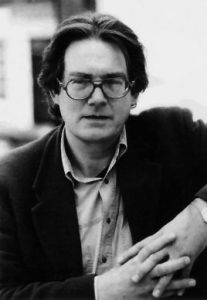 It is with much sadness that I recently learnt of the death of poet and editor, Sebastian Barker (FRSL), who passed away after suffering a cardiac arrest at the age of 68, on 14 February 2014. Sebastian had been stricken with lung cancer for some time prior to this, but I had only heard about his condition indirectly, and fairly recently.
The broadsheet obituaries will furnish readers with the full facts of his life and poetry career, but to recapitulate: Sebastian Barker was the son of the prolific British neo-Romantic poet George Barker (1913-1991) and the Canadian poet and novelist Elizabeth Smart (1913-1986), thus brought up in a rather ‘bohemian’ environment. He was educated at the King’s School, Canterbury, and Corpus Christi, Oxford. He was appointed to many auspicious posts throughout his career: Chairman of the Poetry Society (1988-1992); elected a Fellow of the Royal Society of Literature in 1997; and, of course, appointed editor of the London Magazine in 2002. His many poetry collections included: On the Rocks (Martin, Brian & O’Keeffe 1977), A Nuclear Epiphany (Friday Night Fish Publications, 1984), Guarding the Border: Selected Poems (Enitharmon Press in 1992), The Dream of Intelligence (Littlewood Arc, 1992), The Hand in the Well (Enitharmon, 1996).
At the age of 52, Sebastian converted to Roman Catholicism, and his growing fascination with the traditions, thought and symbolisms of the faith informed his later poetic works: Damnatio Memoriae: Erased from Memory (Enitharmon, 2004), The Erotics of God (Smokestack Books, 2005) and A Monastery of Light (The Bow-Wow Shop, 2012). But this was more a mystical than ‘religious’ poetics, very much rooted in Thomism (Thomas Aquinas (1225-1274), concepts such as Quiddity (essence), and the signs and symbols of human art as forms of transformative sacrament analogous to divine creation as signified in Catholic ritual (e.g. transubstantiation in the Eucharist), notions which had also heavily influenced Catholic poet David Jones (1895-1974), who wrote a monograph on the subject, ‘Art and Sacrament’ (Epoch and Artist). An article on Thomist influences in the art and poetry of David Jones and Jacques Maritain, ‘Art, Scholasticism, and Sacrament’ by Kate Edwards, appeared in the very last issue of the London Magazine under Sebastian’s editorship, and inspired me at the time to write a poem on the theme, ‘The Plaster Tramp’, which I dedicated to Sebastian, and which appeared in my 2008 volume A Tapestry of Absent Sitters).
My own association with Sebastian came, as it were, in the autumn of his long career, and towards the end of his highly imaginative and influential editorship of the London Magazine. Sebastian was the first editor of an established journal to give my own poetry that much-needed ‘break’ into wider recognition. I was extremely fortunate to have sent a copy of my debut volume, The Mansion Gardens (Paula Brown, 2006), to the London Magazine during Barker’s editorship: not expecting it to be noticed, I was very surprised to find a fairly extensive and mostly positive review of the book in the following issue, by respected poet and critic William Oxley. For a first full volume by a relatively unknown poet published by a relatively unknown imprint to get any exposure in a high profile journal seemed refreshingly against the grain of the predominant journal protocols of hoops and nepotisms, and, I think, was indicative of a very open-minded editorship.
Looking back, I can see that was perhaps the peripeteia in my own nascent poetry ‘career’. Not long after this, I was over the moon to have two poems accepted by Sebastian for another issue of LM, to be followed not long after by another acceptance. By the time of Sebastian’s resignation from LM, I’d come to feel I was becoming a regular contributor to the journal, but there would ensue, perhaps inescapably, a pause of a couple of years before my poems and critical writing would reappear there, under Steven O’Brien’s editorship. During the intervening time, there was a disorienting run of issues where it seemed LM had lost its identity and merged indistinguishably into the postmodernist mainstream, from which it had formerly stood out so distinctly and self-determinedly during Sebastian’s editorship. But the fact is, in terms of my own ‘introduction’ into the higher profile literary journal sphere – along with those of a number of other poets and writers I know – I have Sebastian Barker to thank. When I reviewed the last edition of LM under his editorship, in 2007, I wrote:
No journal genuinely nurtured its contributors as compassionately as The London Magazine under Sebastian Barker’s editorship, and as a recent contributor, I speak from personal experience.
As editor of LM (2002-07), Sebastian was, to my mind, perhaps the foremost progressive, generously spirited and genuinely open-minded of the established journal editors, and in those senses continued in and amplified the historical template of literary liberalism and catholicity exemplified by the LM’s briefest but most iconic editor, John Scott (1820-21), famous for his championing of the otherwise contemporaneously disparaged Romantics (Clare, Shelley, Keats); and for being fatally wounded in an ‘editors’ duel’ with J.H. Christie, close associate of the likes of the rancorous Tory literary critic John Coker, and Dr. John Gibson Lockhart of the Tory Blackwood’s magazine, whose snobbish drubbing of the poetry of Keats and Leigh Hunt as belonging to the ‘Cockney school of poets’ sparked a combustive series of literary missives which eventually drove Scott to take up pistols with Christie. It is a strange irony, given its ‘historied’ progressiveness (originally founded –in 1732– to provide supplemental political opposition to the Tory Gentleman’s Magazine) that, in recent years, the London Magazine –though still among the richest and most eclectic journals around– has come under noticeable Tory patronage; however –and to the journal’s continued credit– this hasn’t seemed to have yet detracted from its sense of aesthetic comity (while, from my own point of view as an occasional contributor, I’m keen to continue submitting material, if nothing else, to help towards keeping up the journal’s historical liberalism; this also gives an unusual opportunity to preach to the unconverted, as it were, which in a way adds to LM’s distinctive polemical eclecticism, and thereby encourages debate).
I was in occasional email correspondence with Sebastian around the time I was setting up The Recusant, and asked if he’d like to submit a poem. He sent me what I seem to recall was actually the first ever poem contribution published on The Recusant, ‘The Quercy Cross’, a beguiling pseudo-religious lyric, which I include at the bottom of this obituary. Sebastian would also later contribute some of his more polemically robust/ satirical verses to the two anti-cuts Caparison anthologies, Emergency Verse (2011) and The Robin Hood Book (2012).
As previously cited, Sebastian’s editorship of LM came to an abrupt end in 2007, when he resigned following the axing of funds to the journal by the Arts Council. I contacted him at that time to express my genuine sadness at his departure from LM, and wrote a polemical comment piece on TR in relation to the subject. I had also offered him an opportunity, if he felt so inclined, to write something on his recent experiences at the LM, for TR, but he was determined to put that whole episode behind him as quickly as he could, and didn’t feel then it was the appropriate time to discuss his perspectives in public (I think he did a couple of years on, in Acumen). This was a very difficult time for him, understandably, but he remained defiant, and optimistic for the future, even if, at this juncture, it was a mistier prospect than it had been for him previously. We tentatively discussed the possibility of working together on a Caparison ebook publication of his then current poetry manuscript, but I’d advised him it was probably better for his interests to hold out until another publisher offered him a print publication (which, I seem to recall, eventually came from Enitharmon).
Sebastian will be sorely missed by many across the broad spectrum of our multifaceted poetry culture, not only as a poet, but also as an editor. Though I never got round to meeting Sebastian face to face –something I now greatly regret– his correspondences, whether by email, or in his beautifully shaped snippets of handwritten, personalised comments at the bottom of the LM’s standardised typed acceptance letters, gave off a genuine glow of openness and hospitality, which one can sometimes detect not simply through content but also care of presentation. And in an era of multi-varied means of communication but exponentially rising solipsism –especially through the unspoken non-protocol of the email ‘licence’ not to reply to or even acknowledge receipt of a message sent, or a seeming misapprehension of some emailers to presume the sender is telepathically wired up to know they’ve received and read their messages!– especially among numerous contemporary poetry journal editors, Sebastian’s sense of basic courtesy and warmness of communication marked him out as perhaps one of the last truly empathic editors –a true adherent to apparently prelapsarian notions of polite appreciation.
And, most crucially, in spite of his prolific and significantly successful literary career, Sebastian had that very rare quality, but one which is, to my mind, essential to the spiritual authenticity of any poet: humility. And humility often seems in short supply in our contemporary poetry culture. It’s hoped, then, that in remembering Sebastian Barker, we might all reflect not only on the poetic but also personable reasons why he is, and will remain to be, so fondly remembered.
The Quercy Cross
There in the shade of the Quercy causse, the cross
Stands, as the bells of St Jean de Laur float over
The green auditorium of thin oak trees.
Patterns of sunlight rearrange their colour
As the wind strokes the oaks and settles down
To the fructification of the forest.
The sun pierces the leaves and stings the ground
With baking pools of stone in this neverest
Of ecclesiastical ascension
Towards the stone cross smacked with gold fungus,
An aureole of butterflies, the neon
Blue of the jet-threaded sky, the cicadas
Penetrating literature, with sharp teeth
Biting out the substance of my living breath.
[First poem published on The Recusant, in 2007]
Sebastian Barker (16 April 1945 – 31 January 2014)
He is survived by Hilary, and his four children, Chloë, Miranda, Daniel and Xanthi.
Alan Morrison
Obituary: Brenda Williams (10 Dec 1948-19 July 2015)
Brenda Williams, poet and protestor, was born on 10th December 1948 in Leeds, the eldest child of four. Her two younger brothers and sister have survived her.
The circumstances in which Williams grew up were dire: she lived with her parents and three siblings in a damp basement in a relative’s house; later the family progressed onto a council house.
Williams’ father was an alcoholic and could be abusive, sometimes beating the children. Brenda’s mother, an Irish Roman Catholic immigrant, was often terrified by her husband’s behaviour, and Williams remembered from an early age being taken out into street by her in order to avoid her father’s raving. Such traumatic experiences marked her for life.
Williams could have gone to grammar school but her parent’s couldn’t afford the school uniform. Her mother was an auxiliary nurse; her father always worked but spent much of his money in the pub –this taught his daughter from an early age that to be in work, to be employed, did not necessarily bring with it greater virtues.
Passing four O Levels and gaining an A Level in English Literature, Williams aspired to being a teacher, but ended up working as a library assistant. It was by dint of this occupation that she met young teacher and aspiring poet, Barry Tebb, via a mutual friend he taught with. Tebb’s curiosity was stirred by Brenda’s habit of reading Proust while working at the library; and after asking her out for a coffee following another meeting at a house warming party, Tebb soon realised that he and Williams were soul mates.
The couple married in 1967. Tebb’s poetic ambitions led them to take up a secluded, domestic life in an isolated cottage in Huddersfield. Williams, however, never settled to such a Wordsworthian retreat, so the couple moved to a more urban environment. Around this time, Williams gave birth to their son, Isaiah (for Williams, the first of two sons, her second, Ezra, from a subsequent relationship).
Williams and Tebb divorced in 1975 after eight years married. However, the two remained extremely close, Barry moving to a council house in the street next to Williams’ newly bought house, in Leeds.
Williams started writing poetry in late Seventies, and began having poems published in magazines. Around 1990, Tebb started up his own imprint, Sixties Press, under which he published his own and Williams’ work, alongside other distinctive but ‘unfashionable’ poets. Tebb managed to gain many sponsors for his small press imprint, including Rowan Williams (some time prior to his Archbishopric of Canterbury), with whom he had struck up poetic correspondence.
Their son, Isaiah, passed exams to get into Leeds grammar school (which poet Tony Harrison had attended). Around this time, Williams applied to Leeds University as a mature student, but was inexplicably rejected. This unfortunate stumbling block, however, saw Williams the poet assert what would become the other cardinal ingredient to her character: the protestor. Williams did sit-ins at Leeds University in protest against her unexplained exclusion, while Tebb, ever loyally, trooped the corridors of the establishment until he found out the reason for it. It turned out that her entry had been blocked by a ‘professorial veto’ issued by theology lecturer David Jenkins (later to become the Bishop of Durham) who disapproved of her having an illegitimate child (Ezra). Unfortunately, however, Williams’ protest was not efficacious on this occasion.
Ever close to one another, Williams and Tebb both moved to Oxford, still living separately, but close (echoes of Hardy’s Jude Fawley and Sue Bridehead). Ironically, Williams had finally and belatedly been offered that place at Leeds University, on the eve of their departure for Oxford. It came too late. They didn’t tell Leeds grammar school that they were moving with Isaiah from the area, which meant that their son was not transferred to Maudlin Grammar School, Oxford, as would have normally been the procedure. This second educational vicissitude spurred Williams to set up public protest in their new home town. This time she at least gained national publicity through a full page feature in the Times Educational Supplement. Absurdly, she had been arrested for ‘obstruction’ by an Oxford policeman, in spite of her pitching daily on a nine foot wide pavement. Subsequently the case was dismissed.
Williams now aspired to live in London, and felt St. John’s Wood had a particularly poetic sound to it, so moved there into a sub-let flat facilitated by Tebb, who, again, moved with her, settling nearby in Chiswick. Williams would remain in this flat for the rest of her life. Tebb would meet his second wife, another poet and fiction writer, Daisy Abey, while attending the Buddhist chapel opposite his new flat. Tebb, Williams and Abey all got on well together and remained a fond triumvirate.
Williams became a prolific protestor following her move to London. Perhaps her most well-known protest was in 2007, campaigning for better treatment from the mental health system in Camden and Islington. She pitched daily outside the Royal Free Hospital, since this was a central site. Camden Council, under all three main parties, continually tried to have Williams evicted from her protest pitch and arrested, her placards being constantly seized from her. These events were covered in lots of local newspapers at the time. Protesting alongside Williams was her close friend, Gertrude Falk, a leading physiologist and Hampstead Labour Party campaigner whose obituary in The Guardian (Weds 2 April 2008) mentioned her stint with Tebb and Williams outside the Royal Free. Williams, how own mother had died when she was just fifteen, had come to regard Gertrude Falk as a surrogate mother.
Williams suffered from severe depression throughout most of her life, spending lots of time at West Hampstead Day Hospital where art therapy helped her. She responded well to the compassionate approach of a psychiatrist, Dr. Peter Raven, who was also Senior Lecturer in Psychiatry at the Royal Free. Williams’ other source of human comfort was her indefatigable friend and ex-husband, Tebb, who continued to encourage her poetic efforts, from which she drew much strength.
Williams’ life was rendered more complicated and stressful due to the course her eldest son Isaiah’s took: after an auspicious educational start to his life (Eton, then Baliol Oxford), he descended into chronic paranoid schizophrenia, and remains hospitalised to this day.
Williams became an elected patient governor at Camden and Islington, and was in the middle of her third term when she died. She went to all the meetings, but her depression had been getting worse. Her mental health issues were exacerbated by trouble in the block of flats where she lived: a multi-propertied landlord bought up most of the block (on monies borrowed from the pre-Crash RBS, in 2007) where he ran a rental racket, herding Turkish-German tenants into the flats, charging them exorbitant rents underwritten Housing Benefit, and then, due to short-term tenancies which left the tenants with virtually no rights, evicting them. This 1920s block was constantly racked by intrusive noise as the property developer had his flats renovated. True to form, Williams set to protesting outside the block, which, by dint of being her own place of residence, meant her protest was legal.
Tebb believes that this, Williams’ last ditch protest, in part, contributed to the acceleration of her frail health, and subsequent untimely death; not least since Williams spent on average between eight and ten hours a day pitched outside the block of flats (141 videos on Youtube document it). Williams was diagnosed with lung cancer at the Royal Free in late December 2013, after a persistent cough did clear up with antibiotics. The supposition was that Williams, who had never smoked, had inherited a genetic predisposition to this particular cancer. She had already been perilously ill with a perforated bowel.
Williams’ treatment was transferred to the Marsden (via Tebb’s petitioning due to not being satisfied with her treatment at the Royal Free), but by this time the lung cancer was at ‘spread stage 3’, cellular and incurable. Williams was given a prognosis of 18 months. Then, in 2014, her cancer was unexpectedly deemed ‘77% cured’. However, sadly, by January of this year, the cancer again intensified, in spite of continual chemotherapy, and her doctor gave her 3 to 4 months to live, though she managed to live another six months.
A compulsive and prolific poet, Williams was still writing only a few weeks before her death, on 19th July 2015. Her final poem was the pointedly titled ‘Words Towards an Obituary’. In the last few years of her life, Williams became ‘obsessed’ by the sonnet form, producing hundreds of poems in this fourteen line structure, her ambition being to outnumber Shakespeare’s. In her will, Gertrude Falk had left Williams £6,000, which was used to pay the printer to publish a large number of copies of her Collected Poems, under Tebb’s Sixties Press imprint. Shortly before her death, Williams made Tebb, her lifelong soul mate, friend, champion, carer and custodian of her many cats, her official ‘next of kin’ and, implicitly, publisher and executor of her literary estate. (Posterity will tell if the lifelong mutual devotion and trysts of Tebb and Williams might one day join the canon of the likes of Graves and Riding, Barker and Smart, Hughes and Plath, Redgrove and Shuttle et al).
Finally, some words from this writer: it was my pleasure to have met Brenda once and fairly briefly, but memorably, when she attended the launch reading of Emergency Verse – Poetry in Defence of the Welfare State at the Poetry Library, Southbank Centre in January 2011. I recall in particular how friendly, warm and effusive she was towards me, seemingly delighted at the anthology and its attempt to make a poetic stand against the then-new Tory-led Coalition Government. Brenda simply said that she had to “hug” me for my effort, and promptly did so.
This was a real surprise for me since I’d been led to expect a dourer person from the description given of her by someone to whom she had presumably not felt particularly enamoured. Like Barry (Tebb), Brenda did not suffer fools gladly, but was demonstrably someone who would warm instantly to anyone who was of a similar wavelength and values (poetical and political), and I felt privileged that she warmed to me on our first and only meeting.
When, some months on from that launch reading someone I had previously counted as a friend and poetic champion, the veteran poet and reviewer, John Horder, triangulated a highly personalised and irrational critical assault on Emergency Verse (via a three-pronged duplication/circulation in the Camden Review, West End Extra and Islington Tribune), in spite of his having attended –in Brenda’s company– and read at the launch (though not as a contributor to the book, for my having not been able to get hold of him for permissions while selecting for it –hence, presumably, his sudden animus against me!), I was deeply touched when Barry told me how “incandescent” Brenda was on my behalf. She apparently promptly annulled her long-standing friendship with John as a result.
Brenda realised the importance of that anthology, at such an ominous and hopeless time politically, but also, as Barry related, felt genuinely aggrieved and angry on my behalf after the considerable effort and labour I had gone to in producing the 111-poet-strong tome, replete with epic polemical Foreword and Afterword. I remain forever grateful to Brenda for her empathy, respect and loyalty –loyalty, only after having met me once!
Brenda Williams (10 Dec 1948-19 July 2015) is survived by her sons Isaiah and Ezra, by her two younger brothers and sister, and a grandson.
Words towards an Obituary for Poetry
This is a road I never thought to know
Where memory is mimicking the end,
The future descends on the faculty
Of my soul, my mind struggling for a foothold in
Existence, always the poem, always
The unheard, there is nothing in my hands,
I leave with nothing this world understands.
Unimaginable those early days
The spirit conjuring its poetry,
Forgiveness he cannot borrow or lend
Words unfinished as the first light of day,
Lost as they are, forever on the way
The flickering candle he cannot trim
The undesciphered script of tomorrow.
Brenda Williams
7th July 2015
Your Dying
How can I endure winter without you, sad divine daughter of September?
Your calls outlast autumn’s miasma, the hesitant tone of your final poem
‘Towards an Obituary’, self-questioning, plaintive Keatsian ardour,
Harbour of all your griefs, your mother’s slow death from cancer,
Denied the bus fare for her last hospitalisation.
When they said you were terminal, “Three or four months and a bit”
You tried hard to finish ‘The Poet’, ‘Brian’s Not There’, ‘Forever Young’.
It was hopeless, so you fled to the South Bank to watch the films
You’d missed, a season of Siodmak, Welles in ‘Chimes at Midnight’.
You managed a whole Saturday, Hardy’s ‘Under the Greenwood Tree’
In three two hour episodes but the next day
You phoned at seven, “Please get me into hospital”.
It was the last time, after twelve days they moved you
To the hospice, I sat in the transfer ambulance,
You were strapped down and I strapped up, too far
To grasp your desperate hand. For once your terror was plain,
You’d never come home to your eight cats again.
I was the only visitor to the hospice, save Daisy
To assure your cradle Catholic soul of a Christian burial.
In those last twelve days you awaited death while I,
Hopeless and stunned, listened for your last breath.
Brenda Williams
10th December 1948 – 19th July 2015
Only music can stem the blood wrench of my heart
Your death began but nine weeks on
Every day your absence wakes me at four a.m.
I can never tell you how much I miss you
Words flowed between us like a river.
Barry Tebb
The Closed Door
for Eli Williams, aged four days
The Moving Finger writes; and,
having writ,
Moves on; nor all thy Piety nor Wit
Shall lure it back to cancel half a
Line,
Nor all thy Tears wash out a Word
of it.
The Rubáiyát of Omar Khayyám trs. Edward Fitzgerald
So soon, too soon, my grandson was torn from
Me, my lifeless arms left empty of him,
Never having known our newborn embrace,
Nor ever having seen his first known face.
I exist now with the memory of
You already, our brief life forbidden,
A candle, burnt out, before it even
Had a chance to soar, to magnify my
Dreams in the silence of time and to make
Them last for evermore. Before you were
Ever born, you kept me alive for nine
Months more, anchored at the core of being
To the closed door to come. How to endure
When time is no more than a starless shore.
Brenda Williams
13th August 2014
The world is larger now that you are here,
A new frontier palpable and sheer,
The days sear far into the stratosphere.
Your memory, perpetually near,
Is a bulwark for the hours as they veer,
The unsalvaged years from Truth and Beauty
Roll back low as though their own tsunami
And wake, and break against infinity,
I hear in the echoing terminus
The last mayday and muted sound of us.
In this bleak world between heaven and hell,
Time was left to spiral in parallel,
Yours was the face I never thought to see,
Unimaginable the time to be.
Brenda Williams
22nd August 2014
For a precious grandson
How I have missed you,
Never having known you
Down the long months.
I am your grandmother,
Brenda, and you will
Become the Keeper
Of my poetry in the years
To come. Welcome dear one
19th November 2014
Alan Morrison
‘A Mythology of Savage Gods’: The Spirit of Protest in the Poetry of Brenda Williams
Brenda Williams Selected Poems (Sixties Press, 2016)
Reading the posthumous Selected Poems of Brenda Williams (Sixties Press, 2016) has been a true respite amidst the brouhaha whipped up over a piece in PN Review criticising a collection by a high profile ‘spoken word’ poet for lacking poetic craftsmanship. If there is one thing that the poetry of Brenda Williams will be remembered for it is its indisputable craftsmanship.
Williams was a virtuoso at the sonnet form, having composed, almost by compulsion, several hundred in her lifetime, invariably in the Shakespearean or Spenserian template with final rhyming couplets, strict rhymes schemes and pitch-perfect iambic pentameter. This requires much poetic discipline and application to pull off, especially so prolifically. Here is a typical ‘Williamsonian’ sonnet:
I stand in the supermarket trying
To weigh your needs in the time left before
Returning to the ward routine, crying
From the depths of an unconscious world for
Your mind’s ruin. The bedraggled language
Hardly anyone now can understand,
A monologue nothing can yet assuage,
The tardy eschatology just fanned
Out like a mushroom from the livid day,
The manifest apparitions of night,
The voice of God that will not go away,
The past tense that can never be put right.
The co-ordinates of my life meet in
The Sanatorium’s summer ruin.
It is pointed that Williams’ earliest poetry was far from the compact formalism for which she has become known. One such poem, ‘In Memoriam: Herbert Howells (1892-1983)’, is a proto-sonnet, an almost stream-of-consciousness fourteen-liner in uncapitalised, unpunctuated syllabic blank verse:
time as oppressor impossible impermanent
the heart beat of eternity that never lets go
time turns diminishing unreachable reflections
its lifehold the distance of kaleidoscope fold
Jubilate and Te Deum pull me through but life’s
own hubris has put such futility into light
I cannot hold shadow colour running at the heart
…
with time inextricable it strikes upon itself
31st December 1983
‘Cyril Williams’ is a short cut-glass lyric about Williams’ troubled father, which closes on a truly striking trope: ‘once when the light/ went out wind blown/ branches through the glass/ spoke as men’. Williams wrote with astonishing honesty about her father, a belatedly diagnosed schizophrenic who self-medicated with alcohol, and who subjected his timid wife to emotional and physical abuse. The following passages are from ‘The Fordwych House Extract’:
Nothing
Could prepare her for its outcome each night
Nothing would halt or prevent the ending,
And we never let him out of our sight
So that my mother could escape if she
Had to and we hung on his every word
From the half-open door she had to flee
Through when the shouting stopped or went unheard
In the silence of his lunge towards her,
The stealth of his delirium after.
…
And all the times she walked in Torre Hill
She must have known that nothing would alter…
…
…you stare for the last
Time at my father, your mouth opening
On a silent scream echoing a fast
Locked silent world where you sit just before
Him listening, knowing that the money
Will not be there, that the quarrel of your
Departure was the fare for your journey…
…
Lily Lily I feel out of this worrld,
The falling snow caught in his hair and curled.
Williams more as witness than protagonist is the compass by which we navigate this harrowing familial saga. Such unadulterated candour in depicting domestic abuse is reminiscent of the searing verse of Thomas Blackburn:
Her fare amounted to nothing, and while
He was shouting in the endlessly drawn
Out pattern of years, he knew the trial
Of words was about to end, almost worn
Out as a black groove widens back before
The laceration of recorded sound.
And his words echoed back through the years or
Outward ran as mercury to the ground,
Something was broken, nothing would mend,
But his words would last as long as they could,
Love was never like this, and to the end
Of his last syllable, mutely I stood
Before her paralysed and listening,
I who could have said so much said nothing.
That devastating last line poignantly echoes the open mouth and ‘silent scream’ of her intimidated mother, and blooms a timeless symbolism, recalling Cordelia’s silence in King Lear, and Peter the Apostle’s denial of Christ. But it is far too harsh a self-judgement. Williams tackles her father’s psychiatric affliction in a paralysing couplet: ‘The closed chambers of schizophrenia/ Locked internecine within amnesia’ (‘Killingbeck Drive’).
Williams pays homage to the memory of her mother and the suffering she endured for years as a result of her husband’s mental instability in the 32-sonnet sequence, ‘We are Stardust’. There are some heart-stopping couplets throughout: ‘From the cemetery flowers that he gave,/ You would know too soon he would dig your grave’; and ‘Clutched in the hand of the only witness,/ The unacknowledged Morse of your distress’.
It’s particularly poignant that the plights of mother and daughter were meted out the same unfeeling stock phrase, especially since the daughter’s own suffering was as a result of being unable to come to terms with the mother’s early death (when Williams was just fifteen):
The end was something I could not amend
And for the rest of my life I would be
Told to pull myself together, the end
Was simply put on hold, reality
Would become what was left, you had become
In your own effacement by your own hand
As an undisclosed suicide by stealth…
And then the recollection:
We grew accustomed to him calling you
Woman, the times you would be told to pull
Yourself together there in the onslaught…
The mother’s life just seems to peter out through her eventual departure from the family home and then her early death from cancer not long afterwards:
Nothing can encompass what you endured
As my father’s delusions tore you from
Yourself, even from your shadow, immured
As you were with your four children…
Unsurprisingly, given such a traumatic background, Williams was a lifelong sufferer of depression, for which she was sometimes hospitalised. One detects an attempt to apprehend and contain the uncontainable debris of being within the cramped parameters of rhyme and pentameter:
So many are the days, I no longer
Belong to them and I cannot summon
An echo or its momentum after
For the buried words I am lost among.
May is heavy in the darkened early
Leaf hold of a far evening left as though
At the reach of another shore, slowly
Dissolving in the lengthening shadow…
…
Imagination running on empty
Parrying the end and the verb to be.
(‘Prologue’)
This is poetry sprung from depression –a processing through poetic melancholy; if there’s bleakness it’s a Keatsian bleakness occasionally wonderstruck with sunny intervals:
Time overturned from the black soil receive
Soft December rain piled beside cypress
Rusting tindered arched towards outstretched leaves
And left prone in green imprinted witness.
Outlasting the words Nature falls between,
The end is no more than a poet’s mien.
(‘The Roof Garden’)
Williams perfectly captures the sense of inner-desolation that depression inflicts on the sufferer, and, for the poet, the cruellest affliction of all, the loss of inspiration, the sudden dawning of language’s limitations:
Nothing else mattered and I sat for days
At a time yet unable to amend
An automatic reflex in the haze
Of green and drifting leaf of an early
Spring, the words had failed and I could not go
On, for my mind was burnt out entirely,
A rudimentary black smoke, hollow
With the sense of something distant and near
With the impact of intangible fear.
…
Even reality was a black haze
A smoke engulfing buildings
…
Poetry had lost its meaning for me,
It had become a weight and a pressure
That I could not bear or carry any-
More, for my mind was ill and beyond cure.
(‘Dismantling Fordwych House’)
Every morning now I wake to a dread
Beyond imagining and a failure
Of nerve enough for the silence ahead,
Something of infinity and its lure
Is still confined in me, yet encompassed
Round about are words that cannot get out,
With an origin that was meant to last
And a language I have to live without…
(‘Prologue’)
In hear earliest poetry the depressive tendencies had yet to be tethered in their influence on poetic form, and some passages, in their Joycean word associations and repeated sound-patterns, read almost like the jumbled language of graphorrhoea, a phenomenon sometimes encountered in psychosis or schizophrenia:
…and took in his stride needless humiliation over
the Venus de Milo and for eight weeks on Hebrew
the official university card in his own hand
and P. H. declaiming on an Etruscan cup
May snow in the underworld pine smoke in the pine dark
impermeable nothing lasts in the end nothing
outlasts night pine smoking dark the natural dark…
For those readers familiar with Williams’ main body of work, the seeming randomness and Ginsbergesque gush and clang of ‘For the Big Boys at the Gates of Magdalen’ might seem completely unexpected:
Ginsberg have you tried to carry that red and gold volume
around midway with a chair up bus steps I’ve cursed you yet
hard as the loosened sound inside bricks turning on hardened
cement or the outerside pounded LA Albuquerqe
Wichita Vortex Bayonne iron Horse Apollinaire
…
coming to Howl and thought Whitman irresponsible why
so long why can I read you now in Magdalen…
…
my last day by the railings residual sadness
the Mexican episode do we end or begin at all
Griffin give them guns
These luminous formative swerves into vers libre are aglow with stunning imagery that sometimes borders on the surreal –such as in this surging passage from her first significant long poem, ‘Death and The Maiden’ (1984):
children under starlight and gaslight became as men at
the far side of a street cry endless the rites of capture
and flight utmost the shadows at the time of abandon
in a green world seen through a great Victorian sideboard
brooched silver wrinkled black on astrakhan and rain walls rose
But is it vers libre? Closer inspection reveals it as syllabic verse: each line is exactly fourteen syllables. Given this, Williams’ gifts are magnified: an ability to experiment with grammatical structure whilst keeping within metrical restraints: ‘without end when rain ran once down Regent Street relentless’.
In these senses Williams’ prosodic development follows a similar pattern to that of W.H. Auden’s: from modernist experiment to lyrical formalism. Once Williams discovers her metrical metier, however, she still allows herself, particularly in her longer poems, to play with language. ‘The Fordwych House Extract’, for example, demonstrates how a relaxing of syntax and absence of commas permits poetic experiment within the parameters of rhyme and pentameter. This way Williams gives us glimpses of the sublime: ‘the slow/ Words curl black a cursive script scorched peeling/ Back from language into another tongue’; ‘Gable-ends from the back-to-backs of old/ Leeds reared sloped angles of rain to the cold’; ‘pathways of the wind empty/ Meet in a maze of paralysed shadow’ –and:
…my mind
Traced the letters in that transitory
Space between, pulsing from their charred ruin
The lit extinguished names end and begin.
An occasional focus on the clash between past and present, old and modern, rural and urban, could be an unconscious synecdoche for the poet’s minority formalist technique and tonal sincerity in an era of free verse and affected irony:
Can London’s massed and tangled garden die,
Piled, banked green, its laurel awaiting yet
A grab-loader, Muck and Rubbish Clearance.
(‘The Roof Garden’)
And legend has it that the beck ran red
With blood during the Wars of the Roses,
The king’s armies faced each other, gathered
On Killingbeck Field, wild wheat opposes
Now the chain installations of Walmart
And Comet and the drive-thru Burger King,
The fields of home effaced and torn apart,
Their familiarity a ruin…
There is indeed a sense of loss and nostalgia in Williams’ observations of place –but some of the countryside of her childhood haunts has yet to be redeveloped and still offers a window to the past:
The long shadows of the drive you walked through
In the Sixties are now beyond repair,
Only the blond abandon of the last
Field left to stand reminds me you were there.
(‘Killingbeck Drive’)
Though at times there is a Miltonic austereness to Williams’ sonnets, she occasionally breaks into luscious descriptions all the more impressive for fitting the tight iambic pentameters and rhyme schemes:
Our Lady’s Candles were still emerging,
Chestnut leaves unspread, recently broken
Under hazed green smoke, were slowly drifting
Upward through the grey pall of winter…
…Darkness broke from the cordon of April.
That trope is from the sonnet sequence, ‘In Memoriam Christine Blake’, Williams’ tribute to her friend and fellow psychiatric outpatient who tragically took her own life in 2002 after being ‘denied refuge’ at the West Hampstead Day Hospital.
There is a particularly moving passage in ‘Killingbeck Drive’ which touches on the profound sense of bereavement felt by a parent who has lost a child not to the finality of death but to the limbo of mental illness and the arrested development of personality which that can entail:
There exists no word in the language for
Parents who have lost their children, childless
Is not a fit description any more
Than children there yet not there, the endless,
The relentless presence of their absence,
Whether it be death or mental illness
Or days and nights just left as they were once,
Its aftermath is left to coalesce.
In ‘Margaret’, another poem depicting the apparent suicide of a friend and fellow neglected psychiatric outpatient, we find the poet at the start ‘watching rain slowly falling through/ May’s marble darkness, when I hardly know/ Where to belong anymore’ and ‘afraid even/ To put one word in front of another’. Margaret’s unassisted and fateful state of distress seems to have been the norm under the Camden health authority:
Left to beseech for a hospital bed
Which for some would be permanently full,
They lay abandoned in their homes instead,
At the mercy of crisis teams, a cull
Subliminal and as such it was done.
…
…abandoned they stood alone
With nothing left that they could call their own
Except for the manner of their dying,
As the slow cold intangible scarves curled
Around them, their shadows left with their name…
The alliteration in the line ‘At the mercy of crisis teams, a cull’ is particularly effective in putting across a clinical iciness. Ghosts of literary suicides, like Dido-shades, haunt this threnody for the eponymous bookish lady:
You would have read To be, or not to be,
Preparatory in a time before,
Pondering inevitability
Or accidental death behind your door.
Who can say if you followed Sylvia
The first day of a week you could not face,
You could quote by heart from Ophelia
And like her would vanish without a trace.
And always the hours, yet you knew full well
When Virginia entered the water,
Literary to the last, you would tell
Her that your death would mirror hers’ after…
A little further on Plath is referenced again: ‘And yet you would have known from Sylvia/ That Monday morning about the margin/ Of error’. Williams takes no hostages when apportioning the blame and, with crowning irony, the culprit was the very agency assigned to prevent such an occurrence:
…The crisis team
Killed her by knowingly dragging their feet,
By withholding a bed, and like Christine
Before her, left to accomplish her feat,
Her recent warning attempt had been scored
As nothing and the last one was ignored.
The poet then details Margaret’s previous suicide attempt:
You were suffering from anxiety,
You knew the end was near, three years ago
Everything went wrong and it was simply
A matter of time from then, the shadow
Of Christine Blake was now the nemesis
And template for future care in Camden,
Subsumed under the aegis of crisis
Team remedies, with only the garden
And art therapy a fleeting refuge
For us all. Back then, against all reason,
You were discharged home to face a deluge,
You would overdose there in the flood on
Amytriptaline, your spirit broken,
And found by random chance and awoken.
Williams was also a veteran protestor and campaigner, most notably against the closure of vital mental health services once provided by Camden & Islington NHS Trust, and on which she had been dependent. That she poeticised her protests adds the value of social document to her oeuvre, implicitly, since some of her longer poems and sequences are a part of those protests.
‘Lament for the Day Hospital’, for example, is an 18-sonnet polemic on yet another closure of the local mental health system (‘I trawl/ The far vestiges of a life ajar’). Each of the numbered sonnets is sardonically dedicated to various members of staff and/or management at the day hospital in question. In ‘for the day hospital patients’ Williams comments on the member of staff who is the first dedicatee of the sequence:
George seemed almost flattered by his placard
When he chanced to pass by, but even he
Would have baulked at downright incitation
Of the vulnerable and the ill.
In ‘for Dave Lee’ we get the following: ‘Nothing has/ Altered and the interval is as dust/ Already, the sonnets are seen as though/ ‘Graffiti’ peeling from its own shadow’. But from despondency comes righteous anger:
…For you are the truly culpable,
The dyed in the wool, I’m alright Jack berthed
In the town hall, too busy for the last
Phone call, feathering your nest while the rest
Of us go to the wall
(‘for Camden Mental Health Consortium’).
…but in the unseen depths of
The PCT and the low sea mist of
The Trust, in that Bermuda Triangle,
With the Health Authority looking on,
It is us going down with all souls on
Board, not you…
(‘for Stephen Conroy’)
Williams and her fellow outpatients are left ‘Clinging to the margin of things to come’. The nautical imagery is interesting, and is continued into one of my favourite passages from the penultimate sonnet:
No one is listening? Give. Sympathise. And
Control. Borne along on the barque of poetry,
‘Care is not for life’ like a loaded gun
Left on a hair-trigger when words are done.
The mantra ‘Care is not for life’ is sadly in increasing usage in target-driven mental health care today.
Williams’ fellow protestor outside the Royal Free Hospital had been Professor Gertrude Faulk whose companionship-in-placards in the face of the cancer that finally claimed her in 2008 is documented in Williams’ epic 166-sonnet sequence, ‘Forever Young’. The trope ‘she exists now only as a/ memory, an infinity from which I/ cannot break free, I’m so tired Gertrude,/ wait for me’ has something of Stevie Smith’s ‘Do Take Muriel Out’. There’s plaintiveness to the passage:
…you sat there for far too
Long that last afternoon, mute and watching,
Endlessly weighing the clamorous hours,
The silent vigil before you…
The following passage makes brilliant use of alliteration and assonance:
…There is no known
Relief for the heart waylaid and besieged
By grief, for a mind engulfed and too far
Out, drifting still and endlessly outwards,
At the uttermost rim of the age
And language, I could only run aground.
To Williams, the once-seemingly indefatigable Gertrude was ‘The last of the great and good of Hampstead,/ The empty railings echo now instead’. I excerpt Sonnet No. 12 in full:
Day by day they took away your poem
Fastened to the railings for the world to
See, the council’s final ignominy.
How could they then have sunk so low while still
In the axis of her dying shadow,
For we were not given the time between
Even her death and its diagnosis,
And before two months had run their course, the
Enforcers arrived in the lane by force,
But she would not be there to see as though
She knew already the atrocity
That would unfold untold in the future,
Enacted there in the heart of Hampstead,
The consummation of our daily dread.
There are too many striking tropes to excerpt but here are some: ‘mutely you sat there/ Bowed with your knowledge right through November’; ‘There are no words for loss/ Only the thudding of its aftermath/ Down the corridors of the mind, without/ Even an exit sign to be seen’; ‘The pall of camouflaged stars disparate/ Through neon and ebbing beyond seeing’. There are many luminous passages:
…the March sky was
Unusually blue that day and so
They turned you round to face an ivory
High magnolia which had suddenly
Flared into a full transitory bloom
Inlaid in a solid blue window…
And:
There is no absolution to be found,
Like the Sibyl of Cumae you wanted
Only to die, and for the life of us,
We could not bear you up, and you kept on
Answering how you were now damaged goods
And how you wanted to evaporate…
Another fellow traveller was indefatigable anti-war campaigner Brian Haw who famously pitched a permanent protest at Parliament Square; Williams pays homage to Haw, who died from lung cancer in 2011, in two long polemical poems, ‘The Protest Died Before the Man’ and ‘Brian’s Not There’. Such themes of protest permeate vast swathes of her poetry, often in sequences of sonnets knitted together. In these senses her poetry is that of protest, and rarely has protest in poetry been matched by such exacting craftsmanship as it is in Williams.
Williams’ later life was beset by the deaths of friends; in ‘Silent in Pond Street’ she mourns yet another: ‘…you would/ Die two days after Gertrude without my/ Knowing… / Everything is left behind, as/ A manifest perpetual regret/ Engulfs my mind’. Gertrude, Margaret, Christine –their names and memories lodge in the daily consciousness of the poet, ghosts from an emotional mythology of savage gods. In ‘Doris’, dedicated to Dr Doris Lister, Williams captures the sense of bereavement in the very firmament: ‘The drained stars in the interstellar dark’.
There is a strong sense that Williams’ deeply personal and empirical poems were part of a therapeutic as well as poetic method (therapoetic?) –and the former aspect in no way detracts from the dexterity of the latter:
Language alone manages to steer me
Through the hidden straits and open peril
Of insomnia, where rhythms to be
Are stored unknown and unwritten until
Conjured piecemeal into reality…
…
While the future crumbles into nothing
As though propped upon its own far shadow
Under a precarious scaffolding…
(‘The Fields of Killingbeck’)
It’s interesting how often the word ‘scaffolding’ surfaces in her poetry, suggestive of something unfinished and unstable which needs to be supported –metaphorically appropriate for mental health. Is it poetry itself that is ‘A mendicant language that will not scare’? One of Williams’ most powerful long poems is ‘The Pain Clinic’. It begins with an historical flourish:
I leave you after two years, an affair
Of the heart, something resolute I dare
Not resolve, the mind is the spirit’s limb
And the search of sojourner or pilgrim
Towards or from that of saint and martyr
Whether history or now or another,
Grace is the spirit’s breath, grace is the heart.
‘The light of life’ as Bede said but the start
Of a poet, that lodging of the end,
Outlasting this world, truth without amend.
Between the tombstones of St. Cuthbert and
St. Bede between destiny and England,
The stone sheared for nothing and Cranmer burned
And from your closed city a poet turned.
It contains some of Williams’ most acutely poetical tropes: ‘to tell of love/ After or before is but to tell of/ The rain that dingy blooms on branching pall/ A shadow natural as betrayal’. There’s a curious echo of her earlier work’s unpunctuated tendencies: ‘Beethoven mapped time a territory fit/ For sojourn of the diffident spirit/ And Schubert a lyric for love’s folly’. The couplets come up like tulips: ‘Love in the holy blue of a new dawn/ Is certain as Keats’ Ruth among the corn’; ‘The moments of the asphodel are few/ As the colour of day that Marlowe knew’. As with much of Williams’ oeuvre, ‘The Pain Clinic’ is partly autobiographical:
An Irish immigrant in Coburg Street
Gave birth, she could not know it would be meet
That the Nobel Prize nineteen forty eight
Was that evening given to Eliot.
In Leeds behind Lewis’s for three years
The sounds of the synagogue reached my ears,
Over Brudenell Road I was to know
The permanent anatomy of snow…
There’s a real confidence of touch in the phrasing:
Early November poplar leaves swathed far
And remnant on London’s light green smoke are
Still formal in a late sunlight, moving
With a certain airlessness and breathing
With a little breathlessness, tremulous
As human diminution. But surface
Leaf, unlike man, is buttressed from within,
Only the highest leaves are not given,
Topmost of the Lombardy and its last
Configuration where a leaf is fast
Held as a truth, as a man at the end,
Darker the poplar than night is darkened…
The final long poem in this Selected is the three-part epic, ‘The Poet’, which comprises 74 numbered sonnets. Keats is almost an habitué: ‘Nothing has changed since Keats resided here,/ When the poet stood his ground in Hampstead,/ Loitering on the outside’. This epic is the testament of a poet, and Williams captures it in an epitaphic couplet: ‘A life lived out alone for every word,/ As a bird’s solo flight, unseen, unheard’; ‘A poet is destined only to fail/ In almost everything he tries to do’; ‘The unwritten hours with nothing showing’. Williams perfectly taps into the poet’s preoccupation with posterity and its opposite:
What has the poet to look back to when
Under the scaffolding lies a ruin
Where everything he knows has been taken
From him, no more than left to leaf through on
Far off and ineffable afternoons?
A poetry not of his own making,
A story out of time, without an end,
A familiar anonymity
Turning unread in the wind…
But oblivion is something Williams the poet and person dares to dwell on:
Silence throws no shadows, its ricochet
Is heard far in the hollows of the mind
Where beauty and rage contest, a battle
Inaudible even as Shakespeare’s flower.
The hell of Meaning is every moment
In which the fugitive spirit can find
No refuge from echoes of all that’s known,
From the emptiness, for his own defence
In syllabic darkness…
Williams is a poet of ruminations: her vigorous ploughing over themes digs up different perspectives. She looks back in sadness at all those emotions of the human condition that are destined in the end to simply disappear without a trace: ‘What was it all about, the muted cry,/ The scream that would never reach foreclosure,/ And the anger destined only to die’. No 17 is a beautifully wrought sonnet and a sublime summation of poetic consciousness:
What has a poet to look back to when
All that he knows has been taken from him,
When the future is little more than a
Plundered unremembered mausoleum
To his dreams. The poems like children have
Grown and gone…
…
To belong, even for a moment then,
To a distant irretrievable song,
Seen now as a prodigal son, unknown
And unrecognizable as his own.
She might well ask, as of herself: ‘What drives the poet trapped for a lifetime/ Locked behind rhythm and recurring rhyme’. There are echoes of Keats’ ‘When I Have Fears That I May Cease To Be’ (…‘Before my pen has glean’d my teeming brain’) in the following passage which perfectly captures the strange angst of the creative mind facing extinction and, rather absurdly, panicking primarily at the prospect of not having enough time to write everything they’ve planned:
There was no one to man the CT scan
That night nor even the following day
Until well into the afternoon by
Then, only a low blood pressure could tie
Me to memory, to so long ago
When I was a nurse stood there now looking
On as fifty over forty hovered
Between tomorrow in the anteroom
Of A&E and the unknown miles of
This world and the poetry yet to be.
Number 28 in this sequence is to my mind perhaps the profoundest of all Williams’ sonnets on the subject of the poet:
Tsvetaeva once wrote in Stalinist
Russia, ‘My country has failed to take care
Of me.’ After a row with her own son
She died without warning before morning,
Her own suicide, while he would perish
Within weeks fighting on the Eastern Front.
Greater than Akhmatova, unrivalled
In her lifetime, it is we who are left
Behind to bear witness to betrayal,
A crime so near and yet so far reaching,
Endless as the moment the line left off.
Shadows in the dark undiscerned, this is
The way my country lets its poets die
Unheeded, in the blinking of an eye.
That last couplet is particularly resonant; it’s also interesting to note that many of the sonnets in ‘The Poet’ are irregularly rhymed or sometimes unrhymed, except for the final couplets –in the sense that they still adhere to pentameter puts them pretty much in the blank verse camp, and perhaps, had Williams had longer to live, and write, she might have evolved her style more in the direction of blank verse.
Number 29 is no less sublime and with some lovely turns of phrase: ‘Having known something of greatness once, locked/ Within their bones. Poets are born not made/ Though circumstance can shape the spirit…’. In No. 30 Williams reflects on some of those poets whose times came prematurely, either through accident or suicide:
I’m reminded always of my own kind,
Poets known and unknown who died before
Their time, without the knowledge of the end,
Enough to finish what they had begun.
Lowell in a taxi with no one near,
Berryman stepping from the bridge without
Looking back, Virginia gathering
Stones for weight instead of flowers, ‘Always
The hours,’ the days. Sylvia looking on
At Fitzroy Road searching for something she
Cannot see, birds with an illusion of
The sky in an aviary nearby.
There is no release, every poem is
The last and the rest is endless stasis.
The list of poet-suicides alone is considerable – Thomas Chatterton, Thomas Lovell Beddoes, John Davidson, Paul Celan, Hart Crane, Dino Campana, Amy Levy, Vachel Lindsay, Charlotte Mew, Sylvia Plath, Roger Roughton, Anne Sexton, John Berryman et al. (or see Al Alvarez’ fascinating study of literary suicide, The Savage God). Presumably the poet chooses to mention those particular poets that have inspired them. The couplet of lines 9-10 in the succeeding sonnet is particularly powerful:
…my finger following the drawn
Fold imprinted on a hospital screen,
Wondering if what was written would hold
Against the planetary cold untold…
And the following passage brings the first part of ‘The Poet’ to its close:
To die without knowing and yet to die
Alone by his own hand, not knowing why,
The cordon of silence, the poet’s cry,
While the shrill sun assails his days always.
There some beautiful descriptive phrases throughout: ‘…Softly falling white/ Rain welled into chiselled unstill runnels,/ Pools of unspooled carbon script eddying/ In the cold interstellar light untold’. This epic poem is ripe with aphorism: ‘There is only the time left to forgive/ And to salvage the poetry left there’. Williams again puts the process of poetry, its psychology, under the poetic microscope:
From freedom and folly the words were made,
The years before my father wore his shawl
Of madness, the ancestral roots of then
And now which cling, that time cannot allay,
The Irish girl remembered in my song.
Williams’ Irish mother was Roman Catholic –one presumes the poet herself was either atheist or Protestant after her father; the different nationality and faith of the mother makes her an even more distant, misty figure:
My mother was afraid of cemetery
Flowers and lilac was forbidden in
Our house, the misfortune it would always
Bring in its wake should it be broken free.
She liked lily of the valley and blue
Hyacinth, early May blossom woven
At the stem in a crown for Mary’s head…
The poet laments, in Miltonic tone, what she perceives as the corruption of poetry:
Out of the darkness they come, already
Known, with the earliest foundations laid,
Before the first drawn involuntary cry
A poet’s life is destined to be set
Apart, encompassing Truth and Beauty
Locked within the scaffolding of the heart.
Leaving without language, right from the start,
Poetry was bought and sold and betrayed
To the lowest bidder in the market
Place, the angelic hordes deafened on high.
There are some devastating couplets on the poet’s sense of mortality: ‘The unwritten verse he cannot salvage/ As poetry takes its leave of language’; ‘The tariff rendered at the end, instead,/ But a lifetime unopened and unread’; ‘Its inextinguishable watermark/ The starless, inalienable dark’. There are shades of fellow Leeds poet Martin Bell in the mixing of the parochial with the macrocosmic: ‘While he struggles under the future’s weight/ The far cupolas of Leeds fade, the white/ Stucco peeling from the walls of his mind’. Amid so much universal meditation and metaphysical speculation Williams mixes in concrete depictions of her birthplace:
The road ran from Burley Park to Hyde Park
Past the preserved facade of the picture
House unchanged since the Edwardian age.
A gate was closed against the traffic roar
And a cellar clamour which would immure
Me within its depths until I was four.
The end began there and would seal my fate
Through those first years until it was too late,
The damp, the airlessness could not assuage
Bronchial illness which almost killed us
Until Leeds City Council closed it down…
The nostalgia is indefatigable: ‘The Fifties like softly falling night rain,/ Affinity that would not come again’. Then back to the comfortless present: ‘What a time it is here, October wind/ Shuffles now, braced against reluctant trees/ Trembling’. And the poet’s anticipation of an implacable oblivion continues:
With nowhere to go he struggles to write,
His irradiated brain igniting
Beneath the strain, an inferno fighting
For a life that can never be put right,
For a name which will never see the light…
Williams anticipates ‘The fathomless future/ Which lies beneath the landscape of a dream,/ Laps against the fabric of things that seem/ And the scaffolding of all that has been…’. The poet is perhaps more preoccupied than most by mortality: ‘Many times in his lifetime a poet/ Navigates his own death searching for an/ Answer in the muted abandoned dark’, as he ‘struggles to survive/ Only to keep the poetry alive’. Number 30 in this epic sonnet sequence is emphatically pessimistic as to any transcendence through poetry and creativity:
How does a poet take his last look back?
We dreamed we were pure spirit at the end,
Able to drive language forward into
New frontiers of collaborating song.
We were wrong, for death was always out there
Hovering over all that we would dare,
Annihilating all that was written,
Muting rhythm with a poet’s despair,
When his own ‘green thought’ is an open door
Left ajar, forever more, his last war,
Relentlessly lapping, an incoming
Tide, bearing Charon, ferrying, for an
Unknown shore…
Williams has no illusions as to her fate, and the brutal reality of her spreading cancer is given emphasis in the abruptness of a clinical term amidst the poetic phrases:
Mediastinal spread, the very word
Is a death knell summoning me to hell,
Poets die young, destined never to reach
The culmination of their casual
Song. It is myself I fear, the future
Is not mine anymore, only what I
Lived for will endure, insignificant
As winter’s leaves in February wind…
It is unclear from the first sonnet of the third part of ‘The Poet’ whether Williams’ father actually committed suicide but it seems to be implied:
For Cyril had built his fire up so high
The old ladies feared it would reach the sky,
His wound clock had been thrown from a window
And lay in pieces on the lawn below,
Through window glass he had managed to throw
The one companion, his radio.
The life which he had known, he put an end
To that night, the rest was what time would lend,
While he stood there holed-up before the world,
Before all the days and nights he had hurled
Towards the whispering branches trying
Ceaselessly and needlessly to get in…
Williams gives us much more detail about her father Cyril’s hitherto obscure back story and it is illuminating:
His army discharge papers said it all,
‘Paranoia ’, ‘psychosis’, what it meant
When I found them, I was simply too young
To know, my mother, who knew, would never
Say, knowing it was schizophrenia.
Years later, his diagnosis revealed,
The lasting damage could not be undone,
The poetry came from life, lost and won…
The poet has bitter lessons to learn before finally accepting fate:
The un-negotiated territory
Of the fast shuttered far marauded heart,
There was only ever our life apart,
As reality became memory,
Day and night but the spirit’s own doubting,
And existence, the prison of the free,
Imagination’s pillars thrown and hurled
To the outer rim of fate, left to wait,
As the end unwritten yet meant to be.
There’s a brilliant phrase that suddenly flares up in one sonnet: ‘An unstammering flame which defies/ The dark as the action of a flower’.
It is both surprising yet expected that Williams composed her last poem only twelve days before her death from lung cancer on 19th July 2015. And here it is: ‘Words Towards an Obituary for Poetry’, dated 7th July 2015:
This is a road I never thought to know
Where memory is mimicking the end,
The future descends on the faculty
Of my soul, my mind struggling for a foothold in
Existence, always the poem, always
The unheard, there is nothing in my hands,
I leave with nothing this world understands.
Unimaginable those early days
The spirit conjuring its poetry,
Forgiveness he cannot borrow or lend
Words unfinished as the first light of day,
Lost as they are, forever on the way
The flickering candle he cannot trim
The undeciphered script of tomorrow.
There is an unabashed bearing of the soul in Williams’ poems which perhaps in part explains her neglect by a postmodernist mainstream so soured in irony. In these senses Williams’ oeuvre has more in common, tonally, with the emerging ‘New Sincerity’ across the Atlantic. It also shares much in terms of confessional tone with American poets John Berryman, Anne Sexton, Robert Lowell and Sylvia Plath (the latter two frequently name-checked by Williams in her poems). A bit further back in American poetry and the stitched miniatures of the equally death-haunted Emily Dickinson are traceable ancestors.
In terms of English influences, one feels the presences of the Romantics, particularly Keats, who frequently appears jackdawish in the ruins; Emily Brontë, whose Wuthering Heights casts a folkloric shadow over the Leeds born-and-raised Williams (fellow ‘Loiner’ and then-husband Tebb shared an isolated cottage with Williams in Huddersfield); there is also something of Stevie Smith in terms of themes and tones, though less so prosody; and of Thomas Blackburn, especially in the longer poems which crop up sporadically like archipelagos, but which, impressively, still adhere to iambic pentameter, and rhyme schemes.
Williams’ poems are almost always polemical: whether tackling psychiatric abuse, the interminable battle for decent mental health treatment –or the battle for literary recognition, tackled brilliantly in ‘Coming Through’:
I amount to no more than
A footnote from a protest here and there,
Yet Eliot received the Nobel Prize
The night I was born, the years after were
Encompassed by silence such that it cries
Out for recognition from a mute despair,
From the starless darkness of London’s glare.
This is a bitingly candid poem-polemic on coping with poetic rejection and ostracism, and is resoundingly pessimistic:
And it was never about coming through
Enough or receiving literary
Charity undeserved unjustified
Or even the pointless anthology,
It was more about why a poet cried.
Then as now, as Keats knew, nothing can be
Altered, the lineaments of language
Are set in stone as the fixed parity
Of the ordinary of a mute age,
And poets die at the edge of its sword,
For we write as we must without reward.
…
The debate that you fear has been going
On for centuries and it will not go
Away, it laps at the fact that nothing
Can be done, that there has always been no
Way through…
Williams goes for the jugular on the homogenisation of contemporary poetry in one bitter but apposite couplet: ‘Dullards are now the arbiters of choice/ Drowning out the individual voice’. ‘Four Months’ is a pointedly polemical long poem focusing on the almost endemic shortcomings of mental health treatment still just as prevalent today:
It is difficult to negotiate
The unfolding precipitous footpath
Of the talking cure, too soon or too late
And there is nothing but the aftermath
Of a wrong turning, the circuitous
Forgotten route back to the beginning
Again, lost among the coterminous
Echoes of life alongside…
But the polemic becomes even more pointed further into this poem:
My feelings have been found to be extreme,
Summed up measured and found to be wanting
They are not acceptable to the team
Any more than a poem’s existing…
Then Williams launches into a heartfelt plea:
Why has this pressure been put on my mind
The only offence I gave was to be
Ill, it was exerted by a combined
Team pushing me towards extremity.
It seemed as though my spirit was up for
Grabs, the vestiges of a life for sale,
My innermost thoughts were spread out before
Me, open tattered pages left to trail
An abandoned debris along the ground,
My sensibility bound and censured
Was made to bow and scrape without a sound,
A captive held there somehow to be lured
To a false and final diagnosis,
The slipped unnoticed noose of psychosis.
Her longer poems plough through their themes so thoroughly as to churn up more and more surprising insights:
There a mounting dread
Accompanied me, as anxiety
Was seized upon as something you could fix
With the worst of the anti-psychotics.
I am expected to release my pain
As though it was some long imprisoned thing
Allowing me to visit it again
And again…
…A fixed sentence
That no one can overturn for something
Beyond understanding that happened once
In another time, just to let it go
I must walk away from my own shadow.
In that last exceptional couplet Williams finds the perfect metaphor for the impossibility of complete psychical healing amid the institutional impatience of a compassion-fatigued mental health service. An unhelpful atmosphere for those attempting to get better in spite of stigma and societal intransigence, which leaves the patient numb: ‘Where I turn about searching near and far/ For the lost name of the familiar’.
As with all poets, Williams has her own word-stock: ‘shadow’, ‘echo’, ‘assuage’, ‘language’, ‘leaf’, ‘pall’, ‘scaffolding’, ‘unalterable’, ‘reflect’, ‘hollow’, ‘clamorous’, ‘ricochet’, ‘ineffaceable’, ‘inextinguishable’, ‘immeasurable’, ‘interminable’, ‘ruins’, ‘listless’, ‘lodestar’ etc. This is not only a Romantic idiom –by turns Keatsian, Tennysonian– but also one redolent of the Graveyard School, and Gothic and late Victorian poetics of the likes of Christina Rossetti, or those doomed alumni of the Rhymers’ Club, Ernest Dowson, Francis Thompson et al.
Recurring literary allusions throughout her work serve almost as leitmotivs: ‘Lethe’ (the river of oblivion in Greek mythology) features many times, ‘Charon’ a couple of times, as do fictional and true life suicides ‘Ophelia’ (from Hamlet) and ‘Sylvia’ (Plath) (though oddly no Dido). Plath’s suicide is also the subject of ‘23 Fitzroy Road’:
I stand before a house and the blue plaque
Of Yeats that drew you without warning or
Omen to that last February dark,
The incongruity of its closed door
And the street leading off into Primrose
Hill spanned almost by a tree’s winter girth…
The second and final sonnet making up this poem is exceptionally composed and closes on a strikingly figurative couplet:
And suddenly the Sibyl of Cumae
Caged among a throng in the market place
To answer to the young ‘I want to die’,
Where the spirit is the syntax and case
Ending of a poem, death is a shadow
Awaiting its hour, what was a question
Has now become a reality no
Answer could reveal. And from confusion
When even the spirit fails to exist,
Poetry is time’s equilibrium,
Through filaments of light, memory missed
Or abandoned, there is a life to come.
You alone sustain and your moon’s black hour
Lets fall a snow’s indelible shower.
Unlike Plath, but more like Stevie Smith, Williams’ suicide attempt was unsuccessful: an overdose taken outside Keats’ House in 2006 which she details in ‘The Overdose’, one of three prose pieces at the back of this volume.
In an early poem, the stream-of-consciousness ‘Your Mr Flintoff Holds out Little Hope’, the Oxford that Williams moves to with her young son, Isaiah, and shadowed by ex-husband but continuing companion Tebb, is Hardy’s Christminster by association:
well I came to classics through Coriolanus but
really it was Penelope more the part about
filling Ithaca full of moths for I must know how
he made it and I suppose it was the master’s words
to Gwendolen or Jude in the rain at Christminster
for this alone I come with my son from all things past
the future alight in dreams I cannot hold fast
anymore than the sun dark from which you turn your eyes
Hardy’s Jude Fawley and Sue Bridehead adumbrate the un-showily bohemian Tebb and Williams, not least in the psychoses afflicting both couples’ sons: Isaiah suffered a mental breakdown while an undergraduate at Oxford and sectioned decades on has still yet to recover.
In ‘La Figlia Che Piange’ the Thames is T.S. Eliot’s from The Waste Land or even a parallel Mississippi or ‘strong brown god’ from ‘The Dry Salvages’ (Four Quartets) –the lap and pull of the waters is beautifully evoked with repetitions of certain words (‘emptiness’, ‘sojourner’) and phrases (‘snow dissolved’, ‘altering nothing’):
for ten years her arms full he let her stand Eliot was
silent after La Figlia emptiness the sojourner
who cannot disembark you would not look back emptiness
neither hurting nor healing is the sojourner who will
not see his journey’s end to heal is to hurt and you would
not look back time the distance at the distance of things snow
dissolved over the Thames altering nothing the vowels
remain before and after and untaught out of depths
the senses make the metre reality the oar pull
on the water to know the spirit is to look back to
know futility if only for one who would not look
back altering nothing the knowledge of good and evil
snow dissolved over the Thames altering nothing
But it is ultimately for her supreme application of iambic pentameter as exemplified in her beautifully crafted sonnets for which Williams is most admired:
Every morning now I wake to a dread
Beyond imagining and a failure
Of nerve enough for the silence ahead,
Something of infinity and its lure
Is still confined in me, yet encompassed
Round about are words that cannot get out,
With an origin that was meant to last
And a language I have to live without.
In dreams I remember another time
In memory’s firmament aligning
As a far lodestar, a forgotten rhyme
Held fast in chains of my own defining.
I exist now only as a shadow,
As an echo refusing to let go.
(‘Prologue’)
This handsomely produced posthumous Selected Poems is the perfect introduction to the poetry of Williams. Its still considerable 338 pages are inclusive of a short section of critical essays on her poetry, and a compendious ‘prolegomenon’ by Williams’ former husband, kindred spirit, champion, publisher and fellow ‘Loiner’ (native of Leeds), poet Barry Tebb.
Tebb writes in his Foreword: ‘Of no poet is it more certain that the life and the poetry cannot be separated’. And nor can the relationship between the poetry and the protest: years spent clutching placards at ‘outside ‘sit ins’’ (Tebb) seemed the perfect metaphor for her sense of being perpetually on the outside of the poetry establishment.
Williams was in many senses the epitome of the ‘survivor’ poet, and her oeuvre deserves recognition not only for its poetic merits but also as psychiatric literature. That she dated each sonnet adds a diary-like quality of social document to her work. Now the poetry itself will continue its protest into posterity.
…what am I
But something the world cannot understand,
Poetry and protest go hand in hand.
(‘Martyr’s Memorial’)
Alan Morrison
Norman Buller, Poet
15th February 1927 – 7th January 2021
It is with much sadness I come to write this obituary of the late poet Norman Buller with whom I had the pleasure of being in regular phone and email contact for some years in the early Noughties and also to meet in person on one occasion.
But first the facts of Norman’s life and poetry career.
Norman William Buller was born and grew up in Birmingham, England. He was educated at Fircroft College in Birmingham and St. Catharine’s College, Cambridge, where he read English. He became one of the Cambridge poets of the early 1950s and his verse appeared in magazines and anthologies alongside that of Thom Gunn and Ted Hughes. From the mid-1950s for about twenty-five years Buller wrote very little. His occupation was in careers advisory work at the universities of Sheffield, Queen’s Belfast and Birmingam. While at Belfast he took part in Philip Hobsbaum’s creative soirée alongside Seamus Heaney, Michael Longley et al, but throughout that time published just one pamphlet, Thirteen Poems, in 1965.
Buller flared back into print 40 years later with a pamphlet Travelling Light (Waterloo, 2005). Four full volumes followed: Sleeping with Icons (Waterloo, 2007), Fools and Mirrors (2010), Powder on the Wind (2011), and Pictures of the Fleeting World (2013), all highly praised by critics such as William Oxley, Roland John and Will Daunt in journals such as Envoi, Poetry Salzburg Review,The London Magazine, Cambridge Left, Acumen, Agenda.
Between 2008 and 2013 I was in regular phone and email contact with Norman, a fellow Waterloo Press poet,our correspondence often in the capacity of my helping out with book designs, typesetting and blurb-writing for the imprint, including for all his volumes. I had recommended a submitted manuscript of Norman’s to Waterloo’s chief editor Dr Simon Jenner,which resulted in the slim pamphlet collection Travelling Light (2005). Norman’s prolific body of poetry scrupulously drafted during the course of the previous couple of decades provided enough material (and all accomplished) to fill a good few volumes for the foreseeable future, and since Norman also had a sizeable and very loyal readership, it was feasible for the press to publish his collections at relativelty short intervals. Since many of his readers were happy to ‘subscribe’ to his collections by way of pre-orders, each of his collections had effectively sold out before they wereeven printed.
During the time I was in contact with Norman he made significant headway as a contributor of poetry and critical monographs to many high profile literary journals, perhaps most regularly, The London Magazine, during the tail-end of the late Sebastian Barker’s editorship and through into Steven O’Brien’s. It was actually at a London launch of an issue of The London Magazine in 2011 to which both of us had been invited as contributors that Norman and I met in person for the first and only time, but it was an extensive meeting and one which Norman and his Bavarian-born wife Ursula (whom he called Uschi) had travelled 160 miles by taxi from Worcestershire to get to. The main fragment I remember from our long conversation was Norman mentioning when he’d met Dylan Thomas who had come to do a reading at Cambridge when Norman was a student there – I seem to recall Norman describing Thomas as “rather dishevelled”. Norman certainly wasn’t dishevelled, in suit jacket and bow tie, atop which snowy hair and a short white beard gave an almost wizardly impression.
Norman always came across to me as a kind-hearted, gentlemanly, scrupulously articulate person, extremely warm and polite. He was immensely proud of having made it to Cambridge University from a relatively humble upperworking-class background in Birmingham, and perhaps this was also partly why he was so fascinated by the life, work and character of DH Lawrence. His other main influence had been WB Yeats. Norman himself had been an influence on the young Thom Gunn.
Norman was very careful with his time, choosing to use it mostly in pursuit of his poetic craftsmanship. If not drafting his poetry, he’d busy himself promoting his collections, some of which were audio-accompanied in the form of CD samplers he made in a hired recording studio, whereby readers were treated to his meticulous recitations. He also read at a number of literary festivals including Ledbury.
He often advised me to spend less time reviewing other poets, and to spend almost all my time working on my own poetry – I think he meant that there were ‘critics’ to do the former while poets should purely focus on their own output, but that was perhaps a generational perception since increasingly most poetry critics are themselves poets. I’ve always spent most of my time working on my own poetry, but sometimes it’s felt appropriate to me to critically analyse the poetry of some of my contemporaries – this can be poetically nourishing in a different sense and help to enrichen one’s own writing in all sorts of different ways. Sometimes it’s important to take a step back from one’s own work and take stock of what others are doing. But Norman set himself one particular rule for when he did occasionally write a critical piece or monograph on another poet: they must be deceased –and, as importantly, have a strong posthumous track record. For whatever reasons, he did not believe in reviewing living poets (though he once made an exception for Derwent May). His approach was usually to analyse and contextualise a famous poem by a famous past poet, and these essays included the astute and erudite ‘W. H. Auden and ‘September 1 1939” and ‘W. B. Yeats and ‘Sailing to Byzantium’’, both published in The London Magazine.
On Norman’s poetry: his was a highly refined, exacting and disciplined figurative lyricism, his poems often fairly short to middling in length (he often commented to me that he didn’t go in for long poems and it was rare for his poems to go over onto a second page).There was a definite orientalism to his style, he often composed haikus and poems of similar forms, and this was perhaps most refracted in his 2013 volume Pictures of the Fleeting World. There were definite Yeatsian and Audenesque qualities to Norman’s poetry, some similarities to Bernard Spencer, and to a contemporary, Donald Ward (d. 2003 one year shy of Norman’s94 years) who had been published by Frome-based Hippopotamus Press which I seem to recall had been Norman’s first port of call for publishing his work, and which would have, had the imprint not been cutting back on its list at the time he submitted to them. Needless to say these influences in no way detracted from the distinctiveness of his individual voice.
Norman was also passionate about art and many of his poems were ekphrastic tributes to various past artists and artworks, particularly Post-Impressionists, and Expressionists. He once relayed to me a touching story of how he came to write so much ekphrastic poetry: it had started with an epiphany when extemporising what he imagined was being depicted in a Japanese print on his wall. This Damascene moment led Norman into a whole new approach to his poetry which he put eloquently to me once in an email: ‘I began looking at other paintings and found I could produce successful poems from them…the new poems, when successful, were… re-presentations of my experience of the objects rather than mere descriptions of them. In other words, I had become what Keats called ‘the chamelion poet’, one who became so identified with the object that he, as himself, had, for the purpose of the poem, transposed into it.’
I feelhonoured to have known a fine poet of a much earlier generation than my own and yet one with whom I felt so much in common – some qualities, I suppose, are ageless. Norman and I often mutually lamented the tragic erosion of the postwar consensus and social democracy in Britain since Thatcherism. Norman was very much a product of postwar social meritocracy, of the Pelican-educated Richard Hoggart generation, while I was, am, I suppose, something of a throwback to it, a hauntological nostalgist. The term Norman frequently used to describe the moral regression he generally perceived in post-Thatcherite society was ‘decadent’, which he’d pronounce as if negotiating a bad taste in his mouth.
The British poetry world has, probably without knowing it, lost one of its finest craftsmen, and it can only be hoped that the rest of Norman’s oeuvre will eventually see print posthumously. It seems appropriate to close with Norman’s words on how he saw the poet’s mission: ‘All each of us can do is try always to produce the very best work of which we are capable by whatever means we can.’ Norman Buller was a poet who did so demonstrably.
Norman is survived by his wife Ursula and daughter Anthea.
Below I reproduce the critical blurbs I wrote for Norman’s final three Waterloo volumes, since these give detailed summations of each respective collection inclusive of excerpts from his poems.
Norman Buller’s second full collection confronts the universal prism that Fools and Mirrors us. Behind the prosodic elegance beats an earthy vitalism that tussles with a disembodied, spiritual distrust of the physical – a fascinating dynamic. ‘Portraits by Francis Bacon’ captures the tortured carnality of that artist’s work, its misanthropic grotesquery provoking the poet’s Gulliverish revulsion at the animal in us. But Buller’s pessimism is more sceptical than devout, and when saying ‘we dream a sense of purpose/ …the rest is meat’, a sense of salvation triumphs in the beauty of such phrasing.
In stark contrast is an appetite for Lawrentian symbolism: ‘roadsides yellowed/ by phalluses of broom’. A poet deeply sceptical of the turn society has taken over the last three decades, Buller’s work is alert to an encroaching decadence that most pretend isn’t there. His is a humanistic politics that laments the post-war consensus, while quietly accusing capitalism of its gradual dismantling; from Aldermaston to the eerie blue skies of Manhattan 9/11.
In a more theological vein, Buller probes the spiritual life of Martin Luther, and, antithetically, Cardinal Newman, and Pope Innocent the Tenth via Velasquez. This detour through Catholicism echoes the Thomism of David Jones’s oeuvre: art as sacrament. There are portraits of Kandinsky, Klee, Chagall, and Walter Sickert via a model’s cockneyish idiom. Aphorisms flourish: ‘A church bell summons the faithful./ Something will endure’, or the sublime ‘…I wring your shadow in my hands’.
Alun Lewis and Dylan Thomas haunt ‘and night again prepares to bear/ the village away in sleep’, while ‘Dear Gerard’ ghosts Manley Hopkins uncannily. Such echoing of past voices, no mere pastiche, is almost mediumistic. The book’s core theme is mortality and the artist’s impulse to transcend it: ‘The poet aspires to the condition of art,/ a thing made which outlasts its maker’. Buller’s is a voice of endurance through self-transcendence whose historical verisimilitude makes for a more vital addressing of the present.
*
Powder on the Wind — adumbrated by the critically praised Sleeping with Icons (2007) and Fools and Mirrors (2010) — is a thornily haunting, icily penetrating collection that casts its own distinct shadow. Buller’s authorial humility is as ever marked by a fascination with other creators’ lives — here, Gwen John, Elizabeth Bishop, Walter Sickert among them — paid tribute in figurative miniatures. These poetic portraits take shape either in appreciations of — often unmanageable — talents, orempathetic projections, as if tapping the subjects’ after-thoughts on the spiritualisttable of the page. Buller is also visited by three Russian poet-spectres: BorisPasternak — ‘Take my life from the shelf and blow its dust away;…/ I’ll make theblank page flower if I must…’; Marina Tsvetaeva, spitting metaphors at pastslanders — ‘…that I’m a harlot sprawling/ in a drunken Russia’s arms’; and OsipMandelshtam, who feels as if ‘…rolled on [the] tongue’ of the Red Tsar ‘like a berry’.Buller’s absorption in the blasted tundra of Russian literature sets a bitingly wintrytone. Mortality’s inescapability is sprinkled like permafrost throughout, coldlyindefatigable as the mind’s tireless instinct to negotiate terms. Buller’s antidoteis the holiness of the moment’s insight, defined entirely by time — the explicitterritory of poetry, and love: ‘Here soul and spirit play/ the roles our bodies fix’.This Lawrentian naturalism runs through Buller’s thought and technique, but is lit by embers of metaphysical tension. A half-reconciled agnosticism cannot ignorethe wires of religious legerdemain, nor shrink from imponderables, such as thepossibility of an afterlife utterly unrelated to our earthly one: ‘Suppose our soulsincline/ to worlds beyond this place;/ there love will play by different/ rules fromours’. Thumping down to earth are more mud-splattered portraits, of RobertGraves’ ‘neurasthenic terror’, and Isaac Rosenberg, ambered in sublime aphorism‘wearing/ poverty as his albatross’. Powder on the Wind firmly establishes Bulleras a forceful lyric voice; one in the timbre of poets such as Bernard Spencer (whose peregrinatory qualities Buller also echoes) and the late-flowering Donald Ward.
*
Norman Buller’s Pictures of the Fleeting World signals new departures into more crystallised lyricism, with oriental tints. The double section ‘Studies and Variations in the Japanese’ pays homage to the 18th and 19th century Japanese exponents of Ukiyo-e (wood block prints) – Utagawa Hiroshige, Utagawa Kunisada et al – in a series of exquisite miniatures. Tributes to past artists explore the psychical landscapes of Rembrandt, Turner and Matisse throughappreciation of some of their most expressive paintings: ‘she is formed deepfrom/ his cave of desiring,/ lingering odalisque/ ghost in the mind’ (‘Matisseand the Dancer’). This sensibility ripens in the sublime ‘Edgar Degas’, depicting the ‘painter as eunuch’, while his studies of bathing women framefigurative peepholes which compromise the viewer as voyeur. There is a Munchian quality to elliptical portraits such as ‘Daisy in the Garden’, and the Picasso-themed ‘Weeping Woman’: ‘a handkerchief grinds/ in her frenzied teeth.// Her face is collapsing’. Aphorisms on ephemerality are couched in Audenesque meditations: ‘memories/ outlive graves/ yet die with their possessor’ (‘A Garden Remembered’). Buller’s metier dovetails between themes of mortality and vitality; even virility, as in the Lawrentian ‘Nevermore’: ‘Observe the motif, labia wide,/ and see the risen phallus slide/ between those ever-open jaws’. In ‘The Cave’, a rare self-portrait from a poet who normally shies from introspection, Buller triumphs with a trope which might be an epitaph for the poetic species as a whole: ‘I write for myself and the/ hypothetical other’. Pictures of the Fleeting World is as its title suggests: a gallery of richly captured moments.
Alan Morrison
R.I.P. David Kessel
(10thApril 1947 – 8thMarch 2022)
Socialist poet and mental health activist
It is with deep sadness that I write of the death of lifelong poet and mental health activist David Kessel who passed away earlier this month (March, 2022) aged 74. I feel privileged to have known David, a deeply compassionate man, and greatly gifted poet, whose sheer humility was an example to us all in the poetry community. David was much loved, as was evidenced in a 2012 anthology of poems, Ravaged Wonderful Earth – A Collection for David Kessel, produced by Outsider Poets and Friends of East End Loonies (F.E.E.L.), two groups of which David was a promiment and—up until this time—active member. Indeed, he had penned a number of radical and thought-provoking pocket polemics on mental health and psychiatry which he used to distribute as small leaflets, often inserted in the folds of his spidery handwritten letters. These often read like speculative manifestoes.
The paranoid schizophrenia from which David suffered all his adult life, and for which he was heavily medicated (his speech became increasingly slurred as a result), never dimmed his empathic humanitarianism nor his ruminative mind which often expressed itself in aphorism. One that springs to mind is ‘Schizophrenia could be a diabetes of the mind’. David also strongly identified with the poets of both world wars, because he was a poet pitted in his own psychical war; for these reasons, and in terms of his poetic style, David most closely recalled Ivor Gurney.For example, David’s ‘Listening to the soft rain on the leaves/ I hear the decency and realism/ of friends’ humour’ has a similar cadence and comradely sentimentas Gurney’s ‘Who for his hours of life had chattered through/ Infinite lovely chatter of Bucks accent’.
But Davidalso had similarities with Isaac Rosenberg: while Rosenberg was the son of a Russian-Jewish immigrantwho settled in London’s East End, David was the grandson of a tailor of German-Jewish ancestry (‘kessel’ is German for ‘kettle’) who emigrated from SouthAfrica to North London. By bizarre contrast his distaff grandfather had been a ‘Blackshirt’ and poet.Indeed, David was open to the possibility that such a stark clash of ancestral qualities could have played some part in his schizophrenia. This posesan intriguing genetic theory on the illness, and David was ever the self-analyst (as in his essay The Utopianism of the Schizophrenic). His mother, an Irish Catholic and Communist, presumably had some influence on David’s politics and poetics.
I first met David when I was at Survivors’ Poetry in 2004 working as mentoring coordinator and editor of the Survivors’ imprint and magazine.He was sat outside the Diorama Arts Centre rolling a cigarette with liquorice papers, his gentle brown eyes gazing from under a beanie hat atop a stooped frame in crumpled wax jacket, immediately disarming. While sifting through books sent in for review, I’d come upon his hefty chapbook, The Ivy – Collected Poems 1970-1994 (Aldgate Press, 1989), with its inside quotes from Edith Södergran and Christopher Caudwell and introduction by Arthur Clegg with its emphasis on David as a ‘poet of compassion’. That he certainly was. I was immediately taken by his work—lyrical, elegiac, visionary, but also gritty, angry, visceral and sometimes shocking—and strongly identified with its themes of poverty, socialism and mental suffering, as well as its literary references (Lilburne, Winstanley, Emily Brontë, Hardy’s Jude the Obscure, Robert ‘Tressel’ (sic), Keith Douglas, Drummond Allison) often cropping up in poem titles, and quotes (Wilfred Owen: ‘Poetry is a savage war’ – as well as Joseph Conrad’sLord Jim: ‘In the destructive element immerse’), so much of which chimed with my own sympathies. I felt I’d not only found a poet more than deserving of being published through the Survivors’ Pressimprint, but also, on a personal level, a poet-soulmate. Suffice it to say, David’s poetry has had more influence on my own than any other poet I have known personally. Whenever, over the years, I’ve visited London to do poetry readings, I always invited David to read alongside me; I regarded him as a spiritual fixture to any events I was involved with. He’d also invited me to read on occasions, once, memorably, at Toynbee Hall for a celebration of the legacy of the International Brigades. But when I last launched a book in London, at Housmans Bookshop, Kings Cross, in 2017, David had sadly been too ill to get to it.
What I most admired about David’s poetry was its aphorismic quality, its eye and ear for the striking line or phrase, too many to quote (though one of my favourites is: ‘I fear this mountain I must climb/ More than I fear fascism in a loved-one’s eyes’), and that’s from a fairly modest output of around 70 or so poems—but in these senses David’s oeuvre is an archetypal testament to quality over quantity: he wrote what he felt had to be written, no more, no less, though inescapably his illness and heavy medicating took their toll on his productivity (as they did on his physical health), as it had other schizophrenic poets before him, such as Nicholas Lafitte, and David’s friend Howard Mingham (1952-84), whom he’d first met at Ken Worpole’s Centreprise Hackney Writers’ Workshop in the late 1970s, and whose poems, devotedly kept for years by David, we published through my small imprint Caparison, which included Forewords from both David and Ken.
David was an indefatigable champion of Howard’s work, to an almost apostolic extent. (Howard had died at just 32 apparently after having fallen from the top of a tower block in the Cambridge Heath Road area of East London). David believed implicitly that Howard was one of the most important poets of the twentieth century and would often rank his name alongside the likes of Charles Sorley, Drummond Allison, Sidney Keyes and Keith Douglas. Regarding Douglas, I’ll never forget when David showed me a spine-cracked edition of his Collected Poems, replete with brittle mauve-and-nicotined dust-jacket, intricately inscribed with cramped notes framing each poem, when I visited him at his shelteredaccommodation in Whitechapel. I also have enduring memories of David ruminating over vegetable curry in one of the many loud and bustling Bengali restaurants he habitually frequented. In his later years he was re-sheltered at Sue Starkey House in Stepney.
I wrote at length on David’s poetry in a critical piece, ‘Storming Heaven in a Book’, which served as Foreword to his Collected Poems – O the Windows of the Bookshop Must Be Broken, which I selected, edited and designed, and which became a Survivors’ Poetry bestseller; I can remember at its launch at The Poetry Café in 2006, following David’s recitations—which he howled from his soul and whole being—how almost everyone present queued up to buy their signed copies of the book. That striking title was my choice from a phrase in one of David’s poems but I recall it took me some time to convince him to go with it as he felt it sounded incendiary, though the concept was peaceful enough: to free the books and let them spill into the streets. A selection from this volume was later published in a bilingual German-English volume, Außenseitergedichte (Verlag Edition AV, 2007).
Most of the poems he wrote since publication of his Collected I have over the years published on The Recusant. I have kept all the correspondence he sent me over eighteen years. One of my most treasured possessions is a tattered white and teal first edition of George Thomson’s pamphlet Marxism and Poetrythat David gave me some years ago (hugely generous in spirit, he had a tendency to give away books to friends). David’s bibliography stretches back to the late Seventies, some of his poems having previously appeared in some groundbreaking anthologies of radical socialist poetry: Bricklight – Poems from the Labour Movement in East London (Pluto Press, 1980),Where There’s Smoke (Hackney Writers’ Workshop, 1983), Outsider Poems, Under the Asylum Tree and Orphans of Albion (both Survivors’ Press). Some of David’s poems were also put to music by the EMFEB Symphony Orchestra in Owen Bourne’s score Hackney Chambers.
I have known very few people in my life who have truly deserved the epithets ‘poet’ and ‘socialist’: David was the embodiment, in all the best senses, of both those noble things.
Some poems by David Kessel
David lived in the East End of London his entire adult life, and many of his poems reference places in that district, such as the following:
New Cross
For John Van
We build our own slums. The wind
through the slums blows on the highest
hills. We are all slowly dying
of cold and loneliness, no fags,
no fruit juice, and neighbours with veg stew
and cups of tea. We live with uncertainty,
our giros and our dreams. Yet our aggression
is our frustrated love. In a billion painful
ways we make the little things of love;
a dustman’s sweat, a cleaner’s arthritis,
a streetlight’s mined electricity,
a carpet-layer’s emphysema,
a desperate clerk’s angina,
a mate’s slow moaned caresses.
1984
Some of David’s poems, as with his short essays or leaflets, read a little like a series of slightly dislocated thoughts or images, or they can be a series of declamatory statements, or a manifesto:
Poetry and Poverty
A Declaration
Poetry as witness.
All poetry is a poetry of hunger for the particular rather than the general.
The purpose of poetry is to create hope in desperate circumstances.
The poetry of the common people has been driven underground since 1660.
Poetry and otherness; the otherness of the common people.
When we cease to share, our language becomes a cipher,
the language of the despatch box and the popular press.
Towards a new lyricism we need to rediscover a deciduous
language, that of Gerrard Winstanley and Emily Brontë.
Cockney poetry is underground poetry expressed in Rock music;
downbeat, dissonant, demotic; e.g. The Clash, The Jam, The Free.
Celebration of the ordinary.
Nature of the city.
Metaphysics of poverty.
There can be no cockney power without cockney poetry.
1999
Living his life in the East End of London, the ‘cockney’ identity was something David often referenced in his work.As a leitmotif (recurring phrase or theme), ‘cockney’ has other associations: the great Romantic poet John Keats was from a cockney background and, indeed, the term had been used as asnub of his largely self-taught poetry by a notoriously snooty critic in a Tory-supporting literary journal of his time.
In Memory of Jude
You could still marvel at the blackbird singing
above the dusk college square with sombre bells
ringing beneath May sycamores.
At bookshops bleeding with mankind and the firmament.
Fancy youths with death in their hearts
pass up and down the seductive streets
and behind thick walls make words deadly
with expectation and fear, drunk with themselves.
Only in the cold churches they struggle
to win some divine life.
The desperate vagrant is more solid:
he remembers, as yourself, the rich flinty earth,
cuckoo calling, smell of wheat in rain on a down.
Your death’s carved in stone in library windows.
Your tears angry, soulful music in a pub
by the bus-station. Beneath a bus
your sweetheart wrestles with uncertainty,
spanner in hand, her poems in her pocket.
You are the busman, bright-eyed, eager to know
your mother’s dark land. Your children’s children
may enter this city with nothing but strong
boots, good bread and hope to destroy
and create a strange people’s history.
Oxford, 1982
This poem addresses the eponymous working-class stonemason and amateur scholar of Jude the Obscure by Thomas Hardy. Jude moves to Oxford (called Christminster in the novel) in an attempt to get accepted at its university to study the Classics but is rejected purely because of his social station.
Mike Mosley
There is a conspiracy against the social democracy of the British common people
Grey, calloused, forgotten at fifty,
he has given his all; his wiry heart,
his skilled locked fingers, his
chipped backbone, his broken welding
language, for this choking fag,
this dark blinding pint,
this scouring Irish lament.
Scorned, down for a bundle in bird,
forsaken by wives and the DHSS,
shy of nothing ’cept himself,
to this bare room, phlegm and loneliness
between stubborn slums and useless sirens.
Driven by fury to this back ward,
wasted, ulcered, unforgiving.
I start from here to make anew
the happiness of children playing
beneath heeding enduring gulls
in a wooded tempered land.
February 1991
It’s not clear who Mike Mosley is but I assume it was someone David knew. Whoever he is, or was, this is a sharply descriptive poem-portrait, a detailed sketch in words,which renders its subject not simply visible but almost tangible.
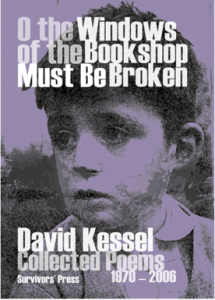
O The Windows of the Bookshop Must Be Broken
David Kessel – Collected Poems 1970-2006
Survivors’ Press, 2006
Edited and introduced by Alan Morrison
Cover design by Alan Morrison
Other resources
http://studymore.org.uk/donkeyda.htm
http://studymore.org.uk/ravaged.htm
http://friends-of-east-end-loonies.blogspot.com/p/david-kessel.html
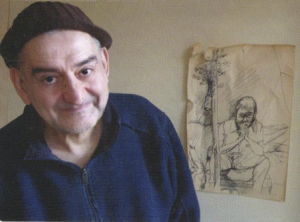
David Kessel was born at Central Middlesex Hospital, Harlesden, London, in April 1947. He suffered a breakdown at 17 prior to medical school where he spent the next six years untreated. With diplomas from the Royal Colleges of Surgeons and Physicians, he went on to practise as a GP in East London until his second breakdown put a halt to his medical career with a diagnosis of paranoid schizophrenia. David subsequently spent his entire adult life battling his debilitating and harrowing condition whilst simultaneously writing and publishing beautiful and sub-lime poetry, and intermittent essays. He became a much-loved and admired stalwart and active member of many London-based radical arts community organisations including Hackney Writ-ers, Outsider Poets, the Jewish Socialist Group, News from Nowhere, F.E.E.L., and Survivors’ Poetry. He will be sorely missed and never forgotten by all who knew and loved him.
David is survived by a son, a grandson, brother and nephew.
Tom Kessel
After my Dad passed, I felt the urge to write down some words that I associate with him. These are both personal and general. I hope that I am able to capture some of David’s character, and that you can recognise some of these descriptions.
Like us all, David was many different things to many different people.
A son and a grandson of course; a brother to Paul; and later on a father and a grandfather.
David was a proud father in fact, who would often embarrass his teenage son, when I came to visit, by introducing me to randoms in the street – and shopkeepers in particular (David loved corner shops).
David was a community GP in his adopted Eastend, but he found his true calling as a poet of course. A poet, a writer, an artist, a thinker, a listener – a good listener.
David was a schizophrenic, and that could be difficult and challenging for those close to David, and probably terrifying for my dad.
But David never hid from his condition. Instead, he embraced it. He embraced the identity and the community as a whole where, I believe, he found a sense of belonging and purpose.
David was a friend, a comrade and a counsellor who sought understand his condition so that he could help others.
A campaigner, an activist, a disorganised organiser, but at times a pessimist and a bit of a hypochondriac, who would often speculate on his own demise.
A forecaster, a meteorologist, a weather lover – particularly bad weather. A map lover – a passion inherited by myself and my son Sol.
A lone ridge-tent camper, a hill walker, a city walker, a Londoner, a lover of London – except perhaps Hampsted, though he did love Hampsted Heath and his mother Peggy. David loved his mum very much.
A dog lover, a gentle nature lover. David loved the countryside. A romantic. Tall, dark, handsome and hairy.
A product of the ‘60s: duffle coats, jazz, spoken word.
A feminist, a pacifist, a socialist, an anti-fascist, an anti-capitalist who was never really comfortable with money.
An outsider, a survivor, a soul searcher, a chess player, a park lover, a café dweller – both greasy spoons and the cheap Bangla kind, like Shalamar’s in Whitechapel. ‘Come over, I’ll buy you a curry’.
A one-time chain smoker, a nicotine quitter, a black coffee drinker.
A sweet-tooth: Fry’s Turkish Delight, Dundee fruit cake. Old Skool English flavours: Tiptree jam, Marmite, Cheddar cheese – and even a bit of cricket.
Scotland – flyfishing; Italy – Arezzo; Wales – the cottage; Broadstairs – Granny Emmie.
A geographer, a book devourer, a historian with a mixed identity: part Jewish, part Christian, part atheist, non-conformist, humanist.
A quiet agitator with intense dark eyes.
A lover of community and solidarity and First World War poetry, who sought to express and understand himself through his own writing – and perhaps, in some ways, to heal himself also.
David believed in, and practised, self-therapy through poetry.
Poetry, politics and mental health were at the heart of David’s true identity.
He didn’t shy away from the darkness. He embraced his condition and openly wrestled with it.
In spite of his schizophrenia, and perhaps also due to it, David lived a full, independent and rich human experience.
The past ten years or so have been good years for me and my dad and our relationship. I’m gonna really miss sitting with him in his flat in Stepney and just talking about our shared interests and loves. I’m very proud of all that my dad achieved and I love him very much. Thank you.
David Kessel
Storming Heaven in a Book: A Poet of Compassion
Preface to O The Windows of the Bookshop Must Be Broken
David Kessel, Collected Poems 1970 – 2006 published by Survivors’ Press (2006)
To say it is as much a privilege to know Kessel the man as it is to know Kessel the poet is possibly to deviate from the true task of a literary preface, but bearing in mind the essential humanity of Kessel’s work, I think it’s germane to express this. Kessel’s personal qualities of humility and sincerity are all the more striking in light of the chronic paranoid schizophrenia from which he has suffered since his first breakdown at 17. He is now 57.
On first meeting Kessel in 2004, I sensed palpable inner struggles when greeted by a shy, vulnerable man with large pained eyes, Hardy’s Little Time grown up – you only need to gaze on the photo of Kessel as a boy on this cover to see depicted a harrowed-eyed version of Jude Fawley’s troubled son; a precocious sense of moral responsibility burdening his brow like that fictional twisted innocent. And responsibility is one thing Kessel the poet never shirks: he writes with naked honesty about the brutal truths of the psychological front line – there’s a genuine analogue here: the trauma of schizophrenic breakdown expressed as a metaphorical shell shock; its symptoms the shrapnel from breakdown’s abstract battlefield.
Indeed, in his spiderishly scribbled letters to me over the last year, Kessel has often quoted Wilfred Owen: ‘Poetry is a savage war’ – as well as Joseph Conrad, from Lord Jim: ‘In the destructive element immerse’. That too Kessel does, fearlessly. He takes much inspiration and spiritual strength from the sentiments of the soldier poets of both world wars: Charles Sorley, Drummond Allison, Sidney Keyes, and his personal favourite, the inimitably barbed Keith Douglas. On one of my visits to Kessel’s flat in Whitechapel, he showed me his treasured spine-cracked edition of Keith Douglas’s Complete Works (replete with brittle brown dust-jacket), intricately inscribed with crimped notes framing each poem; and as you will see, some of Kessel’s poems begin with Douglas quotes. Stylistically and expressively however, Kessel’s poetry has more in common with that of Ivor Gurney and, in particular, Isaac Rosenberg. Interestingly Kessel’s cultural background shares some similarities with Rosenberg’s: while the latter was the son of a Russian-Jewish immigrant who settled in London’s East End, the former is the grandson of a Jewish tailor of German-Jewish ancestry (‘kessel’ is German for ‘kettle’) who emigrated from South Africa to North London. Kessel has also lived in the East End since he was 24.
Kessel’s familial background is, in his own mind, indelibly etched in his psychological make-up: with a Jewish tailor grandfather on his father’s side and a Blackshirt poet grandfather on his mother’s, Kessel himself thinks it a truism that he has been more susceptible to schizophrenic symptoms than most. This poses an intriguing genetic theory on the illness, and Kessel is ever the self-analyst (see his essay The Utopianism of the Schizophrenic on page 96). His parents too play crucial roles in both his psychology and his poetry: his father is the field-suri geon Lippy in ‘Arnhem’ (page 81), whose experiences of war obviously heightened Kessel’s idiomatic identification with war and its poetry; and his mother, an Irish Catholic and Communist, presumably had some influence on Kessel’s own politics (discussed later) and indeed his poetics – a gift she supposedly inherited from her oppositely political father – as evident in a piece of her verse printed on her son’s request at the back of this book. It seems a possibility that the fusing of a Blackshirt’s poetic impulses with the polarised social awareness of a Jewish immigrant has resulted in a leftwing polemical outpouring in the poet grandson.
I first came across Kessel’s work when thumbing through the poetry collections for review when I started at Survivors’ Poetry: his hefty chapbook, The Ivy – Collected Poems 1970-1994, with its inside quotes from Edith Södergran and Christopher Caudwell and absent contents page instantly intrigued me, as did the heartfelt Preface by the author himself; and the empathic introduction by the late Arthur Clegg (reproduced on the back of this book) with its emphasis on David as a ‘poet of compassion’. After reading this generous selection of consistently powerful and emotionally-challenging poems (which I felt compelled to review for Poetry Express Issue 20), several words competed in trying to sum up his intensely expressive style: ‘raw’, ‘ragged’, ‘visceral’, ‘spiritual’, ‘polemical’, ‘bitter’, ‘contused’, ‘bruising’, ‘inspiring’, ‘lyrical’, ‘imagistic’, ‘onanistic’, ‘political’, and so on. But perhaps the word which best summed up Kessel’s work was that chosen by Clegg: ‘compassionate’. Whatever one thinks of this poetry, few can deny the almost tangible spirit of compassion, a disappointed and enraged one perhaps, seething through practically every poem. This is evidently a poet who cares deeply for people and for the ‘Broken city’ macrocosm in which he observes his fellow beings (or Londoners), as if peering into a bustling rock-pool from which he himself is, for a multitude of reasons, separate yet attached; an anomic anemone. And a Cockney cockle: throughout his poems he alludes to an almost semi-mystical motif of the ‘Cockney’, apparently embodying his aspiration for a true 20th/21st century, self-possessing working-class identity – a macro-Cockney. Consciously or unconsciously he perhaps also alludes to the label which fictionally broke the will of John Keats (who was more thick-skinned than posterity gives him credit for): a poet of the ‘Cockney School’ – the snobbish drubbing by John Wilson Croker in Blackwood’s Magazine, April 1818.
On first reading Kessel I was struck by the frequent ideological references littering his work. In the very first poem in The Ivy’s sequence, ‘Arnhem’ – a war-inspired piece strongly reminiscent of Siegfried Sassoon and Keith Douglas* – erupts the line ‘Down to fifty and like Lilburne won’t be beaten’, signifying a political significance in the choice of this 17th
____________________________________________________________________________
* It was Keith Douglas’s generation after all who – exactly 300 years (to the month) after Lilburne was impeached by the Committee of Examinations for arguing for religious tolerance on 17th May 1645 – voted in the leftwing members of the Commonwealth Party (led by demobbed wing commanders), which in their four bi-election wins in May 1945 forced the resultant Attlee Labour Government into a far more radical leftwing programme of reform than it had previously contemplated under the likes of its manifesto-drafting Herbert Morrison.
____________________________________________________________________________
century Leveller* (egalitarian) as a symbol of defiance. Clearly this was a poet whose sympathies lay on the Left. A few pages on, ‘To The International Brigade’ further cemented a – noticeably historic – leftist erudition. ‘Beautiful Ireland’ proffered the equally telling reference to Robert Tressel [sic] (the inaccurate one ‘l’ significant in chiming with Kessel?) as a figure of ‘passionate commitment’: there are no mistaking Socialist undercurrents to the mention of the author of the British Left’s most popular work of fiction, The Ragged Trousered Philanthropists. In ‘Songs of Soho’ Kessel openly expresses his ideological aspirations, albeit slightly obliquely: ‘Will I and my world-joining hope of Socialism be drowned in this lusting ocean?’ And the almost incantatory ‘For Zoe’ is littered with other telling tributes as Kessel – almost reminiscent of the late Ian Dury’s more comical, nostalgia-loaded pop lyrics (i.e. ‘Reasons to be Cheerful Part 3’) – lists the ‘things’ (human and inanimate) that inspire him: ‘Keir Hardie’s eyes’, ‘Robert Tressel’s passion’. There’s also, at the front of this collection, the beautiful quote from the granite-willed Nye Bevan along with one from British Marxist Christopher Caudwell and a reference to the Burford Levellers; into the collection, two poem-accompanying quotes from Edgell Rickword, veteran of the WWI Artists Rifles and Socialist poet, including his striking “That forward blasting vision love”; and a dedication to the memory of Michael Robinson, ‘London teacher, antiracist and Communist’.
A poet of the underdog, the outsider, the societally-labelled failure, underachiever, or purely fate-thwarted, Kessel carries a torch for those unhappy numbers among whom he no doubt – and unfairly – counts himself; a willing martyrdom on behalf of the disenfranchised side of the Us and Them equation. He writes of the posthumous known, both real and fictional, Robert Tressell (unjustly unpublished in his lifetime because the publishers refused to read his manuscript in long hand); Thomas Hardy’s Jude (the Obscure) Fawley (‘In Memory of Jude’), rejected by Christminster University on account of his lowly social status; and lesser known ‘obscuritans’ (this writer’s term for individuals unrecognised in their lifetimes) such as Mike Mosley, ‘Grey, calloused, forgotten at fifty’, and Kessel’s late friend Harold Mingham to whom he dedicated The Ivy, lauding him as ‘a great working-class poet’.
Might we then say that Kessel’s poetry is Socialist: that of today’s true, forgotten working-classes scribbling fugitive lyrics in East End tenements? Well, we might. There’s certainly a strong sense of solidarity, artistic and social, surging through his poems. He quite clearly lays out his poetic manifesto in the polemic ‘Poetry and Poverty’ (originally published in Outsider Poems, 1999):
The poetry of the common people has been driven underground since 1660.
Poetry and otherness; the otherness of the common people.
When we cease to share, our language becomes a cipher, the language of the
despatch box and the popular press.
Towards a new lyricism we need to rediscover a deciduous language, that of
Winstanley and Emily Brontë.
There can be no cockney power without cockney poetry.
This Leveller-esque manifesto – far more than mere agitprop – focuses typically on Kessel’s ‘Cockney’ motif, marrying historical and contemporary working-class political culture by implying the natural inheritors of working-class polemical lyricism are, or rather were, the pop songwriters of the ‘77-’82 punk era: ‘Cockney poetry is underground poetry expressed in Rock music; downbeat, dissonant, demotic;/ e.g. The Clash, The Jam, The Free.’
Certainly there’s some truth in this: how many poets – or even songwriters for that matter – of the last twenty years have written about urban hardship or social alienation? Well Kessel is one, but he’s certainly in a minority (bar Tony Harrison and Pete Morgan, I struggle to think of many others). Occasionally one might be reminded of, say, The Jam’s Paul Weller-penned lyrics such as ‘Down in the Tube Station at Midnight’, ‘That’s Entertainment’ and ‘Town Called Malice’ (1977-82)** when traversing Kessel’s urban inventories (both writers echoing Blake in their London-centricity), indicative of a definite punk flavour to his poetry; that bittersweet blend of social nihilism in the face of unaccountable consumer culture, mingled with a surprising leftwing optimism; Modism rather than Modernism. And like the punk-Mod ideologists of the late Seventies, Kessel thinks there is another way for us to live, and certainly not ‘the third way’. He still clings to the second: Socialism.
It’s also in this polemical piece that inevitably emerges that other great 17th century proto-Socialist, Gerrard Winstanley, leader of the Diggers.There is indeed something of the social pamphleteer in Kessel, which is one way of summing him up: a militant poet polemicist. And in a similar spirit to the inimitable, mainstreambashing tirades of Sixties Press poet and polemical pamphleteer Barry Tebb, the uncrowned laureate of Leeds (also at heart an urban-Romantic), Kessel (the pearlycrowned Cockney¹ laureate) makes no bones about his contempt for the contemporary poetry ‘establishment’:
Established poets are idiots and liars,
Also by definition great poets sleep in gutters
Love is pure contingency
The eyes are everything. (‘Schizoid’)
The more fractured and oblique ‘Glass Is Dynamite’ however is the true polemical tour de force of Kessel’s poems. It is dedicated to Virginia Woolf, Joseph Conrad and, most fittingly, T.S. Eliot: the piece certainly echoes some aspects of the latter’s apocalyptic masterwork, The Wasteland. The poem seethes with frustrated yet efficacious creative force and offers us the strikingly anarchic Rimbaud-esque rallying cry: ‘O the windows of the bookshop must be broken’ (the inevitable title for this inevitable collection). On one of my visits to Kessel’s
_____________________________________________________________________________
** Weller’s late poet friend Dave Waller inspired many of his early lyrics, essentially pop poems, in particular the fictional future civil war concept for The Jam’s 1979 LP Setting Sons; Weller also included a stanza from Shelley’s ‘The Mask of Anarchy’ on the rear sleeve of 1980’s Sound Affects album.
_____________________________________________________________________________
Whitechapel digs I asked him what he meant by this extraordinary line, and he replied: “The only things that were alive in Hampstead were the books in a shop I went into. I thought, the windows of the bookshop must be broken, so the books can spill into the streets”. Poverty is an integral theme throughout Kessel’s poetry, nowadays perceived as ‘the poet in the garret cliché’ by a largely suburban mainstream. Yet we all know only too well how un-lucrative poetry is, especially today, so why the surprise that some poets, especially un-established ones, scrimp in similar material hardships to the Chattertons and Davidsons (cue his anthemic ‘Thirty Bob a Week’) of yesteryear? And that given, why not write about it? Anyone who has experienced – the ‘cliché’ of – relative poverty will strongly empathise with such themes, and anyone who has not might well learn much from attempting to; and what better means than through the naked self-expression of poetry? Perhaps in Blair’s ‘progressive society’ we like to pretend poverty doesn’t really exist, or just happens to other people, certainly not to reasonably well-educated verse-scribblers. But let’s not forget that not all ‘poets’ living today hail from Oxbridge or the conveyor-belts of the UEA: there are also the state-educated ‘naifs’ (to use one of Simon Jenner’s idioms), the Redbricks, the blueoveralls and pinstripe poets (those who hold down ordinary jobs and write in their spare time) and occasional isolated autodidacts who slip through the net into some measure of public consciousness. You could do a lot worse than Kessel for swatting up on the material hardships some inspired minds scrimp in:
A deadly man with loveless breath./ Time eating the stomach. Can’t afford fags.
(‘Disintegration’);
We live with uncertainty,/ Our giros and our dreams.
(‘New Cross’)
Kessel has often related to me his own take on Keats’s Negative Capability (“…when a man is capable of being in uncertainties … without any irritable reaching after fact and reason” – Keats, 1817): he describes his poetic ethos essentially as ‘anti-intellect’. I have taken this to mean Kessel believes in putting the heart, soul and guts back into poetry, and steering it away from the cerebral extremities of some Modernists; those Don Paterson for one has referred to as ‘obscurantists’. But perhaps Kessel’s true target should be the ‘populists’ – as Paterson terms the mainstream poets –, many of whom arguably indulge too much in the plain and mundane, the apolitical ‘just-so-ness’ of society, the preoccupation with ‘things’ and ‘tangibles’ to the neglect of ‘ideas’, ‘abstracts’, ‘phantasms’ (i.e. the imagination); whose conscious attitudinal postures (which this writer terms ‘poetical correctness’) might take heed – along with their
_____________________________________________________________________________
***It’s interesting to contrast this with Keats’s comments on Haydon and Horace Smith in the same letter of 1817 which proffered his theory of Negative Capability: “These men say things which make one start, without making one feel; they are all alike; their manners are alike; they all know fashionables”.
_____________________________________________________________________________
might take heed – along with their polar opposite ‘obscurantists’ – of Keith Douglas’s humanistic dictum cited by Kessel as the source of his own poetic ethic: “‘Bullshit’ – it is an army word, and signifies humbug and unnecessary detail. It symbolises what I think must be got rid of – the mass of irrelevancies, of ‘attitudes’, ‘approaches’, propaganda, ivory towers etc., that stands between us and our problems and what we have to do about them” (from a letter to JC Hall, August 1943)***. This viewpoint is echoed in Kessel’s ‘Beautiful Ireland’: ‘If I could cut out my bullshit intellectualism/ As easily as I crap in heather/ There would be no more wars or leaders’.
Kessel also says of his Douglas-inspired humanist emotionalism: “The invaluable purpose of poetry is to create hope in difficult circumstances****, which manifests in the significance of the British war poets. Standing where people, creatures, things hunger. Being essential, how few are the things that are really essential”.
Modernists (and even ‘populists’) might scoff at Kessel’s somewhat ‘naif ’, cathartic style, spitting out the term ‘confessional’, apparently a contemporary insult. But surely the urge to express oneself is in some sense synonymous with the urge to confess? Or is it just the Catholic poets among us – practising or lapsed – who feel this urge to purge themselves through poetry? And do we take it that they are currently doing so in a climate of Protestant Poetics? A personal communion with the Muse not to be communicated publicly until transubstantiated into a palatable and rational draft; a trend for individualistic as opposed to social subject; a preoccupation with private perceptions and issues as opposed to public and political ones? In that case, rage on the Recusant School.
No poets would espouse wilful ‘obscurantism’, a conscious closing-up to the general readership through a semantic esotericism that only the most erudite of eyes can decode; yet certain types of Modernist poetry can be (mis-)interpreted this way. Equally it is difficult to believe that any adherents to the more pellucid mainstream would champion dull diction and flat prosiness of form, yet many are undeniably guilty of this. Striking the right balance between metaphoric colour and emotional directness is the steepest hill for any poet to climb, but I think Kessel has come close to reaching this elusive summit, in spite of his work’s somewhat ragged, imperfectionist qualities. Kessel expresses his emotions nakedly and uncompromisingly in combination with metaphor and evocation, the nerve and fibre of poetry. He combines the visceral with the spiritual instinctively, producing work which is both innocent and experienced at the same time:
The church is harder than my desire
Though much less real,
As hard as my patronising lust,
And so I masturbate in the wet grass.
(‘Beautiful Ireland’)
_____________________________________________________________________________
**** similar to the definition of Modism: ‘striving to be respectable in difficult circumstances’; in the Mods’ case this manifests sartorially, in Kessel’s case, poetically.
_____________________________________________________________________________
Kessel’s ‘anti-intellect’ stance might be doing his work a disservice in that such a self-label detracts from the demonstrative intellect pulsing through it. One’s led to conclude this is a deliberately contentious claim on his part, a necessary exaggeration or over-emphasis to get an essential, humanistic point across to those who might brush off less absolute phraseology. Kessel’s intellectual gifts are as evident as his expressive ones, his poems littered with tantalising aphorisms and metaphors:
The rain is falling
On chipshop and battlefield.
(‘For Drummond Allison’)
Eyes melting like song in the evening street.
(‘In North London’)
Listening to the soft rain on the leaves
I hear the decency and realism of friends’ humour…
I who am as dangerous as these cliffs
Strive to be as kind as the meadow…
Today a sweetheart’s sigh is more dangerous
Than massed armies.
(‘Desperate Sex’)
I fear this mountain I must climb more
Than I fear fascism in a loved-one’s eyes.
(‘Beautiful Ireland’)
Combined with this accomplished imagism is a gritty Romanticism, a sometimes breathtaking Shelleyan lyricism – often punctuated with the Kesselite sing-song, exclamatory O – all the more striking for its post-industrial backdrops:
O to share a fag on wintry evenings
In a lonely street – all iron and sleet.
(‘To Bleed With Her’)
And I’ll follow the night-train to distant starved cities
To bleed and pain and sing.
(‘Bus No 253’)
Hancock and Lennon have passed through here without being heard
To find peace in the burning innermost slums.
(‘The Barren Age, For the Londoners of my Generation’)
The piano scatters wide her mournful seed.
(‘In a Southern English Seaside Town’)
Despair in a girl’s heart, where wild
chrysanthemums should be. (‘Disintegration’)
Kessel’s striking descriptiveness is painterly, his poems often resembling figurative word-pictures, with an expressionistic quality echoing Lowry’s moth-toned cityscapes of industrial drudgery and Van Gogh’s tangible vividness:
Anger at love that disturbs the malicious street
Leaping in the gutter with petrol and stubbed fags.
The rusty smell of the sea and misogynists’ guilt…
(‘A Mug of Black Coffee’)
A Cockney cleaner moves home eastwards
into the bright slums of humanity
(‘In Finsbury Circus’);
A rasping melody of char-lady morning challenges the conscience.
…a drunk’s daydreams break across unfamiliar streets.
(‘Songs of Soho’)
These silent clouds between silent rows of Brockley terraces.
… To meet this earth in full flight
Between its suicide and the market-place café.
(‘The Park’)
There’s an unfashionably visionary element to Kessel’s poetry, harking back to Blake’s schizophrenic epiphanies (for example Songs of Innocence’s ‘The Ecchoing Green’; ‘Holy Thursday’ and Experience’s ‘The Chimney Sweeper’; ‘London’ – see Kessel’s ‘Elegy For Lost Innocence’, page 56) in its to-ing and fro-ing between polarities of social realism (charladies, bus workers, cockneys etc.) and bucolic utopianism; and William Morris’s aphorisms of romantic utilitarianism and the intrinsic beauty in the useful:
For there is within the soul of labour the tenderness/ Of the violet beneath the shaking lonely chestnut.
Tender words and arms by a spitting gas-fire./ Before the triumph of tyranny on the
television/ dreaming of news from nowhere (‘England, O England’)
…the summer smell of lilac from a scrapyard. (‘Willesden High Street’)
Whatever one’s critical judgement of Kessel’s poetry, one can’t deny that it reeks of truth – as Kessel perceives it. In other words, he is a sincere poet, he ‘feels what he feels’ as Arthur Clegg said, and not ‘because it might suit an audience’. Anyone who has had the privilege of listening to Kessel reading his work will have been struck by the impassioned, almost prophet-like manner in which he loudly howls out his poems, as if each word robs him of strength from the weight of its significance to him. The truth, as it is to him, is in his words. And like all truth, it is both painful and empowering. Despite the palpable sense of struggle and conflict in Kessel’s poetry, one does ultimately salvage from it a sense of optimism and empowerment, for this poet is still here, still writing, still battling the same lifetime’s demons, but those demons have failed to beat him into mute submission. Contrarily, they have driven him out into the world of others along the same steep-verged path trampled by the likes of Clare, Smart, Gurney, Crane, Mew, Lafitte before him, through the liberating power of self-expression. His poetry climbs from its circumstances and pillages them for inspiration, producing something far more lasting and permanent, and beautiful.
¹Note: David has since the publication of this preface in his book, asserted to me he is not a ‘cockney’ as he was not born to the sound of Bow bells. I would therefore like to point out to all readers that if my allusion to David as a ‘pearlycrowned Cockney laureate’ gave the impression I meant he is a cockney, I apologise, however, my meaning was that since he has set so much of his poetry in East London and frequently alludes to the motif of ‘cockney’, that in a sense he might be seen as, say, a surrogate poet of ‘cockneydom’ – this is also intended to allude to the ‘cockney school’ of the likes of Keats in his day; I mean this in an ironic and complimentary sense, and not disparagingly, as did Blackwoods magazine in the 1820s.
Alan Morrison
Obituary: Niall McDevitt, poet
22 February 1967 – 29 September 2022

A Blakean Radical
Almost incomprehensibly, radical poet, psychogeographer, poetry historian, activist, visionary and devout Blakean, Niall McDevitt, has passed away at just 55 years of age.
I had the privilege to have met Niall on several occasions over the years, I always invited him to read at any book launches or readings I did in London, a city whose rich literary and artistic history he came to be an expert on and something of a psychical curator through his legendary literary walks. Niall was also an indefatigable campaigner for the preservation of literary sites, including the Rimbaud/Verlaine House at 8 Royal College Street, and the Bunhill Fields graves of Blake and Daniel Defoe.
A self-described flaneur, anarchist, and republican, Niall was unafraid of ruffling feathered nests and throwing down gauntlets before establishments of all kinds. His poetry was richly figurative, deeply polemical; it had Symbolist aspects, and often incorporated pidgin, portmanteaus (‘luxembourgeois’, one of my favourites) and linguistic experimentation reminiscent of such diverse poets as Arthur Rimbaud, DH Lawrence, T.S. Eliot, Ezra Pound, ee cummings, and Allen Ginsberg.
Niall managed in his poetry to merge the historical and contemporary in an almost mystical, shamanic alchemy. This mystical aspect was Niall’s own particular Blakean spark, his having been a lifelong admirer, champion and, one might almost say, poet-apostle of Blake, grasping the immanence and sempiternal qualities of his timeless poetry.
There was something mediumistic about how Niall spoke and wrote about Blake, almost as if he actually, somehow, knew him personally, or at least on a spiritual plane. When I mentioned to him in an email of my move from Brighton to Bognor Regis in 2016, he wrote ‘you’ll be nearer to Blake now’, referring to Blake’s Cottage in nearby Felpham. That was the setting of my penultimate encounter with Niall for his talk and reading during the 2018 Blakefest.
Where I felt a commonality was in our serendipitous dovetailing on themes such as the impecuniousness of poetic occupation and unemployment—his poems ‘Ode to the Dole’ and ‘George Orwell Is Following Me’ (which he performed to the accompaniment of his drum) were staples of his repertoire. Our approaches were very different, but our sentiments chimed. There were sometimes vocabular crossovers in our verses—terms like ‘thaumaturge’, ‘colportage’, ‘grimoire’, ‘tetragrammaton’, ‘euergetism’—almost like poetic telepathies.
Niall’s self-described ‘anti-Tory poetry collection’ and testament to the early austerity years, Porterloo (International Times, 2012), was a satirical masterwork, which I reviewed in detail in 2014 in a three-part monograph on The Recusant titled ‘Illusion & Austerity’. I made sure to include Niall in all three Caparison anti-austerity anthologies: Emergency Verse (2011), The Robin Hood Book (2012) and The Brown Envelope Book (2021). I recall, too, after wrapping up the launch of Emergency Verse at the National Poetry Library in early 2011, Niall spontaneously presenting me with a Blake print in recognition for having put the anthology together.
The last time I saw Niall was at Bognor Blakefest in 2019—it was fairly fleeting, as on most other occasions, an affectionate half-hug or light part on one another’s shoulders, and polite exchange of words. A softly spoken Irishman, there was something unassuming about him when one spoke to him up close, which seemed in contrast to his always impressive performance persona.
Niall was a poet who really did live poetry, not only through his prolific readings and performances, but also through the posthumous poetries of those he most admired and championed: Blake, Swedenborg, Baudelaire, Rimbaud, Swinburne, W.B. Yeats, David Gascoyne, John Ashbery. Niall was also a champion of close poet-compatriots Heathcote Williams, Michael Horovitz, and Jeremy Reed.
It’s heartening to reflect on the wide and diverse dissemination of Niall’s poetry through numerous imprints and auspices: Waterloo Press (for his debut collection b/w), the aforementioned International Times, the avantgarde New River Press (Firing Slits: Jerusalem Colportage) and Ragged Lion Press (Free Poetry Series #1. Albion), the prestigious Blackwell’s Poetry series (No. 1), articles and poems in the Morning Star, The London Magazine, and many other journals, even History Today (a fascinating scholarly piece on Blake and Thomas Paine), and his engrossing blogsite Poetopography. In many ways dissemination via pamphlet was fitting for Niall’s spirit of colportage, as well as suiting his innate anti-establishment and anarchist sensibilities.
Niall had a prodigious track record of radio appearances, video documentaries (a significant archive on Youtube), and street theatre—having performed alongside such luminaries as Ken Campbell, Michael Horovitz, Iain Sinclair and Yoko Ono. Had the Free and Independent Republic of Frestonia (1977-80)—of which his late associate Heathcote Williams had been Ambassador—retained its sovereignty into Niall’s time in London, he would undoubtedly have been its poet laureate.
There were aspects of the poète maudit to Niall but his gregarious Muse kept him at the centre of a community of poets, writers and artists. Niall’s trademark chalk-striped suits always seemed a sartorially ironic anti-complement to his demonstrable bohemianism but then they were often combined with gold-coloured trainers.
An irreplaceable presence in contemporary literary culture, Niall’s spirit will live on through his exceptional poetry, his prodigious contribution to a countercultural poetry narrative, and in the certainty that there will be many of us who will wish to ensure his legacy is kept alive just as he helped keep alive the posthumous reputations of so many past poets and writers.
Niall is survived by his mother Frances, his brother Roddy, his sister Yvonne, his partner Julie, and her son Heathcote.
This obituary has previously appeared on The Recusant, and in the Morning Star 11 Oct 2022.
Alan Morrison
Tony Harrison RIP
Socialist poet of film and stage (30 April 1937 – 26 September 2025)
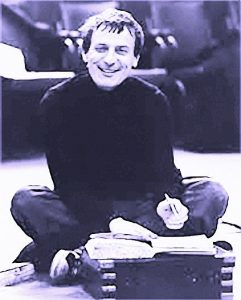 Prolific socialist poet, playwright and verse-dramatist Tony Harrison passed away yesterday aged 88. His many works included The Loiners (1970), From the School of Eloquence (1978), A Kumkwat for John Keats (1981), The Gaze of the Gorgon (1992), and, of course, the controversial and groundbreaking cri de Coeur of Thatcherite Britain, V (1985), written and published at the height of the Miners’ Strike.
Partly a response to finding obscene graffiti on his parents’ headstones in his native Leeds, the proliferation of slang and expletives throughout V demonstrated the breadth of Harrison’s fascination with language in all its forms.
Harrison’s roots were in the British proletarian literary tradition, particularly that strand descended from the Chartist poets. Starting out as a working-class autodidact, he was elevated by a grammar school education, and went on to study the Classics at Leeds University, which in turn influenced his formalist and metrical approach to poetry.
This cultural clash of a Northern working-class background and a Classical education was symptomatic of many of Harrison’s generation, as memorably depicted, for example, in the anomic figure of Dennis Potter’s Nigel Barton (1965). Harrison was, like many other poets, playwrights and writers of distinction from similar backgrounds (not least the ‘Angry Young Men’ and Kitchen Sink schools), a product of that all-too-brief oasis of meritocratic social democracy between 1945 and 1979.
Harrison’s early work focused much on this class-dislocated anomie and sense of being elocuted out of his working-class vernacular, perhaps most memorably in ‘The Rhubarbarians’:
Those glottals glugged like poured pop, each
rebarbative syllable, remembrancer, raise
‘mob’ rhubarb-rhubarb to a tribune’s speech
crossing the crackle as the hayricks blaze.
Primarily a theatre and film poet, Harrison might also be seen as a grittier literary inheritor of verse dramatist Christopher Fry. Lauded throughout his career for his political insights and ability to combine formal poetic eloquence with gritty and even scatological themes (V), Harrison demurred from his many literary accolades.
In 1999, when touted as a possible successor to Ted Hughes as Poet Laureate, Harrison promptly put paid to such a proposition with a long poem denouncing establishment-patronage of poets, titled ‘Laureate’s Block’:
There should be no successor to Ted Hughes…
Nor should Prince Charles succeed our present queen
And spare us some toady’s ode on coronation.
In these senses, as in many others, Harrison put his socialist principles before reputational promotion. A stalwart verse-dramatist of the National Theatre, Harrison was perhaps the closest we have come to a People’s Poet, but his tendency to shun the public spotlight precluded wider recognition of such. The New Statesman in its obituary referred to Harrison as ‘an anti-laureate republican’ and ‘the people’s poet that too few people knew about.’ That is in itself a fitting epithet.
A slightly different version of this piece was published in The Morning Star on 28 September 2025 as an Appreciation of Tony Harrison titled ‘Spare us the toady’s odes’
The Yellow Night
Poems 1940-41-42-23
By Drummond Allison
Portrait and decorations by David Haughton
The Fortune Press (1944)
Cream Telephones
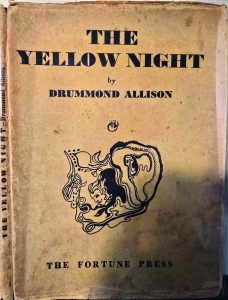
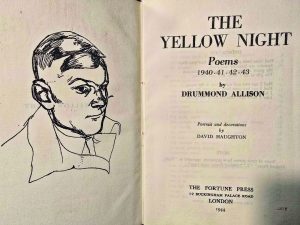
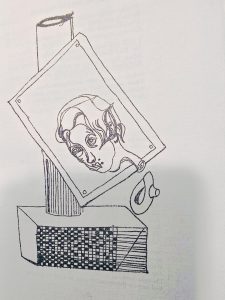
I’ve long been aware of Drummond Allison, at least by the ring of his distinctly upper-class-sounding middle name (he dropped his first name John no doubt for a more distinctive moniker), which one online scholar Richard Warren has speculated was probably after Bulldog Drummond, protagonist in the 1920s-40s series of detective novels by ‘Sapper’ (real name H.C. McNeile), ‘on account of his strikingly pugnacious physiognomy as a newborn’—and, indeed, judging by a photo of the young Allison on Warren’s website, there is a certain puggish or bulldog-like look about the boyish face.
His biography in brief: John Drummond Allison was born in 1921 (exact date not known) in Caterham, Surrey, educated at Bishop Stortford public school in Hertfordshire, and Queen’s College Oxford, where his earliest poems were included in Eight Oxford Poets published in 1941 and edited by Sidney Keyes. Allison went on to Sandhurst and then enlisted as an intelligence officer in the East Surrey Regiment. Lieutenant Allison was killed in action on the Italian Front in October 1943, aged just 22 years (his fellow Queen’s College alumni and poet Sidney Keyes, a year his junior, was killed in action in April 1943).
The Yellow Night—Poems 1940-41-42-43, published in 1944, was Allison’s one and only 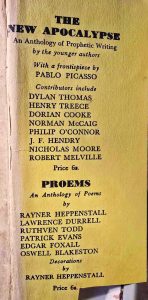 posthumous poetry collection, and is relatively rare and sought-after. I managed to acquire an original Fortune Press first edition hardback copy via an online rare books site for a very reasonable price. The book is a slim charcoal clothbound with a wraparound paper dust jacket which going by the brighter tincture of the inner flaps was originally a primrose yellow, and not the nicotined shade of its more exposed cover. The cover is illustrated by an indeterminate graphic-style image by David Haughton who also contributes a pen-and-ink portrait of the poet left of the title page, as well as a number of sporadic abstract images throughout. What is most striking about this book is the rather thick and rough card-like quality of the inner pages, which are also very jagged and unevenly cut, presumably something to do with rationed materials during wartime.
But to the poetry. The earliest poems in this chronological collection, starting with ‘The Revenant’, seem preoccupied with Arthurian mythology and have a certain mock-Shakespearean schoolboy precociousness about them, and indicate a young poet still trying to find their style, and subject. But even early on we get striking juxtapositions of imageries and idioms of the modern age against those of English folklore, as in the interestingly titled ‘Not Their Cruelty Or Economic Motive’, which closes:
So the destiny of Danton ends like Arthur’s
Linked and latent in Avilion, the gold wren
So mourns Charlemagne’s with Robin’s death and Luther’s
And the green children.
Less interesting is the almost Tennysonian-sounding ‘Come Let Us Pity Death’ which seems to take its tonal and thematic prompt from John Donne’s sonnet ‘Death, be not proud’, though does produce the odd memorable phrasing: ‘We, who can build and change our clothes and moulder’.
‘No Remedy’ shows more lyrical confidence and an alliterative lightness of touch, and some distinctive turns of phrase as in ‘Success and jealousy their unsought sons’ and ‘runs/ His hands through all the plain/ Cards, stuns the girls/ When he uncurls the royal strain’.
By ‘After Lyonesse’ something emerges in Allison’s poetic armoury: a faintly surreal proclivity for portmanteaus which might suggest he had read a fair amount of early Dylan Thomas and other New Apocalyptics-cum-New Romantics such as George Barker, but also, not least, early Auden (against whose earlier ideologically-tinged oeuvre the aforementioned movement reacted): in one line alone we get three consecutive portmanteaus sans commas: ‘louseclothed scabskinned swartsouled’. This verse continues, with rather surreal phrasings: ‘The Serf/ A stench embodied clamber on the carnage/ Taking my toll for branded years of bondage’. The Arthurian imageries remain but they are now charged with linguistic experiment:
But I short scurfhaired symbolise the day,
Redden my hands liplickingly to weigh
Effeminate pale bangles, grope for gray
Brooches at belts, thickbeaded bands of helmets.
They are thin literature, I am life.
This is Arthurian legend seen through a Pre-Raphaelite prism of stark colour and contrast and gritty realism—the poet harbours no illusions:
Their rivalry and greed were their fairknighthood;
Chivalry meant the cost of coats of arms,
Courtesy of rape of goatgirls in dark farms,
Christ the occasional cant of gabled psalms…
But like disease augmenting death I rummage…
Moving to a contemporary setting is ‘The Seaside Hotel’ which carries some striking images:
His master’s glance marks anxious throats as white
As urine-yellow snow
Blackurrant pastilled breath smites His, the slight
Odours of unchanged woe/ Invite his sense…
‘One Finds In Leaves His Solace’ is presumably some sort of figurative comment on then-contemporary Vichy France:
COULD each long-squandered Sunday
Recur, could Soult and Condé
Swagger again for France;
Could all mistaken dances
And unwise words and borders
Be unenacted, Murder’s chance
Have slipped and Death be baffled;
God bridle at his gaffe;
Lust would not lose its tension
Or love its hate, my dear,
Or the suspended truncheon
Its prehistoric fear.
My one criticism here is that the ‘my dear’ seems out of place and perhaps employed to fit the end rhyme. But there’s a finely-sculpted figurative lyricism emerging here that reflects itself well against the poetics of fellow contemporary soldier-poets Alun Lewis and Keith Douglas.
‘The Gardener Rises Restive’ has a Blakean quality:
THE gardener rises restive,
The mastiff shakes its chain
Resentful that exiled shadows
Make widows here again.
Fate’s errand-boy cycles early
Appalling our innate
Decorous sense, loudly leaving
And waving from the gate.
Hopeful hang round in the roadway
Or read while life runs down,
For this unaudienced pageant
The agent or the clown.
‘John Carr (Killed flying, Spring 1941)’ is particularly striking, set into two numeralled parts each comprising two semi-rhyming quatrains, it has a Kierkegaardian charge:
I.
JEER at a widely rumoured fallacy.
Our thoughts are softer than reality.
His head’s vague paintings unbetrayed
Nor the results of what he read,
Caution before his mental cul-de-sacs
And traps, nor some refusal to relax
Revolt against himself, can aid
Repair of fact and body dead.
II.
JOSTLE aside your griefs, disconsolate,
Open your mind—which has no iron-barred gate
His to secure. But dauntless prove
Nothing erases what we see,
Cancelled ambition can destroy no gain,
Absence must urge, is no restricting chain;
Roles, once rehearsed, are written: move
Richer for his strong poverty.
The Arthurian motifs resurface in ‘The Queen’s Maying’ where there is reference to the lesser known Meliagraunce, the lustful knight who abducts Queen Guinevere. Then there’s a significant shift to modern political thought with ‘For Karl Marx’, the first line of which seems to be a neo-Platonic play on dialectical materialism: ‘O MARX, who showed ideas made out of matter’. Allison seems to be working off some elements of privileged guilt from well-heeled inheritance:
… But from my Father’s
Laborious ways to wealth there still remain
Some scorns for spoil the foredoomed victory gathers
Urging allegiance where your books ordain
Annihilation, and my troth is plighted
With guilty classes sure to be defeated.
‘The Petrol-Spotted Slope Before the Garage’ holds some descriptive interest, not least in its descriptively-specific title. ‘The Truth’ is strong epigrammatic poem which debuts Allison’s unusual penchant for unpunctuated caesuras (i.e. pauses without commas) in some lines where nouns are listed:
SPORTS annuals and cigarette-card sets
Contained a clue, in ornithology
One found a further hint or cabinets
Falling in some blue-covered century.
Marx and La Rochefoucald extended hands,
Always withdrew them. Christ’s firm-trodden tracks
Proved an unbroken circle on the sands.
“Oh! What is it,” one cried, “Statistics lacks,
Journal and photograph so nearly own,
Reporters party-members almost share,
Thought-readers scientists look as if they’ve known
But only on their tongue tips now can bear?”
And tired away one turned in new directions
Thinking it nothing, dead, or found in fictions.
The phrase ‘blue-covered century’ is particularly curious. The poem from where the collection’s title comes, ‘We Who Watched The Yellow Night’ elucidates the titular image as a moon-reflecting night: ‘WE who watched the yellow night within the water’, while the following line reaffirms unpunctuated caesura as a permanent fixture in Allison’s poetry: ‘Watched a diffident a fitful slinking current’. Now comes in a decidedly Audenic tendency to put the definite article before each inanimate object or material feature as if transubstantiating the tangible as living or inspirited symbol (a neo-Platonic touch not unlike the Thomist approach of David Jones): ‘Past the shuttered shop and the didactic hoarding/ where the sightless lamp-post pauses’. One is also reminded of early T.S. Eliot, particularly the feline-personification of an elemental phenomenon in ‘The yellow fog that rubs its back upon the window-panes’ from ‘The Love Song of J. Alfred Prufrock’.
But this almost religiously-tinged setting of tone through the use of determiners to emphasises the symbolism of architectural feature or furniture is definitely an Audenic idiosyncrasy, and occurs again in ‘We Shall Have Company’—as do portmanteaus:
IF soon by violence and political police, if soon our class
Is to be flung through doors it opened with such care,
If the cream telephones are to be answered
By black slouchcaps and oilstained dungarees
While from directors’ chairs the shop steward runs
Europe and love and every watchful author;…
‘The cream telephones’ is a particularly resonant image, it reminds me of the image from Philip Larkin’s superb ‘Aubade’: ‘Meanwhile telephones crouch, getting ready to ring/ In locked-up offices’. Allison’s dystopian vision here appears to morbidly contemplate the totalitarian takeover of Britain, either by Nazism or Stalinism, the image of ‘black slouchcaps’ is slightly ambiguous but might refer to the Italian Bersaglieri although theirs’ also have dark green feathers attached. It continues, again, with memorable symbolising:
Or if our nation is erased without a smudge,
Seamen and colonists and sad
Clerks in the suburbs who denied their sorrow,
Miners and centre-forwards, clergy proud
Of God their son; if under similar standards
I too go down with some self-conscious laugh
Like one too late
Discovering the examiners were serious;
The poem then takes a surreal turn in which the barbarism of contemporary fascism sends humanity hurtling back to a comparatively more civilised prehistoric period:
We shall ride out on quaggers, on mastodon and mammoth,
Pat old triceratops in passing, stroke the dynosaur.
Sung to by pterodactyls we shall strew
Food for the roc, the great aulk and the moa.
Giant sloth and sabretooth shall grow tame for us,
Neanderthal and Piltdown will be willing guides to us
And ichthyosaurus wallow no longer malevolent.
‘The Return To Suburbia’ has echoes of Harold Monro and early Eliot whilst foreshadowing Betjeman and Larkin:
Till from bared girders and half-broken blocks
Where still thin typists gape from offices
He comes to Croydon, to the scratching cocks
In bricked back gardens, prematurely says
“Here there survives”—
then the Masonic cage
Marks, and the dread symbolic Orphanage.
In a similar vein is ‘Walton Street Sonnet’:
Eyes of you singers some pale night peruses
Straggling from sherry parties up the High,
Through building-shadows down Cornmarket thrusting:
May book and recollection need no dusting.
In ‘Rejection Song’ Allison deploys more of his unpunctuated caesuras:
Now admitting it my error to have thought
You the right reply to each unsure red setter,
To the query in each clockface in each clutter
Of bewildered boulders, every doubtful fort;…
And then he returns to his Audenic determiners:
Unconvinced old slot machines, the startled knocker
And the flabbergasted spareroom looking-glass;…
The final stanza of this 20 line poem displays a sensuality perhaps for the first time:
Yet before the unlit fire I know my need
Of your thighs your throat your abdomen their movements,
Yet beside the dry-voiced bookcase on pale pavements
I repeat the quite incredible my creed.
‘For The Out-Of-Love’ appears to be about the fatal car crash of an unnamed Hollywood star or at least uses this allusion for a more perennial comment on mortality and fame (or immortality) with mention of ‘films/ stored up in rolls on shelves…/ …not spun for years then scissored’. The poem begins and ends with a similar image: ‘As patterns on a tablecloth recur’ and ‘A guarantee as certain of renewal/ As patterns on a cloth’. The penultimate stanza is particularly evocative:
Knocked by no rocks and walking with the wind,
Learning up love in books,
I cannot write you out a route or caution
You against haunted woods:…
The phrasing of the second line distinctly implies this is an American subject. The alliteration and assonance here are particularly effective: ‘knocked’, ‘rocks’ ‘books’, ‘woods’.
‘From Wales Where Whistling Miners’ is a richly descriptive poem with rangier lines, a social commentary contrasts gritty life in the industrial valleys with the comparatively more affluent suburban Home Counties:
FROM Wales, where whistling miners wait on sopping streets,
Boys collect garbage in a hidden hole,
Slogans from strikes are written by the smoke,
The mouths of hooters form the dark word Dole…
From Surrey, gnomes and birdbaths littering the lawns,
Lamps over tradesmen’s entrances, the nurse
Wheeling the pram round the loud aerodrome,
High houses where the children soon disperse
For boarding schools, the bent-backed gardener yawns
Clipping the privet as full Wolseleys dawdle home;
To Oxford, May Day morning and the straining eights,
Carfax discoloured by the dying sky,
Ice like a kind despair spread on the Parks,
Coffee in Elliston’s meant to defy
Our sense of loss, and talk by graying grates…
Allison gives the impression of feeling smothered by stultifying suburban respectabilities and expresses a hunger for a greater reality to match his intensity of feeling:
Oh! aid me now against my ease and memory;
With look and voice and intellect distract
Me from the larches and the brown front door,
Bookshops and deckchairs, every fun fact.
Oh! save me from short vision, make me see
Shapes are related, varied shades obey a law.
For roads and poems, food and fabled animals,
Hands, films and singing, sunlight cutting clouds
We cannot love completely if we lack
An attitude; nor shrug at all the shrouds
That sheets become, the deathshirt on our back.
O! strengthen me to number now my heart’s Lavals.
(The mention of a picturesque town in Western France suggests the expression of a more artistic French sensibility in this Englishman). The line ‘We cannot love completely if we lack/ An attitude’ is striking and it is likely by this time Allison was aware of Auden’s hugely important poem ‘September 1, 1939’ composed upon Germany’s invasion of Poland, and published in his 1940 collection About Time, perhaps the most memorable line from which was ‘We must love one another or die’. Such angst amidst purgatorial suburbia strongly echoes the poetry of Harold Monro—most memorably in his ‘Aspidistra Street’:
Go along that road, and look at sorrow.
Every window grumbles.
All day long the drizzle fills the puddles,
Trickles in the runnels and the gutters,
Drips and drops and dripples, drops and dribbles,
While the melancholy aspidistra
Frowns between the parlour curtains.
Uniformity, dull Master! —
Birth and marriage, middle-age and death;
Rain and gossip: Sunday, Monday, Tuesday . . .
Sure, the lovely fools who made Utopia
Planned it without any aspidistra.
There will be a heaven on earth, but first
We must banish from the parlour
Plush and poker-work and paper flowers,
Brackets, staring photographs and what-nots,
Serviettes, frills and etageres,
Anti-macassars, vases, chiffonniers;
And the gloomy aspidistra
Glowering through the window-pane.
Meditating heavy maxims,
Moralising to the rain.
The heraldically-titled ‘Semper Eadem’ (Latin motto for ‘always the same’) is a philosophical epigrammatic poem which needs to be reproduced in full to appreciate:
“SEMPER EADEM” says the shield:
The lion fascinated by his boredom
And drowning gryphon tired of holding it,
Stare like hypnotics down the deserted dining-hall.
Repetition of an experimental pattern
Can produce insensibility to experience,
And the triumph of habit and tradition
Can produce that faith which is damnation.
The snow delays in hollows and odd furrows,
The heathfire spreads beside the road.
Or books on desks are bound in dusk
And a new cold rents a room after each midnight.
So in the house and field Destruction demonstrates
To intimidate poets quick to tell themselves:
“Another end the symbol of the only End.”
Speeches at meetings will disintegrate,
Sense becoming sound and arguments an ache.
Writers about writing and inventors of virtue
Are finally and falsely exposed.
Thought analysed is only its component colours
And proven theory makes clear no need for practice.
To use the cliché phrase, there’s a lot to unpack here, but essentially it seems to be a meditation on mortality and the futility of human ambition, though perhaps it’s not as nihilistic a poem as it initially appears. Whatever its essential thrust, it’s a thought-provoking poem, its aphorismic quality only slightly compromised by occasionally prosaic phrasing, as in the second half of the first stanza. There, interestingly, we get again that image of patterns and recurrence which we had in ‘For The Out-of-Love’: ‘Repetition of an experimental pattern’. The ambiguity of verb ‘rents’ in the fourth line of the second verse is interesting.
‘O Sheriffs’ riffs on the Western, a popular filmic theme of the period—it’s a sharply descriptive image-based poem which has an athletic lyricism:
O SHERIFFS hung with long pealhanded guns
Showing your stars, coachditching dark road-agents,
O Pony Express on Sioux-surrounded plains.
Mushers of huskies, dudes in border towns,
Rustlers of painted mustangs down thing gorges
And tumblers out of rustler-run saloons.
O Darrell who the revolving logs defy,
O Billy caught with bacon, mad-eyed Hardin
Daring to draw each pallid deputy.
God like a lone and lemon-drinking Ranger,
Or at a far fur-station the half-breed stranger
Them string up undecayed and stellify.
That oddly phrased final line has something of early Eliot. ‘A Great Unhealthy Friendship’ relates to that ‘Between a student and a god’—its middle verse is particularly evocative:
At tables outside costly cafés
Or visiting asylums’ inmates
They found they had too much in common
Till all each others’ books were finished
Till they had slept each other silly
Till mind on mind preyed like the ichneumon.
The Audenic ‘Doughty’ starts:
OH! hastily the historian of another era
Will shut up this story in the locked libraries
Remaining only as the mausoleums of a class that is extinct.
‘The Fish Poem’ is a figurative piece whose piscine imagery is presumably symbolism of some kind though it’s not clear to me exactly what. Again Allison deploys his unpunctuated caesuras: ‘But a terrifying freak an unmentionable monster’. The second and final verse verges on the surreal although it seems a giant fish has swallowed the British Isles—perhaps the Nazi threat of invasion juxtaposed with Jonah and the Whale:
Now watch her swallow down a Sussex street,
Houses and horses are somersaulting now
Within the intestines where there still gyrate
Grampus and cachalot and harpooned spermwhale.
Look, look, she drinks a spiralling waterspout,
She leans from the startled Eastern Mediterranean
And laps up the Sea of Galilee.
To my mind perhaps the finest poem in the collection, and perhaps the most well-known, is one that my late dear friend, poet David Kessel, once included a photocopy of in a letter he sent to me, ‘A Message To John Alves’, which had a marked influence on David’s own grittily lyrical poetry. I don’t know who the eponymous recipient was, but that doesn’t seem to matter in terms of simply appreciating this superlative aphorismic poem which feels like a definitive verse-statement of Allison’s and warrants anthologising in any selections of the period. The poem starts almost as if responding to Auden’s aforementioned ‘September 1, 1939’ with the line: ‘ALREADY September’s fate is settled,/ Dark gray has taken the corners for the winter already’. The poem really kicks in from the second stanza:
John, I’ve no jargon now, no permanent jape
No sleight-of-hand to dull or stretch the senses.
Forbidden by these buildings, scoffed at by the sky
I’ve lost the only opportunity for deception
But with it the only necessity.
Even in the Avalonian evenings
You knew the knave, could put your finger on the fool
And paddled ankle-deep in that so silted pool
My mind—yet yours lacked every acrity.
There’s an Eliotian eloquence to these lines that marks poetic confidence—also something of the Whitmanesque in declamatory lines:
Shame me again with wit that demands no victim,
Tolerance that never strikes for fairer wages,
And proud defiance of the despot pride!
Then comes an almost parabolic passage which is striking in its charged images:
I tried to track down God among the rhododendrons
Or where girls’ hair had trapped the frightened fire,
Penetrated a soul or two to pinpoint His lair.
And took an interest in His black best sellers.
But, cross or none, Old Man or immutable mirage,
I could not care.
The assonance of the phrase ‘God among the rhododendrons’ resonates strikingly, while ‘where girls’ hair had trapped the frightened fire’ has something of Wilfred Owen’s more figurative moments, as in ‘The pallor of girls’ brows shall be their pall’ (‘Anthem For Doomed Youth’). This stanza appears to be an expression of agnosticism, even atheism, and one senses, as elsewhere in his more political poems, Allison was most probably a Marxist atheist. The mock-commercial phrase referring to the Bible as ‘black best sellers’ is a wry touch; no doubt Allison would have called Marx’s Das Kapital a commercial runner-up. Indeed, the following stanza addresses this explicitly:
I walked their causeway with those unwitting giants
Who set us up redoubtable road signs
—Karl Marx and Cromwell, Paine and Wilkes and Lovatt,
Camille Desmoulins, Martin Marprelate, Somerset;
I strove to assassinate war and swore I’d starve out poverty;
But oh! absorbed I was in slaughters
Wrought on the cowardly brain by craven brains,
Futures of the past and living
Conditions of the dead.
Marx is cited, alongside a list of progressive or revolutionary or socialistic folkloric figures, but the tone still feels downbeat, one of apostasy, and the implication is that these figures of good-intentioned philanthropic ideals in some ways or other either directly or indirectly contributed to demographic depletion through civil war or revolution; this is hinted at earlier in ‘For Karl Marx’ where Allison writes rather unfairly of ‘Urging allegiance where your books ordain/ Annihilation’. The line ‘I strove to assassinate war and swore I’d starve out poverty’ is very powerful in its attempt to devour two pestilences with their own means.
Allison’s juxtaposition of the profound and the mundane also recalls early Eliot:
Now in my bareboard suite in truth’s hotel
I’m stripping off the ill-fitting patched pretences
—The laundry calls to-morrow.
The following verse is deeply evocative in its descriptions and imageries:
The corridor stops talking through its trite
Footfalls and falling water; and soon, below,
Slow ghosts of guardsmen will be studying the notices
(Lugged by their blood-brown swords and weary of their dundrearies).
The long vowel sounds prolong that lugubrious line beautifully. What a word is ‘dundrearies’—it refers to the mutton-chop style side-whiskers, also known as “Piccadilly weepers”, worn by many Victorian men and named after the character of Lord Dundreary from Tom Taylor’s play Our American Cousin (1858) in which the actor Edward Askew Sothern sported the follicular accoutrements whilst playing said role. The image of ‘blood-brown swords’ as opposed to blood-red gives an impression of congealment and age or rust and decay. The following lines are curious but no doubt allude to the war and the continued threat of German invasion:
Fold up your trousers, will the light away:
There’ll be an uncustomary occasion,
A courtesy or an invasion,
Some other nocturnal day.
Once again we get the Audenic determiners and the unpunctuated caesura:
Awaiting the striking dumb or the thunderbolt,
Expecting the blood-purple dawn to destroy the tanks,
We’ve suffered from a growth a faith disfiguring our thought.
The phrase ‘faith disfiguring our thought’ is particularly striking. Allison then tilts into the full Audenesque with symbolising determiners throughout:
I can’t prepare us an appreciation or issue orders,
For look at the only relevant factors;
The amazing meals and the favourite writers;
The chuckling Chinese geese and the dummy
Mermaids on the lake, the dogs as which deserters
Run reincarnate round the immaculate muskets;
The nattering apostles and the grimaces of gravestones,
Drunken tadpole and equine brigadier;
That third line is particularly Audenic. Closing this exceptional poem are five lines that recall some of the protests in the poetry of the First World War, particularly Owen’s and Siegfried Sassoon’s:
Or ants, each one a stentor and a spy,
But never bragging of their lagging verdant burdens
Because, for all their Party-discipline,
Their marching song is always “How to Die”
And their leaflets are headed “Why?”
Sandhurst, September 1942.
The phrase ‘Party-discipline’ would seem to imply the Communist Party, though I might be wrong. Allison’s poems are heavy with colouristic symbolisms as can be seen through these many excerpts: ‘blue-covered century’, ‘blood-brown swords’, ‘blood-purple dawn’, ‘verdant burdens’, and not least, the ‘yellow night’—in ‘The Picture In The Drawing-Room’ we get: ‘yellow flags … straggling on their strings’.
‘A Funeral Oration’ seems to be a threnody to pilots who had been shot down and drowned fighting the Luftwaffe. There is Douglas ‘clad in dark Wellington’, referring to the Wellington Bomber no doubt, who had presumably perished during the Battle of Britain, ‘Shrived by a Messerschmidt cannon’; Robert who was killed in action in the air over the Atlantic; and Colin
…last seen within sight of Greenland,
Who disagreed with all the gods and went down
The gradual stairs of the sea with the “Hood”, until
He could have used vacated shells for tankards
A vigorous white worm for a cigarette
And girl friends having swords upon their snouts.
What is always clear in Allison’s poems is the abundant pool of literary and historical allusions from a superior education. The gloriously assonantal image ‘A vigorous white worm for a cigarette’ is bound to harbour some symbolism though I’m not sure of what; ditto the even more curious closing image.
‘Written From Plymouth’ is an excellent descriptive poem which presumably depicts the Devon city prior to its bombing by the Luftwaffe—the particularly Eliotic use of personification of the inanimate, in this cases elemental, geographic and architectural, throughout is notable:
WRITTEN from Plymouth where portentous mist
Passes its hands across the tattered theatres’
Faces, hit houses hate to hate but must;
Recumbent Sunderlands all afternoon
As well-fed manatees wait on the water
And a destroyer sprints from swoon to swoon;
The hawsers of balloons above the Hoe
Lead to a kind of unkind smile, Drake’s Island
Scowls through its barrack windows at the slow
Horizon wriggle; while those high hotels
The “Lockyer” “Continental” “Duke of Cornwall”
Lick their cracked lips of steps, for pleasure sells
Providing pain provides it gladly. Most
Like unpretending children Plymouth quivers,
Its thoughts apparent in each cost and mast.
In ‘A Speech’ it is not clear who the speaker is though one presumes it’s Allison who feels it necessary to make his point with oratorical emphasis a la John of Gaunt’s monologue in Richard II, and the thrust of this speech would appear to be the noble failures but aggregate knowledge of progressive idealisms of the past:
“YET never by diversity’s immersion,
Nor by exclusion of the pouting Parties,
Can England learn to ring the stern-eyed bell
Whose bare wires dangle in that brambled porch
Whither some actual tract of land must come
Some century relieved (or I believe so).
For History though untrue is not unfaithful
—Each group which grasped a decade and left it gasping
Found clues, whatever its cold scents and false
Trails: with the Chartists and the Diggers and
The Lollards and Barons, mad Fifth Monarchists.
The followers of Wyatt and of Monmouth,
Cade and Hames Naylor, Fox or Warbeck or
Lord Gilford Dudley, vain or virtuous
Discovered each some note by invisible ink
Which the heart’s heat we fan could still decipher
—Whether they forged, or stole it, does not matter!”
The line ‘For History though untrue is not unfaithful’ has both an Eliotic and Audenic flourish to its rhetoric. ‘O Fields Already Lost’ is a fascinating figurative poem which appears to shapeshift from geographically far-flung imageries into contemporary literary polemic. Its early stanzas are image-focused:
O FIELDS already lost to the cunningly clambering
Frost, you same holts hoar where the hermits of Logris
Nursed and confessed in their caves and chapel-hovels
Foreshortened jousters whose flesh grew round snapped shafts!
No longer pretending your shape has any clandestine significance,
I know that the moody bullocks kneeling towards Woolacombe
Can as easily gaze through at the wrigglers out of the igloo;
As easily mark the Dance of Preordination,
The removal of the Paca and the skull of the whale flung back
As be the magic cattle of a satisfactory story.
Through this thick Sargasso is imagery comes a more polemical tone:
Yet thought I see you, fields, and understand
No landmark for understanding stands on the hillock;
Though the dead inside my head are dying of cold;
The writers and their creatures continually interfere
Tinging my uncoloured equanimity with assumption
And anxiety and gratitude and even love.
This polemical tone then intensifies and specifies, reminiscent in some aspects of Christopher Caudwell’s positions in contradistinction to the poetic establishment of the period:
Auden the kestrel and Day Lewis the heron clutter
Up the tiny sky with their vain-glorious wingbeats,
The brindled whelp is slinking down that re-entrant
And somewhere Tommy Brock is in bed with his boots on.
(Tommy Brock would seem to have been a rather sinister Beatrix Potter Badger character). But the more obvious comparison here is with the rightwing pro-Francoist South African contemporary poet Roy Campbell who famously coined the portmanteau ‘MacSpaunday’ (in his 1946 collection Talking Bronco) to mock the leftwing grouping of (Louis) MacNiece, (Stephen) Spender, Auden and (Cecil) Day(-Lewis) as if some sort of gestalt (though even Auden coined his own one for the same group which he headed: ‘Daylewisaudenmacneicespender’—probably indicative of his later distancing from their Oxford-quad-sprung Communist leanings. It’s not entirely clear what Allison’s point is here, but one suspects it’s some kind of snipe at the two poets, either at their formative Communist leanings during the Thirties, or the fact that by the early Forties both poets were well-established and, in Day-Lewis’s case in particular, rather staid (and so thereby inevitably he ended up as poet laureate 1968-72). The poem then becomes more obscure in its symbolisms, but no less affecting:
The last-war trench that quivered under the lovers
Is unresponsive now, and the straight straight hedges disclaim
Any responsibility for indecision.
The truck starts up and very nearly imparts
A suitable film-music to this still.
These lines recall the contemporary work of Marxist Modernist poet and broadcaster Joseph MacLeod who often used mythological and aquatic imagery in his radio verse plays as well as a filmic references and nomenclature (cue Men of the Rocks, A Foray of Centaurs, and Script from Norway) a more avante garde equivalent to Christopher Isherwood in prose of the period (cue Praetor Violet). The unpunctuated caesura resurfaces in the following lines:
O fields, below your tensely stretching quilt
What knees are raised what sharp of oblong thighs?
And, as with the ‘straight straight’, there is another use of anaphora with ‘raining, raining’:
The words relieve themselves, the cold is softened;
And beyond the tors too often visited
Truth and our guess and the legends are jumbled and it is
Raining, raining ocelots and fennec foxes.
Instead of the proverbial ‘raining cats and dogs’, an English phrase dating back to the 17th century, we get a downpour of ocelots, wild cats of the Americas, and fennec foxes, long-eared foxes of the Western Sahara: perhaps the ocelot is an allusion to Patten, and the fennec fox an allusion to Rommel who was famously nicknamed ‘The Desert Fox’?
Betjeman might have written ‘CHICKEN farms, forest, floods, reluctantly/ Sussex turns into Hampshire’ (‘The Floating Island’). ‘John Burns’ is an epigrammatic portrait of the eponymous Liberal MP and son of a London railwayman whose political career, like so many, started out as radical but ended up as firmly establishment, culminating as a minister in the governments of Campbell-Bannerman and H.H. Asquith—this trajectory is presumably what Allison is aiming at in this assured portrait of the MP attending a Downing Street luncheon:
I SAW you sitting in a brown pavilion
While the first shower was fidgeting to start;
And the broad beard, that rendered non-committal
The narrow smile, disguised the desperate heart.
Watched from the wall by altruist and hellion,
Glancing at Grey and Russell on the stair
You came each day to luncheon at the fatal
Table without returning Gladstone’s glare.
That last line clearly referring to a portrait of the lugubrious Victorian-era Liberal prime minister perhaps most famous for his anti-imperialism. The third and final stanza starts with a line which combines both Audenic determiners and unpunctuated caesuras that by this point are an Allison signature:
The books the blackened buildings and the bridges
You put your trust in keep their secret still;
But the worm Unions have laid down a line
That none decline however low the wages:
You’re in a hole too deep for any will,
A cabinet from which you can’t resign.
The ‘blackened buildings’ presumably allude to the distinctly charcoal-coloured Nos 10 and 11 Downing Street. The polemic here isn’t entirely clear, especially given the phrase ‘worm Unions’, but perhaps Allison is referencing a weakening of their bargaining powers, or even some kind of capitulation to the bosses, and the political cul-de-sac Burns now finds himself in as a minister presently sat in the dining room of No 10, Downing Street itself being of course a literal cul-de-sac.
‘My Sister Helen (1917)’ seems to concern the poet’s older sister who presumably perished during the “Silent Raid” of 19th-20th October 1917 when high-altitude (hence ‘silent’) German Zeppelins dropped bombs across most of England.
FIRST the artillery groaned beyond the Channel,
The Zep descended in astounded silver,
At Westcliff then at Caterham cold the mornings
And the short afternoons impatient grew.
…
Oh! had she come, that year of submarines,
She would have needed no sagacious kings
No hovering angels no enlightened shepherds;
She would have been her own effectual Star.
Our very tyrants—those unvanquished queens
Race, Class and Custom, whose great sufferings
Are passed to us; before the rampant leopards,
And lilies in whose flags, we prostrate are:
These would have been her ever-helpless prey.
The mystery of grave doubt with definition
Would have been hers, of faith with toleration;
Her brothers’ conquerors all her prisoners been.
March and Montgomery have moved on to-day
Towards the accurate heart and single nation.
Had she been here, our timorous pale elation
Would have flung taller figures on the screen
Of truth and of accompanying contrition;
She would have comprehended
I am at last reminded,
What we have only seen.
But there is no ‘only’ to what is ‘seen’, as Allison put it in ‘John Carr (Killed flying, Spring 1941)’: ‘Nothing erases what we see’. What is particularly curious about the poem is its inversions of syntax in some of the fourth lines throughout apparently to fit the end-rhymes, though they also give an archaic quality to the phrasing which fits well with the heraldic images of ‘rampant leopards’ associated with the Plantagenet coat of arms of England and ‘lilies’ (Fleur-de-Lys) which were added to it by Edward III.
Colouristic echoes again in ‘Angus Óg:
Now Angus Og is abroad in these brown mountains
Taking the lakes in his stride and choosing
His ancient path across the pathless marshes.
Brown is used a number of times: ‘the brown front door’ in ‘From Wales Where Whistling Miners’, and the ‘blood-brown swords’ of ‘A Message To John Alves’, and the ‘brown pavilion’ in ‘John Burns’. Brown seemed a common colouristic symbol in early to mid twentieth century poetry—one’s reminded of T.S. Eliot’s personification of the Mississippi river as a ‘strong brown God’ in ‘The Dry Salvages’ from Four Quartets, which, having been published in 1941, Allison might well have read. The symbolism of brown is ambiguous: it might mean earthiness and stability, or rust and decay.
‘Two Songs of Belfast’ includes an anaphoric line which might almost have come from the mouth of Eliot’s Sweeney: ‘They’ve drawn the flimsy curtain/—The nice nice girl, the smashing smashing blonde—’; whilst the ‘icecream air of heathen peaks’ echoes e.e. cummings. This curious poem which presumably is about the Protestant-Catholic divide in Northern Ireland, one of ‘Bones and Weeks’, the closing lines to this poem in two parts is evocative:
Grow into yours which says: “Prepare, forgive,
Make like the splendid Dead the hard decision.”
And oh! consider how I may descry
Your Christ behind Belfast till time identify.
‘Private Poem’ is an intriguing introspective piece:
YES, the wide antlers round the reading room,
The headless cottages above the lough.
Who are the dead that they should supervise
My last conspiracy against the Laugh?
While now the sung and wading mountains are
Hers like Wastwater and the haughty High,
Though she remain the heedless absentee
Nor turn to admire her mighty property.
So her dead tenants and the hearted girl
Herself deprive me of my only right,
And I’m kept faithful to a previous pact
With funny faces and the shaking nights.
But writing in the cold and closing bar
I can’t but plan that grand itinerary
Whose ever vivid and so amorous places
I’ll never visit and can seldom vary.
Battle School, April 1943.
‘Leave Poem’, as its title suggests, is about imminent departures, and as with the previous poem, has a mournful quality—this, its evocative final verse:
And I’ll make eastward haste for eager Dover,
The waving friends and flags, the naval types
In permanent pressgangs with their slopping bitter:
Those friends confer, that wary barmaid wipes,
Till I’ve no time to visit you but over
Go to my faithful flocks of swans in long Larne harbour.
On his way to the fateful Italian campaign Allison is preoccupied with history in ‘Frederick II. In Sicily’—it has a sense of foreboding, of historical cycles and soteriological legerdemain in the mind of an atheist:
FROM the ghostly groves above Palermo
I see the smoke approaching, and I see
Another wave of race and anguish washing
On over Sicily.
Here in the heat, not in the sonorous northern
Cavern, my deadness has unholy home;
While the same indistinguishable strangers
Go to their graves in Rome.
Mahmud and Christ told lovely lies before them
—I learned it’s only true that always men’s
Guesses and wars are wrong. If Pope or Emperor,
English or Saracens.
That line ‘Mahmud and Christ told lovely lies’ has an Audenic quality, though it’s curious rather than coupling Christ with the Islamic prophet Mohammed Allison instead refers to the name of one of the Ottoman Sultans (it’s unclear which one as there were three); a subtext of the Second World War being akin to a modern day Crusade is implied with ‘English or Saracens’.
‘The Cold Thoughts’ is the final poem in The Yellow Night, and since this is a chronological collection, it is presumably the last poem Allison wrote. It is a distinctly Keatsian piece of verse, a final demonstration of how assured Allison had become as a poet by this time, and indicative, as so many of the poems in this book, of the prodigious promise of a young poet who was remarkably accomplished for his years:
OH! cold as any snowfruit, colder than
Compulsory bathing or some smiling Head
Master, untouched these thoughts have lately lain
Along the scalloped edges of the brain
Colder than greens long-left upon a red
Enamel plate. But now the Baker Man
Warms up the engine of his different van
—Now round and numbered is the nosy bread
Of war he must distribute—and in vain
Warns us of what we were: the sticks who ran,
The flying child, the optimistic dead,
All those cold thoughts are steaming now again.
For every morning then the bullfinch woke us
Boasting about its berries, or the Persian
Scratched at the door. We saw the huge arriving
Grocers and guests and ghosts, we saw them leaving.
Sun served a fault or chose his old incursion
To crowd the net, changed ends as if to make us
Nervous, to try at least his hocus-pocus
Among those dark spectators (whose impassion
Forgave the crocuses their annual waving)
The yews themselves and larches. Till the raucous
Leghorns were quiet, and bats made full confession,
Christ and the bogey made their dangerous living.
Allison’s anguished agnosticism and materialist sensibility is marked in that last line.
I’m lost and losing and about to lose,
My mind like some forgotten frigidaire
After a party empty and the switch
Still on. And that verandah and deep ditch
Of dock and trampled nettle, landings where
Waits and the giggling girls and hoovers whose
Voices are stolen bore their witness; whose
Loss is announced at last! But darling where
We watched the yellow night, the losing which
Evicts all others occupied me there.
Lost God and garden (with their broken rose-
Trellises) need not ask each other which
Defeat has beaten theirs, what beauty those
—With love so obvious and why and whose.
So sorrow casts out sorrow, minus times
Minus makes plus. The truthful tapes are running
Across the minefields of my fear, and I
Can trace and follow them to-night. Though by
Fast flare and Verey light I see the tombs
Of what my cold thoughts killed or what my darling
Had put to death by tolerance, I say:
“Synchronise watches, we are going dancing, are advancing,
Spite of the blinded windows and the jaundice of the Thames.
School of Military Engineering, July 1943.
How apt that Allison should return to his image of a ‘yellow night’ in this last poem, and in its final line he describes the moon-lit water of the Thames as ‘jaundice’, significantly referring to the yellowing of the skin and the whites of the eyes in liver conditions—a pathological colophon of the collection’s symbolic colour, which brings everything down to the body, the material reality, the slip of the spirit, and given the young soldier-poet’s imminent death in battle, is particularly resonant.
The Yellow Night is an astonishingly accomplished and insightful collection for someone in their early twenties, and stands up well and distinctively against the poetries of fellow poet-fatalities of the war, Alun Lewis, Sidney Keyes and Keith Douglas.
Kevin Saving on
Under Milk Wood: An Appreciation, Sixty Years On
The fourteenth of May, 2013, will mark the sixtieth anniversary of the Dylan Thomas ‘Play For Voices’ first public performance -at least in something close to its currently accepted form- in The Poetry Center, New York. Legend has the writer being locked in a room by one of the center’s staff, his sometime lover Liz Reitell, in order to complete the work on time. The final scripts were handed to the performers as they applied their make-up, prior to ‘going on’. Although initially received in silence, this debut performance was eventually honoured by fourteen curtain calls: the audience hadn’t quite grasped, early on, just what they were getting. Thomas, who left the venue alone, would readily agree to the provision of a fully revised script but, of course, he never lived to finalise it -dying of alcoholic overindulgence (and medical incompetence) less than six months later.
There is a recording still in existence of this theatrical debut, with Thomas himself taking the part of ‘First Voice’ (or narrator) -a role later made his own by the young Richard Burton, who knew the writer but seems not much to have liked him. The classic (1954) BBC ‘Third Programme’ version is thoroughly improved through this (necessary) substitution. Thomas was always inclined to ‘ham’ things up: he would habitually greet his fellow poet, the ‘Overseas Literary Producer’ (and future cricket broadcaster) John Arlott, by inquiring if he (Arlott) wanted someone to ‘Boom’ for him. Thomas -contrary to myth- affected a somewhat plumy English accent for his radio work. He would call Under Milk Wood ‘prose with blood pressure’.
The origins of the play are, similarly, shrouded in Thomasian mythology. Old school friends would later remember him mentioning a similar project way back in the thirties. (One, Daniel Jones, would go on to ‘set’ the songs to music). More persuasively, Thomas recounted having been inspired by the basic idea whilst living in his bungalow, ‘Majoda’, close to the Cardiganshire town of New Quay in 1944. He wrote an account of this in ‘Quite Early One Morning’ (recorded for BBC Wales that December). To start with, he felt that that town should be depicted as ‘mad’.
New Quay and Laugharne (pronounced ‘Larn’) vie for their laurels as the prototypes for the small welsh fishing village, Llareggub (‘bugger all’ spelt backwards). One ‘Rosie Probert’ was a previous inhabitant of Laugharne, but ‘Cherry Owen’ was fairly definitively based on the New Quay builder, Dan ‘Cherry’ Jones. Whether the ‘Sailor’s Arms’ was really ‘Brown’s Hotel’ no one, now, can ever truly know.
In early versions of the script, Llareggub was spelt ‘Llaregyb’. Thomas certainly sailed pretty close to the wind in those far-off, prudish fifties. Captain Cat muses to his dead lover, Rosie
The only sea I saw was the see-saw sea, with you riding on it. Lie down, lie easy – let me shipwreck in your thighs.
The warring couple, Mr and Mrs Pugh, are two of the great comic creations. She, a needling, stalactite hag and bed-nag of a poker-backed, nutcracker wife; he, with his
nicotine, egg-yellow, weeping walrus victorian moustache worn thick and long in memory of Dr Crippen.
And, always, there is the poetry. Whether it is the lush, punning, compound-adjectival ‘impasto’ of the prologue, lisping
down to the slow, black, sloe-black, crow-black fishing boat bobbing sea
or the observational incongruence of
The owls are hunting. Look: over Bathesda gravestones one hoots and swoops and catches a mouse by ‘Hannah Rees, beloved Wife’.
Just as in The Canterbury Tales, all humanity is here – if you care to listen for it. Under Milk Wood is as fully achieved as anything by Shakespeare: as timeless, as great and much, much funnier. All that prevented Thomas from reaching comparable heights of sustained grandeur was a chronic personal indiscipline. He is known to have lost/misplaced the play’s manuscript on at least three occasions.
You don’t need Mrs Dai Bread II’s chrystal ball to project how, if Dylan Thomas had lived, the sixties and seventies would have loved him; how their burgeoning TV culture would have have quickly recognised a ‘natural’ performer. And Oh how he would have enjoyed hob-nobbing with The Beatles and The Stones (and another ‘Dylan’, too) before, most probably, stealing their shirts. Certain aspects of his humour (P.C. Attila Rees peeing into his helmet, for example) prefigure the anti-authoritarian, surrealist comedy of the Monty Python era. Would we have seen more works of similar stature? This appears unlikely: by the end, Thomas had run out of ideas almost as completely as he had run out of time. Under Milk Wood – alongside perhaps a handful of lucid poems – will remain his masterpiece. Both rib-tickling (and sad), sagacious (and sexy), affectionate (and affecting) it will long survive its author. Happy birthday, sweet buggeralL.
Dave Russell on
James Joyce

The workings of literature are comparable to those of the human digestive system. The latter must take in a lot of roughage and dispose of a surplus, in order that its overall capacity may be maintained. Until the final stages of digestion are completed, there can be no separation of roughage and nutriment. Just as it is impossible to truncate the digestive cycle, so is it impossible to determine a single stage, or point of focus, for any aspect of a writer’s activity. On the one hand, he may lack objective knowledge; on the other, he may be in several places at once. Add to these problems that of the impossibility of an objective moral stance vis-a-vis gluttony, and the variability of appetite from individual to individual, and some intimation may be derived of the nature of Joyce’s kinesis.
Portrait of the Artist gives many signposts into the territory of Ulysses, and could perhaps be classed as a supreme guide to the latter. He depicts first of all the idea of the supreme moment of creative intensity. This comes in a description of play-acting:
It surprised him to see that the play which he had known at rehearsals for a disjointed and lifeless thing had suddenly assumed a life of its own. It seemed now to play itself – he and his fellow-actors aiding it with their parts.
He later spoke of ‘pride, hope and desire like crushed herbs in his heart . . . sent up like vapours of maddening incense before the eyes of his mind.’ This proclaims the inseparability of spirit and matter, consistent with the viewpoint of Swift in his Digression Concerning Madness. The intense significance of the word ‘foetus, is inseparable from the mundance quality of the wood from which it was carved, and the boredom of the uncomprhending schoolboy who wrote it. Attempts to impose patterns and regularity are compared to telegraph poles as seen from a moving train. A kindred concept may be essential to define these poles properly, because their purpose is to carry a moving thing, the current of a message – comprehensible when translated at its destination, but giving fatal shocks to anyone attempting importunate contact without rubber gloves. “The telegraph poles held the galloping notes of the music between punctual bars.” the notes may be tethered and kept from their true purpose.
***
The main features of Joyce’s Hell are the spiritual pain of extension and the abolition of contraries:
In hell, the torments cannot be overcome by habit, for while they are of terrible intensity, they are at the same time of considerable variety.
He questions the survival chances of a homogenous aestheticism:
The phrase and the day and the scene harmonised in a chord. Was it their colours? No: it was not their colours; it was the poise and balance of the period itself. Did he then love the rhythmic rise and fall of words better than their associations of legend and colour? Or was it that, being as weak of sight as he was shy of mind, he drew less pleasure frim reflection of the glowing sensible world through the prism of language many coloured and richly storied than from the contemplation of an inner world of individual emotions mirrored perfectly in a lucid, supple periodic prose.
The relationship of the word-rhythm to external rhythms might break down. Like Sterne in Tristram Shandy, he discusses the problem of a baptism ceremony in this fashion.
If a layman in giving baptism pours the water before saying the words, is the child baptised?
If one accepts the premise of the weakness and unreliability of the senses, then it is also possible that some mirrors will be obstructively opaque:-
The inspirations seemed now to be reflected from all sides at once from a multitude of cloudy circumstances of what might have happened.
Through his acceptance of the mirror theory, Joyce accentuated his feeling of distance between himself, and God and the Virgin Mary. He diagnoses his limitations:-
He had to build up a breakwater of order and elegance against the sordid type of life iwthout him, and to dam up, by rules of conduct, active interests, and new filial relations, the powerful recurrence of the tides within him.
He suggests that the internal and external tides are of the same element and have the same motivator. If that which was used for the breakwater were redirected, it could engender an overall feeling of peace and unity.
The problem inadequately presented here is an enlargement of the classic fable of the reeds and the oak. I feel that Joyce’s description here falls short because he deals with the idea of coalescence on one plane only. The interaction of tide and anti-tide could be depicted in a contrary and complimentary fashion. This is an extension of hell – seen in the limited terms of earthly exclusions.
Elsewhere he describes the role of the individual soul:-
Going forth to experience – unfolding itself sin by sin, spreading abroad the bale fire ofits burning stars, and folding back upon itself, fading slowly, quenching its own lights and fires. They were quenched, and the cold darkness filled chaos. Chaos, in which his ardour extinguished himself, was a cold, indifferent knowledge of himself.
The attitude expressed by the term ‘sin by sin’ dampens ardour in the very process of defining it. The idea of defining the process in terms of waves incorporates into it the inextricable process of the tide’s recession; therefore the process of definition may limit the progress of the soul.
In Portrait of the Artist, Joyce expresses his fears, but as yet fights shy of going to the words themselves. He takes this next step in Ulysses. In the ‘Proteus’ section, we find the sensations of word, thing, body and soul lyrically synthesised in a description of a sea-shore:
These heavy sands are language; tide and wind have silted them here. And there are the stoneheaps of dead childrenm a warren of wheel-rats, sands and stones.
Words are nebulous when dynamic and static when perceptible. Throughout Ulysses, this interplay is manifest. Water, the supreme life-giver, is also ‘a sore decayer of your dead bodies’.
Mrs Bloom tell us that ‘drowning, they say, is the pleasantest death; you see all your life in a flash.’ Joyce makes the fullest possible use of this projected synthesis – between total loss and disappearance, and supreme enlightenment. In his role as observer in the Proteus episode, the author combines the roles of beachcomber, lifeguard, and drowning man: ‘A pointm live dog, grew into night running across the sweep of sand.’ The dog depends for its perceptibility on a contrast with the sand, and a consequent possible similarity with the waves:
Their dog ambled about a bank of dwindling sand, trotting, sniffing on all sides – looking for something lost in a past life.
These physical processes may conceal all, in quasi-geological strata, or may help to reveal it through the processes of erosion. On the other hand, by the processes of mutation, the thing sought for may become united with the sand by dissolution, or it may be the sand itself, never to be recognised because of the vast multiplicity of its integral grains.
As a background to Ulysses, as to the Iliad and the Odyssey, lies the symbol of a decayed and finally destroyed city. The symbolism of keys was derived from the legends of St Peter, concerning the state of man as an island. The latter makes a frightening comparison with the former. The rearing up above sea-level, and the exhibitionistic erection of barriers may be futile; the delusion of performance could be built up by the fact that the idiot water, going about its routine business, had not yet taken the step of overflowing it.
With our current ecological awareness, we realise that all intact cities may be undergoing a ‘death in life’, that they create the means of their own decay. In itself, a death-stroke has little violence; it takes effect by striking lightly on something vulnerable. Man’s island state may result from a mere delay in the coming of this light touch.
Joyce intermingles the individual and the corporate by reference to Hamlet and Lycidas. In the former we are told of a reminiscence of Elsinore ‘that beetles o’er his base into the sea’. The base could be the noun (foundation), or an adjective, in the sense of corrupt and despicable; the toppling down of a castle of decadence and false values could be an action of supreme cleansing, on a par with the assassination of Claudius. In the latter, we find that ‘your sorrow is not dead, sunk though he be beneath the watery floor’. Here is a hint at the true nature of our relationships with other people, as a means to facilitate our self-assessment. It seems that Milton used Lycidas to exteriorise, and regulate, his own self-pity. The action of the water has, as it were, peeled off the wallpaper, showing the brickwork underneath: it is the great clarifier of relationships.
However, alienation from this agent can result in a truncated Narcissism. Joyce emphasises the Aquacity of thought. Bloom stresses water’s solidity, docility and ubiquity, pointing out that it forms 90% of the human boidy (p783). He seems to suggest that the spirit of this 90% should find itself in the human mind. When confronted with this problem, Stephen immediately betrays himself as a hydrophobe; he dislikes baths, glass and crystal (distrusting Aquacities of thought and language. He remains convinced of ‘the incompatibility of aquacity with the erratic originality of genius’. He ignores the self-evident truth that water contains regularity in its erraticness, and vice-versa.
Aristotle’s phrase formed itself within the gabbled verses and floated out into the studious silence of the library, where he had read, sheltered from the sin of Paris, night by night.
The phrases and the gabbling, the thought and the silence, are sea and land, but perfectly interchangeable.
The word ‘flooded’ could be substituted for ‘floated’ with no radical change of sense. Any true artist recognises this interhcnageability.
‘As we or mother, Dana, weave or unweave our bodies, their natural molecules, shuttled to and fro, so does the artist weave and unweave his image. As the mole in my right breast is where it was when I was born, though all my body has been woven of new sfuff after time, so through the ghost of the unquiet father the image of the unliving comes forth.’
Words are woven and unwoven. Banal associations are welded into the sublime to give them perspective: ”Come forth Lazarus’ they said – he came fifth and lost the job. The inclusion of banality juxtaposes disparate elements, and makes true intensity easier to achieve, and more accessible to the reader. Joyce uses this procedure to undercut the trite aesthetics of pedantry: ‘Plato’s world of ideas. All the rest is the speculation of schoolboys for schoolboys. The schoolmen were schoolboys first.’
The ironic juxtapositions cut both ways, depriving our perspectives of their customary protections: ‘The tip of his little finger blotted out the sun’s disk – must be the focus where the rays cross.’
The statement that ‘Pyramids on sand are built on bread and onions’ at once makes us mock at the fruits of monumedntal architectural labours, and heightens our sense of awe at the true nature of our dependance on those monuments. Perception is distorted, symbols are soiled by greed and misery: most people, Joyce maintains, are guilty of misappropriating sense-data. Although this misappropriation is wrong, it is inevitable, because of the present weakness of the senses, that they should be rationed.
‘Dark men in mien and movement flashing in the mocking mirrors the obscure soul of the world, a darkness shining in brightness which brightness could not comprehend.’
The positive and negative (active and passive) components in the final totality of light are relative and, furthermore, interchangeable. For ultimate freedom, it seems that immediate restrictions must be imposed – this relates once more to the water imagery: ‘How can you own water, really? It’s always flowing in a stream.’ (191) . . . ‘Can’t bring back time – like holding water in your hand.’ (213)
Joyce indeed touches on the maintenance of water works. The physical needs of human beings are inseparable from the formal network of pipes, cisterns etc. Inherent in our safe, detached contemplations is a danger: we may lose much by always observing our elements within the easy terms of restricted codes of observation. Aware of this danger, Joyce does not flee to the safe refuge of delusions, to the exclusion of disturbing modes of connection; rather does he explore them, finding, in the process, both complementary and contradictory modes of association.
As well as being aware of the gap between thought and word, he realises that there is often a gulf between cerebral, clinical vocabulary and the physicalities of reading and writing: ‘Across the page, the symbols moved in the mummery of their letters, wearing quaint caps of square and cubes.’ (Note that he acknowledges the mathematical factor). The gap between deed and ‘most painted word’ is universal and inevitable.
In Book I, Chapter X, Joyce attacks the common error of confusing spatial continuity with causality. He calls this chapter ‘a pause in the action’. Though occupying the middle of the book, it bears no relation to what precedes or follows. Later, he reinforces this statement with a savage qualification: ‘. . . related by time and place, they lack vital relationship.’ The chapter makes a parody of its own role; in so doing, it curtails the potential sterility of the truncated narrative and the mythological modes of association.
The nearest parallel section in The Odyssey concerns the legendary wandering rocks. What Homer sidstepped, Joyce thoroughly explored. Homer treated these rocks only allusively: he prudently set forth to his comrades the clear alternatives: the route through the rocks, or that of the whirlpool and the monsters. In pseudo-courage, Homer dodged one alternative. Joyce takes both alternatives. Homer psuhed the rejected altrernative into the background, into the area of hypothesis, for fear that the narrative thread might snap. Joyce’s approach is elastic: he takes into account all the possibilities of something coming to the fore, initially by conventional processes, but later growing to assume the state of a rival vantage-point.
He explored the distinction between the living and the dead to the point of nearly eliminating it: ‘Pray for the repose of the soul. Does anybody really plant this, and have done with him, like doen a coalshoot?’
He scorned to place the deceased at any safe remove: like T.S. Eliot’s, his corpses may begin to sprout at any moment.
Joyce questions concepts of time and space, in a manner evocative of Einstein. In fact, the overall concept of Ulysses could be considered as an application of Einstein’s Theory of Relativity. Gary Zukav writes: ‘According to Einstein’s ultimate vision … a piece of matter is a curvature of the space-time continuum! In other words, according to Einstein’s ultimate vision … there is no such thing as “gravity” – gravity is the equivalent of acceleration, which is motion. There is no such thing as ”matter” – matter is a curvature of the space-time continuum. There is not even such a thing as “energy” – energy equals mass and mass is space-time curvature’ (199).
There is in Joyce’s oeuvre as a whole, a movement from linear to cyclical organisation. A Portrait of the Artist as a Young Man, from its tell-tale opening phrase ‘Once upon a time’ to the adult Stephen’s preparation to leave Dublin, exemplifies the forner; Finnegans Wake, whose end takes us back to its beginning, the latter. Ulysses is the transitional text; it gradually abandons linear narration for increasingly curved and cycIical patterns.
I hear the ruin of all space, shattered glass and topping masonry, time one livid final flame.
It is vain patience to heap and hoard. Time would scarcely scatter all.
As well as being the supreme scatterer, our ideas of time impose limits of regularity on the process of scattering. At the end, we might be faced either with an organic synthesis, or with no particles:
In the future, the sister of the past, I may see myself as it is here and now, but by reflection from that which I will then be.
The present is fragmented motion; our idea of it is an inadequate view of the future plunging into the past. The purported glorious past, degraded present and hypothetical future are but different metaphors for one and the same state of consciousness.
Joyce’s montage-tinged spatial consciousness stems from his reluctance to register visual impressions according to an inductive appraisal of the moments in time, and duration of periods supposedly necessary for the registration of sense-data. He became aware of the delusive power of the idea of time through examining its relevance to copulation. The protracted prior contemplation of the act, the frequent brevity of the act itself, and the often protracted retrospective reflection on it, are theoretically contrary but referentially identical. If one can accept both sides of the equation, liberation of outlook is attained.
Harry Levin discusses spatial liberation: ‘If you tried to look directly at the planet, it would disintegrate into tiny fragments, and nothing but consciousness would be left, a million free consciousnesses.’
And yet, if one were oneself one of those consciousnesses, one would realise, through imperceptible contacts and insensible changes, that one was a cell in an immense but invisible mortal growth. This is Joyce’s aim; this is what it means for the artist ‘to refine himself out of existence. Existence here signifies separateness and remoteness. He saw how this factor impinged on the Hellenic civilisation which he used as his backcloth. This civilisation was preserved through the Battle of Salamis, where a phallus-like Persian frontal attack was thwartedf by crushing Grecian thighs. The final result of this operation was the sterility of the ‘cloaca makers’ of the Roman Empire, which Joyce bitterly bemoans as a threat to present-day civilisation. He felt that congealment could only be avoided by interactions seizing each other at all levels. This is the significane of the splendid surrender at the conclusion of the work
In Stephen Hero, Joyce summed up his aims as follows: ‘Its soul, its whatness, leaps up to us from the vestment of its appearance. The soul of the commonest object, the structure of which is so adjusted, seems to us radiant, the object achieves its epiphany.’ In Ulysses, he showed us that this process must be reciprocal: the epiphany must also achieve the object.
Kevin Saving on
O the Windows of the Bookshop Must Be Broken – Collected Poems 1970-2006
[Selected, edited and introduced by Alan Morrison]
Reprint/2nd Edition 2010
Londoner, ‘Survivor’ and poet (but not necessarily in that particular order) David Kessel brings what is almost a surfeit of life-experience to his work. His poems are thrown down like slabs of raw meat into an abandoned amphitheatre – though one through which he knows feral beasts will sooner or later prowl again.
While he expresses an admiration for several soldier-poets of the Second World War (notably Keith Douglas and Drummond Allison) it is a writer from the ’14/’18 conflict, Isaac Rosenberg, with whom this critic senses the closer parallels. Both of them East-enders of Jewish ancestry, both utilising imagistic free-verse of startling power – in each can be heard undertones of the starkest disgust. Kessel’s ‘voice’ is, possibly, the more ‘fractured’ of the two: a jagged, kaleidoscopic affair of juxtaposed contrasts, strange narrative twists, and sudden eruptions into lyrical clarity, the more potent for their non-linear arrival.
The word ‘fractured’ is used advisedly for David’s is a long-term experience of ‘schizophrenia’ -a noun derived from the Greek ‘skhizein’ (‘split’) and ‘phren’ (‘mind’). At some point during the early course of his illness -which interrupted a promising medical career- Kessel determined not to be the passive recipient of a seismic psychical event (which in others can have the effect of completely eroding the personality). Rather, as a poet, he elected to do what genuine poets have always done: make use of what he had. His triumphs -and triumphs they are, though he might possibly disagree- have been to circumvent the prescribed parabola of the illness (and, quite possibly, that of some of its treatments); to function as an artist without recourse either to self-pity or to Denial; and to win-through to that species of informed compassion which is, perhaps, only truly vouchsafed to those who have themselves suffered.
If Kessel appears, at times, to espouse a kind of ‘cockney-centric’ manifesto, it is one that is marked by in- rather than ex– -clusivity. His eyes are firmly on the underdog – and this is evidenced by an underlying aphoristic urgency:
Despair in a girl’s heart, where wild
chrysanthemums should be.
(‘Disintegration’)
The rain is falling
on chipshop and battlefield, and the estuary
of your pain flows worldly into the gulled ocean
(‘For Drummond Allison’)
Today a sweetheart’s sigh is more dangerous
than massed armies
(‘Desperate sex’)
And I’ll follow the night-train to distant starved cities
to bleed and pain and sing
(‘Bus No 253’)
Clearly, ‘The vixen’, ‘For Zoe’ and ‘Hillside, Llangattock’ are authentic, felt poems -tendentious, yes, but better than anything produced by the latter day Heaneyesque/Hughesian orthodoxy; certainly since those two seasoned counterfeiters made their own names via earlier, stauncher work.
No one is going to tell you that Kessel is in any way an easy read. Some years after I first encountered the poetry, I’m still grappling with it, have never yet felt on wholly familiar terms. But then, after summiting on Kessel’s tortured masterpiece, ‘Hungering’, one arrives at his battered credo ‘I have climbed this hill to learn to care’ and feels that the ascent has been worthwhile for the view. Stay with it.
All rights reserved authors © 2007-2027