
Recusant Book Reviews
Vinita Agrawal
G.D. Bakshi
Dances with the Cranes
Published by Pilgrims Publishing, Varanasi
Price Rs. 245/-
ISBN 978-81-7769-943-2
 A poetic flight of mysticism
Dances with the Cranes – a book of poems written by Maj. Gen. G.D. Bakshi SM, VSM (Retd) is themed around reincarnation. All 66 poems in the book revolve around the mystical, magical personal experiences that Maj. Gen Bakshi has had relating to the transmigration of the soul. He shares these experiences in the prologue of the book. His unabashed confessions of self-discovery in a remote area of North Sikkim where the acrid smell of burning Rhododendron leaves wafting from a copper urn nailed the vague yearnings he had had all his life for the Himalayan Mountains. It was later pronounced by the Ying Ma Pa sect Head Lama Thin Ley Dorjey that the army man was a reincarnation of a Tibetan Lama from many lives ago. The announcement not only brought a deep feeling of homecoming in Maj. Gen. Bakshi’s mind but also gave birth to his book of poems. The book’s title has an apt reference to cranes because in the Himalayan nation of Bhutan, migratory black-necked cranes – the Grus Nigricolis – are believed to be the best motif of rebirth. The metaphor of transmigration springs from the migratory flight of these birds year after year.
…Black wings appear
They come year
after year
to our valley
in the Hermit Kingdom
even as they come
from life to life
in our dreams.
The book starts with this poem called Dragon Kingdom. Through this and a host of other poems, the poet’s words demonstrate a magnitude of insights on the cosmic cycle. The poetry is as fascinating as the subject they delve into. Rich images of all things natural – birds, mountains, rivers, hues of precious gemstones and myriad foods are embroiled in the stanzas in a way that leave one slightly breathless. This retired army man’s poems make the reader yearn to grope into the mysteries of where they belong, who they really are…
Lines such as ‘do all birds sing but once to the full moon or is it the tune that waxes and wanes there, then and here again and again’ and ‘Meals made of moon dust and the pale ambience of many moonbeams’ lend a other-worldly charm and texture to the verses in the book. They ensnare and transport the reader into another dimension of time. This ethereal quality of Maj. Gen. Bakshi’s poems sets him apart from the genre of the flat, trifle unemotional-writing that is the hallmark of contemporary modern poetry.
Coming from the pen of a man whose hands have hitherto wielded only guns and cannons, (Maj Gen. Bakshi has seen many years of combat and has had many near brushes with death), Dances with the Cranes is an incredibly imaginative and creative body of work. It brings to the fore the sheer sensitivity, artistry and spirituality of a man who many would not have believed was capable of such delicate thoughts because he belonged to a rough and tough cadre.
The language used is simple but imaginative – ‘Prayers rise like foam to the heavens’ to quote just one line. The poet makes a trademark use of the proverbial benefits of brevity. Most of the poems are under 10 lines and carry an average of three words in a line – such a short –form of poetry is an added impetus to read the book cover to cover for the readers.
As Krishna Srinivas, President World Poetry Society and editor of Poet Magazine says in the Foreword to the book ‘all those vexed with the mysterious march of events in every day ness, craving for liberation from moral colican get solace in the poet’s poems.’
The pensiveness of human life is reflected in the following verse contained in the book
Birds migrate
The self migrates
It flies from life to life
Sparks migrate from fire to fire.
While the subject of reincarnation is understandably a matter of one’s belief, the power of these poems to stir the human mind is unquestionable. The poems per se may not lead us to salvation but they do permit us to link hands with someone who set out to meet his destiny and did not return empty-handed. The book brings home the age-old tenet of our soul being permanent even though its outer form may keep changing.
It would be fitting to quote the last few lines of one of his poems titled ‘Two Golden Oreoles’:
…One bird was free
from the cycle of births
The other returned
again and again
to the Tree.
Leon Brown on
The Selfish Capitalist: Origins of Affluenza
By Oliver James
(Vermillion, 2008)
The thesis of popular psychologist Oliver James’s The Selfish Capitalist, the follow up to his Affluenza, is a devastatingly simple and highly attractive one (at least to those of the appropriate political persuasion, whose numbers – in this country at least – seem to be diminishing daily judging by the current credit-crunched, property-mad torpor of the British people). Capitalism, or at least the ‘selfish’ variety which James identifies, drives you mad. Quite literally.
Although to anyone on the Left, the title of the book is tautological, by Selfish Capitalism, James of course means the virulent strain of freemarket or neo-conservative ideology pursued by governments in the English-speaking world (most notably Thatcher, Reagan, Blair and Bush) during the last thirty years. This is an economic and political doctrine whose fanatical and ruthless apostles, from their pulpits in Wall Street, the City of London and Washington, preach a gospel of small government, slashed welfare provision for the poor, financial deregulation in the, at best, misguided, at worst, possibly criminal belief that a new age of aspiration, competition, hard work and consumerism will result in a more affluent, innovative and efficient society where everyone benefits, including the poor – a theory termed by monetarists as “the trickle down” effect.
What James sets out to do – if slightly simplistically as demonstrated by his use of the somewhat obvious labels ‘Selfish’ and ‘Unselfish’ Capitalism – is to forensically demolish this myth and expose the sad and at times sinister reality lurking beneath. Namely, an irrational and frenzied materialism fostering a culture where people live to consume and beat others despite decreasing social mobility; a growing gap between rich and poor and all-round misery, whether witnessed in youngsters being tested to destruction in schools; spiralling prison populations; increased promiscuity; obesity; kids stabbing and shooting each other on the street; gender rancour at home; and increased war and instability abroad.
At times the book reads like a mental health awareness pamphlet version of Will Hutton’s 1995 seminal The State We’re In, which showed how economy and civic society in Britain had withered due to Thatcherism, and extolled a palliative ‘third way’ between Keynsianism and Monetarism. At the time, Hutton was wrongly identified as being the intellectual founding father of new Labour. New Labour subsequently went on to ignore most of his suggestions for economic reform in favour of a slightly bigger spending continuation of Thatcherism. This is an irony not lost on James whom quite rightly denounces new Labour and its obsession with costly and inefficient Public Private Finance Initiatives and League Tables.
Like Hutton, James also provides an impressive battery of statistics to support his claims: most notably a recent World Health Organisation survey which categorically proves (if any further evidence were needed) that as of 2007 rates of mental illness (which James prefers to euphemistically call “distress”) have doubled since 1973, the year which saw Keynsianism buried under the triple avalanches of the unravelling of the Bretton Woods monetary system, the first oil shock and stagflation. This was an economic philosophy which had governed the West since 1945, underpinned by the belief that government spending on society’s infrastructure can inflate economic growth and the well-being of the population. Keynsianism is clearly what James is alluding to when he talks about Unselfish Capitalism, although at no point does he adequately define it. Had he done so, the younger or even older less-informed readers, who have probably spent much or all of their adult lives living through Thatcherism, would have a counterpoint with which to contrast James’ hated Selfish Capitalism and then decide whether in fact there is ‘the alternative’ which Thatcher denied.
James is adroit at choosing his targets and then taking aim, often with deadly accuracy. Firstly he takes aim at the ‘trickle down effect’, arguing instead that what has happened is in fact a ‘trickle up’ effect. Quite simply, the richest ten per cent have got a lot richer, whereas everyone beneath has seen their wages stagnate. He also argues that the hoped for improvements in society’s infrastructure, whether in health, transport, education or the public utilities, never arrived because privatisation’s sole aim is to improve a company’s share price and not the service. Scarcely an earth-shattering epiphany to any beleagured train commuter on the 7:47 am South Central Brighton to London.
Sadly what isn’t acknowledged is that far from being innocent victims manipulated by “wicked puppet masters” in the City, Canary Wharf and Whitehall, in a sense we are all being complicit in the insane way our society is run due to the greed that resides in all of us. In essence, we are all “selfish capitalists,” although James scarcely pays lip service to this truly revolutionary concept, which probably offends his clear love of humanity. True, the politicians and media (it is noticeable that James has little to say about the likes of Rupert Murdoch other than the role played by advertising) made a naked appeal to this greed through the sale of council houses, nationalism and the supply of easy credit but it’s scarcely likely that we are at any time soon going to tear up our credit cards or sell off our massively appreciating houses. It is this slight naievity about human nature (and particularly British human nature – which is traditionally conservative and individualistic: going back to the days of Edmund Burke, Adam Smith and John Stuart Mill) at large – namely that we are most definitely a selfish and greedy species – which is one of the flaws in an otherwise timely and badly needed polemical tract. Instead, James seems to see humans as innocents through the rose-tinted spectacles he quite rightly slams as one of the basic tenets of Cognitive Behavioural Therapy.
It is in the area of CBT, and the mental health arguments of the book, on which James is of course an expert (in contrast to his sketchy grasp of economics), that the book comes alive. James derides CBT and its emphasis on positive thinking as “mental hygiene”, which seeks to erase the accumulated grime of negative experiences in sixteen sessions without seeking to address the mental scars inflicted by childhood (a theme addressed in a previous book They Fuck You Up). He movingly shows how CBT simply addresses the symptoms and not the root causes of mental distress through a series of memorable case studies.
James also takes successful pot shots at the work of evolutionary biologists such as Richard Dawkins et al, who – despite not intending to – have had their neo-Darwinian theory, that we are self-replicating machines designed to carry our selfish genes into eternity, hijacked by neo-conservative propogandists as scientific justification for their dogmas. Once again here his observations prove illuminating: when he actually asked the publishers of The Selfish Gene for the sales figure history of the book, they refused – presumably because they knew that they showed a leap in sales during the Eighties, suggesting a link between biological natural selection and the mores of its economic twin: Thatcherism, or rather Selfish Capitalism, then at the start of its rise to global dominance.
Finally, and most controversially, James posits the theory that those nasty neo-cons who planned the move of Western civilisation into organised rapacious greed in the mid-seventies a loose collective known as the Washington Consensus (including Milton Friedman, Ronald Reagan and Margaret Thatcher among its ranks) knew this all along! In the book’s final and perhaps most deliciously memorable passage, James’ loathing of Selfish Capitalism almost gets the better of him. He even goes as far as to suggest that the whole intention was to keep people addicted to consumerism in order to create misery. Because of course if people are miserable, to paraphrase the lyrics to Ghostbusters, “Who ya gonna call?” Why the prespcription drug companies of course. It’s an intriguing conjecture but although I share his clear-eyed contempt for neo-conservatives, judging by the sheer scale of their mendacity, incompetence and ignorance these past three decades, most notably in Iraq, I doubt even the likes of Friedman, Thatcher, Reagan, and more recently the Bush/Cheney hybrid, could have been quite this far-sighted or ingenious.
To those (including this writer) who cling to the punctured and shrinking liferaft that is the so-called British Left, none of this comes as a revelation, although James’ book can only be applauded and welcomed as it is likely to sell far more copies and reach more people than any work by Will Hutton. However, despite the fact that I gulped the book down like a cup of hot chocolate, I found myself yearning for solutions. Sadly, James offers none and his conclusion is decidedly blase in its assertion that the electorate is ‘heartily sick of thirty years of Selfish Capitalism’. In fact, there is scant evidence to support this claim. If one looks around Britain, the notion that the population are yearning for public service, redistribution, egalitarianism (beyond knee-jerk political correctness) or indeed any longer capable of questioning or criticising the society around in huge numbers seems ludicrous.
A recent Independent poll found: ‘More than a quarter think poor people are poor because they are lazy or lack willpower, a view held by less than a fifth in 1986. Only 34 per cent think the Government should redistribute income, compared with 47 per cent in 1995’. This suggests that Thatcher’s Victorian mindset is tightening its grip among a sizeable minority of the population; and not just the timid and heartless new Labour politicians who suffer a collective nervous breakdown when the foreign super-rich threaten an exodus if they’re taxed, yet are quite content to punish council house tenents with homelessness if they don’t find a job working in MacDonalds, and then proceed to throw 55 billion of public money at a failing private mortgage lender, Northern Rock. So much for the free market: which has always been an illusion. As for the claim that “sooner or later” a politician or party will come along carrying the torch for Unselfish Capitalism, again this is wishful thinking: there are no grounds for believing this will happen other than blind faith in human nature.
In conclusion then, although The Selfish Capitalist is to be applauded for its hypothesis, it is likely to remain, along with Will Hutton’s The State We’re In, Peter Oborne’s recent The Triumph of the Political Class, and Naomi Klien’s peerless No Logo, sadly another noble yet ignored addition to the small yet growing canon of dissident literature. It is a regrettable and sobering fact that if you look at the history of the last hundred years society only becomes fairer following a fearful catastrophe such as a Depression and a World War – neither of which mercifully are in the offing, although maybe the rate at which we are destroying Mother Earth may necessitate a move back towards Unselfish Capitalism, another concept which James pays scant notice to in his timely yet deeply flawed book.
Norman Buller on
Derwent May
Wondering About Many Women
(Greenwich Exchange 2011)
The author of this collection knows his way around literature. Among other notable achievements he has been literary editor of The Listener and literary and arts editor of the Sunday Telegraph and the European. He has also been a judge for the Booker Prize and the Hawthornden Prize and is at present literary consultant to The London Magazine.
So Derwent May has been active in the literary world for some time, with many poems published in journals, four novels and several works of criticism to his credit. He has had the advantage of moving in influential circles yet, surprisingly, this is his first poetry collection. This speaks well of his modesty and suggests that he has not been subject to the rampant egoism which seems to drive and obsess many of today’s writers.
If you like your poetry to strike a quiet note not dominated by the insistence of ‘the great I am’, this could well be your kind of book. From the first poem onwards one becomes aware of the simplicity and directness of purpose of the author’s approach. It is there in the unfussy dedication to the truth of his experience which characterizes his choice and organization of language. In short, one feels in the presence of much that has been best in the tradition of poetry in English.
It would be disingenuous to pretend that any of these poems actually achieve the greatness of the best in that tradition. None of them are perfect; poems hardly ever are. The important thing is that the personal compass guiding the author’s course is true and without that genuine poetry is well-nigh impossible.
The title poem is a good example of his work:
Wondering About…
Wondering about many women – all
Who looked at me and fell into my care;
Wondering about what they used to feel,
How much they laughed, how much they chose to bear;
Whether any sigh to think of me still,
If they fix a year by our affair.
Wondering about the one who by a kiss
Set all that was really meant in train,
Laid up for me and for herself
Strange shares of tenderness and pain,
And will not see another take her place
– As now she steps in through the door again.
Reflections on past intimate relationships could, in the wrong hands, turn out to be crude, lumpen, boastful and generally unpleasant. Here, however, the tone is entirely delicate and refined, the reflections mature and wholly human – thoroughly civilized in fact. In the final stanza the simplicity of the diction helps express the tenderness and loyalty of the affection which fortifies the relationship, allowing the feeling to come through in a genuinely moving way. This poem represents the quality of Dermot May’s work at its best.
The poems in this book are modest but have the inestimable quality of being wholly unpretentious. They are not interested in ‘isms’ and don’t concern themselves with trying to be great. There is no striving after effect for its own sake. The imagery is, on the whole, effective because it is there for the sake of the poem and not for itself. Some of the poems don’t quite manage to get where they were going but that, after all, is par for the course.
This collection contains only thirty-two poems and one wishes there were more. It deserves a wide readership.
Felix Cassiel on
Isabella
by Caroline Maldonado
(Smokestack, 2013)

‘It is all very egg,’ Ezra Pound once told a young Hart Crane, in response to the latter’s submission of unpublished works to The Little Review, ‘But you haven’t the ghost of a setting hen or an incubator about you.’
While we may be careful not to cast too critical a gaze on the output of a novice, especially that which was written without much, if any, consideration for posterity, nevertheless it is incumbent on the reader to admit to any and all impressions that overwhelm in the course of reading a work; and the impression achieved in one’s encounter with Isabella Morra, from the opening sonnet, tells us overwhelmingly that as our acquaintanceship unfolds, we will want not for egg.
It is a difficult thing to estimate the value of a work that is preceded so acutely by the biography of its author; indeed, as we wade through the sonnets and canzoni that make up the book‘s first half, we are never unaware of the situation of the poetess. And if, for a moment, there is a lapse in our sympathy, the author is quick to tell us what’s what.
What makes the Isabella question peculiar, when considering the separation of the work from the biography, is that there is not much of the former, and even less of the latter. Isabella, we are told, lived in obscurity, and her life itself commands no attention; the tragedy, and sensational ugliness, of its end, is precisely the draw for the layman, if not for the critic.
Caroline Maldonado, who has diligently compiled these poems (as well as translating them, and contributing several of her own) provides an extensive introduction, which is rich in historical context and enticing for all of us interested in the political and social situations of High Renaissance Italy.
It is sufficient to summarise here what we know about Isabella.
Around 1520, in her family’s castle in the village of Favale, Isabella was born. She was of noble stock, and boasted seven siblings. Thanks to the wealth and status of her father, Isabella benefitted from a classical education. Unfortunately, circumstances prevented her from making use of it; while other women of the nobility, we’re told, were living it up in the courts and drawing rooms of Northern Italy, Isabella, restricted to a desolate, plague-battered Southern countryside, could only pull her hair and pine for the life she thought due her, but which, it turned out, was never to be hers.
The Morras were a landowning family, and Isabella’s brothers, rough and brutish, who shared but little in her education and not at all in her refinement, went about the family business, spending much of their time, it seems, embroiled in disputes with neighbouring landowners.
In Southern Italy, decades of political unrest had preceded Isabella’s birth, and at the age of seven or eight the horrors of war and intrigue brought themselves abruptly to bear upon the child’s life; roughly three years earlier, the French King Francis I, ruler of the Kingdom of Naples, was defeated in the Battle of Pavia by the Spanish King Charles V. In the aftermath of the Spanish victory, Isabella’s father, a nobleman-poet, who had sided with the French, went into exile, taking with him only one other – a son, Scipione, who was educated alongside Isabella, and whom clearly showed prodigious capabilities (he would, in adulthood, be appointed secretary to Caterina de Medici). Ms. Maldonado speculates that had Isabella not been a woman, her father might have taken her along as well as, or instead of, Scipione. But, of course, he quite reasonably may not have.
At the time of her father’s flight, Isabella had less than 20 years to live. Those years, if her poems may be submitted as evidence, were spent in desperation, fear, and listlessness. While the patriarch, Baron of Favale, eked out a living and a reputation in the exiled, waning French court, and the favourite son the same, Isabella and her brothers endured in the soil, sweat and sanguinary of the rural south.
Approximately at the age of 26, Isabella was stabbed to death. In what appears to be a most repugnant case of misunderstanding, three of Isabella’s brothers, intercepting a letter to her from one of her few correspondents, suspected an affair between Isabella and the sender, and, in a spirit of high-bloodedness that is no doubt useful for defending one’s fiefdom, but woefully unsuited to weighing the contents of sensitive memoranda, set about the poetess in the most brutal fashion. In the same spirit, they murdered also her tutor, who brought the letter, and, much later, the supposed writer of same, the then-celebrated Count Don Diego Sandoval de Castro. Between the killing of Isabella and her tutor, and the killing of the Count, two years had elapsed, in which the brothers sought sanctuary in the French court with their father. That Don Diego was a notable Spaniard may indeed have been in their favour, but this is not explicitly hinted. In any case, for their crimes the three brothers never saw trial.
This review will give attention only to Ms. Maldonado’s English translations, and not to the Italian originals.
The first sonnet provides an adequate idea of what we’re in for.
I write weeping about the fierce assaults
On me by cruel Fortuna and the lost days
Of my youth, how in this vile, odious hamlet
I spend my life without a word of praise.
In this opening stanza we are acquainted with three of Isabella’s primary concerns: Favale, which imprisons her; her family, which neglects her; and Fortuna, which despises her. These complaints never leave her, yet her hope that ‘despite the interfering, blind goddess’ she may be ‘valued in more highly in some happier place’ endures, if weakly.
Indeed, it is this thin beam of hope, the single Christian element in an otherwise pagan intellection, that seems to buoy the poems amid the ravenous undercurrents.
The second sonnet finds her endeavouring to make alliances; before the cramoisie altar of Hymen, and the ivory of Juno, she solicits support against her adversary, whom, adroitly, she refrains from naming: ‘Tie a fine, gold knot around my neck./ You are the only one I wish to serve,/ I am your dearest and most humble subject’. Turned away from Olympos, it seems, empty-handed, in the third sonnet our beleaguered Neoplatonist redirects her attention to the terrestrial realm; Favale again is the target of her ire, ‘the one and only cause of my torment’, yet here the hamlet’s failing, and the one for which Isabella would see it damned, is that it no longer contains her father.
For when I see no oars cut through the waves
Nor a single sail billow in the wind
(the shoreline is so abandoned, so alone!)
Then must I speak out against my fate
By this point, the impression upon the reader is that it is precisely Isabella’s vertiginous, if incomplete, education, coupled with the high expectations of one of her status, that amplify, if not cause, her complaints; for aren’t we to imagine, in the reading of such a work, that many a young peasant girl, breathing in the same humid air as Isabella, air ruined by plague, flies and dust, enduring their lot in boredom, hardship and deprivation, would have similar, if not identical, grievances; yet this is indeed an act of imagination, for throughout the Renaissance and all the ages either side of it, we hear not a peep from them.
Throughout the sonnets there is a vigour of sentiment, a roughness, almost a violence, that seems to soak the text as if from a heavy cloud, or a burst riverbank; the speaker is impulsive, and meets aggression with aggression; indeed, we may conceivably wonder whether the poetess would not have been quite at her ease in spending her hours garrisoning the perimeters of the fiefdom, club in hand, with her brothers. The result is coarseness, an inelegance of diction, which lights upon the ear at times disagreeably, and at other times, disinterestedly. Isabella apparently admitted to this defect and made no excuses for it, reckoning it to lend bloom to a passion that may have wilted under more assiduous cultivation.
For what is pleasing in the work we must look elsewhere, and pay attention to the sentiments themselves, which, while admitting little shade or gradation, at times find a happy marriage with well-chosen imagery. It is here that we detect the lily amid the thorns.
For Isabella’s intellectual inheritance was rich; her education had included Petrarch, in whose mould these sonnets were made; and many of her lines betray, directly or indirectly, the fruits of the work of men like Pico Della Mirandola, who had died in Florence a few decades previously, and whose life’s project, if we are to use Pater’s paraphrasing of a line from Wordsworth, to ‘bind the ages each to each by natural piety’; and not many years prior to Isabella’s birth Michelangelo had executed the Doni Madonna, a tondo of the Holy Family replete with the voluptuousness of the rediscovered, reimagined pagan sensuality.
In lines such as these, from Sonnet IV, we telescope, for a moment, upon the cultural horde of the High Renaissance: ‘The perfume of the vermilion rose with its sweet/ And vital aura feeds the soul no less/ Than does the sacred golden lily’s scent’. By the tenth and final sonnet, the reader finds Isabella maturing. In this piece the flurry of pagan imagery, indicative of the poetess’s arrested sensuality, is eschewed entirely; in its place we find something approaching reverence, an acceptance of the mystery and a deferment of passion, though for this the lines are no less robust, and no less affecting on the sympathy of the reader.
You know, in those days, how bitterly I wrote,
With what anger and pain I denounced Fortune.
No woman under the moon ever complained
With greater passion than me about her fate.
Now my soul repents of its blind mistake,
No longer finding glory in gifts such as these
And though starved of all that is good while it lives,
It hopes to grow rich in the light of God’s grace.
Neither time nor death, nor some violent,
Rapacious hand will snatch away the eternal,
Beautiful treasure before the King of Heaven.
Nor will summer or winter ever do harm,
For there, no-one feels heat or icy cold,
You see, brother, all other hope is vain.
The canzone follow a similar trajectory, and, in the main, are no more compelling for their extra lines and feet. The rhythms are choppy and the sentiments, which in the sonnets were governed, at times successfully, by the limitations of the form, in the longer works bear the traces of incontinence.
‘I write now only to express my desires,’ says the poetess, yet by this expression, which offers neither outline nor movement of said desires, we learn nothing much of Isabella; as we would expect from one cloistered, Isabella speaks of little else but herself, and it is perhaps precisely for this reason that in reading these works we feel no closer to her. Instead we are given moods, never entirely dissimilar, akin, instead, to a single canvass, daubed with a single brush, at once overwrought with carmine, at another with chartreuse. It would not be inappropriate, in fact, for these canzone to be subtitled along the lines of ‘Isabella, looking out to sea’, or ‘Isabella with her bible, by candlelight’.*
In great effusions of lyric, Isabella probes those sentiments that may be called religious; here, she endeavours to marry them to her carnal impulses, there, she laments their irreconcilable differences. Nevertheless, the poems shed further light on the Renaissance spirit, that which was bent to the union of schools, and the harmonising of doctrines that were thitherto deemed incompatible. For this reason, they are not without interest.
When the blond Apollo raises
His bright face and with his proud look
Chases shadow from the valleys,
A brilliant thought overwhelms me.
I seem to see Jesus in the temple, surrounded
By wise men, debating in a calm voice,
And she, for whom I burn with passion,
Sheds tears of joy.
These beech trees bring me comfort
Rather than unspeakable suffering
And I shun the distant sirens’ song:
For on solitary roads
The lovely youth, so beloved by God,
With his holy, pious and chaste desires,
Saw the path of the angelic choirs.
It should not surprise us that it is in Ms. Maldonado’s own poems that we learn more of Isabella than Isabella could tell us.
A white arrow flies south along a coastline
Of beach, umbrellas scattered and sea all a-glitter;
The land broadens out, flattens, changes filter
To yellow earth, burnt crops, pumpkins pitched
Awkwardly in harvested fields. The soft wingtips
Of windfarms (here they call them Aeolian fields)
Quiver in the breeze. Grapevines clutch fingers
Side by side on the flat, instead of grappling
On hills: white egrets crowd on a branch
Arced over a river inlet. Most becomes sun.
The train’s twenty-five minutes late.
At Foggia the travellers alight. The ticket collector,
Hat askew, steps out, smokes a cigarette.
A horn announces departure. The arrow flies on
Past ruined houses in unploughed fields, fallen
Roofs on oblong brick masserie, past concrete bridges,
Warehouses, apartment blocks, polytunnels and
African men, women in long skirts and head wraps,
Bent double to pick tomatoes with trailing stems
For our pastes and purées, our passatas, our pomod’oro.
(‘South’)
Here Ms. Maldonado offers something more than a snapshot of the territory; in plain, picture-postcard language we are given to understand the heat, the toil, and the somnambulism of the scene, a scene that, besides the few additions from the repository of modernity – the train, the windfarms, the warehouses and polytunnels – has remained, we feel, largely unchanged from Isabella’s day, and from aeons before that. Even the ticket inspector, we imagine, could, if he wished, trace his lineage to the High Renaissance, and beyond; his ancestors, perhaps, worked the land for the Baron of Favale, or for Count Don Diego, or for some other Baron or Count long forgotten. Today, the landscape is dotted not with Italians in the fields, but with Africans, whose labour the great progress of the human mind, through the Renaissance to the Enlightenment to the Industrial Revolution, seem not to have made any easier. And from this toil, this hardship, this unchanging fact of human existence, the fruit, unendingly, is reaped – and puréed.
I watch you lift your skirts,
Climb up through forest paths,
Pick your way over rocks at dawn
Towards the peak of Monte Coppolo
Before the heat descends,
And take your place on the hollowed stone
With only beetles and lizards for company,
From where you can see water
Gleaming through the hills
But no sign of your father’s ship.
There, viewing the abandoned land,
You’re aware of your solitude.
But are there not days when you return,
Your arms full of broom,
Mind bursting with poems,
Heart light as the new sky?
(‘Other days’)
Iron bars on your window. You can just see
The courtyard below, terracotta pots
With geraniums and basil, cactus plants
Against the brick, a strip of sunlight
Across the cobbles and the tabby kitten
Sprawled on warm stone.
There’s a clatter of pans and dishes
From the kitchen, your mother is shouting
At the servants; a tap at the door
And Delfina brings your freshly laundered
Petticoats and a word before she leaves.
Outside the wall at sunrise
You watched a line of men with their hoes
And shovels set off for the fields.
In the evening they’ll return silent,
Heads bowed, their steps slower.
You return to your desk and take up your pen.
The nib scratches the page and the plume
Lifts in the draft from your window
Carrying you to the French court,
To your brother, Scipione, and father,
To a place of pavane and volta.
(‘Outside the wall’)
When they spoke to me of Honour
I cursed them and they called me mad.
The moon tonight is low and red.
Down in the piazza, sounds from lira
And zampogna tear the air like teeth.
I am poisoned by the spider
And will dance the tarantella,
I’ll don a mask, and join the gypsies
And despite my ancient bones I’ll dance.
Faster than the drums, I’ll dance.
(‘After Isabella’s death, her mother curses’)
Though we are in the imagination of Ms. Maldonado, through these pieces and others like them we attain a crystalline picture of Isabella; by the metronomic simplicity of the lines, we sense the nature of Isabella’s plight, the melancholic regularity with which the household is managed; the inability to fill, enrich, or hasten the day; and finally we catch a glimpse of her mother, who remained behind with the family after the Baron’s departure, who struggled to govern the warring personalities of her brood, and who, in Isabella’s poems, remains silent.
Ms. Maldonado treats her subject with care, compassion, and a deftness of touch that rounds and furnishes our impression of Isabella; in the astute guidance of Ms. Maldonado, we are relieved and grateful to find the egg provided its incubator, or its setting-hen.
*A warm thanks to Mr. G.K. Chesterton.
Felix Cassiel on
The Meaning of the Shovel
by Martin Espada
(Smokestack Books, 2014)
 If the ruggedness of the title was not enough to induce in us an expectation, or apprehension, that our open hand is about to be shook by a hard, bitter paw, the collection’s opening stanza offers little in the way of assuagement:
This was the dictator’s land
before the revolution.
Now the dictator is exiled to necropolis,
his army brooding in camps on the border,
and the congregation of the landless
stipples the earth with a thousand shacks,
every weather-beaten carpenter
planting a fistful of nails.
A few poems in, Espada’s primary goal becomes clear; to acquaint the reader with the harshness of the Latin American experience. This is sought via a minimization of the role of the poet, to that of a narrator, or storyteller, leaving no trace of pyrotechnical exuberance; Espada wants our faces pressed firmly against this cold, street-lit, chain-link fence.
Another pickup truck morning,
and rednecks. Loitering
in our red uniforms, we watched
as a pickup rumbled through.
We expected: Fill it with no-lead, boy,
and gimme a cash ticket.
We expected the farmer with sideburns
and a pompadour.
We, with new diplomas framed
at home, never expected the woman.
Her face was a purple rubber mask
melting off her head, scars rippling down
where the fire seared her freak face,
leaving her a carnival where high school boys
paid a quarter to look, and look away.
From Rednecks.
Rendered in a striking, pared-down style, Espada’s depictions dare us to deny his honesty, as in Do Not Put Dead Monkeys in the Freezer:
I was a lab coat and rubber gloves
hulking between the cages.
I sprayed down the batter of monkey-shit
coating the bars, fed infant formula in a bottle
to creatures with real fingers,
tested digital thermometers greased
in their asses, and carried boxes of monkeys
to the next experiment.
The exacting imagery reeks of the inevitability of violence, and despite the obvious brutality haunting the poem’s entirety, the promise is not made good until the final stanza;
So I understood
when a monkey leapt from the cage
and bit my thumb through the rubber glove,
leaving a dollop of blood that gleamed
like icing on a cookie.
And I understood when one day, the doctors gone,
a monkey outside the bell curve of the Fear Data
shrieked in revolt, charging
the red-eyed mechanical head
as all the lab coats cheered.
In true narrative fashion, this ultimate stanza contains the climax of the piece; the moment of rebellion – ‘shrieked in revolt, charging/the red-eyed mechanical head’, the mechanical head being, from what can be gathered earlier in the poem, the centrepiece of the laboratory; a machine ‘with blinking red bulbs for eyes/and a siren for a voice’ that ‘scared monkeys who spun in circles’. What we have here is an animal screaming a Camusian ‘No’ to the expected acceptance of the terror, and the reaction of those present? – ‘the lab coats cheered’; it is mere sport to them, we can see that the staff are suffering a severe disconnection from nature, they are brain-dead, soul-dead, or perhaps we should not be so hasty – are they not cheering because this abused and fractured creature is doing the very thing that they haven’t the courage to do? This last line contains the only display of emotion (from the ‘lab coats’) in the whole poem, and indeed they are, as the narrator so frankly puts it, simply ‘lab coats’; put-upon assistants toiling for a salary, and to no common good. Maybe in this way, then, the monkey is their hero.
The next poem, The Bouncer’s Confession, maintains the overtones of violence whilst adding a nuance of compassion:
Mostly, I stood watch at the door
and imagined their skulls
brimming with alcohol
like divers drowning in their own helmets.
Their heads would sag, shaking
to stay awake, elbows sliding out
across the bar.
I gathered their coats. I found their hats.
I rolled up their paper bags
full of sacred objects only I could see.
I interrogated them for an address,
a hometown. I called the cab;
I slung an arm across my shoulders
to walk them down the stairs.
The idea of a benevolent bouncer may well make some of us smirk, but we must understand this particular bar – this is not a scene of machismo and high spirits, as the first stanza makes clear:
I know about the Westerns
where stunt doubles belly-flop
through banisters rigged to collapse
or crash through chairs designed to splinter.
A few times the job was like that.
A bone fragment still floats
in my right ring finger
because the human skull
is harder than any fist.
The characters in this bar, presumably all working class, bear no resemblance to those common men of the Wild West, those who burned each night with every conceivable emotion in the film-set saloons. The happenings this bouncer oversees are those of downtrodden, pathetic men, forcing themselves into oblivion. The bouncer, then, is more like a caretaker, or caregiver, and his confession, we suspect, may be that he isn’t particular satisfied with it:
This time, I dragged a corkscrewed body
slowly down the stairs, hugged to my ribs,
his books in my other hand,
only to see the impatient taxi
pulling away. I yelled at acceleration smoke,
then fumbled the body with the books
back up the stairs, and called the cab again.
No movie barrooms. No tall stranger
shot the body spread-eagled across the broken table.
No hero, with a hero’s uppercut, knocked them out,
not even me. I carried them out.
Throughout the volume Espada displays an acute awareness of societal limitations, and a person’s ability to overcome them. For example, in A Travelling Salesman in the Gardens of Paradise:
Jardines del Paraíso: The Gardens of Paradise,
or so we’d say, staring into our coffee, whenever
we translated the name of the public housing projects
where my grandmother smoked on the porch,
watching the trade in dollars and drugs
swiftly move from hand to hand
in Río Piedras, Puerto Rico.
The grandmother, observing criminal activity, seems to have attained an unshakeable state of serenity – this may come as a surprise to those of us familiar with an old lady’s propensity for nattering, but here we are faced with a woman who has apparently overcome the burdens of judgement.
One night a visitor called her name
through the shutters of the window,
going door to door with something to sell:
a car battery in his hands, offered with the pride
of a diver showing off a treasure chest
salvaged from the bottom of the sea.
The last three lines of this stanza introduce a touch of wryness to the subject, is the taking of a car battery really an achievement of human endeavour? The reader may feel the metaphor employed here is but a contrived transposition of an adventurer’s pride onto the face of a lowly thief, but, in Jardines del Paraiso, generosity of compassion is necessary;
He was a tecato, Gisela said, another junkie with a face
from the neighbourhood. The next day my grandmother,
who believed that even junkies have a place in Paradise,
called to the same tecato through the window,
handed him her last five dollars,
and sent him to the store for cigarettes.
There is a certain divineness to the behaviour of the poet’s grandmother, this five dollars is not charity, but a measure of curiosity; we may compare her actions to a quote, often attributed to the 17th Century poet John Wilmot; ‘All experiments of interest in life must come at the expense of oneself’.
As we read further through the volume, we notice how Espada seems to enjoy startling his audience with imagery, his stories are patterned with a sensuousness, an earthiness that makes the images feel almost tangible:
Sluggish by 9 PM, the hands
would slide along suddenly sharp paper,
and gather slits thinner than the crevices
of the skin, hidden.
Then the glue would sting,
hands oozing
till both palms burned
at the punch clock.
From Who Burns for the Perfection of Paper
They bang the radiators
like cold hollow marimbas;
they cry out
to unseen creatures
skittering across their feet
in darkness;
they fold hands over plates
to protect food
from ceilings black with roaches.
From City of Coughing and Dead Radiators
The refugee’s run
across the desert borderlands
carved wings of fright
into his forehead,
growing more crooked
with every eviction notice
From Mi Vida: Wings of Fright
It is this robustness of language that is noticeably absent in Offerings to an Ulcerated God, instead we are presented here with a series of carefully uninspired lines – more prose than anything else, we feel, replicating superbly the sterility of courtroom proceedings:
Mrs. López refuses to pay rent,
and we want her out,
the landlord’s lawyer said,
tugging at his law school ring.
The judge called for an interpreter,
but all the interpreters were gone,
trafficking in Spanish
at the criminal session
on the second floor.
Note the monosyllabic line endings of the first four lines, stopped with commas and producing an officious, foreboding cadence.
A volunteer stood up in the gallery.
Mrs. López showed the interpreter
a poker hand of snapshots,
the rat curled in a glue trap
next to the refrigerator,
the water frozen in the toilet,
a door without a doorknob
(No rent for this. I know the law
and I want to speak,
she whispered to the interpreter).
We do not meet Mrs. Lopez’ husband, and despite her confidence, we fear for her; one half of a poor couple against a lawyer ‘tugging at his law school ring’, – the latter marriage is reciprocal, for the lawyer and the law are inseparable.
Tell her she has to pay
and she has ten days to get out,
the judge commanded, rose
so the rest of the courtroom rose,
and left the bench. Suddenly
the courtroom clattered
with the end of business:
the clerk of the court
gathered her files
and the bailiff went to lunch.
‘Suddenly/the courtroom clattered/with the end of business’ – how unmelodious, this flurry of short vowels evokes the clinical formality with which the case has been dispatched. It is hard not to notice, too, the flippancy of the stanza’s final three lines – ‘the clerk of the court/gathered her files/and the bailiff went to lunch’; the rhythm is akin to that of a nursery rhyme.
Mrs. López stood before the bench,
still holding up her fan of snapshots
like an offering this ulcerated god
refused to taste,
while the interpreter
felt the burning
bubble in his throat
as he slowly turned to face her.
And, consistent with the tenor of a nursery rhyme, it ends with a touch of humour; Mrs. Lopez, in a bracing display of audacity, stands up to the bench to express her side of the story. This reviewer doesn’t think it trite to assume the bubble in the throat of the interpreter is shared.
Espada’s engagement with the human spirit is undeniable, much of the work in this collection is infused with a recognition of valour, or at least, the possibility of valour, probably the most thorough example of this would be Inheritance of Waterfalls and Sharks:
In 1898, with the infantry from Illinois,
the boy who would become the poet Sandburg
rowed his captain’s Saint Bernard ashore
at Guánica, and watched as the captain
lobbed cubes of steak at the canine snout.
The troops speared mangos with bayonets
like many suns thudding with shredded yellow flesh
to earth. General Miles, who chained Geronimo
for the photograph in sepia of the last renegade,
promised Puerto Rico the blessings of enlightened civilization.
Private Sandburg marched, peeking at a book
nested in his palm for the words of Shakespeare.
Not quite as stylistically Hemingwayesque as previous pieces, this poem is more elusive, and generously woven with arresting imagistic textures (‘many suns thudding with shredded yellow flesh’), we may find ourselves smiling at a General who believes he can deliver ‘enlightenment’ with a thrust of his bayonet.
Dazed in blue wool and sunstroke, they stumbled up the mountain
to Utuado, learned the war was over, and stumbled away.
Sandburg never met great-great-grand uncle Don Luis,
who wore a linen suit that would not wrinkle,
read with baritone clarity scenes from Hamlet
house to house for meals of rice and beans,
the Danish prince and his soliloquy– ser o no ser –
saluted by rum, the ghost of Hamlet’s father wandering
through the ceremonial ball-courts of the Taíno.
Well, so much for the crusade. With the vocal mellifluence of Richard Burton now urging us onward, we are introduced to Don Luis:
In Caguas or Cayey Don Luis
was the reader at the cigar factory,
newspapers in the morning,
Cervantes or Marx in the afternoon,
rocking with the whirl of an unseen sword
when Quijote roared his challenge to giants,
weaving the tendrils of his beard when he spoke
of labour and capital, as the tabaqueros
rolled leaves of tobacco to smolder in distant mouths.
The line ‘rocking with the whirl of an unseen sword’ is rhythmically stunning, and, coupled with the next line, brings to mind the near-Classical heroism depicted in Ezra Pound’s Sestina: Altaforte (‘Hell grant soon we hear again the swords clash!/ And the shrill neighs of destriers in battle rejoicing,’) but this time without the bloodlust; Luis’ passion is in enlivening the masses, which, we discover two stanzas later, came to nothing:
Another century, and still the warships scavenge
Puerto Rico’s beaches with wet snouts. For practice,
Navy guns hail shells coated with uranium over Vieques
like a boy spinning his first curveball;
to the fisherman on the shore, the lung is a net
and the tumor is a creature with his own face, gasping.
However the final stanza delivers more than the expected consolation;
This family has no will, no house, no farm, no island.
But today the great-great-great-grand nephew of Don Luis,
not yet ten, named for a jailed poet and fathered by another poet,
in a church of the Puritan colony called Massachusetts,
wobbles on a crate and grabs the podium
to read his poem about El Yunque waterfalls
and Achill basking sharks, and shouts:
I love this.
The poem, then, is a celebration of lineage, and while it is unclear to us whether or not the young Sandburg is aware of his ancestry, it is not truly that important; we feel perhaps knowledge of the failure of Don Luis’ noble endeavours would do nothing to hinder the young man; life must be celebrated regardless.
One of this reviewer’s favourite pieces in the collection is the slightly surreal and exquisitely cadent Hard-Handed Men of Athens:
At the wedding of Theseus, Duke of Athens, we play Pyramus and Thisbe.
The aristocrats laugh at us, real actors on loan from the highbrow
Shakespearean company in the valley, and we snarl back at them.
I am the Wall. I am inspired. I lift Pyramus and Thisbe into the air
and slam them together for their kiss. The beam across my shoulders
cracks. The crack alarms the carnivorous vegans on picnic blankets
watching the show. Some think the crack is my leg breaking. Some think
the crack is a gunshot. Suddenly it’s Ford’s Theatre and I’m Lincoln.
Or maybe I’m John Wilkes Booth. The jagged beam presses into my neck,
against the artery in my neck, like the fangs of a vampire hungry for ham.
One stumble and A Midsummer Night’s Dream ends in a bloodbath.
Boasting only a rudimentary familiarity with Shakespeare’s play, I refrain from any impulse to decode the references. The poem does, however, offer the initiated a veritable feast of symbols and allusions on which to nibble with fascination. The piece also ends in what I find to be among the most memorable tropes in the collection: ‘We are the hard-handed men of Athens. This dog is our dog.’ ‘Federico’s Ghost’ is a snappy parabolic tale of rebellion in a fruit-picking camp:
The story is
that whole families of fruit-pickers
still crept between the furrows
of the field at dusk,
when for reasons of whiskey or whatever
the crop-duster plane sprayed anyway,
floating a pesticide drizzle
over the pickers
who thrashed like dark birds
in a glistening white net,
except for Federico,
a skinny boy who stood apart
in his own green row,
and, knowing the pilot
would not understand in Spanish
that he was the son of a whore,
instead jerked his arm
and thrust an obscene finger.
Immediately Espada allows us to realize the inherent virility of Federico (‘stood apart in his own green row’), the arbitrary callousness of the pilot (‘for reasons of whiskey or whatever’) and the inevitable victimhood of the workers (‘thrashed like dark birds in a glistening white night’); the stage is set, then, for heroic action:
The pilot understood.
He circled the plane and sprayed again,
watching a fine gauze of poison
drift over the brown bodies
that cowered and scurried on the ground,
and aiming for Federico,
leaving the skin beneath his shirt
wet and blistered,
but still pumping his finger at the sky
There is something almost mystical about the line ‘The pilot understood’ – we feel it is here that battle is realized and commenced, with both parties instinctually knowing the rules of combat. And is there a more archetypal image of the rebel than that delivered in the stanza’s last line; ‘still pumping his finger at the sky’? After Federico dies (from the wounds sustained in the incident, we suspect, though the cause of death is unstated) there occurs a number of circumstances involving the smashing of tomatoes at night, resulting initially in anger from the employers (‘threatening to call Immigration’), and then bargaining (‘then promising every Sunday off/ if only the smashing of tomatoes would stop’). The vandalism, however, continues, and, perhaps unavoidably, begins giving rise to tales, courtesy of ‘the old women in camp’ – those venerable coiners of legend, who:
said it was Federico,
labouring after sundown
to cool the burns on his arms,
flinging tomatoes
at the crop-duster
that hummed like a mosquito
lost in his ear,
and kept his soul awake.
This is one of the pieces in the collection that this writer feels captures most acutely Espada’s vision; a young individual realizing their purpose, even if it must be in death; in this case, the rebel-hero will not bend, and the reader grasps from the last couple of lines that his purpose, despite being realized, can never, and will never, be fulfilled.
It is with his rebels that I feel Espada most identifies, for it could be said that his ‘mission’, or part of it, is to oppose poetic formality, by way of shrinking the poet’s manipulation of his subject, thereby giving the reader the straight, undiluted story. One of the most telling examples of this is a line from the poem Leo Blue’s and the Tiger Rose: ‘This is a row of dark-skinned men’. It looks and sounds like a photo caption, but a photo does what a poem can’t, and thus the craftsman does well to seek out other methods; is the straight story really ever enough? This critic suspects that, like our aforementioned Federico, Espada’s purpose, with all its breadth and intensity, may never be truly fulfilled, though his endeavours will undoubtedly continue to engage and enlighten us.
The volume ends with a solemn but rousing song for the unsung; Alabanza: In Praise of Local 10, a composition dedicated to ‘the 43 members of Hotel Employees and Restaurant Employees Local 100, working at the Windows on the World restaurant, who lost their lives in the attack on the World Trade Centre’. I shall finish by including the last two stanzas here.
After the thunder wilder than thunder,
after the shudder deep in the glass of the great windows,
after the radio stopped singing like a tree full of terrified frogs,
after night burst the dam of day and flooded the kitchen,
for a time the stoves glowed in darkness like the lighthouse in Fajardo,
like a cook’s soul. Soul I say, even if the dead cannot tell us
about the bristles of God’s beard because God has no face,
soul I say, to name the smoke-beings flung in constellations
across the night sky of this city and cities to come.
Alabanza I say, even if God has no face.
Alabanza. When the war began, from Manhattan and Kabul
two constellations of smoke rose and drifted to each other,
mingling in icy air, and one said with an Afghan tongue:
Teach me to dance. We have no music here.
And the other said with a Spanish tongue:
I will teach you. Music is all we have.
Felix Cassiel on
One Day in the Life of Jimmy Denisovich
By Graham Fulton
(Smokestack, 2014)
The cover of Graham Fulton’s ‘double album’ of a poetry collection is adorned by what appears to be a model train, awash in red, blue, yellow and white, and speckled with worn-down discolouration around the bolts, and inside; a man in a moss-coloured suit, with his ginger head bent dejectedly forward. We must assume this is Jimmy Denisovich.
The collection’s opening piece ‘Traffic Lights Boy’ starts us off at a positive pace, with quickening rhythm that peaks at a point of ecstasy without ever spilling over into Beat-ish rapture. The poem introduces some of the main themes of the collection; the balance of motion and stillness, the thing’s aesthetic and substance, and the poet’s place in a scene.
this boy is obsessed
with traffic lights
the way they are the way they look
the way that red changes to amber
green
the way they wait
in particular places
on the surface of the planet
The notable absence of punctuation in these opening lines, and the use of blank spacing as a way of governing rhythm, seems like the poet’s way of allowing the reader to get as close to the moment as possible, or at least, the moment as felt by the poet. Also interesting is the line ‘the way they are the way the look’. It is as if we have started from inside the thing, the way it is, and have made our way to the outside of it, the way it looks. In this way, it may be observed that aesthetics not only hold equal importance to substance, but that one must make an effort to see a thing, to experience the way it looks. This idea is further evident in the isolation of words such as ‘watch’ and ‘see’ elsewhere in the piece, the action is in the seeing, it is almost as if the poet is attempting to reconcile observation with feeling.
the darkness becoming lightness
lightness becoming darkness
the joy in his brain
the source of everything
at the centre of something,
‘The joy in his brain’, we assume, is that of the poet, and indeed, the fluidity and cluster of vowel-sounds (at least, in comparison with the sparer usage in previous lines) would certainly suggest that what we are reading is not simply a documentation of things the narrator has seen, but a rhythmic internal monologue, there’s no loitering in the moment long enough to allow for adjectives here.
The theme of the poet’s position in his own poem is reinforced further on in the volume, namely in ‘The Trees of Paisley Grammar School’. Had this poem been the only example of free verse in the collection, it would seem, to me at least, to have more than a touch of irony:
Something to say
about the way
they move in the wind,
the free verse,
sway, the leaves,
the complete greenness
of the leaves,
the dark of the branches,
The use of the term ‘free verse’ to describe the movement of the trees (not to mention the layout of the poem, which looks like the wind-blown motion of branches) seems almost adolescent, as if Fulton was having a dig at someone, the lack of maturity found amongst his contemporaries; possibly the main body of young establishment poets writing today. The fact that these trees are in the grounds of Paisley Grammar School i.e. an educational institution, and, I assume, a rather middle class educational institution at that, would seem to corroborate this.
a gap
in the traffic,
for whatever time,
it’s only the rain, wind,
me, the trees
Here, in the last line of the poem, the poet introduces himself. It seems that Fulton believes the poet is part of the scene, we see the observer as an active participant, a ball of energy, just like the rain, the wind, the trees. For me, Fulton’s writing is at its weakest when it delves into sentimentality, in pieces like ‘We Were Punks Once…and Young’ Fulton heads down the well-trod path of the middle-ager yearning for youth.
everyone else has gone, but
the mad lights are still sparking
and the drums are still thumping
and Tommy,
Jim,
myself
are eighteen and bouncing
around the long dark dance floor
Fulton’s ability to convey subject in musical cadence is on offer here, with the stresses in ‘sparking’, ‘thumping’, and ‘bouncing’ providing the rhythmic backbone of the poem, ndeed, we can almost hear the drum work of the likes of Topper Headon in the small auditorium. However, Fulton’s talent for acute observation is not wholly present in this poem, generalisations predominate:
……………………….crossing
and recrossing as if
our lives depend upon it as if
it’s the first night of Earth
with the lager and lime
churning inside
Some of Fulton’s most striking and precise imagery, however, can be found in the penultimate piece in the collection; ‘Closing Time’. Here the poet takes us for a walk around Lindisfarne Priory, alerting us to the ‘…sandstone world/ of altar, chancel,/ curves of shadows, angles of light’. We find ourselves here at a road’s end of sorts; a spherical landscape where the bile and blood that’s been brewing thus far may settle. An island symbolic of man’s relinquishing of his struggle – and hastily placing it in the care of the ‘Empty walls’, we feel, however, that the poet’s efforts to relinquish are not going quite as smoothly: ‘And behind me, I can hear,/ without looking,/ the lonely keening from far in the bay’. In this poem we also have some of Fulton’s most musical language:
And beyond the Priory,
a statue of Aidan,
the gable of our whitewashed hotel.
Double glazed haven, lounge bar, roof,
a dark rectangle of bedroom glass, and you
within, reading, or snoozing,
or trying to work the Sky TV, or
boiling an agnostic kettle
to make me an atheist cup of tea –
The assonance of ‘a’ and ‘oo’ sounds are hard to ignore, as is the nice hidden rhyme of ‘TV’ and ‘tea’. In aesthetic terms also, this poem, for me, is the highpoint of the volume, in large part due to the use of capital letters after full stops, and also because of a scattering of line indentations to convey the uneasiness experienced, the changing line-lengths, and the use of two melodic refrain-like stanzas that give a sense of stability to the layout, and allow for the possibility that everything may indeed be ‘quite all right’.
One Day in the Life of Jimmy Denisovich is a collection of refined lyricism, its consistent use of everyday phrasing will not send the reader to the dictionary, but does allow for a reverence of the commonplace. Fulton is a poet who seems to speak from inside the moment, and some of these poems are endowed with the aim of picking apart time itself, to analyze, escape from, or overcome it. The characters presented in this volume are atrophied, listless, and hesitant – bodies of inactive energy trying to, or not to, navigate the ruthless flux. If the main thrust of One Day goes into detailing this war, then the final poem, ‘Helen Doing the Crossword in Bed’ is the call for ceasefire, with lines such as ‘her thoughts, gracefully, stretching through time’ the poet observes lovingly, and, we suspect, gratefully, the gentle motions of the woman beside him in bed. The poem is a reconciliation, or an attempted reconciliation, reminiscent of Camus’ The Myth of Sisyphus, here the poet does seem to, however, take the ‘leap’ that Camus so thoroughly warned against: ‘everything, every thing/ is being perfectly filled’.
There is a sense of permanence in these final two lines, as if the poet has forgotten the war depicted hitherto, and has rejected any notion of the ‘absurd’ in favour of the apparent completeness of this particular moment, a feeling of completeness that we know is temporary: ‘beside me, this second,/ the one/ just gone’.
Felix Cassiel on
primitive cartography
by Paul Summers
(Smokestack, 2014)

This latest offering from acclaimed poet Paul Summers is far removed, like the man himself, from the working class environs of his North Eastern homeland. This volume is an impressionistic patchwork of the poet’s experiences of Australia; with an aim of depicting the indomitably varied and volatile terrain of a foreign land. And indeed, the volume’s title would suggest as much; this critic began reading expecting the following work to reflect the diversity of this ‘primitive’ landscape: ‘anaximander of miletus/ is gazing at his navel’. So go the first lines of the opening poem, ‘dasein’ (which apparently is a German term, meaning ‘being there’ or more generally, ‘existence’). These two lines assert the direction of the volume; Anaximander, one of the first to attempt to explain astronomical origins, is observing his bellybutton. Umbilical associations aside, this is a starkly introverted opening seemingly at odds with the expansiveness suggested by the volume’s title. We feel Anaximander’s earnestness through the assonance of the second line, and assonant phrasing is used throughout this short poem:
…………….a genesis
from the nib of a crow-
feather quill. the things
we own or think we own
Summers’ musical capabilities are very much evident in this piece, with a series of strong syllables progressing the rhythm, but never without a sense of uneasiness: ‘three continents adrift:/ just rapture and despair,/ between them longin’. In ‘gossamer’ we are met with a degree of iciness: ‘a boy in wisconsi/ has murdered his father’. Suitably journalistic in tone, the find out that the father was killed with ‘a single round to the back of his head’; monosyllables do their work here, until relief is granted with the rather refreshing: ‘the lizard is spared,/ the kookaburra retreats’.
The drawn-out vowel sounds at the end of these two lines offer a sense of mercy, and here, of course, it is mother nature’s mercy, juxtaposed with the coldness of mankind; the latter being the kind of story we glance through in a tabloid rag, accepting it simply as ‘the way it is’, it is moments like the one depicted here, though, that one must ‘be there’ to comprehend, and, perhaps rather agonizingly, in the face of nature’s indifference, an indifference easily grasped through the reading of callous actions printed in papers; a psychopath (or at least, as the media would have us categorize) is indifferent to our pleas, and this, of course, is something we simply accept. Here, though, Summers is seemingly less willing to accept such a thing from nature: ‘………her spastic leaves/ fit in the drip of flesh-war/ rain. a fly-wing fragility’.
The feminine personification of what is here an hibiscus, a rather striking pink-red flowering plant, coupled with ‘flesh-warm’, indicate that this man-poet is longing for respite from an uber-masculine world where sons kill fathers, and the acts are reported without the batting of an eye. This ‘moment contented in its own sparse company’ seems to be not quite that contented, for despite the presence of mother nature’s gentleness at the moment, we sense that this moment has incurred a longing for the company, or at least the touch, of a woman, or wo-man.
As refined as Summers’ sense of musicality is, the melodic qualities he has carefully honed since his last collection begin to get a little repetitive as the reader gets deeper into the volume, which left this critic to wonder how and when the disparate landscapes under observation would provoke a significant change in rhythm, or tenor (the overriding feeling throughout much of the work is one of melancholy, and often, of pining); there is considerable difficulty in comprehending how a country, particularly one as volatile and contradistinctive as Australia, can prompt such an unwavering approach to poetics (as well as the similar rhythmic and tonal structure across the majority of the book, each poem is presented in all-lower case and centralised text, which, in this writer’s opinion, distracts from the poetry itself).
Rather understandably, this volume is quite a departure from Summers’ previous release. The poet has bravely moved away from depicting the class struggle, against which his nose had been pressed since his early youth, and indeed, in the beginning of primitive cartography, despite the jaded underbelly of many of the poems, we feel there is a freshness, a bounce, even, in the poet’s analyses of the minutiae of his adopted country:
un-noted in my pocket-
book of Australian birds,
the magpie’s capacity
for demonstrative care.
In ‘cupboard love’, and in ‘ingot’, the third part of ‘fitzroy triptych’:
the wharf alive;
a brackish fug
of sweat & curse,
of lanolin and amber
rum. A barra leaps;
each lustred scale
a flake of light.
The common man is never far away, as in ‘tab’:
marty’s dad has the skin
of a corpse, lumps the last
of his pension on another
stable whisper.
These are some of the most pared-down lines in the whole volume, and the poem quite accurately depicts the forlornness of the part-time (or full-time) gambler, whether money is won or lost: ‘he comes home like a train/ but they exit defeated’. Close to the concerns described in Summers’ previous volume, certainly, though, in comparison with the grittiness we’ve seen from his work, the faintly quixotic opening lines of this piece may well make us smile: ‘all heads are bowed/ in the church of the fallen’. What may also make us smile, and, some of us; quite broadly, is the piece ‘neuropathway 61 revisited’ and the undisguised connotations to Bob Dylan’s seminal album Highway 61 Revisted. Recorded by Dylan at the height of his electric furore, during which he was almost unanimously condemned by those in the folk music community for ‘selling out’, it bade a vitriolic and bittersweet farewell to ‘protest music’, or, as the purists regarded it, his ‘roots’. This is a poem of which the lower case lettering, this reviewer feels, actually enhances the content:
…………………..we are nothing but energy &
calls to action, a fleet of memories adrift in the humours.
they swerve the chicanes of a glowing web of dendrites;
despite all efforts some collisions are inevitable.
Not quite anthemic, but reminiscent of Dylan’s Tarantula (a book, almost a map of his creativity, written at the same time as the aforementioned album). What started as only a repetitious rhythm, soon becomes a rather incessant technique, the characteristics of which are an overuse of semi-colons and ‘of’s, for example, in ‘mirage’:
today, the heat haze
makes islands weightless;
a convoy of basalt
defying gravity,
their footings breached
by a trick of light.
In ‘creek’:
pierces the dullness of muted silt;
like arrows of fortune awaiting flight,
their heads immersed in acts of survival.
cicada drone, the wing-beat leatherette
of auburn bats, the slow hiss of drying
stones, the finger-snap of startled crabs,
And in ‘siren’:
the islands advance;
drawn by the pull
of your open mouth.
their crop of doubts
ripening like blisters.
a spine of brittle cloud,
each straining vertebrae
stretched to dislocation:
the yank of time, the surge
of wind,
Here we also see a couple of other heavily-used attributes of Summers’ technique, those of metaphor and simile, examples of which seem to grow denser as the collection progresses, for example, in ‘for judith fellows’:
i finger these photos
like morphine phials
both welcome & not
like midnight’s ghosts
And in ‘interregnum’:
& awkward in their transience
the shadows bristle
shrinking like philosophy
to the root of their existence
……………………
as blank & immoveable
as our fear of departure
Paul Summers seems, to this critic, to have reached an expanse of ‘poetic comfort’; that is, an area in which the poet has found he can survive well, and thus shies away from the possibility of breaking new ground. That he has fallen into this ‘trap’ while in the process of acclimatizing himself to a foreign landscape is rather curious; it may be that Summers’ aim for this collection was to distil the turbulence and history of his new home into one coherent form; an admirable goal, of course, but one which this writer believes can only fail. The effect, ultimately, is one of a rather ‘decorative’ poetic; offering little in the way of active engagement (from the reader’s point of view, in relation to the world depicted in the book). Summers is quite clearly a talented and experienced poet, with an authoritative voice, and with the vision, I believe, to write something of considerable profundity in the near future.
Felix Cassiel on
Judith Kazantzis
Sister Invention
(Smokestack Books, 2014)

Plunging us into a bejewelled purgatory of language and imagery, Judith Kazantzis’ latest release strives towards reconciliations; using constantly re-imagined standpoints the poet attempts to marry the public to current events, current events to the poet, and the poet’s craft to her maddening, ghostlike emotion. The opening poem, and title piece, starts the motor in a highly imagistic fashion: ‘The mountain has the skin of a snake,/ blue and green and glowing’. The reader will be forgiven for believing we are heading into a ballad, but the narrator quickly derails our assumptions: ‘flowing downwards, grasping what/ or who she’s caught in her breath/ until she sheds and runs at the sea’. It runs away from us, much like those serpentine waters. We carry on through a phantasmagorical sequence involving tourmaline, a white horse, cowbells and whirlwinds until the 4th stanza:
How the lift goes up and down
touching between howling floors:
lingerie, double boilers, lad lit, chick lit
paradise flowers, cream curtains
madam inviting your little ringed fingers.
We seem to have reached an area of commerce; a department store, perhaps, or at least a supermarket, in which everything is available, with the exception of, presumably, whatever it is the narrator’s chasing.
After the promises that were all but granted by the this stanza, with the precise images depicting almost an inventory of solid items, and allowing us to build up a hope, an expectation, even, that after the hitherto frustrating hunt for apparitions we shall be rewarded, satiated, with a reasonable conclusion, the following lines may leave us feeling a tad impoverished: ‘Oh but the horse steps up the amber stair/ for she is your sister/ the horse of the see-through stairs’. Elusiveness returns like a playful slap on the face, the narrator is toying with us, teasing us, and to what purpose: ‘the jingling bridle in the naked hand./ And you? Her constant sister of invention’. In a Bowie-esque turn of reasoning, the purpose appears to be, if not for the sake of invention itself, then for the sake of invention, or re-invention, as either a coping mechanism, or as a catalyst to some degree of self-understanding. One interesting motif recurrent throughout the poem is the image of limbs; ‘rings on your toes…..cold, cold fingers…..little ringed fingers…..naked hand” – our jointed protrusions, ‘feelers’ if you like, are our antennae and therefore constant, despite the turbulence of mind and environment.
The last line of the third stanza is, I think, particularly telling: ‘where whirlwinds keep the rattling gates’. The gates are rattling of their own accord, because they are gates; entrances and exits, on hinges. The whirlwind is present as a superficial measure – to provide the buckling mind with the semblance of logic. The kind of logic we crave from this poem, or any poem; denied, of course, by the mocking writer, to whom it has likewise been so torturously denied.
For most of the first part of the book (there are four parts), Kazantzis excavates various figures and images from history, using ‘the great halls of tapestry’ (‘In Rome’) as a backdrop for the battling anxieties that arise from being a poet and a woman. Indeed, ‘In Rome’ unfurls like an old embroidery, or perhaps a contemporary reworking of an old embroidery; a sharp modernist tenor is ever-present in the rhythmic development, an astute metre pushes us forward at a snappy tempo:
When you are well
the voluminous apricot folds
of the laundered skirts and the
crisp transparent fichu, the new turban
of the Sybil, or any woman you may like
better, sailing on the Sistine ceiling, conferring
as fresh as a practical woman,
We enjoy here a delicate weave of sound, and the narrator does intend for us to sail; the reader stands in as the masculine observer, taking easy pleasure in the apparent availability of ladies, ‘any woman you may like’ – music to our ears in more ways than one. This passage may act, somewhat, as a reprieve from the beginning of the poem:
When you are ill
the great halls of tapestry
remember themselves quickly as bland, expert
with the muscled bodies of that trance,
silent and sensuous, by torture
at the fingers of white-muscled executioners,
and they rifle the metal hall of night,
and they sight the slow golden morning.
This illness, more spiritual than pathological, has bred beauty and violence, the feminine and masculine, if we like; a cohabitation infinitely more interesting than any notion of historical setting. But we must not seek a party to blame in this particular affray; ‘the white-muscled executioners’ are as innocent as the ‘silent and sensuous’; this is the natural war. In this way, we conclude, it is in illness where we are closer to our nature, and most healthy, and it is in periods of peace, as we are ‘sailing on the Sistine ceiling’, where we enjoy what is merely a dissociation:
Autumn is here. Don’t the men sit still and write
of the plough and the earth,
of country women with the fruitful, high-held baskets?
Let us praise the poets and their conventions.
Upon encountering grandiose lines such as ‘and they sight the slow golden morning’, we may expect things to develop into a kind of call-to-arms; the heralding of a new age, the coming of Nietzsche’s ‘free spirits’, however, the poem ends with something more resembling a grateful compromise: ‘No gilded lily, but given over to your fate/ comfortable, conscious of the sun/ sufficient, gold for today’. Kazantzis’ work, while often refreshingly obscure, is at times frustratingly dense, as in ‘Dr Morreau’s Island, the credits’:
In age they retired
to the eye of the hurricane
climbing its thunderous wall
into the stunts’ burial chamber,
where the soul rows up
to a peep of the endless hurtling dance.
It is an abstractness perhaps required somewhat by the subject matter, and it’s likely that a familiarity with H.G. Wells’ novel would greatly bolster understanding, however the poem does seem ‘exclusive’; rewarding for those involved, sterile for those who aren’t:
After Morreau’s inept knife
the stunts, losing their wings
but gaining a syllable,
tried falteringly dropping
from cars in Bullitt chases,
diving off horses, pushing through
squares of singed bubblewrap
in designed towers
‘Mrs Midas’, on the other hand, does not have this issue.
You set it, I mean that ring
on my finger, and the gold raced in,
streaked in runners of sunlight,
dayglo, gold, up my finger,
settled in.
The imagery is direct, allowing us to observe the alchemy without obstruction. And indeed we are observers to this poem; watching the Greek legend’s curse unfolding in this most intimate of settings. And by the end of the poem we may even feel a certain unease at the proximity granted us:
Now my yellow hand is
all yours to hold in bed,
the one that strokes you heavily
where you like it, so cold,
my honey.
The final piece in Part One is a sweeping, tormented storyboard of a Christmastime car crash. ‘Ghosts’ begins portentously, and gradually ups the pace:
Helter of wind in skelter of rain,
the storm, the worst for years,
beating the tree at the top of the hill
into a whirlpool, in near dark.
My two arrived in an armoured vehicle
carrying a bushel of presents, a turkey, cheeses,
out of the length of the afternoon,
out of the twilight
where the sycamore whipped itself
into a circle of cracking twigs,
the brow of the wood a vicious circle
round and round the sunken pit
of the old disused farm pond
as if on its own farm generator,
With line beginnings such as ‘beating the tree –’, ‘out of the length –’ and ‘the brow of the wood –’ sounding almost like gear changes, the plot progresses through red dragons, Bodmin Moor, solemn encounters with Christian couples and Hollywoodesque slogans of regret (‘Call a Loved One Make Her Happy’), and with a central arboreal theme; the poet, incarnated or partially-incarnated as a tree, develops from a state of prideful unawareness, to horrified self-mutilation, and finally to self-blame:
and my two squealed up under the tree —
Where I bobbed out, flailing my arms
towards an embrace, two embraces,
held back in the teeth of the tree,
For all the intense emotions that are overtly weltering, we can’t help but sense that the narrator is holding back; clinging to vagueness where we crave elucidation, we feel perhaps the narrator, understandably, has not quite come to terms with the incident. The phrase used for the victims – ‘my two’ smacks of possessiveness, and we may feel emotionally excluded; here is a person trying to bear her soul, but hasn’t quite the heart to manage it: ‘but now, then, to bring my arms round each one,/ each sidling, wet, black figure in the lane/ to hug and to kiss, Happy Christmas’. The term ‘black figure’ throws up anonymous images – we cannot relate, and it is at this point perhaps the poet feels she cannot make herself clear, and thus does not even seek our sympathy. ‘My two arrived in an armoured vehicle’ – the poet seems to have crafted an armoured vehicle of her own.
Briskly switching the backdrop to current affairs, we find ourselves looking into Middle Eastern troubles, Western foreign policy and the like. It is not long before we notice a vague disquiet in ourselves, we are sifting through a chronicle of madness:
All the times the screaming head,
the bombed woman,
sees the planes about to
sees her town, her children, herself.
All those times
inside this skull
out through this mouth
sorrow’s grinding scream
protrudes its lava
of terror, knowledge.
This organ plays a march
unstopping, never composed.
The backing is gray flesh —
not wind, brass or string —
the discords silent.
(‘The Bombed Woman’)
The reader, identifying with the innocents, sets himself in an instable purgatory – between apparent lunacy reaching from the skies, raking its claws through the crust and into the bowels of the untapped earth. However, perhaps we are not quite as blameless as all that:
Cross customers are curses to slaughterers,
feeding their panic of being all alone,
fighting, fighting in the locked up deep
frozen chest of meat and not touching.
So they reach out with stubby thumbs,
turning the queue into statues where
we stand, smiling good thank you thank you
we’re better now oh we’re prime.
(‘Curers’)
This poem, somewhat of a parable, seems to dare us to dismiss the thought that it is we Western citizens who are locked up in the ‘frozen chest of meat and not touching’. We, with the worn-down thumbs, rampantly communicating on the current state of affairs, and gladly satiated by either tabloid or ‘quality’ news, depending on our seasoning. ‘Rockets are the jokes of the weak’ offers, possibly in spite of itself, a touch of light (but not quite comic) relief from the murky goings-on:
Finally we couldn’t resist.
Unable to stifle our own
more democratic laughter,
and ever eager to impart our
more civilized sense of fun,
we ran a hilarious sitcom
over three weeks
for 1400 Gazans.
What a show!
They fell over laughing.
They crawled, howling. No surprise.
We have perfect timing, delivery,
state of the art material.
Throughout large parts of Part Two, Kazantzis plays with the idea that, despite our access to facts and information, and more or less unlimited opportunities for communication, we still are unable to grasp what is actually going on:
Today’s news is more of today,
more shells and more shivering screaming
and blood anywhere but this garden lawn,
‘securing the sector’ against ‘insurgents’.
Also my right to say, not in my name?
to say, what does it mean what does it mean
what does it mean what does it mean What
shall we make it mean?
(‘Dick Cheyney’s Garden)’
After some angst-ridden deliberation, we are left impotent in the face of reason, and all that’s left for us to do is induce our conscience into contenting itself with the instinctual conclusion, or subjective mock-reasoning. ‘Bin Laden in the Gulf of Iran’ is initially striking for its constricted layout, it has the appearance, even, of a newscaster:
By the time he reached the bottom
of the Gulf, by the time
on the way down, half a
mile you thought, two and a
half thousand feet, neither
of us could make out metres of
metres of metres, hours then,
even the humble seconds
that lowered the slightly
smiling lips, the bedraggled
infested prophet’s beard past
creatures zoologists can name,
not I, smaller and smaller
his own citizens, denizens,
Starting off at a slow tempo, resembling a body’s gradual drift to the ocean floor, the poem quickly grows into a well-governed rant barely containing its own anger:
erupting all along the passage down,
in, or out, moving from their
accustomed cells through or to
other cells, all intent on eating, him,
each other; propagating, changing,
swimming, dying in the depths they
did not anticipate, he after all a mere
land animal like the other animals
who shot him and tipped him
into the only element he could not
claim for his soul or his god.
It could be that Kazantzis intends this poem to be the public’s response to the news reports constantly streaming into our electronic devices. Kazantzis’ depiction of Bin Laden’s milieu is that of a melting pot; a commotion of beastly, half-dumb cannibalism, devoid of any nobility; we are reminded of the early days of Mesopotamia, in fact, of streets awash with death, disease and manic copulation. The situation we find here, however, is not destined to peak with the birth of any kind of new humanity;
Bits of him fly like rag flags
on battlements of coral —
in full fathom — what was it?
Failing metres, we didn’t know
that either. Wrong. Not the math,
but his (I grant you) efficient
unmartyrdom. Wrong: he
should have lived but in murder’s
lock; and his drowners,
so should they, for great murders
that came in revenge, and come
and come, and slaughter has two roads,
two songs sounding off,
and the saints go murdering on.
In this last passage we face the possibility that no form, not even poetic realism, can accommodate the horror (‘failing metres’) and the narrator is thus reduced to the didactic (the abrupt repetition of ‘Wrong’) – the promised land of the devout ends as a wasteland of gunshots and screaming, it cannot any longer be claimed even for a divinity (‘battlements of coral’), and it ends in a slightly ironic, quasi-adolescent last line, suggesting, perhaps, that, if indeed the narrator here represents the public, exposure to the Terror can’t help but turn us all into would-be poets.
We move on to ‘Easter Monday’, a soft-spoken lament for mankind’s incongruities that gingerly becomes a weary and unstated affirmation of life:
Above my favourite ever race-track
the clouds in their white silks
chase one another in the gallops of the blue sky:
quarter horses and riding ponies,
herding, pulling apart without a squeal,
circus ponies, shires, all classes of crest,
flank and hindquarter, nose to nose
nudging over the laps of the downs.
Envying the grace and ease with which the clouds above manoeuvre, the narrator scoffs at the sight of human diligence bent to the workings of chance:
But none of us care about the weather:
we work our eyes, brains, on the alluring odds
and at last on that single irreversible
all for all and glory of the pell-mell
But they soon come around, noting the ‘uncertain ramrod’ as the rightful symbol of a life well-lived; that despite our inability to know, and our ineffectiveness in negotiating the odds, we have acted with conviction, despite having none. And soon we begin to see the inherent sterility in the sky’s tranquillity:
Check halfway, confirm the coloured dots
strung flat out on the tilted plain,
Hardy Breeze, Northern Saddler, Nearly Gold,
and overhead, in their opposite career,
never jibbing but changing, the chances
even and even along the blue plain.
‘The well bespoke’ is a funny and clever take on Papal disparity. Prefaced with a quote, ‘intrinsically disordered’ (barely a quote at all, so short it throws up endless contexts) attributed to Pope Benedict XVI and his views on homosexuality, this persona piece smugly asks the reader’s forgiveness for some resoundingly un-masculine personal tastes. Because of its meagre length, I include the poem here in full:
Forgive a soft spot for such shoes
inside out of crimson silk,
a silk that Prada specified
of silkworms putti plump on virgin milk,
then dyed to match that matchless blood
whose wounded steps my little feet,
they do say elegantly formed,
thus imitate to trip downstairs and greet
the boring nuns and clever gentlemen
for whom I wave my little wave.
Blood-red beauty! These are the shoes
in which infallibly we trip to save.
Written in the conventional form of ABCB-rhyming quatrains, this poem utilizes razor-sharp humour to portray the pontiff as a figure so effeminate and dainty, he likely could not prosper in the exclusive red-blooded world he so unshakeably espouses. Kazantzis has some fun with the idea that the leader of the Catholic Church, for all his heterosexual bombast, finds himself in an acutely submissive position; a mannequin, draped in whatever garments his commercial affiliates or the ‘boring nuns and clever gentlemen’ wish for him to present to the world.
Some of Kazantzis’ finest rhythmic virtuosity can be found in the latter parts of the volume, with prominent examples being;
We walked on past flowers
too easy on the eye.
What had they sent me?
The shadow wreathed him
a hat, yes — I slowed a stride,
impatiently watched it place the vine
on his head, all three
of us moving, the scratch
of leaves, grapes soft and swollen,
I too breathed, heard no breath behind —
Happy am I, roared the lark’s song.
(‘What the head sings’)
What is daylight?
Shine on me
They say the day
is white, but you
are white —
and night is bluer,
something bluer
and soft, Pasiphae,
two horned mother —
(‘Labrys’ Child’)
She must have lived because she’s dead.
Jam and butter and a pinch of bread.
Old salt scar on old white skin,
such bitterness will do you in.
A drip of milk ran down my chin,
I licked it up and tucked it in.
(‘Salt Lick’)
Kazantzis’ musicality reaches its peak at those times when her joy in observation is most palpable, for example, in ‘Song for Matala Bay’:
The hero on the bow-bellied mountain
stands; a ruff of whispery
red gold haute coiffure
adds breadth to a whiplash neck.
You were Heracles in the morning
shadows, the first to call
dawn to the slippery surf and to
the drought stiff grass,
where you moved like a coin chieftain
with few brains.
Now in his peignoir, stippled,
dappled, eyelids carved
like a monseigneur’s out of hot
geranium, his side-eye
turned in a disk, as he scratches by;
and flutters, like a fish its gills
showing its whites.
He moves quietly
adding his oodles
to those
of the others, quiet sounds
appropriate to a day
under the bow-bellied hills.
In the lengthy banquet of language that is ‘The Garden of Earthly Delights’:
Each bird bends
its beady eyes to love
comical love, that clown,
buffoon of buttocks and breasts
I gawp at your head
You squint through the hole
Delight is wholly a garden,
holy fruit, the holes in fruit,
ripe, rotting — ever the
fruit runs riot, and ripens —
Anyone can squirm through,
you, me and Sesame —
Open wide — what
word or womb or which wide?
A family joke,
a joke of leaves and birds
Faces of innocence
and alabaster arses
we’re all here
happy as blue jays
green as woodpeckers
Sharp as the point of flight
All is one is one and one is all
every mouth is wrong
and every mouth is right —
And in ‘Hopkins Skipkins’, also notable for its bold and refreshing use of archaisms:
O day deliveranos
He chews the pockets of his head
where memory bleeds from a sore gum
inflamed still by its baby teeth,
points which never smoothe.
From the craters of the night
O day deliver the lot of us,
the baby sewn into mud;
how grown souls spring up at night
and stamp around their ruins.
One poem that, for me, encapsulates the majority of the book’s themes to the most intense degree, is ‘Skylla’; a dark and fascinating descent into a particularly monstrous chapter of Greek myth.
Dog heads at the end of tentacles
waving like the tails of a pack of hounds.
Pups in the womb. Abandoned. Miscarriage
re-enacting each its death
slobbering down the side of the cliff
each time there’s a ship.
The echoes whimper back
what delicacy they’re snatching
up out of the spitting race,
retrieving for me. As in former times
the sacred hounds in glamorous woods
hunted with the Goddess? I wish.
First Homer finally Ovid.
Shipmasters drown the last yells.
(Mine too, a fainter cry.)
Men Overboard!
Divided, they say at port,
between two murderous women.
Skylla (or Scylla) was depicted in legend as a beastly sea goddess who lurked among the rocks on one side of the Strait of Messina (directly opposite on the other side resided the daemon goddess Charybdis). In this poem the narrator appears to re-imagine herself at one moment the poet, at another Skylla herself. We are struck a few lines into the poem when we realize that this will not simply be a recording, or even a reworking, of the actual tale, but rather an effort to question why and how the stories themselves have been chronicled. And what, if any, significance a modern revision may have.
Imagine a lost younger sister.
A bubble of laughter, (naiads?)
……………………………………………
Elements of a spark, doused.
A splutter in the mind’s rock.
How was she? Beautiful? Gifted?
Did she laugh? Pleasant to know?
‘Imagine a lost young sister’ may seem to us in one way helpful, in another way a tad condescending (is that great, oft-quoted classical angst so far from our comprehension?!) but the next line ‘A bubble of laughter, (naiads?)’ dismisses the latter thought; the poet is having as much trouble as she thinks we are.
I, she, ache at waist level, hip level,
feed their canines, their baby claws.
I, they, are tearing who they live for,
all to bits, elegantly, year by year.
Seen through contemporary eyes, these lines could well reflect the worries of motherhood, and the horrific mixture of physical pain and spiritual joy, the ‘binary praxis of antagonistic reciprocity’, to quote Sartre, that occurs during childbirth.
But under the waterfall
really — how might she be?
Was she a beauty? Witty, quick?
Postscript: the wickedest queen,
no god’s invention neater,
her crooked finger
to find the chink in little Skylla
— her job to needle —
find it open, bloody,
then stuff her back down herself
screaming, caught for good by
her first/last ocean of desire.
So that in the dark
behind the rock face
notorious to men and ships
the long hair of the waterfall
dries to snake and dog,
the zoo in the hill of the womb,
and as in all such strange cases
(O aborted women)
the misshapen begins to grow.
The insistent questioning is a thoroughly post-modern exercise, we feel the narrator is desperately trying to make sense of timeless predicaments; the atrophying of the soul, and the accuracy and relevance of literature. In this poem we also find evidence of Kazantzis’ endeavours to reconcile; mother and child, youth and old age, the living poet and the dead poet, the primordial and the civilized.
This volume has captured the expansiveness of Kazantzis’ range and learning, and serves as a showcase for her love of words and delight in writing. She has set her various battles across a swathe of different ages and backdrops; endowing her concerns with a degree of timelessness. As her tools of combat she has employed the art of self invention and re-invention, displaying a zest for life, and for language, through which the fruit of her experience is yielded. And indeed – I can confidently say that Kazantzis’ concerns are the concerns of every woman.
Felix Cassiel on
George Simic
New & Selected Sorrows (Smokestack, 2015)

Fish, blood, guns, and constellations; in this collection of newer and older works, celebrated Bosnian Goran Simic endeavours to blueprint the inner world of the outsider; with recourse to his defining symbols of organic and celestial life he plots the career of the hunted – the romance of the passions, the destitution of the situation – to fabricate the tension of a permanent alien.
Of this book, from 2015, movement is a major theme. So much so that after the opening few lines one acquires the impression of having boarded a train; the destination is uncertain, yet for company there is a fidgety old man who, occupying the window-seat, wastes no time in regaling his neighbour. For our narrator is something of a vagabond, a travelling minstrel, singing his songs of sorrow in a reedy tenor, each verse dedicated to the goddess of ennui.
Indeed, Simic’s awareness of the divine, clothed in one mantle or another, constitutes the spine of this drifter’s skeleton. Or perhaps more accurately, its half-eaten flesh. The relationship with the Higher Power is largely antagonistic, and, occasionally, downright abusive. Yet in reading many of these works one feels that what is under review is not God’s presence, but his absence; or rather, the absence of what may be termed godliness in His comportment. God to the poet is one who ‘…sometimes knocks on my frozen window/ and I don’t let him in because/ he has the eyes of a prisoner and always asks: why?’’. This reduction of the Almighty to the status of wretch is made in anger, disdain; yet a prisoner must at some point, for sanity’s sake, shake hands with his lot. Thus follows:
As if I knew.
I just half-breathe humbly and die the other half
Looking for the place where the door used to be.
Sleep, Goran, sleep.
Prisoners do not exist.
Simic’s conversational, atonal method allows for unusual semantic structures, and in the above instance his direction of the reader’s attention away from the word ‘die’ to the word ‘looking’ is indicative of the desperate mind lurching at all costs from the growing likelihood of destruction; it is by utilising passages such as this that the poet reminds us that we function as automata, governed by little except the desire to survive. And to maintain his own survival the poet appears to have deployed various tactics, primary among them anonymity; in ‘Passport borders’, for example, we are given the perspective of the immigrant confronted by his new nation’s apparatchiks, agents of security that cannot help but view him as a potential rogue element.
Perhaps he didn’t know that I travelled at night,
that my skin was full of odours
of continents unknown to him
and my room full of things meaningful only to me;
I brought an icicle from the North,
fire from the South,
a candle from the East,
wind from the West,
and I didn’t have to justify myself to anybody.
The immigrant, bearing such a rich array of global accroutrements, must necessarily fall under the suspicion of a neurotic, individualised policing system. Yet there is an artfulness to his collecting; like the ghostly skin of a prisoner which we cannot make out beneath the tattoos, this international truant has rendered himself unidentifiable to blinkered homeland security: ‘My hands are as cold as the TV news, my skin as blue/ As the stamp on a birth certificate’. Thus in ‘Candle of the North’ Simić continues in this vein, and one begins to feel that the poet has spent many a night in unbearable reflection, perhaps atop Zarathustra’s mountain, or in some bombed-out garret in a Bosnian village. In ‘Adam’ however, we are treated to a slightly more youthful expression:
Outside my window sad people walk the street
and compare themselves with passers-by.
Outside people wear masks while walking dogs.
Even dogs wear masks. Outside is a mess
And in ‘To the dining car’ Simic reinforces the hint of underlying innocence, a memory of the maudlin expectations of childhood.
Let’s go there.
We’ll press our noses to the carriage windows
trying to guess where we are
but all we’ll see will be our eyes wide open in the glass.
Like the eyes of dead fish belly-up on the water.
Where we’re headed or whether we’ll ever get off this train
will lessen in importance.
This piece, which, in its sentimental treatment of the belief in action, and its refrain of ‘let’s go’, is almost an inversion of Eliot’s Prufrock and other early works, places us on a strange train, populated with strange people; and unlike his fellow passengers, the narrator is not quite the small soul curled up in the window-seat, reading the Encyclopedia Britannica, but rather one who seems to bound up and down the length of the train, this train we’ve no recollection of boarding, and which will stop at God knows where. Yet the focus of our attention, and the object of our immediate desire, is not the destination, but the dining car; nourishment, which is attainable, will usually succeed in taking our minds off of the darkness beyond the windows, or indeed, the darkness we see for a moment reflected in our own watery, amphibious eyes.
‘Dream Nuance’, however, returns us to the perspective of the anonymous; here, we sit across the table from a speechless woman, silent but for the drumming of her fingers: ‘Can you see me? I ask her. Can you see me at all?/ She nods. But she is lying’. She is beyond communication, existing not as a corporeal figure but rather a figment; a femme fatale, a murderess in the imagination of the poet, whose death-agony becomes palpable; this poem is less a critique of the mysterious Other, than it is a howl into a glass jar. His inability to connect, and his attendant failure to identify the Other as a creature of volition, reflects his own nebulousness; his avenue of honest communication, between himself and the outside, is but rubble. Yet for having for so long evaded us, about a third of the way through the collection, the poet-as-poet finally reveals himself.
O tell me who I am.
For a long time I lived my literary imagination.
For a long time now I have hovered over a bookshelf,
an inkless page. Too many things remind me of death,
of this planet I dare not touch.
A certain relief is encountered here, a certain gladness; for now the narrator appears to us in a more definable form; and while he still has no idea who or what he is, we feel secure in the belief that we know a little better, that perhaps finally, we have him pegged. Yet sharply on the heels of this piece follows ‘My Shadow’, a more thoroughgoing and lyrical expression of the general tenor than all offered thus far; in this composition we find brevity, a refreshing pungency, and in its representation of the diaphanous spirit, this liquid scribe of the alien, it is emblematic of the entire volume. And while suitably energised, we find ourselves again on the back-foot:
Who will eat my breakfast tomorrow morning?
Who will tell my boss I will be late again?
Who will listen to my fellow workers make jokes?
A shadow is a poor excuse.
They know nothing about my shadow.
They know nothing about how day follows day
and I no longer recognise my face in the mirror.
They do not know my shadow shaves every morning
and how every morning I would cut my skin
if I wasn’t afraid I might see
no blood.
Here we get a firmer sense of the man, a more visceral appreciation for his position; he begins to form before us as one who has worked, one who has probed the craggy plains of the motes in the eyes of the other, and who has, disgusted, turned inward, and, downing his tools in horror, laments bitterly that in the beam in his own eye there is nothing. By the point at which he picks up his pen, his fellow humans appear to him as he seems to appear to himself; organic machines, so many mini-abysses, uninteresting at a distance, and dangerous in close encounters. The disconnect is born of necessity: ‘after I wiped with a dishtowel the blood from/ the face of an old woman, fearing I would recognise her’.
Only one who encountered early the dread of intimacy can use a mask of blood for a buffer. Following this is a series of war-poems, immediate in their effect but rather indistinguishable, with each piece an echo of the one before it; inevitably there arises a sense that our time as audience on this particular train is drawing to a close, and we begin counting the minutes until our stop is due. Yet it is precisely at this point that a wizened yet virile hand reaches over and slaps us; if Simic had not by now quite convinced us of the horrors innate in the warring mammal, he succeeds in ‘Lejla’s Secret’. The violence of the imagery is enough to breed insomniacs, yet it is what is left unsaid that torments the faceless neighbours that make up the subject of this piece. Here Simic takes advantage of the idea that we suffer more in imagination than we do in reality, and he wields his power almost joyfully over the somnambulist reader:
What was it she saw in the mortuary that day?
Like contagion that question began to obsess her
neighbours, and the secret of Lejla’s madness
became our nightmare. Her ghost turned our
basement shelter into a workshop of horror.
Some believed that she’d recognised the face of
her late husband, others that she had seen a
corpse sewn from the bodies of different people.
The rest saw a baby in an open womb. Before
long, fear of our imagination surpassed our fear
of the shells.
On page 79, however, the poet’s eyes turn away from the gory canvas of the physical war, and return to the noiseless power play; on another train, our narrator is assailed by a fellow passenger, this in the form of a statuesque Madonna, whose cold war policy does not leave a trail of eyeless heads and shorn ears, but chill in the soul of the desirer.
The collection ends on a rather drawn-out note, ‘Wind in the straight jacket’, which endeavours to tie up whatever ends may have been cut loose in the preceding works. Over the course of its 39 pages, this composition recovers the trod ground such as identity, family and religion in a reconciliatory manner, though not, it should be added, by softening its bite.
The poem lurches here and there, trying to accumulate assertions from every corner of its reality. As a result, the offerings are something in the nature of the pick-and-mix, producing a pebbledash effect; certain strong lines offer nourishment, but we are left wanting more. ‘How wonderful it is to be protected by the cage of words’ he avers, and we his co-conspirators, dipping into the bath of bitterness, cynicism, and alienation, which he has so politely draw for us, find ourselves agreeing, stiff-lipped and rosy-cheeked. Indeed, those nutritious lines are so individual, refreshing, that they strike us almost as life advice: ‘the safest way to go on a crocodile hunt/ is to wear crocodile-skin boots’–and: ‘My first pair of glasses/ my parents forced me to wear/ to see people better…’, the ignominious spectacle of which was ‘too big for childish eyes,/ seeing people as deer/ or as hunters’.
By page 100 religion is less a framework of faith, or a cause for torment, than it is something more practical, a sorting-house for ritualistic human behaviour: ‘what will the confused door say,/ that threshold you crossed only once in your wedding dress/ but many times in black?’ And,
I am afraid the children will wake up
too early for school,
only to find their teacher
in the classroom crucified.
The latter third of the poem, however, is tighter, more concentrated, and, in essence, declarative. The notion of the sacred has left religion and has been deposited in the figure of a wife, whose body, living or lifeless, must be protected from the cold machinery of the modern campaign:
My darling, I am going to bury you
in our garden,
so I won’t have to look for you
in others,
where you’d get devoured and digested
in the bowels of military trucks.
Yet the trucks are heartless, a product of men, and men a product of nature. Mother Nature is heartless, the Tao Te Ching tells us, and treats all things as straw dogs. Death, for Simic, resides in these trucks, the vehicles of war, yet his argument, we feel, is not with the machines, or the systems that produce them, but rather nature itself: the terror of the situation. The poem, and perhaps the collection, reaches its thematic and emotional culmination in a single stanza, the impetus of which is a childish cry, an atavistic, helpless retaliation against the impersonal aggression of the Other. In this we find the rage, the desperation of the disempowered, yet we also find a hint of resignation, the solemnity of one, sadly but inevitably, exposed too early:
Where is the man? I shouted
Where is the man?
I shouted at the official in clinical attire
piecing together
a nameless skeleton as if solving a mere problem.
Felix Cassiel on
Karl Riordan
The Tattooist’s Chair
(Smokestack Books, 2017)
 It is not for this critic to explore the merits of the art of the tattooist; it may be so that the merits are several, and that in adorning a body it may by gradations according to the skill of the practitioner be improved, or marred by his incompetence; the production may have standalone merit, or may for its full effect depend on the canvas, which by its inherent shape, shade and texture might illumine qualities of the work that would, on another canvas, remain without emphasis; yet we, as observers, cannot judge a tattoo on the strength of its sentiment, nor on the success with which it is communicated. The tattoo, meaning what it means only to the one tattooed, remains to us incomprehensible. How far the poet has sought inspiration from the premier body-artists of the age is a matter for conjecture; it is enough for us to ask how far his own meaning may be anything to us.
And in the manner of shaking hands with a man whose dense embellishment emerges at the sleeve and ends abruptly at the wrist, our first impression upon acquaintance with Mr. Riordan is one of absence. In this case, not of a tattoo, but of a father: one we catch in the process of fleeing a domestic situation that is altogether far too much, or far too little for him:
I watch through the chink in the bedroom door,
My father slicks back his interlocking D.A.
Three angled mirrors at the dressing table
As he whistles to Lipstick on your Collar.
The crackling record spins in the corner,
Grooved like his black Brylcreemed hair.
Listen to the rumpus, the fumbling upstairs,
Slotting his record collection into boxes
Unaware of me pacing below.
I catch him at the front door
As he tries to make a quick getaway,
A day I’d been expecting.
He drives off in his blue Datsun Cherry
Leaving me straddling the white line.
Then the gear crunch at the end of the road,
And you can bet your bottom dollar
That he’s checking his rear view mirror.
(‘Mirror, Signal, Manoevre’)
Such a debilitating loss of blood may procure from us a warm bedside manner, but does little for our expectations. Of the pieces that follow, several appear to prevail upon our sympathy, but others remain aloof; there are times, in fact, when the reader is given so little to go on, that he may conclude, quite reasonably, that his presence is not desired:
After a night shift checking-in drunk guests,
I go with Felipe for breakfast, ale and pool.
Waiting for Billy to pot the seven.
He misses and the thud of the white
Rebounds around the blue baize table.
He bayonets his pal in the gut with a cue,
Clack of sticks the sound of two running stags.
Fallujah’s being bombed on mute T.V.
I tug on the cuff of my sweater
And wonder if the woman serving
Is Diane and how she got into this?
Her alto voice calls to cut it out.
Am old man sat nearby makes cooing sounds,
His top-set of teeth fall down in his mouth.
He extracts the grin, necks a pint of heavy.
Billy-boy sinks the black ball like a gulp.
(‘Diane’s Pool Hall’)
This is not to suggest that Mr. Riordan is not a man of deep feeling. Despite the abrasiveness of the rendering, which serves sometimes to convey an image more completely, but at other times does not, there lives in these works a sentiment of charity, and a developed sense of humanity: both crucial, of course, for anyone who sets upon himself the task of good work, whether in art or otherwise; and this humanity, though vigorous when provoked, is, it seems, too often want to lie prone, to reveal itself substantially only at brief intervals:
Aggie fussed in and out of the kitchen,
Bringing in floppy bread and butter.
The tension built up on Saturdays,
She’d wear her pinny with pockets so deep
She could pick out a wish by fingertip.
I’m perched on the black-leaded shelf,
Back pressed against the oven.
Crowds start to boo from the tele
As Giant Haystacks stomps into the ring
And we all hope he’ll fall through.
Big Daddy fetches a stadium roar,
His sequinned leotard catches the light.
Aggie, rocking in her chair now,
Shreds the Radio Times to coleslaw.
Andrew is cross-legged on the floor
Still struggling with the hoist since age ten
When Muscular Dystrophy took hold.
His limbs are twisted in grey marl school socks
As if someone had applied heat and moulded
His ankles into hockey sticks.
He still manages to bray the floor
Holding his opponent into submission
Three, two, one.
(‘After School and Weekends’)
The poet’s attention is often on minutiae, and generally on the commonplace; and as our acquaintanceship develops, we feel, with regret, that this may be less by design than it is by habit. We are given much of the chair, but little of the tattoo:
Barney perches on the caravan steps,
Drinks tea from a dented enamel mug,
Stares at a scribble of hawthorn hedge
As nest-making sparrows flit out and in.
Brida washes crockery and trinkets.
Hands them down to her her children.
They wrap up pots in local press headlines,
Stow away heirlooms and the old lies.
A police helicopter strips the air;
Their Virgin Mary trembles, looks skywards
From the garden patch. A boy cries
As their blue balloon is sucked away.
The sticks of foxed placards rattle
Against the disconnected
Gas bottles. Stop Evischen.
Let out Childran go to School.
(‘Road to Nowhere’)
Smallness of conception is perhaps the most excusable of a poet’s vices, and certainly if the poet, in an effort to avail toward a sense of good humour and robust fellowship with his reader, resorts to a focus we might term narrow, we may yet attribute to him healthy designs; but when that focus is so held over the course of a book, the content of which to varying degrees impresses upon the reader’s breast a certain languor, we may, with all due respect for the tenets of realism, wish for something with a little more light, and a little more air; something, in short, a little less claustrophobic:
Mother ruffled up my hair today
As she scuffled around the kitchen
In preparation for my 21st.
One more shift,
Before reaching my majority.
Nothing is said only knowing looks,
Keeping me out of the way, slapping hands,
My boots are unlaced warming by the fire,
Just like those mornings before school.
She’s blind to me lifting the oven latch
To peek and inhale the sweet smell of sponge
Taking the air from the sinking cake.
(‘The Cake’)
It is to be admitted that the craggy Anglo-Saxon of the phrasing and the assortment of cultural referents offered by the text would indeed stimulate a sense of the aforementioned fellowship in some readers, and, given the subject matter, it could be argued that any other rendering would be inappropriate, and to this the critic cedes: the volume, after all, is a short one. Nevertheless the language, while craggy and appropriate, lacks vitality; despite our sense that the poet would like something to change, we are allowed no conception of how, and little of what; his reality, so bluntly delivered, is set against no alternative, and the root of the problem, if a problem there is, is left unexplored. Regrettably, the sentiment remains unallied; the essence abides not in the strength of its dogma. In so little a book, this absence of the strong arm may be something of a missed opportunity.
Felix Cassiel on
Liberties
by Victoria Bean
(Smokestack, 2017)
 A German poet, of appreciable wit, in the wake of the death of the Romantics wrote: ‘We write for or against something, for or against an idea, for or against a party; but women always write for or against one particular man, or, to express it more correctly, on account of one particular man.’
While we can readily imagine the smirk emerging on Heine’s lips, we can also – using that commercial awareness typical of all children of modernity – appreciate the utility inherent in writing in the shadow of a determinate, recognisable foe. Heine, in the manner of the lyric poet, drew on a panoply of rarefied energies in the making of his verse; in his prose he would afford himself some playfulness.
Today, however, the task of the poet is different; having undergone the trauma bequeathed us by the intrigues of the past century and a half, our emotional stomach has shrunk, and our ability to discern the imperceptible has been, if our art is anything to go by, somewhat economised.
But with new limitations come new opportunities; by channeling energies, artistic and vitriolic, toward ‘one particular man’, we maximise the potential for a lethal penetration. When one is bedevilled, it pays to know said devil. Victoria Bean, it seems, is one who knows her devil; and while she does not name him outright, the first poem, ‘Waltz’, makes clear the calibre of the antagonist with which we are dealing:
Hangover heavy
he sags into the chair
snarls answers to
questions they
haven’t yet asked:
yes, no yes,
yes no
yes, no and
no comment
quite possibly
and
quite possibly
not.
Like many pieces in ‘Liberties’, ‘Waltz’ is a portrait of omission: Bean paints the holes, and around them we trace the facade. Unsurprisingly, the primary theme of the book is power; the question posed is not who has power, or who hasn’t, but rather: in these conditions, how does power manifest? The parade of characters we meet herein share a common trait: desolation; of this state they seem partially cognisant, like a dark spot in their periphery vision, yet at the extent of their powerlessness they could not guess; nor are they likely to diagnose it as such. ‘The most merciful thing in the world,’ said H.P. Lovecraft, ‘is the inability of the mind to correlate all its contents’. And while this inability appears to be crucial to the survival and propagation of the species, Bean posits the supposition that this mercifulness has perhaps gone too far. In ‘Blue Love’, we encounter
The man who’s done twenty years has a
blur of blue love
on his knuckles and wants to go straight and talks and talks and falters
only when he recalls
his girlfriend going with his two best friends;
he catches his breath blinks back familiar tears and tries to banish the dissolute image
we can all picture now.
His salt water story falls
a sad slow rain
but he won’t accept a tissue.
And in ‘Untitled’, as in ‘Waltz’, we are positioned at the opposite end of the room to one who has power, and is enjoying the attention it affords him:
He writes no comment
in the air with his finger
pokes and punctuates
each invisible syllable
to hold their questions at bay
for as long as he can.
The only individuals who have acquired a sense of power, fleeting as it may be, have done so at the expense of another. In this light, we see the vampiric ecosystem of humanity uncloaked. But we should not be quick to view Bean as a misanthrope. Pity, hatred and fear make up her palette; the characters that come to life before us are victims – the corruption is bone-deep, yet in spite of the evidence there abides a belief that things should be different. In works like ‘There’s a war on somewhere’, Bean displays a high tolerance for pity, pity so acute it becomes unbearable for the reader:
He punch punishes the soldier he once was
left hooks his left cheek
splits an already fine line
from a shaving nick this morning
jabs a finger at his temple:
I’m not thick you know
but the shadows of his old sergeant
father, teacher still tell him that he is.
The work is not all-encompassing; those who read poetry for aesthetic fulfilment will come away feeling undernourished – the focus of the material is monomaniacal; to achieve its desired singularity of effect, some sacrifices have had to be made. Bean is a skilful deconstructor, and in her attempt to extract the cause of the condition she is occasionally ardent, and very often conscientious, yet it is more often than not that dismay constitutes the sum of her exploration; routinely, she finds little more than the gristle and rust of the human machine. For example, in ‘Not another night’, we are regaled by a desperado as
He describes the space in his cell;
arms outstretched –
a fisherman recalling a catch.
Says he’ll hit his head on the wall
to get himself anywhere
but here again tonight.
Shows off knuckles where a ladder of
rough stitches recount another time
his hand split apart in protest.
A young woman walks by, his leg
drives and up and down as she passes,
stops when she leaves.
He goes back
to dreading
tonight.
As the collection unfolds our antagonist moves from form to form; it is the constable, the sergeant, the emergency services telephone operator; it is a half-forgotten memory, a peculiar tone of voice; it is omniscient, a thwarter of hopes, an enabler of unfulfillable desire. And the more Bean seeks its essence, the further away it moves – this creature, which seemed to exist so overtly and specifically in the organisations of the powerful, becomes, in the reader’s consciousness, a chemical fact – a thing present in the transforming and decaying cells of diseased humanity.
Bean returns time and again to the motif of speechlessness; the characters are terminally unable to communicate; their emotions, having no outlet, fester, and go unreviewed; their situation, having no spokesperson, is incomprehensible to their peers. They are, in the truest sense of the word, invalid; and while their impassioned lament may strike an occasional note of sympathy, resulting in a microwaveable dinner, for example, as in ‘Empty cells’, they remain, through the non-transmissibility of their condition, self-contained, self-isolated, and ruled by a self-perpetuating despair.
‘Bad world for poor people,’ said the similarly invalid Stevie, in Conrad’s ‘The Secret Agent’; and in ‘Liberties’, we hear the extended echo of what Conrad termed ‘the lament of poor humanity rich in suffering but indigent in words’. The fate of the speechless is to be ignored. Under these conditions, violence is a natural effect. Bean presents this on a miniature scale in ‘Bone China shadows’:
Sweep the teacups from the table
give the painted birdies flight –
only hearts can break
these china platters.
That’s a thousand pounds
he says and
I’m calling the police.
Shards hurt less
than lack of
interest.
Following violence comes resignation, and several of our poet’s creations are resigned to, and stupefied by, their powerlessness – of this, ‘He has nothing’ is a quintessential example:
In spite of
his young years alone
he smiles
in spite of
his mum’s addiction
he’s warm
in spite of
a fingerprint found
he laughs
in spite of
everything we know –
he has
nothing
to worry
about.
So what of the remedy? In the course of Bean’s explorative surgery our adversary has grown less distinct. Does it have a determinate origin, and a singular manifestation? ‘Power is everywhere’, said Foucault, and ‘comes from everywhere’; the problem, perhaps, is not that a particular subset of power (socioeconomic) is monopolised by a few to the detriment of the many, rather that knowledge of power – personal power, how to get it and how to keep it – is so scarce, and is, in fact, not even an object of contemplation for those constituting the poet’s universe – the ‘frightened and furious’ mother, the petty criminal who ‘can’t even pass the time reading.’
Bean herself seems to exercise her power to the utmost within the limitations of her verse; in these studiously-crafted miniatures, which exist for us almost as windows in a rotting corpse, she represents with restrained avidity an empathy that has been tested and tried, sometimes violently, but which still refuses to avert its hardened gaze. The result is not an empowering experience for the reader, who vacillates automatically from a feeling of gratitude to one of hopelessness; yet in closing the book we do so with a sense of having enjoyed a privileged glimpse; Bean allows us a peek at the viscera, and, in our role of voyeur, we speculate on the repugnant mysteries contained in its bloody folds. To whom or what the viscera belongs is left an open question; it is with unease that we suspect the worst.
Felix Cassiel on
If The Symptoms Persist
Francis Combes tr. Alan Dent
(Smokestack Books, 2018)

‘Terror’, said Arthur Rimbaud, in 1873, ‘is not French.’ And while certain events before and since may lend the line a peculiar cuteness, in this work, by Francis Combes, terror is less a historic curiosity than it is a physical presence; a sword wielded, and never unsuccessfully, in the attainment of specific goals, and at the expense of the majority. Terror, in any form, is a tool; to think we exist outside the scope of its utility, advises Combes, is a fool’s paradise. Terror, indeed, is in the west, and western man is at bay. For against the sociopolitical onslaught, devised by unidentifiable heads – of states, of schools – what may compete? In this realm of hopelessness, angst and ire, man, poet, and man-as-poet are at odds, at sea, at wits’ end. Yet, for all that is absent from this world of men, of power and ideas, something remains; an urbanity, perhaps, or a delicacy of touch, that presents an image of the Medusa veiled – she whose repugnance is, by the play of light on the corrupted fabric, made terrifyingly conspicuous.
We begin in the city. Our guide leads us off the high street, and into the alleys, where, trudging through the colon of civilisation, we are introduced to a miscellany of wretches, who, besides being homeless, are voiceless, and nameless, except for the voices and names lent them by our poet-guide, as he tells of a man on on his knees, murmuring pleas, and who ‘…isn’t praying to God/ but humanity…’. A reasonable endeavour, we might assume, yet only
A few people give him something
not many
(just enough to keep him going).
But most of those he appeals to
do as God
they pay him no attention.
The poet laments not that the man is ignored, however, rather that the act of ignoring is in some way a virtue; for in this arena, wholly animalistic and political, where a man may prostrate himself before the thoroughfare, at the mercy of foot-traffic, and receive nothing but that which will make his prostration worthwhile, nature has written and cast a play in which the majority, though bullied by the director, are nourished by the sight of an underling; this actor, the runt of the company, by his presence nurtures the vanity of his colleagues. The role he fulfils is definite, one-dimensional, and to the group, indispensable.
In this way Combes proceeds, giving clear indication that we are in the soft hands of a humanitarian. He is more than that, however: in the ‘Beggar and the a Great Power’, for example, the poet displays a verve, a wit honed as if in the loquacious coffee-houses of Paris, or in the competitive atmospheres of her salons. By this epigrammatic style we are arrested; the reward is instant. The poem itself, lest we skip idly by, is shaped, physically, as a beggar begging. The humour of a Combes is rarely distant. Likewise in attendance, however, is vitriol. In a poem of two parts, ‘Willy 1’ and ‘Willy 2’, Combes begins hopefully, hinting at the mysteries of the human machine, in expressing that ‘Everyone has within him/ possible chasms and summits.’ Yet in the interim separating the two, a change has occurred; the blood has blackened. In ‘Willy 2’, we see that humanitarians, like the rest of us, have breaking points:
We brought you home
collarless dog.
You betrayed us and tricked us
as
not even a dog would.
The weaponisation of words, embittered yet potent, reminds us of Celine; and as with Celine, we find ourselves with the sense of dealing not with a devotee, but with an empath tormented. With an appreciation of where our guide is coming from, we encounter, in ‘Sililoquy’, another man of few means, ‘talking to himself and making expansive gestures’. Here, we’re advised, is a gladiator in training, whose inscrutable programme inspires wonder in its witnesses
Perhaps he’s rehearsing
a great speech
in which he will throw
his essential truths
in the face of the world
Though the object of our attention is ‘an old Algerian’, we are encouraged to the belief that this man, against the world – unspecific though that enemy might be – will prove a formidable opponent. Yet the world, astute as it is, and, having read Sun Tzu, ‘for the moment’, alas, ‘prefers to avoid him./ It doesn’t want to meet him/ and turns its back on him.’ Our hero’s training is for nought. He’s made to wait, ‘But then/ he is used/ to waiting’. In war, of course, patience is a virtue. However, against this opponent, whose reserve is universal, and whose army is omnipresent, he made to wait risks waiting forever. Similarly terse is an offering titled ‘The Age of Gathering’. In thirteen short lines this piece paints a portrait, in documentary fashion, of destitution in the modern age. Using as its model the proto-societies of our ancestors, it speaks of men and women who
are reduced to walking for hours
in the streets
their hands outstretched
in search of food.
The primary asset of the poem is its emotionlessness; by relating banal observations and making a loose association, this miniature stimulates a series of small but palpable sensations in the mind of the reader; we are led to ponder the trajectory of man’s evolution, his changing relationship with nature, and his cognitive development. By bringing to mind the age of the hunter gatherer, with its dark and occult terror, we nevertheless find ourselves longing for the simplicity, the accord we imagine was theirs; to those early societies, the fruits of the world were available; all that was required was diligence, determination, and, perhaps, a touch of ingenuity.
Yet for modern gatherers, the field of play is different. These bipeds, emerging from forgotten alleyways, venture forth as if by ritual; the cosmopolis is laden with sensory treasures, teems with the culinary vapours of the globe, yet the participants in our little documentary remain unnourished, and return to the innards of the city ritualistically, a little hungrier, and no wiser. In this steel and plate-glass arboretum, even the greenery, strategically planted at the behest of a local governmental committee, provides no succour: ‘(But even the trees/ do not appear to see them.)’. As is common among postmodernists, Combes has a penchant for shock. His ability to lull a reader, utilising rather pedestrian imagery delivered in the cadence of a tour-guide, sets us up for a jolt, and, occasionally, sends us roaring, outraged, back to the ticket-seller. For example, in ‘Intimacy’, we are shown, ‘a few feet from the Arc de Triomphe’: ‘a woman, standing next to her igloo tent/ on the pavement,/ her little knickers around her ankles’; as she ‘carries out with a bit of rag/ her intimate/ washing.’
The slow-moving serpent of cars is transfixed, its occupants, we imagine, given to disgust, some to horror, a few to helpless voyeurism; while others may stare straight ahead, endeavouring at all costs to forget. But sometimes to forget is impossible; an image may burrow, like a parasite, into our memories, and there feed on our endorphins; notions of security, identity, strategy, may find themselves troubled, undermined by one peculiar, and peculiarly potent, representation. In this way, Combes indicates, the dispossessed have a role, though it is not a role they, or anyone, would have wanted. A homeless individual is necessary, in this conception; their utility is psychological, they are as the street-lights or park-benches; they provide succour. By their hunched postures and dripping vestments they affect in passers-by a sense of order, of good fortune; by their ability to shock and disturb we are spurred onward; for darkness, we are reminded, is real, and only by the light of our industriousness, of our hubris and lack of self-reflection, can we keep the night in its place.
There are times when the poet takes an image and stretches it. Musicality is rarely prevalent in this tome, yet there are occasions when Combes sees fit to indulge. In these instances, the reader enjoys a sense of relief, for he has by this time learned to expect the sucker-punch. ‘At the Palais Royal’ offers such relief
Coming out of an appointment with the solicitor
I leant against the railings of the Palais Royal station
to listen to my messages
so I was telephoning
when a young fairy with a face as round as the moon
(of the type of an Italian tourist, or blond gypsy,
obviously stone-broke)
took me by the sleeve.
Though it is not exactly reminiscent of Joachim du Bellay, nevertheless we are not in the company of an avowed song-maker, pedalling love lyrics in country taverns; rather, our raconteur is Bukowskian, one who turns a bitter and impassioned inward-gazing eye outward. To that which we have encountered thus far, ‘Troubadour of the Shops’ is a somewhat different animal:
Now I have to sing of the difficult subject
Now I have to approach an ungrateful and intractable theme
In truth I’ve been thinking about it for months
And always putting it back to another time.
Others before me have sung and others will sing
The beauty of Mother Nature, the ever renewed surprise
Of a rainbow, the renewal of love in the spring
Or the bloody disaster of a sunset.
Du Bellay re-emerges in our consciousness; like that late-Renaissance humanist, our poet delivers in unadorned language a visceral declaration, in this case against consumer culture: calumny attenuated only by a resurgent ennui licking at the feet of the metre.
Others still have known how to speak of the beauties of the town
The nostalgia for stations, the streamlined power of the TGV
The troubling music of the cosmos
Or the insolvable mystery of the black holes of the ego
But who will sing of the charms of shopping areas
Who will praise this new beauty never sung in poems?
Who will eulogise the high aesthetic achievements of capital?
It falls to me today to approach this theme.
Perhaps anyone will say that of all people I’m the worst prepared
In their eyes, my baggage of an out-of-the-way militant
Sets me up badly for the role of commercial poet…
Because the task is demanding and the position sought after.
It is a measure of the poet’s drollerie that perhaps the most rhythmically pleasing verse in the poem is composed primarily of brand-names:
Then, pell-mell, the banners and hoarding
For Saint-Maclou, and Saint Frusquin… Gifi, Renault,
Leroy Merlin, Bricorama, Total, Esso,
Kiabi, Jardiland, Lapeyre, Babou, Gemo…
Combes picks up, albeit wryly, the tradition of the chanson de geste. Cultivated from the 11th to 14th centuries, these songs were made to vaunt the deeds of aristocrats; reaping this harvest of talent and intelligence were the Carolingian overlords, who enjoyed the public promotion afforded by these epic songs, in which their heroic adventures, factual or otherwise, were rendered in the most noble light.
The count Rollant sees the Archbishop lie dead,
Sees the bowels of his body shed,
And sees the brains that surge from his forehead;
Between his two arm-pits, upon his great,
Crossways he folds those hands so white and fair.
This, written in the latter half of the 11th century, is a verse from what is perhaps the most famous example of the chanson de geste, ‘The Song of Roland’; a work of indeterminate authorship. We are given a taste in these few lines of the tenor of the age, an age stained crimson, certainly, but one with veneration at its heart, an ideality that seemed to float above the troughs of war, filth and poverty.
And from this tradition of tragic reverence, our current balladeer strays. Inversion, however, is not his goal; here is violence, but it is invisible; here is reverence, but it is implicit. Unlike those older chansons, made to amuse the egos of warring elites, Combes’s poem flatters the masses, appeals to our sense of injustice; effects which, adequate or not, represent a quick win for the poet; for this emotion, harboured so near the base of the throat, is easy to rouse, being apparently innate, and is surely as old as class itself.
Under the gaze of our minstrel comes no deed or action, no character, nothing lofty or enviable; it moves not on horseback, charges no enemy. In this vale of tears, digitised and self-drying, innocent blood is not shed but sucked; as the host is transfixed by the circuitry of billboards, his essence is stolen through channels uncorporeal:
At each side of the road the great publicity hoardings
With their square shoulders lined up in ranks
Like soldiers prepared for battle
Ready to launch themselves into the conquest of the Earth.
In the reddening evening their escutcheons shine
They carry at their waists their masters’ weapons
Coloured and loud, facing the sky they brandish their coats of arms
Like a glove cast at the world they are going to subdue
Here it is the new epic of the time of peace
The machine gun of the cash till
For which we can always if necessary by the pen and the sword
Launch into new wars.
In this ‘epic of the time of peace’ there are no conflicts, no stalemates, no need for treaties or pacts; the aggressor, our hero, will face no opposition.
And yet they grow and proliferate
Like life, like a cancer
This beautiful carnivorous disorder
Devours everything, changing all it touches to gold.
Neither sword unsheathed nor galloping hoof embroiders the scene; this creature of appetite, insane with greed, embodied not by sanguine warlords but by brand names, by logos, that hover, that seem to exist of their own accord, whose entreaties, seeping subliminally into the minds of the young – those delicate and burgeoning ecosystems of idea and will – reaps gold from earth, secures for itself the twin supplies of vanity: the new and the returning customer.
Its ends are met not through physical tyranny but by sheer ubiquity. ‘The Demi-gods are on the move…’ the poet warns us, but be not afeard: these new kings, cloaked in electricity, wish only to ‘introduce order where disorder reigns’. And hitherto, on the earth, disorder has surely reigned; for confirmation, consult the history books. Subjected to diseases, disasters, and have-a-go demagogues, this derelict race has built castles, cathedrals, monasteries and even pyramids, for sanctuary, for solace. Yet in these times, of what use are such buildings? From what, exactly, need we seek sanctuary? There is on earth but peace and equanimity; and don’t we (most of us) have a little walking-around money, right here in our pockets? The trajectory of the history of human struggle has culminated at a point at which we, children of ease, can finally treat ourselves. And dare not be ungrateful, for if we look at the matter too closely ‘The anguish of the void seizes us and makes us quiet.’
No volume of French verse would be complete without a few attempts to seduce the female readership. Of this campaign, the most successful manoeuvre, in terms poetical and otherwise, is ‘Homo Erectus’s Wife’:
Often, my dear,
I see you battling with things:
an electric plug,
a meter,
a sewing machine,
a computer,
a car engine,
software…
You look at them, you feel them
you turn them over, you take them apart
manipulate them, you get a bit annoyed
and, finally, you are right.
Watching what you do
I think of homo faber,
homo sapiens sapiens
or rather his wife
who, without letting herself be beaten,
(while the man, proud of himself, was coming back from the hunt) rubbed two bits of wood together
in her cave
until the flame appeared.
Yes, you are her descendant..
It’s through people like you
the species makes progress…
As for me
who am no more than homo erectus
as I watch you
to console myself
for my uselessness
I take a fermented drink
and admire you.
Nor would we feel quite at home in the absence of a sociopolitical crie de couer; this wish, if not already met a hundred times over, is met in burlesque fashion in ‘Tract’.
You the tomatoes that have never seen the earth
You the fish that have never seen the sea
You the lettuces which grow in water and fibreglass
You the salmon that have never swum up river
And have never known the joy of sparkling in spume and light
You battery-raised hens who have never known the open air
Never seen the sun, never run in the grass
You the bananas, you the avocados, you the melons
Prematurely torn from your family and left to mature far from home
In hangars beneath displays
You the shrimps who have never been in the depths
And know only tap water
All of you, conditioned products of large-scale distribution
Revolt!
Parodying the style of long-dead revolutionaries, this cannonade of spleen unloads on a series of unlikely targets: farms, factories, laboratories – centres of testing, breeding and culling – the vertebrae of the industry of genetic modification. ‘Down with modern slavery!’ chants the rabble-rouser, storming up and down the supermarket aisles. We are put in mind of Marat, that importunate celebrity of the Terror, vaunted and hunted, and those many lesser pamphleteers, politicking in the shadows of the icons, whose words, which once clung so well to the esprit du temps, were ground underfoot, in the pell-mell disbursement of anguished Parisians. Poet to man, man to poet; perhaps their diseases are non-communicable. Before a silent audience, composed of humans, sheep and grapes, each modified for optimum edibility, a poet must consider his position. As he looks further inward, Combes’s canvas broadens. For example, in ‘Image of Western Man’:
But the most numerous are those who have nothing.
According to his image, western man is a conqueror
but, in life itself, most men from here
are beaten…
The image of western man is always right
it is universal and covers the Earth
while he is quite rare
and altogether in a minority on Earth.
And in ‘The Seven Wonders of the World’:
The sixth wonder I name, is our imperfection, our power to never
be satisfied, to always search, desire, to go further, to imagine and
to invent, to compose songs, build cities and not renounce the
future where we would be a little less imperfect.
We see the poet bringing to bear upon his mentation the themes universality, identity, desire, and later utilising the specimens of history and mythology, to add texture and polyphony to his crystalline conception.
What Pound said of Whistler, that he ‘tested and pried and worked in many fashions’, we could say of Combes; throughout the latter half of this volume he chases and is chased by his muse, as he diligently tries ‘to wrench her impulse into art’. He darts hither and thither, absorbing formats where he can; the result is a loose series of poems written in the miscellaneous forms of rap, living wills, manuals, and recipes.
In ‘The Poem’ Combes revisits the question of his role, and concludes that a poem is something like a
a plane tree leaf, yellow
wide as a splayed hand
falls gently
caressing
this afternoon’s autumn
face.
By which… ‘ the world/ (but it doesn’t know it)/ is slightly changed’. The poem becomes a natural manifestation, an automatic event in the world of cause and effect. The poet, likewise, is but a link in this eternal chain of happening.
The section titled ‘Moral Poems’ is perhaps the most musical in the collection. Here, Combes gives himself room to play, to take in the joys of lyricism, meditating lightly on the complexity of nature, and the necessity of transformation. For example, in Carnation:
Patricia picked it just before we left.
In the folds of her skirt
blood-red cutting
it hides a scent I’d forgotten
a light scent, free and peppered,
an Andalousian, Amazonian and Brigantine scent
which cultivated flowers never have.
In Of Unity & Diversity:
To see them close at hand
(once the gardener has pulled them from the ground)
anyone can recognise
that asparagus
every asparagus on earth
is
different
from every other
and at the same time similar
unique and identical
And in The Bean Plant:
in the company of your brothers
hung along your covering
by the skin of your back.
the light of day
comes to you filtered through the closed eyelid
of your maternal envelope.
The songster in Combes is capable also of the pseudo-nursery rhyme:
The rose and the apple
the plum and the pear
and the cherry
in spite of their differences
are all part
of the large family
of rosaceae.
Scattered throughout the next few pieces are some memorable lines, in ‘Parliament of Birds’ and ‘I and the Other’ particularly; yet in the next section, ‘Political Poems’, the tenor changes quite dramatically.
It’s had its head cut off several times
but, as for the Hydra of Lerna, it grew back.
(In fact, its body was still intact.)
However, it isn’t invincible
and sooner or later it will be killed
because our survival
depends on its elimination.
The ‘it’ is Capitalism, his personal bane, the harrower of his muse. Yet in this poem, titled ‘Capitalism: Wanted Dead or Alive’, Combes again betrays a belief in life, in the primacy of the human above the situation; man to Combes is sacred, ever on the ascendency. Capitalism, and its little sister consumerism, are but twin blips on the horoscope. Yet Combes does not venture to offer anything against this opponent; presumably, because humans are inherently good, just, and righteous (though perhaps a little easily-swayed), it is a matter of course that we will simply pull the plug on this system which no longer serves, and wind up the extension cord. The poet’s view is unhelpfully romantic, and is elaborated in ‘Etiology of the Parasites’:
There are on earth all kinds of parasites
which cling to their hosts
to draw their sap,
their blood, their chlorophyll
or their money…
Parasites are numerous and dangerous
but they are a minority.
Parasitism, to be sure, is rife; the body of the public represents a rich meal. Yet one of the laws of nature is reciprocity; we give, but every one of us takes. Nature favours the most powerful; he who can give less than he takes will find himself with an advantage; a position of power, and each of us, regardless of status, take all the power we can get. Aristocrats, financiers and policemen are listed in Combes’s parasite index; can any of us name a time when those in charge of land, money and law were not generators of ressentiment in the public breast?
In ‘Epitaph for the Twentieth Century’, the poet again frames the powerful as lesser beings, calling out the ‘cockroaches who give orders’, the ‘badly identified bacteria’ – the psychopaths, to whose act, after all these centuries of terror, cruelty and depravity, we should surely by now have grown wise. For Combes, it appears the 99% cannot be elevated without the reduction of the 1%, in terms economic, political, spiritual or otherwise; to venerate the powerless is to disparage the powerful, and the former, it would seem, can not attain any self-respect without the expulsion of the latter.
In ‘Mythological News’, subtitled ‘after Heine’, we are favoured by an appealing conflation of a Greek myth; that of Io, who was transformed by Zeus into a white cow, and of Europe, who was seduced by Zeus in bull form:
Io, Io, my sister,
that the ancient Romans also named Europe
how can you be forgiven?
We know about Leda’s misadventure
that she allowed herself to be seduced by a swan,
is perhaps a little unnatural
but hardly surprising…
And Semele who succumbed
to a shower of gold…
Of course, it’s not brilliant
but the times are hard…
In ‘Gods In Exile’, his famous essay from 1854, Heinrich Heine imagined the flight of the pagan gods from Mount Olympus, at the onset of Christianity; driven first to Egypt, then to Europe, where a few of them took up poorly-paid jobs in the central lowlands, in the farming towns of Germany and Austria. These gods – testy, petulant, myopic, found themselves ousted by a singular deity, one who took their wanton violence and made it part of a programme; who erected on the earth the infrastructure of his worship, and filled the gaps with whatever he thought worth taking from that earlier religion; had it refashioned, and outlawed the original. The pagan gods, wearied by the strain of their excess, stood not a chance against the emergent sovereign, whose scheme crossed borders and kingdoms, whose seed germinated in the bellies of the starved and envious. How unfortunate, then, for us, that Europe allowed herself an indiscretion with a bull; a mad bull, no less, on the wane and in denial:
You must know that you run a great peril in climbing on the back
of such a beast
brutal, jealous, lustful,
who dominated the world and took himself for a god.
Combes knows, of course, that the world’s throne is fickle; power is supreme, but no power lasts. And our Europe, impregnated, is taken to Crete; there, she brings forth Minos, the future king of the island, and the preeminent sovereign in European myth. His mother, our sister, so careless in her choice, so short-sighted – the willing vessel of the spirit of a continent, a continent ruled by terror, by Caesars and Charlemagnes, Napoleons and Hitlers; masters of violence, legislators of cruelty; Europe, the progenitor, who knew not what she did: the poet asks, and we ask, how may we forgive her?
Felix Cassiel on
Eating Thistles
Deborah Moffatt
(Smokestack Books, 2019)
 The Bible hardly ever talks about neglect of the poor. It always talks of oppression of the poor – a very different matter. It does not merely speak of passing by on the other side, and binding up no wounds, but of drawing the sword and ourselves smiting the men down. It does not charge us with being idle in the pest-house, and giving no medicine, but with being busy in the pest-house, and giving much poison. – John Ruskin
In the 1860s, John Ruskin expounded upon the centrality of iron in nature and society; in the former case, its ubiquity in the earth; in the latter, its facility in works. For Ruskin, the pillar of civilisation was triune, consisting of these broad heads: the Plough, the Bond, and the Sword – these being the rules of labour, of law, and of defence, or courage. In each of these, exhorted the critic, the role of iron is chief, and as such is to be reckoned the great enabler of the works of men. Around this pillar the poet’s troops are arrayed, though it is for the reader to decide which way they’re facing.
‘At Meroe’ offers a pleasing introduction to the matters weighing on Ms. Moffatt’s mind; here, we are acquainted with a generous historical awareness, which we are glad to find on display again and again as the volume unfolds. Part I brings us face to face with the burgeoning might of Roman arms:
…I could take delight
In the daily humiliation of the great Caesar,
His head wrested from his statue and buried
Here beneath my feet, our fleeting victory
Enduring, even in defeat.
Part II frames an empire in decline, the military face of which belongs to a certain Horatio:
Kitchener was there, standing hand on hip
In the midst of it all, imperious, distant,
His smile a grimace, his eyes straying,
His patience tried, or spent,
In Part III we find disintegration; there is no hint of a superstructure, and no well-designed hero to front it; instead, we have artefacts of empire, an empire ravaged by empires, sands of immeasurable antiquity, whose gods, with the coming of each new Babylon, were despised and substituted, or, found palatable, appended to the rites of the soldiery, barely discernible in origin or function; and to this land, atomised as it is, and sapped of meaning, peopled by a race duty-bound only to its stomach, and blackened by ahistorical mist, we see the beginnings of an embryo, a new type of empire, one built not by blood, but by technology, sustained not by martial valour, civic virtue or religious order, but by inversions of these, by cowardice, selfishness, and materialism: an empire, in other words, with its reason for being eliminated, leaving the disordered subjects within wondering, indeed, if it really ever is, or was, or will be.
Your companions tap their phones, waiting
For news to break. You scan the desert sky,
Looking for a change in the weather, an avatar,
The emperor’s head, suspended in time.
***
The truck rumbles over Bin Laden’s road. Revenge
Is impossible. There was never anyone to blame.
A moment of carelessness, then you die.
At least he didn’t lie when he said goodbye.
Critics of the modern historical method, I mean that which first set forth the idea of a depersonalised history, that is, as a series of affairs unfolding mechanically, according to laws unaffected by man or the vicissitudes of fate, may find weakness in the poet’s method: after all, what are we given here but an illustration of a life cycle, in which the greatest actors are static – indeed, by the time their images reach us, they are already dead men? yet this is perhaps to neglect another perspective, one rich with the fruit of a cultivated imagination, that which makes intimate the remote, which reflects life into the dead eyes of Augustus, and in this way he becomes for us not a human, but a demon, a form animated by a foreign body: lifeless, yet endued with local motion, and for this we feel no closer to him, nor to the order he represents; but to the living Nubian peasant, through whose one good eye our glimpse is had, we feel, in our poverty of spirit and fantasies of power, something of a kinship:
Yet that same head, that image of the handsome Augustus
As he was when young, his thick curls licking at his brow,
His bronze skin tinged with an olive hue, his tender lips
Set for a kiss, his radiant eyes turned contemptuously aside,
As if my dark Nubian skin or my own blighted eye
Offended him, or as if I were not worthy of his gaze,
There are, however, less successful exercises of this method. ‘The Baltic Shore’, for example, has neither the intimacy nor the breadth to hold our interest; the rhythm is too loose, and the language too prosaic to convey adequately the strength of sentiment.
She dresses for dinner beside a meagre fire,
Each garment a layer of the past, the faded silk blouse,
The threadbare woollen skirt, the thin cashmere shawl.
You remember the jagged ice floes cluttering the winter sea,
The pale bloated corpses floating like buoys amid the ice,
The ragged clothing flapping wildly in the wind.
A more satisfactory affair is ‘The Roman Road’. Here the poet conjures a writer idling before his computer screen. His solitude he savours, she says, as his authorial fancy rushes up against shores he seems to have every intention of exploring. At length, the hour of contemplation terminates. His imagination goes to work, but not without compulsion; as with the rest of the organic envelope, it would much rather be engaged in something less taxing.
He endures his solitude, takes pleasure in the neat black lines,
The first hesitant threads of a narrative unreeling into the screen,
The hours of contemplation interspersed with a fury of typing,
The chattering keyboard a scold, a reminder of work to be done,
While emails remain unanswered and romance is postponed.
By a slow, almost dolorous transport we are taken from the indulgence of expectation to the toilsome drubbing of keys; thence to the profound vacancy of the creative unoccupied. Doubts over the veracity, and then the quality, of his work, commence their insurgency; and these, in the typical fashion of the hubristic author, find themselves just as quickly transferred onto the subject itself – history, not even the area with which he’s concerned, but all history – the grand human periplum, driven by prevaricators and the great tight-lipped – against such obstinate matter, of what use his humble chisel?
This bridegroom, we sense, is beginning to tire of his union, as the duties entrained outgrow the ecstasies. The sense of life going on outside his bedchamber once again prevails upon him. Not that the doubts aforementioned are not, in their own way, voluptuous – as the dreams of a spouse by degrees take the form of a personage other than their beloved, we sense our author’s deliberate attempt to write himself into another world, and in the effort, excusing his actions in this one.
His work nearly done, he regrets his solitude, frets over emails
That no longer arrive, senses her pain and blames himself,
Though it was never just a simple matter of building a road,
He writes, not only the earth that was unreliable – even history
Could not be trusted…
In Eating Thistles dolour is want to turn to despair. By the time we reach ‘The Christian Door’, we are primed for something of a darker cast, nevertheless it is with surprise that enter an interior black as pitch. It is something to be noted, too, that here is found Ms. Moffat arguably at her most lyrical.
A Christian door, your mother called it,
And you bowed your head before the cross
Former by the muntins and rails
Of a door kept closed more often than not.
There was something sacred, you imagined,
In the secrets of that forbidden room –
The stifled whispers, the shuffle of sheets,
The creak of a bed-spring in the night –
And something of heaven and hell
In the storms that blew open the doors
With bright peals of laughter
Or the shrill fury of angry words.
This door, while adorned accidentally with a simulacrum of a crucifix, leads to a private theatre of death – physical, as symbolised by the ‘dumb beasts’ there slaughtered, and spiritual, by the fornication there hidden. The bloody and ritualistic character stressed by the poet serves to excuse the confusion of the subject, that individual in whose memory the poem takes form, and to preserve their ambivalence – which, because it is a moral ambivalence, is necessarily black – as is suggested by the use of the adjective ‘pagan’. Yet ‘pagan’, despite the poet asking us to acknowledge its murderous roots, which we readily do, suggests also something else, something utterly absent from this poem: that is, innocence; though the pagan may be lustful, and malicious, and proud, as his guilt grows, so does his helplessness; the pagan, as history bears out, is eminently convertible. Yet this is not countenanced in ‘The Christian Door’. There is nothing convertible about these protagonists: there is mockery, laughter, taunts and chatter; no innocence is in evidence; the atmosphere, instead, is more noticeably satanic, odoriferous with the abundance of decay; these memories are heavy not only with wrongdoing, but with wrong done knowingly. How else are we to regard the response to that greatest of sins, suicide?
…The barn door,
Heavy and hard to pull on its rusted rails,
Was never closed, until that summer day
When you found it nearly so, and slid inside
To find your father dangling from a beam
With swallows buzzing around his head.
In the swallows’ taunting chatter
You heard your mother’s mocking laughter;
In the dark silence of the barn
You heard the whispered secrets of the bedroom.
The cross on the door was a coincidence,
A chance arrangement of pieces of wood,
Nothing more…
Here and elsewhere in the volume death manifests to varying degrees, and to several purposes. The governing sense, however, at length obtained by the reader, is not of death as a prospect, or even as a certainty, but rather as a state, something that happened before we opened the volume, and in the rotten bosom of which we have placed our heads, and by its fleshless lips are read these stanzas. The characters we encounter strike us as fossilised, their personalities animated by an automation of memory, and their actions already a foregone conclusion. The naturalistic style maintained throughout, while at many times obtaining its object of intimacy, has a tendency to wear on the reader – and there are, it seems, occasions, though rare, when the poems approach the threshold of morbidity, but are, warily, restrained.
The encounters Ms. Moffat provides us are not without interest, and the characters we meet are not ordinary; though they are, in fact, men and women defeated, having succumbed under the weight of iron, or suffered in the dearth of it (for that which gives life is prone to fall into mismanagement, and the recipients of its life, who are also the managers, fall correspondingly into dilapidation) they are, nevertheless, men and women who, to the best of their abilities and the singularities of their natures, fought, for, or against, or in spite of, and, while they exist for us now as but fossils, their evidence may yet inform.
Felix Cassiel on
Clydebuilt
by Owen Gallagher
(Smokestack Book, 2019)

In deciding how best to introduce himself, a poet weighs much, and deliberately: his subject may be general, or specific; his focus may be round, or precise; his diction may charm, and delight the ear, or it may disturb, and prohibit inertia; to the poet, the matter is of primary import, to the reader, it is no less so. For the reader learns, or thinks he learns, a great deal from a first impression; and, in the conveyance, it is the poet’s prerogative to leave to chance as little as he can. Living within, and outside, these considerations, is a matter of great moment, but one too often neglected; the vivifying factor, too often scorned; that which tends to induce but a yawn among our poets, reproduced sympathetically among their critics: that is, the moral matter. A poet may, or may not, have a rigorously developed morality, yet whatever morality he has, regardless of his awareness of it, is bound to manifest; as pores emit traces of the previous night’s garlic, one’s moral system, whether confessed or occulted, inherited or fabricated (though that which we fabricate we are more likely to confess), is born out, by craft or the lack of it, in one’s work.
In Clydebuilt, Mr. Gallagher tarries not; his confessions come swiftly, and his inheritance, with the hoarse strains of a penitent, is given urgent examination. The opener, ‘Soot’, is as black as its name suggests. Here we meet the poet’s mother, but we do not get to know her; we see her from behind glass in a darkened room, being made to behave as no human should behave, by a man in a white coat, behaving unhumanly, we assume, by his own free will:
Each time I flick a light switch
I see mother strapped to a chair.
A white-coated man throws a lever.
Her body thrashes like a live cable.
We have our idea of mother, and our idea of torture; and we may question the integrity of a poet who so eagerly wishes to force these two ideas of ours together; nevertheless, for the ugliness, we find ourselves engaged, though it is not, as we first suspect, of a character sensational: before we know what’s what, our sense of injustice springs forth in arms.
I nurse my heart with its image
Of mother framed in the doorway,
Dressed as if in mourning,
Her temples blackened
From repeated shocks.
Switches are flicked, and levers are thrown; the latter diffuses the darkness, the former, in its failure to limit the spread, quickens it. The lever, in the hand of authority, is mightier in the memory of the poet, than the means subject to his own hand; the one carries the weight of science and government, the other but the poverty of a rebel’s dwelling. To the lever the light-switch is bound in servitude.
I nurse my heart for the mother
Who never came back.
She lived in a darkness
No prescription could lift.
I am the soot from her chimney.
The next poem, ‘Fathering Mother’, adds colour to a few of the disconcerting blanks; the poem is intimate, and we rightly hesitate at the threshold.
Her hair was bramble and fiery red, her face
A pool of freckles. She dipped her brush in
And out of what she called ‘the font’,
And sang Lovely Leitrim, a comforter,
Yet we are drawn in, not as voyeurs, nor even as almsgivers (for amid the cold concrete of the tenement, in those pale eyes that hold their tears unblinking, we sense no expectation of charity), but as ghosts, antecedents of the living blood, with no material assistance to offer, but with an unkillable Nous, that guides us to attend where pain threatens to become unbearable: ‘Once, I found mother on our own stairs,/ Tears pumping out of her. My tiny hands gloved hers./ I was her father, her son, her skin, her tears’.
Circumstances have arranged themselves infelicitously for our child-poet, and we are unsurprised to find in him a pugilistic streak. Against the miscellaneous opponents, large and small,
there is one personage that lurks beyond the ropes; he is a dark, rangy figure, with a crooked mouth, and given to communication by gesture – Plutus, the cowardly and unintelligible god of Riches, he that strips the field and mocks the field-hand, that makes kings of squires and emperors of bankers, yet whom, finding himself in the Fourth Circle, far from his constituency, a heated line from Virgil can send sprawling to the ground:
When the cabinet minister was obliged to dismount
From his bike and charged the policeman
With being a ‘Fucking pleb!’
I thought of mother.
After she stood in the rain to pump the tyres
Of the young Edward Du Cann’s bicycle
She sprinted to open the gates of his estate
Hurdling over puddles on the way.
As his Lordship pedalled past
In his waterproof Mac
She curtsied and wiped the spray
Of muck from her dress and face.
(‘Kowtow’)
Indeed, the shadow over these works belongs to Plutus; the scenes presented are largely domestic, and recommend themselves nicely to the imagination; the characters are rough, hewn from the living rock; and the cadences are regular, well-constructed, and accommodating; and above all this, another presence hangs: its attributes, being toil, deprivation, and death – both living and actual, line the interior with Plutonic dust:
An old ganger told me later that father could out-dig
Any man and square a hole so plumb
It could be tested with a spirit level.
‘He cemented every gang’, he said,
‘And was always horsin’ about.’
The old fella broke into song:
‘As down the glen came McAlpine’s men
With their shovels slung behind them,
‘‘Twas in the pub they drank their sub
And up in the spike you’ll find them…’
Those who could sing, did,
And those like me who marvelled at their camaraderie,
We’re angered that they were sweated to the bone
And their throats were caked with concrete
By the time they got home.
(From ‘McApline’s Fuseliers’)
Yet for the prevalence of the game fighter’s spirit, hostility is little to be found: no slugger is our poet, nor is his guard want to drop. Gallagher is a man who has thought much about language; he knows the rules of his craft, and tempers his ambition where it might easily overwhelm. The poet asks us to pick sides, and he asks earnestly, yet he does not demand it – he knows our side will be picked, whether it is we who do the picking, or not:
And when she was done, his tie and suit pressed,
Pioneer Pin closing his breast, didn’t she pour
Paraffin over him, set him alight, so no one
Could see what they’d done to her wee boy,
And didn’t she go out into the street, kitchen knife
Under her apron, and take three soldiers with it.
(From ‘Christmas in Belfast’)
Throughout the book, our fighter-poet strikes an uncommon balance, possessing, on the one hand, the precision and seriousness of the skilled amateur, and, on the other, the casual bonhomie of the ageing journeyman. From the union of the two issues some pleasing satire.
Whitever thi weather, thi three o’ us, kitted out
Like Columbo, pulled oan unlit cigars.
We deserved Emmy awards fur delivering his line:
‘Where did yi git thae shoes?’
Tae security warkers ‘n’ shop-assistants
While we nicked the latest Levis, ‘n’ Byfords.
Oor coats had mair pockets than Fagin’s.
Oor hauns we’re quicker than a shirt-maker’s
In a sweatshop. Windae dressers wondered;
‘Did ah nae dress that mannequin?’
We strutted wi’ Seturday nicht fever oan thi toon
Boardwalks in oor latest collections,
Left thi dance flair huvin swiped bras as souveniers,
Hummin’ Colombo’s signature tune.
(‘Claes-horses’)
While the humour is exhibited in what may be termed the minor poems, nevertheless the impression left is not quick to fade; it is a buoyancy, a bigness of spirit, that we value, and it is valued no more in a poet than it is in a man; and the more fiercely a man feels, the more humour he needs.
One of the more peculiar pieces in the book is ‘Amen’. In terms of locution, it is one of the most successful; Gallagher is not often a voluptuary of words, yet here, as if by confession, he produces images at once sensual and reverent: the voice is restrained, yet the phrases betray a mind stricken with awe, and enlivened by suggestion – in this case, the suggestion of the cosmic unseen.
It was all a mystery, a kneeling place for faith
To light its candle,
Where pledges were made from the kingdom
Of words and neighbours
Would queue on Fridays to confess a well of sin,
Mend their souls,
Stand like a lighthouse in the family again.
But it was the mystery of Latin I thirsted for most,
The tabernacle of language:
Confiteor Deo omnipotente, beato Mariae
Semper Virgini,
Beato Michaeli Archangelo, beato Ioanni Baptistae,
Sanctis Apostolis
Petro et Paulo, omnibus Sanctis, et vobis…
The rising and falling of its oars,
Where my tongue longed to row,
The learning of it by heart,
A boat pushed out daily
To early and evening mass,
The dark chocolatey flavours
That never melted in the mouth
The ancient recipe that bound me
And that I still recite
To savour the sounds.
In this poem, we are happy to find several of Mr. Gallagher’s moral attributes in sober procession, each bearing their own incense: the deep awareness of tradition, the appreciation of heredity, the hunger for understanding, and the service of community. Encompassing these is a large sense of wonder, made possible by the stronghold of humility; and while Plutus and his dogs may have their way outside, the dark currents of his malice can but strike the outer walls, and return, as if rebuked, feebly to their source.
Felix Cassiel
Richard Skinner
Terrace
(Smokestack, 2019)
‘Art comes to you,’ said Walter Pater, in an essay from his book ‘Studies in the History of the Renaissance’, ‘professing frankly to give nothing but the highest quality to your moments as they pass.’
Over the past century, the school of aestheticism has undergone dissolution; its treasury has been ransacked, and its faculty driven into obscurity. Today, these words of Pater, who believed in the pregnancy of the moment, and in art as its rightful midwife, communicate puerility to the modern ear. The power of the moment is forfeit; the event, composed with a careful manipulation of singularly useless moments, has primacy. The event is a talisman: it is sought after and feared, praised and derided; it dominates the irreligious imagination like a fugitive godhead.
The earthquake, the virus, the obesity epidemic; the recession, the riot, the shock election victory: sublimated into these phenomenal affairs is the moment. The lifespan of any event is the volume of moments afforded it, in other words, the amount of attention it can appropriate. And from this entranced thoroughfare the modern artist can scarcely be distinguished. Utility is the watchword; and that which is not useful in the creation, destruction or avoidance of events is omitted: that goes for mediums, theories, vocations and emotions; our energies, in short, are spoken for: by what we dare not guess. The modern artist rails, wails and bellows; he is outraged, hard done by. His mission is a bitter one, and unpleasant, but alas, it must be done.
From this maelstrom emerges Richard Skinner, who tosses into the air his silken wisp of a volume; with an eager fist we grab it, and are surprised by its contents.
The modern poet has a great deal to say, and it is very important that we hear it. The modern reader, of course, is quite accustomed to being talked at, sold to, pleaded with. Skinner, it seems, has no interest in that; these poems, crafted with a studied musicality and replete with cultural referents, engage without dramatising, deliver without giving an inch; the voice is elusive – in the manner of Eliot and the modernists, he appears to have effaced the individual. Skinner himself, it seems, as a phantom sits before us, motionless, as if at the other end of a poker table, daring us to ask: ‘What is it?’
We begin on a note of advice; not particularly friendly advice, but not particularly earnest either. ‘The Structure of Magic’ provides directives to a reader, presumably younger than the poet, in judicious conduct. The poem reads like a condensed and quixotic passage from one of Seneca’s letters, and is as declarative as the book gets:
Never be the man who fails to recognise himself,
but if you steal, steal well. Cover your tracks.
The place of salvation is small, maybe just a window,
and bear in mind that time is only time’s lapse.
Always leave yourself an exit plan
for choice is the only freedom.
Be senescent. Don’t admire. Refuse.
The line about theft reminds us, too, of a much more rigorous and didactic tome, by that high pontiff of modernism, Ezra Pound, when he counsels the poet, in his article ‘A Few Dont’s’, to
have the decency either to acknowledge the debt outright, or to try to conceal it.
Skinner is a man of wide reading, and, like Pound, is not bashful in showing it. In the second poem, we are introduced to Count Pierre, who we find stalking ‘among the colonnades’, surveying the blooms, for he will shortly be bound for Genoa, and from there to England, and for his perilous journey, only the most impressive and robust flower will do. We segue from the Tolstoyan landscape to an ‘estate on the wasteland’: Karen Philpott’s estate, to be exact. This Philpott, whose ‘bloodless face’ and ‘unkempt hair’ are to our syrupy teenaged narrator objects of desire, leads us from innocence to experience to death, or rather, to death-in-life: an acquaintance with that blind will moving everything, from boy to tree, through its natural cycle:
They say the yews here can ‘walk’ by dropping branches,
which then take root and become a trunk.
Diving into the ground head-first, the cemetery is never still.
They say a yew can walk an acre a year.
But narration implies action, and Skinner is, in the main, not much concerned with action. Here there is no Browning, no knight at the gallop; here there is no event to rise to or to sink from. As the book’s title suggests, our poet is something of an observer, yet even that is perhaps too robust; his diaphanous style is more of a lens, allowing us a glimpse of a dance – a wild and impenetrable frolic of atoms, contrived of ornament and opulent colour, driven by a silent but discernible passion.
For Skinner, colour exists as a force in itself; it does not gild the image merely, but charges it; there is a painter in this poet, and he tries often to get out. For example, we have in ‘Budgerigar’:
Your breast is a map
of Madagascar,
a stain of salmon red
on chartreuse green.
And in ‘Il retrivamento di Giuseppe’:
Their black pantaloons are amazed,
ochre on ochre. In the fading light…..
…..on a faint horizon, the miry earth, half-
eaten skulls lay whitened in marigold-fields.
As an image-maker Skinner excels; these images, in their restrained but sumptuous solemnity, bring to mind the paintings of the French symbolistes, particularly Gustave Moreau, whose dancing Salome we can detect in spirit in the voluptuous rhythms and fleshy perfumes of lines such as
You sip your mint tea while I study your profile:
the imperious nose, the predatory eye.
We sit a long way from the ruby walls,
the ceiling rose off centre, the white plasterwork far too high.
(‘Indoor Pallor’)
And,
How clear the night was.
The orange lamp outlined your head
as an afro halo, which I later embraced.
In bed, I hoped my sleep would be dreamless.
I longed to surrender
to the faultless workings of days,
the sense of falling.
(‘Plaza San Miguel Bajo, Granada’)
To his influences Skinner is quick to pay homage. In ‘Isola di San Michele, Venice’, for example, we find the poet at the end of a pilgrimage:
It took me an age to find you,
your final port of call
obscured by a turmoil of long grass and eucalyptus.
On the mossy slab, the words:
EZRA POVND.
Each glyph sharp as a knife,
cut to the bone.
The sun beats, peacocks cry,
pansies shrivel in the heat.
Each of these cimitero is like a Chinese character
legible only from the sky.
Who reads them now?
Just the birds, who, passing over, break flight
and drop like a stone to the ground.
The dead Pound, whose works are impervious to anything but the most exhaustive analysis, exists in the common consciousness as an oddity, ‘obscured by a turmoil’ of misrepresentations and false data. Pound was, in his final years, self-exiled in Venice – an aesthetic haven, far from the noise of the ‘mass of dolts’ on which he had waged his private war, and lost. ‘You find me in fragments,’ Pound once told an interviewer, Donald Hall; and Skinner likewise struggles with the idea of a fragmented hero; in this way, he seems to imagine the poet’s body scattered across the Venetian cemeteries, communicating to the heavens in Chinese ideogram (Pound had devoted a fair portion of his career to studying Chinese texts, and translating them to English, citing the poems as the optimal transmitters of Imagiste illumination). Yet Skinner does, amid all this, seem to find one crystalline image, an image one can feel with the tips of one’s fingers. ‘It is better to present one Image in a lifetime than to produce voluminous works’, Pound advised, and we feel Skinner has found an adequate representation, if only in the sharp, deep-cut glyphs of the mossy slab.
In much of this volume there is a tangible exultation of heredity; Skinner does not attempt to hide his influences, he opts instead to rejoice in them; and if he has taken without due regard, it is so skilfully subsumed into the superstructure of his art that it has undergone a process of reanimation, scarcely identifiable, but providing continuous energy to its new host. Perhaps the most enjoyable works of the collection are the outwardly ekphrastic: for example, ‘Il retrivamento di Giuseppe‘ mentioned above, and ‘Manganese in Deep Violet’, which takes its lead from a painting of the same name by Patrick Heron:
Down on the waterfront I watch
Africans in green overalls
sweep and clean the quays,
further out on the Thames
boats bring syphilis and smallpox
upriver from Dutch colonies.
Much further downstream I step
into Tate Modern,
look at the Heron and feel the unease
overlapping water colour, in the Hall
the footfall of probable futures
quickens, and fear comes rushing in.
In its studied evocation of the operations of Empire, the poem achieves the mood of fin de siecle literature; the bitterness, languor and sense of foreboding, which charged the aesthetic waters of the 1890s, ripple fluidly through each couplet.
The confluence of red, which darkens from persimmon to cardinal on the canvas, with the poet’s summoning of riverside industry, brings to mind the opening of Heart of Darkness, in which Conrad develops his famous motif: ignorant adventurers, hungry for plunder, sailing over the edge of the world toward, at best, an indeterminate and fearful future, at worst, bloody oblivion:
Only the gloom to the west, brooding over the upper reaches, became more somber every minute, as if angered by the approach of the sun.
And, at last, in its curved and imperceptible fall, the sun sank low, and from glowing white changed to dull red without rays and without heat, as if about to go out suddenly, stricken to death by the touch of that gloom brooding over a crowd of men.
(page 3, Heart of Darkness, Joseph Conrad, 1899).
Keeping with the theme of century’s end, we see also in Skinner something of the Decadent; in works like ‘Nefertiti’ and ‘Death in a French Garden’, we spy traces of Huysmans; there is, in these verses, a lust for the exotic – our poet is, at times, a lugubrious voluptuary, tabulating the adornments constituting his purview:
Clumps of nettles surrounding the great stones,
blotches of lichen.
Soup à la bisque, au lait d’amandes.
Coping of a wall.
White roses,
blush roses,
white musk roses,
damask rose.
Valerian and camphor baths,
Vichy, Seltzer, Barège waters,
Raspail patent medicine,
Regnault paste,
Darcet lozenges.
(‘Death in a French Garden’)
And in ‘Nefertiti’, the items indexed are not merely material, but of the imagination; the poem is composed of spars of knowledge, data lifted from historical reading, each thought imbued with a sensuality, an expectation of the soft touch of flesh:
Watching all this is Nefertiti,
her bronze brow at odds with the sun.
She basks in the warmth to stir
the sangue dormido in her veins.
In her eyes, flecks of mica sparkle.
They have the look of possession,
like in the eyes of women
for their men and children.
She smells of neroli, of orris butter,
the roots of Iris – floral,
obscenely fleshy, like the odour
beneath a breast or between buttocks.
Skinner is a tactile thinker; reading, to him, is undoubtedly an acutely sensory experience. His lyricism is supreme, and his refined sense of musicality, to which he seems to have devoted countless hours, is the beating heart of the collection; its influence is felt in every extremity.
Our time with Skinner ends with ‘Epithalamium’, a wedding song ostensibly in the vein of Donne, but rendered in a more instructive, earthy style than that of the dead metaphysician. Coming as it does after ‘Orpheus’, which speaks of our poet apparently abandoning his bride at the altar:
When I emerged from the shadows,
I should have seen light,
but saw instead a deeper black.
Since then, it has been a struggle,
the mornings weightless, cramped,
my life stuffed into a sour gift.
I can no longer sit still. That failure dreams me.
This final poem has an air of destitution; the poet’s will is sublimated into the enormity of the moment – what transmits from him is a cipher, which it is our good fortune to be in a position to unpick.
There is a red streak in the west, but mostly the sky is a cold,
liquid blue.
Time courses through us like water. Two bodies rise in the night
sky, Venus and Sirius, the dog star.
Together they are very bright and very near.
You are more distant than stars and nearer than my eye. Lift your
eyes gently,
but not too deep, to a place where all the waters meet,
where the birds gather in the shadows, and I will find you there.
Felix Cassiel on
How Death Came Into The World
by Nancy Charley
(Smokestack, 2020)

‘Well, you stay where you are, for all I care.
You sing from there then. Walk your own path.
And you can keep your oaks. But who, tell me,
Who shall be our judge? If only Lycopas,
The herdsman, were in sight somewhere.’
Theocritus, The Idylls: ‘V. The Goatherd Versus the Shepherd’
It could be that the charge, made in a pre-juridical age, has never been adequately refuted; or, as is equally likely, that it has not been taken seriously enough to warrant rebuttal. In agreement with the majority of Western civilisation, Nancy Charley proposes that Woman did not, in fact, bring death into the world; and, in this book titled ‘How Death Came Into the World’, she produces other avenues by which death did not enter.
For the student of The Golden Bough, there is much here that will interest: upon a tapestry of folktale and ritual, of heroes and superstition, the poet has, with precision, embroidered her characters. Though it would perhaps be unfair to examine them strictly as characters; they are, primarily, dislocated persons, removed, it seems, from the narratives of their own lives: voices or bodies, but rarely both; these poems are of the lyric, not dramatic, species.
A reader of Robert Graves, too, will find items here worth his attention. In much of his work Graves advocated the theory that in the pre-Hellenic age, societies in Europe were almost uniformly matriarchal, and that it was only when the Hellenic invaders and raiders swarmed over the islands and the mainland that rule by men was made the norm. Graves argued that a great deal of mythical rape, and certainly the unbounded philandering of Zeus, had as their originals the desecration of the temples of the cults of the lunar goddess, and the institution of the worship of the solar god. The critic can find nothing to suggest that Nancy Charley has not read Graves carefully.
On his first encounter with the text, the reader will be forgiven for thinking himself in the realm of the pastoral; yet in pastoral there is so often celebration, praise and healthy contest; soon he discerns the scaffolding, and notices that the attributes of this particular landscape are, in fact, inversions of these:
Sometimes she dreams of her mother’s teat,
Imagines her yelp in the east wind’s howl
But the urge for nurture
Is being overwhelmed
By a nascent drive to devour.
(‘Foxed’)
And from ‘Not Your Daughter’:
She stalks the streets of St. Tropez,
Fists primed for fight, keepsakes to hawk.
The well-heeled, designated prey,
She stalls on streets of St. Tropez
To plead her need, make men purvey
Her trinkets wheedling as they walk.
The scene is stripped to its core elements, or, certain of its core elements; foremost among them is predation. Men are not properly men, and women not properly women, nor are the beasts fully themselves; the hierarchy is split through the middle: on one side is predator, on the other prey, exchanging positions as the mood demands:
He baits breath, smashes eggshells
On birch trays, patterns mosaics.
Evening sees moth sacrifice by candlelight.
She draws curtains, shuffles the tarot pack.
Faithless he waits, knowing his designs
Die or survive with her soothsaying.
(‘Rule’)
Predominating over all other themes is the interplay between the sexes. In accordance with the teachings of the school of postmodernism, Charley renders the necessary reciprocation between man and woman too often as a power-play. In dramatic or narrative poetry, or in any poem which utilises personae, partisanship may be expected, and in those depicting battle, it may even be desired; torn from the significance of the event, however, its effect, at best, strikes hard upon the ceiling of polemic.
Frequently the poet produces the general tone of polemic, yet its object remains uncertain. In polemic there must be risk, a sense of something personal that is at stake for the polemicist; here, the stand taken by the poet is largely in harmony with the fashion of the age, and it is for us to guess what, if anything, is at stake:
He’d endured the wake,
It’s wailing shenanigans,
Heard how he was loved,
How messed he’ll not be.
He guessed on day,
Though God knows when,
He’d be called up
By a trumpet blast
Or the earth shaking.
But he wasn’t expecting
This recent revival,
Dragged from the ground
In the dead of night
To be gaped at by strangers,
Slit skin flapped apart,
All his innards outer.
And as for his Annie
They’ve felt more of her
Than he ever managed.
(‘Deathblow’)
It is perhaps true that a poet writes his poem only to one person; and the poet himself may have only a hazy idea of who that person is. Even so, the reader of poetry seeks to experience the sensation of being spoken to as an individual, and a poet has no better reason for writing than to communicate directly: the readers of How Death Came Into the World, however, may find themselves not so much with the feeling of being talked to, but of being talked at:
With a song and a swagger, his dancing dagger
Sliced common sense from her brain.
He made captive her heart by that terrible art
Of blurring boundaries between crazy and sane.
How did she come to lie with him
Entranced by the stories he’d weave?
How did she come to lie with him
Forsaking all that she believed?
To no-one’s surprise as the moon hid her eyes,
They left. Her love postured, complained,
Made impotent gestures about how he’d fetch her
Till old men’s lips curled in disdain.
How did she come to rely on him
When she knew he cheated and thieved?
All she knew was she’d willingly die for him
For he thrust to the core of her need.
(‘The Plunderer’)
In the machinery there is something approximating to the folkloric strain of Yeats; and in certain pieces we hear echoes of Yeats’s preoccupation with youth and age, with the progress of the mind toward maturity, and then on to decay. Maturity is attended by new sensations, peculiar combinations of feelings that gain in intensity as maturity develops, and which arouse certain modes of thought from which the less mature are spared. Yeats knew well the dangers, and the imperative sacrifices, inherent in maturation; and he knew also that many minds go from youth to age to decay, bypassing maturity entire – a danger more awful than any enlargement of burden. As such, his human scenes are adorned with a catholicity of sentiment, and his scenes of nature with the implicit knowledge of the primacy of the supernatural.
While How Death Came Into The World wants for catholicity, there is nevertheless an awareness of the timeless; the most striking manifestations are found in Charley’s rendering of social and domestic intercourse – in one case (‘Winter’s Code’), it occurs as each sex’s tendency toward prejudice (i.e. old women are witches) – considered as a whole, this awareness seems also to provide something of a foundation:
For a week the neighbours muttered
About how the farmer wouldn’t get his crops sown.
But the horse knew on which side it’s bread was buttered
(Sorry, poor metaphor – where it’s oats we’re grown),
So returned to the farm with some pals it had made,
A herd of wild horses galloped in and stayed.
The neighbours rushed to congratulate,
Free horses! Such blessing! What bounteous good luck!
The farmer shrugged and simply said,
Good luck? Bad luck? Who can tell?
All we can do is to try to live well.
(‘As Luck Would Have It’)
For the most part, the emotion is monochrome: the poet starts at something akin to indignation, and she struggles to move beyond it. In Yeats, we delight in his suspension of judgement. In Charley’s book, there is no such suspension. The poet does not shy away from suggesting the inexplicable, yet too often the persons she gives us seem but a nebulous complex of atoms, wailing at the wall of myth and ritual; between the person and the past there is a struggle for communication, and the languages of the dead and the living are mutually unintelligible. Standards are set by the dead, and to them the living are subject; standards may be mingled with emotions, even prejudices, age-old and age-thick; but the standards that endure (which tend to be the only ones with which the living take issue) are always constituted by reason; those that are not so constituted perish prior to examination. Whereas for Yeats, ‘an aged man is but a paltry thing,/ a tattered coat upon a stick, unless/ soul clap its hands and sing’, Charley, too frequently, pulls up the horses before we reach ‘unless’.
It is in the lyric that Charley excels. The book does not want for demonstration of skill. Charley has studied rhythm, and her knowledge of the importance of music in verse is beyond question. There are times when the music gets away from itself, and other times when it dominates the content, but we readily accept these instances, delighted as we are at others:
Not enough to alter appellation,
You must transmute the traits.
So take a rabbit, pluck the scut,
Put on a rack. Resect the hop, the urge
To dig a hole, to twitch, to reproduce.
Lengthen the jaw, insert incisors,
A taste for blood and a lust for flesh.
Add padding feet, instinctual howl,
Moonshine prowls, a brandished tail.
A final test in headlight glare:
If eyes are steady and do not glaze,
If she snarls then lopes away,
Wolf shall be her name.
(‘Reclassification’)
In the year of our Lord 1588
Brananter Stevenson fetched up,
Promising rich pickings
To tempt men to work the copperas.
In Tankerton fish were the living
But with no stomach for swell and squall,
Joe joined the gang, dug the pits,
Collected the fossil twigs,
Kept them bucked with seawater –
Four four years!
That Brabanter paid well
And when he began to sell to wool
And leather men, engravers and quacks,
He was true to his word – Joe’s money grew.
But it’s devil’s brew! Tom slid a stone
In his pocket. By the time he was home
His gabardine was burned and holed.
And Harry, the fool, fell in the trough.
They fished him fast – but that night
He breathed his last.
Aye, strange business!
The Dutchman, though, proved shrewd,
Knew the worth of biding time,
Showed living as more than hand-to-mouth.
Felix Cassiel on
Sleeper
Jo Colley
(Smokestack, 2020)

‘To have with decency knocked that a Blunt should open,’ says Ezra Pound, in his eighty-first Canto, ‘this is not vanity.’ An old man, looking back upon his own vanity, and burdened, as he was, with a painful far-sightedness, Pound offered to the generation succeeding him those gentle words, that the new artistic liberties delivered unto them may not be accepted outright, mor their worth assumed at face value. The craftsman knowing the rules of his craft knows, too, that they are immutable; the judgement of his fathers is his own judgement; he services his society, and while it is not expected that that society remains precisely as it was when serviced by his forebears, nevertheless, it does not alter so much as to demand from the craft a new set of rules: or, if it has altered to such an extent, it no longer needs the craft at all. In Sleeper, Jo Colley does not with decency knock, but belabours the door with fist and boot, and screams, I know you’re in there. To our chagrin, Blunt opens not. Nor, for that matter, do we find ourselves received by any personage, notable or otherwise; the door remains shut, but out of the letter-box comes a vapour, and in that vapour is a collation of images: leather school shoes, Rugby shorts, Latin textbooks, black suits, Homburgs, and Freemasons’ handshakes; identity cards, bulging wallets, and bullet-ridden women. And as the vapour dissipates, our voluble guide turns to us, and asks: What more proof do you need?
Boys. The smell of boys: feet, fart and sweat. Later, testosterone.
The muscle surfacing through puppy fat, hardening. The thunk
Of dropping testicles. The gasp of mass masturbatory rites of
Passage, of toilets flushing over the upturned heads of the
Smaller, less fortunate ones. Cruelty and adoration, pain and
Pleasure, the twin peaks of learning to be a man. Chinese burns,
Floggings, wet towels, the hurling of possessions and items of
Clothing. How on earth do you survive without nanny?
(‘Boys’)
Calumny, in literature, is pregnant with risk; a writer, in prosecuting a lust to censure, drastically limits the colours of his palette: that he chooses his colours adroitly is of premier importance. Too many colours, and the work falls short of its object; too few, and the reader is bored. It is possible, of course, for a writer so taken with this spirit to use too many shades of the same colour.
Censorious poetry usually is endowed with what may be termed an antiheroic spirit; the writer, implicitly, confesses his limitations, both artistic and moral; and if he does have the gall or wit to erect an edifice before his persona, it is just as nimbly dismantled by the reader, who is too wise to impute any superiority to one whose aim is to drag a brother or sister over the rocks. The best examples of this kind of poetry, then, carry with them an understanding between the author and auditor: the author, in his effort to commit to Hades the object of his ire, must be willing to go there with him.
And if we return to the likes of Juvenal, it is not owing to a desire to feel superior to the characters he renders, but rather to drink from that peculiar and abundant draught of imperfect insight, poured by one who has condemned himself, along with all he describes, to the pit of merciless correction:
This hour each week was like
A poultice on the open wound
Of my alienation, my wrong
Footed scurry through the world
Of academe. How the voice joined up
The bigger things: history, politics,
The great movements of thought
That shaped the world. I sat
In the dark, in love with
Ideas, their power revealed in each
Uncovered layer. So when I read of Blunt,
The minds he touched,
His mannered cleverness, I weigh
This against his snobbery, his
Queen Mum teas. I force myself
To imagine that he cared about
Injustice, about class war, about
The lives of those he never met or knew.
(‘Was the Queen Told?’)
We note, with regret, a worrisome symptom, and one that persists through much of the work. There is, in the text, a distinct lack of humility; and where there is no humility, there is no humour; and where there is no humour, strong passions are want to go untempered, and in works of animadversion, the stronger passion like an ascendant weed drives out the weaker, and sucks dry the soil from which it grows:
Iconic, back lit, your silhouettes are history
Symbolic of a war that never ends. You
Have the family silver, the Crown Jewels,
And every acre of this land at your command.
You believe – God put you here to rule, to conquer,
And to bask in His glory. We say – the life
Of the mind – ideas have no master. We say –
One day – justice will prevail, the people
Will rise up, and all this will change.
(‘Class War’)
The poet attributes to her enemy recognition of a master, that being God, but is careful not to assign to him piety: the elites, in Colley’s conception, do not fear God, but laud Him only; their religiousness is confined to assigning divine approbation of their own actions (which weakness of mind is not the dominion merely of the elites, of course; status is no bar to believing that what is good is simply that which one happens to do, or say, or think.)
Yet to the poet and her fellows, introduced here as ‘the people’, some other communal treasury is enjoyed: ‘the mind’, populated with ideas that ‘have no master’. Whereas the God of the elites is the giver of material abundance, the people, poor in spirit and resource, recognise no God: if this is said without jest, we cannot but discern its historical, not to mention philosophical, unsoundness; the latter, for as created things, ideas have as master their Creator; and the former, for as history bears out, among the classes it is the one that rules that is first to divest itself of religiousness, and embrace atheism; the common rung is the last, and even when the name of God is no longer on the lips of the poor, the conduct of their interrelations, in the main and indistinctly, retains the commandments:
Those long days. Endless loops of movies in my head,
Our technicolour figures on a beach. He came to me
On the cusp, the high wire act about to fail.
The game was up, before I had a chance to learn
The rules. I shelved my life, flew to a dark airstrip
To meet a man in a dark coat who spoke in his voice.
But it was not the same. He blended with the grey,
Made the alien streets of Moscow a new backdrop.
I needed light, a balcony with a view of the sea,
Restaurants, bouillabaisse. I shivered in my Harrods
Camel coat, incongruous in the bread queue. How
Love thinned in the cold. Did you miss me when I left?
(‘Eleanor Brewis’)
To a generation conditioned to accept as a given the glamour of espionage, Colley’s objective is clear: our views, conditioned though they are, deserve modification; for the characters before us are not the subclinical psychopaths we have come to know by names such as ‘Bond’, and who have, by their psychopathic acts, brought us hours of mindless entertainment; they are subclinical psychopaths known by names such as ‘Philby’, who have occasioned, by their psychopathy, untold destruction, with impunity:
Even as a child, she was promiscuous, knew
How to get what she wanted by pleasing men.
Her father leaves, her husband’s wedding gift
Is syphilis. She endures the death of a son,
The theft of a daughter. She refuses the blindfold,
Her last sartorial decision. Twelve men eye
Her breasts, hoist their rifles, fire. Margarethe
On her knees, waiting for the coup de grace.
(‘Margaretha Geertruida ‘Margreet’ MacLeod’)
So much for our foe. But what of the portrait? At once we may surmise the poet does not care much for rich white men, and the richer they are, and the whiter they are, the less she cares for them. Nevertheless, we are to caution ourselves against that proclivity termed reductionism. Colley’s gripe is not with spies, but with the ruling class, not with the individuals, but with their origins. The complaint is not a new one; indeed, one would be hard-pressed to discover a man who had an affection for the ruling class of his country, and if, among those surveyed, there was one who did in fact harbour such a sentiment, it would be disadvantageous, socially and politically, for him to reveal it. The tenor of cultural discourse today is such that the poet’s view must travel far to run into opposition.
In several of the works, the poet seeks the inner life of her subjects, and her goal is to represent it by internal monologue. Too frequently, alas, this quest is stymied by an overriding contempt, which serves only to turn us away at the door. Nevertheless, there are occasions when the device finds its way clear, and we are received hospitably:
Gone, the boy who ran naked through
Gran Hester Meadows, swam in the Cam,
Compact body pink with privilege. Now
You stagger slant through Gorky Park, nothing
Working as it should. You don’t complain: that’s
Not your style. Besides, you know none of it
Will last, try to be stoic, accept the diversion
Of the dream, a paradise lost. A country lost.
You try to be philosophical.
(‘Burgess in BolshayaPirogovskaya’)
Probably the most rewarding pieces in the volume come to us near the end, under the head ‘Motherland’. Here, for the first time, we are granted an unadulterated perspective; here, there is no more assumption, and little conjecture, unlike many of the pieces that preceded it, which relied for their content on textual research, and theories of power, class and manhood, never fully developed, and at times errant, we profit in Motherland through an encounter with Colley’s tenderness; a tenderness which, we suspect, has been forged with some violence, and which, we are happy to note, reveals itself as an operative function in the poet’s intellection: the sentiment is clean, crystalline, and without a hint of excess:
Your feet and my feet on the weathered boards,
Your arm in mine. The stick keeps you upright
In the northern breeze, while the salt air uncovers
The woman I once knew. Years and cares blown
From your face as you drink in the view, recall
All the oceans of your life, from Flamborough Head
To the Great Bitter Lakes, from the Bristol Channel to
Cardigan Bay, to both sides of the German Sea.
What you liked was the way it always changed,
That view from the beach of water on the move.
Later, landlocked, you lived like a stranded dolphin,
Gasping for breath, unable to help yourself, slowly
Collapsing under your own weight,
(‘Saltburn Pier with my Mother’)
It is in these later pages, too, that we discern, for the first time, an earnest attempt at a poetic idiom; hitherto, generally speaking, Colley’s ideas have been delivered to us shorn of any attribute we may term poetic: the production is at all times neat, crisp, and balanced; yet for a true poetic encounter we might trade these in favour of the rough, the imprecise, the uneven: in other words, we would take a big-hearted Gothic failure over a conceited neoclassic certainty.
Nevertheless, there are stanzas that please the ear. Colley is, perhaps, at her most lyrical when utilising sensations recalled from direct experience. The most successful in this regard, ‘Cold Grey Sea’, exhibits the following:
Eyes down, I cased the pebbles, while you
Kept silent, your switchblade tongue
Slid back inside your mouth.
Alone together, we detectorised the stones,
Gathered what we could: aquamarine tears,
Opaque crumbs, mere fragments. Not enough
To penetrate this complicated fog. I took off
My shoes, immersed my feet in the North Sea.
The reader finds himself not unsympathetic: the fog, indeed, is a complicated one, and rifling through the opaque crumbs and mere fragments yields little in the way of instruction: Sleepers gives us a view of history, which is no less than a philosophy; and as a philosophy it must, as John Ruskin would have it, availtowards life, or towards death; and by its fruits we will know it. Thus we return to our initial concern: what service may a craft provide to a society so altered from that in which the rules of the craft were set? The said rules do not change, and we see this with poetry as with anything else: the rules have not been adjusted, but by degrees removed. To T.S. Eliot’s assertion that No verse is free to the man who wants to do a good job we may find ourselves in wholehearted agreement; yet we confess, too, to a disconcerting observation, that as verse becomes freer, its reason for being becomes more tenuous. If it is argued that certain subjects must be rendered in a manner prosaic, we agree that certain subjects are not fit for poetry. And as the world, and the things in it, become more prosaic, there are correspondingly fewer things for poets to write about. Yet, as the evidence suggests, this does not prevent them from writing. Its effect, indeed, may tend to the opposite: for when rules are relaxed, membership swells. And if the craft of poetry, ‘originally intended’, as Pound claimed, ‘to make glad the heart of man’, is to continue gladdening hearts, it will not do so by its own principles; it will become, instead, merely so much vapour, reflecting images agreeable to our predilections, and its charms will be such as we can get, and will prefer to get, from our amiable espionage thrillers.
Felix Cassiel on
R.M. Francis
Subsidence
(Smokestack Books, 2021)
 Of the diverse criteria by which we measure the health of a culture, one frequently overlooked is the term’s definition. If we take culture to be a living thing – which we must, if we are to take the matter seriously – we assign to it not only the necessity of subjection to certain laws, but also the dignity of accident; no living thing can be known entire, and in our observation of phenomena we do well to confess that our object originates and continues at the behest of laws too subtle for our laboratory conditions; and for that vast and moving assemblage of phenomena we call culture, we would scarcely allow ourselves the pretence of a microscope.
Abashed individuals we may be; yet on the societal level, our behaviour is quite different: here, we wield our microscopes, like John Henry his mallet; we have our Ministry, and our Minister; we have our funding committees, government incentives, and stimulus packages; we have our consultations with ambassadors of arts; all with the end of promoting ‘culture’. Part of the problem, it seems, lies in the term’s accepted meaning. T. S. Eliot’s essay, Notes Toward A Definition of Culture, illustrates the difficulties involved:
A new civilisation is always being made: the state of affairs that we enjoy today illustrates what happens to the aspirations of each age for a better one. The most important question that we can ask, is whether there is any permanent standard, by which we may compare our civilisation with another, and by which we can take some guess at the improvement or decline of our own. We have to admit, in comparing one civilisation with another, and in comparing the different states of our own, that no one society and no one age of it realises all the values of civilisation. Not all of these values may be compatible with each other: what is at least as certain is that in realising some we lose the appreciation of others. Nevertheless, we can distinguish between higher and lower cultures; we can distinguish between advance and retrogression. We can assert with some confidence that our own period is one of decline; that the standards of culture are lower than they were fifty years ago; and that the evidences of of this decline are visible in every department of human activity. I see no reason why the decay of culture should not proceed much further, and why we may not even anticipate a period, of some duration, of which it is possible to say that it will have no culture. Then culture will have to grow again from the soil; and when I say it must grow again from the soil, I do not mean that it will be brought into existence by any activity of political demagogues.
Though the idea of culture has since undergone further modification, we see that its progress has not deviated substantially from the course projected by Eliot. Another measure of the health of a culture is the variation of dialects therein; as a subculture gains from its interplay with other subcultures, while retaining those qualities by which it is distinguished, so a dialect may be strengthened in commerce with other dialects, and the wider culture to which they belong gain correspondingly. The balance is a fine one: there must be fellowship enough to allow for just exchange, but animosity sufficient to keep them distinct. Too much of the former will occasion a blending of the two, or subjugation of one to the other; too much of the latter will result in separation, and a mutual buttressing of cant. With these concerns in mind, R.M. Francis has produced Subsidence, a little artefact containing poems written predominantly in the dialect of the Black Country:
‘E knows ‘ow to kip a furnace burnin’
Through days an’ nights a sun an’ snow.
Alruna gid ‘im the runes for churnin’,
‘E knows ‘ow to kip a furnace burnin’.
Gram-sword deft kept knights returnin’
‘E toils dirt-ore to whetted glow.
‘E knows ‘ow to kip a furnace burnin’
Through days an’ nights a sun an’ snow.
(‘Wieland I’)
Immediately we are put in mind of the border ballads; and as a ballad the piece has much to recommend it. The diction is vigorous, even warlike: each word at times seems to clash with its neighbour, yet the big, muscular, beating heart that drives the rhythm carries the voice before it is caught in a pitched battle. That the opening poem is designed to be sung is appropriate; we are, we feel, in familiar territory, and by the elasticity of the music, Francis has made allowances for our untrained ear:
We ay from brumajum
Weem in the border less
Pits – black be day
Red be night. Where baby
Rhymes with Rabbie – that old
Bard who kept the burn
In his tongue.
That burn connects, it burns
Like our old forges burned –
Burning trade and toil and song
And burning a brand
That yow know and yow know-
Burns like Saxon shamans
Who’s embers were stamped
And pissed on by ministers
Of education immersed in
Double spayke –
(‘Burning Tongues’)
If we have taken culture to be a living thing, we take also its constituent elements to be organic; the parts behave as organic things behave, and the object of their behaviour is survival; as such, we see how in a culture unfriendly to a particular art, the art will over time become more isolated, and its interplay with other arts will diminish, and be eliminated altogether; the art will deteriorate in the agony of its isolation, yet by its evasive action it will have secured its continuance for a short while longer, though in a woefully degraded form. In the same way, a dialect will tend to retreat from a larger, unfriendly power, one that wishes to subsume the dialect into its own system, and take up its station in remoter areas. Hence, we see the remnants of Gaelic in the mountains of Wales, and in the West Highlands of Scotland; we see Doric hiding in the uppermost terrain of northern Greece. Any spirited effort of preservation is attended by, and even dependent on, a certain species of hostility; those among the preservers consider their neighbours effeminate, debauched, and infected with careerism; in this light, we observe that the commerce between the lowlanders of Scotland and the northerners of England has occasioned disapprobation of the former by the Highlanders.
The Black Country, however, enjoys no such fortune of geography; there is little in the way of high ground to which the dialect may retreat; as such, any resistance to outside influence is made by mettle alone. Francis, in this book, endeavours to produce a sense of besiegement; and though its situation may be infelicitous, the Black Country wants not for frontier spirit:
During the day and during the night
Fires on all sides light
The landscape in fiery glows –
Constant twilight reigns.
Broken by hills
Of cinders
The echoing green,
Honeycombed
In mining galleries –
Almost unknown…
Iss plastic an’ electric light
That measures us now, ay it?
Forges pour plagues,
Cut-minerals mek
Shot and cannon
For Colonel Dud,
To sink Charles’ foes –
Thatcher fucked
The redbricked and hardskinned,
Iss PPI an’ empty pubs
In the sink ‘oles now, ay it?
(‘The Cradle’)
It is not long before the reader develops a sense of otherness; we are, to the poet and the people he represents, outsiders; and we conduct ourselves as outsiders are expected to conduct themselves, with a curiosity bordering on voyeurism, made possible only by an acute sense of separation. By the speech of a self-contained community we may be delighted, instructed or repulsed; in either case, we seek to know how far the speech is an accurate representation of the attitudes and morality of the people speaking it. We do not doubt that it is a common assumption that Thatcher single-handedly brought ruin upon England’s mining industry, but we would be surprised to overhear such terms as ‘redbricked’ and ‘hardskinned’ so used in ordinary conversation.
Our efforts are complicated by the method of conveyance; for in coming to grips with verse in dialect, we find it difficult to ascertain what is innate, and what extraneous; how much of what we read would we hear in a genuine encounter, and how much has been superadded. This difficulty is evaded in works of determinate form and metre: we accept, in a ballad, the artifice of song, and concern ourselves but little with its claim to realism. We take as a given that the representation is accurate within the limits of the form, and we harbour no illusion that the superimposition is regulated by the diction; we know the reverse is true:
‘E’d gid yo’ ‘alf a anythin’
‘E ‘ad an’ Ed could spare,
Thass why the swan-wench fell fer ‘im
‘E’d gid yo’ ‘alf a anythin’.
‘E coked a feather into a ring
Daiked with a Tetnall pear,
Thass why the swan-wench fell fer ‘im
‘E’d gid yo’ ‘alf a anythin’.
(‘Wieland III’)
By the conversational pieces the water is muddied; through the use of dialect, the poet provides for himself a well of colour, with which he may add tinctures to his determinate ideas; frequently, in Subsidence, the colour supersedes the idea:
Eileen said –
Down in Worcester, them posh down theya,
Sound liyke farmers
And the wenches wear
Coats med a’ the semstuff
As nan’s threepiece.
The barrista couldn’t understand
How ‘er asked for tay fer two –
‘Er took me as saft, ‘er did.
Eileen doh need ‘em to know
How ‘er yeds med
Like Royal Brierley.
(‘Eileen Says’)
Like the efforts to preserve culture, an attempt to preserve a dialect demands of us resources not at our disposal; in our resistance to the onslaught, we may preserve many things, and dialect might be one of them; yet the preservation of dialect for dialect’s sake is an task essentially Sisyphean. Nevertheless, as our acquaintanceship with the folk of the Black Country develops, we sense increasingly that this is the line pursued:
When young McKain’s son
‘Ad ‘is fust bab
Everyone stuck a quid
In ‘is collection.
Bob knew ‘im as a nippa,
Only tipped ‘is glass.
Soul as grey as ‘is ‘air,
There’s a Mild behind the bar
For tendin’
Leanne’s baskets
When ‘er was down in Burnham.
An’ we all gerr’im one in
‘Cause ‘e onnny ‘as two
Before gooin’ ‘ome
To tend to mom.
We all come and goo ‘ere,
Slipping in and out
In our suppin’.
(‘Bob the Fish’)
History, for Francis, weighs heavily upon the conscience; yet history in these poems serves all too infrequently to enlarge the ideas or contextualise the sentiments, but is used primarily as a measure for decline. History in Subsidence is short, and begins only as the rot sets in:
The middle son boards
With Mother, she could tell a tale –
The only child of a factory wench
And ex-guardsman,
With council estate maisonette,
The stench of salted meats
And carbolic soap. Father,
Eldest of three in Post-War Semi,
Where tobacco, wine and classical
Music steep the scene.
Watched his Mum die at seventeen,
Never says a word about it.
(‘Borderlands’)
It was remarked by the poet Nicolas Boileau-Despreaux that ‘a mean or common thought expressed in pompous diction generally pleases more than a new or noble sentiment delivered in low and vulgar language’; and this is true up to a point. Over vulgar language, pompous diction has two clear advantages: one, by virtue of its construction, it will please before its contents are discovered; two, being quick to please, it will boast more auditors than will the low, which tends to repel before its merit can be discerned. Yet what is termed vulgar may differ from man to man, and certainly from class to class; over the course of succeeding generations, too, a phrase may undergo such extreme modifications as to conduce to solemnity in one age, and to cackles of mirth in another.
One of the issues raised by Francis is the interrelation of speech to conduct; how accurately is conduct, which has for foundation and pillars a particular morality, mirrored in speech; how far does the health of one depend on that of the other?
Now, my marketing company work from a barn, new media bred
From noveaux riche neighbourhoods, riddled with stainless steel
And glass, faux plants and tokens of trade, my bluechipped barn
Farms consultants for consultants and cuntsaltonts and…
(‘Pass Over’)
Francis depicts his characters in various states of degradation; he tells us what they are to him, but gives little indication of what he thinks they could be; there are characters within, looking out, and characters without, moving in (as in the above excerpt from Pass Over): neither think much of language, nor of their own humanity; and the introduction of the latter to the dwelling of the former will onlycatalyse the deterioration of both.
Nevertheless, in so doing, the poet also impresses us with a sense of urgency: hitherto, as outsiders, we have carried a sensation endued with the pathetic, but rarely have we felt engaged with the afflictions of those in Francis’s care; yet, bombarded as we are by the lamentations of those on the interior, the wailing of the besieged, in voices fragmented and commonplace, a sense of impending loss gains upon us: we prophesy elimination, and the prophesy is a sensible one. We have been privy to the process, and have taken it in complacently; soon, we will deal with the denouement; we will tell ourselves that accidents happen, and by accidents are communities removed; we will be less eager to remind ourselves that the operation was observable to the naked, untrained eye, outside of laboratory conditions; and we will have only artefacts such as this to call to our minds the fact that once upon a time, there was life here.
Felix Cassiel on
This Noise Is Free
by A. Green
(Smokestack, 2021)
 Whether it be the garrulous screeching of the gull overhead, the clatter of the waste lorry at dawn, or the ringing of the church bell on a hungover Sabbath, it could be argued, and not too forcibly, that no noise is free; yet we may pay something in the enduring of it.
In this collection, Andy Green summarises his observations in a manner both brusque and generous; generous, for finding an extraneous line, or a disused sentiment, in this slim volume could well be an exercise in futility.
Green is a busker, and his subject matter is his vocation. The history of poetry does not want for troubadours: from Bernart de Ventadorn in the Middle Ages to Joachim du Bellay in the High Renaissance, and in countless practitioners since, we have seen the gradual evolution of the lyric, and the cadence of the spoken word, as they are fastened ever more imperceptibly to the knots and folds of measures perfected by men who knew, as Pound noted, that music atrophied when it departs too far from the dance, and poetry from music. Though we may do well not be overly romantic in our expectations, for with this tradition Green has no truck.
The street is a bottle of white lightning
asking me for a hug
the street is a one-toothed woman
sharing my flapjack
the street is a boy in a bright red scarf
they stole his guitar
and his best Scottish hat
but one day he will get them back
the street is an eighty year old man
singing Elvis in German
giving Nazi salutes
warning me about all his heart problems
the street gets off its bicycle to tell me
it wants to spend more time
making experimental
sonic machines
the street is an Australian jazz musician
blowing the clarinet and roaring
now this is real music!
so sick of this town with its cold jacket potatoes
the street is a beautiful red-haired woman
who’s been out all night dancing
lopsided panther
she winks and hands me a silver coin
the street has been sleeping on the backseat of its car
talking to god and keeping a diary
it’s a long story
the street quietly whispers in my ear
the street is dragging a heavy suitcase
battered and torn
the street comes over and hugs me like a jukebox
it just got out of prison today
(‘The Street is a Vortex’)
Part of the charm of a busker taking to his pen is that finally, and unexpectedly, we get to hear from one whom we always seem to hear, expectedly. The busker is heard, overheard, ignored and adored: and in opening this volume, it becomes clear that our poet is singularly placed to catalogue the contents of a city’s stomach:
He looks rough this morning
I hang around and ask
what happened?
we sit opposite the Mecca bingo hall
scoffing down Lion Bars
4 for a pound
some wankers
just came from nowhere
gave me a good kicking last night
after a while it’s time to move on
Danny champion of the world
that’s what I call him
oh yeah he laughs
getting back up on his feet
well in that case where’s my fookin’ prize?
(‘Champion’)
‘The greatest of poems is an inventory,’ said G.K. Chesterton, in discussing Robinson Crusoe. Mr. Green perhaps encountered this line and took it literally. This Noise Is Free reads as less of a collection of poetry, than it does notes for a collection of poetry. Indeed, we feel something may have been gained for subtitling the book as such:
Aaron’s jeans splattered in rainbows of paint
the pet snake wrapped around Steve’s shoulder
it’s Betty’s last fag before not returning to the hospital
the pint of ale waiting on the bar for Joan to settle
piles of baked beans from the sign language cafe
plastic bags collected and recycled by Kevin
birds nibbling the crumbs of Sandra’s wages
Karen’s pram wobbling up and down the alley
a new moon tattoo covering Emma’s old wounds
out of date crisps from Mike’s market stall
the tambourine man coming around the corner
the closed day-care centre that once took care of Joan
(‘Snippets for Town Mural’)
For one for whom music is considerably more than a hobby, we are surprised to find in the text little trace of musicality. We are quick, however, to admit of an argument in favour of a staccato rendering: given the nature of the subject at hand, any obvious or semi-obvious attempt to fashion the words into a form accommodating the principles of melody, may be to gild a lily best left ungilded, or to shoe a songstrel better left unshod.
For in the scenes and characters that capture the poet’s attention, we see something of the observations of a young Tom Waits, and to a lesser extent, Charles Bukowski. Whereas there was romance in the former, veneration in the latter, and robust good humour in both, in Mr. Green we get something closer to an itemisation of a consciousness, and the items contained therein are all too frequently analogues for wretchedness: the ruined face, the irreparable dream, the divorcee from everything but desperation:
The diamond child watching me
through the eyes of 17 gold canaries
the clothes shoppers swooping in tight formations
the egg cress sandwich I shouldn’t have stolen
the evaporating lottery ticket woman
eating the cloud’s silver lining
the street cleaner whistling at imaginary pin-ups
the man being paid nothing to hold up
an advertising board that doesn’t even exist
the apocalyptic newspaper seller
shouting at dogs from his plastic Tardis
the lips scoffing fresh cream buns of gossip
the rushers by rushing into meetings
which they somehow don’t yet know are cancelled
(‘Hidden Historie’)
The style to the content is adequately married, and in their union we see mirrored the itinerant nature of the poet’s life; though in this as in all things moderation is the key – and there are times, indeed, when a seedling idea seems about to germinate, yet the poet’s attention too rapidly moves on.
No man controls what he sees, but he can control what he writes about. It is this, we feel, that separates the poet from the subject – though he may pick up his guitar and leave a place, he never quite shakes the sense of imprisonment. The busker busks and moves on, but what allows him the two inches of separation is not the utility of travel, which in this case seems less a border-crossing and more a prisoner being moved from cell to cell, but the sentiment of genuine tenderness, which in these works is all too often buried in the pomp of the parade, yet on occasion does present itself as the governing principle, and the nucleus of Green’s literary efforts:
Wanderer in a torn tracksuit
he sits by Tesco Extra
spiky orange hair
dirty trainers
he keeps nodding off to sleep then
waking up again
by his feet
sits a large brass bowl
round and ancient
I keep an eye on him
then go over check he’s ok
it all depends
what path you’re taking
is all he will say
to my questions about existence
words floating upwards
smoke rising from the mountain
(‘Praja’)
As the reader reads, he may be troubled with the question of whether this is a collection of prosaic images rendered poetically, or poetic images rendered prosaically. By the end of the book, this question is unresolved, and for the brevity of the work, and the pace at which it unfolds, we may find ourselves quite as nourished as the poet himself, sharing a four-pack of Lion Bars with Danny the champion.
Dancing With Big Eunice
by Alistair Findlay
(Luath Press, 2010)
The Bald Truth, Boldly
When I encountered Alistair Findlay’s Dancing With Big Eunice whilst selecting the Scottish Poetry Library’s Best Scottish Poems last year, I was highly sceptical that I would get on with a collection of poetry ‘on social work and social workers’. Lines from Tom Leonard’s poem ‘situations theoretical and contemporary’ came to mind: ‘The passengers are excited./Who will win the word processor? […]/Let the tour of the slums begin!’ Writing about the marginalised, disadvantaged or excluded can be morally boggy ground.
Perhaps with this in mind, Findlay opens his book with an unusually long introduction, defending his motivation to write it, which seems to have involved less decision than vocation. He was shocked by the ‘white-knuckled rage’ that erupted when he began to write the book after his retirement from thirty-five years of social work. Poems usually become milder and more moderated as the poet edits and tests them over time, but Findlay’s anger at the evolution of the social work system has hardly lost momentum in the writing. This is sometimes a great strength and sometimes a weakness. A poem is a live tug-of-war between instinct, impulse and formal constraint (or between first getting down what’s on the tip of your tongue, and then making it as clear and powerful as you can on the page) and works when those contrary forces are in balance. Findlay’s rhythmic instincts only let him down when the formal scaffolding of the poem or its content aren’t strong enough to contain the torrent of language, as is the case in ‘Snapshot’.
At his best, Findlay harnesses his passion, and tempers it with structuring forms. These poems work, thrumming like small engines. ‘Mrs McRobie’, the poem I chose for the Scottish Poetry Library, is an impressive feat of containment and potent understatement. It’s a quick-fire thing, crammed with voices; the spiky but regular shape formed by each line overspilling into the next, whilst internal rhymes and strong speech-rhythms hold the whole thing together: ”’Whit kin ye dae, Mr Findlay?’ […] ‘So they took Davie away, and she gret every single day/until they took him back.’
In ‘An Early Social Work Training Film, Shot in 1973, starring Robert Mitchum’, Findlay riffs on Edwin Morgan’s ‘Glasgow Sonnets’, borrowing the first line from each of Morgan’s sonnets to begin his own. The compact nature of the sonnet form, and necessity of fulfilling its expectations of rhythm and rhyme have a really interesting effect here: hustling the reader on, making clear how shallow and reductive is the relationship between Mitchum, fictional ‘social worker extraordinaire’, and his faceless client, an alcoholic with an ax.
And then down crumbling stairs Bob Mitchum goes,
the wife and weans following until Angus,
the director, calls ‘Cut! Bob! Fabulous!
We caught their ghastly faces half-exposed.
For me, child of the era of political correctness, Findlay’s inability to be mealy-mouthed is both admirable and shocking. I find it hard to accept his likening of social work managers to ‘Nazi war-criminals’ (‘The Senior Social Worker’); his outrage is most effective when his language is plainer and cooler and his tone more satirical. In ‘No Problemo’, Findlay gets the balance right, and the effect is heart-breaking. He describes crouching with his arm around the shoulders of an ‘eight year old/spit-ball’ who has just been told he’s not going to be allowed to go home ‘while he questions/my parentage, my manhood/my professional credibility. ‘
If Findlay can get away with calling a child a ‘spit-ball’ it’s because whilst this collection is unsentimental, his integrity and compassion warm it from within. These are barely fictionalised, human encounters. As he put it himself in an email to me: ‘direct, strong (often ‘confrontational’) language/emotions is the very stuff of social work practice [..]you would not earn the respect of the people we deal with unless you told the bald truth, boldly!’
Throughout this collection, Findlay refuses to let clients or colleagues be stereotyped: ‘you can tell nothing from the outside […] not my job to weep […] (or) criticise’ (‘Outside’). And he is scathing about any hint of excessive zeal on the part of the social worker, or any portrayal of the ‘client’ as Other: ‘the alligators/staring at us, strange creatures, strange vocabularies […] on we dragged them, heading for Jerusalem!’ (‘Social Workers on Tractors’.)
Whilst I was choosing my shortlist for Best Scottish Poems, I realised I would have to find a way to justify my selection, to find a way to articulate what I think makes a poem work. Amongst the many poetry collections I read last year, Dancing With Big Eunice was the only one I read through in a single sitting and started to reread as soon as I’d finished it. If we need poets, we need those whose egos are set aside to write, who explore subjects we didn’t expect to make good subject matter for poetry. We need poets who are compelled to write. They’re rarer than you might think.
This review previously appeared in The Shetland Times and the British Association of Social Workers News (2011).
Fiona Sinclair
Write Me into Bed with Casanova Craft
(Original Plus, 2014)
Actually, the romance of the title turns out to be a disappointment. The plaintive voice despairs of ever finding a moment of deep passion, never mind true love. Of course it is from disappointment and frustration that art may emerge as a protest against life’s unfairness. Who wants to read the poetry of a self-indulgent know-it-all?
The conclusion is, by implication, that while Casanova proves perpetually elusive, poetry does not let the poet down. She has a voice. Her tongue, rather than her lips, is the means of satisfying the inner longings of her soul.
What we hear behind these poems is a living personality. That, rather than sophisticated technique, is what gives the work its vitality. Not that Fiona Sinclair is without technique. The artless confession is carefully voiced. I could say almost that it was craftily worked, except that would make her sound insincere. There is craft but not guile in these poems. Fiona Sinclair is adept at the barbed observation in the well-honed phrase that compels attention.
She mourns her parents, and regrets the passing of her own life from youth to that dreaded phrase ‘middle age’. Actually, it’s a very youthful poetry, the poetry of someone whose youth has not passed into memory, nor even into active feeling:
You parade her photos before him,
proof that your mother’s beauty
was not a daughter’s delusion.
Her mother was always a rival, at least in the poet’s mind. How true that was in actuality none of us can say. But it is a truth felt keenly by the poet. And that feeling impels the writing to strike the right note and make us listen. Writers, Alan Plater remarked, are always trying to impress their parents, haunted by a sense of letting them down when the truth may be that they look down from heaven impressed by their child’s ability to say what you mean and to mean what you say. In a world of general lying the occasional word of truth can change the world.
Alan Morrison on
Michael Horovitz
A New Wasteland – Timeship Earth at Nillennium
(New Departures, 2007)
Firstly, it’s necessary to emphasize that this epic poetic anti-testament to the sheer ideological waste – and betrayal – of the main swathe of the New Labour era (1997-2007), is a truly beautiful production, a larger-than-A5 gloss-jacketed and fully illustrated tome, frantic with images throughout of many of the 60 literarily, artistically, politically and culturally progressive/seminal icons of the last two thousands odd years, and many Blake etchings and engravings, together with legion satirical cartoons charting the Noughties’ gradual downturn from social democratic optimism through invasion, war and the national uber-corruption/ acceleration of Thatcheritic nihilism of the buy-to-let property boom which, apart from eventually exposing so many right dishonourable members of parliament as nothing more than opportunistic capitalists, lest we forget, also contributed to our current financial crisis and consequent tyranny of austerity cuts. This juxtaposition of words with images lends the work a certain collage feel, but one completely free of any pretention.
The notes to this epic after-echo and reinvention of Eliot’s 1922 imagistic masterpiece comprise almost half of the book itself, incorporating a veritable encyclopaedia of polemic, dialectic, press extracts and even further poetry excerpts from Horovitz’s own hand, all of which makes for breathtaking, even slightly daunting, reading; and of itself, is a kind of supplementary work to the main poem, an exceptional intellectual achievement, and one which, in its macrocosmic scope, contrasts starkly with the oppositely microcosmic, domestic-oriented mainstream prosetry of the distinctly complacent Noughties (the fashion for post-Joycean/(Dylan)Thomist ekphrastic verse but with the verbalistic and linguistic gusto of those two singular writers torn out in favour of the old Hemingway ‘omission’; invariably leading to basically a prose form of poetry, not quite poetic prose, and work which is commonly lauded more on the basis of what it omits rather than what it actually contains in terms of linguistic/figurative ingenuity or verbal flare; the obsession with continually ‘paring down’ to the point of journalistic uniformity).
Though A New Wasteland – directly reinventing the canto-like structure of T.S. Eliot’s The Waste Land (1922) and satirically rejuvenating its various section titles to clever topical puns – has clearly undergone significant drafting (as such a vast undertaking has to) and no doubt been pared down a fair bit along the way, Horovitz displays a highly accomplished, disciplined and well-sustained flourish of verbal play and musical rhythm throughout this 200-odd paged epic, which is made more reader-friendly by being punctuated with pictures and photos, so as to give pauses for reflection throughout its run. In terms of this book’s polemical message, Horovitz pulls absolutely no punches in his almost physically-felt invective against Blair’s betrayal of a generation and his bastardisation of not only any socialist spirit left in the Labour Party, but also of our once necessarily partisan political system, which by the end of his tenure, melted down to simply a pinstriped, pro-market, anti-welfare right-of-centre consensus where the two main, purely tokenistically tribalist parties were/are marked more by their similarities and ideological overlaps than by any sense of offering alternatives to one another.
But not only is this vitalistic and beautifully phrased vitriol leavened by a razor-sharp dissection of the hypocrisies, duplicities and contradictions of Blairism; it is also given even more cultural weight through Horovitz’s unabashed and hugely admirable chutzpah in so brazenly pouring very clear red water between himself/his (rightly) outspokenly left-wing, establishment-sceptic camp – including, among others, the late though then still writing Adrian Mitchell – and the poetry establishments, through a much-needed trouncing of the journalistic hyperbole surrounding these ‘upper echelons’, charged here not so much for their debatably compromised opportunisms, but more for their complaisance in assuming the often specious mantles thrust on them by a media besotted with the ephemeral and ‘the moment’, who frequently insult the hard-won reputations of past poets who have long earned their critical posterities by empty comparisons between their gifts and the less obvious ones of many present-day pale equivalents; most of whose stars, in any case, have been so transparently ascendant on the backs of one or a combo of salubrious backgrounds, connections, networking, self-promotion and in some cases, sheer ruthlessness of ambition.
Horovitz, for one poet, has not missed this accelerated trend of poetry celebritisation particularly rampant from the late 90s onwards, where one is treated as supremely talented simply because a few underwhelming pinkish columnists and a knitting circle of rotating high profile poet prize judges say they are. One of the only other poets still writing I can think of who has had the guts to speak out against contemporary poetic polite society is the rebarbative and similarly empassioned Leeds-born poet, Barry Tebb. Like Tebb – whom, incidentally, Horovitz himself included in his groundbreaking 1969 anthology of the poetry underground, Orphans of Albion – Horovitz knows instinctively that any true inheritors of the likes of Blake, Clare, Keats, Shelley, W.H. Davies, even Eliot himself, are most likely to be found today on the shadowy fringes of the poetry scene; whereas, perennially, in establishment circles, one is most likely in the main to chance upon the modern equivalents of Southey, Austin, or Bridges. This is hardly anything that surprising of course since most of those lauded from the past were very much a part of their respective periods’ countercultures rather than the fashionable literary sets of those times; but as a doyen of the late twentieth/early twenty-first century poetic counterculture, Horovitz is well-placed to powerfully remind us of such incontrovertible verities, awkward though this may be for many to hear. But A New Wasteland is not meant to be a comfortable read, it is intended and succeeds as a cultural and political wake up call to a nation that was growing disturbingly complacent during the last decade’s distinctly non-ideological, consumerist slumber of ahistorical self-congratulation and empty hyperbole.
One of the reasons I am reviewing this work four years after its original publication, is because, in spite of its topical commentary on a specific period, it is still relevant to 2011, in spite of perhaps this current Thatcherite coalition’s only single gift to our society, of re-radicalising the nation’s youth to the left of the spectrum in response to tuition fee hikes and attacks on the welfare state: but because, more so for those of the previous couple of generations whom position ourselves on the left politically, but most specifically those who still drag their heels in support for a yet-to-be rejuvenated Labour Opposition, it is vital that we do not forget the gross solecisms and missed opportunities of the New Labour era, one which has literally opened the doors for punitive Tory rapaciousness, dismantling of what is left of the welfare state, and a still-embryonic marketisation of our NHS.
This is especially important since Labour is at a critical moment in its history: having distanced itself from some of the more unpopular aspects of Blair’s embourgeoisement of the movement, under Ed Miliband’s marginally more left-leaning leadership, the front ranks of the party are still dithering as to which way to jump, and are being unhelpfully distracted from a full-tilt restoration of its core democratic socialist ideals – which is needed now more than ever before in the wake of Tory social apartheid in extremis – by unhelpful academic hair-splitting of the likes of Maurice Glasman’s ‘Blue Labour’ concept. Apart from its buoyant alliterative titular bounce, this latest shadow-prefix for Labour not only echoes disturbingly its discredited ‘New’ predecessor, but in dialectical terms, ethically misses the point and misjudges the growingly radicalised, left-leaning mood of, most importantly, today’s younger generation – could any of us, during the sheer political apathy of the Noughties, have ever predicted such youth-driven political agitators as UK Uncut cropping up at the beginning of the following decade? That thousands of young people have been jump-started out of hedonistic, iPod-plugged slumber into a new political consciousness by the vicissitude of this draconian government is about all we have to be grateful or optimistic about now at the moment.
While ‘Blue Labour’ rightly debunks much of the Blair/Brown morbidly market-oriented dogma of the past 13 years, Glasman’s brainchild otherwise offers very little different to the expedient ‘squeezed middle’ sophistry of New Labour, keeping emphases on the risible Calvinistic ‘deserving/undeserving poor’ dualism which is presently employed to its maximum rhetoric by the Tory-led coalition – as helped by its leading policy bolsterer, the excremental Daily Express – and, inexplicably, focusing almost entirely on some obscure but inherent conservative-bent in historical Labourism (shoehorning into this notion the fact that now Labour are the new conservatives in that they are arguing – apparently, though it’s not always obvious – to conserve and protect state institutions such as the NHS from the coalition’s market-driven ‘radicalism’), rather than on its infinitely more important and founding principles based in redistributive socialism and egalitarianism; out with Keir Hardie and Nye Bevan, and in with Hughs Gaitskell and Dalton, though curiously, Glasman draws a line in the sand pre-1945, thus attempting – insidiously in my view – to put more clear blue water between Labour and the welfare state and NHS, their greatest ever achievements, as if they have become faint embarrassments among the taxpaying, hard-working/high-flying Islington dinner party sets who purport to support the working classes, while passing the port, but who seemingly wish to not get their hands dirty in the process, and to woo back the tabloid-reading sections of the common man rather than the numbers of left-wing voters of all classes have ceased really caring anymore, and have already switched allegiances to the Greens or to other proper socialist parties (myself included). ‘Blue Labour’ then is another red – or rather, blue – herring in Labour’s long elevenses of the soul; another pause for non-reflection by Labourite middle-classes so they can find yet another vacuous excuse to readjust the movement more palatably for the middle classes so they do not have to admit that they are basically just more compassionate Tories than anything truly resembling left-wingers; so they conspire to turn Labour finally ‘Blue’ rather than just cross the floor and leave the redder members to reassert the party’s soul. I simply cannot wait for Horovitz to get his poetic teeth into this latest wrong-turn in party thinking in his long-anticipated follow-up to this book.
But to put the political magnitude of this book to one side now and to concentrate for the rest of this review – though nothing short of a slim pamphlet of criticism could really do the sheer scale and scope of the work full justice – on the poem itself. One must first say that since this is a thematic, discursive and very visual poem (in terms of its shape on the page, which includes sporadic flourishes of concrete poetry), it feels almost disrespectful to randomly quote excerpts; but in order to give examples of some of what are to my mind the most strikingly composed parts of the work, is necessary in order to give readers a glimpse of what they are missing, and what they need to get hold of in full hard copy in order to truly appreciate. From the point of view of including selected extracts for Horovitz’s contribution to Emergency Verse, it proved a delicate operation editorially, almost like removing organs or taking swabs from the larger body and carefully tweezering them into the page; excerpting from A New Wasteland can’t do it full justice of course since it is a long narrative piece – but in terms of highlighting some of the compositional and phrasal flair of the writing, it serves a sampling purpose, albeit narratively scooped out-of-context.
Chronologically then, one of the first passages that really struck me in terms of lyricism and figurative poignancy on first reading was only a page in to the first section, Prologue: The Burial of the Living, and it reads thus:
– piled windfalls
of sungold apples
ripe and sweet
and free for all
to feast on
under trees
in all the orchards
that for eighteen years
had festered, fruitless
[ – save as nest-egg reserves
for corporate profits
walled in and policed,
safe and untouchable
as the houses of thatcher’s
parliament decrees, for
survival of the richest
maximum security-
portcullised against
all access
for the dispossessed ]
As one can see, there is a deliberacy of shape on the page in the poem, perhaps partly to add a sense of visual movement to the text. The first section certainly packs a punch polemically regards the New Labour betrayal, and there are many exceptional verses one might quote from, but here is another I particularly admire for its Eliotic clipped lyricism:
Where beds of roses had beckoned
punishing thorns closed in
and tore at the most vulnerable throats
– unwaged parents,
the handicapped and wheelchair-strapped,
underpaid nurses and teachers,
unestablished artists and writers,
beginning musicians,
skint students
This particular passage is so poignant for today where we can now see how the punitive New Labour era of ‘welfare reform’ was merely a warm up for the full fiscal atrocities to come in under the present Tory-led government, with what must rank as one of the most shameful episodes in modern British social history: that the disabled of this country were forced to literally wheelchair past Parliament in protest against an unprecedented assault on their very wellbeing and survival in the Hardest Hit march of 12th May – possibly the darkest moment to date in the legacy of our declining social democracy. And Horovitz is equally prescient on the perennially vexed topic of welfare, which has been periodically demonised in periods of economic recession over the past forty odd years in particular, the ConDem’s largely spurious ‘scroungerphobia’ has literally been blueprinted previously in 1976, via the usual suspects, such as the Daily Express and Daily Mail, though back then even more shamefully under a then Labour government (see Peter Golding’s classic Images of Welfare):
– New Labour switched
from bleeding heart voter-hugging
up until the landslide
to claimant-mugging
During these dark times of classist slanders such as Osbourne’s regarding claimants effectively ‘mugging the taxpayer’, among other hyperbolic attempts at scapegoating those dependent either temporarily or indefinitely on the state, a phrase such as ‘claimant-mugging’ should be shouted from the highest rooftop, especially in light of the incoming housing benefit caps in the absence of rent controls, a tacit nod towards Malthusianism that threatens to ghettoise a whole generation of the unemployed, and, with no small irony, in areas likely to provide them less opportunities to secure work.
Horovitz displays a literary humility and collectiveness of poetic cause to occasionally incorporate some of the most memorable quotes from previous socially conscious poets and writers, including that perennial maxim, ‘it’s the rich what gets the gravy/ it’s the poor what gets the blame’ from ‘It’s the Same the Whole World Over/She Was Poor But She Was Honest’ by the music hall songwriters Weston and Lee, famously performed Thirties comic entertainer Billy Bennett. Horovitz’s lamentations at the ideological death of Labour is palpable and heartfelt throughout:
‘Old Labour’ ideals
erased from the lickspittle purring
so-called Centre-Left Agenda
– Socialism excommunicated,
an airbrushed currency,
disused bucket –
Pitifully, it is pretty much the same story in 2011, in spite of a brief makeover by Ed Miliband, with the ‘Blue Labour’ agenda rearing its misguided head as mentioned earlier. Horovitz manages skilfully to marry lyricism with a certain verbalistic, spoken-word tone, making the poem both suitable for page and performance with its constant wordplays and Tressellian titular puns – some of which are eye-puns, such as ‘Her Maggie-sty’s’. There’s an urgent fatalism, an almost teleological sensibility, to the intensifying spiral of this work, which spins inexorably on towards seemingly inevitable social apocalypse (as figuratively suggested by the powerful front cover image of an atomic bomb’s mushroom cloud). Such topical tropes attacking contemporary junk culture, all its tabloid titillations, celebrity chefs and ‘banality TV’ are contrasted vividly with the period interpolations through the mouths of past but still relevant literary and political commentators; crucially in this first section, which largely focuses on the issues of work and welfare, there is a lengthy versified quote from D.H. Lawrence, who was apart from being a prodigious novelist, also something of a sociological visionary, especially regarding the philistinism of the Protestant Work Ethic:
Men should refuse to work at all, as wage-slaves,
Men should demand to work for themselves, of themselves,
And put their life in it.
For if a man has no life in his work, he is mostly a heap of dung.
Such Lawrentian vitalism, in the age of New Deal and exploitative apprenticeships, could not be more apt for quoting, and one also recalls his profound aphorismic poem ‘Work’, ‘There is no point in work/ unless it pre-occupies you as well as occupies you’ – which Horovitz quotes at length in the third section of his poem. Horovitz’s eye roves and plunders language for semantic interplays and overlaps, even some elements of ‘clanging’, a form of speech pattern following sound associations; alliteration is never too obvious but is consistently present, perhaps serendipitous:
For this fat Pharaoh’s story
spun out to bury
labour’s pure-hearted lifeblood,
human rights eisteddfod
Such prosodic juxtapositions give an almost symbiotic capitulation to an overall collage effect stitched throughout with illustrations and photographs. In 2011, with the continual mantras of the austerity cuts spoon-fed to us daily by government ministers, tropes such as ‘‘bray for dear life’ about so-called ‘tough choices’’ seem chillingly prophetic in retrospect and just go to show how politics is ever oiled on specious and repetitious spin.
To which, the second section, “Growth’’, they are shouting, “Growth’’ … kicks off with a diatribe against Blair’s celebrity-baiting honeymoon period filled with ‘lavish binges for his favoured glitterati/ – “a privileged few”’:
– If Tony truly wanted social change
it would have been so easy to arrange
a slap-up meal and champers with cherie
for a party of single parents and their kids
…
along with a quorum
of london’s homeless and jobless,
hungry and unwell
– it could so easily have been
a genuine social security forum
homing in on the breadline range
for genuine political change
Thus spake a socialist of his once socialist party, now turned lip-serving pinking elite quickly forgetful of their electoral promises for the intoxication of power and hobnobbing with the bourgeois establishment – sounds familiar again? It’s the sheer predictability of any remotely progressive party, post-Thatcherism, promising the earth and then delivering little but u-turns, fairy dust and, worse, quite the opposite political approaches once they’ve slid into government limousines that, in light of the latest national betrayal by the Lib Dems, feels particularly sore for most of us in 2011. We always know where we are with the Tories, we expect nothing more than what they dish out, which is invariably brutal and classist, dressed up as enterprising and populist; but arguably the era of true electoral betrayal started with Blair and New Labour, and has now simply been replicated by Clegg and his risibly opportunistic orange liberals. So little has changed, except the colours.
The third section, A Little Kite Music, starts off with an image-rich, verbalistic flourish:
All over London late for work
underslept worry-frayed faces
clench and sweat,
drip dream-dregs
in and out
of sardine-tin tubeholes, hurriedly
grimace into mirrors.
Hands
dab, adjust hair
make-up, clothing, chit-chat
to changing weather,
manoeuvre newsprint, shift
shopping, pounce
at better perches.
Some speculate
on what might lie inside
their fellow travellers’ façades,
on what they might be like
in bed.
Not thrumming headsets
nor dregs of dawnstrained DayGlo orange
sustain body or soul through the cut-throat scrum
Much word-play and ‘clanging’ is employed skilfully in this section, lending a verbal cartooning quality, ‘the nerve-racked edgeworn/ Edgware Road’, which occasionally veers to the Lennon-esque psychedelic with subversions such as ‘Marmalade Arch’. Further into this section the form takes on a more concrete/visual shape, with words curling and freewheeling across the pages. Inevitably for a section focusing on the masochism of the British ‘work’ ethic, there is also a quote from the poem ‘Leisure’ by the ‘Super Tramp’ poet himself, W.H. Davies.
IV: Is there Life beyond the Gravy? is a one page of surreal stream-of-consciousness poetic prose; there’s a rambling Ginsbergian quality to lines passages like these:
I worm to the rear in low dudgeon and
sprawl a clumsy entrée amidst the stinky gaggle of gluesniff-gasping bums who’ve taken over
the back seats alcove. Despite their stoned scatological invective, random retchings and flailing
bottles, my exasperation subsides into a cosy doze
Heady stuff. V. This little island went to Market takes a majestic swipe against the entrenched and ever-retrenching, self-admiring literary establishments through punning polemic that cuts vitally to the bone:
“The poetry superleague”
Waxing fabber and fabber
And ever more fab
An almost Joycean vocabulary abounds evermore tangibly:
And in passing, chew
the fool’s gold-fatted calf, lap up
the sacred milch cow’s fetid barf.
In this celebrity forebear-claimants’ fiddle
and froth of quick turnover rout
Everyone must get Dumbed Down
from the Bard on out.
Horovitz takes no hostages in his bravura verbal blitzkrieg on the self-fulfilling prophecies of media-spun literary hyperbole. ‘Art is Long’ continues in image-rich vein with some wonderful verbal grotesquery in phrases such as ‘tusk-padded shoulders’ (describing the late Ted Heath) and ‘whirligig-roistered … racehorse meat’; Horovitz births his own word-salad patois with his own idioms, such as ‘Goforit’, ‘EnterPrize’, and, inevitably, ‘Tory Blair’. In passages that read like surreally inflected literary criticism in poem-form, Horovitz is unrelenting in his pursuit of celebrity poets of perceived specious poetic reputations, most frequently Felix Denis, the multi-millionaire formalist American spoken word poet. While some might argue that Horovitz hardly needs to draw so much attention to his personal cultural bugbears, one can only admire his brazen candour in so openly denouncing what he sees as over-hyped mediocrity wherever he sees it. But the crux of such invective is a further reaching attack on the commoditisation of art, the dumbing down of hard-won posterities through spurious contemporary comparisons to mostly ephemeral ‘names’ of the moment, many of whom, as is Horovitz’s contention, are celebrated simply because they have been journalistically canonised, thereafter perpetually spoon-fed to the public until, as Lennon would say, ‘the next big thing’ – though Horovitz exposes them more as Lilliputians, poetic pygmies in scale once their actual output is put side by side – as this poet does within these dialectical stanzas – with a chorus of formidable posthumites, such as Blake, Byron, Shakespeare and, perhaps less obviously, Kipling (though the quote Horovitz plucks from the latter is of unusual figurative brilliance, no mere balladry).
What makes this particular section of A New Wasteland so literarily controversial is its – to many of us, incontrovertible – contention that, frankly, comparisons of the most ‘high profile’ or ‘mainstream’ of contemporary poetic output to the countercultural but posthumously celebrated works of past masters in the same medium, simply shows up the former as baldly inferior in terms of subject, ambition and composition; this is not to say that what is past is automatically superior to what is presently still in formulation, but that, inescapably, what is hyped or implausibly lauded of any given time tends to be in the main of an intrinsic and limited value to that particular time, and less likely than slower-maturing works to achieve a critical posterity (for instance, how is it that so many prize-winning poets of practically any period, but quite notably in recent times, rarely tend to elicit the sustained critical praise one might think was an automatic companion to such accolades? Of course there are always exceptions, both in their times and posthumously; but more often than not, as literary history has shown us, those retrospectively deemed to have been the most significant and influential have frequently been ignored or misunderstood in their own generations, though sometimes at least critically recognised by certain progressive circles who themselves also often prove to be of future significances).
VII. Gland of Hype’s Vainglory cranks up the vitriolic wordplay a notch or two:
View Halloo
Demon Bratwurst!
– indisputably the best
Postmodernist rock ’n’ roll model spearhead
of the Goldspivs’ collage head-butting school
of virtual New Vandalism
There are nods to historical Labour left-wing stalwarts such as Nye Bevan, and to the last true Labour leader, John Smith, to bruise Blair with further embarrassment by comparison; and what appears an allusion to the dismantled coal mining industry, possibly merged with old Labour ideals:
the pitiless extinction
of Britain’s last tribes
that mined
the salt of the earth
The Millennium Dome is besieged by a well-deserved barrage of biting polemic from Horovitz:
…astronomical spending
on a monumental
(unironically)
Disneyfied folly
Conceived by the Tories
To squat on Greenwich
– with less outward grace
Or inner necessity
Than the mythic New Clothes
Tailor-made for the arrogant
Emperor of empty
Designer pomp
And the New Labour architects are fittingly described as puffed-up Kubla Khans in suits; and the opening to the next section, VIII. How Astutely Faulty Towers … … Corrupt Absolutely, launches straight into a parody of Coleridge’s famously unfinished (therefore, even more appropriate a parallel to the inconclusive legacy of the dome) dream-poem:
In London town did Kubla Tone
a stately treasure-dome decree
all new brits’ home from home
to be.
Horovitz makes some powerful moral points on the back of the materialistic evangelical cant of Blairism: ‘Saint Tony proclaimed/ that the Dome in its Whizzdom/ would make Britain/ nothing less than/ “…The envy/ of the world…” Then a bit later comes the bruisingly true trope:
The arousing of world envy
figures nowhere in His creed.
And no Mr Blair, the capitalised ‘He’ doesn’t refer to you, but God, whom you purport to worship. Tapping in to corny celebrity-patronage of such vacuous public monuments as the symbolically hollow Dome, Horovitz adds a sprinkle of glossed Liverpudlian vernacular from that red-rinsed doyen of Thatcherite era TV trash, Cilla Black (after falling sharply from the grace of actually being a talented vocalist):
…So:
“Time to make a difference”
only meant
time to gerralorralolly
sharpish
– whilst other countries
turned green
But Britain, of course, continued to be infested with ‘Blue Meanie bosses’, a welcome Beatlesque phrase reminding us that Horovitz has his roots in the Sixties’ Beat counterculture. After a digression into the legacy of the Holocaust, Horovitz aims his guns back at capitalism, by reminding of us the angriest moment in the life of Christ, when he ‘whipped the money-changers/ out of the Temple/ – overturned their tables,/ poured away their profits/ and pronounced them Thieves’. Would that we had a Second Coming at this time and Christ could pronounce the same against the bankers and speculators who have ruined the lives of hundreds of thousands in this country, and also those poised to descend on the NHS like a flock of vultures after profit carrion.
‘Touchstones for Babylon’ is infused from the outset with images and quotes from Blake, whose beguiling closed-eyed bust appears only a few pages previously; Virgil is also quoted, writing against the disease of warfare profited on by a more ancient capitalism. There’s some apt semantic juxtapositions, such as ‘“Culture of Enterprise” and ‘cultureless compromise’, and ‘Moloch’ and ‘Murdoch’. Homage is paid to the spirited powers of twentieth century poets and singers in an incantatory passage which intones the ‘Fire of Lorca’s duende,/ and Dylan Thomas’s hwyl,/ Robeson’s ‘Old Man River’ rolling, culminating in an Eliotonian trope: ‘ – revive the roots/ that clutch/ …stir deep rhytms/ in the blood’.
‘Bombs Degrade Humanity’ echoes the sentiments of Blake’s brilliant poem ‘London’ (as well as his iconic ‘Jerusalem’), opposite which its first page is juxtaposed with a reproduction of that poem as an engraving:
Each wave-slave reflecting
the drear porn-gilt skies,
satanic drudge-mills, wanton lies
of this time-dishonoured
nation of shopkeepers.
An allusion to Eliot’s “…heap of broken images” that were perceived to form his modernist threnody The Wasteland, prompts one to recognise than in many ways Horovitz attempts here a similarly dislocated, muscularly discursive, allusive and fragmented collage of cropped polemics and embossed images scattered throughout the pages like semi-excavated crocks on a dialectical archaeology dig. The omnipresence of the underpinning original Wasteland increasingly punctuates Horovitz’s own verses with echoes from the publican’s refrain in Eliot’s stunning ‘II. A Game of Chess’ section, ‘HURRY UP PLEASE,/ IT’S TIME’. A deeply felt, poignant lyrical passage follows in which Horovitz the man writes beautifully of his late wife, poet Frances Horovitz, where he speaks of the songs they used to sing together that now to his ears ‘mingle/ with the twining cadenzas/ of early birds’; an elliptical lyricism occasionally arrests one, as with the William Carlos Williams-esque, ‘…moon fades/ to a thumbprint/ beyond the curtain/ at daybreak’. But after such aphorismic respite, Horovitz launches back into full-blown rebarbative gusto:
radio waves
break
imploding that idyll
with brain-dead rumbulations
of Big Bomb-bloated
techno-megalo-
Man
at large
– staccato braggadocio
of the inescapable Voice
of Top Doktor Amerikkka’s
“surgical”
missile strikes
– inflaming terror
in Afghanistan
– cremating medicine
in Sudan
//
– praxis of
(for whose sins?)
recurrent man-made thunder
– of Cruise-Aider Clint’s
and Bomb-Trader Tone’s
and Bash-Blagger Dubya’s
mutual bad-habit hardened
blunderbuss cluster-
bombardments of Iraq
Then a brilliantly described digression into the Blitz, in which Horovitz evokes the proverbial terrors of ‘unassailably unpiloted/ flametailed dive-bombs’ of ‘despotic drone’(s) that ‘scattered’ the kids of Forties London ‘from searching out/ velvet-cased walnuts/ amidst the damp/ leaf mulch/ between the trees/ in suburban Cheam’. The apocalyptically titled ‘XI. U-turn On All This – Or Die’, begins with probably one of the best composed passages in the book, an excerpt from which below:
– callous
and complicit as the last gang
with planned obsolescence
– with that casual victimisation of the powerless
which is bound to leave worse-off than ever
anyone who won’t
– or can’t –
buy into
profit from
and spread
this government darkness visible
– clotted as Monsanto – thick
as thieves in the night
with sycophancy, cronyism, owed favours, bribery
– with prostitution on every level,
with calculated deception and finagling,
with state-scripted killer drug addiction
– with planted questions, evasive answers,
ballot-rigging, censorship, ruthless arm-twisting,
industrial giantism, global market-worship,
gung-ho chauvinism, pea-brained Hollywooden
conquering heroics and kneejerk violence
The last section, ‘XII. Epilogue: A New Land’s Hymn to would-be Star War Saints like Bulls Clint, Bash and Blur whose rigged haloes bleed Christ’s gospel to despair’, goes out in a protracted chorus which intermittently satirises the words to ‘Auld Lang Syne’, rounding off the work as a whole with a resounding death-rattle dedicated to the ethical and intellectual global nadir that is the neoconservative/neoliberal trans-Atlantic axis. One can only wonder eagerly how Horovitz might go on in the future to similarly proclaim a counter-gospel to the years 2007-2011, and beyond, into the truly ethically contemptible and socially catastrophic policies, spin and mantras of the new austerity cuts culture, its accelerated – and barely questioned – war on benefit claimants, public sector workers, unions, legal aid, and of course the NHS. Horovitz was rightly so morally offended by the blatant ideological and moral betrayals of the Blair years to have mustered the monumental energies no doubt required to produce such a ringing poetic statement against them as A New Wasteland; and although T.S. Eliot himself was certainly no left-winger, he was undoubtedly a sceptic of capitalism together with the philistinisms that are its bread and butter, and would most likely have had similar distaste for the ethical corruptions of Blair’s tenure as prime minister, but even more contempt for the latter’s hypocritical evangelism in defending his amoral and deceitful ‘crusade’ in Iraq. Otherwise, it seems Horovitz’s choice, or instinct, to reinvent a seminal twentieth century poem by a poet known almost as much for his intellectual flirtations with Thirties’ Falangism (antinomian inclinations mingled with a conservative form of High Anglicanism (which he sometimes termed as ‘Catholicism’ without the ‘Roman’), and even tacit anti-semitism, as for his early modernist trend-setting long poems, was one based more on the corrosive tone and fragmentary composition that constitutes The Waste Land, as an apocalyptic anti-gospel of the war-torn early twentieth century. But really, in spite of very different notions on which type of politics might resolve the perceived decadences and degenerations of human society in their respective times, Eliot – as with the misanthropic, anti-democratic, similarly vitalist John Davidson before him – and Horovitz would both fundamentally agree that something needs to be done to reinvigorate society spiritually and artistically; it’s ‘just’ their ethical responses to the philistine excesses of capitalism are markedly different, even oppositional to one another.
While Eliot, in the context of his time seen solutions in the ancient elites of monarchies, or more specifically, philosopher kings, intellectual meritocracy (echoing Davidson’s contempt for what he perceived as ‘the mob’, his motif for ‘democracy’) and, most controversially, an element of racial purity, Horovitz, thankfully, still doggedly believes in a social and artistic socialism, a true social meritocracy along the lines of Williams Morris or Blake (if we opt here to forget some of his darker and more ambiguous aphorisms, especially those in relation to Milton’s Paradise Lost), a materially egalitarian society in which each individual can fulfil his/her gifts and abilities to their full potential without recourse to state-imposed poverty, as is presently still – even more abjectly than for some time – the case under the thumb of the atomistic Tory ‘work ethic’ which deems anyone who is ‘economically unproductive’ as basically surplus population; Horovitz passionately believes in the important role of the poet in post-industrial society, a principle that was not lost on the much-maligned communist countries, many of which have paid the full cultural price of embracing capitalism as a speciously more liberating economic model – but one which substitutes the more priceless, spiritually uplifting ‘capital’ of rich artistic and literary values with the hollow doughnuts of consumerism and commodity. Horovitz rightly rails against the disenfranchisement and material impoverishment of the poet/artist in capitalist society, and tacitly hints that surely it would not be such an unjustifiable thing to have a form of state stipend specifically for creative individuals whose artforms, while not immediately of economic value, are of even more timelessly imperative literary and artistic value to the societies in which they germinate. Such a central dialectic as to capitalism’s merciless suppression of the creative spirit threads through Horovitz’s mixed-medium tour-de-force with a razor-sharp insistence, and it is both a brave and vital stance to take in such a materialistic society as ours, where tabloids and right-wing governments continue to embed in the national conscious one single narrow equation which goes like this: paid employment + taxpaying = economic productivity = societal contribution. Horovitz is tub-thumping the case that literature, art and music contribute just as much of importance to society and the community as do the frequently less altruistic methods of employment, (mostly grudging) tax contribution (i.e. how many of the so-called Tax Payers’ Alliance actually avoid their taxes?), ‘wealth-providing’ (entrepreneurialism, invariably driven entirely on self-interest profit ,motives); he is urgently addressing the fundamental cancer at the heart of capitalist society, which is that everything is measured in terms of money, as the sole determinant in the usefulness and productivity of lives, and that only human transactions with numbers branded on them – thus quite the opposite of true Christian ideology – have any societal value; not voluntarism, not cultural contribution, not poetry or art or less marketable music forms.
Now in the even more hostile and wrecking-ball era of ConDem austerity, I suspect Horovitz is currently bristling in anticipation of his next masterstroke poetic commentary against the continued moral degeneration of British capitalist society. Having now used the template of The Waste Land to leaven his first epic tirade of verse, quotations and visuals against contemporary capitalism – making for a kind of modern day anti-consumerist epistolary gospel – one wonders, assuming he plans to employ a similar technique next time, which past poetical work he will choose to underpin it. If he decides to stick with Eliot, in the new ConDem age of political duplicity, broken promises and morally hollow spin, ‘The Hollow Men’ beckons? But whatever follows, Horovitz has made a timely and important poetic/artistic intervention with A New Wasteland, an especially brave and defiant statement to make during the politically complacent Noughties’ boomtime, but now no doubt a work that will be sought out by many recently radicalised converts to a counter-movement in the face of punishing right-wing policies, who will find in this book three chief things: an almost chilling prescience regarding how decadent and dishonest British politics would become only a couple of years later; an even more topical polemical work against the centre-right anti-welfare consensus of the political classes, wealthy elites and tabloid moguls; and a book which will, if there’s any justice in posterity, serve as a lasting testament to the untrammelled spirit of artistic socialism during one of the darkest, most tyrannising ages it has had to struggle through; a ‘dialectical trans-materialism’ (even ‘dialectical spiritualism’) of the creative consciousness. A New Wasteland is a unique multi-medium poetic document produced with spirit and passion and the feel of an almost semi-posthumous co-operative effort incorporating as it does lengthy contributions from past luminaries as diverse as Blake, Lawrence, Eliot, Ginsberg and Guthrie, spun together through Horovitz’s highly accomplished and infectiously verbal polemical composition.
Alan Morrison on
Mavericks – 20 Short Poems from Gwilym Williams
(Kitchen Table Publications, 2005; e-book reissue 2008)
It’s a telling thing when some of the more interesting and ‘poetic’ of contemporary poetry seems consigned to the fringe journals and the smaller imprints; even more telling to find many of these underground offerings appear in self-published pamphlets that sadly only a handful of the more discerning of said journals pick out for review, in the knowledge that a book can’t be judged by its cover, or by its lack of a bound spine.
One such offering I’ve had the pleasure to read of late (originally published by the author’s own Kitchen Table Publications in 2005; and this very month in 2008, reissued as an e-book by the author) is Gwilym Williams’ collection of twenty poems, Mavericks. Williams is, as many are no doubt aware, founder and editor of the very friendly and informative webzine Poet-in-Residence. His generosity of spirit in his exposure of other talents, shines through with equal vibrancy in his warmly accessible, pithy but descriptively rich poetry.
There’s often a reverential focus to Williams’ poems (in the consummately tight yet evocative ‘Servus Servorum Dei’, for instance), but more often than not carried with a somewhat irreverent wit – like R.S. Thomas crossed with Ogden Nash. In the genuinely amusing ‘Deus Absconditus’, following on from the breathtaking metaphor ‘the bleating sheep grazed on the hills/ like prayers on the way to heaven’, we get an hilariously vivid image of the well-known aforementioned (fellow) Welsh poet himself:
The pessimistic metaphor R S Thomas (poet)
is preaching from the black pulpit –…
…“The supreme Being will doubtless
fail to join us. Deus absconditus.”
There follows a bit further on another beautifully emotive passage: ‘The hymns will be softly sung/ and strangled in the wind’s knot/ before the church gate’. At his best, Williams combines Larkin’s bluntness with the sprung rhythm and verbal bounce of Dylan Thomas, as in ‘Dyl’ and the Cat’ for example:
Caitlin; barefoot and carolling
wild Irish songs;
polka dress dancing
in the seashore breeze…
…swaying now along the boathouse path
under the leeward leaning woods…
Shades of TS Eliot’s ‘ II. A Game of Chess’ passage in The Wasteland are detectable in the delightful Welsh parochialism of ‘Telling Directions’, which I quote in full:
R S Thomas is it?
Famous poet?
We’re chapel here…
Well my husband is.
‘nglish he is, that man Thomas;
Lived in Cardiff I believe; once
Painted a church as black as night.
I can’t say I liked him very much;
Mind you, I haven’t actually read him,
But I’ve heard things you see.
Welsh, you say? And lived here?
We’re Chapel here…
No need for windows in a chapel,
The buggers can’t read, he used to say;
And him a priest.
Nominated?
For the Nobel Prize?
I suppose you could ask
in the village post office –
She’s … ‘nglish.
Grittier issues, such as mental illness, are powerfully commented on in the very direct ‘Who Speaks?’ which talks chillingly of schizophrenics who are ‘roaming the cream/ corridors of the world…’ The title poem of the collection tackles the same subject with a little more ironic humour. For me the real jewel in the crown is the enviably precise, descriptively striking ‘Cold Sweet Tea’, about his grandfather’s juvenile job as a coalminer’s child assistant – which I also include in full:
Boys, who can barely write, kneel
deep down, miles out to sea beneath
black-ribbed sands, before
the coal-face and pneumoconiosis.
Stripped to the waist, mine’s as thin
as a pit prop; a crab-shadow clawing
for coal to make a rich man richer.
From time to time he swallows
cold sweet tea from a tin,
observed by a sleepy canary
and a blind pit pony in the light
of a Davy lamp. When the clock
strikes I prepare his sink;
water, scrubbing brush, soap.
Listen for his footfall. The house,
within spitting distance of
the shaft, is going to its knees;
coming apart at its dusty seams.
Buckled and sagging, it creaks and
groans with each subsiding night.
This poem, as evidenced above, scintilates with striking descriptions and a symbolic unity: the boy with a waist ‘as thin/ as a pit-prop’; the subtle juxtaposition of a house with a chapel, ‘going to its knees’, also evoking the ‘crab-crawling’ miner; the aural evocation of ‘creaks’ and ‘groans’ of the house further juxtaposed with the instability of the pit-shaft; and the brilliant end phrase of ‘subsiding night’. In one sense, we can see a pit-shaft, a house, a suggested – though not specifically mentioned – chapel, all segued into one entity; three variations on the innate instability of a mining industry, a way of life, a faith. This poem packs a real punch and evokes its subject expertly.
With poems such as these it’s a real wonder that Gwilym Williams hasn’t yet been taken up by a larger publisher. But such is the state of the contemporary poetry scene of today, that the work of an unassuming but evidently gifted poet is pamphleteered from a kitchen table while vastly less appealing scribes flood the large imprints.
A truly enjoyable and striking little collection that will appeal to many readers and linger tunefully with them for some time after.
Alan Morrison on
Phillippa Rees
A Shadow in Yucatán
(Trafford Publishing, 2008)
A welling unimpeded view of everything…
Philippa Rees is as an immediately distinctive and striking poet who writes with unfashionably – often brilliant – painterly verbal play and colour, oozing with a sensuous love of language. Rees’s almost tangible style dazzles with imagistic chiaroscuro; stark contrasts of light and shade, subtext and texture:
…The shafted pencil-light writes clearly on their
crowns; the ankles trace the shadows, but the bare
feet laugh…
Now the sun is cracked for breakfast in the middle
of the street; spatters the sidewalk, and the back of
the newsboy’s knees…
Only sleep soiled quarters grey and dim, door
hatches plastic sealed…
the air-propeller din sucked greedily through
straw of mesh and spat across the street.
Breathtaking. This ripeness of verbiage and intrinsic musicality inevitably bring comparisons with Dylan Thomas (particularly the densely descriptive, rumble-tumble list- passages of Under Milk Wood): ‘The clock-still, washer-numb, rag-bound Sabbath sulks’, and:
Despite the rigours of perpetual war with heat,
the car seat covers, and the sweat that lies in
ambush for the moment in unplanned transit
between the ‘Charity Luncheon’ and the ‘Lonely
Wives’.
I can’t help hearing Richard Burton’s silvery intoning of ‘the webfoot cocklewomen and the tidy wives’. But this is not to detract from Rees’s individuality, which, throughout this book of poetic narrative interspersed with colourful dialogue, is palpable and often beguiling. She is prone to the lingering aphorism that is imaginatively her own – ‘The cradle of compassion lies in an open palm’; ‘Nights are cloth soup silence’; ‘…alone in triptych of frescoed guilt…’ – and the unforgettable image – sometimes oblique, but still workably so:
Lethargy, that toothless crone, skims perpetual
indifference from the cream of richer care.
The old face crumples like a burning shoe, and
shakes as though to free itself of scald.
…the drifting necklace of leaves that swung
from the throat of the shade
Such striking images are abundant throughout this intensely evocative work. Rees also demonstrates a sharp eye and ear for sense impression: ‘the low moan of bark before curling’. Rees’s poetic prose is punctuated by an irrepressible anthropomorphism; an instinctive gift at metaphorical personification. No object is permitted inanimate impunity in Rees’s naturalist, rocking wordscapes: ‘Surgeon trees consulted, sprinkling water on her face’, and:
God is the groin and armpit of a tree, …
His belly is the sweating earth,…
peachy Georgia; the smoke grey road cuts the
water-flow.
It was laid by the card-sharper’s hand.
Another marked Rees feature is expertly peppered alliteration and assonance: ‘benedictus, benedicat, the embedded memory!’, and:
Twenty-eighth street South, holds credit potentia
and promise.
Once a grove of palms, rattling perpetually…
…Only the occasional fruit, silently ripening…
…Stephanie succumbed to a
scent, lethargic even for bees, and dreamt a dream
through the grasses of over-ripe summer.
Rees’s ability to build up a setting with rapids of descriptive imagism can often startle:
The sleek glass door is guillotine to any
thoughtless tread…
The receptionist surveys any likely unwashed
head…
Stephanie is pole-axed, overpowered, drained
by air-conditioned talcum, re-circulated scent,
plushy velvet drapes, glossy blown-up prints.
The latter passage, set in a hairdresser’s, reminds me of the first stanza of Harold Monro’s ‘Bitter Sanctuary’, which isn’t however set in a hairdresser’s, but an office:
She lives in the porter’s room; the plush is nicotined.
Clients have left their photos there to perish.
She watches through green shutters those who press
To reach unconsciousness.
She licks her varnished thin magenta lips,
She picks her foretooth with a finger nail,
She pokes her head out to greet new clients, or
To leave them (to what torture) waiting at the door.
Rees’s own stanza stands on its own expressively-speaking. But it just shows how little has changed over the last century in terms of (rapidly im-)polite society, and, more reassuringly, how certain subjects and a poet’s approaches to them, have a perennial timelessness about them.
The challenge of this 109 page piece is in absorbing and appreciating both its poetry and storyline at the same time, though ultimately they are as counterbalanced as deftly as one might hope from such an ambitious venture. For my part, I read A Shadow in Yucatán mainly for its poetry, its play with language, image and sound, rather than strictly trying to follow the actual narrative. Approaching this book with a sort of Negative Capability, I experienced it in terms of descriptive impression, verbal effect. In this respect, A Shadow in Yucatán is disarmingly beautiful:
The pressure-lamp hisses like a wasp churning oil
trapping space…
Un-consoled by the hammer tap-tapping of shoes
…, blow a ring of bright face.
Causing the dancing arms to blur, and shadows to
leap and curse.
I will need to read this book again in order to absorb the underlying story beneath its rich poetic surface. But the very fact I’m intrigued enough by the language to want to read the book again speaks volumes for its dynamism. Snatches of narrative however inevitably leapt out at me throughout; in particular, The Storm sequence, which reads like an animistic rape passage from Greek mythology. In this naturalistic riptide, the wind itself metamorphoses into the perpetrator: ‘She takes it standing, welcomes its hands up her skirt’. The ambiguous victim of this animistic rape ‘lifts besotted arms in worship, grinds her heels in the mesmerised clay’, seeming almost suppliant in her bodily libation. The raping gusts once ‘Appeased’ then, quite graphically ‘…retreats smiling, licks resin from the/ split in a stone’. But its libido knows no bounds and it ‘…swiftly snaps her back. Crack./ Wraps his thighs about her, and drenches with his/ seed’. This violent conception then results in the comparably visceral birth scene, its vicissitude of forceps:
(The rope was a five ply nerve, clamped with
strong white teeth. The intrepid monkey-muscle
would follow it, through gasping and sweat….
All this prepared in stillness, in the screed of the
darkling wood…
Rees also shows herself to be a deft mimic too in some of the expertly presented pockets of a landlady’s Yiddish-inflected patter:
Oi veh! A bikini I might have managed, so for why do I
start a cape?
Midsummer now, it also seems, and who knows if she
likes the shape?
Here the poet demonstrates as well the playwright’s ear for the colourful salience of everyday speech, though equally one informed by a deeply poetic sensibility. Some might interpret aspects of Rees’s verbal mimicry as verging on caricature or burlesque, but to argue that would also be to level the same at most takes on the gesticulatory Jewish argot in legion film representations (more often than not penned empirically, re Woody Allen, Mel Brooks et al). Whatever one’s critical take on these aspects to Rees’s book, it’s hard to deny their colourful camaraderie:
A letter it is, at long last…too short for any news…Mein
Gott she says she would rather walk!…but ah, in a taxi
she comes…This afternoon? Is it the ninth? And the
florist too far down-town…
I will not attempt to delve into the polemical undertones of this work, nor to focus on the political tone of some of the poet’s take on certain themes or subjects, though I detect on occasions some aspects of Rees’s world-view are probably as unfashionable as her richly verbal style (the latter of which I know she will understand as a compliment).
Rees hails from a post-colonial background, white South African in nationality, and no doubt this brings with it some polarised insights that could be taken as uncomfortable truths. But whatever politics might lie beneath the surface of her work, I challenge any reader not to be impressed and seduced by her beguiling verbalism.
It is difficult to guess how Rees’s ‘Thomasian’ style will be received in the current poetry mainstream, but I suspect that its British exponents, being intrinsically distrustful of writing which is obviously beautiful and powerful, will do their utmost to find fault in it – forgetting as they often do that to strip poetry of all imperfections and verbal flare is to dilute it into less expressive, prosy precision. They will in my view however have to go to great pains to find any flaws so significant as to detract from the obvious poetic gifts of Philippa Rees, abundant throughout the unfashionably brilliant A Shadow in Yucatán.
Alan Morrison on
Gwilym Williams
Genteel Messages
(Poetry Monthly Press, 2008)
A Packet of Revels
I’ve said it before and I’ll say it again: you can’t go far wrong with Gwilym Williams. The editor of the ever heart-warming webzine Poet-in-Residence provides us with an equally warming collection of poems, which goes down as smoothly as a ‘darkly bottled stout’ (‘The poets of the public bar’). Genteel Messages – a nicely produced slim volume with a full colour cartoon cover of part of a man’s head attached to puppet strings – is a welcome follow up to Williams’ debut pamphlet, the excellent Mavericks. It’s satisfying to see this eminently readable and witty poet at last in perfect-bound form.
Williams is a poet who always surprises me through the course of reading a selection of his poems, rather like going through a packet of Revels: you never quite know what the filling is going to be until you bite into it. In just 54 pages, Williams provides sketches of pub literati (‘Good Companions’; ‘The poets of the public bar’), poet ghosts (‘Waiting with Beckett’; ‘Walking with Bukowski’), tongue-in-cheek poetic pastiche (‘Runcorn East’ – subtitled with apologies to Edward Thomas; the Hughesian ‘Crow’), Carrollish polemic (‘Dr. Strangelove & The New Model Triad’), beguiling vignettes (‘An Old Man Walks Home’), quirky studies of the mundane (‘Haircut’; ‘Christmas Shopping’), picturesque travelogue (‘On Attending the Venice Biennale’; ‘On the Felderherrenhalle Steps’; ‘Iron Curtain’), as well as his trademark native leg-pulling (‘Report on ‘Welsh Grammar’’) and Austrian miniatures (‘Simon Rattle Conducts’; ‘Greilenstein Castle’) – the poet resides in Vienna. The fillings are mostly honeycomb and there are very few, if any, orange or coconuts among them (ok, metaphor over).
Williams is a particularly likeable Welsh-hailed poet, in that he doesn’t take his sense of nationality too seriously (unlike other modern day bards from the valleys one might think of), possibly helped by living at a distance in Austria and no doubt gaining a more objective view of his native land and inhabitants as, say, James Joyce did of Ireland while living in Switzerland et al. Two pages in and, even in what is ostensibly a travelogue piece based in Venice, he can’t help a little tongue-in-cheek nostalgia for fellow countrymen, depicting them from proverbial memories by their absence in ‘the last nook and crannied corner’ of an Austrian pub garden:
There was no Evans the Flasher
under the rough lean-to –
…
There was no Seawright the Painter
in the whitewashed entresol –
only his sunsets.
It was all very Welsh.
(‘On Attending the Venice Biennale’)
I mentioned before in my review of Mavericks that Williams possess more of a smattering of his Welsh antecedents, the two Thomases. R.S. is given more reverential treatment (as opposed to the equally masterful but more leg-pulling ‘Deus Absconditus’ in Mavericks):
Having read his anguished words
I too am moved to dip my pen
into the spilled inkpot
of a Welsh sunset.
…
the mangels docked you kept the knife
and grinned your way
to the hunchbacked rain-soaked church
beside the sea.
…
Under your blue slate slab
below the trembling
quilted hill
pray rest easy
in your seashore bed.
(‘On Reading R.S. Thomas’)
Here we have at work both the metaphorical verbal lilt of Dylan Thomas (‘hunchbacked rain-soaked church’) mingled with the sparser lyricism of Alun Lewis (the last stanza). Shades of Lewis proliferate Williams’ poems – whether consciously or unconsciously – with beautiful imagery and an almost prayer-like ease:
The palace of bread and circus
according to the Roman poet.
…
Below the stones of the quadrifons
below the prayers to Jupiter
below the unseen buzzard
wine splashes from dark bottles.
And bread is torn.
…
The crowd begins to cheer.
(‘Carnuntum’)
This uncluttered Lewisian lyricism strikes frequently in Williams’ poems:
Bryn the collie sits tight-lipped
on the tractor.
…
Suddenly
the glare
the strike
and the wax flies
from the dresser candle
to land on the forward leading portraiture
and the blue blazes of crockery.
Bryn the collie growls over the hill
hurtles into space.
The moon rolls over
to drown.
(‘On the Farm’)
Like Dylan Thomas (who often crops up in Williams’ poems – this time in ‘Good Companions’ where, presumably, by ‘Dylan’s/ Ears’ this poet is referring to Thomas’s poem ‘Ears in the Turrets Hear’), Williams both dabbles in verbal play, and vernacular mimicry, which is one of the latter’s greatest strengths (‘Hard Cases’, but most notably employed in the authentic and hilarious ‘Telling Directions’ in Mavericks).
In the painterly sensibility of ‘Iron Curtain’ (subtitled location – Hungary/Austrian border), Dylan Thomas’s verbal influence is felt:
Old wet yellow-skinned apples
lie under bare trees
on rumps of sump-black leaves
on swards of grease-slumped grass
and softly sigh and sink.
Bruised or darkly rotting
worm-holed or bird-pecked
its all silently raked
heaped and salvaged
in old tubs; a winter feast
for the root-crunching hogs
of the wooded hills.
…
The poem closes with the wistful reflection:
I can’t help glancing back
and wonder why they didn’t fall;
those few apples still hanging
from the bones of the shaken trees
like ropes of pale gold lights.
Williams often excels at metaphor, precisely because he doesn’t spell it out:
In Romantische mood
the silver haired spider
is on the podium
before all Vienna
and the Philarmonic.
…
ten thousand trapped and trembling insects
begin to flap
their wings…
He is fond of the sardonic sketch of literary pretension, more often than not set in dingy pubs whose trade is presumably based on such poetasting punters:
The young men, wild rovers,
sailing into the bar;
pals who like their pilsner
buxom-wenched,
by the golden fistful,
barrel-glassed,
fresh, fizzy, and sparking
lightweight verse.
But it’s mostly froth, airy,
full of holes. Blow it away
and you’re left with what?
Half a pot, perhaps?
Sounding far more appetising is the observer’s own take:
Mature taste
little bitterness, solid fare
with the craftman’s touch,
voices of experience in dark corners
under sentimental sepia prints.
I know which I’d rather imbibe. In ‘Good Companions’, the poet recommends taking a ‘bunch’ of poems
…down the pub
in a slim book
that slips easily in the pocket
and sit on a barstool
with your slim poems
and your stout pint.
…
Pressing forward
one might say
what’s that Bloodaxe book you’re reading?
…
Disarm this one
reply that you consider Dylan’s
Ears the tipple of metaphorical maturity
a complimentary pint might even flow.
…
This could almost be a scene out of Hancock’s Half Hour; the Homburged rebel of Railway Cuttings probably would have said in his mockney idiom, ‘a mob of poems’).
Williams never disappoints didactically, in this collection disinterring one of countless forgotten poets, with more than a hint of DT (Dylan Thomas, not delirium tremens – or maybe there is a pun in that):
He was an Irish poet
of the genuine coin and stamp
from Lettermullen; head full
of far-fetched oddments
…
of hand-picked bog land humour.
‘Colium Wallace (1796-1906)’ ends in a more downbeat tone, depicting the unceremonious declining years of the obscure poet, with lightly daubed lyricism:
but in truth he was blind and in bed
and it was probably raining
his own unlikely sunset setting
was Oughterhead Workhouse
…
and it is there he was remembered
simply and straightforwardly
as the oldest man in Connemara.
Williams’ powers of description build in the near-tangible ‘Coastal Path’:
on this wind-blasted coastal trip
with their backs to the waves
small trees bend
to look like scraggy crabs
marching onward
…
on that smooth hillock
on those strange stumps
in this cutting of shells
For me personally, the stand out poem of this truly enjoyable collection is the beguiling ‘An Old Man Walks Home’, which contains some beautifully descriptive lines and some wistful, haunting meditations:
In the garden there grows a crippled tree
heavy with crab-apples
food for worms
and wasps.
…
On the outhouse roof
the owl rests
patient for the night
Magritte’s clock with no hands.
…
And below is an old man
walking home and wondering why
he was given the ability
to question it all.
In the kitchen
his wife
face to face with twilight
draws the curtains.
I recommend Genteel Messages wholeheartedly for any poetry reader who wishes for some rewarding and colourful respite from the dreary introspection of much of today’s British ‘poetry scene’ – and from my favourite ex-pat poet, Gwilym Williams.
Alan Morrison on
Bedlam – London and Its Mad
by Catharine Arnold
(Simon & Schuster UK Ltd., 2008)
Lancing the Boil of Madness
Catharine Arnold’s Bedlam – London and Its Mad is a slightly self-deprecating title – not to mention, arguably, tautological for Londonphobes such as myself – since this is a book which more ambitiously attempts to chart the history of mental health diagnosis and treatment in England from the founding of Bethlehem (to evolve through consonantal shift through ‘Bethlem’ to its eventual ‘Bedlam’) Hospital in the reign of Henry III by one Simon FitzMary, then Sheriff of London. Using Bedlam both as a focal point of research and record and as a motif for mental health establishments down the ages in general, Arnold actually undertakes a macro-survey of the history of treatments, diagnoses and theories on the nature of mental illness from the 13th century right up to the modern day and our post-apocalypse of that Thatcherite abomination ‘Care in the Community’ – taking in the seminal contributions of the likes of Sartre, Freud and RD Laing along the way. The result is about as detailed and colourful an overview of such eclectic a subject as one might reasonably expect in only 277 pages.
Arnold’s prose style is a very readable medley of journalistic salience, academic precision and poetic colour. It is, indeed, surprisingly for an essentially academic tome, markedly poetic both in aspects of its style and focus, as well as in its many germane and well-chosen extracts from various historically situated Bedlam commentators, including observations by the lugubrious Samuel Johnson – an expert on ‘literary madness’, a ‘borderline’ observer of Bedlam – as were many empathically driven literary tourists – due to his own often overwhelming obsessive preoccupations; commentaries by the similarly obsession-afflicted Jonathan Swift; and vivid descriptions by Charles Dickens on his various morbidly investigative visits, which include such insights as his noticing ‘the taciturnity of mental patients: ‘there is no solitude more complete’’; not to mention extracts from germane poems by the likes of Nicholas Breton (c. 1545-1626), William Blake (‘London’) and John Keats’ masterly apt ‘Ode to Melancholy’, one of the most consummate poems on depression in the English language, which poignantly closes this book.
Keats was, somewhat unusually for such a sensitive, poetry-nurtured mind of his time, not among the legion similar men of letters to have found themselves at a point in their psychically turbulent lives within the grim walls of the Bethlehem Hospital. His poet predecessors John Bunyan (self-tormenting author of Pilgrim’s Progress who it’s argued today suffered from a blasphemy-centred form of obsessive-compulsive disorder), William Cowper, Christopher ‘Kit’ Smart (hartshorn-induced religious mania), William Collins, Thomas Fitzgerald, and – arguably Keats’s natural poetic harbinger – John Clare. There’s also much exposition given to the harrowing case of Mary Lamb (1764-1847), known ever since as ‘the sister of Charles Lamb’, he being the famous poet, who dedicated the rest of his life to looking after his ex-Bedlamite sibling, who years earlier, through a deadly combination of disappointed literary aspirations, poverty and an over-demanding invalid mother, committed matricide. There is also some particular attention given to possibly Bedlam’s most famous artist lunatic, Richard Dadd, as famous for his genius grotesque painting style as for the fact that he murdered his father believing him to the be the Devil incarnate.
But Arnold really brings the urgency of such an in-depth study of Bedlam to the fore in her fascinating picaresque accounts of the madness-induced infamies of numerous lesser known historical ‘lunaticks’, such as would-be regicides James Hadfield (c. 1771–1841) – who had been convinced by a religious fanatic, Bannister Truelock, that the Messiah himself would come forth from the minister’s mouth but for the obstacle of the reigning King, George III, whom Hadfield then attempted to assassinate – and Margaret Nicholson (1745-1828), who tried to kill the same benighted regent with a cake knife. There’s also the sad and macabre tales of patients such as Alexander Cruden (1701-70), a diminutive Scottish eccentric who wrote a reference book for the Bible called Concordance; James Tilley Matthews, self-confessed but innocent spy, who believed that a ‘criminal gang, profoundly skilled in pneumatic chemistry’ imposed thoughts in his head against his will via a bizarre mechanism he called ‘The Air Loom’ (which he painstakingly detailed in a series of drawings), operated by an insidious ‘Glove Lady’; Urbane Metcalf, a hawker and door-to-door ribbon-seller who laid a claim to the throne of Denmark; and from Bedlam’s Colney Hatch site: Dorothy Lawrence (1896-1964) who was incarcerated for her last forty years following her attempt to disguise as a male soldier, Dennis Smith, in order to fight in the First World War; Aaron Kosminski (1865-1919), a Polish Jew whom some believed was ‘Jack the Ripper’; Robins the Ranter, and so on. Apart from some of the bizarre and grotesque details of these various inmates’ former lives, the names of said characters and those – patients and custodians alike – incidental to their misery stories are like something out of the titular caricature of Dickens himself: Dr Helkiah Crooke, Alderman Fowke, Dr Edward Mapother, Ludovic Muggleton (founder of the Muggletonians who, along with the brilliant John Lilburne, was among many religious ‘eccentrics’, or dissenters, to be buried in Bedlam Yard), Sir George Onesiphorous Paul, Bannister Truelock, Dr Yellowlees, Mr Baccus and Mr Popplestone – the list of appropriately Dickensian names goes on.
Regarding the monarchy and its relationship with madness through its various reigns, one can clearly see that the broader public attitude and perception of ‘madness’ was reflected against the occasionally bizarre and invisible infirmities of its Kings: Richard II’s post-ousting madness aside, the populace had to contend with the fragrant insanity of neurasthenic Henry VI, almost by way of a dynastic motif for the madness of national internecine feud in the wake of the Wars of the Roses, and later on, of course, the legendary ‘madness’ of George III, which was fairly epic in its sweep and a cause for continual embarrassment for the British establishment of the time (along with the Prince Regent’s less excusable profligacy, in his father’s strait-jacketed absence). In terms of monarchic patronage of the charitable institution of early Bedlam, various Kings can be seen to have been surprisingly compassionate and empathetic, a handful of Plantagenets among them, most notably Henry III, under whom the Hospital was originally designated, and later, that otherwise historically demonised figure, Richard III. Centuries on, Oliver Cromwell also showed a surprising benevolence towards the suffering of Bedlam’s inmates, even if, a little duplicitously – as was common of course for Cromwell – the very Puritanism he championed often enforced the belief that insanity was a form of demonic possession owing to intrinsic sinfulness in its victims; a perverse aetiological view which sanctioned such absurd and brutal practices as trepanning (see later). It was famously espoused under the euphemism ‘enthusiasme’ by one Meric Casaubon in 1655 (more than whose mere name possibly inspired the austere clergyman Edward Casaubon in George Eliot’s masterpiece Middlemarch?).
A common-held psychiatric view, that those in any form of public office were especially susceptible to madness, later developed in view of the fact that not only selectively bred monarchs, but also the less special pedigree of political figureheads were also not immune to breakdown and insanity: the electorally defeated and thence ‘raving mad’ Opposition Leader Charles Fox, and the acutely sound-sensitive William Pitt The Elder, for two.
But the book itself justifiably obsesses on the theme of ‘literary madness’ and indeed the numerous literary motifs of madness throughout English literature, prime examples being Shakespeare’s ‘Poor Tom’ from King Lear (which became the definitive symbol of the insane stereotype since) and his Ophelia from Hamlet; later, Dickens’ cobwebbed recluse Miss. Havisham from Great Expectations, and Charlotte Bronte’s Bertha Mason from Jayne Eyre (superbly expanded on by Jean Rhys’s acutely empathetic prequel Wide Sargasso Sea), cruelly afflicted by a progressive inherited insanity which manifests in pyromania (as it does too, ironically, with Dickens’ Miss Havisham, which Freud might have suggested were behavioural expressions of suppressed Elektra Complexes). My only quibble here is the absence of mention of that other lingering motif of feminine insanity in our literature, Charlotte Perkins Gilman’s creatively starved Doctor’s wife who through prolonged isolation in a country retreat by way of a feeble ‘rest cure’ for her ‘nerves’, comes to believe herself to be incarcerated in The Yellow Wallpaper (1891).
Arnold’s Bedlam is as much a meditation on the evolution in perception on mental illness (or ‘madness’) in medical, social and human terms, as it is on the role that language has had to play in articulating it and, through moulding and shaping its representation on the page, so too symbiotically transforming (more than in the metaphorical sense) its very fabric (progressive and flexible as it often is), and thus in turn exposing more about its aetiology. Language, especially in terms of labelling certain conditions for the first time (as phrenologists had literally done on their brain-mapped porcelain heads), and in describing each disorder’s often numberlessly varying symptoms, can be clearly seen to have played an enormous part in the definition, identification and dissection of psychiatric malaise (not to mention being one of many prime symptomatic markers of certain psychotic states, as in the phenomenon of ‘word salads’, the jumbling together of various – and often un-obviously associated – units of vocabulary into single units, as in ‘realdreamlike’, etc. which smacks of an infantile linguistic regression; a spontaneous quirk which was used as a literary ‘stream-of-consciousness’ dream-device by James Joyce in parts of Ulysses and the entirety of Finnegan’s Wake, as if by some strange homage to the author’s daughter, Lucia’s, decent into chronic schizophrenia; the ingenius gobbledigook of Lewis Carroll’s ‘Jabberwocky’; and, on an even lighter note, as a verbal comedic device by Professor Stanley Unwin). Certainly there’s a strong case for the subverting and re-entangling of dissociative word units and syntax as being symptomatic of the disentangling of ‘rational thinking’ which often spells a lapse into extreme psychosis.
Social history comes into play frequently in Arnold’s wide-sweeping research, which might be called tentatively a ‘sociology of madness’. Particularly fascinating is the assertion, fashionable at the turn of the 20th century, that out of the three main classes in society, insanity and other mental illnesses afflicted the middle-class most of all, due to – as the theory went – the excessive transitive stresses of this class’s sense of the need for social self-betterment and ‘keeping up appearances’ so to speak, and its intrinsic positioning in the no-man’s-land between class tensions and lifestyles, a sort of ‘midstairs’ (as opposed to the more cleanly defined Upstairs, Downstairs paradigms made famous in said Seventies’ costume series) hinterland besieged by the two-way missiles of the classes either side (which arguably made the middle-class uniquely placed to produce some of the most progressive social and political ideas of their times, most significantly, Fabianism at the turn of the 20th century). This sociological proposition indeed makes much sense and brings a fascinating class-dimension to madness and its perception – and indeed, many of the literary rankers among the human traffic of Bedlam’s cells would have been placed broadly as middle-class.
In tandem with such theories comes a brief digression on the perceived hysterics of the Suffragette movement and the subsequent forced-feeding methods of their jailers. But a more detailed and comprehensive section is given over to the First World War phenomenon of ‘shell shock’ or, as it was equally evocatively referred to by practitioners at the time, ‘Disordered Action of the Heart’; and it is noted at this juncture in the book that from this point on in psychiatric theory, a new emphasis was put on the partial physiological aetiology of some forms of ‘insanity’ via the greater neurological debate necessitated by the wide-varying symptoms of ‘shell shock’. The gist here is that the medical establishment was somewhat shocked itself at the fact that, contrary to contemporaneously recent, draconian Social-Darwinian theories such as eugenics – that some humans simply had defective genes and should thus be sterilised so they could no more procreate – the larger number of ‘shell shock’ cases were among the well-heeled, well-educated middle and upper classes of the officers, and far less so among the perceived inferiorly bred working and lower classes who formed the army’s lower ranks. In a sense, at this moment in history, theoreticians were forced to consider the possibility that much of this was obviously down to the fact that many young officers, fresh out of Eton or Oxbridge, had scarcely tasted life in Civvy Street before being expected to blindly lead their troops into the oblivion of German bullets:
…they were out of their depth, facing a war for which no amount of drill or immersion in the military tactics of the classics could have prepared them. Lacking essential leadership skills, they succumbed at twice the rate of the ranks. [pp254]
But such enlightened insights into the clear emergence of a neurological disorder were still at war with less compassionate assertions by military apparachiks that ‘shell shock’ was more a ‘disciplinary’ condition ‘suffered by shamming malingerers’, and by 1918 had become ‘a ‘parrot-cry’ at courts martial’. Nothing like good old-fashioned military cynicism, is there? Inevitably there is, further on in this chapter, detailed mention of the famous work of the Craiglockhart Hospital, and its two shell-shocked poet sojourners, Siegfried (‘Mad Jack’) Sassoon and Wilfred Owen.
Numerous and various landmarks in mental health evaluation and analysis throughout the centuries are mentioned at length in Bedlam, ranging from the physiological fluid-based theories of Robert Burton’s seminal The Anatomy of Melancholy – What it is: With all the Kinds, Causes, Symptomes, Prognostickes, and Several Cures of it; (1621)), which asserted that our moods and mental states were determined by the levels of phlegm or bile in our bodies (a compassionate leap of scholasticism by a man who was, however, otherwise prone to condemning religious dissenters such as recusants, closet Catholics, as suffering from religious manias); through Freud’s psychosexual treatises to R.D. Laing’s now controversial anti-psychiatric ideas of ‘madness’ as a natural human process which requires not restraint, but free reign for eventual catharsis. The book includes a priceless exposition on the phraseology first employed in the original diagnoses of certain psychiatric conditions. There’s ‘Emil Kraepelin’s model of ‘dementia praecox’, first used by Morel in 1860 and described as ‘irrevocable cortical brain disease and enfeeblement in the young’, which later an assistant of Kraepelin’s, one Alzheimer, in failing to pinpoint a physical aetiology, accidentally discovered ‘neuropathological changes characteristic of a form of presenile dementia’, that led to the first diagnosis of the eponymously named illness. As well as this, there is mention of Eugen Bleuler’s diagnostic coining of ‘schizophrenia’ in 1908: ‘I call it “schizophrenia” … because the “splitting” of the different psychic functions is one of its important characteristics’. A definition which later sages such as R.D. Laing (The Divided Self et al) re-emphasised vehemently against the growing popular misconception of schizophrenia meaning ‘split personality’, when what it actually meant was a split in psychic functioning in relation to reality and a mental blur between it and fantasy/delusion. (There are also some incidental etymological insights thanks to Arnold’s extensive scholarship, including the name of one of Bedlam’s more progressive governors, William Battie (sometimes spelt ‘Batty’), who took over the asylum in 1754, and from whom, presumably, the derogatory term ‘batty’, a slang for ‘mad’, derives).
Equally fascinating – though grisly – are the many accounts of the frequently barbaric fashions in mental health treatment, including excessive strait-jacket and leather-strap restraints, the hot-and-cold bath procedure, trepanning (not a Cornish village, but one of the oldest ‘madness cures’ which entailed boring a small hole in an un-anaesthetised patients’ skull in order to let out the evil spirits from the mind); and the now comparatively ‘softly softly’ approach of pharmaceutics (anti-depressant and anti-psychotic medications). Details throughout the book of the extreme privations inherent in accommodating London’s ‘Lunatick’ population, such as freezing damp cells in which patients had to sleep naked on straw, are particularly eye-opening. Naturally, of course, the perennially controversial treatment method of electro-convulsive therapy (ECT) or electric shock treatment (EST) is mentioned in numerous incarnations in its development and application throughout the book; most interestingly of all, in relation to its employment in attempting to cure sufferers of ‘shell shock’, under its lesser known name of ‘faradisation’, or faradism. More constructively, and harking forward to later developments such as what is now known as Occupational Therapy – that is, psychiatric rehabilitation through meaningful activity, often of a creative nature, and inspired in part by the Arts and Crafts Movement of the late 19th/ early 20th centuries – Arnold relates of seminal occupational methods originally employed by way of providing a much-needed ‘fillip’, or stimulation, for patients (modern stereotypes of basket-weaving classes have, naturally, abounded ever since).
Rather like a symbiotic House of Usher, even the very distinct and pseudo-Gothic architecture of the later Moorfield’s incarnation of Bedlam Hospital is put under the magnifying glass by Arnold through various colourful descriptions of the buildings’ imposing aesthetics, perhaps most notably from poet Alexander Pope’s The Dunciad: ‘o’er the gates, by his famed father’s hand, Great Cibber’s brazen, brainless brothers stand’. Here Pope refers to the ‘Brainless Brothers’ sculptures raving over the gateway of ‘New Bedlam’ (although the gargoyle-like sculptures are not standing, but actually reclining, albeit restlessly, over a porch on the gateway). These ‘massive statues, carved in Portland stone’, which ‘represented the two forms of madness: dementia and acute mania’, were designed by one Caius Gabriel Cibber, father of the famous dramatist Colley, and are further described as ‘Oppressive and pitiful in their depiction of madness and despair’, and they certainly resemble this description if one is to go by the disturbing engraving provided in the book. Even more disturbingly, they came to form something of a corporate motif for the Hospital.
In a similar vein, visual representations of Bedlam are painstakingly described by Arnold through examples of contemporary satirical cartoons by the likes of William Gillray and Thomas Rowlandson, blatantly exploitative even in the Age of Reason and Enlightenment – still centuries short of our own age of Political Correctness – as in the exposition below:
In A Peep Into Bedlam, Rowlandson shows ‘Peter Pindar’ (John Wolcot), the Grub Street hack who ridiculed the private life of George III in The Lousiad and Ode upon Ode which are lying on the floor. Pindar is shown in the pose of the mad scribbler, a common Bedlam stereotype. Opposite sits Edmund Burke …. Shaved and naked to the waist, he tramples copies of Tom Paine’s Rights of Man and clutches a rosary, implying that he was a Roman Catholic like his mother, and aligning him in the popular consciousness with the religious maniac….
Clearly political lampooning through satirical cartooning was a particularly tawdry affair in this period, and oddly in spite of the King’s own well-known insanity at the time, which one might have thought would have given the subject of madness more the status of a taboo than a public laughing-stock. Having said this, Arnold relates the even more tawdry and sordid fact, throughout several decades, during which Bedlam was subsidised in part by being opened to the public as an immobile freak circus, people coming to openly gawp and mock at the pitiful ravings and physiognomic oddities of many of the inpatients, as if they were visiting a zoo.
All in all, Arnold has produced a breathtakingly wide-sweeping and eclectic look at very much more than simply a detailed and eye-opening history of the Bethlehem Hospital in London and of its variously famous and notorious inhabitants; she has also managed, brilliantly, to encompass a general overview of the history of mental health and psychiatry in England, the timeless link between creative genius and mental illness, the evolution in methods of treatment and diagnosis, and in international psychiatric theories, but most fascinatingly for me, a comprehensive illumination of ‘madness’ as an all-encompassing human phenomenon which historically both transcends and at the same time distinctly arbitrates across the vast map of artificial social constructs such as class, status, education, material circumstance, diet, heredity, experience and trauma. That in a sense, madness is a human phenomenon which, in both a positive and negative sense, reaffirms the commonality of our species. This book is essential reading for anyone interested in that irresistible medley of psychiatry and social history.
Alan Morrison on
The Sixties Press Anthology of Gregory Fellows
Edited by Barry Tebb and Debjani Chatterjee
This beautifully produced perfect bound book brings together the variedly distinctive voices of twelve poets (some well-known, some not so well-known) awarded Leeds University Gregory Fellowships in the 50s, 60s and 70s, ‘whose work deserves to be presented to a new generation of poetry readers’ (Introduction). Never a truer word said: this book has been a delight to read and to review. It is compiled alphabetically, which avoids the predictability
of slothful chronology. Tebb’s introduction to Martin Bell tantalises the reader with some eye-catching, quoted epigrams – including the striking ‘Unsumcasane as Poet Maudit’:
King then, but of words only. There’s the rub.
Action is suspect and its end uncertain:
Stuck in a job, or browned off in a pub,
Or feted and then stabbed, behind a curtain…
Tebb adds to such epigrammatic poignancy by quoting Peter Porter at the end of the introduction, regarding an ACE grant Bell had been waiting to arrive: “By the sort of irony common to poets’ lives, the money arrived the day after he died.” Bell’s ‘A Prodigal Son for Volpone’ starts with a masterful first stanza:
Conspicuous consumption? Why, Volpone
Would splash it around as if he could afford it,
Wore himself out for his craft, a genuine phoney,
Who only wanted, gloatingly, to hoard it.
This is followed by a striking image in the fifth line: ‘His son had sprung like a mushroom, pale in an alley’. The seventh stanza also stood out for me:
‘Spend it faster?’ He’d pay on the nail for their answers.
A patron’s deepwaving harvest was quick to be seen.
A sculptor in barbed-wire, a corps of Bulgarian dancers,
Three liberal reviews and a poetry magazine.
Martin Bell wrote with an enviable lucidity and mastery of rhyme and metre – to my mind then, a true poet. And there is erudition in his work too: who was to know the collective noun for Bulgarian dancers was a ‘corps’? I need not add to my praise of Bell’s epigrammatic gifts, except to quote his ‘Prospect 1939 (for Campbell Matthews)’ in full:
‘Life is a journey’ said our education,
And so we packed, although we found it slow.
At twenty-one, left stranded at the station
We’ve heaps of luggage and nowhere to go.
It is also with some irony for me that I come to know of Bell’s striking and pithy oeuvre through Tebb’s anthologised selection rather than through my time at University: in my graduating year at Reading in 1997, I was totally unaware that somewhere within my own Faculty operated the obscure Whiteknights Press, which was then putting to print a posthumous publication of Bell’s Reverdy Translations.
The poetry of Thomas Blackburn has a difficult act to follow: namely the introduction charting his extraordinarily troubled life, penned here powerfully by his daughter, Julia Blackburn. Indeed, this biographical extract is almost worth the price of the book on its own. One cannot help but be deeply moved as well as morbidly entranced by such details as this: ‘His (Blackburn’s) Anglican priest father was of Mauritian descent and haunted by feelings of sexual guilt. One effect of his racial inferiority complex was to scrub the young Blackburn’s face with peroxide to lighten his complexion.’ ‘Blackburn’, then, is a cruelly apt surname for someone whose father used to literally try and burn the black off his skin. Blackburn’s deftly lyrical, rhyming/half-rhyming poems spring brilliant surprises in their passage:
And yet all images for this completion
Somehow bypass its real ghostliness
Which can’t be measured by a sweating finger,
Or any salt and carnal nakedness.
Although two heads upon a single pillow
May be the metaphor that serves it best,
No lying down within a single moment
Will give the outward going any rest;
It’s only when we reach beyond our pronouns
And come into ourselves that we are blest.
(‘The Lucky Marriage’)
and, ‘We learn no mortal creature is/ The end of love’s intensities’ (‘No Single Station’); ‘With ‘This you did when sober, and that when drunk’,/ The dirty linen I simply cannot drop,/ Since ‘Thomas Blackburn ‘is stitched by the laundry mark’ (‘A Small Keen Wind’); ‘I watch a cormorant pluck/ Life from a nervous sea’ (‘Trewarmett for Julia Blackburn’). Stripping four line flourishes from some of his longer poems, one can see Blackburn’s mastery of metre and epigrammatic gifts can stand up against the mighty Bell’s:
His shadow monstrous on the palace wall.
That swollen boy, fresh from his mother’s arms,
The odour of her body on his palms,
Moves to the eyeless horror of the hall.
(‘Oedipus’)
No wonder as earth shook and giant fingers
Groped slowly inward through the forest trees,
His brothers, lost within their own phantasma,
Went headlong into blindness on their knees.’
‘This is the younger son’s most precious secret;
And may we always hear the trapped bird cry
And be rewarded by a naked vision
When our appalling manias shake the sky.
(‘The Younger Son for G Wilson Knight’)
Wayne Brown is slightly more avant-garde and imagistic (‘Rain puckers the ocean’ (‘On the Coast’); ‘The sea’s heard it all before’ (‘The Tourists’)). ‘Cat Poem’ curls up reassuringly with a historically indestructible feline motif: ‘The morning after the bomb/ Was dropped, I woke early./ Silence past stillness, the city in ruins –/ My hand touched fur and the cat purred’. ‘Light and Shade’ proffers a final arresting image: ‘This poem is a wall./ Or maybe a string/ Of mountains, out of whose blue haze/ may yet come (if I am patiently dumb)/ Hannibal, swaying widely as his elephant sways.’ Kevin Crossley-Holland’s poetry is in a similar vein to Brown, quite varied in style, often pushing the sense impression boat out, as in ‘Dusk, Burnham-Overy-Staithe’:
Then across the marsh it comes,
the sound as of an endless
train in a distant cutting,
the god working his way back,
butting and shunting,
reclaiming his territory.
John Heath-Stubbs is represented by the two best poems of his I have ever read, ‘For David Gascoyne’; and ‘Letter to David Wright, on his sixtieth birthday’, which, despite its arguably exclusive subjects and flat language, succeeds through stated – rather than suggested – images in begging one’s attention like a small, intimate old-world miniature:
Last year I crossed the meridian of sixty.
Now, David, it’s your turn. Old friend, we first met
In your Oxford lodgings, those in the High
With the Churchillian landlady, which afterwards became
A kind of traditional caravanserai
For poets – most of them doomed, of course.
Sidney Keyes’ officer’s cane
Remained in the hall umbrella stand
Long after his mouth was stopped with Numidian dust.
Allison stayed there on leave, a bird of passage
Migrating towards his Italian death.
And there was William Bell –
Not war, but a mountain had earmarked him.
I risk a stoning from Stubbs afficionadoes by suggesting that there is something of Betjeman in his occasionally arresting, stated observations such as, ‘And then retirement – a spectacled, middle-aged lady/ Lecturing sensibly on interpretation’ (‘Casta Diva, in memory of Maria Callas’). Thanks to Tebb and Chatterjee for introducing me to Heath-Stubbs’ less-hyped, more impressing qualities.
Pearse Hutchinson’s ‘Málaga’ is a deft piece written entirely in couplets. On the other hand, it will take me some time to work out the tantalising metaphor of ‘The Miracle of Bread and Fiddles’:
We were so hungry
we turned bark into bread.
But still we were hungry,
so we turned clogs into fiddles.
Tebb gives a lengthy introduction to James Kirkup’s poetry, highlighting his formative admiration of the Sunderland-born poet and, as with Bell’s forward, one can understand this from sporadic, well-chosen poetic extracts before even reaching his selection:
There is a new world, and a new man
Who walks amazed that he so long
Was blind and dumb, he who runs
towards the sun
Lifts up a trustful face in skilful song
And fears no more the darkness where
his day began.
(‘There is a New Morning’)
At this point Tebb (unimpeachably, I feel) points out something Cyril Connolly pointed out, that all lyrical poetry is ultimately un-analysable. Ironically of course, arguably no other poem in the English language demands analysis as much as Kirkup’s notorious ‘The Love That Dare Not Speak Its Name’ – if nothing else, in order to try and salvage some Christian-moral justification for its extraordinarily relentless religio-pornographic, Christo-homoerotic detail culminating in the narrator masturbating into the open wounds of Christ’s corpse. Be as open-minded as one might, such a mercilessly excessive poem is inevitably going to incur the wrath of the Church. And this it did of course, when the magazine it appeared in, Gay News, was prosecuted under Britain’s blasphemy libel law. This poem then was not only controversial for its tricky mixing of sex and ’the Saviour’, but also because this ‘sex’ was homoerotic (not to mention necrophiliac) – a double-blow (no pun intended). Even the most faintly Christian of readers is likely to feel challenged head on by this uncompromisingly visceral piece while at the same time feeling compelled to fathom its meaning. If it is trying to make a statement on behalf of homosexual Christians, why should a gay disciple be sexually aroused at his Saviour’s bloodied corpse any more than a heterosexual female follower? Perhaps it is Kirkup’s most un-analysable poem of all. This poem should not overshadow Kirkup’s superior output, such as ‘Summertime in Leeds’ with its marvellously chip-shouldered, sardonic social observations:
And larger stores, where, with their great friends,
They treat themselves, the hoydens of the fashionable set,
To cakes, tea, talk, and suburban scandal of a cigarette.
The witty and ‘you-know-you’ve-all-been-there’ poem ‘To an Old Lady Asleep at a Poetry Reading, Of Dame Edith Sitwell’s ‘Still Falls the Rain’’, shows Kirkup is not afraid of the long line nor of the prosaic as a tool of the anecdotal. ‘In a London Schoolroom’ is a powerful social poem, allowing a little light to peak through the shutters into a (presumably) state school classroom:
There is no answer
to the question they have raised no hand to ask,
no cloudless holiday that would release
life that is sick, hope that was never there,
no task make plain the words they cannot learn to trust.
Kirkup’s poetic greatness could almost be pinned on one brilliantly tangible line from the same poem: ‘The tree of hands and faces tosses in the gales of talk’.
Paul Mills’ poems are direct and inimitable in pithily-spun detail, as ‘The Common Talk’ demonstrates:
No clay pot in the garden without fag-end.
Never any corner without a sock.
Telling the time by what’s gone off in the fridge.
The biting polemic of ‘News from Nowhere’ is striking:
What’s happened to this marriage
of innocence now that America
has its teeth in the sheets, is ripping them up,
searching for stains, truculence, depression?
Peter Redgrove’s selection kicks off with a triumphant stride in the excellently athletic ‘Expectant Father’:
So far gone on with the child a-thump inside;
A buffet through the air from the kitchen door that sticks
Awakes a thumb-size fly. Butting the re-butting window-pane
It shouts its buzz, so I fling the glass up, let it fly
Remembering as it skims to trees, too late to swat,
That flies are polio-whiskered to the brows
With breeding-muck, and home
On one per cent of everybody’s children.
This poem is alive. Next comes ‘The Storm’, which describes a wind-tossed tree with such beautiful lines as ‘…fluffed up, boughs chafing slightly’, and the following:
Somebody is throttling that tree
By the way it’s threshing about;
I’m glad it’s no one I know, or me,
The head thrust back at the throat.
Green hair tumbled and cracking throat.
His thumbs drive into her windpipe,
She cannot cry out,
Only swishing and groaning: death swells ripe…
Redgrove is masterfully descriptive: in ‘For No Good Reason’ he makes his mood compellingly tangible:
…gloomy, irascible, selfish, among the split timbers
Of somebody’s home, and the bleached rags of wallpaper.
‘Old House’ seethes with personified metaphors:
I lay in agony of imagination as the wind
Limped up the stairs and puffed on the landings,
Snuffled through floorboards from the foundations,
Tottered, withdrew into flaws, and shook the house.
This imagistic, almost surreal flair surges on throughout the piece:
…bare arms through a dank trapdoor to shut off water
Or windows filmed over the white faces of children:
This is no place to bring children to
I cried in a nightmare of more
Creatures shelled in bone-white,
Or dead eyes fronting ermine faces,…
His ‘Anniversaire Triste’ offers a tantalisingly sublime first stanza:
A piano plays my aunt in a lacquered room;
The wood and ivory lend a dead man sound;
Grinning with grilles, Samurai armour stands
Booming a little with the afterlife.
John Silkin offers us no pause for breath with his comparable imagistic gifts as demonstrable in lines such as ‘And at night, like children,/ Without anxiety, their consciousness,/ Shut with white petals’ (‘A Daisy’); ‘Christ so imbues them/ these workers in Frosterly marble,/ their fossil columns, they drop/ their Christianity/ in heaps of languid clothing/ and ‘slices like generations of boys’ mouths,/ this boy, Dick, even/ now, cramming his/ with white, thick unbuttered bread’ (‘Durham bread’); ‘A fl y without shadow and without thought’ (‘Caring for Animals’).
Bill Turner’s ‘Homely Accommodation, Suit Gent’ is a beautifully descriptive bedsit paean portraying a landlady, Mrs Hagglebroth, with her ‘pleated smile/ and plucked eyebrows’ whose tyrannous control of her boarding house of ‘saddlesoap atmosphere’, stuffed full with ‘The souls/ of miscellaneous gentleman, welded to wicker chairs’, almost extends to an animistic witchery: ‘Sunlight was discouraged: it fades the draperies.’
Turner’s poems are sprinkled generously with truisms such as ‘The trick with cats is to out-ignore/ them’ (‘Rose Harem’). He also offers us an arrestingly paradoxical opener to ‘Progress Report’: ‘The future isn’t what it used to be./ What if the past turns out to be fake.’
This hugely enjoyable and inspiring selection concludes with the late David Wright, whose superb poem ‘A Visit to a Poet’ I quote in full:
Recently I went to visit a poet in jail
(A place which in two ways reminded me of hell,
Being both hygienic and a dominion
Where everyone’s responsibility has gone),
One who, justly imprisoned for injuring the State
By not joining the Army, preferring to try to write
Verses unlikely to sell, in abnormally good
Health, a new suit of clothes, and with regular food,
Cut off from suppliers of harmful alcoholic drink,
With paper and pen, with a room, and with time to think,
Everything, in fact, unnecessary to the Muse,
Suffers barren confinement on the outskirts of Lewes.
Wright offers possibly the most plain, sparsely descriptive poetry in this book, but this is not a criticism as his direct and engagingly straight-forward style perfectly fits his candid infantries on the happy-sad, peculiar lot of the poet. Indeed, his self-deprecating auto-obituary in verse, ‘A Funeral Oration’, further exemplifies this caustic style:
Academic achievements: BA, Oxon (2nd class);
Poetic: the publication of one volume of verse,
Which in his thirtieth year attained him no fame at all,
Except among intractable poets, and a small
Lunatic fringe congregating in Soho pubs.
This poem ends with a breathtaking final couplet:
His life, like his times, was appalling: his conduct, odd;
He hoped to write one good line; died believing in God.
Finally, also worthy of note are Tebb’s colourful, inimitable introductions, which intrigue the reader to study the following poems of each respective poet; and Chaterjee’s informative biographical notes and meticulous bibliographies. This book, both in the poetry, and in the comprehensive records of the related poets, it contains, is a great achievement, an extremely important anthology of a group of true poets, and surely deserving of a prize.
Alan Morrison on
Christopher Reid
A Scattering
(Arete Books, 2009)
 This slender and unassuming 62 page volume simply but attractively designed in Areté’s typographical tricolour livery – a Faberish approach which lends a certain un-showy elegance to the look of the book – is a pleasant and at times emotionally moving little collection, largely inspired – as well-publicised through its winning the 2009 Costa Prize – by the poet’s recent bereavement by his wife Lucinda, to whom it is naturally dedicated.
The book begins slowly and subtly, with a balmy and underwhelming clipped sparseness of style and tone, but progresses and gathers pace and power until the final longish poem ‘Lucinda’s Way’ (nine pages), which acts as the most affecting and lingering piece in the collection. A Scattering is essentially composed of four longish poems, one of which is cut into a multi-titled sequence.
To tackle the book chronologically, if that’s not too expedient, the first poem, ‘The Flowers of Crete’, is quite a Betjemanesque travelogue, with a very slightly twee Englishing of tone, but not one without its appeal; but then the lines lengthen, straggle out a bit more, enter into poetic prose territory but one which, it must be said, is infinitely more affecting and poetically wrought than most other examples of contemporary poetic prose/prose poems/prosetry (I’m thinking specifically here of the lazily prosaic – both in terms of language, subject and tone, of peers such as Hugo Williams, whose more recent oeuvre seems to me very much at the prose-end of prose poetry, its supplementary ubiquity being a constant source of complete bafflement to me as the phrase ‘must try harder’ suggests itself) – Reid’s poetry, when he trusts it to unravel a little more, can be descriptively rich and enticing, albeit with a distinctly Larkinian precision:
we enter the Bible-illustration wilderness.
Slopes of haggard boulders from down at the road,
boulders pitted and fissured, punished-looking,
among which only the toughest of shrubs, the thriftiest thrivers –
a broom in flower now, not making too much of its yellow –
endure what seems a man-haunting, saint-haunted place.
In many ways this reads as prose, but it is poetically-tinted prose, clipped and exacting, which isn’t always necessarily a desired effect in poetry, but here I think works on its own terms well. Reid’s instinct at personification, at figurative animation of non-sentient life such as rocks and plants, is affecting and nicely handled. Almost wilfully plain-speaking, unembellished phrases such as ‘Bible-illustration wilderness’ and ‘punished-looking’, describe plainly, directly and a little prosaically, as opposed to a thicker, more sense-oriented evocation – but again, for Reid’s purposes this works well, and again reminds one of Larkin’s lyrical restraint; again, a very pruned post-Movement English trait in poetry, one which is still highly fashionable in the poetry mainstream and which in other poets can tire for those aching for more of a verbal flourish here and there, but which in Reid’s writing impresses more. But Betjeman’s ghost distinctly haunts some of Reid’s turns-of-phrase, such as the rather quaint and bucolic ‘what a treat to hear bells raised suddenly’, which evokes the aforementioned laureate’s Summoned by Bells oeuvre and slightly though by no means badly suggests a middle-aged middle-class man in cricketing whites and sun-hat strolling around a village church admiring the subtleties of its architecture. Part of me admires while at the same time faintly winces at some verses of this poem that feel just a little bit too clipped, slightly journalistic in the best Sunday supplement features sense of the word, even a touch overly academic in the classically educated sense, such as the following nicely composed extract which I would imagine scholastic outlets such as the TLS would particularly go for:
Or the double conundrum
of the Phaitos Disc, in Herakleion’s
inexhaustible museum: again, a spiral
front and back, each a centrifugal
procession of hieroglyphs, lyrical enough,
to encourage the thought (unsupported
by scholarship) that it might be a poem.
No Minotaur, but a flower, at the centre of one of them.
Here however Reid rescues himself from any real perceived esoteric conceits by choosing intuition and heart over knowledge and head by venturing his un-erudite but instinctual fancy that the hieroglyphs are a poem. So even when a Shillingburyish gentility of expression does emerge here and there, it is counteracted by naïf intrusions of consciousness; it’s this emotional injection, coupled with a general air of humility, that lifts Reid’s very polite and understated poetry into a more interesting authenticity of self-expression.
The next poem, ‘The Unfinished’, goes for a more sparse approach, again quite Larkinian in its slight sense of omission, understatement and faintly curtailed emotion, which works powerfully. Dare one even go as far as to suggest an element of constipated anguish here, very much in Larkin-vein, peppered with some quite starkly archaic phrasing and very English, stiff-upper-lipped, laconic, darkly humorous, almost emotionally cynical (and certainly indicative of a simmering sense of anger that invariably accompanies the more cathartic, gushing feelings accompanying any bereavement) in nonetheless accomplished passages such as these:
Gingerly, as if
loth to disturb it,
i released my arm
from its stiff vigil athwart
that embattled heart…
…
Kisses followed,
to mouth, cheeks, eyelids, forehead,
and a rigmarole
of unheard farewell…
Note the very Larkinian use of the word ‘rigmarole’ here, as if the whole process of witnessing a death is verging at times on a turgid labour, even a nuisance, like any other drawn-out routine and ritual – and in some obscure sense, it can feel a bit like that at times, no matter how loved the person is. And it is this absolute emotional honesty of Reid’s that makes this book all the more a painful but at the same time reassuring read.
There are some brilliantly rhythmic use of unobtrusively embedded alliteration and assonance employed to best effect in some parts of this poem sequence:
No imp or devil
but a mere tumour
squatted on her brain.
Without personality
or ill humour,
malignant not malign,
it set about doing –
not evil,
simply the job
tumours have always done…
…
Hobgoblin, nor foul fiend;
nor even the jobsworth slob
with a slow, sly scheme to rob…
There’s no doubt that Reid is one of the most accomplished poets of the post-Auden-Larkin mould currently writing and verses such as these are evidence to this. It is not actually anti-confessional poetry but more verse that tips the verge of emotional floodtides and lingers edgily there; again, very English, tight-lipped, but deeply felt. And much of this book is in spite of its subject, life-affirming as one critic emphasizes on the jacket:
How bright the wit,
the circumstance-mocking
theatrical badinage, burned.
But precisely because of Reid’s – presumably generational – emotional self-restraint, passages that allow themselves more moroseness are all the more powerful by contrast:
When the brush had started
Tugging out random
Tufts and clumps
Of spring brown hair
From her outgrown bob,
She asked me to shave
the whole lot off.
Fractious, half-hearted,
I took on the job,
began maladroitly,
then finished it
with a perfectionist’s care.
Wasn’t it something –
that the cup of my hand
and curve of her clean scalp
should turn out to be
such an intimate fit!
There’s no doubt this is deeply felt and powerfully moving writing.
The third poem sequence under the umbrella title of ‘A Widower’s Dozen’, comprises really a collection of smaller poems, differentiated starkly by a variety of different verse and lyric forms employed throughout. It begins with a very simple but touching epigram, ‘Conundrum’, which expresses the perennial sense of becoming a ghost oneself on the passing of a closed loved one, particularly if it is one’s spouse or partner, and the feeling that half of you has gone with them, and the other half now simply haunts rather than lives a life. The title poem ‘A Scattering’ is a quirky piece depicting how elephants apparently inexplicably scatter the bones of dead relatives with their trunks; a curious but intriguing motif to use for the book as a whole, and quite unpredictable given the more commonplace association of human ashes. But this poem, for me, is one of the weaker in poetic terms, in the main employing prose to get its point across, though oddly shaped on the page in a rather formal-looking structure. The following poem however, ‘Soul’, is far more figuratively and poetically affecting, personifying the empty-feeling of bereavement as an emotional foetus growing in a cerebral womb where it feeds on mourning and memories:
Coddled there, it’s needy, an energy-eater.
it kicks, or thumps, hollowly, and I come to a standstill,
breathless, my whole internal economy primed,
to attend without delay to its nursing and nourishment:
memories, sorrows, remorses are what it feeds on.
Luckily, I have no shortage of these to give it…
Powerful and very moving stuff; proof too that often the most affecting, profound metaphors are the simplest and most obvious.
Other poems, though always moving, tend to breach the perennial poetic rule of telling rather than showing, though these tend in the minority. Another charge might be that some poems suffer from slightly petering-out endings, though one could easily justify this tendency with the subject matter’s sense of fading. ‘Turns’ is a plaintive and genuinely sad poem, made all the more tragic by the poet’s evident atheism and instinct to brush off any inexplicable visitations:
I know she’s dead and I don’t believe in ghosts,
nor that the house has been saving up
old echoes as rationed treats and rewards.
It’s my brain, that’s all, turned whimsically ventriloquist.
What a doubly tragic possibility it might be that the spirit of a loved one comes back especially to reassure the person they’ve left behind that there is an afterlife and a chance for spiritual reunion, but is nevertheless rationalised away by the bereaved husband as a trick of his mind. Certainly this sequence has its formalistic contrasts, with nakedly prosaic pieces such as ‘About the House’ then contrasted by the stricter versification of the very scholastic ‘Exasperated Piety’, which provides some more detached thanatotic wit in a study of Henry James’ aphorismic flirtations with the subject of death – this is a highly accomplished though quite mannered piece of verse, but technically one of the strongest poems in the book.
Finally, to the tour-de-force of the collection, the long poem ‘Lucinda’s Way’; no doubt intended as the emotional climax of this harrowing collection, this poem for me is certainly justifiably placed as it is the standout piece of the book. This poem immediately grabs with its more essential rankling with the book’s core theme, the aching emptiness of bereavement, and has a more organic, straggling, tendril-like crawl across its pages, with longer and more densely descriptive lines throughout. The first section of the poem ends on a simply but quite stunning couplet:
Can’t you now somehow contrive
to be both dead and alive?
The second section is lifted slightly in mood while it straddles the stage of Lucinda’s formative acting career, and the language here cranks up a notch in tone to the more light-heartedly nostalgic:
…a London fondly constructed from old books and high hopes,
to enlist in the rackety acting profession.
RADA accepted you. You attended classes. Made friends.
Splurged on adventurous recipes for dinner parties
but, totting up the pennies in the ruled back pages of a pocket diary…
Some might call such lines basically prose put in vague verse form, but then Larkin too did the same often, and both he and Reid strike a manageable balance in the main which works on its own terms and broadly eschews true prose, due to an essential rhythmic sensibility underscoring the lines. In any case, it is well-composed writing, even if not always strictly in a poetic sense. This thespianic diversion in the sequence contains an interesting and rare probing of the actor’s obscure psychology:
But I never saw you in either Shakespeare or Chekov,
…
I never saw you in the parts they wrote for you. Nobody did.
…
Is that why actors are so routinely mocked and reviled?
scapegoats for their scapegrace lives
as enigmatic as those of the gipsies
and their law as recondite as the Jews’…
The juxtaposition of the actor with the Jew, both metaphysically itinerant in a sense, is quite an intriguing one; but there are moments here and there when one feels perhaps Reid might be a little more reckless with his poetic instincts and less tamed by his prosaic inclinations. But the following sequence is poetically descriptive, with lovely phrases such as ‘wafty cheesecloth dresses’; in tone too it serves to further beguile the reader with an epiphany moment scouring an old seemingly unimportant memory which now holds far greater significance, as the poet finally realises:
…Each time you brought out
the ugly passport photo
that showed you flash-pallid and gawping,
in some dingy, tube-station booth,
I said, ‘A ghost that’s seen a ghost’.
A story and a poor joke
that have lately adjusted their meaning
to an unbearable truth.
The ensuing sequence however is my favourite in the whole book, Reid employing metaphor brilliantly in describing the sprawling overgrown garden he has left to neglect, whose clambering plants and wilful disorder he seems to almost cathartically relish as a flourishing signature of his refusal to return to ordinary routine in the absence of his wife. This rambling garden operates as a brilliant metaphor throughout this sustained passage and contains some powerfully metaphorical tropes:
…no barbered-to-baldness parsimony of lawn
with flowers and shrubs pushed to the edge,
like hired staff at a heartless banquet.
…
Approaching midsummer, roses shoot everywhere.
tangled arches ambitiously aspire, but are weighed down,
it seems, by the sheer fatness
of clusters of bloom…
These verses work particularly well when theatrical leitmotivs are merged in from the previous poem:
The iris you planted next to the rosemary – Iris orientalis –
Put on its best performance yet two weeks ago,
And even its present tatters manage a certain panache.
Astrania in the shade of the quince-tree looks brisk and sturdy.
Solanum continues to hoist itself
By stealth from bush to bush.
Your disappointing honeysuckle has tried hard, while the abutelon
remains steady.
Then there are all the flowers I don’t know the names of:
Crowd-fillers, walk-ons…
…
Genius of growth and undergrowth, you planned this small
London back plot
To be where a gardener, a lone Eve, could lose herself utterly.
The Larkinian matter-of-factness in the face of profundity emerges throughout this poem again, till parts almost resemble the tone of a administrative report – but again this conceit works in the favour of the piece, only emphasizing the barely beneath the surface emotion through its dry control. It ends with the chillingly moving line: ‘…you’re still to be found there/ if I look carefully’.
The following passages lope slightly down a notch in mood to a more brooding tone again, always affecting but occasionally punctuated by a curious choice of overly prosaic expression, as in the rather odd line: ‘When we sold the flat we had lived in for – amazingly – seventeen years’, which to me jarred slightly amid such otherwise carefully phrased lines.
Curiously still, the final two verse section to this generally accomplished and moving sequence, and book as a whole, is a combination of one of the strongest stanzas in the whole collection with one of the weakest in my view, and rather irritatingly it is the weakest that brings the book to its close, which is a pity but not an overshadowing gripe. But it is the first of these two concluding verse which to my mind should have closed the book:
One afternoon, years later, we crossed on the stairs.
Unprompted, you announced, ‘I love this house’ –
an outburst of the plainest happiness
that the high stairwell
enshrines still.
The closing verse is as follows:
While the innumerable air kisses
we exchanged in passing
remain suspended to this day,
each one an efficacious blessing.
It is niggling that that last line and phrase feels much more artificial than the main swathe of expression in this powerful collection and would I think have been best omitted altogether.
But in the end, Reid has produced here a genuinely moving, haunting volume, a deeply English sequence of reflections on bereavement and the loss of love and companionship, and, most lingeringly of all, the ghostly, purgatorial half-life the widower is left with to himself haunt. Fortunately for Reid, his powers as a poet provide one final consolation to this horrendous loneliness and remorse. In this sense A Scattering is not only life-affirming, but also death-affirming, and above all else, affirming of the strange consolation of self-expression through poetry and its capacity to, at least momentarily, triumph over even the most unbearable circumstances. The fact that this book won the Costa Book Award should in no way detract from its lasting emotional value, since for once this is a collection that has received wider acclaim for its bravery of emotional frankness and sincerity of expression, on which the proverbially facile glitter of a prize hangs a little awkwardly; even, in a sense, serves as an unintended insult to such authentic writing. A Scattering is an exceptional collection primarily on the basis of its subject matter; it is technically polished and accomplished, and contains some scatterings of striking tropes throughout, but as a whole is elevated by the closeness of its sentiment to the poet writing it, the controlled outpouring of a recently bereaved pen; the sheer universality of its theme. In terms of its poetry alone, it is a strong and beautiful book, though not in any obvious sense exceptional; but Reid proves here that the heart produces poetry of equal – and in some cases, greater – importance to the more cerebrally based or experimental. I believe such a book as this is the tip of the iceberg of no doubt many similarly affecting and emotionally compelling poetry collections by other lesser known poets writing now, and perhaps Reid’s ultimate consolation is the opportunity to for his testimony to loss to be lifted from the profound obscurity of private mourning into the laps of a significant readership. On its own terms, it is one of the more affecting poetry volumes I’ve read in recent times, and is certainly recommended for those who wish for some respite from the shallower end of contemporary poetic output; Reid’s book comes well-equipped with memorable imagery and occasionally sublime emotional insights.
Alan Morrison on
The Night Shift – Poetry of the Night
Foreword by John Humphrys
Edited by Michael Baron, Andy Croft & Jenny Swann
(Five Leaves Publications, 2010, 127pp, Hardback)
With so many contemporary poetry anthologies attempting to define a zeitgeist aesthetic of today via a relative handful of ‘academy’ graduates, it is heartening to read an anthology which takes a more diverse sweep of voices and styles to emphasize the timelessness of certain poetic themes. The Night Shift is an ambitious anthology – beautifully produced by Nottingham-based press Five Leaves in A5 hardback – themed around ‘night’, and comprised of three sections: ‘A Hard Day’s Night’ (night shift work), ‘In The Forests of the Night’ (nocturnal animal kingdom), and ‘The Crumpled Duvet’ (insomnia). This is not therefore an anthology with a literary agenda; politically, there is a certain welcome left-wing sensibility at work, particularly in the first section, but this is par for the course with radical presses such as Five Leaves; this is essentially an anthology in the original sense of the word, a collecting together of poems across the literary canon, past and present, all linked by theme of ‘night’. There is a thoughtful Foreword by Welsh broadcaster John Humphrys, and three introductions by the editors to their respective sections.
The first section, edited by poet and Smokestack editor Andy Croft, the most political of the three, focuses on the Morlock-like workers of night shifts. Kicking off appropriately enough with W.H. Auden’s classic ‘Night Mail’, famously recorded peripatetically for a GPO film in 1936 on the London, Midland and Scottish Railway, ‘A Hard Day’s Night’ has its fair share of vignettes and monologues from Linda France’s prostitute in ‘Accounting’ and Linda Hull’s ‘Night Waitress’, who is
…fading
in the morning’s insinuations
collecting in the crevices of the buildings
in wrinkles, in every fault
of this frail machinery.
Marilyn Longstaff colourfully evokes the perennial pub-crawl in ‘Pub-Booming’; Wilfred Gibson, in ‘Fire’, sublimely describes the journey of a night train chugging through an industrial landscape:
By hovels of men who labour till they die
With iron and fire that never sleeps,
We plunged into pitchy night among huge heaps –
Then once again that red glare lit the sky
And high above the highest hill of slag
I saw Prometheus hanging from a crag.
Bob Beagrie’s ‘Nosferatu’ baldly intones:
Live it up mortal children. Party. Shop. Copulate.
Blinkered to the touch of your stone cold fate.
Karen Jane Glenn’s ‘Night Shift’ rhythmically lists all manner of night workers in Audenesque style:
the dawn-obsessed, the checkers of watches,
nurses slipping into unlit rooms…
After a small extract from the very end of a long work of my own about my father’s time as a night security guard (‘Release’ from Clocking-in for the Witching Hour, recently published in full in Keir Hardie Street, Smokestack), the section finishes on ‘The Fore Shift’ by Matthew Tate, which seems to be inflected to a Scottish brogue – ‘by the light of lamp or can’les’ – a poem about the early coal shift, where the dark of the put is its own night. This poem ends resonantly:
Fore shift visions need not haunt them,
Nor the pit’s grim danger daunt them;
Oh, ‘twas kind of fate to plant them
Where they could so safely bloom!
‘In The Forests of the Night’ focuses on the nocturnal animal world, beginning with Peter Bennett’s Hughesian ‘Moon Fox’:
His going is a sudden itch
…
his brush the sickle’s opposite.
William Blake’s ‘Tyger’ is inevitably included here, along with an extract from John Clare’s ‘Badger’, and ‘Hares At Play’:
Through well known beaten paths each nimbling hare
Struts quick as fear – and seeks its hidden lair.
Josephine Dickinson’s ‘How We Got Home’ is a sublime contribution:
…Was it perhaps
an injured rabitting? No, this creature…
…plopped…
…in the water, breathed and began its seamless passing.
‘Rainy Midnight’ by composer-poet Ivor Gurney is another standout contribution:
Long shines the line of wet lamps dark in gleaming,
The trees so still felt yet as strength not used,
February chills April, the cattle are housed,
And nights grief from the higher things comes streaming.
The trade is all gone, the elver-fishers gone
To string their lights ‘long Severn like a wet Fair.
If it were fine the elvers would swim clear,
Clothes sodden, the out-of-work stay on.
Michael Longley’s ‘The Eel-Trap’ is a short but vividly figurative lyric:
I lie awake and my mind goes out to the otter
That might be drowning in the eel-trap:
your breathing
Falters as I follow you to the other lake
Below sleep, the brown trout sipping at the stars.
In this diverse section, many poems by famous vintage voices – Thomas Hardy’s ‘The Darkling Thrush’ and ‘An August Midnight’, WB Yeats’ ‘The Wild Swans at Coole’, Andrew Marvell’s ‘The Mower Among the Glow-Worms’, John Keats’ masterful ‘Ode to a Nightingale’ –rub shoulders with many well-known and lesser known contemporary poets – Paul Muldoon, Jean Sprackland, Anne Stevenson and Pascale Petit rub shoulders with Neil Rollinson, Jane Routh, Lynn Wycherley. This sense of inclusivity gives this anthology a singularly levelling feel.
The third and final section, ‘The Crumpled Duvet, features a formidable combo of old and new poems about sleeplessness, including probably one of the best thanatophobic poems ever written, Philip Larkin’s ‘Aubade’ – here’s its penultimate verse:
And so it stays just on the edge of vision,
A small, unfocused blur, a standing chill
That slows each impulse down to indecision.
Most things may never happen: this one will,
And realisation of it rages out
In furnace-fear when we are caught without
People or drink. Courage is no good:
It means not scaring others. Being brave
Lets no one off the grave.
Death is no different whined at than withstood.
Coleridge’s ‘Frost at Midnight’ is also present, as is a germane canto from Byron’s Don Juan, the iconic opening passage from Dylan Thomas’s nocturnal dreamscape Under Milk Wood, a suitable lyric from the prolific recluse Emily Dickinson, and a sublime four-line epigram by Francis Cornford called ‘City Evening’:
This is the hour when night says to the streets:
‘I am coming’; and the light is so strange
The heart expects adventure in everything it meets;
Even the past to change.
There’s a very typical, superbly expressed poem by Sylvia Plath, ‘Insomnia’, which to my mind is one of her greatest pieces, though oddly this is the first time I’ve come across it – here’s the third of its five sublime stanzas:
He is immune to pills: red, purple, blue —
How they lit the tedium of the protracted evening!
Those sugary planets whose influence won for him
A life baptized in no-life for a while,
And the sweet, drugged waking of a forgetful baby.
Now the pills are worn-out and silly, like classical gods.
Their poppy-sleepy colors do him no good.
Wordsworth’s ‘Composed Upon Westminster Bridge’ and a very moody excerpt from Tennyson’s In Memoriam makes appearances – here’s the last striking stanza from the latter:
He is not here; but far away
The noise of life begins again,
And ghastly thro’ the drizzling rain
On the bald street breaks the blank day.
‘A Child’s Sleep’ is one of Carol Ann Duffy’s better poems by far, and is presumably an earlier one of hers. WS Graham’s ‘The Night City’ is an interesting little piece, its lyrical ending particularly sublime:
Midnight. I hear the moon
Light chiming on St Paul’s.
The City is empty. Night
Watchmen are drinking their tea.
The Fire had burnt out.
The Plague’s pits had closed
And gone into literature.
Between the big buildings
I sat like a flea crouched
In the stopped works of a watch.
A little more tongue-in-cheek is Vernon Scannell’s ‘A Numinous Event’, which movingly tells of a moment hearing God’s voice, only to end rather flippantly:
I must confess
I might have been at least a little pissed.
Peter Sansom’s ‘Sheffield by Night’ is eminently quotable, littered with very contemporary picturesque detail:
I sweat up Paradise Street that was Workhouse Road
and out under green-lit trees of the cathedral
…
then over new tramtracks that Dad would know
as far as the Cutler’s Hall and HSBC.
This is a beguiling and beautifully put together anthology of poems from the late and the living, the great and the yet-to-be classified, the well known and the more recently emerging; the scope and breadth of The Night Shift is worthy of a wide readership – perhaps use in school curriculums too? – and makes one look forward to more thematic titles from the ever unconventional Five Leaves. Highly recommended for all those night shift workers out there, and every nocturnal poet who seeks late night inspiration from their fellow travellers; this is an intelligently selected anthology of numerous memorable and sublime poems that have been done justice by exceptional production standards.
Alan Morrison on
Tom Kelly
The Wrong Jarrow
(Smokestack Books)
It’s not difficult to see why this collection came first in the Purple Patch Best Small Press Collections 2009: these are poems about as unpretentious as it gets, and in their sheer rawness of expression, aphorismic spontaneity, and empirical curl into working-class Tyneside idiom, bare-faced northern warmth and authenticity. The monologue ‘Nostalgia Kid’ is a strong and worthy example:
Twenty years ago it was milk & honey,
Garden of Eden had nothing on those days.
Beer two pence a pint, everybody smiled…
…
Best years of me life: Nothing like now. Shit days.
Everything’s dead, like a bloody cemetery.
You could live, not like now: go on buy me a pint.
Here Kelly has similarities with the regional mimicry of Welsh poet Gwilym Williams; but in his sparse no-frills style and allegorical, almost fabular quality of narrative tone and social snapshot that Kelly shares perhaps most in common with Wigan poet Peter Street. Both Kelly and Street are what certain circles might term ‘naifs’, conceivably ‘autodidacts’, and bearing in mind such influential voices as WH Davies and Stevie Smith are described in both terms, this is far from a criticism. Both Kelly and Street are versatile and can move their voices between regional and class dialects and idioms; both are very much poets of place, nostalgic for their roots, as if those roots half-define them – and both are essentially working-class poets (which is not meant in any patronising sense) in the true sense of such a term, in that they are detectably still a part of their backgrounds, even if they may have moved on geographically.
There is a casualness to Kelly’s use of language (typographically too in the lower case titles and frequent use of ampersands) but it’s not a prosaic one by any means – earthy, gritty, visceral as much working-class poetry can be, it is mostly always colourful, and effortlessly figurative and aphorismic:
It’s a slow death
taking a day at a time
and filling it
with what will eventually kill him.
…
Now his mouth searches for words,
his eyes glisten
and his glass is empty.
(‘empty glass’)
At the corner
they kill time
as time kills them.
Nowt.
‘Nowt’ stamped on foreheads
leaden hands and hearts.
(‘my kind of town i’)
Like Street, Kelly has an effortless knack at nailing the telling trope:
The police helicopter’s
A gigantic moth
Circling grubby lives.
(‘estate’)
Kelly’s Lowreyesque observations of post-industrial life, and historical class-memory of the bygone colliery life, frequently bleed into serendipitous profundities:
‘Learn the children to pray for me,’
Death inevitable as the failing light
That smudged forty men and boys.
And a sublime lyricism born from witness:
Today I told my daughter
That this stone was coal,
That it gave warmth,
Burning like a prayer
In the cold dark.
(‘message on a bottle – Seaham Colliery explosion 1880′)
‘the river again’ could have come straight out of Robert Tressell’s The Ragged Trousered Philanthropists:
…women clasp corners
Waiting for their men
feeling like catchers
grabbing white hot rivets of money
before their men spend wages on anything
but on what they should.
Such a perennial passage, touching on the way in which wage labour, below a living wage, is indirectly robbed after tax through the advertisement culture tempting workers into wasting their hard-earned cash on fags and drink, rather than food and clothes – though in such a limited and grinding lifestyle, such opiates can be seen as necessities.
Kelly has a sharp eye for grim poetic ironies:
He carries the bairn on his shoulders,
‘One day this will be yours’
tattooed in the sky.
Pathos is ubiquitous in these monodies of oppressed industrial lives:
The moment before waking
when you can remake everything,
turn clocks back and forward
(‘game’)
And I’d recommend to the metropolitan elites of contemporary poetry who no doubt think poverty is confined to that limbo period between University and one’s first academic job, reading Kelly’s moving ‘getting by badly’:
It’s trying not to think about the aggravation
& damp shoes and that bar of stress across my back,
& it’s the waking up two hours before you have to
& re-runs of crap days…
Such impoverished sentiments are probably of a social class template that many contemporary metropolitan poets might assume to be in a cloth-capped past, or a figurative present, but their proximity is, time-wise, much closer to home. ‘all that’s left’ is a touching lyric which plaintively captures the powerlessness of the human condition:
what we have is me & you: this is the moment
saying what we feel is all that’s left.
…that, ultimately human beings have only the power to express their powerlessness, but somehow that feels comforting in itself and a true power indeed. Some of the most powerful writing in this collection is in the second section, ‘Poems inspired by the paintings and drawings of Spennymoor artist, Norman Cornish’ (another similarity to Peter Street, who wrote a series of poems for artist Tony Bevan): ‘Colliery Road and Man’ shows us a touching symbiosis:
he knows every step
of his road
and it gets no easier.
These are again very much working-class monologues, as in the Geordie tongue of ‘the faces are ours’:
…me Granda, Tot, never knew he smoked cigarettes
it was always a pipe that he smacked and then spat on the fire.
…
…uncle Tommy that would give you his last
if he had it that day. Then there’s Jackie, dyed-in-the-
wool Communist,
no hymns at his funeral; always dapper, articulate and sad.
One wonders whether the isolation of ‘wool’ with ‘Communist’ has unconscious overtures of the historic British working-class’s instinctive sense of the Far Left as, at best, a bit daft (at worst, unpatriotic, hence the once-common snub of ‘Red’). In these social monodies there is a Lowreyesque quality, and for Southerners (myself included), an unempirical When the Boat Comes In point of reference:
Coal dust bags his lungs, he loses phlegm
on the way to the pub. Smoke mists his face,
waters his eyes; his cap’s stuck at a jaunty angle…
(‘still a lad’)
Perhaps the best poem in the book, and certainly my favourite, is the moving and excellently descriptive ‘man alone’, the subject of which is the ghost of a once proud working man – we are told:
disappointment anoints him,
might-have-been’s tear him to shreds.
The final stanza I quote in full:
He is outside every company, ‘He’s best ignored’,
somebody once said. He wears a muffler
and his shirt’s worn out. His ex-working hands
soft as a bairn’s as he searches for a callous
to recall who he was. All he finds is an old man’s hands.
This is working-class observation of the highest quality. ‘men at the bar’ is a witty piece, and again draws on the Geordie patois memorable from stalwart series such as When the Boat Comes In:
might as well have a bit crack.
The cemetery’s dead quiet.
‘fish and chip shop’ gifts another memorable proletarian aphorism:
…I head home with me fish and chips
keeping me warm as I’ll ever feel.
‘two women’ ends idiomatically on:
‘See ya tomorrow’. ‘If ah’m spared,’ they don’t say.
‘newcastle supporter’ ends equally strongly, in phonetic Geordie vernacular:
The world’s changed
aa haven’t. It’s different and aa’m not crying,
not that you’d ever see me in tears.
And there is the hard-bitten stoicism of Northern masculinity that has withstood so much cultural assault over the last thirty years of industrial attrition. The Wrong Jarrow is a tribute in many ways to the fading industrial culture of the North – those old Labour heartlands – and it is last generation of colliers, limping on almost like emasculated museum pieces. Above all, it is a collection of highly memorable, grittily pictorial monodies, which could well go on to inspire its own responses in painting, vividly drawn as the poems are. The cover, ‘Two Men at a Bar with a Dog’, being a couple of burley labourers leant shoulder to shoulder at a bar, their bulging frames almost loaf-like in shape, their cloth capped heads tucked away from view, pints and fags in hands, as what looks like a Whippet stands between their ragged-trousered legs, is a superb image in chalks and charcoals by Norman Cornish, that evokes so sinuously the hands-on labouring life of the old North – and is more than matched by the tough-loving lyricism of Tom Kelly in this brilliant slice of colloquial working-class poetry. Recommended, especially for those metropolitan elites.
Alan Morrison on
James Fountain
Glaciation
(Poetry Monthly Press, 2010)

Fountain, in his ‘Glaciation’ sequence, demonstrates a modernist-tinged lyrical style which is possibly influenced by his extensive readings of the very protean work of Joseph MacLeod, that versatile Scottish modernist poet whose prolific and varied oeuvre is beginning to be given the critical attention it has long but obscurely deserved. And this posthumous reassessment is no small thanks to Fountain himself who is author of the first Phd thesis on the poetry of MacLeod, and who also recently wrote a comprehensive article on same poet and his work, which was published as an extensive spread in the Times Literary Supplement some months back. ‘Glaciation’ is an intriguing sequence of lyrical abstracts, not without moments of memorable tropes:
…the mind reaches
A momentary peace, a fossilization of emotion,
While you in the far flung twinkling of Sirius appear.
(I)
Claustrophobic stones, hemmed in together
(III)
a school of yellow mantra following its headmistress
(VIII)
But Fountain’s modernist tendencies are more in his leaning to abstraction and leitmotifs that are alternately marine, meteorological and cosmic (mostly macro-), than in his actual poetic style, which is more formalist (employing sestinas and sonnets, and capitalised lines), and, tonally, more plaintive and lyric-based – even, slightly jarringly (though in an interesting sense), with a Romantic inflection to it:
As the fever pitch screams rhapsodies in my head.
…
To come in from the dull day to see your spectre standing there.
(‘Sestina for a Broken Lover’)
This Modernist-Romantic sensibility is a pleasant enough quirk of Fountain’s, and these days, quite unusual (off the top of my head, Philip Ruthen is another poet writing today who employs such sparring modernist and Romantic tendencies, in a cut-glass lyrical precision); though diction such as ‘beauteous’ and ‘yearning’ can seem a little anachronistically Romantic at times, and, again, a curious oddity in what feels like poetry primarily drawn from the more acrylic tonality of modernism.
Fountain’s is a simple but distinctive lyricism:
To the blade before me
jagging into my fingers gently.
To the stained glass sky
whose panes break and fall about me.
(‘To The Stained Glass Sky’)
‘Western Monday’ is a strong diversion away from the more abstracted introspection of ‘Glaciation’, into a realm of sharply descriptive aphorismic witness:
and the week creaks
Forwards, while the couple taste the bile
Of loveless post-coital cigarettes, and tested
Like this, their beliefs and hopes
Are likewise pressured.
Such tropes demonstrate a maturity of insight and individuality of expression that, in spite – even partly because – of slight imperfections, immediately mark Fountain out as a young emerging poet of subtle confidence. His is a kind of figurative grittiness that is marked by its conspicuous philosophical – even apocalyptic – absorption.
Fountain is a stylistically sceptical voice, scholastically fire, allying itself to a pseudo-modernist tradition that is chronologically older – but otherwise just as forward-looking as – than the more frenetic but also more facile, irony-signposted schools of today’s self-anointed avant-garde, and is thus unlikely to scoop the customary ‘young poet’ awards, since he isn’t tailoring his own sense of ‘newness’ to that anticipated by his immediate forebears (who, invariably, are the very granters of said awards); but also because, inevitably imperfect as any poetry is by someone trying to cultivate an individual voice rather than melting in with the uniformity of the time, Fountain’s work is actually pretty good, and at its best, as in the excerpt above, potentially exceptional. But this is his first collection, a 36 page chapbook, and it’s early days yet for this 30 year old Hartlepool poet, who is detectably still developing his craft. But Glaciation is certainly a highly promising debut. What many of these poems have is a sense of spontaneity, which sorely lacks much contemporary ‘academy’ verse and its worship of strictly policed formulas – but there are no perfect formulas for poems in my opinion, and the more polished they become, the more manufactured and emotionally un-affecting. In Fountain’s poems there is room to breathe, prompts for prosodic quandary, and some stylistic contradictions, all of which, somehow, make for a refreshingly unpredictable read; and unpredictability, too, is a definite asset in any poetry today, since it is rare in the most promoted writing, and is often the serendipitous arsenal of the less-formulaic smaller presses.
The brilliantly titled ‘Revolution Falling On Deaf Ears’ employs a verbal relay-racing technique akin to the ‘daisy chain’ poem form, except it uses whole words rather than only letters; this creates a strong self-reinforcing rhythm. This poem includes some imaginative phrasings:
Fervour lost on the political sandcastle attendants
…
Else earth collide with truth
Truth falls on punctured eardrums.
‘On Waking’ has, as with quite a few of the shorter lyrics, a slightly impulsive, spontaneous quality that, in these days of almost tediously polished verse where whole reams of anthologised poetry read as if it had been written by one or two authors rather than a whole anthology. ‘On Waking’ is a confident lyric with some deft use of alliteration and subtle sprung-rhythm:
The sky is cracked, cloud clusters icebergs on a cold blue sea.
Into my mind come transparent thoughts,
Into my dreams come symbols to decode,
This mode of living is mystical, yet unforgiving.
Here it is worth noting some echoes of the Roman lyric poets – mostly the epicureans, Ovid, Propertius et al – a propensity that some more lyrical modernist poets also demonstrate (see the work of Simon Jenner, who, incidentally, provides a quote on the back of this pamphlet; and, again, Philip Ruthen).
‘Boring Meeting’ focuses on alienation in the workplace – not a typical subject in contemporary poetry, but certainly one ripe for considerable plumbing – a sort of corporate anomie. ‘Train Journey’ has some subtle alliterations and memorable phrases, and the feeling often with this kind of work is one of witnessing a gestation on the page as opposed to reading a finished product. But this is in a way half of the appeal to this poetry:
Pylons punctuate the land,
Cables intrude…
…
I-pods emit music from head phones,
Their owners’ eyes gazing upon cloud-clusters,
While sky-rhinoceroses nudge memories.
In its sparse lyricism and figurative surrealism, this, and many of Fountain’s poems, remind me a little of the work of Clifford Dyment. Again, Fountain’s subtle and affective use of alliteration comes into play in ‘Cold Coffee’, particularly in the first ‘v’-rich stanza:
Am I one to talk? The coffee counter floats
inviting me to sit and travel, in magazines,
in novels, while the world around stirs without,
I stir here, within, for you and the title of a poem
you gave me, four months ago, and more.
Some memorable tropes sprout from this poem: ‘The sky hangs shredded/ like confetti outside a church’. A surrealist sensibility plays with us in poems such as ‘Mating Time’:
A goldfinch reels into the spring air, rhythm
In tandem with the wafting trees, Cleopatra
Fanned invisible in their boughs, cradled and nurtured
In a dream, waiting for her Antony, her completing fire
Scorched by their love…
Fountain’s consonantal and assonantal alliterative inflections – particularly ‘m’, ‘d’, ‘o’ and ‘a’ sounds – are a definite signature featuring again in the Capitalist-sceptical poem, ‘Summer-Induced Amnesia’:
The parched day chokes on itself.
The mind loosened of obligation rejoices
at Creation, the scarlet banners hang
from windows high in the tenements,
the grey world illuminated…
…bewildering the masses, nature brought to the fore,
Capital, a looming danger, presents itself
forcefully, the mistake of the machine
nervelessly evaporates, as momentarily we are free.
The juxtaposition of the Eiffel Tower with a tree in ‘Paris Central’ – along with the pylon image in ‘Train Journey’ – has an almost Vorticist quality: ‘Wind moves through the metal branches/ Beneath the artificial tree house’. ‘I have travelled’ ends on a sharply assonantal trope: ‘Reduced to sparkles in the dark’. ‘Pallbearer’ is one of the most successful poems in this collection and demonstrates a mature handling of the inconsolability of death:
I visualize her, quiet in the satisfaction of death…
…The Minister offers prayers,
And I am aware of her nodding, mouthing Amen.
As rain belts on my tired shoulder in further punishment,
I find myself repentant…
…The weight of the vessel’s occupant
Is light, spent in the attempt to go on living,
And now we are at the graveside, lowering her in.
The paradox of a body whose life-force has been ‘spent in the attempt to go on living’ is a sublime insight, and the poem has a funereal beat to it, slightly reminiscent of some of Wilfred Owen’s threnodies, and Larkin’s darker moments (such as ‘Aubade’).The concluding poem, ‘Indescribable’, is among the more callow end of the spectrum, possibly a last minute addition; and it is the mature, more dextrous ‘Pallbearer’ which is the natural concluding poem to this collection.
Overall, this is certainly a distinctive debut collection from a developing voice who shows much promise and no signs of being absorbed into the mainstream academies; another one who’s got away, and whose poetry is all the better for it. The MacLeod influence aside, Fountain perhaps shares a little of the lyrical surrealism of David Gascoyne and particularly George Barker. Recourse to the abstract in this poetry, through practise, will inevitably lead to a further experimenting in style and no doubt to some even more interesting work to come. But this will not be, I anticipate, any zeitgeist-driven pyrotechnics for the sake of it, but something, I think, more emotionally ambitious, and I am certain Fountain will not be tempted into the ever music-sapped arena of irony-encrypted prosetry (such as the egoistic e-speak of Luke Kennard et al) that is so hyperbolised today. If this unconventionally plaintive, distinctive debut is the shape of things to come, Fountain should continue to impress.
Alan Morrison on
Simon Jenner
Pessoa – A Vision
Selected by Mario Petrucci
(Perdika Editions 14, 2010)
Simon Jenner’s highly idiosyncratic, modernistic lyricism – armed as it is with an array of polymathic ammunition – is perfectly attuned to the very specific poetic challenge of giving new life to the Proustian scope of heteronyms that were the ingenious signatures of Portuguese poet Fernando Pessoa (1888-1935), who in spite of his great gifts, died in obscurity. So to the uncanny powers of Jenner to reignite the Pessoa legend, disinter his posthumous heteronyms, and sculpt his mediumistic ectoplasm into a whole new interpretation; a fittingly audacious spot of poetic table-tapping for Jenner, who also writes poet obituaries for the Guardian.
Jenner’s deeply erudite and involved poems are written via those legion alter-egos of the Portuguese master (some elementary familiarity with these sources is desirable, though not essential, before embarking on this ambitious collection), each of whom had their own opinions and quirks – an ambitious enterprise, a kind of psychic transcribing; but as far as the novice can tell, an ambition matched by a formidable marshalling of language. Not many other poets writing today could meet such a specific challenge as voraciously as Jenner, to whom poetry is a seemingly endless opportunity to rediscover – even renegotiate – language; to knead and stretch its metaphorical possibilities; to manipulate and disorientate its grammatical conventions (one of Jenner’s signatures as a poet, for example, is occasionally turning nouns into verbs, or adjectives).
In spite of its high style and literary erudition, this is not a strictly esoteric work – the accessibly written and informative introduction to Pessoa and his heteronyms at the beginning serves to open the door to the novice; and while the use of language is not for the linguistically faint-hearted, this is no obscurantism, but a rewarding read for those who relish a subtly mined didacticism in their poetry, and an imaginative, highly figurative and suggestive method of conveying it.
Reading these poems, it will probably come as no surprise to the uninitiated that Jenner is also an accomplished painter, as the impasto of his poetry in its dense verbal play illustrates. In ‘Pessoa’s Portrait to Pessoa’, for example, Jenner demonstrates the ocular preoccupation of a connoisseur colourist:
The slowing down of mauve I can face:
Its unnatural chemics striate: cerulean
faded cerise stranding in my nose’s shadow.
Now this is you, artificial but fixed –
moustache hatched in a single scratchy brio,
round the hyperbolic modernismo of my lines.
Note also the accomplished use of alliteration and assonance in, particularly, the last two lines. What Jenner frequently has in his favour over similarly oblique, even slightly elliptical poets, is his wit, albeit an often surreal one; his capacity at ‘high brow’ humour, as in the hilariously titled ‘Henry More, Platonist, 1614-1916’:
You, sir, are a masturbator, as if
your destiny were a virgin splash of names –
Jenner’s visceral candour is expertly balanced with a sensuousness that makes for some sharply juxtaposed tropes:
She’s the greater masturbator, your charts
will flow, kindle her balsamic moon.
Again, in this as in other poems, an alliterative and assonantal serendipity trickles through skilfully:
Mistress is my judgment, not the state of wife
with its basket of tares. You’re built for the flurry and rive
of afternoons…
‘Henry More, Platonist, 1614-1916’ is a curt swipe from the Seventeenth century philosopher and ‘Spissitudist’ (from his own term, ‘Spissitude’, for a fourth dimension which he believed housed the spirit world) appropriately – and satirically of course on Jenner’s part – from beyond the grave, as the dates of his existence impossibly suggest (though one wonders therefore at why his post-translated spirit ceases abruptly to exist by 1916, or possibly I’ve missed something there, since I don’t pretend to be familiar with Pessoa’s oeuvre). A reply from ‘Pessoa to More’ ensues, updating the late Platonist on the very nature of modern politics:
…your
Neo-Platonics red-shift with new physics
as Europe’s vigilance dons black armbands.
(Jenner’s acute ear for assonance and alliteration is again in evidence here). ‘More to Aunt Anica’ is a crystalline lyric, displaying Jenner’s astrological instincts through beguiling expression:
Gemini’s a cruel window onto its own
icefields, the river of the absurd
winking blackly beyond.
Imaginative tropes are abundant: ‘shutters/ beating open like a wooden heart’; and:
He purloined both sides until there was just a heavy pencil
shadow of him left…
So comes the response in this cross correspondence: ‘Anice to Pessoa, 1816’ is equally rich in metaphorical lyric, including this Keats-alluding excerpt:
That basil pot your christened Isabelle puts forth
surprisingly. I should plant near a graveyard.
Alliteration here, again, is an efficacious feature; as is the sublime aphorism:
…the terraced
patience of civilization.
Again, too, the zodiacal focus:
I write where night and Mercury are retrograde.
…
Forgive me writing whilst your ruling planet
lies against us.
Jenner has written a zodiacal cycle of poems outside his published portfolio, which no doubt will also see print at some point; this astrological preoccupation echoes the sensibility of an earlier modernist poet, Joseph Macleod (1903-1984), whose diverse oeuvre Jenner’s Waterloo Press is currently championing. ‘Álvero de Campos to Pessoa, 1914’, starts evocatively:
They ravish patter-songs in upper Albion, spilling
from pubs on the Clyde…
These poems can be read on many levels (indeed, such is an intrinsic aspect to Jenner’s poetry in general, which implicitly insists on its own sense of ‘Spissitude’ on the page). The Pessoa poems carry of course a thematic narrative of ‘cross correspondence’ (communication from beyond the grave in the form of automatic writing), like psychic postcards, but my own reading of them, accepting a certain ‘Negative Capability’ in fully fathoming the more elliptical elements to Jenner’s occasionally cryptic voice, and is thus a more lateral reading, snagged as it is on the sheer verbal sinuousness of the poetic language:
So they prophesy that my doctrine of rivets,
my blueprint of engineer puckering
through the tracing paper, is dead
as an Etruscan’s night song down the Arno
where kyries overtone his breath.
And, too, on the occasional social snapshot of period:
I’ll go where the cabbagey kings of overtime
listen with their cauliflower ears…
There is indeed a Vorticist quality to much of Jenner’s oeuvre, though from knowing him well both through his poetry and personality – and in the capacity of benefiting from his formative mentoring – such a tendency is not I think a conscious one, his main influences being more John Keats and Hart Crane than Wyndham Lewis and Ezra Pound (though don’t most poets often unconsciously echo some past voices they’d not cite as conscious influences?). ‘Alberto Caeiro to Pessoa, 1914’ proffers an image worthy of Dylan Thomas:
a farm cat’s purr amplified in a tin bath.
There is also a stirringly surreal aspect to some of Jenner’s more oblique metaphors:
I watch the blinds’ umbrage pine to eleven.
…Only Caeiro
strides – coughing, it’s true – a match blaze
invisible in the noon that will take him,
refusing shadows that imagine.
Certainly there’s an afterglow of the likes of David Gascoyne in such a trope – again, Jenner pushes our grasp of the figurative that little bit further; his poetry makes us work for its rewards. ‘Pessoa to Bernado Soares’ is also rich in aphorismic tropes, single clauses from which can stand alone, as:
…I contrived
Just that brief intercourse over laminate tables.
And, in the same poem:
Why did I feel such cruel paring, this
shoehorn of a life to shadows…
‘Soares, 1934’ also gifts numerous beguiling phrases:
the scent of memory’s impossible…
Its first line, as ever, heavily sense-impressing, and colouristic in focus:
There should be a library wine to sip
books with; rammed chalk palate but enough
fruit to show the browsers’ azure shirts apple
-green and stretched to the bole. Coral dresses
Would flounce slowly to Burgundy underwater,
fluting in the glaze.
That first trope before the semi-colon, I predict, along with ‘You, sir, are a masturbator….’ from earlier in the book, will be recalled in the future as two of Jenner’s definitive poetic phrases.
Ever the physical poet, albeit more sublimely than most, Jenner has a sharp colouristic – not to say mineralogical – eye, with nuances of the spectrum cropping up a number of times throughout this chapbook collection: ‘coral’, ‘age-burnt ruby’, ‘intense throw of lapis’, by ways of example, and ‘swart’, which appears more than once (‘mauve’, too, is a favourite). Jenner’s vocabulary is indeed rich, and it is to be welcomed that in such a prosaic period of verse, poets such as him so brazenly take some of the less common nouns, verbs and adjectives out for a graze on the page ( ‘sump’ and ‘tupped’ spring to mind); his sheer love of words and their many varieties, his voracious verbalism, is to be commended in our prose-inclined contemporary poetry landscape (and I can vouch for Jenner that he is almost genetically allergic to prose, due no doubt to the Welsh part of his DNA). In similarly inventive vein, ‘Anica to Ophélia Quieroz’ gifts us an all new collective noun: ‘a melancholy of windows’.
Jenner’s eye for detail is sometimes testing, albeit intriguingly so, and perhaps footnotes wouldn’t be amiss occasionally for the uninitiated:
behind the egg-white Venetian half-Arlecchino
But those who are familiar with Jenner’s work, there is a polymathic quality. His surrealist tendencies also at times push the figurative boat out, and one could imagine even a young David Gascoyne wrestling slightly with:
…I see him as a winter
carbuncle, a futurism ski-launch from your nose.
Apart from his painterly credentials, Jenner is also something of a musicologist (classical), and occasional quavers of related leitmotifs flute through his poetry:
What can a minor voice like mine hope
to sliver between such querulous giants?
quarrels, self-cancellings? I know timbre –
This trope is another example of masterly alliteration, particularly here with the consonantal interplay of ‘q’ and ‘c’; while a bouncing of ‘b’s reverberates through:
…delivered in yellow
with botched type by beautiful, frowning boys.
But most commonly, traces of Jenner’s true medium, poetry, through prosodic allusion, sprinkle intra-textually in striking phrases such as ‘to twist wild scansions from his brows’ (‘Queiroz to Caerio’), ‘the harem of white-stained adjectives’, ‘sucked-out bones of metaphor’ (both from ‘Trunk to Pessoa’).
The correspondences between Pessoa and his various heteronyms seem to spark off one another in endlessly energetic camaraderie from the struck match of banter. Sometimes their surrealism is suggestive of a Carollian afterlife of elliptical pen pals:
…cigarettes moving
the mauve evening to its own masque.
(‘Quieroz to de Campos’)
And there really are plenty more examples of Jenner’s ever-striving descriptive pyrotechnics:
Bevel your tooled face to the scalloped
edges of my brain. Seal me back to the twenty
-thousand scraps of me in squid-ink darkness…
(‘Pessoa to Trunk’)
And, in the same poem:
But gimleted through you, my sweet wood, I’m
constellated in your limitless coffin like an ancient
minaret.
Such image-striated tropes are almost a contrapuntal echo to the work of Jeremy Reed, who is also an associate of Jenner’s.
This richly textured collection – elegantly typeset and classically dust-jacketed by Perdika Editions – ends on a winding down poem (or as near as Jenner’s relentless energies can come to one) with another crystalline lyric, ‘Days of 1933’, where the Egyptian poet Cavafy is pictured ‘trafficking the classics’.
Pessoa – A Vision is its own inner-vision, and one that rewards rereading, which is the test of well-researched, pseudo-didactic poetry; a highly distinctive, accomplished collection, light years away from the prosaic hinterlands of today’s mainstream. Poet and Perdika editor Mario Petrucci is also to be commended for his insightful selecting and editing of this multi-textural poetry, and without sacrificing any of its essential Jennerism.
Alan Morrison on
Alistair Findlay
Dancing With Big Eunice – Missives from the frontline of a fractured society
(Luath Press, Edinburgh, 2012)
Foreword by Ruth Wishart
In her Foreword, Ruth Wishart alludes to the simmering ‘white knuckled rage’ that infuses Alistair Findlay’s poetic exposé of a lifetime in social work in Scotland and England. Indeed, Findlay’s professional CV – including, among numerous positions, Convenor of the Lothian Region Social Work Shop Stewards Committee (1982-6) – is testament to the experiential ‘true grit’ that under-gravels the robust and hard-hitting, empirically polemical, darkly witty and unflinching poems collected in this socially revelatory collection. The etymology of the curiously picaresque-sounding title is explained by Findlay in his fascinating Preface, which is worth excerpting in itself, succinctly yet poetically phrased as much of it is:
‘BIG EUNICE’ is a metaphor for ‘clients’ – the people statutory social workers deal with; ‘Dancing with’ is a euphemism for what that often feels like; ‘knee-trembling’ is the politest term I could think of to suggest the loss of apprenticeship innocence – ‘virginity’ – I experienced as a raw recruit to the fledgling profession of ‘generic’ (one door) social work in my first job with Falkirk Burgh all of 36 years ago. One could add that ‘Big Eunice’ had few pretensions either about herself or me. The result:
Dancing with Big Eunice was,
I must confess,
a complete knee-trembling experience.
She was a big girl, big and bonnie,
big in tights, and without oany
The poeticised ‘case studies’ in this collection are less the perennial ‘tearjerkers’ as uncompromisingly candid, sometimes excoriating character portraits of countless clients Findlay has worked with over the decades, and on the no-holds-barred approach he takes to enshrining many of them in verse, the poet relates:
the client population should not be confused with the self-effacing, shrinking violets depicted in social policy essays using terms like ‘the deprived’ or ‘the poor’, which might suggest a certain passive resignation in the face of Want, Ignorance, Disease. Such terms may apply in some cases, but by no means all. Resignation and victimhood may co-exist with sticking-up for oneself, physically and verbally.
In Findlay’s oeuvre then, we enter the uncomfortable but vital realm of social document in poetry, or what one might describe as socialist literature on proletarian subjects; and, more importantly, that which is composed from ground-level, rather than mostly hypothetically, as well-intentioned but more circumstantially remote social documenters of yore, such as Beatrice Webb, Storm Jameson, or Bertrand Russell.
Findlay makes some important points about the commoditisation of modern welfare as demonstrated through an increasingly ‘marketised’ vocabulary:
Disrespect is in my view when the language of corporate capitalism is used in the welfare arena to describe relations between the state and its subjects in commodity terms: ‘clients’ are now addressed in policy documents as ‘customers’ or ‘consumers of services’, as though those placed on Probation could take their business elsewhere if they did not get on with the social workers allocated to them. … The misguided aspirations through which government ministers and their corporate management creatures offer up social workers as cure-alls for a fragmented society in fact ends, with media compliance, in social workers being held responsible for the misbehaviour of the people they are busy trying to help. This is as credible as holding the police responsible for the criminals they are trying to catch.
All this makes for a crucial and never more timely polemical intervention on the embattled social work profession, soon no doubt to go into total meltdown in this age of austerity cuts to health and social care and the mass pauperisation of the welfare caps (the dark flipside to what is murkily termed ‘gentrification’ in inner-city areas whereby thousands of benefit-capped families are effectively being mass evicted from their homes to make room for better-heeled tenants). Findlay makes some extremely astute points from his experiences, and encapsulates the bind of the social worker as the perennial first ports of blame for any social vicissitudes which occur among their often unmanageably wide clientele:
Too much is now expected of social workers, who are neither clairvoyants nor ‘engineers of the soul’, as Stalin once called poets … The people referred to social workers are often emotionally damaged and alienated individuals but their behaviour is often not easily distinguishable from the oddly eccentric or the wayward and downtrodden for whom society, and society’s laws, also exist. These are the daily conundrums which statutory social workers in particular face in their work…
Findlay’s Preface, at times, reads as a prose poem in its own right, faintly reminiscent of the poetic prose of Iain Sinclair:
I was curious myself as to what would emerge when the Scottish Arts Council awarded me a writer’s bursary to produce a collection of poems on social work and social workers after 35 odd years on the ‘front-line’ of Scottish local authority social work practice – a bang, a whimper, a Munch-like Scream, a Whitmanesque Yolp, all of the above? What I did not expect was the white-knuckled rage that erupted when I sat down before the metaphoric ‘blank page’.
To the poetry itself: it is uniformly accomplished and well-crafted, buoyed on real anger and energy, sardonic wit, imaginative brio and a use of language which varies in style and tone, from the sinuous and muscularly verbal, to the more direct and unadorned – the subjects determine the shape, rhythm and linguistic character of each poem. At his more sparsely lyrical and descriptively succinct moments, Findlay shares much in common with the similarly socially engaged poet, Ian Parks.
The collection opens with a rumbustious monologue, ‘I am Robert Burns, headcase’, which is inspissated with spoonfuls of Scots dialect and earthily demotic adjectives. Here are some excerpts:
…my flouting gyte rules and conventions,
my long-suffering wife, my neighbours,
poor Holy Willie, whose religious beliefs
I discriminate against, my reprobate
companion, Tam O’Shanter, a blethering,
blustering, drunken blellum, I cannot
deny it, my sanity may lie in the balance,
my support for the French Revolution,
my purchase of cannons, my cadging
songs from the poor and unworthy…
…my laughing at
magistrates – I must be bipolar,
or else a Republican: I scream at the tv when
Blair gets a mention, there’s some talk of
Sections, and someone called Asbos, I drink
in the Masons, I do not vote Labour, I may
turn Scots National, I fear I’m not normal
and perhaps never have been.
This is a colourful and vibrant testament of marginalisation ventriloquised with arresting verisimilitude by a highly perceptive and empathetic ‘witness’ of the ex-social worker poet.
In ‘My First Adoption’, Findlay relates how he had to write a letter to be opened by a child given up for adoption when she reached sixteen – it ends all the more movingly due to Findlay’s employment of suitably clinical language for the elliptical formality of procedures:
your mother wanted to keep you
but of your father little is known
except he was tall, had black hair
and blue eyes and perhaps came from Glasgow.
One of my personal favourites in this collection is ‘Charity’ – a timely piece given the voucher-and-food-parcel nature of our current ‘Big Society’ – which is as much a small social document, or menu for contemporary poverty, as a poem. It demands to be quoted in full:
Charity, students I’d make write essays on,
their feelings, attitudes, beliefs, is it part,
or not, of the gift-relationship their tutors
keep harking on about, or a throw-back,
soup-kitchens, carding for lice, impetigo,
‘Christmas Day in the Workhouse’?
Spell out how you’d spend twelve months
of the year saying ‘No’ to the underclass,
then, for one day only, open all the doors,
burst out the boxes for the poor! I remember
when, in 1973, a 15-pound turkey was donated
by a man who wanted to deliver it himself, yes,
to the chosen ones. It would not go in the oven,
the gas for which had been disconnected: discuss.
‘The new born baby’ is another searing portrait of a case study:
her mother already gone from the hospital
to a drug den
her grandmother unwilling to come
from Carlisle, Pitlochry, Pittenweem
with her heart condition
the grandfather already in prison, dead
the subject of several previous convictions
against his own children
the child sleeps on, blissful,
unaware that someone like me has
already been phoned, care
arranged, and for the next four
years her mother will promise to change
her lifestyle, give up her addiction,
fail, try again, fail…
Poems such as these are rarities in today’s increasingly embourgoised poetry scene: neo-Dickensian miniatures of the marginalised and dispossessed. Another favourite of this writer’s is the short poem-cum-social document, ‘Poverty’, which powerfully evokes the very distinct olfaction of its universal subject (the phenomenon which George Orwell addressed with his notoriously de-contextualised trope, ‘the working classes smell’, in The Road to Wigan Pier (Victor Gollancz/Left Book Club, 1937)). Anyone who has either experienced long-term poverty or witnessed that of others, specifically within the domestic setting, will immediately relate to the profoundly evocative descriptions in this important poem, which also deserves quoting in full:
Poverty has a smell, it’s kind of dank
and musty, like you find gathered underneath
a leaky sink, in cramped, airless, overheated
rooms, bare floorboards, carpets strewn with
debris, but no toys, clutter, the junk that no one
bothers to remove for no one notices the stink,
the crunching under foot, or calls growling dogs
to heel, Alsatians mainly, that do quite literally
steal the food from out the mouths of babes,
whose sticky fingers point and stare and clamber
over strangers’ knees and poke your hair like
you are long-lost cousins, not social workers
only there to inspect the premises, motivations,
a new lodger, lying on a chair, not yet wakened
That opening line is particularly evocative of that certain odour of staleness, of trapped air, that pervades the stasis of impoverished domesticity. ‘Outside’ paints olfactory and aural impressions of the chronic obscurity of those who occupy the council estates of social workers’ circuits, almost personifying the residences themselves, some of which ‘stank of pain, loneliness, humiliation’ or ‘cried or raged or threatened’. ‘Inside’ is another evocatively ventriloquised monologue, scored through with Scots brogue and onomatopoeiac parochial dialect:
an old labourer, me, in winter weather
inside, hanging the pee, sweeping the floor
in plain view of the gaffer, an oaf, a fud
a forelock tugger, a repeater of phrases
cascading, day and daily, guffage, sent down
from the air-holes of the Scottish Executive
crud, geegaws, paper-hats, bells to ring and
whistles to blaw at the ear-holes of paupers
while I, in this bourach masquerading, this
beer-tent, do as I am able: I sweep the floor
[Note: bourach is Scots/Gaelic for ‘small hill, mound, disorganised heap’; some of the other unusual words in this poem appear to be Middle English in origin, though fud could also be Scots, meaning ‘tale of a hare or woollen waste’].
‘Workers’ is a rousing paean to the perennial labourer, or journeyman, and has an echo of the Jack Cades, which again warrants reproducing in full:
Let me have about me workers who are fat
In the beam, but not in the head, well-fed
Natures that give cuddles or straight-talk
Without breaking stride, nor skulk nor hide
In their offices nor strut about in the shade of
Legalese, nor the fear of weak-kneed Seniors,
Afraid of God knows what, of making a mistake?
God, mistakes are what this world is made of,
Our daily bread, so let them not distort our
Features, we band of brothers, sisters, whose
Reward will not be found in headlines nor
Gongs hung round the necks of wasters. No!
We do our work in the people’s cause, firing
Haylofts, saving maidens, slaying robber barons.
‘The Senior Social Worker’ is a shockingly hard-hitting poem, but in that, again, an essential one, which needed to be written as verse witness. It’s about a scrupulously by-the-book social worker whose bible is the ‘[Scotland] Act 1995’, a covenant with his clients whereby he must (in a bravura alliterative display):
protect children
from public-opinion, press-gangs, panels,
politicians, perverts, piss-poor-parenting,
prefects, po-faced professionals, plook-
sookers and persons who drink polish.
[Note: apparently plook is a Scots noun, a variant of plouk, which means ‘pimple’; Scot for ‘sucking’ or a ‘sycophant’, so presumably plook-sooker presumably means something like ‘pimple sucker’…?]. The shock of this poem comes in the grisly exposition of a report the social worker is forced to read:
it says a senior police officer had sex with
his own daughter, aged nine, when his wife
became ill, because he was a strong Christian
and did not wish to break his marriage vows
by going outside the family. Her vaginal
walls are split and she may never have a
child of her own. The senior social worker
looks out of the window, and growls.
This is followed by the slightly lighter (it could hardly be darker!) ‘The Consultant’s on the Phone Again’, where Findlay again displays a deft punch with alliteration: ‘the Voice of God calling, in clipped tones, / for the taking of a Child Protection Order’. There’s an almost sing-song Scots brogue to this poem:
but, the legislation’s plain – it says,
‘significant harm’ must be shown before
a Sheriff, only the medic’s come up ‘inconclusive’,
and the surgeon’s no sayin’, along wi’ him, that
the bruising’s ‘unexplained’, so, he’s going
to report me to my boss for not doing as I’m told,
by him! – well, if it gives them any pleasure –
I’ve more important things to do than bandy words
wi’ him –
like sending out three workers
every day,
and a coallie-dug,
to shore the whole thing up.
‘Process Recording’ is another poignant piece in which a social worker senior mumbles lachrymosely that a case report sounds “Shakespearean” (in the tragic sense, naturally). ‘Social Workers on Tractors’ is an exceptionally figurative piece on the atomisation of social work:
Suddenly, we were genericised, overnight,
professionalised, mechanised and sat astride
our tractors, gleaming in the morning light,
mean-machines, tearing round the countryside
…
draining swamps, marshlands, with the alligators
staring at us, strange creatures, strange vocabularies;
not by candlelight we led them, like fallen girls,
but straight through the barnyards, reformatories,
old workhouses, hospitals for the poor, gears
crashing, engines revving, hencoops scattering,
on and on we dragged them, heading for Jerusalem!
This is a brilliantly lyrical and aphorismal polemical poem, particularly in its symbolic representation of – what I presume is meant to represent – the socially marginalised clients, as ‘alligators’ with ‘strange vocabularies’. ‘Ian Slater’s Overcoat’ is almost like a latter day ‘Old Mother Hubbard’ nursery rhyme for the broken society:
Today, we have the Ian Slater overcoat,
genuine RSSPCC, large and roomy,
whole families once sheltered in its shade,
its inside pocket doubling as a place-of-safety,
…seven-hundred
and eighty-nine cases he had between Stirling
and Slamannan, and only himself, a female
assistant and a collie-dog to visit them, and,
every three months, a meeting held between the
whipper-in, school nurse and him, the cruelty man.
The title of ‘Mau-Mauing the Flak Catchers’ is taken from part of Tom Wolfe’s 1970 Radical Chic & Mau-Mauing the Flak Catchers, and is suitably readapted to the context of bureaucratic showdown between ‘the establishment/ and the underclass
a wee guy looking across
the desk at me in 1973 in Falkirk Burgh
social work department (side-chads, smoking
a roll-up – him, no me!) whose ancestors had
no doubt made the English feel unwelcome at
Bannockburn
Findlay’s rich fount of historical and literary allusion lends a distinctly cultured quality to some of the more quixotic sketches of his fundamentally Marxian take on contemporaneous social document; an historical materialist sensibility transfigured into a dialectical poeticism.
The title poem is a tour de force of cadence, rhythm and patois; like its eponymous personified motif, it is a muscular poem at full-throttle which seizes you on reading it – here’s an excerpt:
from her hips and curved roond
like welded sheets of metal on the bow-sprits
of the Queen Mary – she was hairy –
where she needed to be – oan her heid! –
she had ringlets and curls, swirls and swurls,
and her eyes seemed to follow your crotch,
and wink Hi! as you walked by her room.
Her own walk was indescribable but went
something like – Boom-Boom!
(The homphonous pairing, ‘swirls and swurls’, is noteworthy). The last stanza breaks out from the decorum of tercets into a verbal beat with an almost bebop tempo:
Her lips were soft, her breath was sweet,
you were in her grip, as her tongue unfurled
inside your cheek, and downward drove
towards your feet – where it turned and
growled, then upward hurled until it curled
around your waist, looking – no, licking –
…
sucked you up and hung you inside-out
to die, o my o my – nobody ever kissed you
better – except, perhaps, Wee Marion –
though she’ll deny it to this day.
‘Care in the Community, ‘74’ provides one of the most authentic-sounding
descriptions of the type of physiognomy so often testament to a life of fag-filliped, vitamin-deficient hardship: ‘Fifty, he looked 98, cheeks clapped-in, / no teeth, a mournful monk, / a rabbit caught in headlights’. On a textural note, ‘Panels’ demonstrates again Findlay’s sharply aural grasp of language: ‘Miss Gee retired, thank Christ, satiated, Chair/ of Falkirk Burgh’s Panel, an ex-headmistress’. ‘Tailgunner Parkinson’ offers us another picaresque character, though this time an insider, a whistleblowing probation officer whose own unorthodox means to the truth impeach himself in the process:
Old Tailgunner, they got him in the end,
of course, but what a hoot he was, urbane,
irreverent, his New Society columns chock
full of Romantic English prose, Shelley,
Byron, Blake, a wee bon mot then wham!
…
…he too got his in the tail-end, grassed
himself up too, in his own column, for
giving old cons cash to keep them out of prison
…
…shot down for offending
market-forces, and endless mocking laughter.
‘Here to read the meter, friend’ is one of the most candid poems in the collection, conjuring to mind what by less experiential or empathetic pens would be stereotyping, but by that of a veteran social worker, a sobering glimpse into some of the grittier truths behind such stereotyping (Bill Sykes crossed with Rab C Nesbitt, minus pit bull):
…our job was to care
and deal with those whom God and the
class-system made and coincidence
and the Poll-Tax had cast asunder, Life’s
troubadours, Tommy Sheridan’s crew,
mixed-in with victims and psychopaths,
whose doors you’d knock and sometimes hope
would be not there, not standing in the lobby
looking grim, rent book in one hand, meat
cleaver in the other: how tempting to have
called out then: here to read the meter, friend!
It’s a tribute to Findlay’s Dickensian eye that he can so effortlessly draw out humour from the grimmest of imageries. ‘Notes Towards a Novel’ is a biting slice of occupational misanthropy, or what is today termed ‘compassion fatigue’, which would undoubtedly throw a particularly long shadow on the well-seasoned social worker:
This may underestimate the case.
James Baldwin hated blackness
and whiteness, and the unbelievable
streets. He knew race doesn’t matter,
class doesn’t matter, sex doesn’t
matter, nothing matters except your
humanity. I am a social worker, I
hate people and their appetites for grief.
Few poems could be said to begin so graphically as ‘The Client Said’:
The client said he was unaware
children were in the room
when he started rubbing his genitals
against the TV screen
because Gordon Brown came on
and he hates him.
Its straight-in-your-face punchiness of exposition juxtaposed with viscerally disturbing subject matter reminds this writer of Wigan poet Peter Street: like Street, Findlay is able to depict truly shocking incidents comically, a sort of ‘farcical tragedian’ quality:
The client said she burned
her left leg by pouring diesel
over it and setting it alight
but the pain got too much
so she thought if she drank
the rest it might knock her out.
‘Monday Morning Duty’ is another ‘gallows humour’ coping stone of a poem, darkly witty but equally polemical:
I’ve read all the Emergency Referrals
– the Unrulies, the Self-Harms,
the Runaways, the Admissions, the
general round of Domestics and
Violations of the Peace – whit, in this dump?
‘Snap-shot’ finds Findlay back in angrier mood, still faintly satirical, but sourly so, as he describes a councillor’s photo shoot glossed up for public consumption:
some grinning
councillor standing beside a wheel-chair,
not, I imagine, some child being forensically
examined for rape, a disaffected yob, an
ingrate, a doubly incontinent brain-damaged
inebriate, least of all, a drug-addict in prison
for injuring that child, because, you see
… there
are just some things the great British public
just doesn’t want to know about, or look at –
whether you photograph them, or not.
‘Shrubhill’ offers an amusing interlude whereby the poet and his social work colleague greet each other in a corridor in footballing mimes. ‘Work-to-Rule!’ is a vignette on the internecine trials of the shop steward, written in a conversational, anecdotal tone. ‘Big Tam Says’ continues this theme of industrial relations, or lack of, in a caustic take on the tribulations of trades unionism:
Big Tam says we should have
gone into basw, the professional organisation,
instead of slaving in the unions, nalgo, unison,
and all for the collective right of binmen
to work unlimited overtime in North Lanarkshire.
Big Tam says if we’d our time over again
we’d take no prisoners, oppose the machinations
of the corporate state, expose corruption
in low places, agitate for the professional assessment
of need no matter the cost to the taxpayer.
Big Tam, I says, I thought we’d done that already:
oh, aye, he says,
but next time we’ll no be such Bloody Mr Nice Guys.
‘Managers’ is a hilariously sardonic Marxian little gem, which begins:
Managers, to adapt Lenin, were once
good men fallen among Fabians, but now
are vermin and should be taken out and rehired
by Tesco.
‘No Problemo’ is a particularly touching sketch in which the poet (as social worker) tries to console and bodily cushion a distraught eight year old following a ‘hearing that would not/ send him home’:
I feel his heart thumping against
my frame as we stand, or rather
crouch, in this foetal exchange
the world, and now me, weighed
round tiny Quasimodo-shoulders
until he breaks into a sob and rushes
forward to his carer demanding fish
for tea later.
‘Social Welfare: a Fantasy in Scots’ reads almost like a miniature Wasteland on archaic penal edict juxtaposed with contemporary social injustices:
The gaberlunzie stood
on Waverley Steps
clinking, wet
the pennies in her blanket
jingle
(they say)
Ane cried the Meanistry o’ Social
hae pished in thir mooths
[Note: gaberlunzie is a mediaeval Scots word for ‘licensed beggar’]. This curious piece incorporates a fascinatingly draconic excerpt from the Statutes of Perth 1422-1524, which sounds disturbingly familiar in terms of rapidly reviving ‘Big Society’ attitudes of punishment as retribution, and punishment rather than help as the more effective means to tackle poverty:
Maisters o’ Correction sal entertain wasters, sornars,
overlayers or maisterful thiggers [all types of beggars]
harbouring on kirkmen or husbandmen [medieval taxpayers]
an bi a’ correction necessary or sever, whipping or other
wise [excepting torture]
The poem starts with a timelessly relevant quote from one William Thorn’s Justice Made Easy in Tait’s Magazine of 1857: Fellow, you have broken our laws! Yes, your
Honour, but not before your laws had broken me.
‘Section 12’ is another chillingly contemporary-sounding polemic:
Section 12, the duty on local authorities to
promote social welfare, hailed as a revolutionary
clause. Santa Claus more like.
…like the rest of social work, beyond
rational analysis, an act of faith, used in the early
days to employ community workers to organise
rent strikes, petition councils, fix drains, but it
couldn’t last, councils paying rent arrears to
stop children coming into care.
…when
the Tories began to eradicate poverty by selling off
council houses, we were told by the suits to only
pay a fiver per head per child – for lost giros, purses.
So little changes, it seems. ‘Swearing’ is another hilarious vignette, recounting the poet (as social worker) acts as interpreter for an Irish client detained in a police station:
The officer in charge then spoke jargon for quarter
of an hour. I said, you understand a word?
Nut, she said. Well neither did I, but the gist o’ it
wis, dae it again and you’ll be offski, you’ll be exhere,
aw right? She smiled. I’d made myself a friend.
‘Reading Files’ relates how clients are often far less ‘dragon-like’ than their case files might suggest:
stop in case you imagine
this great towering beast
with a huge fiery tongue
and glittering eyes
because in will come
this wee specky person
‘Supervision’ again comments on the social worker as institutional scapegoat for perceived behavioural leakages of clients into the public and media spheres, tellingly beginning:
I was only supervised myself
for about ten minutes in 1973
The side-splittingly titled ‘An Early Social Work Training Film, Shot in 1973, starring Robert Mitchum’ does not disappoint in its crackling language and satirical tone:
‘A mean wind wanders through the backcourt trash’,
an owl hoots, Vincent Price laughs, a police car
cruises past as the poem pans through film-noir
towards neglected lives, rats, psychopaths,
dwells on tenemented stairs, fag-ash,
then leaps to rub our backs on fictive air
that hangs like fetid breath, balderdash, haar
round Partick Cross, Maryhill, Alcatraz.
But who cares, for here comes Robert Mitchum,
social worker extraordinaire, a mug-shot,
and then he climbs the stair, finds a loose one,
then he’s at the door he’s looking for. He knocks.
A man with an axe appears, looking glum:
‘Take them’, he says, ‘the wife, the weans, the lot.’
This ‘movie verse’ is reminiscent of the similar filmic poems of Robert Dickinson (Micrographia, Waterloo Press, 2010). The lazy-eyed Mitchum, starring here in what might be titled, Philip Marlowe – social worker, makes for a ludicrously inappropriate elbow-patched interpolator:
‘A shilpit dog fucks grimly by the close.’
‘He’s doing what The Social does to us’,
the axe-man says. Bob sighs. ‘I’ll call the fuzz.
Axeman, you’re not my scene. Adios.’
And then down crumbling stairs Bob Mitchum goes
…
Bob yawns. ‘Why don’t Probation carry guns?
Can I not at least shoot the dog, the weans?
This social work’s all crap, they talk like nuns
and fill out forms and make expenses claims
and bleat about the dead-beats, bad-guys, huns.
Who gives a shit for bums, the shit-for-brains?’
This is ingenious comic verse, made all the more amusing for its serendipitous rhymes:
Axeman pauses, lights another cigarette.
Bob looks glum, he’s heard it all before, would bet
a pound to a bird’s-shite Axeman’ll be creased
by noon in some crummy joint, Rab C Nesbitt’s
most like, ‘victim’ boaked all across his vest,
kept warm by whisky-chasers. ‘Jesus Christ,
Axeman’, Bob explodes, ‘what about the weans? Forget
the booze, the greeting in your drinks. Be a man,
my son, or you will die a low-life, loser,
bum!’ The Axeman meets Bob’s gaze. ‘But ah am
a bum’, Axe says, ‘and, yes, by god, a slaver,
but never count me out, Bob, for I can turn
my life round now, if I model your behaviour.’
It all ends with a polemical punch and genuine belly-laugh:
‘Let them eat cake’, made no bones about it’.
If Marie Antoinette’d lived in Govan
she’d have lost her fear of tumbrels even’
– Bob Mitchum tells the youth, the paralytic –
‘it’s not cool, you shit-for-brains should shove it,
look for jobs, apprenticeships, education,
stand up for human rights and join the unions.’
…
Bob Mitchum smiles, unsuspecting, Mrs Thatcher’s
not yet ridden into town and shot his happy ending.
‘Three Hundred Spartans’ is another bravura monologue in brogue:
How can I express the unutterable echtness,
the dree, Three Hundred Spartans deid, and
me here on the brig on ma lane: think TS
Eliot, the hot gates, knee-deep, bitten, fought,
in the salt marsh, heaving a cutlass, eyeless
…
it’s all fear, a driven pack outside and in here
…
a crowd of no-risk-takers, hacking holes in me,
aye, me! – ma vest – the last bleeding Trojan.
[Note: dree is Scots for ‘endure’, ‘suffer’]
‘MBA’s’ is concise polemical poem, ear-catching in its assonantal harmonics, and is worth excerpting in full:
We used to read Biestek on non judgemental
relationships, Hollis and Pearlman,
Maslow on hierarchical needs,
the choice between fight or flight, Erikson,
self determination, client centred practice
and to what extent we are, or ought to be,
agents of social change or social control,
ho hum, that old one, reform or revolution,
and so it went on, ad infinitum.
When the state became this massive casino
our finest began taking MBA’s in accountancy
and brown-nosing. Now the banks have bust
we may have to concentrate once more on
some of the old stuff: saving, the price of mince.
‘Bob Purvis’ gives us another of Findlay’s candidly carved dried-up salvages:
I see Bob Purvis died, a lovely man.
He ran the old Family Service Unit,
Castlemilk, when I was a student there,
He chain-smoked, clicked his teeth
and talked and talked, told endless stories,
how debt-collectors nailed folk to the floor,
’cos that’s still the drill round here, you know,
the syllables of ‘drill’ hung in the air
until the knee-caps froze, and then he clicked
his teeth once more and looked at you, and grinned.
‘Baby P’ is titled after 17-month year old child who suffered a terrible death through parental abuse and neglect, in 2007, and here Findlay universalises the case through the proverbial warning signs among a social worker’s infant clientele, in starkly lyrical, epitaphic lines:
that photograph
your face smeared with chocolate
to hide the bruising
the wary look
the expressionless gaze
we are always told to look out for
‘Tragedy’ is a bitingly vitriolic poem, beautifully composed, as are so many in this volume, which justifiably impeaches the detached, peripheral professionals who orbit round the tragic cases of the social work profession, but saves its most bitter reproach for last:
Tragedy, nothing new, old as death, dogs all
our footsteps, open any newspaper,
the jokers of the press, the editorial
reaching out for metaphors like ‘human nature’
which does not exist, my friend, but dusted off,
may do to swell the note of righteous indignation,
while some poor clod, fifty of a caseload and half
way down the food chain, submits their resignation,
yet they’re the lucky ones – their nightmare’s over;
we who remain still have to read the Enquiry Report
written by some bourgeois, some big-shot lawyer,
who’s never taken kids away, cleaned up snot,
awaited outcomes or thrown themselves upon
the fetid breath, the so-called court of ‘public opinion’.
Equally reproachful is ‘We go to our posts in the morning’, this time towards the more holistically remote police. It begins in a grimly musical style:
We go to our posts in the morning,
our desk-tops, our cell-phones,
the daily rituals, the unwrapping of forms,
visits to clients, perhaps, or
more likely, the courts and the hearings,
then lunch, the anarchy of duty,
the wailings and gnashings, the witherings
and scorns of the inept and maladjusted
‘Pelt’ employs the metaphor of an Elk’s thick skin to evoke psychological self-protection and ‘compassion fatigue’ of decades in social work. ‘Mollycoddling’ catches the humour in the short shrift attitudes of the older working-class generation towards those whose circumstances are only marginally shabbier, but whom they insist on perceiving as profligate and morally inferior, a sub-species to their own subordinating social stations:
My mother, ninety-three,
blames me and my kind
for mollycoddling the feckless.
…
My mother was honed from birth
to almost death by work and soap
and water flung on rock-face
and hearth like pounding surf
on iron-black metallic range
before which she knelt and cursed
sweating and scrubbing and now
she sits like some old steam-engine
balefully eying the slope
the distance between herself
and the imitation fire-place
on which dust is settling.
It’s a candid and caustic depiction of (presumably) the poet’s mother, but in that serves us the truth as Findlay perceives it, warts and all; and it’s this uncompromising authenticity of human landscaping, of documenting social attitudes, that lifts Findlay’s poetry above the norm in terms of subject and treatment. ‘Desks’ depicts the social worker almost as a surrogate parent to his infant clients:
Social workers cover their desks with photographs
of kids they have in care
hang their vivid red blue and green paintings up
‘A Silver Grey One’ brings us down with a thump of grittier reality:
Clearing out my desk I came upon
an old claw-hammer, a keep-sake,
from a distraught mother, trying
to stop us taking her son away
because the Panel said so.
‘Alan Finlayson’ is an affectionate, E.A. Robinson-esque poem-portrait of a stout-hearted and idealistic lawyer, and in that, a seemingly untypical spoke in the cogs of a system that will more usually “pass-the-buck’/ back to social work’:
The great Alan Finlayson, Rumpole
of the Reporter’s Department, Lothian Region,
a brilliant wee barrel-voiced solicitor,
full of wit and humour and lawyer’s lore
yet deep-down serious about justice.
‘Sonnet Frae the Social Works’ is a startlingly rhythmic slice of balladic monologue, reminiscent at once of the variously styled Scots-dialect verse of Robert Burns, Hugh MacDiarmid, Edwin Morgan, and, in its surreal and filmic aspects, Scots modernist Joseph MacLeod:
Wir clapt-oot tramp steamers
doonladen wi’ ores, subs frae the Indies,
electric bar fires, wir tubs fu’ o’ dreamers
but deep in wir holds thir’s urgent supplies,
unguents frae the Orient and the Azores,
the Isthmus o’ Panama, Orkney an’ Mars,
in th’Isthmus o’ Greenock wir knockin’ doon doors
wi’ breidplants an’ incense, baked beans an’ spam,
wir lambasted by trade winds, becalm’d, submarined
wir mendin’ propeller blades an’ doon-broke camshafts,
wir Hepburn and Bogart oan the African Queen
in wir semmits and vests cryin’ Come-oan, Get-aft!
Abin us the war cloods ominous form,
ablow us wir vessels puff intil the storm.
The collection concludes appropriately with the poet’s social working swan-song, ‘On Retiral from Public Service’:
I’ve left my Humphrey Bogart poster
looking down on six Scottish Colourists
hanging on my wall, and although
John Cleese’s Ministry of Silly Walks
has gone, the bowler-hatted business-men
of René Magritte rain on, remorselessly,
from the heavens, and whoever pinned
Laurel & Hardy to my office door,
holding onto each other for comfort on
some precipitous ledge, with the legend
– Oh No! He’s Duty-Senior Again! –
…
Dancing With Big Eunice is a singular collection in terms of its unflinching depiction of some of the thorniest subjects poetry is likely to tackle. That such challenging themes should be rendered to such a genuinely engaging, even curiously heartening, read is a testament to Findlay’s sheer energy, brio, defiant sense of humour and, above all, fecund imagination. Allied to these rich qualities, his highly accomplished compositional talents, and his deeply cadent engagement with the sound and meaning of language, both English and Scots.
Poetry as social document seems to be undergoing something a revival of late, which can only be a good thing, particularly in this new age of austerity and a ‘back to basics’ welfare state Poets such as Tom Kelly, Peter Street, David Kessel, Ellen Pethean, Andrew Jordan, Chris McCabe, Angela Readman, Victoria Bean, Helen Moore, Paul Summers, Clare Saponia, Niall McDevitt and many other notable poets have in recent times contributed to a realignment of poetry with its once common purpose as a medium of contemporary witness and recording of aspects to wider society, further afield than the ivied quads of academia or the dislocated ‘radical chic’ of close-knit metropolitan literati too frequently turning the medium in on itself, making poetry its own subject rather than a channel for more universal issues, and thus in turn, rendering it culturally peripheral, and, therefore often of only peripheral interest to the broader public. There has also been something of a subtle insurgence in poetic topic managing to penetrate the the poetry mainstream itself, with one example being David Swann’s 2010 volume based on his residence at HMP Nottingham, The Privilege of Rain (Waterloo Press), being shortlisted for the Ted Hughes Award 2011.
This is the long-standing irony of much mainstream poetry of the past three decades: a gentrification of subject coupled with a jarring casualisation of language, the latter technique designed to compensate in the eyes of a projected lay reading public for the quotidian, even bourgeois, themes of the verse itself. Poets such as Findlay (and many others, through more socially responsive presses such as Luath, Smokestack, Flambard, Five Leaves, Hearing Eye, Waterloo, et al) are, in part, doing, is producing a riposting poetry: not anything so gauche as a ‘casualisation’ of subject and a ‘gentrification’ of language, but more a ‘socialization’ of subject combined with a more musical and metaphorical ‘recalibrating’ of language; in a sense, putting the ‘song and the throng’ back into poetry.
Like his numerous fellow exponents of contemporary social poetry, Findlay’s key strength in terms of subject is his hard-bitten empiricism, his experiential didacticism (which, as with the best socially educative poetry, never comes across as didacticism), allied with a piercingly empathetic sensibility, though one never afraid to be candid, bitingly satirical, even occasionally excoriating. This book is equivalent to a finely embroidered antimacassar tucked round a concrete chair arm: at once richly spun and softly woven and rough-edged, hard-hitting and thickly gritted. Alistair Findlay is a formidable Makar for the twenty-first century. This collection is highly recommended as essential reading for anyone with an appetite for poetry that actually awakens them to something less comfortable and so less forgettable than all-too-common supplemental stupors; for a grittier poetry taboo.
Alan Morrison on
Norman Jope
Dreams of the Caucasus
(Shearsman, 2010)

I first became aware of the beautifully imagistic and cadent poetry of Norman Jope with his 2009 collection The Book of Bells and Candles (Waterloo Press), one which I found immediately beguiling in its clipped yet descriptively rich language, modernistic lyricism, and highly erudite, socially perceptive, peripatetic foci – Jope having spent much time travelling and sojourning in Eastern Europe, particularly Budapest in Hungary, where his partner, artist Lynda Stevens – whose stunning, textural abstracts always adorn this and all book covers – lives. But for me, the ringing glory of Jope’s poetry – and in this case, his poetic prose – is the seemingly effortless way in which he is able to balance his modernist sensibilities with an immediately attractive, painterly and musical application of language, rarely if ever lapsing into overly conceptual and elliptical prosodic architecture that tends to predominate much – though by no means all – of contemporary modernist poetry. It is Jope’s muscular and plangent engagement with language in all its descriptive tapestries which for me makes the cerebration of his poetic so much more attractive and warm to the eye, ear and mind than the more discursive, oblique and linguistically pared-down work of many of his peers (and in which Jope shares stylistic similarities with poets such as Simon Jenner, Philip Ruthen, David Pollard, Robert Dickinson, and Hungarian poet Thomas Ország-Land, to name only a few of a long-flourishing neo-modernist wave). The phrase ‘musical modernism’ springs to my mind in trying to sum up what it is I admire most in Jope’s poetry; for me personally, Jope has managed to tap that thin and difficult seam which runs along the vast ‘Caucasus’ – if you like – of modernistic poetics, like a high trickling ridge along the careening landscape of its militant sierras. In short, I feel Jope more than most contemporary modernists has captured and recalibrated that elusive Eliotonian quality of clipped aphorismic expression combined with rhythmical grace, that special type of proto-modernism which magically manages to be reductionist but poetic at the same time.
In this beautifully produced Shearsman volume, Dreams of the Caucasus, we are treated to a kind of Selected Poetic Prose/ Prose Poems from Jope’s well-stocked larder of lyrical brain-fruit, presented in seven sections which appear to indicate they have been selected from previous (fugitive?) collections; the prose poems in all cover a period of composition and compilation from 2001 to 2009. As the back blurb touches on, this is not simply an episodic poetic travelogue, but a meta-textual gallimaufry of Jope’s distinctively wanderlust and ‘wonder’-lusting ‘geopoetical’ meditations on both the physical and metaphysical characters of continental locations, as opposed to ‘places’. In some ways, one might attempt to describe Jope’s globetrotting oeuvre as a sort of introspective travelogue, or ‘introvelogue’, an inverted – even subverted – journey into the discursive terrain of the self via the sensory stimuli of literal extra-mental travel; a transfiguration of travel; an anthropomorphic migrating of places back into maps. In these senses, Jope’s particular literary calling echoes those of writers such as Laurence Durrell, and, perhaps most closely, poet Bernard Spencer (who, born in India, spent most of his life abroad, in Italy, Greece, Egypt and Austria). But Jope doesn’t only explore the nuances of foreign cultures in his poetry, he also reprocesses them introspectively, and frequently confronts the ‘foreignness’ of our own natures, the ‘deep silences’ in our only half-mapped consciousnesses.
The first piece, ‘Erg’ (meaning a unit of energy, from which the Greek word for ‘work’, ergon, derives), exemplifies immediately the exquisite lyricism of Jope’s highly poetic yet disciplined prose style:
Soft sand covers the shoes and scratches the lenses of the eyes.
Language is judiciously but persistently pressed to keep up with train of thought, resulting in many curious, disorienting and genuinely innovative turns of phrase and image:
Here is the lazily-shrivelled fire-meat of the interior.
‘Erg’ concludes in something of a rondo with a distinct echo from its opening line:
…gold and silence over the backdrop…scratching the lenses that we use, when walking there, to observe our shadows walking.
‘Serir’ is a series of sharply philosophical tropes, with an almost Zarathustran tone, at once transcendent yet chillingly visceral:
A surface of refusal reaches into the refusal that is death, a domain where every gobbet of flesh is razored directly from the bone.
It also includes this faintly Gnostic-sounding aphorism: ‘Knowledge, here, is scorched. Belief, ignited’. ‘L’arbre du Téneré’ begins with this startling, almost Rimbaudian trope:
The mobile rattles in red wind, a jewel-boned scarecrow whose existence nails the past to a shadow thrown brokenly on gravel, purloined by the lizard playing dead in a limitless noon.
Such peak experiences of descriptive illumination simply keep coming from Jope’s pen, unabated, beautiful, replenishing, unguent, as this at the end of ‘Le nuits de Bilma’:
So look up, to the skies of Bilma – feel the planet tighten under the feet, drink in the absinthes of abandonment, never so alive as when so lost, not needing shade of any description.
Again, there is a definite detectable adumbration of Arthur Rimbaud in such beautifully sustained, imaginative and epiphanic poetic prose. In ‘Atakor’, we catch the distinct notes of a subtly-mined sprung rhythm and rhyme:
Denuded, so that the pipes remain and only the pipes, in the form of cones and dog-toothed plugs that rise above the surrounding plain.
Then a striking descriptive simile: ‘Black spires of rock, like the spars of enormous ships, or the pinnacles of Breton spires’ which leads to the second paragraph’s ‘This is a porcupine landscape’. This spiky landscape is relentlessly anthropomorphised, until it is reduced to a ‘mechanical, charm-spell of a weary old man’, eyes pecked out by ravens, who is ‘spare and defaced, yet continues to wave at the heavens as the skin on his back turns to chitin’. Jope’s eye is painterly, colourific, as in this paragraph from ‘Navigation: The Seven Daughters of the Night’ testifies vividly:
Their sapphire tinge is strong, as piquant as mint. Near them, the Cyclopean eye of Aldebaran is ox-blood red, a haemorrhage of light against its obsidian backdrop.
‘Evidence: The Hoofprints of Camels’ is rich in the philosophical detail of a figurative landscape – in this instance, the desert, which Jope brilliantly describes and transmutes with a sparkle of language and another littering of thought-provoking tropes:
A trace of an old campfire can outlast its creators and the couple who crept out secretly to lie, entwined, beside it, exuding moist heat in the fingernail-cracking dryness, are preserved by their faded shapes, as if embossed on a sheet of beaten light.
Here Jope’s ambition is highlighted: it is a kind of rankling after a fully-formed, almost revelatory ekphrastic appreciation of landscape, of nature’s grand immanence, even if, as I suspect, Jope is consciously atheistic, at most agnostic (but then most of us are) – perhaps then this is more a scientific rapture which he conveys, a sort of Darwinian romanticism for the sheer causeless serendipity of the physical world. But then what of sentience, of imagination, of that certain spark in the human consciousness which some call spirit? Without such a ‘spark’, we would not have such imaginatively reinvented sceneries as these, nor a night sky magicked into a ‘black-skinned galaxy’. The final two paragraphs in this piece in some ways terrestrially echo that famous anonymous religious poem ‘Footprints’, and possibly ‘Hoofprints’ is Jope’s post-Darwinian motif for apostasy – or a clash of quixotic idealism with disenchanting animalism at the brutal transience of deserts and other arid landscapes; faintly reminiscent of the tropical conflictions, the intellectual sunstrokes of khaki-thinkers such as T.E. Lawrence, or the poet and probable suicide, Alun Lewis:
So, the music of the desert is constructed. It is not the ordered polyphony of more fertile regions. It is an assemblage of traces, a swarming unison in which the fragments cluster and coincide, the amplification of a deeper silence.
Dead or alive, there is always room for one more camel, or another azalai of words –from breve to breve, from silence to silence, we deposit the trails that will leave us behind.
Note here too Jope’s inspired symbolism to represent the mark of camel hoofprints in sand, ‘breve’, a diacritical mark or glyph which resembles the bottom half of a circle. In ‘Ahal’ Jope’s own ‘geopoetical’ rooting in the outskirts of Plymouth in Devon produces a distinctive parochial comparison:
…unbearably beautiful yet dangerous landscape, ten thousand Dartmoors stitched together and deprived of moisture.
For any who know the other-worldly, doom-laden, boggy terrain of Dartmoor, there is something of the quality of a green desert about its uncompromisingly dramatic and inhospitable wildness (Bodmin Moor in Cornwall is particularly barren and foreboding, though in its relative flatness of terrain, perhaps less reminiscent of undulating dunes). ‘L’art rupestre’ stretches the desert meditations across a truly startling canvas of philosophical transportations, existential epiphanies, and a beautifully uplifting take on thanatos (the concept of death), itself, an undiscovered landscape as encapsulated by ever-altering formations of sand, willowing dunes whose constant flux and motion can seem imperceptible at times to the naked eye – and the eye’s transient lens-perception is a key focus here and in other pieces in this book, though it is a transience that can at certain peak moments transcend itself and open up to the full panorama of the infinite, unfolding endlessly before it. The awe-filled effect of Jope’s own perception is refreshingly optimistic as opposed to Sartrean and nihilistic; a sense of endless possibilities opening up before us like oysters, or unpeeling themselves like damp envelopes, in these strikingly cerebral yet experiential lyrical lines:
…a herd of aurochs that blindly charges into the semiotic circus-ring.
Here Jope conveys an echo of how perhaps those intrepid, world-explorative intellectuals such as T.E. Lawrence must have initially felt, suddenly dwarfed in their sentience by the sheer immensity of the desert – but again, Jope’s psychical salvation comes in his capacity to delve deeply but somehow rise above negatives and subvert them into positives. Having read much ‘afterlife literature’ – yes, there is such a thing, at least ostensibly – supposedly communicated via mediums to living amanuenses, there is something uncannily similar in Jope’s imaginative projections of deserts as corridors into a perception of infinite firmaments and landscapes, and seemingly boundless horizons, of seeing into time itself – often described by posthumous cross-correspondents, if you will, as akin to how we perceive space and distance in this life; so yesterday or tomorrow, in the afterlife, can apparently be viewed in the way we view the far end of a room – as in much theosophical reportage. I quote the transcendent final paragraph in full:
So, from the outside, one is offered tomorrow in the desert. One stands bare-footed on the blade of the landscape, exposed, besieged, denied and tightened into a body-space that lets the outside reach its maximum size. One shrinks to a point, a grain of sand with a pin-prick of an eye that remains as if the eye of a figure on that cave-wall at La Tefedest, white laser’s aperture that can stare out past the present into the horizon’s wall, can see the far side of its own extinction. Its share of the gaze, this deathless death.
‘Mourzouk’ is another scintillatingly aphorismic vignette, the first paragraph of which sports another imagistic trope which describes ‘‘the mind’’ as consisting of ‘a brain that falls to earth in a parachute of nerves’. The next paragraph begins with the faintly Hopkins-cum-Dylan Thomas-esque pairings, ‘Sun-side, shadow-side’. There’s a touch of immanence, or, if it’s not philosophically contradictory, of perpetual repetitiousness of novice sensation and experience – perhaps best encapsulated in Nietzsche’s theory of ‘eternal recursion’, the individual life repeated infinitely like a stuck-record, a distinctly morbid and futile alternative notion to Christian soteriology (one might call it ‘tautological teleology’):
Here, one is under the spotlight of the One – living from moment to moment by grace, in a constancy of confrontation, where the pulse of thirst repeats itself with the terror of the first time.
But a preceding line, ‘Walk here even in imagination, and one is exposed, impaled, on tomorrow’s side of everything’, has a tincture of the eternal about it, of stretched perception and timelessness which echoes in many ways some accounts of the psychotic experience, even of R.D. Laing’s own attempts at evoking such through his own imagination in his sublime stream-of-consciousness prose ‘poem’ The Bird of Paradise. But it is the third paragraph that seems to turn all on its head; a further ploughing of existential furrows, but this time, it appears Jope’s ‘desert’ leitmotiv acts as an ontological nemesis for both the mortal and immortal, as he conjures for us a kind of eschatological Caste system, in a passage bristling with Zarathustran overtures:
Thirst exists at every level of the need pyramid. And there are fears at all levels – that the water will only prolong the agony, that familiarity will smother all miracles, that the One has no love to share with the Many, that the effort is doomed and one can only await one’s eventual desiccation. So the dunes of Mourzouk hold both promise and threat – they allow the gods of thirst to express their divinity, whilst offering them the obliteration not normally imposed on gods. They offer all, at the risk of withholding everything.
Stunning, and chilling at the same time: what a fait accompli Jope audaciously serves up here, the ultimate judicial punishment: to mortalise the immortal, to put a god in an hourglass.
And that is just the first section of the book, Suspended Gold. Next comes ‘from’ Stranger’s Goods, as mentioned earlier, the ‘from’ indicative of a – fugitive or previously published? – collection of prose poems. This section kicks off in what is in some senses a slightly more economical though translucent and image-driven equivalent to Iain Sinclair’s rich, dense, fruitcake-like ‘psychogeographical’ prose – Jope’s poetic prose style is sparer, more fluid, a little more musical on the ear, but every bit as aphorismic. ‘Getting the Taste Back’ detours into more urban landscapes, specifically the reconstructed docks and pockets of old Napoleonic-era forts that mottle Devonport in Plymouth, and here we get a bittersweet nostalgic paean to meta-environments of the poet’s roots, in some ways placing him as a kind of Plymouthian Sinclair (though Jope’s multi-cultural perspectives are distinctly different to the more insular attitudes of his native city, as he would no doubt testify; naval cities can encourage a peculiar parochialism among their civilian inhabitants, perhaps in reaction to the salt-scent of foreign influences), though Jope’s slightly terser descriptive style is very much his own:
From Whitleigh Green, the platinum smear of the Tamar shines. St Chad’s, in its scuffed Fifties brick, is like a warehouse for a god that’s shaped like a Spitfire.
In a particularly Sinclairian flourish – regards his frequent tropes on London communities being gutted to make way for more plastic Olympic outcrops, cue his recent book Ghost Milk – we get a subtly polemical description when Jope comments on a new dockyard building project:
Millions have been invested although, as yet, the demolition is what one notices most.
And the nice juxtaposition:
The shops that remain in Marlborough Street are as humble as the names are grandiloquent.
Sinclairian indeed; though not so much Hackney – That Rose-Red Empire as Plymouth – That Navy-Blue Dockyard. Indeed, in ‘Town’, Jope beautifully contrasts the halcyon Plymouth before most of it – bar the Barbican and a few other parts – was bombed out and reconstructed into a rather bleak modernist maze of pedestrian precincts just the right side of Brutalism (marginally less depressing on the eye than central Portsmouth at least):
Brutal appliances of demolition, outside Costa Coffee’s newest outlet, tomorrow’ mall rats stare towards the ripped-out innards of Burtons.
And then, after that subtly alliterative appraisal of a homogenous present, we get this slice of nostalgia for a past Plymouth which, though still post-war, was literarily richer than today:
…and think of the books I bought in Chapter and Verse, back in the late Seventies in Plymouth’s only cultural bookshop…
But then we get some real, quite important Sinclairian social document:
My parents are old enough to recall the pre-war street plan, the craters in the ground, the laying of foundation stones and the Khatchurianesque sweep of Royal Parade at its most pristine, like a trumpet blast from Soviet heaven – the marching bands, the flowers, the flags, the cauterised summer air. I recall the brighter stones of my childhood, the post-war vision still fresh at a time of genuine full employment. Now, with the murals beginning to rot, the sutures widening, I am anchored to the city’s re-aging, to the tissues of image-pulp in my head.
The phrase ‘trumpet blast from Soviet heaven’ is particularly striking, and perhaps by loose association, reminds us that this is a deeply cosmopolitan writer, a natural European, a left-field intellectual comfortably out-of-kilter with the crenelated temperament of his city of origin. In ‘Crawl’, Jope inoculates his localised anomie and provides a beguiling stream of images and scenes in evocation of the more traditionally sea-folkloric parts of the city – something like his own mini Under Milk Wood (or, Over Mutley Plain – Jope will get the reference), though sobering enough in its evocation to allay any sense of an under-the-table angle. It begins – ‘at the beginning’– with an appropriately soporific focus:
The city dreams of itself, like any city, in a number of ways. The pirate – or ‘privateer’ – is one such way. Another is the jolly fisherman, who rounds us up for the Dockyard and the Warships on a bright afternoon…
It’s interesting here – though not unsurprising – that Jope alludes to pirates and juxtaposes them with privateers, since this distinctly leftfield take on Plymouthian heritage has been extrapolated into a book-length macro-metaphor of capitalist society in decline by Jope’s associate Plymouth-based poet Steve Spence in his quirkily aphorismic and polemical Forward-shortlisted A Curious Shipwreck (Shearsman, 2010). Piracy is pretty much the perfect metaphor for free-market capitalism, and can be explored from many directions, and Jope and Spence take their own distinct approaches to the motif.
Jope alludes to Robert Falcon Scott a couple of times in these Plymouth-based prose poems, in ‘Crawl’, not by name but by evocation:
I also rate the stiff-upper-lipped heroic version, the tented, frostbitten writer of journals – but that one belongs to all humanity.
Jope then makes a volte-face from historical nostalgia into the cruder contemporary cut of the city’s jib, the depressingly typical testosterone-pumped Plymouthian Alpha male – doubtless, as I always sensed as a relatively passive, even fey young student in Plymouth back in the early 90s, there is a very macho undercurrent to the place, where it is more the ‘civvy’ males who outwardly assert their masculinity and toughness, presumably in response to the naval-and-Marine constituencies that adumbrate the character of the locality. So we have Jope’s somewhat uncharacteristically misanthropic judgement:
…there’s the crew-cut thug, the stamper on heads, who has nothing he wants to contribute apart from his own thuggishness.
Jope then alludes to the conflicted character of a city always tussling with its two cultural extremes of seafaring and parochialism:
The sailor or marine is of course a visitor, the city’s dream of its Other rather than its own. But the dream-shape I assume this evening is that of the merman, tail altered, piscine tendencies no less in evidence.
The last trope is a startling display of alliterative and sibilant deftness of touch. The rest of this piece is particularly Dylan Thomas-esque in its layering of picaresque street detail, and includes some beautiful lines:
So I flop down Kinterbury Street… At the Minerva, the usual Breughelesque crowd is eroding body space, so I settle for a half of cider downed in second via the back of the throat. … At the Queen’s Arms, there is time to lounge in a newly-knitted cardigan and listen to a man berate his girlfriend … because her shadow is flirting, unbeknown to both us, with my own slim shadow. As I crawl to the Dolphin, the salt begins to gather in the tide-pools under the street-lamps… The plaster floor’s as slippery as the deck of a wreck left stranded on the Eddystone reef. Even the punters smell of iodine, and the Plymouth Gin that I quaff is as oily as mackerel.
And, particularly aurally reminiscent of the sing-song rhythms of Under Milk Wood:
Beyond the Mayflower steps, and Dutton’s Restaurant, and the tinkling masts and wobbling lights, I find myself a quieter hole where hake and gurnard nuzzle the tankards of the dead.
The final paragraph spirals towards its muscularly descriptive close:
I round off the evening at Kitty O’Hanlon’s, amongst students in replica strips, and on a bed of sawdust bearing a faint odour of the ocean that I can taste, myself, on the mare’s tails and breakers of a pint of Guinness.
‘Crawl’ ends on the tangibly alliterative flourish ‘I return to myself, the city’s salt-encrusted Tarot intact’. ‘Observation’ concludes the second section and concentrates for its imagery on the ghosts of Scott’s doomed Antarctic expedition, which sailed from Plymouth:
…Bowers and Wilson … lumber up Armada Way man-hauling their memoirs, as a walrus-gummed glacier gleams in the direction of Kit Hill.
A certain surrealism comes into play with such incongruous juxtapositions of the ghosts of Antarctic expeditions mingled with the Brutalist purgatory that is Plymouth’s main bus station – though Jope acknowledges this himself – in what is a truly touching and sublime sequence of tropes:
Back at Bretonside Bus Station – as if by way of contrasts – the choreographies of the mystery tramp continue. He paces, not in the circle but in a series of staccato marches, as if inscribing a sigil on the ash from four decades of cigarette butts. In this all-but-derelict space long overdue for replacement, he paces in his long soiled overcoat, his coarse hair hanging from the threadbare moon of his scalp.
Then Jope beautifully merges his deceptively discursive themes into the leitmotiv of the tramp:
I conclude that he is the extra man of Shackleton’s party – horrified by the white-outs, keen above all else to hide, to pace off his obsessions in this unfortunate sanctum.
Perhaps his fellow-explorer will emerge, to the moraine-like sound of an organ lodged in an orchestra…
This particular piece rises to an ingenious crescendo of metaphorical social commentary with the sublime transfiguration of figures lost in Antarctica into the itinerant exposure to the elements of a homeless man lost to the concrete tundra of a bus station. Not only is Jope’s oeuvre ‘geopoetical’, it is also supremely ‘psychogeographical’.
Section III, Inland, is comprised of three long sequences of single aphorismic paragraphs divided by asterisks, a structure perhaps more synonymous with contemporary poetic prose/prose poems. In ‘Source’, the first of these, the setting feels more rusticated, and we are now out in the countryside – this feels deliberate and adds to the dreamlike quality of the sequences, and in any case, as in many of Jope’s deeply figurative landscapes, the actual locations do not particularly matter, since they are partly meta-locations, internal landscapes. The more countrified these pieces grow Jope’s sense of the past, of history, of pre-history, shakes its bones to make its presence felt in the present:
In the invisible distance beyond them both, the Long Men of prehistory are encamped, as these are, in tussocky grass.
Here Jope shows he is equally evocative and kinetic in description as he is in urban landscapes:
Thin twigs twist over auburn bracken, set against the sherbert explosions of the moor-grass.
And ever-present, the thanatotic sense of time:
Even the gorse has the clarity of crystal – its flowers are trapped in a moment that outlasts them. They bend beneath the weight of white admirals, where weakness is the ghost of acceptance.
Jope composes no-holds-barred when it comes to the translucent and transcendent aphorism, and the almost Buddhistic contra-adumbrations of impermanence mingled with immanence, of the mortality of the microcosm – of the sentient – contrasted with the immortality of the macrocosm – Creation itself. ‘Source’ truly is a source of sorts: of many brilliantly descriptive lyrical passages and tropes. From one, it would appear we are now over the Tamar River and into the eerie ancient careening terrain of Cornwall:
Scrawled on the wall of a quarryman’s hut – Kernow Agan Bro. But what appears to be the Gwenn Ha Du – the white and black of the Cornish flag – is in fact a narrow grille in the wall of the building, where the king, the saviour, lies sleeping with his bracken-haired knights.
With effortless command of his idiom, Jope suddenly throws us into a Pre-Raphaelite Arthurian painting, and there’s a reminder in the Cornish dialect of the county’s close linguistic and mythical links with Wales; the further Jope guides us into the wilder enigmas of Cornwall, we tread into ‘mythopoetical’ Gravesian territory, the ancient Albion of the White Goddess. Jope’s stunning aphorisms and descriptions striate through these pieces like gold-struck streambeds, rhythmically brilliant:
The landscape is fastened to the earth by human constructions – the granite towers of the parish churches, the mine-stacks that flocks in the midst of pastures.
Jope lingers much on the ghosts of derelict Cornish tin-mining industries:
Mine-stacks, quarries … the landmarks of lost effort. The inevitability of these silent chimneys, green-bearded as the fragments of a ship…
And an image which for me – having grown up in a ramshackle old slate-roofed cottage in a Cornish hamlet – stands out so authentically is:
Luminous grey roofs perspire in the afternoon glare.
Jope’s ‘musical modernism’ for want of a better term, its precision of image infused with a sinuousness of language and an ear for cadence and rhythm, to my mind, makes his poetic prose stand out among his more elliptical, linguistically reductive modernist contemporaries – so we get such songful Thomasean images as cattle ‘tethered by shadow’, a ‘late Victorian cottage clad in a worn pink stucco’, and ‘the graveyard is a thicket of names and rhythmic platitudes’. But this being Jope, and not Thomas, we also get the sharp philosophical flourishes:
The inscriptions relate their ultimate settlements, the bargains sealed with the soil of this place underneath the flattened hump of the batholith’.
A Darwinian thanatotic strain of associations runs through this subtle meditation on the ‘origins’ our species, the source of our sentience, and of our destinations:
Origin is all but impossible to grasp – beyond this brief focus of stability, it continues to spiral, back to the Ice Age rovers, and the loping apes who searched for scraps in the Danakil Desert. Only sometimes, by an effort of will, it fixes its glittering eye upon the present’s guests.
In this final segment of the piece, Jope crystallises his instincts, almost in existential defiance of thanatos, of the ultimate limit, the final inertia after life’s itinerancy:
Yet to be laid to rest here, rotting into the clays of evening, is not to be located. To be located is to live, to resist location by the fact of one’s movement, yet to find oneself located moment by moment.
Jope’s own potted Autobiography of a Meta-Tramp. The equine-centric ‘Whim Round’ is a more surreal, phantasmagoric sequence; it opens with a kind of Tantric or theosophical epiphany relating to mortality and the spirit:
Adding one’s footprint, one’s shadow, to the already intact. Subtracting one’s breath, one’s passage, one’s penumbra – letting them rise into the upper air, like a squadron of kites.
There’s an intriguing epistemological trope citing the Tabula rasa belief in the blank slate of birth: that ‘mental content’ is infused into the human mind through experience and perception (nurture over nature) – but then playing against this motif:
The wind has blown through, is blowing through, to leave the geomantic forms of its absence, in a tabula rasa that never was.
We are told that ‘Whim Round’ is ‘the circle a horse’ walks to accustom itself to its ‘winding gear’. Quotes from various sources, including one Peter Stainer’s Minions Moor abound; and paraphrases as in ‘The view from the Devil’s Armchair … can cause the viewer to go mad, or be a poet, or both’ – a passage with a distinctly lycanthropic flavour. A geological texture creeps in with mineral images – something often instinctive in much contemporary modernist writing:
…glassy-grey to white quartz, white feldspar, black biotite, white muscovite, black tourmaline…
Again, Jope seems to take great pleasure in the sounds of words, but this is not superficial decorativeness, it is an authentic receptiveness to the musicality of language, even if he writes ‘I will scratch these surfaces only’. The picturesque quaintness of human sentiment represented in the special need to ‘name’ things, to stamp an anthropomorphic mark not only on man-made but also natural landscapes twinkles through with references to the ‘Cheesewring railway’, a moorland inn called ‘the House of Blazes’, and outposts such as ‘Stowe’s Pound’. This piece ends on another philosophical outcrop where, one presumes, Jope metaphorically ‘locates’ the place of being, of living:
…not here, not there, but in the absence that expresses itself in the word between.
This in many ways serves as the book’s overarching ‘place’. The final piece of Section III is the slightly more experimental prose of ‘Oubliette’, and here Jope meditates much on the semantic magic of ancient language; we have focus on semiotics, on the topographical evocations of place names, as in Jope’s Gravesian etymological mapping of the consonantal drift of ‘Lydford’ in Devon, preceded by:
As I tune in, sluggishly – chiselling at the afternoon’s coign – a calligram suggests itself –
LYDA LYDAN LYDANF LYDE LYDEFORDE
Followed by:
Names march down the map, a waterfall of approximations.
This village is the ‘former home of the mint-masters’:
…the burh where they hammered out silver pennies, to be borne back to Swedish museums on long ships. Devon’s Petra – a single worked-out seam of street, with a name like a rabbit’s skeleton pulled out of a hat.
Jope then guides us into the evocatively named ‘St Petroc’s church’, and the riveting descriptions and gnomic depictions keep coming thick and fast, too many to quote from:
The spalliards and the meresmen, parcelling out the moor’s turbary, come to ground in the notebooks as if in pickled brine.
Jope’s is a very living yet timeless, immanent – in its ancient and historical spicing – diction which intrigues us constantly with its picturesque allusions and names; in this piece we’re treated to ‘twizzle-haired miners’, ‘Gubbinses, with their horrible carmine beards’, and a ‘ju-ju-pink-painted Castle Inn’. Some of Jope’s tropes echo the slightly surreal, neo-Symbolist, Rimbaudian stylistics of the prolific and deeply imaginative Jeremy Reed, particulary in their quirky contra-qualities of historicity and the futuristic:
…the protreeves with their silver seals as heavy as neutron stars. A terrain that power consumes provokes my retreat, to the black space at its core where ringdoves patrol.
Section IV, the slightly esoterically titled Six Strokes for Fernand Khnopff – a Belgian symbolist painter 1858-1821 – begins with the haunting ‘I Lock the Door Upon Myself’, a brooding mood-piece of a vignette whose protagonist – Khnopff? – is depicted as a recluse addicted to silence; it ends lingeringly:
He gazes into chiaroscuro, the world summed up in a book too onerous to be written. Any motion, even of the hand, would be a sacrilege.
‘The Accoutrements of Silence’ is Jope at his aphorismic peak, with some quite Nietzschean-Eliotonian flourishes (or rather, anti-flourishes):
If time could end, then death would complete the picture … Jewels in thick mud, crowns in troughs, the winnowing of dust from dust and the scrape of a scythe with the smile of a god.
There’s a true elegance to Jope’s mastery of the prose form with musical tropes such as ‘the fog brought in from the sea, across the flatlands, past the windmills, mussel-stalls and amusement arcades – cocooned in miasma’ and ‘faded words in a scrolled and over-embellished language – its wielders of power reduced to devoted couples chiselled on tombs’. In ‘Self-Potrait, with Masks and Ashes’ Jope casts himself playing the part of ‘a shabby, overlooked detective’ – certainly he’s a sort of poet-detective, a real life Adam Dalgliesh who merges deduction into his primary aesthetic, and produces forensic poetic prose; something too of the verse-excavator, an archaeological craftsman. There’s a Dantean flavour to this piece too, as Jope morphs into a Devonian Virgil wandering in amnesia through Petroc’s Purgatory:
…exiled to this provincial recess for an unspecified transgression, one searches canals for suicides but finds instead cigarette lighters, porno mags and the corpses of rats.
This passage reads almost as one might imagine an Psychogeographical National Trust brochure written by Iain Sinclair; it certainly echoes Sinclair’s urban detailing, in how Jope sums up so much about the detritus of human society in a few grotty but still poetic images. ‘Adoration of the Mystic Lamb’ transports Jope into the Middle Ages adumbrated by the vulgarities of modern capitalism, so we get ‘exquisite pralines’ sold at the ‘foot’ of ‘scaffolds’. There’s a Blakeian feel to a ‘Just God’ who appears in a ‘lamb’s wool cloud’. There’s a witch who ‘utters a thrombosis of vowels’. This is a ‘con-mingled’ mediaeval reconstruction, brutally authentic, replete with ‘Wimples, hose, chain-mail, rags, smells so enormous as to smother clouds. Scars on the backs of penitents, lepers hidden in corners waiting to be expelled’. Jope’s very earthy feel for language is exemplified in tropes such as:
On the scaffold, an outcast prays in his guttural native language to a heathen deity.
‘Sleeping Medusa’ gifts us a kind of White ‘Savage’ Goddess in a distinctly Vorticist take on the mythical Gorgon whose ‘wings’ are a ‘texture between the feathers of an owl and the metal of a breastplate’. Jope evokes this monstrous oestrogen-totem with a subtle but corrosive use of sibilance and alliteration:
…the hair is copper and the lips corundum. She knows, withdrawing the tenderness of her gaze to replace with basilisk. She knows, and is inscrutable, she holds her poise despite the collapse, in a city made of shadows, water and exhausted gold.
The section ends on the stunningly imagistic ‘Central Belgium in the Dark’, where we are plunged into a landscape of flatness, of ‘belfries and spacious squares’, whose shade-like inhabitants are all regretful – none of them caressed the flanks of the Sphinx. This is why they cannot leave for the underworld. Life should have been enough but it was not, and scrapings of old music pull at their spectral ears.
This is truly inspired poetic prose of the first order; to call it, in parts, Rimbaudian, seems by no means hyperbolic. Certainly there is a palpable, ectopic pulse of the Symbolists – even the Imagists – in passages as the one above.
The fifth section of the book, ‘from’ Inscriptions – which again tantalises as to the existence of the full sequence – Jope visits his girlfriend’s city of repose, Budapest, which he introduces three paragraphs in to ‘Osmosis’ via the transfiguration – as touched on earlier – of a tangible location to its meta-representation in experiential memory:
Inside my head, another street-map becomes more detailed. I can refer to it whenever I want … At times it resembles an immaculately-scaled model… In any case, its exists and answers to ‘Budapest’ – the name of the city.
Then the rather cryptically phrased: ‘Nor, of course, do I take from the city in order to acquire it.’ Then we have, indeed, Jope’s own verbalised self-evaluation of geopoetical purpose:
The city flows into the mind but, conversely, the mind flows into the city and transfigures its accretions…
In ‘Dancing in the Palimpsest’ Jope projects his very consciousness into the physical environment of the Hungarian capital, which is ‘imprinting itself more firmly on the four-dimensional map beneath my forehead’; in this sense, we’re back to the Budapest as a scale model perspective, as if the city is a three-dimensional pop-up. There are again some picturesque details eloquently listed: ‘graffiti’d doorways, wizened plants in turquoise tubs’. It’s as if Jope treats his role as poet and ‘psychogeographer’ of the pen as one symbiotic with its surroundings; but more: as almost solipsistic, as if these surroundings are only there because the poet notices them, and so are in some sublime sense animated by his descriptive powers, brought to life – it’s as if, by implication (and in a sense this applies to every single sentient individual, not only in a literal sense in childhood, but also through the more figurative egoism of adulthood), these surroundings are only in existence when the poet is perceiving them:
I enunciate balconies, stucco laurels, rusted shutters and ripped-up fragments of poster, surrounded by people I pretend to recognise.
And a bit later one we get ‘I insinuate myself into the urban fabric’ – a trope which could well be the signature of Jope’s metamorphic style, his morphological approach to both language and physical form and environments. ‘Dead Man’s Shoes’ is another transfigurative piece, a meditation on Budapest’s own historical contribution to the long legacy of European anti-Semitism by focusing on the image of ‘iron shoes in pairs’ (presumably some sort of monument) ‘on the Pest bank of the Danube’ that mark the purge of Jews from the city by the ‘patriots of the Arrow Cross [who] committed this deed, under the Árpád flag’, who are ‘Sixty years later’ ‘despised by all except the most intransigent of fascists’. But Budapest, Jope tells us, is today ‘both a Hungarian and a Jewish’ city. There are some beguilingly musical phrases: ‘the turul-bird of Magyar legend’. At its close, in what appears to be an allusion to the famous anonymous Christian poem ‘Footprints’, Jope writes:
It’s as if I were expecting to see wet footprints on the opposite bank.
‘White Steps’ finds Jope in quixotic mood, and with this resurfaces the intense though by no means morbid thanatotic preoccupations: ‘Life becomes vast, precarious and mythical’ and ‘Land is infinite, in wave upon wave of turquoise hills’ – the latter trope, a surreal transformation of dry terrain into something more amorphous and sea-like. Jope comes across ‘A suddenly-tattered and defenceless man’ ‘intoning prayers to St Christopher, yet splendidly poised and deeply at ease’ – and one suspects this is the poet’s own doppelganger, or a sudden out-of-body objective appraisal of himself, clinched perhaps in: ‘The world begins with his skin, at last. Make way for the peregrinating fool!’. Then the rusty chivalry of the poet’s own particular quest and his detectable optimism regards mortality and its true nature beneath the surface of decay:
And this temporary sense, the conceit of errant knighthood … leading to a death more resonant, more generous, than he had ever imagined.
‘Paradise’ finds Jope in the region of Visegrád, near the Carpathians, where a phantasmagoria transports us to the shadowy figure of Vlad Dracul (Vlad II of Wallachia, Vlad ‘the Dragon’ and also ‘the Impaler’), supposed as the original source for Bram Stoker’s vampiric Dracula, whom Jope evokes in an appropriate aphorism:
…here was a king with a mighty library, who had never even left a silver goblet in an empty square as proof of his omnipotence.
This weirdly eerie piece finds Jope ‘Descending the Calvary path’ (and I’m not sure if this is a genuine place name, or a figurative ‘place’), and ending on a Dantean meditation on the mortal caught out-of-time while still being aged by time:
Paradise is the place one leaves … knowing that one leaves surprisingly, shockingly older…
The themes of time and mortality spill into ‘Superimpositions’, as Jope records, poignantly in a ‘second-class only, stopping train’:
I listen to the clatter of moments in motion, growing older with minimum abruptness.
‘Fata Morgana’ returns to the landscape-as-map leitmotiv, as Jope compares the Hungarian scenery through the train window to
…an enormous map … spread by a giant on the floor of a building so vast as to contain its own allowance of clouds.
Jope muses further on this papery mindscape, which is, however, simply a mental extrapolation of the confines of our perceptual realities:
But what would it be like to live on a map the size of a landscape, seeing only the four directions under skies that rise to an invisible ceiling?
Jope describes to us in seemingly effortless metaphor ‘the austerity of the Nagytemplom’ and the ‘puszta’ (Hungarian for plaza?) ‘paying homage to a stern white god whose silence is ominous’. There is also a politicisation of landscape:
…sky-crushed landscape of abandoned socialism, lured by exhaustion, boredom and this pervasive flatness.
‘Bells Drowned in Air’ is one of the more dream-like vignettes, almost its own Grimm fairy-tale with a distinctly existential figuration focusing on an ‘apricot brandy’-addicted doctor ‘too heavy and indomitable to die’. ‘Wide Roads in Sunlight’ continues the geopolitical landscaping:
This place is being built on fields, by a loess embankment … to house the proletariat of a heaven-storming steelworks itself the size of a town.
This post-Soviet steelworks lasts as a rusted monument to industrial socialism, and Jope corners its propinquity in a stunning aphorismic flourish:
What remains is still the past’s idea of a future, neutralised by softer human concerns.
‘Spring’ shows us a ‘main room’ whose ‘space is hemmed in with dog-eared almanacs’. This piece transports us back to 1881 and the compositions of Béla Bártok:
Imagine a music purely exposed, nervous and restless and astringent…
One notes how the last word is also an aural contraction of ‘a string arrangement’. Jope proffers a perhaps unconscious riposte to Eliot’s famous aphorism ‘April is the cruellest month’ with his own ‘March is all months’. This piece ends on an uplifting mantra: ‘every note and thought would flow from … the spring of the all-impossible’.
‘A Bird in the Head’ finds Jope again in mortality-reflective mode, ingeniously defining the resort to doing ‘nothing’ as not the same as ‘relaxing’ which, ‘as the adverts put it, is no more than consumption in the slow lane’: here there is one of the more detectable moments of a perhaps only partially conscious thanatophobic instinct in Jope, that is, an overt mortal sensitivity, a feeling of death’s permanent closeness and its adumbration of all things, and an equal reflexive instinct to somehow obviate its inevitability. This leads into a figurative digression about a ‘golden oriole’ which at first the poet thought was ‘a painted bird, a toy of some kind, until it hopped into shadow’ – in this one might deduce along Jungian lines the poet’s ‘shadow-state’ projected into this indeterminate form, which he perceives first as artificial, but then notices its animation and thus sentience as it hops into a ‘shadow’ representing, no doubt, oblivion: a delightful parable on the impossibility of life without death, or rather, as death as the definer of life. Later, in a ‘Budapest bookshop, with a map of Hungary’ in his ‘head’, Jope tries to believe, as his ‘consciousness widens’, that ‘there is a space that is safe from time’. Indeed, in ‘Midnight at the Hotel Savaria’, Jope muses more on his mortality, and with a neurotic death-resistance reminiscent of Emily Dickinson, reflexively writes ‘the act of reaching back seems defiant enough’. ‘A Foreign Field’ continues this thanatotic intensity, where again Jope projects his consciousness into the paper landscape of a map, as if that is somehow realer than his physical environment, even his relationship with his partner: ‘the atlas, for me, is where you are now’ he muses. Then the sublime, slightly chilling, ending:
I know that I am inscribed, invisibly, in the streets we have come to know so well … and that I will not leave them, again, until both of us have died. And I knew it would end like this – in the space between the atlas on the shelf, and the one that persist in my head.
Section VI, Blue Skin, is a series of slightly shorter prose poems set in the Arctic archipelago of Svalbard, near Norway. ‘Comfortless Cove’ finds Jope imagining his own Xanadu in negative, meeting a ‘night-haired companion’ with whom he might propagate ‘blue-skinned ghost-children’; here an unnecessary sun is compared to ‘a blind man brandishing a torch in a room already lit’. In ‘Motivation’, Jope relinquishes ‘magick’ but still thinks himself into a ‘magickal space’. ‘Forget-Me-Nots’ paints ‘faint light’ that ‘billows like a poppy’, and Jope is in something of an egoless trance where his ‘small, besieged identity is of no concern’. In ‘Drifting Snow, across the Screen’, Jope imagines himself as a ‘magus’ manipulating his physical environment: ‘Outside, the polar demons are mine to deploy as I please’. In a mysterious phrase, the poet appears to throw the very wind like a voice: ‘a howl is all that remains, a howl that I ventriloquise’. ‘Infinite Wind’ personifies the ‘blue’ wind as a ‘sheer blue god of nowhere’, and Jope pictures himself in sculptured repose beside his partner ‘on a raised tomb in a Minster of ice’. ‘Weather Report’ is distinctly Nietzschean in its tone and motifs: an absent thunderstorm would, if it were erupting, be ‘Wagnerian’, and ‘There is no longer a hole in the Polar ice for overmen to step through’ – only ‘Tents, half buried in blue-tinged drift’ and ‘‘purple legions’ of cosmic indifference’. ‘On the Brilliance of Lichen’ meditates on a fungi which pre-dates and will outlast our species, and which the poet seems to envy for its non-sentience ‘clinging-on in unawareness’, that is ‘older than we will ever be, more passive and resigned than our corpses’. In Darwinian mood again Jope characterises our hapless species as ‘Apes … beneath unanswering stars and the ghost of a wise old naked father ape in the sky’. This particular organism is an interesting one to focus on since, as John Wyndham imagines in his novel The Trouble With Lichen, its organic source of longevity can also be farmed to prolong human life-spans. ‘Cabin Fever’, echoing the snowbound isolation of Scott and his expedition, seals us inside Jope’s own igloo of introspection – moving from solipsism egolessness:
I do not know … if I will ever see another living creature that is not my own projection. And what am I? A projection of ice? A shadow cast by void?
You stroke my chest as if in reassurance, ghost propositioning ghost. There is white-out inside these walls as well as outside. My name is white on white. I could be …. a transparent man through which the whiteness studies itself.
‘Distance of Spring’ casts the poet as a male Persephone in hibernation until his seasonal emergence, a vigil of ‘the clock’s crevasse’. In ‘A Saturnine Moon’ Jope muses on the ‘death and indifference’ that surrounds ‘our narrow nexus of life’ and that ‘we take on something of that death and it hardens in our souls like a pearl. It is one of the ways we learn to die’. Here Jope seems to be mentally rehearsing for oblivion, attempting to come to terms with the incomprehensible. ‘Itinerant’ finds Jope no doubt unconsciously echoing the nature-wrapt religiosity of Gerard Manley Hopkins, not only in tone and to some extent – part-sprung – rhythm, and tripping descriptiveness, but also more incongruously for a metaphysically sceptical poet, in an inspirited sense:
Moss-green, berry-red and bird’s egg blue … the sky’s impersonal cathedral, leaves and fruits in the aisles, the rustle of your feet or are they wings and the deft movements of a deer in the thicket to my left…
‘Impossible Music’ serves as a recapitulative leitmotiv, a kind of ontological love poem. ‘The Grave of the Mariner’ opens unabashedly with a bald, Eliotonian alliterative image of mortality:
Bleaching bones on a bed of black moss.
Jope subtly self-references his first collection, For the Wedding-Guest (Stride, 1997) in this vivid passage:
This land’s indifference can contain no mariner’s homily, no attentive wedding-guest or kirk on a low green hill. Its stories end in petrified gestures, in sockets too cold for crows to peck.
This piece concludes on the chilling Heathcliffian aphorism:
I inspect the open coffin, a void un-named by a void.
‘After Such a Long Repose’ captures Jope in Rimbaudian mode again, a deeply sensory, intoxicating and phantasmagorical (apologies for my overuse of that word) prose poem in which there are scattered images evocative of the dusky dream-scopes of opium-languishing poets of the past, particularly the ‘phantoms of sublimity’ of ‘Kubla Khan’-cira Coleridge, even hints of Chatterton in ‘sitting back as if with a draught of laudanum in my hand’, conjuring his garret death-swoon in a posture reminiscent of the tumbled Icarus – but with bed-clothes instead of downy wings:
The seventh dream is of ice and I wake, rubbing invisible ice from my eyes, to walk to the window and observe the newly-risen sun. The possibilities have re-ignited…
Then enters a particularly curious reference, stark in contrast to what’s come before it, perhaps a reference to Jope’s own denominational roots:
…and I long, as never before, to be out of this Calvinist place, to forget these austerities forever.
It’s almost as if some kind of Catholic-inclined romanticism of ‘art as sacrament’ (relating perhaps unconsciously back to the recusant schools of thought and poetry, the predominantly Catholic poets of the Yellow Nineties, and the Thomism of the avant-garde David Jones) is in tension with a prosaic Protestant ‘rationalist reality’, stirring inside the poet against his conscious socialisation. ‘The Sleeping Knights’ is a hypnotic encomium with a dream-like brushing of suicidal ideation in ‘I fall from the cliff and forget that I was ever me’; mythological futurism is beguilingly coined in ‘the psychonauts of the Aeons to come’. There’s even what appears to be a subliminal, possibly unconscious image-association with the Jewish Holocaust in the line, ‘as they sleep, their fresh repeats itself in snowdrop after snowdrop’ – but this is perhaps accidental, it’s just the image conjures those in Schindler’s List as the human ashes falling from the chimneys in the concentration camp are confused with snowfall. In ‘It Seems a Pity’, Jope’s thanatotic introspection comes to the fore again with beautiful intensity – ‘To create a text that resides in the aftermath of a text …’ – through reflections on posterity, on becoming posthumous, almost of becoming, in oneself, a poem that will outlast oneself:
Our frozen bodies the found poems of another age, something to mark with a cross or whatever sacred symbol’s in vogue…
There is indeed something of the ring of Thomism, of the symbolic purpose of language and poetry championed by poets such as David Jones (and more recently, Sebastian Barker), seemingly adumbrating this meditation. The piece ends on the brilliantly resonant phrase:
I must leave this silence and this cold to the genuine saints.
‘I Wake to Bare Rock’ consolidates the primary leitmotiv – the secondary is musical composition – of the Blue Skin sequence, wherein Jope appears to have been altered, discoloured to a metaphorical ‘blue’ of the Arctic landscape, presumably also the blue shadow of death-awareness, of a newly acquired perceptual consciousness of mortality:
…when I see myself reflected, both my face and hands are deeply blue. Self-conscious in my blueness, I squat in an empty cabin and, in days, am back in England with my blue tan fading.
This hyper-sensitivity to the ubiquity of death appears to fade as the poet reacclimatises to his more familiar quotidian surroundings again. But, in a trope reminiscent of Wordsworth’s ‘Daffodils’ – ‘For oft, when on my couch I lie/ In vacant or in pensive mood/ They flash upon that inward eye/ Which is the bliss of solitude’ – Jope acknowledges that he can revisit the Arctic mentally whenever he wishes:
Once more, the idea of the Arctic is lodged at the back of my mind, in a place I can return to by sitting quietly.
This, in a sense, is not only a musing on the mind’s camera, its visual recorder through sensory memory, but also perhaps it encapsulates Jope’s notion of ‘place’, of the only permanent yet impermanent, malleable ‘place’ over which he has some power of control: his own mind. But he knows he will not, therefore, be free of the perceptual scar that is his fine-tuned, augmented insight into his own mortality:
But still, the hermetic blues of the Arctic hover, as ever, at the edge of our sight. We affirm them through escape.
That last line, in a sense, feels egodystonic, that is, cognitively conflicting: the poet recognises that his conscious resistance to the inevitability of his own future death, symbolised by this all-adumbrating ‘blueness’ – also echoing Gospel descriptions of the resurrected Christ’s blueish shimmering etheric body; a kind of morbid terror which is only strengthened in its hold on the mind the more it is resisted (the classic trap of obsessional thinking).
The final Section VII, ‘from’ Departures, begins with ‘The Remains’, a supreme flourish of figurative description, autobiographical nostalgia and micropsiac distortions lending a Lewis Caroll-esque quality – the term is also known as ‘Alice in Wonderland Syndrome’, often a perceptual feature of forms of psychosis or schizophrenia (interestingly, macropsia, where things seem to increase in size, is also known as ‘megalopia’ – and in this piece, Jope describes his youthful self as ‘full of unrequited lust and megalomania’, a term in semantic echo to the former):
I walk through valleys of broken china. On either side, smashed cups and plates lay under the evening sky, white as a ransacked ossuary, in the Longport doldrums.
Villages, once blurred by smoke from beehives of brick, infested a tangled map. As I walked, the terraces appeared to shrink to my height.
Not only Carrollean, but also Swiftian, Jope returning home from his transformative travels altered in his perceptions of things once familiar to him, the vastness of the Arctic now dwarfing his perspectives of his home surroundings. Here we get Sinclairian snatches of identity-less ‘edgelands’:
Slag, grassed over, offered perspectives on a mottled geography – beyond, stoat-grey hills…
All seems a ‘collage’ of ‘mini-conurbation’ magnified through microscopic psychopomps in this unsatisfactory reality imperfectly crafted by the demiurges of industrial capitalism. The mysterious ‘D.S. in Köln’ reads very much like an insight into the altered mind of Lemuel Gulliver after his return home, a voyager’s anomie suddenly anchored in the now unfamiliar familiar, with disorienting images such as ‘my veins full of wasp-fur’, and
…I intrude – a cloud-headed shaman – from a monstrous narrative, brought here by the Great God Dromomania.
The latter term, also known as ‘travelling fugue’, means an irrepressible impulsion to wander or travel, move about. There is a sense of Swiftian physical self-disgust, more visceral here than scatological as in Gulliver’s revulsion at the Yahoos, but nevertheless, it is again reminiscent of that traveller’s sudden sense of repulsion at all things flesh, and sense of disembodiment:
And at the end of a world-long journey, even my flesh seems vivid and strange, as mad as the hair that mumbles into my eyes.
‘The Drowning Coast’ is perhaps the most Dylan Thomas-esque piece in this book, one of the most efficacious contrapuntal poem-movements in echo to but still distinctive from the rolling, tumbling verbalism of Under Milk Wood that I’ve ever read:
A resumption of bells, heard through storm water. Out there, Holland-ward, in a stout-brown sea, to the right of the Sol Bay flotillas. And a dribble of bones, in a cliff-face permanent as talc.
After the lost day, the indifferent night. The church, slow-fallen from the sand rise, makes bass-profound music.
…
A misty, ragged rain sets in and muffles the bells, turns water to pitch. The city sleeps and its memories, already long-illegible, are pawed from encrusted surfaces…
And it goes on, beautifully, musically, relentlessly as a landslide – one can’t help being reminded of ‘organplaying galloping woods’ and ‘slowblack, crowblack fishingboat bobbing sea’ while reading this, but the composition is Jope’s own, distinctive in its more clipped and self-prompting discipline to Thomas’s inexorable, gushing prose-poetry. A metaphor of Alun Lewis’s springs to mind too, ‘the church Stretched like a sow beside the stream’ (‘Mountain Over Aberdare’) – and no doubt there is a distinctly Welsh songfulness of language that comes through in such sinuous descriptions of landscape and village, and perhaps Jope as a Westcountryman shares some of this Celtic word-magick. The ghost of poet and suicide John Davidson, who drowned himself at Penzance, springs to mind in the following allusion:
I envisage a hysterical Victorian poet with an oversized mane of auburn hair, pacing the cliff path long since crumbled … intoning lines of extravagant, redundant musicality. He exhausted himself and died, no more alive than the God he had arraigned or the burghers exhumed by the sea’s claws…
‘What I Wanted to Say about György Ligeti’ reaffirms Jope’s ironic sense of that tangible, very physical permanence of death compared to a flitting impermanence of living things, as he talks about ‘clocks’ becoming ‘clouds’ and ‘everything resisting the solidity that is death’ in a ‘quickening world’. The final title piece, ‘Dreams of the Caucasus’, starts with affecting cartographical transfigurations:
The landscapes we unroll from ourselves, in dreams or in daydreams, can tease with imprecision – scrunching the maps we make with our own, somnambulistic hands.
This concluding piece elucidates the etiology of the book’s overriding motif:
In Herzog’s film, the foundling Kaspar Hauser announces that he has ‘dreamt of the Caucasus’ … Yet the ‘Caucasus’ he describes has absolutely nothing of that war-torn, sabre-dance-pomegranate landscape about it – it’s the tidy landscape of a train-set…
…
Like Kaspar, I will exit my life with an Earth in my head that is very sparingly spotlit.
Again, a solipsism emerges here, an ultimate philosophical distrust of perception itself, an ontological quandary akin to Propsero’s famous trope in Shakespeare’s The Tempest: ‘We are such stuff as dreams are made of/ And our little life is rounded in a sleep’:
So – when life concludes – what was real and what was dreamt?
It feels as if Jope instinctively senses that some elucidation will come with death, though he projects in himself an anticipated posthumous apostasy (quite possible according to theosophical accounts of the afterlife, a state in which, contrary to our ‘mortal’ presumptions, our spirit selves are still deprived of ultimate knowledge of the source of Creation, but unlike the sentient, exist in a timeless bliss unbarracked by mental questioning as to ultimate truths, sanguine and curious but not in any way plagued by the human niggling after enlightenments, as if the ‘next world’ is an arrested state of supreme and unflustered ‘Negative Capability’ (Keats)):
…unsure if I’ve ever been living on a spherical planet … wearing the world, upon my shoulders, as lightly as I wear my head. And this leads me into a shadowy world, an egg made of wind and perfume and light, that struggles to break across these pages.
And so this astonishing book concludes:
Here lie monsters. Here lie humans. But encounter is all.
To my mind, this is poetic prose of the highest quality – a more ‘musical’ modernism than the commoner economical, scientifically dictioned, elliptical output of the more experimental modernists of today, although there does run through Jope’s own oeuvre a detectable vein of geological engagement, a mineral quality which often features in the poetry of like-minded stylists. Generally, poetic prose, or prose poetry, is not a medium I am normally attracted to and for my attention to be grabbed the language has to jump out sufficiently in imagery, metaphor and descriptiveness, and with some echo of musicality and rhythm, in order for me to properly engage with it. Jope’s colourfully expressive and plangent style immediately draws me in, and then its meanings and sublimations sink me entirely into its ‘geopoetical’ landscapes – because these pieces are like landscapes on the page in their own way, ‘psychogeographical’, or, one might suggest, meta-cartographical: a mapping of mental as much as of physical landscapes. Dreams of the Caucasus is in my opinion a masterwork of poetic and aphorismic craftsmanship, and of philosophical insight, a truly transporting and transformational read, and an accomplishment in poetic prose which in parts measures up to the standards set by Dylan Thomas in Under Milk Wood. I’ve long been an admirer of Jope’s poetry – The Book of Bells & Candles is an exceptionally well-crafted and imaginative collection – and I can only add that in the medium of poetic prose Jope stamps his mark with a formidable symphonic signature. This book is highly recommended, it is a journey to traverse again and again, and is the most seductively ‘poetic’ and ambitious of poetic-prose volumes I have read in a very, very long time, hence my somewhat feverishly detailed engagement.
Alan Morrison on
Francis Combes
Common Cause
(Smokestack, 2010, 313pp)
Translated and introduced by Alan Dent
Preface by John Berger
 Common Cause is an ambitious translation from the French by The Penniless Press editor, poet and critic Alan Dent of a comprehensive selection from the oeuvre of prolific French countercultural socialist poet Francis Combes, who is also the ‘contradistinguished’ (to borrow from one of Dent’s own terms in his Introduction) editor of radical publishing co-operative Le Temps de Cerises. As already said, this is a truly ambitious publication, and both the sheer range of Combes’ material and the enormous undertaking by Dent in translating it so sympathetically into English, are hugely impressive.
Before looking at the poems in translation, also of note is a fascinating and succinct Introduction by Dent, which argues with a true intellectual authenticity, that, essentially, ‘Mind is one hundred per cent social’ – ‘mind’, that is, as opposed to ‘brain’. This is a hugely contentious – though in my view, incontrovertible – and sublime sociological deduction to come at the reader right from the outset, before any of the actual poems by Combes have been encountered, but it sets up the book at a profound footing, with an instant debunking of practically everything we are taught to believe from our schooldays onwards in capitalist society: that the individual can achieve whatever it wishes to – a maxim limited by its own lack of imagination, its naive dismissal of context, circumstance, and the possibility of its own external imposition: the individual can only achieve what it is taught to believe it wishes to, or which is possible, within the social policing of its particular society, would convey more hint of truth than the flimsy verisimilitude of we’re shovelled in capitalist western ‘democracy’.
Dent’s controversial trope is no doubt the kind of assertion that would send the average conservative thinker into a full-tilt existential panic, suddenly made to doubt the invincibility of the individual identity, and glimpse the futility of measuring one’s self-worth purely in material terms, including in terms of what one produces; it would also send shudders through many creative personalities, at the ego-shunning horror of the impossibility of originality, or genius – since Dent also sculpts out the further irrefutable assertion: ‘However great the contributions of individuals of genius, talent is worthless outside a social context which permits it to be realised’. Such a trope is the ultimate antidote to artistic egoism and its accompanying solipsism – or would be, if it weren’t that most probably many poets, writers and artists secretly indulge their sense of possessing a supreme gift whose fruits are corroborated and justified by their own self-appreciation: producing art for themselves, as it were. But this is never enough, since the artist always desires their work to be admired by others; to subvert Sartre’s famous trope, for a creative person, ‘Hell is no other people’.
But there is something deeply reassuring in Dent’s deceptively clinical assertions: the thrust here seems to be that what is created by any one individual only has significance, indeed is only even recognised, through its affect on and responses from others, and in this sense belongs to others as much as to the creator, since their responses, reflections, reciprocation of the created thing back to the creator, defines its significance and value. Art then is a kind of human currency, its value dependent entirely on its exchange.
One thinks of terms such as the ‘body politic’, or in this case perhaps more appropriate, the soul politic, and in this sense too, art, poetry, that which is created, is an intrinsically political entity; no matter how consciously subjective or distinctive to one’s projected personality it might be, it is always unavoidably relevant to everyone else, as much as to the person who produced it; art, in this particular case, poetry, is for people, not for some spuriously extrapolated notion of one self-influenced individual personality.
Dent indeed talks of how everything has its blueprint, its pre-decided genes and DNA, language being no exception; and many poets secretly dwell at times on the fact that their occupation, ultimately, is technically just the colourful rearrangement of a lexicon created aeons before they were even born, in which they each had no individual part in inventing, and are thus perpetually borrowing the creations of others – a collective of individuals, a race, who mutually evolved certain speech sounds and patterns and visual characters to represent them – in order to put their own jigsaws together on the page in a rebellious attempt to stamp their own distinct signature on a language that belongs to all of us, not to themselves alone, purely through the ingenuity of ever more inventive verbal combinations.
Dent also alludes to the historical blueprints for communist and socialist societal concepts; the inescapable paradox of a form of social ideal which has proven more frequently than not unrealisable in reality through botched attempts to literally administer it on national scales – as in Soviet Russia, China etc. – but at the same time the un-dimmable insistence in countless human minds, in spite of perennial failure, to hanker after its realisation on earth. Some socialist optimists, perhaps more spiritually inclined than many, will continue to believe that socialist concepts are projections of a future trans-material evolutionary possibility for humankind; that in a sense we are, in our presently still materially-preoccupied and under-developed moral, ethical and creative capacities, still trying to catch up with an ideology for which we are not yet ready, or even deserving; rather as with Christian soteriological thought, but more pertinently here, linking in with the notions of eventual evolution into literal bodies of thought (living thought-forms), which even the great social realist writer Gorky toyed with, and which surrounded the secular proto-mystification of our ontology, the projected idea of the body’s caterpillar one day hatching into an earthly psychic stage of human consciousness, not the ‘mind’ surviving the death of body and translating to an ethereal afterlife, but the ‘mind’ transcending the need for the body to maintain it, and continuing to exist on earth in the material realm (such metaphysical concepts subliminally, and contradictorily, surrounded the Pharaohic embalming of the corpse of Lenin, for instance).
Coincidentally, I’m also currently reading a curious book, Life in the World Unseen, allegedly dictated through a spirit medium by a deceased Catholic priest who describes as best as he can in human diction the incommunicable colour and scope of the afterlife; significantly, and uncomfortably for any conservative libertarian thinkers, ‘heaven’ is inescapably egalitarian, each of equal and imperishable importance both to one another and to the collective spiritual purpose of moral improvement; a celestial communism; and creativity in the afterlife is purely motivated by the sense of giving and sharing, though unlike mortal artistry, is devoid of all sense of ego or proprietorship. Perhaps mortal notions of socialism, communism, both in their way secular versions of original Christian aspirations, are implanted glimpses of what is to come after our bodies die?
But Dent’s chief thesis here is that circumstance ultimately shapes, even dictates, the parameters of an individual’s conception of self-consciousness and their capacity to fully develop a distinct personal identity, is inextricably caught up with the extra-ego forces of society; until we come to the paradox that in spite of there being some intrinsic traits prescribed us at birth, without other peoples’ perceptions of us, we would never recognise them: as Dent puts it, ‘We are all born with a unique genetic endowment, but nothing can be made of it without society’.
Disturbing, or comforting, and such concepts to my mind have a mingling of both, there is an underlying, almost Buddhistic logic to Dent’s argument, which he would naturally further assert is not his to make, but has already been made countless times before his re-articulation. This Introduction is a brilliant exposition of what one might term dialectical ontology, rather than purely dialectical materialism; and in many ways it reminds me in its clipped style and probing tone of parts to Christopher Caudwell’s classic work of Marxist literary criticism, Illusion and Reality – A Study of the Sources of Poetry (1937).
After discussion of Darwinian principles in regards the actual physical affect on the shaping of the human brain by the agencies of the society it is a part of, Dent also picks up on Einstein’s powerful point – his own ‘social relativity’ theory if you like – seldom made elsewhere, that post-welfare state capitalist society ‘cripples’ its more deprived individuals invisibly: ‘If the crippling were obvious, if the poor all had rickets … we wouold act; but the crippling is to identity so we can claim it’s nothing to do with us’. Potent polemic, especially for our new anti-welfare Con-Dem Britain.
Now, to the poetry of Francis Combes, courtesy of Dent’s translations. Combes’ intellectual ambition is immediately noticeable since the poems are arranged not in terms of compositional chronology, but in terms of chronology of historical subject, this book basically comprising a sort of dialectical materialist testament in verse scanning the past two thousand years, epoch by epoch, with a breathtaking ideological audacity. The book is set out like a Selected Poems, but with section titles denoting thematic sections rather than titles of individual collections (I assume so anyhow, there is no note to elucidate this structure). Due to the considerable scope of this volume, nothing short of a full critical companion to Combes would do his oeuvre justice, and so I will chronologically comment on those poems I have been most struck by, excerpting appropriately as I go.
‘Questions about human nature’ is a startlingly lucid Socratic polemical poem (though mostly all of Combes’s poems are polemical), which poses some perennial questions about the contradictions of human nature; two particular trope stand out for me, the first particularly emotive:
That man often displays a kindness
Which costs his fellows dearly
(because he hesitates to fight his enemies) –
Is that human nature?
Note the choice of the word hesitates: this word alone speaks volumes as to the moral distinction of human nature, its ability to pause and pre-consider, or imagine the results of a choice of actions, a fount of doubt and indecision from which has arisen, arguably, the fundamental ethical principles of all humanitarian and socialistic thought, as well as philosophy and democratic ideals; and timeless leitmotifs, from Christ’s doubt-ridden agony in the garden of the Gethsemane, through literature, and Hamlet’s famous hesitation on the brink of suicide or violent vengeance (‘To be or not to be…’); this is a core theme to the development of human consciousness, without which, we would have no doubt been obliterated by the atomic bomb by now. It is arguably in the grey area of human hesitation that our greatest achievements have come about, as well as some solecisms. There is then the more political distillation of this theme:
That the majority lets itself be dominated by the minority
and that the progress of some
is at the cost of others’ misery –
is this an immutable social law?
‘In defence of didactic poetry’ is a brave title in a period where any informative verse is invariably misperceived as sententious or sermonizing – the hollow voice’s continuing excuse for ever-emptier and intellectually mistrustful un-opinionated poetics, which often serves merely to bore the reader by its un-daring blandness – as Combes pertinently observes:
These days it’s widely held
That poets should watch out
Not to say too much.
In many cases, not to say anything much at all. This is no sophistry, but urgent gnomic utterance. Combes’ didacticism is frequently on a morally rhetorical level, but a sublime one, leavened as it is with sometimes astonishing aphorisms:
To write, is to allow
A mouth to speak from the shadows
Such didactic tropes abound throughout this relatively short poem:
Because to teach and to learn are the same thing.
Only the person who won’t learn refuses to teach.
Masterly. The poem concludes on a striking note, a true dialectical payoff which so many contemporary poets simply can’t, or wilfully refuse, to pull off:
So we still have much to learn:
well then
let’s not be afraid to teach.
Teach, that is, not preach – there’s the crucial distinction which contemporary poets need to take note of. ‘Eulogy and condemnation of work’ is one my favourite (prose-)poems here, simply because it contains some startling aphorisms echoing the Lawrentian school of labour theory:
For thousands of years we have advanced like a procession of
dockhands, to erect new pyramids.
A trope such as ‘We do our best to make our home/ uninhabitable’ are indeed worthy of D.H. Lawrence or William Morris. ‘The achievements of capitalism’, symbolically threadbare in its exposition, concludes with this ringing condemnation of our long-discredited economic system: ‘all that remains …/ is to produce commodities/ and to cultivate ugliness’ – a kind of anti-phrase to Morris’s ‘fill your homes with what is beautiful and useful’.
‘Navvie’s song’ concludes with this beautifully utopian prayer:
Dig the foundations
for the new houses where our children will live
and let their rooms be bigger and more airy
and let everyone have his right to a bit of light.
The second section, The Precursor’s Book, kicks off with a charmingly satirical piece, ‘The ages of humanity’, wherein Combes through the Golden, Silver, Bronze and Iron ages, and then stalls on our present tacit one: ‘When will we finally leave behind the age of brass?’ ‘The tall grasses’ includes some beguiling phrases such as ‘the trees were great ancestors who watched over/ the village’. ‘Orpheus’s initiates’ is even more fruitful in this regard, which tropes such as:
(In the beginning was the word
– that too was an augury –
because man was born in man’s song.
The sheer breadth of Combes’ didacticism is startling throughout this book; most notably in terms of macrocosmic historical detail, which, in ‘Spartacus’, produces some tantalising lines:
‘Varinius Glaber and Publius Valerius,
Held out for three years
And made Rome tremble.
‘The parable of Jesus and Caesar’ is an atheistic tour-de-force of polemic against the compromise of Christianity’s eventual merge with imperial power (though perhaps it would have been more accurate and fairer to title it ‘The parable of Pope and Caesar’) and concludes with a powerful trope, uncomfortable for any Christian readers:
And finally Constantine established Christianity as the
official Roman religion.
But by conquering the Rome of the Caesars,
of course God lost his soul.
But irrespective of one’s beliefs, this last trope in particular is chillingly sublime, albeit gnomically hyperbolic and deliberately geared to provoke contention. At this point I would note that many of Combes’s pieces read at times like prose-poems as opposed to strict poems, though their lyricism and lightness of phrasal touch lift them significantly above the mere prosaic; it is ambiguous as to whether this is partly a tilt of translation, but one suspects Combes’ poems, if read in the French, are probably of similar form.
‘San Francesco, il Poverello’ continues this poetic critique of Christianity, focusing on St. Francis of Assisi’s life and work, seeming to highlight tacit masochistic attitudes in early Catholicism as to the spiritual virtues in privation:
he loved them because he loved their poverty.
(in the centuries which followed
many who fought the arrogance of wealth
in search of salvation went astray in the same way).
This is a fascinating argument, distinctly Marxian, and something for Christian socialists to certainly ponder on. The phraseology here, as previously touched on regards other poems, can tend slightly too much towards the linguistically prosaic perhaps, but nevertheless, the urgency of the message arguably justifies this on occasions. This poem has some striking phrasal flashes:
Everywhere, Francesco, the little bearded man,
whose enthusiasm is catching,
sings the glory of Christ.
One of the most ingenious poems in the book is ‘Account of Thomas More’s earthly journey’, which brilliantly turns the narrative from More’s extrapolated Utopia to an objectified study of the land he actually lived in:
Thomas More lived on an island which wasn’t called Utopia
it was one of the strangest places where wealth in common had been destroyed.
the fine arable lands no longer served the common good.
The nobles ‘as lazy as drones’ and hungry for luxury and money
drove the peasants from their lands,
stealing the clothes from their backs…
This is brilliant satire on the real-world feudal land-grab, and is all the more interesting for the fact that it is written by a French and not English poet; perhaps something of a hereditary Norman apostasy speaks here?
‘The Mayar’s revolution’ contains its fair share of sublime aphorisms:
(So, all religions
which start by pushing believers towards sacrifice
end by sacrificing all unbelievers).
according to the law of universal rotation
everything passes over the horizon and all stars die.
Heady teleology, with figurative irony:
And it happens in a village in Chiapas
under the watch of the zapatista rifles,
ready to sacrifice so that life may flourish
‘The lost tribe’ provides a pithy retrospective of the discovery, conquest and corruption of the Americas:
When the Europeans discovered America
The Indians discovered trade.
And concludes on speaking of those Indian tribes who went to settle among the white men:
No-one came back.
Victims, among others, of the discovery of capitalism.
The Book of Revolutionary Days pumps up the political muscle of Combes’ oeuvre. ‘14th July 1789, crowd scene’ begins with a stunning first line: ‘History is an engraving hung in a classroom’, then continues symbolically, ‘the Bastille takes up most of the scene’; it then launches into some beautifully descriptive period detail:
their arms outstretched, in a fit pose for posterity,
in tricolore suits, striped trousers, jackets with tails
and their heads, tricornes of boiled leather, scarves
or bonnets phrygiens…
The startling aphorisms keep coming thick and fast:
And everything must stay like this frozen on the wall
and in memory so the revolution can remain dutifully tidy
in the drawers of history
Combes’ sardonically comments on how change takes time with the quip, ‘(the middle-class itself needed a century)’ – then perhaps my favourite Combes trope of all, wonderfully phrased:
without the scuffle amongst those storming a ghost prison,
who would have given the decisive push of the shoulder against
the monotonous heap of days?
And;
who could have made the entire house of cards fall into the stream
or dug the wheels of the chariot of history
out of the pothole?
‘The Saint Denis-Basilica’ takes a swipe at the sanctification of royal bones, restored post-Revolution through a later Restoration in tradition, but not as diligently since, at least in the figurative:
…have no fear,
despite their scruples,
the bones of royals were mixed
henceforth
with the hoi polloi.
‘The death of the Incorruptible’ tackles the thorny figure of Robespierre, though not implicitly; it takes an empathetic line, comparing him favourably to his less scrupulous associate Danton, in an ambiguous appraisal of the notorious revolutionary:
The recourse to Terror wasn’t enough
To purify what had become corrupt.
‘Evocation of Jean-Paul Marat’ begins with a striking image:
Stretched out in my bath, I think of Marat
(his neck bent ra
like a rabbit in a stew pot
There is a clipped, moralistic, and strongly aphorismic style to this didactic poem which echoes T.S. Eliot:
The future is becoming bloodless in the blue of the lagoon
Nivea for the bathtub.
Marat the ill-loved will he be forgiven
his sins by publicity?
This arm which hangs out of the bath is mine.
Standing by is the virgin
outraged
a knife in her hand
waxen
her lips reddened
eternally linked to her victim
(a woman in love sings in the shower).
Yesterday the fops through his ashes into the gutter
once more.
A police dog roams the landing.
It isn’t good to be right.
The strong, climactic ending to Combes’ poems is one of the most bald examples of how didactic and polemical poetry rises to the kind of crescendos once thought part and parcel of constructing a strong and lasting piece of poetry, but which in the past couple of decades have considerably gone out of fashion among poetry apparatchiks (though debatably not their potential reading publics) and substituted less memorably with the petering-out faux epiphany or conscious understatement; these can sometimes provide their own strengths, but have to be pretty exceptional to achieve this. To my own tastes however, the strong memorable concluding lines to a poem are still just as essential today in stamping a piece of poetry in the mind. ‘Inscription for Gracchus Babeuf’ gives another pounding ending:
When they heard they’d been condemned
Babeuf and Darthé stabbed themselves
– like Marcus Porcius Cato
enemy of Caesar and Pompey –
and their corpses, so they say, were taken to the scaffold.
Because, at that time, anyone who attacked the sacred rights
of property
was robbed of his life
and of his death.
Tragically, such materialist moral dogmas are still in place today in capitalist societies, where invariably financial ‘crimes’ are perceived to be every bit as reprehensible, in some cases even worse, than strictly moral felonies, such as violence to another person – unless of course it is corporate malversation, the banking speculators being a recent example of the softly, softly approach to the offenses of the rich and powerful.
‘The journey to Icaria’ charts the fascinating story of the French Utopian movement founded by Étienne Cabet, who formed egalitarian communities throughout America in the 19th century (not the half-forgotten Free State of the Greek island Icaria, which coincidentally embraced communal living for five months before being absorbed back into the Greek nation and which is still known as Kokkinos Vrahos (‘Red Rock’), for its leaning towards communism, though possibly there is a titular connection between the two). Combes’ homage is a bittersweet retelling of the rise and fall of this defiant movement. ‘On 3rd February 1848, the avant-garde left le Havre’ provides a nicely alliterative trope. Cabet himself is later seen to become corrupted by his paternalistic power and is ‘sidelined and expelled by his disciples’. Combes uses the motif of Icarus to full effect throughout the poem, which culminates thus:
They who hadn’t known
socialism in one country
its glory and tragedy
were familiar all the same
with the days of enthusiasm,
discipline and sacrifice,
followed by realism, disillusion
and dereliction.
today, mothballed in the hangar of prototypes
in our history’s attics
icarus’ wings
wait patiently
for another go.
‘Blanqui, the Prisoner’, in spite of its lapse into biographical – even hagiographical – prose exposition, still comes up trumps by its end:
The Conspirator, forced into meditation
Became passionate about the stars
And wrote Eternity According to the Stars
then he came back among men,
Their hopes and their prisons).
A candid and unflinching couple of poems on Karl Marx, beginning with ‘Marx, a caricature’, focus as much on the man as the economic colossus, and throw up some thought-provoking perspectives on this very driven figure; but the tone is largely hagiographical, and the end of ‘Portrait of Marx as Prometheus’ almost depicts the godfather of modern socialism as a messianic figure:
…if he lived in chains
it wasn’t because of a decree from some hephaestus
but by his own volition.
(and it was to set humanity free
that he enchained himself.
‘Sketch for a portrait of Bakunin’ recounts another revolutionary’s career a little prosaically, but is punctuated all the more noticeably with some striking tropes:
he criss-crossed Europe
to set the spark to the gunpowder dormant in soporific minds.
The next poem, ‘18th March 1871’, however, trips on its course with a more descriptive and rhythmic verve:
It was dawn in the Butte, just as Paris was rousing
when the milkman’s churns clink in women’s hands
and the carriers go down to the wine merchants,
it was at dawn on the 18th that the handiwork was found out.
‘Varlin’s watch’ is one of the most strikingly written poems in the book, charting the 1848 wave of revolutions in France, which, among other things, established the principle of the ‘right to work’ and national workshops for the unemployed. The first part of this poem gallop down the page with a verbalistic energy faintly reminiscent of Dylan Thomas:
In the streets of Paris the heart beats thirteen to the dozen
The cobbles are black, treacherous and slippery.
It’s the stalking hour, the time of crime and blood
The time to hide if you’re innocent.
Paris is no longer itself and people are strangers,
Suddenly doors and shutters slam,
Alleyways shut like mousetraps
There follows an astonishingly good trope, recalling Alun Lewis’s sharply figurative lyricism, almost a small poem in itself:
The hands of the clock
On the living-room sideboard
Are scissor blades,
Bayonets, knives.
Compare that cadence to the closing verse of Lewis’s ‘Raiders’ Dawn’:
Blue necklace left
On a charred chair
Tells that Beauty
Was startled there.
Combes employs very physical, descriptive language throughout with lines like ‘It’s time for arrests, spatchcock executions’ and ‘It’s time for the knackers to sharpen their knives’. There is an almost holy quality to how Combes speaks of Varlin:
Varlin the bookbinder who wanted all workers
To be able to read and improve their minds,
Varlin who set up restaurants of solidarity
This is powerful homage of authentic sentiment. As is ‘Marx’s tomb’, where the poet fills the posthumous economic prophet in on how western society has turned since he died, with emotive phrases such as ‘poverty is as old as ever’, and ‘we’ve known the heaven of ideas/ hides backyards and dirty kitchens/ where poorly paid angels are kept busy’. Combes puts emphasis on the relative obscurity in which Marx lived, worked and died as he looks at his posthumous plinth:
A mausoleum was never built in his honour.
He wasn’t driven around in a black limousine.
‘Remembering Paul and Laura Lafarge’ pays tribute to the ‘unrepentant worker’ who wrote the profoundly progressive pamphlet, The Right to Idleness (or, to be Lazy), which argued for the sanity of an eight hour working day (later echoed in Bertrand Russell’s 1932 essay In Praise of Idleness). This poem ends with a touchingly poetic flourish after recounting the suicides of Paul and Laura Lafarge:
It was the gardener who found them,
two motionless carnations laid out on the soil.
‘Epitaph for the First World War’ is possibly the most beautifully descriptive, imagistic poem in the book, beginning with the stunning phrase, ‘The poplars – a blue line of infantry – collapse/ on the horizon’. This passage also stood out to me in this regard:
In the black Chemin des Dames, those who will have had
no entitlement to the gentleness of women lie in
the muddy bed of the trenches
the poppies and the lilacs and their loves
in the slaughterhouse.
‘Lenin in Prison’ provides some fascinating snippets of the latter’s incarceration:
To keep in touch with his comrades
He wrote, in invisible ink, made from milk
Many letters
Which had to be cut into strips
And soaked in tea…
…
It was at this time he began to write
The Development of Capitalism in Russia
(because prison is the university of revolutionaries).
set free, he regretted
not having been there a little longer,
long enough to finish his book.
(Unfortunately for us it would seem Hitler was in prison long enough to finish dictating his diatribe Mein Kampf). ‘October 17’ surrounds the crucial turning point in the Russian revolution when the defecting ‘red soldiers’ of the Tsar’s army began to realise on which side their bread clearly wasn’t buttered: ‘Their great rifles are placed upright on the ground beside them,/ crossed like ears of wheat’. This is another of the poems in which the didacticism is carried more effectively through evocation and descriptive image:
The whole country has come together for peace, bread and land;
in the workshop, amidst the machines, on the bridges of ships or circus rings,
there is Vassya with his wispy student’s beard, a young refugee christ
from Dostoyevsky,
victor, the metalworker, in his leather jacket, who
always has a story to tell,
good-hearted Sacha, the sailor who plays the accordion,
old Fyodor who rotates cigarettes between his yellow fingers
and doesn’t dare smoke,
Olga, the telephone girl and her friend Tania
Then a profound evocation of the collective consciousness built up through the new ‘soviet’ mentality, the breaking down of the old partitions of class and private property:
From Brest to Archangelsk, empire has given away to Federation
and the entire country has become a soviet,
pressed against the others, in the crowd which masses
and climbs onto the stands
everyone feels they’ll never again be alone;
from now on they’re part of the huge and muscular body of the proletariat
This imagistic, figurative quality adds an urgency to the common purpose of this new Russia awoken from the old one, ‘asleep on its sand heap, between its tender green birches/its church, its drunkards and its wooden isbas/ with flowers painted on black lacquer.)’;
Little sour green apple which rolls and becomes red
turning in the electric fire of the sparks of the future
the Revolution sets off on the world’s pathways.
There is a similarly rousing tone to the following poem, ‘Lenin dances’:
When Lenin learned the Bolshevik revolution
had held out for seventy-two days,
one more than the Paris Commune,
he came out of the Kremlin and danced in the snow.
no doubt, he didn’t imagine,
with the enemy at the gates
and there where he danced while blowing into his hands
that the union would hold out for seventy-two years
by iron, blood and roses
‘The emblem’ is an ingenious little poem in which Lenin requests that the sword on the original hammer and sickle design for the Soviet Union be removed since: ‘(Ends mustn’t be confused with means.’). While ‘The present’ offers some rare insights into what could either be Lenin’s ironic sense of humour or his distinctly un-ironic cynicism, after having told the weavers of Klintz who have brought him a gift that there’s ‘no need to send’ him presents’:
And I’d be grateful if you could spread this secret
as widely as possible
among the workers.’
Perhaps he was ironic, as ‘The statue’ suggests:
The portly little man in the worker’s cap
with crow’s feet and an ironic smile,
the revolutionary,
full of life, simple, direct,
the leader
who hated pomp.
‘That’, the visitor could say to himself,
‘Is what you call abstract art’.
Amusing though these very human takes on Lenin are, I can’t help being slightly distracted by the more ruthless qualities known about this leader. However, by humanising Lenin more, Combes in a way succeeds in both praising his better qualities while also bringing him down to earth as very much one of the common people and not the secular prophet some of his embalming followers tried to define him as. This aspect is touched on more graphically in ‘Lenin’s brain’, but in this scenario, it is the atheist Lenin himself who gets the last laugh in a posthumous King Canute moment:
At the height of the re-establishment
of capitalism in Russia
a doctor was given the right to carry out a post-mortem
on Lenin’s brain.
Once done, he declared it was the normal brain
of a normal man.
Thinking he was putting him down
he had paid him a compliment.
Combes touches poignantly on the posthumous ironies surrounding the preservation of Lenin’s body and the building of a mausoleum in which to house it:
… the habits of the Pharoahs
Were revived for him,
The sworn enemy of Empires.
And to keep the symbol alive
The Revolution was embalmed.
So, he who believed in no god
Became the object of a new cult,
Laid out in his dark crypt,
In his suit, small, ginger, his features a bit stretched
Combes then takes this theme to its ironic conclusion, in ‘Tomb for a mausoleum’, by juxtaposing communism with Christianity, but to the end that it is depicted as no more nor less unintentionally flawed and corrupted in time than the church orthodoxy:
That’s how it was because communism
conceived by scientific minds
(which placed doubt above all things)
was also a faith and religion.
come from the catacombs to change the world,
the religion of communism accomplished miracles,
defied Caesars and built new kingdoms on Earth.
This religion had its saints, its martyrs,
its interrogators, its corrupt popes,
its executioners, its victims,
its revelations and its mysteries
which will survive to speak of its glory,
its collapse and its execution.
In my own view, as established/orthodox Christianity became corrupted by its move away from the communist aspect to its original practice, communism was eventually bound to become corrupted by its scientific materialist outlook and abolition of church religion and dismissal of the spiritual needs inherent in humankind.
Some fascinating portraits of figures caught up at the vanguard of the revolutionary fluxes of their times follow. ‘Nikolai Bukharin, the treasured child’ conveys so much in a line such as ‘but the years to come will be blacker and more bitter/ than the tea he allowed to go cold at the bottom of his cup’. ‘Notes for a portrait of Rosa Lux’ is a beautifully described tribute of this madam comrade who ‘felt closer’ to the ‘blue-tit than her comrades’, and who ‘spoke in smoke-filled rooms/ and wrote while under fire’. ‘Rosa’s Revenge’ provides a brilliant bit of sprung rhyme:
With a blow of a rifle butt, a soldier smashed her jaw.
(Thus, even with her executioners
she could converse no more).
Rosa Luxemburg seems to have been very much a compassionate and moral voice for the best heartfelt traits of socialism: ‘To be good, quite simply. That’s what embraces everything/ and counts more than intelligence than the claim/ to be right,’ she wrote in a letter.’ Here Luxemburg emphasizes the roots of socialism in Pelagnianism, the Christian doctrine that preached salvation could be attained through good acts; ipso facto, capitalism is rooted in Calvinism and the notion of predestination (a predetermined spiritual elect unaffected by earthly moral behaviour or ‘good acts’). But did Lenin the pragmatist take note of such noble sentiments?
‘Gramsci climbs the hills’ pays tribute to the Italian Marxist imprisoned by Mussolini, ending beguilingly, almost religiously:
Mussolini had him locked in a tomb
but he didn’t manage to deprive him of light
nor to prevent that light reaching us.
The rather specific didactically titled ‘Mayakovsky and the revolution’s conservatives’ is laced with beautiful descriptions:
There on the wooden table were the tools you need
to write a poem.
Newspapers, cigarettes and even an umbrella.
I imagine you seated, your thick, sulky lips,
your sombre eyes sunk in their sockets,
sentimental and unhappy as a young pup
…
…boots creaking with pleasure
over this patch of earth which is our planet;
so they might be at home amongst the stars
masters and owners, god’s equals,
you wanted the heart’s sack to grow
to the size of the universe.
that’s when you rang the tocsin of words
calling the oppressed, en masse across the world.
Images such as ‘the Court of History’’s ‘voluminous dossier’, and the following tropes, are impressively composed with a subtle bounce of alliteration and well-mined half-rhyme:
There are still some distinguished poets of course
who will consign you to limbo
with a moist rubber stamp.
…
Your poetry’s shoulders are too wide,
they won’t fit the doorways
of the Academies.
Two poems relating to the life and death of Leon Davidovitch Bronstein, or ‘Trotsky’, as a prison guard apparently named him, a ‘contradiction’ noted by Combes, or possibly more of an irony; ‘Trotsky on Prinkipo’ takes us up to his notorious assassination with ice-pick; later in the book, there’s a figurative mention of Stalin having Trotskyism symbolically crushed with its namesake’s skull – at the end of ‘Report on the death of Lev Davidovitch’:
They thought they were saving the revolution: they sent it awry.
By destroying a man’s brain
it was the spirit of the revolution they fatally wounded
and also its heart.
Interestingly, and tapping in to the subject of communism and spiritualism I touched on earlier, Combes does address this dimension in ‘On the nature of a famous perversion’, where he offers an illuminating dialectic:
The very danger haunting any organisation
Which allows authority to flow from function.
– The problem then is this: to hang on to faith
but to have done with church hierarchy.
– Or rather: to have done with church hierarchy
in order to keep faith alive.
As per my previous argument, a spiritually inclined social egalitarianism, or Christian socialism, tends to be my own preferred option of thought; crucially, sans hierarchies. Combes appears commendably open to such quandaries, detectably more agnostic than atheist, with a definite Hegelian (metaphysical idealism) leaning which sporadically asserts itself through an ongoing dialectic which betrays the religion-style trappings of communism in history when at its most absolutist and statist (e.g. juxtapositions of popes with despots).
This might be seen as this poet’s own essential Combesian contradiction; since only pages on, we get more materialist-oriented poems again such as ‘What are communists made of?’, which focuses on Stalin’s mystification of the ‘special stuff’ that makes communists; and ends on a consciously nuts-and-bolts trope that communists are made not of some ‘faultless fabric’ spun after ‘the old rags, tinsel of the aged world’ are thrown off, but are made of their action, their labour – as Combes phrases it, ‘the simple fact of rolling up their sleeves’ (very different to the Cameronian notion of course).
The Spanish Civil War is tackled with an almost Lorca-esque lyricism in ‘Spain in blood and jasmine’, starting with:
Spain, land of beaten leather
the men wear scarves round their necks
and carry heavy rifles.
And further on, producing such beguilingly figurative tropes as:
The olive groves
silver-tipped look like martyrs’ bodies
put to the test
but they are woods of justice
of the people’s pain.
‘Willi Wünzenberg’ describes the man ‘with the good, jovial smile of a Thuringian workman’ who could be taken, with his ‘leather briefcase’ as a ‘commercial traveller of the Revolution’. Wünzenberg achieved the epithet: ‘Red eminence, as his enemies called him’. Here Combes slightly satirises dialectical materialism: ‘…our best dialecticians/ did not always tolerate dialectics’. Another, veritably proletarian figure of (East) German communism crops up in ‘Hans, the Hamburg docker’, which includes some sublimely figurative industrial images:
In the early morning mist
the cranes overlooking the port
stretch out their arms like despairing mothers.
An image made all the more powerful by the cranes’ eventual transfiguration into suggestive ‘gallows’. ‘The flag on the Reichstag’ is a buoyantly alliterative poem, but which threads through it the brooding motif of ‘shadows in the picture’ of photos taken of the Soviet troops hoisting the red flag in Berlin, symbolising the adumbrations of future ethical corruptions of the Russian communist purpose; it ends chillingly by saying that eventually those ‘shadows’ caught up with the Soviet photographer himself, ‘because he was a Jew’; a disturbing reminder of the German anti-Semitism that was only ostensibly deposed by an equally anti-Semitic Stalinism.
Combes has a particular gift for sanctifying communism in arguably a similar way to the historical examples of this which he elsewhere highlights for the belief-system’s inherent contradictions. However, with Combes, the emphasis is on egalitarianism, humility and hope; in many ways, sentiments echoing those of original Christianity. ‘Man, the most precious capital’ is an anti-utilitarian parable – though legion of Combes’ poems serve as figurative proverbs – seeming to challenge the saying that makes the title, which I presume was said by Stalin. The poem then can be seen as anti- Satlinist, forcibly against his materialist pragmatism which ended up reducing the people of the Soviet to mere numbers on a production-line – a far cry from true communist ideals of course, and Combes points here towards a progressive – even visionary – definition of a more deeply humanistic communism. Combes’ gnomic powers are uncanny, reminiscent of Buddhist and Christian proverbs, and, though less so, some of the poems of Mao Zedong:
But the tree that shoots up in the forest
does it do so
to produce good planks?
…
It has to be said that the time
was prone to see in the forest nothing but timber
because the lag in productivity
had to be overcome.
But little by little, we are leaving behind this phase of human life
where man, instead of being his own end,
is a means.
‘Letter to comrade Brecht on the uses of goodness’ is a fascinating dialectic on communist ethics, which is rich with riddling moral logic:
But rather than the comfort of a moral position
the moralist preferred the discomfort of politics.
It concludes with an italicised passage which is presumably a ‘P.S.’ from a letter of Brecht’s, it’s not totally clear and it’s possible I’ve slightly missed the point here (forgivable however, since this is an intellectually demanding book, being muscularly didactic throughout):
That’s why
you taught the hard laws of class struggle
and weren’t by all accounts too holy
though of kindness as the supreme quality.
That’s also why
you remain necessary.
The ingenious overlap here between an idealistic recognition of moral goodness while emphasizing – un-ironically? though Combes is of course using it ironically – that it is ‘necessary’, confronts us with a possible ethical contradiction, where goodness itself is described in rather chilled utilitarian terms, which smacks of a temporary pragmatism, but a possible future expendability. The Maoist – or rather, Zedongian, to avoid other connotations – aphorismic gift of Combes again employs images of forests for egalitarian metaphor, suggesting an organic communism, something green, life-affirming and full of growth – even if in the opening trope of ‘Metamorphosis of the human forest’, the image is used in the negative: ‘We don’t dream of a forest/ where all the trees will be the same size’. It concludes, sublimely, that what makes for the ‘beauty of the forest’ ‘are the pathways and the clearings/ and the daylight striking through the foliage’ – beauty and truth emphasized by contrast.
‘The portrait of Stalin’ plays again with contrasts, through the motif of a painting of the younger Stalin by Picasso (also a communist), which Combes’ uses as the wasted Soviet promise:
…perhaps because by painting him so young
Picasso depicted an unrealised dream,
an iconic view of revolution
when everything was still possible?
Mao is tackled empathetically though critically in a series of shorter poems. ‘Morning snow’ relates how he ordered the snow not to be swept off his doorstep with the telling trope: (‘Beneath snow, the world is without contradictions’). Arguably ‘Under snow’ rather than ‘Beneath’ might have worked better here to emphasize what I assume is being hinted at, that Mao is alluding to the necessary expediency of covering up the flaws and occasional atrocities of his pseudo-despotic form of communism, which, ironically for what is fundamentally intended as a philanthropic social model, in the case of those such as Mao and Stalin, was actually more misanthropic in its implementation. Another China-set parable on what could be Combes’ faint assertion that such an ideal as communism is in a sense non-falsifiable since in its true extrapolated model, it has arguably never actually been existent. Combes’ employs again his figurative powers, where a painter asks his master what the ‘easiest thing in the world’ to paint is, and his master says, ‘Dragons’, because ‘No-one’s ever seen one’.
This figurative ingenuity never tires due to Combes’ imaginative abilities; ‘The water’s parabola’ is a beautiful proverb, its core trope being, ‘Rain water, baptismal water, washing-up water/ water which cleans and purifies never stays pure’ – ambiguous but irresistibly purposeful, as all good aphorisms, my own interpretation being that, if symbolising communism for instance, there are no good ends without the pollution of compromised means.
Aspects of futility to the inextricable inter-mingling between the agencies of the social and commercial are symbolised in ‘A picture of former times’:
The red flags have been taken out of the cupboards
along with the official banners on which
slogans have been carefully painted by the enterprise
which specialises in the production of calico.
‘Father Tu’ is a witty little piece, shot through with strikingly alliterative descriptions such as ‘with his rattan suitcase and typewriter’ and ‘corn chowder and bamboo shoots’. Its ending is paradoxically comical:
In his happy moments
His tracts become poems.
(he has little time for poetry
because all his time is taken up
with poetry).
‘Ho Chi Minh’s tool’ is another gnomic gem:
(He who made the iron tigers of colonialism
tremble.)
…
(You could say too
that by coming down to the level of the smallest
the great
grow greater.
‘The ring’ is similarly garnished with beautifully figurative phrases:
The next day,
very skilled hands
cut, from the aluminium body of the Phantom bomber,
a comb and a ring.
‘Elegy for Che’ has a lyrical sharpness with tropes such as ‘You never knew/ the ashen taste/ of resignation’.
One leitmotif of Combes’ is the ‘tulip’ – I may be unaware of any symbolic significance here, but nevertheless, it is a beautiful noun, and always makes me think of something colourfully swelling or bulging, something budding, of promise; perhaps that is the figurative intention. In ‘May-June ‘68’ we get the beguiling lyrical, almost Rimbaudian, phrase: ‘In our hearts is a conspiracy of tulips!’
The penultimate section of this book, The World’s Song, continues in more lyrical intensity – not only ‘tulips’ but ‘poplars’ also seem to abound as leitmotifs, the latter always reminding me of the interminable poem which Gordon Comstock is unable to finish in George Orwell’s Keep the Aspidistra Flying!, the poet being forever stuck on an opening line describing poplars. ‘At the ‘Sylvia Villa’’ is a discursive piece which coins the inescapable epithet, ‘‘poets will never be cured/ of their obscurity…’’). ‘Letter to Chilean friends’ subtly depicts a kind of proletarian Last Supper; no wine, but ‘the bluish joy of a glass of milk’, and for food:
She sat at the table
broke the bread
of Dignity
and said to us: ‘Eat
this belongs to us’.
Tulips crop up again in ‘In Bucharest a sentry sleeps’, with a beautiful trope:
A butchered guilty tulip in a glass
wonders who stole her colours.
Combes’ almost phantasmagorical talent at description gives us the following faintly surreal image:
…behind bearded witches who
offer you an apple and eat your ear
in the morning float unharnessed horses.
Snow appears again too: ‘the Future has been sacked/ and the present is this arrested snow…’ ‘Muddy Sofia’ tugs us back to grittier imagery:
Dimitrov’s mausoleum
Has been turned into a urinal.
The town is sinking into cold and mud.
Post-revolutionary spring, now into pragmatic winter, the poet of the title asking: ‘Is the only future left for all of us/ to become shopkeepers?’ Similarly blunt in tone is ‘Four postcards from Yugoslavia’, in which a character observes, ‘war/ is just a particular way/ of privatising the economy’; while by its end, a peasant has ‘written/ with big stones/ the name of Tito’. One of the more contentious poems in this book is the grimly empathetic, though not uncritical ‘The trial of Pol Pot’; in fact, after the verisimilitude of its leftfield angle on the corrupted idealist turned despot, Combes subtly exposes how Pol Pot got off quite lightly in real terms after his trial, though for someone of his undoubtedly macrocosmic ego, possibly not, not condemned to death ‘but to live, without any role’. Despots fear unemployment more than death itself seemingly. The forest leitmotif crops up again, when referring to the fate of the Khmer Rouge: ‘isolated and beaten, they took refuge in the forest/ and the forest devoured them’.
‘The Fifth International’ alternates between the blunter phrase, ‘in very modern and democratic/ capitalist societies – / men and women are sleeping under cardboard; and the more descriptive:
Fallen
from the pockets of smoking jackets on the tarmac of towns
like pinches of tobacco
Combes’ descriptive feel for London is admirably authentic, and it is refreshing to see the city through French eyes:
Big Ben
is the umbrella pointing towards the sky
of the ghost of a colonel from the Indian army
who can’t retreat.
His walrus moustache
is lying on a flea market stall
in Petticoat Lane
Here Combes also touches on the pseudo-religiosity of communist thought: ‘we too/ we believe/ in spirits/ and in the life/ (eternal or almost)’.
From London to New York in the brilliantly figurative ‘NY.NY.9.11’ which begins:
A plane in the sky, which banks on its wings with the slowness of a shark
in the middle of the blue sky of the telly screen.
Motifs such as ‘Olympus’ and images of ‘swimming pools full of clouds’ give the poem a hauntingly mythical quality; Combes comes up with one of the most startling faux similes/metaphorical images relating to 9/11 that I’ve yet read (only rivalled by the twin towers ‘falling/slumping to their knees’, which I think I’ve read by another poet):
…Manhattan disappeared in a cloud of smoke
like an octopus which hides in its cloud of ink.
The final section in this epic collection is Poems for a New Dawn. ‘On contemplative Marxists’ produces yet another stunning Combes aphorism:
There are those who
(if you listen to their speeches
and watch what they do)
find the tree of theory green
and that of action grey.
‘A short history of the red flag’ is a fascinating colouristic poem which juxtaposes the ‘red’ with ‘emergency’, and speaks of ‘the black flag of anger’ with startling assonantal impact. It too, like so many of Combes’ poems, concludes on a memorable aphorism:
without the power of the clenched fist
the life of the future will never be able
to win
nor find its heartbeat.
The latter image is of particular significance to Combes’ very compassionate, slightly romantic or even sentimental communism. This colouristic focus is echoed again in ‘Women and revolution (an allegory)’ with ‘the scarlet banner/ of rebellion’. Yet again, a striking conclusion:
Liberty-Equality-Fraternity
Beneath the tarnished inscription appears the watchword
Of this old new time:
Liberalism-Inequality-Violence.
(Perhaps a potential motto for the Con-Dem government?) – and ends rousingly, almost reminding me of a speech Stephen Daedalus makes in James Joyce’s Ulysses when he asserts passionately, something along the lines of, ‘There is God: the sound of children in the street’:
As for the Revolution, it’s reported lost.
If you’re looking for it, be aware
It’s lost its toga and its capital letter.
But it still runs freely in the streets.
‘Thoughts about happiness near a pond in summer’ is something of a transcendent reverie, as the poet meditates whilst swimming on his back in a pool, looking up at the sky: ‘From up there, no love ever fell. // Love rises and doesn’t fall’ and closes by talking of ‘the happiness yet to be invented’.
The mythical feel to this section infuses ‘The trial of Prometheus’: ‘Every poet, every seeker/ and every revolutionary/ is a thief of sparks’ – the message here is a little obscure, but my sense is it is a critique of both transcendent idealism (religion) and of unsuccessful materialist idealism – it ends, lingeringly: ‘Let the day arrive/ when every creature/ will be its creator’.
‘Towards the summits’ is one of the sparsest lyrical pieces in the book, four stanzas of two lines each; the final trope suggests again a distrust of religion as a distracting obstacle to human improvement: ‘At a certain height, the air becomes rarefied/ What threatens you then, is the intoxication of pinnacles’. ‘The red sun’ is another colouristic meditation on communism:
Above the factory road rises a red sun
(not the dirty red of bricks
but the clear, translucent red of the flesh of cherries)
a modest and courageous sun,
a working sun.
Again, some hugely memorable aphorisms here: ‘Every class gets the symbols it deserves’. It ends with the slightly romanticised lines:
But the red sun of revolutions
always rises in the morning.
‘Against resignation’ continues the aphorismic flourish: ‘To live is to refuse to anticipate/ your destiny as dust’. ‘Life is disobedient’ contains some fascinating dialectic:
the main means of transformation
isn’t orthogenesis
(or breeding in a direct line)
but competition between lateral branches.
Evolution is bushy.
the weakest link will break
Lenin predicted
and the margin is in the centre.
It ends with a perennial socialist aspiration:
After freedom without equality
and equality without freedom
perhaps we have a go
at equality with freedom.
Yes, that would be nice. ‘We are the new proletariat’ is one of the most powerful polemical poems on the nature of industrial employment in capitalist society I’ve read, and echoes much of the Lawrentian sentiments regarding ‘work’:
Our factories have been closed; we have been freed from
our work
but, always looking for a job, for work
we aren’t free.
As for those of us who leave school and never get
a job nor real wage
there’s job experience at menial tasks for next to nothing
so we’re never out of work.
This is far from the Hegelian geist or communist gestalt/collective/soviet ideal, but more simply absorption into the utilitarian capitalist Leviathan:
Not now just our hands but our brains and
our nerves which become extensions of the machine.
Using more direct language in this poem, less figurative, but equally didactic on an ethical level, Combes makes some obvious but nevertheless rarely voiced, profound points on the insanity of a modern labour market which maintains its protagonists as wage-slaves and perpetually dispossesses them of any control over their material destinies (let alone any others); that it is not the folk-devil of ‘the state’ spun by Tories and capitalists that threatens our individual flowering, but that of the capitalist octopus, that squirts only phony notions of individualism at us, clouding out the real truth, that the very existence of employment implies bondage to those who ‘employ’ us:
Workers, employees, unemployed or on the brink
we are the new proletariat.
In this universe where only property matters
we don’t even own
our work.
The ultimate dispossession: for one’s very labours to be ‘owned’ by others. But Combes then counters the further ringing irony, followed by a warning to the exploiters:
Owning nothing, we count for nothing.
But we are the most numerous
without us nothing, gets done.
And those who own everything
must reckon with us.
One of the most profound poems in the book for me is ‘Psalm’, an anti-Beatitudes, which replaces ‘Blessed are’ with ‘Happy are’ throughout:
Happy are they who struggle.
(There are too many today who don’t fight
simply out of fear of defeat.
They are defeated without having fought.)
The bracketed dialectical asides after each ‘Happy are…’ seem to be socialist counter-arguments against what is possibly intended as a capitalist Beatitudes.
‘On elevation’ continues the sentiments of ‘Ho Chi Minh’s tool’: ‘a levelling of the world/ which at the same time might be/ a raising of everyone’s level’. ‘Of love and contradiction’ reaches for a more compromising social goal for humanity in a figurative guise:
A day will arrive when these sweet laws
Of the dialectic of friendly contradictions
Practised by lovers every day
Will also govern the lives of nations.
One could think such aspiration might have once inspired the ancient Greeks to create democracy, or rather social democracy. ‘What is communism?’ returns the nuts-and-bolts of revolutionary aspiration, with some more of Combes’s alliterative buoyancy (or should that be Dent’s, through translation?): ‘Instead of the royalty of bosses, the republic/ of co-operative producers’. Combes appears to aspire to distinctly moral and non-scientific socialism, with which I sympathise: ‘Ethics taking precedence over economics/ and politics/ Communism is the people of the world/ in permanent session’. The poem ends with the triumphant definition:
Communism is when the governed
become their own rulers
and when producers are at last creators.
‘On the love of absolute purity’ can be read as a critique on any form of moral absolutism, and the unbloodied impossibility of such, whether religious or purely political in nature:
Now we understand to what extent the love
of absolute purity can be murderous
because, purified, the world becomes bloodless,
and many fall by the wayside.
‘In the vicinity of absolute power, prowls madness’.
…
What colour is whiter than white?
And what colour are winding-sheets?
(The love of absolute purity is grubby.)
…
The poem continues to pour forth aphorisms with urgency: ‘Does the risk of absolute purity/ make filth acceptable?’ and ‘We have to see the dark in ourselves/ and pull it into the light’. ‘When our lot finally…’ is a brilliant anti-capitalist poem, switching from ‘property’ to its flipside, ‘poverty’, as leitmotif:
When our lot finally is no longer poverty
let’s spare a thought for old times
when men could hardly show their generosity
Because if they didn’t possess everything
they possessed nothing.
(Setting his face against the community suggested by Plato
Aristotle said: ‘Only he who has can give’.
It’s often those who have the least however
who give the most.)
Combes seems to argue here in a manner which some communists might be uncomfortable with, but he certainly has a point: ‘it’s not property we must abolish/ but poverty’. ‘The gardener’s lessons’ concludes the book in a more figurative way, again, with naturalistic metaphor for the indefinable, almost unearthly nature of communist egalitarianism:
In the plots the asparagus point to the sky
all different from one another
and all alike. So it is with men.
Here Combes ingeniously employs a similar ambiguity, even impenetrable paradox which characterises much of the proverbs and aphorisms of Christ, in order to convey an ideal state of perfection which is in itself, un-communicable in normal human terms.
The last lines end just as intriguingly, on a lingering figurative peak:
(Liberal or reformist laisser-faire inevitably
leads to the cruel disorder of untamed nature.)
Every gardener acts as an organiser of metamorphoses.
And thus spake Francis Combes, a demonstrably important, even vital poetic voice of our time, now brought to wider attention this side of the Channel through the essential auspices of Smokestack. Alan Dent is to be highly commended for translating such a formidable quantity of Combes’ superbly ‘didactic’ poetry and poetic prose so sensitively and comprehensively; it should be read implicitly throughout my review that many of the prosodic and linguistic flashpoints throughout the book are no doubt in part due to Dent’s own poetic empathy of interpretation as to Combes’ originals in the French – though I do not pretend to be knowledgeable of the true mechanics and nuances of poetry in translation. Nevertheless, translating, and on such a breathtaking scale, the poetry of such a figuratively brilliant, philosophically and dialectically challenging poet as Combes, must have been no mean feat. Common Cause then is a triumph for both poet and translator; textually and collaboratively it is a testament to the enduring spirit of common purpose, a combined achievement of Franco-Anglo poetic and political co-operation, and deserves far wider exposure and hopefully further deservedly applauding reviews. The historical and political scope of Combes’ output is prodigious; his gnomic gifts and aphorismic mastery are of the first order; but ultimately, what is so wonderful about this book, is that once one has read it – and I mean read it: it deserves full and thorough engagement – they come away not simply with a sense of having replenished the intellect and the mind, but also the heart and the spirit; the defiant spirit of socialist aspiration, muddied but un-dimmable.
Alan Morrison on
Nigel Mellor
For The Inquiry
Dab Hand Press, 2010
www.nmellor.com

After a lengthy period in British poetry during which politics appeared, at least in the mainstream, an absolute ‘no no’, a tacit convention not helped and only encouraged by the fairly epic smokescreen of an ostensive ‘Labour’ government between 1997-2010, the symbolic echo of ‘New’ Labour in the poetry scene with the ‘New’ and ‘Next Generation’ promotions, it has been deeply refreshing to notice that openly political, actually ideological poetry is on something of an urgent return and one which cannot be ignored for much longer. The first puncture in the political apathy of the Noughties was when the truly duplicitous face of Blairism unambiguously flashed its choppers with the highly dubious and ultimately disastrous invasion of Iraq in 2003. This vicissitude not only sparked a new era of growing protest with the largest ever march through London in opposition to it, but also spurred the more leftfield sections of the British poetry mainstream into speaking out, most notably through Tod Swift’s 101 Poets Against the War.
But it was the further fallout from the botched Iraq invasion, particularly the scapegoating and eventual ‘suicide’ of weapons inspector Dr David Kelly after he was exposed as having candidly let slip to a journalist that the dossier produced by the government to justify war in Iraq had been ‘sexed-up’, and the subsequent establishment fudge of the ‘Hutton’ inquiry into the circumstances surrounding his alleged suicide, which inspired some individual poets to take a national issue onto their own shoulders in solo collections thematically driven by this whole cloudy episode. Salt published Chris McCabe’s debut collection The Hutton Inquiry in 2005, which both served to spill this contentious and hugely symbolic topical issue to greater attention in the poetry scene, and to bring the highly accomplished, polemical, imagistic gifts of the young Liverpool-born poet to deservedly wider critical attention.
But the subject of this review is of a 2010 publication (which incidentally has a strikingly designed cover of a large dove against a black background), produced both as a print and e-book, by Newcastle poet Nigel Mellor, a poet whom I have previously published on the Recusant and who also contributed some strong epigrammatic poems to Emergency Verse. Similarly to McCabe, Mellor chooses as his titular umbrella theme the Hutton Inquiry, calling his collection For the Inquiry – poetry for the dirty war. As with McCabe’s earlier collection, Mellor’s is not, as its title might suggest, solely focused on the subject of the Hutton Inquiry, but poems set out in the form of a kind of figurative evidence intended for an inquiry of afterthought into the fogged fate of David Kelly and related issues, comes in later into the collection, chiefly in the section titled ‘Crisis’. But Mellor’s overall output here is of a generally polemical/political nature, with a veneer of moral axiom.
The first poem, ‘The man who knew the make’, suggests de-industrialised blue-collared ghosts and has a faint Luddite feel to its thrust, not to say a flavour of Marxist dialectical materialism:
I want right fast that engineering
Oily-handed Lord of Life
That overalled, certificated
Metalmaster, Lord of Life.
Drag him from his dusty cavern
Dredge him from that coaly slake
Find him, pay him, sign and bind him,
Find the man who knows the make.
‘On Souter Fell’ has an industrial wistfulness to it, reminiscent of the similarly sparsely lyrical styles of fellow contemporary Northumberland/Newcastle poets Keith Armstrong and Tom Kelly:
On Souter Fell
Latch’s rasp on rough plank door
Opening
To the sad half light
Of Souter Fell
Through draughty kitchen
To sodden heath
Past rusting spares of farm machines
He trudged unmarked
Returned ungreeted
With logs to burn
With thoughts to speak
There’s almost too an afterecho of R.S. Thomas in this kind of appealing rural bleakness. Mellor also has a talent for affecting epigrams, as with ‘Premonitions of memories in old age’, which I quote in full:
In the kitchen, family calm
August storm and tempers done
Clothes hung damp upon the line
To hear a tape of birthday gone
Recorded voices somehow made
The present telescope and fade
So that the rows and spiteful ways
Of that quite ordinary Summer’s day
Seemed like a once remembered play
Recalled in distant future time
But dimly, from an old man’s mind.
‘Spider’ is a weird and surreal poem, figuratively polemical with its repetitions throughout of the word ‘spin’, and serves a real stylistic curio; a similarly tongue-in-cheek feel is echoed in the slightly less oddball ‘Voices from a bike’ – and here one is also reminded a little of the appealingly witty vignettes of Welsh poet Gwilym Williams (who actually lives and writes in Austria now). ‘Following an unusual conjunction of the moon and the sun and certain planets’ is in similar territory of quirky dark humour, ending with slightly chillingly:
At low tide
Mudflats were exposed which
Until that day had never dried
And beyond the breakwater
Weed choked pools of unsure depth
We hesitated too long in that opening
Then the planets moved
And the waves returned.
‘The clouds’ is one of my favourites in this collection, written, as Mellor notes at the bottom of the page, For the 50th anniversary of the death of Robert Tressell, author of The Ragged Trousered Philanthropists; those who have read that socialist novel will recognise the last line’s of Mellor’s poem as a homage to a memorable line from said book, which, from memory, goes something like, ‘the only reason they had not monopolised the sunlight was that it was not possible to do so’:
The possibility that someone
Would build a meter large enough to hold the air
And send me bills
For rent and standing charge
And so much fuel adjusted cost
Per breath
And that armies would defend
This meter
And this man
And you their right
To deny me air.
As I say, you listened, painfully.
Since that time I’ve heard complaints
That someone tried to steal the rain
From Denver, Colorado
The problem there it seems
Is that no one knows who owns the clouds.
The equally caustic ‘Two foot of 3 by 2 pitch-pine’ relates poignantly by its end of a stack of wood ‘Two foot of 3 by 2 pitch-pine/ To mend a door/ Broken open.’ ‘Speelam Harbour’ again taps into the Northern industrial ghost towns that once made not only Morlocks of their labouring populations, but latterly, ghosts of Morlocks:
Speelam Harbour sits in pools of engine oil
Not leaking, thick from a tanker
But thin and wasted
Furtively disposed
…
Further down
An abandoned mineral line
And staring out
Someone remembered Speelam
Full of men.
Mellor has a definite gift for quirkily metaphorical poems, as in ‘Corruption’, the microcosmic motif for macrocosmic polemic of which is the equatorial ‘stink ant’. Mellor displays a compassion which does his political stance greater service than the sometimes overly vitriolic writings of other left-wing poets, as in the accomplished epigram ‘The re-burial of Lord Haw Haw’, worth quoting in full:
Hanged at Wandsworth
Thirty years this month
His body placed in sacking
In an unmarked grave
Soaked with quicklime within the prison walls.
I had thought that justice
Had progressed.
Surely death was quite enough
For traitor and betrayed.
‘At times like Spain is a curiously elliptical, slightly cryptic, but intriguing little tribute poem:
O.K.
So Alec often gets it
Wrong
And he’s workerist
And just a bit of a sexist
But he kicks arse
(When camera men from the Front
want photos for Bulldog)
And that’s not nice
But at times like Spain
Looking back
Words were not enough.
* For the 50th anniversary of the end of the Spanish Civil War
While the epigram ‘Official secrets’ packs some compacted polemical punch, especially in its quite sublime last line:
We are in greatest danger
From the freedoms we have
They do not become a part of life
But a way of forgetting
The struggle which gave them life
When we no longer have to fight
We forget why and how to fight
To be free is not enough.
‘Opposition’ is also quite hard-hitting, seemingly drubbing the left’s gradual submission to right-wing governments, but it feels possible this is also a brow-beating of the poet’s own frustrated part in this:
Opposition
We talk
At times
As if they came with hammers
And iron bars
To kick and splinter
An oak door.
It wasn’t like that at all
The door was hollow
Rotted through
They hardly needed to push
And we did
Nothing
To hold it.
There is a karmic, holistic sense of retributive justice to Mellor’s way of thinking which is instantly appealing and reassuring, and smacks of a kind of Charles Kingsley-esque Christian socialism (i.e. Mrs Doasyouwouldbedoneby from The Water Babies):
Interrogation*
I won’t hold out for long
Soon you’ll get the lot
The names
And more besides
I will crawl at your feet
I know that
But in the long dark night of your soul
You must finally face what has been done to you
That you can do this to me.
* For the fortieth anniversary of the Declaration of Human Rights
This is no trite moral lesson, it is unfashionable and sublime; sentiments echoed in ‘War crimes’, which one can only wish Mellor might in the future post in a greetings card to directly to Tony Blair:
Now listen to me
You have one job
And one job alone
Do not resist
You have no power to stop the screams
They would kill you anyway
Do only this
Remember
Remember the names
Remember the faces
It may be a lifetime
Before you can stand there
And accuse
So do your job well
Just survive
And remember.
The collection ends with the last section, ‘Collapse’, including just one poem, ‘Afterwards’, one of the more hauntingly figurative meditations:
It would have been about three in the afternoon
If there had remained
Some trace of reason in the world
The man continued to cradle the child
From time to time
She appeared to sleep
They faced ruined walls
But made no attempt to turn
Or seek shelter
As the walls were everywhere
It did not comfort the child
But when awake
The man spoke of times past
Until her sickness returned
For a long while
He had held a housebrick
But could not use it
It would have been about three in the afternoon
When the child began
A cry that would not stop.
Nigel Mellor has a clean, sparse, highly figurative but also occasionally descriptively engaging style; For the Inquiry… is an imaginative and beguiling little collection, its poems in the main of a deceptively simple, morally didactic and enchantingly symbolic timber, at times faintly reminiscent of the slightly naïf social-tone of W.H. Davies, even of some aspects to Blake’s Songs of Innocence and Experience in their subversive nursery-rhyme style charm cradled over deeper wells of meaning, even occasionally, of the sublime. Recommended.
Alan Morrison
Here Is The New Political Poetry: Letter to Auden by N.S. Thompson (Smokestack, ), A Rose Loupt Out – Poetry and Song Celebrating the UCS Work-In (edited by David Betteridge, Smokestack 2011), Caught by Victoria Bean (Smokestack, 2011), Bonehead’s Utopia by Andrew Jordan (Smokestack, 2011), Copyrighting the War and other Business Sins by Clare Saponia (Olympia Publishers, 2011), Alone With the Terrible Universe by Alan Britt (Bitter Oleander Press, 2011)
I choose for the title of this crop of reviews of several recent poetry titles – all of which sport robust political aspects – a kind of riposte to a heading introducing a section of poems by some notable ‘names’ in the Summer Issue, Volume 101, No 2, of Poetry Review; this was the curiously rhetorical: Where Is The New Political Poetry? Now this heading could be construed by some as a kind of disingenuous quip, depending on whether – we don’t know – PR’s editor-in-perpetuity Fiona Sampson has been aware, or not, of the vast swathe of ‘new’ politically engaged poetry that has been avalanching in from virtually every direction since the unreconstructed Tories hooked up with the invertebrate Liberal Democrats to form a ‘coalition’ last May. Of course, there is equally the other more likely possibility that PR is aware of these polemical developments in the poetry scene of the past year or so but is either unmoved by them in the main (Heaven forbid any suggestion of ‘wilful blindness’). But there is in that section heading the faintest suggestion of a mainstream poetry establishment asserting its self-perceived singularity in, however subtly, vaguely, even invisibly, addressing the turbulent social and political issues of this new age of austerity at the highest ‘professional’ (i.e. ‘profile’) level of the medium.
So PR readers get their subscription fix of what apparently equates to ‘political poetry’ – mostly satirical and particularised to isolated issues or topics – from a platform of well-established poets, mainly in Faber relief: Burnside, Harsent, McKendrick, Kinsella, Duhig, Padel etc. Well, it is at least of some comfort that PR is beginning to realise that the time of poets speaking mostly if not entirely to themselves and their peers is no longer convincing in such dire political times as these. Having said that, the editorial partly spoils this welcome initiative with a spot of rather proprietorial polemic:
Everyone who has read John Agard or Jackie Kay, Grace Nichols or Carol Ann Duffy will be aware that contemporary British poetry explores questions of identity, authority and social rights. These questions are unmistakably political. In 2011 poets are continuing these explorations, though sometimes, perhaps, using less declarative forms…
That last phrase, ‘using less declarative forms’, is open to interpretation – there are those who might see the word ‘declarative’ as a euphemism for ‘political’, thereby reading the phrase as ‘using less political forms’. But this phrase also conceivably provides those poets not wishing to ruffle any establishment feathers with a passport to coat any polemic of their own in thick applications of figurative ambiguity. Nothing wrong with that per see, but it smacks of aesthetic convenience, and could also suggest a hint of condescension towards any contemporary political poetry which chooses to express itself more directly than the commoner metaphorical meditation (say, peach bloom symbolising the fragility of social democracy); or which claims to be commenting on current socio-political themes but without any evidence of this in its actual content. Moreover, could it be that most mainstream poets today are not appearing to write politically because they are in fact not writing politically, whether declaratively, figuratively or otherwise; but more philosophically, which is a slightly different thing.
Or is it all about being direct, even prosaic, in use of language, but always vague to the point of invisibility in meaning? There are times one wishes it was quite the other way round; anything to roil up the flat lucidity of much supplemental verse and shake some grit into it. But what seems to be being implied, conveniently for an establishment outlet, is a post-modern reassertion of the ‘politicalness’ of practically any and every subject (including, no doubt, peach bloom), in a similarly evasive manner to conceptual artists’ mantra that anything, no matter how mundane or apparently uninteresting, is ‘art’, and therefore also has political implications.
As previously cited, this is a convenient stance as it enables the more career-minded poets, who don’t wish to speak out too openly against any government (even one which is forcing through legion impingements on our ‘social rights’ such as ransacking the welfare state, deconstructing social and council housing, privatising the NHS, gutting legal aid, scrapping EMAs, imprisoning first-time offenders caught up in riots, tasering travellers out of their homes etc. etc.), to mop-up their social consciences in non-committal metaphors and thus swing their feet over both sides of the fire-grate without scorching their toes. Those same poets, some of whom were more in their comfort zones when – rightly – writing against library closures but in many cases only against library closures, a bit like MPs toeing the line of the party whip and expressing opinions only on issues contained within their own constituencies; some of whom, more contentiously (even contradictorily) rallied to the otherwise politically astute Poet Laureate’s cause to pen prompt – and some would argue, sycophantic – verses congratulating the recently wedded royal couple in, of all places, the Guardian. Are we to interpret from this that none of those poets harbour any republican sentiments? If some of them in fact do, then what has happened to our poetry culture that poets who do not have the obligations of laureateship publicly contribute to a sudden gush of nuptial poetic outpouring which just happens to be published at the same time as a high profile royal wedding? Are, in fact, some of the most prominent poets of today card-carrying monarchists? Or is this simply the latest evasive post-modern nuance designed precisely to open up such a debate among all heart-sleeved literalists? Whatever was behind that particular flinging of poetic bouquets at the royal couple, it sends some very mixed signals to that portion of the public who still hopelessly expect its poets to be a bit rebellious, oppositional and anti-establishment.
But to return to PR: its recent gesture of progressiveness seems slightly undermined by the editorial in the latest Autumn Issue, a much more cautionary polemic, as if there’s been an ideological sea-change between issues:
In the face of mob rule, poetry’s rugged individualism seems especially important. It offers its alternative, a kind of focused integrity – the understanding that we do not need to be totalizing, or totalitarian, but write all the more tellingly when we acknowledge our own particularity…
What this is supposed to mean is open to interpretation, though the rather hyperbolic reference to ‘mob rule’ would appear to indicate a more propertied response to the recent riots. Anyone already wary of a perceived stylistic and critical conservatism in PR over the past few years will no doubt balk slightly at the phrase ‘poetry’s rugged individualism’, which smacks – probably accidentally – of a kind of artistic Thatcherism than anything resembling a new Left Book Club-style realignment (though of course it would be dogmatic to presume all ‘political’ poetry to automatically be left-wing – and PR’s stance seems emphatically not that, but more liberal, even libertarian). There are many practising poets today who would argue that a form of ‘rugged individualism’ (or, as The Penniless Press’s fiercely polemical editor Alan Dent might put it, ‘narcissism’) has increasingly pervaded the poetry – and other arts’ – scene(s) of the past thirty years, and has resulted in systemically narrowed poetic horizons in the British ‘mainstream’; just as, simultaneously, British poetry – mostly on the margins, through smaller imprints – has oppositely mushroomed into a rich and deeply varied renaissance which, ironically, has not been authentically represented through the established agencies (wilful blindness again?).
Certainly, if this year’s prizes are anything to go by, there is no discernible sign of a meritocratic ‘opening up’ or burgeoning sense of inclusiveness: a now fairly typical ‘pass the parcel’ seems chronic, as evidenced by an entirely establishment-centric 2011 T.S. Eliot ‘ten’, all high profile ‘names’, carved up largely between the ever-competing ‘Cabers’ and ‘Picaxes’. So it still seems, disappointingly, that there remains a depressingly convincing case for drawing parallels between the ‘political’ and ‘poetical’ classes – theses of protectorates of ‘vested interests’ at unbridgeable distances have much polemical room; as does such sharp-toothed satire as might suggest that for the future the Eliot include the disclaimer: Please note that any entries received from the more diminutive imprints will not get further than the filterers’ slush-pile…
But any reader of modern poetry who casts his/her net wider than the select six or so imprints could tell you that while no doubt these shortlisted titles have their merits, any implication that they are conveniently (given their salubrious credentials) representative of the best in contemporary poetry requires some considerable suspension of disbelief: many could quite easily cite alternative top ‘tens’ of 2011 which would more than hold a candle to the Eliot’s. So it seems that in a year of radical cultural upheaval and dissent, this prestigious prize is still carrying the baton for a self-perceived poetical ‘elite’ (defined within its own strict remit). But how oppositely its purpose flip-flops forward compared to the life-long aesthetic strides its namesake’s own oeuvre exemplified! One wonders whether today’s more experimental modernist schools shouldn’t just start their own annual competition and call it in ironic gesture the John Betjeman Prize.
Eliotology
At this juncture it feels germane to quote from a book I’ve only recently unearthed among the deciduous leaves of a local Oxfam shop – perhaps its inevitable home, given its high cultural ambition: Tele-ology – Studies in Television (Routledge, 1992) by an Australian filmic sociologist, John Hartley, who, in one particularly fascinating chapter entitled ‘The politics of photopoetry’ (in which, broadly, he proposes the contentious theory that ‘poetry’ has, in late the twentieth century, long since migrated from the page to the televisual and film mediums), draws much intellectual energy from an even more obscure though equally thought-provoking sourcebook, Pandemonium (written in the 1940s; published as late as 1987) by wartime filmmaker and Mass Observation co-founder Humphrey Jennings. The following quotes from Hartley alluding to the theses of Jennings make for some quite profound reading, especially if considered in the context of the early twenty-first century British poetry scene:
Jennings argues that the function of the poet has, historically, been subjected to a division of labour, such that poetry becomes more specialized, until at last it has no subject but itself.
Oh how painfully familiar-sounding in 2011.
Meanwhile, the function originally performed by poet-sages like Homer, Hesiod [etc.]… namely to deal with ‘all problems of life – religious, scientific, social and personal’, did survive, but outside poetry.
This sounds chillingly incontrovertible today.
Unlike the cultural criticism whose hegemony is being forged in Bond Street, Mayfair, Bloomsbury and Hampstead … Jennings does not seek to rubbish civilization in the name of culture. He assumes that ‘the poet’s vision does exist, that the imagination is part of life, that the exercise of imagination is an indispensable function’ of humanity … In the intellectual climate of mid-[twentieth] century England, this integrated theory of poetry and industry is nothing less than counter-hegemonic; subversive of the dominant cultural regime, and deliberately so…
Note the word ‘subversive’: not a term which could be reasonably associated with the vast swathe of mainstream British poetry written today, or arguably in the last twenty or so years (to my mind, the last mainstream example of political or subversive verse would be Tony Harrison’s V, way back in 1985!).
Ironically, in our context of the contemporary T.S. Eliot Prize, Hartley frequently alludes to T.S. Eliot the poet as a kind of proto-punk iconoclast who recognised modern poetry had to oppose popular culture if it was to remain true and relevant; and whilst one might rightly point out Eliot’s own self-confessed Nietzschean elitisms, Falangist sympathies and rather paradoxical ‘royalist’ Anglo-Catholicism, there can be little doubt that much of his oeuvre – particularly The Waste Land, ‘The Hollow Men’, Gerontion and even aspects of the more subtly subversive Four Quartets) – was radically anti-materialist, even if also, tragically, anti-democratic. But a conformist or line-toer Eliot certainly was not. One wonders then what the T.S. Eliot Prize judge panels of the past decade or so would make of this snippet from Hartley on their award’s namesake:
…what’s important, to Eliot … is not the content of the ideology but its adversarial structure. For Eliot … the hope of poetry lies in pitting it against civilization; distancing the means of vision still further from the means of production. Culture [in this context, ‘high’ culture] is anti-technological, anti-modern, anti-popular. Popular culture is thus structurally the opposite of ‘live’ culture; that is, it is death. Its content doesn’t matter.
Have the T.S. Eliot Prize seers forgotten the very poetic mission of their chosen patron? That’s not to say that Eliot was right in his elitism – and it’s not a creed I could comfortably sign up to – but the contention here is that the poetic cerebration and ‘high style’ Eliot stood for and championed through his own work and others’ throughout his career hardly seems to be echoed, in the main, by the fairly conventional (or ‘mainstream’) shortlists annually compiled in his name. For those who might wish for some critical background to this point of view, I’d recommend the appropriately sallow conclusions of F.R. Leavis in his New Bearings in English Poetry (1932), more particularly his deeply pessimistic 1950 postscript in the 70s’ Pelican reprint, in which he expresses his despair at how poetry since a perceived Renaissance in the 1930s, in his view, took completely the wrong path (one which, for many, it still follows today, 70-odd years later).
Inverted Elitism
What we seem to have much of the time is the worst of both worlds: a form of ‘poetry elitism’ which seems to frown on anything seen to be overly stylised, unclear (or ‘obscurantist’), or intellectual; one not primarily based on discernibly sound or objective judgement formed from any obvious poetic qualities, but more on the absence of them, and a perceived suggestion therefore – often through elliptical tone or treatment of topic – of an unquantifiable ‘sublime’, in part, or largely, reliant on the readers’ own interpretations (though not quite in the sense of Empsonian ambiguity). This could be seen as a means of democratising poetics, of involving the reader more in the poetry, chiefly in trying to fathom its meaning, purpose, or even whether it is poetry at all, which can result more in making poets out of the readers than distinguishing the poets themselves (though I’d think this is not intentional); but more often than not the effect comes across as vague, overly impersonal, even unimaginative and dull – or one might dare say, bloodlessly bourgeois, as if composing a poem has become more of an obligation, habit or class-pastime than a creative impulsion or expressive reflex. There is as well a shadow criteria at work, a perhaps slightly unconscious journalistic ‘package’-approach: biographical tick boxes, ‘merit’ of high-achieving educational background (as if, anyhow, one’s academic credentials have any bearing on one’s creative ability), prosodic ‘polish’, accessibility, commercial appeal, pared down ‘clarity’ of expression, and other factors seem, often transparently, to come into play in deciding which up-and-coming poets will be precipitated as the precocious cream of their generations. If, however, as the case may still be, such approaches are believed by their apparatchiks to angle towards genuine critical objectivity, then the only other tenable conclusion can be that there is too a ‘wilful blindness’ towards anything that stylistically or topically diverges from a thinly camouflaged ‘formula’.
This seems then to be an elitism based not so much on originality, distinctiveness or experiment, as on an approximate score of perceived ‘marketability’ – even if, as most of us sadly recognise, contemporary poetry barely has any market – arguably often based on unthreateningly mouldable, even deferential, qualities, as much as talent. Some might argue more sourly that not only has poetry throughout the past thirty-odd years ‘sold out’ to a rather shadowy populism, but it has in addition, failed to grow significantly more popular than if it had retrenched itself in the stubbornly imaginative grooves of mid-twentieth century modernism (again, one might seek out F.R. Leavis, or, to be more up to date on the debate, Andrew Duncan’s The Failure of Conservatism in Modern British Poetry (Salt Publishing, 2003), for a more in-depth polemic on these issues).
So we seem to have a kind of ‘inverted elitism’ where – rather analogous to the mock-egalitarianism of comprehensive education in an otherwise irrationally competitive society – a kind of aesthetic communism is implausibly embedded in ‘the formula’ used to gauge and rank perceived contemporary poetic quality; one which seems to enshrine within it a kind of Hemmingway-esque emphasis on ‘omission’, along with a distrust of rigorous language, and an allergy to poetic personality.
Perhaps it is inevitable in any prize system which almost exclusively uses practitioners in a particular medium to decide who gets the Smarties, judges will consciously or unconsciously look for submissions which stylistically and topically reflect the clear influence of their own poetry, or the promise of its further development, and therefore of their own posterity of oeuvre and influence. In such a materially disenfranchised medium as poetry, where publication and critical ‘recognition’ are often the primary or only rewards, it is even more inevitable that there will be an element of abject egoism coming into play when deciding which poets to pass the podium to. No poets are perfect, few are moral paragons; but at the same time, an increasingly prevalent self-aggrandizing, proprietorial posturing of some through a subterfuge of ‘open-mindedness’ and ‘objective’ taints the public perception of the modern day ‘poet’ to a distinctly unattractive .
Disproportional Representation
PR is perhaps the most prominent of the high profile poetry journals; its fundamental mission is supposed to be to represent the very broad church of contemporary British poetry – but in recent times it has increasingly come under fire for being in demonstrable contradiction of this purpose; or at least, for failing to do so anywhere near as effectively as it should. It has almost got to a point that a glance through any random issue would seem to suggest there are only about 60-odd poets practising in the UK today, who do so on a rota system, and who share a hegemony of binding glue that hangs on the clothes like the indistinct scent of some parallel planet which has a publishing arm – or elbow – straying into our own atmosphere. To extend the cosmic metaphor, a rich universe of energetic, ‘living’ poetry being written and in some cases published by small presses and journals is seemingly snagged on the holographic margins of print Event Horizons, or in many cases, sucked into black holes of obscurity altogether. That – as must be assumed – the doyens of the seemingly hermetically-sealed poetry establishment seem quite happy for those rogue voices to remain there doesn’t say a lot for its sense of poetic curiosity, not to say meritocracy, or will for any thorough representation of contemporary poetry to ever hit daylight, let alone posterity. We’re hopeful that this is not institutionalised ‘wilful blindness’, but it does often come across as that.
So does it seem now that outlets such as PR are trying to readdress this disproportional representation of poetry and poetic topic, as signalled by this recent engagement with the more urgent issues of our current austerity? It might seem that after a period of cautious observation and peer-review, some of these circles are deciding they want to have a piece of the dialectical action. Fair enough; but in opening up to more politically engaged poetry, it is important that those such as PR demonstrate more the spirit of humility – even, dare one make so bold, ‘solidarity’? – as they are not so much spearheading as catching up with a verse movement which is already well underway in other poetry circles. A less solipsistic approach would be more attractive than hinting at a prosodic superiority with which to more effectively tackle the urgent issues of today than the mere ‘lumpen poetariat’ of the saddle-stitched fringes are capable. It would also be helpful in confirming that PR et al. does actually inhabit the same reality as the small presses and fringe journals if it didn’t openly sport borderline-myopic posers which appear to ask something in a manner which clearly doesn’t want to be answered; at least, not by anyone outside its own pages. Perhaps journals such as PR should do a bit more outreach now and then and engage more broadly with the vast and varied poetry culture of modern Britain, rather than exposing itself to accusations of choicest ubiquity clubs.
Here Is The New Political Poetry: a Stack of Smokestacks; an Olympia & a Bitter Oleander
One place it could look to for some of the grittiest, edgiest and stylistically divergent ‘political poetry’ of contemporary Britain is the Middlesbrough-based imprint of ‘poetry that is radical, socialist, and unfashionable’ (a telling trope in itself regards the apolitical nature of the mainstream for at least two decades now), Smokestack Books. Under the energetic eagle-eye of poet Andy Croft, Smokestack continues to publish some of the most topically muscular poetry in the UK, from a wide variety of authors with a wide variety of styles and approaches, but all of whom have in common one fundamental purpose: to challenge establishments: more specifically, all human establishments, whether social, political, economic, cultural, artistic, literary – even question the need for them at all; and, to paraphrase Croft from a rousing polemical speech he made at a recent Poetry Library event, which I also took part in: to put the ‘anger’ back into contemporary poetry (an echo there, though on a diametrically opposite political level, to Eliot’s doctrine of ‘adversarial’ verse). Smokestack, in one sense, is rather like the more radically recalcitrant, raw-edged and feistier cousin of Northumberland’s Bloodaxe; but Smokestack errs more on the side of ideological candour, egalitarianism, formal musicality, and polemic, and tilts at several removes from the former imprint’s more populist tendencies. Smokestack stands for anything but complacency, and thus has been crucial in a period which up until now has been tipped too much towards it; politically, culturally, artistically, literarily. And in our growingly radicalised times – a once seemingly implacable neoliberalism having been sharply jump-started out of its moral slumber by the stark reality that capitalism has finally proven to be time-limited (as many of us argued long before the banking crisis) – in the microcosm of the poetry scene, outlets such as Smokestack – as well as Hearing Eye, Red Squirrel, Red Poets, The Penniless Press, Outsider Poets, Sixties Press, Waterloo Press and other progressive publishers – are never more relevant.
This fresh crop of reviews of some new (or recent) politically engaged poetry titles is not comprised entirely of Smokestacks, but also touches on collections from two other outward-looking imprints, one of which is US-based. But first, to the Smokestacks.
 N.S. To W.H.
I first encountered the poetry of N.S. Thompson when I accepted a polemical poem of his in dextrous quatrains for Emergency Verse (unsurprisingly, another political publication unnoticed by PR); around the time of that anthology’s launch, Thompson had just published his slightly belated – though by no means out-of-time – homage to that prolific and versatile talent of mid-twentieth century dialectical poetry, W.H. Auden; in particular, to his iconic 1936 long poem Letter to Lord Byron: Thompson’s own Letter to Auden.
Thompson’s address to the late doyen of Thirties’ political verse – whose famous walnut-shell visage, in a graphic stamp relief, adorns the book’s cover – acts in a similar way to the Auden poem it takes its title from: it serves as a form of cross-correspondence in verse intended to psychically update the posthumous poet on the reliably dispiriting social, political and cultural developments during the forty-odd years since his passing in a still relatively politically civilised 1973.
This charmingly nostalgic conceit symbiotically replicates the same rime royal stanza scheme of its Byronic progenitor. Judging by the blurb referring to Thompson’s long poem being penned seventy years on from Letter to Lord Byron, it was probably written around 2006, roughly the same period that another contemporary, John O’Donoghue, published his own Auden-pastiche – also in rime royal – Letter to Lord Rochester, one of the Waterloo Press Sampler pamphlets. But whereas O’Donoghue bypassed Auden himself, bar in the implicit titular and prosodic signatures, and addressed instead the Restoration rake, Thompson’s poem, as its title suggests, returns the compliment Auden once paid to the club-foot ghost of Byron. There is no greater homage to a poet of the past than for a poet of the present to symbolically reopen communication through a shared expressive medium, especially through the same prosodic means – which in this case, as with all rhyme, also serves a mnemonic function – and Thompson is sufficiently skilled a craftsman to succeed in such an undertaking.
Those who have read Thompson’s excellent debut volume The Home Front (Festival Books, 1997) will know from the stylistic and topical range of that meticulously crafted collection, with its winning blend of beguiling imagery, warm nostalgia, formalistic discipline, subtle erudition and intelligent readability, that this is a poet eminently suited to the prospect of authentically reciprocating Auden’s Byron. Thompson does not disappoint in this, and manages to sustain his mini-epic with engagingly witty, topically polemical and enjoyably conversational touches which never seem overborne by the regimentation of form, but instead seem more buoyed and exhilarated by the challenge – the adrenalin of craftsmanship, of a poet clearly enjoying the process of his composition, comes through as each rime royal rolls into the next, and carries the reader along.
Thompson’s is a slightly masochistic wit, hair-shirted, and in that sense very English, as he muses affectionately on Auden’s somewhat contradictory nature: ‘I see there is a kind of fun/ In being flippant as you flagellate’. Then we get caustic stanzas, such as the one below in which Thompson digs at the tokenistic and – ironically given some of Auden’s own journalistic tendencies – supplemental tributes to the poet on his fairly underwhelmingly observed anniversary:
Oh, yes, your anniversary’s been news
(Up to a point): pundits and critics tried
To formulate you in as many views
As have accumulated since you died.
I hope you will forgive them if they lied,
There is delight in hagiography
Despite the blots in your biography.
Contemporary polemic, particularly regards twenty-first century ‘muscularly liberal’ foreign interventionism, seeps in as if to give Auden the worst news first:
So first, you want the good news or the bad?
There’s global warming, climate havoc, war
From Dafur to the suburbs of Baghdad
Inevitably, Thompson decides to break the news of the sudden fall of the Soviet Union to Auden who, along with Oxford peers such as Stephen Spender, in the Thirties, flirted with communist ethics (and also volunteered for the Spanish Civil War, Auden, rather implausibly, as an ambulance driver); and there’s a sharp reprimand for the opportunistic western powers’ capitalisation of such seismic events:
Yes, with the Eastern Bloc as driving force
In ’89 came Communism’s end,
(The Soviets reluctantly, of course)
But Velvet Revolutions set the trend
And party leaders reaped the dividend.
Thompson then comments on the subsequent emergence of Russian-style mock-democracy, or ‘demockracy’ as one might call it, in a manner which seems chillingly relevant to current times of Arab Springs shaming British Autumns:
A president who seldom delegates,
Would never put dissenters down a mine,
But manages to make them all incline
In his direction, calling ‘democratic’
What unambiguously is autocratic.
Metaphor is employed robustly in relation to the Chinese economic boom and its new brand of McCommunism:
The Dragon may be green
With dollars, but there’s little landscape seen:
In Northern Provinces, it’s touch and go
Where coal dust carpets Shanxi’s Gerzhuotou.
True that many topical aspects to the content of Thompson’s poetry letter will no doubt make depressing reading for the spirit-Auden, but at least last century’s most iconic (though mostly expatriate) British ‘state poet’ can rest assured that his poetic legacy is still being celebrated in such respectful, politically astute and craftsmanly hands as N.S. Thompson’s. Perhaps one day a future poet will return the compliment with an equally engrossing Letter to N.S. Thompson?
Steel Roses
Never a press to court commercial dictates of the verse markets (such as they are), Smokestack’s list is occasionally punctuated by themed anthologies, and 2011 brings us the quite specific though far-reaching A Rose Loupt Out – Poetry and Song Celebrating the UCS Work-In (edited by David Betteridge), which commemorates a compelling political incident unsurprisingly inspiring a welter of timely verse in response. In the early 1970s (so during the Ted Heath Tory government) as the Glasgow and Clydebank shipyards faced closure under the then-Tory government – headed by Ted Heath – who refused to invest in ‘lame-duck’ industries, a group of communist shop stewards led by the spirited Jimmy Reid organised a ‘working occupation of the yards’ – and that is quite a distinctive thing when one thinks on it: not a sit-in but a work-in. This industrial action soon went national, and resulted in 80,000 people marching to Glasgow Green in support, as well as some benefit concerts and even a £1,000 donation from John Lennon and Yoko Ono. The poem and song commemorations – a mix of those composed during the work-in and later – of this dispute comprise naturally mainly Scottish writers, including Alistair Findlay, Jackie Kay, Edwin Morgan, and Betteridge himself, alongside scores of others of notable contribution. Many of the pieces included are protest songs and spirited ones at that; unequivocally this is a socialist anthology, and in some cases, communist in a little known but distinctly English sense (think the Diggers of the 1650s, the International Brigade conscripts of the 1930s Spanish Civil War, the Militant Tendency of the 1980s, for some markers of this lineage).
The anthology is beautifully illustrated throughout with drawings, satirical cartoons, woodcuttings, photographs and even song-sheet presentations; it also contains some fascinating commentaries and an extensive and blisteringly erudite Introduction and Notes on Contributors by Betteridge, which provide an exhaustive and intriguing contextualisation to the dispute and its subsequently inspired ‘movement’ in protest verse. Betteridge clearly knows his British socialist literary history, as indicated, for instance, by a passage citing the strike of the stone-masons known as the ‘Obstinate Refusers’ in William Morris’s News from Nowhere. An exhaustive and tantalising reading list of various left-wing polemical titles is included within his comprehensive Introduction, which makes for an impressive read. There is also a fascinating elucidation of the title of the book, which comes from Hugh MacDiarmid’s poem ‘A Drunk Man Looks at the Thistle’:
There, in a passage about the General Strike of 1926, the poet (or his persona in a ditch) describes seeing a symbolic rose ‘come loupin’ oot’ …
Clearly this project has been a true labour of love for Betteridge. As it has indeed for many of its contributors: an equally informative and passionate ‘Notes on Songs and Songmakers’ by Ewan McVicar shows equally heartfelt erudition:
New songs of the Folk Song movement were set in the shipyards. And early entrant, in the late 1930s, was Ewan MacColl’s rewrite of a Peninsular War ballad of fallen Scots soldier ‘Jamie Foyers’, in which Foyers lays down his tools and goes from ‘the shipyard that stands on the Clyde’ to fight and die in the Spanish Civil War.
Ewan MacColl was also of course the key collaborator in the now iconic BBC Radio Ballads series of voice-and-song collages that were produced by Charles Parker and scored by Peggy Seeger; a series of these unique ‘radio ballads’ were broadcast and released on record between 1957 and 1964; fortunately my local library stocks them all and I’ve listened to most of them before and they are a truly distinct and inspiring set of socio-political audio documents.
It’s difficult to single out any contributions as more significant than others in what is an initiative and publication intrinsically cultivated from an un-egoistic literary egalitarianism, but some of the pieces which caught my eye on first reading include Scots Makar Edwin Morgan’s ‘V’ from his Glasgow Sonnets, Alistair Findlay’s ‘The Industrial Relations Act, 1971 (Repealed 1974)’ and ‘Clyde-built: the UCS’ which proffers this revelatory internecine description of a certain notorious charlatan-militant of Eighties’ Liverpool:
This Goldsmith College Rastafarian smart-arse
Starts giving out how Reid etcetera have sold out
The working-class, the Revolution, and thus
A furious disputation arose. Next time I saw him,
He was leader of Liverpool Council, Derek Hatton.
Chrys Salt’s witty ‘He Wouldn’t Want an Elegy’, includes:
and as for poetry
he’d want it plain
he’d want it plan and simple
and as outspoken as the rain
he wouldn’t want it dressed up
in a party frock of words
with lots of frilly metaphors
he’d want it to be heard
(one for all those obscurantists out there…?); Brian Whittingham’s ‘The Titan Crane’ is one of the more haunting and descriptive poems, as this excerpt testifies:
Outside they wander round the jib-deck
looking at the remnants of the end of the slipways
still poking their toes into the Clyde
where the great liners each made
an introductory bow to Snodgrass field.
the wives see a barren panorama
of rubble and nothingness.
The brothers see ghosts of sprouting hulls
traversed by workers like boiler-suited aunts,
and they hear a shrill horn piercing the air
and the clatter of thousands of steel-capped boots
worn by spectres stampeding towards the gates.
Evocative stuff. George McEwan’s ‘Ballad for Upper Clyde’ is a highly skilful ballad composed in a Glaswegian patois reminiscent of Hugh MaDiarmid’s Scots-inflected verse:
Ach Peggy lass, ach Peggy, pit mah workin boots away
An’ don’t lay oot mah biler suit for ah’ll no’ work the day.
The hammers they are silent, the welds are getting caul’
An’ ower aw the shipyards ye can hear the silence fall.
Nae mair the mighty ships o’ steel will sail out faur an’ wide.
They’ve sent the Liquidator in tae murder Upper Clyde.
Appropriately I’ll end on an excerpt from editor David Betteridge’s figuratively lingering poem ‘Jaggily’:
Friend, your brambles thorns are sharp
As sharp. Whoever thinks to pick the fruit –
Your drawing makes the point –
Will run the risk of hurt.
As well as thorns, and leaves,
Your penwork’s densities of black on white
Convey the thickened stems of older growth
In stark, dark contrast to the new.
Stiff now, and hard to push aside,
They give the tendrils of fresh green
A palisade of strength,
And skyward pathways to pursue.
Not only is A Rose Louped Oot a hugely varied and enjoyable book of poetry, but it is also one of invaluable historical importance in the cause of working-class culture and literature and so another real feather in the cap for Smokestack.
Exemplary Sentences

Now that we’ve entered the New Victorian Age for the British justice system following, to quote our prime minister, the ‘exemplary sentences’ – some might say reactionary – dished out hastily by the courts during the recent rioting trials, artist, volunteer with Young Offenders, and Arc Editions group member Victoria Bean’s poignant debut volume, Caught, a collection of pithy and powerful observational verse written while she spent a year at Horseferry Road Magistrate’s Court couldn’t be better timed, even if it was I believe published – certainly composed – long prior to Conflagrating August.
These small but loaded verses act rather like poetical sketches or vignettes, glimpses of down-at-heel defendants, the shadow-projections of our society thornily caught up, one might argue, in the tangled jungles of inner-city ghettoising, Brutalist sink estates and piss-fumed shopping precincts. Many of the ‘cases’ come across, in wistfully figurative glimpses, as those lost to the outsourced tags of ‘chavs’, ‘gypos’, ‘hoodies’, ‘scroungers’, ‘scum’ or ‘thugs’ – Britain’s vast and varied pool of cheap sobriquets, many of whose short-sharp-shock Dickensian educations of rough scrubs and hard knocks in prison-like comprehensives and high-rise nests of dysfunctional council estates seem to groom them for the courtrooms in teenage and adulthood. Bean’s thumbprint-sized poems – some only of haiku-length – are however considerably greater in scale and nuance, particularly in terms of emotional and social punch, than many longer, averagely-sized verses prevalent in pedestrian literary supplements: length here is deceptive, these are skilfully and sensitively compressed miniatures which frequently pin their subjects with a socially compassionate eye.
The book-cover’s strikingly threadbare cartoon of two stroppy-looking youths, one in a hoodie, loping in monochrome past a bold brown fence, both emphasizes the invisible plight of today’s marginalised, and captures the moral greyness of poverty-related crime, as well as, textually, the blunt but empathic sparseness of Bean’s lyrical observations inside.
Bean’s ability to encapsulate so much in so few lines is most baldly exemplified in two-liners such as ‘Keeping an eye out’:
He’s not looking around the court;
he’s casing another house.
Bean also demonstrates deductive instincts regarding defendants’ social backgrounds, as in ‘30 years’:
30 years a painter and decorator
‘external work and snagging’
he doesn’t sit on the Central Line’s seats
in respect of the people
wearing suits.
but perhaps most movingly in ‘Pirate’:
he pleads guilty to shoplifting at M&S
while a creased green carrier bag
from the same store
holding all his worldly goods
hangs between the handles of his wheelchair.
and ‘The benefits of a real fire’:
the judge says you’re on a hopeless, homeless spiral
but when you set that bin alight
you had some warmth
and for a moment
a bit of a welcoming glow.
Bean has a canny eye for clean, needling imagery and evocative description, as in ‘So I’m free now, yeah?’:
Matted hair
slipping tracksuit;
itchy blood.
Diamorphine diamond
they’re not going to
punish you today.
and ‘Lady ravens’:
In hindsight there were shadows
from the bank to the market
you like off Edgware Road.
There was a lookout, a cloak,
and the chance to spread it like an invisible wing
around your bag.
They’re still watching now, this time from the dock,
the sentence unreadable on their faces,
only a muffled cry
from the hinge of the door as it closes behind them.
But there are so many striking, vividly imaged pieces in this book it’s impossible to excerpt all of them. In some cases the titles are an implicit, elucidatory part of a poem, as in the powerful ‘Wife beater’:
He’s here
because
of things
he saw in Iraq.
Caught is by no means an entirely doleful, penal-bleak book, but a collection of many varied shades and tones, and Bean unearths some of the black humour in courtroom tragicomedy, as in the hilariously nonsensical, Clouseau-esque interrogation, ‘Not there’:
Do you admit
you weren’t
where
you ought
to have been?
There’s no doubt that this is an important project, something of a statement or testimony by a conscientious objector to all forms of judicial determinism, a holistically inclined witness or ‘appropriate adult’, on behalf of the scores of mostly disadvantaged and misunderstood souls who rotate in the dock with the regularity of football fans through stadium turn-styles; each has a story to tell, but little means to tell it, at least, if it weren’t for keen poetic eyes such as Victoria Bean’s. This is a humbling and poignant collection, and that rare thing: poetry of witness, poetry as social document. This is a promising debut collection from a poet of social as well as self-expressive purpose, and in that sense, a strong example of the broad definition of ‘political poetry’ which Smokestack’s very interactive and inclusive community of titles represents.
Masterful Poetry of Witness
On a similarly penal line and certainly another poetry of witness, is a collection whose topical importance and power is difficult to overemphasize: it is essentially a sequence of poems based on poet and 10th Muse editor Andrew Jordan’s residency at HMP Haslar – previously a ‘Home Office Holding Centre’, now a ‘Removal Centre’ – a detention centre for ‘illegal’ refugees and passport-stripped victims of foreign torture. Again, with crime and immigration topping headlines under a new clink-happy Tory-led government, this too, like Bean’s, is a highly topical and polemically important book. What Jordan does in these challenging and extremely powerful poems is to transfigure the gritty reality of the detainees he has interacted with into a projected ‘tolerant new world’ founded by a fictitious prisoner who is, curiously, the prison’s namesake – and thus the remarkably imaginative and engaging Bonehead’s Utopia is born.
Jordan’s transfiguration of the real-life scenario into a projected ‘utopia’ is quite ingenious in that he is able to compare and contrast how hopelessly limiting HMP Haslar was by reflecting on its past via a – admittedly ambiguously – transformed present, but one which, at least ostensibly, both ex-inmates and ex-prison officers appear to share equally and harmoniously – as in the opening poem, ‘A Celebration’:
The guards,
… perform a folk dance for the new regime.
In the past the officers would pace
From door to door, along the corridors,
Lifting their feet at intervals to show
A nimble step, a sensitivity,
Like Morris Dancers, uniformed, with keys.
This almost bucolic opener ends on a quite profound aphorismic note:
…loneliness makes statesmen of the weak
who dared to dream, or – worse – who dared to speak
of this unity, this strange republic…
The following poem, ‘Prisoner’, has a darkly satirical air to it in its vague exposition of the utopia’s founding principles and their shadowy source (presumably Haslar himself) casts a sardonic glance at the fogginess of Christianity’s own sources and origins; it begins with a challenge:
What is a nation, if not blood and soil?
What is the name that binds a man
To his brother, regardless of blood, regardless?
Then Jordan probes the muddy origins of this religion’s founder, which ingeniously serves a figurative polemical purpose of juxtaposition with the common ‘folk devil’ invested in the trans-national Johnny Foreigner ‘immigrant’ scapegoat:
He was an African, Asian or South American –
An Arab or an Eastern European – or a Balkan-Caribbean?
The early texts do not make this clear.
They obscure his origins deliberately.
he spoke all languages and none, I think.
there was no meaning and no point,
but he came. He was light. …
Then a detectable comment on the figure of Christ as a prophet-by-proxy through the four-authored Gospels:
He spoke so very little but we caught
the gist of what he said and wrote it down;
we wrote the constitution of our state
from things he might have said or might have meant.
A chilling vagueness then to this utopia’s founding religion; one which reveals itself, steadily, to have something akin to the tacit masochism of some of the more hair-shirted Christian doctrines, most notably Roman Catholicism with its implicit emphasis on forgiveness through suffering, or psychic self-flagellation – a disturbingly painful notion of collective grace scratches through ‘Crime and Punishment’:
In our ideal state there is no criminality;
We have no use for punishment, as such,
Yet each of us is punished every day.
Compassion is the wheel we break upon.
All things illegal have been nationalised.
…
We have beneficial pain, carefully targeted.
A collective hurt, administered by the state.
(How topical this sounds, though unlike HMP Haslar, the punishment our Con-Dem austerity tsars are administering is not shared equally, in spite of spin to the contrary, and in spite of figuratively striking but inaccurate allusions to this government’s policies of ‘national self-harm’ – unfortunately the only harm is being inflicted on the most vulnerable citizens by a seemingly insulated political class, so not so much masochism as just good old-fashioned sadism operating in that regard.)
There’s also a faintly Stalinistic tincture to this collective imprisonment of values, as hinted at in ‘The Founding Fathers’:
Their portraits are compulsory, we make
all our myths from what they might have said…
Jordan’s clipped aphorismic style is perfectly suited to his dialectical calling. ‘Naming the State’ strikes some profound teleological notes and is written in a Gospel-like balancing-act between analogous vagueness and half-glimpsed illumination:
It is the failure of the word to hold the thought;
it leaves the thought free, it discards it.
We have bars on the windows, my friends,
and the light above the sea that strikes the clouds
from below, shedding radiance, cannot be grasped’.
This is exceptional philosophical poetry, composed with an almost Zarathustran assuredness, though of course of a very different sentimental timbre. And that poem is no serendipity, for only over the page we have ‘The Hunger Strike’ which concludes with the subverted profundity of another stunning trope:
In my memory I can see
the giant machines working
fields of light where hunger
fills you up like nothing else.
The equally thought-provoking ‘Litmus Test’ is dosed with Orwellian doublespeak – or more, doublethink – and, again, a hint of Catholic self-abnegation, when it celebrates an orthodoxy that
protects us all from the forces we’d unleash
in freedom of thought, or in thoughts of freedom.
Masturbation, human rights and global conventions;
the things that make you blind.
but even more striking here is the beguiling aphorism ‘the present tense is empty’. ‘True Narratives’ has Jordan pushing his philosophical reach still further with unnerving play on the nature of identity:
…each man is informed of who he is
by the Bureaucracy of Immanent Identities.
This poem ends with an almost Solzhenitsynian* flourish:
In this clean world, where no-one disappears,
are we merely uninvented, removed from narrative,
or do we die? Killed-off by writers who
are very good. Poetic. Evocative. Committed.
[*Aleksandr Solzhenitsyn, author of the Stalin-era labour-camp set One Day in the Life of Ivan Denisovich, 1962].
‘A Map of the Republic’ is another marvel of meta-narrative where the founders of this utopia, like exterior-designers, ponder on how best to cartographically describe their immanent and internal nowhere-land, toying with painterly prison-coloured ‘sky of tungsten’ and ‘A vision of the citadel of stars, seen through / branches’ – but then comes the now typical Jordanian aphorismic punch:
…Our meek utopia
…is lost within a metaphor of maps
That we cannot relate to nor perceive
as anything but harmful to the soul.
Now we are trapped on the wrong side
of every border. Our land does not exist
except within the mad map on the wall.
This very much echoes the original meaning of the term utopia from the Greek utopos meaning ‘no place’, but which became homophonically merged, apparently, with the other Greek term eutopos meaning ‘good place’; but the negative association has ever remained implicit in subsequent uses of the term, so that utopia means ostensibly to us a perfect or ideal place, but with the subtextual note of tragic absence, of fictitiousness which was echoed more directly in the title of William Morris’s New from Nowhere, sadly appropriate for an exposition on an imagined socialist paradise. Jordan closes this exceptional poem with a slightly chilling open invitation to what is possibly not quite a ‘utopia’ and thus most probably very much a ‘somewhere’ – playing as he does also on the notion of a less satisfactory, even terrible reality that needs very little imagination:
We are an unnamed nation you do not believe in.
You think we are beyond imagination?
Tread carefully, fellow traveller,
lest you find your way in.
Another serendipitously topical piece, given the recent hacking scandals and the subsequent debate about new media censorship, comes in the dialectical shape of ‘Free Press’, which ostensibly can be read as a double-polemic both on the Soviet mouthpiece Pravda (‘Truth’), and the differently though equally anti-democratic tyranny of the red-top tabloids in our own culture – it begins with a familiar-sounding piece of whitewash as would be gullibly or deceitfully upheld by most apparatchiks of our so-called ‘free press’ today:
There are a number of titles available and these
guarantee our rights and liberties, offering
different points of view,
radical or conservative perspectives.
These days, particularly under the self-proclamations of the Con-Dems, terms such as ‘radical’ and ‘conservative’ have been rapidly devalued to the point of either pedantry or meaninglessness – what our government calls ‘radical’ in any other language would simply be called what it actually is: ‘draconian’, ‘ruthless’, ‘extreme’; ‘radical’ tends to imply an element of progressive transformation, and over the centuries has come to be associated therefore more with the modernising and transcendent values of the left-wing. But under the ethically straw-man reign of David Cameron, both terms have been effectively singed of meaning entirely by their frequent oxymoronic combination, ‘radical-conservative’.
But to return to Jordan: we glimpse some examples of the kind of popular reading matter of HMP Haslar in titles such as Abnegation Weekly and The Talk of Nowhere, whose writers ‘always tell the truth/ and what they say is never interfered with’. Jordan then goes into full dialectical tilt with a faintly anti-Stalinist comment on the tacit state regulation of artistic expression – here the argument of a totalitarian orthodoxy seems to be that censorship no longer exists, has been removed altogether, but paradoxically only as a result of having first removed all potential carrion of censorship; in other words, censorship is no longer needed because there is nothing left to censor:
Gone are the days when a man
could pour his heart out into a poem
to have his words denied
in an act of censorship
in this land between nowheres,
in our oblique state.
Freedom of expression is the foil
to forces that deny democracy
and though those who wrote
Valley of Death and Haslar
have been removed, this was done legally
and nothing should be drawn from their
their awful silence. Other voices have replaced them.
Indeed: those of the resulting police state. But Jordan also touches here on art’s, or in this case poetry’s socio-political purpose, its weaponry of words whose ambiguities can be used as atrophic ammunition against any entrenched hegemonies, subjective liberties as bullets – and here Jordan takes an almost a Bradbury-esque dialectical take on the moral and social responsibility invested in literature:
Anyway, as Plato said of poets, expel them.
They are conjurers, mystics and fakes,
pulling brute matter out
of our camouflage of words.
They ‘tend towards disorder’, awake desires
in those who can’t control them.
This indeed echoes the profoundly disorienting monologue of Beatty in Ray Bradbury’s sublimely dystopian Fahrenheit 451 – memorably filmed by Francois Truffaut in 1966 with the cherubic, nuanced Austrian actor Oskar Werner as the hero Montag and the brilliant Cyril Cusack as his fanatical fire chief – in which he rants obsessively against the ambiguities and contradictions throughout the vast array of the world’s authors, of imagination’s violation against pre-literate humanity’s happy ignorance, of others’ ideas implanting impossible dreams and ambitions in readers’ minds and thus making them ‘unhappy’ at the knowledge of the unobtainable. It’s a profound, even sublime argument, a kind of counter-neurotic damage-limiting philistinism.
From geology and mythology to ‘The Archaeology of Keys’ and another fascinatingly figurative parable of a post-prison society which empowered itself by its own cramped parameters as providing ‘a barrier/ to keep things in’. In ‘Political Prisoners’ there is the hint of polemic regarding the sadly common though unspoken phenomena of poetic policing, or even ‘poetical correctness’ as one might put it; one of the more bizarre products of capitalist cultures where creative mediums are muddied by a contradictory fusion of tacitly elitist (in attitude, not outcome) high competitiveness with a superficial and mythical notion of ‘democratic’ meritocracy, that anyone from any background can achieve anything in society – in the case of modern rootless (in the sense of having no foundation in anything exceptional) ‘celebrity’ and reality TV contests, no matter how little one’s talent – a kind of consumer-communism which implies, say, that with the right course or application ‘you too could be a published prize-winning author’; but this is a cruel mock-egalitarianism which builds up false hopes in many and simultaneously demarks and devalues the often hard-won outcomes of more naturally talented persistency, frequently in the face of poverty on many levels and not without its permanent sacrifices. (While the mission to uncover talent in the most obscure and marginalised parts of a society – which is in part the mission of this webzine – is highly noble and worthwhile, it must not be confused with the cynical capitalising of floating ambition that promises with a mischievous air of infantilism, as if in thoughtless acquiescence to a spoilt child’s tantrum, that one can not only have but can also be or become whatever their momentary whims convince them they desire).
There are no inferior stories. We are working towards
Equality of Narrative, the ideal of inclusion:
Many Stories, Many Voices. That’s our new slogan.
Inclusion is fine as long as it is not at the exclusion of distinction, individuality or divergent gift; however, Jordan has an uncanny knack of pulling some of the more challenging and tangled cords of literary leftism, its inevitably internal conflicts, its struggle to strike the right balance between equality and distinction, common purpose and individual expression (and for some swift antidotes, or rather diversions, I’d recommend the singularly ‘acquired’ socialist arguments of Oscar Wilde in his The Soul Under Socialism).
‘Asylum Seekers’ continues the sublime thread of self-salvation through imaginative redefinition of one’s immediate reality, proclaiming ‘We have made a nation from the moment/ fixed in the present tense’, and concluding, again along the circuitous logic of the caucus-like censorship dialectic of ‘Free Press’:
We do not
compromise the rights of such a man,
nor could we, for such a man has none.
Shorn of one’s freedoms what else is left but the imagination’s recourse to capsize the purpose of imposed incarceration to one of a chosen protection from the outside world? The are Lotus-Eaters behind bars. What follows is another astonishingly disorienting poem on the nature of identity via the motif of the passport, ‘Anthem: The Origins of Man’, which produces one of Jordan’s crowning aphorisms, a truly beautiful and sublime trope:
This passport was
his lyric and his life, the broadside of his soul –
a little chapbook of images and symbols –
with a picture of his face to mark his individuality.
A coat of arms, a watermark, an official stamp.
The poem ends on another thumping trope:
Then, the endless journey back into identity,
or the hurt discovery that all identities are false.
‘One World Day’ speculates on art as a political collaborator with the state, or at least, as a corrupted agent used to protect cultural vested interests:
He is shown in the Portsmouth News
fixing the last tile to the Tree of Life –
which was made by detainees –
it depicts the creatures of the earth…
Well, some of them. Art prettifies the state we’re in.
Art collaborates readily, making the most of pain.
It’s the inclusive moment that shuts you out.
‘Policing the Self’ is an Orwellian vignette focusing on the blurred boundaries between the prisoners and their guards, including a ‘nimby’-like quip from one of the latter, ‘I wouldn’t want one living next door to me, / would you?’, then ‘Sit with a prison officer too long/ and you end up thinking like one’. But it’s not entirely clear here, and no doubt deliberately so, who is perceived as the outsider or ‘illegal immigrant’, the prisoner or the guard – the line quoted above indeed has a hint of the pan-motif of Johnny Speight’s ingenious, Godot-like play If There Weren’t Any Blacks You’d Have To Invent Them – in which ‘black’ is a metaphor not only for dark skin-colour, but for any form of social ‘black sheep’, foreigner, immigrant, offender, molester, pariah, tramp, outsider, of any ethnic minority whether Afro-Caribbean, Asian, Jewish, or even Irish – although in this context it seems to be in reference, curiously, to the prison guards rather than the prisoners. Jordan proceeds further in his Orwellian doublethink:
Fugitives.
A frail shape at the edge of the dual carriageway;
Adam, abandoned, without a leaf to hide himself.
So, we must have our police – even here, in Paradise –
where otherwise good manners are the law
and no-one hides behind the deceit of truth.
Later comes a sublime juxtaposition:
The story of discipline is repressed.
We are punished in our dreams, which we forget.
And mostly those who punish us are nice.
In some way the love of the parent must hurt.
‘The Bishop’s Knowledge’ is a sardonic response to a complaint in the local newspaper by the Bishop of Portsmouth as to the treatment of detainees at the real-life Holding Centre; here Jordan pulls no figurative punches, ending on an ambiguous and thought-provoking biblical image: ‘Offering an apple called Asylum, he said ‘Blame this’’. ‘Choosing the Flag’ describes the challenge in designing a flag to represent an invisible ‘state’ – the sort of subverted within-without kingdom of Heaven suggested by the obscure, discursive scriptures of ‘Haslar’: the ‘hermetic embrace’ of the circle is considered, before they settle on ‘barbed wire diagonals, a cross of bars’.
‘Time and the Forest’ is a sublime, beautifully lyrical piece, that, as pre-nuptial Adam innocently opines that there’s something indefinably absent from Eden’s perfection, a cousin form to echo and contrast his own; so here Jordan ingeniously juxtaposes the womanless Eden with the hermetically sealed testosterone of a prison – bar the ‘female officers,/ helpful tutors, bossy managers with false smiles’. Unlike Adam however, these male prisoners are tormented by the memory of woman, of ‘valiant wives’ whom they can only recount from stilted meetings through the un-touching celibacy of glass visiting screens, leading to the sublime: ‘Here, the echo of a smile can break the heart’. These prisoners are each reduced to an Orpheus mentally haunted by the ghosts of another gender:
Invisibles, they walk the corridors like spirits
and we are blind men, lost in seeking ourselves
on the line of the horizon, which is forbidden.
Another kind of ‘country of the blind’ where the mono-sex is king. Jordan’s lyrical and imagistic gifts come to the fore here:
Below them, the tops of the trees, where updrafts of air
had solidified into a green plumage, a marvellous strata.
You are far from each other now. In a kind of secrecy,
like the unenclosed privacy you felt in the forest,
the world cannot reach you. Now you pace about –
my Orpheus of the corridors, lost underground –
remembering the last backward glance as if it were
an act of betrayal, a guilt you must be reminded of.
‘Our National Flora’ harks back to the notion of identity, in this case national, and for the appropriate emblem for this, the flag already covered, now the national emblem, normally a flower or some other type of plant, but which herbaceous symbol for a country without borders?
We have no national flora. Dandelion – the radiance
of the eye, the tiny, startled innocence of speedwell –
what do they know of national borders?
No abstraction contains them, no identity, no meaning.
They do not fear death. Their art is unconscious.
They grow in the actual land that underpins all maps,
in the absolute truth below official documentation.
Then, later:
Can responsibility be symbolically taken?
Another poem serendipitously appropriate for our Con-Dem times is ‘The Liberal Governor’, an audacious dialectic on the self-contradictory nature of ‘liberalism’, its intransigent insistence on neutrality, its dogmatic non-committal-ism, its self-fencing and pedantic Pontius Pilatism; Jordan personifies these colourless servants of spectator-democracy in the form of a John Bull-ish prison governor, a ‘bully’ and ‘Hypocrite King’ via a counter-‘shadow projection’ (Carl Jung’s theory on social scapegoating as an unconscious projection of one’s own faults or vices, i.e. ‘shadows’, into others):
He is the embodiment of the shame we do not feel,
our evil repressed into his evil, rosy-cheeked, smiling.
the hard-liners are bastards, but the liberals are worse.
The sublime ‘The Disappearances’ relates the epiphanies of an inmate ‘seen to vanish’ and incorporates a polemical quip as to this utopia having an unwritten constitution rather like a ‘state they once called ‘Britain’ in the fairy tales’. A theme of wilful blindness, or physical sight as a distraction from the truth-perception of the inner eye (or metaphorical pineal gland) – a perennial literary motif, featured most famously via self-inflicted or imposed eye-gouging in Sophocles’ Oedipus Rex and Shakespeare’s King Lear respectively, and as a perceived vestigial advantage to the inhabitants of H.G. Wells’ The Country of the Blind – runs through many of these poems; in ‘A Happy Atmosphere’, it crops again more disturbingly regarding ‘The Head of the Board of Visitors’’ ‘image’ ‘arrested and imprisoned in a photograph’ ‘torn from the Daily News’ and ‘pinned on the notice board’:
They put out the eyes
with drawing pins – to make her blind, that she might better see
what was wrong.
‘Ghost Story’ is a beguiling vignette, where inmates’ memories of how they once were or might have been haunt them as ghosts,
Captured in a glance,
the strangers who walked in but did not stay’.
Now, they correspond with our anxieties –
become symbols of power, inverted,
these insubstantial people. Presences.
One past immigrant detainee is glimpsed sympathetically:
Minaev, as pale as fresh snow, is still nervous
and cannot speak except to apologise.
Identity is addressed again, this time in the Sphinxian ‘Riddle: Who am I?’ Beginning:
At sunset I was an absence – no-one expected me
to rise in the dark, to blunt the sharp edge
of the wire along the border with my substance.
There is here the hint of a messianic figure, a Christ-like etheric entity of resurrection, and one could interpret ‘On wash day the laundry is filled with me’ as a subtle allusion to the Turin Shroud’; this interpretation seems possibly confirmed by the line ‘I can walk on the sea’. When interrogated by the Pharisees, Christ was supposed to have avoided any direct reference to himself as ‘the Son of Man’ or ‘the Song of God’, but only echoed back to the questions designed to elicit his confession of blasphemy, ‘Are you the Son of God?’ with an ambiguous ‘You say I am’. At the end of the poem, in topical juxtaposition, the entity asks of his inquisitor: ‘‘So tell me Mr Immigration Officer, who am I?’’
‘The Parable of the Tree’ is no less ambitious and cryptically dialectical, this time excavating further back to pan-pagan mythology and the ancient contention that the apparently male Christian God superseded and effectively usurped the original female Earth Mother of Robert Graves’s White Goddess (itself rooted in James Frazer’s anthropological The Golden Bough). Here Jordan conjures a similar creational ‘tree’ which was anciently uprooted, but whose immortal memory serves to ‘show how/ the soul of man is feminine and wise’; it is the same on which ‘God’ was ‘crucified’ and represented ‘fertility’. Jordan concludes with a breathtaking lyrical flourish:
In this bolted grove, this empty paradise,
it grows ghostly now – in every man –
becoming golden in autumn. Glorious.
Presumably, the soul; the sexless immortal core of humans?
The strikingly titled ‘Waterlights’ continues this mythological-estrogenic theme, which begins beguilingly:
Men have been known to cry when released
from this endless day of light over the sea,
which we call ‘waterlight’…
The sublime-sounding coinage ‘waterlight’ might relate the catharsis of self-knowledge that breaks through with tears, that truth-irrigated rejuvenation in emotional perception which comes in crying – through this cleansing, almost baptismal process, ‘Some have become religious’; a subtly biblical Dead Sea allusion comes with ‘a shadow/ of black unpolished silver in the mercurial sea’. Blood features as a recurring image, female spectres ‘putting the colour back into [his] cheeks’, and the curdling repetition ‘all blood, all blood’, which comes towards the end of what appears to be a pastiche of Shelley’s sonnet ‘Ozymandias’. One trope stands out as more sharply euphemistic than the rest of the poem, again seemingly tinctured by an allusion to resurrection:
He was transformed two days before they said
they would deport him back into the arms
of his previous employers.
Topically again, ‘The General Election’ portrays voting and the chief functions of a democracy as another form of traditional ritual or hollow worship partaken in periodically in symbolic commemoration of a historic curiosity, in the same sense that Christmas is celebrated: elections, in this prison utopia, are nothing more than symbolic celebrations of something which once had a participatory and transformative purpose, but no more; putting a piece of paper into the ballot-box is now as figurative and abstracted as the process of transubstantiation in the Catholic Eucharist – and this has come about chiefly because this society has finally realised that democratic processes have always been symbolic rather than active:
We need to be clear, voting doesn’t change anything,
but it’s important to participate. The electorate are apathetic.
So now it is all simply a matter of commemorative pomp and worship: ‘The men of the Dorms made votive offerings’.
‘Working with Narratives: Our New Reality as the Main Theme’ is a rather cryptic, aphorismic piece, which recounts some of the folkloric fables in which the current regimen is ethically rooted. We have the disorienting detail that ‘a Messiah/ was concealed beneath the uniform of a prison officer’; the curious nativity-tinged ‘princes were disguised as shepherds’; these sources are ‘the stories and the people no-one wants to know…
In this the are similar to asylum seekers; it is an engine of the plot
that prison officers bring it on themselves. Now complete the story.
‘Beyond the Pale’ deals with the ‘‘diction of empire’, that indicates a detour into how language works in our mouths’ – and here we are again reminded of how Jordan sets himself ambitious premises for these poems, a poet who certainly courts the ‘big themes’ with relish. There seems a subtle comment here on the old belief that words possessed magical properties; that for one’s name to be known opened one up to the power of another; that language was organic, living, and, not in a figurative but in a literal sense, could verbally manipulate and rearrange reality itself:
In the tradition of this place, its words and phrases,
something in essence is handed over, sold on, betrayed.
within the fence, histories of other fences;
within the man, compartments called identities…
There is in this poem a level of meaning opening up as to the ‘symbolic’ being purposive in an ontological, even biological, sense; semantic symbols being buttons the tongue presses to effect external functions in their surroundings, like machinery; words as independent operative organisms. Jordan then brings us back to the particularly abject plight of the immigrant detainee who only seeks asylum from iniquitous regimes which have ransomed their origins – and, poignantly, one of the last barriers for many of them is the unknown ‘language’ of their unwelcoming place of asylum:
Lips and lips that speak with the difficulty of language
of refuge, the symbolic language. I helped him
mouth a word. Compassion. He said, ‘What is this?
I do not know this…
The pain of the scapegoat forced beyond the pale, who walked
the boundary many times to know it so well. A human sacrifice
found along the ditch and bank that mark
an ancient edginess. …
He was detained, on the ground a long time
Then Jordan plays more on the amorphous concept of empire, of territory growing outwards organically, of occupying other spaces; empowerment for the perpetrator, imprisonment for the occupier – ‘The diction of empires bound vpon the pillours of Eternity’.
Then the linguistic challenges for the incarcerated immigrant:
A victim – sweet foster-mother tongue – a ritual
in an awkward language with no easy way into
the rhythms of sun and moon. Odd constellations
…
The celestial wire, the starry entanglement above.
Jordan’s finale is a dialectical tour-de-force chockfull with polemical aphorisms which could be used as counter-tropes to our Con-Dem plenipotentiaries today (even, one could imagine, as t-shirt slogans for Red Molotov): ‘Disclaimer’ begins with the note: ‘Workshop idea: discuss the irony and meaning of ‘economic migrants’. Unpack the phrase – see what it represents’. Then Jordan launches into the rich tapestry of contemporary political euphemisms, of ‘How one word is used to signify another’; the possibilities are of course legion – but we begin with the bogus memes and prejudices: ‘They are parasites. They form ghettos in our cities’. But then Jordan progresses to the imagery of prejudice as its own invisible international empire:
A gulag or concentration camp, dispersed
over the globe, it has no fixed point, no centre
or periphery, except in these legitimated fences.
Everything is in disguise. …
It’s nothing to do with us, this global holocaust.
Its narratives are splintered and its crimes are obscure.
Almost invisible.
The poem ends on the passive, self-removing phrase: ‘No blame attaches to us’ – one which echoes recent day mantras of the culpable powerful in which language is used as a means of distancing the culprit from the allegation, or at least from any hint of corrupt intention on their part; the guilty using the language of the victim: ‘I should not have allowed the boundary to be blurred between private and public interests’, etc. But language is a capricious tool: while it can assist the corrupt in escape from responsibility, it can also brutally abandon the innocent, ‘cut his words up into sobs’.
Of equal importance to the poems themselves is Jordan’s powerful expose of the grimmer reality of the real-life HMP Haslar, ‘Inside the Outside’, which relays his challenging experiences while writer-in-residence there; it is a harrowing but biting polemic against the appalling conditions in which scores of ‘illegal immigrants’ are still detained today; and Jordan closes by noting the recent suicide of one Ukrainian inmate who committed suicide the day he was to be ‘removed’ – the detainee then removed himself before this, no doubt, on a subliminal level – as Al Alvarez conjectures in his excellent The Savage God – A Study of Suicide, the final gesture of custodianship over one’s own destiny, and, indeed, destination.
Bonehead’s Utopia sucked me in practically from the first line onwards and I felt that nothing short of a thorough, almost page-by-page review of it would do justice to its extraordinary ambition and imaginative scope; why on earth a book of this calibre is not on the T.S. Eliot or Forward shortlists is anyone’s guess, but then in a sense, it might devalue it if it were, because this is indisputably a book for the people, for all of us, it is political poetry in the most imaginative and intelligent sense, a deeply philosophical collection of poems rich in thought-provoking and transformative aphorisms, and the importance of its unjustly marginalised subject matter cannot be overstated.
Fortunately for a poetry scene which has been so long distracted by the domestic, quotidian and egoistic, there does seem in the last couple of years to have been an emergent school of more socially engaged collections, especially residency-inspired, and more often than not in penal settings; not only Victoria Bean’s Caught, as reviewed earlier, but also last year’s empathic The Privilege of Rain (Waterloo Press, 2010) by David Swann based on his time as poet-in-residence at HMP Nottingham. But, to excuse the pun, Andrew Jordan has truly pushed the bar out in terms of his bold imaginative transformation of the experiences and observations from his own prison residency. Quite simply this is a very important book of poetry, its quality of writing but above all, of thought, quite a cut above the more quotidian stable of contemporary poetry. Andrew Jordan’s collection is a polemical and imaginative triumph and its aphorisms and images will stay with me for a long to come. I couldn’t recommend this book more.
Poems Sprung from Stolpersteine
Clare Saponia has been a contributor to this webzine, and one of the 112 poets included in Emergency Verse via a sharply satirical piece; she is also a spirited reader of her work as I’ve witnessed on at least two occasions now. Saponia is one of the growing new breed of younger politically engaged poets, and has a gift for caustic satirical lyric and energetic and engaging polemical comment. Saponia is by no means tub-thumping mono-themed, one-issue poet, she covers a wide range of contemporary social and political topic, and always manages somehow, and admirably, to strike the right balance between impassioned protest and dialectical subtlety; displays a deft subtlety and nuance of expression but without ever diluting the political flame of her particular calling.
Her poetry often has a palpable compassionate anger, and in that regard she stands out quite starkly against the less politically engaged greater number of her peers. But there is no doubt that the subject of international conflict, the muddy little capitalist wars of tin-pot western post-empires flexing their ‘muscular’ neoliberal – or neocon – muscles across the sands of Iraq, Afghanistan and Libya, and a subsequent indignant disbelief and moral outrage of a conscientious poetic objector is what most encapsulates Saponia’s calling, and it is a calling with all the hallmarks of work that will last.
 Copyrighting the War and other Business Sins is the no-holds-barred title of Saponia’s debut collection handsomely produced by the upcoming Olympia Publishers. Before commenting on some of the poems, I draw attention to Saponia’s eloquently composed prose Foreword, where she relates of when she first encountered the ‘dull bronze tiles’ strangely punctuating the streets of Berlin – where she lived and worked for a while – and acquired the German noun Stolperstein (stumbling block): these are apparently commemorative tiles detailing the names and personal details of all those Jews targeted and deported by the Nazis. This short piece of poetic prose is a beguiling introduction to the book as a whole, expressing in third person how Saponia’s particular ‘muse’ was first ignited; with admirable candour, she also touches on the inherent Gentile guilt as to the legacy of European Anti-Semitism:
The poems emerged by way of protest and in defence of humanity in Palestine, the narrator clearly torn between respecting survivors and victims of Hitler’s mass genocide programme and her loyalty to present day suffering: in Gaza, Lebanon…
But to Saponia’s poems. The book’s title is slightly deceptive as an ambitious number of political topics are covered throughout this book, albeit that of international warfare predominates. ‘Good Medicine’ is a biting comment on the slapdash pharmaceutical industry:
Everyone gets a pat on the back
or a bullet in the throat.
…
Being on medication only
entitles you to get your hands
on more drugs
until they take them away
or give you the wrong ones,
just to keep you on something
‘til they no longer want to keep
you.
‘Ours’ demonstrates Saponia’s figurative gifts, almost to the point of the mildly cryptic, which immediately pits her poetry against any possible suggestions of agitprop or tub-thumpery, as this metaphorically sharp excerpt demonstrates:
There are eight-hundred and forty-
nine scars in my marmalade; I have
counted. They have simplified,
Almost uniform
Each with a tale among the scramble,
…
Each alone before severance
with his lacerations.
This metaphor might be interpreted in many ways, an ambiguity no doubt in its favour if one takes the Empsonian view – though I detect perhaps a tinge of polemic on the difference between the principle and the implementation of ‘democracy’. ‘rapist’ is another figurative polemic, this time on money and the rapacious appetites of capitalism, and contains some striking tropes:
Bad money
the wings of an icon but rarely stops
for compliments.
…
There is
no remedy for money’s inhumanity.
It does its best to rush transience
to a halt.
Saponia is never afraid to experiment with phrase or aphorism, a poetic boldness which strengthens her political tone, as in ‘Gumption moults when it is/ shouted at’ (‘Yes-ing’), ‘the receiver sounds/ like a damp orchestra’ (‘To be arranged’), ‘There is a sundial in my mind and it/ points forwards in hyperbolic/ strides’, ‘slapping the tight, hide/ Lederhosen as if the animal/ inside is still being skinned’ (‘The Obvious’), ‘adverse to being too/ tropical/ that their hanging hair will/ stream red waterfalls,/ bottled for consumption’; and there are many more such flourishes as these throughout the book.
One of the most crystallised lyrics here is ‘In the Recap’, which I quote in full:
I can go back on this
with you,
peeling and transcending
these volumes of language,
the myths; everything we’ve said.
Effortlessly.
Saponia also has a subtle grasp for occasional rhyme, as in ‘Uniform’:
Those who fail you distance.
They’d only tarnish your grace,
be that grudge and guilt on
your conscience, be that
undyed mole on your face.
In ‘another theory of relativity’ Saponia displays some adept playfulness with the sounds of words, their aural associations, the alliterative trip, and a faint echo of Gerard Manley Hopkins’ sprung-rhythm:
Cent, pennies, pesatos, pasta shells,
pus balls, impossibles. Invaluables.
Wheelbarrows of oil and oil-barrels
of wheels…
The title poem ‘Copyrighting War’ is another skilful compression of image and polemic, and I quote it in full:
Copyrighting the war and other business sins;
how many times over time have ethnic
terminations been carbon-copied with a new
heading; how many ways and attempts at
political monopoly duplicated, triplicated,
or lost count of? And where
Is there a copyright law for that?
To my mind there’s no doubt that this debut collection marks Clare Saponia out as one of the more imagistic and lyrically gifted of the burgeoning crop of younger political poets; she engages heart and mind, idea and ideal, polemic and poetic image remarkably well given the very fine balancing-act involved in the composition of poetry of protest – but Saponia strikes the right balance in this refreshingly engaged and engaging, and, above all, feisty volume. I look forward eagerly to her second collection.
September Commemorations
Alan Britt is a prolific and long-standing polemical American poet, published in countless international journals – and also on The Recusant – and author of twelve collections including this latest, Alone With the Terrible Universe, glossily produced by the excellent and innovative Bitter Oleander Press and adorned with a classy horizontal/landscape cover replete with a stunning painting by José Rodeiro entitled ‘9/11’, which compositionally echoes Picasso’s Spanish Civil War statement, Guernica. This volume comprises a selection of poems penned by Britt on and during nine months following the indelible atrocity of 9/11.
In Britt’s quite sparse but image-rich lyricism there is a definite affinity with ‘Red Wheelbarrow’-period William Carlos Williams, a form of microcosmic manifesto of the smallest and most focused moment, the drawing out of the macro from the most infinitesimal detail of object, colour, shape, tone, and the evocation of a mood or epiphany in vivid miniature (think also Williams’ plums in ‘This Is Just To Say’). ‘Return to Teaching’, which also cites another poet of the honed image-lyric, is a good example of this:
Today I go to write
Frederico García Lorca’s name
on a green chalkboard!
So, the proof of my madness
is the dust on the fingertips
from a luna moth’s struggling wings?
Anyway, today I go to write
Frederico García Lorca’s name
on a green chalkboard!
The mirroring of the first and third stanzas in a three-stanza verse gives a sense of circuitousness, enclosure, almost of immutability; it’s rather like a verse-equivalent of Hegelian dialectic but instead of ending with a synthesis, we have a thesis of image, an antithesis of speculation, and then come back to the initial thesis again – rather like a dialectic affirming Keats’s ‘Negative Capability’ (i.e. the means to wonder at something without rankling for an answer, to loosely paraphrase Keats); so the implication here is there is no answer, no closure to most aspects of life. It’s an interesting poetic form, possibly a Britt innovation, though there are echoes in it perhaps of some of Arthur Rimbaud’s looping poems beginning and ending on the same lyrical refrain, as in ‘Song of the Highest Tower’ which begins and ends with the brilliant ‘Idle youth/ Enslaved to everything,/ By being too sensitive/ I have wasted my life./ Ah! Let the time come/ When hearts are enamoured’. But here Britt, ambitiously, takes a more Carlos Williams’ compressed approach, opting only for three stanzas.
‘Pleasure Dome’ again echoes the WCW influence, even mentioning a ‘wheelbarrow’ at one point, though no doubt coincidental to its style; Britt’s sharp and precise descriptive gifts are in evidence with some painterly flourishes such as ‘tobacco-coloured twigs’ and
This happens to be the perfect maple
…
Since the main trunk lists
far to the right
creating a cool umbrella
of muscular green.
And;
A gray and white cat
scampers through the damp waist
of late afternoon.
Echoes
of cars
paste
the sky.
Such flourishes are so abundant throughout this image-laden collection it’s impossible to quote them all, but in ‘Anxious Autumn’ there is a deft display of rich metaphor and cut-glass sibilance and alliteration:
A bushy gray dog
laps the caws of crows
like ice ships
from the frozen horizon.
A young girl
steps from the 8th grade
to practice her diamond sensitive poems
for tomorrow’s Bat Mitzvahs.
The crows, black spearheads
threading wild forsythia.
‘Australian Shiraz’ also has some beguiling imagery:
Fruit flies attempt to romance
this shapely, brunette shiraz.
…
So I huddle
below early autumn fireflies
whose exhausted lime bodies
flicker momentary myths and naïve German fables.
Eventually, my severe gazes
send tracers of dotted green light
through night’s tin roof
dusted by glistening, cocktail-lounge stars.
Here Britt anchors the timelessness of nature in the present via quite daring modern juxtapositions as the last image above; it almost makes one think of a casually shirted Walt Whitman-like sage sat musing in the white spot-lit insomnia of an airport lounge. In some ways I’m slightly reminded of the dying poet ‘grandfather’ Nonno in Tennessee Williams’ Night of the Iguana, who finally finishes his poem on his death-bed, which begins, as repeated throughout the play: ‘How calmly does the olive branch/ Observe the sky begin to blanch/ Without a cry, without a prayer/ With no betrayal of despair’ (at least he finds his lyrical closure unlike George Orwell’s Norman Comstock in Keep the Aspidistra Flying! who can never get beyond his opening line’s descriptive fixation on poplar trees).
‘Autumn’, four musings stitched together by asterisks concludes native American Indian adumbrations:
Some flags that burned
for generations
now resemble
red and white feathers
knotted against a herd
of flowing, blueblack
Apache hair.
There’s plenty of word-play in Britt’s poetry, he frequently melds words and creates his own adjectives – ‘orangered’, ‘Africanized’, ‘yellowgreen’, ‘blueblack’ – and some Hopkinsesque compounds – ‘bruised-orange’, ‘scarab-eyed’, gold-speckled’, ‘thick-ridged’; there are also collocations throughout, combinations of words and sounds that recur, a little like leitmotivs, such as ‘tobacco-coloured’ (‘bruised strawberry/ and tobacco/ colored/ maple leaves’ is another example to one I’ve already quoted) – Britt’s very textural descriptions appeal to all the senses at once, as with the ‘wooden ambience’ of the ‘Australian Merlot’. ‘Maples’, ‘squirrels’ and ‘wine’ are images that feature frequently, the latter often used unusually in terms of descriptions of nature, particularly animals, as in ‘Hips of wine’ (‘Watching Two Squirrels’); the word ‘lusty’ appears more than once: ‘lusty maple’, and to describe, in ‘September 11, 2001’:
…Manhattan island, that lusty landscape
once Walt Whitman’s muscular dream of hope
now García Lorcá’s toxic nightmare.
But above all, Britt is a colourific poet, black (‘black water’, ‘black tarps’), green (‘green tomatoes’, ‘green thoughts’, ‘green and ivory/ teeth and tongues’, ‘green memory’) and yellow feature most predominantly, all naturalistic colours; there are some vivid compounds too: ‘bruised strawberry’, ‘splotched yellowgreen’, ‘dirty-blond’, ‘blue spruce’, and ‘carnation’ (the painter’s flesh-colour) features often; hair can burnish anything from ‘sullen brown’ to ‘blueblack’ to even ‘emerald’. Britt’s verse is rather magical as it seems to constantly reconstitute modern-day industrial and technological images to their organic originators, as if all man-made artifices had their design blueprints already mapped out in nature, as in the beautiful transmutation of ‘Blue supermarket bags’ into ‘tumbling … swarming … Portuguese man-of-war’. It’s a pan-metaphorical reminder that anything, no matter how artificial, is ultimately and inescapably drawn from nature’s own ingredients – one thinks, for instance, of glass from sand.
‘Solitude’ is another good example of Britt’s painterly, faintly Hopkins- even Whitman-esque delight in verbalism, vivid description, word-sound, and almost rhythmically sprung lines, muscular and musical:
Wine’s black hips slosh a pale, blood-stained carnation.
Napkins scattered like poker chips across the Formica table.
An ebony violin guides a blind and arthritic Peruvian jaguar
on a silken chain past our wheezy refrigerator.
Purists might argue that while Britt’s descriptions are quite exquisite, are they anything more than simply descriptions? Is there something in them for the mind as well as the eye to grab hold of? I would suggest that there is a form of sensory illumination, divorced from the intellect, more in-touch with feeling and instinct, that underpins much of Britt’s very impressionistic verse; in the same sense that there isn’t necessarily any particular narrative to many landscapes or still lives in visual art bar those which the observer projects into them through their own cosmos of associations. But Britt’s verses vary between beautiful sensory studies and figurative polemics – there is variety as much as there are many variations on binding images and scenes. One example of a fusing of this imagistic approach with a perceptible philosophical comment is the vividly thanatotic ‘Wednesday’:
The afternoon sun
drags her dirty-blond hair
across the kitchen table.
The late hour, a flock of starlings
blown like pepper
this way
and that.
November circles the house
in a burning red costume
designed to fool death.
‘The Day After’ concludes on an inspired piece of naturalistic description:
Dusk doesn’t say a word
as she glances across
the yellow eyelashes
of flowing broccoli.
If part of the purpose of poetry is to enrich our visual perception into a more intense appreciation of the natural world, of creation, then Britt is at the vanguard of such ambition: Britt’s poetry is startlingly visual, so that the visualising-eye is engaged equally, if not at times more so than the reading-eye. ‘November Morning’, again, reaffirms Britt’s gift at fusing imaginative description with philosophical subtext:
The pink carnation,
humanity
dishevelled to one side,
of her face,
rouge
indiscriminately applied,
leans forward
like an exotic bird
or terrestrial saint,
a religion
of dried blood
like exhausted mascara
dusting the petals
above her eyes.
Poems like this almost seem as if they should be put in a frame and hung on the wall as much as on a page. ‘Love Poem’ is, imagistically, a companion-piece to the above poem:
I inhale the carnation,
her face
a hint
of intelligent rogue.
The latter line is a good example of Britt’s alliterative gifts, as exemplified mid-way through the stunning ‘November Love Poem’:
The harmonica is a young evangelist
just fallen
in love with a gypsy.
The gypsy is a garter snake
with hair and fingernails
of green fire
devouring large, festive dreams.
…
All colours, started with bruised mango,
flow from the gypsy’s hungry lips.
There’s certainly the influence of Lorca, even Neruda, in poems such as these, but nevertheless their ultimate flavour and effect is distinctly Britt’s own.
‘December 2001’ displays an ambitiously high level of descriptive and imagistic confidence with phrases such as ‘December’s/ black throat’, and its final stanza is figuratively striking:
Purple robes
refract
moonlight
that vaporizes
fingertips
on the flesh
of our
affordable gods.
That final phrase moulds itself onto the consciousness with the rubbery grip of a supermarket bottle-lock; it hints at the tangible-based paganism that is the materialist religion we call ‘capitalism’. ‘October Dogs’ demonstrates Britt’s almost phantasmagorical, slightly surrealist imaginative ability to mix the senses, so that we have a very tangible and visual evocation of what here is essentially an aural description:
Neighbourhood dogs
wander across fences
with antler barks
and splintered howls.
No subject is too mundane or diminutive for Britt’s imagistic wizadry to magic into something more spectacular, animistic and alive, as in ‘Barbequing, Christmas, 2011’:
The tongs,
bowlegged
like a Bolivian grandmother
shouldering clay jugs
from the river.
Britt has a finely-tuned ear for the clipped, onomatopoeically harmonic phrase: ‘She cinches her innocence/ At the hip’ (‘Dream that Includes a Painting by Michael Parkes’); ‘Their bitterness,/ sublime/ undressed my tongue’ (‘Capers’); ‘It’s autumn dusk,/ sunlight/ a slab of butter’ (‘Reisterstown, October, 2001’); ‘oozing/ like ocelots/ through the patio lattice’, ‘Saber teeth/ sunlight/ splinter the lattice’ (‘April Dusk’); ‘gaping wounds/ of a suffering Bartok violin’, ‘paints that sag/ below white shadows/ in the Louvre’ (‘Irony’). There are many more examples throughout.
Britt’s ambition is not confined to crystallised imagistic lyrics however: there are some longer poems included, such as ‘Green Oxygen’, which sustains itself exceptionally well in terms of image and narrative:
What about the wine
and Walt Whitman’s robust intellectuals
dented and bruised
beyond civil recognition?
‘March Dream’ is dedicated to Vaslav Nijinsky, the turn-of-the-last-century Ukrainian ballet genius who possessed almost supernatural talents of self-propulsion (legend has it he was able to land – or appear to – at a slower speed than that with which he launched himself in the air), aided apparently by an unusually long and muscular neck, bowing thighs, and, perhaps less convincingly, feet which had avian skeletal characteristics; but whose meteoric rise to fame catapulted him into a career-ending schizophrenia. Nijinsky is an ambitious subject for any poet (and one which I’m also attempting to do justice to in a poem for my next collection) but Britt seizes the moment of inspiration in a suitably refulgent, image-rich but abstracted evocation, which is also one of the longer poems in the book. Britt, perhaps unsurprisingly given his slightly surreal, particularised imagism, chooses not to compose any obvious biographical tribute or hagiographical narrative to Nijinsky himself, but to disorientate us into an abstracted phantasmagoria of natural and artificial imagery – though throughout there is a dislocated, even disembodied sense of the colours and pictures wheeling along the page that holds within it something of the choreographic enchantment of Nijinsky’s ballet magic:
When the wind
rips the flesh of sentimental blue
from the spectrum,
turning its inside
out revealing
intestines
the colour of Irish whiskey.
Shadows fall
from maple trees
leaving large, permanent stains
on my thighs.
Phantasmagorical indeed; naturalistic and, as the final stanza amply demonstrates in what is perhaps the only noticeable allusion to Nijinsky himself, in particular, to his self-choreographed performance in the Debussy-scored L’après-midi d’un faune:
A faun
rustles
the maple seed
inside my chest.
Certainly this poem has a surreal take on its theme, but in a sense, it seems justifiable to evoke Nijinsky, a human of highly developed ‘primal instincts’, through a tapestry of naturalistic imagery. ‘April Afternoon’ starts with this exquisite image-miniature:
Dog legs
flicker lattice;
Jacques’ vermillion collar
alerts the aureole
orbiting
the robin’s
dazzling green overture.
‘Dark Matter’ is perhaps the most full-bodied – excuse the pun – of Britt’s wine-related poems, of which there are a fair few; this poem is threaded together with some beautifully poetic, surreal verses which one could imagine being written on wine-bottle labels to describe flavour combinations for connoisseurs of the grape:
He knows all the vowels of bamboo that click
in a green wind blowing through Magdalena’s voice
…
All the bassoons, oboes, and cellos
that orbit Magdalena’s humid hips
ah, create the irresistible pulse
of dark matter.
There is an astrological theme to this poem too, but from the first lines, ‘The poet/ sees the dark matter at the bottom/ of his wine glass’, one can presume it also morphs into a metaphorical medley related to the drinking of wine.
‘William Blake’ is another curious, quite surreal poem, which to my mind produces one of the most startling images in the book:
But Blake set the standard
for poems
to rise up
on their hind legs
and shred fate
with their
scissored forearms
flared like two golden jumping spiders
on a mango leaf.
It would be difficult to imagine Blake’s poetry being given a more distinctive and unexpected metaphorical tribute than that.
Alone With the Terrible Universe is, in parts, revelatory in terms of originality of image and description, lyrically sharp, highly imaginative, occasionally quite sublime, and perhaps most surprisingly given its nihilistic Sartre-esque title, exhilarating, witty and life-affirming. It is a collection which demands revisiting, in a similar way as one returns with rested eyes to re-engage with a rich and colourful painting; this is almost tangibly visual poetry, painterly in variations of gloss, acrylic and watercolour; there’s no doubting the intensely artistic eye of Alan Britt, but it is also one of a naturalist or nature-lover, of a poet who – like Gerard Manley Hopkins – cannot fail to see the irresistible magic of nature which sometimes appears too craftsmanly to be mere serendipity; though Britt’s pithy observational miniatures are not thinned with religiosity, they are adumbrated by a restless sense of wonder at the apparent ‘happenstance’ of creation, the ambiguities that open up everywhere we look, that at least appear, at times, as glimpses at some grand design. Britt’s sensibility is laced with an undercurrent of Blakean abstraction but this is infused muscularly with a more rugged and empirical corporeal engagement, and most particularly, a harmonious self-immersion in the natural world which more recalls Hopkins, Whitman, or Mark Twain; the ostensible stylistic similarities with William Carlos Williams which strike one on first reading are, on closer inspection, more the decorative sugar-lattices on top of richer and more sinewy consistencies brimming with active ingredients, live cultures of images and symbols, germs of richer perceptions. This is another excellent addition to the Bitter Oleander library.
Alan Morrison
Light Shining in Middlesbrough
Granny Albyn’s Complaint David Betteridge (2008) Smokestack Books 65pp
Angel in Flames – Selected Poems & Translations 1967-2011 James Scully (2011) Smokestack Books 224pp
On the Saltmarsh by Ruth Valentine (2012) Smokestack Books 63pp
Still Life by Gordon Hodgeon (2012) Smokestack 98pp
Kids by Bob Beagrie & Andy Willoughby (2012) Mudfog Press (Middlesbrough, UK) 33pp
union – New and Selected Poems by Paul Summers (2011) Smokestack Books 193pp
Woke up this Morning by Brian Docherty (2012) Smokestack 67pp
Both by Steven Blyth (2012) Smokestack 65pp
Tea with the Taliban by Owen Gallagher (2012) Smokestack 66pp
dante in the laundrette by sean burn (2012) Smokestack 137pp
Andy Croft’s Middlesbrough-based Smokestack Books has been at the forefront of radical – mostly socialist and communist – poetry publication since 2004, and has produced some of the most exceptional poetry collections to come from any imprint during these last nine years. This bulk review of a selection from just some of Smokestack’s prodigious output should give a sense of just how ambitiously broad the press’s range and how unflinchingly committed to providing a platform for some of the most distinctive, nonconforming voices of twenty-first century verse.
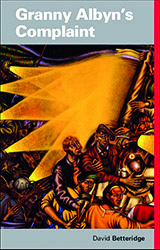 The blurb to Granny Albyn’s Complaint by Glaswegian poet David Betteridge perfectly encapsulates much of the tone and sentiment of this absorbing collection as ‘Green thoughts in a red shade’, and while there is indeed something of the British lyrical tradition running through much of Betteridge’s poems, there is also a distinctly internationalist leaning stemming from a career spent partly abroad, including in Scandinavia – very much contemporary Europe’s last demotic outpost for social democratic values. Nevertheless, there is something of the Makar in Betteridge, which puts him, both in political and poetic sympathies, in the Scots line of the likes of Sorley Maclean (Gaelic: Somhairle MacGill-Eain) and fellow Glaswegian Edwin Morgan (d. 2010). The curious title of this volume alludes to the Scottish polemical tradition of the “complaynt”, a form of robust – and tactically anonymous – territorial ‘sparring by parchment’ of the 15th and 16th centuries. It is also intended as a titular homage to Betteridge’s native Glasgow; as is most of the book, albeit punctuated by the occasional flourish of English red, as in ‘A New Mask of Anarchy’ for instance:
I saw, as in a dream or one of Goya’s caprichos,
the swelling triumph of the newly orthodox. …
…Set free, their greed
rampaged. Their anarchy spread wide;
pundits praised it; publics danced
to its paltry tune.
I heard the voices of the rich usurp,
and spoil, the tenets of democracy.
In ‘Auguries of Evil’, there is a distinctly Blakeian echo, particularly of his anthemic ‘London’ from Songs of Experience:
Twins
I wander through the chequer
of our warring streets, where Wealth
and wealth’s misuse, as old as Time,
run deep.
Every second face I see
bears marks of pain and hopelessness…
Indeed, this is almost a free verse pastiche of Blake’s ‘London’:
I wander through each chartered street,
Near where the chartered Thames does flow,
And mark in every face I meet,
Marks of weakness, marks of woe.
In every cry of every man,
In every infant’s cry of fear,
In every voice, in every ban,
The mind-forged manacles I hear:
(Etc.). But, once having navigated Blake’s ‘How the youthful harlot’s curse/ Blasts the new-born infant’s tear’, Betteridge veers off into his own flourish, with similar imagery:
Addict
A young child cries, with piercing voice,
insistently, victim of a need
she cannot tell. Addict from the womb,
she gives her mother (prior victim,
user, pusher) little peace.
Her mother gives her desperate blows
that bruise, but do not quell,
with overtures of desperate kisses
intermixed.
Particularly affecting and eloquent is the next Dantean-inflected verse:
One of a horde
A beggar, one of a horde
as numerous as lampposts, importunes.
…
His brown encrusted lips work hard.
He argues to the empty air
against his tenancy of ever lower circles
in the hell that is his fate.
Betteridge is an exceptional lyrical poet with a deft ear and eye for descriptive and cadent poetic exposition, alliteration and assonance, as in ‘Carriers’:
Smoke from the burning of a town rose copiously,
Casually, then, ribboning and twisting in an evening breeze,
…
A woman, one of a rout of refugees, walked stumblingly,
intoning prayers or curses to the bomb-scarred ground.
…
Sweeping, swooping, she gathered fist-sized boulders
from the ground,
testing each in the cradle of her palm; the best
she piled to the point of spilling a plastic pail.
This deeply musical sensibility proliferates throughout; at times, it lends Betteridge’s poems a distinctly post-Romantic quality, as in ‘May Day: In Parenthesis’:
I walked with ten thousand others on Glasgow Green;
Spoke with a score; drank beer; and looked around.
Spring was well advanced; even the late reluctant ash
Had opened wide its upturned leaves.
This poem, about a public protest march, is scorched with optimism, as symbolised in the ‘unimpeded blue’ of the sky. There is an almost religious tone to its celebration of common purpose: ‘pipers, with their melismatic turns of tune’ (melismatic: the vocal style of Gregorian chant in which one syllable in a sung text is protracted with several notes). One speaker at the demonstration is quoted using a cartographical metaphor for political transcendence: ‘…We are, or should try to be/ makers of the maps we follow, / mercators of our polity’ – a plea for true participatory democracy. The poem incorporates an allusion to Rosa Luxemburg, heroine of the short-lived Marxist revolution of 1918-19 Germany, who was ultimately captured and executed:
…passionate, an optimist,
convinced that everyone can continue a mite,
or more, to all our hope’s fashioning.
A soldier’s rifle butt abruptly put a stop
to all her eloquence, cracking her proud head
like a coconut.
But in spite of more pessimistic turns, with the haunting concession, ‘Confused, I hesitate at each line’s wrestled end’, Betteridge’s poem ends defiantly: ‘But hold!/ Such episodes of doubt can serve, perhaps,/ as preludes and as paths to change’. Betteridge, indeed, is a socialist poet bursting with a sense of Romantic optimism, even during meditations which choose overarching metaphors of the perennial forestalling of true socialist progress; as in ‘A Fish Rising’, where capitalism and the forces of ‘reaction’ are personified as a bottom-feeding carp, which periodically drifts up to the surface to feed off human social progress, then – in colouristic echoes of John Davidson and T.S. Eliot – ‘noses/ back to the cool of its brown deep’. Betteridge names these carp of history: first they were the ‘Romans’, then they were the Christian ‘monks’ – so that the poet is left to take stock:
I count the faded resurgences
that history has seen,
brief flowerings of the people’s will.
They grew wild, their early promise…
But almost in an unconscious echo of the resonant afterglow of Christianity’s original message: ‘One wound, one cry, one song, one name/ can travel faster than a Caesar’s hate’. Betteridge is a poet with a firm and passionate grasp of socialist history, invoking as he often does the past ‘martyrs’ to the cause, as in ‘The People’s Palace History Paintings’:
the hurt, intelligence, tenacity, and hope
that fired at first the Calton Weavers,
then the Chartists, Suffragettes, and Socialists.
…
they dared assert against the partialities
of class and state
their universal claim.
Betteridge imbues in future generations of socialists the ideology’s dialectical historicism as powerful polemical gunpowder: ‘a flag, unfurling/ held by age-instructed youth’. In ‘In Brecht’s Bar’, he recounts the yarns of a late socialist associate, who is ‘Now dead …– a hero –/ in the History he liked to hear’. ‘Glasgow’s Needleworks Project’ is a wonderful surge of panegyric lyricism infused with declarative Romanticism, evoking the atmosphere of William Morris and the Arts and Crafts Movement:
Stand back, well back.
Enjoy the clash of hues, more splendid
than the Northern lights, or peacock’s tails!
…
Patched, stuck on, embroidered, scribed,
light-hearted fruit of many hours,
how well these dozen hangings put the case
for Glasgow’s genius
The ebullience of the sentiment is beautifully buoyed on the sheer delight in the colour of language. Again Betteridge contrasts the pessimistic with the optimistic approaches to his political cause: ‘Some would have us see things/ through a smoke-grimed glass’, then ‘in May, against a field of red/ black-coated workers, marching; on their banner,/ her arms as muscled as a titan’s hams’. And then the closing encomium:
a dragonfly, an optimist,
hatched out, and launched on shimmering wings…
…
showing in hard-edged silhouette
our city’s built magnificence;
a Paisley-pattern tree, its roots revealed,
traceable to soils both East and West…
Beautifully wrought tropes abound throughout these poems: ‘take a map or globe,/ and, with imagined pencil,/ rule the thin line of force that runs between us,/ soul to soul’ (‘The Net’). Betteridge also has a masterful grasp of aphorism: ‘you are olive-bringer, tamer of furies,/ inspirer of our commonweal’ (‘Athene’); indeed, he devotes two pages to his aphorismic ‘Heavensayings’. To this writer’s mind, the tour de force of this collection is the longest poem, ‘May Day: Happy Returns’, brimming with richly descriptive, Wordsworthian lyricism:
The clouds dense grey has cleared,
revealing stars. Tangled in the foliage
of my neighbour’s chestnut tree,
like Christmas lights
The poet writes of the river Clyde ‘dwindling through my window’; he eulogises on his city’s artistic ancestral inheritance, connecting to the present, with brilliantly alliterative, painterly language:
our city’s epic artist, Currie, comes to paint;
the Scottish Colourists are at his side.
For his green, at the instigation
of these tutor-friends, he dips his brush
in the sap of juicy stalks and leaves of grass.
For his yellow, he blends the pollen of the catkin
and the ore of gold. For his silver,
he takes the scales of leaping salmon
in the Clyde; for his blue,
the skies of furthest space commingled with the pearls
of self-heal; and for his purple, heather.
This phantasmagorical commonweal pageantry, a coming together of the living and their ancestral ghosts, is one sprinkled with miracles:
Even the deaf can hear, including one,
Shock-haired and grim of face, who is inspired
To stretch and coil the gleaming trumpet
Of his hearing aid, and put a mouthpiece in.
Puffing out his cheeks, he blows.
Out pours brassy, brilliant rag.
All turn, entranced; we clap.
It is a rare, impromptu treat. Beethoven: it is him…
The beautifully tripping lyricism streams on: ‘cataracts of voices,/ louder than the Falls of Clyde in spate/ in ragged overlap shout out’. The religious tone of the regalia re-emerges: ‘and other terms in other tongues, unknown to me/ too numerous for me to guess’, and then ‘James Joyce jumps up’… The phantasmagoria picks up again, this time with something of the euphoric afterglow of Dylan Thomas’s ‘Fern Hill’:
The dust converts to clay; the clay to children,
those whom history has damaged in its passing by.
Crammed full with life, they race like suns,
whole and happy, in torchlight
of our Glasgow night.
The aforementioned heroine of the German socialist uprising of 1918-19 resurfaces, electrically:
Who is this voice of challenge and remembering?
Is it Rosa Luxemburg? No.
…
Still bloodied from the blow that killed her,
she wears a large brimmed hat to hide the wound.
Even Heaven cannot heal her
while her died-for cause is incomplete.
Nor is it Hildegard, precursor of the Greens…
Betteridge then bleeds the pseudo-religious imagery – one of teleological design – into a reemphasis of the socialist inheritance as a moving continuum of collective human consciousness:
no babel but a pentecost occurs –
no hodge-podge dissonance, but patternings of patterns,
where all opposites in good order are composed.
I add my bit.
The poem ends with what might serve as an epitaph for this exceptional collection as a whole:
On this note, this dominant,
rememoried, reoriented, and renewed,
I count my sum of blessings,
and conclude.
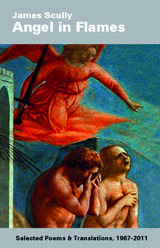 Angel in Flames (2012) brings together radical American poet and political activist James Scully’s Selected Poems and Translations, 1967-2011, and is another compendious volume which, in many ways, is in a similar lyrical vein to Summers’ union. It is important to mention here that Connecticut-born Scully was the son of a factory worker mother and shipbuilder father, so solidly from the American working class (or possibly what the Americans themselves might term ‘middle class’); Scully was active in the anti-war movement in the Sixties US, and also lived in Chile at the toxic period of 1973-4, his ‘Santiago apartment…used as a safe house for the Movimiento de Izuquierda Revolucionaria’. Emphatically, then, Scully is a politically empirical poet, and his fairly prolific output forcefully reflects this. ‘Wild Trees’ is an example of Scully’s surgically precise, very assonantal lyricism, which is often – ironically given its Marxian sensibilities – infused with an almost religious urgency (though isn’t Marxism after all a form of secular Manicheaism: whereas religion is about the eternal conflict between good and evil, dialectical materialism debatably translates this conflictual dualism into the paradigm of labour and capital); it may possibly be read – pessimistically – as an allegory on the seeming impossibility of utopian socialism, disguised as, or juxtaposed with, the unreachableness of a mythical pre-Fall, perfect human condition, just as the 17th century Levellers and Diggers believed in an historically mythic pre-Norman Saxon Golden Age of land-based egalitarianism before the patchwork hedged-in hegemonies:
we came upon
the obvious: crab apples,
blood clots of rusted fruit
these aroused in us
nostalgia
for what never existed
and never would
beyond, we noticed other trees
orchard apples abandoned
to the obsolescence
of prelapsarian desires –
With the term ‘prelapsarian’ we have an implicit allusion to the pre-Fall state: it would appear Scully’s polemic here is in the vestigial impotence that is, in the minds of most Marxists, the ineffectual, inhibiting (i.e. ‘opium of the masses’), even damaging nature of Christianity, as symbolised in the ‘orchard (or ‘church’?) apples’ ‘abandoned’ to its ‘obsolescence’. The totems of Christian religiosity are to the poet ‘hollow trunks/ twisted, fruitless, lifeless’ and, at least to Scully, a lapsed Catholic, ‘they explained nothing/ illuminated nothing’. They are ‘scabrous trunks’ which line the ‘trolley rails of childhood/ torn up’. Scully then strips down the stony icons of Catholicism, ‘the Mary’ who ‘in her muteness/ …gives away nothing’: ‘Mary, in whom/
all questions died before they could come to mind’.
This is poem forms a powerful polemic against the social complacency of religion, and though this writer is not an atheist (but is a lapsed Catholic) as presumably – and no doubt for good reasons – Scully is, he completely empathises with the sentiments, especially the expressionless of seemingly unquestioning Catholic iconography. In ‘Babble’, Scully describes his factory-working mother Hazel while she is dying of an unspecified illness in what is presumably a nursing home. Here the poet brings in many ancient Classical images and allusions to evoke the timeless theme of human mortality and its seeming futility:
baa baa baa baa baa
behind the screen –
Irene, a fetal curl
dying of nothing but old
babbling gargling old old argh
Those first two lines are in many ways sublime: ‘baa baa’ would appear to allude to the roots of the Greek word barbaros (βάρβαρος) which onomatopoeiacally denoted any one who spoke in a language other than Greek, which, unintelligible, sounded like babble (itself derived, of course, from Babel, or Babylon, whose tower of Biblical legend was struck down by God who then punished the world with a splintering of its one single language into many different ones, or ‘tongues’): following this oral Glossolalia (to speak in tongues) with the phrase ‘behind a screen’ at once creates a metaphysical analogy with the incomprehensibility and ‘unknowableness’ of the nature of death and non-existence: the undiscovered country over a border, or ‘behind a screen’. This extended lyric is scored through with some lingering aphorisms, such as ‘how did we ever/ leap into speech?’, ‘agonies of rumour’, ‘the logorrhoea of eternal life’ and ‘the factory crumpled hands/ are monumental’.
In ‘There is No Truth to the Rumour’, Scully explores the ancient use of animal skins to make papyri to write on, and sublimely juxtaposes this archaic human practise – before the development of wood-based paper – with imagery of bruising, wounding, mutilation:
yet regardless of grade, without exception,
skin being mostly collagen,
the water in ink or paint
would melt it slightly
creating a raised bed for the writing
like welts on a body
showing what’s been done to it
‘Boxcars’ touches on the Jewish Holocaust of the Second World War, and again Scully produces resonant biblical-arboreal imagery:
these faces
like tremulous leaves
curled whitely, sensing change in the weather
of a place with no trees
This is an epic lyric, unflinching in its descriptive directness of the Holocaust, and is one of the most powerful empathic depictions of that terrible episode in human history this writer has read. Scully’s stripped-down, surgical lyricism rises to the occasion of this most challenging of subjects:
more night, more fog, rolls in
the natural light of the world
obsessed
with an agenda
turns, merely, to lightning…
Scully doesn’t flinch from facing this horror head on:
HOLOCAUST fires gasped sucking
air out of the air, the engine seemed
to stoke itself
with the remains of ordinary people,
the long dead, first, in shrouds of clothing,
then the sad-eyed, the darkly artful, the sullen
leaving behind
the striped stick figures in terrible baker’s caps
serving now no further purpose
‘Boxcars’ is certainly no easy read, due to its acutely graphic grip on its subject, but it demonstrates Scully’s undeniable gift at stripping down the grisly reductionism of the crimes themselves into a sparse and gut-churning precision of image: ‘eyes, nose, lips/ never again/ to relate a human face’. Scully also deftly emphasizes the cowardice of human complicity in the inhuman act: ‘machetes take their sweet time awaiting/ the decency of dark/ to come in’. Scully evokes much of the horrors symbolically:
the way a column of smoke
gushes up
on its own exhaustion
wreathing an agony of shadows
Ultimately there is an understandable nihilism in Scully’s poetic exposition of the Holocaust:
we exist as present absentees
insects
in perennial rubble
under a heaven of unforgiving genesis
It’s probably appropriate at this juncture to note Scully’s rather peripatetic approach to the visual layout of his poetry, though this is not meant to imply randomness, as, presumably, such varying indentations of lines and irregular enjambments are part of a deliberate design; possibly to represent pauses for breath for recitals, though the precise reasons for such pauses are less obvious to deduce. In this sense, there is a marked similarity with the similarly snaking textual visuals to the poetry of Michael Horovitz (his A New Waste Land being a prime example).
The existential futility, meaninglessness, of war and conflict, particularly genocide, is touched on again in ‘Qana’:
their deaths
like little yapping dogs
rush out
into the nerve-endings of the universe
‘Atahualpa Death Prayer’ comprises 23 short lyrics relating to the eponymous last emperor of the Incas; 21 particularly caught this writer’s eye:
ruled be heaped up punishments
cut to the quick
stupefied, estranged, without justice
isolated
weighing how our bodies have no shadows
‘White Phosphorus’ appears to allude to the slow-burning chemical weapon allegedly used by US forces against Iraqi insurgents; Scully describes a fittingly gruesome and corrosive fatal agency at work:
it looks festive
a geyser
of high-arcing foaming-over stuff
dangling
puff balls of ganglia
…
infinitesimal
tungsten, blown
like metaphysics through flesh
melts bone
‘Midsummer’ finds Scully in rare bucolic mood, but not without a characteristic hint of the apocalyptic: ‘the cows browse in oblivion’. ‘I Frammenti’ is a portrait of an elderly couple the poet stayed with in Damaltia on the Croation coast, and contains some exquisite descriptions, judging by certain images, this stay was shortly after the Bosnian-Croation war of the mid nineties:
Stipin at 74
still poses
paterfamilias stiff
in lavender light
having his picture snapped.
Badly mended
cracked spectacles
gravitate down his nose.
A harrowing depiction of his ailing wife follows:
Stipin’s wife. Untreated
cancer mushrooms in her
voluminous black blouse, under
the mound of dry goods
Then the war-torn nature of this particularly Balkan society is hinted at with descriptive brio:
Even the washed up sea urchin,
a raspberry-speckled egg
shocked with spines
like a contact mine
There’s almost something Whitmanesque in the bucolic symbolism and songful quality of ‘Blueberries’:
(The gentle brutes rub through, as though
accidentally polishing the genie’s lamp.
Patches of deeper blue break out, ragged,
and galaxies glimmer in the distance…)
…
obscure, rotating sentinels
hold smoothly to the dazzling capitals, the columns;
they have turned their shoulders to the wheel
wearing shoulders down.
…
Our vulnerability remains, the saving grace.
Lost in an unspectacular cranny,
battered, manhandled,
we are neither false or true.
O blueberries, whose bloods is juice! All together –
who entertain, perhaps, an aftertaste
Here Scully demonstrates a more lyrical muscularity and aphorismic resonance. The latter capacity is abundant throughout – here are two from ‘Dropping Out’:
Success is swallowing what’s left of pride, the way
Others crash on pleasant drugs, intending suicide.
…
Rumours clutter the kitchen table
Like bomb threats piling up in public telephones.
In ‘Walking With Deirdre’ we are treated to the following morbid but sublime trope:
To open a window
Pasternak observed this
before he melted into the landscape –
is to open a vein.
Although arguably a first dash is needed after ‘window’ to delineate where the parenthesis. Another of Scully’s lingering visceral images occurs in ‘In Cuzco’, set in Chile during the Pinochet coup of 1973:
(the heart in its ribs
like a bloody flag in a fist)
they quick-stepped in
through the cold wet street,
hupping and fluttering a red flag
These empirical Chilean poems, indeed, produce some of Scully’s most striking images: ‘his thumb worked greasy miracles/ with scales’ (‘Toque de Queda’); ‘But muffled, as a held breath/ all night/ mushrooms: a slumridden/ meadow/ or raw wood shacks’ (the wonderfully titled ‘Fascist Pastoral’); and the superb ‘The worn out/ blue of his shirt/ is gray as the overworked sky’ (‘The Day of the Night’). ‘Elementary School’ is hauntingly phantasmagorical:
What after all is rain,
but the lesson –
that birds were children
the wind blew, the rain struck and slurred…
until the children learned
they were not children,
nor rain rain
nor birds birds
To this writer’s mind, it is perhaps the longer narrative lyrical poem ‘Isa Mar’, which pays tribute to the overthrown Chilean Socialist government’s exiled diplomat Marcos Orlando Letelier del Solar who was assassinated in Washington DC, 1976, by Pinochet’s agents. This poem really is a tour de force, displaying all of Scully’s most striking poetic attributes: imagistic lyric, aphorism, polemic, synecdoche and a deeply musical, assonantal use of language. As here, on Pinochet:
When he opens his mouth
all Santiago
contracts to a shrunken head
The poet is dead.
The Ministry of Public Works
lugs his urn from one rented mausoleum
to another.
His land can’t live with it.
which tosses and turns
in the General Cemetery
like a relic thrown into the sea…
‘Isa Mar’ is a poem which serves as Chilean social document; it is didactic in the least obtrusive sense, carried as it is by some astonishingly astute and evocative images – as, again, in Scully’s scalpel-sharp depiction of the deceptively avuncular and dusty dictator Pinochet:
General Pinochet
pokes up
his grandfatherly head
barking like a seal
out in the mist.
Scully adds that he ‘is addicted to stiff white uniforms/ like self-torture,/ To recall/ how crisp/ and clean it used to feel?’. ‘Now Sing’ is the one the most uncompromisingly graphic, lyrically affecting poems on the torture and execution (by firing squad) of a casualty of conflict this writer has ever read – here it is in full:
NOW sing: the guards howling
beat him with obscenities.
But he did.
His legend is
he was singing
Venceremos
when they shot him.
Even for them, it was too much
they killed him,
they couldn’t kill enough.
Victor Jara
sin guitarra
who’d held out with bloody stumps
and sung.
The title poem of this Selected volume, ‘Angel in Flames’, conjures some engrossingly crafted tropes:
And under
the wasp-waisted shirt,
extravaganza of black volcanic glass
crusht in daisies
ay! there’s the merest rib cage,
bird bones of winter,
a sallow angel
…
And some profound aphorisms:
And the fingers
with their walking stick
which is really a weapon
that cannot write –
‘Esperanza’ (‘hope’ in Spanish) seems to either be about an impoverished Brazilian woman with that name, or it is meant figuratively, as a personification of the concept of hope; it is another tour de force of Scullyean symbolic lyricism, containing initially what appear to be voodoo-like images: ‘chicken/ slaughter, pinfeathers, salted carcasses’. There’s an almost jazz-inflected rhythm to the language: ‘The look of work/ and strike, one more/ picket with a slag foot rhythm’. This poem is rich in brilliant descriptive flourishes:
on the strict iron
of the fires escape, she bristles
like chilblains in sunlight
resting her bones against the bare brick wall.
Against the world, which is
legal and anglo, she yanks
as lavender vinyl collar across her face.
Not like an ostrich, but an old opera.
They want her soul her bread
her food stamps, welfare
check, slave pay,
her 30 dollar a week
union dole.
…
Esperanza
shivered to bone
in the throats of restaurants,
in plump bodega hearts,
and in the labyrinth of refineries
‘Enough!’ address the grinding poverty of – presumably – the contemporary austerity States, producing some powerful images (‘the oily roar/ of her horizon’), and ends as form of monody to the life of a poverty-waged American blue collar worker, showing how very little has changed since the days of Jack London’s Martin Eden (1909):
How 38 years
boxing chemicals and breakers,
grinding glass,
add up
to $57.60 a month
for life: enough
for dog food, cheap
stupefying wine,
rest beyond belief.
it is more
than enough.
‘Halfway’ ends on a guttural Ginsbergian image for poverty: ‘So torn the gut/ howls in its pit’. ‘Witness César Vallejo’ is a kind of invocation to the radical Peruvian poet; it is a strange but stunningly beautiful lyric, partly touching on the Spanish Civil War, in which Vallejo was involved, which seems initially slightly sardonic:
To his card carrying
communism we appeal,
his blank passport
utopian
forehead,
his vest and shoes,
his marxist-leninist study groups.
and, why not, his arrogance
his fractured earnestness
so literal!
And the blushing
aureole on his pillar of militant light…
Why not!
For his palm pledges
the muscle pump
crammed into his chest.
For, in fact, 40 years dead
the corpse, which is very dead, is yet
very warm –
like a book face up
under a single staring lamp!
But at other times, like an encomium, or eulogy, and ends almost cryptically: ‘this witness/ whose passion is our verdict’. Perhaps this is a critique of an academic ‘trendy leftie’ intelligentsia which claims some academic ownership over the revolutionary poet’s reputation? Whatever the polemical purpose to the poem, it contains some truly startling leaps of aphorismic lyricism. The epigram ‘Golden Mean’ should be put in an envelope and posted directly to the current Work and Pensions Secretary – the “quiet fascist” of contemporary politics – Iain Duncan Smith, who, having effectively overseen the mass fiscal cleansing of tens of thousands of legitimately incapacitated British claimants, once gauchely termed PCS union leader Mark Serwotka’s deeply compassionate socialist beliefs as “extreme views”:
They call the rage of the oppressed
extremist.
Evenhanded
censure,
from the hypothetical centre
the slaughter they call impartial, objective
Scully occasionally invokes some key voices in the modernistic American poetic heritage to which his own belongs, as in ‘Poe Votes’:
Wednesday Oct. 3rd, 1849
all liquored up
and dragged
(Crane guesses)
retching through Baltimore
This poem of course commemorates the apparently sordid death of the great American author of gothic phantasmagoria, Edgar Allen Poe, who was found delirious – or intoxicated – on the streets of Baltimore, seemingly dressed in someone else’s clothes, on an election day, which led some to speculate that, in spite of his own fragile and poisoned pathology (tubercular, alcoholic etc.), Poe might have been the victim of a macabre practice known as ‘cooping’, whereby unwilling persons were sometimes made drunk, even drugged, and forced to vote for particular candidates, sometimes several times, by gangs hired by some politicians, and who were sometimes beaten or even murdered if they refused. ‘Rhododendron’ is a deftly descriptive, polemic poem on poetry appreciation:
You said, there’s a poem in the rhododendron.
I said, not for me.
Elizabeth Bishop, maybe, but she’s dead:
tough-minded lady with her cigarette
always smoking, I liked her, we both did,
though she did make that racist, sexist
remark about cigar rollers in Tampa.
The words out of her mouth left her
propped at the podium, like a quaint
raspy doll… the air
had left the room, left her
standing all by her lonesome,
like a period piece.
Scully’s voluminous and absorbing volume then concludes caustically with his own poetic polemic on the state of contemporary poetry, simply titled, without rhetorical question mark, ‘What is Poetry’. From his empirically politicised perspective, he immediately challenges much of the synthetic ‘radical chic’ and posturing of contemporary mainstream poetry: ‘At night whom does it adore/ yet at dawn/ what dream would it go to the wall for’. Scully asks, is poetry ‘the ideology of a class or the puff of genius’ – again, sans question mark, which makes it debatably more rather than less rhetorical; a kind of Socratic statement. Scully also puts in his own inimitable word on the perennial Audenic ‘poetry and politics’ paradigm:
does it make anything happen
or does it die to itself, till others notice the smell
is it shrill does its voice break
or must it be a baritone of honey
This is a blistering, visceral riposte to the continuing poetic debate on the true meaning of Auden’s ambiguous trope ‘poetry makes nothing happen: it survives/ In the valley of its making where executives/ Would never want to tamper, flows on south// …Raw towns that we believe and die in; it survives,/ A way of happening, a mouth’ (‘In Memory of W.B. Yeats’, 1940). Through the exceptional empirically political, deeply humane and empathic lyricism of poets such as James Scully, poetry certainly does have ‘a way of happening’, and we can only hope that, in turn – as to some degree historically it has done, as in the sea-change of opinion on war which rose on the vociferous tide of the poetry of Wilfred Owen, Siegfried Sassoon, Isaac Rosenberg, Ivor Gurney et al – poetry such as Scully’s will make something happen; and even if it is a form of ‘nothing’, it will certainly be an emphatic, poetically forceful and titanium ‘nothing’. Angel in Flames is both a searing indictment in poetry of the destruction and inhumanity of the twentieth century, and an astonishing testament to the sheer emotional power and imaginative brio of James Scully’s forty-plus years’ poetic output.
Ruth Valentine is very much a community-oriented poet, dividing her time between writing books for schools on welfare issues, advising charities, conducting secular funerals, and producing her own highly lyrical and socially incisive verse. On the Saltmarsh (Smokestack, 2012) is described by its blurb ‘a book about language and silence’, in particular, the ‘silence’ of countless victims of corrupt and violent regimes throughout the world. The title of the book, echoing – at least to this reviewer – that rather surreal anthological favourite of early twentieth-century poet Harold Monro’s, ‘Overheard on a Saltmarsh’ (in which a ‘Green glass goblin’ is attempting to cajole some ‘beads’ from a nymph), feels quite appropriate for a poet who, similarly to Monro (who was very much the subversive verse-‘goblin’ among the otherwise more ‘hobbit-ish’ Georgian poets, though was also their anthologiser), deftly couches social polemic in subtle, quite refined lyricism. Taking the first poem, first of a title-related sequence, ‘The Poet on the Saltmarsh’, there is a clear Monro-esque quality in its cadent descriptive precision and wistful tone:
The lark scribbles its legend across the cloud.
Reciting its one haiku, the peewit rises.
Only I, the poet, have no words,
picking my way over the salt-marshes,
the rising tide’s ideogram for hunger.
‘The Boat on the Saltmarsh’ is a beautifully judged piece of sparse but richly-phrased lyricism, again, adumbrated by a Monro-esque quality in its dialogic structure and eerie imagery reminiscent of old nursery rhymes and the brothers Grimm:
What happens to the light on the saltmarsh?
It skids to mud.
What happens to language?
Under bulging cloud,
the larks gabble syllables.
What happens to the children?
They lie on the mud-bed,
on the dunlin’s scrawling,
in channels where the tide
trespasses, plunges,
and the rowing-boat
rotting amongst sea-purslane
won’t skim towards them.
Valentine is particularly accomplished at alliterative sense-impression, as in ‘The Saltmarsh as Crêche’: ‘khaki-marsh samphire/ grass/ make camouflage for them’. This poem ends on a haunting note as ‘the mothers’ of phantom children ‘look up’ from their books or newspapers on ‘commuter trains’ and ‘almost remember’ them. ‘The Saltmarsh as Port of Entry’ is similarly sublime, composed of quite staccato tropes, and is again subtly alliterative and assonantal: ‘glasswort, sea wormwood,/ the lapwings screeched around them’. ‘The Saltmarsh as No Man’s Land’ closes this first sequence, is more polemically direct, with the saltmarsh personified as a neglectful, even abusive, elemental mother, along with some contemporaneously polemical war images:
There were children, but the marsh
fed them rock-salt,
left them drenched in their underwear.
The marsh gave them
the half-life sea for a plaything,
…
to trudge in the dark, to flop
in the brimming mud
…
they hauled back rusted land-mines,
cluster-bombs,
sprung themselves into scrap-iron,
trying to shake her.
‘Where the Bodies Are’ is a poem-polemic on the General Pinochet’s violently oppressive right-wing Chilean regime (1974-1989).
and seeds
half-shrivelled in their resignation
force themselves open
stare at the deep drugged sky with unknown flowers.
In the Andes
transported tenderly in the beaks of condors
in Temuco, by the silent railway line
in the shrouds of rain
in Tierra del Fuego, sheltering underneath
the restless ice.
There then comes a brilliantly alliterative trope: ‘turning to coral in the restless ocean/ having been dropped living by helicopters’. Valentine’s great poetic strength is to graphically evoke political atrocities, mostly through physical description, objects, stains on furnishings, almost as if she is getting each tangible scene to express not only the events themselves but also the polemical echoes of them, as in ‘Handprints’:
So the family went back home after the war,
and covered the slashed upholstery, and took
the peacekeepers on patrol the red notebook
naming the people held there, and painted over
the pencilled dates on the wall: but couldn’t cover
with four coats of gloss the marks on the kitchen door,
handprints, that rose to the surface of a faded pink
or lilac-grey, broad hands, the splayed fingers,
the cushioned square of the palm,
a prisoner’s hunger
for the smells of lamb-stew and lemon peel, the face
of a child eating a plum…
Valentine’s unflinching deep-focus lens produces some truly shocking tropes, profoundly evoked throughout ‘The Fortunate’, as in ‘2: Hamide’, where an attempt by Pinochet’s authorities to clean up a scene of domestic torture is crafted in a satirical tone:
No-one has yet invented the right bleach
to take out finger-trails on a veneer
kitchen-door. Unless
it is a kind of acknowledgement of fact.
In ‘5: In Person’, Valentine moves sublimely from the physical to the metaphysical quandaries and repercussions of violent oppression:
savour, your voice: is this
in any way better than lying in the corner
of the kitchen, where you lit
the stove and made coffee every morning,
that kitchen a blackened stove now? Does the soul
look back from wherever it moves to, does it feel
the body’s humiliation? Or is it only
gashed with compassion for the returning living,
This reviewer isn’t completely sure whether the next poem’s title, ‘The Poetry Reading’, is meant literally or metaphorically, but it seems to depict an attempt at an actual poetry reading in the rubble of a blown-apart bookshop in a war zone (though the location isn’t entirely clear, perhaps the scenario is meant universally):
His shoes and his hair are dusty with the thoughts
of Darwish, Mahfouz, Derrida, Socrates,
who last week were waiting equitably on shelves
in the smell of coffee and printer’s ink, and now
are everywhere in the quarter, distributed
beyond ambition, on pavements, into kitchens.
…
The man in fatigues leaning against the car,
the boy crossed-leg on the bonnet, the tall man
lighting a cigarette, are turned towards him.
he makes his voice sound through the ruined shop
behind him, the rubble, the crowd of men,
the generations of poets, the armies, the languages,
…
the rooms where women
sing their children to sleep, the scattered bodies
assembled in clean white sheets, listening in graves.
‘Powerpoint’ is part-elucidated in the Endnotes section with the comment: ‘extraordinary rendition’, and, indeed, its polemical point seems fairly clear, lucidly expressed, again, largely through physical and inanimate imagery:
I have been freighted between the continents
like roses from Colombia, packed half-frozen,
…
Wherever I was unloaded, it was the same
in tropical heat or frost, in the hood-blurred light
off whitewashed walls, in hangars;
the warders trained
by the same chalk-stripe men, in lecture rooms
I try to imagine: Powerpoint images,
role-play perhaps, with laughter, or simulation,
‘Tai Chi’ is a half-rhyming sonnet which appears to depict another attempt at community normality with a tai chi class conducted in a war-zone:
On the wrong side of the planet, in a room
with thirty people, most with short grey hair
as if the plaster dust had settled on them
and they had stopped minding.
In ‘The Government Scientist Deciphers the Clay Tablets – i.m. David Kelly’, we have a directly polemical title to what is a more an allegorical poem which cites various Sumerian goddesses and is laced with imaginatively subverted allusions to the still-‘undisclosed dossier’ on the truth behind the perceived conspiracy relating to the tragic figure in whose memory it is written:
not even Geshtinanna
goddess of scribes – or journalists – his sister,
who would not tell the spirits where he had hidden,
though they offered her food and water, and when she still
said nothing, poured the hot pitch into her –
The poetic composition is richly alliterative and descriptive:
There are the plagues
the sumerians knew, ricin, botulism,
the torturer plying his trade like a master-craftsman.
In ‘The Lament of Ereshkigal’ we are treated to some more beautifully alliterative descriptions: ‘smell of cooled tea sour reek of anthracite/ damped down in the boiler meagre light’. ‘Nouakchott’ seems to be depicting the grittiness of local life in the capital of Mauritania. ‘1: Rainstick’ is a very aural slice of visceral lyricism:
She’s hollow like a rainstick,
seeds rattling, caught on
pressed-in thorns;
she’s the estuary draining,
mudflats, bladderwrack,
light like saliva; she’s
a Venus fly-trap:
In ‘3: Nouakchott’, there is more such evocative description: ‘the saltmarsh whistling, grey-green, venomous’ – and, indeed, a ‘saltmarsh’ might be located anywhere from the green waterlogged fens to the flat arid landscapes of the Middle East. There also appears to be some sort of polemic here relating to rich western women adopting orphans from starving countries. ‘4: St John’s Street’ closes the poem in quite graphic imagery, which almost seems like an depiction of rape subverted from the female point of view – almost to the point of ostensible empowerment, or objectification – whereby the act inflicted on her is somehow controlled by herself:
She’ll kidnap a man on St John’s Street, drag him off,
shovel him into the gap that throbs and opens,
that throbs and pouches inside her, and won’t open.
‘Zoroastrian’ contains some beguiling imagery: ‘a plump hen-blackbird hops,/ from behind the hellebore into your line of sight’ and ‘People leap over bonfires from the indelible/ past to the present and are filled with light’. ‘The Chosen’ is a particularly powerful, graphically descriptive poem about the Jewish Holocaust, almost mediumistic in its deeply empathetic sense of authentic depiction.; it makes strong use of half- and sprung- rhyme:
The sun wiped out at four: that was a sign
the preacher said, and the cloud like a burning barn,
We guzzled potatoes, he said. It was comforting,
in the tin-roofed shack, in the blowy October dawn,
his rant, our hymns of repentance. We thought he came
from north, neon and traffic, and had forgotten
snowfall, cattle-feed, fires. They say he slept
every night in a coffin like a gold-framed saint.
Down here the walls absent themselves, like prayer,
The kerosene smoke folds back over the light,
my daughter whimpers.
Valentine’s talent is in being able to depict the poetry in the most horrific of scenarios; to draw out the almost-numinous from the depths of human suffering – this is a considerable power, made all the more affecting for its refusal to ever sink into mawkishness or, oppositely, overly cerebral symbolism, but keep the balance of heart and head:
My child coughs in her sleep. She dreams of snow
brightening the plateau, eagles studying
village from cloud-level, her twenty hens
picking through shale and thistles, fox-observed,
the eggs cracked open in hollows.
I see her pale,
long-legged under her blanket. Is this world
too brittle to bear her, worn thin by her elders?
Ah, she’ll see soon
snow-dazzle of heaven, hover of seraphim,
our pecking selves
filled, looking up at last. I tug the covers
over her white-boned feet. Just let her live
till spring, dear Lord; gasp at your crocus colours
The Holocaust scenario grows more graphically tangible further into this exceptional poem:
And yet, while groaning to myself this general
confession, unabsolvable, I lay
away from the flame and flutter, in the smell
of tallow, and human skin
never immersed since Jordan, there came a boy.
‘The Fishing Vessel’, which has a certain biblical, almost baptismal quality to it, ends on a vivid image of someone drowned, rediscovered: ‘and the printer-ink/ leaching into the bones of his outstretched arm’. ‘Morecambe Bay’ has a sing-song lilt to it as its snaking sway on the page on the page amplifies –in parts it’s faintly reminiscent of some of Dylan Thomas’s sparser lyrics: ‘brimming beside the dark-/ leaved rhododendrons/ by the grey brick chimneys’. ‘Birthright’ is a short but sublime lyric, closing on a wonderfully crafted, wistful and alliterative verse:
the hammered bolt, silence, a hemp rope pulling
over a blade of rock, at times a tug
that could be longing or treachery, and snow
dazzling out all detail, clarifying.
‘On Reading’ comprises three ekphrastic poems in response to photos by André Kertész –as always with Valentine, the descriptions of deeply thoughtful and evocative –here are some striking excerpts from each verse:
1: Circus, New York City, May 4, 1969
He’s stored himself in the wardrobe tent, between
the sequins and cummerbunds, the satin coats
with darker piping at shoulder and hem to mean
oriental, and the row of boots;
flat on the bench on his stomach, muscled hands
folded together, holding down the page
to stop the story getting away. Beyond
the canvas wall, a lion turns in its cage,
a woman in a white tutu stands on points,
her white horse trots a circle. …
2: Second Avenue, New York City. June 30,1969
…four Tiffany lamps, one boot,
framed landscape in oils, a shelf of dusty jars,
ewer, mangle, five leather-bound books
and him at a desk in the middle, with the paper:
Cuban moustache, brown hands, curlier hair,
the same relaxed attention. Another reader,
a wooden coachman, smiles at the affairs
of men and antiques, long whip in his hand
flicking the rump of an invisible
strawberry roan, his skin the improbable
shoe-polish black of caricature. …
3: Hungary, 1915
…
…All around their feet
rubble and dust, the sweepings of an age
squandered in wars, including this one. Meat
and maps are scarce, but as they concentrate
elephants drink from lakes, an airship lands,
ice at the Arctic creaks, the jagged rigging
sparkles with fire.
This is one of the most linguistically accomplished poems in the book, so a strong one to finish it on. On the Saltmarsh is a beguiling, exceptionally composed volume of poems touching on some of the most sensitive nerve-points of mid-to-late twentieth century history, as well as treading the still-primed mines of the present; it is a highly figurative, lyrical circumnavigation of the whole Grand Guignol of gulags, guerrilla regimes and the terrible ramifications that scar civilian populations long after the fatigues have vanished back into the sand-clouds of departing helicopters.

Still Life is a rare type of collection and one which couldn’t have been published at a more timely moment, as the physically and mentally disabled are being persecuted through the administrative pincer-movement of welfare caps and the notorious Atos Work Capability Assessments. Quite remarkably, Still Life is almost entirely written using Dragon software following its author, Lancastrian poet (and former editor of Mudfog Press) Gordon Hodgeon, became paralysed after a failed spinal operation in 2010 (a state so severe that he needs a hospital ventilator to help him breathe). Both through its highly accomplished poetic composition and sheer emotional force, this book is a profound and deeply moving tribute to the poet’s physical and psychical bravery; a testament to human defiance in the face of extreme disability (and the government-led stigmatisation of disabled claimants previously mentioned). Still Life is also ringing proof that some of the most powerful and beautifully crafted poetry pours from the fount of psychical suffering; a form of poetry which simply cannot be counterfeited through synthetic conceit. This reviewer has a habit of folding the tops of the pages he wishes to return to while reading a book for review, and, complimentarily, his copy of Still Life now resembles a concertina. Right from the outset, the polish and control of Hodgeon’s exemplary half-rhyming verse is in evidence, in the very first lines of ‘This Bed’: ‘This bed is the bed of dreams, they all start/ from this bed, a white hole swallowing/ a collapsing star’. Hodgeon displays a brilliant command of rhythmic alliterative language in ‘Man Writing an E-mail with his Carer’:
The blackened frame bisects her world
between the fixed old dispensation
…
anything could move, the dark fold in a skirt,
that cambric sleeve, a delicate lace cap.
Hodgeon’s symbolic descriptions can be sublime, even mesmerising: ‘a shiver in the gauze curtain, shadow of air,/ the pale geometries of the window glass’. There is an Eliotonian control to such precisely musical lines. Hodgeon’s physical and psychological plight frequently gloom through with a harrowing expressionism, as in ‘Visitor’: ‘I howl it like an abandoned dog: ho o ome’. The tone and control of ‘North Tees Epiphany’ reads like a cross between Auden and Larkin:
Up in the ship of warming air
i see earth roll, unroll ten times or more
to the grey invisible sea, through terraces…
….
always the engines’ thrum as gulls weave
wind’s fabric round and save us, save us
their window-baffled, hardly-hoping call.
I am on ear of many, one eyeball.
This is beautifully judged verse with some unforced rhymes and half-rhymes which shape subtle cadences; Hodgeon seems to know instinctively where enjambments should fall:
big ship’s the grand, the theatrical show,
staging nativities three floors below
while this top deck sets tragicomic bones,
our breaks, distortions, fractures, agony.
‘Of the Tree’ is distinctly Audenesque:
Days will discover; this one curve of brass
marches green-veined light and shadow
over the quivering measures of grass.
Seeming fast, slow, the evanescent now.
In the bittersweet ‘Thank You, Jelly’, Hodgeon produces one of his most startling images, relating to his now paralysed body:
I want to thank it, this shivering blancmange
this paralysed jellyfish, for all it has done
these past seventy years.
‘Easter in ICU’ continues this un-self-pitying focus of evocation on the poet’s numbed body, this time, with an almost mantra-like 1/2/1/22 rhyme scheme, which is faintly Yeatsian:
It is my body on this slab of bed
with one white sheet my cover.
no angels at my foot or head,
but nurses here, who hover:
they lift me, turn me over.
A descriptive flourish in ‘The Leaving’ is reminiscent of passages from Christopher Reid’s A Scattering; again, Hodgeon demonstrates his technical confidence with alternating line lengths, enjambments falling where the cadences of lines seem to naturally pause, so that the effect is extremely well-judged. This poem beautifully juxtaposes the features of a hospital room with natural imagery from the poet’s memory of home and garden:
my sense of sky’s become
the emulsioned white of ceiling,
of sun, the ornate hung circle
of a shaded bulb,
my garden is cut flowers in water.
That last image is exceptional; as a particularly startling one a little later: ‘the last leaf sucked from the wood,/ ripping its fingernails’. This poem is wonderfully composed and, again, Audenesque in its almost genteel phraseology: ‘Under the grass, weak as worm castings,/ our weary archaeology, the bones of buried animals’. The line, ‘Also, the procession of cats stalking through childhoods’, is almost put formally, the ‘Also’ feeling clinical, scientifically precise, almost bureaucratic; it combines with the sound of ‘procession’ and ‘cats stalking’ to create a rustling assonance and sibilance. ‘The Leaving’ concludes with uncompromising poignancy:
I often wake, hear the comfort,
your regular breath beside me.
But this is a single bed
and the breath I hear is the ventilator
filling and emptying my lungs.
In ‘Libby’, one catches the echo of Joseph Conrad’s famous trope – from Lord Jim – ‘in the destructive element immerse’ as Hodgeon says of being taught to swim: ‘we are in our element’. ‘Glazebury Girl’ is a candid expression of latter-day atheism set against memories of a former – and then-fellow – Methodist girlfriend. It begins with richly descriptive recollections of the past student romance, apparently unconsummated as evidenced in the – very industrial – evocation of sexual frustration:
We dragged along the cindered backs
of Railway Road, pressing our weight
on damp yard walls, dank gates.
…
while untaught hands quite failed
to make their way inside your winter coat,
its fingered tufts and curls of bluey-grey.
Then the poem runs to a courageously apostate confession:
But I would like to know,
when all I know will soon be ignorance,
whether you still put trust
in that belief we shared in harvest home
before we had to reckon with
what all our days have brought us.
Perhaps God knows, I tried, but years
wore down, wore through, the fabric tore.
At the back-end, I can’t accept one Word
Incarnate, even as my flash fails.
I might require salvation, but it wouldn’t work,
cliff-hanger snatch out of the fiery pit,
Hell’s teeth, jaws I don’t think exist.
Hodgeon then cites the ‘small mercies’, such as ‘glimpses of poems,/ the studied breath of the ventilator’. This touching poem ends in a kind of epigram:
So here I sit, have little left to say,
locked in this wheelchair’s pew-hard seat.
Too many years gone, I can’t face you now.
More miles, more hills than I will ever make.
‘Long Meg’ appears to be a nostalgia piece about the poet’s upbringing, named after a ring of stones in Cumbria; again, it has some beautifully judged descriptions: ‘Last of the sun backlights Blencathra/ great stranded whale on the luminous shore’ – a line which faintly reminds this writer of Alun Lewis’s wonderful personification of his home village’s chapel ‘Stretched like a sow beside the stream’ (‘The Mountain Over Aberdare’, Raiders’ Dawn, 1942); and the closing flourish:
I bike to the shop, bread and the paper,
the green’s empty. Next to the daughters’ circle
and the great stone chisel plunged into earth
where the light said to itself ‘Stab, stab here!’
‘Up Hartside’ continues this energetic nostalgia with some lovely half-rhymes, assonance and alliteration:
Can’t get enough, that old prune sun,
so tantalised, can’t drink, can hardly sip
with those several septic tongues.
The rasp of them on the grain of scalp
lifting the beads of my sweat,
rubbing each moist pore open.
‘To Long Meg’ is a more personal tribute to the stone circle, bursting with affectionate evocations on revisiting the childhood spot which seems to have altered little during the decades since:
The laneside hedges
much as they were, the red soil banking under them
a shifting tracery of rabbit holes.
Such is the bond of Hodgeon’s consciousness to this childhood haunt that his affection sounds proprietorial – such a powerful sense of place, origin, is enviable: ‘I will explain to newcomers/ the bunkum of Tudor myths, the witchcraft hokey’. ‘Life Class’ is, for this writer, possibly the most breathtakingly composed descriptive poem in the volume, bristling as it is with crackling alliteration and deeply concentrated figurative evocation. Here are some favourite tropes:
We are arranged, the four sides of a rectangle
its cracked edges these square work-tables
tops of scabby teak, others scuffed mustard.
…
…our model is laid out
on her lilo, old cushions from a lost settee
easy in private pool, the slightest breath
lifting her belly, fronds of her fingers stirring.
Dark weed hair falls into textures of cloth
clings in a moss where legs part
from where they flow in their echoing lines.
The horizon of skull, the pencil stroke of eyebrow
the delicate fringe of one lid shivering
finer than any brush here, thinner than trembling lines.
The soul looks out, timid bright, from its hard shell.
Here Hodgeon brilliantly transforms what might initially seem like an ekphrastic poem into its own subject, or rather, into an object deserved of its own ekphrasis; the marine imagery is tantalising. Tropes such as ‘where men took stone,/ the flickering tarn of the eye’ and ‘this obstinacy of eyes and fingers’, are mesmerising. Above all, it is clear that here is a poet enjoying words and their figurative properties, using them fittingly for the subject, and with a painterly appetite for the palette of language:
And the wolds of your body slope up and away
not an abruptness, the angles cameras might configure,
nor the abstractions of clothing. It is not
as an ideal either you are come here, but one
holding-together, while the glue’s strong, the human genome
Note how Hodgeon quite curiously and frequently omits commas at the end of lines/enjambments, as in ‘up and away/ not an abruptness’: it suggests a poet of masterly confidence, in terms of his command of composition, that the reader will read the absence of a comma where the enjambment falls as if the enjambment itself is the clause delineator, or ocular pause. Happily, ‘Life Class’ is one of Hodgeon’s marginally longer poems:
The gathering of shadows,
our hands winding the sun through the sky
into a final darkness where, this same afternoon,
in mortuaries, quick dug graves, bulldozed in-fills,
the murdered lie unpuzzled under dry heaven.
‘Tall Ships in the Shipley’ is another phantasmagorical transfiguration of the poet’s present hospital environment into natural scenes of memory; with its maritime descriptions, it has some of the flavour of the sea-verse of John Masefield, especially in its rhyme form; though is more imaginative in its use of image – more akin, indeed, to Swedish poet Harry Martinson’s poems on his time as a merchant seaman (circa Phantom Ships):
Ships heave, decks twitch, masts lean in wedding dress,
brave elements with their newfangledness.
…
Each ship’s an island, risking liberty,
dragging day-trippers out of their depth like me.
…
The parquet floors swell with the pregnant moon,
the granite creaks, the ceiling trickles down.
Extractor fans break out in harsh gull cries,
horizons leach and lurch before my eyes.
Gateshead’s good ship laden with precious ore
lurches land-lover wisely back to shore.
There are echoes of Martinson’s more imagistic sea-poetry in the following piece, ‘Bella Pateman For This Night Only’, which is couched in one of Hodgeon’s specialities: richly phrased tercets:
A cart is crossing the bridge that’s swung
across the sun-slapped harbour, the rippled bowl.
The drink licks shadows on the crusting steps.
…
She might have jumped at Scarborough last night
after the show’s slow hand-claps, boozy boos,
the run-out sands of emptying stalls.
The same can be said for ‘Sailors’ Song’ which includes some striking turns of phrase: ‘the sea swells up to a bruising lip’, ‘And all I’ve left is a gap-toothed song’, and:
I should haul you safe under a wing,
hold you as close as the words we spoke.
But it’s well that you take this cold embrace
on your silky pelt and swim or choke
round-eyed, electric, remembering.
In ‘Large Winged Vessel’, there’s a hint of the subversive bucolic of D.H. Lawrence’s poetry; even conceivably shades of Emily Dickinson and Sylvia Plath:
In air I squat, in light, coiled heavy
as heaviest artillery,
immune and monstrous bee,
thick-set on slaughter: ‘What I do is me’.
…
You might break
my silence, prove your scholastic
cunning, get your frost to crack
glazed hide where no nerve lives.
And indeed this might be a case of burning ears, as only a couple of pages on Hodgeon delivers a brilliant pastiche of D.H. Lawrence’s ‘Figs’, in his engrossing and amusing ‘Hydroponic’, which begins hilariously: ‘Figs grow, ripen in Middlesbrough’. Hodgeon proves himself here a first rate poetic mimic with an ingenious eye for figurative parody in lines such as ‘these stallion’s testicles gone rusty/ these well-hung wonders of the hydroponicum’ – one can almost hear a delectating Alan Bates licking his lips as he recites these lines to let off some steam between shoots during the filming of Ken Russell’s Women In Love:
Little wonder Mother-in-Law’s Tongue
has ceased its wagging, gone green
or that a Cup of Gold Wine has
spilled down the wall of the hothouse.
Already there are reports of
giant plastic ladybirds
screwed onto tree stumps
where lanky whips of freckled stem
can have their way with them.
The exhibitionists of the plant world
are gathering, rubbery, tattooed intimates
flaunting blossoms like open wounds
pistils of pinky yellow.
This poem grows increasingly surreal as it comes to a botanically polemical close:
Let them cast out
the grubby-fingered peddlers of verse
on the winds of dispersal, the muddy verges
of dual carriageways. Set up a working party
Figs in the Post-Industrial Economy
‘Over the Border’ is possibly Hodgeon’s most consciously uncontrolled poem, which sweeps the reader along through its imaginative word-play:
The river’s invisible, licks
along down there, hums its burden
under crane feet, abstractions of the cranium
…
Not the Transporter where the cars fly slow, traditional like
cargoes of iron ore, dogs’ breath, slave-sweat, Serb girls, soft drugs,
hard core?
This poem’s sense of compositional experiment is dextrously underpinned by the sheer confidence of poetic craftsmanship: hence poetic-prose lines such as ‘green flickering laughter of mudland where ex cathedral stood’ sound meaningful and commanding where similar tropes from less experienced poets might seem mechanical and affected. ‘For CAK, July 2008’ seems to be a threnody for a deceased friend or intimate, and displays again Hodgeon’s thoughtfully descriptive lyricism:
The family you drew close-stitched together,
strong-willed, generous, artful, with humbling love,
nurtures your sampler tree, inscribes your long, wise book.
‘For a Future Reader’ is a hypnotic lyric, which reads almost as a projected self-threnody:
Safe on the shore of your forever city
from fabled books, their wormy memories,
you found and broke my bottled verses open.
…
Poets without question
should be banished, spell-bound messages
returned unopened. Or you’ll lose eternity.
‘Down’ continues this focused lyrical vein with some wonderful colouristic images: ‘The sky’s a rush of tattered suits,/ gabardines of grey, charcoal, ebony’. ‘Rain Falling’ is spellbinding in its almost phantasmagorical mix of bodily and bucolic imagery, brimming with musicality – it has some of the qualities of Alun Lewis and Dylan Thomas in phrases such as ‘hungry for the shiver of movement, the sliver of wet lightning’ and the prayer-like ‘Be silent, listen. It is all of us, living, dying’:
From the broken spine, the weary, worked-out hills,
my arm reaches to the trampled horizon, unravelling the dale,
thirsting in all its veins, stretched to that hands nailed to the gares,
‘Spades’ is one of the most political of Hodgeon’s poems, a scathing piece against the aristocracies of the land-grabs, which calls to mind some of the writing of pamphleteers John Lilburne and Gerard Winstanley (of the Levellers and Diggers respectively). Tropes such as ‘admires/ his ermined and embroidered belly’ and ‘his hands are white, his furs are white,/ he’s never had to scrub/the dirt out of his nails’ act as powerful aphorisms against privilege. ‘Spades’ is dialectic as poetry, deeply rhetorical: ‘Where did/ his fine fibres root, the sheep of his woollens/ graze?’ and ‘Unsoiled, a proper worm-riddle./ …Rich dead bones, safe as a saint’s/ …marbled in basilicas’. The poem closes on a barbed note of warning to the upper echelons of society, with a distinctly Shelleyean tinge:
We are sick of your majesty,
all your angelic orders.
We will queue at the ironmongers
…
We will return without passports,
carrying spades.
The Digger imagery is implicit here. ‘Advent’ finds Hodgeon in more self-deprecating mode, with a trope depicting the more pathetic aspects to late middle age worthy of Larkin removing his bicycle clips in ‘Church Going’, or Eliot’s balding ‘Prufrock’ with his rolled trousered ends: ‘I wear loud sweaters and bark urbanely’. ‘Discovery’ is a powerful, supine nod to impending extinction and the prospect of a personal posterity which is of no proleptic comfort to the devout atheist; it is Larkinian in its clipped rhymed precision and nihilistic tone:
What there is. Keep it for keeping’s sake
with mildewed book, scrapped manuscript,
half a story. Scrape them together, rake.
‘At the Parish Church’ is resoundingly Audenesque in its tone and style, and echoes the sardonic religious scepticism, criticism even, of other poems in this volume:
Words grow together this way, weave themselves
in compound patterns: poet’s inky flick
or twining through the generation’s tongues.
…
A word to share past lych-gate, obelisk,
break into fragments, dole out hand-to-mouth
across the town she lived a good life in
The line ‘Such voluntary of people on this earth/ would swell the smoke to heaven’ has the assuredness of a Shakespearean trope. ‘A Picture of March’ gifts us ‘massed bands of daffodils’. ‘Rising’ is perhaps the best distilled of Hodgeon’s irreligious lyrics – a perfectly judged, beautifully composed pseudo-sonnet reminiscent of the plaintive though more religiously inclined poems of Robert Nye or Sebastian Barker:
Ending today, the whisky in my glass
replaced the day’s colour, scent and taste,
remarked its minute’s unremarkableness.
Hodgeon’s engagement with language is deeply imaginative and delights in alliterative sound as much as substance:
of sense made from these rattled parallels.
I sipped the hours’ slow-greening field, hedge, trees;
dredged grainy souls from the driftleaved village pool.
…
The curlew’s bent blade ploughs the clays.
Applause from scrambler bikes as lapwings wring
their mops
It closes on an excellent rhyming couplet: ‘Easter’s church fills to its prompt: ‘Risen indeed!’/ is emptied like the tomb is, like my glass is emptied’. ‘Cats in the Alhambra Gardens’ is again very much sculpted from sense-impression, especially visual and aural, as in ‘the green/ between-light, tremble of guitars that wake us’ and ‘on the pitch-blue velvet of the gardens’ (presumably witnessed by night?). This reviewer has visited the Alhambra, and Granada itself several times; it is a high challenge to evoke in poetry the vertiginous beauty and complexity of the Moorish palace, particularly its intricate interior decorations – intended to represent infinity – which induce in the onlooker something approaching hyperkulturemia (particularly if visited in the heat of spring or summer), and has yet to read any poem which truly brings this particular setting to full life. However, Hodgeon manages to engender here a strong sense of the place through a ripe engagement with sense impressing images. ‘Muse in Spring’ finds Hodgeon again in a mood of poetic introspection, where he coins the poet’s core as ‘the ambit of my inner/ consciousness, the dark/ where poems grow’, ending hauntingly with ‘You move in wordless and I write./ The days grow longer yet’. ‘Near Midnight’ is another mood-poem, this time of notable despondency: ‘Pitiless/ as those who lead us in our flashbulb blindness’ – ‘The hapless universe/ wants me as much as roses, foxgloves, cow parsley’. ‘The Sands of Respite’ is one of the most powerful and uncompromising poems about the poet’s present physical incapacity, justifiably scathing towards the seemingly un-empathic ‘can do’ approach of the worst forms of occupational therapy: those more atomistic than humanistic, which patronise the patients’ incapacity as a misguided means to motivating them:
Staff pinned such pink and flower rhyme
to notice-boards. Each butterfly
was crucified, the therapeutic game
got played: ‘I can’t walk’. ‘Try’.
At every fall adjusted sweepstake odds
on black eye, cracked rib, broken limb.
…
without a second glance
at what the future tries to hold but drops,
we’d focus on the daily do’s and don’ts,
the present tense that neither starts nor stops,
the short-lived safeties of intensive care,
wrecked fellowship on such gaunt islands.
Hodgeon’s decision to ensure the closing line consciously avoids conforming to the preceding rhyme pattern serves as a symbolism for the poet-patient’s refusal to slot into the tactless, even humiliating regimen foisted on him. ‘October’ is slightly more despondent in mood, though no less angry, with phrases such as ‘But set your face for winter,/ the sharp-tongued matron marshalling the yards’. There’s a flavour of Larkin’s supreme monody ‘Aubade’ or even ‘The Old Fools’ throughout this powerful piece:
Where autumn in obsequious uniform
attends to grey and drooping beds,
the dying, the asleep, dark-cheery evergreens.
I see what passes by this box, this window,
a golden leaf swung on one thread of web,
the swept away. The silent night patrols.
…
What have we done? The wasted roses ask,
their washed-out blossoms shivered in
this last warm westerly. My way
to figural fall, cased, cared for, behind glass.
‘Closing Down’ is a barnstorming cavalcade of frustrated imagery, a kind of (controlled) rant against the legion obstacles of disability, distinctly as experienced in the capitalist farce we term ‘society’:
The world is full of half price sofas,
the universe getting that way. Cliffs of fall,
each hue of leather, fabric of your choice.
Between these mindless mountains, little me
in my wheelchair, doing my little wheelies
…
The grinning of the grim, grime-gulping
Drac, which scythes as it bites as it sucks
dust, dead flies, dried blood up, lost screws,
all detritus up, horsehair, human skin flakes, split ends
This poem is simply bursting with imagery: ‘when the army of robotic sweepers removes all trace’; it then launches expertly into figurative polemic, playing on the famous phrase from ‘Ode to Remembrance’ (‘at the setting of the sun, we will remember them’) as taken from Laurence Binyon’s poem ‘For The Fallen’:
I know, I know,
at the closing down of the sun, everything must go.
all of us caught, packed into bags, boxes,
…
sprayed out like crummy birds’ eyes, fingers,
squirting like Catherine wheels,
slithering like mice droppings
There’s a hint, too, of Eliot’s iconic close to ‘The Hollow Men’: ‘This is the way the world ends/ Not with a bang but a whimper’ – though here Hodgeon hones his apocalyptic tone to the death of the soul that is mindless consumerism, as if he is saying, in effect: ‘This is the way the world ends/ With a closing down sale and bargain Wimpy’. Finally, with ‘Still Life, Autumnal’, Hodgeon ends this magnificent volume on a faintly defiant note:
The darkening hemisphere
shreds its used leaves, the other half
mints bright new currency
to light this globe of teas.
It would perhaps have been a bit more defiant had it ended on ‘currency’, consumer-polemic connotations notwithstanding. Hodgeon the poet is the anti-consumer, the processor of experience and response, who spits out the detritus of bodily being with a glorious psychical gusto and undaunted command of poetic language, image and cadence. Still Life is a book to be treasured and reread; a glimmering tribute to the moral courage and imaginative defiance of one man enduring almost unendurable disability – but what a poetic testament to a masterly lyrical talent trussed-up in such cramping parameters. This is one of the most engrossing and beautifully composed poetry volumes this reviewer has read in some years.

Moving on now to another Middlesbrough-based press, Mudfog, founded by the previously discussed poet Gordon Hodgeon. Kids (2012) is a glossily produced collaborative chapbook collection by Bob Beagrie and Andy Willoughby, drawn from their ten-year residencies in local youth and community projects – facts which implicitly make this publication as much a social as a poetic intervention. The two poets draw much of their imagery and leitmotivs from the more socially oriented silent films of Charlie Chaplin, most notably The Kid (1921), hence the title. The chapbook opens with a consummate semi-rhyming sonnet, ‘Looking For Signs’, which closes with the deftly alliterative-sibilant couplet: ‘Unblinking but in their clear eyes spectres flicker best/ And the hungry bairns of the boomtown are manifest’. ‘Occasion for Keeping Shtum’ might be based on the conflagrations of the August 2011 riots but serves as a more perennial depiction of the largely ghettoised and marginalised ‘ASBO’ generation of the stigmatised inner-city young underclasses:
Outside the take-away on Parliament Road
Mill a pack of clockwork boys, full of intent
And no direction, no sense of anything existing
Beyond the tight band of hills and the boiling river.
A fatigues-clothed polemic surfaces in ‘The Art of War’, which produces the chilling aphorism: ‘When all else fails your weaponry should be/ Whatever lies in reach’. ‘Batteries Not Included’ is a less oblique polemic, figuratively demonstrating the social relevance of a Chaplin doll manufactured by Louis Amberg & Son in 1915, a toy of ‘the tramp’ which, as the poets’ suggest, might as well be re-marketed again for the ‘Big Society’. ‘It’s a Thin Line’ is visually thinned down on the page, as if the lines have been sliced in half, no more than three syllables each; it produces some powerful tropes:
with mother’s
fingers
pricked red
from seam-sewing
that didn’t
make the rent.
…
Brecht only
spelt out
what was
tattooed
on the tramps
too big soles
(Presumably an apostrophe is missing after ‘tramps’, and maybe ‘too big’ should be hyphenated?). ‘The Hungry Ones’ is lyrically direct but evocative:
You hook onto him
in a hooded huddle outside the fishy
at the edge of the louder crowd,
watch for the flick of a fin,
the quiet pike with the bite,
catch the restless shifting of his eyes,
don’t know if it’s your papered chips
The poem alludes to a marginalised youth who has ‘become the Octopus boy,/ all tentacles desperate to suck on,/ make himself real’: the insatiable ‘hunger’ depicted here is not so much literal (although in these days of food banks, who knows?) as metaphorical, relating to the cultural fasting imposed invisibly – through the Pontius Pilate policies of successive out-of-touch governments – on whole sections of socially ostracised young people growing up in impoverished communities. It is the inexpressible, even hardly realised ‘hunger’ for social inclusion, for a stake in an increasingly class-atrophied society, wherein, now, what were once – following the Attlee Settlement and post-war consensus – established rudimentary social entitlements and rights, are now “privileges”, or so we are weekly drip-fed by genuinely privileged government ministers through their red-top foxhounds. This ‘Octopus boy’, a symbolic case study representing the millions of modern Oliver Twists and ‘Little Times’ (re Hardy’s Jude the Obscure) passed on like parcels from one unreconstructed social agency to another –is
In childrens’ centres; Barnardos,
last ditch community rooms
before reform schools and
the inevitable clink
he moves constantly, feeds
through his fingers
It is significant that there is a marked assonantal use of ‘o’-sounds in this stanza, symbolic no doubt of the hole or hollow in the psyche and the stomach of the young victims of social injustice, trapped like flies in the mucilage of the intractable British class system. In some Buddhist philosophy, much emphasis is placed on the problem of physical hunger, a perennial state of the poor which, if only it could be overcome without the need for continual supplies of food, would mean a human social transformation on a hitherto unthinkable scale: without the need of the body to eat, there would, obviously, be no hunger, thus no poverty, no famines, and quite possibly no wars (at least not over trade). The Buddhists tend to use bodily hunger as a metaphor for spiritual hunger – but it is precisely the latter state of numbed emptiness, though transposed into a more philosophical or socio-cultural form, which this poem is driving at. ‘The Hungry Ones’ is one of the longer poems in this collection, and also one of the strongest, at times, almost harrowingly so, as we seem to witness the ‘Octopus boy’ watching a Chaplin film:
His screwed up eyes stretch
mooncalf wide, fix for a while
on the screen as the hungry tramp
makes his morning forages.
he’d like to keep the baby too,
make a nest in his mouldy wardrobe.
Again, the use of o-sounds and assonance is significant here: the phrase ‘mouldy wardrobe’ has an appropriately long-sounding groan to it. Suddenly, one senses, the Chaplin film has morphed into the young viewer’s own real life future:
Flash forward in this plot,
he’s looming blank and fish faced
from the shallows of the evening rag –
he tried to swallow his own name
mis-spelt a thousand times
on the auld graveyard walls.
With Kids, Beagrie and Willoughby have produced an important contribution to a growing breed of poetry as polemic or social document, even social intervention, adumbrated in recent years by two collections based on prison residencies, David Swann’s deeply poignant The Privilege of Rain (Waterloo, 2010; shortlisted for the Ted Hughes Award 2011) and Andrew Jordan’s exceptionally ambitious Bonehead’s Utopia (Smokestack, 2011; which should have been shortlisted for something, but was probably too political and polemically subversive to be).

Paul Summers’ compendious union (2011) is one the most important New and Selected Poems of any poet of this time; it is a book which spurred Alan Dent of The Penniless Press to eulogise thus on its author: ‘He’ll never be poet laureate or be published by Faber, but posterity will cherish him’. Dent’s review of union is an enthralling critique-cum-polemical essay on the pitiful safeness of contemporary British poetry. Dent demarcates between ‘political ideology’ and ‘sensibility’, the latter being vastly more experiential and felt than the often more artificial former; he places Summers firmly in the latter category. Summers writes from a sensibility drawn from a Northern working-class upbringing, a perspective particularly scathing on themes such as middle-class hypocrisy, which (according to Dent) he approaches from a ‘Ramachandran’ vantage point, allied to a biting satirical wit. Such poetics are a punch in the solar plexus of the “radical chic” (Dent) through which many high profile contemporary poets try to project themselves to whittling publics while otherwise seemingly sanguine about merging into the hegemonic scenery. This reviewer broadly agrees with Dent’s verdict on Summers’ extraordinarily powerful and – for a poet born in 1967 (not ‘1976’, as Dent apparently mistypes) – prolific output, which is as surgically focused as it is linguistically rich. Summers’ poems are deceptively self-deprecating; on closer reading, they reveal themselves to be deeply – and commendably – subversive; not to say, confrontational. The oeuvre as a whole constitutes a kind of poetic dialectic, empowered rather than impeded by the poet’s formidable grip on his own pre-allocated ‘positioning’ in the social order. And it is through this constant jostle between social origins and empirical sensibilities – and the threat of their embourgeoisement as the price for reaching poetic destinations – that Summers sculpts out a recalcitrant poetic, one which, in its triumph, leads to the cul-de-sac of marginalised authenticity to which Dent alludes. And there can be no more worthwhile and authentic destination for any poet of challenging origins to reach; and no more admirable approach than to go distinctly against the grain of the ermine-fawning protocols and expectations of established literary elites. True poetic authenticity can circumnavigate any socially constructed obstacles; and that way waits a form of cussed posterity, every bit as inevitable as all those agencies which do their best to stall it. Because poets such as Summers – and there are many more that poetry’s modern doyens would prefer us not to know about: David Kessel, Alexis Lykiard, Niall McDevitt, Peter Street among them – simply refuse to compromise the tone and form of a poetry which is as much about its felt impulsion in response to real experience as it is, in a prosodic sense, fine-tuned and ‘polished-up’. This pits poets such as Summers – in spite of open praise from such high profile ‘names’ as Sean O’Brien – in an ‘unmarketable’ hinterland of authentic poetics which sets him immediately apart from those types of poets whom – as Alan Bold put it in his Introduction to the Penguin Book of Socialist Verse (1970) – ‘have been … cut off from industrial conflict’ so although ‘financially allied to the working class … have…middle-class pretensions’. Summers’ poetry is emphatically the antidote to such – ultimately self-defeating – precocities. This is implicit from the very first poem in union:
we are more than sharply contrasting photographs
of massive ships and staithes for coal, more than
crackling films where grimy faced workers are
dwarfed by shadows or omitted by chimneys, more
than foul mouthed men in smoky pubs or well-built
women in wash-day chorus. we are more than
lessons in post-industrial sociology, more than
just case-studies of dysfunctional community.
(‘north’)
This is about as dialectically direct as Summers gets. For the most part, Summers takes a concrete approach, allowing physical description, image and sense-impression to do much of the work in terms of relaying mood, narrative or polemic:
the balding pebble-dash
of once-home,
to mam asleep,
& dad squinting at the match
…
the door will be open.
familiar stairs will greet me;
still a slither of carpeted pyramid
Then we get the understated machismo of male working-class protocol:
no spoken welcomes;
perhaps a patted shoulder,
a general enquiry of mutual well-being,
an offer of alcohol or tea
This poem, divided into titled sections, is about the poet returning home to Blyth to ‘bury his father’. Summers paints a deeply poignant and candid miniature of his late father:
he had known nothing but outside toilets,
grown accustomed to draughts; thinking
our place posh with its upstairs lav. a relic
of before. he had known the harshness
of strikes, & of begging to the guardians
to a vestige of their charity
Such a depiction is shamefully relevant again in 2013, now that the Tories are returning us to such a pre-Attleean type of society where charities are being increasingly tasked to “hand out” assistance through food banks. The British have an instinctual taste for selective nostalgia and fall effortlessly into the trap of a romanticised pre-welfare mutualist society, where everyone knew their place, and church and charity ‘helped’ the poor; the ‘KEEP CALM AND CARRY ON’ bakelite mentality which is today pinned with the neologism nosterity (or one might alternately call it, austalgia). But it’s a false heritage, since it was precisely the more communitarian ‘wartime’ mentality which tramped the way towards the Attlee Settlement. It is in his supreme reclaiming of poetic language that Summers transcends his own background; and, crucially, on the engine of imagination drawn from the psychical challenges of impoverished experience, rather than in spite of them: the poverty makes the poetry (or povetry as one might term it).
Summers’ occasional Symbolist tendencies help his poetry eschew any easy reductions as being simply social realist: ‘while they were sleeping, the damp patch on the ceiling/ has grown into a map of the dardanelles’ (‘faking springtime’). His descriptive and figurative powers transform his subjects, as in this sublime depiction of a homeless teenage girl forced into prostitution in ‘needlework’:
she was too desperate for embarrassment,
oblivious to protocol, bumming tabs and
scaring old dears into making donations.
eighteen at tops, and with the same
exhausted eyes as my grandma had:
a tell-tale sign of needlework in ill-lit rooms.
Summers pulls no punches in his grittiness of depiction, as in the girl’s slide into drug abuse:
transported away to a light-starved room
where she gnawed the damp leather
of a tourniquet
This is blistering poetry, beautifully described, bitterly felt. ‘class act’ is a wonderful piece of satirical inverted snobbery: ‘i have refused cigarettes on the basis/ of southern accent alone’. In ‘contemplating dust’, we have some strikingly descriptive tropes, such as ‘her lips were strewn on the velour of the three piece’. Summers has that peculiar ability, reminiscent of – though more poetically developed than – the young Paul Weller’s urban lyricism in songs such as The Jam’s ‘That’s Entertainment’ or ‘Saturday’s Kids’ (‘Their mums and dads smoke Capstan non-filters,/ Wallpaper lives ’cause they all die of cancer’), to beautify the ugly, inspirit the gritty, through the empowerment of descriptive language:
the walls grow more patient with each coat of paint,
quite confident the rage will go, we’ll shout so much less,
grow so close as to carve our names in the inch-thick dust
which has settled on the lid of the wedding snaps box.
Or in ‘the hundred years war’:
they huddle in a clique of pints
recalling between bingo lines
bleak paragraphs of angry times
This is blistering poetry, beautifully described, bitterly felt. ‘class act’ is a wonderful piece of satirical inverted snobbery: ‘i have refused cigarettes on the basis/ of southern accent alone’. It is in his supreme reclaiming of poetic language that Summers transcends himself; and, crucially, on the engine of imagination drawn from the psychical challenges of materially impoverished experience, rather than in spite of them: the poverty makes the poetry (or povetry as one might term it). In ‘scab’, Summers echoes Percy Shelley’s deeply empathic depiction of the poor fallen on charity relief in ‘A Tale of Society As It Is: From Facts, 1811’ (‘And now cold charity’s unwelcome dole/ …The law’s stern slavery, and the insolent stare/ With which law loves to rend the poor man’s soul’) with the phrase ‘how many more/ days would you have to wear the empty slouch/ of charity?’. It is in such empirical observation of the minutiae of lived hardship that Summers’ authenticity comes into sharpest focus. Some of Summers’ almost stream-of-consciousness prose poems read almost like miniature staccato Under Milk Woods, as ‘at the bedlington miners’ picnic, 1986’:
the lodge banners from disbanded collieries, the union jacks, & the branch secretary from crofton who had never properly learnt the words for perennial flag anthems. …
& how attlee had boomed his ferocious words, when labour men still could, & grandma had sobbed when they knocked out jerusalem completely convinced that the lyrics were a prophecy.
(Although it’s difficult to imagine the famously reserved, rather clerkish Attlee having ‘boomed … ferocious words’ at any point; more so the robustly outspoken firebrand Aneurin Bevan). ‘heirloom’ contains some potent, aphorismic imagery of working-class domesticity:
they were less concerned, it seems,
with heirlooms, than I, leaving instead
their intangible constants as documents
of our lineage: the acrid legacy of a bedtime fag,
the blunt reek of coal tar soap, of fishermen’s friends;
the taste of cold & of half dry towels, the high pitched crunch
of shovelled coals, or the snapping fingers of half-charred
sticks, spitting their bubbles like grey-faced consumptives.
Note the coruscating alliteration and sibilance of ‘acrid legacy’ and ‘coal tar soaps’ – this is social document poetry of the highest order; Shelley meets Ken Loach via Humphrey Jennings. Possibly the only tangible heirloom of the title is the ‘watch-chain’ that the poet’s father (presumably?) carried like a ‘medallion’, ‘worn down’
…where he’d doubtlessly rubbed it,
when he needed good luck. they sold it to a vulture,
to subsidise a christmas.
Nothing, not even personal mementoes, are sacred in the struggle for material survival. ‘the shadows of chimneys’ is like a marriage of Tony Harrison and Arthur Rimbaud, with its repeated refrain:
we danced our infant summers
in the shadow of chimneys
each episode, a symphony
of bar-code light, clinging
like hockle to a blackleg’s face
(According to the Wiktionary a hockle is: ‘A knob in cordage caused by twisting against the lay’; though I’m not sure what a ‘lay’ is, but ‘cordage’ means ‘a clump of cords’). Touching again on similarities to the very kinetic use of language in the poetry of Tony Harrison, there is indeed in that last line from Summers a consonantal ricochet of Harrison’s striking ‘crossing the crackle as the hayricks blaze’ from his exceptional epigrammatic poem ‘The Rhubarbians’ (The School of Eloquence and Other Poems, 1981). There are very marked similarities between Harrison and Summers in their attention to the sound as well as meaning of language, and the robust, sibilant bounciness. Perhaps one of Summers’ recurring leitmotivs of playful and ironic inverted snobbery towards the middle classes, ‘rhubarbs’, is a conscious or unconscious echo of Harrison’s ‘Rhubarbarians’? Harrison famously transcended his working-class Leeds background through gaining a grammar school scholarship and then advancing onto Leeds University to read Classics, which in turn led to the philological preoccupations that very much define his particular poetic. Summers’ path has parallels, though not specifically scholarly ones; but like Harrison, he is a working-class poet reclaiming language for himself and, in turn, his class. To return to Summers’ ‘the shadows of chimneys’: there is too an inverted invective against the comfortable middle classes which produces some thornily riveting tropes:
we stalked the kids at number 12
like golding’s boys with savage blood
with skewer spears of penknived birch
for crimes of having gardens
Summers continues this more confrontational seam in ‘false memory syndrome’; but these class skirmishes are here laced with a deeply pessimistic and (self-)critical sense of ‘working-class consciousness’:
we have grown deluded & confused; like old women
who think their cats are human: learnt to exist as curios,
cheap entertainment for interested liberals with company
cars: trapped like soap stars in our cyclical plots, we churn
out our childhoods like excerpts from potempkin
But it seems more the self-appointed empathisers among the more sociologically-minded middle classes with whom Summers takes issue, rather than with those among that class who would more readily dismiss his: ‘over the aperitifs, they feign excitement at my mother’s net curtains,/ or her ritualistic scrubbing of the sandstone doorstep’ – and:
…perfectly aware that it’s not in the script to gloss
their tidy histories or shatter their romanticism: so we answer
instead their clumsily worded questions on the place of social
realism in the work of d h lawrence, & they nod their heads,
as if they understand
But a counter-argument might be made against Summers’ polemic: that Summers’ his own presumptions of what the middle-class ‘think to themselves as they wash off the make-up in their marbled/ en-suite bathrooms’ could be construed as every bit as patronising – albeit in an inverted sense – as the stilted politesse they show towards the poet’s domicile. Herein is the nub of the perennial psychical clash of classes; the biggest barrier to mutual understanding and more joined-up social progression. While this reviewer sympathises with the poet’s point of view in this poem, he does feel some of the more socially conscious of the middle classes might be spared a little of the Jimmy Porter-ish vitriol that others of their own class, far less (and no matter how synthetically) empathic than they, deserve far more: middle-class Tories for instance; not to say working-class Tories too – Disraeli’s “angels in marble”. ‘school photo’ provides a snapshot of Summers’ state school days, which serves as a barbed polemic for a more embourgeoised future generation:
we were deranged looking,
ragged kids in badly fitting blazers,
…
segued brogues and jam badges:
ours will be different
not one of them call after a saint –
they will dip their rhubarb
into brown sugar.
(It seems this reviewer’s earlier allusions to Paul Weller and The Jam weren’t entirely amiss with the image of ‘segued brogues and jam badges’. Interesting too to see the ‘rhubarb’ leitmotiv again). Currently living in Australia, Summers’ dilapidated Northern backdrops are interspersed with contrasting antipodean imageries, albeit with an aspect of British murkiness (is it the British who really “take the weather” with them?), as in ‘shallow water’: ‘in water murky by the mud-crabs’ dance’. Returning to his flat, ‘the draught/ from the bedroom has the faintest trace of violins’. There is something David Gascoyne in such surrealistic descriptions as in ‘glass’:
& archie’s glass hoarded
by the bean-canes like marner’s gold.
occasionally, he is static, in reverence –
his bare feet, leather-skinned & salt-white
sinking like picture-hall wurlitzers
into the sand…
Class contrasts are played off against one another throughout this book: a trope such as ‘the smile of the gleaming teeth of affluence’ (‘the dinner party’) is followed on the next page by a profound line from the other side of the fence: ‘he is dying of something he cannot spell’ (‘english breakfast’). Images of hands and fingers are among Summers’ leitmotivs: ‘build a cairn for ghosts with dirty nails’ (‘on quarry moor’); ‘their fingers grip the ebony,/ like brambles on unkempt graves’ (‘the comrades’). Dirt, damp, mould and other images of decay form the order of Summers’ bruising symbols, like cub badges collected by poverty-stricken kids. In ‘the beautiful lie’, we get a portrait of someone called ‘old jo’:
when the earth is damp & the mould
blooms ripe, a smoking gun appears, an
unlit pipe conjoining with his roaming,
georgian nose, & not unlike pinocchio’s
These imagistic miniatures produce some startling imagistic lyricism, as in ‘ghosts’:
his grandma
looks like brezhnev
grey and unmoved,
the camber of her sepia eyes
preoccupied with losses.
& sasha mechtatel mourns
the white silence of dacha snow,
imagines ice dendrites melting
on his tongue, his father’s smile,
an heirloom glass, a silent toast
In pieces such as these, the reviewer’s reminded of the crystallised lyricism of Clifford Dyment; even Alun Lewis – as, again, in ‘sparrows & lovers’ (though both poets would have stopped short at de-capitalising the beginning of sentences!):
easter sun stoops;
makes silver-gilt of birch,
& charcoal shadows
dragged through ragged grass.
they tangle like the arms
of scrapping girls.
‘eucharist’ is lyricism of the highest form, exquisitely scored through with sibilance and alliteration, and some deft rhyming:
the old couple adjacent have us engrossed
he places moiva on his tongue, as if the host,
undaunted by an acrid taste of desiccated piss
each sacrament’s anointed with a kiss,
& each sets free their ancient lips to reminisce.
…
their eyes are fixed on heaven still
though cataracted by the grill
& in their gaping, muted jaws
a frozen accusation thaws.
And in ‘stigmata’, again, Summers’ image-sharp lyricism feels effortless:
this place not shrine but crypt;
for the ill-taught and ill-equipped.
a mournful claxon broke the news.
the sky, rain-charged, a dusty bruise.
In ‘polonaise’, there is something of Keith Douglas’s haunting ‘Simplify Me When I’m Dead’: ‘define me today/ by what I am not// not by the recalled/ but things forgotten’. ‘cabaret’ is comprised of half-rhyming couplets, such as the brilliant: ‘from byzantine iconoclasts to soviet kitsch,/ the vodka’s nudged our volume switch’. On purely a surface level, ‘germinal’ is wrought with buoyant assonance which gives it a muscularly musical quality:
& when they sank this frozen shaft
the miners & the soldiers laughed
carrion gorged on bourgeois words
the corpses of imperial birds.
the laughter spread like heinous germs
it seeped, ten full wet fathoms below,
where comrade mole & comrade worm
sipped absinthe in gehinnom’s glow.
It appears to be a powerful Marxian depiction of coal mining and the slow death of the industry, juxtaposed with imagery of the Jewish pogroms. Summers is equally accomplished at the lingering aphorism: ‘all history is here, reflected/ in the eyes of a pitiful dog’ (‘the long shadow’); or when surreally conjuring a friend as ‘a giant seagull perched on the armrest of my mother’s settee. a big bastard, like an albatross’ (‘fourtrack’) – and note the wonderful alliterative effect of the slangy insult with the avian image. He is also sufficiently self-objective as to not duck his own self-doubts: ‘last night I dream of krylov’s dogs/ dagger-tongued & bitter of spleen,/ stripping the bones of my rhetoric bare’ (‘gossamer’). Nor does he flinch from uncompromising polemic, no matter how topically toxic it might be, as in ‘suicide trilogy’, which appears to hint at the politically obfuscated nature of Dr David Kelly’s “suicide”: ‘text-book execution// river bank/ pills/ scattered like hail/ melting like ambition// one last sigh/ your claret eyes/ marbles’. In ‘the fisher king’, we have another of Summers’ extraordinary lyrical flourishes, rich in imaginative imagery, as he depicts an Australian fisherman:
on his right arm he wears a scar; it is the shape
of a flattened gecko, the colour of stewed rhubarb.
he skewers a flailing soldier crab with a barbed
chrome hook. both of us are smoking, both silent:
a muted union of paper & tobacco, of roaring blood
In ‘surge’ we have an almost phantasmagorical scene-setting, this time in Shanghai – the thick lashings of sibilance throughout make the poem surge:
tonight the moon’s face is bloodless and cold.
we drink more rice wine, smoke endless cigarettes,
conjuring the gentleness of the village’s eyes.
But it is in his depictions of marginalised contemporary urban life that Summers musters his descriptive powers to most profound effect, creating poetry as social document, as in ‘anthem’:
& over by the war memorial
a gaggle of burberry charvs
take tokes on a badly rolled spliff.
More fragile dreams are shelved,
dissolving in a puff of smoke
the colour of duck eggs
or rain-charged dusk.
(Charvs is presumably another variation on the Romani word chavi meaning child, or more specifically, a feral child, corrupted in common British parlance to the pejorative chav, used to stigmatise vast sections of the young British working- and under-class; burberry would appear to refer to an upmarket clothes brand, so the allusion here appears to be to a ‘designer-label underclass’). The Dyment-Gascoyne-Thomas-esque imagistic lyricism resurfaces in ‘fugue’ – ‘from dour bog cotton’s/ cataract mist of cuckoo spit// windsong & wingbeat’ – and ‘harehope quarry’:
admitted to, denied, each mica epoch underscored,
each still, each fragile schist, the faint arc of moments lost
…
left captured in the turquoise of bernician seas
And it goes on: in ‘john innes no. 2’: ‘you can see the algae grow/ in emerald peaks on humid glass,/ imagine then at pristine dawn/ draped in the fur of perfect snow’; and, more surreally, in ‘broken’:
we are digging graves for our dreams
a cold tumour of cloud spitting its bridle
throws an obese cherub from its back
Enchanting indeed; even in the midst of visceral urban subject matter, there are archipelagos of almost pastoral imagery: ‘a-bed, fermenting dreams;/ so gentle cuthbert preached// his sermon to the seals’ (‘matins’); ‘speaks of air-less toil & rusted pride./ the crucible aglow like rampant sun’ (‘quench’);‘burn graphite rain,/ spear the sodden earth/ of this tumescent fell,/ of this crimean fall’ (‘come where the heather blooms’). There are echoes of Yeats, via early Philip Larkin – circa The North Ship – in ‘nightfishing’:
& cold-gripped feet
crack the brulee hoar:
a dance-step bequest
of insignia petals
we read the rod’s
convulsive jig;
through swell-surge
& wind-ship
Such sparse yet luscious lyricism is produced through a whole string of other pieces, such as ‘the glassblower’s ghost’, ‘inficete’ (which proffers the aphorism ‘the virtue of ambivalence’), ‘breath’, ‘the diggers’, ‘refrain’, and the longer lyrical poem, ‘liturgy’, which delights above most in onomatopoeiac wordplay:
round here the streets are dampson
percussion in the practised
gobbings of hubba bubba
pale flesh on display
goose bumps & bony arms
…
its concrete leached
& cancerous
each rusted tumour growing to a fracture
honeycombed, like swan bones
…
a blizzard of mould spores
caught in the strobe
Captivating stuff. But, again, Summers is most effective as a poet of social conscience, as in his portrait of a homeless man in ‘regeneration’:
on norfolk street
a man who has one shoes
and smells of special brew
is speaking in tongues.
oblivious, his form intrudes.
mizzle dances, cold & chill,
the streetscape blurred
in melted pastel aquarelle.
…
…; it grips the pavement
like a half-sucked sweet spilled
from someone’s flapping gob.
There are other gems of social observation, such as the epigrammatic ‘spoil’. Summers’ politics, if one has to categorise them, would seem constitute a form of left-wing anarchism, disillusioned with attempts of parties and movements to properly represent – let alone transform – the interests of his disenfranchised class. Subsequently his perspective seems to be that of an impotent class consciousness, one which can only look on and lament its own tattered histories, as in ‘the march of the landless mice’:
witness the march of the landless mice
snaking like some poison brook
through all our threatless cul-de-sacs
…
a seamless carpet of rodent grey,
like ancient plagues or refugees,
they’ll plot and curve upon a map & plod
into the heartlands of all our rancid artifice.
each barley-field they once possessed
…
to fill their swollen bellies ripe to split,
to celebrate the lessons of an endless
greed; mooted, amended, agreed
Then comes the magisterial ‘acknowledged land’ which comprises a stream of thundering aphorisms
inscribe a legend on your map,
no longer whippet & cloth cap
…
this north, this cold, acknowledged land
where rule is cheap and underhand
where heritage is all the rage
& all our rage now heritage.
Summers also coins the gaspingly resonant phrase ‘the anatomy of rage’ (‘anatomy’). Perhaps one of the most lingering poems in this book is the title poem:
sun, mute alchemist,
shadow-smith, gilder,
…
fashion each footfall
a perfect fitting slipper.
…
doubt dissolving in the thrash,
in this union of inseparables.
Such bitingly politicised, image-rich lyricism as Summers’ simply cannot be found among today’s post-modernist mainstream poetry presses, journals or supplements; only through non-conformist presses such as Smokestack. This once again emphasizes the stylistic apartheid of today’s poetry scene, where rarely do any two poetic sensibilities intermingle – except occasionally in some of the more consciously catholic anthologies. Indeed, this writer would argue that the poetry mainstream acts in part as the administrative arm of a thinly “inclusive”, instinctually exclusive, and strictly policed bourgeois stylistic; while the non-mainstream caters for ‘the rest’, and in that, is far richer in variety and scope, encompassing so much exceptional poetry from naïf and outsider to modernist and experimental. Summers’ deeply subversive oeuvre is free to swim in this other stream of contemporary verse, with its sharply polemical undercurrents. But it is not only such poets themselves who miss out on the level of recognition they evidently deserve; it is also the reading public, drip-fed processed produce from such a narrowly trained seam of poetry while being denied the full fruits of a medium which belongs as much to them as to its practitioners. This is tantamount to a cultural theft, and one made all the more heinous by the ‘bigger’ established presses athletically marketing thin imitations of ‘political’ poetry in place of the genuine thing; and much of this more commercial replacement material is post-modernist conceptual parody of political poetry, and of its perceived futility in the long shadow of W.H. Auden’s imperishable aphorism ‘Poetry makes nothing happen’ (from his ‘In Memory of W.B. Yeats’; though the passage actually goes on to partly contradict itself by saying poetry ‘survives/ In the valley of its making // …it survives,/ A way of happening, a mouth’). It is in this sense that Smokestack’s role over the past nine years as a widely distributing publisher of radical ‘unfashionable’ poetry, has been and remains vital – at least, if British verse is to eventually reengage a readership outside itself. Paul Summers is undoubtedly one of Smokestack’s prime finds: a genuinely gifted, imaginative, and astonishingly forceful voice – he is one of the most powerful poets currently writing of any stream. union is an absolute must-read for socially conscious poetry lovers; it is, in this reviewer’s opinion, one of the most important poetry books to be published in the last decade.
Brian Docherty’s Woke Up This Morning is a bitingly polemical volume of poems. In ‘Manchester’s Big Mistake’, Docherty lambasts the almost satire-proof snootiness of art critic Brian Sewell, who notoriously asked if Manchester was “the Sodom of the North” in his Daily Mail diatribe (in 2011) against homosexuality and transgender storylines in Coronation Street – Docherty pulls no punches here, beginning with a capitulation to the symbiotic title, so ‘Manchester’s Big Mistake’
Is being Manchester; too Irish, too Jewish,
too bloody Northern for Brian Sewell’s taste.
we can’t have a Holocaust Museum here
just because a few Asiatics escaped some
pogrom or other. Who remembers Armenia
in 1915 he drawls; we do, Brian, we do.
We don’t have the luxury of aestheticising
experience, of pretending that only socially
conscious art is ‘political’, or forgetting Wilde
wore The Soul of Man Under Socialism.
‘Refugee Status’ is a deeply touching portrait of uprooted lives with some beautifully assonantal tropes: ‘This morning Mama found our lost heirlooms/ in Nana’s soiled underclothes’. In ‘Rodin’s Left Hand’ we get a consummate opening, again, a recapitulation to its title, which again serves as the opening line to the poem:
Is reaching for a cello’s darkest note,
is black & shiny as a burn victim.
Death is reflected in its glossy finish,
the erased roadmap of the smooth palm.
‘Art Gallery Weather’ is a kind of anti-ekphrastic poem, a brass-tacks Marxist rug-puller which pours vitriol over the more pretentious textures of art criticism, suggesting that aspects to a van Gogh painting ‘are not symbols of
anything, do not stand
for anything except
the state of Van Gogh’s
nerves after too much
absinthe or spending
all his food money
on tubes of paint.
‘Autograph’ is another vitriolic piece, written in tribute to a late poet called ‘Norma’ who appears to have been the victim of verse chauvinism throughout her poetic career:
On learning she wasn’t Iain Crichton Smith’s muse,
they decided she was a lesbian & spat in her sherry.
Exiled from Edinburgh, airbrushed out of photographs.
The poignancy of how literary snobbery and chauvinism can wreak havoc over a poet’s prospects and career through a combination of belittling and ignoring their output while they’re alive and producing, and even curtailing their slim chance at posterity, is powerfully put across in the final tercet:
Norma appeared in Court once, and print twice more –
the Daily Record and obituary in the West Highland
Free Press. Neither mentioned her poetry.
‘War Story’ appears to be relating to a man shot dead at the edge of a field that the poet’s mother is ploughing the field on the home front during the Second World War:
His shirt’s poppy-red stain was redder
Than the flowers on Mother’s pinafore.
She wanted to shake some answers from
Surly men in gaberdine & trilbys sneering
‘Old Working Tools’ is an ekphrastic encomium to eroded industries and their union protections, to the tools of those trades now cheapened and reduced to quaint symbols in auction rooms:
Once, a careless hand picking up the tools
mimed the arcane of demarcation disputes.
Now they are stripped of all mystery & craft;
electricity pours four men’s work into one handle.
In ‘Foliage’, there is a bravura verse which beautifully evokes through sense-impression and assonance, a culinary scene of ordinary domesticity:
The dominant smell is an open cupboard.
A spilled lid, a steamy saucepan waiting
for the magic touch of tarragon and oregano,
when an ordinary evening becomes an occasion.
‘Our Woman in Havana’ is a description of the quixotic Cuban way of life, but it is no mere hagiography to one of the world’s last Communist societies, since it is one the poet describes as being ‘frozen in 1956’:
Only in Havana’s streets
could you find a pig tethered
to a vintage 1950s Cadillac.
…
they building they are parked
outside could camouflage
the pig, the one next door
matches the Cadillac’s seats.
In a hotel down the street
a group of elderly gentlemen
are playing tunes they learnt
before Castro started smoking.
English tourists are tasting Salsa.
‘Seasonal Scenes’ is initially about the paintings of Stanley Spencer, particularly in relation to his canvases of Cookham, or what Spencer called “a village in Heaven” – but the poem mutates into a diatribe against the ‘hippy’ generation’s ultimate destination of consumerism:
His Cookham is fecund, verdant, unbuttoned,
his radiant characters sport long hair & robes
as if rehearsing for the 60s, miming middle-class
bohemians of the sort who live all around me,
…
Often these families decamped to Morocco
or maybe their kids never went to school,
the whole concept of ‘holidays’ meaningless,
their family merging with other families
as the Me Generation went communitarian,
‘Another Country, which relates the poet ‘watching Whistle Down the Wind/ In Ilford Town Hall’, proffers the wonderfully Betjeman-esque ‘Where do the ‘Home Counties’ stop?’. While more of the spirit of Larkin imbues ‘Silver Fox’: ‘My wife observes my beard is going silver./ She says this makes me look distinguished’. ‘Message from a Bottle’ is an evocatively written nostalgia-piece on the bygone Britain of the poet’s childhood:
Milk & mail arrived first thing in the morning.
Sawdust in the Butchers, carbolic soap in kitchens,
beeswax in the parlour; all nice and public.
Let’s not forget the catsmeat, tripe, trusses,
the back bedroom with its shelf of bottles
the doctor took 5/- to say might do the trick,
or might end up discarded, leaking vague fluids.
Docherty contrasts yesterday’s shop items – ‘Calamine lotion, turpentine, linseed oil’ with the equally quixotic products of today’s Londis-style mini-markets:
where you might reach down a bottle freckled
with plastery dust, with a price tag so faded
it might be pre-decimal, or so implausible
Mrs. Patel wonders if she can sell it to you.
The polemic on the modern ‘corner shop inheritance’ of second, third and fourth generation Indians and Pakistanis is deceptively non-‘PC’ and takes real issue with Britain’s long-standing tacit ghettoisation of such immigrant families into a kind of social caste of shopkeepers historically disenfranchised by shoddy products from dubious suppliers:
This ghost of the goodwill which swallowed
their savings after escaping Uganda, glued
to the rear top shelf by sheer recalcitrance,
might be part of the original stock, a remnant
of Crouch End’s exclusive past as a village
which had an Opera House, then a municipal
concert hall, and still has cricket pitches.
‘In Regent’s Park’ would appear to be a figurative polemic against meat-eating:
I am ballasted with mud and gravel.
If I grace your table you will not notice this,
although if you eat me in some Tuscan trattoria,
I hope the shotgun pellets choke you.
…
I am the water, air, the glaze of slime on your trousers
which recalls the tang dynasty pottery you saw
in the british museum, or the flying horse in gerrard st.
which bent your Access card out of shape.
‘Mr Quercus Speaks His Mind’ is a quirky poem in which the poet, his alter ego, or another character entirely, relates how he was ‘struck by lightning’ as a youth but ‘gradually realised that more wind/ could knock me about, loosen my footing,/ perhaps bring me low before my time’. ‘Double Exposure’ is a kind of Confessions of a pornography photographer, in this particular instance, of mainly Asian women:
Film rolled in sporting random aliases,
wage slips wore different logos every week.
I worked with all these women dressed
in Indian national costume, grey anorak
& brown cardigans, shaking their heads,
‘My God aren’t the English strange.’
…
I sent extras of the Sharons & Tracys
shot on some suburban terrace afternoon,
curtains drawn, lights on, to Readers’ Wives
complete with the punters name & address,
I hope they enjoyed adorning garage walls
or being pasted in toupee’d Sales Reps’ toilets.
‘On First Seeing the Bay Area’s Homelessness’ is one of the most powerful social poems in this volume, describing the scale and nature of homelessness as encountered by the poet in San Francisco:
I count at least 200 in one downtown block,
notice far more women than in London,
and that the obviously mad or addicted
are a small minority among this minority
where people of color’ are the majority.
…
Do you give at random or just stroll on
until someone’s spiel gets your attention,
like the Jewish gas money panhandler,
or the Haight St. hipster who sold me
a poetry mag featuring Jack Micheline?
…
Over in Oakland I meet hundreds more.
‘Please give me some money so my son can eat’
one man’s pitch outside Yoshis Jazz Club,
now I will never hear ‘Dock of the Bay’
without seeing the boy on his shoulder.
The collection closes on the peripatetic poem ‘Jetlag’, set again in San Francisco, which the poet compares with bittersweet reminiscences of the cities he’s lived in back in the UK:
I want lunch in Marios Bohemian Cigar Store,
what I have is a cold kitchen, an empty fridge,
baggage, a rucksack of t-shirts, cds & books.
Today I am on automatic pilot, doing everything
with deliberate care; for once I empathise with men
who simplify their lives with routine or drink.
…
Soon I find myself wandering round Crouch End
confused by currency, the local beer, and traffic.
…
Glasgow had ghostly pea-soupers in the fifties,
obliterating the third dimension till we walked into
something or someone, or came to a kerb & halted.
…
How do San Franciscans cope with this irruption
of the natural world into their playground, does it
bring out their generosity when tourists make fools
of themselves,
Woke Up This Morning is a kind of introverted travelogue, a psychical pilgrimage through various times and places that have shaped Brian Docherty the man and the poet; these psychogeographies are underscored by a bluesy nostalgia for Sixties counter-culture, a resurgence of which – inconceivable during the past thirty years’ long sleep of consumerist acedia – now seems much more likely in austerity-stripped Britain. In our current post-capitalist hinterland of boarded-up high streets, pop-up shops, state-outsourced ‘alfresco socialism’ of food banks, and increasingly radicalised youth and anti-capitalist movements (such as Occupy and UK Uncut), poet-agitators such as Brian Docherty may well soon find themselves with an arrested sense of de ja vu, and in sudden demand. Woke Up This Morning is a stirring book which will pump a much-needed transfusion of indisputable red blood around the heart of anyone who reads it.

Steve Blyth’s Both (Smokestack, 2012) is another fairly direct polemical collection, echoing similar sentiments of literary destinations from humble beginnings as fellow Smokestack poet Paul Summers (see later), both having transcended their working-class origins through the self-empowerment of the poetic imagination, and a doses of autodidacticism. Blyth’s route out was through higher education and then entry into local government white-collar work. ‘Name’ plays on people’s assumption that the poet might be a descendant of the notorious Captain William Bligh of the mutiny on the Bounty fame, and the poet’s class-tinted amusement at this. Although, apparently Bligh’s name was a consonantal drift from the poet’s own surname, Blyth, which is Cornish for wolf, so the etymologies are indeed of the same root:
And so I play along, join in the jokes
about breadfruit and mutineers, and hope
my ancestors would forgive this betrayal
However, by noting that his true ancestors are ‘workers in factories, mills and mines’ and not ‘knights, captains of industry, colonels…’, Blyth very slightly misses a trick here, indeed, perhaps unknowingly constructs something of a ‘straw man’ dialectic, since although Bligh eventually rose to the position of ‘Captain’ by the time of the Bounty – although in itself a rank still below that which he might have reached had he hailed from a more auspicious social background – he had had to work his way up through the naval ranks from a ship’s boy aged seven, then able seaman, midshipman from sixteen, then Master’s mate, and then Master at twenty-two when he sailed under Captain Cook. Bligh had himself hailed from fairly humble beginnings in Bodmin, Cornwall and was not considered to be of a sufficiently ‘educated’ status to go into the Navy as an officer; indeed, it is often the assumption that Bligh nursed some sort of class-resentment towards his slightly better-heeled second-in-command on the Bounty, Fletcher Christian. That said, Bligh did eventually, by the age of 57, reach the rank of Appointed Rear Admiral, which no doubt would have subsequently improved the social standing of his family line, so Blyth’s play on the name’s associations against a class-based backdrop isn’t entirely misplaced. ‘Paul’s Great Grandmother’ holds more authentic weight in its polemic by focusing on his own experiences growing up and the adult symbolisms he now attaches to them, most effectively too:
She’d eye
its Roman pillars like a Visigoth,
remind us how this impressive Town Hall
was built on the back of wealth from the mill,
This poem comes to a beautifully poignant, symbolic close, made all the more resonant for the pithy, almost abrupt exposition:
Ninety, friends dead, she said, ‘I’ve lived too long’.
The last speaker of a forgotten tongue.
while the Town Hall stood there as grand as ever,
an illuminated capital letter
starting a fresh page. To those who knew her
it will always seem a little smudged.
‘Funeral’ is a charming little dialectic on the emotional distances between some relatives but whose blood-links are marked occasionally with the very British habit of sending cards at birthdays, Christmas and so on. In this case Blyth writes about a far-flung aunt, confessing his sense of guilt at hardly ever answering her paper gestures. In a rather staccato style, Blyth contrasts his atheism with the aunt’s evangelicalism, noting the church she goes to daily ‘where they sing hymns with their arms raised’. A touch sardonically, he closes the poem remarking that the cards ‘keep coming./ A surprise in the second post./ Your proof, perhaps, that God exists’. This tendency towards ‘knowing irony’ is quite common in much contemporary verse; however, Blyth manages to inject a bit more vim into such postmodernist flippancy by dint of worthier subjects than the average mainstream domestic anecdote. But Blyth is far more profound and affecting when tackling important subjects more through an emotive rather than tittering sense of irony, as in the quite sublime juxtapositions of ‘Secret Agent’, in which he recounts his childhood imagination running away with him and depicting his father’s mundane job as something more in the Conrad/ le Carré line – but the misperceived furtiveness of his father’s activities is simply to do with him doing a bit of cash-in-hand work on the side in order to get in a little extra for his family:
I thought my dad was a secret agent.
Manilla envelopes would arrive marked
On Her Majesty’s Service. Like the title
of that Bond film. The word secret was missed
but who cares when you’re ten…
…
All that hush hush stuff was down to the tax –
declared little of what he earned on
Her Majesty’s forms, worried about snitching
nosey neighbours. A day job draughtsman
drawing plans on the side – granny flats,
conservatories, extensions to kitchens…
It paid for holidays and Christmas presents,
for a birthday party clown or conjuror.
All those evenings and weekends he spent
earning that bit extra for us. I wonder
if he resented it then or still resents,
thinking of all the other dads who went
down to the pub, the match, the golf club?
‘No. Course not. Don’t be daft,’ he’ll say if asked.
But changes subject, unwilling to be pushed,
as if bound by some Official Secrets Act.
Similarly, ‘Tricks of the Trade’ depicts the poet’s friend’s ‘Santa Claus moment’ when he first discovers the mundane truth behind his father’s professional furtiveness: he wasn’t in ‘the Magic Circle’ after all but, as their espionage uncovers, his box of tricks was just ‘a briefcase’ and its contents just ‘invoices playing cards tumbling/ from up his sleeves’. ‘First Cigarette’ recounts the poet’s initiation into tobacco with a ‘Lambert & Butler/ belonging to our chain-smoking neighbour’ who entertained him and his friend by blowing smoke rings. Again there are magician metaphors with the poem closing on the neighbour’s eventual smoking-related death: ‘It was just like more of her magic –/ some spectacular vanishing trick’. ‘The Ball Boy’ has some deft metrical rhythms and half-rhymes:
Then suddenly he’d turn brave. He’d volunteer
to get the ball when it went into gardens
that made the rest of us feel sick with fear –
those of old men rumoured to have shotguns,
the old lady who looked like a witch.
He’d dart in and dodge the huge dog we’d heard
had killed several postmen. he had the nerve
for the mad man’s long grass and the long search.
This is consummate verse, if a little prosaic in its use of language; the alliteration of ‘dart in and dodge the huge dog’ works nicely; but for this reviewer this type of anecdotal poetry, which can tend to read more like versified prose than actual poetry (i.e. a detectable lack of metaphor or transportively phrased descriptions), and though this is not the only stylistic employed in Blyth’s collection, it can become a little bit formulaic after reading a few poems similarly composed. ‘Christmas 1979’, again, is a perfectly accomplished piece of prose writing, but were it not for the fairly frequent internal sprung-rhymes and end-of-line half-rhymes, it would remain just that. Blyth is particularly good at ending his poems, and this one is no exception:
Being older, they allowed us a sip,
Like that first communion wine on our lips,
This taste just as big a shock – burning, tingling,
Something given to deaden the tongue.
But the subject is highly important and deeply disturbing: a Church Warden using his annual role as a pretend Father Christmas to subtly fondle children through his clothes. As is often the way, of course, the children’s parents don’t believe their anecdotes and silence them as ‘‘Filthy rumours!’. In this sense, Blyth’s juxtaposition with the sting of communion on the children’s tongues to ‘deaden’ them in the same way the parents’ chides silence their accusations, is a quite brilliant and subversive touch. Blyth’s depictions of his schoolteachers is no less caustic and irreverent, since the teachers themselves betray their behavioural hypocrisies when getting drunk and flirting with departing pupils at ‘The Leavers’ Do’ – not quite Grange Hill:
Gibson fawning over Katie Meacher,
pawing her, trying to smooch in the bar;
Miss Houghton telling the dirtiest jokes.
‘The Smack’ is an extremely brave confessional poem in which Blyth shares with us his grief at a moment’s lapse which leaves him as symbolically bruised as his son’s arm with ‘Red marks’ left on it afterwards. Only parents with the patients of saints have never at least once smacked their kids; nevertheless, it is one of today’s great taboos. ‘White Noise’ describes the poet’s son listening to radio ‘static, as if to their whispers/ to glean experience in cloudy matters’. ‘The Black Arts’ is a touching piece about the grimness of state schooldays and exam pressures on those who develop a little later, and differently, to the more academic pupils (something this writer strongly relates to):
But swotting hadn’t helped
and I was so desperate
not to get Ds again,
bottom of the class, scared
I’d move down.
This poem closes on a wonderfully metaphorical trope:
Turn over and begin,
Answer all the questions…
Incantations to turn
a prince into a frog.
‘Portrait’ is a charming little vignette on memories of what is presumably a cousin’s father who used to draw ‘griffons, dragons’ and other images like ‘the covers of prog-rock albums’; it also touches unusually on some couples’ protracted cohabitations without producing children:
parents pushing forty, shrugging when asked
if they fancied a family. ‘It just
hasn’t happened’. That’s that. Uncle and aunt.
Subsequently it seems, they did finally have a child, the poet’s unplanned cousin (?):
A world that wasn’t expecting you feels
your presence – you break its pots, scratch its woodwork,
stain it with spills. On its face, a surprised look
you capture in your scribble on the walls.
‘Crime’ is this reviewer’s favourite poem in this volume, one which one could imagine Dennis Potter’s Nigel Barton composing with a bittersweet sense of nostalgia. This time the poet is prompted to recall his workaholic father justifying working late in the office:
When we moaned that his hours were too long.
He’d say, ‘It pays for this and this and this…’
On every this, his finger would prod something –
…
It was like an attempt
to put his fingerprints on everything
so as to prove he’d been here all along.
This is one of Blyth’s most sublime poem-endings, beautifully judged with imagery that talks of the hard-working father as if, were it not for the material things his labours have bought for his home and family, would feel almost as if he’d never existed, like a ghost. It’s a profoundly figurative moment in which human self-authentication through the tangible proof of ‘spending power’ emphasizes the psychical alienation and fragility of consumerist culture; but more specifically, of the perennial Marxian contention that by distancing the means of production from the producer, capitalism disempowers and alienates him from both the tools and products of his skills. ‘Back Page’ is another unusual topic for a contemporary poem: a working-class poet’s complete lack of interest in sport or football, which further distances him from his more typically bloke-ish father, who advises him to pretend to ‘Buy a newspaper and read the back page’ when he gets bored in his office job. Blyth comments at the end ‘pressing some money into my hand’ to that purpose, ‘the closest he’s come to being classical –/ coins for Charon, easing my way to hell’. Here, of course, there are obvious echoes of the work of Tony Harrison, who transcended his own working-class background through a scholarship and whose poetry frequently revisits his sense of classlessness against his origins, being educated in the Classics and with a particularly active interest in the Greek and Latin etymologies in the English language. ‘Lefty Robot’ is a slightly sardonic poem on the seeming futility in Union strikes at work, mindful as the poet is of his great granddad having been a shop steward. ‘Dress Down Day’ is a less-than-enthused comment on the sartorial Saturnalia that is the random event of most office cultures; Blyth is particularly good at the aural sense-impression: ‘On the Town Hall’s tiled floors, out trainers squeak/ sounding like excited small dogs yapping’. ‘Promotion’ almost sounds as if it could have been written by Victor Brown from A Kind of Loving, as Blyth laments his own promotion, and then juxtaposes his ‘softly, softly’ approach to having to give a worker her notice with the exposition on methods of a hitman: ‘First, one to the heart; then, one to the head’. ‘The Bomb’ is about the poet and his office workers being shown round the nuclear bunker underneath the Town Hall they work in; it’s composed in rather staccato, clipped sentences reminiscent of Philip Larkin. ‘The Prison’ is a timely polemic on the seemingly inescapable ‘ends-as-means’ that is the contemporary notion of ‘work’, communicated through the poet’s imagining as he passes the local prison if it currently pays tutors to indoctrinate prisoners into the unimpeachable panacea of ‘employment’:
Look. Learn. There go people who are honest
To honest jobs for honest pay. Join them.
Start by catching their train the day you’re free.
And buy a ticket. This is your first test.
Remember to do it as they do – grudgingly.
‘Prosperity’ is about a bland suburban estate called by that name but with no Street ‘or way or close or road’ following it; the poet notices some ‘Traces of cobble stone/ under the mud’ and wonders wistfully, ‘once/ did it lead somewhere else?’ The collection ends on ‘Maggie’, a quite profound and ingenious polemic depicting the poet’s lack of choice in having to pursue an education instead of going straight out to work in a manual job, due to Thatcher’s trashing of northern industry and escalating unemployment, as having been perceived at the time by his family and neighbours as moving a couple of rungs down the social ladder, rather than up it:
Thank you very very much, Margaret Thatcher,
for mass unemployment in the mid-80s.
It meant I couldn’t follow my granddads,
dad and uncles into the jobs they had –
welders, plumbers, or working in factories
as a skilled operator or a fitter.
It meant I stumbled into education –
further, then higher – as something to do.
I found philosophy, literature, art,
and read and wrote stuff I never thought
myself capable of. All thanks to you.
My life enriched. A sort of ‘wealth creation’.
When it comes to those men, you’ll find no thanks.
You’re loathed for crushing their trades and industry.
I was pitied because I was ‘unskilled’,
was like a child suddenly made disabled
in some accident you’d caused. Eventually
they laughed at me because I couldn’t fix
a pipe or re-wire things or mend machines.
The potency of this dialectic is that, on one level, those older men of the poet’s working-class community who ‘pitied’ him for being ‘‘unskilled’’, had perhaps some reason to: not only does inheriting manual skills significantly empower one to be less dependent on others and more self-sufficient, but in today’s world, there’s considerably more money to be made, say, as a plumber, than as a teacher, and certainly a poet. Nevertheless, Blyth is a chalk-stripe poet who works in local government in order to keep himself in the otherwise impecunious position of poetry production, and he uses his frustrations with office life to strong effect throughout these incisive poems; though those recounting symbolic moments of his childhood and working-class upbringing – to this reviewer – make for the most important and memorable poems in this highly readable volume. Occasional postmodernist sensibilities aside, Blyth’s poems would certainly knock the socks off most of those some mainstream editors might mistakenly place them alongside. But arguably some of them are missing the trick in Blyth’s highly polemical output: its complete indifference in being acceptable to fashionable tastes, and its determination to make more polemically complacent readers feel distinctly uncomfortable.
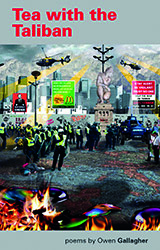 In a similarly no-nonsense, directly polemical vein is Owen Gallagher’s Tea with the Taliban (Smokestack, 2012). Gallagher shares a very clipped – sometimes sparse – lyrical precision with other politicised Northern poets such as Ian Parks (cue his The Exile’s House, Waterloo Press, 2012); also in common with Parks is a curious propensity for dovetailing poetic themes and metaphors of politics and romantic love. But much of Gallagher’s polemical tilt is towards empathising with and expressing the traumas induced in young servicemen thrust into futile Middle-Eastern war zones. ‘The Work Ethic’ is a polemic on the self-immolating nature of capitalist ‘democracy’, which ends in the aphorism:
You’d think it would seek a pension
but it wakes daily to a bowl of porridge,
goes off to work whistling.
Continuing in this ‘democracy’-sceptic vein is ‘Emma Goldman’, named after the early twentieth century Russian anarchist and ‘riot inciter’ – and in many ways this figurative encomium reads almost like a political love poem when, after imagining receiving a ballot paper scrawled on by Goldman advising the poet to spoil it, Gallagher produces a startlingly imagistic, almost romancing trope:
Without hesitating I struck a match for Anarchy
and lit out on horseback
past a world I knew, galloped towards Emma,
her arms open like a wishbone.
Gallagher is no less descriptively vivid in ‘On Trotsky’s Anniversary’:
I raised the ice-pick and thought of Mercader
bringing it down on Trotsky’s skull
and red spilling all the way to Russia,
seeping upwards onto Stalin’s hands.
The phrase ‘Trotsky’s skull’ is wonderfully alliterative. The title poem is a short, almost staccato vignette of war fatigue in fatigues:
Children played upstairs.
We took our fingers off triggers.
…
We offered cigarettes, left refreshed.
that night we were ordered
to raid the house.
Again, there is a deft alliterative effect with words like ‘triggers’ and ‘cigarettes’. Gallagher poignantly allows war imageries to seep into poems on ostensibly very different subjects – though in the case of ‘The Mind Hospital’, touching as it appears to on his ex-soldier father’s post-traumatic afflictions, possibly related to dementia, such battle-dressed leitmotivs seem both literally and metaphorically appropriate: ‘My father’s mind is full of land-mines,/ his finger jerks an imaginary trigger’. One of this reviewer’s favourite poems in this collection is ‘The Afghan Rope Trick’, which stands comparison with some of the desert-bound war lyricism of Alun Lewis and Keith Douglas – it warrants quoting in full:
Everyone in the regiment were shocked
by O’Niell’s rope trick on guard duty.
Where would he have descended to in this Afghan desert?
If a soldier were admired for turning
coal into alcohol, it was O’Niell. There were
no tracks, no note saying Sorry; only
his laced up boots, his rifle protruding from the sand
and tags hanging from the trigger,
were left where he had been posted.
He would peer past snipers, wade
in the River Tullaghabegely and catch
Donegal salmon in his hands.
‘The Unofficial Exhibit’ is another figurative war-piece, this time brilliantly highlighting the shameful plight of many ex-soldiers who return home to different types of battle, such as post-traumatic stress disorder but lack of psychiatric support, which makes many unable to re-adapt to civilian life, becoming unemployable, and in many cases, homeless. As Gallagher puts it in the first moving verse:
The one-armed soldier’s hand extends, not
for him to be hauled back from where he has,
in the past, fallen, or to be shaken, but
to beg for loose change. His beret lies
empty….
This is hugely poignant imagery (particularly in the last trope), and echoes once more the perennial domestic plight of the soldier, idolised when at duty abroad, but either tacitly judged, or even ignored entirely, when returning home – and here one recalls Rudyard Kipling’s ballad on precisely this theme, ‘Tommy’. It almost makes one wonder whether the only soldiers ever really accorded true respect are those who return in coffins draped in the Union Jacks (those very public processions late of Wootton Bassett). But what of the returning veterans, physically and mentally scarred by wars that also seem to have little except futile purpose? Well, in the case of Gallagher’s veteran, many end up on the streets in whose ultimate defence they have sacrificed so much of themselves for. Gallagher’s khaki polemic has an almost symbiotically regimented way of keeping strictly but evocatively to its point:
The streets of London are paved with ex-soldiers,
from the Falklands to Afghanistan,
in hand to hand combat with themselves.
they are concussed by war. No truce
or curfew is declared. There is no bandage
to cover memory. Each night they are positioned
at the bins of restaurants, cat-nap with
their nightmares in doorways.
At dawn they tour the city with upturned
palms. The soldier’s memory is the enemy.
It is lined with booby traps…
This is powerfully empathetic poetry which brings much-needed attention to the guilty secret of a society only too glad to wave its Union Jack while those who serve it at their ultimate risk are let down and abandoned by it. Not only have so many of the troops sent out to Iraq and Afghanistan been shamefully under-equipped in practical terms by successive governments, but those who have survived their ordeals have returned home to a mental health system under-equipped to provide them adequate support. ‘Yalta’ is another accomplishedly composed poem on the societal and military betrayal of army veterans – it’s difficult to cherry-pick tropes from this poem so here it is in full:
Poised over a map of Europe, three figures rearranged
borders with pins. Under coffee mugs and ashes
from Churchill’s cigars countries disappeared.
There was a boom in coffins and land for graveyards.
Outside, the dead kept survivors awake.
Millions were displaced inside their minds.
Amputees sat on corners and begged, What
next? Prayers rose and fell. Gods were on vacation.
An iron curtain was drawn that only birds and missiles
could cross. Stalin’s claim to Poland hardened
as did Roosevelt’s arteries.
Again, Gallagher’s ability to be so succinctly emotive is impressive. His tropes feel instinctively controlled, compact but loaded, like little bombs. This concision gives many of his poems an epigrammatic quality, and their very metrical, sometimes half-rhymed lines also lend them a mnemonic potency – these are, after all, poems well worth remembering. Probably one of the most powerful poems in here in terms of its profound juxtaposition of images is ‘Serving My Redundancy Notice’, which is presumably an empathetic piece, a kind of internal monologue of a soon-to-be unemployed House of Commons cleaner who role-plays at the despatch box in the empty chamber to vent occupational frustration:
I sweep up crumpled papers, wipe
sweat and dust from benches, apply vinegar to stubborn stains
after another taxing night in the Commons.
Tick, tick goes the clock. Hunched
in the Prime Minister’s place I rehearse how I’ll inform
my wife of my redundancy.
My knuckles turn white at the Dispatch Box.
I rage against a world that deprives people of work,
handcuffs them to hunger. …
‘The Good Samaritan’ is a torrid vignette about a bus trip in Israel interrupted by a bomb scare and interrogation of the poet by Israeli security because he’s found carrying a ‘Solidarity with Palestine’ leaflet in his jacket. ‘Listening to Angels at a Workshop on Earth’ is a bitter rebuke to ‘God’, personifying Him, with much irony, ‘Darwinian by nature,
he supports
survival of the slickest, depends on a surplus
of the poor. There is a backlog of prayers he is unable
to clear. He works closely with the police and has dismissed
petitions to create a parliament of angels.
He wears a bulletproof vest…
This is, indeed, a very Miltonic version of the autocratic tyrant-God, though unlike Milton, Gallagher casts his characterisation with a full Blakeian consciousness. ‘The Pope and Saint Marx’ is a depiction of the poet’s working-class Catholic upbringing, infused as it was with a conscious socialism:
Back then, every Catholic home possessed a picture of Pope John
XXIII. Some had lights that flashed, it was said,
to the rhythm of his heart. …
…
Mother’s brother, Hugh, had two pictures, side by side:
one was the Pope, the other Saint Marx as Hugh called him.
… One was to assist us
into Heaven, the other to enable us to take what we were due
on Earth. This, the priest informed me at confession
was a mischievous notion. …
Nothing of the kind of course, but a perfectly justifiable and scripturally obvious segueing together of two parallel faith systems. This reviewer’s favourite poem in this volume is ‘The Pay Poke’, a poem about working poverty of the type which sees the monthly wage practically disappear as soon as it’s collected – again, Gallagher invokes religious imagery and phraseology to satirise this sacrificial monthly ritual of paying debts and bills from a rapidly dwindling pay packet:
Only the shadows of the two men crossed the doorway.
I peeled father’s pay poke open, laid out his wages in piles.
The first man was from a loan company.
No words were exchanged. …
… The second man was a priest,
God was his minder. Purses and wallets opened
for him like the sea for Moses. He was paid
in silver. We felt special when he gave the house
a blessing, called each of us by our name.
So it continued until mother became the man
of the house; father’s heart had had enough.
I would spill out her wages, wait for the rap.
I often wished I had a beanstalk. Now I set aside
money: for the men from ‘The Chemist’ in the block
who provide us with snort, the hard cases back
from Iraq, who provide security on the estate,
and those who come with the Labour Party’s plate.
‘The Lead Thieves’ is an irreverent poem about the poet’s father and brother stripping ‘lead from the church roof’ to boil down and use to ‘cast/ religious figurines’ including ‘Arsenius the Weeping Monk’ and, of course, ‘Jude for hopeless causes’. It’s a scene straight out of the Boulting Brothers’ Heaven’s Above! (1963), a perpetually cig-lipped Eric Sykes rolling up the church roof with sidekick Roy Kinnear. Again, it’s slightly ambiguous just how figurative or imagined some of these poems are, but one suspects there are grains of genuine experience within them. ‘The Aisle to Heaven’ is beautifully described vignette on the poet as a child at what would seem to be a Catholic boys’ school:
As all the other boys slept, I scaled dykes and walls
to lift the great rusted ring on the church door
God left open and don the black robe, the white surplice
so stiff it could stand unaided. …
‘The Promised One’, dated ‘2 May 1997’, is about the poet canvassing for Labour in the upcoming election – its first four lines form a consummate 1/2/1/2 rhyming quatrain:
We encountered Tories on a no-go estate
At the corner of Whig Street and Prig Street.
We were both canvassing for our candidates.
You could cut the hatred with the edge of a leaflet.
In ‘Newsworthy’ Gallagher aphoristically coins: ‘workers race like paramedics/ to where a capitalist axe was raised’. ‘The Land Rush’ produces a similarly striking aphorism: ‘This planet has more owners of title-deeds than trees’. ‘Left, Right Left…’ is a brilliant dialectical epigram to dialectical materialism, which ends poignantly:
This we know: there is need on one side,
greed on the other; our stomachs expand
or shrink to what they know.
Anthems, arms and flags accumulate
in history’s wardrobe.
‘Art in Ascendancy’ depicts graffiti protests ‘on the eve of the Government’s party conference’:
we gathered outside the hall not to hold a vigil
but as artists to spray dismay. Walls are our catwalks,
our mouthpiece. We donned Davy lamps, finished
before the sky’s light came on, proud our hands
had found a tongue for those without a voice.
‘The Parliamentary Blacksmiths’ continues this gustatory imagery to similarly potent effect:
Wouldn’t it be wonderful if during their term in office
Ministers used their tongues like wands
to legislate that houses, schools and playgrounds be built;
…
Instead, they sweat like blacksmiths at the anvil,
attempt to hammer us into shape.
‘The Minister of Poetry’, cushioned by the quote ‘a people without poetry are butterflies without wings’, is an amusing satirical piece which begins:
Under the State of Emergency
the first act of the new Government
will be to declare a Department of Poetry
to address the growing decline
of the nation’s minds.
Poetry being perhaps the most impecunious of artistic mediums, the depiction of its sudden procurement by politicians as a powerful and essential societal tool is at once hilarious as it is ironic given that in Soviet Russia, for instance, literature and poetry were considered of high cultural and political capital by certain state leaders (albeit more often than not channelled through ‘agitprop’, Gorky being one early exponent). Gallagher has quite a bit of fun with this scenario: ‘Hospital/
patients will be comforted by/ light verse. Poetic drop-in/ centres will be sited in supermarkets’. Then the rib-tickling trope on a new hyper-literary immigration policy: ‘Anyone who enters our country/ must be a published poet’. ‘Driving to Utopia’ is another satirical piece, this time depicting an idyllic socialist society peopled by such luminaries of the Left as ‘‘Red Shelley’’, Mayakovsky, and counting among its customary tipples ‘a Robert Owen cocktail’. Highly surreal. In ‘Rule, Britannia!’ the poet declares bitterly: ‘Yes. I can fight for Britannia,/ watch poppies sprout from my chest’. The collection ends on of the most memorable epigrammatic poems, ‘Democracy was a Fine Idea’, which warrants quoting in full – the first line being a capitulation to the intra-textual title:
until the Government dragged it onto the floor
of the House of Commons, ripped
its thoughts out and held them high,
taunting the opposition.
They plucked the vision from its sockets,
tore the speech from its mouth,
severed its head
and stamped on its calloused hands.
To ensure its remains would not be venerated,
they doused it with hate, struck a match
and shovelled the ashes
down a sluice into the Thames.
That sounds about right, given today’s thoroughly broken politics. Indeed, Owen Gallagher’s Tea with the Taliban is a collection of incontrovertible, distinctly red truths poured like liquid lead into the moulds of succinct, well-formed – and well-informed – poems, none of which outstay their welcomes; the poems on the under-written theme of soldiers and veterans have much to impart for these protracted days of sand and fatigues, Union Jack-draped coffins processing through quaint country towns, and successive ‘interventionist’ prime ministers intent on their stints at foreign adventurisms in desperate attempts to resuscitate the blimpish sentiments of long-dead empire, as well as bagging a bit more oil into the bargain. Tea with the Taliban is, in itself, a brave and significant poetic intervention, and well worth seeking out for all those who believe that poetry can, in the long-term, make some things happen.
 Sean Burn’s (or ‘sean burn’’s) poetry collection dante in the laundrette (Smokestack, 2012) is far more, in terms of stylistic and substance, than mere after-trimmings of the e e cummings school, even if his industrial-scale blanket use of lower case throughout aesthetically echoes the oeuvre of fellow Smokestack poet Paul Summers (who resists de-capitalising his actual name). This is a blisteringly polemical, linguistically energetic and adventurous collection, its considerable length partitioned into several titled sections; there are vast flourishes of pseudo-Joycean ‘word salads’ (re Finnegans Wake), onomatopoeic word-play and poetic stream-of-consciousness throughout, some pieces occasionally resembling a kind of Droogish vernacular (re Anthony Burgess’s A Clockwork Orange). In all these respects the book’s strikingly alliterative, surreal title seems entirely fitting, and it’s certainly one which grabs the attention immediately with its purgatorial implications for contemporary urbanity (in terms of catchy titles Burn also has much form, one previous collection having been entitled molotov’s happy hour). The book kicks off in topically polemical form – given austerity Britain’s contemporary “1930s moment” – with ‘an evening in the weimar republic’. Immediately one notes Burn’s poetic procurement of word-salad to mark out his aesthetic territory – in the psychiatric world this linguistic phenomenon is known as schizophasia, but in Burn’s usage, it is a conscious poetic conceit intended no doubt in part to communicate implicitly the distinctly schizophrenic nature of modern capitalist society (and in that sense it is a kind of stylistic homage to the writings and theories of R.D. Laing):
cables sinuosity flexes curves
to whip-hand tight over mike as we
underclass raise glasses through
smokechoke to marianne faithfull
…
stony vocals chiselling edges
…
i know about the seven deadly sins
and eight nine ten in her scandal school
Then come the stunning aphorism: ‘we bruise easy as fermenting fruit’. Note also the occasional use of small blank gaps within the lines, as in the first two quoted here, almost acting like visual pauses or caesuras indicated by tabbed space; it’s possible to speculate as to whether this form of broken line is employed instead of using a ‘dropped line’ – but clearly the intention is to instruct a breath-pause if reciting it aloud. Burn has a gifted ear for clipped, almost haiku-like alliterative lyricism: as in ‘people oscillate/ jostle the crowded street’ (‘late night shopping’), or the searing imagism of ‘graveyard’:
silver birches
mossed in repeat
seep of guttered rain
hangout for sisters
whose moonshine limbs
rave vogue tempt
where syringes drop
deal done
…
agaves deep
blades of green
which conduct
deserts red coda
This reviewer would broadly categorise – if it is categorisable – Burn’s poetry as a form of contemporary Imagism, or neo-Imagism, descended at is appears to be via the long line of Anglo-American experimentalism from the likes of Wyndham Lewis, F.S. Flint, Amy Lowell, Skipwith Cannel, Allen Upward, William Carlos Williams, ee cummings and of course Ezra Pound and his Ideogrammic Method, which was essentially a poetics which dealt with abstract concepts through concrete use of language (a famous example of which is Pound’s ‘In a Station of the Metro’: ‘The apparition of these faces in the crowd;/ Petals on a wet, black bough’). Burn’s ‘this tumbled stone’ is a highly accomplished neo-imagist poem:
cormorant
at anchor
inscribes itself
on bridge-foot
slick as oil
spelling s for storm
rupture/d
before
herons great flags of
raggedy not-so-new print
newborn to ouseburn
in dispirited priestly grey
record signings
so much ash blown
forlornly down tyne
…
wren stumbles through
the weather boneyard
a thumbful of feathers
small liturgies
tying up this tumbled stone
This is not an easy form of poetry to pull off without appearing in some sense pretentious or even mechanical – yet with Burn one rarely senses any such lapses and this is largely due to his superior grasp of language and poetic image and his delicate ear for aural impressions, the sounds as well as meanings of words as justifying their pairings. There’s a sensitivity to Burn’s poetic approach, to the extent that it feels more a sensibility than a stylistic artifice; this sensitivity is prosodic as well as textual, and there is a technical astuteness in his employment of metonymy (figure of speech in which a thing or concept is not called by its own name but by the name of something closely associated with it) – this sometimes manifests with Burn in a kind of semi-metonymy, as in ‘boneyard’ instead of ‘graveyard’. As with the Imagists, Burn seems in part inspired by Japanese poetics (more specifically, waka, particularly tanka or short verse-forms) – this is most marked in poems such as ‘remembrance sunday’:
magpie
its beak
trapped inside last nights
can of mcewans
unable to break free
to fly away
Again, a consonantal alliteration is marked here with the ‘k’-sounds throughout; note also Burn’s anarchic approach to punctuation, such as apostrophes, i.e. by simply not including them: the possessive ‘nights’ and ‘mcewans’. The title poem is a tour de force of synecdoche, metonymy and polemical punning:
just like the vowels at the jobless centre
youth asks for a light says obsessively
i’ve seen yer seen yer i’ve seen yer
…
i’ve no see terror-wrist acts bad as they
penny for halloween eh this dull thud
of fireworks should be three weeks away
but the flash of blue and thump of powder
‘24/12’ includes the subversive pun on a common phrase, ‘days white as the driven cocaine’, and the very imagistic description of a ‘gunmetal town’; the poem is bursting with associative imageries:
pulsing to the bigg markets disco beating
a butcher heaves past with bleach as
wannabes swig scrumpy crush tinnies
in the gloom big issues have a hard time
pushing christmas specials this month
‘mcenemy’ is a long poem given its own title page; it’s a quite discursively laid-out poem including some flourishes of concrete poetry; rather than attempt unravelling its sub-textual meanings this reviewer instead draws attention to some of the most striking tropes and aphorisms littered throughout:
and six guards haul dole generations molotov from dock
…
make my wish as rain blurs the ac/dc of night-city
largactyl-dreaming of first electric chair in this place
For those not familiar with pharmaceutical terminology, ‘largactyl’ is an anti-psychotic drug; note too the mention of ‘ac/dc’, which could well be a synecdoche alluding to both the acronym ‘alternating current (AC) or direct current (DC)’, perhaps in relation to still-in-use electro-convulsive therapy (ECT) for some psychiatric patients, and also possibly to Heathcote Williams’ anti-psychiatry play AC/DC (1970). ‘gob, aye’ is a sequence of seven short poems, the first of which, for this reviewer, is the more arresting in its use of image: ‘howling blue, howling black, gobs words/ aquaplane why yer forsakin me?/ waking to hell-salt on the tongue’. ‘symphony of ravens’ is one of the most interesting sequences in this book, many of its leitmotivs rooted in Norse mythology – an ancestral trait perhaps in a Northumbrian poet, the North-East having of course been one of the most extensively invaded and raided areas of the country (mostly by Norwegian and Danish Vikings). Ravens are a common image of Norse myth: the psychopomp and god Odin had two ravens, Huginn and Muninn, who kept him informed of mortal affairs. The short prayer-like ‘prologue’ is worth quoting in full:
root, bark, leaf – yggdrasil the guardian tree branching out
across many worlds.
root, bark, leaf – yggdrasil’s early days and late nights journeying
this multiverse.
root, bark, leaf – yggdrasil our guardian tree carving where
past-presents-future collide.
Yggdrasil was the Norse (most likely Icelandic from the Saga of the Poetic Edda) name for ‘the Great Ash Tree’ which stood at the centre of existence acting as a kind of metaphysical alembic between earth and the heavens. This sequence is again fairly typical of Burn’s aurally associative, metonymic style:
above roseberry topping, clouds were longboats, dragons,
lungs. and up ahead this weather-worn, this beech-nut, this
gargoyle, words slow as volcano.
The symbolic language grows more and more Joycean (a la Ulysses; Finnegans Wake) in its onomatopoeic exposition as the poem goes on:
i look into a great whorled pool, forged and furrowed where
his eye should. the haar shallows moors around while a pair
of ravens caa—caak caa—caak in warp and weft
Burn’s collective noun for ravens is ‘an unkindness’. Allusion is made to Odin hanging himself from yggdrasil ‘so his mind could fill with poetry’ – though Norse mythology has it that the god did so in order to understand the runes, but Burn’s interpretation fits well with this. The following sequence, ‘never sleep with anyone who has more scars than you’, begins in a phantasmagorical spillage of imagery, faintly Rimbaudian:
child of the mirrorglass
reflecting white stone towers
whitestone towering against grey sky
Burn has his own inimitably figurative version of a kind of Marxian dialectic with lines such as ‘pissing in sinks of whitestone bedsits is no life comrade, no life at all’, which is repeated as if a kind of anthemic refrain. We get some coruscating imagistic rejection of the shallowness of contemporary consumer society: ‘gilt-edge lies, gilded wives and taken down the docks, all the clichés’. ‘mind the reality gap’ is another surreal, stream-of-consciousness tirade (meant in a good sense), this time set in a metaphorical underground:
mind the gap
a hurricane of policies
rutting the night-flowering city
stand clear please
at their feet a deregulated train
howling through ghost stations
…
inside local gallery, depressives
spell nuts out their medications
That last line is curiously constructed: one feels there should either be an ‘of’ or ‘from’ between ‘nuts’ and ‘out’, but perhaps this omission is deliberate. This poem mutates into a kind of Finnegans Rant:
say sorry sheetmetal maggie
powercontrol maggie
insert your coins now maggie
firework yobs clamp down pinochet flammables
But this is nothing compared to the explosion of Ginsberg-esque outrage towards the end of the poem, which ingeniously intermingles some choicest post-Thatcherite capitalist phrases and tropes whose decadent symbolisms are lost on those distinctly unrefined minds that coin them:
ravish the railworkers / cha-cha-the miners – the firefighters /
rock the dockers / tango the fishermen the seamen …
…
hetrogaze / scudding the colonisation / that slaphappy
…
beautybitch baroness thatcher / ramraiding workers
unskilled unmanned / eased off jobless / greaselubed back
to work / so get it, get it out / this plague is sponsored by /
your liturgical meat godhead / this plague is sponsored by /
ethical cleansing is back again / whitenoise whitenoise…
And so on. ‘outstaring’ is a similarly fragmentary stream-of-consciousness piece which is a kind of expressionistic polemic on pornography. ‘leery’ seems to be more a sequence of individual poems – each individually titled – than an actual sequence as most of the other sections are. Most of these poems are again in the lyrical Imagist mould, as in ‘you are now within a foot of the extreme edge’:
scraps of bin bags
on gulag wind
are hung on trees
…
forecast is grey
the clag becoming critical
before dawn
For this reviewer Burn is often at his strongest as a poet when in this more disciplined lyrical mode. In ‘we are come to this great stage of fools’ we get some strong imagistic flourishes:
this bleached beach leviathan
out back house bought from council
cheap cig between narrow lips
the accusing aperture starts
This concrete lyricism becomes even more concentrated in ‘a disease that’s in my flesh, which i must needs call mine’:
bleary guy
smelling of
piss and cig
…
muttering
life’s a lottery
of blood, sweat n bones
‘then shall the realm of albion come to great confusion’ is a deft little polemical lyric on the fatherland:
hurricane tore through leers heartland
trees which stood before shakespeare are fallen
chaos from the butterfly who stomped her steel-capped boot
though thatchers heart was no longer in it
but still the greymen came extending a decade of greed
Again, this reviewer still struggles to see the point in de-capitalising names and omitting apostrophes (for instance, this makes it more difficult to determine whether the poet means Lear’s – as in King Lear – with ‘leers’, having seemingly miss-spelt it, or whether it is an odd conjugation of the verb into a sort of adjective; but the mention of ‘shakespeare’ in the following line would seem to imply it is meant as ‘lears’). This blanket de-capitalisation of all text does create a kind of visual ‘text-speak’ on the page which may or may not – depending on one’s tastes – be slightly off-putting. ‘smells of mortality’ continues the hard-edged polemical tone, especially apt for this current period of pernicious austerity cuts inflicted by government on those with the narrowest shoulders:
your carnivore belief in free market is now paid for
struck down through eating contaminated meat
half-blood cuts stolen from a pensioners picnic
in ‘userer hangs the covener’ we get the very visceral image ‘piss a triumphal arch’. In ‘we two alone will sing like birds i’the cage’ there is some sharp alliteration at play, while tenses are muddied to disorienting effect:
as I passed round cheap beer
gave hard-slap, others spilt handful
of salted nuts and laugh it off
‘fie, foh and fum, i smell the blood’ continues in this viscerally alliterative vein – this time a grim and disturbing depiction of typical state school hard knocks with the detached teachers portrayed as almost sadistic spectators:
teachers held mugs of sweet tea
looked on through reinforced glass
…
cheesewire taut until tongues popped
lost child of albion shiny with tears
…
now fertiliser is laced with paraffin
a fist of semtex in suburban litterbins
By the time one reaches ‘when every case in law is right and bawds and whores do churches build then comes the time, who lives to see it’ (phew!), the aphoristic chutzpah punches at the solar plexus:
history’s welt across your bloodied back
tattoo bearing imprint of memory
where once we spoke fairytales
Burn can never be accused of being prosaic, predictable or pedestrian. The final sequence of the book is titled ‘honeysuckled’, a normally gentle-sounding noun which is rendered harder-hitting as a past participle adjectival noun, and almost echoes a kind of unconscious rhyming slang for ‘knuckled’. Burn’s deeply imagistic lyricism is at some of its most fruitful throughout this sequence:
in a game of hic-hac-hoc / paper-scissor … whats
the chance on coming up stone each and every?
…
caedmon bends to computer screen
her illuminated scream detonating night
…
slips out and at dawn tender-tendrils
alight to honeystone this city alone
The effect of the tone and language of this sequence is one of almost surreal polemic. Some verses have a certain quality of Dylan Thomas’s more surrealistic, phantasmagorical poetry experiments:
foxes gloving it, their early
bells off – flay, fly and flee
home before sun-sups
and leave of yggdrasil
…
to power up laboratories
of spin and local par-liar-ments
breweries of light, libraries of neon
…
There is something deeply unsettling, polemically sublime, even darkly prophetic about such lines as: ‘will today bring winning numbers/ or smoking outside the crem?’; and something quite apocalyptically apt in the more fathomable polemic: ‘honeyed sweet nothings/ of the con-dems when you come right down// – smokers die’. This reviewer finds some similarities in Burn’s highly symbolic, surreal and almost dissociative style with that of the eminently polemical Niall McDevitt’s (b/w, Waterloo Press, 2010). In Burn’s poetry, the sense is that the texture and sound of language is as important in terms of its gut-sense visceral impressions as in any strictly logical dialectical sub-text; in other words, the impression of Burn’s oeuvre over all is of instinctive meaning conveyed through associative (and dis-associative) images, sense-impressions and word-sounds intended to communicate a primal effect on the reader (or listener), a kind of ‘unarticulatable baroque’ –in itself, a gut-felt poetic response to the schizophrenic nature of so-called ‘rational’ society, often through schizophasial language:
ribboning community orchards – they just might be : a
thousand and a thousand and a thousand bairns cherry-
stonings striping the c2c cycle-way, bloom breathed slender
and into fruitful reach – such is caedmons balm
her smile-lines are row upon row of garlic – chive – onion
and seedbombings till sore, nasturtiums – those sluts of the
plant world, are needed more than prow of new business
school; quinces more than executive offices; urging
honeysuckle more than the corporate codpiece – hostmens…
The meaning here is neither instant nor, this reviewer feels, intended to reveal itself in any strictly logical sense on closer reading and dissection; it is what it is, more stream-of-consciousness outpouring, a sort of extemporised poetry, but one which inescapably has an unconscious purpose, a surface metaphorical thrust, and in these senses is a kind of surrealism. Moreover, Burn’s tendency to continually bounce certain demotic and topical terms off one another, and juxtapose archaic with contemporary terms such as ‘corporate codpiece’, or natural with abstract, as in ‘quinces’ and ‘executive officers’, serves as a kind of semiotic signposting, via cultural associations, no matter how bizarrely paired off, so that a very metaphorical polemic is deeply felt – if not fully understood – by the reader. Indeed, Ezra Pound’s Ideogrammic Method – the abstract dealt with through concrete language – is particularly marked in this excerpt:
mind is selling off cutlery
– knives are behind the counter
please ask
wrapper-upper ensures
bud vase for lover-sister-comrade
is padded to perfection
young goths
wearing their ribs on the outside
cry over onions in the gutter
pull wheelies
on borrowed wheelchairs
air-guitaring crutches
…
for these honey-slicked and licked
caedmon soft-slipper shuffles
translucent as vellum
So no matter how surreal, dissociative, schizophasial, ‘Droogish’ and syntactically tilted Burn’s style of exposition, the reader may feel disoriented, but never entirely lost, because the semiotic signposts are always there, particularly through culturally resonant images:
downing shutters, so that on and over
rosed-stone and polished railings
parkouristas make the running…
The synecdoche ‘parkouristas’ is curious and could have multiple associations and meanings. Burn even cites Anthony Burgess’s Grand Guignol on urban ‘ultra-violence’ at one point in this sequence:
…vol 68 and for encore discarded clockwork
orange dvd frisbee’d against the drear for a rescued mastiff
(Even Burn allows himself the typographical luxury of italicisation of titles). The contemporary and topical signposting in this sequence grows more and more recognisable as a more polemical purpose surfaces:
and the kissing bairns
hold tongues in reserve
the land asbo forgot – for now
and caedmon never will
….
seasons new jackdawing
to parkouristas very move wheeling air-spin
hunt late bugs / grubs, rejecting greggs seconds
stalemating around pill court, refusing even freegan
end-of-days – crayfish sandwiches with artisan cress
– excess the soup kitchen barely stomachs
pasties pigeon-bombed into vault spiral
swift break out-climb wheel crash-tag
branches just-turned leaves a-shaking
only for gulls to close – bursting
on thru in hardcore pastie fight
jackdaw-wing foliaged for the wee greens
those bugs, grubs, chrysalises tree’d
Note the interesting grammatical mutation of a noun into a verb with ‘jackdawing’.
the unlucky who – meaning it ironic –
told her approved social worker to run with it
just as they scissored out her blisterpacked meds
now repetitively stubbing flesh out and outside
the new deal fire-station where bhangra lads
hang u-turns – england air-fresheners off rear-views
One might almost term this type of stream-of-consciousness social comment as a sort of ‘phantasmal polemic’. Indeed, the Finnegans Wake-style lingual phantasmagoria go into full tilt a page or so on, carried along by its sing-song cadences, and producing as it does one or two startlingly surreal images, such as ‘cheese-string/ watch’:
drinks can blown up pitt street, blows on up sheer in vent
bairns of the homeless dropping their cheese-string
watch as fluorescent marker stamped throb-pink to retro
cobbles clipclopping one of poundworlds plaster saints
clip-clop ace of spades, joker in the gutter long blown
cli-cli-clop aftershock shots glass rolling idly wild
pair of police horses stride-striving for canter
no longer the happy plod but shucking off
their heavies, trot and gavotte not garotte
Certainly in imagistic terms, this final sequence of the book is something of a tour de force – Burn has no shortage of images; he also frequently surprises with sudden, more disciplined lyrical flourishes:
Bridging with gap
Breath frail skin
Exact weight of
Cigarette papers
Before the inhalation
…
militant in her
redrawings
redoublings
fractal-sing
caedmons got
this licked, aye
all the new
grotesqueries
Burn has a true talent at sublime descriptive images, as in the wonderfully alliterative ‘whiteface blown into high branches a bleached carrierbag’. The sing-song quality of this sequence is again reminiscent of Dylan Thomas’s more surreal outings, not to say David Gascoyne’s:
trews hung the honeycombing of seven stories
boots ascend the civic bell-tower, the slowdrip
nursery rhyming, cradle, cradle, cradle
rock and bye, rock and bye
rock and bye…
Indeed, the latter lines have something of the musicality of Thomas’s lines from Under Milk Wood: ‘the sloeblack, slow, black, crowblack, fishingboat-bobbing sea’ – and indeed ‘slowdrip’ seems – no doubt unconsciously – to have ricocheted from the conjunctive imagism of the aforementioned work. The last piece in this sequence, and indeed in the volume as a whole, is perhaps Burn’s most evocative and beautifully composed poetic prose in the book:
and breathe in the moth-sky and sly wolf-light messages seeping night-time libraries, saints and swingers cemeteries, frying bread and fried pans, improvising bridges, kittiwakes feedbacking, drivers cutting up casualty, the casual stitch that, tracks and track-marks, walls and wallflowerings. so many honey-bound wounds, such sweet-amber blastings, such a lotta anarchy-laughings. caedmon is her own marginalia unmooring from pages this great illuminated, like corporation seahorses upping anchor and floating free, the apocrypha of millennias merging, smile lines from corners her mouth are girders webbing; her onion skin sloughs off, sloughs oil, great crack-winged manuscripting in flight, her honeysuckle-honeysuckling-honeysuckled of pre-dawn and the fist that will always stick, clothing each and every, beautifully with jeweleye, irepoint, ranter
The phrase ‘great crack-winged manuscripting in flight’ is particularly striking, while ‘moth-sky’ and ‘wolf-light’ have almost mystical qualities. This is indeed rather a wistful and beguiling passage for such a viscerally charged book to close on, and perhaps points towards a slightly more refined and spectral poetic approach for the future. Obvious points of caution in conclusion on this compendious volume would be to point to some possible room for future elements of restraint in terms of Burn’s more explosive linguistic tendencies here and there, and a particular vigilance might be exercised in just how much language can be manipulated for long stretches of poetry without risking incomprehension among those readers less familiar with the more experimental end of the poetry spectrum; that is, if Burn wishes to necessarily carry such readers along with his work. The Joycean ‘lingual phantasmagoria’, too, though over all brilliantly done, could also possibly do with a little reining in here and there, at least for longer sequences; and some greater concentration perhaps on communicating specific polemical or narrative purposes to equal that spent on the surface sound-textures of a quite challenging linguistic technique (or sensibility), might well benefit Burn’s poetry in the longer run. But there is no denying that dante in the laundrette is a highly distinctive, imaginative and striking collection, seemingly boundless in its subversion of language, and is certainly one of the most poetically experimental of Smokestack’s ambitiously broad and far-ranging poetry list. Certainly for all those who enjoy linguistic challenge in their poetry, but of the type that skilfully mixes in a quite infectious sense of cadence and rhythm, not to say a sharp eye for the violent beauty and energy of language, dante in the laundrette is an absolute must-read; and Sean Burn is definitely a poet on his own inimitable trajectory, one which is bound – sooner than later – to ferment into an even richer ripeness of output which may yet startle us all.
These – and legion other – titles reaffirm Smokestack’s reputation as the natural home of the most challenging and thought-provoking political poetry being written in Britain today. With presses such as Smokestack, and Mudfog, it would seem that much of the future of British radical socialist poetry is firmly rooted in Middlesbrough, a city also significantly among the worst-hit by Tory austerity. Where there’s Smokestack, there’s fire; and it is heartening to know that in these dark days of cultural decline there is still a formidable light shining in Middlesbrough.
Alan Morrison on
Andy Croft
1948 – A Novel In Verse
Illustrated by Martin Rowson
(Five Leaves Publications, 2012)
The line between defeat and winning
Is that between bald lies and spinning
Andy Croft is a veteran versifier whose vital and prolific oeuvre has ever gone energetically against the grain of mainstream poetic acedia. In many ways he is the natural successor to both Adrian Mitchell and Tony Harrison in his socio-political concerns, but a poet distinctive in his own right for his infectious and defiant infusion of humour into the fundamentally serious and compelling themes he tackles. This is one of Croft’s inveterate strengths as a poet and writer, since humour, especially, in his case, a philanthropic and all-inclusive humour, is one of the most powerful tools towards ingratiating and warming-in less ‘converted’ readerships to an ideological viewpoint – in Croft’s case, a form of radical socialism, or ‘romantic communism’ – they might otherwise feel more encouraged by a wider ‘junk culture’ of red-top misanthropy, Tory rhetoric and capitalist spin, to scoff at as hopelessly utopian, impracticable, and anti-‘enterprise’ and individualism (though socialism is in actual fact a drive towards an equity of ‘individuality’ for every person, social and psychical self-actualisation, as opposed to the inauthentic and often, ironically, homogenous ‘identities’ permitted by the narrow, materialistic paradigm of utilitarian capitalism). As a side note, though an equally prolific one, Croft is also the sedulous founder of radical Middlesbrough-based imprint Smokestack Books, which has been at the vanguard of a new socialist poetry renaissance in the UK over the past decade; Smokestack’s distinctive grey-framed and red or black-spined books are rapidly becoming the iconic livery for British poetic dissent; an increasingly influential, proletarian riposte to the typographical, tricolour wraparounds of Faber.
My main focus in reviewing Croft’s latest volume, 1948 – a novel in verse, his second narrative outing in Pushkin sonnets following 2007’s verse novel Ghost Writer, is on efficacy of technique more so than narrative analysis. Nevertheless, this being very much a verse narrative, it is of course highly relevant to explore initially the ingeniously subversive storyline, at least, as best I am able, not being a natural follower of narrative but more a lateral appreciator and absorber of texture and effect, as well as rhythm and music, through the treatment of language. The plot of 1948 is quite convoluted, but in this, the discipline of conveying it through 150 verses/individual Pushkin sonnets, using a strict and expertly crafted 1/2/1/2/3/3/4/4/5/6/6/5/7/7 rhyme scheme, aids accessibility, together with Croft’s inimitably succinct but descriptively rich employment of language and image. This is no mean feat to accomplish, but to skilled formalists such as Croft, it feels instinctual, even compulsive, as evidenced further in the equally skilled Pushkin-crafted Dedication and Acknowledgements. Croft is prosodic to the core. But to pull myself away, already, from focusing on technique – briefly, to the narrative, which I don’t pretend to have comprehensively grasped after first reading, but it’s essentially as follows.
1948 is set in its eponymous year, but something of an alternative reality where the UK is governed by a Labour-Communist government – so in this sense of a ruling coalition, and being an Olympic year in the UK, the scenario is a kind of upside-down parallel to the UK in 2012. The title is of course an inversion of George Orwell’s Nineteen Eighty-Four, which was of course its own titular inversion when it was penned in 1948 (though actually published in 1949) – and here we enter into a kind of meta-textual junction point of narrative and historical overlaps and synchronicities reminiscent of the equally byzantian psychical ‘triangulation’ between Joseph Conrad’s Heart of Darkness, T.S. Eliot’s ‘The Hollow Men’, and the 1979 film Apocalypse Now, in which the demonic anti-hero Kurtz, based on the same-named character in Heart of Darkness (on which the screenplay is narratively based), in one scene quotes a passage from Eliot’s ‘The Hollow Men’, which in itself is inspired by Conrad’s novel, beginning as it does with the epigraph “Mistah Kurtz – he dead” (and both Conrad and Eliot’s works themselves influenced by Übermensch (‘Overman’) concept of Friedrich Nietzsche, which also adumbrates the film and its symbolisms). But somewhat less apocalyptically, and more politically than philosophically, 1948 draws us into an altogether wittier polemical hemisphere orbited by the ‘shabby genteel’ ghosts of Eric Blair/George Orwell, his more comically treated fictional protagonist Winston Smith (portrayed more like Orwell’s hapless alter-ego, the anticapitalist poet and dropout of his Keep The Aspidistra Flying (1936)), whom Croft transfigures, paradoxically, into a somewhat dishevelled, chain-smoking detective who is implicitly a personification of Orwell himself (as literally illustrated by Mark Rowson’s brilliantly drawn, almost tangible caricatures), whose boss in a rather noirish espionage plot is named O’Brien (after Nineteen Eighty-Four’s pivotal double-agent who ultimately entraps Winston and re-indoctrinates him into an almost cabbage-like state).
All the characters in 1948 are named after characters from 1984 (excuse the numerals, but the original Secker and Warburg cover for Orwell’s novel actually had the title written over an adumbration of its numerical representation, thus making the now iconic title typographically interchangeable, as is 1948 itself variably written from advert to review, even in Five Leaves own website catalogue): Syme, Charrington, Ampleforth, all are names from 1984, but who, one detects (though in my case might need to read a second time to decode) represent historical cultural movers and shakers of the time. The posthumous Ampleforth, for instance, sounds faintly Audenesque in terms of his surviving poet associates’ descriptions of his work-in-progress, ‘Forward to a Soviet Britain’; he has been assassinated, news which his envious poet-competitors greet with feigned grief and barely restrained relish, and although the suggestion here is of a late state poet, or laureate, a post which John Masefield occupied in 1948, one suspects in this parallel Labour-Communist Britain the more likely laureate would be W.H. Auden. This attempt at character decoding, however, is immediately thrown off course with the allusion to ‘“…Wystan”’ having ‘“moved to Leningrad”’ (in the aftermath of the, presumably ‘democratic revolution’, and a new Far Left government, the royal family has reallocated to colonial Rhodesia).
Possibly the most pivotal moment, in the meta-textual, paradoxical sense, of the narrative of 1948, is when Winston thumbs through a discarded book by one Eric Blair, titled 1984, and relaying what he perceives to be an unimaginative and highly unlikely dystopian projection into a future capitalist Britain atomised by social inequality and class divisions (i.e. our own reality’s historical UK of 1984, and of 2012, our second Olympics since 1948). Convoluted as all that sounds, it is only the surface scenario in which Croft’s actual espionage plot unfolds, but one which I’ve not the thriller readers’ aptitude to recount with any logic. However, I believe the main purpose of Croft’s 1948 is that of satirical commentary on how far our society has regressed ethically and politically since the comparatively enlightened, optimistic and humanistically ambitious days of the late Forties and the post-war Attlee Settlement – the leitmotivs of dates and events (such as the Olympics), of crossing over fictions and histories, narratives, characters, names, symbols, political and cultural allusions, and parallel subversions are, to my mind, the main purpose of the verse novel, a delightful and intricately detailed literary conceit crafted and structure in order to demonstrate how the true parody and satire of British society in its actual history and present-day incarnation.
In short, that the real-life British political and social narrative thread veered off into self-parody and tragic farce, into its own satirical, or rather, satire-proof narrative decades ago, but most particularly since the counter-dialectical, spiritless and inspissated materialist nihilism of Thatcherism, at which point any progressive British narrative was truncated and replaced with an historically uprooted culture of immediacy, without true identity or values, divided into disunited individualisms based solely on financial gain via the ‘faith-system’ of profit. The atomisation of community and collective values at the altar of anarcho-capitalism: eater of histories and cultures. Croft’s incredulous verse intervention shows us that our national teleology has simply looped back on itself over the decades, as demonstrated in how such tautological satire as 1948 has been handed its semiotic mandate today. Confused? Well I certainly am; which is why I now turn to the craft and technique of the poetry itself.
Each Chapter of the book is headed by two quotes each, most drawn from the evocative nursery rhyme The Bells of St. Clemens, and most others, from George Orwell himself, or from Ealing films such as Passport to Pimlico. All this rather cosily evokes the London setting of the period. Croft’s tone is witty, even side-splitting, throughout, and he frequently milks the task he has set himself in itself with his frequent ‘breaking through the fourth wall’ asides to the reader, through sometimes hilarious punctuations of parenthesis, which kick in right at the start, in circuitous Comstockian style (re said fictional character’s perpetual attempts to perfect the description of poplar trees at the eternally arrested beginning of his phantom long poem in Keep the Aspidistra Flying):
It was a bright cold day in April.
Oh no it wasn’t – for a start
I cannot find a rhyme for April…
…
It was a bright – but does it matter?
How relevant’s the time of year?
The clock was striking – dear, oh dear –
Though you may like descriptive chatter,
I’d rather cut out these delays
And start at once in media res.
It was a bright – oh sod the weather
Who cares what kind of day it was?
It is worth remarking after this first excerpt that Croft sustains this disciplined attention to scansion, meter and rhyme throughout all 150-odd Pushkin stanzas, which makes in itself for a significant accomplishment (Croft is as consummate a verse craftsman as any poet writing today). Croft’s tone and style can seamlessly switch from snappy witticism to brooding evocation:
The wharf rat slips behind a derrick
And disappears into the night.
(To make it seem more atmospheric
This scene is filmed in black and white).
…
The moon that shines tonight in Wapping
Looks like it badly needs a drink.
The clouds move in. The shadows sink.
Again, there’s no doubt as to Croft’s mastery of meter and rhyme, at which he seems a rare natural; so many of his stanzas have the clipped aphorismic quality of earlier twentieth-century poets such as Harold Monro (himself in many ways the George Orwell of verse – see his polemical ‘Aspidistra Street’, which surely had some influence on Orwell’s own assault on the pot-plant emblem of suburbia), and early T.S. Eliot (whose ‘Love Song of J. Alfred Prufrock’ was stylistically inspired by the ‘gentrified dissent’ of much of Monro’s oeuvre). Croft’s capacity at highly literate comical verse is in evidence throughout:
Here every mood’s subdued, crepuscular;
Like Hammett, Cain and Hemmingway
The only ink I’ve used is grey;
The verbs are manly, strong and muscular,
The adjectives are hard and taut.
Some sentences. Are very. Short.
There’s a fecundity of literary, cultural and political allusions throughout 1948, which provides a constant stream of cerebral and ideological sustenance to any readers literarily nostalgic for the days of avuncular socialist intellectuals pinioned with wasp-wing spectacles, studies lined with well-thumbed editions from the Left Book Club. There was an England like that once. But though Croft is a poet steeped in the English radical left tradition (in his case, that of the Thirties Communist poets such as Tom Wintringham, Christopher Caudwell, Edgell Rickword, Randall Swingler – the latter on whom Croft wrote a biography, Comrade Heart: A Life of Randall Swingler (2003)), his own particular ideological recipe is essentially an internationalist one, particularly influenced by Russian literature, poetry and culture, both Soviet (Maxim Gorky et al) and pre-Soviet (Pushkin, Gogol et al). Croft is only ever self-referential when he feels the need to satiate his own appetite for self-deprecation:
Though some prefer to dream in colour
And hold up Nature to the light,
There’s those of us who, dimmer, duller,
Still see the world in black and white,
Old-fashioned as a Pushkin stanza,
Quixotic as a Sancho Panza –
But here the reader intercedes
Observing that this novel needs
More narrative and less narrator
Croft is several sizeable shifts to the left of the very English ‘left-winger’ Orwell himself, who oscillated during his lifetime between radical socialist, anti-communist and, later, ‘Tory anarchist’. Orwell was also notoriously commissioned to compile a list of writers he suspected of being Communists, and thus unsuitable to work for the Labour Government’s Information Research Department, which focused on anti-communist propaganda (this was in 1949, the ‘hottest’ period of the Cold War), and which, ironically, he parodied as the Stalinistic construct of the Ministry of Truth in 1984 (though presumably the latter was also based on the distinctly Orwellian-sounding Mass Observation, a social research organisation in operation between 1937 and the mid-Sixties; a now invaluable source of social document, as most recently plumbed by David Kynaston for his Tales of a New Jerusalem social histories which started with the bible-thick Austerity Britain 1945-51, in 2008). This writer has often sensed a seam of circumspection, scepticism, even slight hostility from Croft’s point of view towards Orwell and his politico-literary legacy, which is not meant in any way as a criticism, and would have no doubt been respected as a necessary vigilance by Orwell himself against his own knowingly impetuous pen. Besides which, Croft is himself a communist, and it is an inescapable irony that Orwell probably contributed more than most other writers towards the deconstruction of communist ideology in literature (notably Animal Farm, and, arguably, 1984). Orwell was, above all, and individualistic socialist, and as distrustful of ‘the state’ as any Tory or capitalist; but one could reasonably argue he wasn’t truly anti-communist, only anti-Stalinist, which in the main, all humanistic communists are, and pretty much all socialists.
But this curious posthumous sparring between Croft and the ghost of Orwell whose shadow frequently stalks him, is a bittersweet, ‘love and hate’ affair, nuanced, tonal, and, ultimately, affectionate. In previous works, Croft has made some polemical sport of the coincidence in Orwell’s real surname, and that of the latter day, Clause Four-flouncing, ultimate ‘reformer’ of the Labour Movement; it’s conceivable, had Orwell lived longer, that he would leant much more towards the Tony Crosland school of Labourism than the left-wing socialist end of the party spectrum (a la, Nye Bevan, Michael Foot et al), but it’s open to speculation as to whether the further right-ward shift of ‘New’ Labour would have fooled him as easily. He might have sympathised in some ways with the modern ‘Blue’ Labour viewpoint, and toyed too with John Cruddas’s peculiar composite, ‘conservative socialism’, with its emphasis on working-class traditionalism and ‘Englishness’. But to return, thankfully, to Croft: his is a far less patriotically preoccupied, fulsomely crimson political colour. The tonality of Croft’s urban descriptions are often striking, and unpretentiously metaphorical; but, are occasionally punctuated with bracketed digressions in which the poet sends up his own technique and the Pushkin discipline he’s imposed on himself, a sort of intermittently ‘fourth-wall-breaking’ running commentary, which is highly amusing, but at times, arguably a self-deprecation too far:
The bombed-out waste ground on the corner
Is filigreed with silver light,
A pastoral scene of bricks and fauna,
(Oh god, this could go on all night)
The missing houses frame a skyline
(This sort of stuff is not in my line)
Of broke streets beside the Thames
Like silent blocks of printer’s ems.
Oh, but ‘this sort of stuff’ very much is Croft’s ‘line’, demonstrably, as this very verse testifies. Poet, know thyself! The last couplet excerpted above strikes an exceptional trope of juxtaposition, all the more accomplished for its serendipitous rhymes; a highly original descriptive image of an urban scene, which suggests so much more on a figurative level than the arresting beauty of its surface evocation: it’s an image which transports one.
Croft contemporises the scenario of the book as often as he can, to keep its parallelism to today as prominent as possible – even if the actual political dynamics are so remote, even opposite, to our own time (which in some ways is half the point):
…the Lab-Comms win
With such a thumping great majority
That those who crowd Trafalgar Square
Smell Revolution in the air.
But then we thump down with an all-too-familiar thud of under-ambitious, complacent agendas, shadow-manifestoes of gradualist pragmatism:
In fact the programme’s less ambitious
Than those who’ve voted for it think;
The House of Lords may be suspicious
But London isn’t Red – it’s Pink.
Here Croft then plays on Churchill’s Red-dreading ‘Iron Curtain’ rhetoric of the time:
If Britain’s haunted by a spectre
It’s called the Fabian public-sector,
Investment in the nation’s health,
And taxes on excessive wealth.
The relatively ‘pinker’ spirit of democratic socialism. Croft’s attention to cultural detail is nothing short of uncanny, as seemingly throwaway couplets such as ‘(He’s read No Orchids for Miss Blandish/ And didn’t think it that outlandish’ demonstrate – again, with quite ingenious rhymes, though none are quite as comically ingenious, as the purely aural rhyme: ‘Till then her ideas of Romance/ Don’t reach her draught-excluding pants’.
Croft’s conceits know no bounds, when he switches from the inter-textually fictive to what he asserts is reality, which is itself part of the several-layered fiction:
It’s time that we turned our attention
From fiction to the world of fact.
The growing international tension,
The strains within the Lab-Comm Pact
His listed description of Winston, aka Orwell, has some surreally virtuosic rhymes, here chiming purely on the Northern short vowel pronunciation:
Mid-forties. Male. Six foot. Giraffish.
Size 13 shoes. A thin moustache.
A thinner smile. Hair greying, raffish.
A shabby jacket flecked with ash.
Croft is expert at descriptions of the perennially down-at-heel, politically engaged, struggling poet, as he deftly does in one stanza via the sartorial deduction of the sleuthing protagonist as he rifles through the clothes of a poet’s corpse:
Smith checks the pockets of the coat:
A photo of two kids. Poor blighter.
Name: Ampleforth. Some kind of writer,
Though not one blessed with Fortune’s smile –
Inside his wallet there’s a pile
Of what look like rejection letters
From literary magazines with names
Like Red Horizon, Anvil, Flames.
(Red Horizon is a left-leaning extrapolation of the real life literary magazine edited by Cyril Connolly, Horizon). This picaresque portrayal of the tight-knit, egoistically suffocating and impecuniously quixotic twilight world of the limited-circulation literary journal scene is hilariously evoked in the following stanza, reminiscent of the left-wing ‘poet in the garret’-magnet of Philip Ravelston’s journal Antichrist in Orwell’s Keep the Aspidistra Flying, and of Ivan Ginsberg’s pilgrimage through rented rooms and dingy night cafes to ‘pyramid-scam’ his way to collecting sufficient donations towards producing the ever-elusive first issue of his own little magazine, Scamp, in Roland Camberton’s title of the same name:
I think it’s time we paid a visit
To Red Horizon magazine,
A small example – though exquisite –
Of London’s red-hot literary scene;
Whose claims to cultural leadership
Are greater than its readership.
The caustic last couplet will tickle any veteran of the frequently self-hyperbolic British poetry journal scene. Croft takes in the then-less fashionable right-wing end of the late Forties literary scene in a sweeping piece of exposition:
While old Fitzrovia’s slowly burning
With revolution, on the street
The melting city’s quickly turning
To butter in the Summer heat.
The rats are coming out in London.
As Eliot, Campbell, Pound and Blunden
Denounce the plagues of Red and Yid
In weekly broadcasts from Madrid.
In this alternative 1948, the fascist-sympathising poets have long relocated to the Spain of Franco, also, seemingly, as victorious here as in our own historical past. For this writer, it’s in the petulantly neurotic and hyper-competitive scenario of the Red Horizon circle that 1948 most entertains and impresses in its wit and descriptions:
We’re just in time to catch a meeting
At Red Horizon magazine,
Where temperatures are overheating
On temper, tea and nicotine –
An always fatal combination
In any earnest conversation
About the social role of art
Involving fans of Jean-Paul Sartre
And devotees of all things Russian.
The scene grows funnier still:
Oh bloody hell. Another nutter.
‘Don’t worry sir – it’s just routine.
May I?’ ‘Of course. Don’t mind the clutter.
We’re editing the magazine’.
Beneath a poster of Guernica
A rubicund and owl-like speaker
As if on cue, is holding forth
About the work of Ampleforth –
‘Such bourgeois intellectual squalor,
The vilest verse I’ve ever read,
So out of date, his style is dead – ’
And, on hearing of Ampleforth’s assassination:
The fat man pales. ‘My god – how awful!’
He seems half-terrified, half-thrilled
To be so close to things unlawful;
‘But why? I mean, he can’t be – killed?’
He stares into the middle distance,
‘How fleeting is a man’s existence…’
The room falls silent. It appears
The fat man’s very close to tears.
‘He fagged for me, you know, at Eton
This is first-rate literary comedy, worthy of Roland Camberton, but distinctly Croftian in its almost symbiotic constriction within a sharply rhyming verse-form. But the hilarity continues through this chapter, culminating in ‘the fat man’, cryptically named Stephen – and I say ‘cryptically’ since if it’s meant to represent Stephen Spender, known for his lean gangly frame (as also described under a thinly-disguising sobriquet in Christopher Isherwood’s autobiographical memoir Lions and Shadows (1938)), plus the fact Spender is, like Auden, referenced elsewhere, would mean that this either based on an entirely different poet or poet-editor of the time, or that physiologies and weights are their opposites in this parallel England – recites one of his poems in memory of Ampleforth:
‘O youth! O Stars! O moving masses!
O splendid limbs! O naked spear!
O Lenin-loving Lycidases!
O sun! O moon! (‘Oh dear, oh dear!’
Thinks DC Smith) ‘O soaring eagle!’
(‘If this is art, then I’m a seagull’)
‘O mountain barricades of doubt!
O let us in! (‘O let me out!’)
The poet stops abruptly, blushing.
‘As you can see, it needs more work – ’
The room, however, goes berserk,
The fat man next to Smith is gushing,
‘C’est incroyable! Magnifique!’
Smith thinks it’s time to take a leak.
Contrasting with such heady humour, Croft soon moves again from witty narrative verse to cooler pools of aphorismic poetic description:
By day the city’s bright and cheery,
By night the street-lamps show her age;
Six years of war have left her weary,
An actress on a darkened stage
But Croft’s formalistic virtuosity is sometimes most strikingly caught in the more humorous stanzas, snagging itself on consciously, even deliberately tenuous rhymes, as a tool to comedy in itself, as in the verses in which the Russian femme fatale Tamar Zaleshoff’s thick accent and off-kilter syntax provides much sport for Croft’s mischievous ear:
Is called Tamara. To be formal:
Prokovna Zaleshov. Iz long,
Am knowings, for your English tongue.
You call me Toma please? Iz normal.’
…
‘I hef been sent to help, concerning
Your striking actions of the docks.
The information ve hef learning
Iz – how you say – a paradox?
Iz problem not. For us, of course iz
The clash of dialectic forces.
Croft’s bracketed asides of a smitten Winston trying to place the particular tint of Zaleshoff’s seductive eyes punctuate the following lines with rib-tickling irrelevance:
‘Tovarish, please pay more attention.
Ve hef important verk to do.’
(Her eyes are teal – or azure-blue)
‘No time to vaste,’ (or maybe gentian?).
Croft fleshes out the bones of the political backdrop to his alternative 1948, where the British press is still irrepressibly right-wing and red-top propaganda abounds, curiously pretending to encourage a further revolution of even deeper red in order to, presumably, tip the balance the other way:
The papers are now concentrating
On putting Britains off their food
By endlessly regurgitating
The dream of Stateside plenitude.
Apparently they want their readers
To put their faith in union leaders
…
Ironic that such Bolshie thoughts
Should bring the Tories satisfaction,
But rats prefer the deepest shades
On both sides of the barricades.
Now Britain’s governed by fanatics
And sandal-wearing bearded cranks
With busts of Lenin in their attics
And wades of roubles in the banks,
In West End clubs the lunchtime diet
Is peppered with a taste of riot.
(To hear the bourgeoisie admit
To be revolting, takes a bit
Of what they call a sense of humour).
The right-wing papers, day and night,
Help circulate each latest rumour
About a military coup
So here appears to be a hegemony of champagne socialists, well-heeled ‘trendy lefties’ and rogue Greens. A bit later we catch Winston drowning his sorrows in another splice of comic brio:
He dives headfirst
Into another pint of bitter
As though it might contain a clue
That helps him find the bastard who
Was in the bastard car that hit her.
But first needs another drink
(He shometimeth findsh it helpth him shink).
Many of Croft’s couplets form self-contained aphorisms of their own: ‘What quicker way to sober up/ Than supping Truth’s aseptic cup?’ His descriptions of setting and place can appeal potently to numerous sense-impressions, as in the following lines, which lead up to Winston’s meta-textual encounter with a certain implausible book of a future British capitalist dystopia:
He lights the stove to make a cuppa.
Outside a washer-woman sings,
‘They sye that time will ‘eal all fings…’
Looks like it’s tea and cigs for supper.
The caddy’s empty. Just his luck.
Hello, what’s this? A large black book.
He peers behind the muslin curtain.
…
A swirl of gritty dust. …
…
The air is thick with the aroma
Of cabbages and sooty streets.
Outside the same old song repeats.
Smith wonders what the woman’s age is.
Then sits down in the sluttish chair
Picks up the book (‘by Eric Blair’)
And then to an author’s vision of a horrific future society of unbridgeable wealth and power divides:
It opens with a gruesome picture
Of Britain, 1984,
A future where the rich get richer
By stealing from the nation’s poor.
Then follows what Winston perceives as tantamount to a B-movie level projection, with appropriate cast, including, inevitably, Ronald Reagan. The all-too-familiar setting is further extrapolated:
The first part of the book is focussed
(Smith thinks he’d better concentrate)
On telling how this plague of locusts
Dismantled Britain’s Welfare State,
A vision of a national polity
Designed to widen inequality,
Where violent sociopaths insist
Society does not exist,
Declaring war against the miners
And anyone who thinks it does
Because they are not ‘one of us’.
As in that foul commode of Heine’s,
This future has the putrid stench
Of every would-be übermensch.
This exposition draws some powerful tropes from Croft as he embeds our future and present-day as a future fiction within a fiction, which makes our reading of it all the more chilling:
Of public wealth in private pockets,
Of camps of homeless refugees,
Of toxic skies and poisoned seas,
And sanctimonious politicians
Whose simpering falsehoods dulcify
The wars where others’ sons must die
Here Croft maximises the scope for reinforced Orwellian leitmotivs:
The nightmare’s followed by another,
Of prolefeed duckspeak magazines
Where everybody loves Big Brother,
Of twenty-four hour telescreens
…
And tortured camps, and endless war,
And nothing lasts but the impression
Exchanged in every market-place
Of boot-prints on a human face.
Croft ingeniously plays with meta-textual paradoxes throughout, lending the narrative a dizzyingly omniscient playfulness, almost like an Ealing Comedy for the LSD generation. In the following excerpt, Croft fore-paraphrases from Philip Larkin’s future poem, ‘Annus Mirabilis’:
She wants a chap who’s lantern-jawed,
But also fluffy as a puppy;
She can’t take Smith into her bed
Not least because, as someone said,
She won’t discover making whoopee
Until the Beatles’ first LP
Comes out in 1963.
Towards the end of the story, in its final Chapter 7, we get some more meta-textual references that give a macrocosmic flavour to the narrative:
Of course all writers tell some porkies.
For though the Truth may be our goal
(This maxim’s from a book of Gorky’s)
It cannot heal a wounded soul.
And the concluding stanza:
And so proschai and do svidaniya.
Twelve lines to go, and not too soon.
We won’t play out with Rule Britannia –
Jerusalem’s a better tune,
And if the lyrics lack precision
They’re more in keeping with the vision
Of those who laboured to create
The post-War British Welfare State,
Who thought the future would be ratless,
Who knew the songs that we must play
If we’re to pipe the rats away
And stop them spreading round the atlas,
From shore to shore and sea to sea
Beneath the spreading chestnut tree…
It’s difficult to think of a more textually appropriate and resonant final aphorism on which to end this Orwellian novel-in-verse, drawn as it is from the dark adaptation of a song lyric (from ‘Go no more a-rushing’, a popular English campfire song from the 1920s) which haunts Winston’s mind after he has been finally and thoroughly indoctrinated by O’Brien at the end of 1984 (most gruesomely involving his ultimately betraying the woman he loves to torture in order to be spared from having rats nibble at his face in cage attached to his head): ‘Under the spreading chestnut tree/ I sold you and you sold me’.
Following on from Ghost Writer (Five Leaves, 2007), and the excellent collection of shorter poems, Sticky (Flambard, 2009), 1948 once again reinforces Croft’s reputation as one of the most accomplished craftsmen of today’s British poetry left, and, in that, a true and authentic ‘national treasure’ of a distinctly crimson hue, who is able to seemingly effortlessly combine deep ideological conviction with a warm, humorous and touching accessibility of tone and language. Alan Bold wrote in his Introduction to the Penguin Book of Socialist Poetry (1970) that ‘It is necessary for the socialist poet to have more impressive technical equipment than his apolitical contemporaries because his task is that much more important’, and there’s no doubt Croft is a socialist poet who certainly has the prosodic ‘technical equipment’ to hammer out his polemical lines in the smithy of hard-tested political poetry.
It only remains to note that the masterfully expressive caricatures of cartoonist Martin Rowson, which illustrate the frontispieces for each chapter in the book and adorn what has to be one of the most striking poetry covers in a long time (a deathly grey ravaged-faced Orwell gripping a spindly cigarette against a murky crimson background with names and title in hammer-and-sickle yellow), are a perfect compliment to the picaresque quirkiness and biting satire of Croft’s effervescent verse. If you want to read a poem which is at once highly entertaining, unobtrusively didactic, satirical, and expertly crafted, then treat yourself to 1948, which The Recusant recommends as a must-read companion and antidote to this year of our dystopian Cultural Olympiad. Winston is waiting – and Big Laughter too.
Two Volumes, A Dozen Years Each: 2000-2012
Peter Branson’s Red Hill & Alexis Lykiard’s Getting On
Red Hill – Selected Poems 2000-2012
by Peter Branson (Lapwing Publications, Belfast, 2013)
Getting On – Poems 2000-2012
by Alexis Lykiard
(Shoestring Press, 2012)
Brown Corduroy Fields
 I published Peter Branson’s similarly titled debut ebook collection, Red Shift, as the first in a series of Caparison solo ebook collections, via The Recusant, back in 2009. Of the scores on scores of early submissions to The Recusant, Branson’s dexterously disciplined and cadent poems, mostly composed in exacting blank verse iambic pentameter, stood out to me as among the most accomplished I had received, and so when I decided to set up a small ebook imprint, Caparison, Branson was the first on my list for a solo production. Red Shift followed, and contained many exemplary poems, mostly politically engaged (left-leaning, naturally) and laced with memorable aphorisms.
But on reading his belated debut print collection, Red Hill, published by the excellent and eclectic Belfast-based press Lapwing (who produce beautifully simple and elegant perfect hand-bound and hand-printed volumes in thin-spined white liveries), I was more than pleasantly surprised to see that since Red Shift Branson’s poetry has progressed significantly, and entirely positively, from what was already a highly accomplished metier, into what is now, in my view, an even more impressive oeuvre whose range of subjects, painterly imagery and metaphor, and prosodic precision have become something quite formidable.
The wealth of varied and respected journal and supplemental credits listed at the front of this collection also pays testament to the wide appeal of Branson’s poetry, his Acknowledgements almost constituting an A-Z of the most prestigious poetry journals around; and the triple-A of Acumen, Agenda and Ambit, at the beginning of the list, demonstrates how versatile Branson’s style is, while only the most commercial of post-modernist glossies are conspicuous by their absence, which itself pays testament to the fact that Branson’s style might be supplement-friendly, but is not, thankfully, in any sense ‘fashionable’ or ‘trendy’ enough to find itself couched alongside today’s most groomed young-up-and-coming poets of ‘the moment’ (or ‘Puppies’, as one might refer to them). Quite simply, Branson has now proven himself a masterly poetic craftsman and one of the most rhythmically accomplished currently writing. Readers will forgive my expediency in choosing to comment on what are for me the stand-out poems of this fine collection in page order.
Ironically Red Hill kicks off with two of the least typical of Branson’s poems, ‘Nanny Goat Lane’ and ‘Attila the Nun’, both of which are composed in short-lined free verse, following no particular iambic meter. Though not among the ripest of this collection’s rich crop of poetic miniatures, both pieces are nicely judged, albeit of a slightly more mainstream timbre than most of Branson’s poems. ‘Nanny Goat Lane’ ends on a pleasing half-rhymed image:
tall as the clouds,
you scoured the wooded tracks
for unicorns
with finest ivory
proud on their brows.
The punning titled ‘Attila the Nun’ alludes to Branson’s upbringing in the Roman Catholic faith. It produces an arresting description of the –presumably rather tyrannical– nun of the title: ‘the stark, starch, habit-white,/ black-shrouded penguin suit’. But for me, this collection starts proper with the first of legion tightly-packed iambic blank verse sonnets (very much Branson’s prosodic signature), ‘Jubilee’, which begins with a quote from the nursery rhyme ‘Jack be nimble, Jack be quick’, and a dedication to one Brian Lythgoe. Branson’s poems are so compact and precise in terms of iambic exactitude that they almost come across as slightly obsessive in terms of prosodic discipline –but then, isn’t poetry, in its most meticulously composed forms, among the more obsessive of the artistic mediums..?
‘Jubilee’ is an immediately intriguing poem, rich in imagery carried by a faintly Dylan Thomas-esque cadence:
Rosarean Club, with half the parish wrapt,
like sympathetic string. As rare back there
as outhouse loos today and rationed, wireless
king, ghosts float before your eyes, reflect
grey-flannel world outside. Mind set one meanstreet,
ranger ride away, sneak home to build
an outlaw roost behind the chicken coop.
You’re down four foot before you know, see off
light rain with hessian and cane, off-cut
broadloom for floor, snug as a grave. …
One notes the dextrous sprung rhyme of ‘rain’ and ‘cane’ within the same line (11).
If I had any criticism of Branson’s miniaturist style, it’s simply that at times this almost symbiotic impulsion to stick strictly to the iambic pentameter for each line inevitably produces very sharply clipped phrasing which, with images after images punctuated by commas, can occasionally come across almost as image-lists; and this in turn can also remind one a little of the more staccato aphoristic journalistic practice of some of the higher brow broadsheets (or, for example, the figurative compactness of David Thomson’s inimitable film reviews), although that is certainly not a negative quality, most often, quite an arresting one.
These are of course mere quibbles –hence best to get them out of the way early on– with what is in the main a stylistic tendency at which, for me, Branson excels above any poet currently writing (at least those of whom I am aware); and if many of his verses can be categorised as ‘supplemental poems’, perfectly formed miniatures which sit neatly and compactly in a white square couched between broadsheet columns, that is certainly no criticism either, since, unlike many of his contemporaries, Branson’s poems actually have something interesting to impart, if not in subject then almost always in terms of descriptive image, invariably fairly gritty Northern urban images, tinged with some form of social comment (or, to put it another way, poetic miniatures which paint an urban picture –more often than not rather Lowryian– in striking aphoristic language, almost like social document).
‘The Salvager’ is the first of many descriptively striking poems, beautifully composed with some deftly evocative combinations of images –and manages too to impart a wistful and very touching narrative, which appears to be about an older relative, perhaps the poet’s father or father-in-law, remembered by the bits and bobs he spent much of his spare time among in his shed, after his death from cancer:
He spent his hard-earned freedom in this shed,
two bar electric fire, appraising form
and filling betting slips, old woodwork tools
and garden implements fussed over, rubbed
to sheen with oily rag, at our expense.
No doubt he was at home here making stuff,
his fag end glowing on/off, like Morse code.
The smell’s what kicks you when you first come in,
that mix of sawdust, polish, oil and damp.
His workbench fills one end and there are shelves
on all four walls, with jam-jars full of strange
concoctions, tins of every shape and hue,
unlabelled so you’ve no idea what lies
within, yet he knew perfectly each one:
drill bits, nuts, bolts, nails, screws, rawl plugs…
…
…He’d tease out nails from planks,
tap-hammer them till straight – against his vice.
He fashioned things with craft and care, each joint
perfection, never mind how long it took,
his coat slung on a nail inside the door,
the pockets tired and sagging out of true.
By his muscular grasp of the nuts and bolts of language and image, Branson manages to pull off a poem which ostensibly depicts a fairly quotidian scene with such confidence and panache that he makes it genuinely interesting and arrestingly evocative, where many other contemporary poets would, in less well-crafted, cadent forms of more elliptical, sparser lines, have simply bored the reader before they reached the end. With this, as with many of Branson’s poems, I could have comfortably continued reading something of twice this length, so beautifully sure-footed are his flourishing lines. Towards the end of this poem, where the fatal illness that snatches this handyman from his family is cited, we also get an intriguing allusion to Cathy’s dipsomaniacal brother Hindley from Emily Brontë’s magisterial Wuthering Heights:
“Man of few words,” Macmillan nurse explains
when you turn up just after he has gone.
Later, you howl, pummel the steering wheel.
Hot tears, bleak school reports, cold war missiles,
dark Hindley clones lurk deep inside your dreams.
This ‘Hindley’ allusion presumably hints at a darker side to the handyman relative (e.g. the hint ‘tap-hammer them still straight/ against his vice’), presumably the poet’s father-in-law, who is otherwise depicted more rosily at his soberest and most resourceful. It’s interesting too to note again the clipped phrasing of the lines, such as ‘Macmillan nurse explains’, which would seem to echo the very Northern (mostly Yorkshire) habit of omitting the definite article in everyday speech –a serendipitous complement to this distinctly Northern poet’s iambically precise style.
‘Time Travelling’ has a lovely look on the page, being arranged less compactly than most of the other poems in the collection, with slightly rangier lines falling in indented verses, giving it a sing-song appearance –and even though the lines are not strict iambic pentameter, there is still a strongly cadent rhythm to them, hinged nicely by sporadic assonantal half-rhymes. As ever, the descriptions are quit exquisitely phrased:
such inborn, fragile elegance; ash brown
above a creamy, dappled breast; what taste!
Dash out in twisty, darting flight to snap
up insects on the wing: turn deftly back
to self-same spot they started from, like kids
used to in playground games embracing chalk
and token bits of brick.
Eggs warm to touch,
you’d gaze in wonderment; translucent, pale
and delicate, pure porcelain…
This poem appears to be a figurative narrative using bird symbolism for someone’s children leaving home, the ‘old habitat’, for ‘six new houses schemed’, and there is some nice imagery relating to what is presumably a ‘bereaved’ mother recalling old struggles to feed her young saplings: ‘…too soon/ that thankless task, striving to pacify/ those gaping famished mouths’. So cadent is Branson’s poetry in its sprung rhythm that they often carry the effect of being rhymed verses when they are not, and are almost only ever at most half-rhyming, and this is of course largely due to the brilliantly bouncy iambic blank verse –‘The Blood Eagle’ is a great example of this Bransonian buoyancy –here’s a sizeable excerpt:
Same postage-stamp, iconic stance, you say
they’ve long died out. “A wanderer,” he smiles,
“from Scandinavia.” The statue stirs;
winged sail, red shepherd sky, dawn sacrifice.
Can’t wait to tell them at the boarding house.
Defying gravity, first bouncing bomb
then low-slung Lancaster, you watch it till
there’s nothing there to see, time in reverse.
There’s a great use of alliteration in the following stanza, particularly with the g-words, and a masterly deployment of assonance throughout this and the subsequent verse:
Less anger than relief, strange men a straight
red card, they’re on your case. Lips sealed, you sound
silent retreat, trail tears of cupboard grief.
Tongue tied, hot beans to spill, you rage inside.
Horned devils armed with broadsword, axe and spear
spew from the dragon’s mouth, as quiet as wraiths.
With famished rabid strides you make high ground
before church bells cry foul, whole town asleep.
(I particularly like the phrase ‘low-slung Lancaster’). Here Branson demonstrates how a sense of cadence is eminently possible without any recourse to rhyme-endings through a meticulous control of blank verse iambic pentameter. This is a difficult prosodic effect to get right, but Branson has a habit of making it seem effortless.
‘Gobby’ is another bravura burst of iambic buoyancy and riveting imagery, rich with brilliant alliteration:
Bolted, thin as an unstrung bow, all eyes,
you stooped to suit, with Tonka hands and feet,
stilt arms and legs like loose-strung bags of bones,
pure pantomime, it never worked. I joined
your scourging, swallowed pride; when things died down,
played faithless Peter by your side, for you,
pie crust of permanent surprise baked on
your doughy face, were indispensible.
…
… With birds, somehow you knew.
Outside your territory you’d point which patch
the garden warbler’s nest would be, spot where
the barn owl should appear and she’d be there,
pale as a ghost, gilded and quartering.
This is near-tangible poetry; images such as ‘pie crust of permanent surprise baked on your doughy face’ are exceptionally original and imaginative, as well as unobtrusively alliterative. ‘Ice Maiden’ returns to the Bransonian staple of iambic blank verse sonnet form, proffering some more beautifully judged images –just take the first perfectly sculpted verse:
“Married the job,” but at what cost (Mum talk),
way back? Dad’s two pints proud: “Inspector in
the Force, retired with cataracts, own house.”
Like rusty headlamps on her goggled Sprite,
tight-lipped, not able to relax, knick-knacks
at risk, those frog eyes follow me around.
Thick lenses wither, halos of white light,
garaged, widescreen, gimlet-gaze magnified.
‘Sandpipers’ is a lengthier poem, in more irregular meter, and its first three lines strike an instantly affecting aphorism:
You notice every time you pass, old pub sign
faded to a pallid afterthought,
like watercolour ravished by the sun.
But the linguistic momentum doesn’t stop there –it goes into full tilt with some more stunningly sculpted descriptive lines which, in their rich lyricism, remind one of Keats:
You’ve never been inside, imagining
tar-varnished walls, tired furniture, cramped style.
Recall your visitor, aged nine, disturb
him from his meal, pipe-dream, small patch of silt
above the broken wheel and silent mill.
Too small and delicate to be a snipe…
…like wine, improves
with age, “The Shadow Of Your Smile” refined
and more intense. Forewarned by piercing threenote
cry, you’ve scanned the pool for strangers through
tall reeds and sedge, then watched the bobbing head
and tail, those stiff, bowed wings in ticking flight.
You clamber back, through feral dank remains
of ornamental Wilderness, last trace
of fallen country pile, now real estate,
to watch the willow warbler flit from tree
to bush, a loose leaf nervous on the breeze,
until it falls to ground and disappears
beneath low bramble and rough thatch…
The image of ‘country pile’ is particularly striking –how often do poets evoke rippling pastures by depicting them as rumpled carpets? ‘Jenkie’ continues the alliterative dexterousness:
Can’t raze it from my brain, that Christmastime
you spewed the claret down on Stafford Street;
worked in between the cobbles, wrinkled, crazed,
all weather face. Drunk as a leaping lord,
knocked from your ninepins by a headstrong car.
Was never caught. He felt your collar though.
“The impact snapped the second vertebra”:
that skittled you. An educated man…
I also find Branson’s use of colloquialisms and slightly faded phrases appealingly nostalgic, such as ‘leaping lord’ and ‘ninepins’. For me, one of the most accomplished poems in this exceptional collection, and certainly one of the very best of the sonnet forms, is ‘Rook Pie’ (preceded by a quote from the nursery rhyme ‘Sing a song of sixpence, a pocket full of rye’), which has an almost Keatsian quality to it in terms of startling images and phrases couched jewel-like in precisely cut sequins of lines:
Plump squabs fresh from nest were treats way back.
Told how he scaled, swayed in frail rigging, wing
‘n’ prayer, green besoms in clenched fists the glue
that bound, singled him out from Icarus.
Graveside, words spent, you view the spire beneath
Red Hill. A beech stand screens old town and new.
See in its topmast reach, ink blemishes,
x rays of bleeds that fetched him here today.
Black birds, our noisy neighbours, nomads from
the Steppes, here centuries before those bells
were cast, are oil-on-water sheen close up,
soft purples, blues and greens, like dragonflies.
They shoal at dusk, like mating galaxies,
cavort and kiss, one consciousness, one will.
Images such as ‘green besoms in clenched fists’ immediately grab the eye, and subsequent ones such as ‘ink blemishes’ and ‘Black birds’ chime nicely in alliterative recapitulation; while the subtle sprung half-rhymes and alliteration of ‘the glue/ that bound, singled him out’, grabs the ear. This is a beautifully composed and phrased poem, a little jewel. ‘Men’s Work’ is another compact sonnet, its theme seeming to be about The Troubles in Ireland, with the subtitle reference, ‘Wicklow, October 1920’; more specifically, it appears to depict a female Irish Nationalist activist (or for want of a better term, ‘insurgent’, of the nascent Irish Republican Army), described in a visceral, almost erotic manner, reminding one of the female counterpart to the notorious gangster duo Bonny and Clyde, of the same period:
…Broad daylight, pistols tucked
inside your knickers, you’re the gunslinger.
Crude hardness bruising chaste white thigh, each signpost
one more Station-of-the-Cross…
The imagery in the poem plays palpably on Roman Catholic symbolism, and Branson’s alliterative descriptions are as ever robustly displayed:
Mouth parched, loose talk or treachery
bad news, sweat beads anointing brow and nape
like rosaries, you draw more secular
responses from the Black an’ Tans…
The final lines seem almost to juxtapose religious with sexual practice, even if this is just suggested rather than explicitly invoked:
At Mass, the Lads make furtive craic,
like émigrés, outside the high church door.
Such scant observance male preserve, you kneel
within, amenable, head veiled and bowed.
One notes the –I believe– Geordie colloquialism, ‘craic’, the etymology of which is presumably either Gaelic or Irish. Branson undoubtedly has a strong Irish connection, hence, too, his formative Roman Catholicism, and the following poem ‘On the Old Bog Road’ is also subtitled ‘County Galway, Ireland’. This small gem of a poem, another blank verse sonnet, starts off with disarmingly aphoristic aplomb:
His face adds texture to the ground he cuts.
Cured by the wind and rain and written on
like pages from long-faded paperbacks…
And again ‘craic’ appears, this time couched alongside the alliteratively contrapuntal ‘cook’ and ‘crook’:
…The air is dozy with
the sense of drying peat. You watch him turn
new-sheening turves to cook, then try his spine,
lean on his crook to craic the time…
The word ‘turves’ is presumably also some form of (Irish?) parochialism. The poem concludes on a Hardyesque aphorism:
He’s shaman-wise, stacks visionary truths,
old as these hills, we burn unwittingly,
like youth’s fair-mindedness, to smoke and dust.
‘At the Rising of the Moon’ is dedicated to folk singer Luke Kelly who died in 1984 at only 44; the title of the poem partly taken from a song by John Keegan Kerry with an ‘At’ added at its beginning. This poem starts with another of Branson’s descriptive flourishes, initially appealing to our aural sense:
The awesome present of your voice: outside
the angry guttur of a power saw;
slowly the copper beech across the way
is layered to the floor. The Council say
it’s wormed inside and dangerous, mindful
of recent winter storms when branches tore.
(Presumably ‘guttur’ is the poet’s own coined noun taken form the adjective ‘guttural’). The image of the copper beech being cut down at the beginning of the poem would appear to serve as the prime metaphor for the early death, at his prime, of the folk singer in question, who is next described, brilliantly, in colouristic echoes of the felled tree:
Feral red hair, rash beard and navvy looks,
you work each song as though it is your last;
a wild wood-kerne, veins cabling from your neck
as unequivocal as gelignite.
Beneath a rover’s weather-battened face
and dancing tongue, you charm tired simple tunes,
breathe text to life transporting minds and souls.
Unglazed by sophistry you clarify
what’s right, inspire us with pure energy,
complexity resolved to black and white.
The third and final stanza brings us back to the copper beech image, but this time terminally, using its ‘wormed inside’ as a powerful metaphor for the aggressiveness of an unspecified illness soon to claim the life of the singer:
Banjo divining like a Thompson gun,
you cast our doubts and forge an attitude:
raw undirected anger driven straight
inside the heat of things; fuse life and art
in perfect symmetry that’s understood.
The heroes you revered died sound, culled long
before their time. This tree, now a mere graze
of dust upon the ground — like you, inside,
the incubus had gorged and thrived; too brief
that span between the two great mysteries.
Once again there is a very cadent thread of sprung rhyme throughout Branson’s iambic blank verse which makes the lines sing, until the final line sounds as if it is rhyming with another end-of-line rhyme when in actual fact it isn’t (indeed, its only near-rhyme is the sprung one of ‘symmetry’ earlier in the stanza) –one might almost call this technique ‘ghost-rhyme’.
‘Heroes’, which begins with a short quote from Seamus Heaney’s poem ‘Clearances’, appears to juxtapose the past Ireland of The Troubles with contemporary England of Middle East military interventionism and the more ‘peaceful’ physical competitiveness of the London 2012 Olympics, in what seems to be an embryonic polemic on the primal parallels between sport and war (reminding me of D.H. Lawrence’s aphorism, ‘that decadent mystique of athletics’, which I believe was an allusion, in part, to the spectacle of the 1933 Berlin Olympics in Fascist Germany). I say ‘embryonic’, because Branson’s adherence to his signature sonnet form restricts what might have perhaps been a more forensic dialectic stretched out over a rangier frame. However, such succinctness is what gives much of Branson’s poetry its tantalising quality, and no doubt this sense of compactness and leaving the reader somehow wanting more is perhaps in part what appeals so much to the journal editors. ‘Heroes’ is one of the most striking miniatures in this collection, beautifully phrased throughout with some faintly Keatsian images, and, as ever, a bravura array of alliteration and assonance, not to say, as well, the occasional onomatopoeic word:
Tromping to Monsalhead and back with friends,
you pause near dank cold Demonsdale beneath
a fitful crowded sky, mapping your mood
where Devil’s Scabious turns green banks haze-blue.
Parade of Heroes, the Olympic dream
fulfilled: no lives at risk from those who fight
(Afghanistan, Iraq), or those who don’t,
no bones wrong – right; no loving sacrifice.
Take Heaney’s great-grandmother, off to Mass
in her new husband’s trap for the first time,
mobbed by the Orange gang she’d left behind.
Sense neighbourly outrage, well-hurled insult,
riding the Troubles straight through here and now,
white-knuckled cobbles, blood across the page.
‘George Green’ is another exceptionally sculpted slice of iambic blank verse, and this time around we are treated to three ten-line stanzas, all wrought with gorgeous imagery. The alliteration is again mostly hung on the g-sounds of words, as signalled by the title itself –here are some significant excerpts from the poem which I most admire, the ellipses signalling where some lines have been omitted (otherwise I’d be literally quoting the entire poem), the first verse being distinctly Larkinian:
Shaped from heart wood, hard stone, no figment, flesh
and blood transformed by low-born artisans,
these fiendishly-depraved eyesores, symbols
employed to decorate high corbel, roof
boss, font, bench-end and startled misericorde,
kept fussy church officials ignorant
of what they represent, the living sap
within the gnarled dark root, those furtive eyes
above old chapel doors, the dancing men
and stag-horns peeping out from altar screens.
“The Reverend Griffith took me to his church,
showed me this curiosity in oak,
with leaves and branches sprouting from the mouth
and ears, entirely smothering the face.”
Jack in the Green’s abroad. No begging game
by lean black chimney sweeps in garish clothes,
led by a hobby horse;…
Where branches arch beyond the grazing height,
you’ll find his signature…
Those haunted eyes, gaunt cheeks and knotting brows:
there’s something present here we’ve never known
yet recognise, an energy, a fugue,…
…
These days George Green’s despondent, gaunt, afraid
he lacks the strength and cunning to redeem,
restore our baneful toxic fingerprint;…
Technically this poem is another Bransonian tour de force, and its un-sledge-hammered dialectic on the mute dissent and radicalism expressed by church artisans, stonemasons and craftsmen through their skilled manual work, is particularly compelling, and imaginatively depicted; while some of Branson’s most eye-catching descriptions and turns of phrase punctuate throughout: ‘startled misericorde’, ‘branches arch beyond the grazing height’, and so on. This is a poem about craftsmen composed in an appropriate display of poetic master-craftsmanship. ‘The Time the Light Went Out’ is one of the more contemporaneously polemical poems in this collection, its title punning on the well-worn trope so often clothes-pegged onto the much misunderstood and unfairly maligned Seventies (and also echoing the title to the recent Seventies-revising tome, When The Lights Went Out), but, subtly, attaching the more ominously singular phrasing of ‘Light’ to modern day ‘austerity Britain’: ‘Lids flipped, big-time; weird portents, false sunsets./ The web and mobile culled, churches swelled up –…’. The poem turns reality into part-projected, dystopian conceit, by extrapolating from current Tory-driven social miseries something more approaching a state of all-out anarchy, though not entirely extrapolated since, of course, riots hit the streets of our major cities as early as 2011, only about a year or so into Con-Dem occupation:
Cards idle, cash
points blunt – rioting: ‘All looters will be shot!’
Shops glass-eyed blanks and supermarket shelves
exposed, how people change … They hid what food
they’d got.
And again we get a poetic hyperbole as if perhaps to warn –and thereby hopefully preclude– any future mutations of material austerities to out-and-out vigilantism and fascistic retributions (though, in terms of currently ‘acceptable’ neo-fascist rhetoric against the poor and unemployed, the UK of 2013 is, at least attitudinally, already there): ‘…a boy was birched/ for stealing cabbage leaves; black marketers/ and deviants were scourged and strung from trees’. Indeed, Branson’s boy being ‘birched for stealing cabbage leaves’ is a polemical play on the Dickensian case of the young man caught stealing a bottle of water during the riots being sentenced to six months in prison. But the dark satire bites the most in the brilliant third and final stanza, where Branson’s polemic is at its most robust and unflinching with regards to the contemporary Tory ‘class war’ waged against the poor, unemployed and disabled, in particular, the mass evicting of tens of thousands of pauperised households through the malign and vindictive bedroom tax to outer “doughnut ghettoes”:
Folk tried to flee the towns
and cities. …
…
Badlands we shun today, rank with hindsight,
became death camps. Nine out of ten expired:
many gave up the ghost. …
…
Gamekeeper, poacher, new age traveller
survived The Cleansings; gypsies dined like kings.
Arguably here Branson is signposting just how perilously close this nation is currently coming to its own “1930s moment” through Tory social policy of benefits-stigmatisation and persecution of the poor and vulnerable –our very British homemade brand of ‘gentrified fascism’. ‘Ghosts’ is a candid but deeply touching depiction of fatigued married life, and in its exceptionally evocative descriptions of what is presumably an aging working man and smoker, reminds me of the coalminer poems of Jarrow-based poet Tom Kelly (another poet adept at the compact image, but who chooses sparser free verse forms on the whole in which to couch them); again, alliteration mostly hinges on the g-sounds of words, giving Branson’s lines a guttural quality fitting to the grittiness of subject:
The kitchen is the space she likes to dwell,
framed by the hearthside’s gilding under-glow.
Next door he taps his pipe against the grate,
refills, strikes up. She smells tobacco, hears
his old man’s cough-and-hack into the grate,
the chatter of hobnail on flag, discerns
his little dog scrape by into the hall.
There’s something of Dylan Thomas’s Under Milk Wood in tropes such as:
Some nights, the cradle ticking like a faint
heartbeat, a live time bomb inside her head,
she hears the cello. Locals tell he played
slow airs when beasts came near their time or yields
were low…
It’s suggested that possibly this aged man is a farmer, when Branson sublimely juxtaposes a fumbling attempt at making love to a tired wife with the clinical, almost gynaecological imagery of a vetinary examination:
Strong arms wrap round her waist; rough hands
expose her belly, breasts, between her thighs,
as though examining a troubled ewe…
‘One for Sorrow’ seems, if you like, one for more mainstream tastes, being rather more anecdotal and casually phrased than the majority of poems, but still proffers some typically adept descriptions, such as ‘this ancient pub, oak-boned, magpie, foot-worn’. ‘Poems ‘N’ Pints’ is a caustic satirical depiction of a typical elbows-out type of poetry reading in which most of the audience are themselves poets, all competing with one another for their moment, few of them likely to be taking very much in of the other poets’ readings but giving special attention to their own. The lines are suitably iambic, but just six beats per line (i.e. iambic trimeter):
This could be any town,
tired old committee room
up narrow jointed stairs.
…
This is no common muse
to prick out feelings with,
plant words for everyman:
recession, dole and debt;
Iraq, Afghanistan.
Quaint dusty poetry
on bookshop shelves;…
One notes the flipping of the ‘Afghanistan, Iraq’ from ‘Heroes’ here –the mere listing of the two nations instead of any attempt to evoke them in some more symbolic form is partly justified by the fact that both country’s names are now so loaded to British ears that one almost doesn’t need to expand on them descriptively; though I would argue this is an almost bullet-pointing technique which would better only be employed once, not twice. ‘Poems ‘N’ Pints’ seems to be figuratively placing a poetry reading in a war zone, again playing polemically on the dissociated cultural contrasts of desert wars abroad and icy literary conflicts at home, or guns and pens, if you like (pens can be loaded weapons, ‘sticks and stones’ etc.), but also commenting on the evident sense of most contemporary British poets’ detachment and distance from said battlefronts in terms of their actual poetic subjects of the same period, even if, ironically, it is much more the fiscal atrocities of austerity on the home front that the majority of Britain’s established poets seem indifferent to, whereas what dearth of polemical poetry there has been in recent times has focused much more prominently on the more universal and non-ideological topic of futile wars in the Middle East:
Quaint dusty poetry
on bookshop shelves; should this
grow topical you guess
they’d move on somewhere else:
local theatricals,
folk dancing club, life class.
Sniff teargas on the breeze:…
…
This lot don’t flinch
as mortar fire takes out
the local library,
oblivious to what
is really happening
outside. Stray bullets chip
the old pub front. Gaga
about the last poem read,
some woman who communed
with this small goose…
In this sense, the poem reminds me of a similar poem about a poetry soirre in a war zone in Owen Gallagher’s recent volume Tea With the Taliban (Smokestack). ‘Life Class’ is a touching vignette about a lonely septeginarian spinster attending life writing classes, presumably facilitated by the poet –in a tone faintly reminiscent of Paul McCartney’s ‘Eleanor Rigby’, Branson depicts both snapshots from the elderly lady’s autobiographical writing, and his own imagined projections of her lonely domestic routines of dotage. One trope manages to communicate something sublime without actually saying anything in particular, carried by the sprung assonantal half-rhyme of ‘on’ and ‘become’:
Eventually she shakes herself from sleep
to carry on, changed irredeemably
from who she was to what she has become.
Indeed, this portrait through recusatio, as it might be described, is symbiotically attuned to a sense of repetition, reawakening or resurrection, wherein memories which have been previously unearthed through creative writing have, like past drafts, been discarded and forgotten, only to resurface again through another writing exercise –and here one also senses a subtle play on the effects on memory from diseases such as dementia:
A long term member of her writing group
yet each September she begins afresh,
same train and station, page or two, full stop.
Blacked out, weird sirens like banshees, strange stars
appear between clear pools of fierce moonlight,
as shell fire shakes the shadow-lands beneath.
It starts at Stafford stepping from the train,
name tagged, evacuee down from the Smoke.
Eventually, about six paragraphs,
she joins a family she can’t make out
at all near Stoke. That’s where her story sticks.
The ravaged sky splits open like pie crust
and she dives in. Bad memories are cut
and spliced, words inked, till there’s mere shrapnel left…
The switch from the elderly lady in the writing class to her reminiscences of being a child evacuee in the War are particularly moving, and it’s interesting to see a hyphenated use of C.S. Lewis’s phrase ‘shadow-lands’. The poem ends on a touching depiction of an old film in which an apprehensive wife listens for the footfall of a man with a telegram about to impart her new widow-status:
…Deep in her seventies,
stalled in the Potteries, she’s in the groove
again, takes tea and coffee, washes up,
enjoys the gossip of this gang of friends.
What happens to her after she lands here
she finds impossible to call to mind.
Would it be better, do you think, or worse
than old B pictures we have conjured with:
official telegram; footfall outside
her room at night, door slowly opening…
‘The Barthomley Massacre’ appears to depict a Cavalier siege of Parliamentarians during the English Civil War; and, another of Branson’s beautifully sculpted blank verse sonnets, deserves quoting in full:
Fresh from an argument with friends, “That sort
of thing could never happen here,” a sign
glides by, headlines the total loss at one
black spot in three short years. On Slaughter Hill
you wince inside. A Chinese whispers thing:
“Sloe Tree”? Far-fetched you think, as cavaliers
turn up to cleanse the place of parliament,
high Christmastide of 1643.
This day the Valley Brook is flush with blood.
Some flee to Barthomley, claim sanctuary
inside their parish church, till they are forced
from safety when the tower is put to flame.
“Twelve men were slaughtered while one youth, his throat
sliced open, bleeds to death before my eyes.
Sweet Jesus Christ!” Four wounded, three escape
this Calvary of fruitless sacrifice.
‘Shadow Dancers’ is a duo of ornithological sonnets, both of which are scored through with some meticulously crafted descriptions –‘The Swift’ plays beautifully with alliterations mostly of b- and p-sounds:
Not here this year, lost souls, homes worn away,
handhold to fingertips, like spent pueblos.
They don’t die back or hibernate, but cruise
vast distances above the turning world.
July evenings, they side-step, scissor-kick
thin air, etch pen ‘n’ ink invisible
tattoos. Banshees, dust devils in wet suits,
anchors on skeins of rising light, they’re soon
shrill specks in your mind’s eye. Time lords, stealth craft
hot wired to while away brief summer nights,
they preen, breed on the wing, use what the wind
blows in to feed, fix nests under house eaves.
Broadcast, they silhouette the urban sky,
shape-shift, in one heartbeat, present and past.
‘The Hobby’ is equally beguiling and deftly alliterative:
Late August daylight crumbles into dust,
the cemetery behind, the marsh ahead;
above, in feeding mode, vast teeming shoals
of double sickle-shapes in silhouette.
One shadow dancer’s larger than the rest,
a lithe stealth-jet slip-streaming nimble shrill
spitfires. This deadly symbiotic dance
of insect, swift and falcon must reprise
at watering holes both here and Africa,
points in between, throughout the turning year.
A random pick, or wilful choice perhaps,
within a blink this conjuror can craft
a fallen angel broken on the rack,
a rag doll from a tumbling acrobat.
Continuing in this avian timbre, ‘The Curlew’ is one of my favourite of Branson’s sonnets, another compact gem of descriptive detail and rhythmic precision, lamenting as it does the near-extinction of the titular bird –note the brilliant deployment of sibilance throughout this excerpt:
This tearful horn-anglais refrain haunts like
old Irish pipes, high-bubbling trills as shrill
as tribal widowhood. St Beino blessed,
his sermons rescued from the waves…
…
These browns, burnt olives, duns add clout…
…echoes of flyblown
gunnels and consumptive back to backs;
of guttersnipe, folk old before their span –
famine, disease, debilitating dust;
of gamekeeper, mill owner, magistrate,
pawnbroker, rent collector, tallyman.
It is with a tone of despondency that Branson lists all those pestilences of industrial society and their complementary human operatives all of which are still sadly with us, while a natural creature of beauty and plangent, haunting call, teeters towards extinction –these contrasts of urban grimness and pastoral ghostliness are strongly reminiscent of William Blake’s ‘The Chimney Sweep’, ‘The Garden’ and ‘London’ from Songs of Innocence and Experience. ‘Some Blessed Hope’ is a slice of polemical iambic blank verse worthy of W.H. Auden’s Thirties’ and Forties’ periods, clipped and precise yet also somehow expressive, it succeeds once again in setting an evocative urban scene, at New Year’s Eve 2012/13, the lines snagging on alliteration –particularly hard consonantal k-sounds– and sibilance:
Three quarter century’s neglect has left
this feral coppice tired and overspent.
The gate I lean against this blear-eyed New
Year’s Day is propped by barbs of rusted wire,
millennium twelve years away, your time
one hundred more, same tune, a sepia ghost.
Fearless, all frost and fire, the stormcock’s back,
lights up the swaying oak’s exposed topmast;
first salvo, flings its raking challenge in
machine-gun rote, defiant, unabashed,
then charms the darkling treescape with its themesong,
wassail, band-of-hope – all this despite
the corrugated ground, a spectral, iron
death-mask; our threadbare hospitals and roads;
the central heating on back home full blast;
e money flooding from rogue credit cards
like blood flushed from cadavered-marble slabs;
soldiers in coffins flown from far off lands.
Unusually, this is something of an expanded ‘Bransonian sonnet’, with the bonus of an extra four lines. ‘Comic Cuts Bin Laden’ is unknowingly prophetic of a subsequent and very recently exposed war atrocity allegedly committed by a soldier in Iraq against an unarmed and wounded member of the enemy, as detailed in the quote preceding the actual poem, “Killing a captive who poses no immediate threat is a crime”, Benjamin Ferencz, a prosecutor at Nuremburg’. A further note under the title elucidates an allusion in the poem: ‘Hugh Lupus, or Hugh the Wolf’ who ‘was granted most of Cheshire by his brother in law, William 1’, together with a footnote mentioning Cheshire’s ‘The Bleeding Wolf Inn, circa 1933’ –in terms of pinning down its precise meaning, this is one of Branson’s more cryptic pieces, beginning with a paraphrase from Shakespeare’s Richard III (e.g. ‘Richard is himself again’):
Himself again, pub window seat, tells how
he got laid out upon the bridle-path
behind. A wild beast bars his route. His mount
rears up and that’s the last he can recall
until he comes to here, this roadhouse inn,
listed, survivor from the golden age,
white render, Norfolk thatch, for those who could
afford a car way back. Oak panels, beams,
stone inglenook, tall story in stained glass,
fag end Pre-Raphaelite – kills wolf and spares
King John; saves Magna Carta too, drunk with
hindsight…
‘The Boat House’ seems to be a wedding poem, possibly one recited by the poet at the reception itself –not only Larkin and Auden, but also, in strictly stylistic terms, Wilfred Owen’s more compact sonnet form and succinct phrasing is echoed in this poem:
This is the season for it, not when fields
are iced iron-rut or frayed brown corduroy
or loud with corn; rather when bells are pitched
to tune with living things, the rising sap,
white blossom, throstle, lark, hormonal rooks.
These days the stallion’s bolted, door distressed –
For me, Branson’s crowning trope in terms of imagery in this collection is in the fields like ‘brown corduroy’ –in such acutely observed descriptive evocation contrasting the natural and the man-made, Branson demonstrates an astute poetic susceptibility to inspired simile comparable at times to Keith Douglas, but in terms of complementary lyricism, more so Alun Lewis (who in my mind was the superior of the two World War Two poets, being more emotionally affecting and tonally mature than the more greenly cerebral –though exceptionally imagistic– Douglas).
‘Crow Bait’ is one of the most image-rich of Branson’s compact sonnets, beginning with an ominous description of the black bird almost as a death-portent as it ‘prints/ its shadow on the lawn beneath your feet’. Continuing in this thanatotic vein is ‘One Step Away’, inspired by a plaque at Magpie Mine, Sheldon, Derbyshire, quoted before the poem: “In memory of Ephraim Brocklhurst, killed at Magpie Mine, Jan 20th, 1860, aged 25 years, ‘There is one step between me and death’”. The description of the now disused mine is nicely phrased and alliteratively wrought: ‘It’s more ruined bailey than abandoned mine/ viewed from afar, tall chimneypiece a tower’.
‘Retrospect’ is a curious little piece, starting off with a typically succinct depiction of Christ’s parents drawn from a famous painting, then switching in its second stanza to the distinctly secular ‘icons’ of Isaac Newton, and George Orwell –all three subjects are focused on through the prism of iconographic significance from an angle of hindsight as to their ‘obscurity’ pre-‘fame’ or ‘celebrity’, but they are very odd choices of bedfellows, and one presumes Branson is trying to juxtapose religious with scientific icons, and then by adding Orwell, whose name is so synonymous with his last novel Nineteen Eighty-Four that ‘Orwellian’ has long entered the lexicon as a term for dystopian authoritarianism, thus presumably Branson here is commenting on the ‘propaganda’ elements to how recorded history, through soteriological, secular, and artistic representation, is always an exercise in ‘reality-adjustment’ and ‘spin’ –but what ‘Retrospect’ appears to be fundamentally about is the fact that behind every ‘myth’ of the past there are ordinary ‘human’ subjects, hence his choice to start the poem on one of the least hagiographical depictions in painting of the Nativity scene:
In Breughel’s masterpiece, Joseph and spouse
arrive at Bethlehem to pay their dues,
no hint, before celebrity kicks in,
they’re more significant than other folk
out there, soused by the snow. This makes no sense
in geography nor when bowled over by
two thousand years’ remorseless spin.
The second stanza is, for me, less imaginative linguistically: ‘smug contemporaries’ is a little lame a phrase, particularly for such a phrase-rich poet as Branson, and perhaps again highlights the restrictiveness of sticking so strictly to the iambic pentameter, while, although no doubt meant slightly ironically, ‘All things are possible’ is a truism bordering on trite.
Those who knew Newton as a problem child,
had they an inkling what he’d grow to do?
Could smug contemporaries at Eton sense
the Orwell rising in young Eric Blair?
All things are possible. In later years,
no doubt, drunk with hindsight, they drown in clues.
‘Retrospect’ is one of Branson’s least successful pieces, though it still more than holds a candle to much contemporary output by other poets; but the point is, Branson can do much better than this, and one feels in this instance the arc of the dialectic here simply cries out for expansion of poetic form –fourteen lines isn’t nearly enough to either do the polemical thrust justice, or rise to the occasion poetically. But the reader only has to turn the page to be greeted by another of Branson’s supremely crafted sonnets, one of the most strikingly phrased of them all, ‘The Flax Bow’, subtitled ‘A tradition of the Cherokee Indians’, which I quote in full:
The squall you sensed tonight would bring has built
into a storm. When latches rattle like
long-dry Morse bones and windows re-invent
themselves, moulding continuously before
your eyes, melting, like ancient 45s,
dark energy you’ve sacrificed to fire,
each agonising flinch a cruel death mask,
you crave the sanctuary of calm outside.
If you could craft a bow of flax, the roof
green willow sprigs, which bend like compromise,
thread beads, rose quartz for harmony, turquoise
for trust and kindness, amethyst and mother
of pearl, stability, on strings you weave
together, seal with tears like ambergris…
This is a stunning miniature, painterly in its compact descriptions, with some luscious images that tantalise almost all our senses: ‘latches rattle like/ long-dry Morse bones and windows re-invent/ themselves, moulding continuously before/ your eyes, melting, like ancient 45s’ is a masterly trope, made more emphatic by the rhymes of ‘eyes’ and ‘45s’, while ‘the roof/ green willow sprigs, which bend like compromise’ and ‘amethyst and mother/ of pearl, stability, on strings you weave/ together, seal with tears like ambergris’ are equally compelling, cadent and lyrically rich in the best sense, worthy of Keats or Alun Lewis –the alliterative chiming of the g-sounds is again very tangible with ‘strings’ and ‘ambergris’. Technically and lyrically, this is one of the stand-out poems in this collection, a true gem which warrants future anthologising. ‘Rode Park’ is a curious little ornithological, this time observing a sparrowhawk flitting about on a cricket ground; it contains some rather quirky descriptions: ‘this paraclete,/ mad beatings of the air like bongo drums/ ignored’, while its compact ending, the last line being tucked up neatly into place, though again nicely alliterative –b-sounds this time– does have rather the effect of an image-list: ‘no bullet in the brain,/ revenger’s tragedy, bedlam, mob rule’. There’s a lovely play of sibilance and assonance at the conclusion of ‘Class War’:
…Sensing an armistice
she feints a flank attack, then suddenly,
hard face caves in, divest all artifice
(disarming), one euphoric gormless grin.
‘Hillsborough’, though obviously on an extremely important theme, and a timely piece given recent revelations surrounding the ‘publicity’, or rather, fabricated ‘version’ of the tragic event of 1989, is for me a little throwaway in terms of its sing-song structure, replete with repeated choruses, none of which really adds much to the subject that hasn’t been said before, and little of which plays to Branson’s strengths as a poet. Branson’s poetry is sufficiently cadent due to its frequent use of iambic meter, so I feel this use of slightly irregular iambic lines with rhyme-endings, song lyric-like, is a stylistic ‘experiment’ which actually, if anything, feels more pedestrian than Branson’s more typical metier. ‘Fox Tor Mires’, depicting Great Grimpen Mire, setting for Arthur Conan Doyle’s Sherlock Holmes novel The Hound of the Baskervilles, is another bravura blank verse sonnet (though where Branson allows himself the luxury of irregular meter) with Branson’s signature short clause phrases, almost staccato at times, and contains some typically rich imagery:
Green counterpane palpates,
seductive, soft as eider down beneath
your feet. Alone, both limbs shin-deep in icecold
peat, you’re ancient mummery…
This sonnet has something of the thanatotic metaphysical conceit of the sonnets of John Donne, ending: ‘Ghost virals we can’t shake inoculate,/ draw out death’s sting, shroud darkness in white light’. ‘Narrow Boats at Road Heath Rise’ juxtaposes the sight of barges tied to the sides of canals with that of corals of wagons in cowboy films:
…proud ring a roses livery, war paint,
throat-lozenge shapes, like coffins in a plague.
…
sterns list where tethered heavy-horses strain;
bows nodding-donkey ride, tease air for sign
of hostiles, like old wagon-trains in films.
It’s handy for the all day shop and pub,
next lock. No space to form a circle though;
exposed to locals on the towpath side
who wander by with dogs or fishing looks.
‘Folk Rising’ is a wistful nostalgia piece on the radical British folk revival of the Sixties and Seventies, dedicated to Bert Lloyd and Ewan McColl, the latter having arranged and performed much of the compositions which punctuated the hugely absorbing series of radio social documentaries on the cultures and traditions of the various British proletarian trades, such as coal mining and train driving; this poem appears to be Branson’s homage to a now sadly bygone revivalism in working-class culture and consciousness, which also infiltrated, for a time up until the cusp of the Eighties, popular music too –hence the many allusions to slogans –‘Ban the Bomb!’– and songs of the period throughout. Having witnessed Branson actually singing some of his poems at a poetry reading, I can vouch for the evident vein of folkloric inflection in his oeuvre, and, indeed, for his good ear for tone and harmony. The second and final stanza is particularly resonant:
It couldn’t last. The moguls changed their tune,
signed likely lads, stars in their eyes; folk rock
drowned out the words. Gone underground, down-sized
yet in rude health – until next time, so keep
it to yourself; new songs to tell it like
it is when roused by breach of commonwealth.
“Just You Wait and See” is another nostalgia piece, the title quoted from the famous song ‘The White Cliffs of Dover’ (as famously performed by Vera Lynn), and is preceded by another ornithological quote: ‘Some species of long-distance spring migrants are declining in numbers at an accelerating, possibly unsustainable, rate’. The imagery here focuses on stars in the night sky, and there’s a curious nod to the Hopi Indians, whom, among other singular cultural traditions, used to believe that celestial powers were absorbed into their heads via holes in the skulls:
…Not shapeshifters
nor sleeping ones the Hopi knew,
half ours, alternative far worse, they chase
the tilt of Earth and charm us with their voice
As is often the case with Branson, there is a faintly dystopian flavour to the poem as it projects anxieties as to some apocalyptic future:
What if they don’t turn up, flycatcher, swift,
warbler and turtle dove, those cuckoos in
‘The Times,’ that nightingale in Berkeley Square?
Will spring go missing too?
‘Scouse Jack’ appears to depict an ‘elocuted’ Liverpudlian friend of the poet’s, but later in the poem, this figure also serves as a personification of the unique Liverpudlian accent and character, a bracketed explanation of the term ‘Scouse’ as ‘a Liverpool stew’ very much symbiotic with the impression of a ‘stew’ of influences which themselves concoct the inscrutable distinctiveness of the natives of this distinctly Catholic-centric North-West city –the unique Scouse accent itself being mixed from the melting-pot of Irish, Welsh and Lancastrian accentual ingredients. Branson hits the nub of the Liverpudlian personality by drawing on the dockside city’s rich heritage of imported influences:
An inner émigré, he’s hard to pin,
urbane, that razor wit, well-honed in youth,
reined back and kindly-used. Rare time when drink
cuts in, just two or three, shield brows relent,
shy scamp again, deep furrows harrowed out.
Salt twang he ditched, when elocution blitzed
at grammar school, returns “Address unknown”;
vowels broaden, consonants go walkabout.
Take stock of Saxon, Viking, Norman, Celt,
sea gypsy, refugee, bondman and slave,
scran hostel, hovel, bawdy, drinking dive,
constituents of rabid enterprise,
add spice from Orient and Africa,
rich mix to tease and whet the appetite.
‘Mis-En-Scène’ is a sequence of five Bransonian sonnets, iambic pentameter blank verse with mostly assonantal end-line half-rhymes; each poem appears to describe castles, abbeys and cathedrals form various parts of the country, Wells, Bath, Coventry, Lichfield in Staffordshire, and Salisbury, and the language is suitably picturesque. At the beginning of the first poem, ‘Tomb Effigy, Wells’, we get a fascinating piece of architectural history: ‘Large cracks began to appear in the tower structure. In fear of a total collapse, several attempts at internal strengthening and buttressing were made, until the famous ‘scissor arches’ were put in place by master mason William Joy between 1338 & 1348’, followed by a gloriously tangible description of the object in question, with some breathtaking use of alliteration, particularly on the c-sounds, and sibilance:
Chased out of rock laid down in salt lagoons,
…you rest here on
your crib of self-indulgences, paid for,
fair copy of what’s rotted underneath.
This leprous nose is flattened out, the stone
dissolving, cartilage, bone congealed like wax,
the Silent Scream played on a misericord
…
Is it good luck to rub your ghost facade,
a rite to keep believers safe from spells,
the charm of gravity, collapsing walls,
tamed here by master mason’s scissor trick,
until the early warning trumpet calls?
‘Bath Abbey’, the second poem, is also beautifully sculpted with description throughout:
Round here, even the scroungers are well-heeled
and know it’s not polite to poop on folk
who take their ease at pavement coffee bars,
corralled, led by the credit card. Gulls strut
like troubadours, sleek pigeons dance between
packed chairs and tables, standing legs, tired feet.
…
And from the tall west frontage of the church,
in your mind’s eye, God gazes down, benign,
above the scant remains of angels long
since ill defined, and saints with bare-faced flaws,
blunt-nosed, expressionless and disinclined.
‘Hunter’s Moon’, the third, subtitled ‘Cathedral of St Michael, Coventry, November 14th, 1940’, is so beautifully described that it deserves almost full excerpting:
The bulldog breed don’t beat retreat, to view
toy town, close weave of hearth and industry,
emblazoned by a quisling Palmer sky.
Berlin gets blitzed, its people terrorised.
…
…massed thunderheads and balls of light,
hard raining hell on earth for anti Christ.
A dragon sucking in cold air to feed
itself, the old place glows white hot. New church
is raised, a garden made, the cross of nails,
‘Father forgive.’ Ruined walls retained, lest we
forget…
‘The Ladies of the Vale’, the fourth, is my favourite, ironically juxtaposing as it does, in a compact rift on the English Civil War of the 1640s, the vestigial scars of the Roundhead desecration on what was presumably a Laudian church during the English Revolution, and the Cromwellian decapitation of the Monarchy, with the Ruritanian spectacle of street-bunting celebrating the Queen’s Diamond Jubilee celebrations of July 2012:
Dark Ladies of the Vale command the view,
in widows’ weeds, just like when Parliament
lay siege, the reek of powder on the breeze,
the talk of sorcery and regicide
Pass bunting Jubilee, red, white and blue,
criss-crossing narrowed sky like razor wire.
See saints and angels soar like kittiwakes
west face, three spires severe as witches hats,
space acrobats, defying gravity
on wing and prayer. Inside, all reliquary
defiled, carved heads lack noses, puritan
distaste for ornament, whole site ransacked.
This miniature reads almost like a distilled versification of Christopher Hill. Finally the fifth poem, ‘The Spire’, a slice of verse-ventriloquism through the spectre of John Constable as he paints Salisbury Cathedral, is, once again, sharply descriptive and strikingly aphoristic:
This painting was commissioned by my friend,
John Fisher. See him with his wife beneath
these elms, the meadows drained, church settled where
the deer gave up the ghost, as legend tells.
There is no easy way to paint a pure
and unaffected scene, movement and light,
for landscape alters as the weather does.
…
rainbow behind, dark thunderhead on high.
‘Essere Amata Amando’ is one of the most lyrically well-formed and musical of Branson’s sonnets, and innovates in being, I think, the only one which actually ends on a rhyming couplet; it starts with the quote “To love and to be loved’, Alice Douglas-Pennant, Penrhyn Castle, 1880’, and has something of Christina Rossetti’s haunting ‘Remember’ about it –here it is in full:
I gaze down from my ivied tower room
on lean-to greenhouses and potting sheds,
walled garden where we met, etch words of love
here on this diamond page of leaded glass.
Childhood charmed us invisible, times when
the governess was occupied, young girl
and keeper’s son. And nothing changed till you
were old enough to join the outside staff
and I was on the cusp of womanhood.
Eyes and ears everywhere, silent as wraiths,
the housemaids come and go, unseen, between
two worlds, this and the one below the stairs
where gossip brewed. The butler passed it on.
Now I’ve been banished here and you have gone.
‘The Spirit Mask’ seems almost a kind of homage to magical realist novelist Angela Carter, replete with titular allusion to her most famous (and later filmed) short story, The Company of Wolves, and to its main source of inspiration, Little Red Riding Hood (the other being lycanthropic folklore):
Before dawn dark, beyond the kissing gate,
no trace of human enterprise, year’s edge
and seasonably cold, big moon hoodwinked,
the wood’s re-wilding at flood tide. Alone,
anything’s possible, hair trigger primed.
You conjure up the company of wolves,
soundscape all eyes. Words come to mind but not
tall stories, shepherds’ lore, Red Riding Hood.
Too soon, the darkness draining like a halfblocked
waste, they melt away like smoke. As light
re-civilises things, with nature trained
on gibbet, poison, snare and gun, recall
men in wolf heads, dead outlaws posed by ghosts
of bounty men, snug in your sheepskin coat.
This is yet another deftly sculpted, richly phrased sonnet, and, perhaps fittingly, concludes this collection with a colouristic echo to the volume’s title.
Such is the sheer painstaking craftsmanship of much of Branson’s poetry that it felt only respectful to catalogue what to me were the stand-out poems –which are, in fact, the good majority of the collection– with significant excerpts intended to demonstrate to readers just how well-honed are Branson’s prosodic skills, and how exceptional they are at a time when much contemporary poetry is considerably less meticulous in its composition, more prosaically phrased, less linguistically engaged (or engaging), and too often gratingly casualised in tone. Branson’s poems are, to my mind, qualitatively the pinnacle of supplemental verse –but their surefootedness of form, image-compactness, and metrical discipline rarely curtail their richly poetic aphoristic qualities –and, taken together, Branson’s finely honed skills as a poet make for some of the most descriptively striking and visually attractive (in terms of shape on the page) poetry I have read in some time. If I have any qualms at all, it is simply that I would like to see some further, more expansive breakings with what for Branson is clearly, in the main, a certain ‘comfort zone’ of blank verse iambic pentameter sonnets –though, having said that, so beautifully composed are these Bransonian sonnets that I also crave to read some more.
Branson has undoubtedly found his ‘voice’ now, has proven his supreme craftsmanship as a miniaturist poet; all that now remains for him is to, if he wishes, show his gifts in more expansive, looser forms, should the impulsion spring upon him. Lapwing has both done him much justice with this handsome production as it has also procured for itself something of a coup: Red Hill is one of the most consistently strong and richly formed collections of recent times, and, most crucially of all, the vast majority of its contents, particularly the lusciously sculpted sonnets, are more than deserving of enshrining in book form since they simply scream out to be re-read and savoured several times over. This collection comes highly recommended by The Recusant –it really is worth purchasing and treasuring for many years to come, as, bluntly, very few poets practising today equal Branson’s sheer artisan-like craftsmanship at iambic blank verse.

Alexis Lykiard is a veteran poet, novelist and literary biographer whose iambic rhyming and blank verse, often in epigrammatic and/or sonnet form, has in many ways –along with the work of those such as Peter Sansom and W.N. Herbert– adumbrated such after-flowerings as Peter Branson’s; there are indeed stylistic similarities between the two poets, which is serendipitous considering I am reviewing both in succession, but the comparisons are more prosodic than tonal. Whereas Branson tends to the deftly metrical sculpted poetic miniature, Lykiard dialectical verse is inclined more towards the slightly looser line (not always strictly iambic), and sometimes the longer line too, in which to couch his phrases and aphorisms, a style which might be broadly described as ‘Audenesque’ –though it is not predominant– and which has the confidence of touch to accommodate rhythm and cadence alongside the occasionally more prose-inflected phrasing.
There is the chief difference in styles between the two, and for the purposes of Lykiard’s robustly polemical oeuvre, this slight de-regulation of figurative language is, in the main, complementary to a somewhat more political and less impressionistic timbre. In a sense, Lykiard’s is very much a dialectical materialist ‘Muse’, although his ideological allegiances are too organic for any easy categorising, and he is a distruster of all organised systems of thought and behaviour. Lykiard is of Greek extraction, having been born in Athens in 1940, thence removed with his parents to England in 1946 – hence his distinctive name (this formative transplanting of roots from Greece to the damper climes of England draws comparisons with C.P. Cavafy – and, receptive to this parallel, Lykiard pays homage to said poet in one of the poems in this collection).
Lykiard is a man of considerable accomplishment, not only in poetry and other literary genres, but also in academia, having been awarded the first Open English Scholarship from King’s College, Cambridge in 1957, when he was seventeen. He penned the Sixties teenage bestseller The Summer Ghosts; went on to translate Lautréamont, Artaud and Jarry; wrote two memoirs on the reclusive novelist of the Twenties and Thirties demimonde, Jean Rhys (who happens to be one of my favourite novelists), whom he knew personally, and has to date published fourteen poetry collections (the often striking covers of which can be viewed in an eye-catching collage at his personal website: www.alexislykiard.com). Lykiard’s succinctly political poems have been a staple feature of many poetry journals over the decades, and have appeared very regularly in the excellent left-wing poetry journal The Penniless Press.
Lykiard has a special pedigree as one of the most outspoken poets of recent decades, especially in terms of satirising and criticising the distinctly apolitical and quotidian post-modernist ‘mainstream’ of what might also be coined ‘establishment poetics’ (e.g. that which often has a casualness of tone and plainness of expression almost indistinguishable from prose, which is often affectedly ‘ironic’, placing most emphasis on the aphoristic ‘epiphany’ often at the expense of cadence, lyricism, figurativeness, and broad adherence to recognisable poetic form, resulting, indeed, in what might be described as ‘columnised prose’), a robustly oppositional stance which of course precludes any poetic ‘honours’ (such as poetry prizes, radio slots or monopolies of space in newspaper supplements), and I certainly admire his sheer gusto in so openly poeticising his –bluntly, entirely justified– animus against the fashionable one-upmanship of today’s somewhat bloodless ‘mainstream’.
Lykiard spares no invective, though it’s almost always coated with a sharply satirical lacquer, and, combined as it is often is with rhyming or blank Augustan-style verse, bears obvious resemblance to Alexander Pope. In these senses Lykiard reminds one of the indefatigable and equally incendiary Leeds-born poet Barry Tebb (one of my first publishers), who was once given the sobriquet “the Dreaded Tebb” for his spirited and uncompromising poetic opposition to established trends in modern poetry. But whereas Tebb’s style is quite discursive, Lykiard’s is more formalist and metrical, and his versified invectives, as sharp and devastatingly precise as his prosody. For my own part, Lykiard’s frequently quite striking verses have served–alongside the work of some others– as something of a yardstick over the years, particularly in honing my own rubric of politicised poetry, so it’s a privilege now to be able to write a full review of Lykiard’s fifteenth volume, which, as with Branson’s Selected Poems, also collects together the poet’s output of the past twelve years, divided up into five titled sections. Again, readers will forgive my chronological (in terms of page order) ploughing of Getting On; so we begin at the beginning, with the first section, Distances.
Whereas ‘Bransonian’ sonnets are almost always perfectly metrical blank verse, often in iambic pentameter, ‘Lykiardian’ sonnets tend to be often in iambic hexameter, also known as alexandrine, though they are slightly less precise in terms of iambic feet, which in no way detracts from their sense of rhythm; they also frequently adhere to some form of end-of-line rhyme pattern, albeit often irregular. The opening poem in this collection is one such sonnet, ‘Setting Out’, which, though not among the most striking of the book, at least sets the prosodic tone for the ensuing collection in sprightly and dextrous form. ‘Dutch Streets’ is a more interesting poem in both style and subject, made up of two sizeable numbered stanzas of irregular iambic blank verse with occasional end-of-line half-rhymes. The second verse is particularly impressive and displays at once Lykiard’s scalpel-sharp poetic precision and confident control of the line, again reminding me slightly of Auden, but much more so, in this poem, of Larkin, with whom Lykiard also shares most in common tonally (and possibly in terms of ‘poetic temperament’), while his ideological allegiances are more inclined to the former. Here is an excerpt from the second verse of ‘Ditch Streets’ –one notes the deft use of alliteration:
2
Why should these admirable sites appear unique,
and might they vanish soon? history’s quicklime would
efface most verbiage…
…
yet while little uplifts us, few artefacts last:
fabric falls to fragments, ruin perpetually;
language drifts back to the Babel of fabulous times…
Near water, pairs of footsteps ebb and flow, with
no trace left. Poor human imprints are transparent,
porous as brick, brief as remembered rhymes:
what price these classical ideas, that Golden Mean?
By giving the nice lie to cynical philosophy
a note from the resonant past can be heard.
Deep in the Museum of Egyptology,
here lies the 18th century figurine
of the God Bes, three-and-a-half thousand year
old, still going strong – “protector of music,
drunkenness and eroticism”. Just my kind
of mythic personality…
Perhaps because of his Greek roots, Lykiard’s oeuvre has a more Continental than ‘English’ flavour, not only in terms of subjects and themes, but also in a distinctly un-British intellectual tilt towards wanderlust and exploration of other cultures, particularly, of course, of the Mediterranean. This thematically peripatetic quality bespeaks flannel suits and sun-hats, and echoes past expatriate British poets and writers such as Laurence Durrell, Robert Graves and Bernard Spencer; while a palpable Epicureanism of sensibility (almost contradictorily combined with stoicism of politics, a kind of atheistic, flinty but not doctrinaire Marxism with a small ‘m’) and tendency towards the sexually visceral, reminds me, in philosophical terms, of D.H. Lawrence, even if in the prosodic sense Lykiard’s clipped versification could not be more different to the rangy muscular lines of Lawrence’s discursive free verse, more often than not a form of poetic prose.
‘A Pair of Kings’ is an historical vignette about the meeting of Freud and the composer Mahler in Vienna in August 1910 –it’s an example of Lykiard’s energetic engagement with language –here are some choicest snippets:
…
glum cuckold grips from the great maestro Mahler
…
Muse to alpha males, groper of Gropius:
…
by narrow canals burgher, student and lover,
like Marlowe’s ‘perfect shadows’, shuffled off sad airs,
while these dark professorial foreigners criss-crossed
…
and mapped out awkward discords to avoid.
The phrase ‘groper of Gropius’ reads almost like a Classical scholar’s attempt at end-of-the-pier postcard sauciness; this denotes the distinctly tongue-in-cheek, even irreverent tilt of Lykiard towards the past and its most significant figures; though it’s not a disrespectful tilt, it simply emphasizes the human commonality of all people, whether cat or king, throughout history (the old ‘we all go to the toilet’ sort of tilt). This is particularly interesting as it flies in the face of Lykiard’s contrapuntal fascination with the mythic –no doubt a vestigial leaning from his Greek ancestry– though, admittedly, not with its mystifications through the ages, which he abrasively contravenes in his verse: Lykiard, like Lawrence, wants to get to the nuts and bolts of things, of bodily being, and, perhaps in some sense, transfigure the physical and material into its own mythology or religion (cue again Lawrence, and also, of course, Joyce).
‘Funeral Rights’ is a caustic piece on the ‘funeral trade’, or what might be called ‘thanatotic capitalism’, composed in slightly irregular iambics with a fairly scattered pattern of rhyme-endings, but also with the bonus of sprung rhymes –here’s an excerpt which for me demonstrates all these technical qualities, as well as the, as ever, visceral robustness of Lykiard’s distinctly earthy take on, well, all things earthly:
or well-rewarded deals for bearers of each pall,
new styles of coffin, gags with every contract.
One obese old dear need a bigger
gurney and with huge exertion was propelled
on her last journey down the ramp. The flames
sucked at their fatted freight, promptly exploding her;
great clouds of methane gas forced gasping workers back…
Rarely are such burning issues raised (no names
no packdrill); backstage, fire reigns in hungry rigour.
‘Filial Focus’ is a nice little lyric portrait of the post-impressionist painter Seurat as, in a room with his mother, ‘he sketches as she stitches’ –I confess Seurat’s mathematical pointillism leaves me somewhat cold, ingenious though his unique technique was, but nevertheless, Lykiard manages to intrigue the reader through a sensitively-wrought vignette. ‘Roll-Calls’ is an epigrammatic rhyming poem in two stanzas of five lines, succinct, and laconically Larkinesque, not only in its metrical precision and clipped aphoristic qualities, but also in its rather life-fatigued, faintly resigning tone; indeed, the first verse has definite echoes of Larkin’s ‘Aubade’, and one almost hears in it the line ‘Death is no easier whined at than withstood’:
By seventy, you check the obvious score,
and scan each fulsome Obit with far more
than empathic headshake, pedant’s eye,
or curious disbelief. Death is no lie –
a dismal truism the young don’t share…
How can they guess there’s never time to spare?
For many of us, farewells seem unfair,
mean threadbare stuff, patched up for some old bore:
good luck to those who know love, friends and fun,
fulfilling their brief lives with harm to none.
Again, I’m reminded of some of Larkin’s lines from ‘Aubade’ (for me, by far the Hull poet’s greatest poem) as to how thought of death harries us ‘when caught alone without friends or drink’. But Lykiard’s take on the ultimate of subjects, mortality, and its contemplation, bespeaks not so much Larkin’s thanatophobia, as a sanguine fatalism, but, crucially, one tempered by a deeply humanitarian, compassionate fortitude as to the ultimate purpose of life being to live with and for others as much as possible. Curiously for Lykiard, being an atheist, there’s none of Larkin’s muted rant about the ‘moth-eaten brocade’ of religion, that thing promulgated in order to convince us that ‘we do not have to die’. (‘Aubade’ was apparently only ever published in supplement form during Larkin’s life, and only ended up in book form for his posthumous 1998 Collected Poems (Faber), where I first read it –how ironically fitting, given its anticipatory theme, that the poem was embalmed in a bound book posthumously).
‘Roll-Calls’ is indisputably a veritable supplemental-style poem, and one can only presume the reason none of us has stumbled on it before in the likes of the TLS is quite simply because Lykiard’s reputation as a politically outspoken poet and polemicist on the contemporary poetry scene precedes him perhaps a little too conspicuously for the temperaments of establishment editors (in spite of their frequent though demonstrably flimsy pretence to be ‘open-minded’ and ‘inclusive’ of various styles and points of view). Such is the price, it seems, for poets who speak their minds precisely because so few other of their peers do; who refuse to sycophantically pander to the recognised ‘poet-pedagogues’ in hope of advancing their own careers, in what has been, for at least twenty years, a pitifully ‘un-opinionated’, dialectically redundant ‘mutual (de-)appreciation society’ of a contemporary poetry ‘scene’ (if ‘scene’ can really be applied to it). Suffice to say, a poem like ‘Roll-Calls’ would be far better suited to white-bordered space in the TLS, or the LRB, than the, bluntly, nerveless verse of celebrity ‘poets’ such as Clive James (whose conservative formalism of prosaic, metaphor-lite, rhyming, metrical light verse seems something of a spotlight-monopoly –who says ‘celebrity’ doesn’t serve as a passport to publication, even in spite of a style flying in the face of otherwise intransigent established trends? So much for meritocracy!).
“I Feel Like A New Man” is a curious poem juxtaposing two Newmans: Cardinal Newman, and the jazz trumpeter Joe Newman, Lykiard’s point being to –excuse the pun– ‘trumpet’ the latter as a greater agent of lasting ‘spirit’ (as in, artistic) than the Catholic theologian. One particular trope of two rhyming lines is particularly skilful and resonant:
Sainthood with hindsight’s pure whimsy, just count off the temporal riff;
endgame’s a fact, while corruption refutes any glorified If.
‘Last Letter to a Son’ is a touching poem, faintly Audenesque in style, with occasional sprung and end-of-line rhymes; here are some tropes I particularly like for their turn of phrase and subtle alliteration:
Tight-lipped, warped by regret, or still bestowing
a recriminative bitterness, exposing
old emotions best outworn. Curt valediction
also figured, gestures made to nudge or goad
a numb recipient’s reply, no matter what…
nowadays, with age, I’m easier going, but
persist despite myself, am not a jot resigned.
…
I’ve struggled to present the awkward truth,
clear of resentment, cloying diction or soured
motherlove; tell instead dreams, things seen and done,
hopeful reflections. …
…
and though a few plain words won’t mean a thing,
freely or not composed, they seek to heal.
Responses growing out of silence help us sing…
“Sweets to the Sweet” (i.m. Gertrude Starink 1947-2002) is a strikingly phrased lyrical encomium to a passed-on friend, starting in an almost Rimbaudian flourish, with a wonderful use of ‘p’-alliteration:
O feed her poppy and mandragora and kindliest
of all, Queen Morphine. A kiss upon the brow
to ease departure…
Its ending is deeply touching without sounding at all sentimental –and again, this is captured by the focus on imagery rather than emotional overstatement:
…she floats, moonpale, moving away
from us, turning toward the sky, to find an end –
the pure impossibility, limitless sun.
The short metrical rhyming epigram ‘December Song’ is Lykiard’s caustic riposte to the contradictory age of what one might term the ‘solipsism of social media’. ‘Irreverent Reveries, or, A Quartet to Four’ (Lykiard is fond of puns, and deploys them well) is a richly descriptive two page poem in four randomly rhyming verses, depicting the poet unable to sleep, waking up in the early hours to the sound of rain and, perhaps inevitably, contemplating mortality:
The four a.m. wolf hangs back: these are the small hours,
petty and dull indeed. They mock my mislaid keys
to night’s elusive kingdom, slippery domain.
Oblivion’s not sudden now, half-asleep’s a tease.
Neither insomniac nor yet noctambulous,
I’m restless as they drum on roof and windows –
wild torrents not of spring but of midsummer.
The downpour must have all but drowned the tall
tomato plants, sprouting bamboo-propped in their tubs.
Rivulets surely overflow both rain-butts,
while all this water cascades down the gutters,
gushes out of course from the leaf-choked hopper
and scurries down one wall, splashing into the drain…
Stylistically and tonally this opening calls to mind the garden poems of Christopher Reid’s much-praised volume A Scattering (Arete) –the only difference between the two being a Costa Prize appended to the latter’s book of distinctly Faber-like cover design (no doubt a homage to ex-Faber editor Reid, who has recently had two sizeable volumes published by that prestigious press which once ‘employed’ him… Lykiard’s own ‘connections’ are distinctly more left-field and countercultural, and arguably all the better for it). The second ‘Irreverent’ verse is equally engrossing linguistically:
Naked the memories swarm, before they flee
from me that sometime teased this Greek, prompting
partial recall of assignations, footsteps,
whispered encounters, rhythms in the dark.
The song runs I can’t stand the rain, but that old tune
fades too, angst of Anne Peebles, best and blandest part
of an intrusive storm which wrecks each blissful silence.
The third verse closes on a roll of Larkin-esque aphoristic introspection, ending with a confidently loaded line:
…Consciousness remains. The bleary dawn
is so far unimaginable. One must wait in vain
until the first burst of the glorious clear chorus
spills from that bright, bedraggled, always dauntless song.
The poem’s final lines more than justify its length, with an affectionate nod to 18th century metaphysical poet (and suicide) Thomas Lovell Beddoes, and his masterpiece, Death’s Jest Book:
What if one managed casually to fall asleep
at last never to wake? That sounds like the best jest,
perfectly simple exit, unobtrusive, neat,
in one’s own bed: to clinch the struggle and slip through
death’s inner door – a consummation keenly wished,
worthy of Beddoes, exquisite anatomist…
All the same, it’s no morbid notion, more a joke
which reassures or sets to rights the febrile mind
journeying feebly onward to the end of night.
Why strain to mark the fitful if intemperate rain
that skims life’s surface and like breath will not persist?
The title of the short lyric ‘Earning One’s Death’ is taken from an off-the-cuff phrase from author Jean Rhys (most famous for her deeply poetic prequel to Charlotte Brontë’s Jane Eyre, the masterpiece in its own right, Wide Sargasso Sea –but she was also the author of other angst-ridden gems such as Good Morning, Midnight) in conversation with Lykiard, and the poem itself is a kind of encomium to the departed writer.
The second section is titled, Ovid-like, Games of Love and Language. ‘Games’ might indeed be the operative word here in that much of this section charts the perennial literary parlour games of poetry corrupted to a quixotic source of competitive one-upmanship and ego-amplification, even if a medium completely untouched by any actual market-appetite or ‘demand’ for competition (and, more often than not, ‘competition’ which tends to result in some of the less obviously gifted or imaginative exponents sweeping up much of the plaudits, supplemental space and, significantly, financial prizes –though, interestingly, more seldom decent reviews, except for the proverbial ‘damning with faint praise’).
Lykiard is as unabashed as the like-minded Barry Tebb –not to say also the often equally outspoken and robustly apostolic Michael Horovitz– in his verse invectives against the inexplicably self-satisfied and self-congratulatory British mainstream, albeit with a detectable tongue in his cheek at times, and enough ironic wit to soften his more scathing judgements –in fact, combined with frequently scatological imagery, some of Lykiard’s poem-polemics are distinctly Swiftian, having generally something of the visceral irreverence of eighteenth century lampoonery. Indeed, one wonders, with the first poem in this section, ‘Questions Time’, if it is an attack on literary critics who hide behind cryptic initials or a ‘brutal Anonym’ (to quote from the first line of the poem), or a satirical ventriloquism of the very type of died-in-the-wool poets-cum-critics of perceived prejudices and complacencies of their own ‘scene’, a vicarious spleen-venting through a hypothetical critic, with whom the interlocutor, Lykiard, feels more than a smidgen in common, in terms of the subject’s vast tapestry of targets. Whichever the interpretation, there is palpably something more than mere empathy charging these coursing, energetic lines of skilfully phrased aphorism. The piece is preceded by an un-typically capricious, tone-setting trope from John Clare’s ‘The Parish’: ‘Let those who merit what the verse declares/ Choose to be vexed and think the picture theirs’. Here are some choicest excerpts to give a flavour of this bravura piece of verse:
These brisk sarcastic retorts – there’s no need to resort to a shout –
are par for the broader intellectual course,
are part of a brazen, most unwelcome habit
of bracing LitCrit, underpinned by sharp impatience.
A presence of berate pretension, smug imaginings,
he’s here to deplore the current ambience –
…
and calmly, soberly, directs his own due rant
at whichever drab poetaster raises
his own fierce and horripilant hackles.
The phrase ‘smug imaginings’ is a great piece of alliteration, while the wonderful ‘horripilant’ would appear to be a neologism of Lykiard’s. This anonymous ‘critic’ is particularly indiscriminate, or rather, wide-ranging and eclectic, in his comprehensive sweeping aside of all types and stripes of contemporary poets and poetry:
Banality of Academe, mere self-regarding cant,
This also, absolutely, he dispraises.
Winners of Awards, Established Reputations,
the New Obscurantist Sensations,
bygones and Icons, National Treasures, Dim Young Things,
how few of them manage a poem that sings!
Which drooling ninny is fit to browse on Gert Stein’s tender button?
Strangers to genuine experiment, to ecstasy,
freeliving foes may flaunt The Drug Experience:
unfortunate lambs ripe for slaughter, while dressed up as wise mutton;
those too he fulminates against – clogged prose, limp lines and woolly brain.
Pouring scorn on the School of the Bleeding Heart,
he shows healthy contempt for Confessional Pain,
and dismisses such stuff with a belch or fart.
Somehow this ‘critic’ comes across as possessing almost universal animus, marking his own distinction through his macrocosmic dislike of almost every conceivable poetic style; but after all, most critics are natural born misanthropes –and something in the very anatomical imagery of Lykiard’s ventriloquised invective reminds me at times of the late epic blank verse-diatribes of John Davidson, such as his ‘The Crystal Palace’ and ‘The Triumph of Mammon’. The litany of this critic’s perceived scourges is truly impressive, and quite often disturbingly understandable:
He castigates too the neat Minimalist;
decries a threadbare bourgeois Domesticity;
Freud’s invoked, to poke fun at grim annoying Miserabilist
whose cloying aches and pains ooze from a childish hoard.
New Righteousness is spurned, Gendered Self-Pity
that toils on woodenly prosaic chopping-board;
he lambasts as well trendy tweakers of daft feminiscule truth.
No litterateur escapes, not hallowed Age or callow Youth…
The neologism ‘feminiscule’ is a potentially toxic one, no doubt; again, one wonders just how much of Lykiard himself is invested in this personification of the macro-critic –whatever is, is nothing to be apologetic for, given the truly patience-trying nature of our particularly narcissistic contemporary poetry culture (microcosm as it is of a desperately narcissistic broader culture), which, frankly, has a distinct knack at attracting frequently understandable opprobrium. Indeed, in the second section of this piece, the macro-criticisms go into even fuller tilt, with more specific subjects for criticism:
Cliques and claques he furiously abominates,
likewise the lame ducks of officialdom. And laureates,
Media-besotted Old- or New-Gen publicists,
the suited apparatchiks of the BBC,
Left or Right Message-Bawds, earnest Religionists,
tripe-mongers straight or gay, their hangers-on, old mates,
macho lad, jammy rat, piffling Postmodernist.
Re the Networker Careerist, he reserves the right to be
quite as politically stern or incorrect
as necessary – sensible, impeccably direct.
Impartiality imbues his hates;
he likes to rile the ranks of his half-baked antagonists:
the precious Clever-Clogs who go out of their way
circuitously to confound all honest sentiment
as they confuse plain truth with truism, inert cliché;
the Rag-and-Bone Creeps, clad in outdated styles;
colourless Collagists of yesteryear; trite Rappers of today.
…
He knocks those Nerds, aficionados of the second-hand,
Tricked out in worthy Oxfam, or less worthy Oxbridge, gear;
Slick Plagiarists; Recyclers of junk and throwaway ironies;
Clones and pathetic Clowns; Performance Poseurs
…
Pretentious self-congratulatory sniggerers,
Pseuds and Prize Winners – smartarse figurers
in the dull, barrel-scraping likes of Poetry Review’s
Top Hundred, or a Colour Supplement’s ‘Best Ever’ Lists.
But who’s omitted? Who next to abuse?
The spite –whether justified or not– of this mystery-critic is truly prolific and Lykiard conveys it with real linguistic gusto –as in the third verse:
Satire’s the only apt response these days, he purrs,
since one must loathe each philistine – the toff or prole
alike – and worse, the tight-arse
middle-classes, blinkered and blank and apathetically content.
…
PR should be despised, he warns – genteel mendacity, third-rate
detritus of the times: smug propaganda and bad faith…
…
Poets turn nervous now at readings: in disguise,
he aims his lethal shafts, flighted with craft and expertise;
Then a telling slip of impartiality from Lykiard with the following trope –and quite fair enough:
these comments brim with justice, bring keen pleasure and surprise
to other verbal terrorists… Today the smartarse brash Young Man
In Vogue is targeted. A drivelling Teacher-dullard’s next.
then an avuncular Eccentric, flourishing fusty text.
Insecure versifiers desperately seek
to spot, anticipate and ambush him. They never can…
At times during this poem I keep speculating as to whom this shadowy ‘critic’ actually is, assuming he is based on one in particular and not some composite amalgam of a plurality of critics –were it not for the fact that many of his caustic remarks about contemporary poetic complacency strike chords with many of my own critical perceptions, I’d have suspected that, in terms of boundless surplus of spleen and acidic curtness of phraseology, Lykiard was depicting a certain notoriously scathing, initialled ‘critic’ who holds kangaroo-court on the back of a certain weekly national supplement…! But too many of the views expressed here seem, frankly, too apposite and discerning for the particular candidate I had in mind. But, unlike said acrimonious acronym, I leave the possibility that I could be wrong. Talking of which, Lykiard then begins to probe deeper into the Teflon-coated critic’s own closeted skeletons:
How about the dreaded Heckler-Critic though?
What’s his own whispered weakness, his dark history?
What seedy CV secret should we all make haste to know?
The mystery remains, crimped as it is in conveniently enigmatic initials… This poem closes on an exceptionally well-composed, aphoristic six-line rhyming ‘Coda’, which I quote in full:
Good critics? Well might you enquire! There’s a new Millennial lack.
Wyndham Lewis, Leavis, Grigson: does the memory call them back?
With Roy Fuller, Enright, Empson, could they rally to attack
Our increasing stacks of balderdash, this century’s bric-à-brac?
Should we ignore, or acknowledge, a ghostly shadow on blue plaque?
Are true, irascible talents required to keep Poets on track?
‘A Knightly Afternoon’ is a verse-vignette about the poet addressing the Tennyson Society at the picturesque setting of Tintagel in Cornwall, where, in spite of archaeological chronology long-since established, the locals still manage to make a reasonable living out of local tourism by touting the hugely impressive but much later-dated remains of the town’s cliff-top castle as those of the legendary Camelot, court of King Arthur (which, as with the pool from which Excalibur was allegedly raised by the Lady of the Lake, has a habit of cropping up, rubble-like, in various other locations, in Wales, and across the Channel, in Brittany –though anyone who has ever visited the eerily still and treeless Dozmary Pool on Bodmin Moor in Cornwall will no doubt have felt something of the ancient Celtic mysteries about the timeless and desolate place). This poem is quite Larkin-esque in form, anecdotal but also didactic in places, beginning:
I’m booked to extol minor Victorian verse,
addressing members of the Tennyson
Society, gravely assembled at Tintagel –
the venue Camelot Castle, huge hotel.
This grey late 19th century folly squats
with proudest Gothic weight on the steep cliff-
Edge. Is owned, they say, by scientologists;
looks grandiose enough for any cult,
boasting, what’s more, its very own Round Table
rather handcraftily installed in one
high-raftered hall – a truly curious wonder!
(In a footnote at the back of the book, Lykiard relates how his ‘disingenuous father’ knew L. Ron Hubbard, formulator of Dianetics, and was, for a time, an adherent to Scientology himself). This is, in case you haven’t noticed already, a somewhat sarcastic poem, but wittily so. Here’s some more from the third stanza:
From them I turn to celebrate the Reverend
R.S. Hawker, vicar of Morwenstow
so many years ago. His mini-epic,
a few of whose footnoted pages I’ve
artfully edited, I’ll read aloud.
I sip some water, rise to my feet, embark
emboldened on The Quest of The Sangraal.
Thirty-odd in the audience, mainly women,
Tennyson relatives and academics,
Arthurians for the most part, clearly clued-up.
Such the attentive group one needs must entertain,
if not convince…
Hawker’s imperilled knights
Relay their song of wandering without fail.
Blank verse to rival the revered old Laureate’s
Idylls tightens the line and buoys the music up,
Keeps its momentum…
‘Radio Fun’ is composed in looser and longer lines than most of the poems up to this point; it has something of the earlier Surrealist poems of W.H. Auden about it, or David Gascoyne, particularly in tropes such as ‘that deeper audible lode reveals an absurdist grin’. Lykiard is never short of tantalising aphorisms, even if they are themselves scalloped around ones by other authors, as in the beautifully alliterative line: “The rest is silence’, hints alternative history’ –the incorporated quote being Hamlet’s last words in the eponymous Shakespearean tragedy. Bouncing on its buoyant alliteration and sibilance is the fourth and final stanza of the poem, worth quoting in full for its Audenesque phrasal confidence:
Whenever set or mindset’s on the ball, the boil, the blink,
Dreamers approved the creative babble, those eccentric visions
Overloading the digital gig, word warfare relayed fancy-free.
Sceptics, though, hear too much – not conundrum nor wireless elisions,
But bland propaganda brought home, trails of grandiose vacancy…
‘Weekly Reviewers’ is another caustic little epigram –here it is in full:
The latest Art these hail or damn, while relishing stale work:
each critic’s lot is paradox, emergent from the murk.
Some insects whine insistent, through frenzy drawn to light;
irritant horse-flies manifest a dull obsessive spite
and keep on sizzling busily but are best pleased by shite.
Lykiard, like Larkin before him, doesn’t mince his words. There’s similar acerbity in Lykiard’s tongue-in-cheek swipe at a printer introducing ‘new typos’ to the proofs of one of his ‘Slimmest of volumes’ in ‘An Embattled Book’.
In ‘Mysteries of Missouri’, Lykiard turns his attention to two iconic avant-garde experimental writers who both happened to hail from St. Louis, Missouri: ‘T. Stearns Eliot’ and ‘W. Seward Burroughs’, as Lykiard chooses to call them at the start of the poem –both were to achieve considerable posterities as being fairly seminal in their fields, Eliot for his trend-setting High Modernist poetry (most famously, his masterpiece The Waste Land), and Burroughs (alongside the likes of fellow Beatniks Allen Howl Ginsberg and Jack On The Road Kerouac) for his visceral stream-of-consciousness prose, most famously The Naked Lunch. Lykiard’s own take on these two avant-garde literary figures is distinctly circumspect, not to say fairly sceptical as to the real merits of their highly revered oeuvres –though Eliot’s is arguably by far the most revered of the two. Lykiard is generally a formalistic poet, and certainly one of the most accomplished currently writing, and so one supposes his detectably lukewarm feelings towards these two more ‘experimental’ writers is in part down to his vastly different prosodic temperament; however, Lykiard is also a highly versatile poet, and is more than equipped to choose to compose in freer verse forms as and when he feels the inclination. Perhaps it’s fitting that –probably partly as a means to slightly mock his two subjects– in this poem Lykiard writes in a broadly free verse form, even at one point rather irreverently opting for a self-consciously tenuous enjambment:
Thus one might rearrange, annex and
playfully rejig quite a bit of Lit-
erature and Art in general,
chop sui generis material –
But this is another poem in which Lykiard demonstrates a skilful tilt towards faintly Surrealistic aphorisms and turns of phrase, which remind me again of early Auden, or Gascoyne –this from the first stanza:
Wellbred Wasps turned into revered highflyers
Yanks turned out like Anglo-Gents
and yet they were a weirdly priestly pair
running their dry-toned modernist routines
with keen if raffish elegance…
And from the second stanza:
Ancient Possum and
El Hombre Invisible
What both heard
was eloquence stirring beyond themselves
a mischievous multiplicity of voices
intimations of futility
what both had
were newest means
of collage, shuffling of crowded echoes
into a mortal dread and a mordant wit.
Certainly the term ‘collage’ perfectly applies to the esoteric scalloping of images, metaphors and allusions, which are in part what gave Eliot’s The Waste Land its mesmerising brocaded effect of multi-layered meanings and subtexts –qualities which still today mark it out as such as pivotal and distinctive Modernist achievement, since some of its most captivating aspects are, almost contrary to the pared-down Puritanism of much Modernism, more a kind of abstracted baroque, cerebral rococo, or, again, linguistic and imagistic ‘collage’. For me, the key to Eliot’s ‘greatness’ in verse is the fact that his (early) tilt towards experiment, particularly in tone, never lost touch with the essential musicality of poetry –whereas, arguably, many of his self-proclaimed stylistic ancestors have, confusing the progressive directive of ‘modernist’ poetics with a drive towards austereness, sparseness of expression, and in some cases, almost-mathematically arid minimalism. Lykiard plays much on feline imagery when speaking of Eliot and his densely ‘allusive’ oeuvre –thus, himself, alluding to Eliot’s own Possum’s Book of Practical Cats:
Allusive texts ranging from the bland to the grand –
and make a mark with feline claws
scratching at strange, decipherable hieroglyphs.
Often these scattered geneses appeared original,
their timely novelty urgent enough for us
to explicate, unravel, seek to comprehend.
Indeed, one might argue that, in –admittedly rather offbeat– parallel to the later groundbreaking decadal dominance of The Beatles in the Sixties, Eliot’s particular ‘genius’ was serendipitously placed at a time of cultural flux and upheaval (in his case, the war-traumatised, anomic and desperately pleasure-seeking ‘Roaring Twenties’), during which ‘something’ or ‘someone’ would inevitably crop up to supremely encompass the ‘vibe’ of the time, and, in turn, define that entire ‘moment’; for the new ‘godless’ Modernist era, that ‘something’ was The Waste Land (almost a contrapuntal poetic riposte to James Joyce’s simultaneously published prose-explosion, Ulysses –which ironically Eliot himself had, reluctantly, turned down at Fabers, prior to Joyce finding a publisher in Sylvia Beach at Shakespeare & Co., Paris), and that ‘someone’ was Eliot; in the Sixties, those ‘someones’ were The Beatles, and by 1967, cultural zenith of the decade, that ‘something’ was Sgt. Pepper.
Of course, subsequently Joyce’s own magnum opus would also be seen to have been both decade- and genre-defining; but at the time the vast stream-of-consciousness epic was, perhaps inescapably, misunderstood in its significance, except by a small circle of writers and intellectuals who noted its astonishing accomplishments. While The Waste Land was, almost par for the course with such convention-breaking works, ignorantly drubbed by those mainstream supplements peculiarly predisposed to impatiently and wilfully misunderstanding anything of any obvious and striking originality at any given time (the Times Literary Supplement in particular set to work with one of its customarily punctual hatchet jobs on Eliot’s audacious experiment, laconically commenting that it had ‘nothing to do with poetry’), its significance was more widely recognised and its influence more readily reflected in the wider literary community of its time than Joyce’s was. Funnily enough, no doubt regretting having turned Ulysses down himself as an editor at Faber, Eliot later wrote in The Dial what would become perhaps the greatest encomium for Joyce’s masterwork, given that it issued from one of the very few contemporary writers of his extraordinary calibre:
I hold this book to be the most important expression which the present age has found; it is a book to which we are all indebted, and from which none of us can escape… The next generation is responsible for its own soul; a man of genius is responsible to his peers, not to a studio full of uneducated and undisciplined coxcombs.
There, then, it is crystal clear the effect that Ulysses had on Eliot and his own subsequent work (in a similar sense to his earlier valediction to the undervalued oeuvre of ‘Yellow Nineties’ poet John Davidson, whose brilliant ‘Thirty Bob a Week’ Eliot cited as one of the poems that had most influenced his own urban-bound (specifically London-focused) imagistic verse, particularly his borrowing from Davidson’s pioneering use of mock-Kiplingesque ‘cockney’ vernacular (from said poem) in what is perhaps the most accomplished section of The Waste Land, the ‘HURRY UP PLEASE IT’S TIME’ gossip-monologue of ‘The Fire Sermon’.
But to return to Lykiard’s ‘Mysteries of Missouri’: the fourth stanza once more provides some bravura alliterative effects:
All of which gives lesser scriveners pause,
lessons via tough survivals, distant lives. And so,
how far must would-be magi of the World still go
on ageless patient journeys, to renew and reinvent
those rows of lines along each revelatory page?
Furrows on faces long bespectacled
bespeak the urge for visionary order, how
to attain or earn some enviable end…
Here Lykiard brilliantly captures the perennial post-Eliot Modernist ‘mission impossible’ (which is of course a contrapuntal affliction in the post-Joycean prose world): to somehow, and probably impossibly, progress beyond the astonishing ambition and almost inhumanly chthonic efficacy of The Waste Land. Can it be done? Has it already been done and we just haven’t recognised in which work yet, or by whom? Or can it simply not be done; at least, not in the same sort of way? Some scholars might argue that David Jones’ In Parenthesis (published 1937) pointed a further way forward from Eliot’s hinterlands; others might even cite Dylan Thomas’s Under Milk Wood (1954) as a kind of lyrical afterglow, and certainly its own influence and significance have been fairly extraordinary; others, too, Allen Ginsberg’s Howl (1955).
But Lykiard hits the nub of the almost impossible ambition of post-Eliotic Modernist poetry, and his own opinion seems to be that there is no way to further traumatise the tectonics of Modernist poetics beyond that vital verse-rupture of 1922. Moreover, for Lykiard, The Waste Land was in itself something of a poetic pyrrhic victory, in that it debatably devastated future poetry by its sheer anarchic and apocalyptic Obscurantism. More to the point, by Eliot’s masterwork being arguably significantly ahead of its time in many ways, it also introduced something of a perpetual and implacable ‘temporal paradox’ into the very tectonics of Modernism –as with the movement’s own self-defeating name– in that almost anything composed since The Waste Land still seems as if, at certain levels, it’s trying to ‘catch it up’: Eliot outmoded Modernism itself, and when it was still relatively in its infancy –how more ‘modern’ can Modernism be in the future when its still-unchallenged apogee is now dustily historical, and long-archived over 80 years ago?
To Lykiard, the rest, inevitably, is either the best-intended pretensions of diehard Modernist poets to somehow replicate Eliot’s masterwork, with something resembling a kind of Waste Land II –or the bloodless circumambulation of anti-intellectual postmodernism, most of which is, ultimately, simply a much less decorative and musical Georgianism, a kind of adulterated-milk version with all the luscious cream skimmed off it:
Discuss: handfuls of dust stored in Hellenic urns;
sift through the poetry of Place; review belief
systems, fine verbal variants. From such minutiae
we may glean next to nothing, news from nowhere.
Life simply gets more difficult, pondering how
best to appreciate these aristos – past masters of what’s now
an ever-spreading acreage, wastepaperland…
There Lykiard strikes the seam again: The Waste Land is now long past and crumpled to the very bone-dry fossils of its blasted image-scape; so here he ingeniously depicts the scorched-earth of Modernist poetics left in its long-shadowed wake as, paradoxically, amounting to its own form of wasteland, an ‘ever-spreading acreage’, or ‘wastepaperland’, as Lykiard wittily puts it. This is a fine literarily themed poem which offers some refreshing and invigorating tilts to long-asked questions in relation to post-Eliotic Modernist poetry, even if its own conclusions are, in the end, as ostensibly nihilistic at Eliot’s own instincts on other subjects.
Lykiard shows short shrift for journalese, and linguistic and grammatical laziness in general, as in the deftly iambic ‘Spelling Things Out’:
Misuse and common errors, after not too long
are quietly overlooked, almost extenuated.
Acceptance creeps in blindly: what can knowledge do
when PR players bray with such sublime aplomb?
Perhaps inescapably, Greek-born Lykiard pays homage to the great Anglo-Greek Modernist poet C.P. Cavafy (1863-1933), in ‘A Lifetime After Cavafy’, which poignantly dwells on the posterity, or rather, ‘after shelf-life’ of the hugely influential Alexandrian –and in this sense, continues from the temporal paradoxes of ‘Mysteries of Missouri’. Lykiard here places the posthumous Cavafy among the papyri of ancient sources which inspired much of his highly erudite and culturally rich poetry:
…Some trace of coda, touch of sublime
truth (the poetic brackets closed) lingered and clung to his person:
he lay within History. Deceased now, described, part of time.
The past he so quirkily chose, examined. Beads of amber flicked
by his long fingers. Recounted, the brightest moments lived again,
Cigarettes lit. A studious parsimony required each
to be snipped in half. Ephemeral fragments, none remain.
Depicted here as the inveterate poet-and-smoker so typical of past practice – and something of an unconscious mortality-courting literary tradition kept up today by an ever-thinning lineage– Cavafy eventually died of throat cancer, as Lykiard alludes:
…If irony’s work resists time,
One’s taken to task, or tortured, by process of common sense.
Thus cancer caught him by the throat, to leave him speech
-less through the last months. …
Lykiard’s lyrical crystallisation of Cavafy’s lasting influence is beautifully evoked through descriptions of the poet’s past haunts in Alexandria, while the tone is almost mystical, Swedenborgian even, in its hints of earthly life being mere shadow of the truer and richer reality to come in the spirit realms:
Still they meet, melt quivering in heat-haze; shadow flirts with silence.
…
The various apartments he dwelt in, fleetingly beautiful forms
of the echo realm, the flyblown café life, those distant dynasties,
well, everything must be recaptured – sovereignty of flesh
built on the Logos, vaporous. The poems leave their paper trail,
tell of a teasing constancy, the faintest phrase and cadence
always wittily angled, imprinted against the void.
That ending is particularly defiant –even if flecked with Nietzschean futility.
Lykiard is, as is already evident, very much a lexicographical poet (in the theoretical, not practical, sense), and in the rather acerbic ‘Two For the Ex’, he makes much word-play with semantics and etymology through which to express his reflective perspectives on a past partner –here’s an example from ‘Pounds of Flesh’: ‘She cooked up for those trueblue, blasé Courts/ a frightful dish of offal – olid olio of orts’. The brio of Lykiard’s cosmopolitan vocabulary is particularly marked in that latter assonantal trope, which, in contemporary parlance, translates roughly as ‘foul-smelling hodgepodge (or mixture/mishmash) of scraps’. Ending the first deftly rhyming verse (of 1/1/2/2/2/3/2/3 rhyme scheme) with ‘this plump upholder of the rights of greed’, one might conclude that the poet doesn’t hold particularly fond regards for his ‘ex’, in this instance. In the second piece, titled ‘Epigram for E.’, there is nice use of sprung half-rhyme, and an aphoristic precision of phrase which has a sculpted quality to it:
Eons (or Aeons) too late, I’ve hit upon this
word form the Greek expressing one long-gone fix:
it’s fit for poet-sawbones: Beddoes, perhaps Keats.
I believe ‘sawbones’ is a slightly antiquated informal term for a ‘surgeon’.
The Audenesque ‘Languages of Romance’ takes as its theme that perennial phenomenon –never more apparent than today– of ‘reputational’ one-upmanship, something which, unfortunately, perhaps most of us are slightly guilty of at times; but a highly questionable and unattractive attitudinal behaviour when it becomes habitual, not to say even an engrained part of the behavioural fabric of, in this instance, the poetry scene. So here Lykiard justifiably takes some swipes at the poet-careerists of our contemporary culture, or those whom one might term ‘pinstripe poets’. But, indeed, as previously admitted, so meagre are the rewards for poets –at least, in any concrete or truly sustainable worldly senses– that it is perhaps in part inescapable that a large part of their aspirations are attached to achieving some sense of renown for their work, or even the phantom scent of future posterity, and hence are concentrated in the amplification of their own ‘poet-hood’ –the struggle for ‘recognition’ and ‘significance’ which, in both organic and inorganic senses, oils the ego.
There is also the proverbial revenant ‘old man in a hurry’, too; and most poets, even when still young in actual age, are almost temperamentally ‘old’ and ‘in a hurry’ from the very outset of their insecure careers (in part the product of poets’ overt sensitivity to time and mortality), only ameliorated, temporarily, by the verse-investiture of that proverbial ‘first slim volume’; or the mortal fore-glimpse of posthumous monument in seeing one’s name engraved on a book-spine –poets being psychical pharaohs, rather morbidly addicted to frequently visiting their own future tombs. So in this poem Lykiard demonstrates some empathy towards some of those poets in middling years who think and hope they have finally hit upon their somewhat belated ‘moment’ in the poetry spotlight, while later being slightly more admonishing in his approach to those who allow their impulsions to run away with them to the point of almost emasculating their actual poetic output to fit with current fashions and attitudes, simply so they can pass onto the next level of the ‘mainstream’ supplemental plateau. Both coat-tail trippers and careerists, which Lykiard criticises, have ever had their enthusiasts and equivalents in the circles of literary scholarship and criticism, as reflected in their critical opinions –a target John Middleton Murry had firmly in his sights in one particularly apposite paragraph of his The Problem of Style (OUP, 1922), which might be applied to the present day’s post-modernist poetic and critical trends of deconstructive reductionism, far more so than the then-modernist context of its grievance (a paragraph I happened to come upon only the other day, ironically):
Or again, the unaccented style (‘style’ in our second sense) proper to a lucid expression of intellectual argument, innocent of all distracting metaphor, with the plastic and emotional suggestion of the words reduced to a minimum, will be considered an excellence in a writer whose chief function is to give the illusion of life. This is one of the most glaring of the false sophistications prevalent in what we may call superior criticism to-day. A flat style is supposed to have some aristocratic virtue of its own, no matter to what subject-matter it is applied; to be vivid, on the other hand, is to be vulgar. That is pure heresy, and those writers who, through some deficiency in their own creative vitality or some fear of the contempt of the superior person, embrace it, must inevitably become parochial. They will enjoy a languid sequence of success d’estime in their lives and be quietly forgotten after their deaths.
(God knows what Middleton Murry would have made of the Sixties onwards in British poetry –or most of all, of the ultimate distillation of his prosodic Bête noire in the post-modernist mainstream poetry scene of the 90s to now!). Here are some choicest excerpts –and note Lykiard’s scholarly use of occasional French and Latin phrases (one of which I elucidate in brackets), indicative of the more classical nature of his generation’s educations:
Illusive and empurpled patch
it’s situated squarely where
defiant foreign bodies strut or languish, barely
aware of how they’re rated – their sad mission
the fond pursuit of the old ignus fatuus (ed: will-o’-the-wisp, or ‘fairy lights’)
flitting through manufactured scenes
past reinvented selves in endless repetition.
The phrase ‘empurpled patch’ is a nice Lawrentian play on the phrase ‘purple patch’, which basically means a time in someone’s life when everything comes together and they mark out some distinction in a certain field. The next excerpt has a distinctly Larkinesque tone and sound it:
tall tales are apt, life a ramshackle game at best,
but here’s the vast void of ego-consciousness,
that seeks by all means not to draw the line.
by lies, by-lines, misuse of metaphor,
they entertain or bore, entrance a few,
and meanwhile prance and strut and grovel
until removed from public view,
each exit pitiful, exposed at last, cast out of smallscreen hovel,
fancy studio-set…
Again, there’s also a real echo of Auden’s Thirties’ oeuvre here, both in style, confident extension of occasional line in order to cradle an extended phrase, and also in its rather Thirties-ish preoccupation with the Caudwellian paradigm of ‘illusion and reality’, falseness and authenticity, and the ontologically neurotic (though no less incisive for being so) perception that in some sense ‘life’ in a capitalist society is akin to acting or pretending, in faintly unreal surroundings resembling more flat-backed frontages –a la capitalism’s ubiquitous advertising hoardings– like those of a film set. As the poem winds to its close, we hit its nub, as Lykiard’s tone and locution become more directly rhetorical:
…So what became
of valid action, daring word and deed,
the valiant challenge, true outspokenness?
And, to assume there was once such a nothing,
what ever happened to that really
hard-fought simulacrum, well-earned fame?
Here, again, a Thirties-ish sensibility comes to the fore, both in the meta-language of ‘falseness’ and unreality in the use of the word ‘simulacrum’ (likeness), and with the emphasis on that decade’s all-defining quandary of literature and action/poetry and politics; and there is almost a faintly detectable recapitulation, in distinctly Lykardian phrasing, of Auden’s resonating trope regards how poetry might contribute more directly to culture by ‘making action urgent and its nature clear’ in those first three lines above. And if any contemporary poet has the right to ask what has happened to poetic ‘outspokenness’ –other than Barry Tebb perhaps– it is Alexis Lykiard, who is valiantly ‘outspoken’ in his exceptionally polemical poetry.
A final note on this last part of the poem is as to whether it is deliberate that Lykiard produces the line ‘to assume there was once such a nothing’…? One wonders whether this might have originally been ‘such a thing’ and the no- prefix happened serendipitously…? Whatever, it makes for a more beguiling and ambiguous phrase.
‘Oh, A Poem’ is another exercise in word-play, this time self-consciously on the assonance of the ‘o’-sound, the hollowness of which is wholly appropriate for the type of poetry-by-numbers produced by so many supplemental poets today –it begins:
Older Athenian poets
obstinately abhor piffle,
obscurity and pretension.
Oracles, administrators, proliferate –
oily-arsed politicians,
obsequious, ambitious, persuasively
ousting any principles…
And closes:
…otiose academics, poseurs.
Only adore perfection,
orchestrate attractive polyrhythms,
offer a poem,
order another pint!
[Note: I would have personally preferred it to end on the penultimate line].
‘A Festschrift’, titled after the academic term for a collection of writings by various authors paying tribute to a scholar (in this context, presumably, a literary scholar, or literary critic), is a tour de force verse-invective composed in hypnotic rhyming couplets –again Lykiard pulls no punches in his stripping down of the ‘character-on-paper’ of what appears to be a proverbial breed of acid-tongued ‘critic’, nay ‘hatchet-man’, whom the poet alludes to in the dedication of the poem in what is presumably an anagrammatic moniker, ‘Prof. R. Buggin-Stern’, in which one can detect the word ‘bugger’ (a la Dylan Thomas’s famous jumbled-up name for the village in Under Milk Wood: ‘Llareggub’, ‘bugger all’ spelt backwards). I excerpt what for me are some of the most exceptionally composed tropes in the slightly lengthier poem:
O leaden pedant, an unyielding Ode
is the best notice you are owed:
no other form of homage should accrue
to cretinizers such as you.
…
…A Bronx cheer
might well greet the egregious footnote-maker
who retails stalest gossip – low-high-table-talk
to fit emetic hearsay or hermetic lie…
What a squalling malevolent magpie,
repulsive puffed-up puffin, squat small auk!
[One notes that the term ‘stalest’ is a part anagram of ‘latest’, which is naturally associated with ‘gossip’].
Respond, you sad youth-hater, untruth-seeker,
time- and self-server, corrupt text-tweaker:
must rarefied thinking involve drinking slime
before those like yourself can sell Art’s Paradigm?
While always well-housed, wined and fed,
arch-parasites like you feast on the dead,
parade opinionated orts, ill-quoted knowledge,
to narrow minds confined within your College.
[It is a contentious though arguable transfiguration of the nature of a ‘literary scholar/critic’ as to depict them as a kind of parasite on the buckram-bound hides of the posthumous; even more so, to then come up with the following, even more disturbing analogy:]
Objectionable Eng. Lit. necrophile,
you play ghoul at post mortems, filled with bile,
then – shameless spouter of the latest jargon –
show off, a fake Authority on this or that…
…
So you present yourself as priceless bargain,
stool-Scholar readily available for hire,
the pundit semi-literate editors require.
A space-filling long piece? A ‘specialized review’
for this dull broadsheet, that pretentious journal?
Therein the precious, self-styled expert you
still claim to be, picks over pith or kernel.
but never no meat on dem dry bones,
whether or not dished up in those affected tones
of yours – braying and class-betraying tones!
Perhaps the most powerful trope of all is:
Sit tight, cunning old leech.
Let’s hear them speechify, pontificate:
Sly relic, you were born to be a tenured bore,
Drier than dust, the deadest metaphor.
Now that’s a poetic putdown! I almost feel a bit sorry for the target of this poem, but at the same time, am also inclined to think, ‘don’t dish out what you can’t take back’ –and clearly, to have inspired such vitriol as is in these verses, the subject must indeed have fairly formidable ‘form’ as a literary drubber. Lykiard punches straight in the solar plexus of the egoistically insecure literary critic, forever harrowed by the thought that, unlike many of the writers they ‘criticise’, whether constructively or not, they themselves are unlikely to attain any comparable posterity: ‘none, in the years ahead, would willingly read you’. The poem closes thus:
Vanish then, petty vampire, dismal creeping thesis,
Spewer of spite in vile yet verbose prose:
Oblivion’s pit awaits you, vile Hackademic!
‘Ten Ways of Coping With the Dentist’ shows Lykiard in more whimsical mood, even if the subject is mundanely painful –but the spit and rinse of mandible-misery is lightened throughout by choicest literary puns and pastiches; even some lines from Blake’s ‘Jerusalem’ are given the root-canal treatment of dental metaphors. But amid all the lightness there are some almost sublime flourishes, as in verse 3, which also demonstrates a dextrous rhyme structure not predominant of the entire poem:
Reason goes haywire, churns a tender curse.
‘My mind’s not right’, complained
Cal Lowell, cracked Bostonian bard.
but if his teeth were wrong, the fact explained
so many private things quite hard
to swallow in his more self-pitying verse.
Or, in verse 7:
Everyone will confess to anything
anyone will confess to everything
we all howl we all sing
how soon reduced to gibbering.
But the ultimate dark wit of the poem steals the limelight –as in verse 4:
My torturer burbles about
the many suicides within his own
profession. If I could, I’d shout
how frequent such things are in mine!
Who’d ever have thought of comparing dentistry to poetry in terms of associated suicide statistics? (The more disgruntled as to current poetic trends might also extend the metaphor by arguing that, like dentistry, much modern poetry also inflicts pain on others!).
The final poem in this section, ‘Luck of the London Irish’, is another richly phrased, lounging Audenesque verse, replete with semi-regular rhyme-endings, some sprung-rhyme, and a flexible though detectable iambic beat –it depicts Lykiard’s youthful memories of the Fifties, and his formative meditations on the beery, smoky, hand-to-mouth lifestyles of some of the poets and writers of that time, in this case, even of those fortunate enough to secure occasional freelance spots on radio –here are some choicest excerpts:
Third Programme pay meant spirits rose that night.
Convivial radio evening. So in grandest style
they grace the BBC’s best-favoured hostelry,
placed quite conveniently beside the studios.
…
You puzzled music-makers – none too sober men
whose eloquence mocked logic…
…
they reel on, elegant MacNiece, wild Behan, two
true jokers. Until awestruck glances meet –
Dominic singing, Louis silent. No more rant
while silhouette looms spectral, drifts up front,
heads northward, is like them soon lost. Great Portland Street
stops dead…
Turning to the third section of this collection, tantalisingly titled Art and Politics, we stop first at the writers’, poets’ and philosophers’ graveyards in Berlin (a place I also visited years ago and wrote of in a poem entitled, strangely enough with Lykiardian punning, ‘Absolute Berliners’), in ‘Uneasy Jet Set’, composed in loosely rhymed verse with some occasional long-lounging Audenesque lines. The poem-letter, or verse-missive, begins by greeting its two addressees: ‘Dear friends, Editor Dent and Comrade Clay’ –these are shorthand sobriquets for Alan Dent and Ken Clay, co-editors of the excellent socialist poetry and polemical journal/webzine/imprint, The Penniless Press –which I regard in many ways as an elder cousin to The Recusant– to which Lykiard is a veteran poet-contributor. Lykiard’s attempt to poeticise, through description, the poignantly quiet and contemplative graveyard of past Germanic luminaries, besieged as it is on all sides by the uninspiring builders’ debris of a capital city seemingly forever undergoing new urban development, is quite amusing in some ways, and his sense of aesthetic disgruntlement is palpable:
Checked out the street plan: Chausseestrasse, in the former East,
is a wide, windswept unappealing thoroughfare
with pavements, we are told once scuffed by pimp and whore.
I strolled past 125, and missed the massive door,
since scaffolding concealed its grimed façade.
This admission by Lykiard as to the less-than-inspiring remnants of austere and impersonal Communist town planning reminds me of Ken Worpole’s conviction that –to paraphrase– Socialism has not yet accomplished a satisfactory or sufficiently attractive form of architecture through which to effectively reflect its best cultural ambitions (Staying Close To the River, Lawrence & Wishart, 1995; and the very broad and seemingly endless Modernist ‘Roman road’ of Chaussessstrasse truly is an existentially trying avenue to walk down, as I recall from my brief visit to the East Side of Berlin). Allusions to famous past literary Berliners abound, such as ‘the Commie beast’, and the ‘cigar-smoking genius Bert. B’ (Brecht); there are also some nice poetic descriptions, especially as the poet enters the graveyard, which he appears to have stumbled on somewhat serendipitously:
…into winter sun
which seemed too weak for shadows. Headstones, dark brown, grey
simply incised and grouped in the adjacent graveyard,
near a brick wall, prompted our awed surprise. One
didn’t expect such names amid that bourgeois stuff –
grand soot-black mausoleums, solid statuary,
the family tombs built high and heavy to impress.
Then Lykiard reverently surveys the mossy names of the posthumous:
Berliners ensemble lay here, tucked in, modestly enough:
Brecht alongside Weigel, the first pair on the left,
positioned rightly so. Hanns Eisler, Paul Dessau
close by – if not unsung, their music silenced now.
then, longer-lived, another famous Mann,
Heinerich, author of Die Blaue Engel – or
he who begat ‘Professor Unrath’. (The real rat
was Emil Jannings, wrote Mann’s nephew Klaus.)
But Brecht himself could play the artful louse
at times, pleading poetic licence; so is that
cause to hit the booze? Next down, Herbert Marcuse,
whose books were Sixties fodder…
…
beside these plain and plainly left-wing plots
is placed the plaque and grave of ‘Anna Seghers’,
best-seller once, quite celebrated in the East…
The quiet enclave constitutes a democratic space
where artists, profiteers, bourgeois and beggars
might meet as equals, suitably displaced;
we left their austere patch in evanescent sun…
But Lykiard is not by any means purely a poet of antiquity and nostalgia; he is also very much an epicurean poet at heart, a poet who immerses himself in life and being and experience, which is also reflected in his peripatetic themes, his wide-travelling (no doubt always restless in some sense due to his formative transplanting from his native roots in Greece), and in these senses reminds me –as I’ve mentioned before– of past flannel-suited ex-pat poets, such as Robert Graves, Lawrence Durrell and Bernard Spencer. Lykiard’s sense of life-affirmation and vitality tilts into this initially memorialising poem as if to carpe diem towards the close of the poem, coming unexpectedly after perhaps the most mournful trope:
in fact we were relieved to be alive not dead,
knowing that nothing lasts, flowers wilt and works remain undone.
P.S. The Fascist catch-phrase ‘Better dead than Red’
was often jocularly parroted.
One sober, cheerier line of thought instead
inspires me to conclude this airborne letter:
it’s life itself, my friends, dear life that’s better!
P.P.S. Belated missive to enunciate
some fugitive reflections well before
they fly off into limbo’s corridor.
(Four years ago or more – forget the date.)
Indeed, that last line in its way reads as if wilfully flying in the face of reflection and remembrance by dismissing the importance of recalling a precise date to the verse-letter.
‘Orders Old and New’ is one of Lykiard’s many signature rhyming epigrams –which are almost always bitingly polemical– to which I’ve become accustomed over years of browsing various journals they’ve appeared in; this one, a much-needed republican cri de Coeur for our ermine-fawning times, deserves quoting in full:
While malcontent philosophers may guardedly observe
the poor in other countries ruled by despots none deserve,
careerist politicians here – most servile or corrupt –
still now and scrape to Royalty no scandal can disrupt.
Enthralled, the masses play braindead. Class proves ‘a learning curve’
for subjects, never citizens. All dread the price of change
and thus uphold a system with rich pickings: it’s not strange,
this reverence for privilege our governors preserve.
More contentious still is ‘MCs – For Mercenary Colonials’, which takes as its subject the ‘Gurkha debacle’ of Gordon Brown’s twilight premiership, when retired servicemen from the famously loyal and ferocious British-raised regiment from Nepal-Gorkhaland (where the root noun Gorkha derives) were rather shoddily denied full military pensions and/or the right to settle permanently in the UK. It might not surprise us that Lykiard’s personal take on this issue flies in the face of broad public opinion of the time (from both right and left of the political spectrum), and has something of the devout pacifism of those such as Tony Benn, or John Pilger) –though sentiments with which I certainly sympathise to some extent, even if a small part of me nurses a very slight, ingrained respect for the more self-sacrificial aspects to the services, attitudinal casualty of coming from a fairly long military family line (my father was a Royal Marine for ten years when he was younger, his half-brother was a Royal Marine officer in the Second World War, their father, a Northumberland Hussar in the First World War, and my mother’s father fought in North Africa in the Buffs during the Second, etc.).
Nevertheless, Lykiard’s epigrammatic dialectic does pose some understandable questions about military expectations of civil society’s expressions of respect and gratitude, which, fairly scathing though it is, is quite a brave statement to make at a period of such high patriotism and, particularly, reverence towards the armed forces (cue the until-recently regular ceremonial rituals through Wootton Bassett). I quote from the alliteratively and sibilantly striking fifth line, to the end:
Plucky stars of every distant battle circus
needn’t repine for further bounty or rewards,
apart from gratitude the Commonwealth affords.
Strange attitudes may tarnish military workers…
don’t medals suffice? What else rattled those Gurkhas?
Some of those more sympathetic to the armed forces may indeed find the last rhetorical trope a little difficult to stomach, particularly with regards to the Gurkhas, essentially Britain’s last colonial native regiment, fiercely –and some would say, inexplicably– loyal to our country and Queen, and among the most highly decorated of all of our regiments (and not only at the level of the ‘Military Cross’ –Lykiard’s ‘MC’ reference: twenty-six Victoria Crosses, the very highest medal for bravery, have been awarded to Gurkhas in just over a century, between 1858 and 1965). One feels that in this particular poem, Lykiard is fundamentally disinterested in the military, except for when he might write about it in order to make a broader ideological point about society, as he does here; in this sense, there is something of the robust but at the same time slightly sweeping rhetoric of John Pilger. But poetry is certainly a better place for such controversial verse.
More widely supported are Lykiard’s views in ‘Fus in Urbe’ (dated ‘Autumn 2009’), which tackles various contemporary scandals and perceived offences to democratic mandate, such as the deeply unpopular and seemingly futile military interventionism in Afghanistan. A humanist, Lykiard tends to take a ‘live and let live’ world view –albeit one also, perhaps slightly contradictorily, inflected with something of a ‘revolutionary zeal’, though one much more Lawrentian than Marxian (i.e. more in terms of ‘individual revolution’ through self-transformation, and the encouragement of the primary human inheritance of being ‘the moral animal’ –a secular humanism arguably originating in religious thought– than anything strictly political or macro-material; and in any case, mass organisation and mobilisation of any systems of thought are anathemas to Lykiard, his being inherently distrustful of any ‘dogmatic systems’ of thought). This poem starts off almost in tonal homage to the late Ted Hughes:
Out in our narrow garden by the stream
a squirrel scuttles through dark yellow
foliage, scurrying headfirst down the old oak bole.
October dusk…
But then tilts from the pastoral into the high-octane vicissitudes of recent political history, where a polemical tone seeps in:
Unease seeps from the radio,
a droning drawl to warn Security is tight,
but where that was I didn’t twig at first.
(Pakistan’s apparently worst place to go.)
…
The spectacle’s continuous – dimly partial show.
Meanwhile some more financial fiddlers try
to justify themselves, bankers, MPs:
Who Dares, Spins. Cute deception is a public curse,
disease of sorts, grinning duplicity whose sole
aim’s propaganda for some scam or fiscal scheme.
One catch-phrase to be honest gets it glibly right,
since lies breed simple folk who swallow War
On Terror. The poor in spirit thus proliferate,
become mere nuisances, prey to the brutish State
whose neat pretence of meaning well hides tight control.
Lykiard is an atheist, and so spares little vitriol for organised religion:
Be wary also, of each suave religionist
who smartly claims to save a credulous soul
from Hell, and shuns plain logic, and plays down harsh Fate,
consoles through Faith, promising worlds elsewhere, less grey.
All creatures though, must meet their Great Anatomist.
There’s a hint of Larkin’s short shrift for gentrified belief systems in that piece of verse. Finally, Lykiard takes again to his epicurean perspective (albeit one also tinctured with a slight stoicism), mining solace in the seam of the moment:
Doomed species or damned sceptics, let’s enjoy today
at any rate… I go on watching squirrels, note
that nuts this year are not in short supply.
‘Secondhand’, a poem contemplating the rather limited posterity –if that’s not an oxymoron– of most poets as names on piled-up spines of bedside books (it was Keats who famously juxtaposed ‘Sleep and Poetry’, of course), has some of the wistfulness of the meditations of contemporary poet Norman Buller, but, quite typically for Lykiard, the overall tone is fairly optimistic in terms of the lasting value of verse:
Here’s Nazim Hikmet, with Milosz and Guillevic,
three welcome bookshop finds, substantial, thick –
review copies, parked upon crowded shelves unread,
but now residing stacked beside my bed.
Dead poets often do survive, of course:
their brand of quizzical humanity defends
the free spirit while the work upholds, transcends
language and culture; they oppose regimes
that would dilute or dissipate our dreams.
A writer’s style and stance may for a time persist,
stay purely classless, unclassifiable,
even in exile…
Again, one also notes Lykiard’s disdain for organised belief systems, whether religious or political:
This despite rigidities
imposed by servants of the status quo
(bureaucrat, propagandist) whose timidities
or bluster serve to bolster some crass tyrannies.
Such livres de chevet summon legends chanced upon,
whose verities can soon enchant and seem
[The French phrase livres de chevet translates as ‘bedside books’]. ‘Tracey’s Taking Off’ (dated October 2009) is a much-welcome poem-swipe at the barely talented yet inexplicably lauded, trendily ‘seedy’, narcissistic, Tory-supporting conceptual ‘artist’ Tracey Emin, product of the Stuckist (or rather, ‘Stuck-in-a-Rutist’) school of artless, shock-tactic installations. The poem begins by paying tribute to past true exiles:
the conscience-gnawed whom ideology impels –
genuine artists tired of guarding backs
from ridicule or populist attacks.
There were the witchhunt victims, sad exiles,
beleaguered refugees, enduring hate
together with the tortured and the desperate
flotsam of war, fleeing official spite,
migrants in dread of State hostilities.
Such folk weren’t grandiose and self-important; these
had to abandon roots and loves, reluctantly.
Lykiard then juxtaposes them with the eponymous contemporary fake equivalent, whose self-serving vacuity pales in comparison to their self-sacrifices:
The latest exiles simply evade tax,
betray themselves in boasting shamelessly –
departing arrivistes who now claim sympathy.
Emin, as media bad girl and mean-minded Star,
is free to take off where she fancies, near or far.
But living art mistrusts both gain and loss:
a brilliant fraud will fade. Then what price dross?
‘21st Century Bohemians’ begins with a laconic quote from fin de siècle social novelist George Gissing – “Anybody who encourages any young man or woman to look for his living to literature commits no less than a crime”– which gives a flavour of the poem to come: something that might have been composed by Gissing’s idealistic, commercially doomed novelist (and alter-ego…?) Edwin Reardon in the hugely engaging New Grub Street (1891):
While all the wild young writers always burned
to cut through clichés, seeing Art despised,
their allies remained few, since unabated
the full fat clouds of cliquish jargon floated,
invariably illiterate, ill-advised.
Art turned to fashionable commerce, rated best
as disposable product, self-interest
feeding a personal Myth, a public Face.
No would-be makers should have been surprised
if indigence soon cramped their ideal space.
And Lykiard takes a swipe at the creatively compromising careerist writers of the literary world, as represented in New Grub Street by the opportunistic and unscrupulous writer-cum-supplemental-hack, Jasper Milvain, antithesis to and nemesis of the struggling Reardon:
Struggle and starve, or else scoff and sell out,
with polar opposites seldom in doubt
and slogans prevalent – say Greed Is Good.
How to survive, to work well where one could?
New nomads sniffed that freezing air and shivered.
As you will observe, this is another bravura rhyming verse by Lykiard. In a similar vein, ‘PLR Check’ is a candid authorial lament on the disproportionately small material returns from high poetic output:
The more books the more writers publish every year
the less income comes in, as calculated here.
Proliferate yet be short-changed – the problem now applies
across the scribbling board quite equally. In my own sphere,
seventy titles earn me peanuts, feed one grim idea:
for every scribe who registers, scores more will soon appear,
to share fast-growing angst. …
authors know industry and indigence go hand in hand.
Borrowers, not of books but cash, increase. And libraries?
Their funding cut, they sell up stock, close down. …
‘Richard Yates (1926-1992)’ is an encomium to the eponymous late American avant-garde novelist, which begins, in rhyming flexible iambic:
“Self-deception, disappointment and grief”.
The New York Times lead Obit. summed things up.
What else are lives and works about? No doubts? Belief
in oneself through isolate strife – that bitter cup?
‘A Rural Hostelry in the 1960s’ is a kind of Beatnik pastiche, centred on the page –here it is in full:
Good craic, local colour, most frank his opinion:
“Steer clear of Tim Leary,
be leery of Ginsberg,
Yankees the both, whether junkie or Jew,
and after the arse for to screw up the brains,
they’d fancy the pants off me mare or yer ewe!”
So reckoned one Irishman – Guinnessy-beery,
red cheeks rather dappled with purplish veins –
in an inn that was stoutly, undoubtedly Fenian,
by the darkening shore of Lough Derg.
The fourth section of this volume is entitled, tantalisingly, Poets Cornered. We kick off with ‘Beware Paparazzi!’, a craftily sarcastic title given its subjects: avant-garde poet J.H. Prynne, and his apparently tireless critical champion, Robert Potts, current managing editor of the inscrutable Times Literary Supplement, and a former editor of Poetry Review. But the title plays impishly on a supplemental item, which is quoted after the title: ‘“The Sunday Times had no trouble snatching an impertinent photo of him cycling down the street a few weeks ago…” [Robert Potts on ‘the famously obscure poet Jeremy Prynne’, The Guardian, April 2004]’. It’s perhaps no surprise that Lykiard has little truck with anything approaching highfalutin Obscurantism in poetry –the poem has some of the biting qualities of Barry Tebb’s verse invectives:
Professor Prynne receives, at length, the fulsome praise
of explication, broadsheet prose. He is reviewed
with fitting, baffled awe. Prynne’s hard to understand.
Cutting-edge stuff. And avant-garde. It can’t be panned
lightly. So what’s with his staunch acolyte, R. Potts?
Ah, Potts, pretension and obscurity in Academe
are often deemed ‘significant’, not viewed as traps!
Critics may lap up sourly intellectual cream,
fool a few poet-readers for some time perhaps.
‘Dumbing-down’ is derided. An acute malaise
recycles dictionaries skimmed in better days:
so consciousness runs dry and silts its own quick stream.
Due space is always found for peddling of a pseud…
Po-faced effusions from odd toadies, Doctor Potts,
puff up each poetaster: there of course are lots
whose self-importance swells, great with ingrowing praise.
Prynne is as nice, bright as R. Potts, for all I know,
but Lit. Crit. should enlighten, sharp and sure – not slow
to prune endangered Poetry before it rots.
(I also like what I suspect to be a play on the oft-used and oft-pejorative term ‘mainstream’ at the end of the second stanza). But even more ‘Tebb-esque’ is the following poem, ‘As In Dull’, in which Lykiard makes no bones about his opinion on a contemporary prize-winning poet, Louise Glück, whose surname is truly perilous in the hands of a less-than-enamoured rhyming poet:
‘Flow Bare was Ur reek loose’.
Grim stuff in flattest New World Poet-Voice,
while not dead-airtime, clogs the BBC.
Its toneless owner clucks as if home free,
and comes on like a faintly silly goose.
Reclusive Flaubert, more gregarious Joyce,
felt saintly lust for words, yet took great care
lest best intentions be construed foursquare.
Critics work hard still to pronounce in vain
upon such gems, choices reviewed again…
‘A Winsome Woman’, subtitled ‘or, La Belle Dame Sans Souci’, takes aim at the more affectedly prurient, ‘sexed-up’ aspects to contemporary poetry, via a public reading by an apparently rather coquettish young voice –this verse drives itself on lengthy rhyming lines:
Hackneyed verse so pregnantly voiced betrays unending confidence.
She’s attractive and keen enough to charm her captive audience
of mainly female hangers-on. They’re egregiously vain, alike,
and fidget impatient and wait their own turn at the Open Mic.
After the cod hesitation and the insignificant pause
come chronicles, most scurrilous, all angling for scanty applause.
…
The performer tries to decide: her lovelife must surely enthrall;
within a fancy blue folder she starts to forage, simpering.
…
[And then a perhaps inevitable parody of Keats’s cited ballad:]
(A hapless drone lies drained and prone, alone and palely whimpering…)
While she reckons Win some, lose some, alert critics know Less is more:
the slow water-torture of readings drives commonsense out of the door.
Next up for the Lykiardian treatment is ex-poet laureate, Andrew Motion, who at least had the humility to publicly admit that he suffered frequent bouts of ‘poet’s block’ while his creative juices, far from being fermented, stultified in that frigid, inspiration-sapping office –but in his punning ‘Motions Past’, subtitled almost in Gillray & Rowlandson-style lampoon, ‘or, Literary Litter’, Lykiard is resolute in his criticisms, closing with an impish half-pun on ‘blank verse’:
Dog-mess and nice Princess Di proved bathetically miserable themes
for dismal excretion, sad stuff, descents to rhetorical slime.
What if the singular, demanding Muse thus seems
disposed to thwart poor Laureates of wettest dreams?
The blankest occasional verse courts banality every time.
Next up for satirical stick, though, detectably, with a spice of affection and respect, is self-described “anti-capitalist” Australian poet John Kinsella (whom, alongside Alice Oswald, commendably bowed out from a recent T.S. Eliot Prize shortlist due to objecting to the Arts Council-disinvested Poetry Book Society, which facilitates it, taking up sponsorship from a private hedge fund company), in ‘Down Under and Up Above’:
Stealing the thunder on R3
bold John Kinsella, digger don,
showed listeners to the BBC
octosyllabic mastery,
so Poms might hear and ponder on
that brainfund ransacked to discuss
Ned Kelly’s band and banditry.
Let’s hand it to the swagman, he
brandished one word to menace us –
verisimilitudinous.
‘Revaluations In The Poet’s Pub’ is a longer, loosely rhyming verse continuing in the vein of this section with its sustained disdain for careerist poets and/or those perceived to have compromised their initially ‘radical’ promise by gradually melting into the opportunity-honeycombed establishments. The targets for criticism are all rather cryptically depicted without being named, except for the last:
Our cheerful group debates the ‘worst Poetic Crime’,
bent on linking
offender and sad lines, as hindsight often shows
how some dead poetaster ended second-rate.
The bubbles in the glass keep winking,
threaten to spill into most splendid rhyme,
enrich us, help us laugh at penury we chose.
Each vows, mock-serious, to sing and praise perfection,
shun the hour of karaoke, chase perception
until the bland finale – unforgiving Close
of Play. Forget good work, if keen to cultivate
contacts, sell out, or flatter for a fee.
…
Careerists all betray their slender gifts. You name
one such who compromised the sacred flame,
was duly celebrated, soon and late.
Born charmer, lovely chap, too smooth to hate –
how fortunate the fellow-travelling apostate
should end up safely Faberized, Possum’s old mate!
…
Thus did a disingenuous, well-connected creep
engender verse whose very bathos might seem deep.
Tall story man or Thirties schoolboy-pretender?
Banal white knight of the soul, Sir Stephen Spender
was a talent surrendered to Caesar, one long lifetime
spent in thinking
“continually of those
who were truly great.”
Last in this section is ‘The Biters Bit’, composed in four rhyming tercets, which focuses on those often thorny, emotionally –even physically– violent but as often productive poet-nuptials, and deserves quoting in full:
Muse and poet alike get bitten, each is not
always love-drunk. Smiter or smitten cries So what
game do you play – Demon-Bard or Dangerous Sot?
Smart fought with Barker, found the nerve to give him lip –
forty stitches – still, theirs was a full lifetime trip,
The End never signalled. Moustache disguised that nip…
Plath promised fervour, first meeting and biting Hughes
over booze. Which showed cheek enough, having him choose
poetry’s bitter route, sharp blood-gift none refuse.
Rebellion, provocation, short or long lives – tales
dryly retold by scholars of wild furies, injured males,
whose parlous squabbles endure. Good old squalor never fails.
The somewhat ‘masochistic’ quartet of poet-couples under Lykiard’s microscope are of course George Barker and Elizabeth Smart (whose celebrated 1945 novel, By Grand Central Station I Sat Down And Wept, was based on her long affair with Barker, which produced four of his fifteen children, but was never sealed in marriage), and Ted Hughes and Sylvia Plath; and as Lykiard mentions in his Notes for this poem, he ‘knew and admired three of the four writers in question’.
The fifth and final section in this collection is titled Chip Wrappers, paraphrasing ‘a 1988 verdict passed on my poetry by that jocularly moralistic arbiter The Sun… : “much of it is so filthy you wouldn’t want to wrap your chips in it”’. The appropriately titled ‘Matters of Taste’ is another poem made up of irregularly rhyming tercets, this time eleven in all; its target for opprobrium is the more complementary medicine-end of today’s rapacious pharmaceutical industry, in particular, those numerous aphrodisiacs and ‘miracle cures’ –often touted with the hyperbolic evangelicalism of 18th century travelling quackery– offered for such maladies as ‘erectile dysfunction’, along with all the advertising bumf that comes with it. Here are some snippets from this infectiously punning poem:
Here be pills and herbal remedies, liverish all sorts, panacea,
buff-envelope guff, gratuitous, fresh from the Channel Isles,
morning cures for erectile dysfunction, put on a par with piles.
Encountered within plain covers – coy economy? honest truth? –
are restoratives flogged for the jaded and cures for faded youth,
that promise to cleanse the colon or swiftly to dry out diarrhoea.
Old codgers with dodgy prostates, erratically spilling their seed,
are also pledged satisfaction, achieved through the aid of junk mail
that comes on crude erotic waves, a flood of ecstatic spunk. Male
orderers are reassured – anonymity guaranteed,
proof of the sender’s discretion and duly respected. But guys,
these ads bear truly glad tidings! (Most miracle aids must be lies,
fanciful claims boosting gizmos whose mysteries urge wild surmise).
Far from a prurient poet, Lykiard is, however, no shrinking violet when it comes to depictions of sex, going more for the explicit approach than Lawrentian fruit metaphors (see the latter’s ‘Figs’, for instance), but still with a brilliant attention to the use of language –it’s a poetic approach which might be a little too piquantly spiced for more prudent palates (the duplicitous Sun included, whose columnists presumably believe their own page 3’s perpetual preoccupation with mammary glands is choreographed with all the sublime grace of Botticellian nudes…?!):
A squirt from a can’s all you need: while aerosols don’t preclude Soul,
they invigorate sluggish loins. By applying a splash of Erexin®
prior to inserting the member – a ‘thicker and harder!’ sex in
the requisite bullseye desired, whatever the chosen hole –
each user is sure to attain long-lasting delight. ‘Simply spray
Erexin® direct on the organs, commencing without delay!’
‘Clinical trials have proven’ enhancement of sexual play
upon spraying this grand, brand-new nostrum. (Viagra’s so yesterday!)
‘A delicious sensation’ is promised for ‘your partner’s private parts
(more precisely, on her clitoris)’ since it’s ‘Perfect for women too!’
One need hardly practise or know any arcane amatory arts,
when cunning use of a spraycan means fucking fulfilment for two.
Ask not whether application across the whole sexual turf
renders less pleasant, for instance, the tried-and-tested soixante-neuf,
and dampens such trusty pleasures, above and below the waist,
discouraging oral explorers numbed by some synthetic taste.
Abandon quim-nibbling quibbles, cock-gobbler stuff, flippant queries,
Erexin® dispels primal fears, attests to the latest theories:
the product’s a great orgasmic opportunity none should waste.
Doubting John Thomases, BUY NOW, with utmost unseemliest haste!
[The French phrase soixante-neuf means ‘sexual position’]. In ‘Enda Gut, Alles Gut’, Lykiard, as previously mentioned, an atheist and distruster of all organised religions, takes aim at the Roman Catholic Church; in particular, its alleged attempts to cover up what seems to have been something of a paedophile epidemic among its priesthood over several decades –most contentiously of all, the papal expedient of ‘relocating’ culpable priests, rather than defrocking them (though, as alluded to in this polemical swipe of a poem, its justifiable bile is aimed at the papacy of the former Pope Benedict, aka Joseph Ratzinger, so pre-dates what many Catholics hope will be a far more transparent and compassionate period for the Vatican under the distinctly egalitarian Pope Francis, aka Argentinian-born Jorge Mario Bergoglio –and I’d truly be intrigued to read a Lykiardian take on him). Here are the closing five lines:
Absolve those black and blatant misdeeds if you can,
smooth pillar of the church-cum-saintly businessman.
Back to your German boss (that arch-prevaricator), go!
Bad faith’s grim emblem and the poor child’s foe:
good riddance to the Papal Nuncio!
The cryptic ‘Victoriana’ is an impishly composed piece, wherein Lykiard forms one end-of-line near-rhyme by one of his occasional prosodic signatures of mid-word enjambment:
John Addington Symonds
described the guilty ‘Classical’ yearnings
of those he dubbed Urnings.
Then this handsome scholarly invert
became fully aware how for him and some
others, the male form of Sin hurt.
There follow two translated sonnets, dated 1881, by nineteenth century ‘Decadent’ French novelist Joris-Karl Huysmans –both are under the umbrella title, ‘A Couple From J-K. Huysmans’. Both pieces appeared to be structured in something resembling blank verse (i.e. un-rhyming) Petrarchan/Italian sonnet forms. Huysmans is perhaps most famed for his highly controversial 1884 novel, À rebours (Against the Grain or Against Nature or Wrong Way), which gained further notoriety as having been cited as an example of “sodomitical” literature by the prosecutor in the trial of Oscar Wilde some eleven years after its first publication. In-keeping with the aforementioned subject is a depiction of what used to be termed, with a certain vulgarity, ‘sodomy’, in the accomplishedly composed ‘Masculine Sonnet’, which is undoubtedly the most visceral and explicitly phrased of all the poems in this collection:
Curtains all sullied with a tosser’s snotty slime
Hung about the bed. – Full of water a bidet
Lay in waiting. The old guy entered – put his gift,
Five francs, in a zinc mug – and the bumboy
Turning his back proffered his buttocks’ curves,
Love’s demijohns, for cork of client’s cock.
With grease a great aid, he was quickly fucked
Inside that fleshy vault where odours reek
Of saltpetre and shit: this prick kept slipping out,
Frantic, between his fingers! After long effort
It plumbed the innards of that yawning hole
And anus, spitted, sounded its sweet flip-flap.
That’s good, eh, little chap? – Oh harder, yes, go on!
Wait – stop – leave off – hey! How they heard the crack!
This is poetry at its most uncompromisingly explicit and viscerally evocative (bringing to mind, for example, that legendarily controversial poem about a grimly baptismal act of necrophiliac onanism over the crucified corpse of Christ, ‘The Love That Dare Not Speak Its Name’, by the late James Kirkup (d. 2009)) –but few can doubt Lykiard’s sheer linguistic gusto, and if some of Lykiard’s work is indicative of a kind of latter day neo-Decadent poetics, then it is an incredulous and didactic ‘Decadence’.
The second piece, ‘Sanguinary Sonnet’ depicts cunnilingus, and Lykiard appears to relish the quite visceral task of its translating:
Like a broken heart your tail bleeds, little slut.
The monthlies are flowing in great gouts and, craving
Love and mucus, an enraptured faun,
I daub myself with wine you bleed, and slurp it up.
The lips of slimy carmine together gum
Moustache and tongue alike. – Glued to your shorthairs
by melted clots, I’ve so often caught
A briny whiff; yet you’re astonished if
I guzzle your gluten without disgust?
– But that’s just the right time for a man of taste
To dapple his mouth with the rags’ red sap
Even as the painters are cheerfully in!
Some ergot, quick, to spur and stir the flux.
For best is the gift of tonguing, better far than fucks!
Whether or not Lykiard’s translation is a fully authentic reproduction of Huysmans original is by the by: it is an exceptionally composed and –albeit explicitly– evocative verse, and the final –though, ironically, incongruous, given the vague Petrarchan character of the sonnet– rhyming couplet is, if not inspired, then highly spirited, and draws some comparison with the more sensually inclined of John Donne’s sonnets, a poet who also delighted in the use of puns).
‘There’s A Plenty’, subtitled ‘[trad. air]’, is an irregularly rhyming sing-song verse which continues in the vein of what one might euphemise as more visceral ‘Ovidic’ verse –the first phrase of the initial foray into foreplay would appear to allude to cunnilingus again, and in this context, placing an interesting multi-juxtaposition of the purposes of the human tongue, as conductor of language, taste-sampler, and, for more adventurous lovers, clitoral stimulator:
Linguist and glutton, besotted yet cunning,
persistent, persuasive – each lad who would get
a tender agreeable lass truly wet
and render her more than warm and willing.
Futile some forward young fellow filling
her long before she feels herself ready:
the preferred caress is light but steady.
So coupling’s prepared, both play slow and loose.
First fruits are squeezed, suave libations running
quite copiously next; these ought to please,
be teasing toward the conclusion – release
of utmost reciprocity, climactic juice.
No haste to resolve what grows still more thrilling;
lovers are lavish, delay in the spilling,
till bodies are brought to that source of all ease.
Eros enshrined, well-watered too, is amply fed
as best becomes divinity, given full head.
‘Top of the Morning’ appears to be a lament on the withering libido of bodily ageing, even impotence, as well as a nostalgic reflection on the habitual masturbations of youth:
Absent – what an obstreperous old blade
used once in his spent youth, quite carelessly, to call
the early morning hard… How soon dreams fade
from view and sense, energies dwindle! All
that was valued formerly seems vain pretence.
Those joys barely recalled, the rites of innocence
in gathered lust, prime juice desired and felt,
pale by stark contrast with the card that age has dealt.
It’s a curious poem to close this collection on, and yet, in some senses, perhaps appropriate, since it deals both with imagery of youthful virility and elderly impotence –fitting then for a poet with such authorial vitality as Lykiard, whose voice resonates so forcefully, and whose ‘poetic personality’ is, indeed, coursing with ‘life force’; a deeply experiential, epicurean, passionate, well-travelled, but, above all, ‘lived-in’ voice. And though the title of this highly accomplished collection no doubt alludes to the poet’s sense of having now reached, at 74 years of age, that summit-sighting maturity that has passed the realms of mere ripeness, one feels from Lykiard’s muscularly sensual and richly nourishing verse that here yet, in spite of age, writes a poet in his prime –and it’s a ‘prime’ which is as potent as it is prolific.
Alan Morrison
Hegemonick
by Andrew Jordan
(Shearsman, 2012)

As the seeming semi-neologism – or ‘eye-neologism’ – of the title might imply, Hegemonick (Shearsman, 2012) is a deeply conceptual work, a kind of oblique polemic on power structures and their underpinning in the semiotic manipulation of language. In prosodic terms, it is a long poem sequence divided up into six parts made up of 24 individually titled pieces, some of which are in highly accomplished metrical blank verse, while others parts are more compositionally experimental. The word hegemonic, of course, is the adjective for hegemony, meaning the dominant influence in society, whether it be the government, the church, the judiciary, or a combination of these, which one might also term the establishment, or the established version of reality as according to the powers that be; by adding k on the end of the word suggests another, monicker, normally a slang term for a person’s ‘name’, or ‘nickname’, or ‘alias’. To take a hermeneutic perspective on this – as one detects is part of the intention of Andrew Jordan’s meticulously crafted, deeply subversive (in a good sense) and sometimes cryptic text – we might interpret the title as a suggestion that the hegemonic is indeed a common and perennial cultural umbrella term, a euphemism or alias for the occulting power structures in society; i.e. those intending not to be detected by its citizens (which immediately calls to mind such ‘shadow operators’ as the Free Masons, and the City of London Corporation).
This book, taken as an entire entity – much of its very design and layout being symbiotically fused with the concept of the poetry itself – seems in structural and meta-textual terms to amount to a work of poetic significs, or semiotics (semiosis), that’s to say, a sort of poetic exploration through linguistic symbolism, its use and abuse, and the amorphous political corruptions of word-meanings depending on alternating contexts. There’s an underlying intuitionist logic to Jordan’s dialectic, and the subjects and narratives of the work have to be excavated by the reader through a sort of poetic archaeology. Whether or not Jordan draws consciously on the axiological and philological explorations of the likes of Victoria Welby (significs: navigation through words as signs and symbols), C.K. Ogden (The Meaning of Meaning, 1923), Charles Sanders Peirce (pragmatics: the behavioural instructions of signs and symbols, and cultural units of communicated behaviours and attitudes, or memes), Ferdinand de Saussure (semiotics: signs and symbols in language), or, indeed, more recently, Jacques Derrida (Of Grammatology, 1967), and Noam Chomsky (morphophonemics: the shape and structure of morphemes and phonemes as units of language), is perhaps by the by given that his poetic constructs implicitly resist easy deconstruction or reduction: but it’s perhaps a useful way for readers to objectify the organics of the work and thereby have some sort of rubric or compass with which to navigate them. Of course, even in such exposition of approaches, one instantly falls into some of these semiotic traps. The cover of Hegemonick has a kind of meta-ergonomic function, not only denoting an aesthetic but also an ethic (or anti-ethic); it is very much a part of the texture and fabric of the poetry within it; the front image is a rather haunting sepia photograph of what appears to be a tall, angular-looking farmer and his small daughter gazing up to the sky at something we cannot see (‘Hark, Hark, the Lark at Heaven’s Gate Sings’ by Ida A. Battye, circa 1930s), which almost has an eerie John Wyndham feel to it (cue Day of the Triffids), or even the haunting weirdness of a still from a David Lynch film, with the title Hegemonick writ fairly large with a crown symbol above it – the effect of the look of the book alone is disorienting. The short, elliptical blurb is equally puzzling but enticing, seemingly written by the poet himself and, one might speculate, partly in response to some sort of (metaphorical?) poetic occupational therapy:
Memory and rehearsal. The cognitive processes upon which we have learned to depend, they keep us in our context, which is where we are screwed. She said, “Use your imagination to set yourself free, be inspired to think the unthinkable.” And I did. But there are so many things that contain us.
As soon as one starts reading the book – so conceptually executed that even some aspects of the design itself seem to be part of the concept of the creative text – it feels clear they are starting out on a journey without maps. The first poem, ‘The Bull Artefact’, which begins
[artefact inscription]
A worm of many features
A colossus of tiny worms
[All eyes and mouths]
Collision of myth and genetic
marvels • Beast of many heads
is an instant challenge in terms of both textual and visual oddness, but more than adumbrates the broadly Eliotonian texture of most of the poem sequences in the book, composed as they are with great metrical precision, often slightly staccato, clipped and aphorismic tropes punctuated frequently with full stops. Such poetic technique reminds this reviewer of the levels of poetic confidence achieved in Eliot’s Four Quartets – albeit with much of the apocalyptic and semiotic attributes of the latter’s most pored-over melting-pot of avant garde high style, The Waste Land. Take the first few lines of what is a fairly typical slice of Jordan’s highly accomplished blank verse style:
A mast or tower inside an enclosure.
This is what it was like then, I said
“It looks like an idol, the head of a bull.”
A test rig, canvas draped on scaffolding,
about it many obsolete fortifications,
buttress and bastion, a bulwark built for the
defence of the past. I had it in my mind
to walk up to the tower, to look down
into the gardens, to see the houses below,
the shops and flats a colossus bends to inspect.
Paedophile thoughts were beamed into the estate.
That last trope immediately echoes the metaphorical introversions and ‘paranoid delusions’ of much schizophrenic poetry (and thinking), reminding this reviewer not only of the literary output of many such diagnosed patients he once provided poetry workshops for in a psychiatric hospital, but also of the bizarre 18th case study of ex-London tea broker, and latterly Bedlam inpatient, James Tilly Matthews, who believed a machine he called ‘The Air Loom’ implanted thoughts into his head, along with various other ‘delusions’. Clearly here Jordan is playing on such associations, knowing any readers less ‘irony literate’ might jump on this as some demonstration of the poet’s own psychopathology. But what is not clear, at least to this writer, is precisely what point Jordan is making here, or rather, how he wishes the reader to respond to or interpret it. This is not a criticism, just an honest comment from a reader who is fairly comfortable with ambiguity. He would however hazard a guess that Jordan is employing an apparent ‘schizophrenic’ symbolic thought process to serve itself as a metaphor for the average modern citizen’s implicit sense of alienation from the true workings of the society in which he/she lives, for the most part, in happily sheep-like myopia or ‘wilful blindness’. Certainly Jordan’s richly allusive, sometimes almost cryptic poetry requires some hefty hermeneutic application from the average reader (particularly those not so accustomed to contemporary poetic experimentalism). The consciously paranoid tone of the poetry itself meta-textually plays on this:
Allurements, coercive rewards, false claims;
of course some fell for it. I had a strong desire
to confess, to clear myself from all my harms.
As noted before in this writer’s review of his superb Bonehead’s Utopia, Jordan is an exceptional exponent of the sublime aphorism:
Remember how, in the past,
we had furtive or private lives, the things
we cared about and then lost hold of.
What Jordan is essentially composing is a poetic counter-dialectic to the bureaucratic misinformation processed through the pores of society to all of us, whether we wish to listen to it or not. His verse intervention is seemingly designed to prompt us as to this mass-brainwashing, and to encourage conscious dissent, but in a way which is in itself as closely guarded, encrypted and sometimes – though fascinatingly – abstruse as (if not more so than) the power structures he is metaphorically fracturing, even rhetorically traumatising. This makes for deeply subversive verse (in the anarchic, libertarian Eliotonian sense, which is meant complimentarily). By coincidence, this writer is currently reading a 1973 Pelican edition of J.H. Plumb’s absorbing The Death of the Past (1969), which is precisely about the perennial power structures of successive societies and how their variously appointed recorders of events – whether contemporary or past – or ‘historians’, were more often than not the bureaucratic mouthpieces or ‘agitpropists’ for the hegemonic constructs of their respective times; often manipulating historical facts to suit contemporaneous power-prejudices through mythologizing the nature of events rather than accurately representing them – and in the pre-secular ages, often with a teleological purpose (emphasizing a perceived divine pattern or providence). Plumb’s essential thesis is a demarcation between ‘the past’ and ‘history’: the former, he contests, is ideologically tainted, partisan and distorted to put across certain ‘messages’ to societies, while the latter is an objective and scientific attempt at documenting the past in a purely factual way. Compare, by way of example, the following passage from Plumb with the following excerpt from Jordan:
Plumb:
The past in … society had a constant daily purpose. …the essence of it lay in the concept of the Mandate of Heaven – to secure social subjection and continuity in a world of political change.
This use of the past for social purposes occurs in all early civilizations for which we have written records.
…
Myth, usually terrifying, provides for the worker; the official past is the property of government.
[pp24 and 26, ‘The Sanction of the Past’, The Death of the Past]
Jordan:
Collective or national power has become a re-enactment
of itself within an illusion called ‘transparency’. Powers
dispersed through sentiments, our sense of the past. Pain and
remission from pain underpins our interest in heritage.
Note the word ‘sentiments’, which implies an emotionally-rooted sense of the past, as most grotesquely exploited in mythologies, as in nostalgia (one might term this ‘mythalgia’, or ‘nostology’). Jordan here appears to be extending the Plumbian dialectic to suggest that the mythologizing of history to suit contemporary power structures is as much a historiographical aspect of today as it was in more strictly religious cultures, or the heavily symbolised pre-Christian myth-underpinned societies of the ancients. Jordan also focuses on the possible perils of dissociation of self, the dislocation of individual authenticity or subjective inner-knowledge in a society which continually pressurises us to view ourselves objectively; at least, as beings acutely aware of their being observed, whether by other people, or by the ubiquitous invisibles of a CCTV culture –but perhaps more specifically, the dangers of an obsessive awareness of a monitored society, leading to an overt preoccupation with how others perceive one:
The private person is compared with the personas
they present, their observable behaviour. Strident
or furtive, they are known. Outer compliance and
inner withholding of compliance: this is the fracture
the State must fill, into which it already extends.
This ostensible Orwellian tone is perhaps more sanguine than it initially comes across, since here seems to be a mind ultimately reconciled to the ‘Big Brother’ subterfuge of supposedly free democratic society, reassured as it is by the inevitable paradox of such paranoid and paranoia-inducing cultures: how can a government ever know how much it itself is being observed or monitored? Who observes the observer? And who observes the observer of the observed? It’s a Russian doll-like conundrum which is unsolvable, every bit as much as arguments for or against the existence of ‘God’, hitting each time as it does the hoary old Thomist riddle that, logically, something or entity had to be behind the ‘creation’ of the universe as there is always a ‘cause’ for every ‘effect’; effects don’t happen spontaneously without a cause. And yet, who created the creator? Jordan’s ‘The Paulsgrove Experiment’ closes on a curious, almost conspiratorial (though no doubt with good reason) footnote which details two apparently secretive state organisations, ‘Qinteq and Dstl (Defence Science and Technology Laboratory)’, the former referred to by the author in conscious homage to semantic mythologizing as a ‘cult’.
Tapping back into the schizophrenic subtext of Hegemonick, the following poem is titled ‘Hypnophrenia’. It again plays quite graphically on the deeply symbolic thought processes of this still mystified and misunderstood psychopathology – and one begins to suspect that either Jordan is suggesting in part that there is a kind of thought-encrypted rationalism and vital truth to the ostensibly ‘jumbled’ thinking of those termed ‘schizophrenics’ (in the Laingian sense, something societally induced and stimulated in certain individuals which expresses itself in a semiotic puzzle as direct reflection of the byzantian contradictions of perceived social and political ‘rationality’), possibly even – in a metaphorical sense – a mental tendency in some which is externally created, politically implanted somehow through suggestion or some other subliminal but artificial means (hence the classic and contextually understandable schizophrenic resistance towards any form of synthetic treatment, or chemical medication): ‘A poem was transmitted into my head/ Or my poem was broadcast over the landscape’. This line ends with a cross symbol to denote a footnote curiously pointing the reader to the fact that the ‘transmitted’ poem is part of this very collection, ‘The Sonnet Past’. But in ‘Hypnophrenia’, there is not only a meta-textual play on schizophrenic symptoms, or visual/auditory ‘hallucination’, but also, apparently, on neurotic ‘thought disorders’, such as obsessive compulsive spectrum mind-sets:
As directed, I took out my notebook
and began to write – I channelled
involuntary imagery, invasive thoughts
called ‘inspirations’.
…
I was crawling along a tunnel that linked one complex
of fears to another deep in my neurosis…
Symptoms of obsessional neurosis (or Pure-Obessive disorder, ‘Pure-O’) involve automatic and involuntary ‘intrusive thoughts’ which appear spontaneously in the consciousness and are often of a destructive or violent nature which is in complete contradiction to the moral personality of the sufferer; or what is termed ego-dystonic, which means, essentially, alien or antipathetic to the ego. Jordan’s segueing together such mental phenomena with the impulse in some to channel them creatively – which is often the most effective way of managing them – as if they are (distinctly painful) ‘inspirations’ is an apposite response which recalls such mental adaptations to similar symptoms of numerous ‘creative’ thinkers of the past, both artistic and scientific, such as John Bunyan, Samuel Johnson, Jonathan Swift and Charles Darwin. In many ways Jordan’s meta-textual polemical poem-pilgrimage marks him out as a kind of contemporary secular Bunyan; Hegemonick is as much about journey as destination, though is in many ways a teleological loop; a kind of temporal paradox. Appropriate to such, Jordan employs the intra-spatial imagery of ‘symbiotic’ schizophrenic or psychotic thinking, whereby external societal features are internalised, creating deeply conflictive, even disassociated internal consciousness, whereby one’s body is felt or perceived not to be one’s own, is somehow directly connected to the outside environment, the property not of the self but of an outside agency who metaphysically lets it out to the occupant; or vice versa. This reminds this writer of one schizophrenic ‘hallucinatory’ anecdote he once heard regarding a woman who was absolutely convinced that the IRA had planted a bomb in her leg!
The real difficulty so far in any psychiatric attempts to fully understand the nature of psychosis or schizophrenia is that these are psychopathologies which are not simply abstract phenomena (i.e. purely the product of muddled thought processes) but are psychical states that are physiologically felt as much as they are thought. And, to some extent, neurosis operates similarly, whereby obsessional thoughts that invariably induce severe panic in the sufferer, are felt through both the physical effects of panic (rapid heartbeat, hyperventilation, hot flushes, tremors, sweats etc.) and the automatic (or ego-dystonic) muscular reflexes in which an energy surge – a kind of physically felt impulse – is experienced, making the perceived threat of an obsessional thought or idea – often of a spontaneously violent nature – seem all the more real and impending because the body is primed with the mind as if to act it out (which leads in turn to the added confusion and anxiety of thought-action fusion, an almost superstitious fear that a thought will automatically lead to an act; a kind of permanently arrested ‘fight or flight’ conflict). Jordan’s ingenious conceit in Hegemonick is to constantly play on this sense of symbiosis as experienced in symbolic ‘delusional thinking’ (to use the psychiatric phrase) as a meta-textual and tonal stylistic. Hence the narrator of the poem fuses a polemic on the clandestine state operations underneath Portsmouth and its surrounding area’s physical landscape with what comes across on the surface as an expression of symbolic or ‘magical thinking’ (another psychiatric phrase): ‘“You see,” she said, “how you are exploring/ neural pathways, precious veins, energy lines…” The person speaking would appear to be the voice of some sort of therapist. Jordan’s continual merging of topographical and psycho-physiological imagery generates a challenging ambiguity to the narrative of the poetry itself. So we get synergies of meanings all at once with neurological phrases such as ‘neural pathways’ also suggesting the tunnels of secret industries underneath the landscape, while ‘energy lines’ is possibly metonymically allusive to the concept of ‘lay lines’. This mingling of image and meaning energises much of ‘Hypnophrenia’:
She said we must LIBERATE THE SACRED GROVE
to cure phobias I had known
as a part of myself since I had lived
on Portsdown Hill, over an emptiness –
Here, once more, we get the deeply symbiotic, consciously ‘schizophrenic’ personality of the poem. Then the resurfacing of the poet’s consciously constructed poem-apparatus of paranoiac construct: ‘My hypnotherapist was Dstl trained./ I think she told me this and then told me to forget’. So this is specifically a ‘hypnotherapist’, someone who works on patients’ unconsciousness, through their ‘neural pathways’. The superficial suggestion here is that the poet/patient/protagonist – whichever way we feel is appropriate to categorise the narrator, which is itself ambiguous – believes his hypnotherapist is manipulating his treatment (for some unspecified psychological trouble) in order to literally hypnotise his unconscious on behalf of ‘Dstl’, indoctrinating him at a subconscious level into some sort of perceptual cul-de-sac whereby he might not notice the signs of a secret state organisation’s shadowy workings beneath Portsdown. Then, again, the play on physiological symbiotic introversion so common in ‘schizophrenic’ thought processes:
She had worked for them. Through a process of healing
she concealed her own thoughts inside my body,
…
She tuned me to the frequencies, placed codes
of her own within my flesh, made the muniments
work differently, as if they were a part of me –
she used my numb dissociation to embody
Again, there is the tacit allusion to historical case studies as schizophrenic or psychotic ‘delusional’ or ‘hallucinatory’ thinking of the likes of James Tilly Matthews (1770-1815), with the reference to ‘frequencies’: Matthews believed that a mysterious device he called ‘The Air Loom’ manipulated his thinking via sound frequencies. The feminisation of the objectified perpetrator of the narrator’s psychical state is interesting, tapping as it does into the latent male fear of being somehow invaded, dominated, or, in Freudian terms, penetrated. Here the penetration is into the subconscious, but with an effect on physical sensation also, which suggests mental and physical penetration, or implantation with some foreign body or device. Then, after having made his ‘being subsidiary to hers’ and ‘stored her self in my own for safe keeping’ the narrator says ‘She left the map inside my body, so that I know my heart/ is a location inside Portsdown Hill’. Is this also a physiologically displaced metaphor for being in love – what one might term ectopic eroticism? The female hypnotherapist is finally ‘Recalled to her office’ and ‘filed in deep calcareous fissures’ – presumably this means she sinks into his very body and consciousness. Next comes the ‘transmitted poem’, ‘The Sonnet Past’, which further encrypts itself into the meta-textual complexity of this byzantian book-length work; it reads almost as if the reader is being given some sort of directions on a psychical treasure hunt, beginning: ‘There was a raised causeway: an atmosphere, a depth’. This first line is then linked to the first four footnotes, the first three of which are pieces of rather cryptic imagistic verse. Here is the first footnote, itself a deeply ambiguous piece of symbolic poetry:
Cancer of power – the line of tension
a swelling in the earth; tubercle, embossment,
a stud platform from under which to measure
and survey the machine called time
they had discovered and explored, a cameo
on the printed page, a clock made of money.
Again, in its succinct complexity of diction and metaphor, one is instantly reminded of early Eliot. This poem also proffers another sublime Jordanian aphorism:
Heritage is a form of amnesia. After the Reformation
there’s nothing to remember. With heritage, objects
do it for you, the past is just the bit you consume.
That last trope is particularly potent and resonates chillingly with today’s hyper-consumerist society in which ‘history’ seems to have little place a constant present-ness is promoted supremely as the only reality which matters. This again taps into the historiographical dialectic of J.H. Plumb:
Industrial society, unlike the commercial, craft and agrarian societies which it replaces, does need the past. Its intellectual and emotional orientation is towards change rather than conservation, towards exploitation and consumption. The new methods, new processes, new forms of living of scientific and industrial society have no sanction in the past and no roots in it. The past becomes, therefore, a matter of curiosity, of nostalgia, of sentimentality.
(The Death of the Past, ‘Introduction’)
Into the second section of Hegemonick, ‘A Paulsgrove Bestiary’, the poem ‘Equus’ reads much like the metrical, broken-rhymed, religiously symbolic blank verse of Eliot’s Four Quartets:
A bleak acreage that lost itself in fog.
The cloud is low today.
…
Innocence
Cowering amongst the scabby thorns
where once even the incumbent
was a paedophile. Paulsgrove, a vast,
betrayed estate – like an otherworld –
surrounding it. We got off at Cosham.
our rendezvous, the White Hart at Portchester,
already lost. The key to the riddle
in which ‘how you feel in your body’
is the map that shows you the way out.
Chemical ingredients to anti-depressants and/or anti-psychotics are alluded to in ‘iron oxide’ (i.e. oxide yellow; many medications being composed of chemical colourings), in a trope which might have come out of the mouth of Dr Dysart in Peter Shaffer’s play Equus (1973):
Now, mutilated,
his white mare bleeds iron oxide on the hill –
and his gentle sacrifice must be made
a spirit urge domesticated
under the knife.
Jordan is aphoristically sharpest when at his most socially polemical, as in one of his characteristic dialectical takes on how class shapes human perceptions:
Alembic of good fortune, crucible of the soul;
the working class, unhitched from reality
not really made by them, nor owned,
but an ideal that served to fill the gaps
left in identity. We walked through the ideal,
from Self Help into Loathing, where
disgust is palpable. Each public space –
an anxiety.
‘Alembic’, an alchemical term referring to distillation via two tube-connected vessels, serves as a highly appropriate symbol for the symbiotic thrust to Hegemonick as a whole (it also connects nicely to the widely use aphorism ‘the alembic of creative thought’). An Eliotonian urban acuteness of description continues in the following passage, which seems to meditate on such cultural taboos as the concept of sexuality in children (a contemporarily toxic topic which Jordan touches on as if tapping at a public nerve with periodic mentions of ‘paedophilia’):
The bank of the motorway, located
to provide atmosphere – a kind of fosse –
an ancient effect which might unite
the tribe around children – their innocence
plastered over the slope as fool’s parsley,
toadflax, milkwort, vetch or ‘rose’.
The pithy ‘Bridge Perilous’ returns to the theme of being as being observed, and non-being, or absence, as being unobserved: ‘In cloud I was absence. No-one observed me.// …Step one into agoraphobia – an absence/ of horizons or horizons that move’. The poem ends on ‘A reassurance. I was unobserved’. ‘News of the World’ is one of the longer poems of the book, bursting with urban imagery and, in parts, almost stitched together out of aphorisms, some of which are astonishingly wrought, textually – and texturally – embossed in virtuosic alliteration, as in ‘the drip of rusted guttering’, or in the first near-tangible stanza:
A grey line of leylandii along the track.
below, an estate where mobs unleashed
the best of darkness –rumour, vengeance, hate–
as a radical agenda for change.
the path into abnegation
The noun ‘leylandii’, referring to the Leyland Cypress (named after Liverpudlian banker who gifted one such shrub as a wedding present to his nephew in 1847), may well be in part semiotically allusive to ‘lay lines’. The following verse suggests to this reviewer more vividly than the poems preceding it a definite meta-textual seam of Manichaeism – which threads throughout Hegemonick: references to a legendary king first recounted by Geoffrey of Monmouth, together with the parallel theme of a landscape honeycombed by secret state weapon and defence installations which locals are not supposed to know about – tantamount to an underground infestation of parasitic technologies and an overland, or local landscape ultimately unknowable to its inhabitants – brings to mind David Rudkin’s sublimely subversive 1976 ‘Play for Today’ Penda’s Fen:
We approached the fort. High walls of
Victorian brick – glowing, as if
the sun had taken refuge there
from this grey light which corrupts flesh;
you are rotten in your body. Belinus
in his otherworld fort, not to be parleyed with.
our souls in his care, stacked like munitions,
deep in the chalk.
Such supernatural visions (or hallucinations?) as the young sexually repressed, Elgar-loving youth in Penda’s Fen increasingly witnesses of angels and demons seems – if unconsciously – echoed in this poem:
Lucifer,
a sensuous child,
hung from a tree
at the gate. Castellated.
And, again, a tangible sense of the timeless mythological roots to our common perceptions, no matter how scientifically enlightened we might like to think them, seems ubiquitously adumbrated in every scenic detail Jordan describes:
At Lover’s Leap –false memories–
the Greek Temple recovered,
like an absurd bandstand,
from a thicket. 1973. Puke of romance –
an astonishing wank – chronicled
and archived.
The monologues of Schaffer’s Dysart spring to mind again, particularly his observation about his horse-blinding patient Alan Strang: that, while the psychiatrist pores over images of Centaurs in his books on antiquity at home, ‘outside my window – He is trying to become one, in a Hampshire field’. This poem has to be among the most powerfully expressed and aphoristically startling of this exceptional book:
And compassion is a selfish urge,
a dark figure observing.
Water on the walls.
The whole building sweating;
Note again the use of ‘observing’. Jordan intensifies his segueing of past and present, mythology and technology, ancient and modern, by describing the abstract ‘Modernity’ as ‘an ancient tradition/ started over and over’, and also as a ‘victim’, ‘a child – abused/ and demonised,/ or made into an ideal’. This trail of thought grows more engrossing still as Jordan brings in potent scenic images of the common consciousness in order to further emphasize his point:
Stonehenge, an amended form
of the Brutalism
first practised at Avebury – the ugliest
stone circle in England, too modern –
…
Nearby, an obelisk to hint at
Nelson as the one-eyed god
or penis. Erected about 1814;
phallus of sunlight; proud
victory over consequence.
This latter verse is particularly subversive in how it implants in us an irresistible juxtaposition of Nelson’s statue with, say, an anthropomorphic chalk feature closer to this reviewer’s own neck of the woods, the Long Man of Wilmington near Eastbourne, stood on a hillside with giant erect penis on proud display.
The third section of Hegemonick, ‘A Further Survey of the Hill’, begins with the double-spaced ‘Fort Widley’, a fairly short poem virid with alliterative ‘v’s throughout, as once more Jordan merges modern and ancient constructs; or rather, superimposes ghosts of ancient religious constructs onto modern scientific ones, mostly via adjectives evocative of more archaic architectures, as if to emphasize the transience of even our post-historical present version of reality:
A giant ring of observatories erected at intervals
to maintain security in the heavenly sphere
so that Heaven’s Light might be our guide.
…
The breastwork of an administration vanishing;
…
Portsmouth
stretched out cadaverous below, dark against the sea.
in closes with an indented verse of shorter lines which are sharply imagistic:
in local pubs framed prints now
the fleet reviewed off spithead,
the sea tilted to reveal the ranked
men of war that are hidden now.
The last line presumably alludes to the underground state-armament distilleries. ‘Blind Springs’ is another tour de force which, again, appears to chafe against the dialectical materialist take on historiography of J.H. Plumb in his The Death of the Past; though this time focusing on the earliest propagandists and their use of mnemonic didacticism in order to brand their ‘message’ into the minds of future generations:
You look up to imagine the shamen and their
predecessors, an ideology enforced by rhyme and narrative,
making the executive, an aristocracy, seem natural.
meritocracy –the same pathology– what they call it now.
Glamour cast over the edge of the shape of the enclosure
and the island below, corporeal echo, corporate future.
So Jordan appears to say that while words, semiotics, language might all change through time, the perennial intent to manipulate public consciousness through political euphemism or metonymy – a kind of encrypted hegemonic tongue – does not. ‘Blind Springs’ is one of Jordan’s more combative polemical poems:
and priests, the ghost-arms of the state. Religion a fist
rendered in heroic tales to hold aloft the mantle
of celebrity. …
… Belonging, is rooted in knowing when to cry
and not to cry for justice. A square pit to mark
the founding of the law and the first punishments;
dowse the fosse of the mechanism…
…
You can feel it in the depth,
a tremor of conflict, a black stream redirected into
blind springs …
… Common sense dictates.
The slightly tangential hints as to a conspiratorial shadow state timelessly in operation surface again:
Masonic excess
keeps builded light out of kilter with old notions
of harmony, they have deployed it now for bad reasons.
The use of the very Blakeian verb ‘builded’ is interesting here, evoking as it does the famous line from ‘Jerusalem’: ‘And was Jerusalem builded here/ Among these dark Satanic Mills?’ There is again, as in Eliot’s Four Quartets, a distinctly etymological sensibility preoccupied with place-names, as in one line which is literally a staccato list of locales: ‘Fort Monkton. The Gosport Redoubt. Southsea Castle’. A vaster footnote follows this poem which in part elucidates many of its allusions and themes – though it would seem that part of the ingenious conceit of many of Jordan’s footnotes is not so much to elucidate as further obfuscate metaphorical meanings (or rather, to add to them). ‘Farlington Redoubt’ is a direct continuation from the previous poem, referring again to
A thick tar of energy
from the black streams, it sticks like an oil spill,
is endlessly diluted by the passing vehicles and redirected
back into the hill along the remaining tunnels.
This seems to be in part suggesting a kind of symbiotic lifeblood or public consciousness of the local community filtered and reprocessed through secret subterranean alembics. This symbiosis with place is continually evoked:
girls and boys ran uphill to the crater left by the hurricane,
so children are still moved by these forces
like iron fillings on paper with a magnet underneath.
The last image perfectly captures, in a blinding metaphor, the thematic current running through Hegemonick of an underground power station which invisibly influences topographical phenomena and both physical and psychical atmospherics on the surface:
It builds up static as pollutants circulate along tunnels
where loss, grief, hatred and despair leak into the aquifer.
The hill sends power over radial spurs to far stations
to vitalise policies, deployments, broadcasts. It is still functioning,
a complete pentagram, although its outlying works have
been demolished, the orgone damped, the secret diminished.
…
The old ways blocked by dumped rubble. Ruined armouries
used as reservoirs for a darkness you can distil and deploy.
So we seem to be in the shadow of Manichean menace; but in this context, the hoary revelation that it was not a benevolent God but an artful demonic entity who created our world is transposed into the realisation that society is not constructed from collective common will but is architected outside of us by an invisible elite, establishment, or state: a hegemonic – as opposed to demonic – governmental demiurge. ‘Fort Southwick’ appears to be a topographical personification of the narrator’s ostensibly hallucinatory state:
intense activity over months forced
repressed psychic material into
the chalk. The place developed sentience.
…
They experimented with therapies.
This physiological wearing of a state-utilised, honeycombed landscape by the narrator grows more and more chilling in its mechanical descriptions of consciousness as a kind of construct tricked into believing it is natural, organic and autonomous, as the narrator personifies himself as the hollowed-out hill itself:
In laboratories cameras were installed to provide it
with eyes, so that it could see its therapist,
and microphones through which it could hear.
Cognitive and behavioural therapies were developed
to put the productive capacity of the entity to work.
Ingeniously, Jordan appears to be, in part, including a metaphorical polemic in our current government’s obsessional preoccupation with getting more and more incapacitated benefit claimants “back into work” via the brutally persistent Atos Work Capability Assessments.
In the fourth section, ‘The Paulsgrove Mystery’, what has been rapidly morphing into a kind of Swiftian nexus of psychical dissociation segued with mechanical experiment and visceral symbiosis begins to take a more Kafkaesque (or metamorphic) turn in ‘Fieldnotes: Fort Nelson’:
It seemed to me that the fort was like a toadstool
sunk low into the ground,
like something poisonous.
…
steps down into the moat. No light –
a damp airy shadow – a depth south of the citadel
…
Turned left at the spiral staircase, I think
…
it went through a rampart called ‘consciousness’
…
A psychical dump, old
bricks and pipe
all mossie and dampe,
no time for tears:
The archaic spelling of ‘mossie’ and ‘dampe’ is interesting. The poet then reveals that this is was the state in which he found this location ‘at the end of the 70s,
mostly derelict and covered in graffiti. A haunted space
below an event horizon. A fort shimmering
on the column of a void.
‘Theory: The Self’ continues with the symbiotic merging of the mind, body, identity with man-made constructs of the landscape as ‘The psyche exists within affective walls’, and then the description of a derelict site with a ‘precinct’ of ‘timber structure’ at its centre ensues; and then we are told that within its ‘post holes’
This is where the self lurks,
holy mutant, craver, administerer of small things,
and addict swayed by sentiments, stupidly
vain host to thoughts, this dark interior.
The central area contained post holes and
a pit in the middle, perhaps used for libations.
The theme of being observed is again commented on by Jordan, this time in the footnote to the poem: ‘The environment represents absolute surveillance in that it registers our every action’ and that now Nature ‘groans beneath economic globalisation and we, the consumers, must embody the blame’. ‘Research: Hillsley Road 1978’ – which sounds like a report made by Mass Observation (the Orwellian-sounding social research organisation which used ‘volunteer observers’ to record data on social behaviours between 1937 and the mid-1960s, and whose founding alumni included such figures as film-maker Humphrey Jennings and poets William Empson, Charles Madge and Kathleen Raine) is, in a sense, a poem-survey of the social atmosphere of the year of the title, written in a nostalgic tone of a time which is nowadays commonly hyperbolised by conservative-revisionist historians (such as Dominic Sandbrook) as one of general decline. Jordan, however, depicts it with a cussed sentimentalism with which this reviewer strongly empathises.
There had been a period of
industrial unrest and on TV there were images
of uncollected rubbish and references to the ‘unburied dead’.
But Jordan challenges this received conception of the late Seventies by flying in the face of the Tory-spun mythology of the notorious “winter of discontent” (a disingenuous one, since there was an even worse “winter of discontent” under one of their own governments, Ted Heath’s, in the early 70s):
An aura burned bright in Paulsgrove then –
redoubt of a collective spirit, stronghold
of redistribution – a future still seeming as if it were
underpinning the place
that had vanished elsewhere.
Then Jordan turns to prophecy in retrospect of the oncoming storm of Thatcherism and its gutting of working-class industry:
But already it was the place that propped up
yesterday’s future, there was a fugitive sense of
a ground that was lost, of a better world
in time to come from an obsolete past.
And then the landscape began to give way.
Then follows what reads like a kind of industrial warning sign writ large in giant font; and in the footnote, this: ‘Certain geological features, especially fissures and the dead, can act as good conductors of sound…’. ‘Inside Mary Millington’ is ostensibly about the eponymous ‘hardcore porn star’, Britain’s first, who was ultimately driven to suicide by the blackmail of ‘corrupt police offers’ who exploited her ‘professional’ vulnerability for their own illicit sexual involvement with her. Jordan spells out her suicide note in a giant overlapping font:
The police have
framed me yet again.
They frighten me so
much. I can’t face
the thought of prison.
In the footnote, Jordan plays on the word ‘Framed’ in terms of Millington’s career of having her voluptuous nude body framed in the camera lens: ‘It means ‘made picturesque’’. This poem is one of the longest in the book, and one of the most polemically – not to say linguistically – loaded: ‘Gape cunt replica. It was put on display/ to make something invisible. Not like Mary’. Then a cross symbol appears to lead us to another figurative footnote: ‘She had been filled in. Spoil heaps placed over her. Her body like the lost tomb of a pharaoh. The State must control or destroy key nodes. Her cunt was neutralised and then buried’. Jordan’s full-on repetition of the word ‘cunt’ seems to be his way of confronting the misogynistic pincer-movement on Millington by consciously employing said visceral depersonalisation of a woman’s body as purely existing as a vessel for male pleasure. The poem then slightly discursively drifts back into the symbiotic personification of industrial constructs with talk of ‘portals’ – the description is frequently sexually suggestive: ‘you can see along the length of the oil fuel pipeline/ to the pumping station behind the North Star pub’ –and grows more explicitly so further on, with Mary Millington now merging metaphysically with the man-made landscape:
The outcrop
of her pretty cunt – and hooded mound – with the long building
of the Vosper shipyard visible below.
This visceral evocation becomes more and more graphic and startling:
I followed the path
through a tunnel entrance, below concrete, into
foggy greyscale. The authenticity of flesh.
you could taste her bloody ore on your tongue.
We have a trope which almost reads like a combination of Franz Kafka, William Burroughs (The Naked Lunch) and Jean-Claude Forest (Barbarella): ‘Engines to generate an orgasm’. This is, of course, no titillation, but, one senses, an emphasis on the inescapable human sexualisation of everything in the environment, even down to inanimate or derelict things. Then we get: ‘On the casing of her clitoris, a sign:’ with ‘Danger’ writ large in giant font underneath, followed by smaller block capitals stating ‘NO UNAUTHORISED PERSON TO/ TOUCH THIS SWITCHBOARD’. Phallic imagery surfaces with ‘The plume of your torch’; and then another erotic-metaphorical intra-exploration of industrial construct:
At the centre was a cavern as big as a cathedral,
with no supports, just a great big dome. The pumps
all gleaming green and red, with highly polished
brass and steel…
This viscerality continues into slightly seedier descriptive avenues in ‘And Close to Qinetiq these Cults Persist’:
She was up against the wall outside the Portsdown Inn.
It looked like it must have hurt her back to keep
her pelvis in that position for so long. She was in a trance.
I doubt she remembered it.
And again there is a sense of emphasis on the unconscious interrelationship of sexuality and infancy (or pre-pubescence), or rather, of eroticism and innocence:
She looked from deep
within herself – she was a portal like
an infant’s soul – as if momentarily released.
Aspects of ‘magical thinking’, of obsessional compulsion even, echo in the first poem to ‘Part Five: Repetition’, ‘A Walk in Hegemony’:
I knew from the moment it began that my walk was not ordinary.
It had a ritual feeling about it, as if it were an act
of reckoning, or a pilgrimage. I did not know why.
Jordan speaks again of the mythologisation of the past when noting the local name of ‘the Royal Forest’:
This name persist on the map, as if the Ordinance Survey
were obliged to uphold an obscure tradition
…
storing
hermetic information in sheets
Later, we get a bravura imagistic polemic on the architectural sterility of the nouveau riche:
I passed the garish ranch style homesteads of the wealthy,
their expensive cars shining in arid drives lined
with tiny conifers. unbroken sunlight. lawns
that were too green, too flat. New-build
as out of a place as a roman villa or disney castle.
their cars swerving past me
as I walked in the road – the mute hostility.
And, again, this reviewer is reminded of Penda’s Fen with the following epiphany of a suddenly transformed landscape:
I stood at a field gate and saw as if in a revelation
an alignment of ancient features that I marked
on the map that I destroyed.
The poet doesn’t allow the commonplace human luxury of received thought or idea without a poet’s self-reproach, which also plays on the metaphorical schizophrenic sense of the psyche somehow being occupied by the thoughts and perceptions of others: ‘This episode exposed an act of literary colonisation’ – the line precedes a quote from one Alfred Watkins writing on an experience he had ‘riding across the hills to Bredwardine’. Polemical aphorisms sprout thick and fast on the landscape of this poem:
This is the nature of the land.
Abstraction underpinning sentiment.
Sentiment a tree planted before a factory in which
short-term returns define a sense of history, or self knowing,
made into the commodity now called heritage.
Shades of a staccato Eliot crop up again, particularly echoing such poems as ‘Journey of the Magi’, with almost mantra-like repetitions of ‘city’:
This is the furthest rim of the city.
It defines the heart of the city. This is where the city is found.
This is what we have come to.
Then we return to the conspiracy-laced poetic: ‘I was due north of the research facility now called Qinetiq’; and further passages which the Eliotonian tug of some sort of psychical pilgrimage:
I had this in my mind, became afraid
of what was in the ground, felt a fear of corpses,
of the unexploded shell of my body
containing – as it does – a self that is alien
to the earth as any human being.
And then a return to the being observed leitmotiv of the poem and the book as a whole, in a phantasmagorical, beautifully composed series of lines:
There was a man watching me from a distance, unsure.
He saw how the moon had become filled with malign
significance, sought to decant its curses solely
into his life, magnetic attraction, a hate campaign
to focus this disk of light carefully on one so blameless –
the idyll, the past – a reservoir of hate
which people enact now in everyday life.
For some reason this last verse very much encapsulates to this reviewer the red-top-whipped, claimant-baiting ‘big society’ of “shut curtains” neighbourly espionage. But never content with staying too long at one or two dialectical levels, Jordan swerves back to elemental Manichaeism:
He stood shocked in the light
Of the poisonous moon, this spectral intelligence,
A lump of dead rock in space, a screen
Upon which to project sentiments
For a species that hates nature
And that idealises nature.
The map tilted to this sickly glow.
A thick band of blood ran suddenly across the landscape.
When I went into a pub
To wash the blood off my hands
There was a single puncture mark.
This has left a scar like a full stop;
Just beneath the skin, a fleck of rust.
It responds to magnets. In my hand each August
I can feel the rising of the harvest moon.
The mention of ‘magnets’ again links back to the ‘forces/ like iron fillings on paper with a magnet underneath’ of ‘Blind Springs’. Magnetic forces are indeed a great metaphor for the unseen underground workings mysteriously governing the movements of the surface of society with their subterranean gravitational pull – and we are also reminded again of James Tilly Matthews and those thought-implanting air waves generated by the ‘Air Loom’. ‘A Walk in Hegemony’ might very well cement itself into wider – that is, beyond this reviewer – critical perspective as a ‘Journey of the Magi’ of the early 21st century. Like most of the poems in Hegemonick, it could more than justify a full critical essay in its own right – such is the challenge of attempting to get to grips with this extraordinary volume as a whole. ‘Some Photographs’ has some striking descriptions, such as of two people snapped in a photo ‘leaning forward,/ as if running into a gale’. The poet documents his album of pictures with clinical proficiency which bespeaks of perceived significance: ‘I wrote ‘Portsdown Hill Spontaneous Picnic,/ June 78, Hants’’. For Jordan, the camera, and its captured frames of metaphysical emptiness, never lies: ‘In the photographs of the picnic in June I see that I am smiling,/ But this concealed a vacancy within’. Is this ‘vacancy within’ another metaphor for the hollowed-out underneath of this locality? The symbiosis of landscape and psyche is graphically present in terms of symbolisms and descriptions, as is the almost out-of-body, schizophrenic perspective: ‘a remote landscape that is so far below us/ it seems dissociated’ – perhaps the landscape here represents the body? A sense of floating, of being suspended in air, or time, is caught serendipitously through a tilted lens: ‘Our feet are not visible, we are adrift in a white featureless sky’. This poem then closes, again, on Manichaean imagery:
It is strange that, despite the adventurous spirit
of some people in our group,
nobody approached this portal. We were
just outside the underworld
and a darkness was already upon us;
a vast demon stalks the hill,
it leans invisibly into these pictures
and we waited outside an entrance
like the victims of a sacrifice
ready for our purpose to be fulfilled.
‘Around Another Sun’ projects an intra-telescopic lens ostensibly suggesting that our world and the universe is one of infinitely encapsulating Russian dolls, and any seepage ‘might form vapours
around a planet, robing Venus in mystery, making
rings around Saturn. At the centre of this earth, the sun.
Around this sun there is an earth circling. The same seas
…
… And this earth is hollow,
it too has a smaller sun at its centre.
One almost thinks of lines on Xanadu from Coleridge’s unfinished ‘Kubla Khan’ at this juncture: ‘Where Ralph the ancient river ran/ In caverns measureless to man/ Down to a sunless sea’. The poem then comes over more John Wyndham as Jordan writes of his ‘interest in the movements of lights/ in the night sky’, ‘revived’ circa 1978. ‘The Repetition and The Source of Love’ marks another series of small aphorismic explosions, beginning:
There is no collective past. Memory is a vulnerability.
It makes identity contingent upon the ideas of the imagination
Which are faint and obscure. Meaning derives.
Events, perceptions and memories work differently
And project different futures.
If that’s not too disorienting we then get:
The tree, which had formed over centuries, ring
Upon ring, was rent by explosions. It was as if tensions fuelled
Flames that only appeared to feed on wood.
Jordan’s deeply parabolic poetic, necessarily ambiguous – as all of the more profound aphorisms in history – can at times be considered more abstruse than simply ambiguous; however, it seems meta-textually appropriate, in a sense, to approach a polemic on – in part – the obscurantist antics of a subterranean state with at least ostensible metaphorical obscurantism. But these aspects to Hegemonick aside, the lucid and sometimes musical character of the surface poetry itself carries the reader along, even if full comprehension of meaning is in part clouded. The detectable but healthy tonal ‘paranoia’ of the narrative hits again on the notion of being observed, of surveillance, and in this particular passage, taps into the previously mentioned ‘Mass Observation’ activities:
Eventually the car returned, slowing to a crawl
as it passed us, its occupants staring hard,
as if to memorise
a description
for a report.
Not only David Rudkin’s Penda’s Fen, but also Troy Kennedy Martin’s Edge of Darkness (dramatised 1985) seems to have played some part in the textual mutations of Hegemonick. More in Rudkin’s vein, another aphorism posits a sublime notion of symbolism, that is, the semiotic representation of an existent thing, being itself of equal if not greater importance than the thing itself: ‘For me, the tree was reduced by flames/ to a symbol. It represents, having once only existed’. The rest of this poem appears to be recounting a friend’s (‘Dez’’s) hallucinatory experience after taking some sort of narcotic, or what might be more succinctly termed, ‘a bad trip’:
He became erratic in his movements – frustrated
and consumed by grief about the thought
that he could not recollect.
…
Say the same thing again, say it,
you said it, you just said it,
say the same thing again, say it.
Jordan’s descriptions of suburban blandness, as he and Dez hallucinate their way home in the night – ‘the blank frontages of homes’ – grows more phantasmagorical and, again, Manichean:
The dark well of the gardens with their outlandish trees;
at the heart of this settlement of darkness
we guarded. A watchful emptiness within.
A perimeter was patrolled.
…
When I had exhausted him and the mania had subsided
I left him sleeping in his bed. It was
just before sunrise when I walked past the crematorium.
I was pursued by demons. I can recall
dark shapes that flitted around me
as I had been worn thin
like an icon and they knew me to be weak.
Finally we converge on the sixth part of the book, ‘How the Last of the Light is Held’, which begins with ‘Marsh Gas Incendiaries’ (another title which has that early Eighties industrial electronic tilt to it, as much contemporary modernist poems, and could well have been that of an OMD B-side circa 1980-81). This poem once more employs a conscious synergy of industrial and almost occulting terminology – almost hallucinogenic symbolisms – in order to re-emphasize the mythological character of our flimsily secular contemporary society:
The sub-control points were arranged in alignments
With the entrance of a fiery underworld; most of which
Still exists though the bunkers are derelict and overgrown.
Then Jordan seems to progress further into occult motifs, such as Tibetan Buddhist tulpa or thought-forms, seemingly three-dimensional solid images or objects apparently willed into existence through disciplined mental projection – though here Jordan’s meaning seems to be a metaphorical comment on subjective perception:
A thought, carefully expressed, can shape space making
A topography others might observe.
The eye, a shaping organ.
To each, the product of their gaze.
In any act of rapture the watcher is vulnerable.
This knowledge – new at the time – has since enabled planners
To make decisions for civilian populations, drawing them
Along a line over a barrow in a field
That you can see from the road,
And over modern politics.
This sublime then seeps effortlessly into metaphorical polemic on the mass delusion, or involuntary ventriloquism that is contemporary democracy:
An enclosure, once a Parliament. They said the people
Of this country were represented here,
Like a film projected onto a screen,
The people were enacted by those who managed them.
A shamanic hand that
Crushes what it personates.
…
They felt nothing of the dream they had entered.
A city, shifting, creates no turbulence.
Jordan’s polemic then seems to shift to the politics of semantics, to memes (culturally germinated behaviours or ideas) and their indoctrination of the public consciousness (think in today’s terms of the “scrounger” meme perpetuated in every right-wing red-top tabloid, as an example of this):
Perception makes the ground solid according to
The rules of a vocabulary, a system of rehearsals repeated
Endlessly to confirm the position of stars that will guide you
Back, a series of repeated actions leading to nullity.
Nature absorbs us. My heart is a layer of organic material
Just below the present ground level. The natural order
Is something we comply with and governance
Has responded to this, employing unconscious processes
To lead us into a point of view or behaviour.
Thus we become consumers, mimicking nature,
Absorbing things. The Q-Decoy site rehearsed the mall.
It looks like what we think it is and that is all.
That last rhyming couplet is particularly striking. Following an image of natural double-obfuscation in ‘grotesque shadows of smoke on the mist below’, the next stanza pulses with an implicit solipsism:
The whole machinery of the self
Builds an environment it can recognise, a process which
Consciousness cannot observe. The essence of
The self is arcane, knowing only memory and rehearsal, it is
The largest and most sophisticated decoy ever built.
But a decoy from what? Or whom? Ourselves as observers? Or others as observed? Then we have a sense of unreality, or virtual reality, or human perception as a smokescreen, a filter, and our physical environments spontaneously inventing themselves to delude us into believing they embody anything more than merely synthetic verisimilitude – the smoke and mirror film set masterminded by a demiurge:
A fog over the rooftops to hold the glow of fires in buildings.
A phantom town hall in the marshes.
A string of structures, mainly in the north
Of Langstone harbour, to mimic the effect
Of light shining through chinks in doors and windows.
This goes beyond Christopher Caudwell’s dialectical materialist Illusion and Reality: we are in the nothing-is-quite-what-it-seems realms of Jordan’s poetic existential treatise, Illusion of Reality. Focusing purely on the surface for a moment, Jordan has a singular capacity at making industrial terminology sound almost breathtakingly poetic:
In the Grid Fire paraffin was continuously sprinkled
onto a hot metal grid to which was attached wire waste
and metal turnings – scrap from the fuselage of a Dornier
to attract them with a likeness, hot metal in the heart to
kindle a passion – and she was there too, in his thoughts
to haunt him later, when his force was spent. this burning
with a vivid yellow flame.
This reviewer hasn’t a clue what the poet is writing about here; but it sounds quite beguiling. The meta-textual melding together of derelict industrial imagery, mythological, biblical and Classical allusion, existential neurosis and secular dissociation and dislocation from one’s once-natural, now partly artificial environment, draws obvious and justifiable comparisons with The Wasteland; and certainly, if any long poem of today – and Hegemonick is, in spite of its six sections and individually titled parts, intended as a long narrative poetic work – comes close to echoing or re-evoking that blasted, apocalyptic atmosphere of Eliot’s avant-garde Grand Giugnol of Nietzschean – seemingly atheistic but actually not – anxiety, then this reviewer would say it is most likely Hegemonick (over and above various contenders, or pretenders, of recent years). Like Eliot, Jordan employs the aphorism of the disinherited godless prophet through a continual jar and clash of secular and religiose phraseology – ‘Hell-fires, the opium of warriors’ – and almost hallucinogenic Vorticism. Jordan’s vision is of a continually reshaping landscape, becoming more and more an impression of itself:
And so there were mass attacks on a mirage
conjured from a bunker
about 600 yards away –
…
this fortress at the edge of an imaginary city
…
…. how it sat at the edge of England, increasingly imagined,
…
It was an inferior copy of the real one.
‘Three’ appears to return us to the scenario of narrator-‘patient’ with all-invasive Mother Earth-like female therapist – and possibly the title to this poem alludes in part to the three-faced moon goddess excavated in Robert Graves’ The White Goddess and James Frazer’s The Golden Bough:
She had been living with the beats, her physical shell
trapped in an enchantment, her body made
to move according to programmed codes,
perverse instructions. It had wanted her soul.
This time, however, the roles appear to be reversing:
They had rented a house for her just behind Portsdown Hill
… You could see the transmitters
on the hill from there and feel the broadcasts.
He had been inside her head, touching things.
Even when the experiment had ended
He kept the loop running, added new data.
He was at the centre of the conspiracy, had
children in closely guarded bunkers, had a front story
that he was a therapist, working with
convicted paedophiles.
The poem becomes more and more phantasmagorical:
The creature had fascinated her but
Children had bothered them in the night.
There was singing in the woods
and high-pitched cries, the blur of
a face at the window.
The chalk children, I said
it was the chalk children.
…
They look at my hypnotherapist, judging her darkly, thinking
how best to kill her or
should she be killed,
or was she one of us?
They instantly became their latest fascination.
The poem then seems to mutate into the narrator’s own observational scrutiny of the analytical attempts of the therapist:
You have constructed a narrative
based on three concentric circles, she said,
these are the walls of Your Fortress Amnesia.
The outlying earthworks of the original defensive complex
are now levelled in the main, although
they are visible close to the river, a vallum
to delineate a fictional narrative, this most strong
urge to communism – an act of nature
in which the young although bewildered
and greatly abused will throw off the notion
of the bourgeois centred subject to express
personhood through the narratives of the tribe.
These lines spring to mind Shelley’s line ‘Children of a wiser day’ (The Mask of Anarchy), or even Angela Carter’s Wise Children; there’s a psychical purgative at work here, of the savage innocents putting the corrupt, topsy-turvy world to rights, no matter how violently – it’s fundamentally a Blakeian anarchy, a milk-letting:
…place and all other indications
of identity will be wiped away by children
…
Symbolic exploration
is analogous to the child’s exploration
of the human body, its own and other people’s.
…
As the poem tumbles on, one is drawn into a Jungian jungle of shadowy symbolisms, and Freudian id-like leitmotivs of ‘children’ as embodiments of an instinctive, amoral form of innocence which might, among adults, be termed ‘psychosis’ (R.D. Laing is vital to explore in this regard):
Death made fast the horizon from under which
Children still peep. There are beast fights
And other entertainments involving heroes, sinners
And saints who loom large within the childish psyche.
An Imperium is formed which the insurrection
Will dismember, bit by bit, brick by brick,
Death by death, as ants will dismember the remains
Of a bird that has fallen from the sky
Without needing to understand the engineering,
Of feather, muscle, bone or the physics or fact of flight.
This last trope echoes Keats’s concept of ‘Negative Capability’: ‘when a man is capable of being in uncertainties, mysteries, doubts, without any irritable reaching after fact and reason’. Yet Jordan’s impulsion, or so it appears, as a poet is very much to understand and get underneath the ‘engineering’ of everything, of human environment, of reality itself. Perhaps this ‘child’ to whom the poet keeps alluding is a reference in part to Nietzsche’s construct, the wholly free and impulsive state of innocence which was the projected synthesis of his dialectical aphorism of the ‘The Camel, the Lion and the Child’, that is to say, of the ‘morally burdened’ (thesis), the ‘moral rebel’ (antithesis) who throws off the burden, and the reconstituted ‘innocent’ (synthesis) who is finally free from the manacles of morality?
This is the child as it was defended
early on. Then it was overrun and pushed back
into the last redoubt, where it withdrew
under the ground, connecting to other children
via a system of tunnels that adults could not enter.
…
Then came industrialisation and the mass abuse of children
as it occurred in the late modern period.
Then children burned their parents and their teachers,
they slipped social workers
from their skin…
And so this extraordinary poem continues, at one point hitting on what may or may not be interpreted as the poet’s attempt to define – aphoristically, naturally – the umbrella eye-neologism of the title: ‘Hegemonick. The bull artefact. The Law retreating to/ sub-cortical areas to detect coincidence’. ‘Sub-cortical’ refers to the brainstem; but what precisely is meant by ‘the bull artefact’ is open to speculation, though this writer suspects some sort of allusion to Zeus, the Greek god who often metamorphosed into animals to seduce mortal females, mostly memorably as a bull. Then we come to (technically) the last poem in the volume, ‘How the Last of the Light is Held’. Here Jordan seems to be in more detectably polemical mode again with a graphically composed comment on tabloid-spun ‘moral panic’ of the like which generates social scapegoats, bogeymen or ‘folk devils’, forms of Jungian ‘shadow-projections’ which take shape and germinate in the public consciousness to a hyperbolic ubiquity; but more specifically, Jordan is referring here to the very real ‘paedophile purges’ which erupted in Portsmouth’s Paulsgrove estate in 2001 following the ‘naming and shaming’ of known paedophiles by the News of the World:
The paedophile riots in Paulsgrove erupted
via a deep underground fault which vented
directly into the national media. Qinetiq operatives
were on bonus payments for weeks. Journalists
with dodgy images on their laptops
bought drinks for vigilantes, suggested scenarios,
mythologised what was already mythic, and provocateurs
whispered names, described intimate touching in the park,
set up their gear in advance and waited.
The estate developed a personality, it was a celebrity teenager
who liked to self harm on camera. Children
learned the hard way how to abuse themselves, speak
filth to strangers. They shouted ‘Kill, Kill, Kill’.
Then it all went quiet.
The stories were withdrawn. Shadows drained
back into the ground and one morning the estate woke up
to sunlight. It was as if there had been a storm in the night,
an act of nature, that nobody could properly remember.
Like a child haunted by a nightmare,
the neighbourhood looked over its shoulder.
Later the citadel was on fire.
Youths had gathered,
as on any other night
they gathered outside the shops.
Then another stark, eerie image of the ‘chalk children’, who seem to be a kind of Golding-esque juvenile retributive vigilante group armed with sharp flints skulking inside ‘Paulsgrove House air raid shelter’: ‘Inside there were a few of the chalk children, naked/ or dressed in dusty rags, nothing unusual’. On an aesthetic note, there’s a beautiful alliterative flourish in the following stanza:
And then yachts moored in the marina at Port Solent
were set adrift in flames. From the slopes of the hill
they could be seen drifting before the Vosper shipyard.
The conflagration of mass infant anarchy grows more and more apocalyptic through the course of the poem:
So we climbed from the old air raid shelter
and followed a path beneath the line of pylons along the hillside
to the east, hearing a chanting that grew louder and already
the first automatic fire from the compound above.
A helicopter flew from west to east below us,
just above the level of the rooftops of the estate,
we thought it was an air-sea rescue chopper
with no weaponry, just a crew gaping out into
a world renewed by fire and the violence of children.
There were revenge killings—teachers, social workers
I and frontline healthcare staff were killed
as a form of play, as a means of healthy socialisation.
Finally the children destroy the industrial constructs of the locality, the ‘henges of hegemony’ if you will: ‘And then the image of the grey transmitter tower engulfed/ in bright petroleum flames…’. Then we come to a sort of juvenile subversion of the Creation of Adam with the resurrection of a killed child:
We saw him rise and coat himself with dust.
And then one by one they embraced him.
The poem – and the book proper – closes on a lingering, infernal image:
And fiery pits opened up
and the engines deep in the earth burned.
Phew! Then follow three more pages of footnotes titled, in the nature of the theme, ‘Devices Found’. Jordan here provides an elucidation of his ‘eye-neologism’ via a related quote which reveals that actually the word is more an eye-archaism than –neologism, since it was first coined in 1656, though we are not told by whom:
Hegemonick
The idea of hegemony is “… especially important in societies in which electoral politics and public opinion are significant factors, and in which social practice is seen to depend on consent..
“From 1567 there is Aegemonie or Sufferaigntie of things growing upon ye earth, and from 1656 ‘the Supream or Hegemonick part of the Soul\ Hegemonic, especially, continued in this sense of predominant’ or ‘master principle’.”
Keywords, Raymond Williams
(Fontana Press, London 1988, pp. 144-145)
Clearly these ‘Devices Found’ footnotes are a part of the thematic meta-textual structure of the book as a whole, as indicated in the very Tilly Matthews-esque elucidation of the ‘Bull Artefact’:
Page 9
The Bull Artefact is a cognitive prosthetic device. It serves as an interface, creating analogue neurones to mirror processes in the brain. It allows the predator to match and mimic the brain functions of a victim or group of victims and altering thoughts in ways the brain cannot detect. The device creates a cloud within which neural pathways form, connecting one subject with another via ontological functions sensed as ‘belonging’. The device operates in sublinguistic regions, using imagery. The device creates dependency in its victims who become loyal to what they experience as a deep and previously hidden aspect of themselves. When the functions of the device are withdrawn the subject exhibits symptoms of distress, including sadness and depression. The Bull Artefact is housed in a unit referred to as The Maritime Integration and Support Centre (MISC). It purports to be a radar testing facility. Artefact inscription: this poem ‘The Predatory Auntie’ was induced by the Bull Artefact.
And just when the reader may not expect things to get more cryptic, disorienting and out-and-out bizarre, we find on the final page of the book what seems to be a continuation of the footnotes, which include within it an intra-footnote poem, which is a beguilingly weird lyric in its own right:
Ode to Oblivion
Device located in notebook dated 1978. Device is a hypnopomp or example of nulled hypnopompic speech. A force defined by its effects, it consists of desires once suppressed by the mechanism itself. Currently inactive or stilled. Function unknown.
Ode to Oblivion
Oh to choose to move slowly now, to
fall into oblivion
anchored freely by the wind and find
the land is slightly thin
forever shadow find your home and
see to much you can
condone.
Device reveals subject to be predisposed to False Landscape Syndrome (FLS), a condition in which a person’s identity and relationships are affected by beliefs pertaining to the nature of landscapes and the construction of’places’in terms of their histories, physical structure and social, economic and political functions.
“At different scales, spatial relationships can be said to mask, naturalise or mystify contradictions either between social groups with different interests or between the forces and relations of production.” Source unknown
“Inasmuch as adolescents are unable to challenge either the dominant system’s imperious architecture or its deployment of signs, it is only by way of revolt that they have any prospect of recovering the world of differences—the natural, the sensory/sensual, sexuality and pleasure.”
Henri Lefebvre, The Production of Space
(English translation by Donald Nicholson-Smith, Blackwell, 1991), p. 50
And so concludes this deeply complex, even unfathomable, supremely conceptual, fragmented book-length poem which seems to be a combination of (distinctly Swiftian – re Gulliver’s Travels) satirical narrative, meta-treatise on sexuality and sexualisation, poetic conspiracy thriller-cum-macrocosmic polemic; an ostensibly discursive but detectably logical dialectical verse-novel which is ingeniously organised into its own intra-textual references, codes and cartographical instructions, a sort of psychical orienteering outing with amorphous map and compass; a richly allusive, sometimes cryptic, and encrypted poetry that, in spite of its hugely ambitious conceptual leaps and conceits, carries the attention of the reader through the sheer prosodic accomplishment and imaginative use of image and phrase that spring from the legerdemain of Jordan’s inspired and utterly absorbing poetic vision. As with Jordan’s previous volume, Bonehead’s Utopia (Smokestack), Hegemonick is an absolute must-read for any keen reader of contemporary modernist experimental poetry, and will well, too, serve as a truly revelatory alternative to the far more linear conventions of mainstream verse; compared with which, Hegemonick reads almost as if composed in a parallel universe –only, of course, it is not, it is our universe, as experienced but externally and internally, but simply at a further – at times, extreme – tilt (a ‘tilting at pylons’ if you like). This is a volume which simply screams out to the reader to keep revisiting it, not only to continue trying to fathom and decode its multi-layered conceptual complexities and polemics, but also to re-experience the brilliantly accomplished cadence of its Eliot-esque blank verse. It almost sounds cheap and commercial to say it, but this book comes highly recommended.
Alan Morrison
Almost Medieval: Two Historically Rooted Smokestack Collections
Jolly Roger by Keith Howden (Smokestack Books, 65pp, 2012)
Oswald’s Book of Hours by Steve Ely (Smokestack Books, 85pp, 2013)

Keith Howden’s Jolly Roger is rather deceptively titled in terms of vibes, since its thematic 54 12-lined semi-rhyming verses are accompaniments to Hans Holbein’s The Dance of Death, a series of 34 stunningly detailed, polemical 16th century woodcuts which transformed the traditional farandole-leading mediaeval figure of ‘Death’ into a moral interventionist and humanistic dispenser of justice in line with the new religious and social attitudes roiled up during the Reformation. The woodcuts, reproduced above each poem (bar the supplemental five verses at the end of the book), are in the fashion of the German Gothic School. The ‘Roger’ of the title is Howden’s contemporary sobriquet for the Devil, an oddly morally didactic, symbolic motif, seemingly fused with the figure of ‘Death’ throughout, and more a scholarly Manichean demiurge than the Fallen Angel –very much a Renaissance Prince of Darkness.
While in terms of its ekphrastic theme and ostensibly uniformed presentation Jolly Roger might initially appear rather formulaic, close reading of many of the verses reveals some striking lyrical flourishes and highly accomplished command of rhyme; and though occasionally there are lapses into tongue-in-cheek plays on modern day phrases and memes, much of the register of the verses is suitably macabre, and, in terms of tone and subject, vaguely reminiscent of John Donne, or even John Keats.
Sometimes these arguable antagonisms of the darkly comical and the gloomily Romantic commingle in the same poem:
Roger the Lodger craves your infidel
and passionate embrace, your wanton kisses,
but throbs his music for a darker queen.
There are sad songs among the cypresses
when Jolly Roger beats his tambourine’.
(‘The Newly Married Lady’)
It’s important of course to remember that mediaeval through Renaissance and Reformation verse –Chaucer, Langland, Marlowe, Shakespeare, Spenser, Donne, Marvell et al– often played much on sexual innuendo and puns (Chaucer, for instance, could sometimes be almost prurient), and so Howden’s approach is in no way anachronistic to the time and medium he pseudo-pastiches here. Even if, at times, the Gothic quotient reminds one as much of Roger Corman and Vincent Price as of Edgar Allen Poe; and the insistence on bouts of rib-tickling throughout the verses so as to add a spice of light relief in a generally sepulchral narrative can occasionally impress more the atmosphere of the Gatti’s-in-The-Arches music hall than the Tomb of Ligeia. Though Howden’s poems are ultimately more rib-rattling than rib-tickling:
…Nagelring and Morglay
rattled my ribs but couldn’t bring my bones
to barbecue. Your blade’s as blunt as a toy.
Hollywood’s pansies mime with sharper ones…’
This verse, ‘The Nobleman’, is wrought with erudite allusions to various magic swords –phallic symbolisms of ‘magical’ potency– of European mythologies, from Arthurian and Anglo-Saxon through Germanic to Nordic: ‘…Angurvadal,/ and Avondight, Balmung and Glorious/ zorroed to bayonet me’. Howden’s swashbuckling verbing of ‘zorroed’ is certainly original, though perhaps should be capitalised?
In ‘The Miser’, Howden begins with an arresting if slightly opaque aphorism on cupidity:
‘Money conceals itself in saws. Is Love of cash
really the root of all evil (when it’s not half
the weed religion grows)?…
For me personally, this is slightly undermined by a following line which –again, seemingly to wire-in more modern-minded readers– quotes ‘Money can’t buy you love’. But then, unexpectedly, Howden follows with another more surefooted trope: ‘(when it lets you stuff/ such succulent counterfeits)?’ It seems rather ironic that two of the lines in ‘The Miser’ which are to my mind the most interesting and imaginative in the verse are both in parentheses.
‘The Preacher’ is perhaps one of the most impressive and accomplished verses in Jolly Roger –and I excerpt its first eight lines:
‘Who built the skidding planets? Who lit the sun?
Who seeded sky with all the little stars?
Who made your God? Who cares? Not me, for one.
Plague is among you. Within these cloisters
and aspirant columns, do you feel its osmosis
blistering within you? The syringe and prick
of faith won’t immunise. Soon, these stone trellises
will crumble, slates splinter, rotten beams crack,
and from your pulpit, dust to dust will be
my usual advocate…
Of particular note here is Howden’s seemingly effortless command of rhythm, half-rhyme, assonance and alliteration: ‘prick’, ‘slates splinter’ and ‘pulpit’ give a spitting effect fitting the agnostic criticism of the tone, while ‘dust to dust’ and ‘usual advocate’ provide a wonderful run of ‘u’ and ‘d’ sounds. Similarly sharp on alliteration and sibilance is ‘The Judge’:
… This is a case
arcane and echoic in its argument,
hermetic in its niceties. But your decease
invalidates your verdict. I am innocent…
It’s actually not a common thing today to see such unadulterated Latinate acrobatics in poetry; but it has its place, and certainly Howden has chosen an appropriate place for its deployment (not all contemporary British poetry has to be bogged down in Gaelicisms or Anglo-Saxonisms). In ‘The Duchess’, we get a finishing trope which riffs on a famous quote from Shakespeare’s As You Like It, while proffering an audacious eye-rhyme:
…But tragedy’s a counterfeit
to bloat their hubris. The world’s a comic stage,
and all their self-aggrandisement deceit’.
The last line almost seems to rhythmically evoke Prospero’s ‘And our little life is rounded in a sleep’ from The Tempest, though this may simply be my imagination. Keeping with Shakespeare for a moment, I don’t think it hyperbolic to remark that Howden’s poems have their ‘Shakespearean moments’ –as in ‘The Child’:
‘You think the thrush is innocent? Then try
to call it. It flies away. It knows the universe
conspires against its life. See how the holly
points spears against the world. The leaf infers
the fait that waits the unprotected. …
…
Why do you value innocence and complain
its unimportant loss? And what defensive wall
can you believe it mortars or merits? Your whole
creation boils in blood, exists only within
the fief of death. build and the storm will haul
it down. Do not parcel your hope in children’.
The final line of this poem is a masterly aphorism, both in meaning and choice of words. The earlier part of the poem, sharply parabolic, has some of the qualities of what William Empson termed ‘Covert Pastoral’ (polemical poetry communicated through the rustic picturesque). Still in a Shakespearean mode of thought, ‘The Drunkard’ might be a depiction of both Falstaff and Sir Toby Belch rolled into one (and under the table of course) –the pun of the second line works particularly well:
‘Well, Sir, if spew were gold, you would be rich,
Though carats to carrots is how it looks from here.
If spew were faith, such hagiographies retch
–this agape of meat and wine– would pretty sure
promote you belching Canon. If spew were art, I
might well regard this esemplastic
explosion of colour as something Saatchi
could advertise to greatness and enthusiastic
saccharin reckon superb. …
The final five verses of Jolly Roger are unaccompanied by Holbein woodcuts, presumably because the 34 have run out by this point –and these last poems really serve as a kind of wrapping up on the overall narrative thrust of the book as a whole, while also returning us more to the ‘here and now’, though newly shadowed within the frame of ‘Rogerian’ choreography. ‘Memento Mori’ is a deft rhyming verse:
…your Mass assumes its capital. I inhabit
the lift’s robot lips, the monotone that says
‘Your door is closing’. You will hear my dialect,
waiting alone in some darkened station,
that blur from another platform’s tannoy broaching
your ears with its message that the last train
to nowhere you can imagine is now approaching’.
‘Dead Seas’ is a rather irreverent and sardonic dialectical materialist snipe at Christianity, particularly its parabolic aspects; the casualised phraseology of some of its lines feel to me a little too nudging in their disdain, as well as veering into Life of Brian biblical pub-speak: ‘They told some story/ of how their mate, with bits of bread and sprats/ netted five thousand’. But the poem ends in a more thoughtful vein:
…But fishermen’s tales
are fishermen’s tales. Sprats swell to mackerels
and mackerels bloat to aeroplanes or whales,
swarming the mind’s seas with their parables.’
The polemic here appears to employ metaphors for the contagious growth of rumours, Chinese whispers, even gossip and outright lies, and it’s ironic, though no doubt deliberately so, that Howden impeaches the permeations of parables as ambiguous ballasts for moral codes through his own similarly parabolic method. It’s also important for us to remember that all ‘Prophets’ used parables and metaphors to put across their creeds: from Solon, Socrates and Christ all the way to Karl Marx (the ‘poet of commodities’ as Edmund Wilson depicted him in To the Finland Station (1940)).
‘Tardis’ is a whimsical verse which doesn’t seem to completely fit in the collection –even if it is, by definition, Dimensionally Transcendental (forgive the joke!). But, amid its whimsy, it does contain an aphorismic flourish, which almost reads as if re-imagining Doctor Who produced and written by Jean Luc Godard or Francois Truffaut:
…We personalise
your bottle holding the last blue smoke aroma
of lost love’s cigarette. For the real losers,
our shelves are groaning with nostalgia…
As both a lifelong ‘fan’ (I prefer the term ‘appreciator’) of vintage Doctor Who (and emphatically not the frenetic and tonally confused modern pastiche of the series) and, unfortunately, a smoker, I’ve often imagined what it would be like to have a smoking Doctor; and seeing as the character is in many ways Sherlock Holmes in space, a sporadically imbibed pipe –or even a spot of drug addiction– shouldn’t be entirely taboo.
‘Actuary’ features the evocatively named tarot reader Madame Sosostris from T.S. Eliot’s The Waste Land, and includes an imaginative half-rhyme:
I am in the hand you are dealt and your future
is augured in my bones. So go and grope
your divination from some sad Sosostris:
you will pay her in vain. Whatever you do
–no matter how you try to play the ostrich–…
Certainly Howden, I would assume, is something of a general sceptic with regards to any supernatural ‘pretensions’, cartomancy no exception. Finally, the last verse in the book, ‘Semtex’, closes Jolly Roger on something of a controlled explosion. Here I find the linking of fundamentalist terrorism with misinterpreted religious doctrines one of Howden’s more challenging and thought-provoking polemics; indeed, the emphasis on ‘words’ as potential weapons in themselves is quite unnerving, and reminds us of the etymology of Grimoire (magic book), derived from the Middle English/Old French ‘grammarie’, from which ‘grammar’ also derives –hence reemphasising the ‘magical’ ingredients once believed to inhabit language (when spoken), and, in turn, the Romantic sense of the incantatory quality of poetry.
Howden’s juxtaposition of this old-world superstition as to the ‘power’ of ‘words’ to produce actual effects on the world around us (the cognitive vestiges of which, according to some psychological theorists, survive as a form of ‘magical thinking’ in some obsessive-compulsive pathologies) with the roots of religious atrocities in the worm of a ‘Word’, is quite profound. The poem is dextrously composed, as are many in this volume, and again makes good use of alliteration and sibilance, as well as sense-impression –I excerpt the poem in full:
‘I am the bone to which all other bones
have bent. I am plastic. My grammar is
I will. Words wear my terrorist explosives
and I have primed a fissile tongue to fuse
religions, to make gods and oppose them other.
I chew lexicons to put the slime behind
and melt the world’s solid shape. My lips stutter
sin’s documentaries, tell each episode
of salvation’s soap. I scream outrage
at time’s unhearing amphitheatre. I will.
Language within a world that lacks language
moulds me the semtex architect of hell.’
This is bravura verse, as powerfully compact as a blob of semtex; and Howden’s ultimate message here remains ambiguous since, while ostensibly it appears he is criticising the hortatory ambiguities of religion for –deliberately or not– engineering in more literal-minded ‘believers’ destructive, even homocidal, behaviours, we’re also aware that this is meant to be the voice of ‘Death’, or of ‘Jolly Roger’, hence the implication would seem to be that religion has long been the plaything of a meddling demiurge intent on poisoning the well of true faith and leading the world to believe that religion is really the root of all evil and destructive acts (rather than materialistic greed). It’s certainly a potent poem to end the book on, particularly in these days of fulminating fundamentalists.
All in all, Keith Howden’s Jolly Roger is an accomplished and philosophically sharp collection, and its abundant aphorisms alone make it a worthy addition to the Smokestack catalogue.

From the 16th century all the way back to the 7th and the reign of Oswald, Anglo-Saxon King of Northumbria (635-642 AD), lesser known rival of St. George for the patron sainthood of England, and, as far as Steve Ely is concerned in his hagiographic Oswald’s Book of Hours, the de facto or default shadow-patron saint of England, canonised by ‘the people’ (whom he apparently championed) following his ‘martyrdom’ at the hands of Mercian pagans. Oswald was much documented by Bede for his Christian evangelism. Oswald’s defeat of the pagan Mercian King Penda at the battle of Heavenfield in 634 proved a pyrrhic victory: the embittered Mercians eventually defeated his armies near Oswestry in 642, where Oswald was killed and dismembered.
Ely is perhaps tapping into the historical nostalgia once popular particularly among the Puritan social radicals of the mid-seventeenth century –the Levellers, Diggers, Ranters, Fifth Monarchists etc. –which cited an ‘Anglo-Saxon Golden Age’ as the near-mythical example of a more egalitarian England which was brutally truncated by the Norman Yoke post-1066, leading into Feudalism and, a little later on, legends of a Saxon resurgence, as with Robin Hood. But Ely’s nostalgia, partly cultivated from a very rooted sense of ancestral place (he is from the very Saxon-Nordic-sounding Osgoldcross wapentake in Yorkshire), is also a Catholic one, which explains the very noticeable juxtaposition of Saxon Old English vocabularies with Mediaeval Latin throughout the book.
And before turning to the poetry itself, the particularly striking cover of the book is worth noting: Le Livre de Chasse by Gaston Phébus, a Mediaeval painting depicting the pursuit of a hare by a pack of lithe leaping hounds, followed by some crop-headed Norman-like nobles on horses –a riot of greens, purples and blues which work particularly well against Smokestack’s grey grounding. Having a 14th century painting on the cover of a book mostly depicting vicissitudes of the 7th century might seem pretty anachronistic, but one presumes Ely’s intention is to symbolise the flight of an Old Saxon English heritage (e.g. the hare) from the hot pursuit of a Plantagenet dynastic feudalism. In any case, Ely’s book takes in a much broader time span of periods, from the 7th century up to the late 20th, in what is a kind of immanent dialectical materialist (though not atheistic) take on the struggles of identity and authenticity throughout the ages.
The opening poem of the collection –and the first of many with a Latin title– ‘Kalendarium’ is an introductory monologue spoken by King Oswald, presented almost in a kind of stream-of-consciousness, all in lower case, rather like an overly eloquent Saxon text message. What is immediately clear is Ely’s considerable vocabulary and feel for some of the turn of phrase and nomenclature of –presumably– 6th century Saxon English –here are some excerpts from the poem which particularly struck me in terms of description and evocation:
…apples and white bread and frankish grape-wine,
fumes curling from the jar like dawn-mist rising over the stank,
…
…aethelfrith, my father, who was pagan and barbarian
and took me to hunt the eofor in the water-waste of haethfelt,
where i leapt from my mount in the birth-scrub
…
in a tumult of pigshriek, yelping greyhounds, aluntes snarling…
These stanzas have the gutsy sinuousness of Anglo-Saxon English and at times remind one of Beowulf. I do still puzzle, however, at the insistence of complete lower case, even when it comes to proper nouns. One feels at times as if actually reading semi-translated Anglo-Saxon poetry:
…the hare has no season, yet after candlemas,
some say she cannot be taken, for then she cometh
into her heart and is quick with leverets.
…
… for ice-bit hours we rode the world,
flushing nought but bustards. then, with daylight closing to vespers,
the cry went up and we flushed a solitary hare.
the houndes uncoupled she ran them in great circles, as is her wont,
across field and common, into copse and bankings,
the houndes giving mouth and making good gallop…
There are beautiful and striking images throughout this muscularly rhythmic piece: ‘green-leaved beech-boughs,/ the warm sonne speared to the bluebell floor’ and ‘i had much pleasure of birdsong and the daffodil sonne-light/ and the leafs and croppes of lententime’. And the deluge of imagery is rich with alliteration: ‘foulmart, ermine and miniver’. My only slight qualm –which isn’t an actual criticism– is with what can sometimes read like listings of Saxon names and terms rather than an integration of them into the narrative for descriptive effect, a quality which for me echoes some forms of currently ‘fashionable’ rusticated verse (Alice Oswald springs to mind for instance, and not just for her name). ‘Kalendarium’ closes on its most polemical note, which emphasises the proto-socialist attitude of Oswald:
having kneeled the churls at sword-edge,
i demanded they account for their arrogance
in stealing a deer from the forest of oswald their king.
they bowed their heads and none dare speak,
until the boldest saith, ‘sir, is no synne for an englisc-manne
to take a deer from his own landis forest.’
and i could not fault him…
The next section, ‘Godpsel’, begins with a quote from a poem in what appears to be Anglo-Saxon English, titled ‘The Battle of Brunanburh’. There follow four verse tributes to a somewhat disparate quartet, each title beginning with the Latin phrase ‘Incipit eungelium secundum’ followed by the name of the historical subject or speaker. To just provide an elucidation of the purpose of these Latin introductions, they allude to the mediaeval tradition of a Book of Hours, as explained by Ely in a Note at the end of the book:
In the medieval period, wealthy pious who wished to pray the Divine Office commissioned their own personal ‘Books of Hours’. Often exquisitely illustrated, these books contained a range of devotions –prayers, psalms, antiphons, texts from the Old and New Testaments and so on– to be prayed or sung at the canonical hours: matins, lauds, prime, tierce, sext, none, vespers and compline.
These prose poems are presented in narrow fully justified columns, thin strips of text like those in the Bible or old illuminated manuscripts (presumably the analogy here), and still today, of course, in some newspapers and magazines. Each sentence is numbered, which gives a methodical impression of statements, and the lines are suitably staccato (not a quality that particularly appeals to me in poetry if I’m to be honest, but here it seems to serve a purpose). ‘Incipit euangelium secundum Aethelstan Rex’ contains some quite striking lines/clauses:
-
-
- And did I not gather the bones of
saints, holy blood and holy thorn, establish
chapel and chantry for munuc and nunne?
- And did I not gather the bones of
-
This verse is thick with historical exposition, but remarkably well communicated, so it never reads dryly:
… 6.
The kingdom was Godwine’s, rihtcynnes
Englisc, father, and Harald, his son. 7. But
enough of this prattle; to business. My
Counsel is Alfred’s…
One notes here that Ely uses sentence case, in contrast to ‘Kalendarium’’s lower case. However, the first letters of each line are in lower case (unless starting with a new sentence). This is standard prosodic practice in most contemporary poetry, though I’ve never fully understood why: to me, personally, sticking to the rules of standard English prose (i.e. capitalisation only of first letters of sentences) in verse simply gives more the impression of prose than poetry, and it’s difficult not to wonder whether the general abandonment of capitalising the first letter of each line in poetry (as was fairly standard up until the twentieth century) has not in its own small way symbiotically contributed to the increasing ‘prosy-ness’ of poetry over the past seventy years or so.
While some early Modernists started to drop into lower case verse, even for the start of sentences –ee cummings being perhaps the prime seminal exponent of this typographical fetish– one also recalls that much of T.S. Eliot’s earlier and most experimental verse still tended in the main to capitalise the first letters of his lines (I’m thinking of The Waste Land, bar the more stream-of-consciousness parts of ‘III. The Fire Sermon’; while similar can be said for much of Ezra Pound’s oeuvre). Perhaps a Classical or Augustan ‘lag’, but to my mind, capitalised lines lend poetry a greater medium-emphasis and stylistic distinction, helping it to keep a very clear blue water between itself and prose (and I also further argue that perhaps the two greatest works of ‘prose poetry’ in English are James Joyce’s Ulysses and Dylan Thomas’s Under Milk Wood –while I struggle to recall any actual de facto ‘prose poems’ that, for me, employ language as powerfully and hypnotically as those two works).
‘Incipit euangelium secundum Wat Tyler’ depicts the Peasant’s Revolt of 1381, a period more in keeping with that of the book’s cover painting. This is a monologue from beyond the grave from Tyler, recalling his betrayal by the duplicitous boy king Richard (II) Plantagenet at Mile End when, both armies assembled opposite each other, Tyler and his cohorts were, as Ely puts it, ‘flattered and fell for the King’s flim-flam’ (a mooted ‘truce’ and capitulation to some of the demands of the people’s army) and Tyler himself knocked off his horse with a fatal blow by one of Richard’s henchmen.
This piece is written in a casual modern vernacular –its’ opening reminiscent of the informal tone of Peter Street’s satirical poems which give voice to the political personalities of various shrubs of the plant world. Sometimes the alliteration slightly trips over itself: ‘a purpled pisser into their plutocrat pisspot’ (wouldn’t ‘plutocratic’ have worked better there?). The expletives, however, which may seem anachronistic, actually aren’t at all: Anglo-Saxon English was nothing if not ‘earthy’ and ‘colourful’, while English throughout the ages –bar the Puritan hiatus of the Cromwellian period, and prior to being ‘gentrified’ during the 19th century– was ever prone to the scatological (particularly post-Restoration and through the 18th century, something satirised in part by Jonathan Swift in Gulliver’s Travels).
In spite of this conversational style, there are still the occasional arresting descriptions: Richard described as ‘apple-cheeked’, for instance. Tyler describes how trustingly, or naively, he ‘swaggered before them like a drunken churl’ and ‘paid with my life and the jubilee of the commons’. Towards its close the piece tilts into some of the more noticeable contemporary polemic –via juxtaposition– in the book:
-
-
- And yet there is a fourth thing: pray for the
interession of Ball: 11. His spirit is the
strength of England, for he will fire the
fieldfolk and seek to destroy those who
live on their labour without themselves
working: 12. Baron and banker, lawyer
and lord, cleric and king. 13. From Eden
were all men created alike, according to
God’s will and in His image; and the
bondage of the many comes from the
arrogance and grasping of the few…
- And yet there is a fourth thing: pray for the
-
John Ball was the Lollard priest who played a prominent role in the Peasant’s Revolt, which he survived, unlike Tyler, hence the expressed hope here that he will continue to generate at least a psychical or attitudinal insurgency against the feudal system. There then comes a prophecy which could as well presage the future Gunpowder Plot, or, metaphorically, something more contemporary, as King Oswald’s ghost is rhetorically summoned in the ‘His country needs him now’ sense that King Arthur’s normally is:
15.
Sainted King Oswald, heed well my
lesson. When your moment arrives, seize
it: lead the fyrd of your people to palace of
Westminster and hesitate not to treat it
with fire; 16. And doubt not that your
people, should you ever oppress them or
lead them astray, will turn upon your
Northumbrian tower, with springole and
trebuchet, block, scaffold and hatchet.
The last two lines, which evoke civil revolution through the blunt instruments of associated objects of retribution is very typical of the ‘show, don’t tell’ techniques of much contemporary poetry –and in some respects this works to make a point almost without making a point: a partial authorial neutrality is tentatively maintained so the poet doesn’t come across as too ‘preachy’, ‘hortatory’ or ‘sententious’. But the only trouble I have with this all too commonplace approach in poetry today is that the ‘show’ aspect can often become an end in itself until the ‘tell’ is only remotely implied, if not, sometimes, subordinated to faint murmur. So we end up with just ‘show’ of nothing in particular; with a ‘whimper’ rather than a ‘bang’, to paraphrase Eliot.
The hardest thing to accomplish effectively in poetry is the communication of a political stance without it coming across as clumsily tub-thumping. As Alan Bold put it in his Introduction to the Penguin Book of Socialist Poetry (1970) –if one substitutes ‘political’ for ‘socialist’: ‘It is necessary for the socialist poet to have more impressive technical equipment than his apolitical contemporaries because his task is that much more important’. Hence, post-Thirties, poets have been petrified by their own opinions. Arguably, over the decades, some of those more politically minded poets have perhaps focused on the ‘technical equipment’ so much so as to almost neuter, through encryption, any polemical point being made. Or, ironically, and in contradistinction to the often politically cogent but poetically simplistic nature of ‘protest poetry’, the ‘show, don’t tell’ approach invariably results in a specialisation of expression at the expense of any specialisation in polemical point being communicated, to the extent that the ‘political message’ becomes more simplistic, and in many cases trite or banal.
In the worst scenarios, which we occasionally encounter through attempts at being a bit more ‘political’ by some higher profile poets who epitomise ‘mainstream understatement’ to the point of not only unoriginal ‘message’ but also unremarkable use of language, we get ‘poetry’ which is neither politically nor poetically engaging (but which, inexplicably, somehow seems to get away with its own inoffensive nebulousness). ‘Poetic understatement’ is another phrase we might use to signpost the ‘show, don’t tell’ edict. Having said all this, at least Ely’s imaginative engagement with language gives his more de rigueur moments of ‘understatement’ a linguistic lift which distinguishes them against the more blandly expressed platitudes of the mainstream.
With ‘Incipit eungelium secundum Scouse McLaughlin’, we move into darker territory. The eponymous McLaughlin was a Paratrooper during the Falkland’s Crisis of 1982 who, along with other Paras since nick-named ‘The Green-Eyed Boys’, after taking Mount Longdon from the Argentinians. According to an account written later through the retrospect of post-traumatic stress by one of the soldiers who witnessed the Guignol, Corporal Vincent Bramley (Excursion to Hell, 1993), some of his comrades shot and bayoneted the surrendered Argentinians, as well as some alleged American mercenaries among their ranks. Most gruesome of all, Bramley witnessed the mutilation of some of the Argentinian corpses and his fellow squaddie Stuart ‘Scouse’ McLaughlin cut off the ears of the dead as ‘trophies’, in macabre homage to notorious American atrocities in the Vietnam. McLaughlin was later killed in action, sustaining a particularly gruesome wound which apparently exposed his spine and lungs.
Ely’s fourth and final ‘Incipit eungelium secundum’ is a difficult read (the easily offended may blanch at phrases like ‘bayoneting spics’), being an imagined posthumous statement of McLaughlin’s, but it makes some important polemical points on the brutality and brutalisation of war, which pits human beings in scenarios antipathetic to the sensitivities evolved as a species, so that ‘animal instincts’ are over-stimulated –indeed, exploited by politicians– to the detriment of psychical susceptibilities, and those soldiers who degenerate into the venting of even more primal behaviours, are rather hypocritically condemned by the deskbound politicians and war commanders, vicarious warmongers who are effectively soldiers’ puppeteers (hence Grand Guignol is not an inappropriate metaphor to use for war).
While it is perfectly right to condemn such acts (i.e. war atrocities), it is also important to condemn war altogether, which can trigger such uber-barbarities; and, difficult though it is, to extend some element of clemency towards the protagonists. This piece works up to a compelling Kipling-pastiche post-mortem on political and military hypocrisy:
… 10. Then the shell hit it,
Goodnight Vienna. They screwed me out
of my posthumous VC on account of the
lugs, but God knows his own. …
…
… 12. And that’s
about the shape of it: plucky Tommy
Atkins, (Gawd bless ’im) vs Booze
Britain and the Inter City Firm. 13. It’s like they
say up here; Daemon et Deus inversus.
two sides of the same coin: you can’t have
one without the other. 14. And the next
time the shit hits the fan, who you gonna
call? The Independent? The Groucho
Club? Alderley-fucking-Edge? 15.
Oswald, King and Saint, I know one thing
and one thing only: the rabble is the
blood-pulse of England. Never forget it.
The next section, comprising just two short poems, is very Catholically titled ‘Prayers to the Virgin’ –such aspects, along with the use of Latin, remind me of the late Sebastian Barker’s oeuvre, particularly his Damnatio Memoriae (Eintharmon, 2004), and Erotics of God (2005; also Smokestack); the more stream-of-consciousness Thomist Modernism of David Jones –The Anathemata– also comes to mind.
‘Obsecro te’ (essentially, ‘I beg a favour of you’, or a ‘pardon’) depicts another soliloquised verse-ventriloquism, this time through the mouth of English Protestant martyr Thomas Haukes, one of the countless fatalities during the persecutory reign of Catholic Queen (‘Bloody’) Mary Tudor; as the introductory preamble notes, Haukes was burnt at the stake on 9 June 1555. This choice of tribute to a Protestant rather than Catholic martyr serves to emphasize that Ely’s Catholicism is in no way blinkered to its own historical faults and felonies. The poem begins in Latin: ‘Obsecro te regina Maria’. This is one of the most eloquently expressed poems in the book, rich in Tudor-era evocation, with some luscious turns of phrase and pastoral lyricism:
… Catkins break from quickening willow,
and spring’s green titmice dart and cheep;
conies creep under doilied blackthorns
and from the kingcup-meadow, the hot fitch prowls…
Lines such as ‘Blood rises with the sun that on my springtime smiles’ wouldn’t be out of place in a Shakespearean sonnet; while ‘England’s verdant Word’, and much of the above excerpt, are faintly Marvellian, not to say also Wordsworthian and Keatsian. What is essentially Haukes’ plea for clemency from Mary Tudor becomes more hortatory towards its close:
Lady, the people will be turbulent
in tongue and in tract, the virtue and virility
of the race; wisdom, therefore, is to suffer
dissent and in no ways suppress. Let a table
be prepared beneath the blossoming crab-tree
and there come together your querulous breed,
to commune in beer and loaves of barley:
fyrd-food, the bread of our fathers.
This is a moving plea for conscientious amnesty, as well as for an armistice between denominations of the same root-religion. ‘O intermerata’ is not, as one might initially presume, a flipside of the coin, starting as it does with a quote from a prophecy made by Elizabeth Barton, the ‘Nun of Kent’, to Henry VIII in 1532, imploring him to ‘Forsake Anne Boleyn’ and ‘take back’ his ‘wife Catherine’ (of Aragon), lest the king incur divine wrath and be struck down in his prime, leaving the crown prematurely to an unprepared Mary, daughter of Henry and Catherine (of Aragon). Barton was later burnt at the stake. But the actual content of the poem appears to be more a poetic impeachment of Catholic Mary Tudor’s subsequent ‘Bloody’ reign. It begins, again, with a plea in Latin, ‘O intemerata et virgo Maria’, and hurtles full throttle into another virtuosic cascade of evocatively descriptive image and sense-impression, albeit perhaps needlessly scatological at times:
…now mottled as a throstle’s breast
or the coat of a wall-eyed Romney sheep-dog.
twice-sullied: by Spain’s rotten sperm,
begetter of gut-ghosts and flatulence only,
yeasting your womb with the crown-prince of farts;
and divine right’s Cain-brand, the red-merle rash
of poxy guilt congenital from your sire.
…
Against the English people, turning your head
to the Alcazar and to Rome. You wore
his crown indeed, ever your father’s daughter;
for kings and queens will burn: Tyburn’s stake,
the pyres of purgatory –the incendiary torches
of the fishwives of Kent, shrieking through the halls
of Hampton Court palace.
The phrase ‘gut-ghosts’ alludes to Mary Tudor’s sporadic phantom pregnancies –here the alliteration with ‘Begetter’ is notable, as is that of ‘poxy guilt congenital’, lending the poem a very guttural and visceral quality.
By the point of coming to the next section, ‘Hours of the Virgin’, some readers may begin to feel themselves saturated in Catholic nomenclature and somewhat overcome by a perhaps unintentional bouquet of obscurantism (forgive my own obscurantism –I mean to say: a lot of Latin and Catholic terms and allusions). I’m a Catholic myself (and a socialist, so have at least two things in common with Ely), but felt fairly at sea with much of the Catholic esotericism of the book, not least the Latin, and while reviewing it, had to look up many terms and allusions on the internet due to the absence of any explanatory footnotes. Future online searches may become even more confused when Latin terms crop up under The Recusant and its very different namesake run by the conservative Catholic Society of St. Pius X (SSPX)! The latter Society would to some extent approve Ely’s very erudite Episcopalian collection, particularly the eruptions of Latin throughout, as the SSPX campaigns, among other things, for retaining Latin in Catholic Masses (Ely’s book should also find favour the slightly more socially enlightened Tablet) – rather like the traditionalist monks on an isolated island in the TV film The Catholics (1973) who try to resist a social-activist Vatican official’s instruction that they cease using it in the cause of liberation theology.
‘Matins: Annunciation’ contains some nice descriptions but for me gets a bit too staccato, like a list of images:
Packing the van in drenched Jack Pyke:
Lazerlight lamp-kit, slip-leads, dogs.
the long drive east to the ditch-cut flatlands.
Sleet strafing down. Wind howling in the hawthorns.
…
halogen beam. Green-eyes in hedge bottoms.
Transfixed conies. Dogs running down the beam…
And so on. Apparently ‘Jack Pyke’ is the brand name of a camouflage-style cagoule often associated with hunting. ‘Lauds: Visitation’ seems to confirm the subject is (nocturnal?) hunting. Again, the impression is of a list of descriptive images as yet towards no clear purpose, well-written though they are:
… Then the bridlepath
to Clayton in may-flower dawn, thrushes pealing
from the hedgerows like the clamour of church bells
on Sunday morning. My bobbery pack before me;
plummers and whippets, Hancock lurchers,
flushing partridge from the bracken…
Etc. ‘Prime Nativity’ seems to be about a litter of puppies, but the contents are anything but an Andrex advert:
… The black dog was runty,
kept falling off the tit. I gave it the weekend
before drowning it in the sink…
Now that is blunt! Ted Hughes meets Irvine Welsh. ‘Tierce: Annunciation to the Shepherds’ is even bleaker, and seems suddenly to be the inner-monologue of a ‘Scouse’ McLaughlin-type veteran (hence the repeat again of ‘green-eyed’, an allusion to the ‘Green-Eyed Boys’?) with his sights set on ovine quarry:
…determined to show them what green-eyed means.
Nine in the morning, pissed out of our heads
from the all-night lock in. What was I thinking?
But I’d done it all my life, rabbits, hares,
deer and what have you; why not a sheep?
Fuck the farmers. So I pulled over
at the turning place, ran one down in the heather
and cut its throat with my Fairburn-sykes.
Allahu akbhar. Anyway, the farmer called the bizzies…
Then this rather crude anecdote almost veers into Droog-like pidgin a la Clockwork Orange: ‘turns out some nosey gwilum/ had seen me weaving my Hilux’ (though, granted, Hilux is a type of trailer-car –but gwilum? It sounds Welsh, but reminds me of the Droogism ‘gulliver’ in how it’s deployed). However, what is thought-provoking, especially in light of the horrific decapitation of a British serviceman in Woolwich in May 2013 (and all the more chilling since presumably Ely had written this prior to that horrendous event?), with ‘Allahu akbhar’ (‘God is the Greatest’ –though I don’t think ‘akbhar’ normally has an ‘h’ in it), following the description of the garrotting of a sheep, presumably an allusion to the ubiquitous sacrificial cry most commonly associated today with Islamist extremists and/or suicide bombers; and here too the ovine victim seems biblically symbolic i.e. ‘lamb to the slaughter’.
‘Sext: Adoration of the Magi’ depicts hare-coursing –as of course depicted, in medieval form, on the book’s cover; for me personally, any lyrical flourishes here (‘The barley shook/ and he vanished, rippling the crop like wind’) is undermined by the pretty off-putting topic, and a fairly needless quote from a Showaddywaddy lyric made no more interesting –or relevant?– by its simple repetition of ‘re-member, re-re-member…’ etc., and which recurs a second time further down in the poem.
‘None: Presentation in the Temple’ sets the scene evocatively with some ornithological details:
Dappled shade of Kirkby churchyard,
Whitsun, seventy-six. Beyond the walls,
sky cloudless brilliant blue; big sun burning down.
Bucolic cool within; turtles purring
from the breathing limes, swallows and martins
flicking between the graves, polyphon blackbird
and thrush…
But then tilts back into ‘Ted Hughes-on-the-rampage’ mode with a kid ‘commando crawling/ between the graves’, who, ‘pulling back fronds/ of camouflage burdock’, reveals his ‘dump of feathery corpses’. One detects a pattern here –and it’s about to rupture into a crescendo: ‘Vespers: Massacre of the Innocents’ depicts a Parson hunting and slaughtering a ‘buck’ (a deer or rabbit isn’t clear, but presumably a deer) –this piece is perhaps the most descriptively impressive of the sequence, but is still quite unnerving and unsavoury reading; here hunting seems to serve as a metaphor for warfare and also, perhaps, those not too distant spates of random mass shootings in some rural English settings:
…then the blood-freezing bok of angry twelve bore.
The Parson came whimpering back.
he led me through the oxlips to her body
by the five bar gate. Her ribcage was shattered.
Each dying breath belched blood. Somewhere in the blur
angry voices were gaining. Knuckles bleeding white
on the shotgun stock…
One presumes from ‘her’ that the maimed beast is a doe. ‘Compline: Coronation of the Virgin’ veers back into more visceral evocations again and is all the blunter for its staccato macho-speak – I know that Ely is trying to evoke certain uncultivated attitudes that no doubt he feels at best ambivalent towards, but for me this doesn’t make for particularly involving poetic fare. Nor am I too clear on the point of the juxtapositions of types of Church service with types of hunting. The first few lines struck me in terms of compact images:
Blue-merle bitch; five-eighths greyhound, quarter collie,
one eighth bull. All legal quarry, and then some;
rabbit, walked-up or lamped…
Some of the slang-like vernacular, such as ‘lamped’ (presumably ‘punched’?), works well as sense-impression –but the blunt and truncated phrase ‘and then some’ is for me off-putting in a poem, especially so near its beginning.
The next section, ‘Hours of the Cross’, is heralded with a quote form an Old English demotic poem ‘A Geste of Robyn Hode’. But flip the page over and we’re back into Latin again with the poem title ‘Patris sapienta’. Then we swing back into Old English with what is either a continuation from ‘Robyn Hode’ or Ely’s own pastiche. The poem itself swings in and out of what one presumes to be a form of Anglo-Saxon or Old English, of a Germanic kind, so presumably pre-Norman English at any rate. If I’m honest, I find the constant use of these ‘Anglo-Saxonisms’ more fatiguing than intriguing after a while, so that the reading sometimes weighs heavily.
In this particular poem, too, the Saxonic semantics are rendered even more daunting by an inexplicable return to the blanket lower case text of the book’s opening poem (even more inexplicable when proper nouns crop up), which can trigger in me something of a ‘poetic migraine’, something I normally suffer from when ploughing through more abstruse ‘experimental’ or ‘Modernistic’ contemporary poetries. There’s no doubting the erudition here, the feel for Anglo-Saxon language and memes –as in this excerpt:
when brother fights brother,
fellowship fails. tautology
of the weak. tostig’s cain-brand,
the oathbreaker dead
and lamech inherits the earth.
…
hereward, eadric, wulfric;
but the atheling spirit bled out
at senlac and stamford bridge.
And then, a little later, the Anglo-Saxon English gets even more impregnable:
ic geseach on swefne a manne
of our cynne, blynded of eie
and lopped of foot, in beggary
at my skel on watlynge street.
And so on. At this juncture I suppose I just inwardly ask: Is this going anywhere? There’s much depiction, evocation –but to what end? This isn’t something peculiar to this collection, or to Ely’s oeuvre: it’s a reflexive quality I find in much mainstream verse, to which my instinctive response is often, ‘Ok –And…?’ It’s an irony of poetic fashion today that while too thorough an engagement with language is often frowned upon as somehow verbose or linguistically indulgent (and if poets can’t indulge in language then who can?), the same rule suddenly evaporates when it comes to chewing on the cuds of ancient or medieval verbiage. Maybe it’s just me, but that’s the impression I tend to get in the main.
If one was to be particularly needling one might ask what exactly it is about such etymologically tinged poetry that so appeals to the otherwise more pedestrian and prosaic tastes of mainstream prize panels? Is it the mystique of not quite understanding what they’re reading? If so, then surely they should be equally intrigued by the plethora of experimental poetics thrust at them every year, which, in the main, they seemingly ignore. The likeliest conclusion is that work such as Ely’s, whether understood or not, has sufficient guts and energy in its use of language to intrigue enough to warrant a second reading, and then perhaps a third. Nevertheless, as argued earlier, this still doesn’t explain the inexplicable neglect of so many other similarly linguistically engaging poets.
‘Hours of the Holy Spirit’ is a more interesting poem which, in contrast to ‘Patris sapienta’, draws one in almost immediately –perhaps in part because it’s more conventionally presented in blank verse quatrains. It begins with a quote from what appears to be an Old English Bible translation from the Acts of the Apostles –though ‘Hooli Goost’ evokes more Gaelic or Scots; it is then followed by an indented and italicised slice of what one presumes is Anglo-Saxon verse, whether original or not is unclear, but of particular note is the last verse which mentions William Langland’s ‘Peres Ploughman’ and instructs him ‘go to his werk and chastise wel/ Hobbe the Robbere’. Then the poem proper begins, in Modern English. Here Ely enjoys his encyclopaedic catalogue of historical radicals, and makes good sport with alliteration and assonance:
Note well our trueman Cyril Atkinson
who defied Norwood’s shotgun
and Rooke’s barbed wire to walk Barnsdale’s
dirt-roads open for the people.
And our brother Aaron Wilkinson,
who from our own spilled blood and expropriate
soil, wrote his History of South Kirkby
in priceless Silvine notebooks.
Billy Whitehurst of Hickleton Main
who terrorised Hansen and the Daily Mail
with elbows, head-butts and bare-knuckle
bar fights, for the greater glory of Thurnsca.
I particularly admire the use of language in the following stanzas:
Hatfield’s Dave Douglass –red-ragger, siccarius,
man of rough letters, anarcho-syndicalist
hewer of coal –who would yet destroy the lords
of this realm, their crops and judges and lawyers.
Brian Plummer, the sainted person
of Harlington maggot-farm, entering the dumps
of coal-soiled cities, finding truth in rat-holes,
the pits of conies, Charlie’s reeking earth.
I have to admit I’m not really sure who most of these figures are, though perhaps the point of the poem is to draw attention to them. A quick look on the internet elucidated some of the names: Billy Whitehurst was a footballer; Brian Plummer, a Welsh writer; and, curiously, Cyril Atkinson comes up as a past Conservative MP, though perhaps Ely is alluding to a different Cyril Atkinson (a rambler perhaps?). While these character vignettes, or potted biographies, are reasonably intriguing and well-phrased, I still feel that in the end they should add up to something, to some particular polemical point –perhaps there is one there, but I was unable to fathom it myself.
‘Septem psalmi paenitentiales’ is a series of poems, all with Latin titles, which are each imagined confessions and/or statements by John Nevison, a Restoration-era highwayman, who was nicknamed “Swift Nick” by Charles II. These thin strips of verse (prose poems really) are in a fairly contemporary and casual vernacular, which led to my disengagement with them, particularly when sudden bursts of distinctly modern expletives crop up –though it’s probably unfair to scoop one such ‘colourful’ line out of context, I must be a prude, since I can see no purpose that a nonsensical phrase like ‘I was jumping/ bollock-naked like a twat’ serves in any verse which intends to be taken seriously. Somehow period images such as ‘flintlocks’ and ‘cocked-pistols’ take on whole new meanings. For me, this section is playing to the younger galleries of readers, though I’m sure many of them won’t be engaged to any greater extent simply due to more graphic use of language.
‘Hours of the Dead’ is really one long verse cut up into sections, as indicated by the absence of any individual tites. Each begins with an italicised preamble relating to one John Schepe, though it is unclear who he exactly is/was (and even Googling the name drew a blank!). The first piece is rich in vocabulary and arresting description, though seems ultimately another of Ely’s compact lists of images –here it is in full:
A child in the graveyard pulling femurs
from the earth; Mortain and Maerleswin,
the rickety pins of serfs. Turf tumescent
and studded with daisies, rooting from the dead.
Headstones rotting under bowed laburnums,
the riven sandstone sundial. Surnames
in copperplate; Atte-Hall, Stillingfleet, Warde.
A clambering idiot, smearing mistletoe
on poplars, stealing seeds from the hoary crabtree.
Owl pellets and stale confetti. The packed-lunch
vista over Mappleyard to Frickley,
examining our treasure: a bag of old bones,
decades of flaccid bellis perennis,
the star-pipped flesh of crabs.
One also notes Ely’s firmly rooted sense of place, which is characteristic of the book as a whole, and, a somewhat rootless Southerner myself (born in the South-East, brought up in the South-West, and back in the South-East since my mid-twenties) I envy such Northern rootedness. On the other hand, I also find it has limitations of interest for those completely unfamiliar with the locality in question (is it the poet’s native West Riding or Oswald’s Northumbria?). The parochial is fairly common in contemporary poetry, and echoes the topophilic propensities of late Forties and early Fifties poets, such as Dylan and R.S. Thomas (Wales), Norman Nicholson (Cumbria), Edwin Morgan (Scotland) et al.
The next verse starts off with a curious italicised quote (or pastiche?) which seems to convey an egalitarian sentiment: ‘Bread and cheese, small beer; the mad cantor’s/ levelling stipend, worthy to receive’. The first few lines are earthily evocative with a Nordic flavour (‘huscarls’ or ‘housecarls’ were Scandinavian ‘non-servile manservants’ or thanes/henchmen of Viking lords and kings) –here the juxtapositions of ancient and modern imageries work well:
Under the golf course, the dead of England lie;
beneath the steel mill, their vernacular graves.
Rolling and turning in tectonic earth,
drifting turfward in turbulent methane,
the sphenoids of huscarls reveal in the borders
of the Whitehill Estate…
For me, this is one the most effective and successful openings in the book, drawing the reader in through evocation and with the sense of a polemical trajectory; the language is instantly engaging, and the phrase ‘vernacular graves’ is particularly striking. The verse then moves into more modern/contemporary memes and images, depicting some sort of pub night. Then we’re back with the Falklands ‘Green-Eyed Boys’ again circa 1982:
Jase Burt, Neil Grose, Ian Scrivens,
zipped into body-bags on the scoured slopes
of Longden. And the Funboy Three
… singing to the tune
of the drunken sailor: What shall we do
with the Argentinians, erlie in the morning?
Bomb, bomb, bomb the bastards…
So there’s a real sense of time warp in this verse –the pop-group allusion to ‘Funboy Three’ a rather chilling link back to the three ‘Green-Eyed Boys’; while Longden is strangely miss-spelt here, with an ‘e’ instead of an ‘o’. The next verse begins with:
‘Athelstan’s guilt offering, for Earls and Kings,/ his own unsainted soul. For the blood of Christ/ was insufficient on Weondune’s hazelled field’. So far so good. What we have next is a compact mythologizing of a geographical area –seemingly in Yorkshire, so presumably the poet’s native West Riding?– with a time-shifting deluge of allusions to places, events and local people:
What picnic at the Sheepwash, damp-arsed
among kingcups and Yorkshire fog,
chomping bread and jam. …
…
the arable water tasted like much
and organophosphates. A Wimpey’s expedition;
…
between Kirkby and Hemsworth, where
the farmers of Limphill and Hague Hall farms
used to dip their sheep in the stream. It’s not
only maps, but one sweltering Sunday
in the miners’ strike, Arthur Wakefield
stopped there to thumb a lift to the Alpha.
It’s where Flick Spencer used to watter his dogs,
Michelle Appleyard her horse. Stu Priestley raced
Ness there and back from Buck’s Farm,
and Crazy Horse Hampton lost it on the curve,
flinging Millsy face first from his helmetless
pillion, into the sodium lamp-post:
broken in the silts of the funerary waters.
It is indeed like a potted proletarian local history, apparently set mostly at the time of the Miners’ Strike, and has a sort of modern folkloric quality. It is, again, staccato, anecdotal, a listing of events and characters, and the ‘miner’s strike’, de-capitalised (I’d normally instinctively capitalise it due to its significance), feels a bit ‘thrown in’ here, almost like a sound-bite, though presumably in this context it’s about the setting of time and place and the poem is not specifically about the strike itself. It’s also curious that ‘yorkshire’ is de-capitalised too, not to say ironic given its pivotal place. My problem with pieces like this, no matter how well composed they are, is that they’re such specific individualised nostalgic associations that, at least without a bit more fleshing out, they’re like glimpsing someone’s memories by bullet points.
The next verse begins with the italicised lines: ‘Sometimes the sword. For John Schepe’s floc/ is fled to the ravenings of wolfish men./ Middle-earth shrunk to food and devouring:/ Past and future –silent birthblind dreams’. Nicely written but difficult to get a handle of. The verse itself, again, is a cascade of imagery, often gorgeously descriptive and alliterative, but ultimately only partially revealing of anything in particular other than random memories:
Transitions of the Virgin in Hampole Wood:
milky galanthus and snowbright anemones
drifting under bare-bone oaks; equinoctal
narcissi, funnelling the sun; sky-belled
hyacinthus. The immemorial robings
of Barnsdale, unwitnessed by Richard Rolle…
Maybe Ely is attempting a kind of Under Milk Wood of the North here, a free-flowing onrush of breathless images and microscopic descriptions –rather like peering into a provincial rock-pool. His etymological command of language, particularly of obscure root-words, as rich in Anglo-Saxon as it is in Latin, is beyond question; but the purposes of such a poetic, isn’t. Not in any fundamental prosodic sense, but simply in terms of trying to grasp some overall message or point. Certainly the next verse –which proffers the resonant phrase ‘amnesiac graves’ in its italicised preamble– moves even more robustly into Dylan Thomas-esque mode, and, indeed, there is something of the almost euphoric nostalgia of his ‘Fern Hill’ about some of the lines:
Spirituous mists are chilling the outside air.
…
A mournful puit, a curlew’s severed plaint,
a loon’s sinister atmospherics
at Camp Crystal Lake. Turn off the light.
Sit in silence by the window and listen
through the stare of your black doppelganger,
as springtide darkness presses against the glaze.
A blackbird’s alarums, the frantic ticking of robins –
cat-yowl, maybe, clawed-paws flipping the lid
of the tit-box? Sally forth in carpet slippers,
brandishing yard-brush. Blackbirds and robins erupt –
and haloed in the moon on the herringbone aerial:
athena noctua, presaging death in this suburb.
These ghosts are drawn from my own fuming blood.
That last image is particularly compelling. For a moment I’d assumed ‘herringbone’ was a portmanteau a la Thomas, but it’s actually the name of a type of V-shaped twilled cloth; nevertheless, the singing assonantal line ‘haloed in the moon on the herringbone aerial’ is, to my mind, worthy of Dylan Thomas, while the wonderfully alliterative ‘As springtide darkness presses against the glaze’ is beautifully wrought, and evocative of Wordsworth or Coleridge.
Another thought occurs to me the more I read these verses: does there have to be any particular point being made? Well, no, there doesn’t have to be –there has been much poetry, of all periods, that has had its phantasmagorical ambiguity, being seemingly a build-up of impressions, an aggregate of images; not least among the Romantics. If one thinks of Ely’s poems more as impressionistic, than polemical or parabolic (though there are aspects of both in some of his poems), then it works on its own terms.
The following verse, for me, is of most note for its italicised preamble than the majority of the actual poem: ‘To hedgerow crones, pulling the screaming mandrake,/ bloodwine and breadbody John Schepe brings./ For God made for you herb and unguent brockfat/ and stowed them in our apotek woods’. Much of the poem itself is prosaically written and anecdotal, more prose than poetry. However, there are two lyrical flourishes, one in the middle, and at the end:
… Why not his name
on a marble slab in the native soil
of our Carr Lane cemetery?…
And:
… in your exile
on Horcum, there unmourned by the lonely
curlew, on the bee-less purple moor.
Next we have what seems to be an anecdote of military brutality set in the Napoleonic Wars, which is marvellously verbal and polished of composition:
… William Rockliff,
driver James Crammond and gunner John Butterworth
of the Royal Horse Artillery got royal for tuppence
on Flemish gin. …
…
… Rockliff
made a raft, and arming themselves with clubs,
they sailed forth that midnight to bash out their brains.
At dawn, the boot-and-saddle sounded, calling them
to the front, bleary and stinking like otters;
where Crammond’s head was shattered with grapeshot,
and Butterworth blown to pieces by his own cannon.
The verse goes on to describe how only Rockliff, ‘veteran of Seringapatam/ and Salamanca, survived to bodge chairs/ in the officer’s mess at Clichy,/ a pause on the march to Paris’, dying at the then-ripe old age of 88, ‘Campaign medal pinned to his chest’, buried at ‘St. Mary’s hearth,/ Smeaton, a hero of Waterloo’. In spite of its presentation, however, these lines, accomplishedly written as they are, are disputably more poetic prose than full-blown poetry; though this is nothing untypical of much contemporary verse, where an unnecessary insistence on sticking to the full grammatical presentation of prose tends to result in prose-with-enjambments; as opposed to more compacted poetic structure, where the more routine grammatical rules of prose, such as conjunctive clauses and definite and indefinite articles are, where possible, and without compromising clarity, skipped (often a way of doing this is to simply replace them with dashes). For instance, the above lines might have been written thus:
… Rockliff
made a raft –arming themselves with clubs,
they sailed forth, midnight, to bash out their brains.
Dawn: boot-and-saddle sounded, calling
Bleary and stinking otters to the front;
Crammond’s head –shattered with grapeshot;
Butterworth –blown to bits by his own cannon.
Admittedly the suggested changes here are slight, and the personification of the men as otters, rather than simply a comparison to otters, audacious. But much contemporary poetry is keen on emphasizing similes with ‘like’, which, again, echoes more prose than poetry. Until perhaps a couple of decades ago or so, there had been a long-standing trend among poets to emphasize metaphor and personification more implicitly by avoiding ‘like’ as much as possible, so that similes (descriptive comparisons) merged more into complete metaphors (transformations). One famous line which exemplifies this is from T.S. Eliot’s ‘The Love Song of J. Alfred Prufrock’ (1920): ‘The yellow fog that rubs its back upon the window-panes’. Here the fog is described, or personified, as a cat rubbing itself against a window, and this is implicit in the associations of the description, it is not spelt out, and is presented more as a ‘transmogrification of a moggy’, rather than as a more prosaic simile/comparison, i.e: ‘The yellow fog that like a cat rubs itself against…’ etc.
The problem with employing the structure of prose in poetry is that, perhaps inescapably, the poetry then morphs into prose –even if, as with Ely’s, a descriptively rich or ‘poetic’ prose. I’m trying to make a more general point here, and it is certainly not best exemplified by this poem, which still retains many poetical aspects.
The final verse in this section reveals in italics at the beginning the grisly fate of the sill un-elucidated ‘John Schepe’: ‘…head on a spike at Micklegate Bar,/ dribbling maggots, preaching yet’. This is a particularly macabre image of defiance post-decapitation, Schepe’s corpse having apparently been left to rot where it feel rather than being properly buried. Like the previous verse, this is a brilliantly compact-descriptive poem, and closes the sequence at a more polemical pitch, serving as a poetic statement of class defiance against perennial social oppression:
In my nihilism and solipsism and bravura
low esteem, I told them, throw my corpse
over the back wall for the dogs and magpies.
No church or memorial, just nettles
growing lush through the bleached bones of my ribcage
in a ditch of garden rubbish; I sneaked in
through the back door unnoticed, and I’ll leave
the same way; a nothing of life to be matched
by a nothing of death. The workers have no country,
no bloodline to their people or their past.
A starveling present and a cockaigne future:
you only live once! But I’m a changed man
in my people and my land. Heaven or hell
will do what they will. I’ve lived my life
and confessed my sins. So bury me in our earth
at the plague church at Frickley, east of the gate,
south of the gas gun, under the Virgins
dessicate hawthorns. Like Depledge and Speight,
Rockliff and Jennings, my stone will tell my story.
Scarlok and the millers son, lurking by the Skel
on Watlynge Street, clutching their daggers.
My only criticism is of the rather overemphasized opening line, which for me reads a little adolescently –I’d have thought ‘solipsism’ would have done on its own, and ‘bravura low esteem’ seems almost oxymoronic: is it possible to have ‘a florid’ or ‘brilliant’ sense of ‘low esteem’? Or does Ely mean ‘bravura’ as in a highly technical musical passage? If so, it still makes little sense. But that’s my only real quibble with this otherwise among the most aesthetically pleasing and purposeful verses in the volume (which makes the clumsy opening line all the more irksomely placed). Lines 6 to 9 have the aphorismic resonance of a Donne sonnet. ‘Cockaigne’ (also spelt ‘cockayne’) is employed suitably here, both in terms of its being a specifically medieval name for a mythical ‘land of plenty’, and also as a perfect metaphor or motif for the phantom ‘future’ of the landless working classes of whom Ely is writing.
In this time of new enclosures and clearances instigated by a new ruling landed class in the flimsy guise of democratically mandated ministers, through the rapacious welfare cuts, bedroom tax and general ‘gentrification’ (i.e. ‘social cleansing’) programme, dismantled welfare state and epidemic rupture of underemployed and working poor, lines such as ‘The workers have no country,/ no bloodline to their people or their past./ A starveling present and a cockaigne future:/ you only live once!’ have an even more powerful resonance in austerity-shattered 2014 than arguably at any other time since, well, the mid-Eighties, when Thatcherism stamped its lasting mark on the nation after its literal and symbolic –though not moral– ‘triumph’ over the miners (the last rearguard of working-class resistance). For if the working class and ‘lumpenproletariat’ of the past had ‘no country’, today’s generation of ‘have-nots’ now barely even have their own front doors.
This Tory-led Government is wielding the Thatcherite hatchet and permanently traumatising the social map so that the landless and dispossessed classes lose not only a sense of country but a sense of any community or stake in society whatsoever. But far from simply ‘finishing the job’ of Thatcherism, it is, even more ambitiously (in the worst sense of the word), hurtling us back to the Austerity Thirties of Stanley Baldwin’s similarly extreme right-wing National Government, which today’s has demonstrably used as a template. In attitudinal senses, we are going back to Victorian times. At certain levels, and much more audaciously, the Tory elites seem to be reasserting some sort of ancient aristocratic autocracy by essentially pauperising vast sections of the working classes to the level of a near-destitute ‘slave class’ –rather like mediaeval feudalism, except without the one single consolation of noblesse oblige.
And this is glaringly symbolised by the three ‘top Tories’ in power at this time, David Cameron, ‘George’ Gideon (Baronet-in-waiting) Osborne and Alexander Boris de Pfeffel Johnson, all three of whom are hereditary multi-propertied millionaires and lower aristocracy. Moreover, our current prime minister and London Mayor are both distant cousins of one another, and of the Queen, being both descendants of past British monarchs: Cameron is a direct (illegitimate) descendent of William IV, while his ‘cousin Boris’ is descended from both James I (Stuart) and George II (Hanover). So the three biggest positions of power in the land, monarch, prime minister and Mayor of London, are all mutually related by blue blood. Against such an absurdly anachronistic backdrop, which is implicitly a mockery of our so-called ‘parliamentary democracy’, the feudal-flavoured tapestry spun by Ely in Oswald’s Book of Hours is, disturbingly, more relevant to our times than one might initially realise.
And these are, in part, some of the core aspects polemically explored by the likes of Jon Cruddas MP, Labour’s current head of policy review, and by the now aborted ‘Blue’ Labour project: to somehow find a way of culturally ‘repatriating’ a rootless and uprooted British (‘native’) working class. It’s also of course the rhetorical stomping ground of Nigel Farage’s UKIP, now depressingly popular (and populist), intent on exploiting such working-class cultural anomies and alchemising them into votes for a party which is uber-Thatcherite, even more to the Right of the currently neo-Malthusian Tories, anti-immigrant, xenophobic, borderline racist, and in all fiscal senses, antipathetic to the working class. It’s also deeply ironic, uncanny in some ways, and relevant to the geographical ground of this volume under review, that in the recent local elections, practically the whole of South Yorkshire went purple! And I’d be surprised if Ely wasn’t already composing some sort of poetic response to this UKIP-isation of the lower part of his own West Riding.
The final section of the book is somewhat audaciously titled ‘Memorials of the Saints’: ostensible hagiographies, one detects a sardonic or ironic touch, depending on each subject. The first choice is perhaps the most contentious (though not from my personal point of view), ‘Arthur Scargill’, and indeed, 2014 being the anniversary of the start of the Miners’ Strike, certainly much of Ely’s book is commemoratively relevant, even though the book was published in 2013, and presumably written the previous year. But this poem, one of the best-written and composed in the book in my opinion, is more a depiction of the miners themselves than the eponymous militant NUM champion, who is only really brought into it in the last three lines. The poem begins with a panegyric on manual workers of various types then focuses in on the collier. I excerpt this poem in full:
The lowest of the low and low-paid,
the primary men; farmhands, quarrymen, colliers.
Crude men, of appetite and violence, mumblers,
white-knucklers, averters of eyes. Beast of burden,
their lives lived out in the rhythm
of the Coal Board’s seasons: days and afters,
Henry Halls, neets reg. Larks orbiting the wheel
and the cold gate falling. Crushed torsos under splintered
chocks, amputations on the maingate rip,
blood-streaked phlegm hocked-up. Surface to the land
of cockaigne: egg and chips, beer and the bookies.
You brought them health and Palma de Mallorca,
Cortinas on the drive and kids in college,
reading Marx and Mao and The Wealth of Nations.
This last part of the poem, which finally brings in Scargill, is ambivalent in its portrayal, seemingly satirising the NUM leader’s contributions to the working-class struggle with its allusions to cars and package holidays, and its juxtaposition of Marx with the famous laissez-faire evangelising work by Adam Smith, which was more a sourcebook for Thatcherism than the left-wing militancy that attempted to countervail it (this mixed-message encomium is perhaps more befitting the conspicuously consuming closet-‘Trotskyite’/Militant Tendency ‘entryist’ and deputy leader of Liverpool’s Labour-run Council (1983-86), Derek Hatton, than Arthur Scargill).
At a poetic level, this is an exceptionally evocative poem with customary compact-description. The second and third lines are brilliantly evocative of certain working-class traits; while ‘cockaigne’ and ‘egg and chips’ in the eleventh line is poignantly emblematic of a certain type of British ‘working-class’ sensibility. These symbols, combined with ‘beer and the bookies’, remind us how the sharp curve towards intellectual self-betterment among all classes encouraged during the more culturally progressive post-war social consensus (1945-1975) –and galvanised by the outreach of the Open University and the pale blue Pelican range of sociological literature– was abruptly truncated by Thatcherism, which replaced it with a new climate of philistinism, one-upmanship and rampant materialism. Thus the lapse in the working classes from a growing desire for acquisition of knowledge –up until then parsimoniously rationed them– to a visceral material acquisitiveness.
Today, in 2014, the centenary of the first publication of Robert Tressell’s The Ragged Trousered Philanthropists, we’ve now almost come full circle and arrived back at an almost identical state of affairs for working-class culture, conditions and aspirations as those very same ones depicted by Tressell among painters-and-decorators in the Hastings of 1906 (the actual year in which he wrote the novel): poverty wages, extremely thin union protections, virtually extinct full employment rights and health and safety laws, and, of course, the modern scourge of zero-hours contracts, ultimate con-trick of a capitalist system whereby a burgeoning surplus workforce is used as leverage to keep wages down and as a means to threaten easily-replaced employees with dismissal if they protest too much. Noonan (Tressell’s real name) must be reeling in his grave to realise that a century on, after an oasis of thirty years or so when workers’ conditions were rapidly and enormously improved, the subsequent thirty-five years would see a systemic unravelling of all those vital post-war achievements so that we end up back where we started –almost as if Keir Hardie had never even secured that first Labour seat in Parliament, let alone Attlee’s welfare state ever been constructed.
The next poem, ‘Wayne Johnson’, is as dextrously written as ‘Arthur Scargill’, though I’m not clear as to who the eponymous subject is but presume he is a personal acquaintance of Ely’s (?). This is one of this poet’s most distinctive features, and also a tribute to an unusual poetic egalitarianism: his mythologizing of some of his own contemporaries, irrespective of any claims to fame, or even in part precisely because of that lack. Having said that, it’s quickly clear that this ‘Wayne’ character is something of a local hard-nut, a rougher-upper, a prolific Yahoo, and hence no doubt known for all the wrong reasons locally. Again, I excerpt the poem in full:
He’ll see you in the tunnel or the car park.
Your orbital sockets will crack like wood,
you’ll be spitting out teeth like tic-tacs.
Get ready for his bite in the gristle of your ear,
his chawing in the cartilage of your nose.
He’s a good lad though: shake hands mate?
Two gallon in the club and a thousand stories:
sparked out pikeys, shit-scared half-backs,
turds floating in the bath; swung elbows
and cracked patellas, greensticked tib and fib.
Careful what you say, though, because he’ll flip
like that; he’ll do you in the bogs or outside
the fish shop, leave you paramedicked
in the street. Are we glad he’s on our side!
Both these poems remind me of the similarly anecdotal, sharply descriptive and highly polished character depictions of David Swann’s The Privilege of Rain (Waterloo Press), a collection of poems about numerous inmates of a prison; while in terms of lyrical pithiness and Northern-centred political topics, I’m also reminded of Ian Parks’ The Exile’s House (also Waterloo), which also included the poem ‘Orgreave’, a recollection of the most notorious pitched battle of the Miners’ Strike (a subject which is also currently being dramatised in a play by another writer).
‘Dismas, the good thief’ is a less linguistically involved verse, but is quite sublime in its depiction of the sainted ‘thief’ (or of a contemporary equivalent) who was, along with another ‘criminal’, crucified next to Christ, Who forgave both felons their sins and promised them before the day was out they would be with him in Paradise (perhaps something for our current Justice Secretary Chris Grayling to reflect on since his despicable banning of books brought as gifts for prisoners from visitors, and his Judge Jeffrys-style penal emphasis on retribution and punishment rather than rehabilitation). This poem is mostly quite tongue-in-cheek and ironic, even slightly irreverent, but closes on quite a profound note, which suggest what might be –at least, pre-Grayling!– a contemporary rehabilitative punishment for this modern day Dismas:
… the alternative being
social work and poor-you counselling,
from the Howard League for Penal Reform.
But for the serial thefts from ASDA
and Weavers, the Allied Supplies break-ins,
the gang-assaults, arsons, recreation ground rapes:
today thou shalt be with me in Paradise.
This is hard-hitting stuff at the moral level, juxtaposing as it does the diametrical opposites of sociopathic criminality and Christian salvation, of brutal violence and unconditional rehabilitation. But that is, essentially, the essence of Christianity, even if our current Tory lords and masters would have us believe the faith they also purport to uphold is much more to do with damnation and the blood and thunder rapid-response to ‘sin’ of the Old Testament Jehovah. This is a very challenging poem in terms of its incipient polemic, which seems to suggest to us that the absolutes of evil and good are flipsides, and rather than cancelling each other out, sometimes peculiarly complement one another (even in the same personality).
‘John Ball’ is a superb little tribute to the radical Lollard priest who accompanied Wat Tyler in the Peasant’s Revolt –I also wonder on reading this piece whether John Schepe, here spelt ‘Johon Schepe’, was another name for Ball perhaps…?
Wycliffe’s words and Langland’s gave the Englisc
back their tongue. Manor french and church latin,
cut-off in the throat, battening behind
the buttresses of keeps and cathedrals,
parsing and declining. Johon Schepe
proclaims his hedgerow gospel, singing
from the furze like a yellowhammer
…
there were no lords in Eden’s commune.
scythes sharpened on whetstones…
But why on earth the proper nouns ‘french’ and ‘church latin’ are de-capitalised is a mystery, especially since ‘Englisc’ and ‘Johon Schepe’ are capitalised!
Next we have an encomium to highwayman John Nevison (‘Swift Nick’), who also featured in an earlier poem. In spite of its historical subject, this verse is written in modern vernacular, and hence is the least arresting linguistically. ‘Joseph the Dreamer’ reads pretty much like a potted biography of the surrogate father of Christ, though part of its point seems to be to emphasize the sketchiness of many biblical figures, and none more so than Joseph, who indeed does mysteriously vanish from events pretty much once the Nativity is out of the way, when the figure of Mary becomes resoundingly significant (which also interestingly emphasizes the matriarchal qualities to original Christianity):
… Joseph the joiner,
line of David, husband of Mary,
the bland paternal surrogate of our Lord;
written out of the script by chapter three.
‘Michael the Archangel’ appears to be a poem-swipe at prominent scientific (or ‘rationalist’) atheists, and is another exceptionally descriptive piece, bristling with alliteration and dripping with symbolism:
…bored in the bones of Barnsdale, before breaking
to the light in a winter-wheat field,
east of the Ea Beck bridge. Soon, rags were tied
to streamside trees and silver sown
in the muck’s bright mirror. An underground
tradition, like midrash or the cult of the saints,
bubbling forth like a rolling boil:
one harrowing hell with the corpse
of Moses, under the guns of Randi
and Dawkins, the canons of the Church.
The only issue with such compact, almost staccato, pieces as these is that one only feels they get a glimpse of certain images and insights but are not able to get a proper grip on the point or message being conveyed, as there’s just not quite enough meat on the bone to flesh it out into a full meal. ‘Mary Magdalene’ is of a similar formula, again, intriguingly written, if a little oblique in places:
Vain Belias, Carnivean the lewd
and Berith of strife. And four more conjured
drom the babbling world or via the Enochian keys.
A whore, allegedly, replete with vices,
snared in her sordid quotidian –
Closer!…
I confess to getting lost in that last sentence. But there are some interesting contemporary juxtapositions which follow:
… Primark, nails and extensions,
Loose Women’s eternal hen-night,
the wild-dog savaging of librarians
and nuns…
The last four lines are beautifully wrought with an assonance of o-sounds and some poignant imagery –although the overall point being made by the poem remains rather obscure:
Sudden death falling like a midseason sale;
rosier preens in grief, shops for roadside flowers:
you witnessing by the ghostless body,
in the slab-cold luminous tomb.
On legion levels the biblical figure of Mary Magdalene is one of the most fascinating and contentious, especially in terms of the nature of her relationship to Jesus; but also in terms of male perception of female identity, and religious misogyny, which is quite endemic to the Judaic Old Testament, but arguably almost absent from the New Testament –and Magdalene is herself testament to that. There are also revisionist historical theories today that Magdalene might well have been a prominent apostolic representative of Christ’s teachings, that there is evidence she was selected by Christ as an emissary for his teachings, among archaeological finds showing depictions of female priests in some recently excavated Christian catacombs.
Magdalene was also of course one of the few to both witness the Crucifixion and the emptied tomb afterwards (as depicted at the end of Ely’s poem), as well as having played a part in the preparation of Jesus’ body for internment in the tomb. In many senses she is the implied ‘13th disciple’ of Christ; while some historians argue she was also, effectively, His ‘wife’. Magdalene has perennially been the target of more misogynistic biblical scholarship, and in many ways is the earliest personification of feminine individuality as asserted against patriarchal dogma.
‘Paul’ is another deftly written poem with a tangible use of language, imagery and symbolism, and great deployment of alliterative effect, again with the g-sounds:
…The God-fearing goyim of the Roman galut
knelt at his supper, giving thanks
for their foreskins, pork and prawns
and life everlasting…
It is composed as an epistle itself, addressed to the eponymous apostle:
… Those reputed
to be pillars murmured against you,
spreading slanders in the synagogues.
But you held your line, in tract and epistle
and to Kephas face to face…
Then, suddenly, in the closing lines, a modern-day localised juxtaposition (?) abruptly thrusts up, somewhat throwing the reader:
… Christ and him crucified.
rain or shine, from Antioch to Cadiz
with Big Jeff and Gaz Hutsby, shouting Socialist Worker!
under the clock at South Elmsall Market.
At least, it threw me, anyway: it seems one has to employ an awful lot of hermeneutic muscle to piece together what Ely’s point is here –other than the rather barebones juxtaposition of Christianity with its secular equivalent, Socialism. The eponymous ‘Richard Rolle’ of the following poem was a prolific 14th century Christian writer, poet and hermit who settled in a Cistercian nunnery in Hampole Yorkshire –he was also a Christian mystic, and many of his theological ideas were criticised by his contemporaries, including the anonymous writer of the The Cloud of Unknowing, a work of Christian mysticism of the same period. I excerpt the poem in full:
Deep Dale, set back from the high road,
a cell of wildwood stone. Lenten sunlight
squinting through oak boughs, dappling shadow.
Grass snakes unfurling from last year’s bracken,
frayed heads of narcissi gone over;
stitchwort and bluebell, yellow archangel,
now coming into their kingdom.
On the earth path from Hampole
comes big-bosomed Margaret, bearing bread, beer
and shitbucket. Gledes mewing overhead.
Willow-wren tight in her feathery cave.
Dwale in the leaf litter, a woodcock’s liquid eye.
And ringing through Barnsdale’s sultry forest,
the nightingale’s hot sweet song.
There are some breathtaking ‘Elyian’ tropes here, especially the Keatsian ‘Lenten sunlight/ Squinting through oak boughs, dappling shadow’. Again, there’s an intensity of floral imagery fairly typical of Ely, and, combined with the compact aphorismic style, reminds me to some degree of the similarly rural and religiously inclined poetry of Sussex poet Tim Beech: both poets, I think, share a kind of Empsonian ‘Covert Pastoral’ sensibility. But ultimately this poem and other poems in this sequence seem, in spite of biographical and historical details, more impressionistic than expository exercises.
The eponymous historical figure of the next poem, ‘Robert Aske’, was a 16th century lawyer who opposed Henry VIII’s ground-razing Dissolution of the Monastries and headed the Pilgrimage of Grace which played its part in the counter-Reformation rebellion in York. Aske was tried for treason, convicted, thrown in the tower, and then hanged in chains (‘gibbeted’), as a result. However, Ely’s depiction in the seventh and eighth lines implies that Aske was beheaded –though the following trope going into the ninth line fits more with the image of hanging:
Cinquefoil and creeping tormentil
watered in the win of five rivers struck
from the bread of his temple: Derwent, Aire,
Went, Ea and Skell. Heavy horse and hobnails,
tramping over bridges, camped under banners
at Cheswold’s starry gate. Pierced by blades,
blood and water came forth: his lopped head
rolled like a cannonball. They flew him
like a flag from the from the walls of Clifford’s Tower
and scattered his bones for the kites,
swarming over stones at Hampole and Roche,
packing ox-carts with pewter and plate.
Skipper’s gold on five-leaf grass, All Saints
graveyard, Aughton: oblier de noy.
This is another beautifully phrased poem, rich in sense-impression, image and description, and with some virtuosic alliterations; also, the use of symbolism echoes the Thomism of David Jones. There is a sense that Ely is in part writing for the already initiated, as if he’s presuming some modicum of knowledge of medieval Yorkshire/Northern history and Catholic doctrine and nomenclature (replete with a rudimentary grasp of Latin) among his readers. If not, then some explanatory footnotes really would have helped an awful lot, and the absence of any real elucidations throughout much of the book (bar a couple of pages of Notes at the back, mostly biographical in relation to Oswald) could be perceived as obscurantist.
Ironically, too, as the 17th century Puritans accused Archbishop Laud’s Anglo-Catholic dogma of mystification through its insistence on the use of Latin in Church services (and its symbolic separation of priest from congregation by raised altar), which common worshippers could not understand, Ely’s use of –and clear fascination with– Latin sans English translation arguably goes slightly against the grain of the kind of English religious-egalitarianism which rejected ‘Laudianism’. Perhaps that’s to be expected from an essentially Catholic poetics.
That’s not to say of course that Roman Catholicism, at its root-level, isn’t in its own way fundamentally egalitarian; indeed, in spite of some common perceptions, it is in many ethical senses more communitarian-minded than Anglicanism, and the emphasis on Confession through a priestly intermediary emphasises the sense of Catholicism as a community of worship –‘Catholic’, from the Greek katholikismos, means ‘according to the whole’– to which its members are held spiritually accountable –as opposed to the emphasis on ‘individual conscience’ of Protestantism. (The political ramifications of these denominational differences are explored in Max Weber’s The Protestant Ethic and the Spirit of Capitalism (1930)). And in some senses Latin in itself is perceived in Catholicism as a fundamentally binding and universal ‘sacred language’, almost a kind of substitute-Glossolalia (or default-Tongues), which in theory should unite all nationalities of Catholic through a mutually understood lexicon of worship.
Almost inevitably we have an encomium to the most iconic folkloric figure of English egalitarianism, Robin Hood, here spelt –presumably in Old or Middle English– ‘Robenhode’. For me, this is perhaps the most exceptionally phrased of all the poems in the book, with some sumptuous descriptions and alliterations, particularly with c- and m-sounds –I excerpt it in full:
Death by venesection. She dosed you
with feverfew then cut across the cords.
Chamomile kept it flowing, first the thick blood,
then the thin. In the dark before dawn
your breathing grew shallow and rattled
in your throat, as you whispered your houzle
into John Littles ear, him raging to fire
and sword. In Marys name, you stayed his hand,
bade him help you bend the bow.
You bled out by cock-crow, your lard-white,
unsumped body crimsoning Roger’s couch.
The arrow earthed in Barnsdale, and water
came forth. There drinks the fox from his own
cupped hand, under the keeper’s gun.
The trope ‘unsumped body crimsoning Roger’s couch’ is particularly striking. The poem obviously depicts the death of Robin Hood, ‘venesection’ means ‘taking blood’ (called phlebotomy today), while the evocatively named ‘feverfew’ is a herb which used to be used for migraines; and of course Robin’s apothecary is Maid Marian (this scene is depicted touchingly in Richard Lester’s 1976 film Robin and Marian, although embellished by screenwriter James Goldman for greater tragic effect with the herbal draft given to Robin as ‘medicine’ being a poison, which Marian also sips, realising Robin will not properly recover, and not wishing to live without him). According to Ely, then, the arrow Robin shot through a window in Nottingham travelled a fair far way to pitch down in Barsndale, Yorkshire.
Fittingly, the final poem of the section, and of the book as a whole, is ‘Oswald’, which commemorates the memory of the Anglo-Saxon ‘Saint of the North’, while juxtaposing a grimmer modern day depiction of the hope-corrupted, nihilistic and consumerist junk culture that’s swamped Oswald’s old stomping ground over 1,500 years later:
At the appointed time, the chief men
of each parish rode Caesars streets
to assemble at Pomfret s thyng.
From Castleford, Kirkby, eremitic Wragby
and a dozen others. Around your market-rood,
blurred by metathesis –Osgoldcross–
the jeers and raised voices of the open air witan,
overlooked by the Old Town Hall.
Today we dream by Giles the hermit,
buying rhubarb and Spanish and Reebok Classics,
steak slices from Greggs and SIM-less phones;
glassing each other on the Red Lions carpets,
or keeping the faith at the Northern Soul night
at the Ancient Borough Arms.
The symbolic use of various commercial brand names and commodities as anti-sacraments of contemporary consumerism is particularly effective and resonant, closing the book on a sour
dystopian note, lifted only by a neon allusion to ‘Northern Soul’, very much a music style infused with hope in its defiantly upbeat tempo. So, perhaps, there is still some hope for us along as we have ‘soul’.
This book was shortlisted for both the Ted Hughes Award and the Forward Prize for Best First Collection –a considerable accomplishment considering its sinuous engagement with language, which usually tends to preclude mainstream prizes. In short, it was heartening to see, for once, poetry so muscularly imagistic and metaphorically rich receive high profile notice from a postmodernist hegemony which normally proscribes such qualities.
But by the same token, it makes it all the more inexplicable that so many similarly charged poetries –including numerous others from Smokestack’s own stable– still remain in the background and far from the glare of broader recognition. One might diagnose in Ely’s oeuvre a certain stony forthrightness and authorial detachment of tone which to some extent fits the flintier Northern tilt of fashionable contemporary poetry (one thinks of much of Bloodaxe’s output, for instance); and in these respects Oswald’s Book of Hours is perhaps more ‘mainstream-adaptable’ than some of the more cussedly radical and stylistically non-conformist Smokestack collections.
Not of course that the collection isn’t ‘radical’ in terms of many of its subjects and themes –which it undeniably is. But its politics are fairly well-camouflaged, and perhaps perceptibly less challenging or contentious given their framing within almost entirely historical contexts: even references to ‘Arthur Scargill’ and the Miners’ Stike are, technically, historical, and thus more commemorative than polemical. (This was to some extent also the case with Helen Mort’s prize-winning and multiple shortlisted debut collection Division Street (Chatto & Windus), critically praised for practically every quality one can think of bar the political, in spite of its provocative cover image of a miner in a fake police helmet squaring up to one of Maggie’s coppers, confrontational title, and vicariously reflective poems on the Miners’ Strike (which drew to its deeply unsatisfactory and scarring climax in the year of the poet’s birth –1985)). Similarly, in Oswald’s Book of Hours, there is no specific contemporary polemical comment (only adumbrations open to interpretation by the reader), and perhaps that’s in part why the mainstream felt able to accommodate it.
Though the socialistic politics are signposted sporadically throughout the collection, this is not one which ‘wears its politics on its sleeves’, nor one which seems to communicate any particular polemical point in terms of juxtaposition of Oswald’s time and that of today, which possibly some readers might initially presume will be the case. However, that isn’t the point of the book in any case: it seems to be more a work of folkloric nostalgia for a more immanent common cause, and in this sense also links into a seam of chiliastic Catholicism referenced throughout (more a dialectical immaterialist take on social history).
Ultimately, though Oswald’s Book of Hours is, in the main, a highly accomplished collection, I feel much more could have been made of its themes in terms of communicating a more fundamental polemic on contemporary times by means of more explicit juxtapositions. Its dialectical qualities comes across as quite fractured, and in some ways, in spite of its rather stretched thematic aspects, the book works best being read more for certain remarkable parts than for its sum total –so in these senses is very much a ‘collection’, as opposed to a splintered epic work. While it’s certainly a worthy addition to the Smokestack catalogue, as a seasoned reviewer of this press, it wouldn’t be among my own personal top picks from the imprint’s prolific crop to date, though it is good and reassuring (to a degree) that it gained such high profile recognition, not least for putting Smokestack a bit more prominently on the map of contemporary poetry.
What still perplexes me, however, as an admirer of Smokestack’s output in the main (with a handful of reservations, among which, Martin Rowson’s whimsical Limerikiads completely throw me), is that so many other brilliant volumes from the imprint every bit as accomplished and relevant as Ely’s have been inexplicably overlooked by the prize-pickers and ‘top’ journal ‘critics’. Having said that, judging by the highly acquired tastes of contemporary poetic ‘fashion’, I personally see such neglect as a tacit back-handed compliment, and, though it sounds curmudgeonly to say it, when a book is short listed for a domino of multiple prizes, and thrust up as a ‘radical’ collection by the rather staid and establishment Poetry Review, I instinctively approach it more sceptically.
I am however glad to say that on this occasion I think the book in question is certainly as deserving –if not more so– of high praise as most other currently acclaimed volumes. Oswald’s Book of Hours is definitely one of the better collections to be singled out for mainstream plaudits for quite some time, and maybe, just maybe, it’s a promising sign of a critical renaissance which has long been urgently required to shake up a poetry scene that’s been far too complacent for far too long.
Alan Morrison on
Mike Jenkins
Barkin!
(Gwasg Carreg Gwalch, 2013)
Mike Jenkins is a prolific and award-winning Welsh poet (born in Aberystwyth, currently living in Merthyr Tydfil), former editor of Poetry Wales and current co-editor of socialist poetry journal Red Poets. He is author of several prose works, short story collections and novellas, such as a Welsh dialect children’s story Barbsmashive (Spells Trouble; 2002), and over sixteen poetry collections for adults and children spanning over thirty years, including The Common Land (Poetry Wales, 1981), Invisible Times (Seren, 1986), A Dissident Voice (Seren, 1990), Graffiti Narratives (Planet, 1994), Red Landscapes (Seren, 1999), Moor Music (Seren, 2011). Barkin! is Jenkins’ fourth collection of poetry and prose from Welsh-dialect press Gwasg Carreg Gwalch, following Laughter Tangled in Thorn (2002), The Language of Flight (2004) and Walking on Waste (2007).
My understanding of the use of the term ‘dialect’ in the case of the linguistic style of Barkin! is to indicate that the poems, mostly anecdotal monologues from various Merthyr ‘characters’, are presented in a form of accentual vernacular which is comprehensible to English readers whilst visibly stressing the phonological aspects of the Merthyr idiom through pseudo-phonetic inflections. These aspects, coupled with a lively and humorous tone, though not one which precludes social and polemical comment, or meaningful meditations on the human condition, remind me of another contemporary Anglo-Welsh pseudo-dialect poet, Gwilym Williams, in particular his Mavericks (2005; 08) and Genteel Messages (Poetry Monthly Press, 2008 –both previously reviewed on TR); and, to some extent, perhaps inescapably, Dylan Thomas’s iconic benchmark for all subsequent Welsh-inflected English poetry, the phantasmagorical bucolic Under Milk Wood (1954), which still throws such a profound shadow sixty years on.
But Jenkins’ particular metier is the Merthyr Tydfil dialect, and he presents it, as mentioned, with a phonological tangibility on the page, as opposed to Thomas’s more rhythmic evocation of the undulating sounds of the Welsh accent (in his case, from Carmarthenshire), Alun Lewis’s similarly musical ‘valley’ adumbrations (Abadare), or, again, Gwilym Williams’ phrasal emphases. What to the English eye and ear might seem a faintly old-world, quaintly Celtic and parochial idiom in the village-gossipy presentation of Jenkins’ speakers, is nicely juxtaposed with the impersonal auspices of contemporary consumerist society in what feels almost like a clash of not only cultures but also histories, attitudes and, most particularly, regional relationships with language.
Suffice it to say that the Welsh –like their fellow Celtic Irish, and to some extent, the Gaelic Scots– have continued to cultivate a very ‘lived-in’ vernacular, an intimate and highly expressive engagement with their dialects/languages, songful, melodic, intuitive, brimming with feeling, compared to the long slow Anglo-Saxon linguistic disengagement, the English arguably being the only monoglot regional group in Britain, albeit with some startlingly varied colloquial nuances; particularly in the North-West, in cities such as Liverpool –where, however, the accentual distinctiveness of ‘Scouse’ is, of course, of mostly Celtic influences, being a combined absorption of both Welsh and Irish locutions into a Lancastrian coastal community.
Rather ingeniously, Jenkins also uses his dialectal idiom to play on homophonic –and often ironic– serendipities, as in the first line from the first poem in the book, ‘Posh Pirate’, where the speaker mentions ‘a newclear scientist’ who ‘lives up Dowlais Top’, and later in the same poem, ‘ee knows ow to ambush poetree’. ‘Posh Pirate’ dips us straight into the Merthyr ‘dialect’ that dominates Barkin!, and there’s something immediately reassuring in reading/hearing contemporary memes of consumerism couched in perennial Welsh phrasing and the elongated monophthongs singular to the region:
there’s a trolley stuck in-a river,
Taekwondo at-a Leisure Centre…
from ower very best Pound Shop…
picks arguments with minin engineers,
leaves nex day soon as ee can;
posh pirate leggin it to Englan’.
Jenkins tends towards the shorter line and shorter stanza, and most commonly employs tercets, a succinct form which has been fashionable in contemporary poetry for the past three or more decades in particular. ‘The girl oo become Blonde’ is a deft anecdotal lyric which manages to be both conversational and poetic at the same time, not something easily pulled off, but Jenkins has a real ability to bring different linguistic dynamics together for best effect –a kind of sing-song slang:
Sittin on a bus t-Cardiff
nex to the mingiest person as always,
windows shut an i’m gaggin.
then this girl, just by Whitchurch,
does this really weird thing
(bout 16, dressed in Chinos an Converse);
she puts a back cap over er air,
short black air an simple
not like er fren’s purpley steaks an spikes;
…
is it some disguise, or t make er
look a lot older in a bar?
On a bus fulla baldies and silveries
an the mankiest person in-a universe…
‘I’m A Dead Man’ is a powerful lyric-monologue, in short haiku-like tercets, relating a marital or relationship breakdown from the point of view of a man left behind –that Jenkins can draw out such raw emotion, even despair, from so few words and phrases, is quite remarkable:
She’ve left
she’ve gone,
to er I’m a dead man.
we lived close by,
suppert t’gether
an now Aberdare
might just as well
be Australia
f’r all she cares
I paint, do collages,
end up turning em black,
end up burning em up
all them years
f’r what?
no kids, no nothin!
And then some hints that the absconded wife suffered some form of schizophrenic illness:
that Clinic turner er
‘gainst me an I even
paid f’r er t be there
too many voices
when she shoulda slept:
er father fucker her up
now I’m left t regret
I couldn be er child an usban’:
I’ll have a fewnral f’r myself
drink till my ead’s a canvas
stretched an ready f’r-a brush,
but my ands shake, I carn raise it.
This is pithy but potent stuff, almost like a Welsh version of the similarly succinct urban lyricism of Tyneside’s Tom Kelly (published by Red Squirrel Press). In ‘Las Person on-a Planet!’ there’s some more additions to the Jenkins Merthyr dialectal idiom, such as ‘yeard’ (heard) –and it’s also noteworthy that Jenkins even manages at times to draw half and full end-rhymes out from his vernacular verse, ‘crisis’/ ‘roses’ and ‘transfer’/ ‘counter’/ ‘splutter’/ ‘in yer’. The final line is particularly powerful.
It’s a mark of Jenkins’ tonal confidence that the following poem, ‘In Memree of ‘Toilet”, is markedly lighter-hearted, albeit in a reflective way, the narrator remembering a departed busker friend of his who was a big Beatles fan and was nicknamed, inexplicably, ‘Toilet’ –it’s the first poem of the collection to divert from tercets into quatrains. The next two poems are back to the swifter tercets, ‘Las Person on-a Planet!’ is similarly anecdotal and humorous, while ‘Smokin the Torch’ is particularly amusing, recounting an episode where a local livewire imbiber of various chemicals (alcohol and drugs), called ‘Scripo’, while ‘Arf pissed, arf stoned’, unknowingly sabotages an Olympic torch ceremony in the village, seizing on the flaming totem assuming it to be ‘a giant spliff’:
As cops catch old of is coat
ee yells out –‘Ardest joint I ever smoked!’
ee singed theyer eyeballs with a-flame!
It’s almost like a Welsh punk version of Last of the Summer Wine. It closes with another deft homophonic play:
In-a ‘Merthyr’ nex week wuz the eadline
REPUBLICAN DRUNKARDS RUIN OLYMPIC RELAY!
an I made Scripo a Yew-tube sensation.
‘Ewman Advert’ is a curious, almost surreal piece about a man stood for waiting for a bus outside a KFC, who appears to be overcome in the heat and fumes of the fast food restaurant, until he feels as if he’s metamorphosing into a Kentucky fried chicken; but the poem’s subtext, playing literally on the adage ‘you are what you eat’, or in this case, ‘you are what others eat’, seems to be an olfactory and gustatory satirical take on the depersonalisation of consumerism, when the man finds his very body and apparel (read identity) transmuted into a KFC advert, though more for the battered comestibles of a ‘Field Marshal’ than ‘Colonel’ –Kitchener Fried Chicken:
A sign across my t-shirt read –
‘Colonel Sanders Needs You’
like an army recrewtment poster.
‘All Poetree’s Gay’ is a tongue-in-cheek monologue by Merthyr male suddenly finding his masculinity being called into question following his entering and winning a poetry competition; almost as a statement of his uncompromised machismo, he sells the book tokens he wins to his ‘ol man’ in return for some money. The title poem appears to be about an eccentric local, ‘Dave’, who, almost Mr Ben-like, normally alternates his appearances in various themed costumes of ‘Fancy Dress’, but who is observed on day out shopping and looking relatively conventional in a ‘a grey suit’, with ‘is silvery air…/ plastered down/ in thick, greasy strands/ tryin t ide is baldin…/ ung in a wiry web’. In the next poem, ‘Itchcock’s Brother’, we encounter ‘Dave’ again, this time posing as Alfred Hitchock’s lesser known brother –this is an individual with a multitude of assumed identities alternately sported for the amusement of his fellow Merthyrites:
Coz I seen im loadsa times:
‘MEXICAN DAVE’ down Tescos
with is floppy sombrero,
‘COWBOY DAVE’ in is stetson
an ‘POLICEMAN DAVE’ down-a presinck
Again, the theme of identity is being examined by Jenkins, and it’s significant to note that these characters –‘Toilet’ and dress-alternating ‘Dave’– sublimate their senses of identity vicariously through popular cultural icons, while the ‘Ewman Advert’ has his identity seemingly decided for him simply by the propinquity of a KFC, and Scripo chooses to amplify his personality through chemical means.
Without wishing –or intending– to sound at all patronising, the impression I get through this ‘Jenkinsian’ ventriloquism is of a subtle polemical comment on the inauthentic senses of identity cultivated by so many people in anarcho-capitalist society who inescapably come under the ubiquitous influence of commercialised and consumerist memes and symbols –popular idols, celebrities, fictional film and TV characters etc.– as if the only way they feel they can express their sense of individuality is vicariously, through the introjection of famous others’ accomplishments, as if they are their own personal accomplishments; to try and become what or whom they admire, like wearing badges or t-shirts branded with the images of their icons –to be living symbols for other things or other people, rather than simply being, or rather, discovering themselves.
But being or discovering ourselves are particularly slippery pursuits in the labyrinth of malls and shopping centres that is the Primark-kitted kultur of capitalism; in most senses that truly matter, this is a type of society which is, less obviously, every bit as inhibitive of individuality and expression of personality as Soviet Communism once was. Most of our ‘choices’ are superimposed by hypnotising spiel and sales pitches, and variations in ‘ways of being’ are reduced to symbols, logos and brands, mostly indistinguishable from one another in terms of their actual products; capitalism serves up for us merely the symbols for things, but not the things themselves (and by ‘things’ I mean more metaphysical experience and opportunities).
But more particularly, in this parochial context, these poems and their various picaresque characters seem to portray a quite tragic case of a Welsh working-class community (possibly ex-coal mining?) seemingly gutted of its authentic heritage to a de-industrialised cultural relic of its own past character, where old comities and camaraderie are replaced by commercial mimicries, and human exchange is reduced to a game of incognito charades. In this scenario, then, these various characters appear to represent individual attempts to invest such consumerised anonymity with aspects of spontaneity, even if, perhaps inevitably, these subversions are themselves victims to the all-pervasive influence of commercial advertising, so that even ‘Dave’’s wardrobe is fimbriated with prefabrications, he only being able to express his restless itch for a true identity through various disguises that signify other people’s identities.
Indeed, capitalism almost implants in many of us a sense that the only way we can become ourselves, express our true personalities, is through acquisition –in this case, acquisition of wealth and fame; aspiring to be rich and famous is essentially aspiring to having an identity or a fully explored personality –something so fundamental to being and yet something so many feel is only obtainable through essentially material means, when it’s actually anything but. Hence the deplorable term ‘wannabe’, which basically means someone who ‘wants to be’ something or someone else, largely due to a sense of personal inadequacy (‘status anxiety’), and a reassurance-seeking narcissism (actually a sublimated deep sense of inferiority), which capitalist society, with its social Darwinian emphasis on competition and hierarchy, instils in almost all of us. But by aspiring to wealth and fame, to ‘celebrity’, we are not, in truth, aspiring to an authentic realisation of our personalities and identities, but simply to the opportunity of feeling superior to others and/or reaping the applause and admiration of others, a kind of egoistic reassurance-seeking –which is itself a synthetic substitute for true self-actualisation.
(One of the typical psychical tricks of capitalist society, amplified by the false familiarity and phrasal casualness of tabloid and red-top prose, is the phoney personalising of the rich, powerful and famous, particularly celebrities and royalty, by speaking to us about them in first name terms, or even slightly more intimately phrased nicknames, in order to try and cultivate a public sense of vicarious intimacy with them and thereby make the elites seem more informal, hospitable and accessible; a classic example of this today is in the over-familiar moniker of ‘Wills’ (i.e. ‘Wills and Kate’), which tabloids apply to the second direct heir to the throne, Prince William, Duke of Cambridge who couldn’t be more removed and partitioned from ordinary people’s lives in terms of his hereditary status. But even contemporary politicians don’t miss this trick of synthetic casualness by abbreviating their Christian names in order to try and sound more down-to-earth and ordinary: ‘Nick’, ‘Danny’, ‘Ed’, ‘Tony’ etc.).
But to return to Barkin!, which at least has more verisimilitude in its tone of familiarity and casualness. ‘Yew’re Gonna Pay’ is about that most impropitious slap-in-the-face of industrial capitalism: the redundancy notice just before Christmas –no doubt a fairly common annual vicissitude under the present State-cutting government:
The debt’s so ‘eavy
slike cement on ower backs;
money runs through us
like-a Taff in flood.
…
Christmas’ll afto be cancelled,
my, kids won’t get nothing
on theyer Santa lists:
the future’s a wall, no endin.
…
Me an my famlee below
an starin up, no cracks o light,
the shadow of-a wall
always blocks-a sun out.
‘Owlin at-a Moon’ is a lively verse about the resilient comity of outside smokers in the backyard of a pub, who take a prompt from one of their number, Mark, who starts to ‘owl like a werewolf’ at a full moon above them ‘bright ‘n’ round/ as a promised coin/ to a young child’, and all howl together:
An somebuddy from over-a wall
in-a bus station close by
owls a really loud reply
an we piss owerselves.
That’s what I like about Merthyr:
this town’s full o nutters.
In these gentrified, smoke-free times, it’s almost as if social camaraderie is relegated to a kind of courtyard lycanthropy –smoking is one of today’s frowned-on social taboos, an ‘elephant-in-the-patio’ of pub life, and takes its place, metaphorically, alongside sport-apostasy and republicanism. From howling wolves to tuwit-tuwooing owls in the next, rather gloomier poem, ‘Too Far Gone’, in which a narrator recounts the accidental death of an old school friend fond of pranks, who found ‘Everythin’ borin’ “cept art’ but whose doodling during lessons was tolerated by teachers ‘long as ee kept is mouth shut’. Tanked up on that cheap liquid opium of the masses today, ‘White Lightnin’, a kind of battery-fluid white cider, the prankster ends up tightrope-walking along ‘an ol pipe’, tempting fate by deliberately wobbling and flapping ‘is arms’ and shrieking ‘like a loopy parrot’ until he slips ‘onto solid boulders stickin out:/ down like a bird shot/ landin on is ead’, then not moving. Then, in a darker tone:
We panicked and done a runner.
Never even called a-cops.
Left im there t rot.
The narrator is subsequently plagued by nightmares of his old prankster friend ‘crawlin up-a banks/ an draggin at my legs’ –this rather gruesome anecdote of youthful fatal high jinks reminds me of the genuinely unnerving, almost macabre 1977 Public Information Film (PIF), Apaches, which depicts several typically lank-haired Seventies kids playing at ‘Cowboys and Indians’ in a dilapidated farmyard, each picked off one by one by various inanimate hazards –a falling sheet of rusty corrugated iron, impaling farm implements, a bog-like vat, the raking blades of a tractor etc. – in a kind of agricultural Grand Guignol (like an episode of The Famous Five directed by Sam Pekinpah), or a rusticating Resistentialism (the latter ‘jocular’ neologism coined by humorist Paul Jennings in 1948 to mean ‘seemingly spiteful behaviour manifested by inanimate objects’, a kind of spoof on existentialism with attaching slogan, “Les choses sont contre nous” (“Things are against us”); though Jennings was prefigured by M.R. James’ 1933 horror short story, ‘The Malice of Inanimate Objects’).
The next poem, ‘Settin Fire t Tescos’, was one of Jenkins’ contributions to The Robin Hood Book – Verse Versus Austerity, and was, I think, written in part-response to the August 2011 riots and arsons (the theme of shoplifting in Tescos echoing the Dickensian episode in said riots when a youth who pinched a bottle of water from a supermarket was handed a six month prison sentence). In this poem, it’s a Merthyr petty shoplifter who, while ‘on drugs n booze’, accidentally perpetrates the felony of the title while trying ‘t burn off-a tags’ from some shop products in order ‘t scurry through a-securitee’, and is then pounced on by security, his ‘ead a Waltzer spinnin’. His confessed defence at the end is perhaps not the best advert for most shoplifters’ motives of impoverishment (ever more common no doubt today in our stripped-down ‘food bank Britain’), a very candid slice of social realism:
I was liftin clothes tha’s all
coz i carn afford none:
arf my benefit goes to-a dealer
an the rest is jest f survivin.
But Jenkins’ sociological cogitations are undoubtedly well-intentioned, and more on the side of the transgressing underdog than the punitive and disingenuous ‘justice’ system that criminalises him; while there’s also a nice double-play on both perennial auction and penal phrases:
What ope f the likes o me
when there’s fuckall opportunities:
sirens blarin all ower town,
theyer message – ‘Goin… goin down!’
‘Soopermarkit Drama’ continues the theme of parochial shoplifting with a more humorous episode in which some customers in the local ‘soopermarkit’ suddenly take part in a spontaneous incipient Bacchanalia, one ‘bloke’ clearly –by way of pun– ‘off of is trolley!’, who starts ‘strippin off’ ‘jest by-a frozen peas n carrots’, and another ‘young fella, beard an long air’ who climbs up on top of the ‘Wines an Beers’ (not completely sure how this is practicable) and starts ‘slurpin’ from cans while performing a striptease, only to be ‘dragged down by eavies’ before he’s had a chance to get ‘down to is goolies’. The Merthyr narrator concludes, as if by cut-price dialectic: ‘What a protest against shop-liftin,/ ee wuz pissed with all ee’d bin nickin’.
‘The On’y Way’ is one of the more intriguing of these anecdotal poems, its narrator recounting how an evangelical Seventies schoolteacher –presumably of Religious Education?– and reformed alcoholic converted him to ‘Born Again’ Christianity and put him off all literature other than the strictly Biblical, but by doing so, at least in the ephemeral sense, ‘saved’ him:
It wuz-a worse time f me,
Parents always arguin,
Fren’s inta drugs n drinkin.
I coulda gone either way,
My ead like litter in the wind,
Coulda ended up in-a drain.
Ee tol us Jesus wuz the on’y way,
To follow is life ev’ry day,
The bible ad-a truth of ev’rythin.
‘I’m sorry, but gays…’ ee’d say
‘…ull all end up in ell
With anyone oo’s disbleevin!’
At-a time when-a boyz
Wuz inta glam, when bands
Dressed up like women;
I knew ee’d saved me
An I’d leave my parents fightin
Whenever the Rapture come.
We done disgustin stuff in school:
‘Of Mice n Men’ all swearin an blasphemin,
This woman Angelou with scenes o rapin.
We ad meetin’s ev’ry week at lunchtime,
Ee tol us these wuz Satan’s work,
The bible the on’y book of education.
We wuz the promised ones, ee sayd,
Ee’d bin through it, drunk an misled:
English, I sat like a gravestone, an never read.
There’s an intriguing suggestion of juxtaposing alcohol and evangelicalism as two types of ‘intoxication’, though the latter, to a degree, a less debilitating coping strategy for life, albeit one morbidly empowered, so it would often appear, by a certain ‘damnation-happy’ disposition almost antipathetic to the basic charitable purposes of Christianity. It’s interesting to note the once almost standard use of John Steinbeck’s un-intimidatingly slim and accessibly allegorical Of Mice and Men for the State school English curricula, which I also remember studying at around fourteen at an archetypal Brutalist-prefab comprehensive which was a breeding ground for right-wing and/or evangelical pedagogic dogma. Fortunately my English teacher, one Mr Armer (the first person who ever encouraged my creative writing), was unapologetically left-wing at a time when it was almost requisite to apologise for being so, or at least exhaustively ‘justify’ one’s socialism (this was the ultra-Thatcherite late Eighties); Mr Armer also took us for R.E. as a side subject, and, being himself an evangelical atheist, singularly innovated in tossing the Bible aside and turning our attention instead to unsolved mysteries of alien visitations (something I found quite diverting, even if I wasn’t myself an atheist, though more at that age an agnostic).
‘The Bloody Snow’ is more quotidian but no less quaintly entertaining in its colloquial idioms –‘my ol rag n bone body/ worryin down t the bus-stop’, and:
Tha’s all ‘ey talk about in-a queues,
yew’d swear we woz Eskimos,
it’s snow this an ice that
an ow it’s warmer in Vladi-bloody-vostock!
(Ivor the Engine meets the Savage Innocents…?). Again, the Welsh-inflected poems of Gwilym Williams spring to mind, which also often have a sprightliness of tone, are slightly tongue-in-cheek, quirkily anecdotal, but which are not ‘dialect’ transcriptions as Jenkins’ poems, but play more on parochial turn-of-phrase and expression, as well as on rhythm –here’s an example from Williams’ witty ‘Telling Directions’, from Mavericks (2005):
R S Thomas is it?
Famous poet?
We’re chapel here…
Well my husband is.
‘nglish he is, that man Thomas;
Lived in Cardiff I believe; once
Painted a church as black as night.
I can’t say I liked him very much;
Mind you, I haven’t actually read him,
But I’ve heard things you see.
Welsh, you say? And lived here?
We’re Chapel here…
Here we can see similarities between the two poets’ styles, but Jenkins’s, also highly rhythmic, is, demonstrably, more phonologically presented.
The rather bizarre ‘Diego Maradona Come t Merthyr’, which begins with an apparent visitation from the aging Argentinean football star ‘with is air totalee grey/… is beer gut/… gone all bigger’ on the Merthyr ‘Igh Street/ goin on bout-a play-offs/ an ow Cardiff blew it’, then suddenly diverts into a phantasmagorical polemic on the contemporary upsurge in CASH FOR GOLD STORES, basically flimsily disguised Pawnbrokers:
The day ee lifts is And o God
an points down-a arcade
t where a new shop ave opened,
doubts ee’ve got any gold.
Slike some buildin society
on’y with-a name of a butcher;
in is blue n white stripes,
carn bleeve it’s a pawnbroker!
With is face pale as lard,
with is worn out trainers,
numero 10 couldn elp wonderin
if is shirt ud bring any fuckin money in.
So, presumably, this is another of the ragged-trousered Merthyrites who expresses his personality through a ‘popular’ (sporting) icon, and who the narrator playfully depicts as the actual icon himself, now somewhat over the hill, casually wandering around a Welsh town in his Argentine kit, as if he’s just strayed off a World Cup pitch.
‘Surjree Talk’ plays ironically on the common phrasal emphasis on sanguinity and wellbeing in casual daily greetings by using the demonstrably un-salubrious setting of a GP Surgery –the joke of the poem is encapsulated in the first and last stanzas, interpolated by a series of verses listing all the various symptoms and ailments that might have brought one there, including ‘an throat like a clogged chimley’:
Funny ow, in-a surjree
Ev’ryone always sayz –
‘Yer owright ‘en?’
…
Yew could ave all o these
An yew’d still bloody well reply –
‘Not too bad, ow about you?’
There are potential problems –at least, for more purist poetry readers– in composing poems around everyday ironies in the manner of jokes or ‘gags’, which can give the impression of a poem as a comedy routine, ending not in an epiphany but a punch-line. In the main, I think Jenkins succeeds at conveying more than mere observational comedy in most of his poems in Barkin!, but I feel ‘Surjree Talk’ is perhaps an exception in that it doesn’t really appear to be imparting much more than a humorous irony. Fortunately the following poem packs more of a polemical punch again, ‘A Big Party’, a satirical take on David Cameron’s nebulous concept of the Big Society, in mock-tribute to which some Merthyrites gather for a boozy celebration, replete with a token appearance from a khaki-clad Afghanistan casualty (Wootton Bassett meets Merthyr), and, more disruptively, ‘them Thomases Welsh-Nat’s/ Welsh-speakers’; but the party is brought to a crashing standstill when one ‘Alan up-a road puts a dampener
On the whool bloody evening,
stan’s on-a table, one foot in-a cake remains
an gives off t ev’ryone –
‘Big Fuckin Party!’ ee shouts is ead off,
‘yesterday I gotta Big News,
the Council’s on’y laid me off
an now I feel like a nobuddy!’
‘Nodbuddy’ being the operative word here: if one loses one’s job in the ‘Work’-fetishising Big Society, then they also, at least in economic terms, lose their sense of identity. ‘In-a Bus Shelter’ is a narrator’s candid encounter with a Cockney transvestite (‘She woz an ee’) who speaks ‘in a voice deeper/ an much oarser than mine’; it also includes a spot of Welsh self-mockery: ‘Which is the one f Llan’illeth please?’/ I sayz, careful not t gob over er’. After repeating the phlegm-churning name ‘Llan-hill-eth’, the transvestite replies curtly:
‘Well, you can go to Aberbeeg an walk!’
Ee chwtshed at a baby in a pushchair,
Never stopped knittin till is bus come.
Fuckin ell, Ebbw Vale’s weirder ‘an Merthyr!
‘Nothin Lager’ is a monologue of a seasoned beer-drinker bemoaning the acidy substitute tipple of the title, which sends the narrator gushing on various types of the genuinely brewed drink:
I kept thinkin o Rhymney brews
made in a Dowlais micro.
I kept thinkin oppy an barley:
golden summer, bitter autumn, dark winter;
Spring in Belgium, with Trappist ales
t get any monk boppin.
It closes on an apposite aphorism, which might also serve as a metaphor for the synthetic comity of consumer capitalism: ‘But it tasted of all them chains/ o the Igh Street, of metal links joined’.
‘Passin Facebook Frens’ is a deft satirical take on the ironic pseudo-solipsism of social media forums such as Facebook and Twitter. Continuing in the vein of exploring some of the Huxley-esque dystopian pastimes of contemporary capitalist culture is ‘Fish Foot Clinic’, tackling one of the more bizarre types of consumer decadence, and in this instance, depicting an inebriated Merthyrite demanding not guppies but piranhas as ‘On’y piranhas are ard enough’ for his tattoos. In ‘Int Goin Out’, a fearful narrator verges on agoraphobia when considering all the potentially fatal hazards of travelling anywhere, whether to Al Quaeda-stalked London, or Tenerife, after the recent grisly incident of an English woman tourist getting ‘er ead chopped off in a soopermarkit’. ‘Mormons on a Mission’ is the Merthyr take on the white-teeth and tanned American religious cult, apparently doing a spot of evangelical outreach in Wales with their ‘rucksacks fulla scripture’, ‘badges like executives’ and ‘shirts white as virgins’, in ‘pairs like salesmen: ‘Get yewer soul sealed with double glazing,/ get a tidee conservatree in eaven’.
In ‘Criminal Fence’, the narrator lambastes some cowboy builders for constructing a ‘Bamboo Curtain’ in their absence, and struggles to find ‘words t describe ow I feel’, settling for a combination of the surnames of three notorious prime ministers for an ultimate expletive: ‘CAMERONBLAIRTHATCHERS’. In light of the recently mooted –though swiftly aborted– Tory proposal to make the vaguely phrased ‘annoying behaviour in public’ a future offence in our post-ASBO society, as well as the increasing intolerance of social attitudes towards the unemployed and incapacitated, and the welfare cuts, bedroom tax and other punitive social policies creating something akin to a penal atmosphere for the poorest sections of the population, the penultimate stanza of this poem might now be more apposite than perhaps the poet thought at the time of writing them:
No, this wuz about ‘abusin the builders’.
If ‘abusin’ is such a crime,
They could arrest arf the population,
Or make the whool countree a prison.
The verse ends on a triumphant and wholly appropriate half-rhyme:
There are limits t bard language:
If I could really describe ower neighbours,
If I woz ever in-a dock
I think I’d call em VILE MURDOCHS!
‘Em’tied Lives’ is a deeply poignant and moving monologue about ‘working poverty’ which in this instance leads to debt and repossession for a family simply trying to scrape by in employment, lamenting the years of hard unforgiving labour which seem to have all been for nothing. In aspects of tone and theme, it’s a kind of modern day Welsh equivalent to John Davidson’s ‘Thirty Bob a Week’ –though that magisterial pastiche-Kipling poem-monologue by a poverty-stricken Cockney clerk is a formidable template to summon up for comparison with any contemporary poem (and given said poem was penned in the 1890s, shows just how much modern British society has stagnated in terms of social progression and improved wages in over a century). Nonetheless, Jenkins gives the perennial theme of the soul-destroying diminishing returns of poorly waged employment a good stab in this powerful and heart-wrenching poem which needs to be excerpted in full:
I done it all frmyfamlee,
I worked all owers
an didn ardly see
my two little ones.
My missis workin on-a tills,
we paid f r nursree.
It gutted me
t come ome late
an find em in bed orready;
I kissed theyer cheeks
an promised all-a olidays
we’d ave eventually.
Itwoz jest a letter,
I even joked t Debbie –
if issa bill
put it where it b’longs …
in-abin!’
I couldn bleeve it,
on y a coupla months
we adn paid up:
wha with the eatin,
foodgoinup ev’ry day,
scrimpin f r value stuff;
we don’ even smoke,
go out on Sat’dys down-a club.
All tha talk bout ‘negative equity’
‘it me slap in-a face
like I’d bin mugged,
‘repossession’ a word
never thought I’d read
in a letter to us.
All-a thin’s we’d done t the ouse
and I int even andy, conservatory
an a combi boiler. Issa tidee area
an all, the kids cun play safely.
Don’ know where we’ll go: my
mam’s is a small terrace. She’d
ave us tomorrow but Deb is so cut
up she stares inta distance an
lissens when I rant -‘Whassa
fuckin point? Why ave we
bothered? All ‘ese yers workin so ard!’
It’s easy f them politicians an
them experts on-a telly, sayin
thin’s ull turn agen, sayin it’s on’y
tempree. F’r us, it means ower
lives ‘re em’tied, ower futures
stole like the bailiffs come an took
furniture away.
Wish now I adn toiled
my bollocks off doin overtime
an put the presen’ first,
played with Shane an Faye,
read em stories till they slept.
An when Deb sayz
we’ll afto start agen
I glare at er like she’s crazee
like she aven learnt nothin.
Thus is the ever more common crie de Coeur of the ‘working poor’ of Tory society, those very families who “do the right thing” and “want to get on” but who are prevented at every turn from reaping the tangible rewards promised them for such sacrificial industriousness. The ending packs a particularly profound punch, a kind of ‘kitchen sink’ aphorism which imparts its own philosophical point, though it’s slightly ambiguous as to what that ‘point’ really is: is the husband saying that starting again would simply be to repeat the same mistakes, or is he saying that they should learn from this betrayal by a system which promised them things their labour couldn’t reap, that they should prioritise the things in life that really matter, like family time, over any slavish and fruitlessly sacrificial ‘work ethic’? The final emphasis on the word ‘nothin’ also seems significant, since ‘nothin’ would appear to be, in material terms at least, what their years of profitless hard work have gained for them, while robbing so many of their days and opportunities for familial nurturing –and time cannot be reimbursed (pensions cushion retirement but they can’t extend it).
The gloomy ‘On-a Bridge’ is a strangely downbeat ending to the main poem section of Barkin! (which is followed by a further twenty-odd pages of prose vignettes, also in dialect, but I confess I’m not particularly keen on poetry-prose combination collections –I personally find little point in continuing switching the medium from verse-narratives to prose-narratives in what is fundamentally a poetry collection, but this is not peculiar to Jenkins, such mixed medium is becoming more common today in poetry volumes, blurred even further by the contemporary fashion for prose-poems or what I call ‘prosetry’), and is quite possibly depicting how the husband and father of the previous poem has ended up: homeless and without anything to tout in return for spare change. It’s a moving and succinctly lyrical piece and, given our society’s rapid return to mass street-homelessness courtesy of Tory policy, an appropriate close:
Pass me by
on-a bridge
I see yew go
with yewer bags,
come back full.
Yew don’ see me,
I squat so low;
like dogshit on yewer shoes,
later scrape it off.
Walkway over a-road,
ev’ryone’s goin somewhere,
but I go nowhere.
Carn offer no mewsic,
don’ offer magazines.
I got nothin t please.
An emptee can
waitin f coins.
Yew turn away yewer eyes:
presen’s t be bought
an ice on-a streets.
Ev’ry day I wonder
if the river an the weir
would take me further.
The cold an damp
got steel-capped boots;
theyer the ones oo stop,
an give me a kickin.
And today it’s not just rogue Droogs who give the homeless ‘a kickin’: it’s also the well-heeled shoes of pinstripe Tories through the remorseless jabs of their toe-capped rhetoric; even those street homeless who show some ‘enterprise’ and ‘initiative’ (to pick from the Tory lexicon) by, for instance, pitching on behalf of the Big Issue as street vendors, aren’t spared the broad brush-tarring of the Big Boot Society, even in the subverted slogan of the very magazine they tout: ‘Not a handout, but a hand up’. I once stopped to chat to a dishevelled, coat-hanger-shouldered young man brandishing his clutch of Big Issues at his street pitch, who almost apologised for the fact that he was a street vendor, saying to me that he felt like he was begging even when he was, demonstrably, working, and merely for some tiny percent of the copies he sold (supposed to pay towards what precisely for him? A couple of quid day isn’t going to lift someone out of homelessness!), which at best would only get him a snack and a hot drink each day while he stood out in all weathers for several hours.
More recently, I chatted to a young Scotsman sat in his sleeping bag near Covent Garden –when I expressed my sympathy for his predicament and sense of solidarity with his all-too-common plight, he almost seemed slightly evasive, muttering quite calmly about “it not being so bad”, and, when I asked him if he had anywhere to sleep, proudly informing me that he did have a shelter to go to at night: the corner of a disused car park. It’s at times such as these that one comes to confront the ultimate attitudinal victory of anarcho-capitalism, which seems almost magically capable of making some its most abjectly impoverished victims seemingly in denial of their own destitution, or at best, accepting about it, as if it’s just par for the course in capitalist society, and therefore somehow acceptable; there’s even a sense of complaisance detectable sometimes, as if they still feel, inexplicably, given their often involuntary situations, some sense of obligation towards the very society that has abandoned them to the pavements.
In my view, this is nothing noble, but something deeply depersonalised and disturbing. It’s as if the Cameronian Big Society rhetoric has, in some cases, succeeded in indoctrinating its very scapegoats into some masochistic sense of ‘debt’, or penniless will to ‘contribute’ –but contribute to what? To an iniquitous culture which not only cultivates the grotesque economic inequalities which inescapably inflict destitution on the most defenceless sections of society, but also actively victimises and stigmatises said victims. Certainly the rhetoric of the “undeserving poor” has worked its ‘unsympathetic magic’ on the likes of the street vendor who apologises for his labour as if it’s beggary, and for the street-homeless Scot who seems to feel almost grateful that he has a car park to sleep in at night and is almost puzzled by the expression of concern from a member of the public as they pass by him sat on the pavement. It’s not even a case of how far we’ve come, but how far we’ve gone, backwards, in a century, from a nation of ‘ragged trousered philanthropists’ to one of ‘ragged pavement apologists’, pauperised penitents, some of whom even see their poverty as something of a ‘privilege’, when in fact it is the one and only ‘entitlement’ permitted the un-propertied and dispossessed of the population.
But off my soap box, and to sum up on Mike Jenkins’ Barkin!: an accomplished collection of monologues in Merthyr dialect, with some apposite polemical comments made throughout, and a rewarding mixture of tones and themes, from the comically picaresque to the grimly urban, a patchwork depiction of the resilient spirit of a small Welsh community cultivating its own very distinctive version of modern living. Barkin! might also be broadly read as a survey in verse of contemporary Welsh working-class memes, attitudes and behaviours, albeit in many cases consumerist substitutes for a more authentic cultural past. In many ways, with a mixture of colourful characters expressing themselves through anecdotal monologues in a provincial context, Barkin! has something of a modern day Chaucerian mummering about it –say, Merthyr Tydfil Tales, or the Wyf o Taff…
Although I normally prefer poetry which a marked metaphorical and descriptive use of language, it would in any case be disingenuous in the context of dialect-‘poem monologues’ to pick up on this too much; moreover, considering the linguistic challenge of this particular idiom, and also the need to keep the locution colourful but at the same time reasonably authentic (where highfalutin metaphors might appear implausible), Jenkins does as good as a job as one could expect. His insistence on an almost phonetic representation of Merthyr dialect –and in every poem, which, personally, I’d be inclined to restrict to a sequence rather than an entire volume (though I know Welsh dialect poetry is Gwasg Carreg Gwalch’s chief remit)– is where he tends to differ from his closest comparison (to my own mind), Gwilym Williams, whose own poems, however, lay more stress on the dialogic Welsh turn-of-phrase as opposed to more directly (or phonologically) representing the idiom on the page, and this allows Williams more scope for poetic language, and focus on image and description. But, as said, considering the meticulously linguistic template Jenkins employs for a whole collection, his ability to imbue many of the poems, nonetheless, with a cadence, musicality and rhythm, is impressive. Barkin! makes for a divertingly irreverent read, and one which is also, in places, deeply touching.
Alan Morrison on
Two Greece-related Smokestacks
Romiosini
Yiannis Ritsos
Translated by Bill Berg
First published by Pyxida, Athens 1954
(Smokestack, 61 pp)
Crisis – 30 Greek Poets on the Crisis
Edited by Dinos Siotis
(Smokestack, 2014, 99pp)

Greeks Bearing Rifts
Neither the twentieth nor twenty-first centuries have been at all kind to Greece, the world’s most ancient democracy, which is today the first de-democratised debt-yoked bondage state of the Troika post-global economic crisis (the vexed subject of the second book under review here). Greece had been under the imperialist control of the Ottoman Empire (Turkey) on and off for centuries up until the Greco-Turkish War of 1897 (The Thirty Days’ War or the Black ’97), rupturing again during the First World War when Greece sided with the Allies against the Turks and Germans.
There were two periods of relative political and democratic stability under Eleftherios Venizelos (whose pro-democratic adherents, the Venizelists, would continue to jostle for power against the right-wing monarchists –equivalent to the Spanish Carlists–for decades to come), 1910-20 and 1928-32; later titled as “Ethnarch” and “the maker of modern Greece”, Venizelos was very much the modern day equivalent to the ancient founding fathers of Greek democracy, Solon, Athens first Lawgiver, and Kleisthenes, its first democratic reformer (“the father of Athenian democracy”).
Not as well known historically is that almost simultaneous to the vicissitude of the Spanish Civil War (1936-39), Greece was rocked by its own internecine upheavals, with a Far Right political coup led by War Minister Ioannis Metaxas, who announced a ‘state of emergency’ on 4 August 1936 (less than a month after Franco and the generals revolted against the democratic Republic in Spain, 17th and 18th July), assumed the title Arkhigos (leader), and installed himself as new autocratic ruler of Spain, basing his dictatorship on Mussolini’s in Fascist Italy, banning all parties bar his own, which was rooted in the Greek National Youth Organisation (whose symbol/banner, like that of the Spanish Falangists, depicted a form of the Roman fasces, a clump of sticks held together with axes, which were transported by the Roman lictors – a type of mobile retributive judicial rank who meted out ‘justice’ by carrying out sentences against alleged felons).
Mextaxas’ ‘4th August Regime’ lasted until his death in 1941, by which time Greece was under German-Italian occupation. Subsequent to the Second World War and Greece’s liberation from the Nazi yoke (Greek resistance being largely Communist-facilitated), the nation was then plunged into a bitter civil war (1945-47) between the Democratic Army of Greece (DSE), the military branch of the Greek Communist Party (KKE) (backed by Bulgaria, Albania, Yugoslavia and the Soviet Union) and the ultimately victorious rightist forces (backed by Britain and America).
Over the following three decades Greece would hurtle from crisis to crisis, and before it returned to anything resembling a democratic Republic again, had to endure another seven years of right-wing dictatorship under another victor of a Franco-like coup, George Papadopoulos of the Sacred Bond of Greek Officers (1967-74). It is fortunate that, for now at least, the recently ascendant Greek fascist front Golden Dawn is in decline following latter successes in the European elections for the Greek socialist party Syriza (the Coalition of the Radical Left –very much a modern day DSE/KKE equivalent).
We now thrust into these political contexts the figure of Yiannis Ritsos (1909-1990), the late Greek poet and nine times Nobel Prize for Literature nominee, whose prolific literary output very much serves as a socio-poetic chronicling of politically turbulent twentieth-century Greece. Ritsos was no mere witness of events, but was very much instrumental to many of them during his adulthood: a fugitive figure of the Metaxas regime (during which copies of his epic poem Epitaphios were burnt at the Acropolis in Athens); a member of the Greek resistance, the National Liberation Front, during the Axis-occupation of Greece (1941-45); a prisoner in the post-War Greece concentration camps; literarily verboten in Greece until 1954; and imprisoned again for three years under Papadopoulos’ dictatorship.
It was in 1954 that his epic poem –published in English for the first time in this Smokestack edition– Romiosini finally appeared in a collection of his work entitled Agrypnia (‘Vigilance’). As the back cover blurb to this finely produced slim volume furnishes:
The word romiosini (ρομίωσίνί) or ‘Greekness’ derives from the Byzantine idea that the Greeks are the true Romioi, the heirs of the Roman Empire. For hundreds of years under the Turkish occupation the flame of romiosini was kept alive in codes of honour, loyalty, bravery, love of the land, religious devotion and patriotism. For Yiannis Ritsos, the Greek Partisans of EAM/ELAS in the Second World War were the heroic heirs to the romiosini of the mountain klephtes*, the medieval epic hero Digenis Akritas, and the revolutionaries who fought against the Turks in the 1820s. First published in 1954, Romiosini was later set to music by Mikis Theodorakis….
The prestigious pairing of Ritsos with Greece’s most acclaimed living classical composer emphasizes the cultural status of this poet as having been effectively Greece’s national poet, and certainly its poetic folkloric figurehead, equivalent to Garcia Lorca in Spain. It is interesting to note with regards to the Greek cultural meme of romiosini its historical circularity, since, according to Virgil’s Æneid, Aeneas, a survivor of the fall of Troy (the ancient city in Anatolia on the frontier between Greece (then Hellas) and Turkey (then Persia)), voyaged to Italy where he settled, and was ancestor to Romulus and Remus, who legend has it founded Rome.
Ritsos’ epic poem places itself almost effortlessly –by dint of both historical and cultural context and epic themes– in the ancient tradition of Homer’s Iliad, being a definitive mythopoeic epic of its period, ingeniously intermingling Greek mythology –his literary birthright– with the turbulent political history of nineteenth and twentieth century Greece, thus teleologically segueing both periods of the nation’s history together and emplacing modern day events in the mythological fabric. In essence then, this is a work which almost feels as if it was meant to be written, was waiting for the appropriate time and the appropriate poet to compose it.
[*The klephtes, or klephts, mentioned above, were a tribe of self-appointed militia who lived in the Greek mountains at the time of Ottoman rule, and are today represented by the strangely balletic-looking guards who slow-motion march outside the Greek Parliament. Interestingly, klepht is the Greek or ‘thief’, since the klephts were perceived as brigands; the terms kleptomania and kleptocracy derive from the Greek root, κλέπτειν (kleptein), “to steal”. It is ironic than today, at a time when Greece is in the grip of the Troika, which, in terms of its draconian fiscal impositions and evisceration of Greek democratic sovereignty, operates arguably as a form of kleptocracy, the Evzones or Tsoliades, derived from the klepths, should be the all-too-symbolic guards of the Greek Parliament, itself simply a puppet-administration of the Troika].
Romiosini’s American-based translator Bill Berg’s compendious Introduction furnishes much of the historical and cultural context surrounding this work, the most salient parts of which I will reproduce throughout this review by way of interpolative exposition in order to contextualise each Canto. The follow excerpt from Berg is instructive before starting to review the poetry itself:
Romiosini is a poem of war, like The Iliad, and like Homer’s epic, it serves as a theater for the display of extraordinary virtues under extraordinary circumstances. Fresh in Ritsos’ mind… is his recent experience in the resistance movement against Nazism and, after the war, against all anti-democratic authority. …his stage is populated by the defenders of an anonymous besieged and burnt-out coastal village that could have been any of those destroyed in German reprisals, or in paramilitary attacks on ELAS partisans after the war. Ritsos, however, insists that we see this village in an historical context harking back to the Revolution par excellence that had cast off the Ottoman yoke.
Romiosini is a wonderfully figurative, lyrical and cadent long poem, composed in fairly short aphorismic sentences throughout, punctuated with frequent full stops, as opposed to being stitched with semi-colons. The first verse to catch my eye is the third, on page 1 of Canto I:
Trees, rivers, voices have turned to marble in the whitewash of
the sun.
The root stumbles against marble. The dust-covered mastic
shrubs.
The mule, the crag. Gasping for breath. There’s no water.
Everyone thirsty. Years now. Everyone chewing a mouthful of
sky on top of their bitterness.
By way of cross-reference to other poetics, I was struck by an image in the fifth stanza:
The hand is glued to the rifle.
The rifle is the extension of the hand.
Their hand is the extension of their soul –
They have rage hovering high on their lips
This reminds me of Second World War Anglo-Welsh poet Alun Lewis’s similar imagery in his poem ‘odi et amo’ from Raiders’ Dawn (George Allen & Unwin Ltd., 1942):
My body does not seem my own
Now. These hands are not my own
That touch the hair-spring trigger, nor my eyes
Fixed on a human target, nor my cheek
Stroking the rifle butt; my loins
Are flat and closed like a child’s.
Both poets here seem to play on the necessary depersonalisation and dehumanisation of the soldier in order for him to fulfil his military function, which goes against inbuilt religious/‘Christian’ morals; in both imageries the humans are depicted, almost Vorticist-like, as symbiotically melded to their weapons. This also reminds us that the most effective way to fire a gun is to apparently shoot it as if pointing one’s own finger or arm; though the symbiosis is more marked in Ritsos’ poem, while Lewis’s seems more emphatically depersonalised, as if the marksmen is operating on autopilot, alienated from his own weapon and purpose, as if to somehow cushion his conscience by distancing himself from his actions.
In his Introduction, Berg deconstructs these passages of Ritsos’ thus:
The first and second Cantos prepare us for this insight, presenting first of all the barren, sun-bleached landscape of desperation that surrounds the nameless village: heir fields consumed by heat, their houses soaked with brine… All those years besieged from land and sea, the villagers somehow find the energy and determination to fight back, to make their rifles the natural extensions of their wasted limbs – romiosini, already, in full force.
In Canto II, the ‘lip’ resurfaces again as an image –almost a leitmotif– in the following imagistic lines:
and the roofs ponder the golden fuzz on the upper lip of July
– yellow fuzz like the hair of the maize that’s smoked in the
sorrow of sundown.
Whether the rather staccato composition of much of this long poem (i.e. the short full-stopped sentences) is the authentic Ritsos or some elements of contemporary American-English poetics slipping in through Berg’s translation is open to conjecture:
Shade at the spigot: the barrel ice-cold.
The farrier’s daughter: her feet are soaked.
On the table: the bread, the oil.
But either way it matters little since the metaphors and language are so well-honed and the importance of the subject and purpose of the narrative so compelling that considerations of style seem almost disrespectful. But the sentences do occasionally vary in length –as with the following one, allowing its lyricism more space to spread its wings:
Ah, what stars of silk thread will still be needed
for the pine-needles to embroider This too shall pass on
summer’s charred corral?
If a poet is to be judged by aphorisms and striking images then Ritsos certainly acquits himself impressively: ‘A great night like the cake-pan at the tinsmith’s wall’, ‘to have the sun smash a pomegranate against your denim apron’ –and:
Look at them scrambling up and down the heights of Nauplia
filling their pipes with thick-cut leaves of darkness
sporting a mustache of Rumeliot thyme and stardust
and;
Come, lady of the salty lashes and gilded bracelets,
come away from the worries of the poor and from all the years –
love awaits you amid the mastic shrubs!
Rumeliot refers to the inhabitants of the Rumeli region of Greece who resisted the Ottoman Turks during the Rumeliot Campaign of 1826-27. But Ritsos’ points of reference are by no means solely historical, they also take in Greek mythology, and folklore, as with the following verse which draws on Digenis Akritas, hero of the Aritic folksongs which celebrated frontier guards who defended the eastern borders of the Byzantine empire between the 7th to 12th centuries:
with raki in their granddad’s skull they toasted death,
met the hero Digenis on his old Threshing Floor, and settled
down to dine,
breaking their sadness in two as they broke their barley loaf on
the knee.
We also get the striking image: ‘Come, lady, you who sit on the golden eggs of the thunderbolt!’ This image –as with many throughout the poem– is rooted in Greek mythology, as Berg elucidates in some detail in the Introduction:
Canto II introduces us to the venerable mystery of the revolutionary woman, of female romiosini, and does so through a series of allegorical images that Ritsos pulls up mostly from the classical past. All the women of Canto II, however, are reflections of the Greek Mother – or better, of Mother Greece – so the first image is that of the Panagia, the all-holy virgin mother of God, the primary object of worship throughout modern Greece.
Just as Theophilos, the greatest Greek painter of the twentieth century, had portrayed the earth-goddess Demeter as a simple peasant girl carrying her scythe and a sheaf of grain, so Ritsos brings us the Panagia lying in a field of myrtle, her worker’s skirt stained with the grape-harvest.
Later, from more ancient times, we have a flash of Leda (Come, lady, you who sit on the golden eggs of the thunderbolt!), impregnated by a swan (Zeus) with the egg of destiny, and of Niobe, bereft of her seven sons by the arrows of Apollo (How long yet will the mother torment her heart over her seven slaughtered heroes?).
And there’s Persephone as well, daughter of the earth-goddess, distributing her pomegranate seeds for you alone to share, seed by seed, with your twelve orphans. Canto II offers other archetypes indispensable to the meaning of the entire poem. In the first place, the landscape is firmly identified as Greek with the mention of Nauplia (captured from the Turks in 1822), the first capital of free Greece. Just as important is the mention, a few lines later, of Digenis Akritas, the medieval embodiment of romiosini, who, like the partisans of the poem, had his own duel with Death.
Canto III continues in high mythopoeia:
The people go forward ahead of their shadow, like dolphins
ahead of the skiffs of Skiathos.
Later, their shadow turns into an eagle that dips its wings in the
sunset.
Later still, it perches on their heads and ponders the stars while
the people lie down on a terrace of blackcurrants.
Here I’m reminded of the faintly surreal, mythopoeic long poems of Joseph MacLeod (particularly Foray of Centaurs (1932) and The Men of the Rocks (1942)), as well as of Swedish poet and Nobel Prize laureate Harry Martinson’s epic space odyssey poem Aniara (1954). Frequently, Ritsos’ imageries verge on the sublime:
They sit and count the stars as if counting their ancestral silverware.
They make a late descent to nourish their grandchildren with
Messolonghi gunpowder.
This is true too of Ritsos’ aphorisms:
He holds his Greekness tightly under his arm
the way the worker holds his cap in church.
There is also occasionally a Whitmanesque quality to Ritsos’ style, even with a hint of the Rimbaudian in its combinations of proclamation and intense imagism:
Ah! It will blow once to harrow away the orange trees of
memory.
Ah! It will blow twice to make the flint spark like a fuse.
Ah! It will blow thrice to derange the fir forests of Liakoura.
Everywhere mythological and historical images and allusions abound, as in the following lines:
…dance for us, amid the ramparts, the tsamikos,
and the moon will beat a tambourine to fill island balconies
with crowds of children half asleep, and the mothers of Souli.
These and the others of the third Canto are elucidated by Berg thus:
Canto III is full of allusions to the Greek places that had once kindled revolutionary fervor, either through acts of courage or through heroic sacrifices that became shining examples of romiosini during the early years of the nineteenth century. Skiathos, where the first revolutionaries met and devised the flag of Greek independence in 1807; Patras, ‘the High Threshing Floor’ where war was first declared on the Turks in 1821; Missolonghi, twice besieged by the Turks and finally evacuated under extreme duress; Souli, where the women threw themselves, singing and dancing, off a cliff rather than yield their freedom to the Turkish pasha; Lagkadia, a town that had produced whole families of heroes and martyrs for the Revolution – Ritsos alludes to all of these in Canto III, insisting that the partisan struggles of his modern epic are inspired and inflamed by the very same romiosini.
The story of the Souli women is particularly haunting, even if it is actually based in some sort of historical fact or record –though possibly embellished for resonance– it is in itself almost indistinguishable from a fairly typical symbolic mythological trope.
In the first verse of Canto IV, it is unclear whether the mix between singular and plural in the lines is deliberate or a mistake of translation:
They pushed on, all together, toward the dawn, with the disdain
of a hungry person.
In their unflinching eyes a star had formed.
They were bearing the wounded summer on their shoulders.
Whichever the case, we get an almost Cyclopic image, perhaps symbolic of how a group of people, or an army, form themselves into an unconscious gestalt or corporate entity –and one suspects this may have been Ritsos’ intention here, and thus not a mistake on Berg’s part. This mixing of singular with plural appears again in the following equally striking stanza:
The troop passed by here with the flags stuck to their bodies,
with hard-bitten obstinacy between their teeth like an unripe
wild pear,
An image similar to the earlier one of silverware appears in ‘ceilings trembled inside the houses and glassware tinkled on the/ shelves’; and another Whitmanesque/Rimbaudian proclamation: ‘Ah, what song shook the summits!’. Gustatory and visual images combine resonantly in the following questioning lines, presumably denoting some significant folkloric or mythological Greek symbolism:
Who now will bring you at night that warm loaf of bread to feed
your dreams?
Who will keep company with the cicada in the olive’s shade, and
not let the cicada be silent –
While olfactory sense-impressions accost us in these lines:
That ground with its sweet dawn fragrance,
the ground that was theirs and ours – their blood – ah, the scent
of that ground!
Canto IV draws to a close with plangent symbolism and what might be references to both Woodie Guthrie’s folksong anthem ‘This Land Is Your Land’ and also Ernest Hemingway’s Spanish Civil War novel For Whom The Bell Tolls (both dated 1940):
Never mind. The bells will sound their names.
This land is theirs, this land is ours.
Under the earth, between their crossed hands,
they hold the bell-rope.
Canto V starts off with a beautifully composed stanza setting the scene slightly ominously:
They sat under the olives in the afternoon
sifting the grey light with their thick fingers.
They took out their cartridge-belts and began to calculate how
much trouble the night path was worth,
how much bitterness in the knot of the wild mallow
There follows a little further down the page a striking if rather strange, macabre aphorism: ‘The light down on the beach was clear and clean, like the good housekeeping of a murdered woman’. One suspects at times Greek idioms weave their way in and out of the poem; either that or the images are entirely Ristos’s. One also senses this is the images and illusions of the arresting fifth stanza –either cultural or mythological idioms:
The old mothers throw salt on the fire, throw dirt on their hair.
They uprooted the Monemvasian grapevines lest the black grape
sweeten the enemy’s mouth.
They put their grandfathers’ bones in a sack together with the
family silver
and begin to wander out from their ancestral walls, seeking a
place to take root in the night.
This figurative mythological Greek stylistic reminds one, for example, of the poetry of Judith Kazantzis (whose latest volume, Sister Invention, was also recently published by Smokestack), particularly her Odysseus Poems; and one suspects that Kazantzis has drawn some influence from Ritsos.
Ritsos is indeed a master of aphorism, though the presentation of these in English clearly owes much also to Berg’s sensitive translations. I am again reminded of Alun Lewis with the trope: ‘it will be hard to ask those trigger-calloused hands for a daisy’, as well as the more abstracted Keith Douglas; both Douglas and Lewis were exceptionally well-honed poets when it came to contrasting images of natural beauty with those of the destructively artificial –one is reminded, for instance, of Douglas’s striking image of ‘gun barrels split like celery’ from his ‘Cairo Jag’. There’s certainly echoes of both British WWII poets, as well as the brilliantly figurative WWI poets Ivor Gurney and Isaac Rosenberg, with the following lines by Ritsos: ‘It will need time. And we will need to speak. Until they find bread and justice’. And especially Gurney with the almost slightly naïf sing-song rhythm of the lines ‘Ashes the olive, the grapevine, the house./ A miserly evening with its stars in a sock’.
Otherwise, at times, there is the definite rumble of contemporary British mainstream staccato phrasing, as with: ‘Dried bay leaf and oregano in the wall cupboard. The fire didn’t
touch them’ and ‘The familiar footstep, the click of nails on the uphill stride’. The ghost of Gurney, again, in the following lyrical aphorisms:
So the light will find its trees; the tree, too, will someday find its
fruit.
In the fallen comrade’s canteen there’s still water, and light.
Kalispera, my brother. Kalispera.
In her wooden hut old lady Sundown is selling spices and
French thread.
Ritsos’s aphorisms spill out onto the page seemingly effortlessly, sometimes reminiscent of García Lorca, the folkloric Spanish poet whom the folkloric Greek poet Ritsos in many ways parallels. These three aphorisms in three successive verses, the latter one closing Canto IV:
The children made toys out of their matches that had lit their
cigarettes and the spines of the stars.
…
and a pomegranate sprout will break through, like an infant’s
first laugh,
on the sunbeam’s bosom.
Later still, we’ll sit on the rock and read their heart
as if reading, from the beginning, the history of the world.
Canto VI begins in customary figurative tone –another bravura scene-setting:
So with the sun on the breast of the sea that whitewashes the
opposite side of the day,
confinement and the torture of thirst are two times, three times
considered.
From the first, the old wound is considered,
and the heart is broiled in that heat like the onions of Vatika
outside the door.
Almost breathlessly Ritsos’s poetry rolls from one aphorism to another, the first excerpted below being to my mind the most arresting:
Empty is the mother’s courage, together with the clay pitcher
and the cistern.
The gums of solitude have the bitter taste of gunpowder.
Where now can we find more oil for Saint Barbara’s lamp?
Where can we find mint incense for the gilded icon of the afternoon?
Saint Barbara was a Christian martyr of 3rd century Nicomedia particularly venerated in the East Orthodox Church; she is the patron saint of artillerymen and all those who work with explosives, so presumably her ‘lamp’ alludes to bombs or explosive devices. Excerpted below is what for me is a particularly striking piece of poetic description:
Atop the island’s hill fort the prickly pears and daffodils are
spreading
on ground pitted with cannon rounds and graves.
The demolished army command post: patched with sky. There’s
no more place at all
for other dead. No place for grief to stand and braid her hair.
Burnt houses that survey with dug-out eyes the marble sea
and the bullets stuck in their walls
like knives in the ribs of the saint they tied to the cypress.
To my mind Canto VI contains some of the most luminous poetry in this work; Ritsos seems to be in an almost phantasmagorical flow of image and description, even if reined in somewhat by the staccato full stops:
You clasp the hand. It’s your own, damp with brine.
The sea is yours. As you tear hair from the head of silence
the fig tree’s milk drips bitter. The heavens see you, wherever
you may be.
The evening star rolls your soul in its fingers like a cigarette
so that, on your back, you may smoke your soul
dipping your left hand into the starry night
while, with your rifle – your betrothed – glued to your right
hand,
you remember that heaven never forgot you,
whenever you’ll take from that inside pocket its old letter
and, unfolding the moonbeam with burnt fingers, read of
heroism, and glory.
‘The evening star rolls your soul in its fingers like a cigarette’ is a wonderful image; while ‘with your rifle – your betrothed – glued to your right hand’ takes us back again to the Lewisian gun-symbiosis imagery of the ‘hand glued to the rifle’ in Canto I, wherefrom as well the line ‘Their hand is the extension of their soul’ is recapitulated nicely with the image of the ‘cigarette’ ‘soul’ here. But this time the rifle is depicted in a nuptial metaphor as a ‘betrothed’. The line ‘The heavens see you, wherever/ you may be’ calls to mind imageries of the Olympus gods stirring their fingers in omniscient pool of human endeavours with celestial detachment. Even in what with many poets would be more run-of-the-mill narrative or description, Ritsos manages to make what could have been a fairly nondescript detail somehow figuratively suggestive: ‘as if you were to find, years later, the doorlatch of your ancestral home’ –to my mind, the mark of a true poetic imagination.
The first stanza of the final Canto VII is an eruption of aphoristic lyricism, a kind of heaping recapitulation of the poetic leitmotifs and descriptions used previously:
The house, the road, the prickly pear cactus, peelings of the sun
in the courtyard for the hens to peck.
Those things we know, and they know us. Down here in the
bushes
the adder has left her pale mantle.
Down here is the ant’s hut and the wasp’s tower with its many
ramparts,
the shell of last year’s cicada and the voice of this year’s cicada on
the same olive tree.
Amid the rushes, your shadow that takes after you like a silent,
much-tormented dog,
a faithful dog – afternoons it sits beside your earthen sleep and
sniffs the oleanders;
evenings it snuggles up to your feet and gazes at a star.
There then follows a little further on a wonderful description: ‘the country chapel of Saint John the Abstainer is drying up/ like white sparrow-droppings on a flat, parched mulberry leaf’. The imageries then grow evermore vivid, phantasmagorical, primal, surreal even:
The shepherd you see wrapped in his sheepskin
has in each hair on his body a dry river,
has an oak forest in each hole on his flute,
and his staff has the same knots as the oar that first struck
the Hellespont’s azure swell.
You don’t have to remember. The plane tree’s vein
has your blood. So does the island’s daffodil, so does the caper.
The full round voice of black glass and white wind,
full and round like the ancient jars – that same primeval voice.
And the sky washes the stones and our eyes with indigo.
The poem then appears to meditate much on the gulf between individual and collective consciousness, isolation and togetherness, travel and roots, the self and others:
But again, for now, those things are a bit too far off
– or a bit too close, as when you clasp a hand in the dark and say
good evening, kalispera,
with the bitter politeness of the expatriate when he returns to his
ancestral home.
While ‘And he’s certain/ that the farthest path is the nearest to the heart of God’ resonantly symbolises the sense of distance between the human soul and its ultimate source and the salmonic tendency in us to forever move forward while simultaneously trying to get back to our origins. In these final verses there’s an almost primal feel of bicameral (two-chambered) human consciousness reconnecting to its purportedly unicameral authenticity (anthropology has it that the human mind might once have originally been more whole and integrated –rather than binary in the consciousness/ sub-consciousness sense– and that our senses were also more in-tune with the natural environment, our minds more integrated with one another –possibly to an almost telepathic degree, something possibly truncated through the development of language– and our psychical sense of otherness/the supernatural, more intuitively felt and accepted as near-tangible fact; William Golding explores some of these anthropological notions in his 1955 novel The Inheritors). But the more surface-emphasis is on a reconvening of Greek homology and identity –the ‘Greekness’ of the title; and we might broadly depict this ‘Greekness’ in one simple word: endurance.
All this near-hallucinogenic sense of universal inter-connectedness –a metaphor perhaps for tribal solidarity against a common enemy, or communism even– reaches a wonderful crescendo of breathless ekphrastic rapture in the final verse:
And there’s that moment when the moon, in a sort of anguish,
throws itself on his neck in a kiss,
and the dried seaweed, the flower-pot, the stool, the stone steps
tell him kalispera,
and the mountains and seas and countries and sky tell him
kalispera
– that’s when, shaking the ash of his cigarette from the balcony
rail, he can weep from his certainty,
he can weep from certainty of the trees, and the stars, and his
comrades.
Athens 1945-47
[The Greek word ‘kalispera’, incidentally, is a common afternoon and evening greeting]. Hermeneutics are of course ultimately quite objective, apart from some commonly identifiable and objectifiable patterns, idioms and allusions. But obviously Bill Berg’s interpretations are the most closely informed:
Having prepared us in Cantos I-III for the scenes of struggle and joy, of carnage and desperation that follow in Cantos IV-VI, with the dream of triumphal homecoming confronting the grim reality late in Canto VII, the poet is finally left to his own resources, left alone on his balcony to take tearful courage from the elements themselves, inanimate beings whose permanence seems to hold a reliable promise, and to remind him of the unswerving devotion of comrades. That faith, too, is romiosini. Ritsos won’t let us overlook the fruits of romiosini – the joy taken, for example, in the meagre produce of the land in Canto VII, the joy shared by brothers-in-arms as they eat, dance, and carouse together in Canto IV, the joy of communal festivity and the taverna in Canto II. Those joys, along with sorrows, struggles, and devotion, are all facets of romiosini – the burdens and the rewards of being a true Greek.
Bill Berg
Gearhart, Oregon, 2014
Yiannis Ritsos’s Romniosini is certainly an epic, not so much in the sense of length, but in terms of the scale and scope of its mythological, historical, cultural and socio-political mythopeia of the Greek race, through all its legion trials and tribulations of foreign Occupation, from the Byzantine through the Ottoman Empire to the Axis powers of the time at which it was written. Ritsos’s poetic vision shines a torchlight of collective strength and unity, the homologous glue of ‘Greekness’ which binds the historically invaded and occupied inhabitants of the world’s most ancient seat of democracy together throughout centuries of interpolation and oppression. One which it must be hoped will continue to keep the nation together in the face of the punishing fiscal vicissitudes inflicted on it today by the Troika.
Given such ambitious narrative scope (albeit brilliantly compacted), and such luscious prosody, it is no difficult nor hyperbolic thing to place Romniosini within the Greek epic poetry tradition –in so many ways Ristsos was something approaching a modern Homer, but with as much in common with Hesiod, particularly his didactic masterpiece Works and Days. For this is precisely what Ritsos puts across in Romniosini: the works and days of centuries of Greek people, specifically its agrarian proletariat, against the mightiest of odds. This long poem is one to procure and treasure, as is the book itself, adorned with a particularly resonant cover photo of Greek partisans, the one nearest to us gripping a cigarette between his lips, his eyes smiling with a sunny recalcitrance. Highly recommended.
From historical Greece and its Fascist Occupation of the Forties to the nation’s latest crisis of the modern day, with an anthology of anti-austerity protest verse from numerous contemporary Greek poets, Crisis – 30 Greek Poets on the Crisis, edited by Dinos Siotis. Having edited and selected the first British anti-austerity cuts anthology, Emergency Verse – Poetry in Defence of the Welfare State (2010; 2011) and The Robin Hood Book – Verse Versus Austerity (2012; 2013), it is with both a sense of solidarity but also humbleness that I read this similarly polemical anthology from the Greek poets of protest, since of course Greece has been the most brutally hit of all European nations by the swingeing fiscal guillotine, to the point of now effectively being little more than a debt-bonded vassal-state of the Troika to which its very democratic sovereignty –the most ancient in the world– has been effectively mortgaged.
More than ever before Greece needs a new seisaktheia (σιεσάκθηα), a ‘shaking off of burdens’, or debt-wipe, as instigated by the ancient lawgiver Solon in order to free those communities of Greeks whose hardships and impecuniousness reduced them to debt-slaves (doule; δουλέ) under the definitively draconian era of Draco (from whom the word draconian derives). The ancient parallels to today’s era of draconian austerity are nothing if not uncanny.
The word crisis is of Greek derivation, from the root krisis (κρίσις) meaning, originally, a critical turning point. Dinos Siotis’ brief but insightful Introduction furnishes some fascinating context to the Greek poetic tradition and spirit, and is worth excerpting from:
The roots of poetry in Greece reach deep into Homeric times, from the battles of the Iliad to the seashores of the Odyssey; from C.P. Cavafy’s ‘Ithaca’ and George Seferis to Yiannis Ritsos and Odysseus Elytis. Thousands of Greek poets have kept the Greek language alive throughout the centuries. Geographically small but occupying a vast plateau in history and culture, Greece has been and stubbornly remains a land of poets. Today, of the hundreds of Greek poets who are writing about the crisis – the current, the personal, the social, the economic, the ecological, the existential – thirty-three have been selected and are presented here.
Because planet Earth is not the best of all possible worlds, every poet worth his or her title has to be in contradiction with the universe. Therefore every poet lives their whole life in a kind
of crisis – real or imagined – and in dispute with the cosmos. In this anthology, we find poets who are not trying to be ‘smart’ or ‘funny’ about the crisis. Bearing the light of Greece, where
poetry has thrived for three millennia, the poets in this book discuss the current reality and what it truly means to be anthropos. It is a light seen through a convex mirror, reflecting the
many faces of the crises which modern Greece has experienced since its formation in 1823.
The Iliad would not have been written if there hadn’t been a crisis – a crisis caused by the capture of Helen by Paris. The same goes for the Odyssey – Odysseus was under the heavy spell
of a ten-year crisis trying to return to Ithaca. Poets thrive through crises. In this context, the poetry in this volume is full of social, political and ecological explosions. Like all good poets,
the poets here do not follow the news in despair; instead their antennae catch everything that surrounds them and transforms it into a mixture of volatile dimensions. The poets presented
here have the ability to see the invisible and shed light on what is imperceptible with verses of rare beauty. Their poems are news bulletins from an undeclared war against the human condition.
Between Nanos Valaoritis (born in 1921) and Thomas Tsalapatis (born in 1983) there are thirty-two poets who brilliantly describe the discovery of that ineffable contemporary Hellenic
Odyssey. This Odyssey has inspired poetic fantasy, rich in texture, sweet and sour in taste, ironic and sarcastic, caustic and smooth, real and surreal in form. …
Of particular interest is what Siotis describes as the hyper-empathic nature of Greek poetry (a stark contrast to the highly individualised character of much modern English poetry, so slow in responding to the miseries inflicted on others through austerity):
This anthology reflects the conviction of many critics that Greek poets, even when they write about themselves, are expressing their concern for the ‘other.’ In a world ridden by greed, Greek poets offer their allegories as a substitute to depression. Besides comedy, Greeks love drama and they cannot live without it. In a single day, Greeks live many lives, simply because life in Greece is filled with complexities, paradoxes and surprises.
For the poets in this anthology, poetry is a legal defense against the dishonesties and miseries of life. The tragic elements that describe Greece today – high unemployment, dwindling salaries, the shrinking middle-class, political corruption, social unrest – are a warning of what is going to happen in other European countries.
And concludes on a meditation not unlike W.H. Auden’s legendary ‘poetry makes nothing happen’ dialectic from his ‘In Memory of W.B. Yeats’:
Poetry isn’t as useless as a lot of people say it is. Poetry is a suspension of reality. This anthology is neither a protest movement nor a lesson in disobedience. Poetic language alone does not start revolutions. But, as Odysseus Elytis put it, people who read poetry might be inspired to do just that.
It’s never particularly easy to review anthologies of multiple poets, and one’s personal taste inevitably reduces the criticism to highlighting a selection of subjectively choicest contributions. All of the poems in this book are affecting and powerful in their own ways, but I will restrict my review to discussing those poems which particularly struck me.
The first poem in the anthology –which is incidentally compiled in alphabetical order of surname, an egalitarian arrangement which I also did for both of the protest anthologies I edited– Dimitris Angelis’ ‘My Town Today an Underage Girl’, translated by Angelos Sakkis, depicts a homeless girl, seemingly mentally afflicted, perhaps an inpatient of a shut down psychiatric hospital, or maybe her instability has been purely recession-induced. This is a short and punchy figurative piece with some immediately arresting images. The girl’s mental instability, or dislocation from an unbearable reality in the wake of extreme austerity, is suggested by her calling ‘pull-pull to pigeons’. There is the implication that perhaps this young girl has also been forced into prostitution:
My town today an underage girl
her dirty dress flag of a red stubbornness
she hugs her scraped knees, puckers her lips,
beheads butterflies…
At least, such is implied by ‘underage’ –since, ‘underage’ for what?
Yiorgos Blanas’ ‘Homeless 2013’, translated by David Connolly, is a directly expressed monologue of one of countless post-austerity street-homeless Greeks:
Truth is this cold would kill
a bear and Stadiou Street is
bitter, but tonight will pass: the dogs
will come… I’ve scavenged
what’s left of two hamburgers
from the bin in Omirou Street,
they’ll eat them, they’ll curl up beside,
they’ll get warm, I’ll get warm.
Eh, no way I’ll die of their lousiness
before I die of the cold!
The homeless person then tries to console himself as to his newly itinerant lifestyle by reflecting on the more stultifying aspects to a conventional home life:
Let them go home, quarrel
with their wives over the kids
and with their kids over school,
let them see how they’re sworn at
on TV, let them stuff themselves,
let them turn down the heating
before going to bed and let them die
of stupidity before they die of the heat.
Kyriakos Charalambidis’ ‘Aphrodite on the New Economic Measures’, translated by Angelos Sakkis, has a more satirical take on Greek austerity, ending on a thought-provoking question –here it is in full:
The high subsidies for breasts
will be specifically taxed,
my own left hand, the right foot,
the alcoholic substance of my eyes and all
tobacco products of the hair.
As for my subsidiary concerns
and the real estate portfolio
those are included in the new package
that Fate already has submitted at Olympus:
Surcharge on all food items, on medicines, also
on income from the accrued interest of love affairs,
and finally application of the final stroke
on further measures, for austerity
and for energy savings.
As you can see, gentlemen,
I am about to be unemployed, I’ll become
Aphrodite of Burdens, of the Rocks,
of Rationalization and Conservatism.
What will remain finally of the memory
of a goddess that no longer rules the body?
The rubrics of ‘Rationalization’ and ‘Conservatism’ mark this poem out as one of the more openly polemical in the collection.
‘The Beggar’ by Dimitra Christodoulou (trans. Dinos Siotis) is a brilliantly compact lyrical depiction of the humiliating death of a homeless man, a fourteen-line pseudo-sonnet, also worth excerpting in full:
Look at him. With degrees and a moustache of stone.
He drags two three hungry babes
Feeling completely illiterate
Next to the Old of the Days. His Creditor.
He pushes a puppy in his belly.
He hates and is ashamed and afraid.
His mouth gapes from difficult breathing.
Does not expect clean air.
All his thoughts a stain with his finger
On the name, the origin, his kilos.
Sketched in a bill
He passes directly to Charon.
Not even there he’s welcome.
First he has to beg for the fare.
The trope ‘With degrees and a moustache of stone’ is particularly resonant and reminds us that austerity capitalism is no more a respecter of the educated than it is of the less well-educated working classes. The unpunctuated line ‘two three’ of the second line places the stylistic firmly in the breathless textspeak of the early 21st century; while the image ‘He pushes a puppy in his belly’ is either just ambiguously phrase (the ‘in’ actually meaning ‘into’), or a surreal metaphor. ‘The Beggar’ is for me one of the standout poems in the anthology.
Yiorgos Chouliaras’ ‘Grow Up’, translated by David Mason and Chouliaras himself, is the only piece presented in the form of poetic prose or prose poem in the anthology. Its second stanza/paragraph contains a pseudo-mythological image which faintly reminds me of the tale of Tantalus, and in this sense serves aptly as a metaphor for austerity:
…If the tree grows
fast, the sitting person with the noose will hang. If, however, the
sitting person grows faster, will he uproot the tree?
I love the alliterative effect of these lines from Yiorgos Chronas’ ‘Cafeteria Minion’, translated by Yiannis Goumas:
You light one cigarette after another
and see through sunglasses
bought cheaply in Patission Street.
This poem ends on a rather lurid onanistic image which packs a real punch in its depiction of the abject degradation of exposure through homelessness and its complete lack of privacy:
…
that you might come,
your sperm spurt out on the tiles
like a morning garland
in this, Chaos’ cafeteria.
Veroniki Dalakoura’s ‘Prayer’, translated by Dinos Siotis, works on repetitions:
The dead with the dead
The stone with the stone
The view with the view
The shame with the shame
The paid answer simply with the paid
And is thereby, for me personally, one of the more obviously formulaic poems in the anthology. However, amid such overripe repetitions, no doubt designed to read mantra-like, in-keeping with the poem’s title, there are some thought-provoking lines:
The illusion with the reality
The sweet children with the children
The sweetness with the leprosy
The infected with the symbol
– or with the infected –
The youth with the passion
The desire with the echo
The strength with the angels
Another standout poem, for me, is Yiannis Dhallas’ ‘Welcome’. This is one of the most directly polemical poems in the anthology, striking a blow for Greek homology against what is depicted as the second German Occupation in the nation’s history, this time an economic one, though not without civil unrest and occasional outbreaks of heavy-handed firepower. Here it is in full and glorious technicolour:
‘Welcome glorious German!…’
said an artisan who recognized you,
‘German of the Third Reich back then,
and now of the euro zone… Welcome
to this fiefdom of yours, of the South
In the year 2013, yes!… where the victim is obliged
to declare the victimizer as benefactor
With his body bleeding indebted and with his soul out resisting
As a serf who raised his head
Oh, the rage of the people, my soul, who holds you?
And at the gates of the presidential pavilion the police
with their thumb passing from the water stopcock to the teargas
and instantaneously in case of need to the trigger
The ceremony was held inside
the reception, the line-up of the contingent
and the playing of the anthems: elegiac
the one ‘From the sacred bones arisen…’
and unbowed and marching
the tone of the hegemonic of yours ‘…uber alles’
A fiesta with the streets all closed
You should come again, skilled, come again
and the carpet which would then be unwrapped,
said again the industrial who was present,
oh! the carpet will be a carpet of blood
of red colour deep red
tapisserie of a genius colourist
from the palette of an abattoir Bacon style’
Irini Papakyriacou’s translation seems to stumble at times, mixing singular and plural with ‘police/ with their thumb’, and slightly broken-up phrases as ‘said again the industrial’ –but in a sense these presumable mistakes are serendipitous in how they lend the poem a fractured, almost slightly concussed quality, while also part-resembling a kind of stream-of-consciousness, or depiction of the moment when the blood is up and the mind rambling. This image-rich poem reads very much like an adrenalin rush.
Kiki Dimoula’s ‘In Defense of Improvidence’ is another interesting piece, playing on Æsop’s fable of ‘The Ant and the Grasshopper’; albeit again slightly confusing in terms of its translation by Cecile Inglesis Margelos: ‘Those little funnels are called moonflowers/ evenings they open their leaves wide in gardens’. The poem is rich in aphorisms:
Pinecone explosions grow scarcer
heat now takes great care not to throw
lit matches.
Providence is a handyman. Early on it harnessed ants –
pushing and pulling they’ve already hauled
a good deal of winter into their nest.
Storing up. A respectable, I must admit, sated
form of euthanasia.
In part the fable is right.
The grasshoppers should be reasonable
set aside half a song for the cold
save some
of their life’s improvidence.
Easy for the fable to say.
What else can grasshoppers do.
Intensity can’t be stored.
Wouldn’t it too want to live longer?
But it can’t be stored.
Keep it just one day and it goes bad.
George Douatzis’ ‘Fatherland of the Times’, translated by Yiannis Kanakakis, is a brilliant depiction of the cuts-pelted Front of austerity capitalism as a war fought with silent but deadly pecuniary weapons, shown through the daily grind of Greek evictees and street-homeless:
You did not think this was war
for you couldn’t see the blood, the wounded,
but you saw those, the dead
bending over the garbage bins
high noon in the heart of the city
pleaders in the trash of shopping malls
the hungry, the dead tellers begging
you saw them
War I say, war
with no ammunition and gunfire
generals,
the grey suits and the white collars
new aged computers used as heavy guns
War
my refuge was sold
your hands were sold
dreams were sold
voice, mouth were sold
our existence was sold…
…
How can we look into our children’s eyes?
And please never forget
that there is not greater guilt
than our own tolerance
If you only knew with how
little love
the world could change…
This poem as a justifiably accusatory tone, thought the accused, or the culprits of this misery, the markets, are ubiquitous but invisible, unable to be targeted. The second stanza has a distinctly Thirties take on the nature of economic Depression as a kind of dummy warfare, reminding me of Graham Greene’s polemical novel on the brutality of capitalist society, It’s A Battlefield (1934).
Mihalis Ganas’ ‘The Smoker’s Sleep’, translated by Minas Savvas, is a fine mood-piece, fairly casually phrased but still lyrically affecting, its depiction ambiguous, but, one senses, another portrait of street-homelessness, with an interestingly combustible metaphor for economic Depression and its devastation, almost like an invisible forest fire:
The duration is an obsession.
It’s a slow-burn obsession.
All in accord, without flames since it devours them.
But without fumes as well. With fewer ashes.
It doesn’t get red hot, you say. Nor does it cool down.
In contrast, it keeps the fire alive.
At least the spark. That, too, is something.
Its final figurative verse is particularly arresting:
Give me your hand to put it to sleep.
The night is an unbuttoned coat,
a hide of a slaughtered animal that is still breathing.
Sleep: my heart is lying awake.
Yiorgos Gotis’ ‘The King of the Market’, translated by Angelos Sakkis, is another directly polemical verse, one of the most blatant protest poems in the anthology, but none the least compelling fir its directness:
The king of the market is selling the desert
that grain by grain for so many years
he’s been hoarding inside him.
His kingdom a world of hypocrisy
He kowtows and answers to it daily.
By stylistic contrast, Ilias Gris’ ‘Lethargic World’, translated by Kerassia Karali, heaps its polemical point with some brilliantly figurative language and allusion, and is for me another standout of the book:
Patricians shoot at you
Under the sun’s mantle on the green mound
We are surrounded by thick-skinned serpents and the cats
Ah! Your cats, Mr. George S.
With dry eyes they have bade us farewell
Without a meow; our vineyards unharvested
And the carcasses of construction sites, in a single night
The scoundrels sold away our entire livelihood
Mr. George S.
We ruminate oblivion
Shoeless moons in Erebus-like heather land
The chubby Lady of Red Years has come back
Inviting us for coffee at the nip of noon
…
Unshapely as she hastily crosses the pavements
Her shoulders stooped from so many dead ones
From so much blood.
Yiannis Kakoulides’ ‘Crisis Management’, translated by Angelos Sakkis, focuses powerfully on the psychological effects of extreme economic austerity. Its final stanza is particularly chilling, hinting as it does at the intensification of suicidal ideation among countless Greek citizens as a direct repercussion of the bleakness and hopelessness of chronic poverty in an economic Depression apparently without any tangible end in sight (the suicide rate in Greece skyrocketed following the nation’s bankruptcy and debt-bondage to the Troika):
I must make you laugh more
write new poems for you
and tell you stories
with sunshine and great storehouses
I must wrap you in a lie and let you
believe that you have gained
one more day of happiness.
Afterwards I’ll bring the blacksmith
to block securely the balcony door.
That last trope packs a particular punch of suggestion.
Elias Kefálas’ ‘Jack’, translated by Yiannis Goumas, uses the template of the English fairy tale Jack and the Beanstalk (originally written by one Benjamin Tabart in 1807, then embellished further by ‘Felix Summery’ (Henry Cole) in 1842, and then by Joseph Jacobs in 1890) as a metaphor for the effects of austerity. This poem is consciously composed in a kind of naïf nursery-rhyme style, albeit without the rhyme, which is reminiscent of the deceptively simplistic verse of Stevie Smith:
Jack, is it snowing up there?
Jack, is it raining?
Who has hung out his snow-white sheets
Which spread and flutter in the sky?
Like the waters of a white sea do they rise
When it foams with the wrecks of dreams
Alarming us with its roaring.
…
Our orchards have no fruit
Something invisible scares us and worries us.
Jack, Jack, Jack,
The dragon is here.
Where’s your bean stalk?
Cough, sneeze, laugh, and let me hear you, Jack.
Seeing as so many Greek children have been scandalously impoverished by Troika-inflicted austerity over the past few years to the point at which countless Greek parents have had to go without food in order to afford to prioritise their medical treatment, ever more expensive due to depleting supplies (a scenario which permatanned IMF-head Christine Lagarde shamelessly dismissed by highlighting Third World poverty as far more abject than anything the Greeks were enduring), Kefálas’ ‘Jack’ is a quite ingenious subversion of the popular fairy tale to fit the modern age of austerity, and could well be distributed throughout Greek schools as a figurative primer for the times for Greek children. (Significantly, too, the noun dragon derives from the Greek drakōn, the same root-source for draconian, itself derived from Draco, the name of the ruthless original legislator of ancient Athens; the word therefore dovetails over many associations, a chief one being the ubiquitous use of the word ‘draconian’ used by almost all contemporary critics of capitalist austerity).
In its pithy and stark lyricism and almost crucificial symbolism, Elsa Korneti’s ‘Bearing Humanity’s Pain’, translated by Patricia Felisa Barbeito, is one of the resounding highlights of this anthology, and warrants excerpting in full:
I stand amazed
And look at myself
Turned into what I always dreamed of
Slow and steady of step
Faithful servant of law and order
Dogged follower of the straight and narrow
I freeze into my assigned position
Rusty of joint
I struggle to pick myself up when I fall
A key bores obstinately into my back
Never one to complain
I endure all without a word
Steely of sensibility
Dead of tongue
I throw myself on the mercy
Of those who scourge me, those who break me
Those who beat me, those who reject me
Just this, let it suffice me
To be remembered now and forever
For that which I always dreamed of
For that which I have become
A little Wind-up Man
The last quite stunning image, depicting what appears to be one of countless street-homeless Greeks as a kind of clockwork martyr, is truly compelling, emphasising the depersonalisation of abject poverty and exposure, its almost robotic auto-pilot of the personality, drawing disturbing but inescapable parallels with Christ on the cross almost rapturously accepting His tortured self-sacrifice; the trope ‘A key bores obstinately into my back’ could almost be replaced by splinter or nail; while ‘I throw myself on the mercy/ Of those who scourge me, those who break me/ Those who beat me, those who reject me’ has definite associations with the Passion and Crucifixion, and Christ’s mocking by the Romans with the crown of thorns.
In this figurative context, it is Greece, as a collective consciousness, sublimated into a martyr or Christ-figure sacrificed by the Troika (or Roman yoke) and taking on the perceived ‘sins’ of fiscal profligacy for the sake of redeeming the rest of the near-bankrupt European community from bankruptcy. But it is the Troika –or in this context perhaps, the new Germanic ‘Roman’ economic Empire– which is morally bankrupt, mistaking the Lutheran virtues of thrift and frugality as more important than those of basic compassion and human worth above the material.
Maria Kyrtzaki’s ‘Nude’, translated by David Connolly, projects her metaphors on Greece’s Troika-inflicted austerity cuts onto the truncated form of a Classical Greek sculpture –here are some excerpts:
the belly the limbs’ joints what weight
of bodies they supported what
metal sperm of pleasure was emptied
in your mould and you keep your knees joined
like a hidden wound…
…
but you/shielding your eyes
but you/hiding. Your life all cuts
and your body wood.
(As if for the first time someone were seeing
you naked. ‘Ask to see the passbooks’
comes the sound from sign stuck
to the wall. Knees joined
to hide the vulva and the feet the base
of the standing statue a horrid repetition)
…
Your life all cuts and your body
wood in a private collection
your mould a public menace
(Ever under some regime – superfluous for me the crisis)
Again, there is a sense of the translation going slightly awry grammatically, particularly in the stanza in parenthesis above –but this doesn’t significantly detract from the piece. There are some syntactical translation issues too in the following poem, Νektarios Lambropoulos’
‘Untitled’ (trans. Dinos Siotis), particularly in its first stanza:
I
Each class has its means of transportation
Few fly in the sky
Some are high in a limo
Many and lower in the bus
Most of them deep in the subway
Some and deeper go on foot
Few crawl at the bottom
and all of them tread on the poet
Not for the first time in this anthology there’s a Cyclopic image:
II
The intellectuals
in times of crisis
never leave their country.
Land
is cheaper
labor is free
and finally blind people seem to be more than them;
the one-eyed.
Lambropoulos plays on what this writer often terms the ‘trans-satirical’ nature of modern political rhetoric:
III
It is a fact.
Comedy in Greece is under crisis.
There aren’t any good actors anymore.
All talents have been absorbed by politics.
The fourth and final stanza is the most polemically direct, emphasizing the universal ‘Draconic codes’ of capitalism-in-crisis, certainly indistinguishable from our Tory-run austerity regime in the UK:
IV
If you have no income
they will tax you because you ’re a thief
If you have small income
they will tax you because for sure you cheat.
If you ’re on salary
they will tax you because you can’t do otherwise
If you ’re a banker
the more they can do is to export
(capital).
Again, the translation gets slightly muddled here (though really it’s no major thing in itself seeing as one finds similar types of grammatical errors in poetry collections written in their first language), and one suspects the ‘more’ of the penultimate line is meant to be ‘most’; although the line ‘they will tax you because you can’t do otherwise’ is a little sloppily phrased, but presumably just means ‘without your permission’ or ‘automatically’.
Lily Michaelides’ ‘Unexpectedly’, translated by David Connolly, is another striking polemical lyric, this time personifying ‘crisis’ as a perfumed prostitute or whore-goddess –pithy and thus best excerpted in full:
Crisis burst in everywhere.
Her hair wafts in our faces.
Her heady perfume a smell of brothel
she gazes smug and intense.
The downhill streets of crisis.
Balcony overlooking the valley of crisis.
The escutcheon at the entry of crisis.
Yet crisis, I reflect, is an abstract concept
How could it vanquish the air, the mountains
the sea, the sun?
How can all that expansive light around us
possibly belong to the crisis?
I disregard the warnings.
I wear time in reverse, pluck its white
temples, slap some red on its lips
and surrender myself to your judgement.
Equally pithy, and a little more casualised in phrasing, but no less powerful, is Pavlina Pampoudi’s ‘Colour Photo’, again translated by Connolly:
(The card players startled, red-eyed like rabbits. Trapola means trap.)
How did I come to be here?
On someone’s account.
Some common ancestor most likely.
I fancy I dint want to play. I don’t recall.
Oh, anyhow
It seems a simple game of cards. But
It’s not always what it seems:
Often, at daybreak
Playing partners invisible amid the smoke
Gods, these too condemned in their power
Shuffle other cards.
In the word above they shuffle, cut and deal
My images and my mirrors
In poses and in motion.
Amid the smoke
They shuffle, cut and deal
Different cards.
They cheat me.
Me, an excusable mortal.
The card-playing images are apt for what has been an economic crisis caused by banking speculation, euphemistic for gambling, while the cutting of the cards obviously plays nicely on the austerity cuts; here the poet is powerfully and appropriately juxtaposing the omnipresent but invisible Markets with the Olympian gods, endlessly meddling in the affairs of ‘mere mortals’ from the impunity of their cloud-obscured mountain-top –this is an almost inescapable metaphor for the hedge-betters and speculators who have caused global economic meltdown but who continue unabated to speculate even on the catastrophic social repercussions of the austerity by which they are –the super rich apart– singularly unaffected. The translation slips a bit again here, the ‘I dint’ of the fourth line presumably an error, though possibly a serendipitous one, since it can be interpreted either as some sort of truncated textspeak patois with an inadvertent double-meaning.
Another of the standouts for me is Eftychia Panayiotou’s ‘The Sea that Binds’, translated by Philippos Philippou, which I think one of the most faultless poems in the anthology in terms of purpose and composition –another fairly short piece, it warrants excerpting in full:
First we love our dead.
First it’s those we’ll remember, if we have to remember,
as our childhood eyes remember an explosion.
Time; bomb disposal expert; hand that comes
and smudges the eyelids like a poem.
I talk to my mother, I write her ‘sea’.
Words on paper wash into a map.
Algeria, Tunisia, Egypt
– some unfulfilled dream –
but what bars our way to the Canal
is not black smoke;
There must be something that awakes a frightened man
from the slumber of the dead.
No one knows what really happened
except cold memory or naked revelation.
For now humanity is a sound,
scratched glass,
call it an attempt for freedom.
Christos Papageorgiou’s ‘Spectator’, translated by Angelos Sakkis, is another short poem, but one which opts for a more stream-of-consciousness; contentiously, it appears to posit the question as to whether spectators of the Greek austerity riots were/are themselves vicariously instrumental in the acts of the riots themselves; but reading at another level, with the mention of ‘screen’, presumably meaning TV screen, and other references such as ‘markets of Albania’ (possibly referring to black markets?), the poet seems to be suggesting that all those who buy into the capitalist system are thus inculcated in the violent repercussions of its collapse. Papageorgiou deploys an almost stream-of-conscious style which ends abruptly, as if truncated, on a conjunction –‘and’– and a full stop:
You’ve read the screen, spectator, and
Dense pack of hooded ones and
You smashed shop windows and
You looted sensibilities
Anything that is sold in the markets of Albania
You ducked for the bullet to go by and
Held the wood beam in your two hands
What the construction workers left
In the enormous garbage bin
You destroyed the parked cars and
So that the Ambulance looks like a limousine
Spectator, you tossed Molotovs inside banks
You set on fire buildings dedicated to culture and
What few people desired as they went by
During the night/day and
In front of a million cameras and
On the edge of a razor
That speaks in the ghetto and
Before the rejection of
The social doctrine and.
Translation-wise, the first and second lines appear somewhat confused although since the poem ‘and’ seems to be of very deliberate emphasis on the part of the author.
Yiannis Patilis’ ‘Alcohol in Remission’, translated by Vassilis Manoussakis, is one of the more allusion-packed poems in the anthology. It begins with a quote: ‘and if I do not see // before Greece’s sanctum / tangled in a dance / Freedom and the Muses / it is death that I desire (Andreas Kalvos, ‘Hope of a Country’)’. Compositionally the poem uses sentence case lines but omits full stops, so that a first reading is rendered slightly stilted until one picks up on the grammatical pattern, realising that each clause ends where a capitalised first letter of a line appears next (I confess I’m not quite sure why, if one wishes not to use full stops, a simply em dash can’t do just as well, and thereby also make the reading a little easier; moreover, there’s also an occasional omission of commas too, which creates its own issues of arrested understanding). But all that apart, it’s another strong and interesting poem, albeit self-consciously stylistic, reminiscent of ee cummings:
I found you in the turmoil
with a borrowed coat, sleeping
on a bench with memories from the future
and it was London cold, toxic
I do not know if God speaks Greek
but surely the Greeks here
will soon speak it less and less
If they talk at all, that is
Sit up on your mattress a bit to see
the garbage it drags along
the wind of change
bottles, the brave
of the boodle emptied
And hold on as strongly as you can
because the alcohol is in remission
bringing the hypodermic shudder and torpor
the nightmares from the assault of the vacant
There’s a curious line, ‘en th twn nyn Ellhnwn dialektw’, which is asterisked to a not altogether completely clear elucidation: ‘In ‘greeklish’, ie the language of contemporary Greeks’. There’s also the presence of some slightly esoteric terms, as glimpsed in the following polemical verse:
Greece Hellas of the New Age
a neoteric fantasy you were
delivered as a test
by three flagships*
To be nourished by the unequalled corruption
The coinherence of the socialists
with the scum of the Earth
The compound of Family and Parliament
London one thousand eight hundred nineteen
The term ‘neoteric’ means ‘belonging to a new fashion or trend’, and is no doubt also meant here as an allusion to the Neotericoi (Greek νεωτερικοί “new poets”) school of Greek poets in the Hellenistic period (323 BC onwards), which was essentially the first avant-garde literary movement. It is perhaps then fitting that there is very much a high modernistic flavour to this poem, as mentioned, to my mind, reminiscent of ee cummings, among others, but presumably echoing the Greek line of modernist poets, such as the Anglo-Greek C.P. Cavafy, for instance. I confess I’ve insufficient knowledge of Greek poetry to recognise the more implicit homage to:
Andreas Kalvos Ioannidis
HOPE OF A COUNTRY**
what a modern title, my god
and even if it was written two centuries ago
how desperately
prophetic
All I can glean from a quick glance at Wikipedia is information on one Andreas Kalvos (1792-1869), a Greek poet of the Romantic period. (That other curious word, ‘coinherence’, means inherent spiritual fellowship).
Titos Patrikios’ ‘The Lion’s Gate’, translated by Roula Konsolaki, is one of the shortest poems in the book, and one of the most ostensibly simply written, but neither of these aspects in any way detracting from its significance. Patrikios employs an effective use of repetition with the word ‘terrible’. Here it is in full:
The lions had already departed.
Not even one in all of Greece,
except for a rather solitary, evasive
lion hiding out somewhere on the Peloponnesus,
a threat to no one at all,
until it too was slaughtered by Hercules.
Still, our memories of lions
never stopped terrifying us:
their terrible images on coats of arms and shields,
their terrible figures on battle monuments,
that terrible relief carved
into a stone lintel over the gate.
Our past is forever full, terrible,
just as the story of what happened is terrible,
carved as it is now, written on the lintel
of the gate we pass through every day.
Angeliki Sidira’s ‘Unemployed’, translated by the curiously named Platon Memo, is one of my favourite poems in the anthology, both for its theme, simplicity and emotive use of symbolism. It occasionally incorporates syntactic inversions which seem rather peculiar in that this is a free verse lyric and thus needs no such contortions to wrestle out end-rhymes; further, such inversions are rendered slightly confusing when commas are omitted. However, it’s still a powerful lyric, which, again, I excerpt in full below:
It is not the alarm clock
that makes him jump
out of bed, sweating
at dawn.
It is his heart beating
accustomed to being rudely
woken by the loud ringing…
Lazy sips of coffee
petrify poison stalactites
in his guts.
In the dregs
slowly sink
accumulated dreams
frustrated.
In the wardrobe
a grey suit
scarecrow on the hanger
with its striped tie
ties his neck in a knot
mocking him
and his shoes
shine grinning memories
of itineraries finally
cancelled.
The walls
the days
are empty
empty sheets the newspaper
as if the letters
had jumped off the balcony.
He goes out,
absentmindedly measuring
the void…
Balconies seem to be something of a leitmotif through some of the poems in this book, hugely symbolic of course for a psychical sense of being out on a limb or precipitous edge, which taps into a recurring theme among some of the poets of suicidal ideation.
Yiannis Stroumbas’ ‘Ice Box’, translated by Dinos Siotis, is also just 16 lines long, as Titos Patrikios’ ‘The Lion’s Gate’, though both two lines longer than 14 line ‘The Beggar’ by Dimitra Christodoulou (which up to this point is the shortest poem in the anthology). ‘Ice Box’ is a slightly naïf lyric, almost like a compact fairy tale or strange vignette, but for me it seems to run out of steam by its close, ending somewhat abruptly and on what feels a rather throwaway and unedifying line which seems as if in place of a more purposeful ending. Here it is in full:
Mom, something strange happened while you were swimming.
As I was playing with the sand in front of our tent
A lady with a straw hat approached limping
She asked for water.
I opened the little faucet of the ice box
And offered her ice water.
‘Lady, why are you limping?’ I asked her.
‘Just came out of the plaster cast’, she explained.
She raised her cup and started drinking
And as she was sipping
To my surprise I saw her getting old
Like a bag lady, like a beggar homeless and jobless
As if forty years had fallen on her hunchback.
Water poured out of her denture.
‘From plaster to ice’, she whispered mysteriously,
Then she disappeared where she came from.
Thanasis Triaridis’ ‘Keyboard’, translated by Hara Syrou, is very much a protest poem without frills, but makes a very important point nonetheless in its haranguing arraignment of those citizens who choose to parrot right-wing tabloids by blaming many of the victims of austerity –immigrants, prisoners, the homeless, the unemployed etc.– for the nation’s economic woes, which of course distracts them and others from the true organ-grinders:
It’s really interesting to drag around our so-called guilt
but tarring everyone with the same brush
is a first-class alibi for the actual culprits
(industrialists, capitalists and other plutocrats).
This trick justifies Josef K.’s judges,
you can’t throw the baby out with the bathwater –
and if everyone is guilty, then no one is…’
Thomas Tsalapatis’ macabre ‘The box’, translated by Lina Altiparmaki, is presented as a prose poem, and though I find this kind of block-text approach in much contemporary poetry almost instantly off-putting, its dark, chthonic metaphorical conceit is instantly arresting and deeply disturbing. It begins:
I have a box inside which someone is always being slaughtered.
A little bigger than a shoe box. A little more graceless than
a cigar box. I don’t know who, I don’t know whom, but someone
is being slaughtered…
Obvious echoes of Sylvia Plath’s ‘Arrival of the Bee Box’ aside, the metaphor of a box in which someone is ‘always being slaughtered’, which implies some hidden torment muffled by its containment and yet somehow detectable, the ‘always’ emphasizing a chronic condition of ‘someone’ or a continual state of affairs in which someone among many is always suffering, is a potent one for the topic of a social fabric being continually harmed and lastingly scarred by relentless austerity cuts. I’m almost reminded here of a passage from George Eliot’s Middlemarch (1874): ‘That element of tragedy which lies in the very fact of frequency, has not yet wrought itself into the coarse emotion of mankind; and perhaps our frames could hardly bear much of it. If we had a keen vision and feeling for all ordinary human life, it would be like hearing the grass grow and the squirrel’s heart beat, and we should die on that roar which lies on the other side of silence’.
‘The box’ closes on the interesting trope, ‘A friendship I maintain simply to give someone presents’, makes me think of a possible play on the ancient dialectic of Greek altruism, whereby it’s argued that giving is actually receiving, in that it gives pleasure to the average person at a moral level to be generous to or please another, and that therefore selfless giving is a sublimated form of self-gratification (not a line of philosophical argument I personally subscribe too however). But of course, given the very ominous innards of the ‘box’ in question, there is certainly no pretence of altruism in this particular context.
Christos Tsiamis imaginatively titled ‘Churches of the Enraged’, translated by Karen Emmerich, is to my mind another standout poem in this anthology –one of the very best of the crop; a brilliantly subversive, aphorismic poem which manages to combine bold polemical comment with a sharply poetic use of the figurative to get its point across:
Dogs bark at uniforms
and the entire country retreats.
Logic is disrupted. Winds and sacrificial smoke
blow here and there. The city squares
have become the churches of the enraged.
Punctual for once to their rendezvous, these tragic
doppelgangers of an ideal benefactor
speak as Tiresias might.
Words thick and dark as tar.
Not for the mind, these words, but for bottles
set to explode, against rhetoric and pre-packaged laws.
People drift amid reflections of mirrors
and the small bonfires from Molotov cocktails.
The mention of Tiersias, its mythological significance apart, immediately reminds us of T.S. Eliot’s ‘III. The Fire Sermon’ from The Waste Land (1922). There the simple but profound rhyming couplet: ‘In the chaos everyone wants to speak his mind,/ in a place where language is hard to find’. Then something of the distinct pathologisation of societal decline and economic meltdown typical of many writers and cultural commentators of the Depression-hit 1930s surfaces in the following verse:
A language that would pull us from this sickness,
that would call things by their names – a rotten fig is a rotten fig
in our yard, and the worms headed for the neighbour’s yard…
The use of the word ‘sickness’ to describe the austerity of Greece was common to the kind of diagnostic terminology often used to depict the social effects of the Great Depression, and so is well-suited in the context of today’s “Great Recession”.
It feels quite fitting to find the anthology close on a four line epigram, by far the shortest poem in the entire book, Yiannis Yfantis’ ‘Question and Answer at the Market Place’, translated by Ourania Yfanti:
‘Do you make money’ they ask me ‘from poetry?’
‘Money?’ I answer them, ‘money?
Does the lover ever make money?
Only the pimp makes money’.
Pithy but unaffectedly profound in its juxtaposition of the poet and the ‘lover’, both pursuers of pure and unprofitable impulses/pastimes with the ‘pimp’ –a parasite profiting from the prostitution of others– and the unnamed but implicit publisher, who profits (albeit nowadays very modestly) from the ‘poet’ who himself seldom receives any material returns for his output. In the context of the anthological theme, we might see the ‘pimp’ symbolising the parasitic speculators who profit not only from Boom but also from the subsequent Bust they themselves have created, their bonuses seemingly unstoppable no matter the economic health of the society from which they leach.
Crisis is an exceptional anthology, catholically selected and meticulously edited by Dinos Siotis, who is of course also one of its most prolific translational contributors. Since Greece has been the most socially devastated of all European nations post-Crash, rocked by seismic civil unrest, riots, political extremism and societal meltdown, and reduced to an effective bondage state of the democracy-eviscerating Troika, any anthology of anti-austerity protest poetry is a must-read for all conscientious objectors to today’s anarcho-capitalist asset-stripping and the kleptocratic machinations of the unaccountable markets; but the almost uniformly exceptional poetic quality of this particular Greek anti-cuts anthology makes it a truly invaluable piece of work –a poetic social document or testament in verse to the iniquities inflicted countless citizens who were unfortunate enough to be living at a time when its most ancient seat of democracy was declared bankrupt, and its democratic sovereignty subsequently auctioned off to the lowest bidder.
A vicissitude which is testament in itself to the fundamentally contra-democratic nature of capitalism, which puts money, property, capital before the rights and welfare of the people on whose wills democracy itself is supposed to be founded. But it’s not elected politicians who really call the shots in capitalist societies: it’s the markets which no one elects, nor can ever easily identify in terms of actual living entities or individuals. Capitalism puts a price to everything, including democracy, and our human rights; and when capitalism tips into crisis, it will manipulate the democratic framework to prop itself up, even if this means stripping the people (hoi demos), the embodiments of democracy, of all but the most basic means of survival. Crisis is a deeply affecting and resonant counterpoint in poetry to the continuing capitalist assault on the rights of the common people of Greece to decide their own future. With the present rise in support for the Far Left in Greece, we can only hope that in the coming years there will be less and less need for such collective verse protests as Crisis; but in the meantime, we can at least draw some significant consolation from such powerful and well-accomplished contemporary political poetry from the very eye of the economic storm.
Alan Morrison
The Spanish Civil War; and Granada
& a review of Yoke and Arrows by Rob Hindle
(Smokestack, 2014)
Since the global capitalist crisis sparked by criminal –and as yet unpunished– banking behaviour in 2008, Spain, second only to the Mediterranean’s ancestral seat of democracy, Greece, has been rocked most remorselessly by austerity cuts, its public sector ransacked and its youth betrayed to chronic unemployment (at an all-time high of 51%) –all ramifications of fiscal policies inflicted by the ultra-capitalist Troïka (the triumvirate of the International Monetary Fund, European Central Bank, and European Commission). This puts one of the more historically volatile of southern European countries in a precariously incendiary position, which to date (April 2014) shows no signs of any significant improvement, in spite of centre-right political leaders across the Continent incipiently speaking of “the Great Recession” now more in the past tense. But such optimism only applies, as ever, to the European super-rich, while ordinary people, the workers, the underemployed and the unemployed are yet to see any improvement in their pay packets, iniquitously stripped benefits, and plummeting living standards, and may well not yet for some years –even decades– to come.
In Spain, in the meantime, tensions as to land rights and distributions at a time of economic paralysis have already seen scenes not dissimilar to those in agricultural regions of Spain in the early Thirties, with some landless groups taking over apparently unused land belonging to absentee city-living landlords in order to grow their own food and be self-sufficient (and in a manner also historically similar to the English Diggers of the late 1640s and early 1650s, and, as well, a brief flourishing of present-day English Diggers on the Brunel campus near Runnymede in 2012). Further, there have been significant protests and civil demonstrations by anti-austerity groups, such as Cabalgata de los Indignado (the Outraged Cavalcade) (who also use today the same defiant phrase used against the fascists in Thirties Spain, ¡No Pasarán!, ‘They shall not pass!’), and the militant miners who have conducted hunger marches (in ceremonial hard hats and walking canes, which have often ended in bloody confrontations with police), even sporadically partaken in a primitive form of guerrilla warfare using homemade rocket launches against Spanish police. Such deteriorations in political and industrial relations have, inevitably, accelerated since the return to power of the right-wing Popular Party in 2011. Spain is a hot-blooded nation, and its inhabitants are not historically known for sitting down and putting up with governmental political oppression for very long.
As was the case during the Great Depression, which devastated the Western world throughout the 1930s, Spain, perennially one of the poorer European nations, is once again one of the worst hit by capitalist malfeasance. The impact of the Thirties’ Depression, to some extent, led to a climate of social and political tensions which culminated in the Spanish Civil War (17 July 1936 to 1 April 1939), sparked by a right-wing military coup led by General Francisco Franco against the democratically elected centre-left Republican Government. This shattering internecine conflict ended, after four years of ruthless and bloody fighting, with the cataclysmic victory of the Francoists. The Spanish Civil War was also, in many respects, a dusty rehearsal for the Second World War, which became inevitable once it was clear to hitherto appeasing Western powers that the military triumph of Fascism in Spain was unlikely to be restricted to that nation alone as the expansionist rhetoric of Hitler waxed ever more aggressively over the airwaves to the heils of his brownshirts.
There had also, of course, been the highly significant invasion and eventual occupation of Abyssinia by Mussolini’s Italian Fascist forces between 1935-36, paralleled by Hitler’s incursions into the Rhineland in March 1936 –both vicissitudes having been quietly tolerated by the increasingly toothless League of Nations, but which had both served as dire warnings of the growing Fascist threat. For Fascism is, implicitly, an active creed, a behavioural ideology which is intrinsically pugnacious and pugilistic; not an armchair philosophy such as the brandied Liberalism it so often rubs up against for time-playing appeasements while it musters its artilleries for the ‘surprise’ ambush of democracy.
The Spanish Civil War was the most baldly ideological European national conflict of the 20th century, and attracted tens of thousands of volunteers from other European countries, mostly young men of left-wing ideals who flocked to the Communist-organised ranks of the International Brigades. These included battalions of green literati, socialist and communist poets of the period, such as Robert Graves, George Orwell, Stephen Spender, W.H. Auden, Tom Wintringham, and several who never returned, their lives and highly promising careers cut brutally short: John Cornford, Christopher Caudwell, Ralph Fox et al. Due to its perception at the time as much more a political crusade in defence of social democracy against the rise of reactionary and authoritarian fascism than a simple prosaic war of nations, this singular conflict has long melted into the mythology of the European Left as symbolic of a pivotal peripeteia in world and socialist history, and is still venerated today in many respects as an historic example of the passion, bravery and defiance of the socialist spirit against the most formidable of odds.
In some senses, too, as with the political upheavals of 1848, and the French and Russian Revolutions, the Spanish Civil War was also, in some respects, another unexpected rupture in the otherwise ‘locked-in’ teleology of dialectical materialism, as propounded by Karl Marx in Das Kapital: even if ultimately unvictorious for the Republic, the anarcho-syndicalist experiment in Republican Barcelona during a period of the conflict’s duration was every bit as significant in the history of socialist organisation and anti-capitalist self-sustainability as the Paris Communes of 1848 and 1870-71.
Historical revisionism of the past couple of decades has attempted in part to redress the traditional cultural attitudes towards the Spanish Civil War, in terms of the actual nature of the conflict, which had been (justifiably, though also rather hypocritically in the case of those politicians who had at the time maintained neutrality) much more weighted in favour of the Republican/Loyalist side with regards to conduct, compared to the –though still, according to documentation, more ruthless– Nationalist side. And although it was written mostly from the perspective of the Republicans, socialist filmmaker Ken Loach’s 1995 depiction of the war, Land and Freedom –using as its main source material George Orwell’s forensic empirical memoir-cum-polemic of the conflict Homage to Catalonia– did not shrink from emphasising that in many ways the ultimate defeat of the Republic was as much due to internecine conflicts within the various factions of the Left, as allegedly orchestrated by the Soviet Stalinist powers (which turned both propaganda and guns against some groups of its own side), as it was to the Nationalist side’s overwhelming military arsenal, equipped and reinforced as it was by both Nazi Germany and Fascist Italy (Fascism also being, by nature, a distinctly militaristic ideology, in part adumbrated by the spike-moustached Prussian bombast of Bismark and Kaiser Wilhelm, but with lashings of racial prejudices and genetic mythologies throw into the mix. Fascists are basically the Spartans of modern history, but equipped with machine guns).
The more liberal Western governments, such as the UK, USA and France, while tepidly sympathetic towards the Spanish Republic, spinelessly ruled out any military intervention on its behalf, and even shied away from any significant diplomatic intervention. This policy of quiescence later melted into the notorious one of Appeasement, in the British case, under starchy Tory Prime Minister Neville Chamberlain, used to try and flatter Hitler into playing by the Queensbury rules, but which, nevertheless, tipped into declaration of war against Germany once the Nazis impolitely stomped into Poland. The failure of even the British Opposition to support intervention on behalf of the centre-left Spanish Republic was the cause of an ongoing Left-Right rift in the Labour Movement for some time afterwards.
This was also echoed among the British Left literati of the time. Victor Gollancz’ Left Book Club being ostensibly founded in 1936 as a direct literary response to the fascist threat, and included among its contemporaneous titles Arthur Koestler’s Spanish Testament (1937) and G.E.R. Gedye’s Fallen Bastions (1939, about the fall of ‘Red Vienna’ and the rise of Nazism), while George Orwell’s Homage to Catalonia (1938) would have also been an LBC Choice had its author not by then parted company with Gollancz after the ‘PR’ debacle over his controversial Road to Wigan Pier (1937), and sought sanctuary with Secker and Warburg. Ernest Hemmingway’s For Whom the Bell Tolls, based on the author’s experiences as a correspondent during the conflict, appeared in 1940. There was also Cecil Day Lewis’s Left Review pamphlet writ large in a double-negative, ‘We’re not going to do NOTHING’, as well as numerous other periodical appeals for literary opposition to fascism; and, in broader British society, the series of ‘Spain Days’ during which the Spanish Republican cause was promoted in many British cities through municipal kiosks which distributed flags of the Spanish Republic and polemical pamphlets and brochures arguing in its defence against fascism. Over twenty years after the collapse of the Spanish Republic, there came perhaps the definitive work on the conflict, Hugh Thomas’s 800-paged bible-thick The Spanish Civil War (Pelican, 1961); and over the following four decades legion other tomes, slims and pamphlets on this most ideological of wars have appeared, many concentrating on specifics, such as the International Brigades and the contributions of the British Left to their serried ranks, mostly through left-leaning fringe imprints. And the intra-Left cross-dialectics on the tortuous intrigues of the Soviet-sponsored Loyalist side, frequently bashed out between the Leninist (sometimes also Stalinist apologists) and Trotskyite factions of the radical Socialist* Left.
[*actually meaning Communist in this context: political wings almost always name themselves after their closest, more moderate cousins, presumably partly as a camouflage for more revolutionary significations –this political implicature is particularly typical of British parties, either through rhetorical camouflage or titular deception: prime examples being UKIP (whose scepticism towards the EU and immigration disguises what is essentially gentrified nationalism of more the Mosley than Salmond type); the BNP and EDL are of course essentially two factions of the old openly racist National Front; the Liberal Democrats are today actually just Liberals, in the Classical sense of the term, which means bourgeois libertarianism but indifference to proletarian interests; the ‘New’ of New Labour was a euphemism for ‘Neoliberal’, while Ed Miliband’s makeover of ‘One Nation’ Labour translates either as ‘(pseudo-) redistributive capitalism’, ‘social capitalism’, ‘compassionate capitalism’, or ‘social democratic’ (the old SDP position); the Scottish National Party would more accurately be called the Scottish Socialist Party; Plaid Cymru could well be called the Welsh Socialist Party; the Green Party would be more accurately called the Green Left (actually the name of one of its ginger groups), the Green Socialist Party, the Eco-Socialist Party (or even Green Labour –if nothing else, as a more grassroots riposte to the risible ‘Blue’ Labour bandwagon of a couple of years back); and present-day British Conservatism, in terms of social policy, could be more accurately renamed ‘Militant Toryism’, ‘Privilgism’, ‘Blue Falangism’, ‘Blue Malthusianism’, ‘Social Darwinism’, ‘social fascism’, “democratic’ fascism’, or, perhaps less alarmingly, ‘Two Nations Toryism’].
Or [*actually meaning Communist in this context: the more militant political parties almost always name themselves after their closest, more moderate cousins, an implicature which camouflages more radical significations to the wider public while at the same time tacitly signifying to possible sympathisers/supporters a more fundamental ideological impetus].
In terms of poetry-witness, or rather, empirical poetry on the Spanish conflict, there was of course W.H. Auden’s partly hortatory, partly despairing epic poem ‘Spain, 1937’:
“What’s your proposal? To build the Just City? I will,
I agree. Or is it the suicide pact, the romantic
Death? Very well, I accept, for
I am your choice, your decision: yes, I am Spain.”
…
The stars are dead; the animals will not look:
We are left alone with our day, and the time is short and
History to the defeated
May say Alas but cannot help or pardon.
And there were also the more experiential poems of Tom Wintringham, who originally went to the Spanish front as a correspondent for the Daily Worker (now the Morning Star) but ended up commanding a British batallion of the International Brigade; his collected poems, We’re Going On!, were published posthumously by Smokestack in 2006 (reviewed elsewhere on The Recusant).
In many respects, the Spanish Civil War was a war within a war, internecine in every sense, from the broad paradigm of it being between two ideological factions within one nation, and also by dint of the subsequent conflicts between various groups within one of those ideological factions, unfortunately for Spain, and for history, the progressive side –and whichever side in the conflict could not stay united was to almost inescapably be the one to lose the war. But a poetry book review isn’t the place to go much further into what was a truly tortuous web of deceits, betrayals and counter-actions within the Republican ranks.
But one other aspect to the Civil War which Land and Freedom in part touched on, and in spite of its fundamental –and, I’d argue, completely vindicated– pro-Republican slant, were the reprisals against Catholic priests for their active complicity with the Fascist side, and this is depicted quite brutally in one particular scene in Loach’s film, where a group of Loyalists drag a priest out from his church and shoot him. But such violent vicissitudes, where even the cassock wasn’t a protection against the bullet, must be kept in their context –as Loach does so expertly: priests complicit with the Fascists were perceived as betrayers of ordinary people (particularly the peasant classes) and of the social democracy in place to protect them from unfettered exploitation and oppression–and this accounted for the majority of the clergy, the Spanish Catholic Church having essentially declared its allegiance to the Fascist side.
Undoubtedly part of the reason for this –other than what was at the time a deeply reactionary seam in Spanish Catholicism, it ever being a far more conservative-minded form of the faith compared to, say, English Catholicism, which tends to be, oppositely, more to the Left politically– was the gradual but widespread secularisation (a cultural and institutional change from religious/Christian values to irreligious ones) in what was still a fairly ardently Catholic country, implemented under a social democratic administration from as early as 1931, and rolled out over the next four to five years, in the face of significant Catholic opposition. So while the Fascist forces opposed the Republic from a mostly political point of view (i.e. in terms of power structures and a preference for tradition, patriotism and monarchy), the Spanish Catholic Church came to oppose it, primarily, it would seem, from the point of view of feeling its continuation and sanctity threatened by what was often a rather aggressive rising secularism.
The reasons Spanish secularism had such an antipathy towards the Church was because many Spanish secularists, atheists, communists and socialists believed that, along with monarchy –which had been truncated with the abdication of King Alfonso XIII alongside the resignation of Miguel Primo de Rivera and his right-wing military dictatorship in 1930 –the Church, as the other ancient pillar of Spanish culture, was equally responsible for the long history of polarised social classes in the country, and the vast divide in terms of wealth and land ownership between the aristocratic and capitalist elites and the massive landless agricultural peasant population, most prolific in the South of the country (particularly in Andalusia). For secularists of various political colours (from centrist liberals to radical ‘reds’) the Church also needed to be wrenched out from its roots in order to hasten a national transformation from a backward, near-feudal society to a more equalised social democracy. There had already been bouts of open hostility towards the Church throughout the country sporadically even prior to the outburst of hostilities in the Civil War itself.
But for any Spaniard who was both Catholic and socialist at this time, choosing sides in the upcoming conflict must have proven extremely difficult and confusing, and would have undoubtedly been decided by just which of the individual’s beliefs, the religious or political, felt most important and urgent at that particular point. Certainly in social real terms, this choice would have felt weighted towards defending the Republic, in spite of its rampant secularism, since, in a previous guise and under mainly Socialists, it had implemented some fundamentally vital social policies, most important the new eight hour working day, which had significantly improved the conditions of impoverished rural agricultural workers and peasant classes throughout the country and thereby protected them from the worst effects of the Great Depression. The spectre of a future Fascist Spain (which, tragically, would come to pass and last right up until its dictator Franco’s death in 1975) was a truly black prospect for the landless classes of Spain, promising only absolute subjugation of their still-young and hard-won labouring rights, and a continuation of the near-binary obscenity of a nation abjectly divided between Haves and Have-Nots.
The Spanish Civil War was a deeply complex and confusing conflict, not least in the aforementioned ‘internecine war within an internecine war’ which bedevilled the Republican side; and such inner-conflicts were perhaps unavoidable given the more diverse array of political nuances that characterised the various Loyalist factions: Marxists, Communists, Socialists, Soviet-Stalinist Communists, Trotskyites (considered enemies of the Soviet State by Stalin), social democrats, liberals, anarchists and anarcho-syndicalists –a heady gallimaufry of left-wing and centre-left ideological nuances which together mingled in the ranks of the International Brigades. By 1935, a splinter faction, the POUM (Partido Obrero de Unificación Marxista/ Workers’ Party of Marxist Unification: which comprised the Trotskyist Communist Left of Spain (Izquierda Comunista de España, ICE) and the Workers and Peasants’ Bloc (BOC, affiliated with the Right Opposition)) was formed by those communists who were opposed to the Soviet Union’s interventionist attempts to control all Republican factions via strategic dictates from the Comintern. Subsequently, the Stalinist Soviet forces turned their propaganda and guns against the POUM, officially denouncing them as ‘Trotskyists’ and/or as a type of provocateur faction which was covertly trying to weaken the Republican side (also known as the Popular Front) patroned by Stalin, from within (which has since been proven a completely spurious accusation); and its founder, Andreu Nin, was eventually captured and tortured to death by the Soviet People’s Commissariat for Internal Affairs in Madrid.
This tawdry and brutal internecine episode in the Civil War, the Soviet suppression of the POUM –a pyrrhic victory for the Stalinists, since it ultimately led to the Republic’s defeat by the Francoists due to subsequent in-fighting in its ranks being what eventually weakened it sufficiently for the Fascists to triumph (deeply ironic since it had been the Trotskyist POUM presented as the ‘enemy within’ threatening to weaken the Republican side, but had proven those auspices which presented it as thus which, in the end, did that very job) – takes up much of the drama of Loach’s Land and Freedom, with its central protagonist, an unemployed working-class Liverpudlian who volunteers to fight for socialism, continually torn between his personal loyalties to the POUM with whom he initially enlists, and his more pragmatic will to crush the fascists, no matter how, which eventually leads him to enlisting in the Soviet column. Loach’s socialist-realist depiction of the conflict apart, the Spanish cinema tradition on the Spanish Civil War and the subsequent Censorship has often been approached much more indirectly and frequently through more symbolic, even magical realist auspices (with the exception of Communist Spanish film director Luis Buñuel, who had formerly acted as propagandist filmmaker on behalf of the Spanish Republic during the Civil War, making España 1936, and attempting but not completing another film on the conflict, Cargo of Innocence, shelved in 1938 due to the clash with another, American-produced film on the Spanish war, Blockade), as in Victor Erice’s Censorship-era The Spirit of the Beehive (1973) –and the use of such symbolic film technique in order to communicate anti-Francoist sentiments was of course necessitated due to being made in Franco’s Spain. But even still to this day, similar allegorical approaches to the conflict in Spanish cinema have continued, as in the highly regarded anti-fascist pseudo-fairy-tale, Pan’s Labyrinth (2006 –one year before the Historical Memory Law incipiently prompted Spanish culture for the first time since the end of the Censorship to reopen those historical wounds without fear of governmental redress or social ostracism).
For me personally, the most informative and fascinating account of this deeply complicated conflict was the six-part documentary, simply titled The Spanish Civil War, broadcast on Channel 4 in 1983, and narrated by the impeccable actor Frank Finlay. Not only is this an unapologetically in-depth account of not only the war itself but also of the whole period which encompassed it, inclusive of the roots of the conflict and of the Spanish manifestations of Left and Right ideologies which adumbrated it, as well as some exposition on the immediate aftermath and the start of Franco’s 37 year-long Censorship; it is also, in my opinion, the most thoroughly absorbing and captivating war documentary series ever broadcast –and is, in my view, even superior to the iconic and perpetually repeated Laurence Olivier-narrated World At War (1973) (I’m not even sure 1983’s The Spanish Civil War was ever repeated, and it’s certainly not yet been released on DVD, nor even ever on Video, though it can be downloaded online). What makes this documentary series so engrossing its considerable analysis of the partisan ideologies which triggered and greased the Spanish crisis through to its tragic conclusion, including, of course, much examination of the notorious inter-internecine intrigues and in-fighting of the fractious Loyalist side. There are also numerous subtitled interviews with both Left and Right veterans of the war, thus providing a factually balanced account of the conflict; while the documentary’s sheer absence of any pretentiousness, its unashamed didacticism, straightforward narrative approach, use of photographs, stills and old film footage, and almost meditative pace, are all the kind of strengths of a less frenetically directed period in television to today’s flash-bang-wallop rapid edits, cuts and perambulatory camera movements. In short, it’s almost like six hours slowly leafing through a seismically eventful sepia photo album to the dulcet breathy curatorship of Frank Finlay over one’s shoulder.
The pluralism of the Republican side apart, their opponents comprised various factions as well, though arguably ones more ideologically cemented than those of their rivals: the Spanish Falange (Spanish Phalanx of the Assemblies of the National Syndicalist Offensive) was a modernist and avant-garde socio-politico-cultural movement which associated most closely with Mussolini’s Italian Fascism and Hitler’s National Socialism (Nazism), and also attracted the fascination of –interestingly and significantly– the elder British and American literati of the time, such as T.S. Eliot, Ezra Pound, Percy Wyndham Lewis and South African poet Roy Campbell, who actually served as a war correspondent alongside Franco’s forces (though in his partial defence, his chief impetus for opting for the Francoists was his first-hand witness of clerical executions in Toleda in 1936, having personally stumbled upon the dead bodies of seventeen Carmelite monks, some others of whom he had hidden in his own house); the Spanish Confederation of Autonomous Right-wing Groups (Spanish: Confederación Española de Derechas Autónomas, CEDA), an ultra-conservative Catholic movement (contrary to received wisdom, Franco described himself as a “conservative” rather than a fascist); and the Carlists, a right-wing monarchist faction which wanted to restore King Alfonso to the Spanish throne.
There were ideological compromises struck on the Nationalist side in order to form a formidable pincer-movement to encircle the Republic: one aspect to this being the supremely ironic fact that fascism, as represented by the Falange, is itself a political movement which aspires to the foundation of a Republic, only, of course, one which is essentially authoritarian and militaristic (a kind of Spartan State), as opposed to the social democratic Republic defended by the Loyalists. Fascism isn’t, strictly speaking, pro-monarchist, but is pro-autocratic, often in the guise of dictatorship (so, in effect, it aspires to a form of non-hereditary ‘monarchy’, but which invariably ends up moulding itself into tacit dynasties). One of the most deceitful and disturbing characters of –particularly nascent– fascism is often an opportunistic and disingenuous championing of ‘classlessness’, which, however, is not commensurate to actual social equality, since fascism is implicitly hierarchical and autocratic in structure; it also often ostensibly turns much of its propaganda machine against capitalism, which is, paradoxically, the very economic manure from which it grows, since fascism is often fuelled on (lower) class resentments which it cynically kindles, almost always promising full employment to the masses (which almost always ends up, of course, as occupational conscription into uniforms).
All this considered, there must have been a significant ideological compromise involved in the unification of Falangism and Carlism on the Nationalist side, since the Carlists were monarchists, and the Falangists, at root, indifferent if not antagonistic towards aristocratic interests. It is significant that following the Nationalist victory, while Franco assumed the role of dictator, the monarchy was not, initially, restored. However, by 1947, having sustained his grip on power by a political compromise in fusing the Falange with the Carlists as a chronic national party, presenting himself as Defender of Catholic Spain (against atheist Communism), Franco restored the monarchy, and in 1969, designated the future heir to the throne, Prince Juan Carlos de Borbón, as his successor; in a strange twist, on his death in 1975, the ascendance of King Juan Carlos brought with it the first democratic election in Spain for forty years –and to this day Spain remains an unobtrusively monarchic ‘democracy’ (akin to Britain), subsequent generations of Spanish, perhaps singular among European nations, psychologically segueing together the two fundamentally contradictory systems of democracy and monarchy (though Spanish monarchy is really only a nominal institution in most respects).
To make matters even more confusing, the Spanish Civil War marked a vexillological convergence of opposing sides, being a clash of identical colours: while the flags and colours of the Popular Front, the Confederación Nacional del Trabajo (CNT; “National Confederation of Labour”), Unión General de Trabajadores (UGT, General Union of Workers) and the POUM used reds, blacks and whites, those of the Falange and the Carlists did as well (though there were other more varied colours involved on both sides, not least the broad Republican flag which was a horizontal red, yellow and purple tricolour). The nomenclature of the Spanish Civil War was also complicated: the Republicans were also known as Loyalists (because they were defending the existent Republic against the Fascist coup), while the Soviet Communist factions were known as the Popular Front, itself comprising the International Brigades (forming what was effectively a kind of Communist Foreign Legion), and there was also the official national Spanish Republican Army, all of whom would have invariably been alluded to as ‘Reds’; while on the ‘rebel’ side there were the Francoists, Fascists, Falangists, Carlists and Alfonsoist monarchists.
Both sides had tens of thousands of volunteers from other countries: the Republicans were joined by 10,000 French volunteers, 5,000 Germans and Austrians, 3,500 Italians (the Garibaldi Battalion), and over 1,000 each from the Soviet Union, Poland, Yugoslavia, Hungary, Canada, the US (the Abraham Lincoln Brigade) and the UK (the Clement Attlee Battalion; in spite of a huge amount of British Left literature on the British contribution to the International Brigades, just over 1,000 volunteers sounds like small beans compared to the significantly high numbers sent from France, Germany, Austria and Italy), 500 Romanians, and 80 Irish (the Connolly Column), as well as being supported in terms of supplies and ammunitions by Mexico (curiously, where Leon Trotsky was then in hiding) and the Soviet Union; on the Fascist side, 50,000 Italians, 20,000 Portuguese (the Viriatos Legion), 16,000 Germans (incorporating the Condor Legion) and a 600-strong (Catholic) Irish Brigade –Germany and Italy also providing significant supplies and ammunitions. So the Spanish Civil War was in many senses, ideological as well as in terms of the multi-nationalities of its European combatants, a bloody adumbration of the slightly later global war that was to come.
Atrocities were committed on both sides, though the Fascists’ ‘White Terror’ inflicted the most casualties –up to 200,000 Loyalists and civilians were massacred; the Nationalists claimed that up to 55,000 of their number, including civilians and clergy, were executed during the Republican ‘Red Terror’, though, being the winning side of the conflict, their figures cannot be entirely trusted (and historian Anthony Beevor heavily disputes the true statistics were as high as this) –this figure is thought to have included nearly 14,000 priests, monks, friars, bishops and nuns, counting altogether as 20 per cent of the Spanish Catholic clergy. The bitter legacy of over 255,000 fatalities in the four year conflict, and a folk memory of atrocities on both sides of the war handed down through the generations, solidified into a tacit Spanish cultural silence on the national catastrophe, which was cemented by the long suppression of public dialectics on the Civil War under Franco’s 37-year Censorship, and then re-cemented by the Pact of Forgetting (el pacto de olvido), a political agreement between both left and right Spanish political wings, consolidated in the 1977 Amnesty Law (two years after Franco’s death and a return to democracy) to obviate any protracted constitutional and legal wrangling over the legacy of Francoism. More recently, in 2007, the Historical Memory Law (Ley de Memoria Histórica), a kind of statutory riposte to the Pact of Forgetting, was implemented by the Spanish Socialist Workers’ Party (Partido Socialista Obrero Español) under then prime minister José Zapatero, in which all victims of the Civil War were officially recognised for the first time post-Censorship, with primary emphasis on the later victims of Francoism, and an official condemnation of said regime (opposed, of course, by the Spanish political Right).
Perhaps it was the combination of the Censorship followed by the Pact of Forgetting which fed a cultural unwillingness to discuss the Civil War in Spain, but it’s something I myself observed at first hand in Granada, Andalusia, which I visited several times during 2001-2006 with my then Granadan girlfriend, who herself used to tell me that the Spanish Civil War, as well as the Censorship, were rarely if ever talked about, at least, by the Andalusians (whose region of Spain, being one of the historically poorest, and geographically the closest part of Spain to then-Spanish Morocco, and the Canary Islands wherefrom the then-stationed Franco amassed his Moorish troops to begin his advance into Spain again, was swiftly subsumed by the Francoists and brought under their aegis early into the conflict). Whether or not attitudes have began to melt towards more open discussion about the Civil War and Censorship in Spain since the 2007 Historical Memory Law, I don’t know, but certainly in the last five years preceding it I experienced a very palpable tight-lipped-ness on the subject among Granadans. The Granadans themselves tend to exude an unspoken intensity and slightly pained pride, perhaps fairly characteristic of the Spanish as a whole, which differentiates them so markedly from their more vivacious and garrulous Latin cousins, the Italians. The Andalusians, being historically one of the poorest regional groups of Spain, as well as one of the most put-upon, exploited and looked-down-on (by the Northern Spaniards), seem to have a certain melancholic air, a kind of ancestral sadness mingled with vigilantly guarded anger: the temperamental birthmarks of past oppressions.
Granada is an almost fantastical city, it doesn’t feel as if it is really in Europe at all, dripping as it with richly decorative Moorish architecture, not least the imposing sand-coloured Alhambra, which, on its interior side, is so intricately architected and decorated in tortuous Islamic arabesque and curlicues and ornate cloistered gardens within its long-trailing walls that one is almost prone to a kind of vertiginous overawe –as I was on visiting it one scorching Spring– akin to the hyperkulturemia (Stendhal’s Syndrome) most famously attributed to the artistic and architectural deluges of Florence in Italy. My Granadan ex-girlfriend used to intone to me on occasions when we were together in her native city as to how “Spain is so heavy”, and if Granada is anything to go by, I could feel what she meant.
Granada is a sensory deluge, and a considerable challenge to the palates of architectural gourmets: its tortuously twisting backstreets, the cultural clash of Moorish turrets with colourful rococo terraces; the lavish gold-dripping Catholic cathedral; the labyrinthine Moorish arcades honeycombed with baroquely decorated, catacomb-dark Arabic tea-rooms; the Rioca-fumed bars hung with bull’s heads. The city is also aurally bustling: the piercingly chirping flocks of tiny colourful birds clustered in the orange trees; the deafening cafes brimming in the dusty, thick-aired evenings with Granadans gossiping over their Churros (very rich deep-fried crispy doughnut-like comestibles) and hot chocolates. And when one decides to take the weight off their feet outside one of the city’s prolific cafés, ubiquitous, leathery-skinned, tan-singed gypsy shoe-polishers often foist their services on you before you’ve had a chance to plant them on the ground.
Granada is of course famous for being –among many things– the birth place and home town of the highly regarded Marxist poet and dramatist, Federico del Sagrado Corazón de Jesús García Lorca, emblem of the avant-garde Generation of ’27, who was ruthlessly executed by Francoists in the hills outside Granada on 18 August 1936 (aged just 38), just under a month to the day of the beginning of national hostilities (17 July 1936). when one visits Granada, they are greeted by Lorca’s haunting glare from the sepia of countless postcards in the doorways of all the souvenir shops, as if he has long since posthumously metamorphosed into a paper ghost haunting the city of his birth and martyrdom. It will however disappoint any Lorca-scouting tourists to discover that the café outside which the Granadan poet used to sit and pen many of his aphoristic lyric-poems while sipping his ‘shadow’ (black coffee) and smoking innumerable black tobacco cigarettes, has long since been colonised by the auspices of the giant yellow ‘M’ of that ubiquitously colonising American fast food brand.
Lorca also collaborated with Cádiz-born Spanish composer Manuel de Falla (most famous for his mesmerising, bee-humming composition ‘El Amor Brujo’ from The Three-Cornered Hat, and after whom an auditorium is named in Granada) during his considerable sojourn in Granada between 1921-1939, most notably on the El Concurso del Cante Jondo (Contest of the Deep Song) of 1922, which celebrated the art of flamenco, and through which Lorca hoped to encourage a new folkloric comity among ordinary people in a manner of which, for instance, contemporaneous English communist poets and polemicists W.H. Auden and Christopher Caudwell would have both undoubtedly approved in terms of putting poetry and music back at the heart of common life.
Yoke and Arrows

It is ostensibly in the charting of the last fateful year of Garcia Lorca’s brief life that the main narrative thrust of Rob Hindle’s poetry collection, Yoke and Arrows, takes its lead; it is a collection cut into Three Acts, so is in a sense a form of verse-drama conveyed through a series of verse-vignettes which can also be read as semi-self-contained poems. The book’s striking cover is illustrated with the 16th century manuscript representation of the yoke and arrows (el yugo y las flechas), emblem of the 15th century Spanish monarchs Ferdinand of Aragon and Isabella of Castile, who, among other things, expelled both the Moors and the Jews from Spain. But the yoke and arrows also, significantly, later became the emblem of the 20th century Spanish Falange, the nemeses of Lorca, whose emblem also draws uncanny associations with the Roman fasces (or fascis), a bundle of rope-bound wooden rods with an axe affixed to it, which used to be worn and used as a means of punishment and even execution by the Roman lictors, a type of magistrate and punisher all in one whose authority was granted under the auspices of the Roman Republic; and it is from this symbology, and more specifically, the word fasces, that the term fascism itself was born, initially, in Mussolini’s Italy. So for various reasons, political, and in terms of associations with Granada, and thus with Lorca, this is an aptly protean emblem to adorn the cover of this book.
Hindle’s slim volume (64pp) begins before the contents proper with a triple-quatrain poem, ‘Prologue: The Fiesta of San Federico’, sub-dated ‘18 July, 1936’, one day after the outbreak of the Spanish Civil War. It’s a straightforwardly written poem sans frills, but sets the scene for the ensuing narratives –the last verse is perhaps the more evocative, though it consciously avoids any overstraining in this purpose, and the unessential repetition of ‘flowers’ lends a slightly hypnotic quality:
The feast-bells sound across the Vega.
It is the day of San Federico, the church filled with flowers
and the scent of flowers; and the talk is of Morocco,
Franco, the army on the streets of Seville.
Then begins ‘Act One: At the Rosales House’. First there is an italicised quatrain entitled ‘Falange’, which is disturbingly suggestive of the shape of things ahead:
In the name of God and the Catholic Kings
who lie in the Chapel of Granada
the boys go round the streets with sacks
and truncheons, a list in the captain’s head.
Again, this is a piece of scene-setting, almost ominously sparse in its expression of an uncertain time approaching. ‘Señor Rosales’ (named after a leading Granadan Falangist with whom Lorca was personally acquainted and initially took refuge) is another triple-quatrain poem –its language is also restrained and descriptively economical, the last stanza, again, being the most evocative of the three:
In the square the fountain is lifeless
among the flower stalls. He walks quickly home,
his way strewn with stalks and torn leaves,
the smell of jasmine trailing him like a swarm.
This is almost prose, but not quite, since its flexible syllabic meter –9/11/8/11– lends it a sense of rhythm. The poem partly relates the routine rounding up and shooting of Loyalists by night in the city cemetery, which over the course of time culminated in the executions of thousands of people (massacres of far vaster scale to those of the snatches of Carmelite monks in Toledo witnessed by poet Roy Campbell).
In the next poem, ‘Piano’, of a slightly looser form, Hindle begins to tilt his poetry away from prose and more towards aphorism, and, complementarily to this, more resonant images and descriptions begin to surface:
…and there is nothing but the voices of women
and the voices of water.
…
a guitar singing in the blue light.
There is a woman dancing with a shadow,
their matched steps like a child’s kite.
soon, I think, there will be silence
and they will fall into the black earth.
When I awake there is singing from the next room,
low and secret as a fountain.
Here we can begin to detect poetic echoes of Lorca whispering through, with the aphoristic quality to the lines, and the image-use of colours, ‘blue’ and ‘black’ –both, perhaps deliberately, associated with blows and bruises, so possibly prefiguring the violence to come (and, in the long-run, the terrible recumbentibus to be inflicted on the besieged Spanish Republic). The wonderfully alliterative-assonantal phrase ‘a guitar singing in the blue light’ is particularly reminiscent of Lorca’s phantasmagorical lyricism; while the chiming ‘i’-sounds throughout and the serendipitous (?) rhymes of ‘light’ and ‘kite’ lend an aural ringing quality to the lines.
Similar tintinnabulations hinging on ‘g’-sounds can be heard in the next poem, ‘Toll’, which is also about a bell, ‘A great bell… on the tower of the Alcazaba’ in a town or village in an area of Spain Hindle refers to as ‘the Vega’, which is ‘rung morning and evening’ for hundreds of years. I’m not quite sure where precisely this ‘Vega’ is –Fresno de la Vega, for instance, is in the northwest of the country, in the province of Castile and León; judging by the term alcazaba, of Arabic derivation, which means a Moorish fortification (of the likes of the Alhambra in Granada), I’m assuming this particular ‘Vega’ is indeed Fresno de la Vega, since, although in North Spain, the West of this vast province borders Portugal, where there are also Moorish alcazabas. Further, Madrid, where, according to his biographical extract, Hindle lived and worked during the 1990s, nestles under the South-East border of the Vega province, so it is likely this is the area the poet is speaking of, having no doubt visited it himself.
The tradition of the Vegan bell relates to the provincial necessity for ‘irrigation of the land by opening and closing the acequias, or ditches, at set times’ for those Spaniards newly settled there after the end of the epic 781-year Reconquista (Reconquest) of Spain, which started with the victory of the Visigoths at Covadonga around 718-722, and ended with the fall of Granada, last of the Moorish strongholds, in that hugely significant year of 1492 (the discovery of the “New World”, the Americas, by the Italian explorer Christopher Columbus, under the auspices of the Kingdom of Spain). This folkloric aspect is alluded to in the three quatrains of this poem, each of which also dextrously achieve subtle and irregular half-rhyme-endings: ‘fire’/ ‘prayer’/ ‘still’/ ‘tilled’/ ‘city’/ ‘cemetery’:
Even in August, when the plains cracked open,
and abandoned stork’s nests flew into fire,
there would be water in the Vega, the huge bell
in its tower calling the farmers as if to prayer.
In the next verse, there is an eerie silence in this campanological tradition for the first time in centuries, ‘Now it is August and the bell is still’, but not in terms of irrigation, ‘The land is tilled/ and watered; but every village has lost men’, for we are now into the early days of the Spanish Civil War –and then the sentence continues after an apt enjambment, on the first line of the final stanza: ‘and will lose more’. The trucks that have passed ‘through the villages sloughing dust/ across the can fields’ continue their ominous pilgrimage by night, ‘leaving the villagers to themselves, their sleep/ rent by nightmares heaped in the cemetery’ –that final trope is a particularly affective and rhythmic aphorism.
‘Angelina Cordobilla’ is a quite beautiful verse-vignette in two five-lined stanzas, and inclines more towards evocation by image and description than the initially more sparsely phrased opening poems:
Women gather at the gaol door with their baskets,
jaws and knuckles clamped with fear.
Enrique the butcher’s son pokes under the linen,
bread, cheese, oranges, a clean shirt.
There is a strikingly figurative nocturnal trope in the second verse: ‘They pass into the corridor, footsteps flitting like bats’ –the shadow of Lorca looms the more one moves through these poems, though Hindle is by no means subsumed by it, simply inspired. An Endnote relates that the woman of the title was ‘Nanny to the three children of Concha García Lorca, Frederico Lorca’s sister’ who ‘walked across town each day to take food and clothing to Concha’s husband (and recently inaugurated Socialist mayor of Granada) Manuel Fernández-Montesinos in the city gaol. He was shot on the 16 August’.
The next poem, ‘The Massacre of the Abencerrajes’, split into four sequences under separate sub-headings, takes a folkloric step back in time to a bloody episode in Granada’s Moorish past, relating the eponymous ‘punishment’ perpetrated against all the males of the Abencerraje clan while they were guests at the Alhambra: their host, the Sultan of Granada, ordered their deaths after the head of their family had been observed canoodling with one ‘Zoraya’, the ‘favourite’ of his Harem. The first poem, ‘The Generalife Gardens: Evening’ is composed of five two-lined verses, and is seductively image-rich throughout:
Wind shucks the pools of the royal gardens
the smoothes them into syrup, into water.
There is a woman, almost invisible,
sitting in the edge of a great window,
The haunch of the town beneath her stitching
its streets with lamps and fires.
A thrush drops over the grey wall and disappears
like a stone; a man shadows the trees, solid
against a bleed of sunset. He should know
there are eyes everywhere, eyes and knives.
In ‘The Mexuar, or Public Halls: Morning’, there’s a verse which has some of the aphoristic quality of poetry by despatches which characterised much of W.H. Auden’s Thirties and Forties poetry:
Soon will be the mid-day prayer,
the day stopped, the rooms emptied.
each will lay out his mat, physician,
soldier, counsellor; will wash face, arms,
head, feet; will stand, bow, stand, prostrate.
I’m sufficiently struck by the clipped lyricism, ripe sense-impression and choreographic vocabulary of the third piece in the sequence, ‘The Serallo, or Reception Halls: Midnight’, that I’ll quote it in full:
Somewhere there is laughter, a short glissade,
a rill –lost immediately in the deep shades
around the patio. The black square of water
is glassy and unmoved, so sheer there are stars in it.
The myrtles breathe out, spicing the heat.
Fish rise, their suck and swirl quick as a kill.
Now there are footsteps, low voices in the shapes
of questions. The night keeps quiet.
‘The Harem: Dawn’ is a rather haunting and disturbing close to the sequence, given the context of the aftermath it depicts, and is composed in a more compactly lyrical form, reminiscent to some degree of Lorca –it contains, again, some striking and quite phantasmagorical imagery:
After the Fahr prayer
the Sultan stands at the oratory window
eyes closed, still.
He can hear the river
and, distantly, the wrecked voice of a cockerel.
‘Song for Luis Rosales’ is even more Lorcaesque, a lyric-piece strung with colouristic images:
…
at midnight, singing.
We will make a candle
with the yellow moon,
a heart with a guitar
and we will sing up a wind
to make the olives’ silver leaves
crackle and the orange flowers
fall like snow in the squares.
…
and in your eyes the night
of Andalucía with all its stars.
As I recall from poems of Lorca I used to read during my own Granada days, the poet often used lots of nocturnal images, moons and stars, and colours (white and black most commonly); while the ‘guitar’ was something of a Lorcan leitmotif. ‘From a window in Calle Angulo’ is a slightly more pedestrian affair in poetic terms, but it still includes one or two arresting images:
Everyone remembers the shirt he wore –
white, symbolic. Certainly, with his tie loose,
his jacket hanging lifeless on his arm,
there was something cinematic in his going.
The poem ends on an ambivalent observation, a type of aspiring profundity faintly reminiscent, to my mind, of pseudo-epiphanic mainstream verse from which Hindle’s superior poetry needs no help: ‘I stood/ in the window looking at the still street:/ nothing I could tell was different’. I’m also not sure about the Americanised term ‘cops’ ending the first line of the poem, but concede that it links in with the term ‘cinematic’ later on.
The next, fairly sparse lyrical poem, ‘García Lorca: Juan Breva’, is Hindle’s translation of a piece from Lorca’s 1921 collection, Poema del Cante Jondo, composed to coincide with Manuel de Falla’s El Concurso de Cante Jondo (Contest of the Deep Song, 1922), which celebrated the Andalusian flamenco vocal style of the title, associated with the gypsy “siguiriya”, and involved a flamenco performance inside the Alhambra. Certainly one can detect the exacting, diamond-cut lyricism of Lorca –here it is in full:
Juan Breva had the body of a giant
and the voice of a girl.
His song was like nothing else,
like pain beneath a smile.
It stirred from sleep
the lemon groves of Málaga.
And held in its weeping
the salt of the air.
The blind man sang like Homer.
He had that voice, that something
In it of the clouded sea,
and the dry husk of an orange.
The mythical, semi-Graeco images –‘giant’, ‘groves’, ‘Homer’– merge well with the hypnogogic atmosphere of the poem; some of the alliteration is quite magical in quality, as in ‘lemon groves of Málaga’; the phrase ‘pain beneath a smile’ serves well as a metaphor for the happy-sad, passionate-proud character of the Andalusians; and the attempt at evoking the parched strains of the deeply soulful cante jondo itself through the aural-gustatory image of ‘the dry husk of an orange’, is admirably imaginative and effective. The only remote quandary here is how do we know how Homer ‘sang’, what that sounded like etc.…? But of course this is probably meant in terms of the aural impression Homer’s hexameter imparted from the page, particularly in its use of spondees (words containing two long vowel sounds); and obviously here Lorca is seeking to link flamenco vocalism, and its then-contemporary revival, to the oral poetic tradition pioneered in Ancient Greece by the likes of Homer.
‘Interlude: At the Cemetery’ returns us sharply back to the gritty Grand Guignol of the Spanish Civil War, linking us back almost full-circle to ‘Señor Rosales’ by depicting, with quite remarkable empathic prowess, the night executions of Loyalists and Socialists during that first fateful Falangist August in Granada:
When they shot Manolito he was looking out at the dark,
knowing the shapes of hills like the knuckles of his hand.
Just before the shatter of the guns, he heard an owl’s call,
followed in his mind the long arc of its flight over scrub,
maize field, wall, lemon grove.
The repetition of the initial clause for the first line of each verse –‘When they shot….’, followed each time by a different name– is particularly effective as a kind of threnodic drill throughout the poem. Some of the imagined last thoughts of those about to be executed, or of their witnessing relatives, are deeply moving, and, at times, sublime:
… stupid boys
who would never raise a crop from the fields
nor feel their children’s skin against their skin, never notice
their father’s faces stiffen against them.
While, again, Hindle’s vocabulary and painterly application of description becomes increasingly marked:
The different faces of fear, one gnurled and dark,
an olive stump, one smooth and still as moon.
when they fell, their eyes shone exactly the same.
I suspect ‘gnurled’ is a typo: either it is meant to be ‘gnarled’, or possibly ‘knurled’, which means ridged, beaded or knobbly in texture. Perhaps most profound is the final stanza, which almost trips into picturesque rapture in spite of terminal peril, while making a fascinating point on the symbolic murder of past standards, traditions and history that all wars and revolutions involve:
When they shot Joaquín, they shot sixty years
of the country, the lap of the sea at Málaga
that made his lullaby, the rutted roads
of the Contraviesa, the eyes of all the women
in the villages, the smell of spring coming
up the valleys, and those bird lining up
across a red-setting sun; they shot the wetness
of grass in autumn; they shot his drunken snores
and his quiet breathing and his old jokes
that told the hard world that everything was well.
This would almost be Joycean if it was not for a certain restraint in image and expression –but it has echoes of Cervantes perhaps: the hoary Joaquín is depicted almost like a latter day Don Quixote, tilting at the rifles of Falangists as he falls. ‘Interlude: At the Cemetery’ very much reminds me of Francisco Goya’s highly expressive painting, The Third of May 1808 (aka The Charge of the Mamelukes, 1814), which depicts the nocturnal execution by firing squad of several Spanish resistors to the French invaders, by Napoleon’s Turkish troops (the Mamluk corps), the picture being most iconic for the rather naively painted –almost unfinished– figure in the foreground prostrating his arms and goggling his eyes in martyr-like defiance as the soldiers aim their bayoneted rifles at him and his compatriots.
‘Act Two: In the Civil Government Building’, begins again with an italicised quatrain entitled ‘Falange’:
Ramón Ruiz Alonso crosses the square,
quick march. His face is ugly with glory.
In his pocket, his just-typed defamation,
subversive; traitor; poet; maricón.
Ramón Ruiz Alonso was, according to an Endnote, ‘A prominent Fascist in Granada’. ‘Moth’ is a short lyrical piece which is strongly reminiscent of Lorca –here is an excerpt:
There’s a moth in the lampshade.
You can hear it clattering about
its bright shell. The light flickers.
A man is sitting in the cell,
hands gripping nothing, mouth
making nothing but noises.
The chiming of ‘moth’ and ‘mouth’ is a subtle homophonic touch, while the juxtaposition of a moth trapped in a lampshade with a man trapped in a prison cell is a novel one. ‘Nicolás Velasco, Left in Charge’ depicts the eponymous ‘retired Civil Guard’ who was in charge of the ‘Civil Government building the night García Lorca was incarcerated there’ being instructed by an anonymous someone to ‘Do nothing; say nothing’ following Lorca’s arrest. Velasco appears to have been drinking:
You’ve been drinking, Velasco:
this isn’t the good old days.
(A sloven, too: ash on his shirt belly;
blue pouches at his eyes.)
This poem has a staccato, filmic quality, and is clearly more implicitly part of an ongoing narrative compared to many of the previous poems. It also appears to be the first dialogic poem in the collection. ‘Along the Calle Real: Qasim’ is a similarly dialogical piece, in three tercets –the ‘Calle Real’ of the title ‘was the main street of the royal city of Alhambra’. It is composed in present tense, presumably to give it a sense of immediacy and urgency:
The market inspector says he should come at once,
so here he is, Qasim, gripping the door, the red muck
of the road still on him. He is trembling, hands and knees.
This is “Quasim of Murcia, weaver”, presumably Moorish, as the last verse would suggest –one which appears to comment on the depersonalisation of war, the stripping of identities along with all hitherto recognised norms:
Later, after the Dhuhr prayer, he finds his pitch wrecked,
his tool bag gone. ‘What for?’ he asks a neighbour.
The man shrugs. He too came once from somewhere.
That last pseudo-epiphanic line has a haunting resonance and serves its purpose as a meditation on loss of identity and social position in a conflict zone, where it’s almost as if the past up to that point of catastrophic peripeteia has simply been wiped out –at least, for the duration of hostilities. In the next poem, ‘Albaicín’, named after ‘the oldest part of Granada’ and ‘the last place to fall to the Nationalist rebels’, the loss of identity and past is to a location –though this place is perennial, timeless and essentially unchangeable in spite of the vain little white ants crawling over it as if it is a carcass:
It waits as it has always waited,
white against blue, a chalk hill
cut into fissures and scars.
People traffic the lanes and stairs
with retreat or vacancy.
Hindle handles the personification of place, as a kind of metaphor for the countless human depersonalisations of the national upheaval, with a crisp precision of image, until, in the final stanza, this anthropomorphism seemingly replicates into what can be interpreted as its opposite: chremamorphism (the depiction of humans with inanimate characteristics), with all its gruesome suggestiveness of the aftermath of a firing squad:
A square has captured the sun
and is beating it against a high wall.
There is a tree reaching over
like hair and at the whitewashed foot,
rose-red carcasses of pomegranates
lie haphazard and split.
‘Angelina Visits the Poet on Three Successive Mornings’ has –as its title adumbrates– an almost biblical quality, depicting as it does something of a Gethsemanean pilgrimage made by the dutiful Nanny, Angelina Cordobilla, to the interned poet-uncle of her young charges; Lorca is almost venerated in a way that is commensurate to a secular martyr, so this pre-crucifixion atmosphere is perhaps, in part, appropriate. This is a meticulously crafted poem, richly figurative and loaded with thanatotic symbolisms:
1
She takes the stairs slowly,
her hand stretched in front of her,
the basket heavy in the nook of her arm.
She would stop for breath if she dared;
would hold the guard’s wrist.
But his hands grip his gun in front of him,
Farmer’s hands set from swinging axes
and hammers, from driving spades
deep into the old ground.
The latter imagery is evocative of the burials subsequent to the mass executions of Loyalists in the locality; and the phrase ‘old ground’ again plays on the sense of the past being buried. There is some exceptionally well-honed description in the second verse, evocative of decay, alliteratively trilling with l- and c-sounds:
2
The basket is still on the table
with its spilled crumbs, the tortilla
that the guard slashed open
purpling in the air.
He hasn’t touched it.
There are curls of tobacco
on the paper he hasn’t written on;
a dark dry coffee ring.
The final verse, in two tercets, has a fairy-tale quality to it, with appropriate allusions, and is phrased with aphorismic coolness –here is the first stanza:
3
We know what happens, the third day in stories.
The wolf gets stewed, a messenger returns
with Rumplelstiltskin’s name…
This folkloric spin on the new climate of skulduggery in Civil War Spain and the threat to identities is inspired, particularly in terms of Rumplestiltskin, whose unspoken titular identity is the key to his hold over the miller’s daughter imprisoned by the king on pain of death if she cannot keeping spinning straw into gold (enabled by the magic powers of the eponymous imp), since, after having made her promise her future first-born son to him as payment for his thaumaturgical assistance in her predicament, he allows her only one opportunity to relinquish said bargain: if she can discover his name. It used to be believed in more ‘primitive’ cultures in thrall to the concept of magic that to know someone’s name was to have magical power over them, and the Brothers’ Grimm tale of Rumplestiltskin serves as a kind of metaphor rooted in this old belief, albeit subverted to almost the reverse: by having his name revealed (via a chance eavesdropping by her messenger), the imp loses his power over the miller’s daughter, hence, figuratively, his magical potency, or, alternatively, the miller’s daughter acquires figurative power over the imp by learning his name.
‘Along the Calle Real: Fatima’ is a touching triple-quatrain lyric about a local lame homeless girl who suddenly disappears one day –it begins with faintly Hughesian, phantasmagorical imagery:
They used to watch Fatima
like you’d watch a crow
on the wall, wry-headed,
its eye on something.
But at its end it settles into something more wistful and hypnogogic:
Then they heard she’d gone.
and some dreamed about her
and some, eyes open, lay
waiting for the lull in her step.
The last phrase, soporific in the right sense, has an unusualness in its dreamlike description of a ‘step’, something of aural weightiness, as having the lightly lifting and dropping quality of a ‘lull’ –and the use of this word also lends the poem a lullaby quality. ‘Dioscoro Galindo González’ has a similar nursery-rhyme feel to it, both in tone and content, composed in eight rangy two-lined stanzas that have a songlike rhythm and employ sporadic verbal repeats which add to this musical sense. The poem is preceded by an italicised snippet on the eponymous man, who was last seen being escorted out of the Civil Government building in Granada, handcuffed to García Lorca, with whom he was bundled into a car and driven out of the city, on 19th August 1036; González is depicted here in his former position as a schoolteacher with one wooden leg: ‘When the children of Pulianas asked their teacher/ why he had only one leg, he told a different story every day’.
Like a nursery rhyme, each verse begins with a weekday and a different explanation for by the teacher for how he got his wooden leg –mostly these are humorous explanations, but mid-week it is as if he is struck by some presentiment of his future fate:
On Wednesday (never a good day), the teacher would stand
at the window and look out at the village and the mountains beyond
and the sky beyond them and say he’d got ill,
and nearly died; and he’d stand very still on his leg
and his wooden leg with the sound of birds coming in through
the window. Then he’d turn and smile and say it was time to go.
Out of curiosity I looked up which day of the week 19th August 1936 was on the internet, and lo and behold, it was a Wednesday, which perhaps strengthens my interpretation of the hint of presentiment, and the parenthetic emphasis on Wednesday as ‘(never a good day)’ suggests an intentional signification on Hindle’s part. The poem ends with a sleepy picture of the teacher as a kind of benign Pied Piper, again, reinforcing the fairy tale-like quality: ‘On Friday, he’d walk to the church, the children/ behind him hopping and skipping in adoration’.
The title of the triple-quatrain, ‘The Violin Player’, alludes to Ricardo Rodríguez Jiménez, who, according to Hindle’s italicised note at the top of the poem, ‘had an antrophied right hand’ and ‘had been given a violin by García Lorca when he was a child. He lived in Calle Horno de Haza near to the Civil Government building’; it depicts Jiménez’ witnessing the bundling of the handcuffed Lorca –alongside Dioscoro González of the former poem– and begins on a threnodic note, recounting the famous Spanish violinist Pablo Sarasate, who died in 1908 from chronic bronchitis, who bequeathed his Stradivarius to Musée de la Musique in France, which subsequently bears his name, Sarasate Stradivarius:
Sarasate, Spanish virtuoso,
busked old Europe with his gypsy songs,
the grey eyes of his audiences welled
with those dark, shrill incantations.
Then the poem turns to the juvenile Jiménez:
Now a boy is standing in a Granada street
looking out beyond the city. Lights hang
on the high sierra, winking and disappearing,
distress flares over the blackness of an ocean.
He has seen his friend, Frederico, bustled
with an old schoolmaster into a car and driven
away into the dark. He stands in the street,
his fingers working the ghost of a violin.
The final image is particularly arresting and has strong echoes of Lorca’s string-instrument leitmotivs, invariably either guitars or violins, both associated of course with flamenco and gypsy folk music. ‘Along the Calle Real: Umar the Tanner’ is another figurative lyrical piece, this time composed in two tercets with a quatrain in the middle –it is ripe with colouristic images of flowers and fruits:
One he would plant lavenders round the hut,
make fires of pine and mulberry. Still the stink curdled
in the vats and soured the air, summer and winter.
The lavender never thrived; Muhammed and Abd Allah
complained when the smoke got into the granary
(though God knew it sweetened the bread
better than the rancid liquor of bird shit and hides).
Personally, I’m not so keen on expletives in poetry, I seldom see any point to them, least of all in a poem otherwise so beautifully phrased, but presumably here Hindle is partly complementing the short ‘i’-assonances of ‘rancid’ and ‘liquor’. Particularly striking, for me, not least in its bravura use of ‘v’-alliteration, but also as an image of futility, of visual withering and olfactory wilting is ‘The lavender never thrived’, which would have made for a very arresting title; the chiming of ‘thrived’ and ‘hides’ is also a nice rhythmic touch.
‘John of God in the Madhouse’ is a vignette about a familiar ‘fool’ of Granada who ends up being forcibly committed to an asylum where he is subsequently abused by a brutal psychiatric system; we learn in the first verse that a child he had once ‘carried’ (the meaning of this isn’t made entirely clear) christened him affectionately ‘Juan de Dios’ (‘John of God’). The narrative is deeply moving, almost hallucinatory in its depiction of what would seems to be the ‘fool’-figure’s sense of triple-split identity fragmented into three vocational types:
Juan saw ghosts of himself.
They stood in the light the pain made:
pilgrim, soldier, shepherd.
When the lashing finished
they were still there, shimmering.
Juan prayed on his knees
thinking them angels.
The trope ‘They stood in the light the pain made’ is particularly striking, if not sublime. There’s the suggestion of what used to be more crudely termed ‘religious mania’ to the fool’s psychical makeup, though one which is seemingly benign and accepting, and in this sense, of an almost Christ-like quality (for many at the time of His judgement would have perceived Jesus as not only a heretic and, thereby, a ‘blasphemer’, as the Pharisees and Sadducees framed him, but also as ‘deranged’ or even ‘religiously mad’). Indeed, in the final stanza of this poem, the seeming serenity, childlike innocence and even purity of the fool’s deportment is contrasted with the appetite-corrupted impurity of a propinquitous priest (presumably there to hear his ‘confession’):
The dormitory raved its obscenities.
Near the door, the priest
slumped at his desk, drunk
as a gaoler. The hour sounded.
Hindle’s command of alliteration and assonance is quite exceptional in one particular verse, in terms of the ‘c’ and ‘o’ sounds which however do not feel at all obtrusive:
Trees, dark, shocked shapes,
clutter the façade of the university,
the old Hospital de los Locos.
[‘Locos’ is the collective noun for the Spanish slang for ‘mad’ (‘loco’)]. ‘García Lorca: Malagueña’ is another of Hindle’s translations from Lorca which, from memory, reads very similarly to a previous translation I’ve read of the same poem, but may well have some differences and I’m unable to compare the two at this time –but in its musical succinctness, rich sense-impressions, striking metaphors and emblematic images –colours, animals, instruments, flowers etc. (an almost Symbolist sensibility)– it is unmistakably Lorca (at least, in terms of Lorca’s fairly typical stylistic representation in English) and sufficiently brief to quote in full:
Death goes in and out
of the bar.
Black horses and cruel men travel
the dark paths of the guitar.
And the sea-lilies shiver
their salt-scent, their tang
of the blood of a woman.
Death comes and goes,
in and out of the bar.
The mingling of images such as ‘sea-lilies’, ‘salt-scent’, ‘blood’ and ‘woman’ appear to evoke menstruation and female fertility, following as they do the more phallic images of ‘Black horses’ (stallions) and ‘paths of the guitar’, which suggest virility. Closing this Second Act of the book is the second poem to titled ‘Interlude: At the Cemetery’, and continues with the intentionally repeated first phrase of each verse: ‘When they shot…’, etc. This slightly mantra-like structure of threnody-by-rote lends a sense of defiance and simmering indignation to the tone of the poem, so that, no matter how touching and harrowing much of it is, there is never any sense of wallowing, resignation or passive acceptance. In spite of its gentler elements, and attempts to objectify the almost perfunctory brutality of executions by firing squad by assuming an equally perfunctory routine-tone, this a poem simmering with understated anger:
When they shot Gustavo, before the shots
rang back their echo from the dry walls
of the Sierra de Elvira, there was a sigh,
soft and unremitting as a glance,
short and limitless as a man’s life.
The startling alliteration of those last two lines apart, the final trope is particularly interesting, with its almost sublime metaphysical spicing of immanence with the human condition, in the almost oxymoronic phrase ‘short and limitless’. The third stanza is perhaps the most brutally described, albeit with a theatrical quality of Grand Guignol:
When they shot Arturio, he slumped to the earth
like a bad actor, knees and neck hinging woodenly,
mouth gagged wide with pain, eyes turned up.
He fell in a hole, even, the bathos of his bald patch
only undone by his face cracking on a stone.
(That latter, rather gruesome description reminds me of George Orwell’s evocation of the sound of ricocheting bullets as ‘nuts hitting stones’ in his empirical memoir-cum-polemic of the Spanish Civil War, Homage to Catalonia). Particularly arresting is the detachment from human emotion through depicting instead the unspoken responses of an anthropomorphised landscape, which, along with its transitory aspects of light and dark, seems throughout the poem to remould itself in expressive response to the terrible events, rather like a writhing, recoiling van Gogh landscape, all motion and emotion –Hindle uses the scenery and the natural environment as a mute but visibly responsive backdrop, wounded by each gunshot, through which the almost indescribable human emotions are projected, and this is most apparent in the second and fourth/final stanzas:
When they shot…
… everything
went utterly still, the road back to the city
lost and treacherous, the world empty
without its moon, gasping, bewildered.
…
When they shot Julia it was almost dawn,
the mountains humping out of the dark.
Moving slowly as the light moved, the mountains
and over the vineyards and the cane fields
and the just-returning sea.
It’s almost as if the ‘mountains’ are acting not only as pallbearers for Julia’s spirit, but are also so absolutely bereaved as to spread the pall of her ‘small silence’ over them and across the fields to the sea; this is, indeed, a scarred landscape, a wounded countryside that wears the sacrifices of its inhabitants like stigmata; and perhaps in this Hindle is suggesting that the country, the land, serves as dumb witness but doesn’t forget, as the atrocities of war are scorched into it, and, in turn, into common memory. The war-torn landscape remains a permanent commemoration of those myriad incidents intended to be buried within it, and forgotten –but any future Pact of Forgetting will not apply to the landscape itself.
Act Three is entitled ‘La Colonia’ –it begins with third italicised verse under the title ‘Falange’:
One says next morning, García Lorca is dead.
He was one of those shot him, he says,
up in the hills at Viznar. And I gave him two
in the arse’, he adds, ‘for being a queer’.
Lorca was indeed doubly vulnerable to the grasp of the Falange being both a prominent Marxist poet and a homosexual. This final section of the volume begins with a beautifully picturesque poem of some striking and quite original images, ‘Sierra de Alfacar’:
You might find houses up there,
small white flags raised against the summer;
a string of goats on the ridge
crying like souls into the steep shade…
The ‘g’-alliteration in these opening lines lends a tangible texture. This poem again anthropomorphises the Spanish landscape: ‘the mountains have buried the moon/ and the stars give almost nothing’. As well as composing some unusual, if not original, phrasings, Hindle can also occasionally experiment with grammar, as in the nicely alliterative (‘l’ and ‘v’-sounds) line, ‘weasels silk like thieves on the drove-ways’. As well as weasels the poem also includes owls and a lammergeier (also known as the Bearded Vulture), possibly symbols for the watchful Republic and the encircling raptor of Fascism? An endnote elucidates that the newly renamed Villa Concha, ‘up in the Sierra de Alfacar beyond the village of Viznar, had been used during the early 1930s as a summer holiday house for Granada schoolchildren. The Nationalists used it to house prisoners who were to be executed’.
Part of the same endnote also explains the identity of the main protagonist in the following poem ‘The Archbishop’s Palace at Viznar’ (subtitled ‘July 1811’): ‘Peruvian-born Juan Manuel Moscoso y Peralta was Archbishop of Granada from 1789 to 1811’. This poem again has a strong figurative quality, almost like a folkloric allegory, and depicts Peralta remembering his perilous experiences during the Inca Revolt in Peru of 1780-83, prior to his Archbishopric in Granada –here is the conclusive verse II of the poem:
In the palace garden, thrushes
inhabit the shades, flicking at leaves,
listening. If they get snails
they hop into the sun and smash them.
When he came to Granada
the mountains were nested with clouds
as if it were home. Now as he waits
at the rim of the world and the bell
of the Alcazaba sounds across the plain
he sees Cuzco, the red clutter of roofs
surging the valley, La Compañia
with its twin towers ringing
and Tupaq Amaru the rebel, the Inca king,
tied between horses and pulled asunder.
‘Two Photographs’ is also split into two parts. ‘I: A Holiday at Villa Concha (‘La Colonia’), 1933’ describes a snapshot of the location when it was used for the more innocent purposes. The language in this verse is in the slightly more prosaic style of the first couple of poems in the book –but Hindle’s writing is never dull, there are always one or two interesting touches to lift it even when some aspects skirt the pedestrian: so, after the fairly commonplace simile, sans the Carrollian Cheshire, of ‘the housekeeper grinning like a cat’, we then have the more mystical extra simile, ‘like a familiar’. Similarly, the description of ‘the hill in the background floating like an enchantment’ lends an ethereal quality. ‘II: La Huerta de San Vicente, 1935’, titled after Lorca’s parents’ summerhouse (now a museum), describes a photograph as if it is a static portal into a past sepia otherworld. Again, the landscape is anthropomorphised, animated, active, even in a picture: ‘The pale lawn tracks past them into the tree shade,/ its flat curve like a river slowing towards its end’. The second verse then switches times to a different reality with rich colours as first perceived by a newborn:
… We are from the future:
an unimaginable place where these old men
in their light summer coats will sit away
the winters in their farms…
…
Where the mother will not see her reflection
in her husband’s face, but the face in him
of her son, silent and fading;
where the baby, now looking at the new world
with its green floor and its white walls
and its blue ceiling, will watch it darken
and grow unfamiliar.
The ending with ‘unfamiliar’ contrasts with the ‘familiar’, which closes the first verse of the first part of the poem; perhaps, as well, the fresh perceptions of a baby just out of the womb of a quickly darkening world serves as a metaphor for the unrealness of the times ahead as the storm clouds of oncoming war gather across the country.
‘The Black Squad’ is for me one of the most strikingly descriptive and compacted poems in the book, brimming with symbolism, rich in sense-impression, and among the most rhythmically regular (with approximately alternating 11/9/9/11 syllabic beats) with some occasional end-rhymes and half-rhymes. It begins with another compendious italicised proem: ‘Members of the Black Squad, assigned to La Colonia to execute the prisoners, are in the upper room, listening to those locked up below. It is some time before dawn’. I excerpt the poem in full, since it is only ten lines in all:
Dark as witches, eyes flickering round the stove,
they sit with their legs splayed out straightly,
supping cocido. Spoons clack on the tin bowls;
one slurps, one spits. The night goes quietly.
In the stove’s red cowl the fire collapses
a little: a brief yellow light jumps into the room,
shocking the men’s faces, glistening teeth
and tongues. Through the floorboards come
voices like the voices of the damned, singing
lullabies and songs of the country.
The ‘red cowl of the fire’ (‘cowl’ being a hood-like covering) which ‘collapses/ a little’ could well be a metaphor for the tottering Republic, or even for Lorca, the doomed ‘Red’ poet, while the ‘brief yellow light’ that ‘jumps in the room/ shocking the men’s faces’ possibly symbolises Lorca’s imminently departing spirit or aura; this halo-like image also conjures that of an angel, and the shock of tomorrow’s executioners has something of the fear and trembling of biblical transgressors who ‘know not what they do’.
The ‘voices of the damned’ from below serve really as echoes of the consciences of the transgressors above the floorboards hearing them, as if symbolic of a retribution which awaits them, not the temporally ‘damned’ prisoners, on another plane, where the situation may well be reversed, and the members of the Black Squad be under ‘the floorboards’ (i.e. in Hell). In this context, the aural image of ‘lullabies and songs of the country’ has a Banshee-like foreboding –a vocal music which is, to paraphrase George Bernard Shaw, a veritable ‘brandy of the damned’. Here we also see Hindle’s quite hypnotic, songlike use of verbal repetition: ‘voices like the voices’, which serves as an aural reverberation.
In the next poem we slip back into a far distant past again, the furthest back yet, in the ominously titled ‘Pogrom’ (subtitled ‘Winter 1066’), the term here being deployed in its original authentic sense, specifically relating to a violent purging of Jews; in this context, the night-time ousting and execution of a Jewish Vizir (of Granada, presumably?):
They crucified Joseph son of Naghrela.
He hung on the wall of the old fortress,
clothes sullied, the sunset caught in his eyes.
In the time honoured manner, they’d hacked off
a foot and a hand. Blooded, they flew into town
to find more Jews…
…
Soon it will be day, the last of the old year,
the sun making shadows the length of mountains.
The poem is incredulous, imparting to us through its subtly revealing verses that this vigilantism is not under kingly patronage, but does however serve as a vicarious blunt instrument for the tacitly anti-Semitic Moorish ruler:
Then it will be for the king to decry the mob,
to send his guards to clear the streets of their butchery.
More will die as tokens of his strength, maybe;
and then he must call up his council, choose one
among them (Berber, not Jew) to stand
in place of his dead Vizir, Naghrela.
It is implied, then, that ‘the king’ is unofficially countenancing, even probably encouraging, such pogroms as this, which has vicariously –and violently– removed a Jewish Vizir whom he appears to have wished to be removed, as hinted at in his choice of a Muslim replacement for his vacant post. As most rulers, this king is particularly unscrupulous, even to the point of avenging the Vizir’s brutal removal by subsequently ordering the collective execution of ‘the mob’ which did this, purely as a ‘PR’ stunt to publicly wash his own hands of any part in the vicissitude.
So this is a pogrom-by-proxy, and in that, chillingly prefigures, for example, the feigning of ignorance by Adolf Hitler as to the full horrors of the world’s biggest pogrom of all, the Holocaust, perpetrated under his private direct orders (and, to a much less graphic degree and on a smaller scale, although, in attitudinal terms little different, the ‘wilful blindness’ to the material, social and psychological destruction wreaked by the “difficult decisions” and “tough choices” of our own partitioned rulers in present-day Whitehall, through the welfare caps and the machinations of the DWP-Atos axis against the sick and disabled, as well as the vicarious persecution of the unemployed via oratorical stigmatising –e.g. “scroungers”– and rhetorical discrimination –e.g. “skivers” versus “strivers”).
In an historical context, this horrific incident is also curious, since ostensibly there was a tacit cultural pact and exchange between Moorish Granada and Jewish Palestine. For example, although it’s rarely –and equally curiously– cited in the brochures, one of the most iconic features inside the Alhambra, the Fountain of Lions, after which the central court is named (the Court of Lions), described on Wikipedia as ‘an alabaster basin supported by the figures of twelve lions in white marble, not designed with sculptural accuracy but as symbols of strength, power, and sovereignty’, was, so my Granadan girlfriend –as a native interlocutor– informed me at the time we visited the palace, a gift from Jewish Palestine (in spite of it being inscribed with a poem by Moorish-Granadan poet Ibn Zamrak).
One aspect to endnote to the next poem sequence, ‘El Paseo’, that ‘Frederico García Lorca was executed along with two bullfighters, Joaquín Arcollas Cabezas and Francisco Galadí Melgar’ has an almost-biblical symbolism about it, faintly echoing the crucifixion of Christ alongside two ‘thieves’ –Dismas and Gestas; of course, bullfighting isn’t a deviancy or crime (at least in the legal sense), but its terpsichorean cruelty and perverse mystique of gory chivalry is, in essence, emblematic of the darker animalistic side to human nature. And by this juxtaposition –factual but metaphorically serendipitous– such Messianic associations aren’t entirely unfitting given the vaguely hagiographical regard in which Lorca has been posthumously held in both poetic and political circles throughout the decades.
‘El Paseo’ is a sequence of six individually titled lyrical pieces, each with a different prosodic shape, and each expressing the point of view of the protagonists in this nocturnal Danse Macabre. The first, ‘The captain’, is an exceptionally evocative three-line depiction of the officer in charge of the Black Squad leading the prisoners to the place of their execution –Hindle’s grasp of sense-impression, particularly the aural and tangible, is virtuosic:
He walks ahead, chin up, stick fast under his arm: his baton.
each step, his holster slaps on his thigh, heavy like a sack
of ox heart. It sickens and excites him.
That final pairing, ‘sickens and excites’, serves well as an aphorismic pathology of the almost sadomasochistic mentality of fascism. ‘Two bullfighters’ is a startlingly poignant lyric, depicting the eponymous toreadors as they are made to kneel –presumably blindfolded with hands tied behind their backs– before the firing squad, picturing themselves in their minds as preparing for a last performance in a blind bullring of the inky night:
Did we imagine it different?
Buckling our knees in a new silence, caught breath
and the round sky thickening?
Would we notice the thrown flowers?
The horses and swords round the bull’s dark stillness?
Our graves of sand? Our blood?
Their execution is almost depicted as a brutal retribution for their years of bull-slaying, but this ‘round sky’ is no longer that of an arena, but a cemetery –their cemetery. ‘The school teacher’ interpolates the last thoughts and reflections of Dioscoro González, recalling the day one of his pupils brought him a dead finch as a strange present, in the manner of a cat –again, there’s the sense of the belated recognition of a past portent, and, as if in homage to the ‘grinning like a cat, like a familiar’ of ‘Two Photographs’, here the image is of an infant augur expressing a kind of feline fealty:
He put it on the table, smoothed the wings
and walked to his chair. Whenever I looked up
he looked away. I never asked for his story,
where he’d found the finch; he never told me.
Is the implication that the boy might not have ‘found’ the finch in its current rigor mortis, but possibly killed it himself? ‘The poet’ needs no elucidation; it is an appropriately Lorcaesque encomium to Lorca in his last moments, simply dripping with sense-impression –ocular, aural, olfactory and gustatory; tellingly, there is no tangible evocation here, presumably because the poet has his hands tied behind his back, and, perhaps more tellingly, the main emphasis is on the olfactory and aural, because it is either a pitch-black night, or, more likely, because the poet is blindfolded (since if it was too dark then the Black Guard would have trouble hitting their targets).
Having said this, the second verse would appear to suggest that, at least initially, Lorca is not blindfolded, since the descriptions are almost all ocular. Hindle’s deployment of alliteration and assonance is, as is typical of his poetry, of a sculptural quality. The Messianic implications of what is historically depicted in common memory among the Spanish Left (and literati) as a secular martyrdom, moreover, an almost Christ-like self-sacrifice akin to a symbolic crucifixion, is honoured quite emphatically by Hindle in the final Golgothan line:
Smell of pines, the dust of the path,
spice of orchids. This is all.
scrape and crunch of my feet,
trickle of stones in the barrancos.
My throat, thick as a wound
Stands of pines, black on the blue night.
Rocks and fields of rocks below the path,
the bulked slopes crowding above.
The utter darkness of caves. This is all.
No scent of the distant sea.
No gold or tin moon, wise or aloof.
No song. Nothing beyond this paseo
in the loud emptiness of the sierra.
No cross or Calvary.
[Note: barrancos is Spanish for ravines]. Again we have the bruising colours of ‘black’ and ‘blue’. ‘The executioners’ is another striking, allegorical epigram:
When Goya was mad he might have painted these
like he painted Saturn eating his children.
They have the god’s eyes, some of them: staring,
lost from whatever it was that once kept them human.
Saturn was the Roman god of agriculture, which is of significance to the agricultural character of much of Andalusia, as well as to the agrarian disputes and tensions of land rights and ownership that adumbrated the larger ideological imbroglio of the Spanish Civil War itself. The last piece, ‘The grave-digger’, is a kind of mini-monologue by the eponymous protagonist expressing resentment and moral discomfort at his occupational complicity:
Look. If you knew me
you’d know what I think of this.
In the bars they are all so certain:
the Reds deserve what they get –
and so on.
I like the assonance of ‘the Reds deserve what they get’. In its slightly matter-of-fact style, its casual frankness of tone, I am reminded of some of the work of Wigan-based poet Peter Street, particularly his wittily satirical ventriloquisms of anthropomorphised flowers and plants –and, by a strange coincidence, among Street’s former legion occupations, he once worked as a grave-digger (a subject which he has occasionally depicted in poems). We next get a hint of how these night executions are illuminated: with lamps, or lanterns:
Well, then: let them come up here
each night, wait for the crack of guns,
the lights coming back, job done.
Let them climb those last yards,
each darkness hiding horrors.
The lamp then becomes the key emblem of this poem:
Let them stand the lamp on the rock,
scrape the ground back,
slack and grim.
The name of this poem isn’t of a place but is the rather gloating sobriquet ascribed by the firing squads to the fateful route of the Alfacar road along which they marched their prisoners –as the endnote puts it, the ‘executioners mockingly called this walk of death el paseo after the evening stroll which is a part of every Spanish family’s life’.
The endnote to ‘Ainadamar’ (subtitled ‘The Fountain of Tears’) elucidates the eponymous place: ‘The ‘fountain of tears’ celebrated by the Moorish poets –now called Fuente Grande– is the spring of the Río Darro. Its water was diverted to irrigate the gardens of the Albaicín as well as to provide water for the Alhambra. García Lorca was killed closed to the fountain’. Presumably, then, the ‘fountain of tears’ is near to a cemetery –or possibly Lorca wasn’t shot in a cemetery, as were many other Granadan Loyalists. This is a poem of aftermath, almost of refreshment after the event, making much use of aqueous imagery:
It is suddenly night in the Plaza Larga.
The men playing Mus tilt their cards
to the window light; low voices carry
like farewells from the bar door.
The water of Ainadamar
brings it cold songs from the sierra
From the terrace of San Nicolás
the bluff of the Alhambra darkens
by minutes: gold; bronze; umber.
A bell clanks like a pall.
The woodenness of that last description is curious given bells are normally associated with metallic sounds. These watery refrains have a deft aural trickle –the ‘g’-sounds in the second line of the second refrain lend a irrigative quality: ‘The water of Ainadamar runs in its channels,/ its songs ringing in the lanes and gardens’.
There then comes an apt description of the continual seasonal and elemental contrasts of Granada between the climate of the valley-city and that of the mountains that surround it; for instance, in spring, the valley of Granada gasps with a thick-aired heat wafting over from the North Sahara, which is trapped within the Granadan basin until the city brims like a dust-bowl –and yet, even when temperatures can reach as high as 35 to 38 degrees, the mountains overhead in the distance are still, contrastingly, capped with snow. In Hindle’s verse below, the contrast appears to have reversed, so that the mountains are sun-traps while the valley below is depicted at night, probably just before dawn, hence the lofty glimmerings of light:
Even now there is sun on the mountains
on Veleta, Caballo, on Mulchacén.
There is sun up there, flashing its curfew;
there is deep memory of snow.
The penultimate poem is another of Hindle’s translations from Lorca, ‘García Lorca: Barrio de Córdoba’, subtitled ‘A night theme’, it is, again, instantly recognisable as a Lorca lyric, with its images of night, and its emblems of flowers, birds and string-instruments –note the lulling quality of the rich assonance throughout:
In the house they hide
from the stars.
The night is in ruins.
In the house a dead child lies,
a dark rose clustered in her hair.
Six nightingales weep for her
at the window bars.
The men are signing the truth
with their guitars.
‘The night is in ruins’ is a wonderful phrase, while the ‘men… sighing truth/ with their guitars’ is poignantly evocative of that more mournful, sadder strain of Spanish gypsy music. We then come to the closing piece of this absorbing, even mesmerising volume, the parabolic ‘Epilogue: At the Pass of the Moor’s Sigh’. Curiously, this is a prose-poem, composed in fully justified paragraphs, but it is emphatically a poetic prose:
That story, the Moor’s sigh, last breath of the old world. They tell it with grins on their faces, a drinking song. The king weeping, his mother scolding, the echo dry as rock fall. Do not cry like a child for that which you could not defend like a man.
Only the mountains then, snow and the hawk’s rattle. The sun sunk in the west.
The flag of the Christians is on the tower. Yoke and arrows. The Moor turns his horse to the high blue road south, the ghosts whispering in the barrancos. They are mountain people: they must live again in the mountains.
The final endnote elucidates its precise depictions: ‘Boabdil, the last Moorish king of Granada, surrendered the city to the Christians on 2 January, 1492, following a seven-month siege. The treaty guaranteed religious rights to the Moors and safe passage to the Alpujarra mountains. These rights, however, were soon overturned, and the inevitable rebellion was brutally put down. Within 10 years, all Muslims of the former Nasrid kingdom of Granada were either killed, expelled from Spain, or forced to convert to Christianity’. Whether or not any suggested juxtaposition between the purges of the Moors by the Christians and the later defeat and oppression of the Spanish Loyalists –many factions within which were actively atheistic– by the Catholic Falangists and Carlists is being made here by Hindle is open to interpretation, but if so, it’s an intriguing paradigm. The chiming imagery of ‘sighs’, from those of the sad strains of Spanish guitar-players to the historical motif of the Moors, perhaps suggests, by way of symbolism, that such a paradigm is, to some degree, being implied.
Rotherham-born Hindle is that not so common combination of a poet and journalist – or at least a much less common combination than poet-and-critic or poet-and-literary journalist; indeed, it’s difficult to think of many poets who were/are also journalists (though much easier to think of journalistic poets, but that’s an entirely separate matter, and doesn’t apply to Hindle), but there are some: American poet Archibald MacLeish (twice Pulitzer Prize winner), who famously lectured on ‘Poetry and Journalism’, and, lest we be permitted to forget, Anglo-Australian broadcaster and supplemental-poet Clive James. Ezra Pound once coined the aphorism ‘Literature is news that stays news’ (ABC of Reading, 1934).
A contemporary American poet and journalist, David Tucker, commented not long ago that poetry and journalism complement one another –and certainly when one reads such disciplined and precise poetry as Rob Hindle’s, this would seem to be a justified remark, albeit only in terms of applying to a certain type of poetry. Tucker also alludes to Walt Whitman’s Leaves of Grass as “the best piece of reporting to come out of the 19th century –Whitman having been originally a typographer, then a successful journalist in New York, parallel to his prolific poetry career. Poet John Greenleaf Whittier was also a newspaper editor; and triple-Pulitzer Prize-winning American-Swedish poet Carl Sandburg worked for a period for the Chicago Daily News. There are numerous poet contributors to The Recusant, for instance, who are also journalists of various sorts (whether reporters, feature writers, reviewers or critics): Anglo-Hungarian poet and correspondent Thomas Ország-Land, Iris poet and journalist John McKeown, and of course Andy Croft who frequently contributes poetry write-ups to the Morning Star. But this tacit tradition of poetry and journalism would appear to be more of an American than British –or European– one.
The discipline of Hindle’s bread-and-butter profession might account for his extremely polished, clipped and aphorismic style, as well as for his tendency to write poetry about other lives, other events and cultures, and of other times, rather than concentrating on more personalised self-expression, and, as is a key journalistic technique, to impart polemical or political points through the mouths of others (anything else would be opinion piece, the preserve of columnists) –a kind of poetry as empathetic reportage. Such qualities were perhaps neglected to some extent by Cyril Connolly in his Enemies of Promise, particularly his chapter cautioning aspiring writers against careers in journalism, ‘The Blue Bugloss’; but of course Connolly had a point in emphasizing the distinction between the ‘todayness’ or ephemerality of journalism, and the aspiring and sometimes accomplished permanency of poetry.
Hindle’s previous collections have also had historical-narrative themes, both in international and regional senses, as indicated by their titles: Some Histories of the Sheffield Floods 1864, Neurosurgey in Iraq and The Purging of Spence Broughton, Highwayman –and in the case of Yoke and Arrows, Hindle’s biographical extract on the back mentions that he lived and worked in Madrid in the 1990s. I’d be curious to know how well-acquainted Hindle is with Granada itself, and it’s not always completely clear from his descriptions and depictions of the Moorish city how intimate his associations are. However, I know from my own frequent visits to that very Moorish and yet also quintessentially ‘Spanish’ city, how challenging it is to try to evoke its very particular atmosphere and architectural eclecticism in poetry without tripping into pseudo-Lorcaesque synecdoche and colouristic aphorism.
Because it is the richness of the colours and the odours of the city –it has a very distinctive bouquet comprising eucalyptus, oranges and various spices– that tend to linger in one’s memory the most, as well as the thick dusty Saharan-heat in spring and early summer, the very heavy sense of Spanish tradition and history that drapes over the city like a brocaded hanging. And it is an intensely coloured, richly elaborate tapestry, which incorporates such a heady potpourri of historical and cultural scents and fragrances: the Alhambra’s lasting monument to the mediaeval Moorish occupation; the effigies of King Fernando and Queen Isabel as sculpted representations of the Spanish purges of the Moors (and Jews); the folkloric legacy of Miguel de Cervantes, Shakespeare of Spanish prose, and his ingeniously allegorical novel Don Quixote (in Granada, every souvenir shop and department store is chockfull with Don Quixote and Sancho Panza miniatures of all types and materials –although the iconic character hailed from La Mancha, the region that borders Andalusia to the North).
Clashing with the Moorish Islamic architectural influences are the triumphant relics of the Spanish Roman Catholic Church’s overbearingly baroque heritage, typified by the gold lustre and vertiginous inner-design of the Cathedral of the Incarnation; as well as the still living tradition of Holy Week processions when anguished Madonna icons and bloodied thorny Christ effigies are hoisted through the streets. There’s even one shop window in Granada which has an assortment of literally hundreds on hundreds of Biblical figurines, encompassing practically every protagonist, including some of the more obscure ‘cameos’, and, of course, all the Saints, lined up as a cosmicstrata of miniatures –window-shopping for strictly Catholic tourists.
Then there is the vast population of postcard Lorcas; the Manuel de Falla auditorium; the tortuous Moroccan arcades; the ubiquitous orange trees; the wide-girthed bullrings; the proud and passionate tradition of gypsy flamenco (Granada has the country’s oldest and most famous flamenco bar, a catacomb-like haunt wallpapered with myriad photographs of famous and flamenco stars and historic performances). I’ll never forget one late Spring evening when we chanced on a public performance by female Spanish dancers in their full peacock-like traditional dresses with fans brandished, performing danzas españolas replete with crotacología (playing castanets while dancing) –though this type of strident brassy music and striking choreography are traditionally associated with Spanish ‘music nationalism’ and the works of the likes of patriotic composer Enrique Granados, even to some degree Manuel de Falla, who, in spite of his ambivalence towards Francoism, was nevertheless knighted in 1940 under the rank of Grand Cross of the Order of Alfonso X the Wise, while he lived in self-imposed exile in Argentina (certainly the bolero-like ‘El Amor Brujo’, an almost viscerally stirring piece by de Falla, has many of the orchestral characteristics associated with the music of the Nationalist movement).
Granada is an intense tourist experience, exhausting even, if one is –like myself– practically incapacitated in any kind of heat above 28 degrees (I once endured 35 degrees one late spring in Granada, where fans merely circulate the thick warm currents rather than relieving them with cooling breezes, and felt like I was walking around in a spin-dryer when we finally trekked out after six pm –we had to stay indoors during the day as it was almost dangerously hot, small wonder the Spaniards don’t bother with carpets, but have cool-inducing tiled floors in every room). Being landlocked and in a valley circled by mountains, Granada can become a dustbowl in spring and summer, albeit a still intensely beautiful dustbowl; in winter, when it snows thickly from the mountains, it is sublime and fairytale-like. Hindle captures something of the exotic, almost-magical qualities of Granada in these poems, even if his prime aim seems not so much to evoke a particular place as a particular place–in-time, one which is as much psychical and atmospheric of mood and emotion as physical.
The Granada of Yoke and Arrows is a city of mind and of the soul –its dark night, indeed– and Hindle’s empathetic poem-depictions of the last days and nights of García Lorca in a scorching August of 1936 are by turns deeply touching, hypnotic, and often exceptionally choreographed. This is a highly accomplished collection, and quite apart from its considerable poetic qualities, is also a worthy contribution to the long canon of Spanish Civil War-related British literature, as well as surely one of the most empathetic, sensitively handled and carefully sculpted poetic tributes to García Lorca, his life and his poetry. In many respects, Hindle, I think, manages to capture in these poems many aspects of the cultural-historical-political-poetical post mortem made by Cyril Connolly in the closing chapter to the second section of his literary polemic, Enemies of Promise, ‘Outlook Unsettled’, from ‘II. The Charlock’s Shade’, which was published either towards the end or at the end of the Spanish Civil War (1938), so was presumably written a little earlier, chillingly near-contemporaneous to the execution of Lorca, so far from the emotionally removed judgement of greening wounds:
The most real thing for a writer is the life of the spirit, the growth or curve of vision within him of which he is the custodian, selecting the experiences propitious to its development, protecting it from those unfavourable. When he fails to do this something seems to rot; he becomes angry, frightened, and unhappy, suffering from what Swift called ‘that desiderium which of all things makes life most uneasy’.
The spiritual reality of the artist may come into conflict with the historical reality of his time and true to his own reality, he may even have to sacrifice himself by his opposition to the external world and so find that no life but premature death is required of him. … Genius is important in creating that world and therefore will be among the first things to suffer. There are destructive elements – war, plague, earthquake, cancer, and the dictator’s firing squad are among them – which take no account of the unfinished masterpiece or the child in the womb. They are real and their reality must never be under-estimated but there remains a reality of will and spirit by which within the unchanging limitations of time and death they can be controlled.*
Then, in an asterisked footnote, Connolly uses the then only recently executed Lorca as a contemporary example:
*The Spanish poet Lorca was shot because he fell into the power of an element which detested spiritual reality. Yet Lorca fell into those hands because he lived in Granada. Had he lived in Barcelona or Madrid he would be alive today like Sender or Alberti. But he lived in reactionary Granada, a city of the past, of gipsies and bullfighters and priests, and he made his best poems about bullfighters and gipsies. That element in him which sought the past, which drew him to the medievalism of Andalusia, contained the seed of his own death, placing him, who was no friend to priests or feudal chiefs, in a city where the past would one day come to life, and prove deadly.
Today, Spain appears to be almost economically paralysed at what is another socially and politically fractious time, which looks set to continue traumatising its way through the younger generations, over half of whom are faced with grim prospects of chronic unemployment in conjunction with remorseless cuts to public expenditure and welfare benefits, and, as even more graphically in bankrupted Greece, rising homelessness, destitution, despair and suicides. So, at a time when Spain –particularly Andalusia– is experiencing the same kind of capitalist-caused social and economic iniquities to those it was ultimately sundered by in the Thirties, Hindle’s Yokes and Arrows is aptly timed. The volume serves both as a benediction to a Marxist poet effectively martyred during his country’s darkest hour, and as a poetic reminder of the torrid and bloody societal meltdown into which Spain was plunged over eight years ago as a result of the catastrophic failure of European capitalism; for the seeds of class resentments are the periodic poppy-seeds blown by capitalism, that, almost singular to its auspices, nourish arid plains of fascism.
Moreover, during a period which is in some respects Europe’s potential second “1930s moment” –a kind of Thirties Redux–Hindle’s empathic Spanish testament in verse also serves as a dire warning from the past of just how rapidly capitalist crises can tip into partisan extremism (contemporary Hungary, for example) and open hostilities (Greece, Spain, Ukraine et al), which in turn can be so easily orchestrated into outright civil war. Chronic economic recession –for in Spain it appears to be chronic– is a lingering hair-trigger for civil unrest, anarchy and worse. And where there is anarchy, the strong arm of the Far Right is always waiting in the wings to seize its chance, as almost happened, for instance, through the rise of Golden Dawn in Greece, the aggressively anti-immigrant vanguard of which held an alarming attitudinal and behavioural sway in Athens up until its impeachment as a criminal organisation in September 2013 and the prosecution of its leader Nikolaos Michaloliakos, following the assassination of an anti-fascist rap artist.
We can only hope and pray that Spain, among other European nations at this time (Greece, Ukraine et al), never reaches that same tipping-point over which it tumbled in 1936. In the meantime, The Recusant recommends Yoke and Arrows for a shot of poetic-historical reflection on the incalculable Spanish sacrifices in the cause of democracy and freedom (and socialism) that, in the longer run, did not prove futile –but the belated fruits of which, post-Censorship, appear to be increasingly and rapidly threatened once again in the second decade of the twenty-first century, as a result, entirely this time, of capitalist malfeasance, as unemployment among young Spaniards skyrockets out of control, hundreds of thousands are plunged into poverty, and a recently elected centre-right government hammers out the axe of austerity on the anvil of the Spanish public sector at the kleptocratic dictates of the Troika. In the Thirties, the great threat to Spain was fascism; in the Twenty-Tens, it is the ‘fiscal fascism’ of the IMF, the ‘White Terror’ of the Troika –this is a time of a pecuniary yoke and arrows.
All rights reserved authors © 2007-2027